Camel’s Hump Mountain and the von Trapp Family Lodge, Vermont

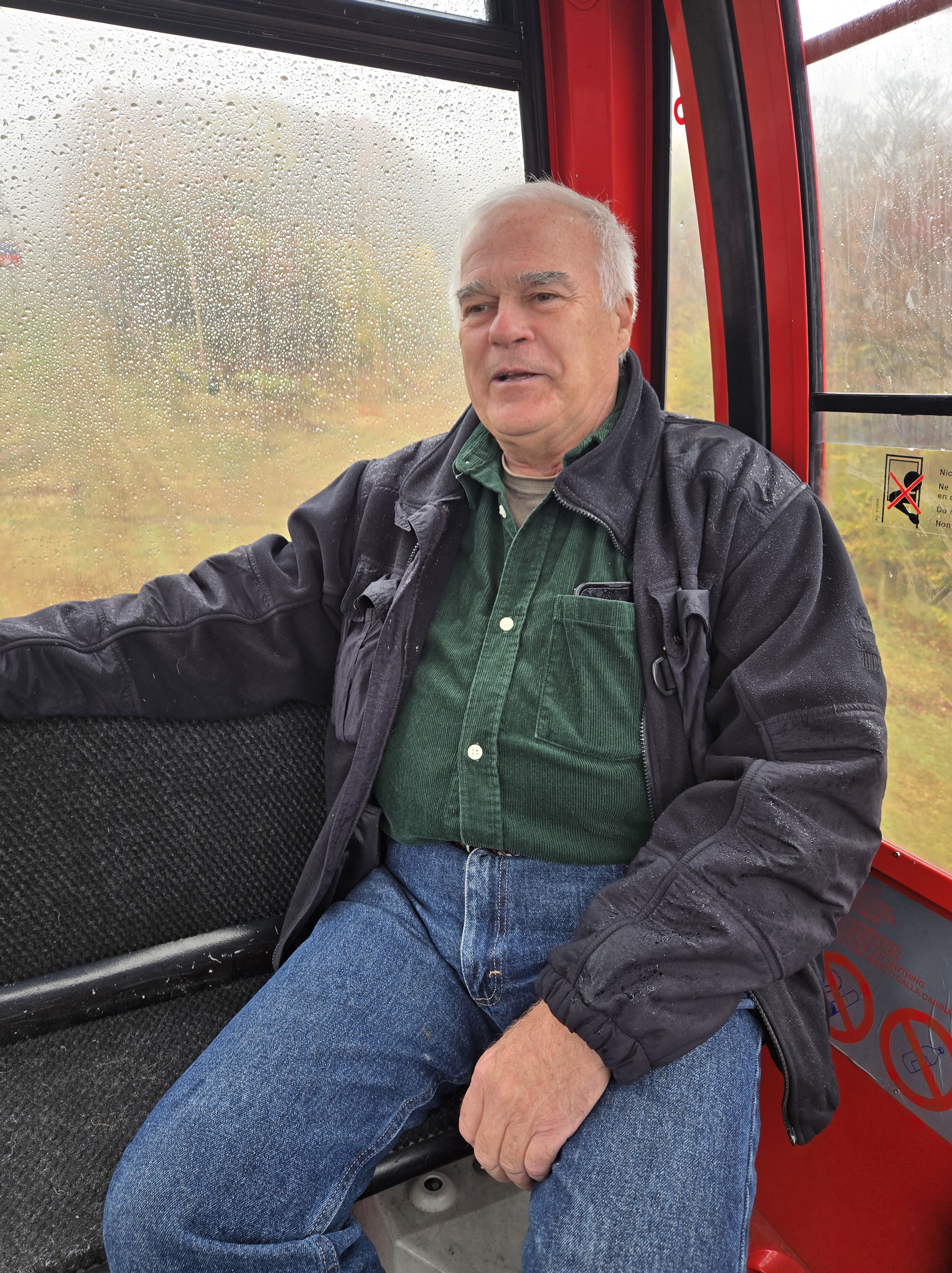
Historian Brian Lindner. He treated us to lunch at the top of Mount Mansfield. Here, he’s in a ski hill gondola on the rainy way up to the restaurant.

The same day back in October when we toured the Ben and Jerry’s Ice Cream Factory in Waterbury, Vermont, (previous post) Russ and I were chauffeured around town by local historian Brian Lindner. Brian has spent decades researching a World War II bomber training crash that my uncle David Potter died in near the summit of a local mountain named Camel’s Hump. (It’s really shaped like the back of a camel!) Although the crash took place in 1944, parts of the plane still lie in the bush on the mountainside.

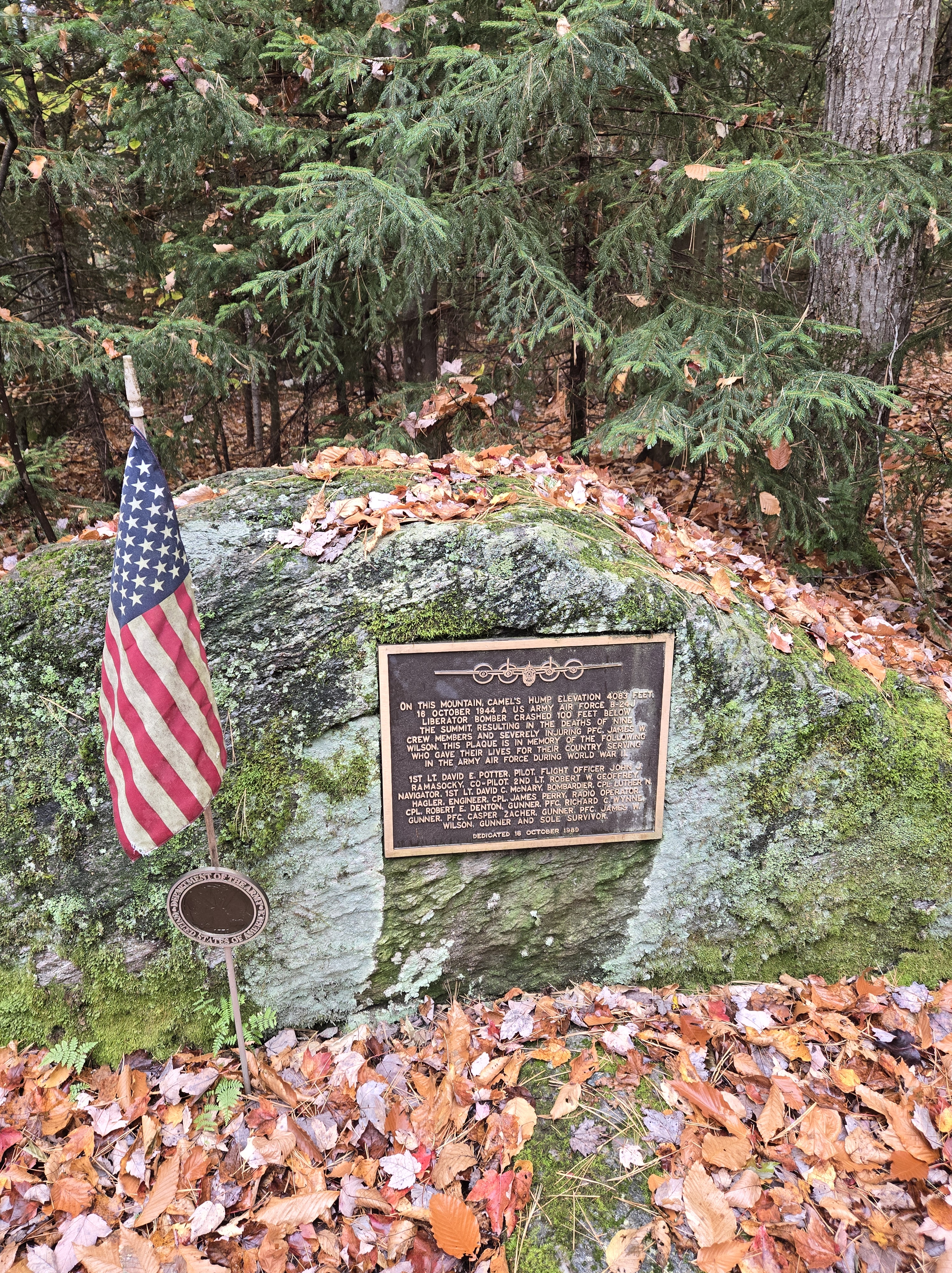
Originally, we planned to hike up to the crash site with Brian’s guidance, but a steady light rain scrapped those plans. With my luck, I’d break an ankle again like I did in Scotland in 2024. Instead, we opted for a tour in Brian’s Jeep around town to see sites associated with the people who helped with the rescue operation. Then he drove us to the base of the mountain so we could view the commemorative plaque he had installed on a rock at the trailhead.

If you’re interested in the crash, you can read more about it in a two-part series I wrote last year: Part 1, Part 2.

The Camel’s Hump Mountain plane crash plaque.

While we were touring the area, I felt like I was in a Steven Spielberg war film. Seeing the historic places in the town and at the base of the mountain played like a movie in my mind. Standing in the colorful, damp fall foliage, we read the inscription on the plaque that listed the names of the dead. I felt an overwhelming sense of peace. If my uncle had to die somewhere, perhaps a quick death at night on a mountainside wasn’t as bad as a violent death on a battlefield.

Brian grew up in Stowe on the grounds of the ski hill at Mount Mansfield. He’s worked on the ski patrol there for years, and as a historian for the hill and National Life Company in Montpelier.

As he drove us around, he kept waving to people as we passed. We thought he must know everyone, but then he explained it’s a Jeep “thing.” People who own Jeeps wave to each other in solidarity. It’s also a thing to bedeck the dashboard of Jeeps with rubber duckies. He wasn’t sure why, but it was awfully cute. Since I’ve returned home to Minnesota, I’ve seen a few Jeeps with rubber duckies on the dash, so apparently, it’s a thing even here.

The man knows everything about the area, and we felt fortunate to benefit from his expertise. He’s been a friend of our family for years, but this was the first chance I had to meet him in person.

The von Trapp Family Lodge and Resort

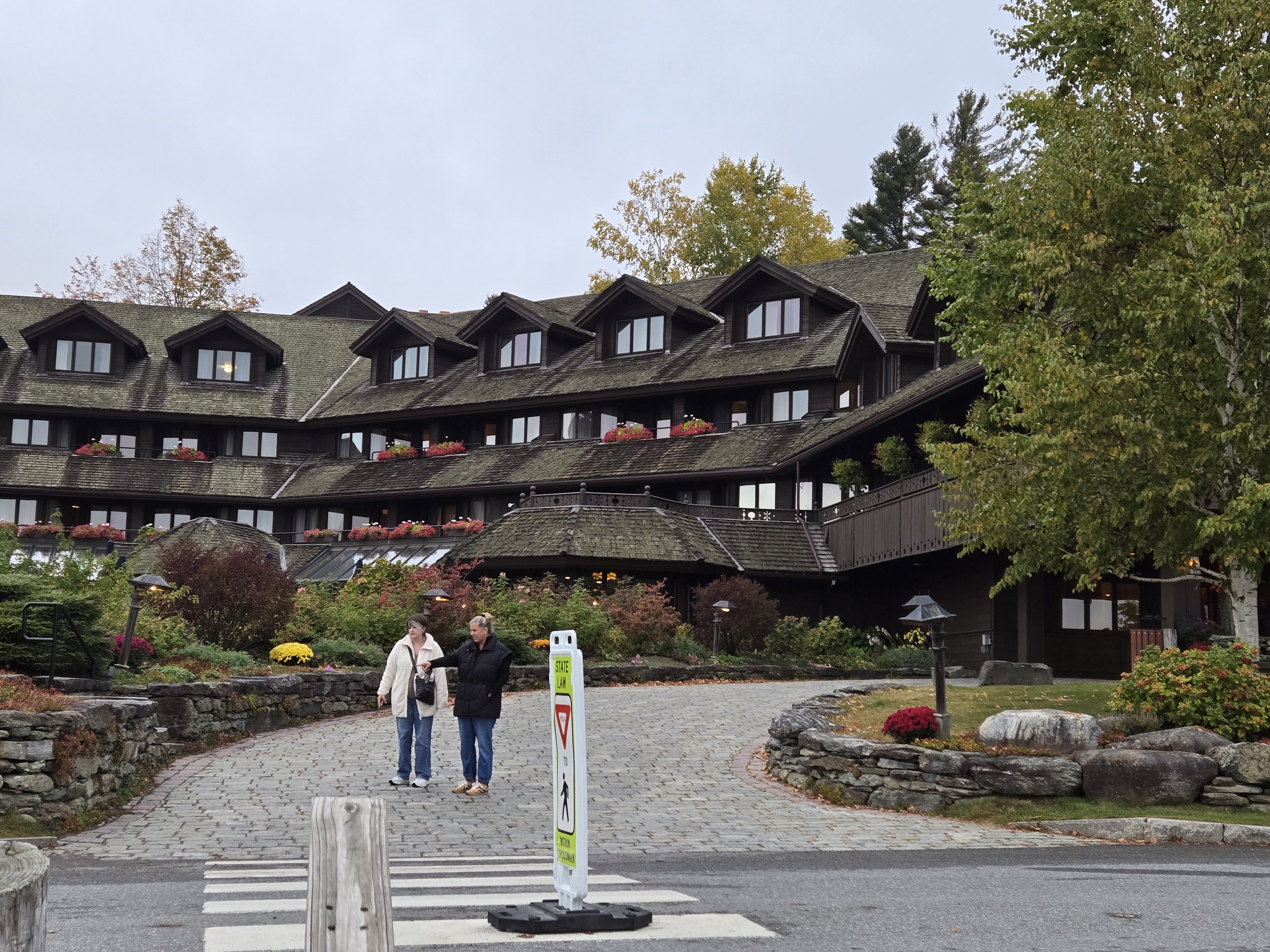
That evening, we ticked off another must-do experience: dinner at the von Trapp Family Lodge and Resort. If you’ve ever seen The Sound of Music movie, you know the von Trapp Family story. (It was the first movie I ever saw in a theater as a child.) When the family escaped Austria, they immigrated to the U.S. and settled near Stowe because the landscape and lifestyle reminded them of home. They’ve owned the land since 1942, began welcoming guests in 1950, and the family still runs the resort.

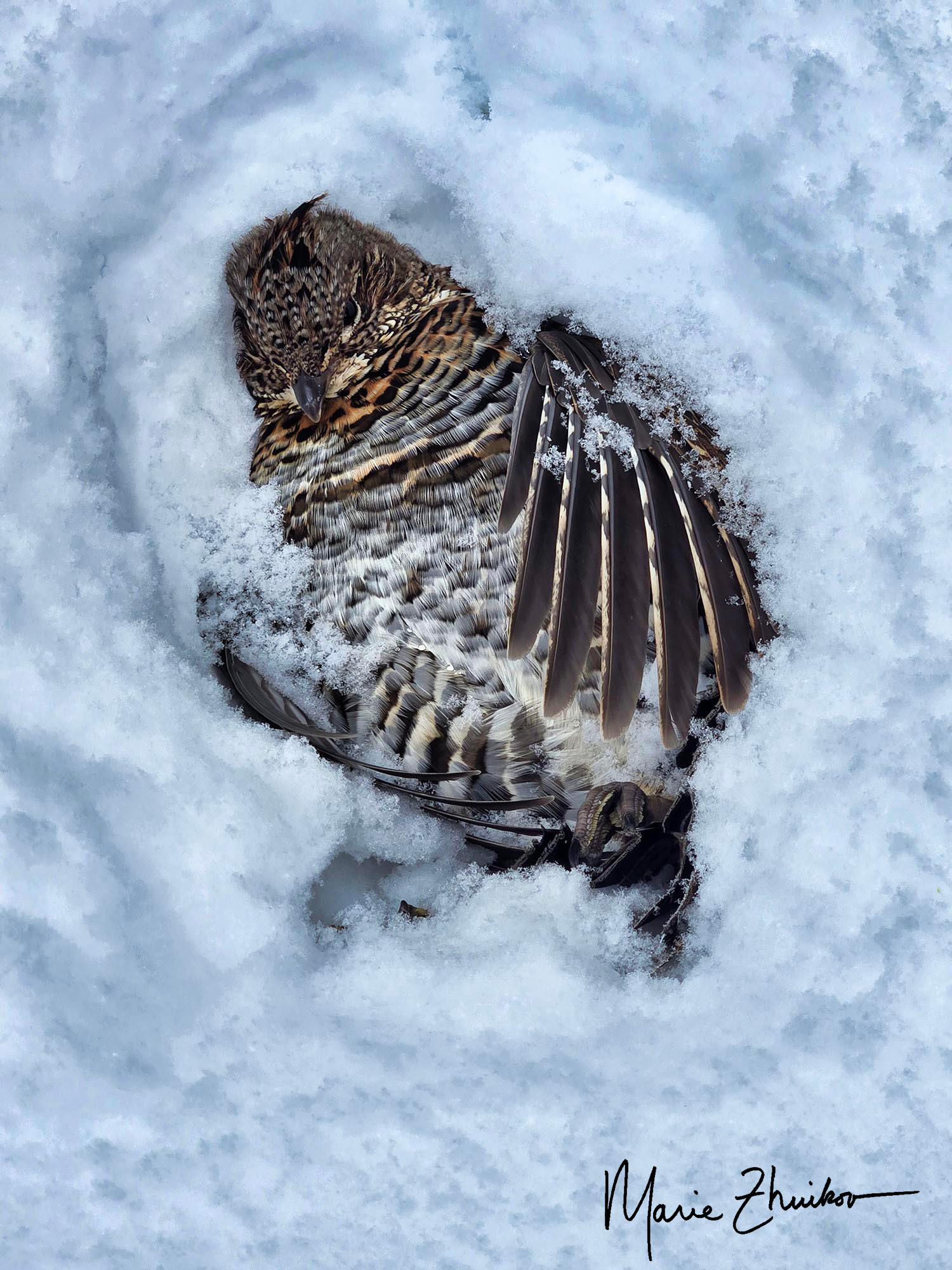
My quail dinner and lingonberry spritz.

We couldn’t afford to stay at the lodge, and timing wouldn’t allow us to partake in any of the special guest experiences they offer, but we could manage dinner. We made our reservations for their main dining hall a few weeks beforehand. They serve Austrian- and Vermont-themed farm-to-table foods. Russ had the Wiener schnitzel. I ordered a wild game dinner that featured venison and quail. However, they were out of venison, so I got two quail instead! To drink, I had a lingonberry spritz. For dessert, Russ had carrot cake, and I had chocolate mousse with hazelnuts. Everything was divine, and our waiter was attentive.

Because Disney owns the rights to the Sound of Music movie, the lodge can’t display any of that paraphernalia. But to me, that made the dining experience more authentic. The lodge is the family’s, and the surroundings celebrate their special heritage.

We ended our day with brains and stomachs pleasantly stuffed with Vermont history.

Next up: The Lost Kitchen, Freedom, Maine

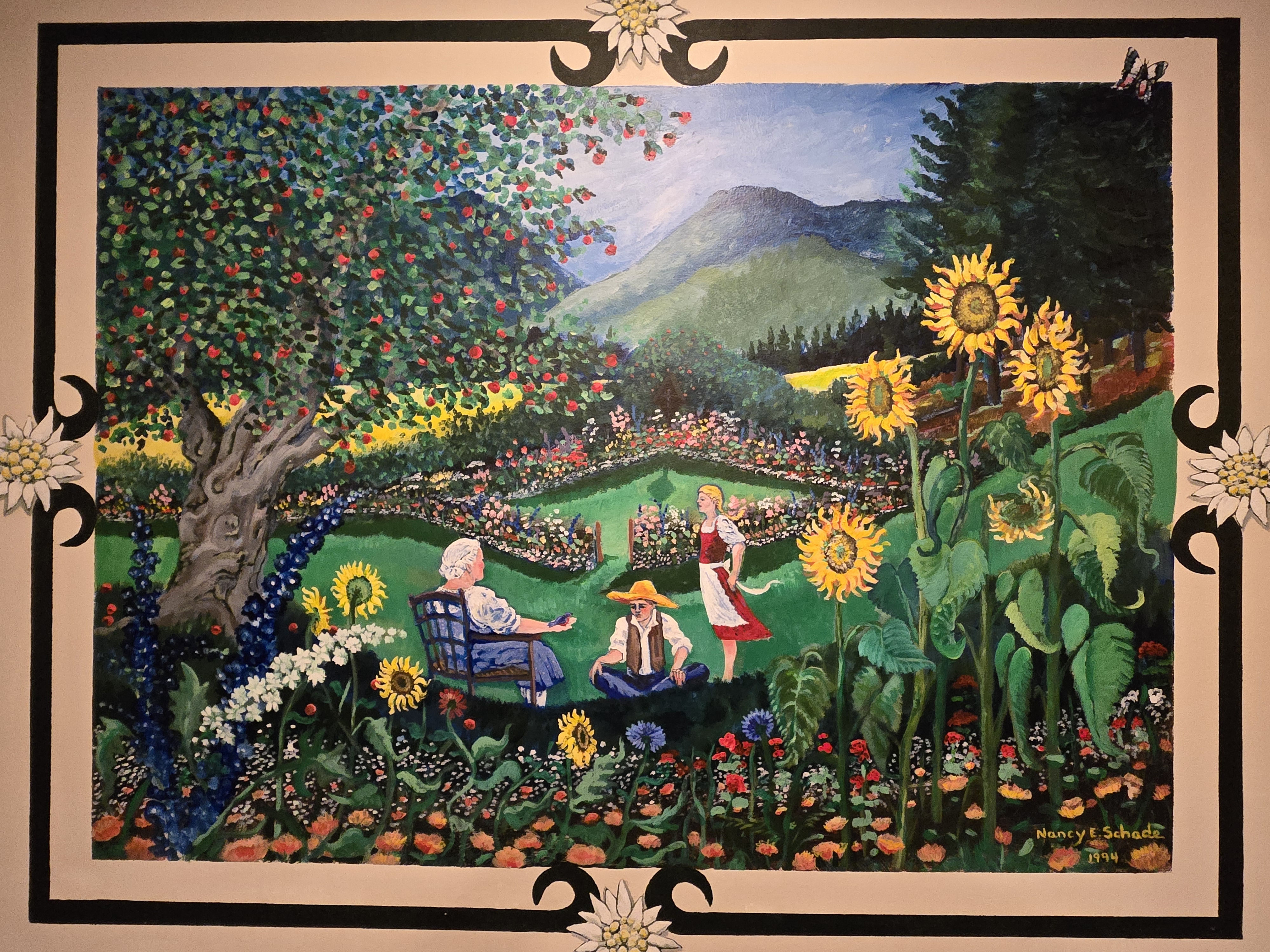
A painting in the von Trapp Family Lodge and Resort.

Ben & Jerry’s Factory Tour

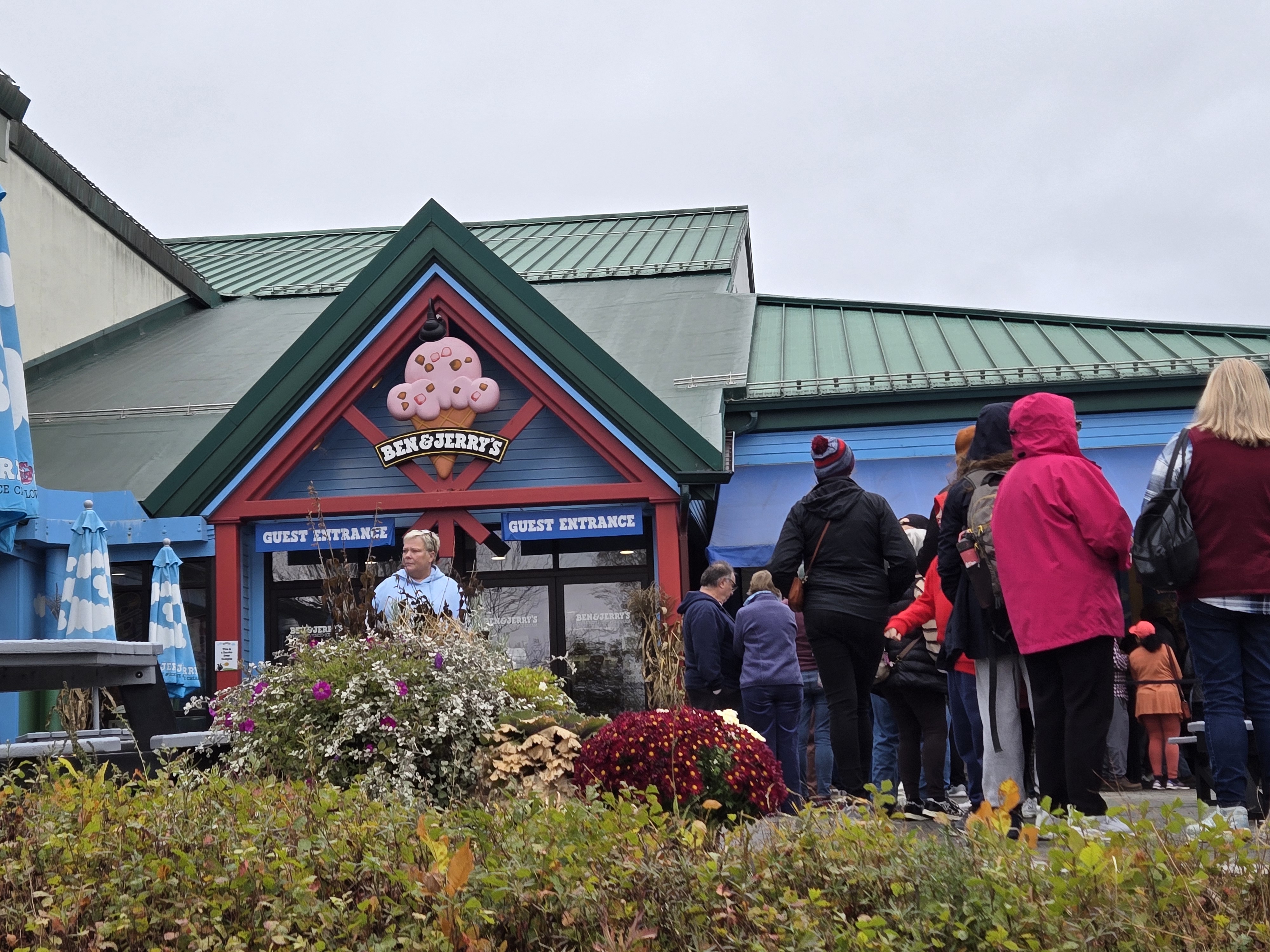
The Ben & Jerry’s Factory in Waterbury, VT

…White people…cleared the forest. They dug up the land. They gave us the flu. But they also brought us penicillin, power tools, and Ben and Jerry’s ice cream.
—Marilyn Whirlwind, a Native character in Northern Exposure, Season 4, Thanksgiving episode

Our next stop on our Epic New England Road trip was Vermont, also known as the place where Ben and Jerry’s Ice Cream originated in 1978. The store and factory are no longer in a renovated gas station in Burlington, but in a modern facility in Waterbury (also St. Albans, VT, and the Netherlands). We made our factory tour reservations two weeks ahead of time (the farthest ahead you can book) to ensure our visit.

The factory was a must-see for this trip because I’d been to Vermont before but didn’t have a way to reach the factory. Both Russ and I love the ice cream brand with its quirky flavor names and corporate social conscience. My favorite flavor is Chunky Monkey, which features banana ice cream loaded with fudge chunks and walnuts.  Russ’s is Cherry Garcia, which has cherries and fudge flakes.

The tour began with a video that outlined the company’s development and philosophy. Then we climbed up a floor to viewing windows that overlook the factory floor where they mix the flavors and fill the ice cream containers. (No photos allowed, though.) Our tour ended with a free sample. I can’t recall now what it was, but like all Ben & Jerry’s flavors, it was great! Afterward, we toured the gift shop and bought a puzzle that shows the lids from all the flavors that the company has produced.

Word to the wise: if you want to buy an ice cream cone at the factory store, be prepared for a long wait in line.

What’s your favorite Ben & Jerry’s flavor?

Next up: Camel’s Hump Mountain and the Von Trapp Family Lodge

A Merry Minnesota Christmas!

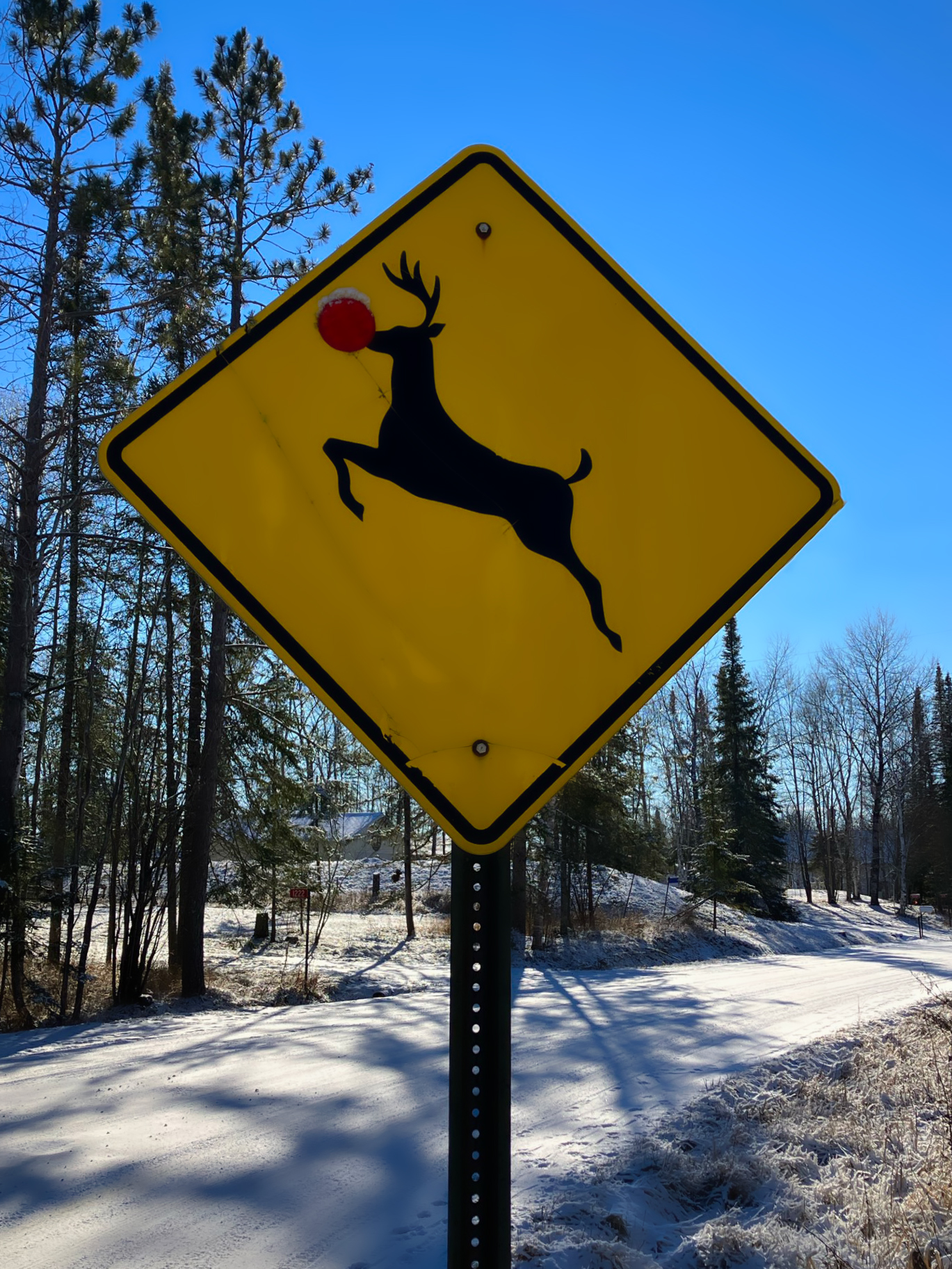
Here’s wishing you a Merry Christmas the Minnesota way! I took this photo near my cabin. It’s a typical rural Minnesota scene, except perhaps for the red reflector on the deer’s nose. I found the sign this way — I did not add the reflector! Rudolph’s red nose has since fallen off, so I’m glad I took the photo before that happened. This sign provided the design for our custom-made Christmas cards this year — the first time I’ve done that and maybe not the last. Because I retired this year, I’ve had time to write cards and pop them in the mail. It’s been fun “going retro” this season.

We hope you have a wonderful, whimsical holiday, and thank you for reading.

My Connection to the Battle of Lexington

The famous Minute Man Statue on the Lexington Battle Green. It’s in honor of one of my relatives, John Parker.

I became sidetracked from writing about our Epic New England Road Trip by my previous PSA post about author scams, but now I’m back on the road, so to speak. Our next stop was Lexington, Massachusetts. A few years ago, I discovered that one of my relatives was Captain John Parker, who was the head of the Lexington militia during the battle when the Revolutionary War began on April 19, 1775.

We booked a private walking tour of the Lexington Green from the Lexington Visitors Center, which is located near the green. As our costumed guide led us on our tour in light rain, he made sure we understood that the Americans who fought in the battle weren’t actual minutemen, as is often said. Minutemen were highly trained; the people who fought on the historic green were militia – more like regular folks with weapons. The term minutemen had more cachet, so I guess those references are a historic case of propaganda.

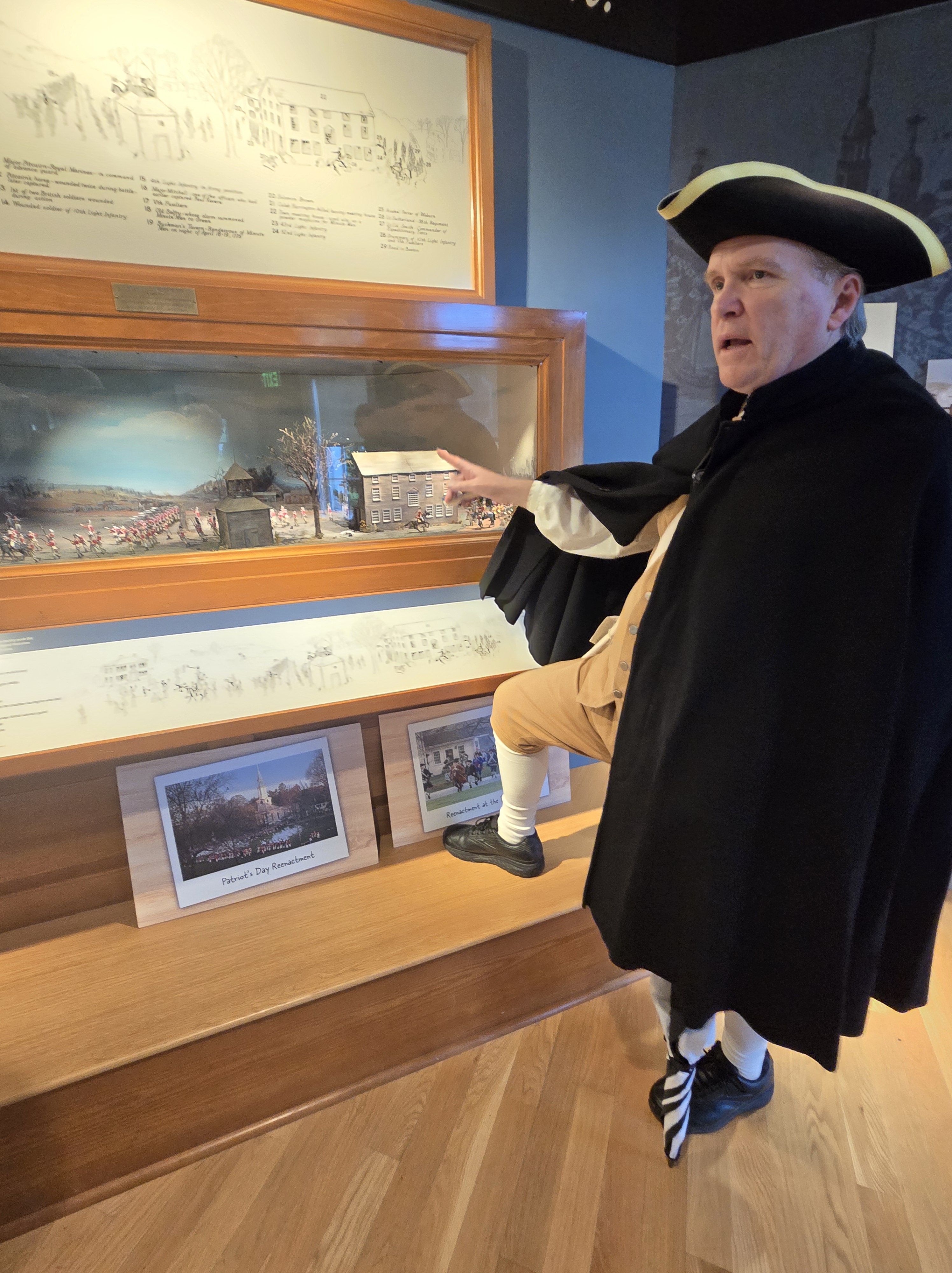
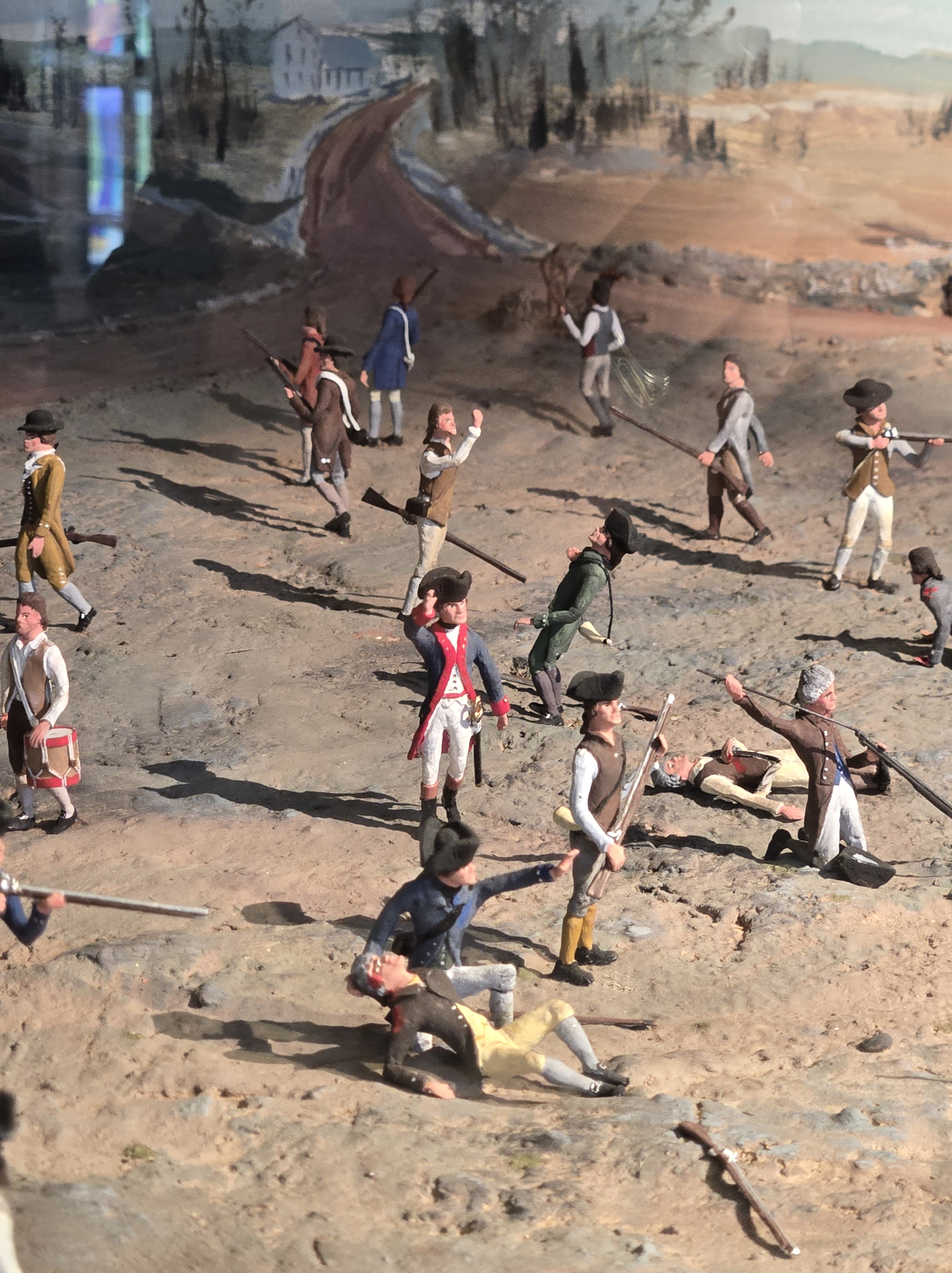
Our tour guide shows us the diorama of the Battle of Lexington that resides in the Lexington Visitors Center.

He led us to the Minuteman statue, which is modeled after John Parker. Our guide said that Parker was a wheelwright and farmer who was in his 40s and suffered from tuberculosis. He lived only a few more months after the battle. In contrast, the statue depicts a young, healthy man in his 20s or 30s. Yet another form of propaganda, but maybe Parker wouldn’t have minded this more robust version of himself??

John Parker’s cousin Jonas was killed in the battle, along with 7 others who are buried on the green. At least one of the houses near the green still has a bullet hole in the door from the battle. Our guide said the door is preserved for the history it shows.

John’s famous quote, “Stand your ground. Don’t fire unless fired upon. But if they mean to have a war, let it begin here,” is inscribed on a boulder near where the militia stood during the battle on the green.

Information about the battle itself is plentiful on the web, so I won’t go into it here. A good source is the National Archives, which offers a short slideshow with an overview of the Battle of Lexington and Concord. The main thing is that those involved didn’t realize the significance of their actions. It was the beginning of the American Revolution, which later inspired the revolutions in France and Russia. The gunfire on the Lexington Battle Green was truly the “shots heard ’round’ the world!”

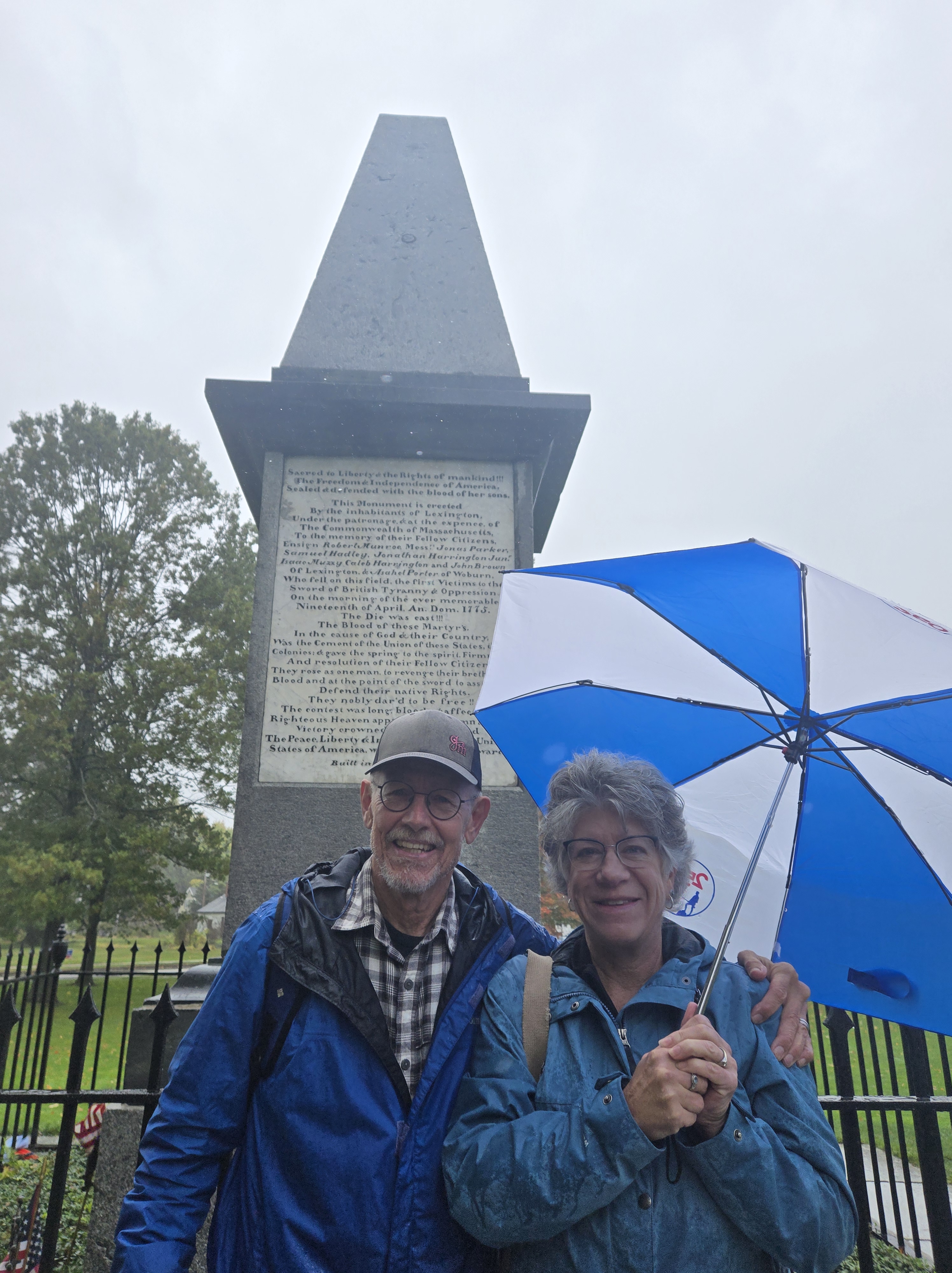
Us, all cold and wet at a memorial on the battle green dedicated to those who died during the first battle of the American Revolution.

John Parker was Theodore Parker’s grandfather (the minister whom I described in my previous trip post). My family and I share a common ancestor with them: Congregational Church Deacon Thomas Parker, who immigrated from England in 1635.

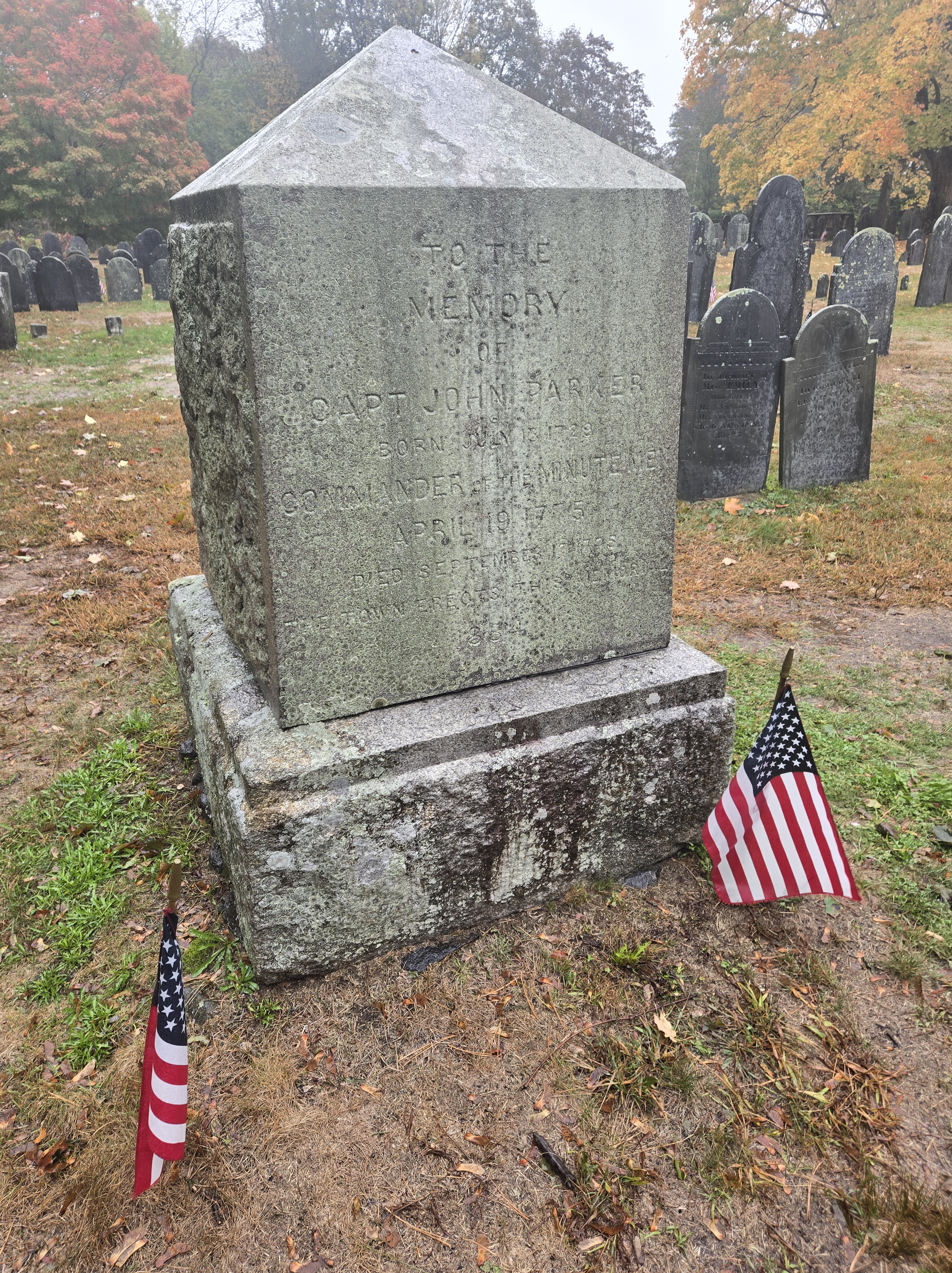
Despite using umbrellas and wearing raincoats, Russ and I were rather cold and miserable. I think our guide took pity and gave us a quicker tour than usual. After visiting the green, we made our way to a nearby cemetery (behind a Unitarian Church) where there’s a headstone for John Parker. There is some question about whether his body lies there or on his farmland.

After that, we made our way back to the visitor center, which offers a museum about the battle. It features a diorama of the battle scene, complete with a figurine of Capn Parker, which was cool to see.  The center also has books and other interpretive materials and souvenirs for sale. (Parker is also mentioned in the Ken Burns documentary, “The American Revolution,” which we recently watched and recommend.)

John Parker’s headstone

The nearby town of Concord also offers interpretive facilities, but we focused on Lexington due to my family connection. When we were done, we made our soggy way to eat lunch at the Town Meeting Bistro, which is inside the Inn at Hastings Park. The décor looks like you’ve stepped into a town meeting hall: plain wooden tables, wooden wingback chairs, and a large fireplace.  

The diorama that features John Parker. He’s the one in the red/gray uniform in the middle.

I am a clam chowder aficionado. Throughout our trip, I sampled chowders everywhere we went. I am happy to say that the bistro’s chowder wins my best chowder award! (It even beat Maine clam chowder.) Theirs featured applewood bacon, quahog clams, and new potatoes. It was creamy and divine. My only complaint was that I couldn’t get a larger bowl of it!

Our lunch hit the spot and took the chill out of our bones. We had planned to visit Walden Pond and the town of Salem later in the day, but the weather discouraged us. We returned to our hotel to change into dry clothes and curl up with a good book.

Next up: Waterbury, Vermont

A cutout likeness our our tour guide in the visitors center. He was great!

Book Interview and Author Scams

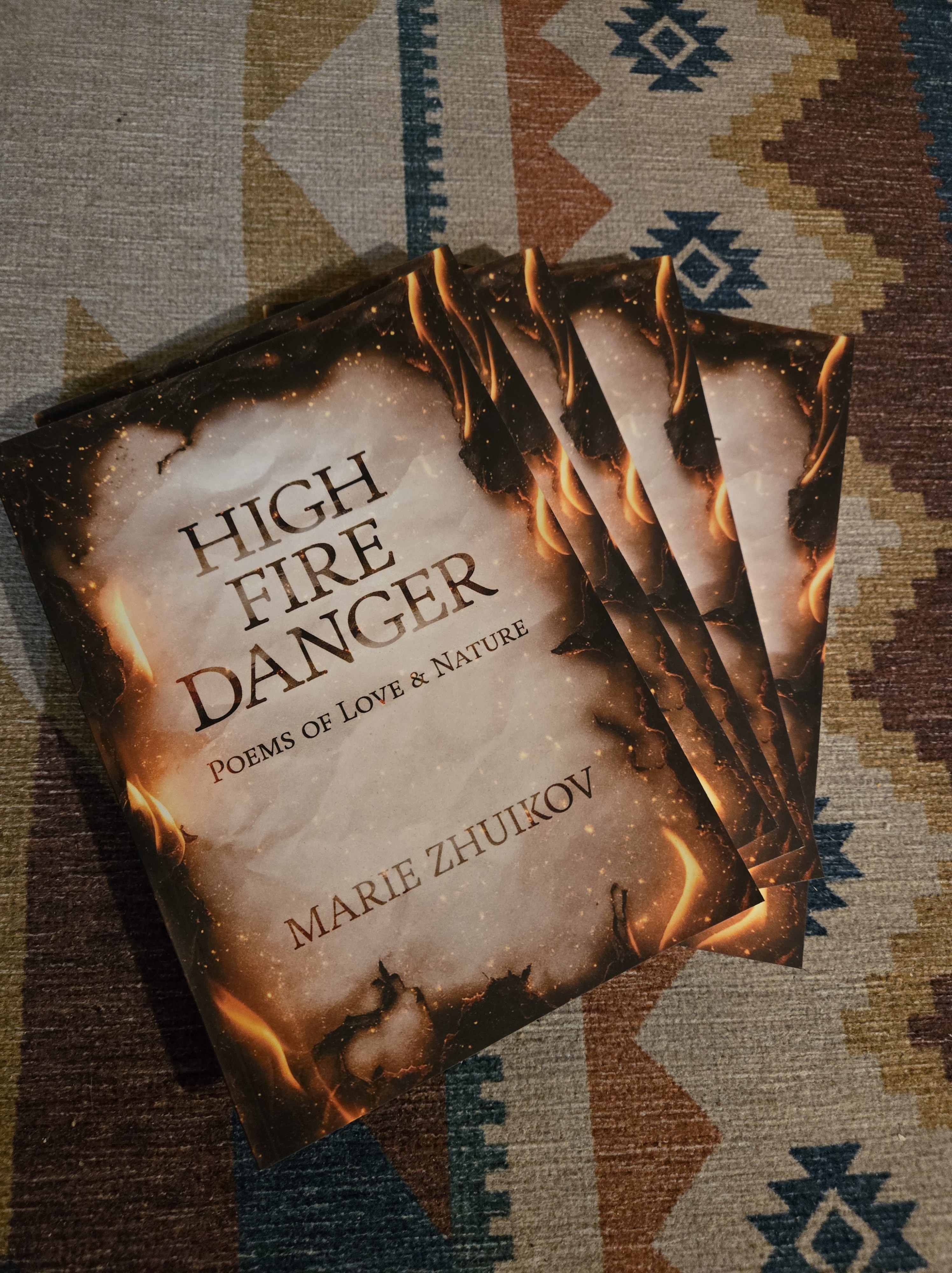
I love my book cover. Doesn’t it look like it’s really on fire?

I made it onto the local ABC channel affiliate’s lifestyle show recently to promo my poetry collection, High Fire Danger. The hostess, Baihly, does a great job of making interviewees feel comfortable in what can be a nerve-wracking, live-interview situation. You can watch the story here.

This year, I received many bogus author promotional opportunities that I’d like to warn you about. Most involve book clubs. The first was an email I received from someone purporting to lead a silent book club in New York City. They said my book was getting some “buzz” among their members and they’d like me to be a featured author for the group.

Of course, this surprised and delighted me. I have a couple of friends in NYC, so it’s possible that one of my books could have found its way around the city. I looked up the group online and found a Meetup page for them, so it seemed legit. I replied, saying I was interested and asked for more information. I didn’t hear back, so after a week, I pinged them again. I received an automated message that the email address no longer existed. That made me figure it was a scam, so I put it out of my mind.

A few days later, I received another message from them from a slightly different email address. They apologized for the delay in response and offered a revised date for my book’s promotion. I replied, just to see what would happen. I soon received a response that said I wouldn’t actually need to appear in person. They would set up a display for my book, and that would cost $216.

This spurred me to investigate them further. I input the search terms, “New York City Silent Book Club author scam,” and was led to this website, which solidified my hunch that it was a scam. So, authors, don’t fall for this one!

The second “opportunity” took the form of book club publicists who reached out to me separately about four of my books. They praised the books extensively (and excessively!) and offered to bring them to the attention of thousands of book groups. The emails come from gmail addresses. Although the praise was ego-affirming, I could tell that it was based solely on the books’ descriptions. The “publicists” had obviously not read the books. Their email text was probably AI-generated.

Here’s an example for my poetry book:

High Fire Danger is an exquisite collection that embodies how love and nature mirror one another, both capable of tenderness and destruction, both powerful enough to transform us entirely. From the first page, it’s clear that this is not merely a collection of poems but a lifetime’s reflection distilled into verse that burns with emotional clarity and elemental force.

The range of your imagery is breathtaking. You take readers from the cool expanse of Minnesota’s lakes to the windswept coasts of Scotland, and even beyond the bounds of Earth itself, yet the emotional truth in each poem keeps us grounded. This interplay between vast landscapes and intimate feelings gives your work both a cosmic and deeply personal resonance.

I was particularly moved by how humor and humility are woven into the meditations on love. There’s an unflinching honesty of voice, one that acknowledges the beauty and peril of connection, whether with another person or with the natural world. The poems don’t shy away from the scorch marks left by passion or the quiet ache of solitude, but instead, turn those experiences into sources of illumination.

The title High Fire Danger feels perfectly chosen. It speaks to the tension running through the collection, the balance between awe and fear, creation and destruction, desire and loss. Each poem feels like a spark that could either warm the heart or set it aflame. This duality is what gives your writing such emotional weight and timeless appeal.

What also stands out is your mastery of accessibility. Despite the scope of the themes, every poem feels intimate and inviting, like a conversation held beside a campfire or on a shoreline at dusk. The poems make the profound feel personal, and the personal feel universal.

High Fire Danger will resonate deeply with readers who are drawn to works that celebrate the natural world while exploring the human heart with honesty and lyrical grace. It’s a rare collection that appeals to both poetry lovers and those new to the genre, offering moments of reflection, passion, and healing in equal measure.

There were actually a few descriptive lines in this that I liked. If you watch my television interview, I stole the one about the poems feeling like “a conversation held beside a campfire or on a shoreline at dusk.”

Ha! The scammers wanted to use me, but I ended up using them! A fellow author said he replied to one of these emails just to see how much money they wanted, and it was several hundred dollars. I’m sure they’d just take the money and run.

Beware out there, authors. It’s treacherous.

Theodore Parker Unitarian Church

The morning before we visited the Parker Tavern in Massachusetts, we caught a church service at the Theodore Parker Unitarian Church in West Roxbury near Boston. This site was the second ancestral “treasure” I uncovered a few years ago (the tavern was the first) while looking for something else.

I discovered that noted Unitarian minister and abolitionist Theodore Parker (1810-1860) and I were related through Thomas Parker, a Congregational Church deacon who immigrated from England in 1635. Theodore’s first church assignment just out of Harvard Divinity School was this church in West Roxbury. But the actual building where he preached burned, so the church we attended was not the original.

After nine years, Theodore left the church after being kicked out of the Boston Unitarian Brotherhood for his “radical” views on abolishing slavery and other religious matters. He also believed outrageous things such as women should be allowed to vote, and to become doctors, lawyers, and (gasp!) even ministers.

Theodore spread his views not only through his sermons but via pamphlets. He is credited with famous quotes later shortened and used by President Lincoln and Martin Luther King. The phrases are, “a government of the people, by the people and for the people” and “the arc of the moral universe is long but it bends toward justice.” The former was used by Abraham Lincoln in the Gettysburg Address and the latter by Martin Luther King.

But as historical events played out, the moral arc of the universe must have brought him back into favor, because the church, designated a Boston Landmark, was named for him, and his statue was erected in front of it.

We arrived out a half-hour before the service began and had time to appreciate Theodore’s statue and wander around the outside of the church. Soon, a congregation member arrived, and we followed her to the old wooden front door. She took out a key to open it but had trouble. Russ and I looked at each other in dismay. We’d come all this way, and now we couldn’t get in!

Russ soon stepped in to help, and with his key-handling expertise, he was able to open the door. Soon, more people arrived. In chatting with them about why we were there, they pointed out two Theodore Parker historians who were in attendance. We were able to speak with them both. They affectionately referred to him as “Teddy.” They reinforced what I already knew and pointed out some things I didn’t, including artifacts saved from the first church fire: a clock, Theodore’s pulpit, and his chair.

Theodore Parker’s chair.

One of them also pointed out a trio of gorgeous 1927 Tiffany Studios stained glass windows that grace one wall. They feature irises and morning glories ringing a lake and mountain scene, with the words, “I will lift up mine eyes unto the hills from whence cometh my help.” According to a sign about the windows, a stained-glass consultant called the design one of the studio’s “greatest.” It incorporates several signature techniques: plating, where three layers of glass are used to achieve depth of color; mottling, which recreates intense sunlight as filtered through leaves; and acid etching, which involves removing a layer of colored glass to reveal a clear or palely tinted base glass. Intense leading is used on the windows to depict the organic lines of flowers and foliage.

The outcome is dazzling. One church attendee told us she purposefully positions herself during services so that she can see both the windows and the pulpit for comfort and inspiration.

The service was conducted under the watchful eye of Theodore’s bust. We attend a Unitarian church in Duluth and were comforted by the similarities in the services. Everyone was super friendly, and we enjoyed hanging out with them afterward in the social hall.

Next up: Lexington, Massachusetts, and another illustrious Parker cousin who has his own statue.

The Parker Tavern, Reading, Massachusetts

The Parker Tavern

If you have been reading this blog for about two years and have an excellent memory, you may recall this previous post about my search for Irish ancestor names in my genealogy before our trip to Ireland in 2024. I was unsuccessful in that quest, but I found colonial American treasure instead.

The first “treasure” was information about my direct ancestor, Caleb Parker. He was born in Shrewsbury, MA, in 1760, and was originally named Nathanial but was renamed by his parents after his presumed-dead-in-war brother. Caleb served under George Washington late in the Revolutionary War. Later, he was head of the Vermont militia. After he resigned his commission, he and his family moved to and founded Stukley, an eastern township of Lower Canada, not far over the Vermont border. Caleb died there in 1826.

That, in itself was pretty cool, but in following Caleb’s line back in time, I discovered that his grandfather, Thomas Parker, a Congregational Church deacon, immigrated from England and founded Reading, Massachusetts. I also found that the oldest surviving building in Reading is named after the family. The Parker Tavern was owned and operated by Thomas’s great-grandson Ephriam (who would have been a cousin of sorts to Caleb), and it has been turned into a museum. I vowed to visit it one day.

Well, that day came during our New England Road Trip. The first part of our trip was all about Russ and his family. The next part was all about MEEEE! (and my ancestors.) We left Russ’s relatives in Andover, Connecticut, and drove to Massachusetts. Our first stop that Sunday morning was to attend a church service at Theodore Parker Unitarian Church. More on that in the next post.

A painting of what the Parker Tavern used to look like.

Our second stop was the Parker Tavern in Reading. The tavern is on the National Register of Historical Places. It has been turned into a museum and is open Sunday afternoons from May to October. Due to our recent education about the importance of taverns at the Strong-Porter Homestead in Connecticut, we knew taverns were vital to colonial communities. They served as gathering places where information was exchanged and they provided food and lodging for travelers. As such, they were instrumental in the spread of revolutionary ideas, ultimately becoming hotbeds for political debate and organizing that led to the American Revolution. If you’re an Outlander fan, you’ll be familiar with this concept because characters in the books/movies are often shown scheming in taverns. Although the series is fiction, this depiction is based on truth.

Because they were such important spots, not just anyone could run a tavern. Managers needed to be in good standing in the community. Often, they were people associated with the local church, be they the ministers themselves or relatives of ministers. Given that Ephriam was from a ministerial family, it makes sense he was a tavern owner.

Like the colonial homesteads we visited the previous day, the Parker Tavern is a saltbox building, and it was built in the late 1600s. Besides providing lodging for travelers, the tavern also served as a jail of sorts. The docent told us that Sir Archibald Campbell, a lieutenant general for the British, was kept at the tavern from June 1776 to January 1777. He was a wealthy Scot who owned a lot of land in that country. At the time of his capture, he commanded the 71st Regiment of Foot, Fraser’s Highlanders. (For Outlander fans, another commander was Simon Fraser of Lovat.)

Sir Archibald Campbell image credit: George Romney, Public domain, via Wikimedia Commons

Campbell was captured after a battle aboard a ship in Boston Harbor. At first, he was in solitary confinement in the Concord jail. But after complaining to his superiors, who brought Campbell’s plight to the attention of George Washington, he was moved to the tavern for more humane living conditions.

In researching for this blog post, I discovered that Wikipedia says that the tavern was owned by the jailer. Ephriam Parker owned the tavern from 1770 to 1785, which is during the time that Campbell would have been there. The docent told us that Campbell was thankful for the amenities the tavern provided and enjoyed his stay there, as much as a prisoner can enjoy his “jail.” He wasn’t alone, however. According to a Daily Times Chronicle story (Woburn, MA), he housed about twenty-five of his servants in a tented area on the grounds and possibly on nearby Scotland Hill to comply with the army’s prison requirements.

The same newspaper story states that Ephriam and his son were part of the 4th Company of Minutemen, which took part in the battle of Lexington and Concord in April 1775 that began the Revolutionary War.

After his stay at the Parker Tavern, Campbell was released to “freedom” within the confines of Concord. In May of 1778, he was finally totally freed in an exchange for Ethan Allen. He later became the governor of Georgia, Jamaica, and Madras. His tomb lies in Westminster Abbey.

The Parker Tavern dining room.

The tavern museum is filled with antiques and an interesting display of shoe-making equipment. The docent explained that shoemaking used to be a cottage industry and that many homeowners participated in this side business.

Touring the museum is free; however, we chose to support it by joining the antiquarian society that runs it. To find out more about the tavern and to see more images, visit their Facebook page.

We left the tavern with our heads stuffed full of information and with a greater appreciation for the role of such buildings in the foundation of our country. Later, we toured the town to get a feel for it, and walked the graveyard where Thomas Parker is buried. We didn’t find his grave, but we saw some great examples of Puritan gravestones and their distinctive three-lobed shape, symbolic carvings like the “death’s head” or winged skull, and inscriptions that reflect their beliefs about death and eternity.

Next up: Theodore Parker Church

For previous posts about our New England trip, view:

The Nathan Hale and Strong-Porter Homesteads

Wickham Park

The Katherine Hepburn Museum

Governor’s Island

A creepy doll in the Parker Tavern attic.

The Nathan Hale and Strong-Porter Homesteads

The Nathan Hale Homestead in Connecticut

Andover Connecticut was our next stop in the Great New England Road Trip. Russ was having a mini family reunion there with his cousins, one of whom I hadn’t met yet. We stayed at his cousin’s home, which backed up to the Nathan Hale Homestead and state forest. After socializing, we decided on the spur of the moment to visit the homestead.

Because we hadn’t planned our trip well, the homestead museum was closed, but the grounds were open. Nathan Hale, Connecticut’s State Hero, was born on the property in 1755. After working as a schoolteacher, he was recruited as a Patriot spy but was caught and hanged by the British in 1776. He’s known for uttering his famous last words: “I only regret that I have but one life to lose for my country.” Statues of Hale stand in the Connecticut state capitol, at Yale University, the headquarters of the CIA, and more. 

Hale’s dark maroon Georgian-style home has remained intact. If we had been able to go inside, we would have seen that it is furnished with family possessions and other period antiques. As it was, we wandered the grounds and enjoyed soaking up the colonial ambiance. It was easy to imagine a young Nathan frolicking in the nearby forest and working in the family fields.

The Strong-Porter House

Not far down the road we found a museum that was open. The Strong-Porter House was built by Nathan Hale’s great-uncle and is listed on the National Register of Historic Places. It was the same dark maroon as the Hale homestead. The oldest part of the saltbox-style house dates from 1710 and admission is free. The museum is open Sundays during summer and fall.

The dining room-turned museum in the Strong-Porter House.

The helpful docent showed us the dining room, which was filled with historical information about the importance of taverns in colonial times. We found this of keen interest because we planned to visit a historic tavern that’s associated with my ancestors the next day. (Synchronicity!)

The home’s floorboards were much wider than usual, a testament to the huge trees they were made from. The main parlor has exposed beams, wide paneled wainscoting, and a fireplace cupboard that suggests a much larger chimney once stood there. 

We left with a greater appreciation for the basic comforts and hardships people must have experienced during the early years of our country.

Next up: Theodore Parker Church and the Parker Tavern in Massachusetts

For previous posts about our New England trip, view:

Wickham Park

The Katherine Hepburn Museum

Governor’s Island

Wickham Park

Part of the Oriental Garden in Wickham Park.

The next stop on our New England road trip was Manchester, Connecticut, and the beautiful Wickham Park. We chose this particular park because one of Russ’s cousins was a long-term manager of it, and it has connections to Russ’s family. Although Russ’s cousin Jeff is retired, he still works at the park “part-time” as director emeritus. That’s in quotation marks because, although his official position is part-time, we suspect he spends much more time at the park!

Just off Interstate 84, the park is managed under a nonprofit, private foundation and was created in 1961. It contains 280 acres of gardens, fields, woodlands, ponds, and sports facilities. People can even get married there in one of two stunning venues, including a log cabin. The entry fee is very reasonable ($7).

This log cabin was being set up for a wedding. It sits on a hill with a stunning view of Hartford, CT.

The majority of the park was a gift from businessman and inventor Clarence Wickham. If you’ve ever used an envelope with a little plastic window in it for the address, you’ve used one of Clarence’s inventions.

We received a personal tour from Jeff and his wife. We didn’t have time to tour the entire park (which would take more than a day, anyway), so we only saw the Irish Garden, the Italian Shrine, the Lotus Garden, the Oriental Garden, the Scottish Garden, and the Nature Center.

The Irish Garden and Wickham Park.

The highlight of the trip was a tour of a new garden that’s not open yet to the public. It’s named for Jeff and Russ’s family. (I’m not going to divulge that name here, but if you go to the park, it will be obvious). It was conceived by Jeff and his wife, financed by the family and donors, and built with the help of park staff. It celebrates the relationship between art and the natural world, showcasing sculptures and other art forms, including topiaries sculpted from plants. It even sports an observation tower and labyrinth. Some bureaucratic matters are still being finalized, but as soon as the paperwork is complete, the art park will open to the public.

The view from the observation tower in the “family art garden.” The building in the background used to be the carriage house but now houses the park office.
Russ and I interact with an art piece in the family garden.

The place exudes peace. If we lived in the area, I’m sure it would be one of our favorite places to visit and hold family gatherings. As it is, we live over a thousand miles away. So, we’ll have to visit it in our memories.

Next up: Two historic Connecticut homes.

For previous posts about our trip, view:

The Katherine Hepburn Museum

Governor’s Island

The Lotus Garden

Seeing Red

Here’s yet another side detour from my New England travelog. Don’t worry, I’ll get back to it!

The other night Russ and I meandered around the backroads north of Duluth, joining many others who parked their cars in random spots and looked up to the spectacle happening in the sky.

That spectacle was the northern lights. I took these photos the second night of the show at about 8:30 p.m. It was so kind of the aurora to happen before bedtime! We found a spot on a gravel road where we could see a whitish curtain of aurora on the horizon. We first stopped at a town hall but there were too many lights, so we went back down the road until we found a dark area. I took a few test shots with my phone camera and wowza! Jackpot.

A green curtain filled the sky, with some red overtones. As the lights continued to dance, the red intensified. This color is rare in auroras.

Here’s an explanation from a local astronomer, Astro Bob (King). I don’t totally understand it, but here’s what he said about that storm:

Red aurora occurs high up in the atmosphere at an altitude of around 150-300 miles. Green emission happens at lower altitudes, around 75 miles. Both are produced when incoming charged particles strike and energize oxygen atoms. After the impacts, the atoms release that energy in the form of green and red light when they return to their original relaxed state.

At high altitude, the number of atoms drops sharply — it’s basically a hard vacuum up there. After it’s struck by a charged particle, an oxygen atom needs almost two minutes to release that energy. If a neighboring atom were to bump into it during the transition, it would short-circuit the process. But because there are so few atoms at that altitude, oxygen has time to release red light before a collision occurs.

There’s so little oxygen to begin with at high altitude, a strong storm is required to crank up enough oxygen atoms to produce the red aurora. Seeing red is a good sign that a significant storm is underway. Overall, the Nov. 11 storm reached the G4 (severe) level, with aurora reported in all 50 states (including Hawaii) and as far south as the tropics.

A farm house and barn stood off to the side and provided more visual interest to the shots. Eventually, the cold got the better of us and we crawled back into our car to return to our modest home filled with artificial light.