In Which Marie Competes in her First Paddleboard Race

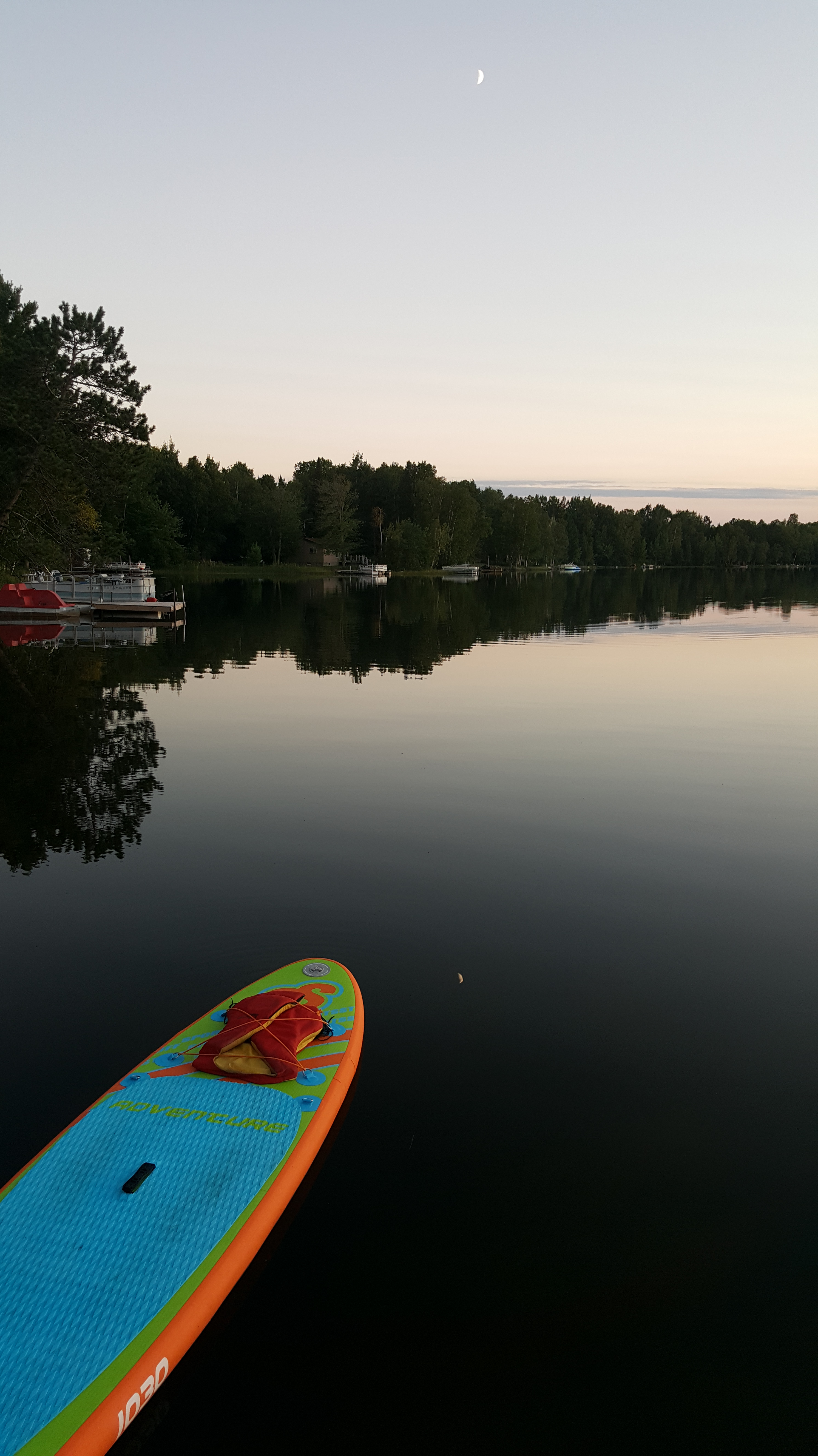
One of my paddleboards and a sliver of the moon reflected in the water.

For more years than I care to count, I’ve staffed a booth for work at Lake Superior Day, which falls annually on the third Sunday in July. When I wasn’t informing people about water quality issues and research, I was gazing wistfully at the groups of paddlers gathered for a race held in conjunction with the event.

The “Paddle for the People” competition welcomes paddleboarders, canoeists, and kayakers. The 4 K race takes them around Barker’s Island in the bay just offshore from the city of Superior.

Last year, a gray-haired woman won the event. She inspired me. I decided that in 2025, since I’d be retired and not staffing a booth anymore, I was going to enter the race.

This spring I sent in my entry. Once the ice went out on our cabin lake, I began training. Having never raced on a paddleboard before, I watched online videos for tips. Russ helped me figure out that two-and-a-half times around our lake equaled the race distance. Around and around our lake I went.

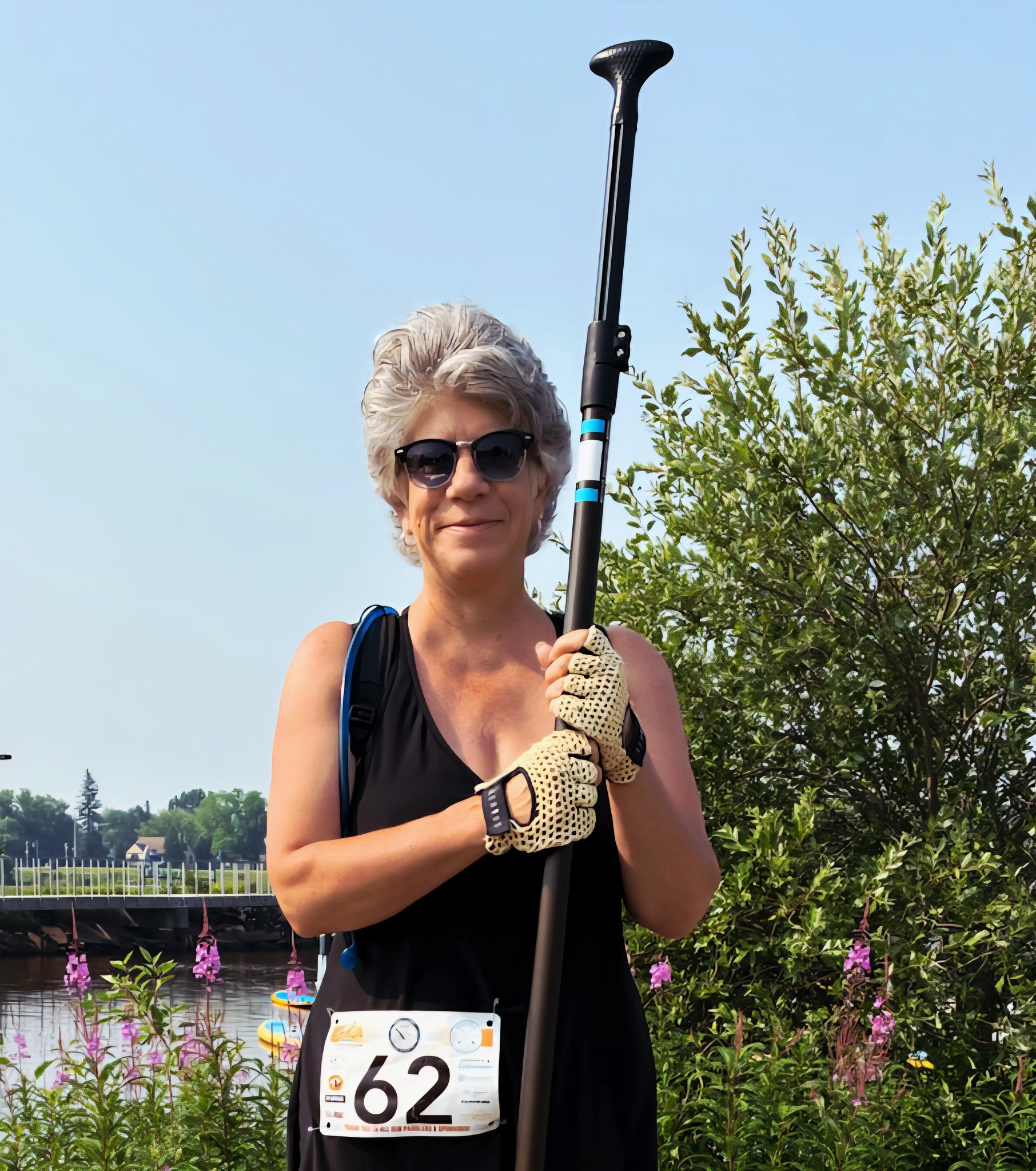
Me, ready to paddle!

I’d circled Barker’s Island on my board a couple times in the past just for fun, but I did it one more time before the race to assess any hazards and to build my confidence.

Come race day, I awoke a couple hours earlier than usual (ouch) to make it to the start of the race on time. I felt good but had no illusions about winning. The weather cooperated: warm and sunny with little wind. The only problem was poor air quality from wildfire that had drifted from Canada, but it didn’t seem to bother me.

About thirty of us lined up in the bay on our various crafts behind an imaginary starting line. When the bullhorn blew, we were off! I got a good start, paddling with quick, short and powerful strokes and I didn’t crash into anybody. Soon, we paddled around one end of the island and were out on the unprotected side, but conditions stayed optimal.

I was about halfway around the island when an older lady who I’d spied before the race slowly passed me. I wondered if she was in the same “old lady” race category as I was. She was about a foot taller than me. Her technique wasn’t that good, but she was propelled by long-armed strokes. I decided to try and stay with her and pass her if I could in case she was my competition.

At one point, she slowed to (unsuccessfully) try and pick up a can floating in the water. Although I was impressed by her environmental concern, I thought this was my chance to pass her. Try as I might, I couldn’t catch her. I still felt like I was paddling strong when I watched in dismay as a couple of young people with small dogs on their boards passed me. Then came two overweight people who were sitting too far to the front of their boards. They virtually plowed through the water paddling with kayak paddles and also passed me.

I shrugged off my dismay and just dug in. The “other old lady” crossed the finish line twenty-five seconds ahead of me. At the end, I felt good about the effort I expended and the fact that I wasn’t last.

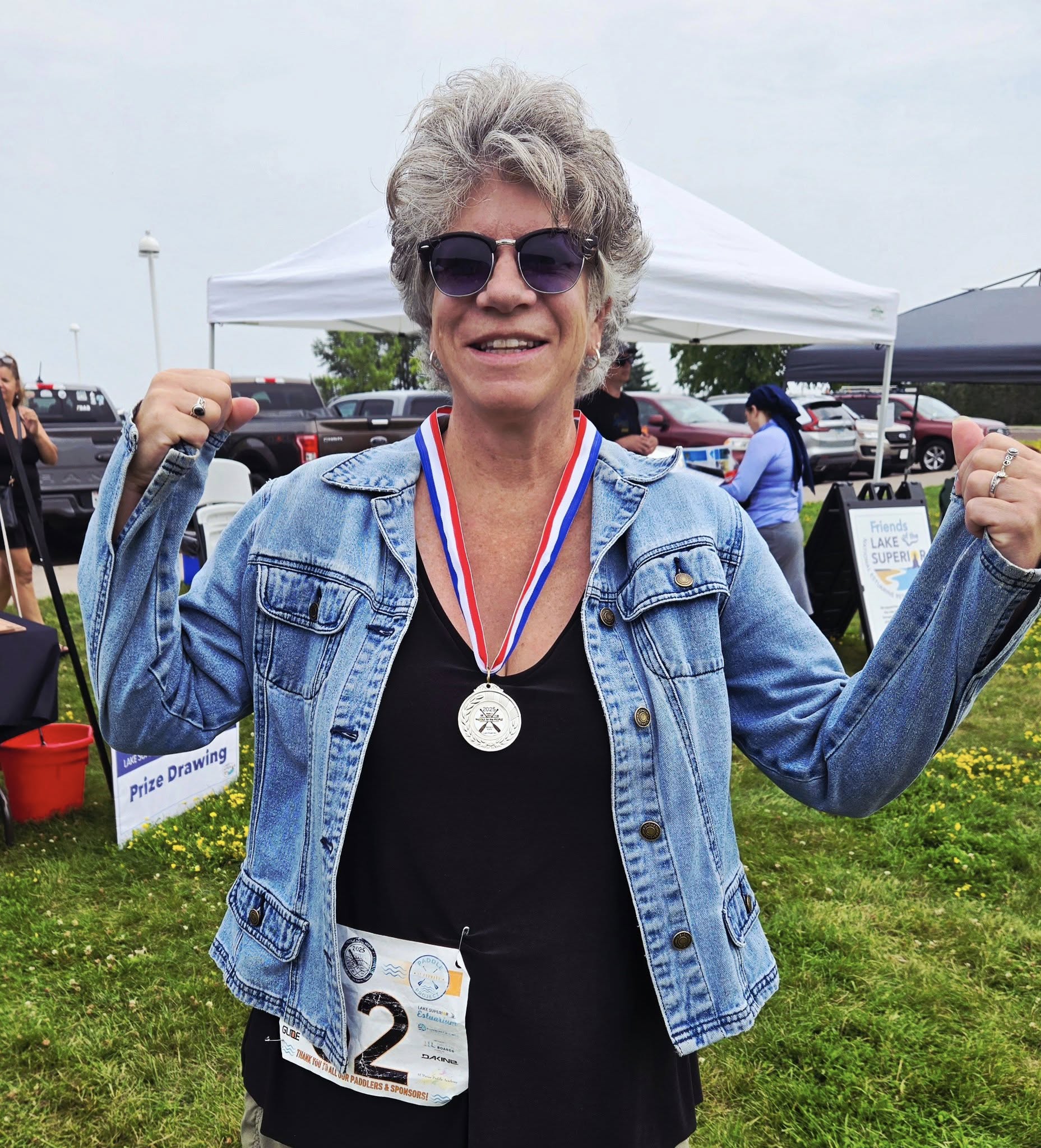
The race organizers held a short awards ceremony afterward and sure enough, I came in second in my category to the woman I had been chasing. I received a silver medal for my efforts.

Now I know what the race is about. But I don’t think I’ll do it again. Waking up early and then paddling hard for 45 minutes isn’t my idea of fun. But I’m glad I stayed true to my self-promise and participated instead of gazing at the racers wistfully from shore. What dreams have you pursued this summer?

Book Author Panel

Note: The time on this graphic is incorrect. The event is beginning at 6 p.m., not 5 p.m.!

Hey, this Thursday at 6 p.m. Central, I’ll be one member of a four-author panel for my publisher, Cornerstone Press. The event is being held at the University of Wisconsin-Stevens Point. If you can’t make it in person, it will also be live streamed and available afterward on their YouTube channel.

I’ll be reading from my speculative fiction short story collection, The Path of Totality. We’ll also be doing a panel discussion and taking questions from the audience.

I’m looking forward to meeting my publisher in person for the first time, along with the other authors!

The World According to Accordions

The World of Accordions Museum. Image courtesy of the museum.

I’m aware that I’m jumping the gun. World Accordion Day is May 6, and National Accordion Awareness Month isn’t until June. But I just couldn’t wait to write about our visit to the World of Accordions Museum in Superior, Wisconsin.

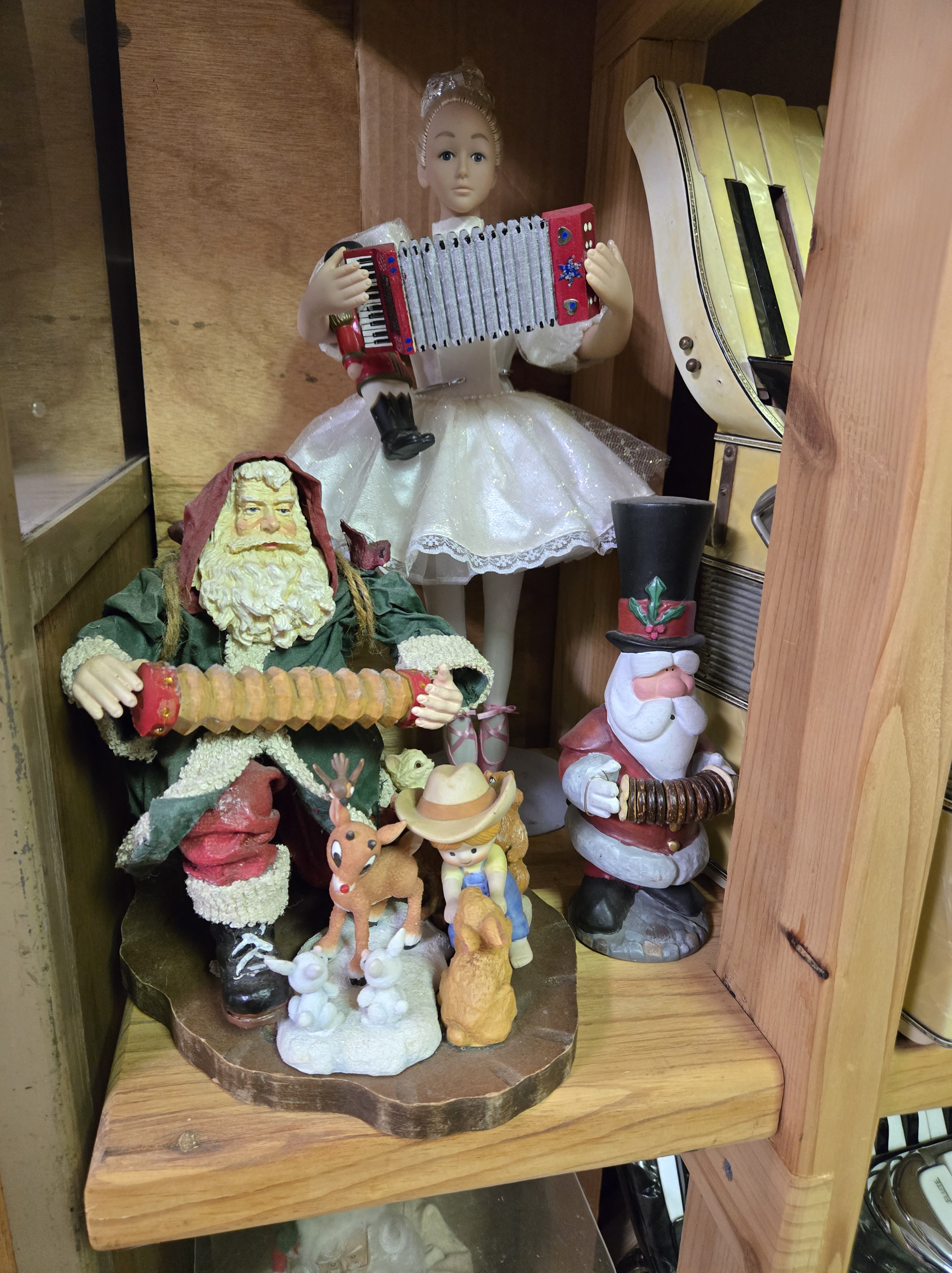
I’ve driven past the unassuming building on a busy street corner hundreds of times on my way to work and finally had time to take a peek last weekend. Inside are over 3,000 accordions and probably every ceramic figurine ever made that’s holding an accordion. The museum contains instruments from all over the world: Ireland, Spain, Germany, Scandinavia, etc. —from primitive concertinas to highly embellished accordions from the Vaudeville era that feature abalone. We even noticed a wooden accordion.

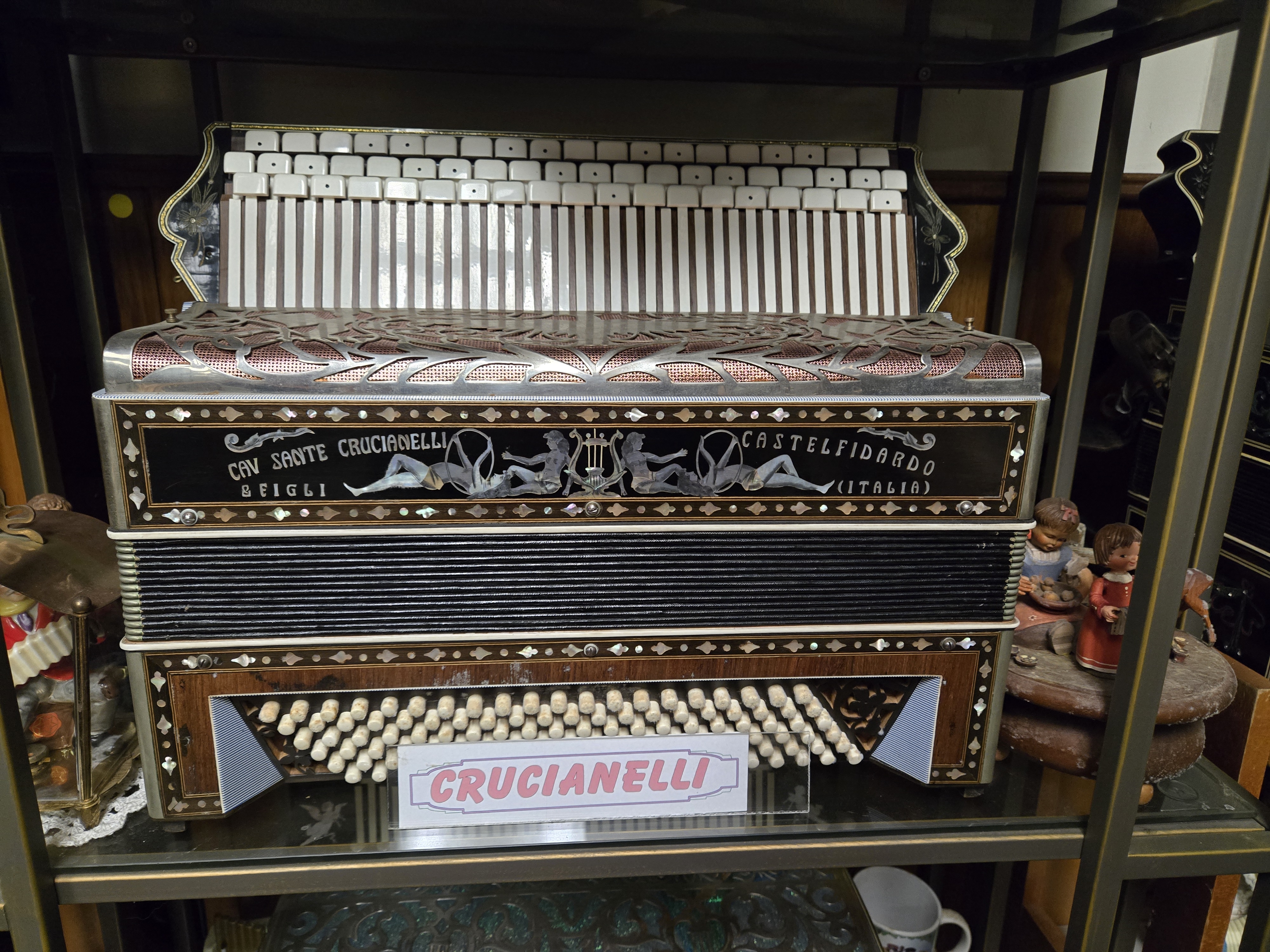
One of the fancier accordions in the museum.

The World of Accordions Museum was founded by Helmi Strahl Harrington in 1993. Our tour guide told us that Helmi’s mother was an accordionist who was conscripted in Hitler’s Germany to teach SAS wives to play the accordion. The family escaped to America and Helmi continued the family accordion tradition. She learned how to maintain accordions through a technical college in Red Wing, Minnesota. Although she currently has cancer, she hasn’t let that stop her from teaching accordion students and repairing accordions.

Christmas accordion figurines.

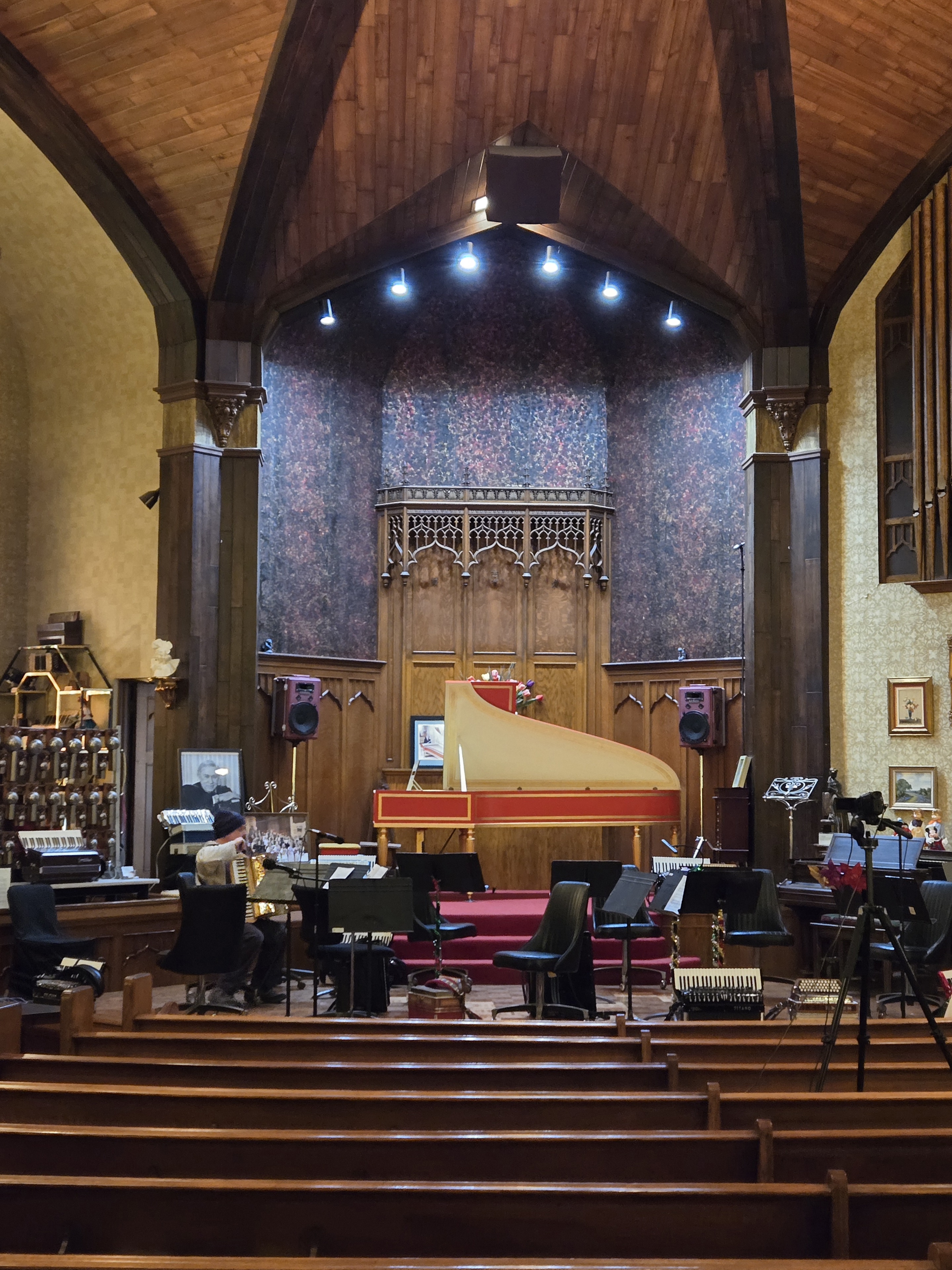
The nonprofit museum also houses a music and files room and a concert hall in what used to be the sanctuary of a former Episcopal Church. Our helpful tour guide said she got hooked on the museum when she came in for a tour. Now, she’s taking lessons and giving the tours herself. She even let us try our hand(s) at playing an accordion.

The performance space in the museum.
Mae West. Image courtesy of the Los Angeles Times Archives

Due to my dust allergies, I couldn’t spend as much time in the museum as I wanted. My sinuses began to ache! But before we left, one interesting thing we learned was that blond bombshell and actress Mae West was married to an accordionist. His name was Frank Szatkus, whose stage name was Frank Wallace. He agreed to keep their marriage secret to help West’s career. According to Wikipedia, the couple never lived together as husband and wife. When asked, West insisted that they had separate bedrooms, and that soon after their marriage, she sent him away in a show of his own to get rid of him. They married in 1911 and divorced in 1942. Was it because of the accordion?? We may never know.

One of my favorite store chains, Drink Wisconsibly, has made a YouTube video about the museum, which is fun to watch.

The museum has an annual festival in early May, centered around World Accordion Day. They offer workshops, talks, and concerts. Keep your eyes out for info about that. It would be a good excuse to visit if you just can’t get enough of accordions.

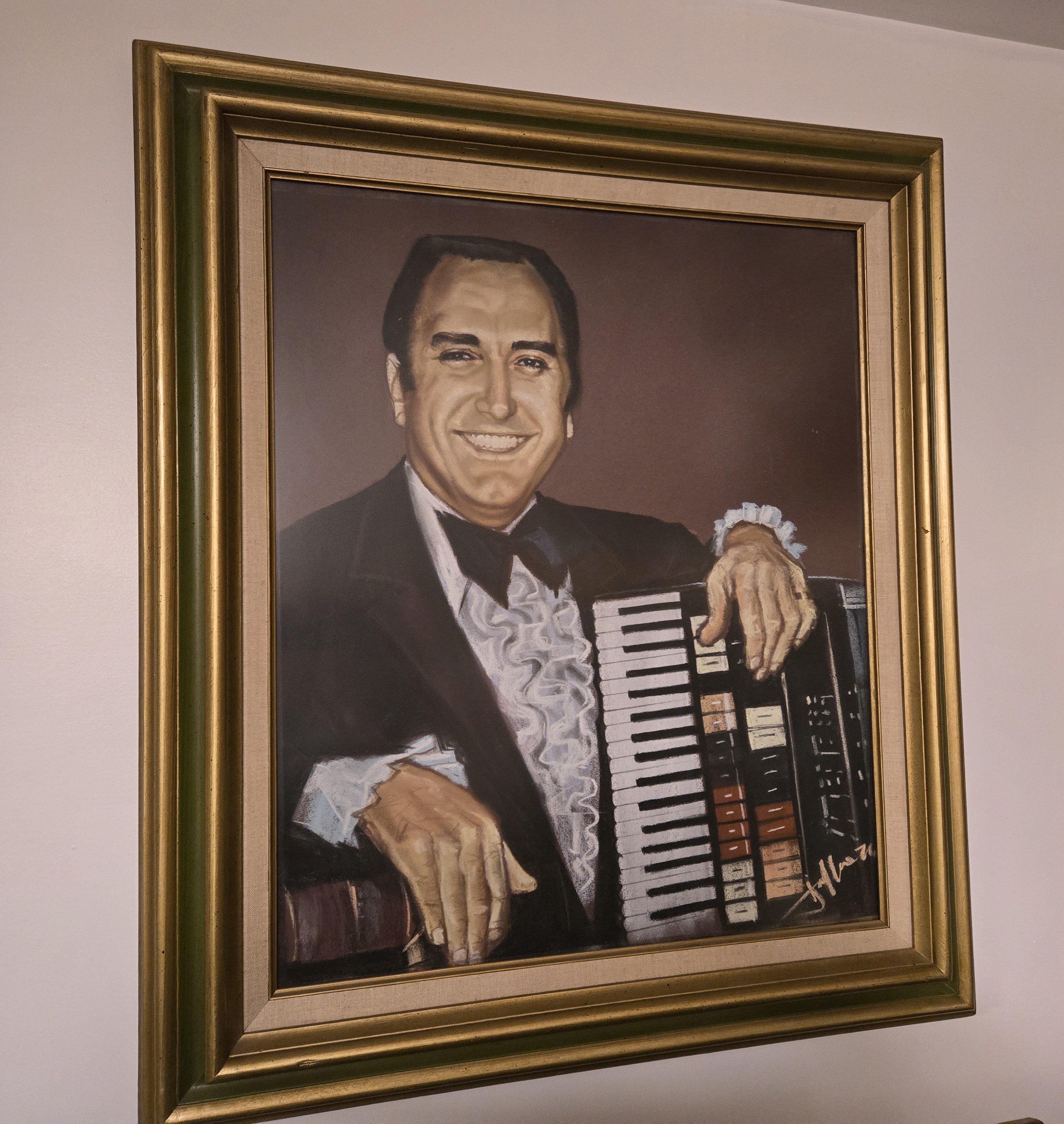
I don’t know who this guy is, but he seems pretty happy with his accordion.

Book Giveaway, Libraries, and a Signing

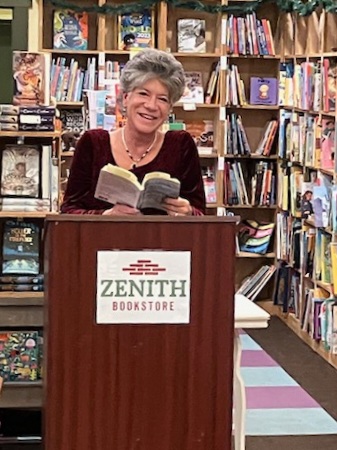
Marie and most of her books at Foxes and Fireflies Booksellers in Superior, WI.

Bookish things have been happening in my world. First, I wanted to let you know that my speculative fiction/magical realism short story collection, The Path of Totality, (POT) is having a giveaway on Goodreads. Three copies will go to some lucky readers in ten days on March 12.

The second thing is something I learned from one of my fellow writers. He clued me into the WorldCat website, which is where you can see what libraries around the world carry certain books. He looked up POT and told me that it was in seven libraries already. Cool! Of course, I then looked it up and my other books. POT is available in libraries in Omaha, NE; Farmington, NM; Charleston, SC; and Orlando, FL. This exercise reminded me that I should donate a copy to my library in Duluth so that they have it.

One surprising thing I discovered is that my first novel, Eye of the Wolf, is available in the National Library of Qatar, in the Middle East. How did that happen?? Another surprising thing is that my second novel, “Plover Landing,” is available in 233 libraries! I think that might be because I offered libraries free rights to a PDF download of it. Since that happened a few years ago, I can’t recall now what service I used for that.

The last bookish thing regards a signing and reading I had yesterday at a new bookstore that opened in Superior, Wisconsin. Foxes and Fireflies Booksellers is run by a woman who’s also a reporter for the local newspaper. Maria Lockwood began the store as a lark. She was reporting on a business startup grant program and as part of that, put in a grant request to open a bookstore as an experiment to see how the process worked. Lo and behold, she was awarded the grant.

Superior hasn’t had a literary independent bookstore in many years, so the community was excited to see Foxes and Fireflies open. The store is very cozy and is filled with neat items. I probably spent any royalties I made during my signing on a cute little fox toy that is destined for our cabin. Oh, the glamorous life of a regional author! Superior writer Vickie Smith featured the bookstore recently on her blog.

Now that I’m on a countdown to retirement for my day job (not my fiction writing), I figure I’ll have more time to read writing trade magazines. I used to subscribe to Writer’s Digest but quit after a while because the copies just kept piling up and it felt too much like work to read them. I’m wondering what writing magazines are your favorites? I’d appreciate recommendations.

Marie’s (Fish) Cheeks

Did you know that fish have cheeks? And did you know you can eat them?

Well they do and you can. Several species of fish, both saltwater and freshwater have cheeks that are large enough to harvest. These include halibut, grouper, cod, walleye, whitefish and lake trout. About the size of a scallop, fish cheeks are prized for their firm texture and tenderness.

They’re usually not available in supermarkets, but if you’re near a commercial fisherman, you might be in luck. For work, I recently meandered along Lake Superior to the Bayfield Peninsula in Wisconsin. I stopped by Halvorson Fisheries in Cornucopia where they had frozen lake trout fish cheeks for sale. I’d never had them before, so was intrigued. I bought a half pound and took them home in my cooler.

To find out what happened and get a free recipe, please visit a blog post I wrote for work. You can visit it here.

In Which I get Paid to Work in a Bar

The Kom-on-Inn in West Duluth. Image courtesy of Jennifer Webb, University of Minnesota Duluth

I recently worked in a bar. Not as a bartender, though. I didn’t even drink! I was there to view art and explore how it relates to community and the restoration of the St. Louis River, which flows along the border of Minnesota and northwest Wisconsin. You can view my resulting story on Wisconsin Sea Grant’s “Unsalted” blog here.

Marie Goes Wild Ricing

Me, happily ricing, unaware of what lies ahead. Image credit: Wisconsin Sea Grant

I had a chance to harvest wild rice in the St. Louis River near Duluth recently for work. It wasn’t the first time I’d been ricing, but it’s the most memorable.

You can read about my little adventure on the Wisconsin Sea Grant blog through this link. Enjoy, and happy meandering!

Learning About Bears in the Apostle Islands

Bear tracks on Julian Bay, Stockton Island.

I had the chance to meander to Stockton Island, one of several islands in the Apostle Islands National Lakeshore in Lake Superior a couple of weeks ago. I was there to cover what the National Park Service is doing to make their facilities on the island more accessible to disabled people. I’ll be writing a story about that for work, but I also got a tour of the island by former park ranger, Neil Howk, who gave us (there were about 8 of us) the skinny on the history of black bears on the island.

Neil Howk imparts his knowledge about bears.

Neil worked for many years in the Lakeshore and is now on the board of the Friends of the Apostle Islands, which organized the tour on a sunny, breezy Friday. Neil took us on a short hike on the trail that leads through the campground on Stockton Island to the signpost for campsite number 4. We took a sharp right and began bushwhacking into the woods. Neil knew there was a bear den nearby.

After not too much whacking or getting whacked by tree branches, we came to a deadfall – a tree that had been blown over by wind. Neil said the bear had made its den among the tree roots, which provided a fairly snug place to spend the winter.

He felt okay taking us to this location because: 1) It’s not winter, so no bear will be actively hibernating there, and 2) Bears usually only use a hibernation site once, so disclosing its location should not endanger the privacy of any bears (except if another one ends up using it!)

Besides overwintering in dens in rocks or tree roots, black bears have also been known to hibernate inside hollow trees and even in eagle’s nests. I did not know the eagle’s nest thing. I also learned many other new bear trivia, such as: bears don’t poop all winter. Neil said they eat grass in spring to get their bowels going again.

The deadfall bear den that Neil Howk showed us on Stockton Island.

Also, cannibalism is normal for bears. Males will sometimes eat cubs – presumably ones that aren’t related to them, in order to bring females into estrus sooner so that they can procreate with them. And bears will also eat meat (besides the berries, ants, and other things that bears are known to consume). Neil said that deer fawns and chipmunks are among their favored meaty fare.

Another fact that Neil conveyed is that when bears were first counted on Stockton Island – sorry, I’m not sure when that began – there were only a couple. But now there are 20 known to live there. I can attest to their presence. On my several trips there, I’ve seen many bear tracks on the island’s beaches. (I’ll try to dig up some of my photos of those for this post.)

Black bears like to gnaw upon and otherwise dismember the wooden campsite markers on Stockton Island.

One memory that emerged during the tour came from a trip I made to Russia many years ago. One of my former husband’s relatives bragged about a bear he had shot. Granted, this relative liked his vodka and ended up chasing one of my young sons around the picnic table where we were eating – he was a rather scary, imposing figure, somewhat bearish. At some point, he showed us photos of his triumphant hunt. From the snow in the photo and the location, it became obvious that he had shot a hibernating bear. So much for sportsmanship, but I guess maybe they do things differently in Russia!

Anyway, I learned some things I didn’t know about bears from this tour, and I hope you did, too.

The Story Behind my Isle Royale Lighthouse Story

The Isle Royale Lighthouse on Menagerie Island. Image courtesy of the National Park Service.

I recently had an article published in Lake Superior Magazine about a family of lighthouse keepers who spent their summers on a remote, rocky island that’s part of Isle Royale National Park. Here’s how the story (“Romancing the Stone”) came about.

Last December, I was hawking my books at a table at Fitger’s Bookstore in Duluth. Many holiday shoppers passed by, but one couple stopped to chat. Somehow, we got on the topic of Isle Royale, and I told them that my first novel was set on this island in Lake Superior.

The husband said something like, “Well, I’ve got a story for you. My ancestors were lighthouse keepers for two generations on Isle Royale.” The husband’s name was John Malone. His wife was LaRayne, and she mentioned they got engaged while on a trip to the “family’s lighthouse,” which was the Isle Royale Light on Menagerie Island. John mentioned that his lighthouse keeper great-grandfather had 11 children who lived out on the remote (and very small) island.

Although intrigued, I had plenty of story ideas in my head to keep me occupied for months. I told them I’d consider it but couldn’t promise anything.

But the more I thought about it afterward, the more interested I became in the story of the Malone Family. I checked with the Lake Superior Magazine editor to see if they’d ever featured a story about the Isle Royale Lighthouse and the Malone Family. She told me they hadn’t and that she would be interested in it.

I couldn’t find John Malone in the phonebook, but I was able to connect with him through social media. I reminded him who I was and told him I was interested in doing a story about his ancestors and family. On New Year’s Eve, he replied to me with his phone number. I called him to get more information so that I could pitch the story to the magazine.

Not long after, I pitched it, and the story was a go!

Then the work began. I was lucky that the Malones had a copy of a copy of the Isle Royale Lighthouse Keepers’ log, which they loaned me when I visited their home for an interview. Also, the National Park Service had done oral history interviews with two Malones a few decades ago. These Malones were now deceased, so those interviews were invaluable. I was able to combine those interviews with the ones I did with John.

After the last lighthouse keeper in the Malone Family quit his job on Isle Royale, he piloted yachts for the wealthy in Duluth. One of those families were the Congdons who built Glensheen Mansion, which is a tourist attraction now in the city. John Malone told me a tale about how his ancestor had been aboard the yacht when it sunk due to a fire. He had this great information (which is in my magazine story), but he didn’t think that the staff at Glensheen Mansion had heard the history.

It so happens that my daughter-in-law used to be a docent at the mansion and still has ties there. I consulted with her and she consulted with the staff at Glensheen to see what they knew about the sinking. It seemed as if a meeting between John and the mansion staff was in order, so I arranged it.

We met at the mansion and met with a Glensheen historian and the education manager. John got to tell his tale and I recorded it for my story. The mansion staff was excited to learn this new information. I hope they work it into the information that they provide to the public. And I think John was touched to have someone value the historic information he was privy to.

The Lake Superior Magazine editor only wanted a 1,200-word story, but I gave her more like a 2,000-word story. I apologized, saying the more I learned, the more there was to tell! But it paid off in the end because she dedicated much of that issue to maritime history.

Trying to sell books to people passing in a hallway can be depressing. I sometimes feel like one of those poor souls who stand on a street corner with a cardboard sign. My sign would say, “Will write for pay.” But this is one case where several good things came from putting myself out into the world.

Architectural drawings for the Isle Royale Lighthouse. This did not make it into my magazine story. Illustration courtesy of the National Park Service, U.S. Department of the Interior, Isle Royale Light Building Proposal, ISRO Archives, ACC#ISRO-00999, Cat#ISRO 20175.