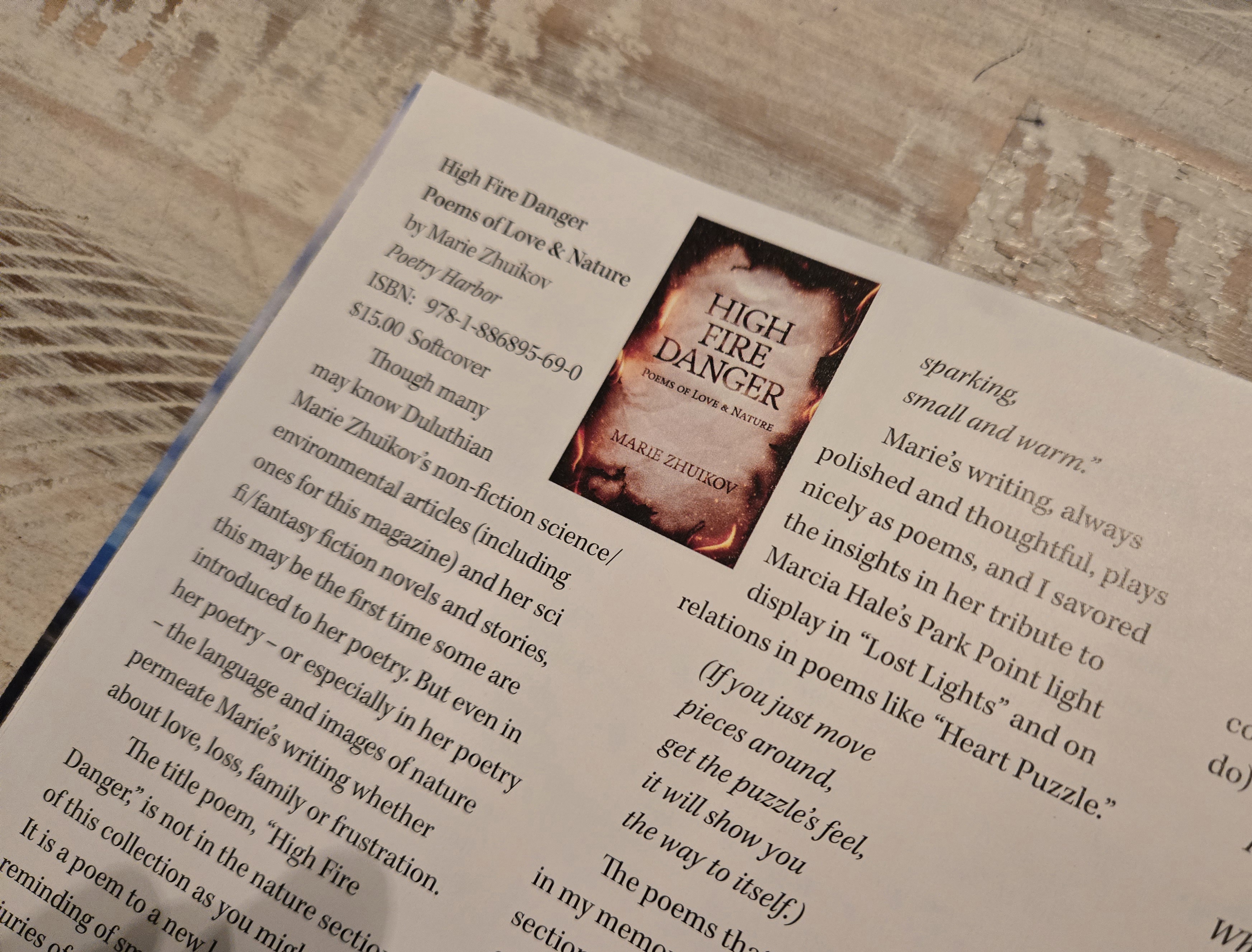
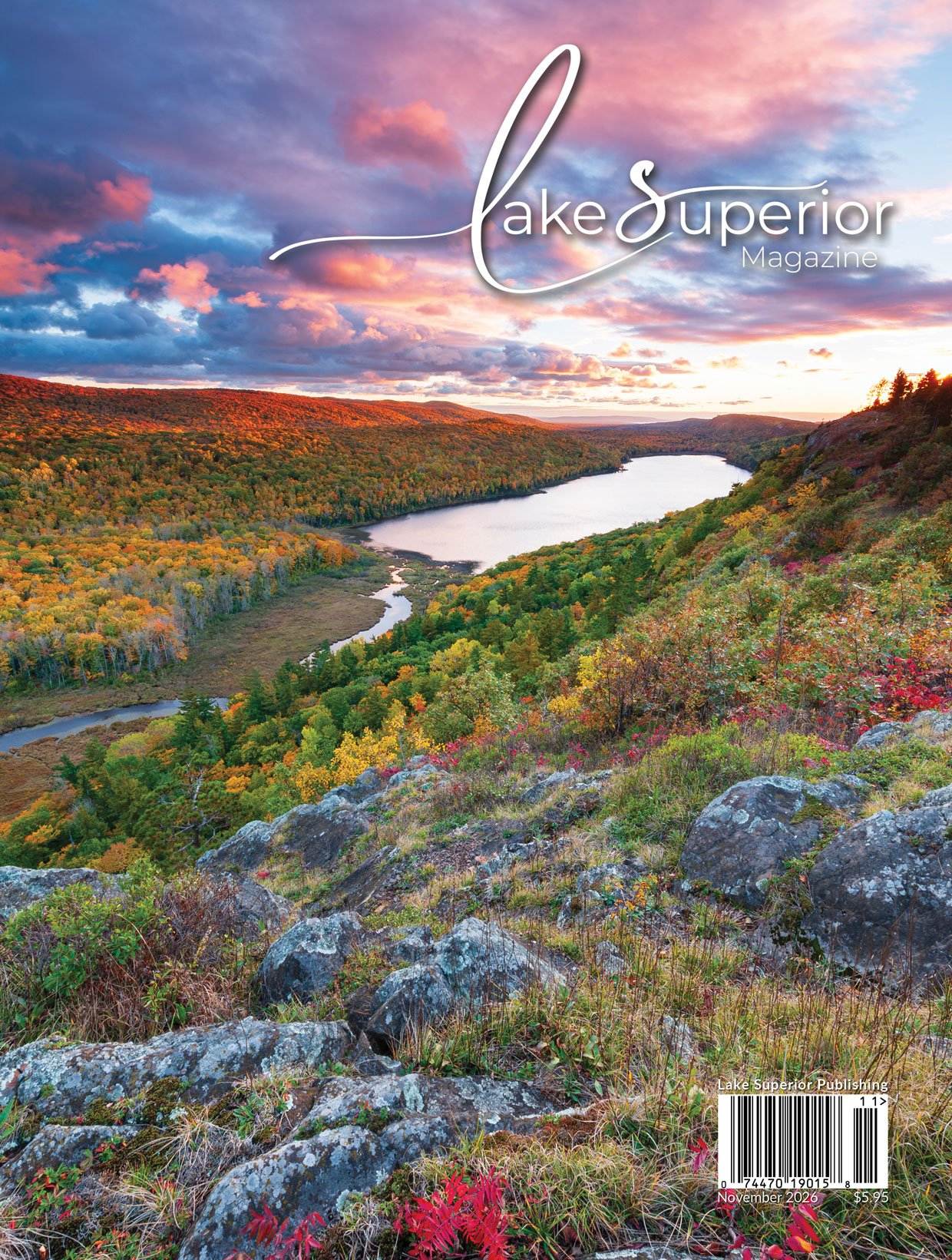
My poetry book, High Fire Danger, was reviewed in the latest issue of Lake Superior Magazine. Sorry, the review is only available to subscribers. But here’s an excerpt: “In her poetry, the language and images of nature permeate Marie’s writing whether about love, loss, family, or frustration.”
And here’s a review by a member of the Wisconsin Writers Assn. that you can read even if you’re not a magazine subscriber. Hope you have a chance to check out the reviews. High Fire Danger is available on Amazon.
Second, I received a fan email from a reader in Maryland. She read my first novel, Eye of the Wolf. “To say I enjoyed it is an understatement. What an unusual and vivid story! The last few chapters were absolute page-turners! You are such a lovely writer…” That made my week! The book is out of print but is available through many libraries.
For more information about my books, please visit the book page on my web site.
The piping plover pair that nested on Wisconsin Point this summer. The birds are marked with colored plastic bands to identify and track individuals. Photo credit: Mikayla Erickson
I’m happy to announce that the endangered piping plover shorebirds (Charadrius melodus) have nested for the first time in 49 years in Superior, Wisconsin. This culminates years of habitat restoration work by many groups, including the St. Louis River Alliance, which I worked for in the past. I wrote the first grant to receive funding for this work, but I left the Alliance for my Sea Grant job before I could see the results come to fruition.
I took what I learned through that experience and applied it to my second eco-mystic-romance novel, Plover Landing. The book tells the story of Melora, who is fighting to save the habitat of these birds on the shores of Lake Superior. It was published in 2014.
In Plover Landing, the birds nest on Minnesota Point, but in recent reality, they nested in a bird sanctuary on Wisconsin Point. We’d often had reports of single plovers passing through on migration, but this time, a male and female plover must have been passing through at the same time and decided to make a go of it.
Alas, their nesting efforts were not successful, but natural resource managers hope they might return next spring and try again. Here’s a link to a good Wisconsin Public Radio story about the topic.
I am so excited to see the situation I dreamed of in my novel burst into reality! And I’m happy that these adorable birds are making a comeback.
If you’re interested in my books, please check out my Books page. And if you live in the Twin Ports, be sure to visit my booth at Chester Bowl Fall Fest in Duluth on September 19th. I’ll be selling and autographing books along with local poet Stanley Kusunoki.
What makes a novella different from a novel or a short story? I (and others) help address this question in an article by Chicago writer David Berner in the latest issue of Poets & Writers magazine. If you subscribe, you can read excerpts from my interview beginning on page 25.
Want a hint? According to Berner, “More is not more. More is less, and that may mean your narrative needs far fewer words than you think.”
Info about my novella, “Invisible Connections,” which is part of my The Path of Totality short story collection, can be found on my Books Page.
In other news, I just returned from a trip to France. I’m editing my photos and getting my thoughts organized for upcoming blog posts. Can’t wait to share the experience with you all!
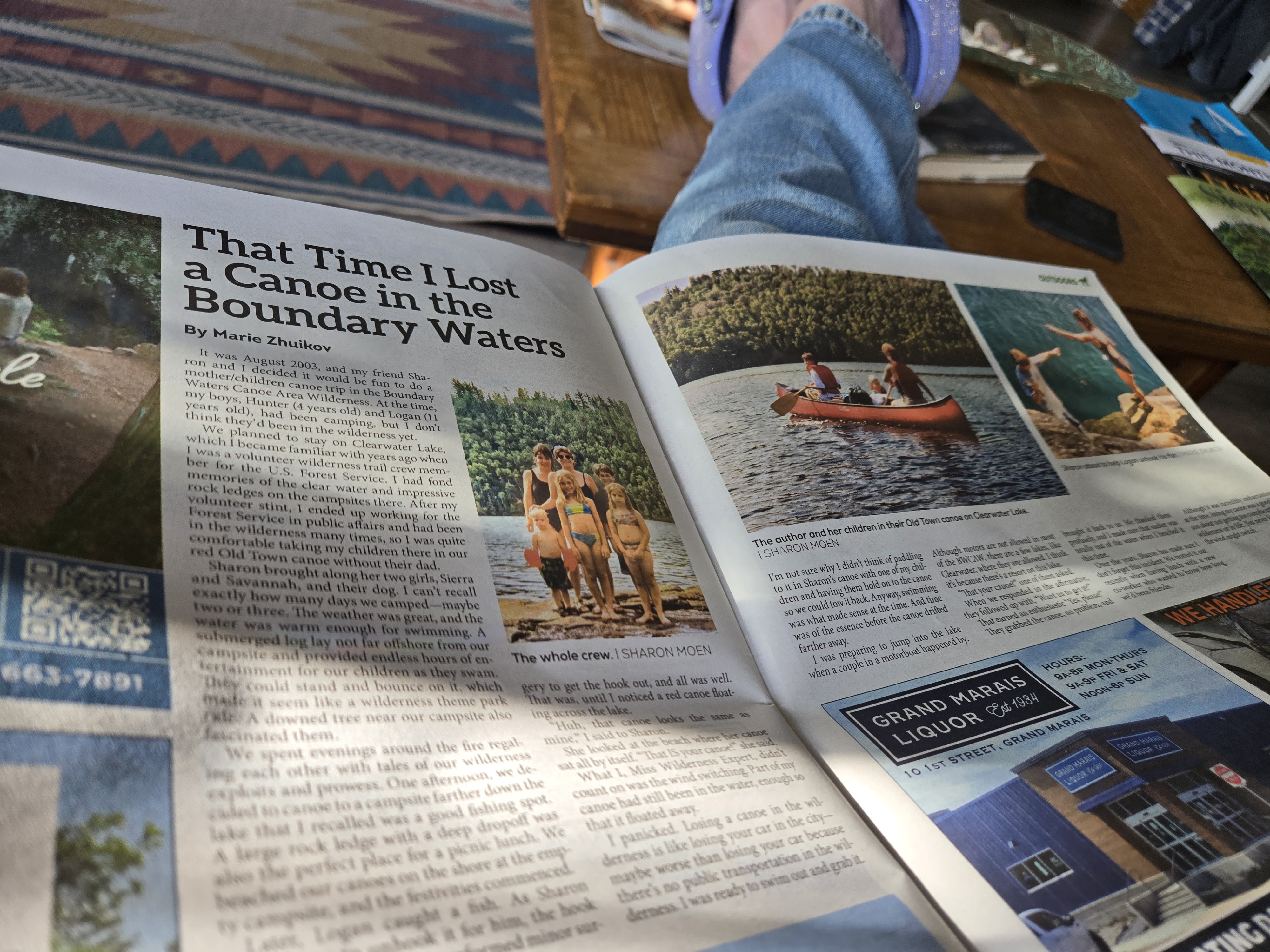
My story, which originally came from this blog, was recently published in a local magazine called Northern Wilds. The story is about “That Time I Lost a Canoe in the Boundary Waters.” The magazine is on local (northern MN) newsstands now, but if you’re not from around here, you can read the original story here. This story, which took place in 2003 with my BFF Sharon and her children (and mine), also appeared in my blog-memoir book, Meander North. The Wilderness teaches me a lesson in it.
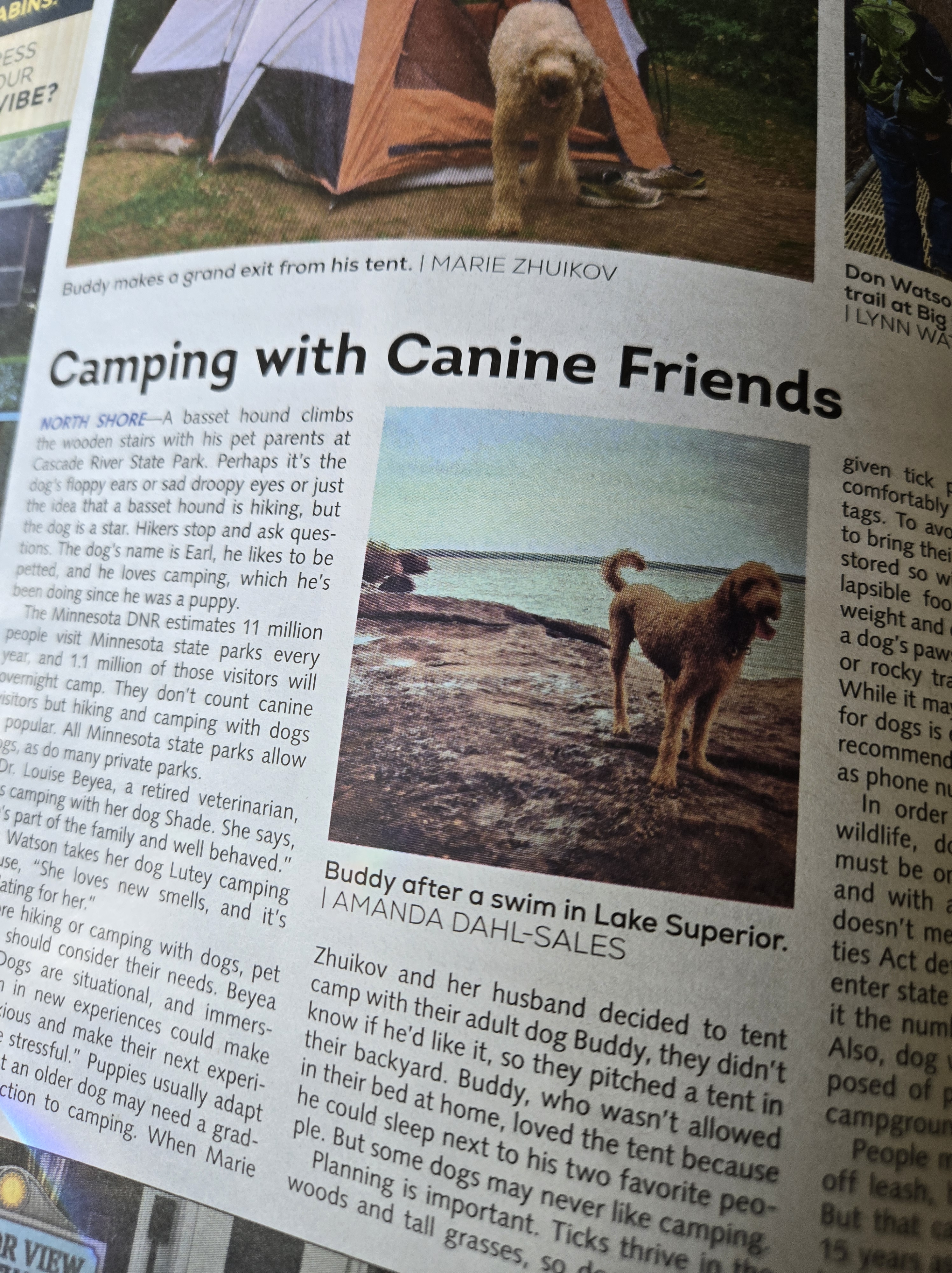
The Northern Wilds editor has been gracious enough to agree to publish some of my blog posts in her magazine when she needs stories. In this June issue, I was also interviewed by writer Victoria Smith for her story about, “Camping with Canine Friends.” You’ll see photos of my dearly departed goldendoodle, Buddy, and tips about how to successfully camp with your dog.
In case you’re wondering, I still miss my Buddy greatly, but I’m not ready to get another dog. I have too much meandering left to do, and that is easier without having to pay kennel fees for the dog left behind. Perhaps once I/we curtail our traveling, we’ll be open to loving another pet.
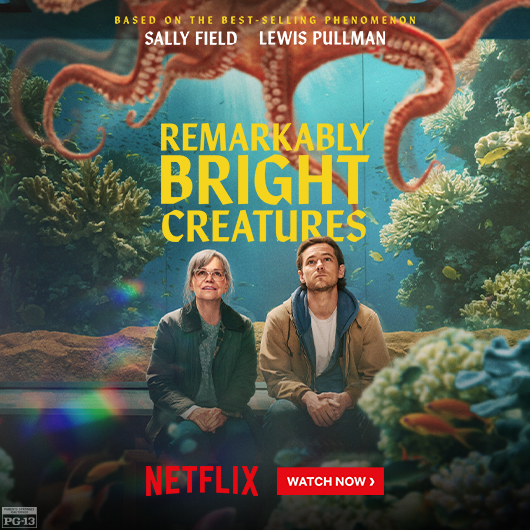
I first learned about Shelby Van Pelt’s novel, Remarkably Bright Creatures, from a local bookseller who recommended it to me. If you’re not familiar, the story is about Tova, a widow, who befriends Marcellus, an octopus at the aquarium where she works as a night janitor. Along the way, Tova meets Cameron, a wayward young man, and the two develop a friendship. Curmudgeonly Marcellus narrates the book and eventually solves a mystery that benefits both Tova and Cameron. The challenge is how the octopus can communicate his knowledge to these humans, who are “remarkably bright.”
The story blends drama, mystery, and magical realism. It focuses on themes of loneliness, healing, and intergenerational connection.
The movie version was just released on Netflix. I finished the book about 1-1/2 years ago, so I am a little hazy on the exact details, but it seemed like the movie was as faithful to the book as it could be. Sally Field plays Tova, and she was perfect for the role. The story is set in the Pacific Northwest, but the movie was shot in Vancouver, which looks much the same. I thought the movie aquarium building was so quaint!
I rated the book 5 out of 5 on Goodreads, and the movie was right up there, too. While reading the book, I couldn’t quite bring myself to believe that Marcellus could read and understand human speech, and I thought the movie handled these issues well.
I’m currently taking a screenwriting class. I have a long short story that I think would make a great movie. Instead of waiting for some screenwriter to notice it, I decided to become that screenwriter! I just finished the first draft of my satirical thriller feature film set in a northern Minnesota bog last week. I need to add a few more pages of content, but the script is on its way! I meet with my instructor this week to discuss it. Of course, I think it’s the best thing ever, but, like with my stories, I’m often quickly disabused of this feeling after receiving outside feedback. Then I sigh and put in more work. I expect it will be the same for this script.
My class was another reason I was keen to watch Remarkably Bright Creatures and note how the movie handled different situations presented by the book. I was able to visualize how Marcellus’s narration would be written in the script and how certain scenes would be described.
As another learning experience, I attended the Minnesota Film Festival, which is held in Duluth. I was able to sit in on a table read of a script-in- progress. (That’s where the entire script is read by actors.) I also went to a networking session where I met other writers in this medium.
I’m excited by screenwriting. I love its emphasis on the visual, which seems to fit with how I experience the world. It’s been fun to learn yet another form of writing (as if short stories, novels, novellas, memoirs, blogging, short-short stories, and poetry weren’t enough)!
Anyway, back to the movie. If you prefer a tight, suspenseful narrative, Remarkably Bright Creatures might not be for you. But if you enjoy character-driven stories with a touch of whimsy, this movie should resonate.
A friend of mine couldn’t believe it when a hotel clerk, with whom she thought she had a memorable encounter a few hours before, didn’t remember my friend when she saw her again. I shared a theory about this with my friend. I developed the theory from reading Going Gray by Anne Kreamer and I turned it into a speculative fiction short story titled “Invisible.” But you’ll have to read my story to find out what it is! No freebies here. Although the story itself is free.
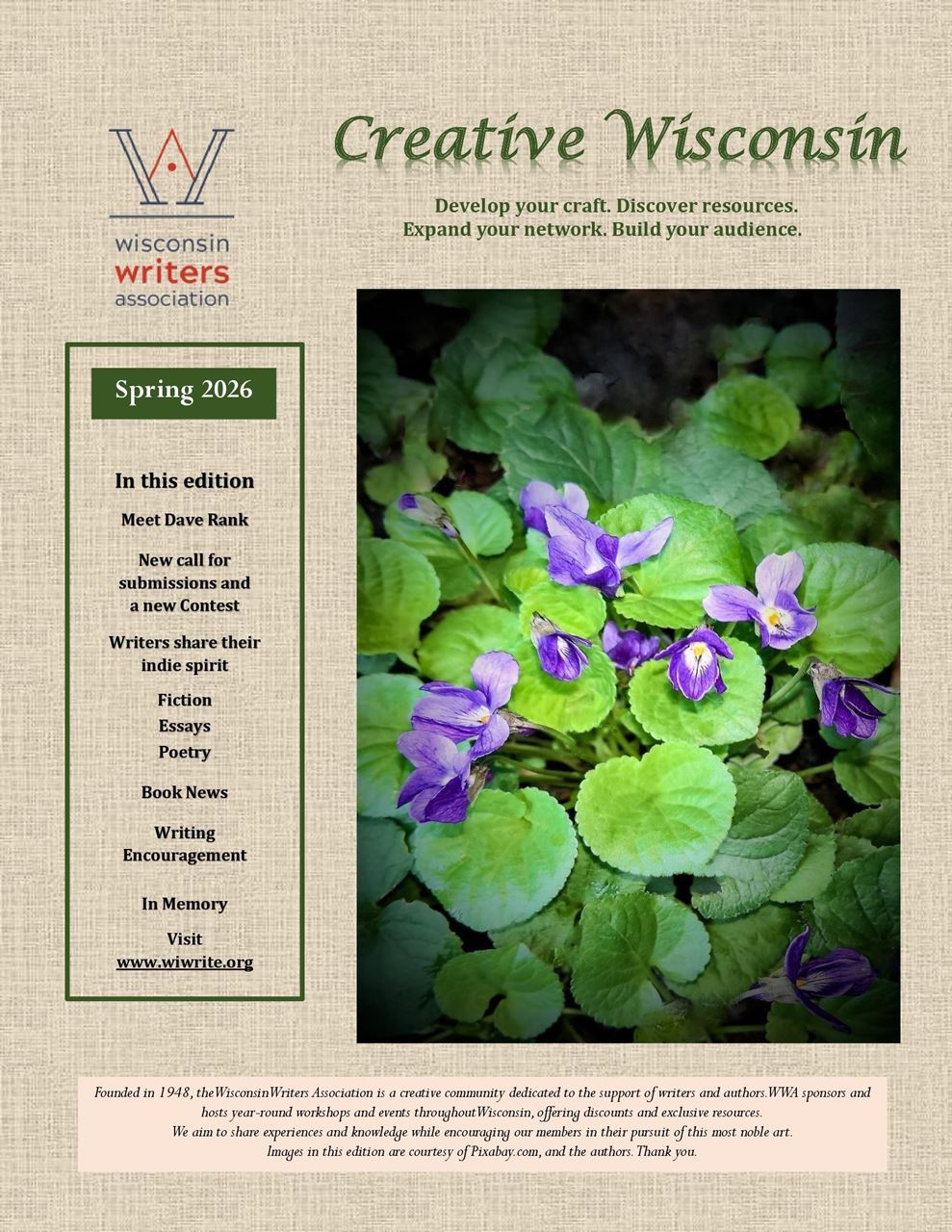
“Invisible” was recently published in Creative Wisconsin magazine, which is published by the Wisconsin Writers Association. I joined them a few years ago when I had a Wisconsin-based publisher and job, even though I don’t live in Wisconsin. I’ve taken a few classes from them, and I’ve attended two of their writing conferences. They’re a great group!
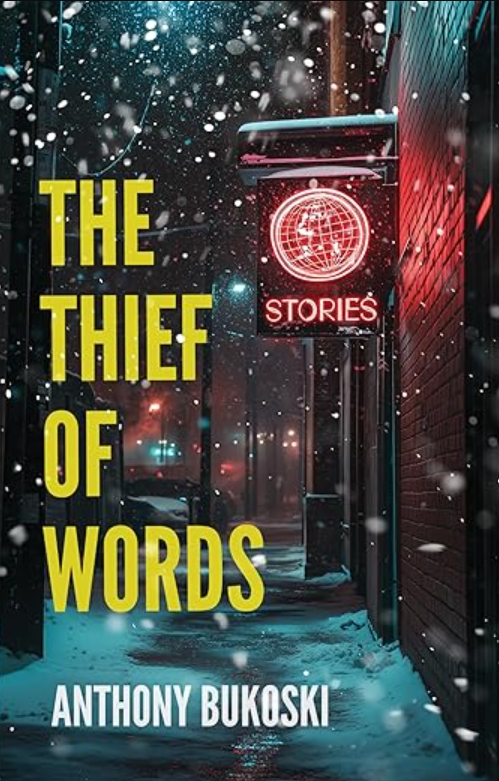
I spent a memorable afternoon with Superior, Wisconsin, short story writer Anthony Bukoski last summer. We discussed his book, The Thief of Words, which was published in 2025 by the University of Wisconsin Press. Tony’s stories feature white collar-blue collar tensions that belie his time spent in both worlds. The Thief of Words focuses on such themes as loneliness, longing, dislocation, assimilation, and generational conflict.
Thanks to the kickboxing workouts I’ve been doing for the past four years, our interview ends in a surprising way! You can read about it in Hypertext, a digital literary magazine published in Chicago.
I thank Tony for this opportunity and Hypertext for publishing it. If you’re looking for something to read, please check out Tony’s book.
I have two writing things to impart. The first is a review of my new poetry book, High Fire Danger by Rebecca Swanson, a fellow member of the Wisconsin Writers Association. She kindly says they are “some of the finest nature poems” you will ever read, and that every page is filled with “warmth, wit, vigor, and beautifully crafted poetry.” My book costs $15 and is available from Amazon.
The other is my new Facebook author/photography page. I used to have pages for each of my novels. Even though my first novel’s page (Eye of the Wolf) had 2,500 followers, it was so out of date that, after notifying my followers to switch to my new page, I held my breath and sacrificed it. If you follow my new page, you’ll get notifications of my writing events, see my favorite new photos, and get links to my latest blog posts. My page is slowly growing with 77 followers; I could use a few more.
Image by Sharon Moen
I also have an Instagram account, but am less active there. My profile photo shows my arms hugging a tree. Because, you know, that’s what I do.
I was interviewed this week by the MN Reads radio show, which features Minnesota-related authors. The show airs on Duluth’s community station and is hosted by Luke Moravec, who is a new author himself (and also a talented actor, musician, and probably some other things I don’t know about). The interview was about my latest book, High Fire Danger: Poems of Love and Nature. I feel fortunate that Duluth has this media outlet that supports local authors.
You can listen to the eight-minute interview here.
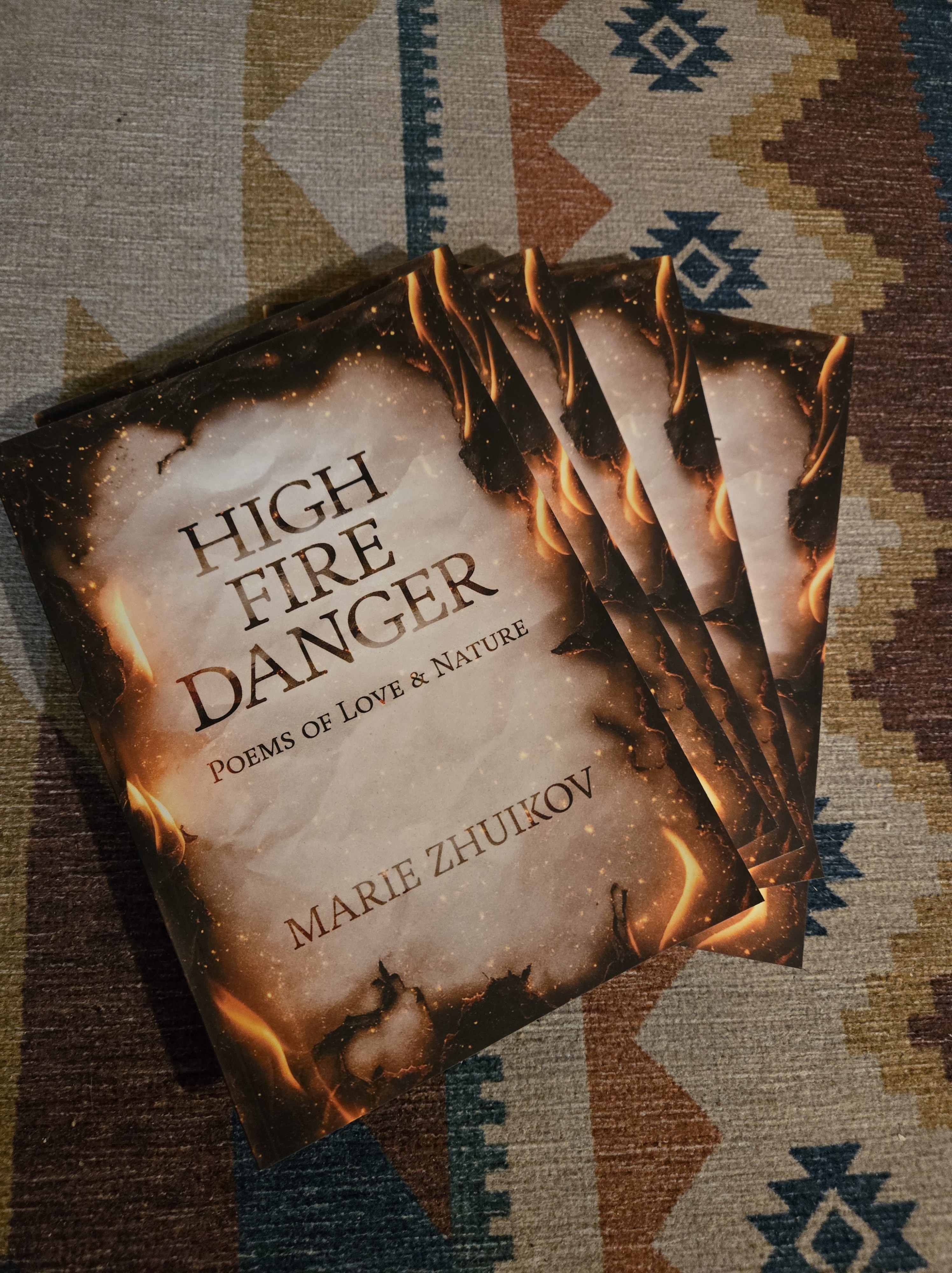
I love my book cover. Doesn’t it look like it’s really on fire?
I made it onto the local ABC channel affiliate’s lifestyle show recently to promo my poetry collection, High Fire Danger. The hostess, Baihly, does a great job of making interviewees feel comfortable in what can be a nerve-wracking, live-interview situation. You can watch the story here.
This year, I received many bogus author promotional opportunities that I’d like to warn you about. Most involve book clubs. The first was an email I received from someone purporting to lead a silent book club in New York City. They said my book was getting some “buzz” among their members and they’d like me to be a featured author for the group.
Of course, this surprised and delighted me. I have a couple of friends in NYC, so it’s possible that one of my books could have found its way around the city. I looked up the group online and found a Meetup page for them, so it seemed legit. I replied, saying I was interested and asked for more information. I didn’t hear back, so after a week, I pinged them again. I received an automated message that the email address no longer existed. That made me figure it was a scam, so I put it out of my mind.
A few days later, I received another message from them from a slightly different email address. They apologized for the delay in response and offered a revised date for my book’s promotion. I replied, just to see what would happen. I soon received a response that said I wouldn’t actually need to appear in person. They would set up a display for my book, and that would cost $216.
This spurred me to investigate them further. I input the search terms, “New York City Silent Book Club author scam,” and was led to this website, which solidified my hunch that it was a scam. So, authors, don’t fall for this one!
The second “opportunity” took the form of book club publicists who reached out to me separately about four of my books. They praised the books extensively (and excessively!) and offered to bring them to the attention of thousands of book groups. The emails come from gmail addresses. Although the praise was ego-affirming, I could tell that it was based solely on the books’ descriptions. The “publicists” had obviously not read the books. Their email text was probably AI-generated.
Here’s an example for my poetry book:
High Fire Danger is an exquisite collection that embodies how love and nature mirror one another, both capable of tenderness and destruction, both powerful enough to transform us entirely. From the first page, it’s clear that this is not merely a collection of poems but a lifetime’s reflection distilled into verse that burns with emotional clarity and elemental force.
The range of your imagery is breathtaking. You take readers from the cool expanse of Minnesota’s lakes to the windswept coasts of Scotland, and even beyond the bounds of Earth itself, yet the emotional truth in each poem keeps us grounded. This interplay between vast landscapes and intimate feelings gives your work both a cosmic and deeply personal resonance.
I was particularly moved by how humor and humility are woven into the meditations on love. There’s an unflinching honesty of voice, one that acknowledges the beauty and peril of connection, whether with another person or with the natural world. The poems don’t shy away from the scorch marks left by passion or the quiet ache of solitude, but instead, turn those experiences into sources of illumination.
The title High Fire Danger feels perfectly chosen. It speaks to the tension running through the collection, the balance between awe and fear, creation and destruction, desire and loss. Each poem feels like a spark that could either warm the heart or set it aflame. This duality is what gives your writing such emotional weight and timeless appeal.
What also stands out is your mastery of accessibility. Despite the scope of the themes, every poem feels intimate and inviting, like a conversation held beside a campfire or on a shoreline at dusk. The poems make the profound feel personal, and the personal feel universal.
High Fire Danger will resonate deeply with readers who are drawn to works that celebrate the natural world while exploring the human heart with honesty and lyrical grace. It’s a rare collection that appeals to both poetry lovers and those new to the genre, offering moments of reflection, passion, and healing in equal measure.
There were actually a few descriptive lines in this that I liked. If you watch my television interview, I stole the one about the poems feeling like “a conversation held beside a campfire or on a shoreline at dusk.”
Ha! The scammers wanted to use me, but I ended up using them! A fellow author said he replied to one of these emails just to see how much money they wanted, and it was several hundred dollars. I’m sure they’d just take the money and run.