Post-Vaccination Reunions: Why I Expect my Grandchild to Run Away From me

The adorable, incomparable Francine in 2020. Image credit: Amanda Jo Dahl-Sales

Videos that show happy reunions between grandparents and grandchildren keep popping up on my social media feeds and in newscasts. With the Center for Disease Control’s blessing, once grandparents wait until their immune systems are fully protected by their vaccinations, they have the green light to hug their children and grandchildren.

Many of these reunions happen outdoors. The grandparents surprise their grandchildren at a bus stop or on a sidewalk. The children pause a moment to realize what’s happening and then run with squeals of joy into their grandparent’s open arms. I always tear up at these.

I am looking forward to such a reunion myself. My target date is April 15, two weeks after my second vaccination. But I have no illusions that my grandchild will even recognize me. I expect she may even scream and run away!

Francine was less than a year old once COVID hit and we all retreated to our individual lairs. Since then, we’ve visited a couple of times outdoors with masks on. We’ve computer Zoomed with Francine and her parents at least monthly, sometimes more. But it’s not the same as spending in-person time with a young grandchild.

Most of the grandchildren in the happy reunion videos are older. They had time to bond with their grandparents before the pandemic. Poor Francine was too young for that, and I expect there’s at least half a generation of other grandbabies who have had their grandparent-bonding interrupted.

We saw videos of Francine’s milestones – learning to walk and talk, but it’s not the same as being there. It sucks and it’s been so hard. And I don’t know about you, but I have a bad case of Zoom fatigue these days. For work and play, I’ve had at least two Zoom meetings every weekday for the past three weeks. Today, I didn’t have any, so that’s why I think I have energy to write this post.

I’m not the only Minnesotan with Zoom fatigue. I just read a story in the Minneapolis Star Tribune that proves it. By tracking geotagged tweets, researchers found that Minnesotan tweets led the nation in phrases like, “I hate virtual meetings” and “I hate Zoom meetings.” Some of the reasons posited are that the Zoom communication style goes against Minnesota culture. More eye contact is required, plus, watching yourself on camera can be “cognitively tiring and anxiety provoking.” Then there are those awkward pauses so difficult to negotiate. Minnesotans prefer a more indirect communication style that simply doesn’t work well in a virtual world.

Nevertheless, I’m glad we at least had Zoom to work with. I don’t know what we would have done without it. We won’t ever get this year back. I am fully prepared for Francine to take time to warm up to me. But I’m sure going to enjoy making up for lost time.
A “River of Poems” spans the world

We expected only a few local poets would be interested. We thought they’d offer poems about the St. Louis River on the Minnesota-Wisconsin border.

That was our mindset when the River Talk planning team at my workplace first developed the theme for the public poetry reading to be held in conjunction with the St. Louis River Summit as an evening program in March 2021. We were mistaken, but in the best possible way.

In reality, our call for river poems through the literary submission management platform Submittable garnered interest from 76 poets from across the U.S. and around the world. They submitted 148 poems for consideration.

“As it turns out, a lot of people like to write about rivers. That’s because they are really important in our communities and in our lives,” said Deanna Erickson, director of the National Lake Superior Estuarine Research Reserve, which co-sponsors the River Talk series with Wisconsin Sea Grant.

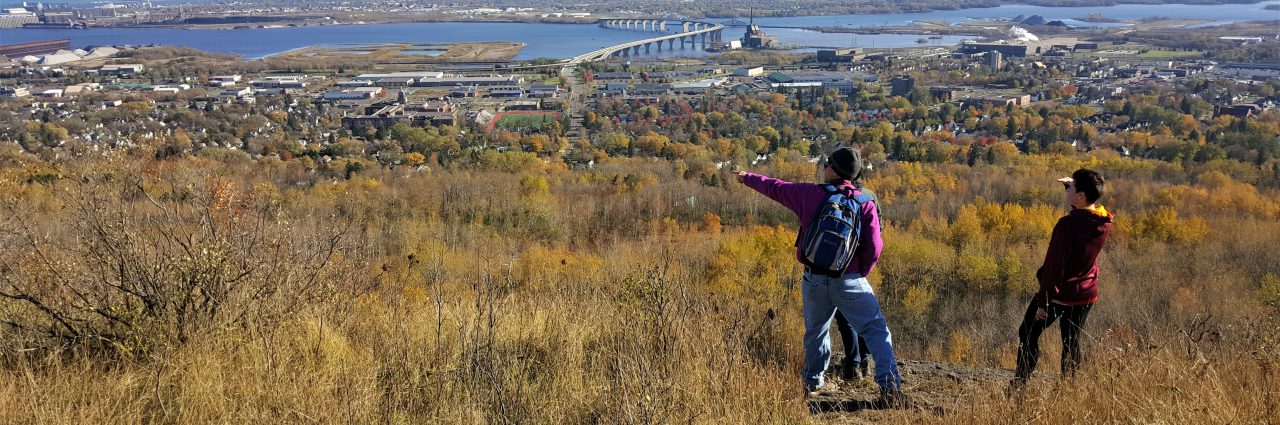
An overlook above the St. Louis River in Duluth, Minn.

We quickly realized we were going to need more judges. In the end, we gathered six who represented a good cross-section of the audience we expected to attend the summit.

The judging was “blind,” which means the poets’ names were not associated with their poems. After two rounds, the judges narrowed the number of poems down to a dozen, with a few for backup in case any of the chosen poets could not be reached.

Although communication was sometimes a challenge, all 12 poets were enthusiastic about participating in the reading. They represented a wide diversity of ages and ethnicities.

The River Talk was a couple of weeks ago, but the warm fuzzy feelings it engendered remain with me. I could use many adjectives to describe it: powerful, beautiful, stark, raw, funny — but it’s really best if you listen to the poems and feel all the feels for yourselves. The reading drew 85 Zoomers, a record attendance.

The Lake Superior Reserve, our partner in the talks, recorded the reading and it’s available on their YouTube channel. Here’s a list of the poets (in the order they read) and the names of their poems:

Tyler Dettloff (Michigan) “My Stars”
Heather Dobbins (Arkansas) “I Held us on for 36 Hours after the Levee Broke to hell”
Ben Green (New Mexico) “Immersion: A Prayer of Intent”
Lorraine Lamey (Michigan) “Catching Your Drift”
Joan Macintosh (Newfoundland) “The Current Feels”
Kate Meyer-Currey (England) “Timberscombe”
Rebecca Nelson (California) “Of the St. Louis River”
Stephanie Niu (New York) “To the Beaver’s Eyes”
Diana Randolph (Wisconsin) “Knowing the Way”
Ron Riekki (Florida) “It Took a Long Time to Discover”
Derold Sligh (South Korea) “Rouge River”
Lucy Tyrrell (Wisconsin) “Talking Water”

Ironically, the one poem specifically about the St. Louis River was written by someone who had never visited it. Rebecca Nelson said her poem, “Of the St. Louis River” was inspired by the spiritual experiences she’s had while watching water. She grew up in the Midwest and said she wrote the poem thinking of the rivers she knew from childhood. “I would love to visit sometime after the pandemic!” Nelson said.

Barb Huberty, St. Louis River Area of Concern coordinator for the Minnesota Pollution Control Agency, offered this comment in the Zoom chat, “I never knew that poetry could unite people across the globe.”

Sharon Moen, Eat Wisconsin Fish outreach specialist for Wisconsin Sea Grant, offered, “Thank you to all the poets and organizers! I am inspired by the depth of your thoughts and stories.”

Remaining River Talks will be held on April 14 and May 12. For more information, visit the River Talks page: go.wisc.edu/4uz720.

The Horses Nobody Knows

If you didn’t get a chance to see my article in “Lake Superior Magazine” about the rare and endangered Ojibwe Horses, the same story has been reprinted in a different magazine: “Equine Monthly.” Click here to read it online.

An Ojibwe Horse, also known as a Lac LaCoix Pony. These horses are well-adapted to life in the northern wilderness.

If you’d like to hear the story behind my story, read my blog post here. These animals are so special. I felt privileged to be introduced to them.