Murals Tied Together by Water

This is a post I wrote for work, but I thought you might enjoy it, too. During the latest St. Louis River Summit, I had the chance to meander over to the library in Superior, Wisconsin, for field trip . . . .
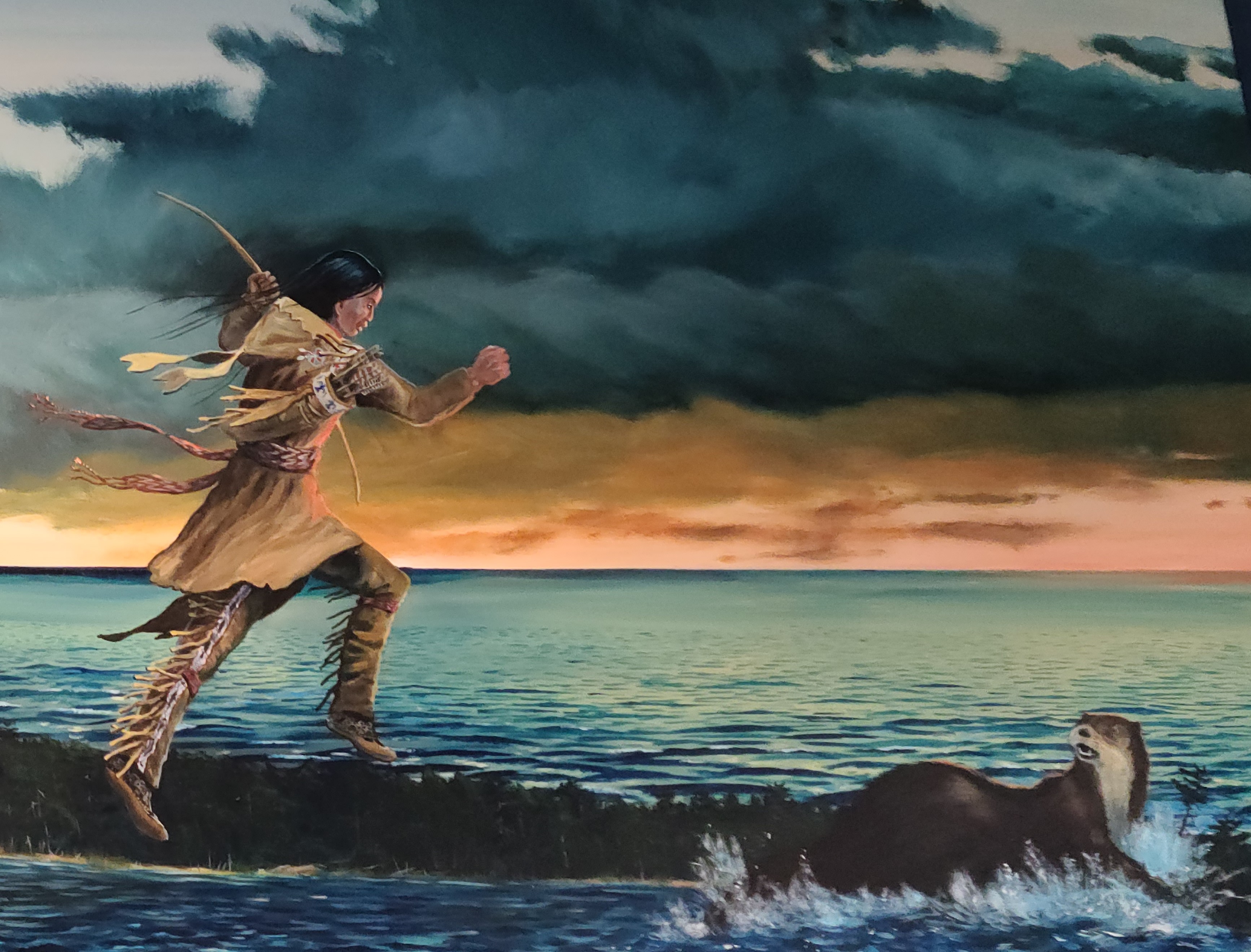
Mural #2 in the Superior Public Library by Carl Gawboy. It shows the area where the Ojibwe people settled on Wisconsin and Minnesota points on Lake Superior and how the points were separated by a giant otter. Image taken with permission by Marie Zhuikov, Wisconsin Sea Grant.

What’s in a library that could relate to a river summit? A series of 35 murals line the Superior Public Library walls, showing the history of the area. Many feature the St. Louis River, Duluth-Superior Harbor and Lake Superior.

The murals were painted over 10 years by artist Carl Gawboy, an Elder enrolled in the Bois Fort Band of Chippewa. The murals begin with the Ojibwe creation story and continue through the 20th century, reflecting how people have interacted with the landscape through time.

Local historian and retired librarian Teddie Meronek led the tour. “I like to say I was here at the birth of the murals, but that started long before any paint went on canvas,” Meronek said. She described how Paul Gaboriault, the library director who commissioned the murals, was a former co-worker of Gawboy’s. Gawboy was born in Cloquet, Minnesota, and grew up on a family farm outside of Ely. He eventually taught at Ely High School, which is where he met Gaboriault. The friends both ended up back in the Twin Ports.

To research the murals, Meronek studied Gaboriault’s and Gawboy’s correspondence. She said the library used to be a Super One grocery store. “If you really look at this building it was just a big warehouse. It wasn’t built for a library. Dr. Gaboriault knew, in his way, that it needed something, and the first thing he thought of were murals.”

The second mural in the series shows the story of how the Superior Harbor opening was created through Wisconsin Point. A giant otter digs as a Native man approaches.

“The great otter represents the Ojibwe religion,” Meronek said. “He is breaking an entryway from Lake Superior into the harbor. The human figure is Nanabozho. He is bringing arts and fire to the land. That was Carl’s interpretation of the legend. The otter is pictured as being so large because it’s representing power.”

According to Gawboy, Lake Superior ties all the murals together, Meronek said. “You can’t always see it in every mural but it’s there. It influences what is going on, which is very true. I’ve lived three blocks from the bay of Lake Superior every day of my life and I can tell you there’s not a day that goes by that the lake doesn’t influence you in some way.”

The location of the horizon line also links the paintings. Meronek said it’s in the same place in each image. As she walked past the murals, she described each one, sharing her impressive knowledge of local history along with personal observations. Other murals include notable buildings and personages, as well as historic events.

Meronek ended the tour on a somber note at a mural of the Edmund Fitzgerald. She often listens to Gordon Lightfoot’s song about the ill-fated ship. “There’s one line in it that always makes me cry: ‘Does anyone know where the love of God goes when the waves turn the minutes to hours.’ Always beware of Lake Superior, right? I can’t even put my foot in it, it’s too cold! What a beautiful thing though, isn’t it? It’s the greatest of the Great Lakes, right? An inland ocean.”

If you’re ever in Superior, stop in the library and take a look. Of course, if you’re not a Superior resident, you can’t check out a book, but you can check out the murals, so to speak. Not planning a visit soon? You can also see the murals online.

“Meander North” is coming!

Nodin Press in Minneapolis is planning on publishing a book of the “best” posts from this very blog. The process received a boost yesterday when I learned I received a grant from the Arrowhead Regional Arts Commission to pay for the book’s editing. I’ve received plenty of grants through my Sea Grant work before but this is my first personal arts grant, so I’m pretty psyched.

As planned at this point, my “Meander North” book will be arranged by season and will celebrate all things northern Minnesotan. Plus, bonus chapters will relate to bookish adventures and brushes with fame. There will also be some content you haven’t seen before. When asked what genre it is, I answer that it will be a blogmoir (blog memoir).

Thank you, Arrowhead Regional Arts Commission, for the grant and for all the work you do to support artists and writers in this neck of the woods!

Whisky, Zero, Romeo . . .

My father and his ham radio.

In my childhood home, my father would sit in front of his ham radio microphone, sending out his call sign to the world. His call letters were W0RXL, which in amateur-radio-speak equate to Whisky, Zero, Romeo, Xray, Lima. (I use the version of “whisky” without the e to honor my Scottish heritage.)

Those of you who have been following my blog for years may remember that my father’s ham radio hobby meant so much to him, we even buried his cremains inside one piece of his radio equipment.

When his call sign made it into some other ham radio operator’s ears in some far-flung place, they would tell each other a bit about themselves and where they lived. My ears would prick up whenever I heard him mention that he had a daughter named Marie. Sometimes he would tell jokes.

I’m not sure how this worked, but apparently, they would even exchange addresses and send each other postcards with their call signs on them. Since my father was also a stamp collector, this transaction did double duty, serving that hobby as well as documenting his contacts across the world.

I swear, he talked more to these strangers than he did to his friends. By eavesdropping on his radio conversations, I learned more about him than I did from our dinner table conversations, which were mainly led by my mother.

Some ham radio operators he contacted regularly. Some he became friends with. I remember we even met a few of them during our road trips across America and Canada when I was young.

The other day, it struck me how much blogging is like amateur radio. We blog authors post our words for anyone in the world to read much like ham radio operators send out their call signs. I’m always amazed how many people from other countries access “Marie’s Meanderings.”

Several bloggers I consider friends and would love to meet with them if I was ever in their necks of the world.

Word Press offers a way to look at what countries have accessed blogs over different time periods. Just for fun, I looked at the stats for countries since I began my blog. Readers from everywhere but a few places in central Africa and islands north of Norway, plus Tajikistan have clicked on my blog at least once. Maybe those places are without internet access.

Not surprisingly, English-speaking countries have the most hits (the U.S., the U.K., Canada, India, and Australia). The country with a foreign language that has the most hits is Singapore, but even so, I guess about half of its citizens speak English at home.

I suppose the comments people leave on my blog (which I appreciate, by the way!) are similar to the postcards my father used to receive. And I suppose if my sons read my blog, they would learn things about introverted me they didn’t know before. I honestly don’t know if they read it. I’m afraid to ask. If they said no, I’d have a hard time with that. Then again, they each have busy lives. Besides, I’m just their mom! What interesting things could I possibly have to say? 😊

Recently, I learned of a new hobby that’s gaining in popularity. It’s called Postcrossing. One of my coworkers participates in it. It’s a project that allows people to send and receive postcards from random people across the world. It reminds me of my father’s hobby, and I bet he would have loved this service.

Through thinking about the similarities in amateur radio and blogging, I’ve come to realize I might be more like my father than I ever suspected. And maybe that’s not such a bad thing.