When a Member of your Writer’s Group Dies

James O. Phillips

In mid-April of this year, the Tunnel Fire engulfed more than 16,000 acres northeast of Flagstaff, Arizona, prompting the evacuation of more than 700 homes. One of those homes was that of Jim Phillips, a long-time member of the speculative fiction writers’ group of which I’ve been a part about fifteen years. Jim joined the group when he used to live in Duluth, Minnesota, and was a member of Lake Superior Writers. After he retired, he moved to Arizona, where he lived alone with two cats for at least half a dozen years. His nearest relatives lived several states away.

After the evacuation ended, a neighbor noticed that Jim’s Jeep was in the same spot it had been before the evacuation. Concerned, the neighbor apparently called the police to do a welfare check on Jim. They found him dead of “natural causes.” He had been dead for several days.

It was during this time we were supposed to have our monthly Zoom meeting to discuss our writing. We hadn’t heard from Jim about his availability for the meeting, so we delayed it until we learned more about his status. It just seemed weird to have a meeting without him.

We were aware of the evacuation and thought maybe he left his home so fast, he forgot to take his phone charger or something. That would be like him. My emails and texts to him remained unanswered, which was unlike him.

There are two other women in our group besides me, Linda and Lacey. Linda is retired and had a bit more time on her hands to investigate what was going on with Jim. Lacey has her own blog (Lacey’s Late-night Editing) and wrote a post that goes into detail about the events, should you be curious.

Linda doggedly tracked down information about Jim and called me when Russ and I were on vacation in Yosemite National Park to deliver the sad news. I was shocked, to say the least. We knew Jim had some health issues, but he had seemed fine the month before when we met via Zoom.

Like I told an acquaintance recently, Jim just “up and died on us with no warning.” It was disconcerting, and it took me several days to get out of my funk, even though I was surrounded by the unsurpassed natural beauty of the park. I found comfort in that beauty.

I’ve become a fan of Spotify and its various music mixes. A song called, “Resist the Urge” by Matt Sweeney popped up in my Daily Mix during vacation. Although I don’t agree with the song’s encouragement not to grieve someone’s death (you need to feel all the feels!), I do like the lyrics that say, “If you need reminders, look around at what is huge and wild and there you’ll see the way . . . I may not be there bodily, but in the wind, I’m here.”

Jim enjoyed hiking and getting out in nature. He often regaled us with tales of his hikes around Arizona. I felt he would approve my turning to nature to grieve. There wasn’t even a funeral for him that we could attend to share our grief. Not even an obituary we could find online. However, Jim started a speculative fiction group in Arizona and a member wrote a post about him (with Linda and Jim’s sister’s assistance). It’s fitting and such a good remembrance of him.

I especially appreciated this comment in the post: “The writing communities of Duluth and Flagstaff will fondly remember Jim for his scientific curiosity, love of all things science fiction and horror, his wicked sense of humor, his keen editorial eye, and his promotion of the Oxford comma.”

Our writers’ group at the Grand Canyon, 2017. From left: Linda, me, Jim, Lacey, Lacey’s husband Ivan and baby.

Since we couldn’t attend a public funeral, my writer’s group decided to hold a ceremony of our own. Last weekend, we gathered in Willmar, Minnesota, (the halfway point between all of us geographically). We had lunch together and then made our way to a state park north of town, where we hiked a short way on a trail (“Trail J,” for Jim). We found a small grove of oak trees and ventured off the trail to sit among them. I’m sure Jim would have approved of the location.

We shared our collective memories and feelings about Jim. We all were grateful for the visit we paid him a few years ago in Flagstaff, where we all gathered for several days. We visited the Grand Canyon and met with the writer’s group he had organized there.

As Lacey so aptly said in her blog post, losing a writing friend is different from losing a “regular” friend:

There is a part of me, a deep and essential part of me, that these three — now only two — people know more intimately than anyone else in my life. To share your writing with another, especially in its formative stages, requires a great deal of vulnerability. And from that vulnerability comes a trust that rivals the trust I have in my husband, my best friend, or my mom. Because time and again, they have proved themselves worthy to be allowed into my inner landscape, the world of my mind that is shared only sporadically with those I share my “real life” with.

Losing one of the few people who I consistently trusted with that part of myself is no small thing. And grieving it is no small task, especially when it is tied up so closely with the very thing I have turned to throughout my life to process everything else. But it’s the only way forward.

Jim provided a unique viewpoint on our writing that no one else will be able to match. Besides that, he was just an all-around good person. Even though he died alone with his cats, the ripples from his death reverberate through our lives, and it’s going to take some time to recover.

I couldn’t write any fiction for about six weeks after his death. When I did try, my output was only half of normal.

I’m okay with that. It’s going to take time to get over this.

When we met in Willmar, we didn’t bring any writing to critique. We’re saving that for our next meeting in August, when Lacey will be in Duluth (from her home in South Dakota). I suspect this meeting will be difficult without Jim, but we know he would want us to continue forward. He’d want us to keep writing. The WORST thing we could do is stop writing.

So, we will keep moving forward, keep putting words to paper. Keep hoping they are worthy.

We’ll miss you, Jim.
A Family Tradition Returns

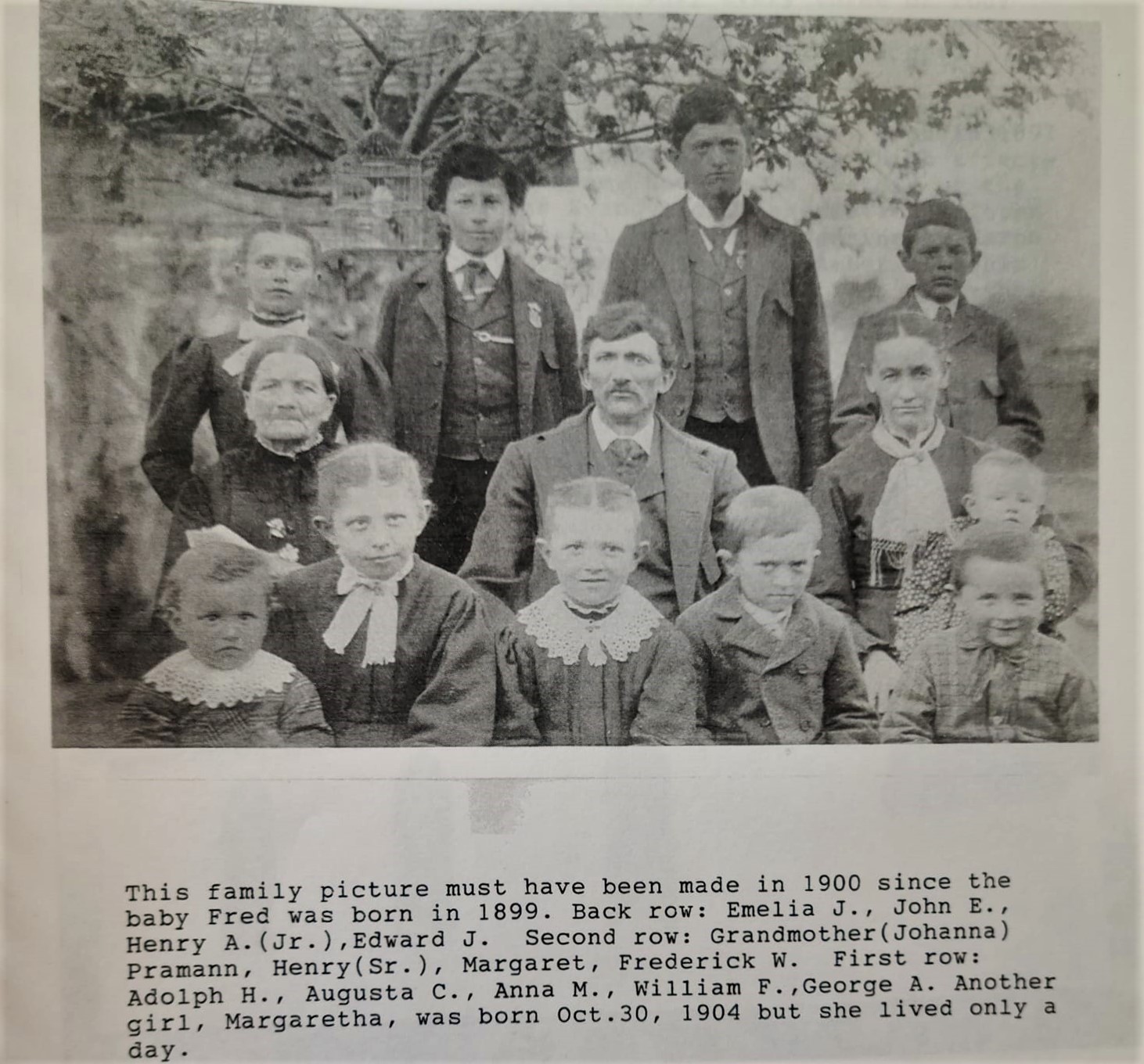
The beginning of the Pramann Family in the United States. Johanna is in the center row on the left. Her husband Johan must no longer have been living at this time. Her son, Henry and his bride Margaret, are in the center row, right. Their multiple children make up the rest of the photo. My grandfather is the dapper dark-haired boy in the back row, second in from the left. Otherwise, it’s kind of a rough-looking bunch! I like that they included their bird in the photo (see cage in background).

Every two years during the second Sunday in June, members related to my father’s side of the family gather south of St. Cloud, Minnesota, and celebrate our relatedness. The Pramann Family Picnic began in central Minnesota in 1957, one hundred years after the original family farmstead was founded. (1857, which was one year before Minnesota gained statehood. The picnic was begun on the centennial on purpose.)

The “founding couple” (my great-great-grandparents Johan and Johanna Pramann) immigrated from Othfresen Germany. It’s speculated that they left, even though Johan’s family were the major landholders in the area, because Johan would not inherit the land because he was not the oldest son. Apparently, there was a tradition that the oldest son inherited the land and the younger sons were given money to build a house in town. Maybe that wasn’t good enough for Johan, so he came to the United States to seek his own land, with his wife and a foster daughter (Augusta, age six) in tow.

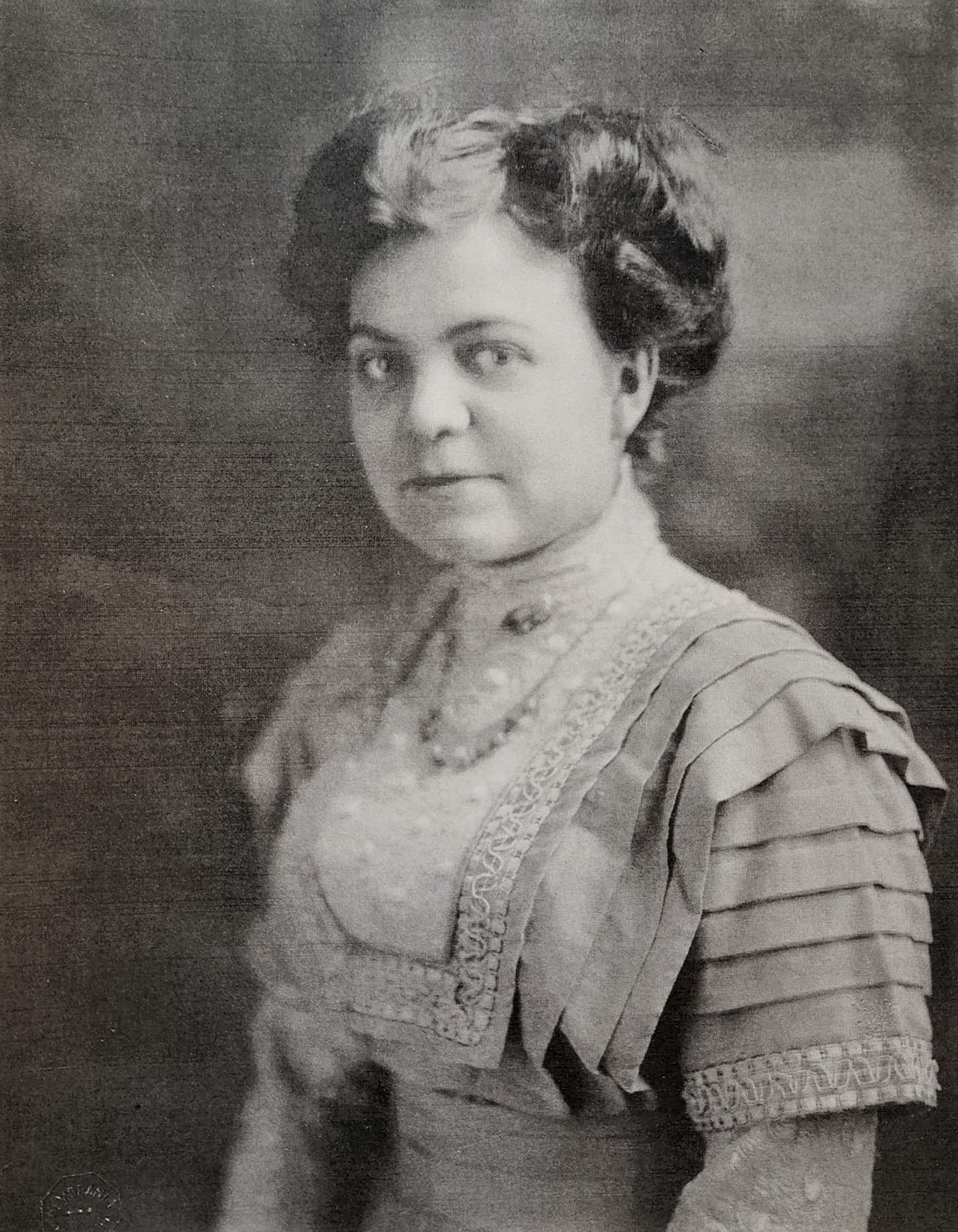
My grandfather, John Pramann

They spent seven weeks on the ocean and finally arrived in New Orleans, taking a boat up the Mississippi River. They disembarked in St. Paul, loaded their meager belongings on an ox cart, and walked beside the cart (the cart was small and there was no room to sit!) 77 miles to St. Cloud, Minnesota, where they stayed with some friends. That must have been a long trip.

Eventually, they settled in Fair Haven and had one son named Henry, who was my great-grandfather. Johan and Johanna were fairly successful farmers in spite of bad times, such as blizzards, fires, and grasshopper plagues.

Henry met his wife Margaret after she immigrated from Switzerland. They had seven boys and three girls. My grandfather John was their second son and was born in the family’s log cabin.

At our family reunion, those gathered usually identify themselves by which of the second-generation American children of Henry and Margaret they are related to. All I need to say is that I’m “John’s granddaughter” and the relative I’m speaking with can visualize where I fit in the family tree.

According to a biography that my Aunt Marguerite wrote, John was a good student. He went to the country school nearby and “remained in the top eighth grade for three years, he said, ‘until I learned all the teacher could teach me.’” With his older brother set to inherit the land, he realized the farm did not hold much of a future, so he went into town to get business training. That’s why my family aren’t farmers.

John moved to Minneapolis and worked for a hardware wholesale company (Janney, Semple, Hill and Co.) for two years and attended an evangelical church there (as did his two sisters) where he met his future bride Louise, “a blue-eyed young woman whose family attended the church and who was employed as secretary to the president of Metropolitan National Bank.”

My grandmother, Louise (Bonsack) Pramann

They moved to St. Cloud, which is about fifteen miles north of Fair Haven, where my grandfather eventually worked as a banker and insurance agent. He built their house with his own hands, but alas, it is not standing anymore. The neighborhood was demolished for a parking lot. Somewhere along the line, they switched religions from evangelical to Methodist, although I guess they are closely related.

One thing perhaps a bit unusual about this side of the family is that they had their own cemetery and church. In 1873, the Pramanns donated some farmland to the Evangelical Association so they could build the church and cemetery. A church was built in 1880 and was known as Gethsemane. The church was officially incorporated in 1887. Services were held there regularly every three or four weeks in the afternoon until 1920. The church is no longer standing. Henry and Margaret are buried in the cemetery, as are Johan and Johanna.

The Pramann Family Picnic was delayed by the pandemic. We hadn’t gathered since 2018, so I was keen to continue the tradition when it returned this year. About one hundred of us gathered in the city park picnic shelter in Fairhaven, Minnesota, last weekend. Everyone brought a dish to share and their own silverware and plates. I brought potato salad made from my mother’s recipe (with black olives, mustard, hard-boiled eggs, vinegar and dill). She often used to make it for these occasions. Families tend to sit together, but also mill around and talk to other relatives they haven’t seen in a while. Most live locally or elsewhere in Minnesota, but sometimes relatives from out-of-state attend. (Pramanns live in New York, Louisiana, and the West Coast.)

After dessert (ice cream is a family tradition and must be served!), a family meeting ensues, conducted according to Robert’s Rule of Order, where minutes from the previous family meeting are read and approved. There’s a treasurer’s report, new family picnic organizers are elected, and various family members are recognized for their youth or age. In the past, people have verbally noted new deaths and births, but this time, everyone was encouraged to write those down on a special form so the family tree could be updated later.

The picnics originally were held at the homestead farm. Then they moved to the city park in Annandale, Minnesota, and then to Fair Haven. In the past, the group sung hymns and pledged allegiance to the flag, but now we just eat, talk and meet.

The Pramann homestead farm outside of Fair Haven, MN, as it looks today.

The weather can be unsettled in this part of the country in June. As a child, I remember my family packing up and leaving one picnic early when the sky turned a sickly green from an oncoming tornado. For last week’s picnic, Russ and I drove through an unexpected rainstorm on the way.

I had never seen the cemetery and church site, or the original homestead before (that I can remember), so, when the chance came to visit them during the picnic, I was eager. A cousin led us on the car ride north of town and down a gravel road to the sites.

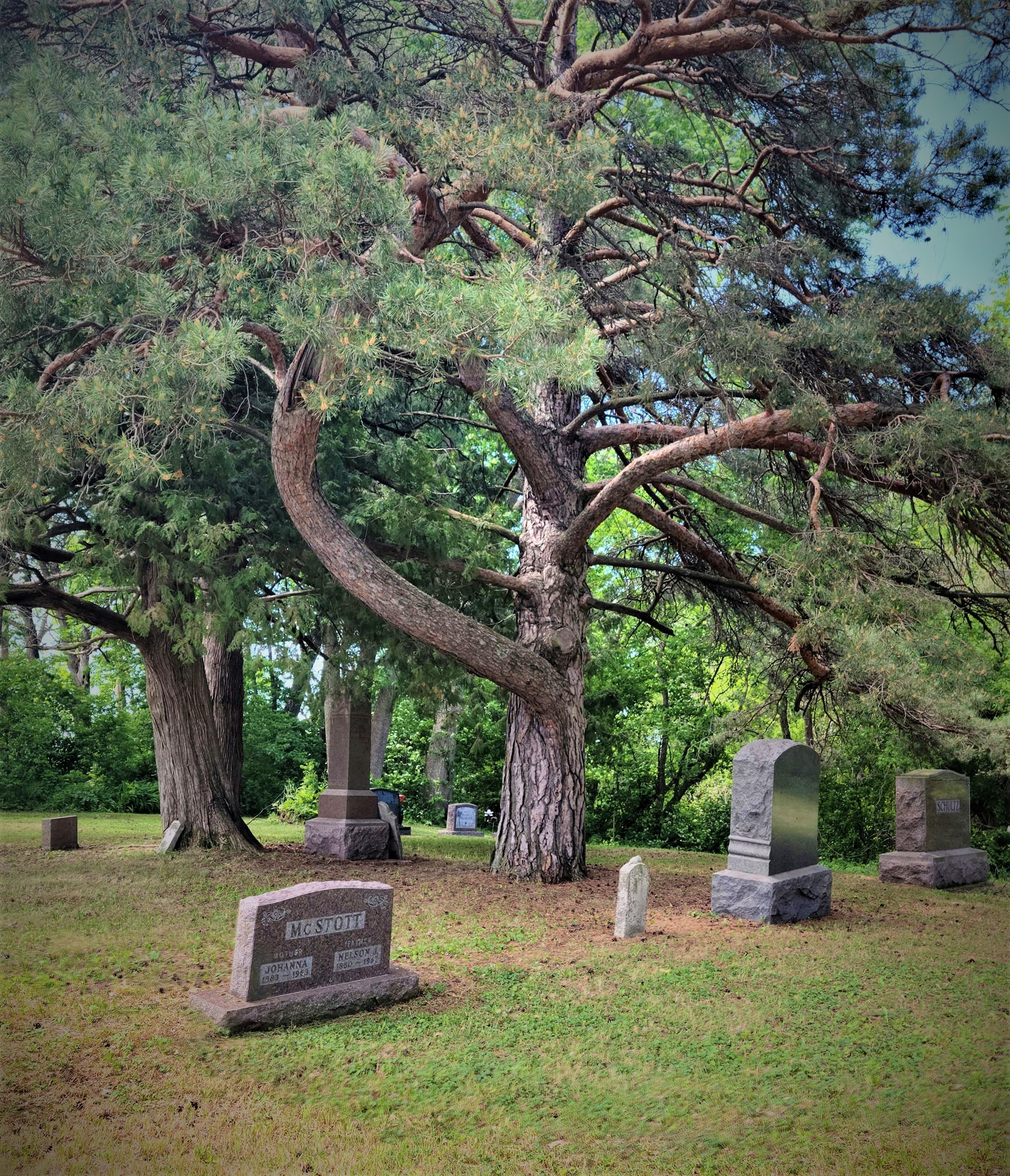
The trees were the first thing I noticed about the small cemetery. Several pines tower over it, one with graceful twisting limbs. These trees feed on the bones of my ancestors.

The Gethsemane (Pramann Family) Cemetary, Fair Haven, MN.

Headstones bearing the name Pramann and other surnames from Gethsemane churchgoers dot the ground. Some markers are written in German. Some are so old the writing had eroded away. Some are so modern their occupants haven’t died yet. Farmland surrounds the cemetery and the Pramann homestead is visible a short way down the road.

Several other relatives arrived at the cemetery after us and regaled us with old family stories. One, that I recall hearing before, involved “how Johanna fed the Indians.” The story was written by my grandfather John (in “Some Facts on the Genealogy of the American Branch of the Pramann Family” – Jan. 1964), but basically, Johanna was home alone one day, cooking. A group of Native Americans – probably Dakota (Sioux) – arrived and asked for something to eat. According to my grandfather’s account, “She placed the large kettle on the floor, where the group sat and ate potatoes and even unbaked dough. After finishing their eating, they left, but a few days later, a whole venison was left on their doorstep.” The couple thought it might have been left in thanks for the food Johanna had provided.

Thankfully, their interactions with the natives were peaceful, or I might not be here to write this blog.

My grandfather John was interested in genealogy and was instrumental is beginning the Pramann Family reunion. My aunt found this prayer in his papers, which he must have recited for one of the reunions. Although dated and patriarchal, I think it sums up the thankfulness that many immigrant families must feel on coming to the United States.

We thank thee, our heavenly father, for the foresight of our forefathers in migrating to this free county where we can worship as we wish. In thy sight we are all equal regardless of nationality, color, creed, or church affiliation.

Lord Jesus, as thou “didst break the bread and bless the loaves by Galilee” bless our food and pour thy heavenly benediction upon us, receive our thanks and keep us all in perfect unity with each other and with thee.

Amen

The Pramann Family Picnic meeting commences in the Fair Haven city park picnic shelter, 2022.

Trillions of Trilliums



Great white trilliums, Trillium grandiflorum

When Russ alerted me to the presence of trillium wildflowers as we cycled along the Munger Trail near Duluth, I leapt off my bike, dug my phone camera out of the seat pack, and haphazardly laid my bike on the shoulder as I scampered to get a closer look at the white beauties.

Russ was probably having a minor heart attack at my treatment of my bike, but the sight was worth a little equipment abuse. You see, trillium blooms only last for a short window of time each spring. Because I’ve missed seeing them the past few years, I didn’t want to miss the spectacle this year.

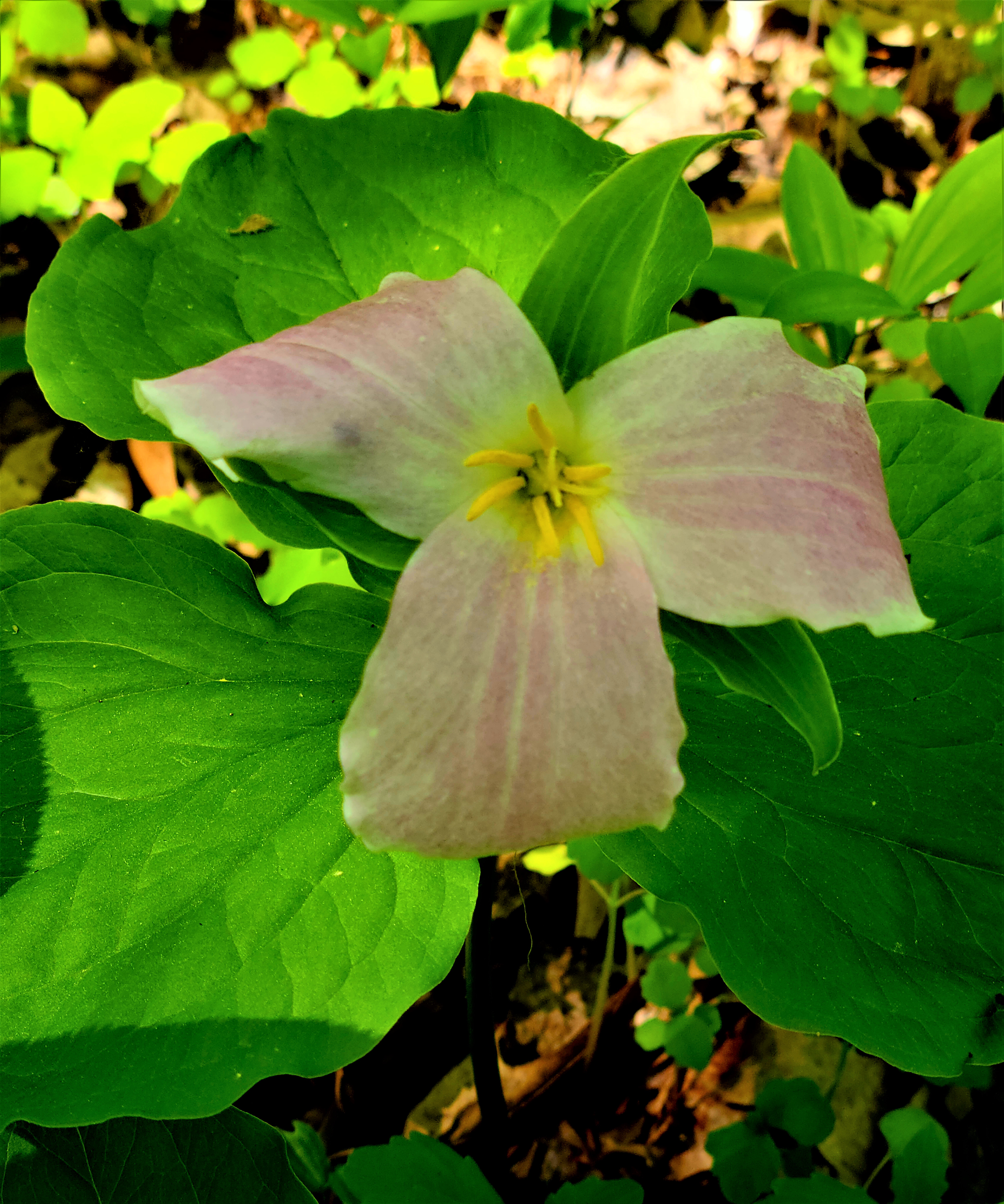
The flower’s three white petals make it easy to recognize. Sometimes they turn pink when stressed by cold or aging. They don’t have a scent, but for me they epitomize the North and the glories of living life here. They grow in maple or beech forests in eastern North America, as far west as Minnesota. It’s also the official symbol of Ontario Canada.

A pink trillium, which means that it’s stressed out.

This is one flower species best left alone in its natural habitat. If you want some for your garden, make sure you purchase cultivated trilliums, not wild ones that have been dug up. There’s some controversy over whether there are actual cultivated trilliums. If anyone knows a reputable source, let me know!

Trilliums sprout from bulbs and take seven to ten years to bloom in the wild. So, think twice or even three times before you go picking that pretty white flower. It’s really better just to take photos and enjoy them that way.

I took a few pictures of the flowers along the trail, then we continued our ride. Eventually, we turned around and took a bit of a different route back.

After being so excited to see a few trilliums, imagine how excited I was on our return trip to see whole hillsides covered with them! To get close enough for photos, I had to scale a ravine and fend off a million mosquitoes. But it was worth it because I saw a pink trillium close-up as well as trillions of trilliums on the hillside. Note: I did not step on any trilliums in the process.

I ended the ride feeling replete with trilliums, and that’s a rare feeling indeed.

Trilliums as far as the eye can see makes for a happy Marie.

Bikes Before the Storm

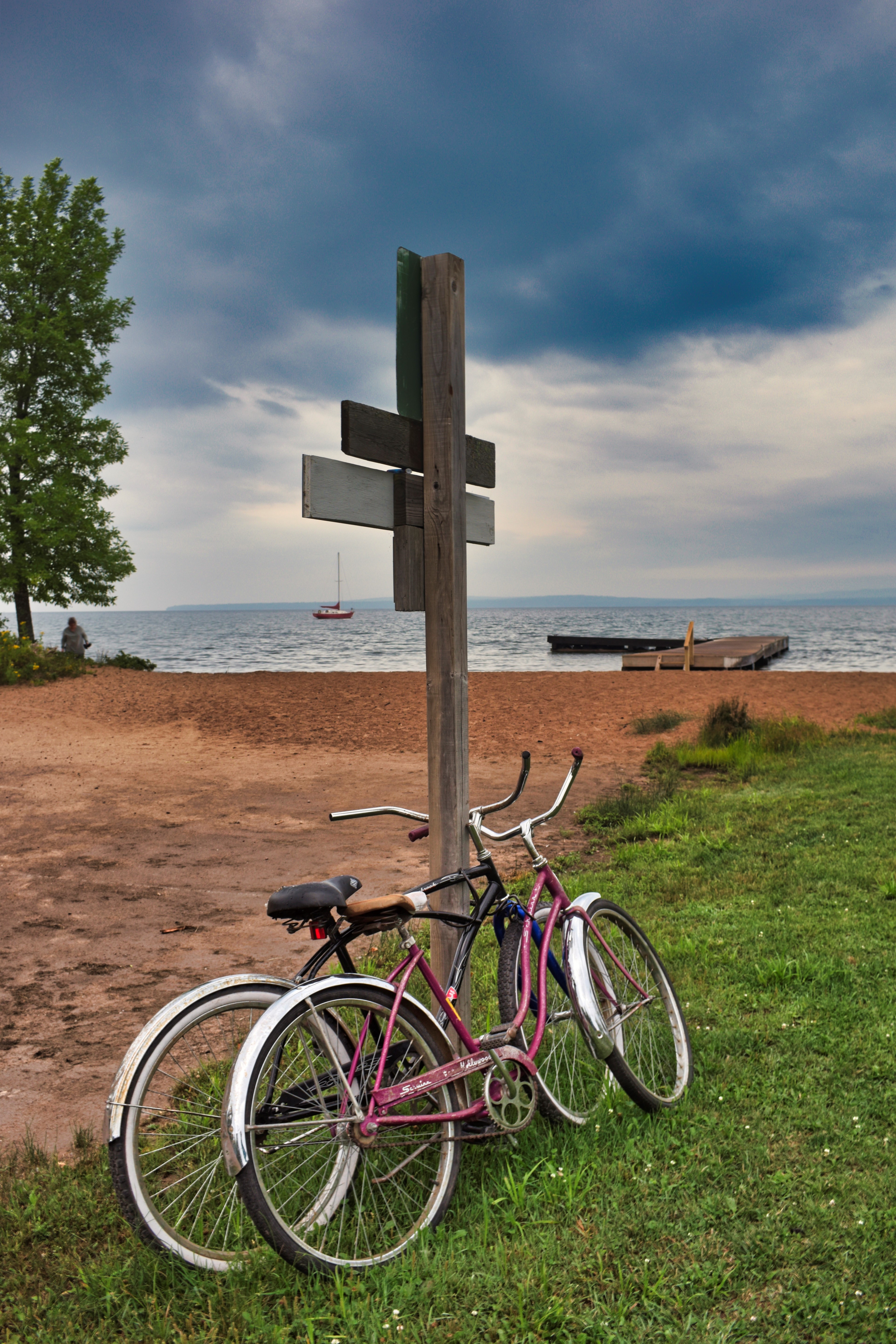
“Bikes Before the Storm,” taken at Joni’s Beach on Madeline Island in Lake Superior.

A photo I took last summer earned an honorable mention in a national “Coastal Love” contest organized by the National Oceanic and Atmospheric Administration’s Office for Coastal Management. The images chosen celebrate America’s coastlines – both salt and freshwater.

Sailboats moor off the beach and I suspect the bikes were there for boaters to use to get around town after they row ashore in their dinghies. I was on the beach for a sunrise shoot, but as you can see, the sun was not cooperating.

Getting photo honors is a first for me, so I’m pretty psyched. You can see the other winners here: https://coast.noaa.gov/about/photo-contest/.

To see more of my photos, visit my photo collection page.