Russ and I meandered to the big city recently: i.e., the Twin Cities, i.e., Minneapolis and St. Paul, Minnesota. One of our stops was a tour of the Wabasha Street Caves in St. Paul.
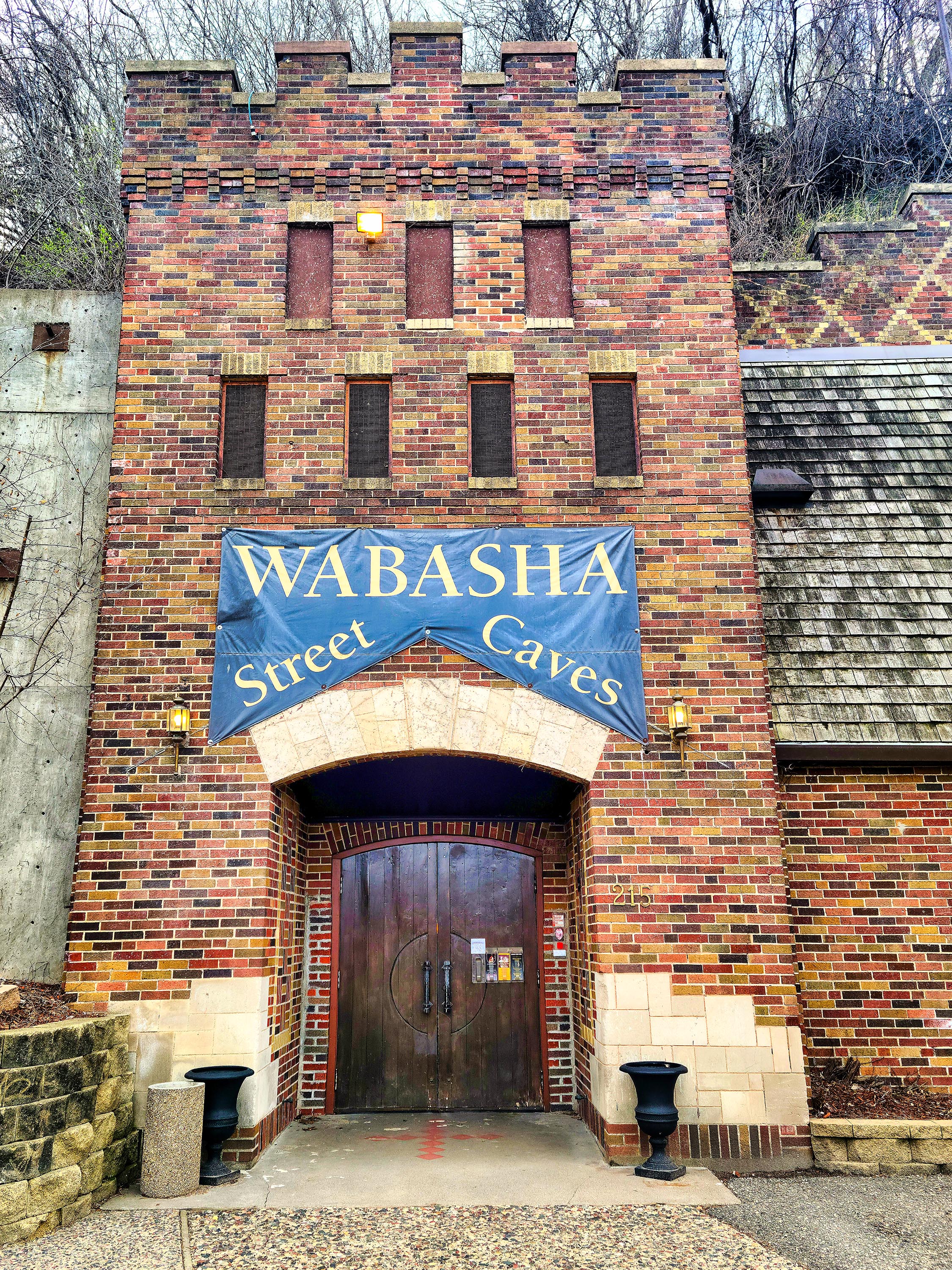
This series of seven caves are in a sandstone/limestone bluff not far from the Mississippi River. They were dug in the 1850s to mine silica for making glass.

Our tour guide was named Lois. She began our tour not in the fancy entrance that leads to a refurbished part of the cave, but in a more primitive entrance, where we could see what the unfinished, original walls look like. While we stood in front of an entrance to a side cave, Lois explained that once the silica mining was over, the caves were used to store produce from off the river boats. Temperatures range from 50 to 55 degrees, which makes the caves ideal for storing veggies, growing mushrooms, and aging cheese.
The Wabasha Street Caves were once home to the largest mushroom growing operation in the United States. An immigrant Frenchman and his wife saw the cave’s dampness, darkness, and cool temperatures as the perfect environment for growing the delectable fungi. Plus, the streets of St. Paul provided a free source of growth medium in the form of horse manure.
Although that operation eventually ceased, the mushroom company lives on today in the form of Lehman’s Farm in Lakeville, Minnesota, which sells its marinated mushrooms to high-end food outlets like Lunds & Byerlys. The caves were also used by the Land O’Lakes Company to age Roquefort cheese.
In the 1950s, the caves fell into disuse until a flood caused massive damage to St. Paul. Lois said the caves were seen as the perfect place to store all that untidy debris. She shined a light down a side entrance where she stood to show us it was filled with old tires and dirt. But, before the flood, in the 1920 and 30s the cave was modified as a speakeasy, casino, and a nightclub. The debris-strewn side tunnel was thought to once lead to the speakeasy.

From there, our tour moved into the refinished part of the cave. We saw the long bar, which was rebuilt based on old photos. Stucco covered the ceiling and water pipes and electricity ran through the walls. A separate section contained a dance floor, fireplace, and a stage. Lois said that famous jazz bands used to perform in the cave’s Castle Royal Nightclub.
The nightclub and casino were favorites with local gangsters. St. Paul had the reputation as a safe haven for them. The police wouldn’t arrest gangsters as long as they didn’t commit any crimes in St. Paul, although Minneapolis was fair game! The gangsters also shared their ill-gotten gains with the police department. This was called the Layover Agreement.
Despite this agreement, one notable crime happened in the caves. Four gangsters were gambling after hours. One of them apparently took umbrage at the conduct of the others and shot them all dead with his Tommy gun. At the noise, a cleaning lady ran in from another room to find three of the gangsters lying dead in pools of blood. She alerted the police who came to investigate.
Suffice it to say, with the cozy relationship between the gangsters and the police at that time, justice was not served. The police cleaned up the scene and chided the cleaning woman for filing a false report. It’s thought the bodies of the three gangsters still reside in the caves somewhere. Despite the protestations of the police, evidence of the crime can be seen in bullet holes on the cement fireplace.
Now the caves function as an event center and tourist attraction. They offer swing dancing and special ghostly tours. We were fascinated to learn about the caves and the shady history of the city of St. Paul.
 Marie's Meanderings
I’ve done the Cave Tours, but have never seen the ‘entertainment’ part of the caves fully decorated…what a treat!
They say St. Paul rolls up its sidewalks at 5 pm and it’s the city in which you raise your family; if you want to party, just cross the river to Mpls. Apparently not true in gangster days! 🙂
Yes, it sounds like there was plenty of corruption going on in the gangster days. In terms of the event center, other than for the lack of windows, you’d never guess you were in a cave!
So interesting! I’ve lived in the twin cities over 30 years and have never gone there. Now I need to go! I had heard that story of how the gangsters wouldn’t be arrested in St. Paul on a walking tour of Summit Avenue, another interesting tour. Thanks for sharing 👍
Yes, you should definitely check out the caves! I have not done the Summit Ave walking tour. Will have to try that some time.
This is fascinating. It’s hard to pick something that I found the most interesting, but I think that would be the gangster story. The quirky fact I liked was the use of horse manure off the street to fertilize the mushrooms!
I guess the French couple used to grow mushrooms in the sewers when they were in France with the help of “human fertilizer.” Ewww! That makes manure sound not so bad.
Have any of you-all read Meridel Le Sueur’s novel “The Girl”? I believe it’s mostly autobiographical, but is written about a young woman in St. Paul, during Prohibition. Written in 1939, then blacklisted due to McCarthyism, then finally published in 1978.
Terrific, IMHO.
No – I’ve read Meridel’s book about writing, but none of her other books. Sounds like one worth adding to my list! Thanks.