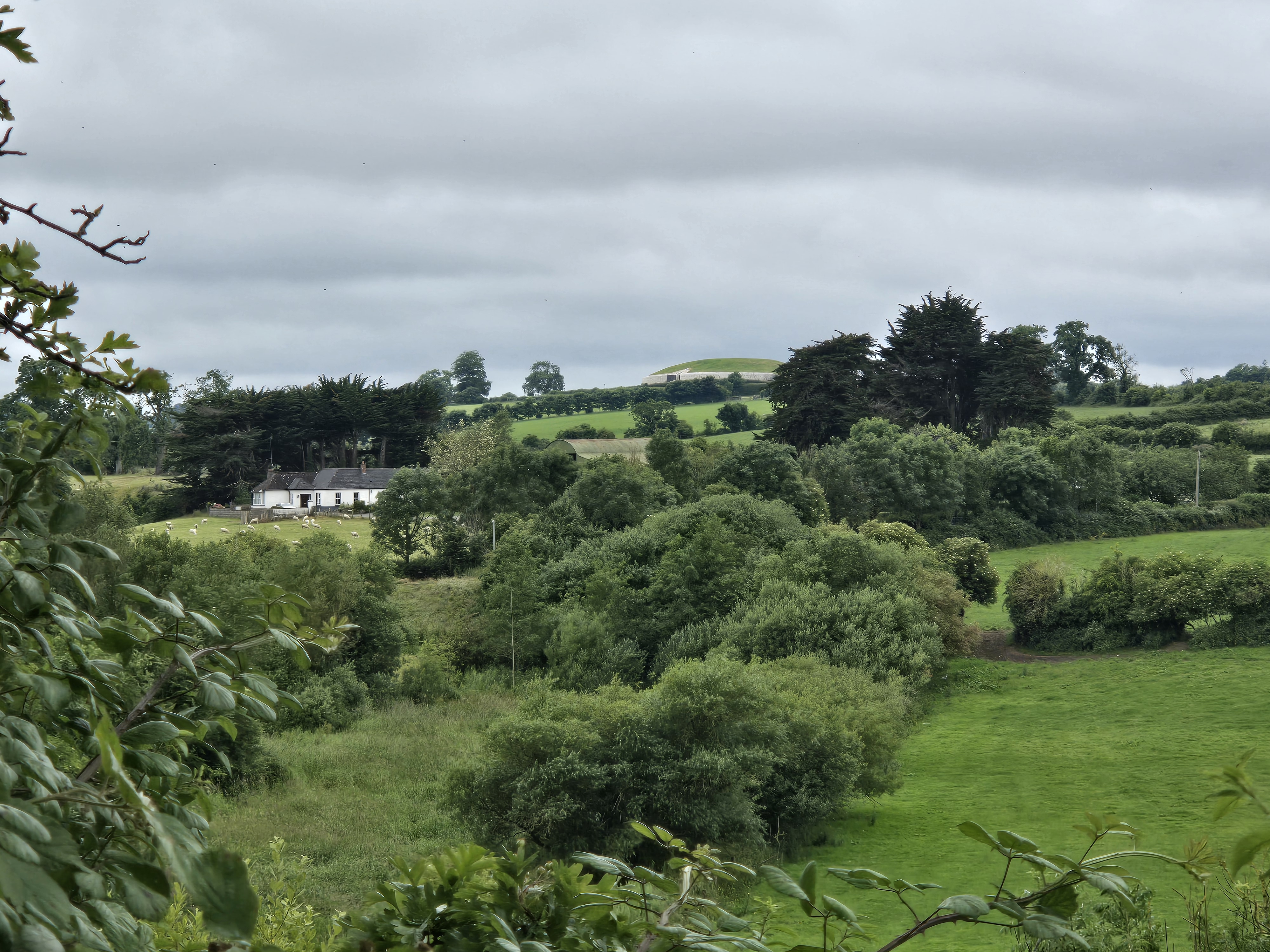
Surprises and mystery lay in wait for us on our final day in Ireland. We took a long cab ride from Dublin to the World Heritage Site of Newgrange, also known in Gaelic as Brú na Bóinne. Newgrange is like the Stonehenge of Ireland. It’s actually older than Stonehenge (and the Egyptian pyramids) and is likewise one of those mysterious Neolithic sites where during the Solstice the sun shines through the stone doorway and lights up the interior. Never having been to Stonehenge (yet), this version was a must-see for our trip.
Surprise No. 1 had come a few weeks before when we made reservations for a tour of the inner chamber at Newgrange. I had thought there was only one passage tomb mound at the site, but discovered there are two other large ones (Knowth and Dowth), plus standing stones and henges. We chose the main tour option, which includes entrance to the visitor center, a guided tour of the Knowth mound, and access to the chamber at Newgrange.
The visitor center does a great job of interpreting the site and it has a gift shop, which we appreciated more after our tour and learning about the significance of the symbols on the passage tombs. The shop sells jewelry and other things with those designs on them.

We spent about 45 minutes in the visitor center before the start of our tour. Our tour began with a walk across the fabled River Boyne to a bus stop. I was excited to see the river in person. Our former minister, who was of Irish descent, often referred to the river in his tales of the “salmon of knowledge” from his trip to Ireland. Crossing the river on a small bridge, I was struck by the sheer lushness of the landscape and all the life that the river brings to it. Other than for some nearby farms, the area is largely undeveloped. It’s like an Irish Garden of Eden! I could imagine what it must have looked like in those Neolithic days (3200 BC).
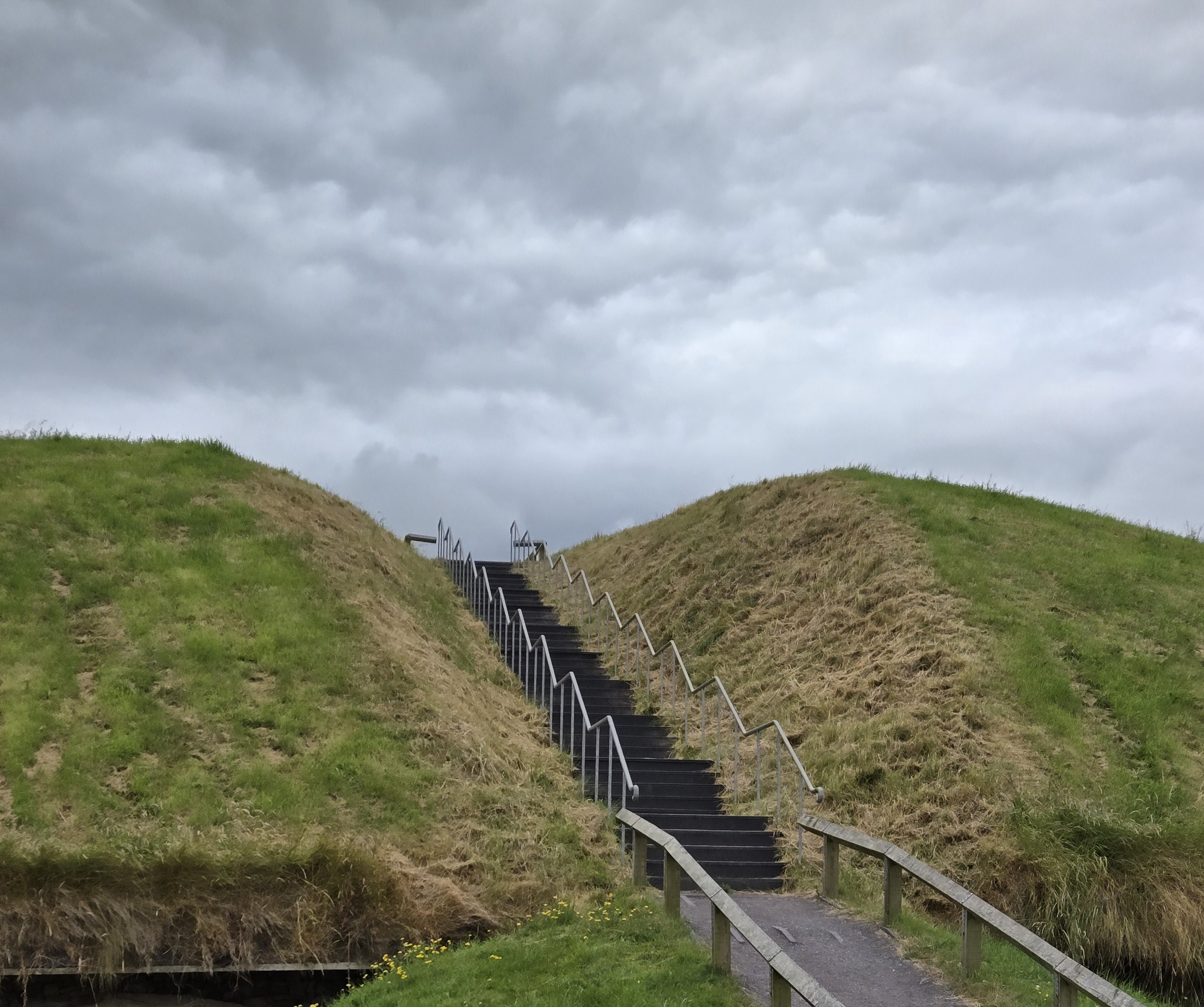
After waiting at the bus stop with two dozen other people, our bus arrived. We boarded and rode through narrow rural Irish roads to the first stop at Knowth. It featured a large mound surrounded by 17 smaller mounds. Although no tours of the interior of the large mound are offered, a stairway is cut into its side, and we could climb atop it.
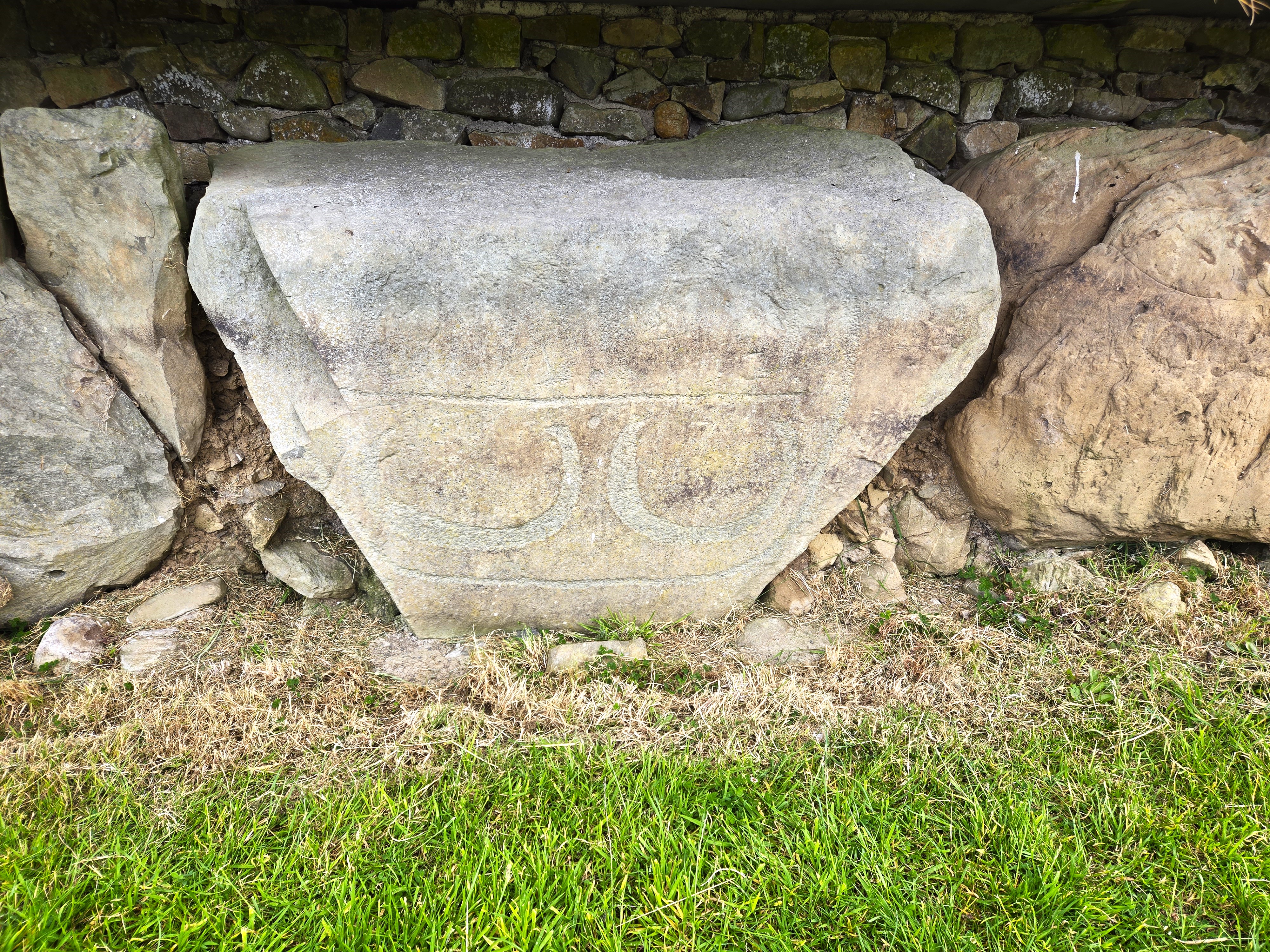
But first, we walked around the mound, admiring the largest assemblage of megalithic art in Europe. Designs were hand-carved (of course) into the stone. Unlike the main mound of Newgrange, every stone at Knowth seemed to be carved. They’re called kerbstones and there are 127 of them. Most interesting to me was the Mirror Stone, which sports two U shaped carvings. When the sun shines on them during the equinoxes, the shapes are mirrored below the originals. Some theories suggest they represent crescent moons. So cool!
The tour guides didn’t come right out and say it, but I learned that these mounds are like human-made wombs. Knowth features two independent stone slab passages built along east and west lines. The passages were covered with layers of soil and stone. They end at cruciform chambers—think the end of a cross or a uterus and ovaries. Cremated remains of the ruling class were placed in these side chambers, along with bones.
Surprise No. 2 was that the kerbstones are also carved on the inside—the sides that faces the mound. Our tour guide said this was so the dead could “see” the carvings also, but other things I’ve read suggest the stones were already carved elsewhere and were just reused for the mound. I prefer the first explanation. The huge stones were transported from surrounding areas by boat, or they were pulled on ox hides over the river ice.
The view atop the mound was amazing! This area is steeped in so much lore. If you ever go on the tour, interpretive signs atop the mound will describe the sites you are seeing. During the Middle Ages, a royal residence was built on the mound, but it’s no longer there.

Close to the Knowth mound and off to one side is a wooden henge. Surprise 3 to me was that there used to be such things. I thought all henges were built of stone. The original henge was made of oak trees, but the modern recreation features spruce tree trunks. Our guide said that when the site was used for rituals, tables were in the middle of the henge sheltered by a tarp. The bodies of the dead were laid on the tables for decomposition, I assume before they were moved inside the mound. The guide also said that the remains or cremains of 200 people have been found in the mounds and that Knowth mound was used as a giant refrigerator. Nine “sutrains” — things like little root cellars—were dug into the sides of it for food storage.
After our tour, we boarded the bus for the short drive to the Newgrange mound. It’s the largest mound in the area and is thought to have taken many years to build. Who built it? Our guide said that DNA testing on the remains in the mound shows a relationship most closely to people of Sardinian descent. Surprise 4 is that these people weren’t the ancient Irish! I’m sure they became the ancient Irish as they had families here, but huh. I wonder if that’s where the “dark Irish” come from?

During the time the Sardinians came to Ireland, the culture was changing from hunter-gatherer to farming. It would make sense that knowing the cycles and location of the sun would be important to farmers. Perhaps the Sardinians were ousted from their land in a royal feud or something. They were obviously highly intelligent and became a ruling class in their new land.
A large oblong stone lays on the ground at the entrance to the Newgrange chamber. It features at least spiral designs, which are thought to represent different life stages: birth, death, rebirth; or birth, adulthood, and old age.

The guides warned us that the stone chamber is very narrow and low, and that larger people might not be able to make it all the way inside to the end chambers. We entered single file. Russ said that a couple people on our tour did have to turn back because they couldn’t fit. We made it to the end, however, and were treated to the sights of more spiral stones and basin stones that used to hold the bones and cremains.
Once we were all gathered, our guide turned off the lights. Another guide outside shined a light to simulate the sun during the Solstice so we could see what the chamber looked like on its banner day. A hush fell over us and I’m sure I’m not the only one who was awestruck.
Once the lights came back on the spell was broken. If you are a person of average dimensions, I highly recommend the chamber tour! Emerging from the chamber did feel like a kind of rebirth through time and history. We wandered off into daylight, returning to the modern world.

 Marie's Meanderings
There is a wood henge near Stonehenge and in 1998 another was discovered after coastal erosion off the Norfolk coast. I think there are others, but these are the two I know of.
Oh, interesting! Thanks for the info. These old sites are so interesting!
This must be an anthropologist’s dream destination.
Yes, it made me wish I could redo my career!
That’s how you know you had a great visit.
Hi. Very interesting. I don’t think I’d heard about these mounds before. I’ve enjoyed your Ireland articles.
I think it’s so impressive that the mounds are even older than the pyramids. I also like that the area’s not fully developed like it would be in the U.S. Still very rural and non-commercial.
Wow! This is something I’ve never heard of. Your explanations and photos have really intrigued me.
It’s quite the place to visit. Takes some pre-planning for reservations and because it’s sort of in the middle of nowhere, but it’s worth it!
Thank you for taking us with you on your adventures! I love this!
Thank you, Gail. Nice to hear from you! I hope y’all are well.
What an adventure! Beautiful photos.
Thank you, Amy! I enjoy seeing your photos, as well.
Newgrange definitely sounds like a must-see. Your description of the inner chamber, the experience of entry and exit? (Shiverrr!)
Thank you! I thought I would employ a bit of literary journalism on that part of the story. It’s definitely worth seeing.
Wow! I’ve just finished reading about your trip to Ireland and Northern Ireland. I think I will write some comments via your Contact page. 🤗🍎🍏🙋♂️