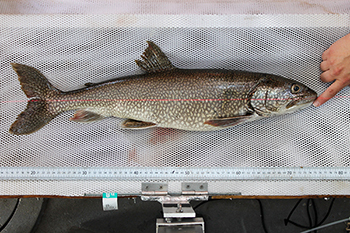
The Michigan Department of Natural Resources (DNR) published a story a few days ago that made many people upset. As someone who has her feet in both natural resources management and public relations/science communication it offers an interesting case study. The DNR was trying to highlight an interesting fact about how fish can reach old ages, but some mistakes got in the way of this message.
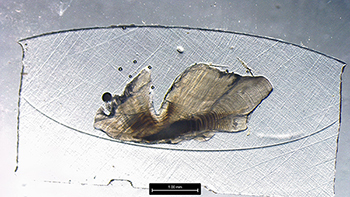
The ear bone of one fish they caught in a special survey done in 2023 to study the different forms of lake trout and their reproductive biology was recently analyzed and the DNR discovered that the fish was as old as I am! (62 years) They caught the lake trout on a reef in the southeastern part of Lake Superior (40 miles north of Grand Marais, Michigan) and this lake trout is the oldest one currently on record.
The ear bones of fish show annual rings much like a tree, and that’s how the DNR can tell the age of the fish. It’s the only way they can do this, and they have to kill the fish to extract the ear bone, also called an otolith
One mistake the technicians made was naming the fish. They picked the era-specific moniker of Mary Catherine because Mary was one of the most common names in 1961 when the fish was hatched. People who heard news reports were excited that such an old fish was found, and that it even had a name, only to be crushed when they learned later that the fish was killed in the process of discovering its age.
One Facebook commenter said, “Hey we just killed Mary Catherine, but the upside is we now know that she was 62 years young, much like many grandmothers and recently retirees. There’s one less on Social Security now, and that should help keep it solvent.”
Another said, “Sad that they killed a fish who is probably older than the combined ages of some of the researchers, but it is interesting information.” Another commented that the fish might have lived another 20 years if not sacrificed for science.
You might think that such an old fish would be very large, but she wasn’t. Mary Catherine weighed 2.1 kilograms (4.62 pounds) and was 627 millimeters (24.7 inches) long. That’s because Lake Superior doesn’t have much food in it and animals grow slowly. The typical lifespan for a lake trout is 25-30 years.
The story gained wide media coverage, so it was successful that way, but even some of the reporters were dismayed that Mary Catherine was a goner. People already love to hate the DNR, and this well-intentioned science story just gave them another reason.
I’d say the main lesson is not to name your research subjects in newsworthy stories, especially if they’re dead.

The researchers were mum about whether they were inspired by the Saturday Night Live character, Mary Katherine Gallagher.
 Marie's Meanderings
Another argument for leaving the mystery be! Those commenters were savage. Love it!
The commenters were savage. There were many more comments from them that I could share, but this is a family blog. 🙂
Interesting. I have mixed feelings about how this fish died. People go fishing everyday (summer thru winter), and the end result is the death of a caught fish–even sometimes with “catch and release” practices. And let’s face it, most people fish for entertainment and/or relaxation and not to feed their family. I would assume that the fish was handled humanely and provided some important research data, which is a better than dying just for the entertainment purposes.
So true. I didn’t mention it, but the FB comments about the original article devolved into name-calling. Some commenters called others “sissies” for being squeamish about the killed fish. “Fish die every day! Get over it!” they said. “It’s just a fish!” others said. I think the fact that the researchers named it, like you would a pet, is what gets people.
It is too bad that so many people post toxic comments these days. One can disagree without being mean or extremely negative. BTW, thanks for posting such an interesting “fish story.”
So true, Diana. Thanks for being a faithful reader and commenter!
I might have to call that a “bonehead move”! 😂
OMG – so good!!!
It’s interesting that we humans have selective compassion for creatures. How many other old fish or other animals have been killed for the benefit of mankind?
So true. Probably a lot of other old creatures have been killed. Even sport anglers probably kill a lot of old fish unknowingly.
Wow, interesting that a fish could live this long. And I had no idea about the ear bones used to date the fish. Or that they had ears! Great post!! 😊
Thank you! I’m glad to have enlightened you about fish and science.
I’ve have met many who catch and release through my kayaking adventures. I think there are upper and lower limits of length that they can keep. I also know people who hunt and fish and eat what they are allowed to eat. I’m surprised a larger fish never caught this one. It avoided being prey all these years.
I wonder if there are many larger fish in Lake Superior? The lake is so cold and there’s not much food in it compared to the other Great Lakes. I know that sturgeon get larger but they are bottom feeders. But perhaps this fish had special powers at hiding from any larger fish?
I wonder what purpose was served by killing the fish. Did they just want to learn its age? They could have just asked Mary Katherine, but she probably would have lied about her age. My nana always lied when someone asked her age. But I keep thinking there may have been a scientific reason they wanted to learn the age of fish in the area. Either way this reminds me of the opening in the nonfiction book American Canopy, where a bristlecone pine named Prometheus was cut down. It was determined to be over 4,800. It was cut down in the name of research, even though it was known to very, very old. However, just like the fish, the tree’s true age couldn’t be determined without being cut down.
The old fish was caught for a special survey to study the different forms of lake trout and their reproductive biology. The only way to age the fish was to kill it so they could look at its ear bone. And you’re right, Mary Catherine probably would have lied if asked directly. 🙂 For the Prometheus tree, I wonder why they couldn’t just take a tree core sample instead of cutting it down? Alas, there is no such method for fish.
The person who cut down the tree did it as part of his graduate studies. After it was found to be the oldest living tree in America, what he’d done was controversial. It makes my heart ache to know such a fine, old tree was cut down.
Marie, the science was solid; the storytelling stumbled. With record-old trout, the method matters as much as the message—and naming a lethal sample invited the backlash.
There are three techniques for aging fish:
1. Otoliths — most accurate for old fish, but lethal.
2. Scales/fin rays (clip-and-release) — non-lethal, yet tend to under-age long-lived salmonids; pelvic fin rays can outperform scales but still trail sectioned otoliths in confidence for very old fish.
3. Epigenetic DNA-methylation “clocks” — non-lethal fin clips/blood showing strong accuracy in trials, but not routine yet for lake trout management.
Bottom line: the age result was defensible; christening the specimen wasn’t. Let the rings speak—62 winters under Superior is wonder enough.
Thanks for sharing your scientific expertise with us!