How Hallmark’s “Rescuing Christmas” Movie Made my Tree Ornament Famous

The main characters in “Rescuing Christmas.” Image courtesy of Hallmark.

Russ and I watched “Rescuing Christmas,” a Hallmark movie this weekend that is set in my home of Duluth, Minnesota. The movie is available on the Hallmark Movie Now Channel. If you have an Amazon Prime membership, you can get a week-long free trial membership, which we opted for to view this movie.

I know, I’m so cheap!

Hallmark shot another Christmas movie in my fair town last year. It was called “Merry Kiss Cam” and dealt with a Christmas romance between a bar owner and an artistic painter. I don’t recall that “Merry Kiss Cam” ever specifically mentioned the setting was Duluth, but that was refreshingly clear in “Rescuing Christmas.” This was one reason I liked it better.

I also liked it better because it didn’t try to make Duluth look like something it’s not. There were plenty of local landmarks included in the shots, from OMC Smokehouse (a restaurant whose name stands for oink, moo, cluck – very meat-centric, but vegetarians can find something to eat there, too), and other Lincoln Park businesses including the Dovetail Café and Frost River, which is an outdoor clothing and equipment store. Those familiar with Duluth will also recognize the Aerial Lift Bridge, Bayfront Festival Park, the train Depot, and one of the red brick mansions that are frequent sights in the eastern part of town.

The movie follows several days in the life of Erin, a talented photographer whose Christmas spirit has been ruined by a past breakup. She’s granted three Christmas wishes, her final wish being that Christmas would just disappear. To her bewilderment, it does! Can Sam, her potential (and rather generic-looking) suitor who is a wood-carving lawyer, help her bring back Christmas to the world?

Other things I liked about the movie are that it wasn’t too smarmy and that it attempted a bit of diversity. Get this, there was a Black Santa. Plus, a Black Santa overlord, who had Star Trek tendencies. She was rather like a combination of Captain Kirk and Lieutenant Uhura. Good for Hallmark to at least try for some diversity.


My now-famous Christmas tree ornament.

Yet another thing I liked about this movie is that an ornament similar to one we happen to have on our own Christmas tree plays a pivotal role! The ornament is a birch tree slice that features a painting by Kate Kebbekus, a local artist. It depicts a grove of white birch trees with a red heart etched into one of them. (What the movie doesn’t show you is that there’s another painting on the back that features a red Christmas ornament.)

I bought the ornament at a local Christmas fair a couple of years ago. I could not believe it when a similar ornament showed up in the movie! Sam gives the ornament as a present to Erin when they celebrate their first Christmas together. Sam said that the ornament was one his family used to hang, and it was his favorite. Erin reacts favorably, giving him a big smooch in front of all their relatives and friends.

It’s a Hallmark movie, so, of course, everything ends happily for all.

If you’re a “Marie’s Meanderings” devotee, you may remember that I created my own Hallmark Movie Drinking Game during the pandemic. The rules involve imbibing varying amounts of alcohol depending on what formulaic scenes occur in the movie.

In the case of “Rescuing Christmas,” there are not as many formulaic scenes as usual, but there are a few. The Christmas kiss between the main characters is the biggest one. According to my game, that is on the highest level and involves a whole shot of liquor.

Lessor imbibing results from the scenes where “a cynic is filled with the Christmas spirit” and “a Christmas-themed food is mentioned.” In this movie, the food are pizzelles, or Italian cookies. In my game, these require finishing your drink.

One sip is required whenever the town mayor appears, hot chocolate is on screen (lots of those scenes are in this movie, usually with a peppermint stick), mistletoe makes an appearance, and a character makes a deal with Santa or one of his minions.

Russ and I did not play the drinking game during this movie, but if you do, there’s probably enough for a proper buzz.

Even if you don’t play the drinking game, the movie could help you get into the Christmas spirit. We watched it after a day of decorating amidst a gentle snowfall that provided the required ambiance but did not amount to enough to shovel. Now that’s something everyone can get behind.

Happy Holidays, everyone!

A Lake Superior Survival Story

Angelique and Charlie Mott. Image courtesy of “Abandoned: Angelique’s Isle”

We recently watched the movie “Abandoned: Angelique’s Isle,” which is a based on a true story set on Isle Royale in Lake Superior. I’d heard of the movie before but never had an easy way to view it until it turned up for free in my Redbox feed. Can’t get much easier than that!

Longtime readers are probably well-aware of my love for this wilderness island. I had a chance to revisit this national park this summer and fulfill longtime dreams. As wonderful as the Isle Royale is in the summer, I can’t imagine spending a winter out there.

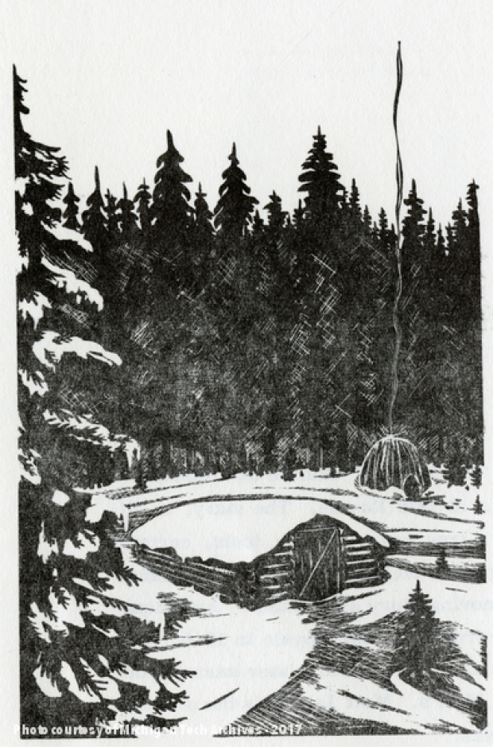
A sketch of the actual Angelique, courtesy of Michigan Technological University archives.

But that’s just what happened to a French voyageur and his Metis wife during 1845. Charlie Mott met 17-year-old Angelique and they lived at LaPointe on Madeline Island – although the movie makes it look like they were in Sault Ste Marie. Looking for work, Charlie is persuaded by some bigwigs from Detroit to visit Isle Royale on a mission to find copper.

Despite Angelique’s grandmother’s concerns, Angelique accompanies him and ends up being the one to discover copper – a huge mass. In the movie, the copper boulder is up on the shoreline but in reality, it was in the water. It’s summer and the Detroit men convince Charlie and Angelique to stay on the island for a few weeks so that the men have time to stake a claim. They said they’d send a supply boat and then they’d return for the copper and take them off the island before winter.

The couple agree and find shelter in an old fishing cabin on the island. They fix it up along with a birchbark canoe that’s there with it.

As you can guess from the movie title, the supply boat never comes, and the men don’t return before winter. What follows is a tale of perseverance, emotional strength, ingenuity and heartbreak. The themes revolve around being true to one’s roots and also (tongue in cheek), if your grandmother is having bad dreams about your impending trip, maybe you shouldn’t take it! I won’t give away any more of the plot in case you want to watch it.

An illustration from “Wolf’s Eye” Vol. 5, No. 4a. “Charlie and Angelique Mott: A tragic but true story of Isle Royale.” It depicts the living quarters of Charlie and Angelique Mott while they were staying on Mott island.

Isle Royale is not the easiest location to film a movie, so the film was shot in Terrace Bay (near Rossport) and Fort William in Ontario, Canada. The sand beaches are a dead giveaway – I don’t know of any sand beaches on Isle Royale. It’s all rock and cobble. I also don’t know of any rivers with huge rapids on the island like are in the lead photo for this post, but the stunted trees and rocky shoreline found in Canada are quite similar.

In all my time on Isle Royale, I never knew that Mott Island was named in their honor. It’s a small island where the National Park’s island headquarters are located off the main island. I was excited to see Native actress Tantoo Cardinal in the movie. She plays Angelique’s grandmother. I was in a movie with Tantoo and actually got to touch her arm in a scene! So, it was like seeing an old acting buddy, ha ha.

According to Mikel B. Classen’s blog, Angelique’s story was first written down as a footnote in the book, “The Honorable Peter White: A Biographical Sketch of the Lake Superior Iron Country.” That, combined with original research, inspired the book, “Angelique Abandoned” by James R. Stevens. His book was turned into a screenplay by Michelle Desrosier, an Indigenous woman from Canada.

Although some of the storytelling could have been smoother, I found the movie a meaningful tale of the power of women, the power of love, and belief in the forces of the universe.

Wild Rice Revisited

Not much has been going on lately in my mind or in my personal life, thus the paucity of posts. But I have been blogging for work. I attended a two-day wild rice symposium recently in northern Minnesota and learned all sorts of useful tips for harvesting this wild delicacy. Plus I learned more about efforts to restore it to lakes where it has disappeared. Read more here.

You may recall my recent “immersive experience” into ricing. I heard many similar tales of tipped-over harvesting canoes, so felt in good company.

Gobs of people attended the symposium — well over 200. It was good to see so much interest in the topic!

Bear Head Lake State Park

One of the small docks along the shore of Bear Head Lake.

Russ and I had only used our Scamp trailer once this summer (to Pictured Rocks National Lakeshore), so, we decided to get one more trip in before the snow began to fly. We chose Bear Head Lake State Park in northern Minnesota for several reasons: it was nearby, and we had passed the turnoff for it several times and wondered what it would be like to stay there. We were also intrigued because we’d heard that in 2010, it won the America’s Favorite Park contest. It must have something going for it!

We pulled into our site on a Friday evening. We chose a site on a loop that bordered the lakeshore. One thing that impressed us was that all campers have equal access to the shore. No sites are directly on the lake (they’re across the road from it), but there are several trails off the road that lead down to small docks that are perfect for fishing or lake-gazing.

The beach at Bear Head Lake State Park.

The air was warm for mid-October and the wind was calm. After our Spam and eggs supper, we took a walk on trails along the lake. The tamarack trees and aspens were still clothed in their splendid yellows. The trail ended at a beach surrounded by tall red pines. We’d find out later that these pines were spared during logging times because they were too small to be of interest. Good thing the place is a state park because they’d certainly be of interest to loggers now!

A Trail Center building nearby offered bathrooms and a warm place for hikers to gather before heading out on any one of the park’s 13 miles of paths. I discovered later that the impressive center was built thanks to the park’s standing in the 2010 contest, which was sponsored by Coca Cola. The park won $100,000, which they spent to build the center.

At the time, the park staff credited their win to Facebook and the power of social media because a popular bear frequented the park and people wanted to help draw attention to the bear’s home. The bear is no doubt long gone, but the Trail Center stands as a testament to the good will of social media strangers.

After our hike we enjoyed a fire (firewood is for sale at the park office). Our plans to hike the next day were disrupted by a steady drizzle. We opted to drive to Ely, Minnesota, instead. One of our stops was the Dorothy Molter Museum, which I described in my previous post. We also ended up getting a private tour of the Pioneer Mine Museum. Like the Dorothy Molter Museum, it was also open past Labor Day, contrary to its publicized operating season.

We didn’t intend to visit the Mine Museum. We began walking on a paved trail around Miner’s Lake but the steady drizzle and my failing health (I was catching the flu or something from Russ) made us turn around after a short jaunt.

As we neared our car in the parking lot of the Mine Museum, a man called to us from a building atop a nearby hill. He said the museum was open and he’d gladly give us a tour. Having nothing else better to do on a rainy day, we took him up on his offer.

The Pioneer Mine closed in 1967 and its payload was iron ore. The museum featured a plethora of artifacts and photos from its hey day. Our guide was Seraphine Rolando whose grandfather and other relatives had worked in the mine. Seraphine was a great storyteller and regaled us with tales of memorable rescues and descriptions of what it was like to work in the mine. Unlike the nearby Tower-Soudan Mine, the Pioneer Mine was wet, dirty, and much more hazardous.

Seraphine is a legend in his own right. I found this profile of him in the local Ely paper after I returned home. I easily remembered his name because one of my ancestors was named Seraphina, which must be the female version of his name.

Seraphine Rolando in the mine museum. Image courtesy of Trip Advisor

After our tour, we stopped at the Evergreen Restaurant in the Ely Grand Lodge for lunch. Interestingly, the lodge is built on a pile of mine tailings. The restaurant featured a beautiful view of Shagawa Lake and more golden trees.

Rain featured heavily on our next camping day, too. We ended up leaving for home a few hours early because I was now fully engulfed by the flu. But I recovered and am now ready for more meanderings.

Staying at Bear Head Lake State Park is like staying on a lake in the Boundary Waters Canoe Area Wilderness, but with more conveniences. Electric sites are available but not water hookups. A pump well is in the park and civilized toilet facilities are also available. They were closed during our visit, however, so we had to make do with an outhouse.

A final thing I wanted to mention was that one of our camping neighbors employed was using a leaf blower as they were packing up to leave. I suppose they were cleaning leaves off their outdoor carpet, or something. That was a new one on us – hearing a leaf blower at a campground. It’s bad enough hearing them at home, much less in a natural space. I sure hope this doesn’t become a trend!

The view from Evergreen Restaurant in Ely, MN.

The Root Beer Lady: A True Story

Once upon a time, a woman lived alone in the northern Minnesota wilderness. Except, she wasn’t really alone. Birds and otters kept her company. Canoeists stopped by her island on Knife Lake near the Canadian Border. At one time, she even ran a resort there.

Image courtesy of the Dorothy Molter Museum.

But after the land was designated as an official roadless area and then a Wilderness with a capital W, making a living became more difficult for the woman, not to mention getting supplies. Rogue sea plane pilots tried to help her, but they were arrested. The only thing the woman could do was haul in the supplies she needed by canoe, portaging five times over the 33 miles to civilization.

In 1952, a writer with the Saturday Evening Post visited her and wrote a story about “The Loneliest Woman in America.” The article turned her into a national legend – a woman living alone among wolves and braving minus 50-degree winter temperatures. But the woman always contended the writer got it wrong, she was never lonely, even in winter.

One day, she was cleaning and found dozens and dozens of glass bottles left from when her resort served pop (as we call it in Minnesota). Rather than haul out the bottles and discard them, Dorothy Molter (as was her name) got the idea to make root beer for passing canoeists in the Boundary Waters Canoe Area Wilderness.

Dorothy Molter’s root beer cooler.

She hit the jackpot. If there’s one thing most wilderness campers appreciate, it’s a fizzy cold drink after days away from civilization. Dorothy made her drinks with root beer extract, sugar, yeast, and water from Knife Lake. They were cooled on ice cut from the lake in winter. Canoeists donated a dollar per bottle.

Dorothy made root beer for years. At the height of her business, she produced 12,000 bottles and still couldn’t keep up with demand. She was trained as a nurse and aided any canoeists who needed help by sewing up cuts and removing fishhooks from various body parts. She once saved the lives of a father and son who got hit by lightning in a sudden summer storm. Dorothy also nursed wild animals, including a crow and a mink.

A strong and plain-spoken woman, Dorothy didn’t swear or curse, but she didn’t mince words either. Her philosophy for surviving in the wilderness could be summed up in the sign she posted at her home on the Isle of Pines. “Kwitchurbeliakin,” it advised.

Dorothy continued living in the wilderness until she was in her late 70s. She kept in touch by radio, checking in with Forest Service staff daily. One winter day she didn’t check in. Then another day passed with no contact. A wilderness ranger made the trek and found her dead of a heart attack from hauling wood.

The Dorothy Molter Museum, Ely, MN

Although Dorothy’s time passed, her memory is preserved in a museum named after her in Ely, Minnesota. The fame and good will she garnered through her lifestyle prompted its formation.

Russ and I had heard of Dorothy over the years but never had a chance to meet her or visit her museum. We thought we were out of luck on a recent camping trip to Ely because a brochure we happened upon said the museum was closed after Labor Day.

With drizzly weather forecast, Russ and I ditched hiking plans and meandered into Ely to see what struck our fancy. We had driven though the whole town with no fancies struck, when we passed the sign for the Dorothy Molter Museum on the outskirts. The sign read “Open.” So, we turned in, hoping the sign wasn’t just the product of end-of-season-forgetfulness on somebody’s part.

The museum really was open! We spent a couple of hours touring Dorothy’s cabins, which volunteers had hauled out of the wilderness to house her artifacts. We enjoyed watching excerpts from a video about Dorothy’s life. We viewed her root beer-making equipment and perused the gift shop, where visitors can buy a bottle of Dorothy’s root beer. Despite the drizzle, we also got a bit of hiking in on the quarter-mile trail in the pine plantation surrounding the museum.

We left glad to see Dorothy’s memory preserved.  As one of the museum signs says, “Although Dorothy  has been gone from Knife Lake for over 30 years, we hope that you find inspiration to live your lives like she did, in harmony with the environment, with integrity, helping humankind, and making a contribution toward a better world.”

Dorothy’s winter boots

All the Light We Cannot See: The TV Series that Broke the Internet

Well, it wasn’t the series itself that broke the internet in my neighborhood, rather it was a virtual presentation about it by Netflix that seemed to break it.

About a month ago, I was invited to an exclusive virtual screening of a new television series that’s being made out of the book, “All the Light We Cannot See,” by Anthony Doerr. I was invited because I rated the book on Goodreads.

However, right when the screening was supposed to begin, the internet went down at my house. Luckily, I was able to access the event via my cell phone. I sure was glad I signed up for that new unlimited data plan!

The event began with an introduction of one of the series’ main characters (Aria/Marie). Then the first installment of the four-part series was shown. It was filmed in Budapest and is set to air November 2 on Netflix. This was followed by an enthusiastic conversation between Doerr and the series director, Shawn Levy. I recorded it so I could make this blog post, complete with quotes and everything.

If you’ve been living under a literary rock, you might not know that “All the Light We Cannot See” won the Pulitzer Prize for fiction in 2015. I attribute this to Marie being one of the main characters’ names. Ha ha.

Marie-Laure is a blind girl who crosses paths with a Werner Pfennig, a German soldier, in occupied France during World War II. After her uncle disappears, Marie takes over his nightly clandestine radio broadcasts from the attic. Werner’s job is to track down resistance operations, including radio broadcasts. His life and Marie’s collide in this book, which illuminates the ways people try to be good to one another against all odds.

I gave the novel five stars on Goodreads, saying, “This book has *almost* spoiled me for any other. The writing! The metaphors! The sensory descriptions! OMG. The flipping between time periods and character points of view were confusing at times, but it all works in the end. So, keep reading. You won’t be disappointed.”

The character of Marie is played by a woman who is actually blind, “That’s valuable detail that impacts and informs every frame of this series,” Director Levy said. He conducted a global casting search for the part.

“We got thousands of videos. One of them is a unicorn of a discovery. She’s never auditioned, she’s never thought about being an actress, she’s an academic,” Levy explained.

He chose Aria Mia Loberti. She’s an American who was a graduate student in rhetoric. She learned about the audition from a former childhood teacher. Aria was a fan of the book and this is her first acting role.

Levy optioned the rights for the story after it was rejected by another firm, which decided it was too complicated to tell in a single movie.

Levy directs all four episodes, a task that Doerr called “herculean,” but Levy said this allows for aesthetic continuity between episodes.

Levy decided to direct all four out of selfishness because he loved the book. “By page 12 of episode 1 of the script . . . I said, ‘Oh no, no, I can’t share. I need to direct it and I need to direct all of it because I want live in this world and create this world in a way that feels uniform and unified across episodes.’”

Levy describes the work as one story that happens to have four episodic breaks. “I knew if I could make myself happy as a rabid fan of this book, likely I could make other fans happy. That was my whole strategy.”

Levy previously directed “Stranger Things,” a sci-fi horror series on Netflix. He also directed “The Night at the Museum” movies and “Deadpool 3.”

Doerr said that the general advice writers get is to write what they know. “I like to write into what I don’t know.” With “All the Light,” he said to Levy, “often, I’d get one-and-a-half sentences in and just like you guys, I’d have to go and build the set.” He had to research what it was like to be blind during the time period of World War II.

Levy asked Doerr how he combines lyrical storytelling with a taut narrative action. “Often, as a novelist, you’re toggling between the tiniest microscopic details, which can take a whole morning . . . and then other days, you’re trying to move totally structurally, and think, ‘where’s this tiny moment in the book falling in the larger scope of the narrative?’” Doerr said.

Levy finished Doerr’s thought with: “Because you always have to keep the narrative in your mind. Always. But you also have to be hyper-focused on this shot. It’s like zooming in and out from a macro to a micro lens.”

Many people think the book’s title comes from the blindness of the protagonist, but this was not Doerr’s intention. He thought of the title while on a train to NYC to see his editor about the cover of his current novel at the time.

“There was a guy in the seat in front of me and he was on his big 2004 cell phone. He was talking about the movie, ‘The Matrix.’ I remember that quite clearly. As we go underground as we near the city and Penn Station, his call drops, and he gets unreasonably angry. I remember thinking at the moment that what he’s doing is a miracle. He’s got this tiny set – a radio — a receiver and a transmitter no bigger than a deck of cards, and he’s expecting this conversation to work at 60 miles an hour, sending these little packets of light between radio towers at the speed of light. And who knows, the person’s he’s talking to could be in Madagascar or France. I remember thinking that what we’re all taking for granted is using this invisible light that can pass through walls. It’s a miracle and so many generations of humanity never had access to this kind of communication.

“I wrote down the title (usually titles come really late to me) but I wrote down “All the Light We Cannot See” in my little notebook that I carry in my pocket before I had anything. All I had was a girl reading a story to a boy, which is how episode 1 really begins, over the radio. I conceived of her being blind and him trapped in darkness, desperately needing this story. I just wanted to play with all the metaphorical meanings of where are we living and what our human perceptions involve.”

Levy asked Doerr whether it is surreal to have this population of people living in your head for years and then to see them burst into life on the screen. Doerr replied that he was blown away by seeing Aria’s audition video and also by the younger version of Marie, played by a child actress named Nell.

The movie stars other, more familiar actors, too. Wisconsinite Mark Ruffalo plays Daniel, Marie’s father. Hugh Laurie plays the reclusive uncle.

From being privy to episode 1, I can tell you that if you loved the book, you’ll love this series! I still can’t quite believe that I was invited to this preview.

Then the screening and conversation was over. Just as mysteriously, my internet reappeared at that instant. It made me wonder how many people got invited to this “exclusive” screening, anyway?

Unlike the man on Doerr’s train, I did not get unreasonably angry when my technology stopped working. I did get stressed out though, because I didn’t want to miss the screening. The irony does not escape me that my cell phone worked while the train man’s didn’t. And for that, we have to thank the miracle of invisible light that can pass through walls.

Minnesota’s Pink Beach: Biking the Gitchi-Gami State Trail

Iona’s Beach, Lake Superior

The online entry for the part of the Gitchi-Gami State Trail from Gooseberry Falls State Park to Split Rock State Park along Lake Superior said, This trail segment has steep hills and curves that can be particularly arduous for recreational use.

The warning was in italics and demanded attention. Russ and I looked at each other and shrugged. “Meh. How hard can it be?”

Will we never learn?! Spoiler alert: Actually, it wasn’t that bad, but a few of the uphills toward the end of our round-trip tour did defeat me, and I walked them. Just a reminder that I am 60 years old, so you gotta cut me some slack.

But the arduosity was worth it to bike a new (to us) segment of this trail on the North Shore and to see Iona’s Beach – a fabled shore littered with pink stones.

The Gitchi-Gami trail is composed of several paved segments totaling 33 miles. Eventually, it will span 86 miles from Two Harbors, MN, to Grand Marais, MN. I’d been on a segment north of the Gooseberry-Split Rock previously and enjoyed gliding through the birch and aspen forests and crossing river bridges.

The Gooseberry River before the falls on a foggy day.

After buying our MN state park pass at Gooseberry, we made our way to the trailhead, which is near the picnic area. The trail begins by taking bicyclists in the wrong direction – you travel south for a bit, but once you get near the park entrance it turns north. Cyclists get a spectacular view of the head of the Gooseberry River falls. In about 3 miles the trail winds into Twin Points Safe Harbor and Iona’s Beach Scientific and Natural Area. Fog from the lake rolled in and out along the way.

Iona’s Beach

We stopped and explored Iona’s Beach. Probably because of the mist, it wasn’t very crowded, but that was okay with us.

As you can see from the photos, the beach really is composed of pink stones. The stones have eroded from waves and frost from a nearby cliff (made of rhyolite) and are kept in place by dark basalt rock headlands on either side.

We sat by the water to see if we could hear the beach “sing.” When waves recede from the cobblestones, the stones come to rest with a tinkling sound unique to this beach. Waves were plentiful during our visit – the sound was subtle, but I do think we heard the beach sing!

The beach is named after Iona Lind, whose family bought the area and ran a resort there for more than 50 years. Iona ended up protecting the lakeshore she loved permanently by donating it to the state.

We continued on our way, gaining a close view of the rhyolite cliff from a bridge. A small waterfall cascaded down its face. The Split Rock River was another inspiring site. We made it a few miles into the park before my legs begged me to turn around, so we headed back to Gooseberry Falls. We did not make it all the way to the famed Split Rock Lighthouse.

All total, our trip was 15 miles. We were famished by the end of it. We wanted to eat at Betty’s Pies outside of Two Harbors, but it was so crowded that we opted for Blackwoods in Two Harbors. A mushroom and swiss burger never tasted so good!

The rhyolite cliffs that formed Iona’s Beach

FYI – Minnesota also has a black beach farther up the Shore in Silver Bay. It’s not natural, however. It’s created from discarded taconite tailings from iron ore mining activities. According to media reports and info from friends, it’s not that healthy to regularly play around on a beach made from industrial pollution, but a visit or two is just fine. The beach has been cleaned up in the past, but I would still be cautious if you have young children or have immune issues.  Maybe opt for a natural pink beach instead.

Marie Goes Wild Ricing

Me, happily ricing, unaware of what lies ahead. Image credit: Wisconsin Sea Grant

I had a chance to harvest wild rice in the St. Louis River near Duluth recently for work. It wasn’t the first time I’d been ricing, but it’s the most memorable.

You can read about my little adventure on the Wisconsin Sea Grant blog through this link. Enjoy, and happy meandering!

Last Day at Pictured Rocks: Au Sable Light Station and Luscious Food

The Au Sable Light Station.

Rain moved in on our last full day at Pictured Rocks. It foiled our morning plans to hike from our campground (Hurricane River, Lower Loop) to the Au Sable Lighthouse, a 3-mile round trip. But after Russ and I read and were generally slothful, the rain stopped in the afternoon and we were able to hike.

The “trail” to the lighthouse is more like a gravel road. In fact, the park employees who staff it drive on it with their car. It’s mostly level and easy walking along the shore of Lake Superior. Several shipwrecks lie on the beach near the lighthouse, but we couldn’t access them because of the rough waves.

The treacherous sandstone makes up Au Sable Point.

The light station is comprised of a small museum, the lighthouse and keeper’s quarters, a foghorn signal building, two historic outhouses (plus one the public can use), and a small brick oil building.

I’d wanted to visit this particular lighthouse for several years – ever since I discovered it’s the twin of the lighthouse on Outer Island in the Apostle Islands National Lakeshore. I would like to set a novel in the Outer Island lighthouse but was unable to tour inside it, so the Au Sable Light was the next best thing! Tours are offered during the summer for $5.

With its underwater reefs and thick fogs, Au Sable Point is a hazard to Lake Superior mariners. The lighthouse was built in 1874, the same year as the Outer Island Lighthouse. The light tower is 86 feet high. In 1945, the U.S. Coast Guard took over operation, replacing civilian keepers. In 1958, the Coast Guard converted the light station to an automatic, unattended light and discontinued the fog signal. The station became the property of the park service in 1968. The Coast Guard maintains the small LED beacon and solar panel that charges its battery. The park has completed several restoration projects over the years.

The Au Sable Lighthouse as the fog rolled in.

The furnishings inside the lighthouse are not original, but they are of the appropriate time period. The keeper’s quarters consist of a kitchen, dining room, living room, bedroom, work room and several closets. The lighthouse tower can be accessed directly from the living quarters.

The second floor of the keeper’s quarters is much like the first and was built for the assistant keeper’s family. Tours include a trip up the 90 steps to the top of the tower, with its impressive view of Lake Superior and the surrounding forest.

After the tour, Russ and I wandered the grounds (with me taking photos). As we prepared to leave for the hike back to the campground, a fog rolled in, completing the ambiance.

Our evening plans included a drive to Munising to trade in our Spam camping food for more elegant fare. We made reservations at Tracey’s at Roam Inn. It was pricey, but the food was worth it! I had the Lakeshore Pan Roast – a seafood stew made with lobster, whitefish and scallops in reposado cream (made with tequila). Russ had the Grass-Fed Bison Filet Mignon. You can choose three different ways for your meat to be prepared. He chose the “House” method, which involves covering the meat in pepper and serving it with mashed potatoes, birch syrup asparagus, and morel mead cream. If you like pepper, this is the dish for you.

The Lakeshore Pan Roast from Tracey’s Restaurant in Munising, MI.

Both of our meals were luscious and provided the perfect end to a wonderful trip. For dessert, Russ had the chocolate cake (served with raspberry sauce and whipped cream), and I had the crème brulee served with lingonberry sauce and a stroopwafel (a Dutch waffle cookie with caramel filling). This put our meals over the top!

Chocolate cake for dessert.

As we dined, we reflected on our experience. I was tickled by how excited people became from seeing “rocks.” On our sunset cruise, they were taking selfies with the various rock formations as well as cell phone videos to share with friends. Calling the Pictured Rocks National Lakeshore “just a bunch of rocks” (like our church friend did) was like calling the Grand Canyon “just a big hole in the ground.”

The next day, we would drive home with our Scamp. But we would do so filled with a new appreciation for an area we had driven past many times but never had time to visit.