
The Rouchleau Mine Pit as seen from Minnesota’s tallest bridge.
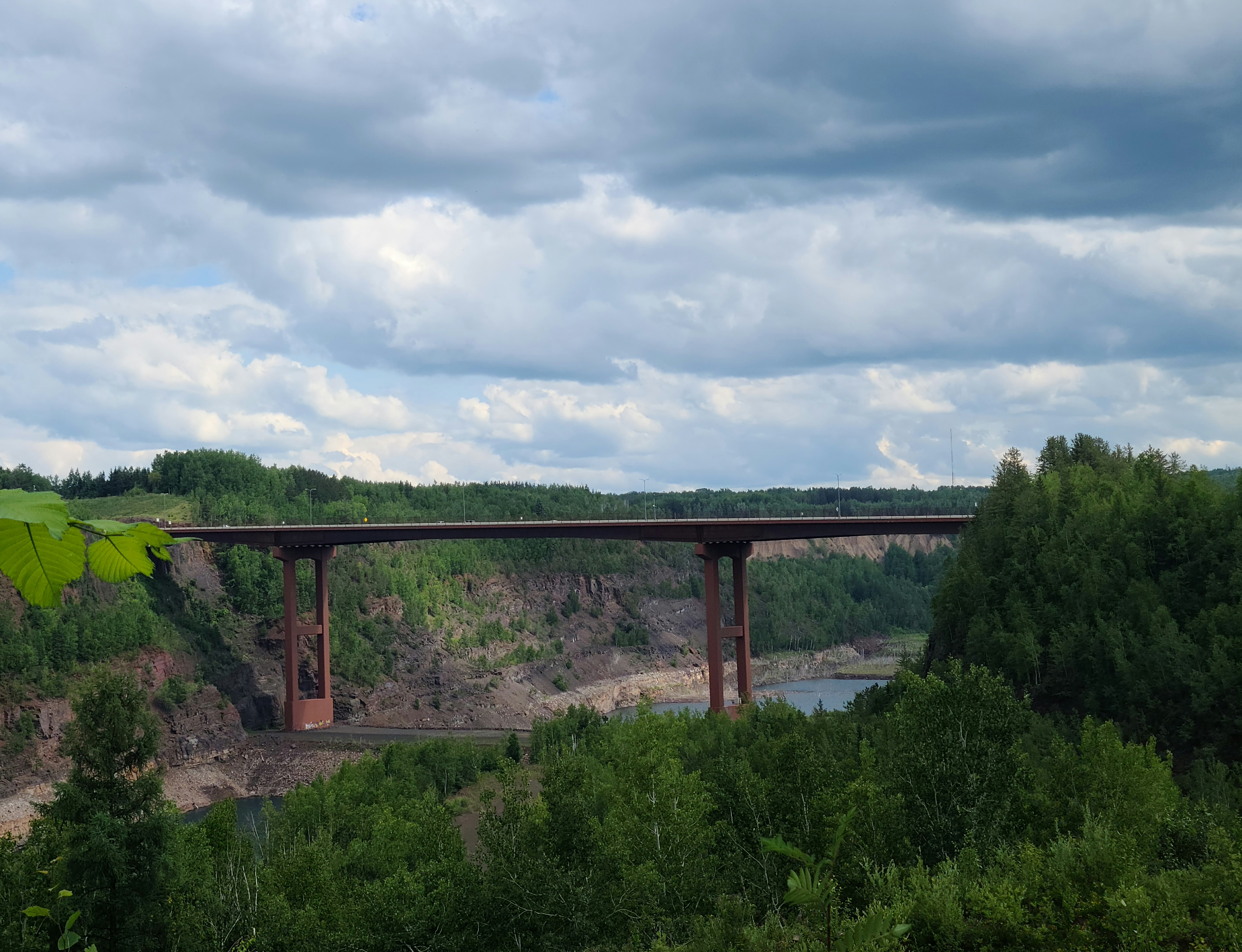
Russ and I explored a new (to us) section of the Mesabi Bike Trail in Minnesota’s Iron Range this weekend. The section we targeted took us across the state’s tallest bridge, the Thomas Rukavina Memorial Bridge, near Virginia, Minnesota. We driven over the 204-foot-tall structure plenty of times but always looked longingly at the walking/biking/ATV trails right next to the freeway, and today was the day to make our dream come true!
The Thomas Rukavina Memorial Bridge outside of Virginia, Minnesota.
We meandered to bike trailhead in the town of Gilbert at the Sherwood Forest Campground. Biking toward Virginia, we promptly lost the paved trail as it merged into the city roads for several blocks. I think in the past, trail directions had been painted on the road, but those have been lost to the weathering of snow and traffic.
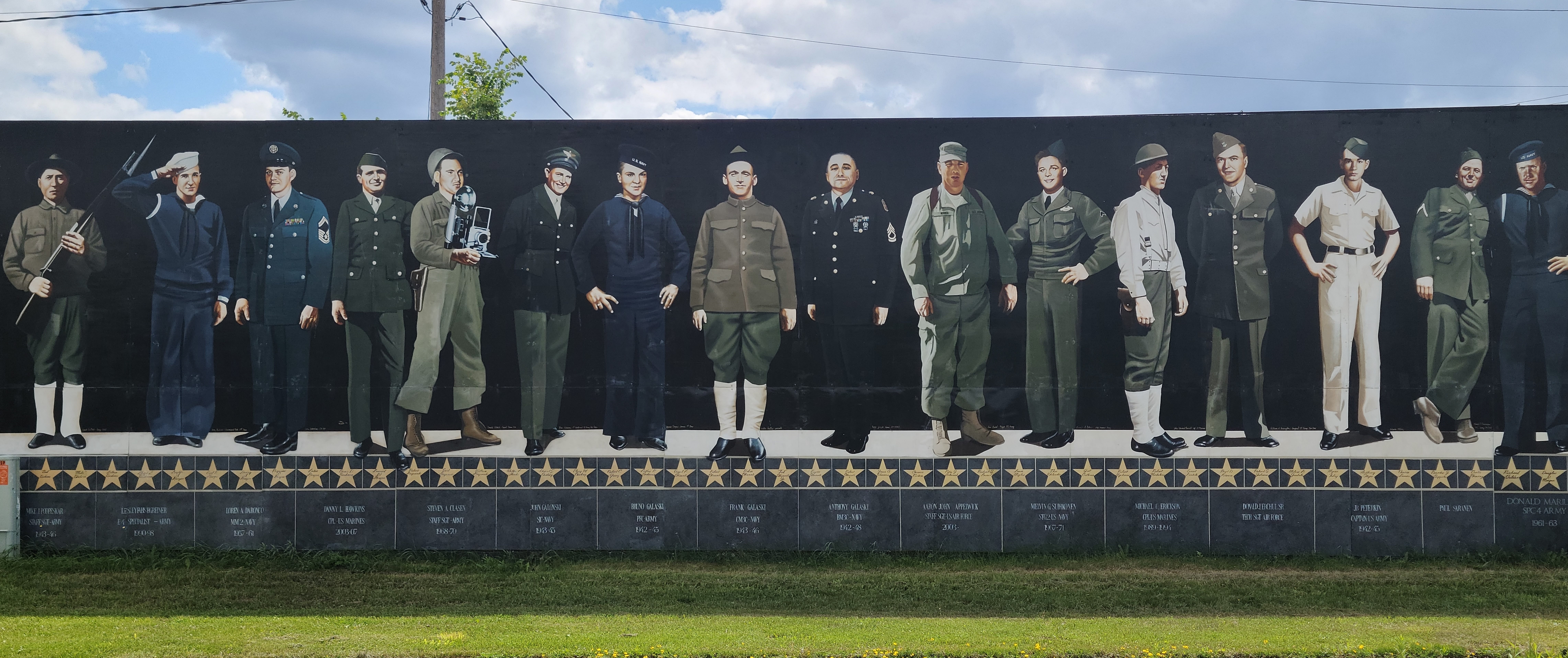
A veterans’ memorial mural we biked past in Virginia.
We had a general idea of where to go, however. We just followed our noses for a few blocks and the trail reappeared, taking us past a restaurant and across Highway 37. Then we headed into the woods. I love these forested sections of trail with their lines of aspen and birch. Pink fireweed is beginning to bloom, which added pops of color to the route. One impressive stretch took us on a skinny peninsula high above a gravel pit and a wetlands area.

What the bike trail looks like across the bridge.
The topography is gradual and unchallenging. The only part my legs complained about was the gradual incline once we returned from the bridge, but I get ahead of myself.
Eventually, we reached the bridge. One side of the trail is for walkers and bikers. The other side of the painted line is for ATVs. A low concrete barrier separates the trails from the freeway. A high railing on the outside provides protection from dropping 200 feet but still provides a view of the Rouchleau Mine Pit below. This mini Grand Canyon was created by iron ore mining activities and now provides drinking water for the city of Virginia.
Wind likes to whip around the bridge, but the weather was fair for us. The bridge was built because mining companies wanted to dig where Highway 53 used to be. They gave the transportation dept. plenty of notice, but, as you can imagine, moving a highway is no small feat. This was the most economical route. Even so, the project cost $220 million! And the bridge was constructed as part of it.
The Oldtown-Finntown Overlook.
Thomas Rukavina, its namesake, was an Iron Range lawmaker born in Virginia. He was a staunch advocate for the Iron Range and its people. He’s also memorialized in a park about a half-mile farther down the trail from the bridge. Bridge View Park offers a good vista of the structure and some interpretive signs and benches.

Once we biked to the outskirts of Virginia, we stopped to investigate a rather overgrown overlook of the mine pit that features a 50-foot caged safety bridge out to the pit’s edge. It’s named the Oldtown-Finntown Overlook.


From there, we passed the historic downtown district with its quaint old streetlights and American flags flying. The trail took us to Lake Virginia. We decided this would be a good turnaround spot. We biked around the small lake, disturbing a gaggle of Canada geese, which hissed at us, and then headed back to Gilbert.
The total trip was 13.5 miles. Although the bridge was our main goal, it was fun seeing the other, unexpected attractions along the way and becoming familiar with a new route.
When I was in the process proofreading my blog memoir, “Meander North,” before publication, I found myself laughing. “Hey, this book is pretty good,” I thought. “Who wrote it?”
Reading my book was like having an out-of-body experience. Finding pleasure in what I wrote was a good thing but it’s not a very Minnesota thing. We’re not supposed to think we’re that special! Well, it’s too late. I really did like what I wrote. That doesn’t happen often.
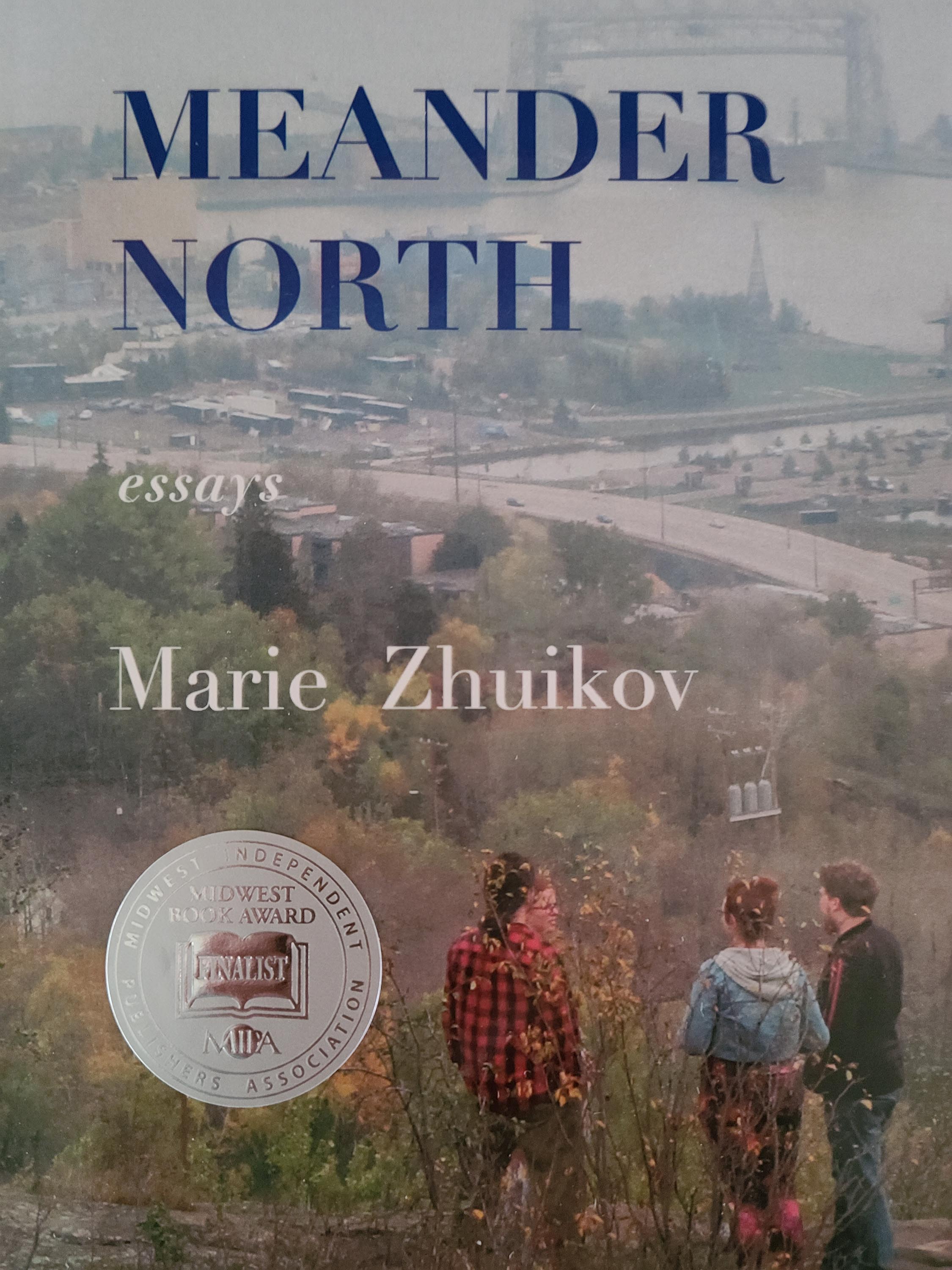
My book with its silver award seal.
I suspect most writers will agree there are several distinct and disparate phases they go through in completing a work. When you complete that first draft, you’re so relieved! You think it’s God’s gift to humankind. Then your writing group or beta readers get ahold of it and you begin to see its flaws. You fix those but by that time, you’re able to distance yourself from it enough that you see even more flaws. You hate the work. It’s awful. It should never see the light of day! There’s so much that needs fixing.
Some writers never get past this point. But if you take it slow, chunk by chunk, and are kind to yourself, and you remember what you were trying to say with your work, you can come out on the other side. You might even like it in the end – enough to think that maybe somebody else wrote it.
I recently attended the Midwest Book Awards Gala, held in Minneapolis for finalists in their awards program. It’s put on by the Midwest Independent Publishers Association, which serves indie publishers in 12 states. This year, the contest attracted 227 books from 122 publishers. “Meander North” was one of them. It ended up earning a silver award in the nature category.
Mary Ann Grossmann, keynote speaker.
The gala’s keynote speaker was Mary Ann Grossmann, retired book editor for the St. Paul Pioneer Press. She told tales from her long career, including when Pulitzer Prize-winning author Studs Terkel “kidnapped” her in his car because he wanted to keep talking, and when Grossmann convinced activist author Susan Sontag to go see the 5,000-pound boar at the Minnesota State Fair.
Grossmann’s main advice to authors was to “hire an editor!” In my case, I hired two of them, just to be sure. I was so close to the material that I felt like I was missing all the little nits that needed picking in the text.
At the end of the gala, authors were given the judges’ comments. I was heartened to see that they all thought the writing was very strong. The book was also judged on things like production quality and mechanics/organization. One judge said their favorite story was the one about the sensory deprivation tank. They said, “These essays are definitely something I would read again, and I intend on following this blog now, as well.” Thank you, whoever you are!
Another judge said they thought I had a “really appealing and charming voice, and I found the writing excellent.”
Do you see me over here, preening myself in a most non-Minnesotan way? Ha ha.
Cheri Johnson, who goes by the pen name Sigurd Brown, accepts her Midwest Book Award at the gala.
While at the gala, I got to meet some people from my past who turned into authors, one of them for the same publisher who produced my book (Nodin Press). I also met some people I have had interactions with online but had never seen in person. One of them was Sigurd Brown, the pen name for the author of the thriller, “The Girl in Duluth.” Her book won gold in its category. I have not read her book yet, but I have it on order.
She was nice enough to read “Meander North,” and she posted this review on Goodreads:
I enjoyed this book very much. Zhuikov’s personal stories of everyday life in northern Minnesota—which include subjects as varied as solving the mystery of headless rabbits on a trail near her house to her discovery, twenty-five years after the fact, that the UPS delivery driver at her new job is the boy she kissed in the coat room of her first-grade classroom—are both frank and charming, and in total they tell not only the story of a life but describe the fabric of a town (the port city of Duluth on Lake Superior, where Zhuikov lives). This is a friendly and calming book, with a narrator who is pleasant to spend time with. Reading one or two of the short essays that make up the book every night before bed, I often had the feeling that I was out on my porch in the evening, exchanging a few words with the neighbor I’m always glad to run into. The writing is also very nice; her sentences are as neat and luminous as pearls. The book is a silver winner of a 2023 Midwest Book Award and I can see why.
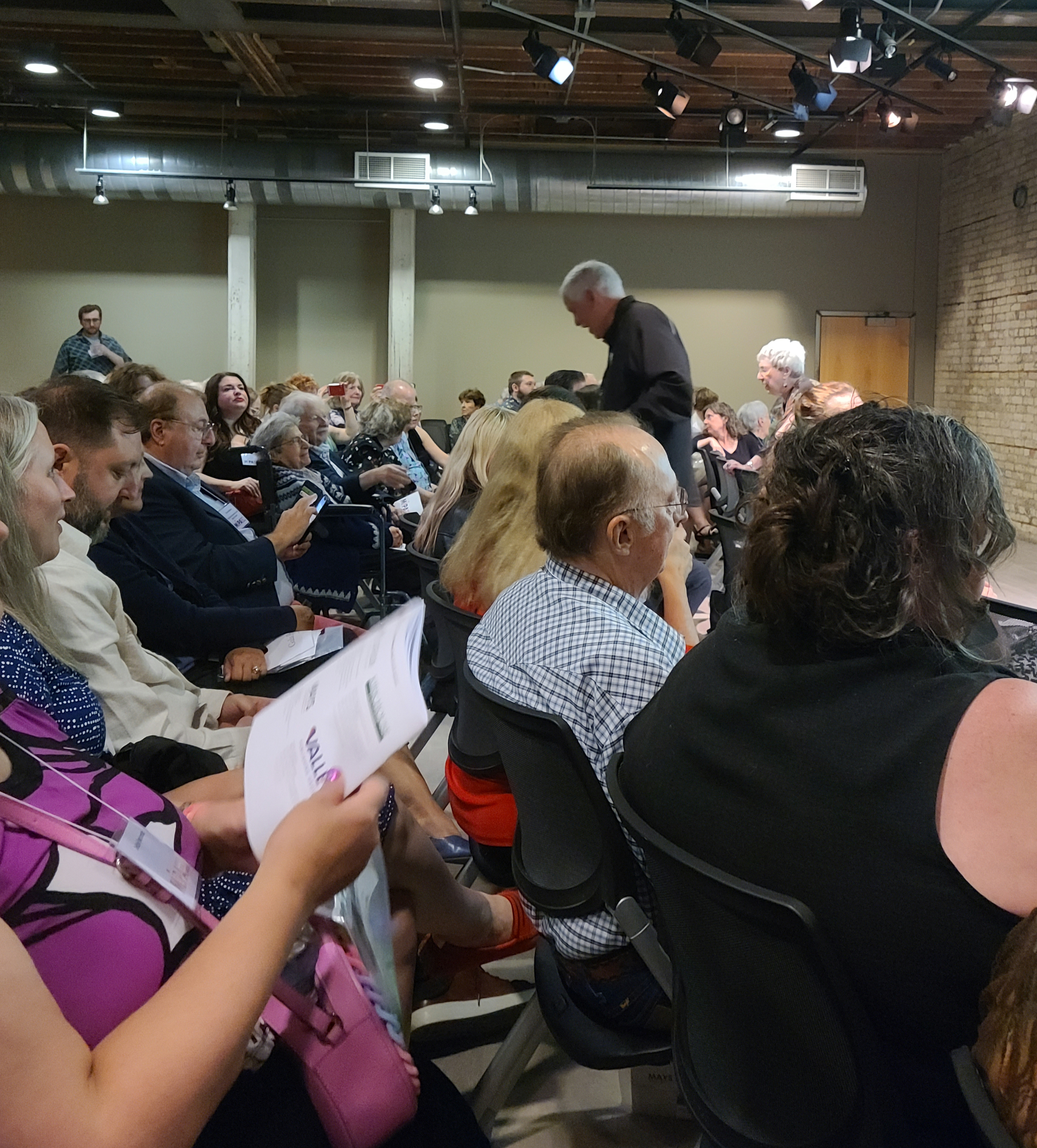
The gala audience.
I reread, “Her sentences are as neat and luminous as pearls,” several times. That’s what having two editors will do. Lord knows I don’t have that many editors for my blog! (From which the stories are derived.) Needless to say, I’m feeling a bit of pressure to write a similar glowing review of her book. But I’m sure that won’t be hard since it’s a gold winner already.
“Meander North” was also recently featured on the National Science Writers Association website. They offer a column that describes new books written by association members, and they were good enough to list mine, even though it’s been out for a while. Although my book is mostly personal reflections, there is some overlap with my day job as a science writer, so those things are highlighted in the column.
There, enough bragging. In ending, I’d like to point out that I probably never would have had enough content for a book based on this blog without the feedback and continued readership over the years from all my blogger buddies. So, you can consider this your accomplishment, as well. Thank you!!
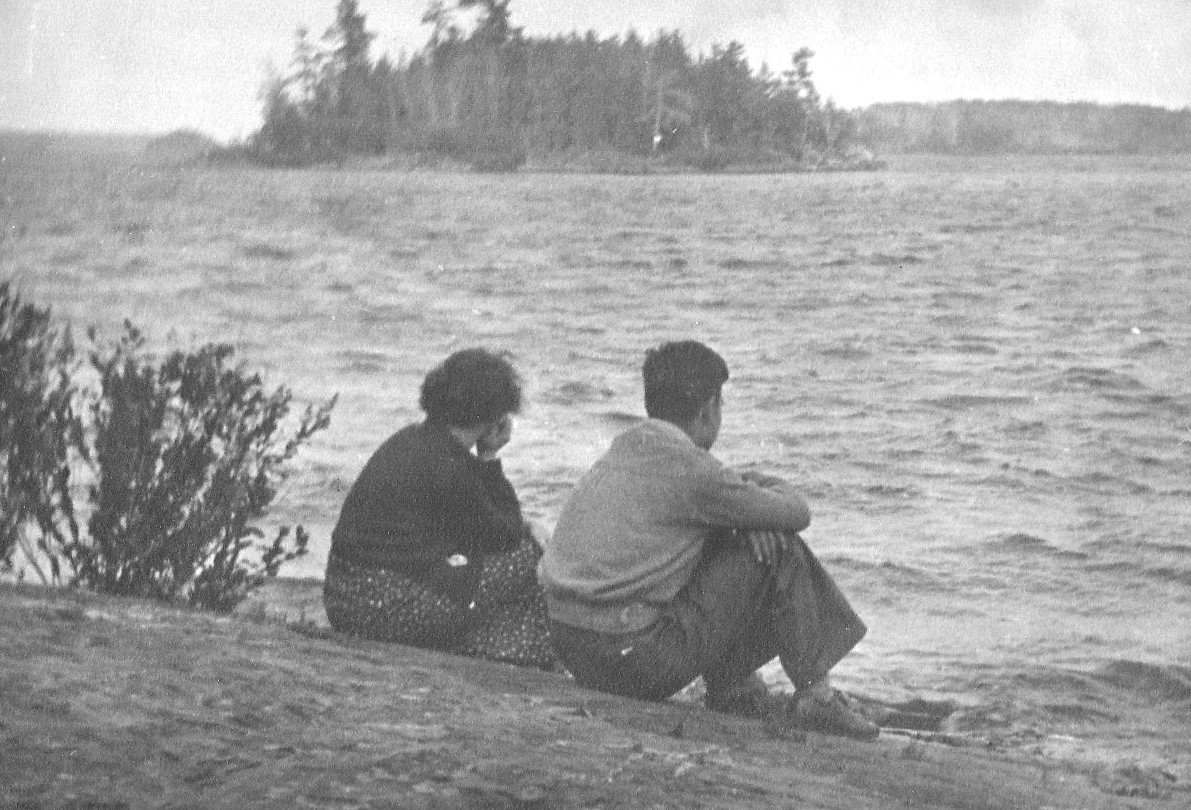
Marguerite and her brother (my father) on the Minnesota-Canada border, 1936.
A few weeks ago, I had the chance to speak with my Aunt Marguerite over the phone. She was in a hospital in Minneapolis and it was pretty clear she was dying. She’d gone in for a urinary tract infection, which should be easy enough to treat, but she wasn’t doing well. After a few days, she was on hospice care.
My cousin Priscilla was with her and said that Marguerite got a big smile on her face when she heard it was me on the phone. My aunt and I exchanged hellos. I said I hoped she felt better soon. I think we both understood that could be taken several ways. Then we said goodbye. Those were the last words she spoke. She died peacefully two days later with Priscilla at her side.
Although I live 150 miles away, the morning Marguerite died, I felt it as did one of my other relatives. We had a connection to this woman, my father’s sister and the last of her generation. I’m not sure how to explain the feeling except that it’s one of absence. A grand and stubborn spirit is gone from this world, into the next.
Russ and I felt lucky to have seen Marguerite in person a couple of weeks before when we made a trip to St. Paul. We felt like we said our goodbyes to her then.
Like me, my aunt loved meandering around. She attended at least 28 Elderhostels (when they still used to be called that) all over the world. If she had a blog, I bet she would have named it “Marguerite’s Meanderings!” We also both played the French horn in school. When I chose it, I did not know that she had played it, too. I just liked the mellow sound of it.
Marguerite never married and had no children of her own, but one special thing she did was take each of her nieces and nephews on a trip. My outing with her was in the 1970s in her Volkswagon camper van she nicknamed Pokey. We camped along Lake Superior’s North Shore. One destination I particularly recall was Finland. I was confused about how we could go there because I thought Finland was a country overseas, but I soon discovered that Minnesota had its own small town by that same name.
She was also very generous with her home. In 2005, when I was commuting to Minneapolis for graduate school, she let me stay overnight at her place on a regular basis. Money was tight for my family at this time, so I was thankful for this free lodging, plus I got to know her better.
I seem to be the family obituary writer, so that has been my contribution so far to all the tasks that need completing when someone dies. You can find Marguerite’s here.
As people like to say, she lived a good long life, but that doesn’t make her passing any easier.
The Wisconsin State Capitol as seen from Lake Mendota.
May seemed the month for me to meander around Wisconsin. My communications group at Wisconsin Sea Grant goes on an annual field trip to familiarize ourselves with projects that our water research program works on and the researchers who we fund.
Although most of our staff is in Madison, Wisconsin, this year, we chose that locale for our field trip because we have several new staff members. This was especially useful to me, who works far away in northern Wisconsin.
One of our activities during the two days in late May was a pontoon boat ride on Lake Mendota. This is the lake where the University of Wisconsin-Madison is located, and Sea Grant has funded many research projects in and upon it. I had never been on the lake before, so I was looking forward to the ride. I know, I have such a tough job if I get paid to go on a boat tour!
Our videographer, Bonnie, arranged for the rental. She thought she would be able to drive the pontoon. But when we arrived, the staff said she was too young and that she had not taken a required boater safety course, so someone else who was older needed to drive the craft.
Captain Sarah at the wheel!
In stepped Sarah, our graphic designer. She had never piloted a pontoon boat before, but she had experience sailing, so we figured she was the next best thing. I could have possibly done it, too, but was happy not to have the responsibility since I am unfamiliar with the lake.
After Sarah’s short orientation to the pontoon’s operation, we motored off around the lake on a two-hour tour. Viewing how homeowners dealt with erosion in contrast to more natural areas around the lake led to interesting conversations among us.
When we were about a quarter of the way around the lake, a siren sounded. Everyone else on the boat seemed to know that this meant “get off the water!” We were near the university docks, so Sarah headed there. The problem is, she had never docked a pontoon boat before. She recalled from reading the orientation instructions that docking was the most dangerous part of operating the craft.
Understandably, she was wary. She thought maybe we could circle near the docks until the “all-clear” siren was sounded. In the meantime, the wind picked up and rain began to fall. Then came lightning. Sarah and Bonnie checked their phones. Both had received calls from the rental agency, telling them to get the pontoon off the lake.
After her third circle near the docks, Sarah gained enough confidence (or perhaps she was just worried enough) to try and dock the pontoon. She told us which side she planned to dock on, so we deployed the fenders and I organized everyone regarding who would throw ropes and who would jump onto the dock to catch them.
The only problem was that the wind was blowing with gusto by this time. Sarah’s plan to dock us on the left side quickly turned into a plan to dock us on the right side as the wind blew us in that direction. We adjusted on the fly and jumped out onto the right dock.
Stormwater gushes out into Lake Mendota underneath the college’s mascot, Bucky Badger. Note the mallard headed into the stream.
We secured the pontoon and stayed docked for at least a half hour. Rain poured down as the five of us huddled under its canvas roof. A brown plume of stormwater erupted from a nearby storm drain, carrying with it a red baseball batter’s helmet and assorted flotsam that the local mallard ducks surged toward, finding it irresistible. Gross!
Shortly, we discovered that rain leaked through the roof’s zipper, but that was easy enough to avoid. We thought of running through the rain into the shelter of the student union, but the surety of getting wet outweighed the danger of being on the water in a metal structure. Perhaps not so bright, but there were two other pontoons of people who had docked near us, and they were also waiting out the storm on their boats.
While rain poured down and thunder roared on our side of the lake, the pontoon rental people called Sarah and told her it was all clear and that we could go back on the lake. We were like, no way! We waited out the storm another half-hour.
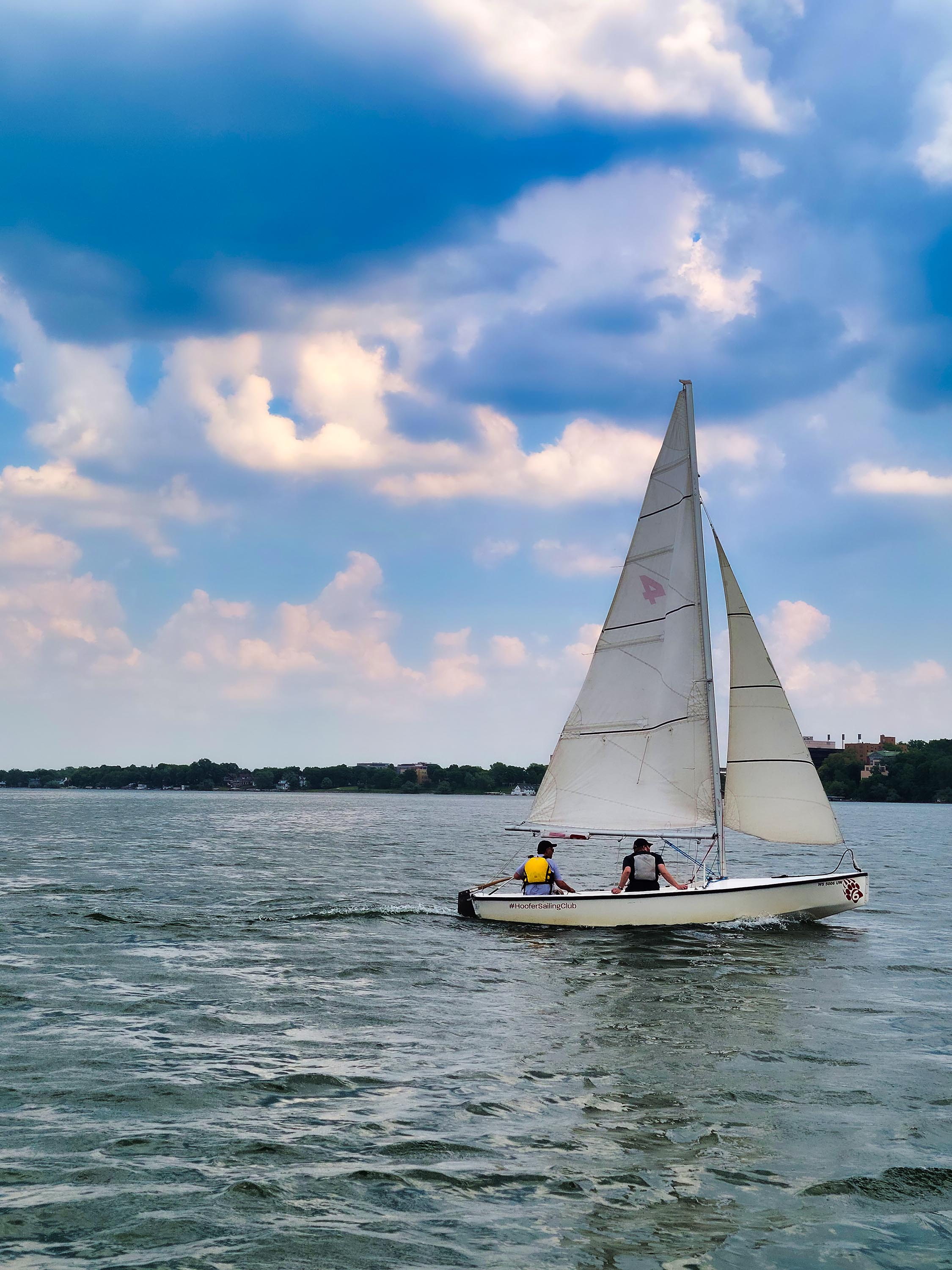
Our unscheduled team-building exercise wasn‘t all terror. We saw this picturesque sail boat before the storm. Note the gathering clouds.
When it seemed like the storm was over, we hightailed it back to the rental place because we were overdue. Bonnie and our boss, Moira, were sitting in the front of the boat and the rest of us were under the canopy. Bonnie had a cap on. Moira didn’t, and she noted with some amusement that her long hair was standing on end.
I wasn’t sure if this phenomenon was due to the wind or some less friendly element, but it’s obvious there must have been electricity in the air. Bonnie didn’t notice it happening to herself because of her cap.
Capn Sarah quietly checked her weather app and gunned the motor. Eventually, Moira’s hair deflated, and we made it back to the rental center intact. Our two-hour tour had turned into a three-hour tour due to weather, but we weren’t charged any extra due to this “act of God.”
Later, at dinner, I looked on the internet to see what it means “when your hair stands on end when you’re in a boat on water.” The entry stated, simply and plainly: You will be struck by lightning!
When I shared this with my colleagues, we all felt lucky to have survived the tour unscathed. Sarah admitted that when she had checked her weather app while Moira’s hair stood on end, it had shown lightning in our vicinity.
After more conversation, it slowly dawned on me that, although I had no hand in organizing the pontoon ride or piloting the craft, my coworkers unanimously blamed me for our misadventure.
Why? Because, as we were about to board the pontoon, I was singing the theme song to Gilligan’s Island. And I MAY have mentioned something about a three-hour tour.
This post is reblogged from the Wisconsin Sea Grant blog, which I write for work.This is the second (and final) story in a series about my weeklong trip around Wisconsin as part of the Wisconsin Idea Seminar. Part 1 described our experience on the University of Wisconsin-Madison campus learning about Ho-Chunk history. This part will describe the rest of the trip in general, focusing on a tour of the Green Bay Packaging Co.
A Wisconsin Idea Seminar participant contemplates Black Smokey Falls on the Wolf River in the Menominee Reservation.
Continuing the first day of our tour, a Badger Bus took us to Portage, where we visited the Historic Indian Agency House, which is where the Ho-Chunk people came to collect their government allotments once they were displaced from their lands by settlers. Reading the names of the Native families on the outdoor plaques was a poignant reminder of this traumatic time in history.
Then we traveled to Appleton, where we took a walking tour of the town, learning about Black history. When the area was first settled, some land and businesses were owned by Black people, but by the 1930s, the town was entirely white due to organized, unofficial harassment that drove Blacks away. That has thankfully turned around so much that there’s even a soul food restaurant in town, which is where we ate supper.
Loblolly pine seedlings in the Green Bay Packaging Co.’s conference room. The company’s Arkansas plant uses loblollys when they need virgin wood fiber to make paper.
On Day 2, we drove to Green Bay where we toured the impressive Green Bay Packaging Co. There was a rumor floating around on the bus that this was the business that the Green Bay Packers football team was named after. Later, I discovered through my own research that this wasn’t true. The Packers were named after a meat-packing plant, which was one of their first sponsors. See, this Minnesotan really is learning about Wisconsin culture!
Green Bay Packaging makes paper from recycled materials. That paper is then used to make boxes. They don’t make the boxes on-site – they ship their paper elsewhere for that. Two years ago, they expanded their facilities on the same land by the bay. Much of the process is automated. Even so, the company employs more workers than before. In the early 1990s, this mill was one of the first in the world to become totally effluent free (zero discharge of wastewater).
We were led through the plant by Olivia Durocher, project development specialist, and Andrew Stoub, environmental manager. Durocher said that 50% of their recycled materials comes from “big box” companies like Target and Walmart and the other 50% comes from consumers. They produce about 550 tons of paper per year.
“Wisconsin has been a top producer of paper for a long time,” Durocher said. “We’re happy to have a hand in that.”
She explained that a paper fiber can be recycled seven times before it becomes too short to be used any more. That’s why other mills still use trees to make paper. “If you stopped introducing virgin fiber into the system, the entire country would run completely out of boxes in about six months or less. That’s why it’s important to continue to plant trees and use virgin fiber to produce kraft paper. It introduces that virgin fiber into the system. That’s why we can’t have all the mills be recycled mills,” Durocher said.
A map of all the communities we visited during our tour. Image credit: University of Wisconsin-Madison
Stoub said the water used in the plant does not come from the bay. About half of the water is recycled from treated water the mill has already used and half comes from treated wastewater from the city of Green Bay. The company uses the methane gas produced by their wastewater digestor to feed their boilers instead of burning the gas off, which many facilities do. Plus, the gas fuels a generator that produces enough electricity to power the mill’s wastewater treatment plant. “It’s a pretty cool sustainable system,” Stoub said.
During our tour of the plant, most impressive to me was its automated 100,000-square-foot paper warehouse. According to Durocher, it’s the largest vertically stacked paper warehouse in the Western Hemisphere. It holds 8,000 rolls of paper, which is the equivalent of 26,000 tons of paper – about 22 days of inventory. No people are allowed in the warehouse because of the danger of a huge tower of paper falling on them. As you can guess, when they built the floor for the warehouse, they took pains to ensure it was totally level!
We were able to view the warehouse through indoor windows. The paper is moved around by four vacuum cranes (Konecranes), which each employ 14,000 pounds of suction. Compared to mechanical cranes, the vacuum cranes allow workers to store the rolls closer together and move them around faster. Paper from the warehouse is shipped out by rail and trucks. Alas, I don’t have any photos of the warehouse or the inside of the mill because we weren’t allowed to take them.
Stoub said you can tell that a box came from the company’s materials because it will have their logo on it.
Highlights from the rest of the five-day trip included a visit to the Menominee Reservation where we learned about their sustainable timber harvesting practices and sawmill operation. We also visited Big Smokey Falls on the Wolf River on the reservation, where we had a chance to get a feel for the land and contemplate what we’d learned so far. That day ended with a tea-making workshop led by Menominee Elder Bonnie McKiernan. We made a mixture that’s good for colds, with bee balm (which I have a ton of in my yard; I did not know it was edible), peppermint and mullein.
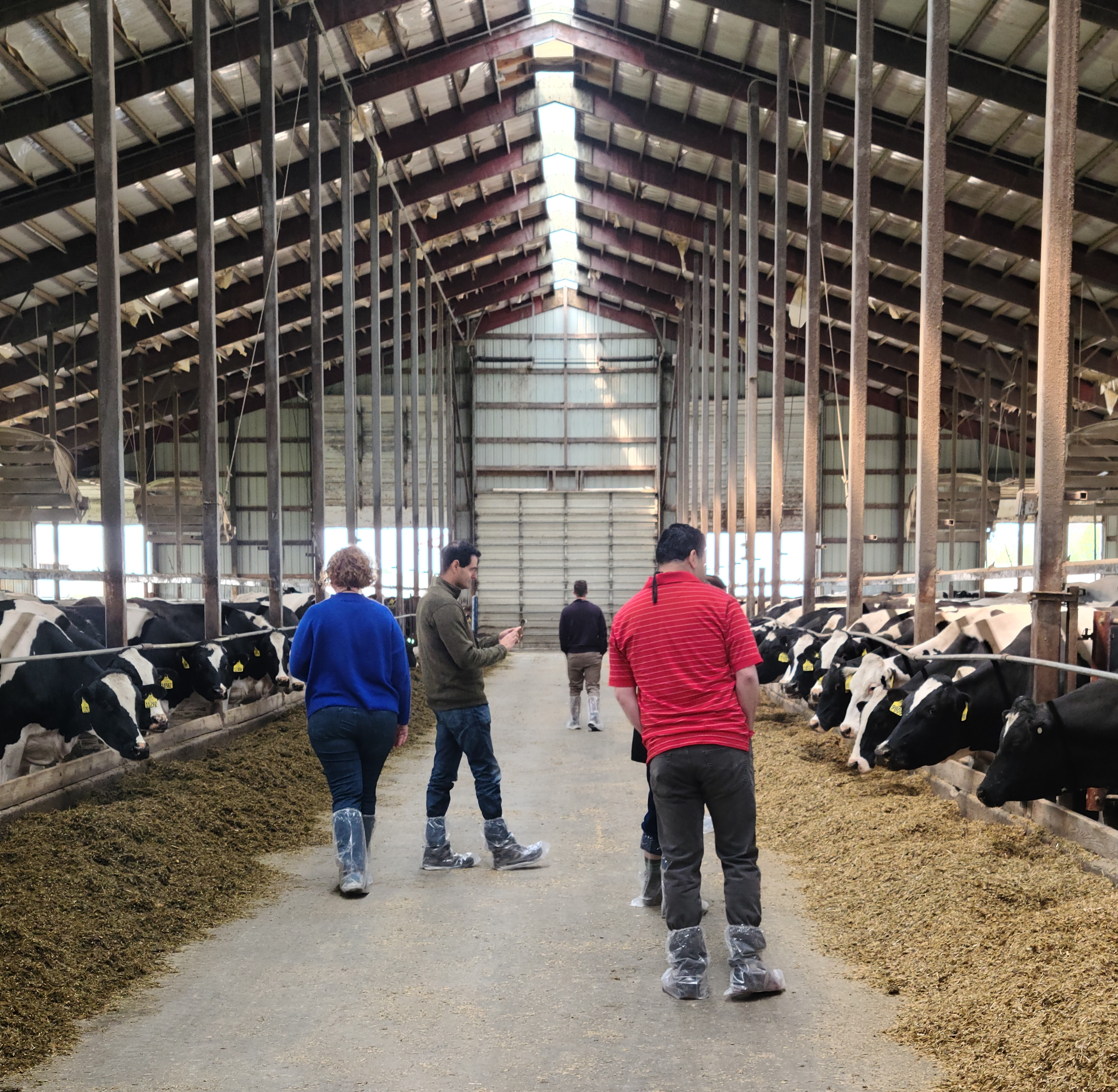
Getting friendly with some dairy cows at Soaring Eagle Dairy.
On Day 4, we visited Soaring Eagle Dairy in Newton, a woman-run business. I learned more than I ever wanted to know about how that industry runs. Their milk is used by Land-O-Lakes Inc.
During the final day, we took a walking tour of Milwaukee’s South Side and visited Escuela Verde, a charter school. The tour ended with an art project where we were able to reflect on our experiences.
Through it all, our bus driver Bob was with us. He literally held our lives in his hands, and we respected him greatly. He became a favorite among us.
I came away from the experience feeling more familiar with Wisconsin. This Minnesotan still has a lot to learn, but I feel a bit more confident in my knowledge base now.
I’m a born and bred Minnesotan. I’ve lived there almost my whole life. Sometimes, that can make working for Wisconsin institutions like Sea Grant and the University of Wisconsin-Madison challenging. While I am technically a UW-Madison employee, I live in Duluth, Minnesota, and my office is just across the border in Superior, Wisconsin. Although I’ve worked for Wisconsin Sea Grant 10 years, I’m not as steeped in my workplace’s culture and geography as I am in my home state’s.
This can lead to some interesting mistakes. One happened a few months ago when a co-worker said they grew up on Wisconsin’s Fox River. I only knew the part of the Fox that connects to Green Bay so, in the story I was writing at the time, I put that person’s birthplace near Green Bay. I was chagrined to learn she actually grew up near Oshkosh on a branch of the river 50 miles away from where I originally placed her.
I hate making mistakes in my stories. Even if it’s just during a draft. So, when I saw an announcement for the Wisconsin Idea Seminar in the UW employee newsletter, I jumped at the chance to apply.
The seminar is an annual five-day immersive study tour of Wisconsin culture and geography for UW-Madison faculty and staff. It’s designed so that participants:
Gain a deeper knowledge of the cultural, educational, industrial, social and political realities of Wisconsin
Learn firsthand about the social and cultural contexts that shape the lives of many UW students
See and experience the University’s connections to the state
Understand the public service mission of the University
Nurture an increased mutual understanding between the University and the people of Wisconsin
What this looks like in real life is about 40 people on a big red Bucky Badger bus riding around the state, talking to people and to each other, participating in activities and drinking in the landscape. The theme this year was Forest + River, which was right up my alley as a water research storyteller who is also a Wisconsin geographically challenged person.
This post focuses on just one of our experiences during the seminar’s first day. I plan to write another post later about the rest of the trip and a visit to the Green Bay Packaging Plant, which makes recycled paper used in boxes.
*
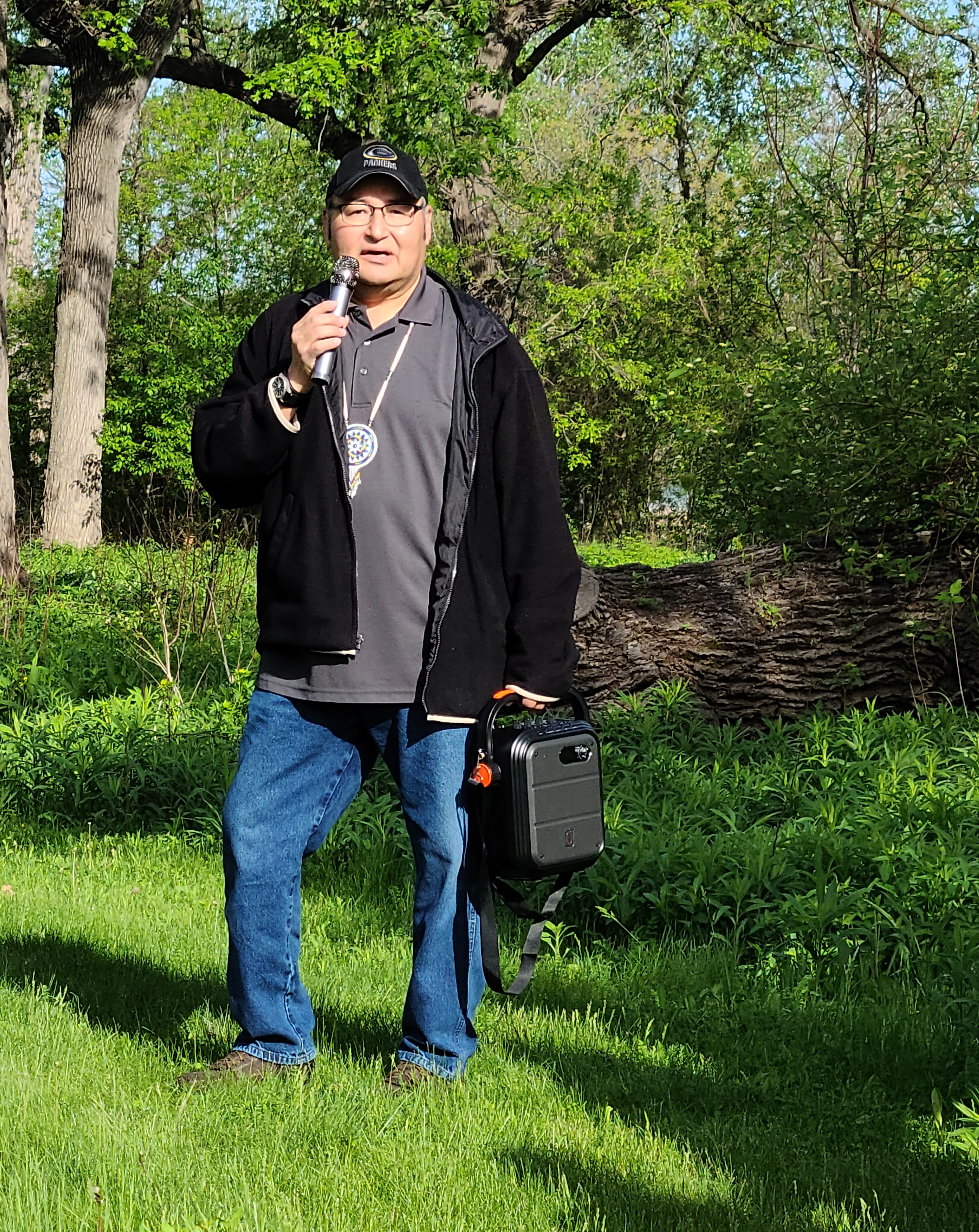
Our experience began on the Madison campus with a walking tour of Ho-Chunk sites. Amid a cacophony of spring birdsong, Bill Quackenbush, tribal historic preservation officer for the Ho-Chunk Nation, took us to several effigy mounds. These are ancient burial mounds formed in the shape of animals — birds, in the case of the two that we viewed.
Bill Quackenbush, Ho-Chunk tribal historic preservation officer.
The Madison campus is home to more of these ancient earthen monuments than any other university or college campus anywhere in North America, and probably the world. There are 38 burial mounds. At least 14 others have been lost to development. They are several thousand years old, perhaps as ancient as Egypt’s pyramids.
I learned something new right off the bat, mainly that there is a goose-shaped effigy mound right outside the Sea Grant office in Goodnight Hall. Granted, I don’t work on campus, but you’d think I would have heard something about that during my career here! Quackenbush said a Ho-Chunk village used to be where the office building is now located on the shores of Lake Mendota.
He explained how the Ho-Chunk are working to reclaim their culture. “These earth works are one small example of a portion of our life. We are no different today then we were back then. We humans like to take care of not only our babies and our children, but also our ancestors,” Quackenbush said.
The goose effigy burial mound near the Sea Grant office on the UW-Madison campus.
He criticized a stone marker on the mound not only for disturbing the site but for the text on it, which gives the impression that the mound is a thing of the past. “It isn’t a thing of the past at all,” Quackenbush said. “This is ever-present. It’s living and it’s here. Our ancestors are buried in this ground. They’re living, breathing things to us like that tree over there. Their bones have probably returned to the earth by now, but it’s the ground that is sacred to us.
“However, I don’t want to be all doom and gloom. There’s a lot of good things that have come from protecting these mounds,” Quackenbush added.
The mound site was designated on the National Register of Historic Places a few years ago. The University is working to restore an oak savannah that used to exist there.

The Ho-Chunk Clan Circle.
A short walk took us to the Ho-Chunk Clan Circle, a series of 12 metal sculptures that was dedicated earlier this year. Each depicts a clan symbol. Quackenbush said the circle represents the Ho-Chunk people as a whole.
Fitting my Sea Grant employment, I found myself standing near the Water Spirit sculpture. Quackenbush said the tribe was involved in the process of creating the circle and that the sculpture offers opportunities for him to meet and speak with more groups such as the Wisconsin Idea Seminar participants. He explained the various clan roles and how they fit into the tribe’s governmental system.

Next, the group was able to view a dugout canoe that Quackenbush built with the help of Ho-Chunk youth. They built it in much the same style as the ancient canoes that were recently discovered in Lake Mendota.
Quackenbush’s dugout canoe.
“This canoe doesn’t look very exciting, but the journey it’s been on is,” Quackenbush said. “When I saw that the historical society discovered the dugout canoes in the lake behind you as I was drinking my cup of coffee, it shot out of my nostrils! It was amazing to me because we had aspirations of putting one of them together.”
He worked with Dane County to find a suitable cottonwood tree that was going to be removed for a trail project. The county delivered the tree to a youth education center, which is where Quackenbush and the students worked on it. Everything came together and, like the clan circle, the canoe is a great educational discussion piece.
Amy Rosebrough, interim Wisconsin state archeologist, joined us and described how the historic dugout canoes were found. She also detailed the significance of the new canoe. “These lakes remember. With the canoes, they’re telling the story of the Ho-Chunk presence here.”
Her office’s goal has been to work with Quackenbush and other partners to keep that story alive, “…To let people know that when they’re out there fishing, this isn’t something new. This is something that’s been going on for thousands of thousands of years. It’s not just the mounds, it’s this whole landscape. And to have Bill and his team come through with this new dugout, that was a wonderful thing – to sort of bring that back,” Rosebrough said.
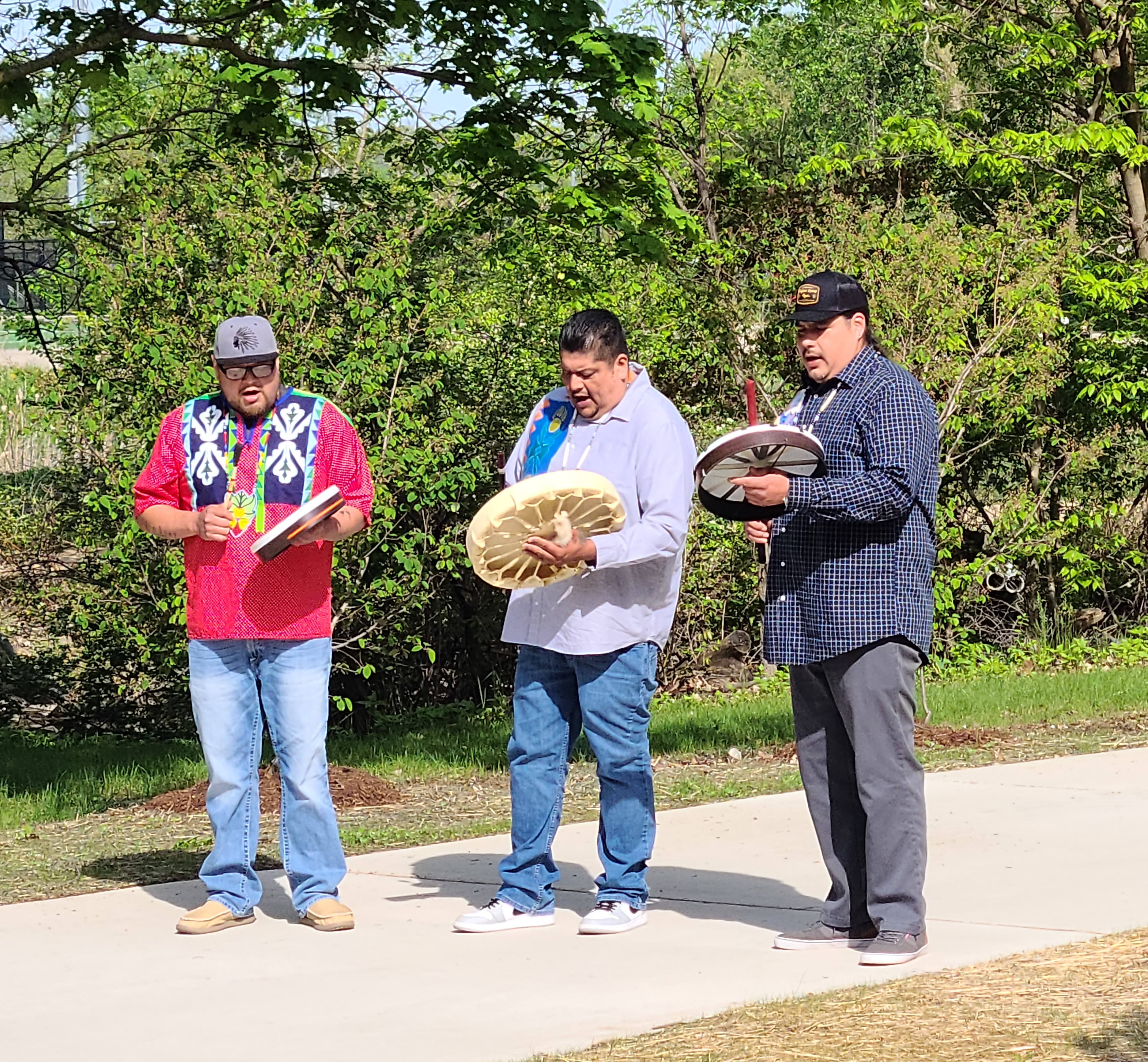
Our visit ended with a Ho-Chunk drum ceremony by the Iron Mound Singers. Listening to them was like hearing the heartbeat of the Earth. That is definitely not something I get to do everyday in my job as a science writer. As we walked back to the bus to head to Portage and Appleton, I felt privileged to learn more about Ho-Chunk culture and the history of the land where the university stands.
The Isle Royale Lighthouse on Menagerie Island. Image courtesy of the National Park Service.
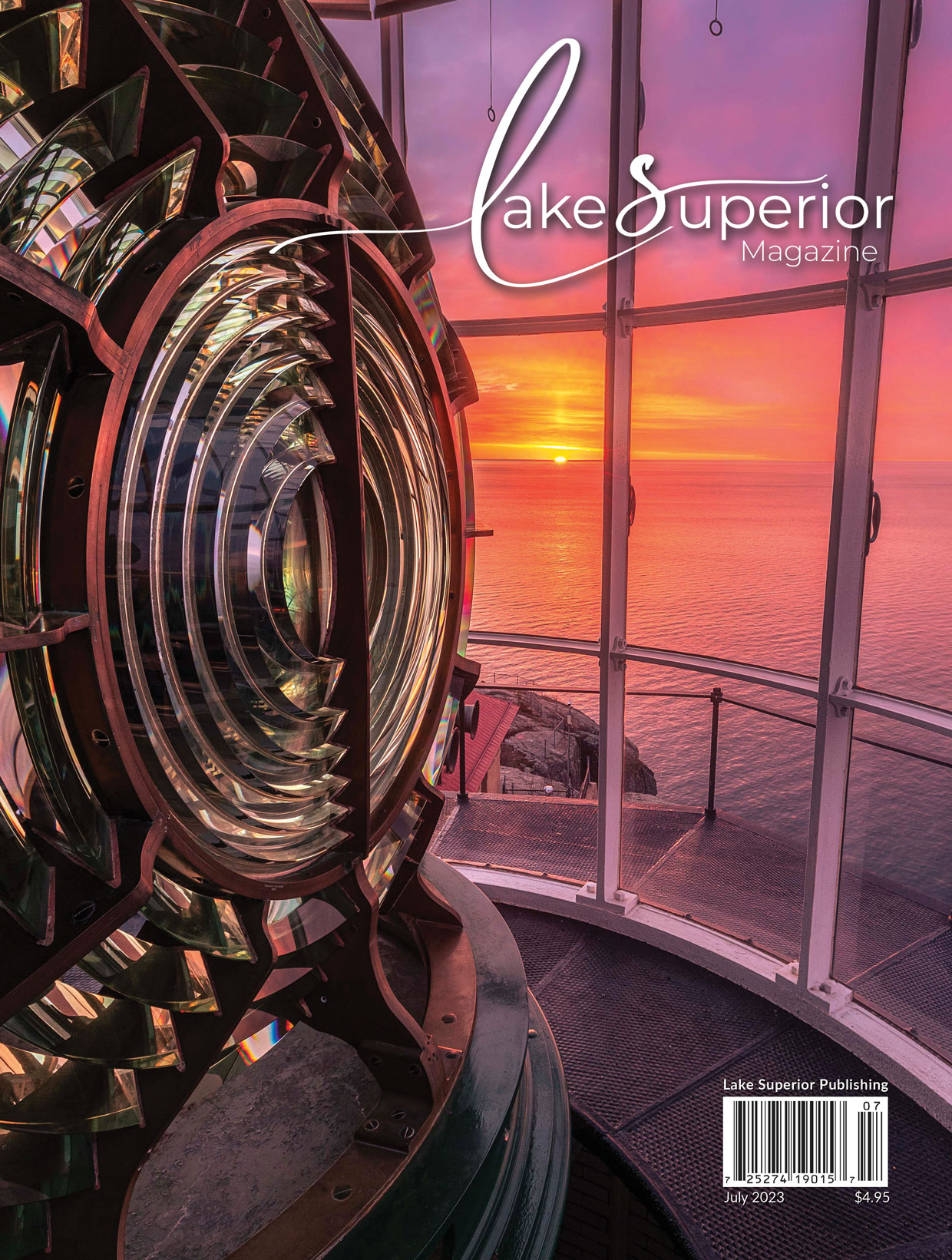
I recently had an article published in Lake Superior Magazine about a family of lighthouse keepers who spent their summers on a remote, rocky island that’s part of Isle Royale National Park. Here’s how the story (“Romancing the Stone”) came about.
Last December, I was hawking my books at a table at Fitger’s Bookstore in Duluth. Many holiday shoppers passed by, but one couple stopped to chat. Somehow, we got on the topic of Isle Royale, and I told them that my first novel was set on this island in Lake Superior.
The husband said something like, “Well, I’ve got a story for you. My ancestors were lighthouse keepers for two generations on Isle Royale.” The husband’s name was John Malone. His wife was LaRayne, and she mentioned they got engaged while on a trip to the “family’s lighthouse,” which was the Isle Royale Light on Menagerie Island. John mentioned that his lighthouse keeper great-grandfather had 11 children who lived out on the remote (and very small) island.
Although intrigued, I had plenty of story ideas in my head to keep me occupied for months. I told them I’d consider it but couldn’t promise anything.
But the more I thought about it afterward, the more interested I became in the story of the Malone Family. I checked with the Lake Superior Magazine editor to see if they’d ever featured a story about the Isle Royale Lighthouse and the Malone Family. She told me they hadn’t and that she would be interested in it.
I couldn’t find John Malone in the phonebook, but I was able to connect with him through social media. I reminded him who I was and told him I was interested in doing a story about his ancestors and family. On New Year’s Eve, he replied to me with his phone number. I called him to get more information so that I could pitch the story to the magazine.
Not long after, I pitched it, and the story was a go!
Then the work began. I was lucky that the Malones had a copy of a copy of the Isle Royale Lighthouse Keepers’ log, which they loaned me when I visited their home for an interview. Also, the National Park Service had done oral history interviews with two Malones a few decades ago. These Malones were now deceased, so those interviews were invaluable. I was able to combine those interviews with the ones I did with John.
After the last lighthouse keeper in the Malone Family quit his job on Isle Royale, he piloted yachts for the wealthy in Duluth. One of those families were the Congdons who built Glensheen Mansion, which is a tourist attraction now in the city. John Malone told me a tale about how his ancestor had been aboard the yacht when it sunk due to a fire. He had this great information (which is in my magazine story), but he didn’t think that the staff at Glensheen Mansion had heard the history.
It so happens that my daughter-in-law used to be a docent at the mansion and still has ties there. I consulted with her and she consulted with the staff at Glensheen to see what they knew about the sinking. It seemed as if a meeting between John and the mansion staff was in order, so I arranged it.
We met at the mansion and met with a Glensheen historian and the education manager. John got to tell his tale and I recorded it for my story. The mansion staff was excited to learn this new information. I hope they work it into the information that they provide to the public. And I think John was touched to have someone value the historic information he was privy to.
The Lake Superior Magazine editor only wanted a 1,200-word story, but I gave her more like a 2,000-word story. I apologized, saying the more I learned, the more there was to tell! But it paid off in the end because she dedicated much of that issue to maritime history.
Trying to sell books to people passing in a hallway can be depressing. I sometimes feel like one of those poor souls who stand on a street corner with a cardboard sign. My sign would say, “Will write for pay.” But this is one case where several good things came from putting myself out into the world.
Architectural drawings for the Isle Royale Lighthouse.This did not make it into my magazine story. Illustration courtesy of the National Park Service, U.S. Department of the Interior, Isle Royale Light Building Proposal, ISRO Archives, ACC#ISRO-00999, Cat#ISRO 20175.
I’m reading “David Copperfield” by Charles Dickens in preparation for reading this year’s Pulitzer Prize-winning novel, “Demon Copperhead” by Barbara Kingsolver. Although it’s not a requirement to be familiar with Copperfield before reading Copperhead, the latter is based on former so I figure it can’t hurt.
Given my blog’s name, imagine my delight when, in the opening of Copperfield, I found a short treatise on meandering. David Copperfield was born with a caul (amniotic sack) around him. Back in the day, cauls were thought to have mystical properties, one of which was to protect whoever possessed it from death by drowning. They had value. David’s family sold the caul in a raffle. It was won by an old lady who died triumphantly in her bed years later at the age of 92. She was triumphant because she did not drown. But drowning would have been difficult for her even without a caul since she never went in or near the water except to cross a bridge.
Copperfield says, “Over her tea, to which she was extremely partial, she, to the last, expressed her indignation at the impiety of mariners and others who had the presumption to go ‘meandering’ about the world. It was in vain to represent to her that some conveniences, tea perhaps included, resulted from this objectionable practice. She always returned with greater emphasis and with and an instinctive knowledge of the strength of her objection: ‘Let us have no meandering!’”
That made me laugh. Good thing the dear departed lady is not alive to read my blog. She would surely find it objectionable.
I have been doing my share of meandering lately, thus my absence from this blog. I hope to write more soon about my adventures traveling around the state and culture of Wisconsin.
The book I wrote based on the best of these blog stories is a finalist for a Midwest Book Award. I can hardly believe it! “Meander North” was nominated by my publisher, Nodin Press, in the nature category. Two other books are finalists in that category also: one about Wisconsin rivers and lakes, and one about Iowa farmland.
I was surprised to see my book in the nature category. I think of it more as a memoir, but you’ve got to admit that the outdoors plays a big role in my life.
This is an annual competition organized by the Midwest Independent Publishers Association, which operates over a 12-state region. This year, they received 303 entries and 83 are finalists. Judges are booksellers, university staff, and librarians who are subject matter experts and collectively hail from the Midwest. Winning entries will be announced at a ceremony in Minneapolis in mid-June.
You can view all the finalists and purchase the books here.
I am a bit flabbergasted, but extremely honored just to be a finalist. I could not have produced the book without the help of Nodin Press, and my editors John Toren and Lacey Louwagie. Both of my editors are also bloggers. You can find their sites here:
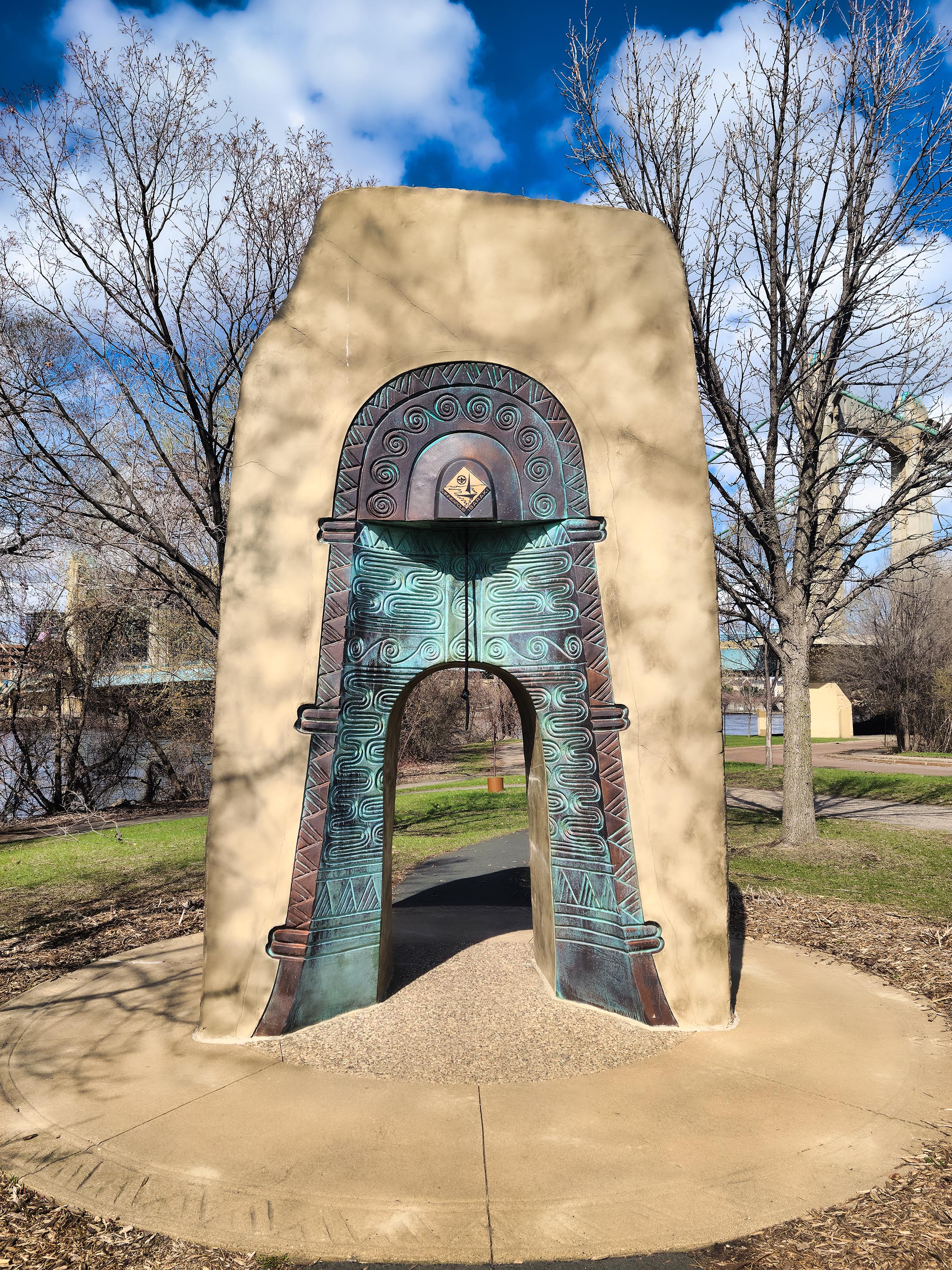
This is the Bell of Two Friends on Nicollet Island in Minneapolis. We came across it during an impromptu walk around the park pavilion. See the rope hanging down over the archway? Ringing the bell it’s attached to signifies a prayer for world peace and continued friendship between the people of Minneapolis and their sister city, Ibaraki, Japan.
The sculpture was inspired by a 2,000-year-old terra cotta mold of a bronze bell, discovered in Ibaraki. We didn’t know all this when we rang the bell, but we could feel the friendship somehow.
Nicollet Island is supposedly the only inhabited island in the Mississippi River. I’ve had the chance to visit it on several occasions. Each time, I come away thinking that if I was forced to move from Duluth (probably at gunpoint, which is what it would take) and reside in the Twin Cities, I might be able to be happy on this island.
I love the historic feel of it, the energy of the river that runs on both sides, the roar of St. Anthony Falls, the green spaces, and old homes. My latest visit prompted me to read a book about the island (“Nicollet Island” by Christopher and Rushika February Hage). I learned that there used to be five other islands near it but once settlers arrived, two were filled in so that they joined the riverbank, two were destroyed when a lock and dam was built, and one eroded.
The view from underneath the Hennepin Avenue Bridge on Nicollet Island.
Before it was named for explorer Joseph Nicollet, the Dakota people called it “wita waste,” meaning beautiful island. They fished from its banks and tapped maple trees that covered it. Rites of transition from childhood to manhood were carried out there and the island was considered as a safe place for women to give birth. Plus, it had the added benefit of the sound of the falls to drown out the screaming. 😊
Waterpower from the falls proved irresistible to the settlers, who used it to run sawmills and flour mills. Once the home of the most fashionable and prominent Minneapolitans, the island changed drastically after a fire in 1893 that began by boys smoking at a Wagon Works. Eventually, rebuilding occurred in the form of a Catholic high school and a monastery. Once-elegant apartments were subdivided and occupied by pensioners and veterans. As the economy tanked during the Depression, the island became home to the homeless.
The Hennepin Ave Bridge in black and white.
In the 1950s, the city razed many buildings in the nearby Gateway District, forcing even more homeless people to the island. Then the razing eyes of city government turned toward the island, but the residents resisted.
In the 1960s and 70s, the island was a favorite with the counterculture. Musicians, artists, (dare I say writers?), and drug-users coexisted with the poor island residents. They did not want to be “improved” upon by city planners.
In 1971, St. Anthony Falls and the island were designated in the National Registry of Historic Places. A city preservation commission helped with a movement to preserve the island’s historic homes. Eventually, a city park was established on the site of vacant industrial land.
Now, people like Russ and I enjoy walking, biking, and running on the island. And we ring a bell in world friendship.













 Marie's Meanderings