The book I wrote based on the best of these blog stories is a finalist for a Midwest Book Award. I can hardly believe it! “Meander North” was nominated by my publisher, Nodin Press, in the nature category. Two other books are finalists in that category also: one about Wisconsin rivers and lakes, and one about Iowa farmland.
I was surprised to see my book in the nature category. I think of it more as a memoir, but you’ve got to admit that the outdoors plays a big role in my life.
This is an annual competition organized by the Midwest Independent Publishers Association, which operates over a 12-state region. This year, they received 303 entries and 83 are finalists. Judges are booksellers, university staff, and librarians who are subject matter experts and collectively hail from the Midwest. Winning entries will be announced at a ceremony in Minneapolis in mid-June.
You can view all the finalists and purchase the books here.
I am a bit flabbergasted, but extremely honored just to be a finalist. I could not have produced the book without the help of Nodin Press, and my editors John Toren and Lacey Louwagie. Both of my editors are also bloggers. You can find their sites here:
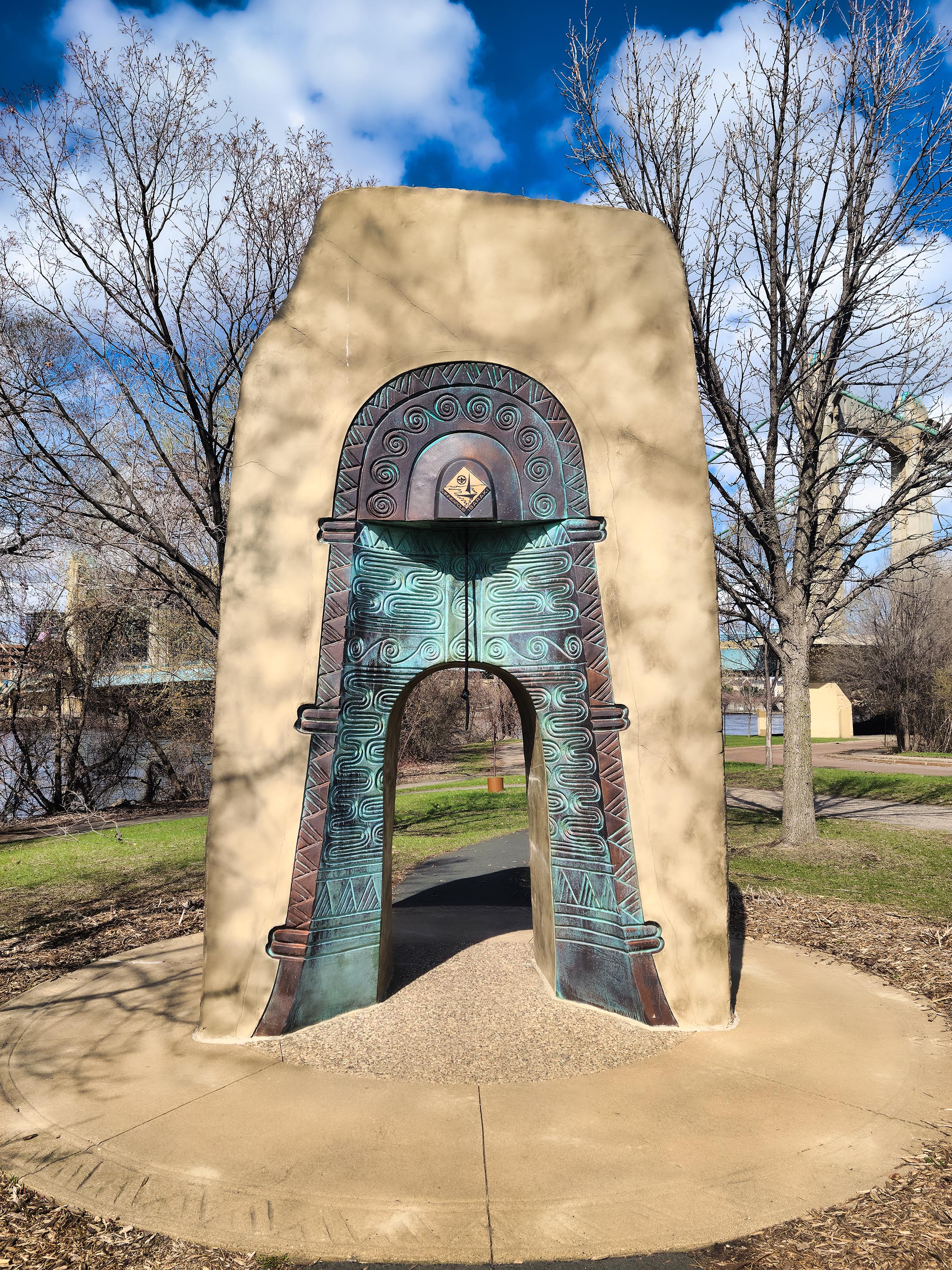
This is the Bell of Two Friends on Nicollet Island in Minneapolis. We came across it during an impromptu walk around the park pavilion. See the rope hanging down over the archway? Ringing the bell it’s attached to signifies a prayer for world peace and continued friendship between the people of Minneapolis and their sister city, Ibaraki, Japan.
The sculpture was inspired by a 2,000-year-old terra cotta mold of a bronze bell, discovered in Ibaraki. We didn’t know all this when we rang the bell, but we could feel the friendship somehow.
Nicollet Island is supposedly the only inhabited island in the Mississippi River. I’ve had the chance to visit it on several occasions. Each time, I come away thinking that if I was forced to move from Duluth (probably at gunpoint, which is what it would take) and reside in the Twin Cities, I might be able to be happy on this island.
I love the historic feel of it, the energy of the river that runs on both sides, the roar of St. Anthony Falls, the green spaces, and old homes. My latest visit prompted me to read a book about the island (“Nicollet Island” by Christopher and Rushika February Hage). I learned that there used to be five other islands near it but once settlers arrived, two were filled in so that they joined the riverbank, two were destroyed when a lock and dam was built, and one eroded.
The view from underneath the Hennepin Avenue Bridge on Nicollet Island.
Before it was named for explorer Joseph Nicollet, the Dakota people called it “wita waste,” meaning beautiful island. They fished from its banks and tapped maple trees that covered it. Rites of transition from childhood to manhood were carried out there and the island was considered as a safe place for women to give birth. Plus, it had the added benefit of the sound of the falls to drown out the screaming. 😊
Waterpower from the falls proved irresistible to the settlers, who used it to run sawmills and flour mills. Once the home of the most fashionable and prominent Minneapolitans, the island changed drastically after a fire in 1893 that began by boys smoking at a Wagon Works. Eventually, rebuilding occurred in the form of a Catholic high school and a monastery. Once-elegant apartments were subdivided and occupied by pensioners and veterans. As the economy tanked during the Depression, the island became home to the homeless.
The Hennepin Ave Bridge in black and white.
In the 1950s, the city razed many buildings in the nearby Gateway District, forcing even more homeless people to the island. Then the razing eyes of city government turned toward the island, but the residents resisted.
In the 1960s and 70s, the island was a favorite with the counterculture. Musicians, artists, (dare I say writers?), and drug-users coexisted with the poor island residents. They did not want to be “improved” upon by city planners.
In 1971, St. Anthony Falls and the island were designated in the National Registry of Historic Places. A city preservation commission helped with a movement to preserve the island’s historic homes. Eventually, a city park was established on the site of vacant industrial land.
Now, people like Russ and I enjoy walking, biking, and running on the island. And we ring a bell in world friendship.
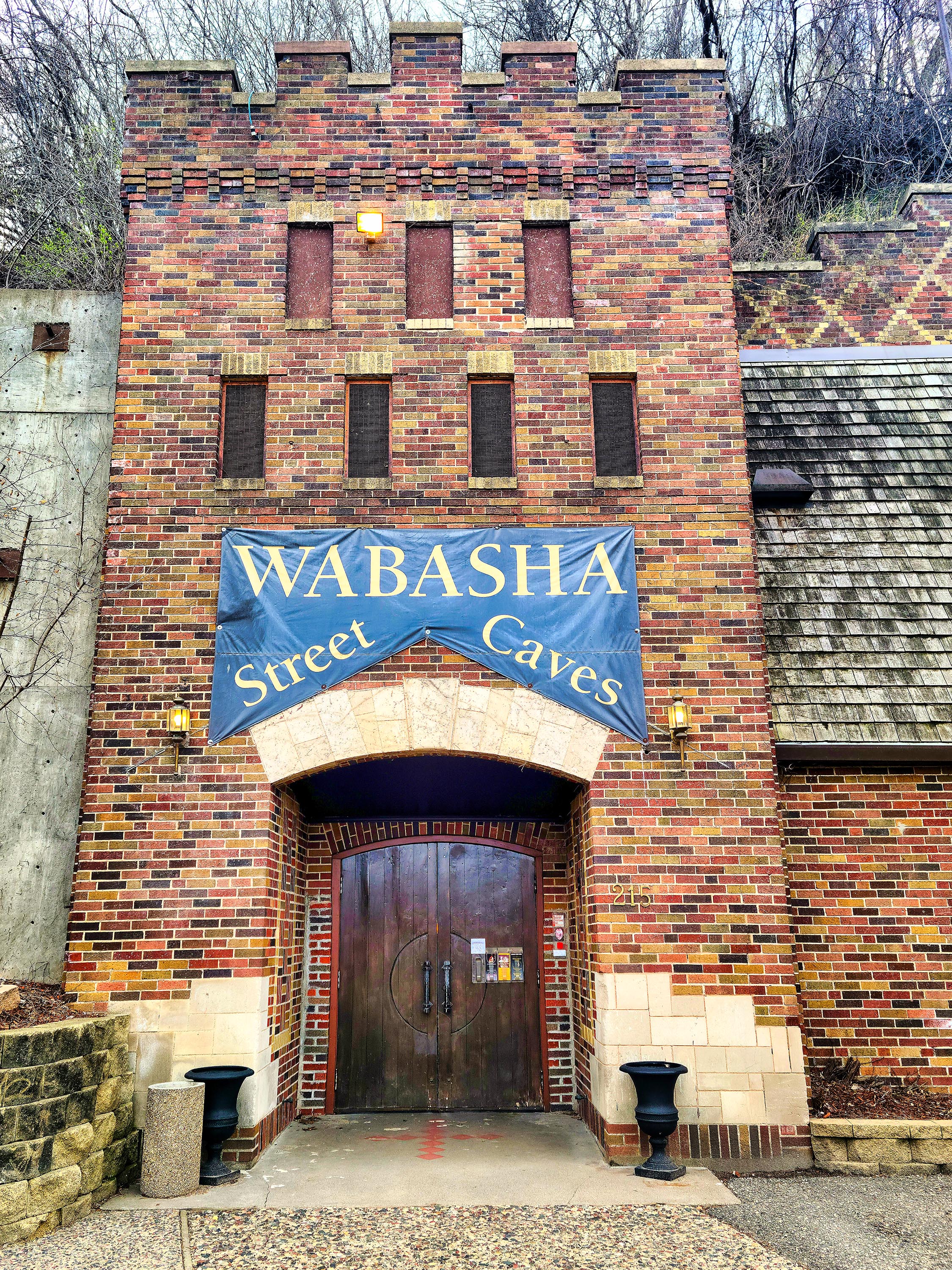
Russ and I meandered to the big city recently: i.e., the Twin Cities, i.e., Minneapolis and St. Paul, Minnesota. One of our stops was a tour of the Wabasha Street Caves in St. Paul.
This series of seven caves are in a sandstone/limestone bluff not far from the Mississippi River. They were dug in the 1850s to mine silica for making glass.

Our tour guide was named Lois. She began our tour not in the fancy entrance that leads to a refurbished part of the cave, but in a more primitive entrance, where we could see what the unfinished, original walls look like. While we stood in front of an entrance to a side cave, Lois explained that once the silica mining was over, the caves were used to store produce from off the river boats. Temperatures range from 50 to 55 degrees, which makes the caves ideal for storing veggies, growing mushrooms, and aging cheese.
The Wabasha Street Caves were once home to the largest mushroom growing operation in the United States. An immigrant Frenchman and his wife saw the cave’s dampness, darkness, and cool temperatures as the perfect environment for growing the delectable fungi. Plus, the streets of St. Paul provided a free source of growth medium in the form of horse manure.
Although that operation eventually ceased, the mushroom company lives on today in the form of Lehman’s Farm in Lakeville, Minnesota, which sells its marinated mushrooms to high-end food outlets like Lunds & Byerlys. The caves were also used by the Land O’Lakes Company to age Roquefort cheese.
In the 1950s, the caves fell into disuse until a flood caused massive damage to St. Paul. Lois said the caves were seen as the perfect place to store all that untidy debris. She shined a light down a side entrance where she stood to show us it was filled with old tires and dirt. But, before the flood, in the 1920 and 30s the cave was modified as a speakeasy, casino, and a nightclub. The debris-strewn side tunnel was thought to once lead to the speakeasy.
Tour guide Lois tells us spooky tales of nefarious doings in the Wabasha Street Caves.

From there, our tour moved into the refinished part of the cave. We saw the long bar, which was rebuilt based on old photos. Stucco covered the ceiling and water pipes and electricity ran through the walls. A separate section contained a dance floor, fireplace, and a stage. Lois said that famous jazz bands used to perform in the cave’s Castle Royal Nightclub.
The nightclub and casino were favorites with local gangsters. St. Paul had the reputation as a safe haven for them. The police wouldn’t arrest gangsters as long as they didn’t commit any crimes in St. Paul, although Minneapolis was fair game! The gangsters also shared their ill-gotten gains with the police department. This was called the Layover Agreement.
Despite this agreement, one notable crime happened in the caves. Four gangsters were gambling after hours. One of them apparently took umbrage at the conduct of the others and shot them all dead with his Tommy gun. At the noise, a cleaning lady ran in from another room to find three of the gangsters lying dead in pools of blood. She alerted the police who came to investigate.
Suffice it to say, with the cozy relationship between the gangsters and the police at that time, justice was not served. The police cleaned up the scene and chided the cleaning woman for filing a false report. It’s thought the bodies of the three gangsters still reside in the caves somewhere. Despite the protestations of the police, evidence of the crime can be seen in bullet holes on the cement fireplace.
Now the caves function as an event center and tourist attraction. They offer swing dancing and special ghostly tours. We were fascinated to learn about the caves and the shady history of the city of St. Paul.
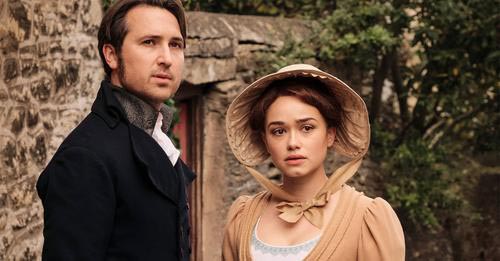
Characters from the series “Sanditon.” Image courtesy of PBS.
In my household, we’ve been watching the Public Broadcasting Service series, “Sanditon.” It’s based on an unfinished novel by Jane Austin – the last of her writings before she died. It’s set in England, of course, with strong and conflicted heroines.
Anyway, a social media announcement for last Sunday’s program said it was time to watch “the penultimate episode of Sanditon!”
I got all excited and told Russ that the best-ever episode of Sanditon was coming up. In our ensuing discussion I discovered that the word “penultimate” does not mean the ultra-ultimate of something like I had been thinking all these decades. Instead, it simply means it’s the next to last episode.
I was so disappointed. Not only because the series is ending and because the episode wasn’t going to be the best-ever, but because I’d been misinterpreting this word for so long. I don’t think I’d ever actually used the word anywhere, but it was a quite a blow to someone who is a writer.
I had fun thinking up a title for this post. Does the title mean this is the second to last mistake I will ever make in my life, or does it mean I am mistaken about the word penultimate? Or does it mean I’ve made the best mistake ever? 😊
Last week, I gave a presentation about blogging for my local writers’ group. It was a first for me, so I needed to research the topic. Thankfully, there’s a lot of info out there about blogging, much of it from Word Press. I thought I’d share some of what I learned with you since I am now this font of knowledge.
There are 600 million blogs out there in the world. This is so many that they make up one-third of the web!
Most people read blogs to learn something new.
80% of new blogs last only for 18 months. Most quit after 3 years.
22% of Word Press bloggers write once per week. 2% post daily.
Word Press is the most popular blogging platform, hosting 43% of blogs.
The highest recorded salary for a blogger in the U.S. in 2022 was $104,000.
It takes an average of 20 months to start making money with a blog, but 27% of bloggers start earning money within 6 months and 38% are making a full-time income within 2 years.
Posts that have “how-to” or “guide” in their titles are the most popular in general. (I am testing this with the title of this post!)
Images are helpful in garnering interest. Post with up to 7 images get 116% more organic traffic compared to posts with no images.
In 2021, the average length of a blog post was 1,416 words.
The average blog post length has increased 57% since 2014.
The trend is for increasing word count for posts. Posts with over 3,000 words get 138% more visitors than posts with fewer than 500 words.
Do any of these stats surprise you? I’m surprised by the trend toward longer posts, but perhaps that makes sense because there more words and more topics for search engines to find. But I would think that people don’t have that much time to read. Maybe they find the posts but don’t read all of them?
Okay, now I need to find an image for this post. And I should probably make it longer, but I am out of time!
I’ll be giving a Zoom presentation next weekend about blogging. It’s for our local Lake Superior Writers group as part of their monthly Writers Cafe, but anyone can attend – you don’t need to be a member. The presentation is free, and it will occur on Saturday (4/8) at 9:30 a.m. CDT. Pre-registration is required.
More deets:
Join us as we learn about blogging for writers, including setting one up, maintaining a schedule, finding your audience and more. Our guest expert is Marie Zhuikov–a fiction writer, poet, and blogger who also works as a senior science communicator for the University of Wisconsin Sea Grant Program. Her most recent book is a blog-memoir called “Meander North,” which was published in 2022 by Nodin Press in Minneapolis. It features the best of her humorous and outdoorsy posts from her “Marie’s Meanderings” personal blog.
Pre-register by emailing writers@lakesuperiorwriters.org. The registration deadline is Friday, the day before the event by noon.
You will receive an email with a Zoom link close to the event.
An angry raccoon. This image is from a Fox News story about a Florida couple who thought they were attacked by a bobcat, but after DNA analysis, it turned out to be a raccoon.
In his “Recollections of L. E. Potter,” my great-grandfather Laforest, who was a young settler in Minnesota tells a cute story that I didn’t have time to include in an earlier post about him.
The year was 1865. The family of 12 had moved from Wisconsin to Minnesota, settling for a time on the banks of the Watonwan River a few miles south of Madelia. One spring day, Laforest’s father John was mowing hay with a scythe about 80 rods from the house they were renting. Laforest writes (edited for clarity):
*
I was sent to take him a drink of water, also a watermelon. We got our water from a spring on the riverbank back from the house. I took my pail and melon to the top of the bank or bluff, laid the melon down by the side of the path and went down the path through the brush after the water. When coming back up the bluff, I heard something going through the bushes straight down to the river. This was rather startling to an eight-year-old.
Laforest Potterin his later years.
When I got to the top of the bluff and my melon was gone, boy-fashion, I did not stop to reason, but let my imagination run wild. I thought some animal had carried it off and that was what I heard going through the bushes.
I took the water to father and told him about the melon and the animal that carried it off. The more I talked about it, the better my imagination worked until I could tell what the animal looked like – what color he was, bigger than a dog. In my mind it was something terrible!
Father asked what I thought it was. I couldn’t tell him. So, he said he thought it must be a Racorebob.
Father told folks about my Racorebob for years after. Whenever my imagination would get the best of reason, I was reminded about my Racorebob. I believe it has always had a good effect on my life.
Father found the melon at the foot of the bluff, smashed against a tree. Somehow, it had started rolling down the bluff and that was what I heard.
*
(Marie here – I’m not sure what the word amalgam Racorebob means. Laforest never explained it, but my guess would be a “raccoon or bobcat?” Any other interpretations are welcome!)
When last you heard about us, Russ and I were having past life regression sessions in Prescott. That done, we left Prescott a day early under the impending threat of ten inches of snow. We drove across the mountains to the funky mining town of Jerome. Russ had not been there before and we were so close, it seemed a must-see.

Like on my previous trip, we ate lunch at Bobby D’s BBQ. This time, it was Russ’s turn to sit in the “haunted booth” where a former restaurant owner died. Despite this unappetizing tale, we heartily enjoyed our lunch of BBQ chicken, ribs, onion rings, and zucchini fries. They make the BBQ sauce on-site. Our favorite of the four was the jalapeno, molasses and brown sugar one. Zippy but not too spicy, even for us Minnesotans.
Sated, we searched for Nellie Bly’s kaleidoscope shop, which I’d visited last time. Then, I did not purchase any of these tubular wonders. Now, I had some relatives’ birthdays as an excuse. I even bought a small polished wooden one for us. Sometimes, you just need to look at the world in multiple triangles.
A kaleidoscope image I took with my phone camera, looking through the scope when back at home.
After some more browsing, we decided it was best to hightail it to lower elevations before the snowstorm came. We drove to Phoenix where we stayed overnight. The next day we visited the Heard Museum, which specializes in Native American art. From the sculptures outdoors to the paintings indoors, it was all marvelous. But my favorite exhibit was “Stories Outside the Lines: American Indian Ledger Art.” Hidden in several upper floor hallways, the drawings show events and past achievements that Native artists recorded in ledger books.
According to the museum, this art form began in the late 19th century when several Great Plains tribes were relocated to reservations by the U.S. Government. Many of their cultures had traditions of recording events on animal hides using natural pigments. Faced with imprisonment for practicing their cultural traditions, the Natives turned to the materials they had at hand, which were ledger books and colored pencils, provided by traders and government agents.
What struck me was their two-dimensionality. They looked like something a school child would draw except for the subtle sophistication of the topics they depict.
Russ and I are both big “Outlander” book and TV series fans, so our next stop was in the suburb of Phoenix at the Poisoned Pen Bookstore. The bookstore is near Outlander author Diana Gabaldon’s home and she sometimes does events there. We found that we missed Diana by a mere day – she was going to be speaking the next evening. Although tempted to stay, we had relatives waiting for us in Tucson, so we had to content ourselves with buying a few books instead. (After I got home, I discovered that one was autographed by Diana!)
An example of ledger art, courtesy of the Heard Museum.
Later, we drove south to Tucson and stayed at a relative’s home. We awoke the next morning to, you guessed it, a few inches of snow. It was the first snow the city had experienced in several decades. It seems we just could not escape it. However, the white stuff quickly melted.
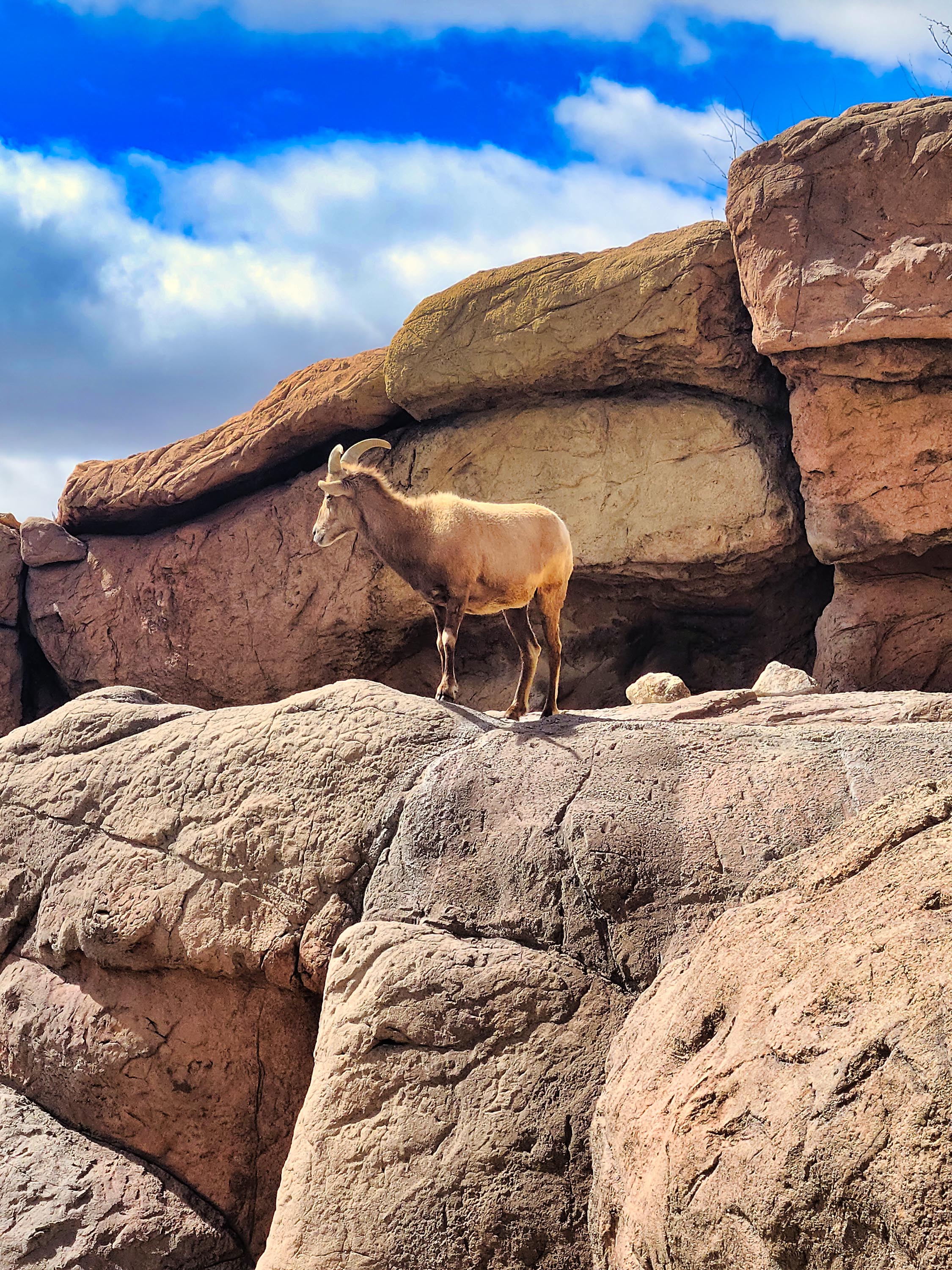
A blooming cactus at the Sonoran Desert MuseumBighorn sheep, Sonoran Desert Museum
We saw my son in Tucson and toured the Sonoran Desert Museum. Both Russ and I had been there before, but my son hadn’t. It had been years since we’d been there – the exhibits seemed more numerous and larger than I recall, but I suppose some had been added since the 1980s!
Our trip capped off with a hike in Madera Canyon, which to me seemed more like a valley than a canyon in the national forest nearby. The area is known for its birds, so we made sure to take in the bird-feeding station at the Santa Rita Lodge after our hike. We saw a lot of turkeys and Mexican jays.
Thus, ended our trip to Arizona to escape the snow. We failed in that regard, but the experience was successful in so many other ways.
When Russ and I travel, we usually do many “outward-looking” things like hiking, biking, seeing the sights, etc. For our recent trip to Arizona, we decided to go on a more inward adventure. We contacted a local psychic for past life regression sessions.
I’ve never shopped for a psychic before, but I figured the internet was a good start. A search of psychics in the Prescott area came up with three hits. The one that looked the most legit to me was “Psychic Readings by Deva.” Deva does readings by appointment only. She lives in a lovely home on the outskirts of Prescott.
We corresponded by email to set up the appointment. That went fine, except on my end. I was so distracted by dealing with the details of our impending trip that I sent Deva the incorrect dates of our visit. I thought I was setting our sessions up for the end of February and she thought they were going to be at the end of March!
When we showed up a month early, of course, she wasn’t home. Her husband was, though, and we were able to set up a session with Deva for the following day. Deva was very accommodating about this and I am forever grateful. I’m usually not such a scatterbrain. Was I unconsciously trying to sabotage the experience? Only Carl Jung can answer that!! (Get it? The famous Swiss psychoanalyst? Anyway…)
Besides past life regressions, Deva does tarot card readings, hypnosis, and energy work. She’s originally from Germany and has an accent that fits a session on a couch, which is where we laid during our separate hour-long regressions in her basement.
But first, while we were still sitting upright, Deva asked why we wanted the sessions. We basically just said we wanted a different vacation experience. Deva explained that in past lives, we could be different genders and races. There could be some violence involved since human history is so full of wars and conflict.
Russ went on the couch first while I waited upstairs, reading a book.
I was looking forward to the experience. I can’t say that I’m a true “believer” in past lives, but I am open and curious. I was bummed when I feared I had messed up our opportunity with the date snafu and was so glad that it worked out, after all.
A past-life regression is definitely not something I would have ever considered doing at home, where life is so busy. However, years ago, I bumped into a group past life session that was going on once down the hall from a meeting I had in the same building. A bunch of handouts entitled, “Tips for a Group-Guided Past Life Regression Experience” lay on a table, beckoning me. I picked one up.
One of the tips was to ignore your critical thinking so you can be fully present in the experience. This is very hard for me because I’m judgmental and critical by nature. Another was to trust that the information that drops into your mind during the regression is exactly what you’re supposed to see, even if it feels like you’re making it up.
When it was my turn, Deva spent about 20 minutes of the session on relaxation – taking me from the tip of my toes to the top of my head. Then came some imagery work that prepared me for exploring my past life/lives.
I ended up describing three lives. I really did feel like I was just making it all up, but thanks to that handy stolen tip sheet, I realized that was okay. I was male in two of the past lives, and female in one. One of the lives had a lot of violence and loss, but the other two were rather tame, except for a prairie fire and an absent husband.
In each life, I learned a lesson. None of the lessons were things that particularly resonated with me currently, and I didn’t really see anyone in my past lives that is in my current life. But I did end the session with a deep feeling of loss. Tears welled into my eyes and streamed down my cheeks. Deva found some tissues for me. 😊
I felt like I’d been through a ringer afterwards. It felt like one of those vacation experiences I often tend to get myself into — like a trail that’s way more difficult than the guidebook described.
On our way back to our hotel afterwards, Russ and I exchanged notes. He explored one life during his session. It seemed like it was in greater detail than my lives. But there were many similarities in it to the life of mine that had a lot of violence and loss. We were even the same ethnicity, although we were in different time periods. The lessons learned in these separate lives were eerily the same.
The session helped me understand some of my passions and dislikes and why I seem to have lost my green thumb.
In summary, Deva was great. The experience was unique, but if you do a past life regression, don’t expect a flippant jaunt down a flat trail, even if the guidebook classifies it as “easy.”
Russ and I wanted to escape Minnesota’s snowy winter and cold. We also wanted to visit my son who’s in college in Tucson, so we hoofed it south a couple of weeks ago.
Our first stop was Prescott, a small historic town in north western Arizona roughly between Phoenix and Flagstaff. I’d visited the town as a child. The tall pines and bright sun (due to the 5,000-foot elevation) had piqued my interest.
I must convey the correct pronunciation for Prescott. The locals say “Preskitt.” If you call it Press-Scott, they might shoot you with their open carry pistols.
We drove up the mountains from Phoenix at night, missing views of the saguaro cacti that stand as sentinels on the landscape. As we neared Prescott, a light rain began to fall. We checked into the Hassayampa Inn, which is on the National Register of Historic Places. We chose it for this reason and because it’s within easy walking distance of the town’s many attractions. Also, it has a coffee shop, bar, and art deco restaurant (the Peacock Room).
The inn’s name is derived from Apache and is named for a nearby river. Hassayampa means “the river that loses itself”— fitting for a mysterious stream that often disappears beneath the earth and reappears elsewhere. The inn’s promotional language says that the inn has the same effect on its guests, “who often come for a chance to lose the tensions of hectic urban life and emerge restored.”
Our plane got delayed, so we didn’t arrive at the Hassayampa until near midnight. A cheery fire in the lobby welcomed us and did the night clerk, who gave us (and our luggage) a ride in an old-fashioned cage elevator up to our floor.
When we awoke in the morning, the rain had turned cold. The view out our window included about four inches of snow covering the land. So much for our grand plan to escape the white stuff!
After breakfast in the Peacock Room (excellent, plus friendly staff), we walked around town picking up supplies. The historic district was only a couple of blocks away. Alas, the museums (the Sharlot Museum was one) we had hoped to visit were all closed due to snow, but many stores were open as were the saloons and restaurants on Whiskey Row. This historic district developed after a fire in 1900. When rebuilt, the area featured an “inordinate” number of bars (40), built to quench the thirst of gold miners and settlers drawn to the town.
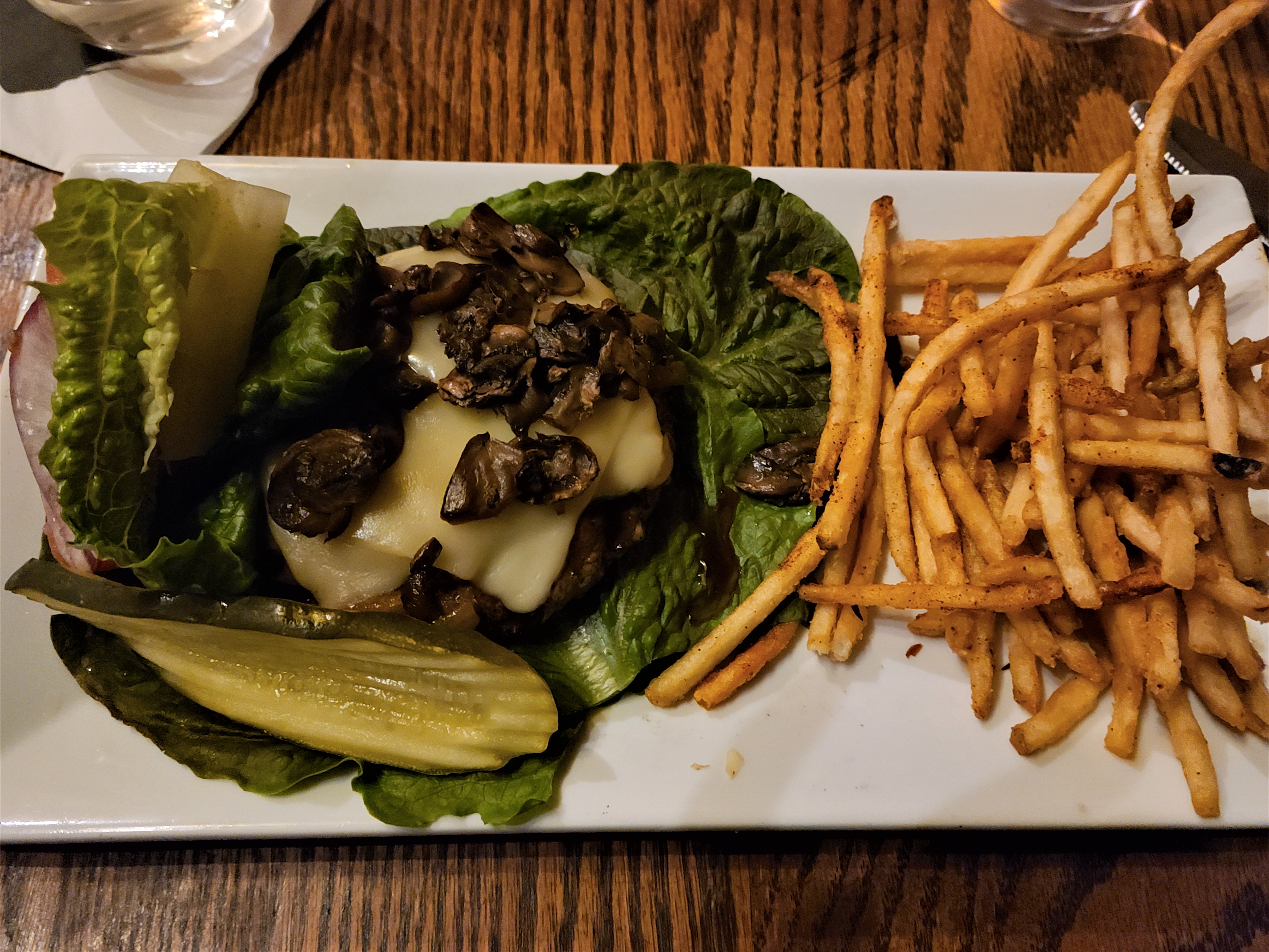
For supper that first day, we ate at one of the original saloons: The Palace. In addition to imbibing scotch whisky (how could we visit Whiskey Row without it?), I had a scrumptious burger called “the beast,” which is made from a mix of meats including boar and elk. I heartily recommend it!
The Hassayampa Inn lobby fireplaceThe Hassayampa Inn lobbyThe Beast Burger, Palace Saloon
Unlike in our hometown of Duluth, MN, the snow in Prescott melted fast. Most of the streets were clear by the afternoon.
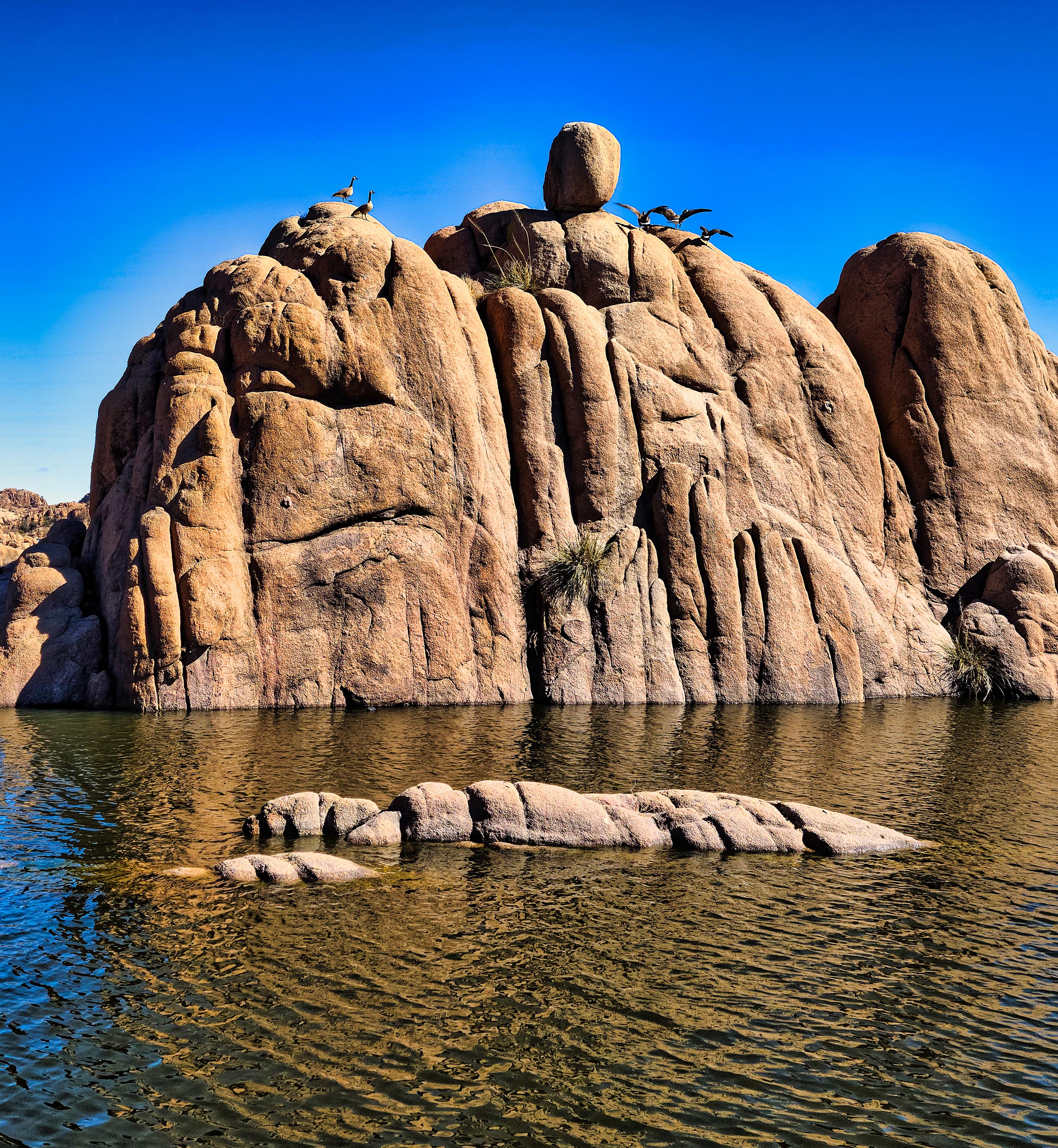
We spent our second day hiking around Watson Lake and visiting the Heritage Park Zoo, which is in the same vicinity. Watson Lake was especially dramatic, with rocky dells rising straight out of the water. We saw lots of Canada Geese and other waterfowl there.
While on our hike, we also saw an interesting warning sign. It alerted us to the presence of flying discs, since the lake has its own disc golf course. That’s not a sign we see every day!
We had intended to stay in Preskitt for another day, but an impending snowstorm, which was supposed to drop a foot of the vile white stuff on the town, chased us out early. The hotel manager was supremely understanding and promised to refund our aborted night’s stay. So, the next day we headed out of the mountains for the historic mining town of Jerome, and then Phoenix.
But before we left Prescott, we had one more adventure planned: past life regression sessions with a local psychic. More about that in my next post!