Here’s the second installment of “The Shower Singer,” a quarantine romance parable set in Minneapolis. The story does not provide all the answers. It makes readers think. It’s one of a series I’m working on for an anthology on the theme of deceiving appearances.
I hope it offers a fun, but relevant distraction during these trying times! (Read Part 1 here.)
The Shower Singer (Part 2 of 3)
By Marie Zhuikov
Then came the morning when the shower lady’s shower didn’t turn on. Then another, and another.
Sam listened intently for any life next door, even putting his ear against the wall. Nothing.
He began to wonder. Maybe she was in there hurt, maybe a victim of foul play, maybe in jail? No, not in jail. That didn’t fit Sam’s image of her. To him, she was young, modern, with long hair, and skin wet from the shower . . . .
Several newspapers were strewn across her sunburst doormat. Sam wasn’t sure what to do. Ask a neighbor? Nah, that would seem stalker-ish. Besides, he didn’t know any of the other neighbors.
“What do you think I should do?” he asked Randy the next time he was practicing in the garage.
It was Sam’s third day without the shower lady. He didn’t tell Randy that the woman was his muse, just that he was worried about her.
Randy leveled his brown-eyed gaze on Sam. “Why don’t you just ask the landlord or the building manager?”
“You know they hate me,” Sam said. “I’ve already got a bad rep with them from Stella. If I ask about this lady, they’ll probably think I just want to case the joint or something.”
“Yeah, but how are you going to find out about her otherwise?” Randy asked.
Sam searched the nooks and crannies of his muse-starved mind. Nothing came to him. He had to know what happened to her. What if she had moved? He had to find her.
“I don’t know. Guess I’ll just have to put on my big boy coveralls and get to it.”
Randy gave Sam’s shoulder a fist bump. “That’s my Corn Boy.”
The next day, after another morning with silence next door, Sam knocked on the building manager’s door on the first floor.
The last time he spoke to Bruce, the manager had threatened Sam with eviction. Sam waited, holding his breath. A short heavyset man with graying hair opened the door.
“Oh you, whadda you want?” Bruce asked.
Sam paused, exhaling to keep himself calm. “It’s my neighbor.”
“Which one, four-thirteen or four-seventeen?” the short man asked.
“Four-thirteen.”
“What about her? She complaining about your noise, too?”
Sam shook off his annoyance. “No. I’m worried about her. Newspapers are piling up outside her door. I haven’t heard anything over there in days. Could you take a look?”
Before answering, Bruce eyed Sam up and down as if searching his baggy T-shirt and jeans for drug paraphernalia. A sly smile slowly lit his chubby face. “Neighbor? What neighbor? That apartment has been vacant for weeks.”
Sam’s thoughts wheeled for a few moments, finally settling in the direction of ghosts. Had he just been hearing things? Had it all been an illusion?
Bruce’s smile widened at the expression on Sam’s face.
Sam felt his blood pressure spike. “Cut the bull. She might be in there hurt or something. You need to go investigate.”
Bruce’s smile disappeared. “Just having a little fun. Let’s go have a look-see.” He closed the door most of the way and went back inside his apartment, returning with a set of keys. “C’mon,” he said, and the two climbed the stairs to the fourth floor.
The newspapers were still lying outside the door of apartment four-thirteen.
Bruce knocked. When there was no answer he took the keys from his pocket and opened the door. “You stay out here.”
Sam did what Bruce said, but couldn’t help trying to see inside. Her apartment was laid out differently than his. She had an entry hallway. His door just opened up into his living room. He saw an entry table with a lamp on it. A ceramic bowl — maybe for keys, sat next to the lamp.
Bruce’s muffled voice came from inside, “I don’t see nothin’. Don’t see her. Wherever she is, I gotta leave a note letting her know I was here.”
“So now what?” Sam asked after Bruce came out and locked the door.
“I’ll call her work. Jane’s a nurse at the county hospital -– in the baby unit. Lives here by herself.”
Sam’s heart gave a jump. Jane. Now he had a name to go with the singing. Bruce was on his way back down the hall before Sam collected himself enough to say, “Let me know what you find out.”
Bruce just kept walking. His “Yeah, whatever,” floated down the hallway.
*
The next evening was Friday night. Sam had checked his cell phone all day, hoping for a message from Bruce. No such luck. The wait was wearing on him.
As he ate his grilled cheese supper, Sam considered calling Bruce. He disliked the man, but how else was he going to find out what happened to Jane?
Bruce answered on the third ring, sounding annoyed as usual.
“I was wondering what you found out about my neighbor.”
Sam didn’t want to call her “Jane” to Bruce, sure that the way he said her name would give away his feelings for her. Besides, her name seemed too precious to say to this jerk.
“Yep,” said Bruce.
Yep? That was all he was going to give him? “Well?” Sam asked.
After a pause, the manager said, “She’s under quarantine.”
It took a moment for Sam to process the strange word. He knew what it meant, just not the “why” of it. “So what’s the deal?” he asked.
“She was exposed to that new disease goin’ around,” Bruce said. “You know, that crypto-whatever-it-is. So they got her locked in a room at the hospital until they know for sure if she’s got it or not.”
Sam had heard of crypto. It stood for cryptofungosis, a nasty disease that was spreading overseas. It was caused by inhaling a fungus from the soil, but it could be passed from person-to-person, too. Pregnant women infected with it gave birth to babies with deformed arms and legs.
“How’d she get exposed?” Sam wanted to know.
“Dude, they wouldn’t tell me that kinda thing,” Bruce said. “All I needed to know was where she was at, and now I know, so I didn’t go axin’ all kinds of questions.”
“Okay, okay.” Sam tried to mollify the manager. “Thanks for telling me. Let me know if there’s anything I can do.”
“What you can do,” the manager said, “is to keep down the racket. Even if one of your neighbors ain’t home no more.”
Sam didn’t think that deserved a reply. He pressed “call end” and looked at the wall behind his kitchen sink — a wall that Jane should be behind.
He had to get outside and think about what he should do. Sam left his half-eaten grilled cheese on his plate, slinging his guitar case over his back and his bike over his shoulder. He headed for Powderhorn Park, a couple miles down Cedar Avenue.
As Sam biked through traffic, the face of his mother floated in the humid summer air and green hedges before him. She was wearing her camouflage gear, looking at him with her soulful brown eyes. She had been a medic in the Gulf War. The helicopter she was in crashed, her body burned in the desert. They didn’t have much to bury when she came home. It was like she disappeared when she walked out their farmhouse door for her tour of duty.
Their dad had tried to hold it together for Sam and his brother, but things were never the same after their mother’s remains came home in a gray metal transfer case.
Dad threw himself into working the farm and never did find anyone else, at least not yet. Sam doubted he ever would, especially since he hardly ever left the farm.
Sam shook his head to keep the hollowness in his soul from growing, and he kept on biking. Once at the park, he leaned his bike against his favorite bench that overlooked the big pond in the middle. The water was full of goldfish, carp, and all kinds of plants or animals that people didn’t want in their aquariums anymore. But Sam liked seeing the bright flashes of orange as the fish came to the shore, looking for handouts.
He sat on the bench and took out his guitar, strumming it absently. A breeze cooled him and the sky was beginning to take on the purplish hues of twilight.
What should he do? Jane, Jane, his Jane might have some god-awful disease. How did quarantine visits work, anyway? Tomorrow was Saturday. He didn’t have a gig or work. Should he try to visit her – see if she needed anything?
That would be stupid. A girl like that probably had lots of people looking out for her. He’d just be in the way. What was he to her? Just the stranger next door.
But the hospital wasn’t that far away. He could easily bike there or walk. Jane was probably pretty bored.
What if she died and he never got to see the woman who haunted him with her music? He could never forgive himself, never repay her if he didn’t see her. It would be like his mom — like she left one day and never came back.
Jane should know the gift she’d been giving him, and how he’d been using it.
He laughed at himself. Here he was getting all emotional about a woman he’d never even seen. He thought again about how she might look. With such a beautiful voice, she had to be beautiful, didn’t she?
What if she wasn’t?
What the fuck did that matter? It was the place where Jane’s music came from that he was falling for. That’s what was important — the place inside her that he owed a debt to. Not her looks.
A couple wandered past and did their best to ignore Sam, until he started playing “Stranded.” Then they stopped a few steps away and watched him play, the setting sun reflecting purple and red behind them, creating fuzzy haloes around their hair.
They clapped when he finished, and Sam gave them a quick salute.
*
The next day, Sam chained his bike to a lamppost outside Hennepin County Medical Center and entered, on a search for the birth center. He knew Jane wasn’t there, but hoped someone could tell him where to find her.
The desk nurse at the center directed him to another building across the street. As he walked down the hall of the building, the smells of disinfectant and the silence of the closed, and presumably locked, patient doors unnerved Sam.
A dark-skinned woman sat behind the unit desk. She was talking on the phone, but interrupted her call when she noticed Sam standing in front of her.
“What can I do for you, honey?” Her voice had a southern twang that enchanted Sam. Her nametag said “Gladys S.”
“I’m looking for Jane — I don’t know her last name, but she’s an employee here who’s in quarantine.”
Gladys spoke into the phone and ended her call. “You immediate family?” She looked Sam over.
He started to fidget, shifting from one foot to the other. “Not exactly.” He quickly added, “But I’m her neighbor. I figured she might need something. I just want to help.”
Gladys’ gaze turned stony. “I can only let in immediate family and medical personnel.” She paused for a moment, then said more softly, “It’s too bad you ain’t immediate family, cuz nobody’s been to see that poor girl other than some of her friends who’s nurses. I don’t know where her family is, but they shore ain’t here.”
“Well, can you at least tell me how she’s doing?”
“No can do,” said the nurse. “Only . . .”
“. . .for immediate family and medical personnel.” Sam finished for her.
Gladys stood and peered across the desk at Sam more closely. “Say, ain’t chu that musician? I thought I saw you at the 331 Club a coupla weeks ago.”
“Yeah, that was me.” Sam’s heart gave a little hop. “Listen, I just want to see her. Just for a bit.”
“You go in there and you gotta suit up like a Martian,” Gladys explained. “Only her family can do that. Poor girl’s in there for another three days till they know for sure whether she’s got the crypto or not. Sorry, but I can’t let you in.”
“Well can I at least call her or something?”
Gladys regarded Sam again. “She know you?”
“ . . . No,” Sam said.
“You two never met? What you doin’ here then?”
Sam shrugged and tried to look innocent.
Gladys took his measure yet again. “You best approach her more careful-like, then.”
Sam waited for the nurse to explain.
Gladys looked up at the ceiling for a moment, as if the answer were there. “Like . . . send her a letter or somethin’. Let her decide if she wanna talk to you. She under a lot of stress, you know.”
“Thanks Gladys,” Sam said. “That sounds like a good idea.”
“Okay, you go on now,” Gladys said. “I ‘spect I’ll see you back here soon.”
“I spect you will,” Sam said, caught up in Gladys’ manner of speaking.
*
Jane turned off the TV gameshow and looked out the window of her hospital room. Rain sputtered, painting the windows with gray rivulets.
It was Sunday and she had another two days left in this hell hole. That was, if she didn’t have crypto. If she did have it, she’d be in for another two weeks, pumped full of strong anti-fungal drugs.
Jane sighed, thinking back to the chain of events that brought her here. It had been Christine, a pregnant woman who had just returned from a trip to the Middle East. When she felt sick, she had visited her doctor at the HCMC Birth Center. Jane was the one who had taken her blood samples and stood close enough to breathe in the air that Christine breathed out.
Too late for Jane, the doctors had discovered that the cause for Christine’s malaise was cryptofungosis. Now she was quarantined just down the hall, too, undergoing treatment and no doubt worried about her unborn baby. Even future babies Christine might have could be born with the deformities that were hallmarks of the disease.
Jane shuddered. Her foot stuck out from under her sheets. Although she was afraid of what she might see, she couldn’t help but glance at her toenails, looking for any black streaks — one of the first signs. Nope, nothing yet.
Even though the disease was treatable, the medications were so strong that doctors wouldn’t prescribe them unless they knew for sure she had it. So Jane had to wait.
She looked back up, catching a glimpse of herself in the mirror on the other side of the room from her bed. Framing her straight brows and dark blue eyes, her black hair was starting to get stringy. She hadn’t showered in a few days.
Normally, she had a nurse’s instincts to keep clean, but it’s not like she had to shower to look good for visitors. Her parents lived on the West Coast, too poor to afford a trip to Minnesota on her mom’s salary as a waitress. Her dad was a disabled vet from the Afghan War, and his disability check didn’t cover much. She had no brothers or sisters.
Jane had come to Minnesota in search of a good nursing education, leaving the California poverty behind. She’d gotten her degree, her first job, and now this . . . .
Thank God she had her cell phone — her one link to the outside world and to her parents. She also called her nursing school friends, who had all dispersed to other cities and hospitals. The few other friends she made here were great when she needed help moving, but most were too busy to visit her in the hospital. Or maybe too scared.
A knock sounded on the hallway window to her room. The staff used the tray underneath the window to transfer food and other items to her. Jane got out of bed and walked over to it. Gladys stood, holding an envelope in her hand.
“Sweety, a man named Sam who says he’s a neighbor of yours brought this for you.” She held up the manila envelope, which Jane could see was wrinkled with several rain spatters.
“You mean from my apartment building?”
Gladys nodded.
“But I don’t know any Sam,” Jane said.
“Why not just read this and see what it says?” Gladys placed the envelope in the tray and pulled the lever that pushed the tray into Jane’s room.
Jane retrieved it. “All right then, thanks.” She turned and sat back down on her bed, ripping open the envelope. There was something hard in it besides the paper, but she ignored it in favor of the letter.
Dear Jane,
Hi. I’m Sam from #415. I noticed you haven’t been home for a while, so I got Bruce to check on you. Sorry to hear you might be sick. I saw on the news where that lady exposed a couple of other people besides you, and they’re also under quarantine. That’s got to suck.
You must be pretty bored. I’m including one of my CDs for you to help pass the time. I’m a musician and these are my songs.
Not to freak you out or anything, but I noticed that you like to sing in the shower. I can hear it from my kitchen. You’re a good singer, you know. I ended up writing a couple of new songs based on your tunes. Maybe someday you’ll get out of there and I can play them for you.
I tried to visit you, but they wouldn’t let me since I’m not family. So this letter will have to do for now. But if you want, you can call me. I’m usually home in afternoons during the week (612-555-1234). Hey, maybe I could play my new songs for you over the phone!
Anyway, I just wanted to thank you for the inspiration, and to let you know that somebody’s rooting for you out here. Give me a call and let me know how you’re doing.
Your Friend,
Sam
Jane laid the letter on her bed and took the CD out of the envelope. She studied the photo of the man holding a guitar and standing in front of a gritty urban scene. Sam was cute — with scruffy blond hair, deep-set eyes and a hint of mustache over his lip. His body looked wiry and tall; his fingers slim and nimble on the guitar strings.
A pleasant shiver went through her. This was her neighbor? Damn, why couldn’t they have met before she got quarantined?
She didn’t know how she felt about him overhearing her singing in the shower. That was a little creepy. She thought she was singing in private. That Sam had heard her made her feel exposed. She crossed her arms and sat back against her pillows.
Sam had heard the little tunes she made up, and had created songs from them. Should she be mad at him for “stealing” her shower songs? Jane thought for a few moments. No. She wasn’t mad. She rather liked that something good came from the thin walls in her bathroom.
She certainly hadn’t been singing in the shower in the hospital since she got quarantined — she was too worried.
Jane thought back to when she used to luxuriate in her morning showers. Her singing came in fits and starts — only when she was happy and relaxed.
She had wondered why music sometimes came to her in the shower and sometimes not until the day she had been curious enough to Google it. She discovered that shower singing had been scientifically studied, which made her chuckle.
The researchers found that people liked to sing in the bathroom because the hard surfaces created good acoustics.
“The multiple reflections from walls enrich the sound of one’s voice,” the researchers said. “Small dimensions and hard surfaces of a typical bathroom produce various kinds of standing waves, reverberation and echoes, giving the voice fullness and depth.”
But that didn’t explain the emotions behind it. Another link on “How Stuff Works,” provided her with that. It said that people sang in the shower because they’re alone, and they feel safe and comfortable in the warm water. “Stress literally washes off you. When you relax, your brain releases dopamine, which can give your creative juices a jumpstart.”
The website also said that the act of singing made people feel even better because the breathing involved in it put more oxygen in their blood. This provided for better circulation, which improved their body and their mood. The end result was something like meditation.
Jane had hardly taken any showers here. Not only because she didn’t have many visitors to look good for, but because she was fearful of what she might see on her body once it was naked — black streaks on her skin and nails.
It was like if she didn’t look at her body, she could ignore her current situation. Ignore the smooth white skins waiting to betray her.
How could she even think of calling Sam and starting a friendship when she didn’t know if she was sick or not?
But damn, she was lonely. She didn’t know if she could make it the next two days while she waited for the news. She’d already called her family so often, and her nursing friends. It might be nice to talk to someone new.
Jane looked out her window at the rain still coming down. Sam must have braved the storm to bring her his letter. She smiled and kept mulling.
That’s all for now. I’ll post Part 3 on Thursday.


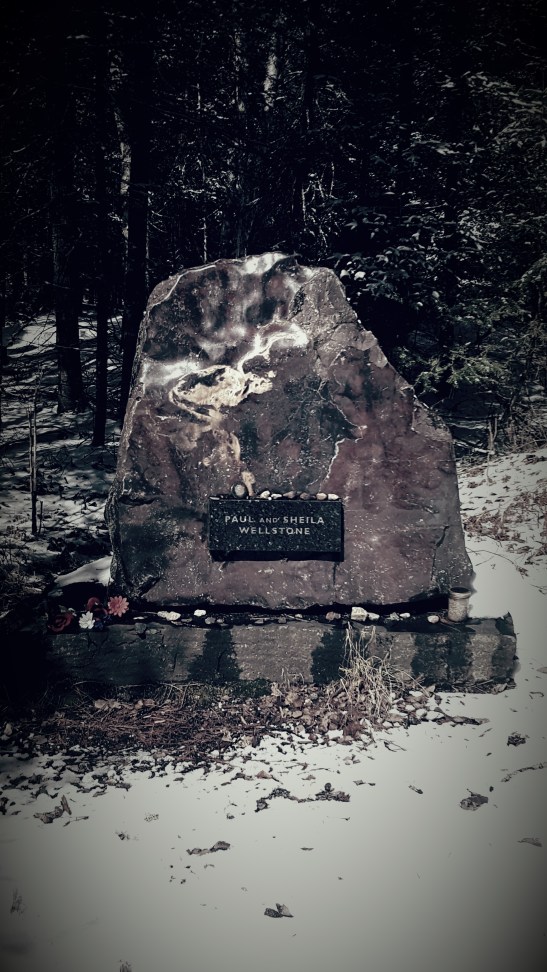
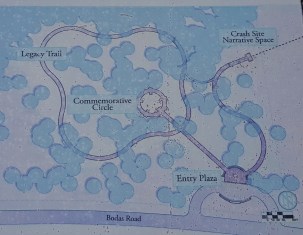 Russ and I had driven past the signs for the memorial off Highway 53 several times and finally had the time to stop. The first thing to greet us in the parking area was poetry. A snow-covered stone mantle sat at the entrance to the memorial. We brushed off the snow, trying to read the poem that was etched into the rock. We couldn’t do this because of the moisture, but were able to make out some of the words later, after they had time to dry.