Cruising in the Crawler Lane: Adventures in Scotland, Part 1

SCOTLAND! 014

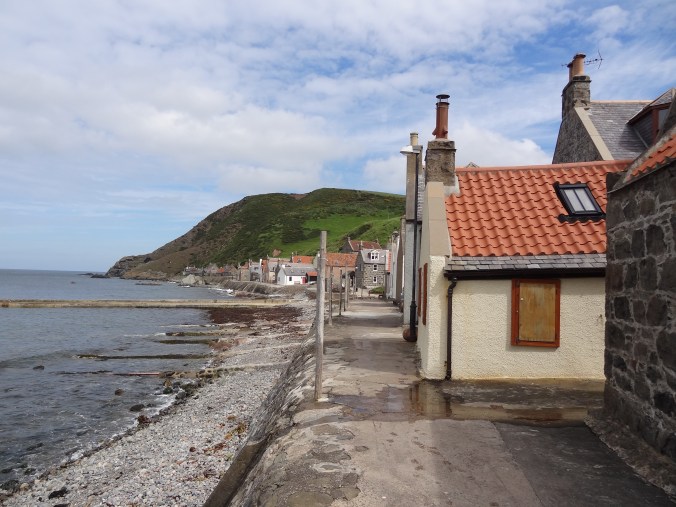
Crovie Village, Scotland. Where the sea is not only on your doorstep — it IS your doorstep!

At the time of this writing, I am almost done meandering around Scotland for ten days. I traveled with a friend and we spent most of our time in northeastern Scotland (the Moray Coast area near Banff). After that, I traveled by myself to the Borders area in the south to visit my ancestral hometown of Kelso.

First of all, I would like to apologize to all the drivers in Scotland. Yes, for the first several days at least, we were the ones stalling our manual transmission rental car while driving up hills and through round-abouts. We were the ones poking along in the far left lane (a.k.a. the crawler lane), afraid to drive over 65 m.p.h. It’s not easy driving on the left side of the road and shifting with your left hand. Just one of those things would be difficult, but add both of them together and it causes Driving Dread. It took me about four days before I could approach the car without wincing at the imagined bloody outcome.

SCOTLAND! 024

More Crovie.

Thank you Scottish drivers for not honking at us too often and for not crashing into us.

There, that’s out of the way.

We chose to stay in the historic fishing village of Crovie (pronounced “Crivvy” by the locals). It was settled by displaced Highlanders after the Battle of Culloden. Located at the bottom of a steep bluff right near the sea, I suppose it was land that nobody else had the guts or desperation to settle, and so it was theirs for the taking.

Crovie operated as a town and fishing center, home for up to 300 people at one time, until 1953, when a severe storm damaged many homes. Most of the people moved to Gardenstown, just a mile next door. Now the town functions mainly as a tourist attraction, hosting seasonal visitors and a few residents.

We met the last of the remaining full-time residents during our stay. His name is Billy. He’s lost some fingernails, and parts of fingers. He is also missing some of his upper teeth. But Billy is a rough-cut gem, and has obviously survived a hard life near the sea.

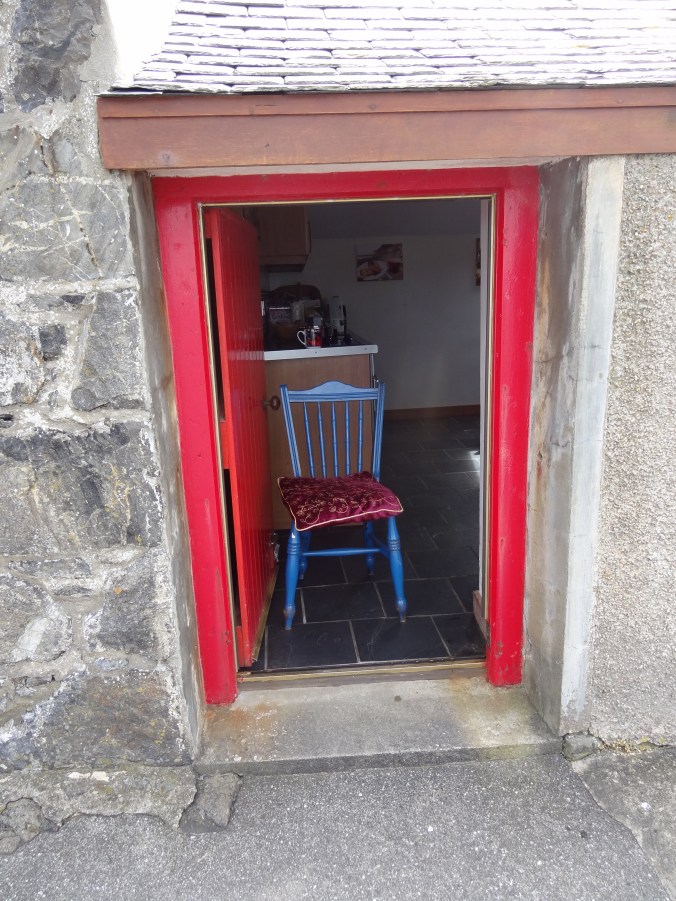
SCOTLAND! 027Our abode was Crovie Cottage Number 13. What could go wrong, right?

As the cottage ads say, abode number 13 is not suitable for triskaidekaphobics (those who fear the number 13). Fortunately, we do not suffer such a fear and found the place inspiring and charming. It took us a while to figure out which switches to flip for necessities like hot water and electricity, and how to operate the electric meter that required feeding with 1 pound coins for an uninterrupted flow of electricity, but after a day or two we had it down.

We also learned how to light a coal fire in the fireplace, and how to eat breakfast with the front door open to the sea (which is only three feet away).

Be forewarned – if you ever decide to visit or stay in Crovie, the descent into the village is extremely steep. You also can’t just park your car in front of your cottage and unload. There’s not enough room between the cottages and the sea for a road, so you have to park either at the lot above the steepest part of the road or the one at the bottom of the steepest part, and roll or wheelbarrow your supplies to your cottage.

My kind of place! More adventures to follow . . . .
SCOTLAND! 015

St. Martin Island – Where Nothing is Better

St. Martins 1 030

A Carnival parade in Marigot, on the island of St. Martin.

The weather in my town is so foggy and cold lately, it’s got me wishing I was back on St. Martin, an island where I meandered four years ago. This blog entry is a good excuse to revisit that trip and share it with you.

I travelled to St. Martin with a friend. We chose it that February because: A) It was warm. B) English is spoken. C) No visa is required, just a passport, and D) U.S. dollars can easily be used. It was foreign, but not too foreign, if you know what I mean.

The island is also extremely easy to find your way around, literally. One main road encircles the coast, so it’s hard to get lost. Also, round-abouts abound, making it easy for confused tourists to have more than one chance to choose the proper exit.

Pineapple Hill SimpsonBay

Pineapple Hill at Simpson Bay.

We stayed at a beach resort, and did plenty of frolicking in the waves and snorkeling. The first off-resort beach we went to was the one famous for having an airport runway approach right overhead (Maho Beach). It’s not often you get to take a tan and watch a plane fly only 50 feet above your prone body. I kind of wonder how long it will be before a disaster happens and either the beach or the airport gets moved. (But I hope no disasters happen.)

ButterflyFarther inland, visitors can zipline through the jungle at a nature preserve, visit a butterfly garden and open air markets, and hike to the highest point on the island (Pic Paradise).


Half of the island is under jurisdiction of the Netherlands, the other half, France. The day we explored the French side, we chanced upon a Carnival parade in the French capitol city of Marigot. We also scored a fabulous French meal in a harborside bistro, Le Chanteclair, where their most-appropriate motto is: Gastronomy is the foundation of true happiness.

St. Martins 1 041

A meal at Le Chanteclair in Marigot: prawns with an egg roll and lobster sauce. To die for!

In the Netherlands capitol city of Philipsburg, we discovered an art gallery and movie museum run by the “Yoda Guy.” He was one of the original make-up artists who worked on Yoda in the Star Wars movies.

The residents of St. Martin are friendly, and unlike some Caribbean islands I’ve visited, there doesn’t seem to be a huge income disparity between the islanders and the visitors. I never felt unsafe walking around at night or driving through towns. And the bartenders are friendly, too. My middle-aged friend and I had one hit on us (he gave us his phone number with hearts drawn around it), which makes me even fonder of the island. 🙂

One note of good-natured warning. Be sure to consult your beach guide so you know what type of beach you’re going to. We stumbled upon a nude gay beach by accident, but figured things out pretty darn fast (and ran away!) The island also sports several nude resorts, Club Orient, is the most popular. Their motto is: Where “Nothing is Better.”

St. Martins 1 038Although we ran away from the nude gay beach, we did find a nude beach suitable for the adventurous introvert. Sorry, I can’t recall the name of it now (Happy Bay?), but it lies within a gated community. A couple who were leaving through the gate were good enough to give us the entry code, and we enjoyed freeing ourselves of our swimsuits on a relatively private beach.


Another note of warning: don’t step on any sea urchins. Those things hurt. My friend found out the hard way. The good news is that if you do step on one, pharmacies on St. Martin carry sea urchin spine removal ointment. I can’t say that it worked very well on my girlfriend, but maybe you’ll have better luck.

Ah, St. Martin. I would go back in a heartbeat. Thanks for the warm memories on this dismal day.

ToolsofTrade

Hangin’ on the South Pier

I had to wait for some work colleagues on a pier on Duluth’s Ship Canal last week. They were late. I had a camera. Enjoy the fruits of my boredom!

ChinWu Wave Pressure Gauge 003

ChinWu Wave Pressure Gauge 008

Duluth’s Aerial Lift Bridge (from a different perspective than usual.)

ChinWu Wave Pressure Gauge 024

A ship, the American Spirit, enters the ship canal. Looks like it’s going to crash, doesn’t it?

ChinWu Wave Pressure Gauge 029

ChinWu Wave Pressure Gauge 039

A friendly little house wren kept me company. It was catching bugs behind the lighthouse on the pier.

ChinWu Wave Pressure Gauge 034

When my colleagues arrived, they installed a wave gauge pressure sensor off the pier that will be used to help detect and predict the presence of rip currents, which can sweep unwary swimmers out into Lake Superior. The local newspaper wrote a (front page!) story about the project. Read it here.

Monarch Mania

20160521_125303

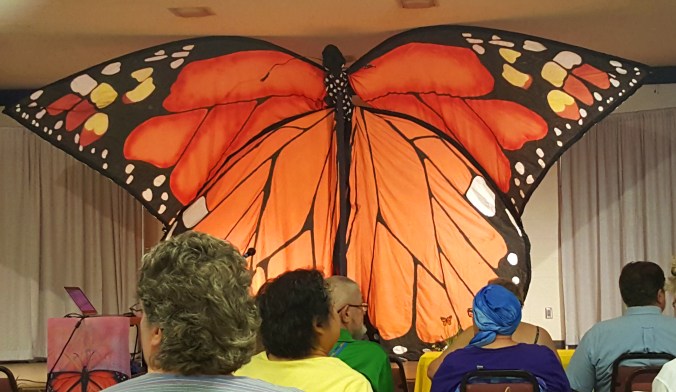
Any minute now the first monarch butterflies will wing their way into the northland on their annual migration. Thanks to the first-ever Duluth Monarch Festival this weekend, I learned that the butterflies that return to Minnesota aren’t the ones that left in fall for Mexico, but are their offspring that grew up in early spring somewhere in the southern U.S.

If they aren’t the butterflies that left here, how do they know to return? How can an insect that weighs about the same as a paperclip survive the long flight? These are just some of the intriguing questions that surround monarchs.

On the street where I grew up, milkweed (the monarch caterpillar’s favorite plant food) flourished in a vacant lot kitty-corner from our house. I had a little round wire mesh insect container where I would grow the caterpillars into butterflies indoors. I can’t recall exactly how I learned to do this, but suspect my older brothers taught me. I raised dozens, fascinated by the transformations the caterpillars went through in becoming the beautiful black, orange and white butterflies that are so distinctive and a joy to see.

My attachment to the creatures even extended to the schoolyard. On one of my first days on the kindergarten playground, a boy killed a monarch caterpillar. I thought he was the cruelest person on the planet, and begged him not to kill it because, “These are the ones that make butterflies!” Other than that, I lacked the communication skills to tell him why I was so upset. I ended up burying the caterpillar underneath a pile of playground pebbles. Now I understand his actions were just the casual cruelty of boys (and because he had probably never raised caterpillars), but for the rest of my grade school career, I shunned him as The Boy Who Kills Caterpillars.

DSC02677

A monarch caterpillar on a milkweed plant.

Playground killings aside, the monarch population has dropped significantly over the years due to habitat loss, pesticide use, and a wacky climate — to the point that the fall migration to Mexico is in danger of disappearing. The last two years have had the lowest counts in history. Instead of taking up 18 hectares of roosting forest in Mexico (1996), the butterflies now only take up 2-4 hectares.

One relatively painless way to learn more about the plight of the monarch is to read “Flight Behavior,” a novel by Barbara Kingsolver.

The monarch festival I attended is one effort to help this beleaguered bug, and the organizers hope to make it an annual event. The goal was to educate citizens about monarchs and to help people become involved in restoring monarch habitat. One of the speakers was Prof. Karen Oberhauser from the University of Minnesota. She said an estimated two million more milkweed plants are needed for the monarch population to stabilize. To that end, a local group (Duluth Monarch Buddies) was giving away milkweed seeds. Milkweed plants and other butterfly-friendly plants were available for sale.

They were also encouraging people to sign up to be monarch larva (caterpillar) monitors. The Monarch Larva Monitoring Project is a citizen science effort where volunteers track how many monarch eggs and caterpillars are in a local milkweed patch. How I would have loved to do this when I was a child! Heck, I intend to do it now. Monitors visit their sites once a week and enter observations onto a data sheet. The goal is to better understand the health of local monarch populations and how they change over time.

I picked up a packet of milkweed seeds. I can’t wait to plant them and do my small part to save the monarchs. Take that, Boy Who Kills Caterpillars!

Songs that Should be in Movies

BobbieD

Bob Dylan

Duluth is gearing up for Dylan Fest this coming week. For those unaware, singer Bob Dylan was born here and lived in northern Minnesota through his high school days. Although some local controversy exists about Dylan’s perceived slights of his hometown, many people here like his music and I expect the events will be full.

Not long ago on the radio I heard Dylan performing Rodgers and Hammerstein’s “Some Enchanted Evening.” Hearing him sing it in his nasally voice was funny and sort of surreal. It made me pull off the road and start a list of “Songs that Should be in Movies.” Who knows, such a list could come in handy if movies are ever made from my novels. (Grin.) I can see Dylan’s song accompanying a slow dance scene.

Other songs I’ve heard since then that I’ve added to my list are:

Running with the Wolves,” by Cloud Cult. This would make a good road trip song.

From a Payphone in the Rain” and “Me, You & the Universe,” by Teague Alexy. The payphone song is so heart-wrenching, it made me glad that Teague doesn’t record such songs very often. (Just stab me in the heart with a pencil and twist it, why don’t you?!) These songs are stories in themselves – maybe too specific for a movie soundtrack — but they’d make for good closing credits songs; ones to hear while you’re feeling the after-effects of a movie and you want to prolong the agony (or ecstasy) of the story and chill out before you stand up and go out into the real world.

That’s it for my list so far, but I’m still adding to it. Any suggestions?

How I got a job at Mayo Clinic

PlummerHallway

A hallway in the Plummer Building at Mayo Clinic.

As I sat at the graduation ceremony for my oldest son recently (he has a master’s degree now, yay!), I surveyed the vast audience of new graduates, wondering how the economy can absorb so many people seeking jobs. And to think, new graduates are being let loose on the country all over. So many of them, swarming across the spring landscape. I know not all will slip seamlessly into the perfect jobs. It might take a while. For some, it might take a long while.

It reminded me of a job I had once that was a great fit. As a public service, I’d like to offer some job interview secrets that might help new grads, and employers, too. I am not doing this to show how great I am or because I am a chocolate-covered narcissist with narcissistic filling. Well, maybe I’m a little narcissistic. (Said the woman with a blog about herself.)

Seven years ago, I started feeling overworked and underpaid at my job. I also had a relatively recent master’s degree. Armed with that, and with the restlessness that seems to go with mid-life, I decided to look for a different job.

The first one I applied for was a public affairs consultant position with Mayo Clinic in southern Minnesota. The very next day I received a call for an interview. I figured that meant either they were desperate to fill the position, the timing was right, or they were excited by my application. Turns out, it was a combination of all three.

They paid my way for the interview, which included an overnight stay in a hotel. The next morning, I hoofed it through a winter’s chill over to the historic Plummer Building, walking through its ornate brass doors and trying not to be too impressed and overwhelmed by the hallway chandeliers and bathroom stalls made out of marble.

I met the chair of the search committee and the administrative assistant who would be guiding me to other buildings to fill out human resources paperwork and for an informal interview with the head of the Public Affairs Department. Then the search committee chair (who later became my boss) did something for which I will be eternally grateful. She gave me the interview questions ahead of time and allowed me a few minutes to think over my answers.

Why don’t more employers do this? I had never had that happen before, or since (even when I asked). It cut my nervousness by about 85% and it made my answers more cogent, thus making better use of the committee’s time. I mean, half the battle with job interviews is the fear of the unknown. You don’t know what they’re going to ask you, so go into flight or fight mode and freak out. As it was, I had just enough time to write a little outline of my answers for each question.

PlummerDoorPanel

Just one of the many panels on the brass door to the Plummer Building.

The interview went well. Then I was given over to the administrative assistant for the trek to the other buildings. In case you’re not aware, Mayo Clinic is comprised of many buildings, taking up a good chunk of downtown Rochester, Minn.

I decided to make use of my time with the assistant. I figured she would be a good person to talk to about how she liked working for Mayo. So we talked as we walked. Sometimes I opened building doors for her, sometimes she opened them for me.

My interview with the department head was conducted as we sat in a hallway. Keeping from laughing was the hardest part for me because a bunch of boisterous ladies wearing purple dresses and red hats kept passing us. (For the uninformed, see the Red Hat Society.)

That interview seemed to go all right, too. Then we were off to human resources and back to the Plumber Building. When we got back to the room where we started, the administrative assistant took off her coat. I saw she was pregnant, so we had a typical “Oh, when are you due?” chat about that.

Experience over, I was free to go. A week later I had a phone interview with the PA Department head’s boss. That went okay, too. Soon after, they offered me the job, and I ended up accepting. Months later, I found out that the reasons my boss reacted so quickly to my application was that a hiring freeze was looming (this was during the 2009 recession) and because she was excited to see my qualifications.

She also said one of the reasons I got the job and the five others they had interviewed before me didn’t, was that I was nice to the administrative assistant. She said the fatal errors by the others were that they were arrogant and treated the assistant as an underling. An organization like Mayo runs on teamwork and compassion, so that was her secret test to see if the job candidates would fit into the work culture.

So, the message I have for employers is to give job candidates a few minutes to review the interview questions beforehand. It will help both them and you.

To job candidates, my message is to study the mission and vision statements for the organization you’re being interviewed by, and try to demonstrate those values. (And just be a good person!)

I am no longer working for Mayo Clinic, but I loved the job. I’m glad I took the chance and made the change. The aftermath wasn’t easy to deal with, but it’s led me to where I am today, which is also a good place.

Good luck grads!

Trail Cam in the Office

TrailCam

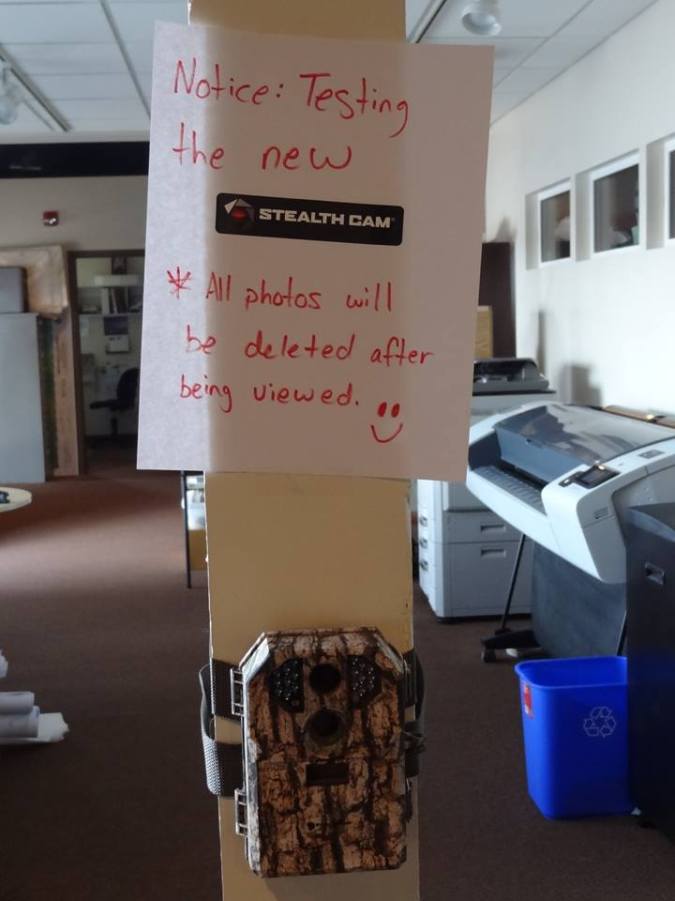
True story. This happened in my office last week.


We’re caught
inside the camouflaged box that’s mounted on a pole
in our office.
Eyes wide, coffee cups in hand
we walk down the hallway
feeling like someone is watching.

What strange natural rituals
will the camera catch —
Mating habits of the white-collar worker?
Dominance displays of the office alpha female?
A furtive mail boy stealing candy from a desk?
The shy engineer emerging from a conference call?

I suspect all the mother wolves who have had their birth dens invaded,
all the nesting birds who just want to feed their young in peace
would enjoy the sweet revenge
of these photos.

©2016  Marie Zhuikov

Nobody Dies in Spring in Duluth

Marsh_marigolds_near_a_stream,_Lydiard_Park_-_geograph.org.uk_-_1249758

Marsh marigolds. Credit: Brian Robert Marshall [CC BY-SA 2.0 (http://creativecommons.org/licenses/by-sa/2.0)%5D, via Wikimedia Commons.

April is National Poetry Month in the U.S. I couldn’t let it pass without posting a poem. This is one I just finished, inspired by a poetry class taught by Duluth Minnesota’s Poet Laureate Jim Johnson, based on Philip Appleman’s poem, “Nobody Dies in Spring.” Try your own version! It’s a fun exercise. I hope this Spring finds you well.

Nobody Dies in Spring in Duluth

Nobody dies in Spring in Duluth.
That’s when we hold gloved hands
with total strangers on the Lakewalk.
We sing sweet nothings to our dogs,
who have been lying by the fireplace
all winter, gazing up at us
with walk-hopeful eyes.
Kids yell and splash bikes through street potholes.
High school students don shorts
when the mercury hits forty-five.
Fathers take a year’s worth of family refuse
in pickup trucks to the dump.
Pussy willows sprout gray fuzzy nubbins
for mothers to cut and bring inside.
Shy yellow marigolds beckon in marshes.
White gulls cry and fly over melting snowdrifts.
The sun reaches down with tentative warm caresses.
Nobody dies in Spring in Duluth.

©2016 Marie Zhuikov


Entering the Virtual World

20160417_192112

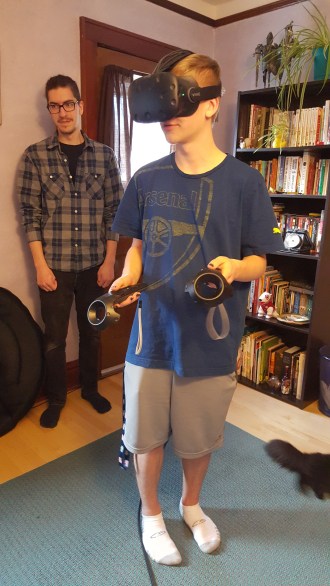
My youngest son enters the virtual world under the tutelage of my oldest son (in background).

I spent the weekend in a virtual world. Well, okay, it was just a few hours this weekend, but it was a cool few hours. My oldest son, who is a computer science graduate student, used his tax refund money to buy an HTC Vive. He treated me and my youngest son to a demonstration of this virtual reality system at his house.

The easiest way to describe it is to say it’s like stepping inside a video game. You put on the virtual reality goggles and **bam** you’re in another place.

Now, I am a mom, so I think of safety-related messages like these: Be sure to only try virtual reality with people you trust. You can hear the people around you, but you can’t see them once you put the goggles on. Others in the room could easily trip you if they are the mischievous sort, and you’d never see it coming. Likewise, remove all pets from the area that could wander into your virtual space and make you fall flat on your face.

I tried several demos from a program called “The Lab.” I entered a cave, complete with dripping water and piles of snow. Using one of the hand controllers, I found I had the ability to blow up balloons, which quickly rose to the cave’s ceiling and popped. It might not sound that exciting, but when you’re surrounded by the world, and you see the balloons you create actually rise like real balloons, it’s pretty darn cool. Then I was off to a secret shop that felt like a wizard’s lair come to life.

When it was my youngest son’s turn, he started out at Vesper Peak, throwing sticks on a mountain top for his slinky robot dog companion. He also tried Longbow, which had him defending his fort with a bow and arrow against rabid gingerbread men-like raiders. He also got to try his hand at being a line cook in one of the job-related games.

I am a real-world nature-lover, so my knee-jerk reaction to virtual reality games is negative. But after trying it, I can see how it’s certainly better than watching television because it gets you up and moving. Also, I can see how it can be a powerful storytelling tool because it immerses you in the experience more fully than a flat screen ever could.

In short, the virtual world’s not so bad. It might even be useful.