Angelique and Charlie Mott. Image courtesy of “Abandoned: Angelique’s Isle”
We recently watched the movie “Abandoned: Angelique’s Isle,” which is a based on a true story set on Isle Royale in Lake Superior. I’d heard of the movie before but never had an easy way to view it until it turned up for free in my Redbox feed. Can’t get much easier than that!
Longtime readers are probably well-aware of my love for this wilderness island. I had a chance to revisit this national park this summer and fulfill longtime dreams. As wonderful as the Isle Royale is in the summer, I can’t imagine spending a winter out there.
A sketch of the actual Angelique, courtesy of Michigan Technological University archives.
But that’s just what happened to a French voyageur and his Metis wife during 1845. Charlie Mott met 17-year-old Angelique and they lived at LaPointe on Madeline Island – although the movie makes it look like they were in Sault Ste Marie. Looking for work, Charlie is persuaded by some bigwigs from Detroit to visit Isle Royale on a mission to find copper.
Despite Angelique’s grandmother’s concerns, Angelique accompanies him and ends up being the one to discover copper – a huge mass. In the movie, the copper boulder is up on the shoreline but in reality, it was in the water. It’s summer and the Detroit men convince Charlie and Angelique to stay on the island for a few weeks so that the men have time to stake a claim. They said they’d send a supply boat and then they’d return for the copper and take them off the island before winter.
The couple agree and find shelter in an old fishing cabin on the island. They fix it up along with a birchbark canoe that’s there with it.
As you can guess from the movie title, the supply boat never comes, and the men don’t return before winter. What follows is a tale of perseverance, emotional strength, ingenuity and heartbreak. The themes revolve around being true to one’s roots and also (tongue in cheek), if your grandmother is having bad dreams about your impending trip, maybe you shouldn’t take it! I won’t give away any more of the plot in case you want to watch it.
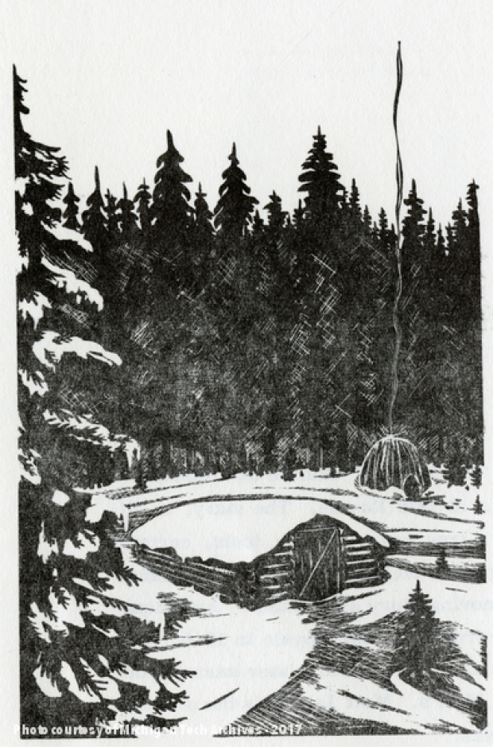
An illustration from “Wolf’s Eye” Vol. 5, No. 4a. “Charlie and Angelique Mott: A tragic but true story of Isle Royale.” It depicts the living quarters of Charlie and Angelique Mott while they were staying on Mott island.
Isle Royale is not the easiest location to film a movie, so the film was shot in Terrace Bay (near Rossport) and Fort William in Ontario, Canada. The sand beaches are a dead giveaway – I don’t know of any sand beaches on Isle Royale. It’s all rock and cobble. I also don’t know of any rivers with huge rapids on the island like are in the lead photo for this post, but the stunted trees and rocky shoreline found in Canada are quite similar.
In all my time on Isle Royale, I never knew that Mott Island was named in their honor. It’s a small island where the National Park’s island headquarters are located off the main island. I was excited to see Native actress Tantoo Cardinal in the movie. She plays Angelique’s grandmother. I was in a movie with Tantoo and actually got to touch her arm in a scene! So, it was like seeing an old acting buddy, ha ha.
According to Mikel B. Classen’s blog, Angelique’s story was first written down as a footnote in the book, “The Honorable Peter White: A Biographical Sketch of the Lake Superior Iron Country.” That, combined with original research, inspired the book, “Angelique Abandoned” by James R. Stevens. His book was turned into a screenplay by Michelle Desrosier, an Indigenous woman from Canada.
Although some of the storytelling could have been smoother, I found the movie a meaningful tale of the power of women, the power of love, and belief in the forces of the universe.
Well, it wasn’t the series itself that broke the internet in my neighborhood, rather it was a virtual presentation about it by Netflix that seemed to break it.
About a month ago, I was invited to an exclusive virtual screening of a new television series that’s being made out of the book, “All the Light We Cannot See,” by Anthony Doerr. I was invited because I rated the book on Goodreads.
However, right when the screening was supposed to begin, the internet went down at my house. Luckily, I was able to access the event via my cell phone. I sure was glad I signed up for that new unlimited data plan!
The event began with an introduction of one of the series’ main characters (Aria/Marie). Then the first installment of the four-part series was shown. It was filmed in Budapest and is set to air November 2 on Netflix. This was followed by an enthusiastic conversation between Doerr and the series director, Shawn Levy. I recorded it so I could make this blog post, complete with quotes and everything.
If you’ve been living under a literary rock, you might not know that “All the Light We Cannot See” won the Pulitzer Prize for fiction in 2015. I attribute this to Marie being one of the main characters’ names. Ha ha.
Marie-Laure is a blind girl who crosses paths with a Werner Pfennig, a German soldier, in occupied France during World War II. After her uncle disappears, Marie takes over his nightly clandestine radio broadcasts from the attic. Werner’s job is to track down resistance operations, including radio broadcasts. His life and Marie’s collide in this book, which illuminates the ways people try to be good to one another against all odds.
I gave the novel five stars on Goodreads, saying, “This book has *almost* spoiled me for any other. The writing! The metaphors! The sensory descriptions! OMG. The flipping between time periods and character points of view were confusing at times, but it all works in the end. So, keep reading. You won’t be disappointed.”
The character of Marie is played by a woman who is actually blind, “That’s valuable detail that impacts and informs every frame of this series,” Director Levy said. He conducted a global casting search for the part.
“We got thousands of videos. One of them is a unicorn of a discovery. She’s never auditioned, she’s never thought about being an actress, she’s an academic,” Levy explained.
He chose Aria Mia Loberti. She’s an American who was a graduate student in rhetoric. She learned about the audition from a former childhood teacher. Aria was a fan of the book and this is her first acting role.
Levy optioned the rights for the story after it was rejected by another firm, which decided it was too complicated to tell in a single movie.
Levy directs all four episodes, a task that Doerr called “herculean,” but Levy said this allows for aesthetic continuity between episodes.
Levy decided to direct all four out of selfishness because he loved the book. “By page 12 of episode 1 of the script . . . I said, ‘Oh no, no, I can’t share. I need to direct it and I need to direct all of it because I want live in this world and create this world in a way that feels uniform and unified across episodes.’”
Levy describes the work as one story that happens to have four episodic breaks. “I knew if I could make myself happy as a rabid fan of this book, likely I could make other fans happy. That was my whole strategy.”
Levy previously directed “Stranger Things,” a sci-fi horror series on Netflix. He also directed “The Night at the Museum” movies and “Deadpool 3.”
Doerr said that the general advice writers get is to write what they know. “I like to write into what I don’t know.” With “All the Light,” he said to Levy, “often, I’d get one-and-a-half sentences in and just like you guys, I’d have to go and build the set.” He had to research what it was like to be blind during the time period of World War II.
Levy asked Doerr how he combines lyrical storytelling with a taut narrative action. “Often, as a novelist, you’re toggling between the tiniest microscopic details, which can take a whole morning . . . and then other days, you’re trying to move totally structurally, and think, ‘where’s this tiny moment in the book falling in the larger scope of the narrative?’” Doerr said.
Levy finished Doerr’s thought with: “Because you always have to keep the narrative in your mind. Always. But you also have to be hyper-focused on this shot. It’s like zooming in and out from a macro to a micro lens.”
Many people think the book’s title comes from the blindness of the protagonist, but this was not Doerr’s intention. He thought of the title while on a train to NYC to see his editor about the cover of his current novel at the time.
“There was a guy in the seat in front of me and he was on his big 2004 cell phone. He was talking about the movie, ‘The Matrix.’ I remember that quite clearly. As we go underground as we near the city and Penn Station, his call drops, and he gets unreasonably angry. I remember thinking at the moment that what he’s doing is a miracle. He’s got this tiny set – a radio — a receiver and a transmitter no bigger than a deck of cards, and he’s expecting this conversation to work at 60 miles an hour, sending these little packets of light between radio towers at the speed of light. And who knows, the person’s he’s talking to could be in Madagascar or France. I remember thinking that what we’re all taking for granted is using this invisible light that can pass through walls. It’s a miracle and so many generations of humanity never had access to this kind of communication.
“I wrote down the title (usually titles come really late to me) but I wrote down “All the Light We Cannot See” in my little notebook that I carry in my pocket before I had anything. All I had was a girl reading a story to a boy, which is how episode 1 really begins, over the radio. I conceived of her being blind and him trapped in darkness, desperately needing this story. I just wanted to play with all the metaphorical meanings of where are we living and what our human perceptions involve.”
Levy asked Doerr whether it is surreal to have this population of people living in your head for years and then to see them burst into life on the screen. Doerr replied that he was blown away by seeing Aria’s audition video and also by the younger version of Marie, played by a child actress named Nell.
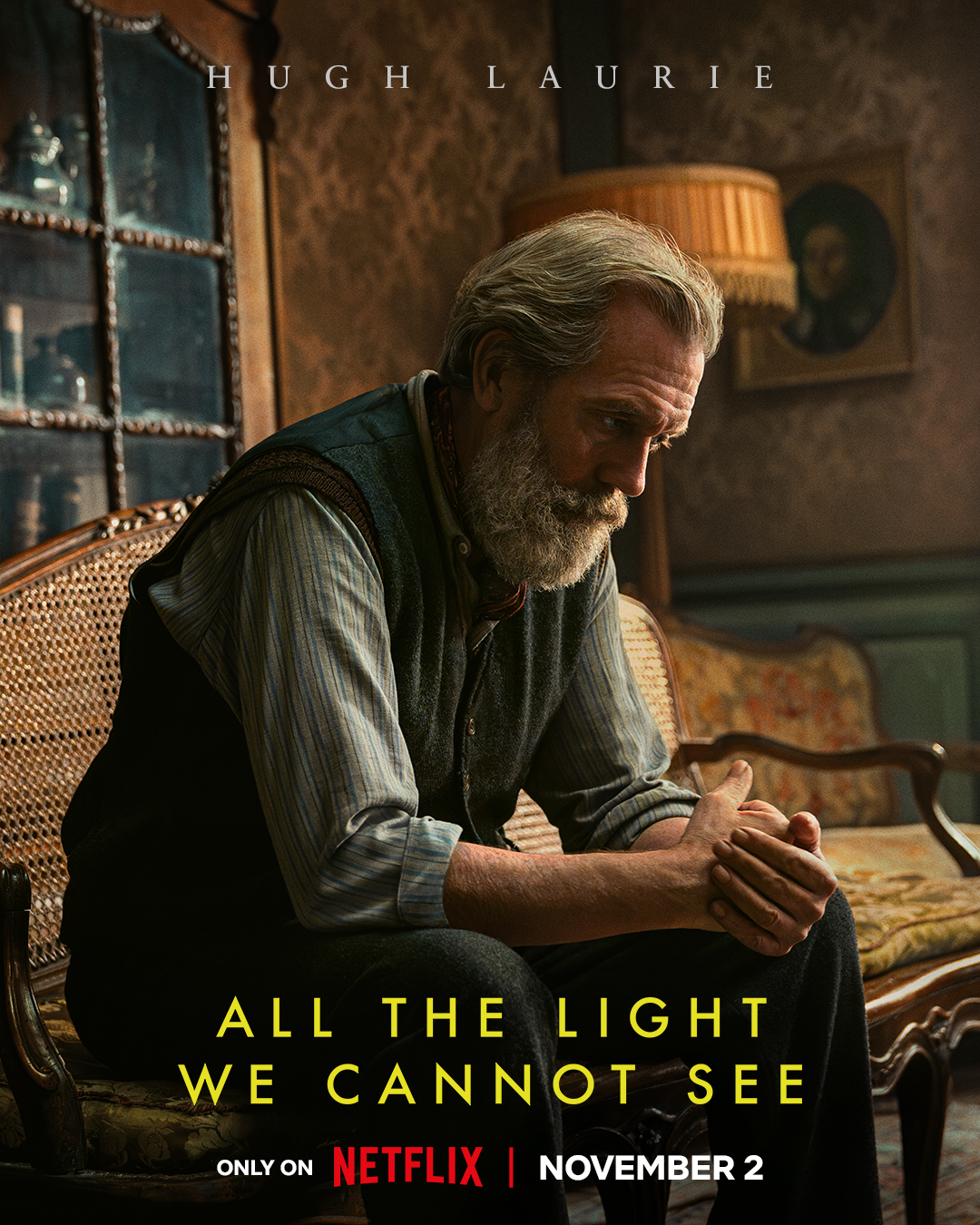
The movie stars other, more familiar actors, too. Wisconsinite Mark Ruffalo plays Daniel, Marie’s father. Hugh Laurie plays the reclusive uncle.
From being privy to episode 1, I can tell you that if you loved the book, you’ll love this series! I still can’t quite believe that I was invited to this preview.
Then the screening and conversation was over. Just as mysteriously, my internet reappeared at that instant. It made me wonder how many people got invited to this “exclusive” screening, anyway?
Unlike the man on Doerr’s train, I did not get unreasonably angry when my technology stopped working. I did get stressed out though, because I didn’t want to miss the screening. The irony does not escape me that my cell phone worked while the train man’s didn’t. And for that, we have to thank the miracle of invisible light that can pass through walls.
…For the first time in my life I had failed to work for the joy of knowing the wilderness; had not given it a chance to become a part of me. –Sigurd Olson, “The Singing Wilderness”
Garretts Point Campsite
After our delightful stay on the Duckfoot Islands, we headed back toward the houseboat base. Our goal was Garretts Point, another sandy campsite in a protected cove. This was Garrett’s idea, for obvious reasons.
He successfully piloted us out into the lake. Then I decided to give houseboat driving another try. The first time I did it, my steering wasn’t so bad, despite the wind. There was less wind on this day, but my steering was much worse. I almost did a 180 with the boat! Luckily, we were in the middle of the lake, without any obstacles. That was one reason why I chose this stretch to try again.
The campsite rubber duckie
As I zigzagged down our route, I figured out my problem. I’m used to steering a sailboat with a rudder. For that, you turn the rudder in the opposite direction you want the boat to go. Not so with a houseboat. To turn right, you turn the wheel to the right. I kept wanting to do the opposite. Also, you’re steering from near the front of the boat and the motor is in the back. That’s weird, too.
Despite all this, we successfully reached the Brule Narrows again and Garrett took over. The rest of our trip to Garretts Point in a light rain was uneventful. The site is sandy, but the beach is not as big as the one at the Duckfoot Islands. The fire ring is circled by nine stately red pines. We were greeted by a sparkly rubber duckie that someone had left on a rock by the fire ring.
Garrett was excited to arrive, and we took an obligatory picture of him standing behind the official campsite sign. Russ explored in the kayak and found a huge beaver house nearby. The beaver visited us that night as we sat around the fire.
I spent most of my time reading, but I also had a chance to explore my feelings. It didn’t seem right to be able to access these rustic locations without working very hard. Sure, driving the boat was stressful, but I wouldn’t call it physical labor. I’m used to canoeing for days and sleeping on the ground. This just seemed way too easy, like we didn’t earn it. It felt surreal to sit in my fluffy bathrobe next to a rocky campsite with scraggly jack pines and the chatter of a red squirrel.

The bell on our boat
Northwoods writer Sigurd Olson had these same feelings when he flew into Quetico National Park in Canada in a seaplane. In his book, “The Singing Wilderness,” he described the switch from civilization so quickly to the wilderness as “violent” and a psychological shock. While flying into the wilderness was what he had dreamed of doing, it didn’t allow him time to adjust and to soak in the wilderness ambiance.
He wrote, “Yes, I had been on a flight, had gone far into the lake country, had taken a few trout and enjoyed myself, but inside I was still a little out of breath and somewhat baffled by what I had done.”
We had another restful night and got up early in the morning so that we could drive the houseboat back to base by 9 a.m. so that somebody else could use it. In no time at all, we were back to the base. The houseboat guys came out to us when we were in the bay to pilot the boat into the dock.
As it turns out, we arrived in the nick of time. As we were clearing our gear out of the boat, we heard on the radio that the wind had switched and picked up speed. The base issued a no-travel advisory. We were glad we didn’t get stuck out there because Garrett had a plane to catch back to New York City. Whew!
I was glad to have had the houseboat experience, but I know that the next time I visit these northern border lakes it will be with a paddle and a pack so that like Olson, I can, “feel the rocks under my feet, breathe the scent of balsam and spruce under the sun, feel the wetness of spray and muskeg, be part of the wilderness itself.”

When I was in the process proofreading my blog memoir, “Meander North,” before publication, I found myself laughing. “Hey, this book is pretty good,” I thought. “Who wrote it?”
Reading my book was like having an out-of-body experience. Finding pleasure in what I wrote was a good thing but it’s not a very Minnesota thing. We’re not supposed to think we’re that special! Well, it’s too late. I really did like what I wrote. That doesn’t happen often.
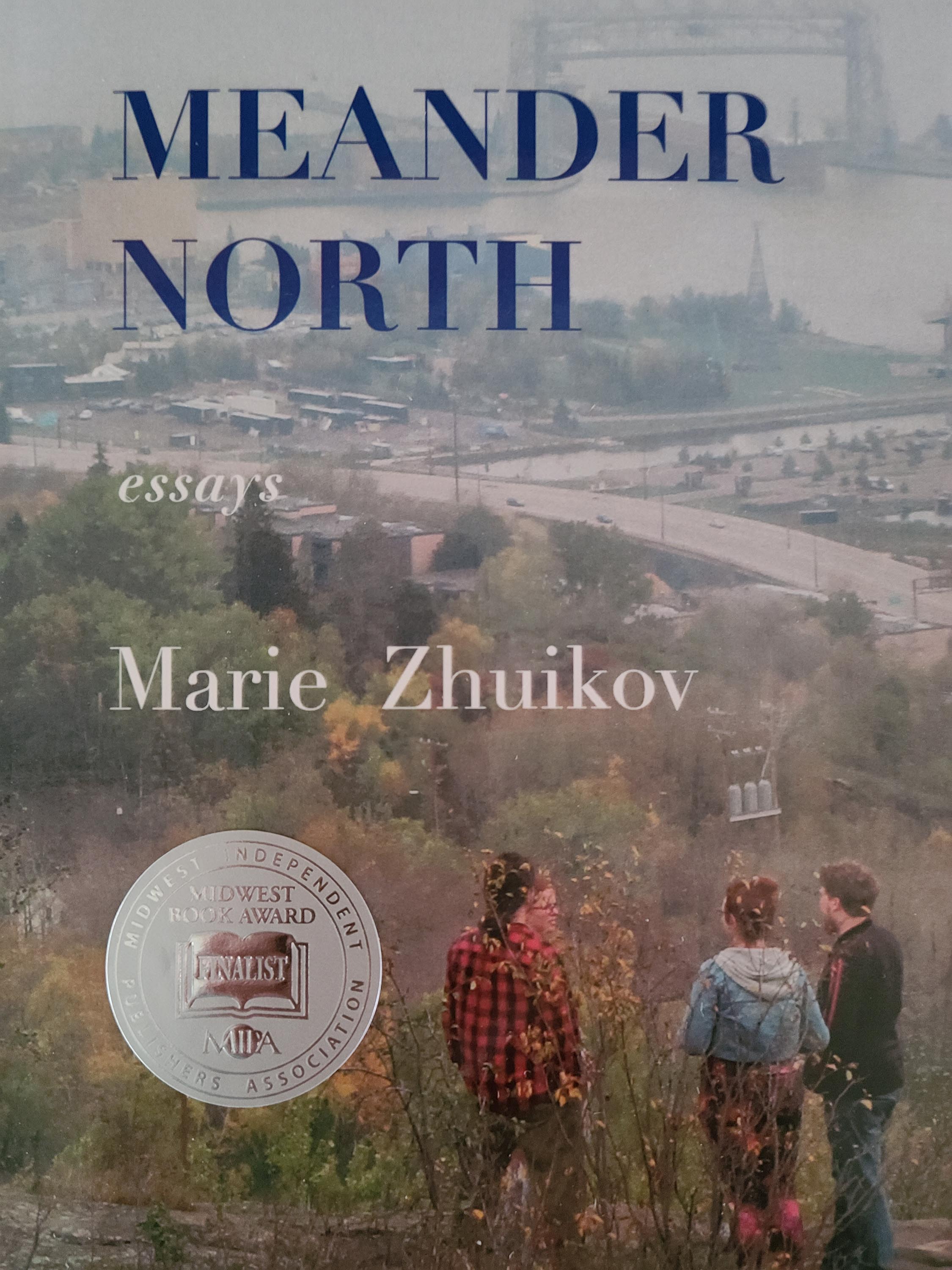
My book with its silver award seal.
I suspect most writers will agree there are several distinct and disparate phases they go through in completing a work. When you complete that first draft, you’re so relieved! You think it’s God’s gift to humankind. Then your writing group or beta readers get ahold of it and you begin to see its flaws. You fix those but by that time, you’re able to distance yourself from it enough that you see even more flaws. You hate the work. It’s awful. It should never see the light of day! There’s so much that needs fixing.
Some writers never get past this point. But if you take it slow, chunk by chunk, and are kind to yourself, and you remember what you were trying to say with your work, you can come out on the other side. You might even like it in the end – enough to think that maybe somebody else wrote it.
I recently attended the Midwest Book Awards Gala, held in Minneapolis for finalists in their awards program. It’s put on by the Midwest Independent Publishers Association, which serves indie publishers in 12 states. This year, the contest attracted 227 books from 122 publishers. “Meander North” was one of them. It ended up earning a silver award in the nature category.
Mary Ann Grossmann, keynote speaker.
The gala’s keynote speaker was Mary Ann Grossmann, retired book editor for the St. Paul Pioneer Press. She told tales from her long career, including when Pulitzer Prize-winning author Studs Terkel “kidnapped” her in his car because he wanted to keep talking, and when Grossmann convinced activist author Susan Sontag to go see the 5,000-pound boar at the Minnesota State Fair.
Grossmann’s main advice to authors was to “hire an editor!” In my case, I hired two of them, just to be sure. I was so close to the material that I felt like I was missing all the little nits that needed picking in the text.
At the end of the gala, authors were given the judges’ comments. I was heartened to see that they all thought the writing was very strong. The book was also judged on things like production quality and mechanics/organization. One judge said their favorite story was the one about the sensory deprivation tank. They said, “These essays are definitely something I would read again, and I intend on following this blog now, as well.” Thank you, whoever you are!
Another judge said they thought I had a “really appealing and charming voice, and I found the writing excellent.”
Do you see me over here, preening myself in a most non-Minnesotan way? Ha ha.
Cheri Johnson, who goes by the pen name Sigurd Brown, accepts her Midwest Book Award at the gala.
While at the gala, I got to meet some people from my past who turned into authors, one of them for the same publisher who produced my book (Nodin Press). I also met some people I have had interactions with online but had never seen in person. One of them was Sigurd Brown, the pen name for the author of the thriller, “The Girl in Duluth.” Her book won gold in its category. I have not read her book yet, but I have it on order.
She was nice enough to read “Meander North,” and she posted this review on Goodreads:
I enjoyed this book very much. Zhuikov’s personal stories of everyday life in northern Minnesota—which include subjects as varied as solving the mystery of headless rabbits on a trail near her house to her discovery, twenty-five years after the fact, that the UPS delivery driver at her new job is the boy she kissed in the coat room of her first-grade classroom—are both frank and charming, and in total they tell not only the story of a life but describe the fabric of a town (the port city of Duluth on Lake Superior, where Zhuikov lives). This is a friendly and calming book, with a narrator who is pleasant to spend time with. Reading one or two of the short essays that make up the book every night before bed, I often had the feeling that I was out on my porch in the evening, exchanging a few words with the neighbor I’m always glad to run into. The writing is also very nice; her sentences are as neat and luminous as pearls. The book is a silver winner of a 2023 Midwest Book Award and I can see why.
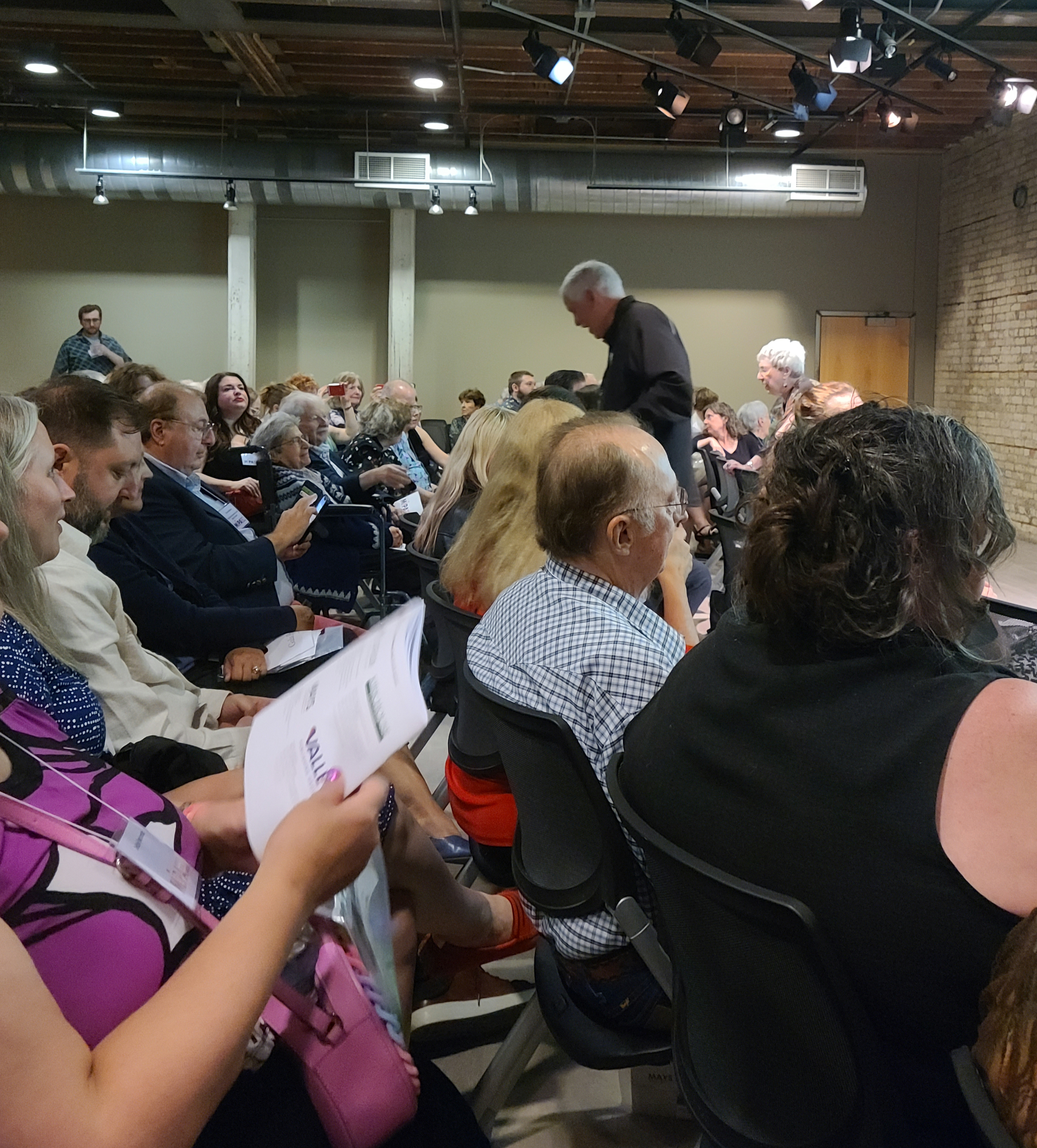
The gala audience.
I reread, “Her sentences are as neat and luminous as pearls,” several times. That’s what having two editors will do. Lord knows I don’t have that many editors for my blog! (From which the stories are derived.) Needless to say, I’m feeling a bit of pressure to write a similar glowing review of her book. But I’m sure that won’t be hard since it’s a gold winner already.
“Meander North” was also recently featured on the National Science Writers Association website. They offer a column that describes new books written by association members, and they were good enough to list mine, even though it’s been out for a while. Although my book is mostly personal reflections, there is some overlap with my day job as a science writer, so those things are highlighted in the column.
There, enough bragging. In ending, I’d like to point out that I probably never would have had enough content for a book based on this blog without the feedback and continued readership over the years from all my blogger buddies. So, you can consider this your accomplishment, as well. Thank you!!
I’m reading “David Copperfield” by Charles Dickens in preparation for reading this year’s Pulitzer Prize-winning novel, “Demon Copperhead” by Barbara Kingsolver. Although it’s not a requirement to be familiar with Copperfield before reading Copperhead, the latter is based on former so I figure it can’t hurt.
Given my blog’s name, imagine my delight when, in the opening of Copperfield, I found a short treatise on meandering. David Copperfield was born with a caul (amniotic sack) around him. Back in the day, cauls were thought to have mystical properties, one of which was to protect whoever possessed it from death by drowning. They had value. David’s family sold the caul in a raffle. It was won by an old lady who died triumphantly in her bed years later at the age of 92. She was triumphant because she did not drown. But drowning would have been difficult for her even without a caul since she never went in or near the water except to cross a bridge.
Copperfield says, “Over her tea, to which she was extremely partial, she, to the last, expressed her indignation at the impiety of mariners and others who had the presumption to go ‘meandering’ about the world. It was in vain to represent to her that some conveniences, tea perhaps included, resulted from this objectionable practice. She always returned with greater emphasis and with and an instinctive knowledge of the strength of her objection: ‘Let us have no meandering!’”
That made me laugh. Good thing the dear departed lady is not alive to read my blog. She would surely find it objectionable.
I have been doing my share of meandering lately, thus my absence from this blog. I hope to write more soon about my adventures traveling around the state and culture of Wisconsin.
The book I wrote based on the best of these blog stories is a finalist for a Midwest Book Award. I can hardly believe it! “Meander North” was nominated by my publisher, Nodin Press, in the nature category. Two other books are finalists in that category also: one about Wisconsin rivers and lakes, and one about Iowa farmland.
I was surprised to see my book in the nature category. I think of it more as a memoir, but you’ve got to admit that the outdoors plays a big role in my life.
This is an annual competition organized by the Midwest Independent Publishers Association, which operates over a 12-state region. This year, they received 303 entries and 83 are finalists. Judges are booksellers, university staff, and librarians who are subject matter experts and collectively hail from the Midwest. Winning entries will be announced at a ceremony in Minneapolis in mid-June.
You can view all the finalists and purchase the books here.
I am a bit flabbergasted, but extremely honored just to be a finalist. I could not have produced the book without the help of Nodin Press, and my editors John Toren and Lacey Louwagie. Both of my editors are also bloggers. You can find their sites here:
A tree reading a book. Image by Angela Waye. This is what I envision on the cover of my upcoming book.
I’ve mentioned a few times in passing here that I’ve been working on a collection of short stories. I tried for about a half year to find an agent for them, to no avail. So, I switched to contacting publishers directly.
I am happy to announce my collection will be published by Cornerstone Press, the publishing arm of the University of Wisconsin-Steven’s Point. They were actually the first publisher I tried!
I learned about them when I went to a conference by the Wisconsin Writers Association and happened to sit by someone who had a short story collection published by them. I checked out her book. It was good quality, so then I researched Cornerstone Press, and they looked good, too.
I had time between holidays in December to finalize my book proposal. The stories are of a magical realism bent, similar to my novels. They deal with the power of appearances to captivate and deceive. Plenty of nature is included, along with a monster, trees that can communicate, and a hot botanist.
It’s tentatively titled, “Don’t Judge a Book.” But we’ll see if that name sticks. I expect the book to be available in spring of 2024.
I submitted the proposal for my recent blog-memoir, “Meander North” a year ago between December holidays, too, when it got picked up. That seems to be a good time for me. Maybe I’ll make that a standing tradition!
So, I’m doing a little happy dance in Marie Land. Join in the dance with me . . . .
My memoir based on this blog has been printed and is on its way to the distributor. I haven’t received my copies yet, but soon…
Here’s the cover. The image was taken by the Nodin Press editor. I like how “Duluthy” it is, with the lift bridge, a person wearing flannel, and a ship coming into the harbor.
It’s available for preorder ($19.95) from Itasca Books in Minneapolis.
Here are the deets:
Bite-sized memories and adventures written on a weekly basis come together in “Meander North,” a blog-memoir by Minnesota author Marie Zhuikov. Collected over nine years on Zhuikov’s “Marie’s Meanderings” blog, the 51 quirky essays are arranged by season, and cover a wide range of outdoorsy and community-based reflections: from an insider’s view of Duluth’s Christmas City of the North Parade, to a spring cleaning trip to the local dump, and a description of a lawn-mower race. One piece depicts a gleeful summer morning paddleboard on a quiet lake. Another takes readers on a meditative fall walk on a woodland trail. The book finishes with specific topics including, “Brushes with Fame,” where Zhuikov describes close calls and meetings with famous (and not so famous) people, and “Bookish Adventures,” which detail her literary leanings and incidents that have added spice to book signings for her previous works.
Although the topics are diverse, all display Zhuikov’s love for her home state. “Meander North” is a celebration of Minnesota, its seasons and traditions.
Reviews:
Naturalist Marie Zhuikov’s sense of home bubbles up at the confluence of absurdity, loss, and transcendent beauty. Drawn from the annals of her long-standing blog “Marie’s Meanderings,” the short essays in “Meander North” shimmer like the northern lights in their illumination of the joy, folly, and hard-earned grit one develops living at the crossroads of Minnesota’s and Wisconsin’s north shores. From encounters with boat-towing loons to organizing a sea-lamprey tasting event, the stories within the collection are sometimes zany and always delightful, revealing a Midwestern outdoorswoman’s celebration of family, community, and the mysterious forces of the natural world. – Meg Muthupandiyan, author of “Forty Days in the Wilderness Wandering”
A walk with Marie through the seasons and terrains of her northland writer’s life, this interweaving of environmental science with a reverent appreciation for the Earth and its inhabitants is lovely and moving. In essays that evoke the fragility and toughness of this northern world of icy lake waters and rocky shores, rugged pines and graceful birches, this collection is timeless, a treasure to be read and reread. – Linda LeGarde Grover, author of “Gichigami Hearts”
With wit, reverence and unabashed honesty, Zhuikov offers us delightful insight into what it means to live with purpose in the North. – Sam Cook, “Duluth News Tribune” outdoors writer
Upcoming Events:
Zenith Books (318 North Central Ave., Duluth MN) will host a book launch on November 17 at 7 p.m.
Old School Holiday Market (9165 Hwy 53, Cotton MN), Nov. 19, 10 am – 3 pm
Get it Local art and gift fair, Peace Church (1111 N 11th Ave E., Duluth MN), Dec. 3, 10 am – 3 pm
I haven’t been meandering much lately. I’ve been too busy with final edits to my “Meander North” manuscript — a book coming out this fall composed of the best of my blog entries. Choosing the stories was easy. Figuring out how to edit them was difficult because they occur during different timeframes during the first nine years of my blog. Plus, there are fifty-one of them!
But I think my editors and have I figured it out. If all goes well, the book should be available in late October. I’m planning a launch event in Duluth for early November. I will post details here once I know them, and I’ll be doing a cover reveal!
In other news, I’ve been continuing my kickboxing workouts. I love them. I am proud to say I can now jump rope 70 times in a row. That’s quite a change from a couple of months ago when my count was like, uh, nothing. Everytime I go to the gym, I feel like Rocky Balboa. 🙂
Russ and I have had many gatherings of friends and family lately. We’re looking forward to setting sail on Lake Superior soon.
Nodin Press in Minneapolis is planning on publishing a book of the “best” posts from this very blog. The process received a boost yesterday when I learned I received a grant from the Arrowhead Regional Arts Commission to pay for the book’s editing. I’ve received plenty of grants through my Sea Grant work before but this is my first personal arts grant, so I’m pretty psyched.
As planned at this point, my “Meander North” book will be arranged by season and will celebrate all things northern Minnesotan. Plus, bonus chapters will relate to bookish adventures and brushes with fame. There will also be some content you haven’t seen before. When asked what genre it is, I answer that it will be a blogmoir (blog memoir).
Thank you, Arrowhead Regional Arts Commission, for the grant and for all the work you do to support artists and writers in this neck of the woods!












 Marie's Meanderings