Psycho Dads: A Comparative Book Review of “My Absolute Darling” and “The Marsh King’s Daughter”

Warner bros the shining

One of the scariest psycho dads of all time: Jack from “The Shining.” My post is not about him, but it is about psycho dads. Image by Warner Bros.

Fathers. They can have a profound impact on their daughters’ lives. Unfortunately, the two daughters in these books hit the jackpot when it comes to living in a family headed by psycho dads. Both books make for compelling, disturbing reads.

I read them back-to-back by happenstance. I was lured into “My Absolute Darling” by an intriguing and glowing New York Times book review. Alas, judging from all the complaints on Goodreads, I wasn’t the only one misled by the review, which glosses over the nasty bits about incest and the fact that THE DOG DIES in it. (I hate books where the dog dies, especially when scavengers pull its intestines out of its anus afterward.)

Instead, the review focused on positive comments by other writers, including Stephen King, and the author Gabriel Tallent’s background (this is his first novel).

The unfortunate daughter in “Absolute” is Turtle, a young teen living in the woods of northern California with her dad. Her mother died when she was young, leaving her at the mercy of her father who has an inordinate fondness for guns, and a paranoia about societal collapse. Turtle eats raw eggs for breakfast and wears combat boots to school. Her only friends are her grandfather, who lives in a trailer home next door, and a teacher who sees the signs of abuse and tries to help.

Later, Turtle befriends Jacob and Brett, two boys near her age who are lost in the woods. These well-read surfer dudes provide a foil for Turtle’s dark story, and are the catalyst for her father’s abuse to escalate.

The story of Turtle’s escape from her father is often profane, violent, heartbreaking, frustrating, stark and sometimes funny. On Goodreads, I rated the book 3/5 stars, mainly because some of the violence felt unnecessarily exploitive.

I read “The Marsh King’s Daughter” at the recommendation of my book group and because it’s set in Michigan’s Upper Peninsula – not far from my stomping grounds. The unfortunate daughter in this story is Helena. Her father kidnapped her mother when she was young and brought her into a remote marsh in the wilds of the U.P. Born in the marsh, Helena grows up in blissful ignorance of her true situation because her family is so isolated from the outside world.

Like Turtle, Helena is at home in the woods. Her father has taught her well how to survive and track animals. These descriptions are especially vivid and believable, as are the scenes of Helena’s eventual escape from the marsh.

The abuse in “Marsh King” is tamer than that in “Absolute.” Another thing that puts readers at more of a distance is that the story is told in retrospective. Helena is grown and out of the marsh, with a family of her own when she begins relating the tale. Even when the action is in the present, Helena is prone to bouts of rumination and repetition that slow down the action. There was so much of this in the climax scene where she has a death match with her father that I could hardly tell it was taking place in the present. But the story hooked me enough that I kept reading.

Another scene that stuck in my reader’s craw, however, was the one where Helena’s father tries to drown her mother in punishment for what he thinks is an escape attempt. Helena’s mother is canoeing alone across a lake (to search for strawberries on the other side) – something she is apparently forbidden to do. The father comes home and asks Helena where her mother is. Helena points to her mother who is out in the canoe. Somehow (I don’t recall exactly and no longer have the book to refer to), the father reaches the mother in the canoe and manhandles her out of it. To punish her, he almost drowns her. But does he do it in the lake where there’s plenty of available water? No. He drags her up to the porch, gets a bucket full of water and does it there. That just seems inefficient and weird to me, even for a psycho dad.

I gave “Marsh King” a higher rating on Goodreads (4/5 stars) than “Absolute” because the violence seemed less exploitive. I would have given it an even higher rating but for the rumination/repetition issues and the near-drowning scene.

Neither book dwells on how the fathers became psycho. They just deal with how the fathers’ actions impact their families.

In both books [spoiler alert!] the daughters triumph over their fathers both physically and emotionally. So if you want to read a book about “girl power” these are for you.

“Virgil Wander” Debuts in Duluth

Leif Enger

Duluth scored a literary coup yesterday when award-winning, multimillion-copy bestselling author Leif Enger launched his new book, “Virgil Wander,” here.

One of the reasons we were able to get him here versus, say, Minneapolis or New York or San Francisco, is because, as of seven weeks ago, Enger and his wife Robin live in Duluth. What a boon for our (relatively) remote city on the shores of Lake Superior!

Most news stories will say it took the Minnesota-born Enger, who is best known for his debut novel “Peace Like a River,” ten years to write his new novel. During questioning after his reading at Zenith Books, he said it actually only took him four years to write “Virgil” and that he spent the previous years writing 400 pages of something else that didn’t work out – it didn’t have the vital combination of character, setting, and story.

Enger said another thing that delayed his writing was a “dark patch” due to the failing health of his and his wife’s parents. Plus he contracted meningitis, which I suspect is is a good excuse to delay just about anything.

The novel’s setting is the mythical town of “Greenstone, Minnesota,” which he said is an amalgam of Silver Bay, Beaver Bay and Grand Marais – small towns along Lake Superior’s North Shore. It’s the story of Virgil Wander, a movie house owner who survives a plunge in his car into Lake Superior. He loses his memory and language, awakening to an unfamiliar world. He pieces his life back together with the help of “affable and curious locals.”

The promotional blurb about the book on Goodreads says, “With intelligent humor and captivating whimsy, Leif Enger conjures a remarkable portrait of a region and its residents, who, for reasons of choice or circumstance, never made it out of their defunct industrial district. Carried aloft by quotidian pleasures including movies, fishing, necking in parked cars, playing baseball and falling in love, Virgil Wander is a swift, full journey into the heart and heartache of an often overlooked American Upper Midwest by a master storyteller.”

During his reading, Enger said the owner of an Art Deco movie house in Florida inspired the main character of Virgil. The passion of the owner to restore the theater stuck with Enger and emerged when he was fishing his subconscious for ideas for his new novel.

20181002_200515A hike on a hill above Beaver Bay with one of his sons inspired Enger to set the novel on the North Shore, and then the story came to him.

When a member of the audience commented about his use of humor in the book, Enger said he wanted to write something he would enjoy because he’d be “spending a long time with it.”

Before and after the reading, audience members feasted upon snickerdoodle cookies and brownies made by Robin. I even took a photo of them. Why? Must be because I am so affable! No, really, I thought that was cute, supportive, and very Minnesotan.

“Virgil Wander” is now in my pile of books on my bedside table. Can’t wait to read it!

Walt Whitman Lives!

20180912_192829

Patrick Scully as Walt Whitman

A literary figure came to life in downtown Duluth a few days ago. Walt Whitman made an appearance at the Zeitgeist Teatro Zuccone on September 12 in the form of a one-man show by Patrick Scully.

Whitman, of course, is known for his poetic work, “Leaves of Grass” (1855). The book received praise from Ralph Waldo Emerson and Henry David Thoreau but was also controversial for its overt sexuality.

In Scully’s show, “Leaves of Grass – Illuminated,” Scully embodies Whitman in his “multitudes,” exploring his inclusiveness and embrace of all humankind – things everyone needs reminders of, especially now.

The show premiered in New York City and Minneapolis. If you missed it in Duluth, you’ll have a chance to see it at the Guthrie Theater in Minneapolis on July 12-14, 2019, shortly after the 200th anniversary of Whitman’s birth.

Scully performs a couple different versions of his show. The one we saw was the full-meal deal, featuring videos of male dancers dressed in appropriate period garb (and also lack thereof). The videos played behind Scully, who stood at a podium near the audience.

20180916_175923Whitman has been a long-time favorite of mine, ever since I read a first-edition version of “Leaves of Grass” (pictured, copyright 1959) that I think my parents gave me off their bookshelf. It kept me company during a summer on Isle Royale National Park in the middle of Lake Superior. No libraries there! So I lugged a duffle bag full of books along with me when I worked as a waitress at the resort on the island during college.

Some of my favorite lines come from, “I Sing the Body Electric.” In looking through my old book, this one still strikes me:

I have perceived that to be with those I like is enough,
To stop in company with the rest at evening is enough,
To be surrounded by beautiful curious breathing laughing flesh is enough,
To pass among them . . to touch any one . . . . to rest my arm ever so lightly around his or her neck for a moment . . . . what is this then?
I do not ask any more delight . . . . I swim in it as in a sea.

Like Whitman’s poetry, Scully’s show pleased my soul well.

Thanks go to Lake Superior Writers and the Minnesota State Arts Board for hosting and sponsoring the evening.

Of Lighthouses and Books

20180801_161517

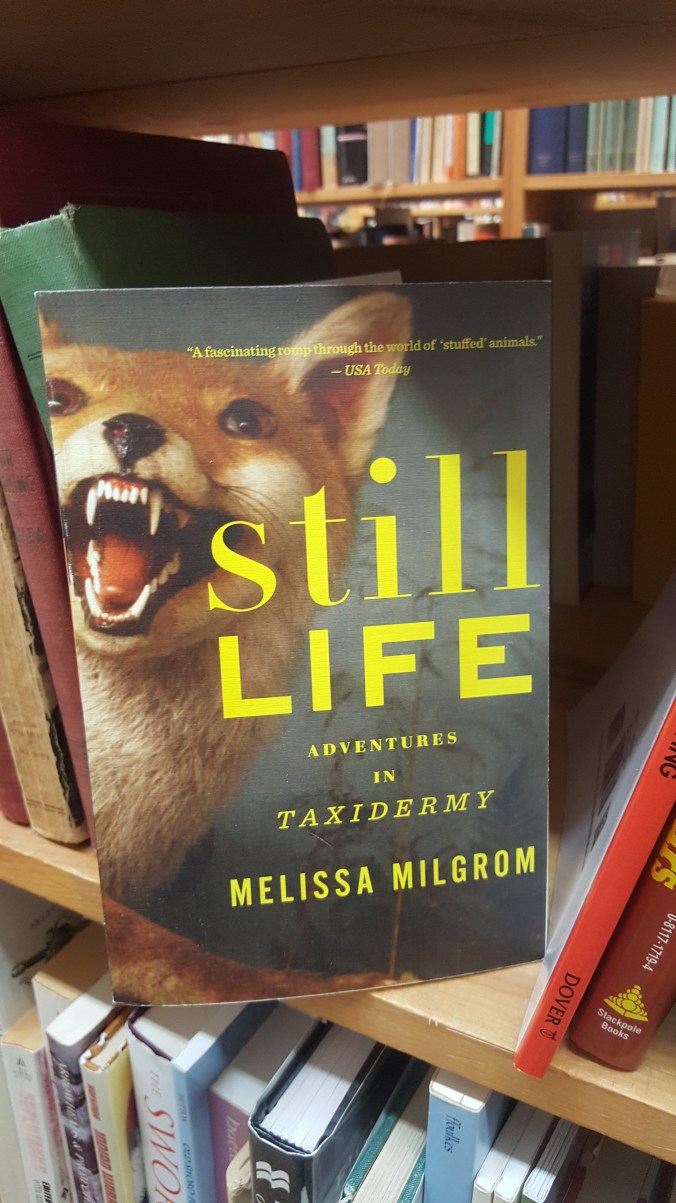
I found this gem of a book at Chequamegon Books in Washburn, Wisconsin. Would you read it? I especially like its promo blurb by USA Today: “A fascinating romp through the world of ‘stuffed’ animals.”

Somehow the phrase “fascinating romp” has never combined in my mind with the topic of taxidermy.

I did not buy the book. But I was impressed with the bookstore. The last time I visited years ago, the store looked like the kind of place where books go to die. It’s been spiffed up recently, with better lighting, ventilation, and a new back room that makes space for lots more books!

The topics are all well-organized and easy to find. It’s a book nerd’s dream. Stop in if you’re ever in Washburn.

DSC04840

The back room in Chequamegon Books in Ashland.

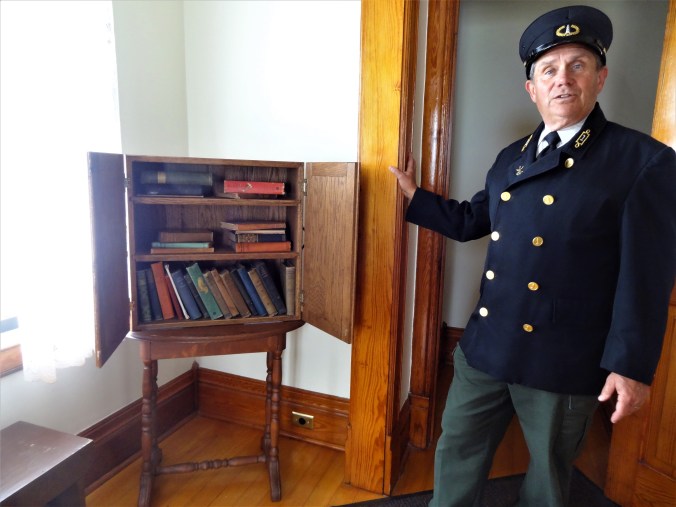
While I was in the area, I had the chance to visit Raspberry Island in the Apostle Islands National Lakeshore. My bookish theme continued when the lighthouse keeper on the island showed me the traveling bookcase that the lighthouse service used to provide to help entertain the keepers and their families.

And I really do mean that he only showed me the traveling bookcase. Of our group that visited the island, I was the only one who opted for the $5 lighthouse tour, so I got personal service!

DSC04862

DSC04870

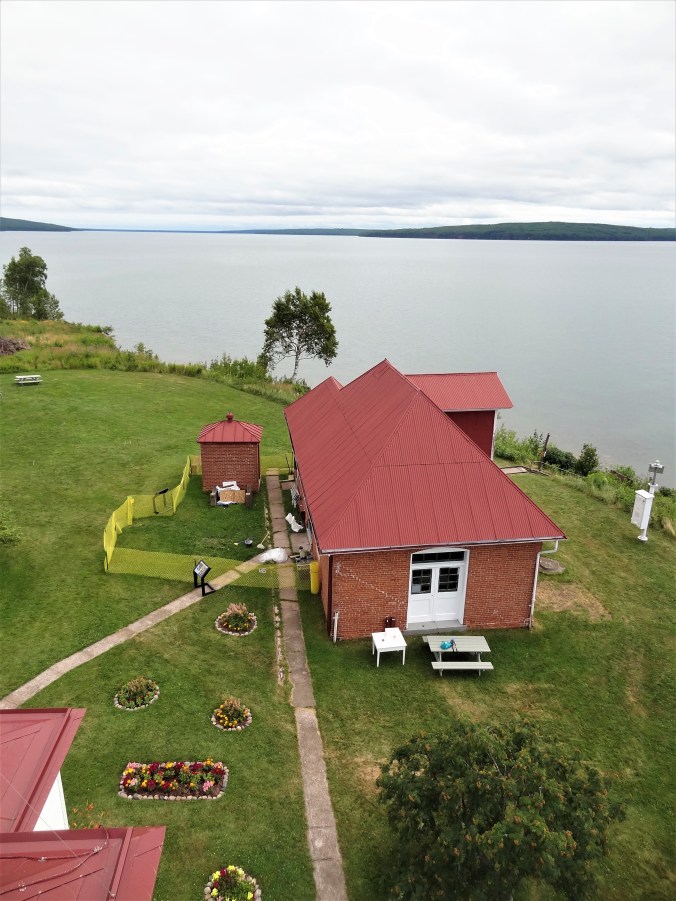
Raspberry Island Lighthouse in the Apostle Islands National Lakeshore.

DSC04866

The view from the top of the Raspberry Island Lighthouse.

After the tour, I took a hike to an overlook along the coast of the island. On the way, I found this fine example of Canada yew.

DSC04872

Christmas colors in August! Canada Yew is an important shrub for wildlife. Not often found on the mainland because it gets eaten by deer, it sometimes thrives on islands like Raspberry Island, which have few, if any, deer.

Books and lighthouses: a good combination for an outing….

“Going Coastal” Wins Honors

20180524_201802

The “Going Coastal” anthology sporting its snazzy Northeastern MN Book Awards seal.

An anthology of Lake Superior short stories that contains one of my tales was awarded an honorable mention in the fiction category of the Northeastern Minnesota Book Awards competition. “Going Coastal” contains stories written by nine writers who live around the lake in Minnesota and Wisconsin.

Here’s what the awards committee had to say about the book:

The stories in Going Coastal are all deeply personal, and reflect the lake as a source of beginnings and endings-a source of inspiration, loss, and renewal. The anthology contains a variety of very different stories, touching us in many ways, and connecting us to the power of Lake Superior.

The award was established to recognize books that substantially represent northeastern Minnesota in the areas of history, culture, heritage, or lifestyle. For a list of other winning books for 2018, check here.

To learn how this book project happened, read this previous blog post.

A Funny Thing Happened at Bent Paddle Taproom . . .

20180424_203354

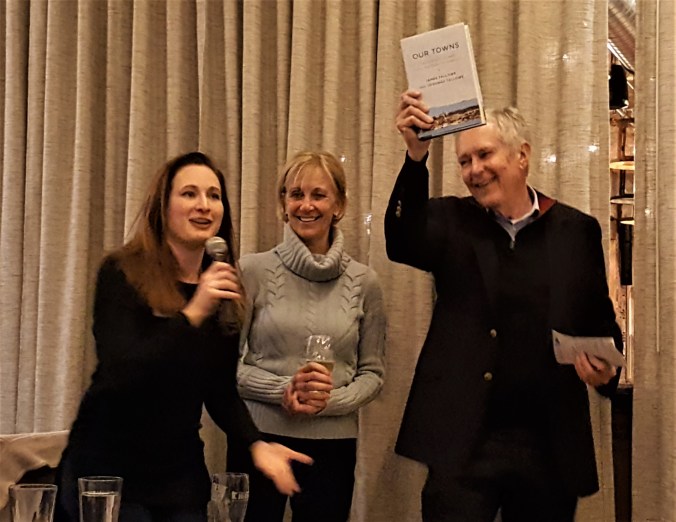
Laura Mullen, co-owner of Bent Paddle Brewery, introduces Deborah and James Fallows to writers in Duluth, Minnesota. James holds up their new book, “Our Towns.”

Yesterday, I meandered over to the new taproom of one of Duluth’s noted microbreweries, Bent Paddle, even though I don’t like beer (I know, gasp).

Amongst other local literati, I listened to a panel discussion in the brewery’s back room about how to apply for arts grant funding. The event was hosted by Lake Superior Writers, a group that fosters the literary scene in these parts.

The panel was sooooo interesting. Four writers and one person from an arts granting agency shared their experiences and insights. I now feel less intimidated by the idea of applying for one of these grants, should I ever be so inclined.

During the intermission, the coolest thing happened. Just by chance and happenstance, James Fallows, a long-time writer for The Atlantic Magazine was in the taproom, filming a segment for CBS News Sunday Morning. The segment will promote a new book he wrote with his wife Deborah, called “Our Towns: A 100,000-Mile Journey into the Heart of America.”

Deborah was with him, too, and when they heard from the owner (Laura Mullen) that a bunch of writers were in the back room, they HAD to come speak with us. Although it was hard to hear them over the din of the taproom, here’s what I gleaned.

James first came to Duluth to do a story about Cirrus Aircraft, a local company that makes private planes, which deploy their own parachute in times of peril. He also became familiar with Bent Paddle Brewery, which was just starting up at the time. Then he and Deborah had an idea for a book project that would allow them to take the social pulse of America as it stands now. In their own Cirrus plane, they flew to a dozen cities for their research, concentrating on ones that weren’t too large like Greenville, South Carolina; Columbus, Missouri; Burlington, Vermont; Fresno, California; and Duluth, of course.

When asked, James and Deborah said their favorite cities on their tour were the ones with “heart.” They included Duluth in this list. And they said they were so glad to see that the brewery was thriving. James offered us intel on what the Atlantic is publishing these days and even gave us his email address in case we have story ideas to pitch.

How cool is that?!

In preparation for the book’s release on May 8, they had decided to come back to Bent Paddle to film the promo segment. They also filmed in Greenville. The segment will air on CBS Sunday Morning on May 6.

I suspect I unwittingly got filmed for it earlier in the evening when I followed another writer to where the taproom offers three different kinds of water on tap (sparkling, ambient and chilled). We were talking about short stories. When we turned around from the water taps, we were met with the glare of camera lights and shadowy cameramen behind them.

We didn’t think much of it, continuing on our writerly ways, trying to look nonchalant. But after the event was over, I excitedly told my writer friend that our backs might be on national television! Can’t wait to see if we made the cut.

It just goes to show, you never know what can happen when you follow your passions, and that good things can happen in a brewery, even for people who prefer wine over beer.

The Taste of Hope

20171126_181632

Chef Sean Sherman

Native American chef, Sean Sherman, visited my fair town several weeks ago to promote his book, “The Sioux Chef’s Indigenous Kitchen.” Given my interest in cooking and gathering wild edibles, I had to go. He spoke to a packed house along with his co-author, Beth Dooley, who is the food editor for the Minneapolis Star Tribune. The event was sponsored by Zenith Bookstore.

One of the first things Sherman did was to disabuse the audience of the notion that Native American cuisine involves any type of fry bread. He works with pre-colonization food made with ingredients the natives grew themselves or foraged. These are things like squash, wild rice, chestnuts, fish, berries, and cedar boughs.

Sherman talked about how natives used all parts of edible plants and animals and how every one of those things had a purpose, “Except for wood ticks. They don’t have a purpose,” he joked.

A member of the Sioux tribe, Sherman grew up in a hardscrabble life on the Pine Ridge Reservation in South Dakota.  He became interested in learning about the foods of his ancestors when he was twenty-nine and was burned out from working as an executive chef in Minneapolis.

He took a year off in Mexico and ended up consulting for a restaurant there that focused on local foods. In his book, Sherman writes, “In an epiphany, I tasted how food weaves people together, connects families through generations, is a life force of identity and social structure. After seeing how the Huicholes held on to so much of their pre-European culture through artwork and food, I recognized that I wanted to know my own food heritage. What did my ancestors eat before Europeans arrived on our lands?”

Re-energized, Sherman returned to the U.S. with a plan in mind. After a lot of research and consulting, he formed The Sioux Chef in 2014 in Minneapolis.  He worked with other indigenous team members to cater events, operate a food truck, host pop-up dinners, and soon they will open a restaurant.

Sherman’s vision for revitalizing indigenous foods reaches beyond the Midwest. He hopes to spread an indigenous food system model across the country, which involves providing education and tools to native communities to reclaim their ancestral cuisines and an important part of their cultures.

And why not? It’s a diet that is hyperlocal and uberhealthy in more ways than just the physical. At the end of his talk at Beaner’s Coffee House (thank you Beaner’s!), samples of cedar tea sweetened with maple syrup were passed around. Man, was that good!

As I drove home with his book on the car seat beside me, I was excited to learn more about Native American cuisine. I could still taste the tangy cedar and sweet syrup on my tongue. To me, it tasted like hope – hope that this movement will undo some of the damage to native cultures, and hope that it will interest more people in taking care of the natural world. You don’t pollute places where you gather your food. If we look on our whole landscape as a big grocery store, perhaps we will take better care of it.

Grand Canyon Joy

20171208_143044

“Wherever you have friends, that’s your country, and wherever you receive love, that’s your home.” A Tibetan saying.

20171208_121345

The Observation Tower on the South Rim of the Grand Canyon.

“Pain is inevitable; suffering is optional.” Dali Lama.

“Whoever gives you love, that’s your parent.” Dali Lama

“The brave man is not he who does not feel afraid, but he who conquers that fear.” Nelson Mandela

These quotes, which are worthy of pairing with Grand Canyon scenery, came from “The Book of Joy.”

20171208_135431

The Grand Canyon in Arizona.

Louis Jenkins’s Favorite Poem

20170926_191607

Louis Jenkins reads at Zenith Book Store in Duluth, Minn.

Laconic prose poet Louis Jenkins gave a reading at a book store last week in Duluth.  He’s one of my favorite local writers (even though he lives in a Minneapolis suburb now instead of Duluth), so I went. I think of him as Duluth’s Earnest Hemingway. He has that larger than life quality and talent. A chance encounter with him once even inspired a poem out of me. (See “Two Poets in the Cereal Aisle.”)

The Poetry Foundation website describes Jenkins’s poems as having “a tight focus on the mundane particularities of ordinary existence, using deliberately flat language to comic and often heartbreaking effect.”

The last time I went to one of his readings years ago, I left my cell phone on. My children were home with a babysitter, and I wanted to be available. I told the sitter only to call me in an emergency. Right when Jenkins was reading a poem, my phone went off. I was in the middle of the crowd and everyone looked at me. I was too mortified even to turn off the sound; I just fled the room with my ringer intermittently blaring.

The call was not an emergency. After mildly chastising the inexperienced babysitter (I am a Minnesotan, after all, we can’t afford to get all riled up), I sheepishly returned to the reading, waiting until the crowd was applauding to cover my entrance.

At last week’s event, you can bet I turned that sucka OFF. Jenkins read from his new book, “In the Sun, Out of the Wind.” Afterward, he took requests for readings from his other books and he answered questions.

One memorable question came from my friend and partner in crime, Sharon. She asked which poem of his was his favorite. His response was, “The next one.” He went on to explain: “Sometimes you think, ‘I got pretty close with that one,’ and those are the good ones. Other times you wonder, ‘Why in the heck did I write that?’ ”

Another person asked him what he thought of living in the Twin Cities. “Bloomington’s a lot like Duluth,” he said. “It’s only got one good restaurant.”

The topic of actor Mark Rylance came up. In case you haven’t seen the Tony awards lately, Rylance is the actor who, for the last two Tonys he’s won, recites a Louis Jenkins poem instead of giving an acceptance speech. Rylance and Jenkins even did a play together based on Jenkins’s book, “Nice Fish.”

Although age has taken its inexorable toll, Jenkins still has a twinkle in his eye when he reads, and his wit is unmistakably intact. I felt privileged to see him once again, and to sit through the entire reading this time.

A Visit From the Book Fairies . . .

20170917_175009

The books I hid today in a local shopping mall as part of International Hide a Book Day.

You may not know it, but today is Hide a Book Day. “Book fairies” around the world are hiding books in public places to encourage a love of reading and to celebrate the ten-year anniversary of Goodreads.

I had recently cleaned out one of my bookshelves and was going to give away these books anyway. There are some oldies, but goodies by Margaret Atwood, George Orwell and Nevada Barr. After watching the Emmys last night, I thought it especially appropriate to be giving away “The Handmaid’s Tale,” which won so many awards and fits with our current political times.

So if you’re in the Kenwood Shopping Center in Duluth today, keep an eye out for these gifts from Marie the Book Fairy. Enjoy and read in good health!