The Making of a Minnesotan at the State Fair

The Great Big Wheel at the Minnesota State Fair

I am interrupting my U.K. meander to cover some exciting developments since we returned home. I’ll resume with our trip to Scotland in a few posts.

My husband Russ has lived in Minnesota for 23 years, raised two children here, trekked the Boundary Waters Canoe Area Wilderness, biked gravel roads, sailed Lake Superior’s North Shore, cross-country skied, and snowboarded. He also volunteers his medical expertise for the local ski patrol. About five years ago, he married a Minnesotan: me. But when people hear that he’s originally from New England, they call him a Yankee.

Thanks to our recent meander to the Minnesota State Fair, I can correct that misconception now. Despite all his time in Minnesota, Russ had never been to the fair. I was aghast at hearing this and decided it’s the one last quest he needed to do to call himself a real Minnesotan.

So, we went last week with a busload of other people arranged through our local community education organization. If we had been traveling on our own, we might have picked a different day because the heat index was 103 degrees!

We survived traipsing around the fairgrounds with the help of plenty of lemonade, water, and root beer floats. The merry-go-round is my favorite ride at the fair. Even though I’m in my 60s, I had to go on it. Russ was a good sport and accompanied me. I think he had fun! We wanted to have new experiences on other rides, as well. We hopped aboard the Great Big Wheel (think Ferris wheel) and the Space Tower (think Space Needle).

Russ makes a rare blog appearance, riding on the merry-go-round and being a good sport about it!

Then it was lunchtime. Russ sated his hunger at the Hamline Methodist Church Dining Hall. My extended family goes to that church and has a long history of volunteering in the hall for the fair. Russ had ham loaf with corn and a corn muffin. I carried in my Spam burger with cheese from an outside vendor. I do have a fondness for Spam and usually use it during camping trips once or twice a year, but why not the state fair, too?

The Spam food stand.

As we were dining, I noticed that NY Times bestselling Minnesota author William Kent Krueger was at the head of the serving line, taking food orders. He attends that church and was a friend of my aunt who also worshipped there. I’ve met him a few times over the years. I caught Ken’s eye and gave him a wave. He waved back!! He’s such a great guy, and his books are pretty darn good, too.

After lunch, we wandered over to the animal barns. In the horse barn, huge draft horses were getting prepped for the afternoon competition. Percherons, Clydesdales and Belgians stood docilely still outside their stalls while people groomed them. They’re about twice the height of a regular horse. We watched in awe as two women stood on tall stools to brush a Percheron’s black coat and braid its tail. I’m not sure I would want to stand behind those powerful legs and haunches and fiddle around with a horse’s tail! Another person worked on its hooves.

A Percheron being groomed for competition.

We returned to the arena a few hours later to watch the draft horse wagon-pulling competition in the coliseum. Sixteen teams of six horses competed, trotting in circles around the arena with harnesses jingling, and then showing their prowess at backing up and doing figure eights. Seeing the powerful beasts with rippling muscles high stepping in synch was like watching poetry in motion—mesmerizing.

In the end, all the horse teams lined up in the arena for final judging. It’s not every day you get to see 96 huge horses standing around in front of you. I was particularly impressed by a team of Percherons pulling a red wagon. They seemed more in synch and stepped higher than the other teams. I told Russ my bet was on them to win.

The draft horse teams lined up for final judging.

Apparently, I have a previously unknown talent for judging draft horses because in the end, that team won! They took a victory lap and accepted a trophy. They were a team from Minnesota, which made their victory all the sweeter.

We capped off the day with a trip to the department of natural resources fishpond, which sports all sorts of native species, and we took in parts of several music shows. We also ate ice cream and funnel cake and visited “tractor hill.” Unlike my past memories of it, there’s no hill anymore; and it’s more like riding lawn mower land—not so many tractors on display.

By the time we clambered back on the bus, our shirts were drenched with sweat. But we had survived both the heat and the crowds! More to point, Russ had survived his first Minnesota State Fair experience and earned his long-awaited induction into Minnesotahood. Welcome, Russ.

Enchanted Phoenix

The skating rink/trail and light display at Enchant in Phoenix.

Russ and I meandered down to Phoenix, AZ, to visit relatives. One of our festive outings was to an outdoor baseball stadium (Salt River Fields) in the suburb of Scottsdale to a walk-through light display, called “Enchant.”

I must admit, I was a bit skeptical about the likelihood of experiencing a magical Christmas experience without snow and the cold, but I came away impressed by the scope and organization of the event.

We entered the gates and spent time wandering through a “village” with food vendors and booths selling Christmas wares. A trip down the stadium stairs took us to the light maze on the field. The maze’s theme is “mischievous.” One of Santa’s elves and his reindeer pal have misplaced toys meant for children on Christmas. The goal is to find all the missing toys in the maze so that children will receive them as presents.

We were delighted by the scenes around every corner in the maze. A gigantic Christmas tree dominates the center, surrounded by huge lighted up presents. There’s even a multi-colored “disco” floor where the light squares change color when stepped upon.

People enjoying a warm fire and one of those light bulb drinks by the skating trail.

Although it was about 45 degrees out, everyone was dressed like it was twenty below. Many people were walking around with drinks in lighted clear containers that resembled light bulbs. I asked one person what was in the drinks and they said something about vodka and strawberry juice.

The more adventurous in our party signed up to rent skates and try out the ice-skating trail. You need to sign up for a specific time so that the rink doesn’t get too crowded. I haven’t skated in about 7 years, but I was game to give it a try with my sixty-year-old legs. The skates were made of sturdy black plastic and are available in a huge variety of sizes. After signing accident waivers, we snapped on our skates and hit the trail with dozens of other people, many of whom had probably imbibed those light bulb drinks. Vodka and inexperienced skaters – probably not the best combination?

I was intrigued to see how Arizonians skate. You see, in Minnesota, most children learn to skate about the same time that they learn to walk. If their fathers are speedskating coaches like one of my children’s was, they are out on the ice even before they learn how to walk. That son was with us and he had no problem skating. His Arizonian girlfriend was another story, but she gave it a good try.

Elves having fun on the changing-color disco floor.

After a few wobbly steps, my skating instincts returned, and I was good to go. My main worry was avoiding out-of-control skaters. We witnessed many butt thumps on the ice and many people turning in circles when they wanted to skate forward. But everyone seemed to be having fun.

After skating around for about 20 minutes, we emerged unscathed from the trail. We spent more time exploring parts of the light maze we’d missed before. Afterward, we made our way back up the stadium stairs and visited more of the vendors.

There are other activities at Enchant as well. I think there’s a play, and there are various levels of tickets that people can purchase. Enchant is not only in Phoenix. It’s offered at six other cities, including Milwaukee and Las Vegas. The show goes on until December 31, so there’s still time to go if you haven’t already.

How Hallmark’s “Rescuing Christmas” Movie Made my Tree Ornament Famous

The main characters in “Rescuing Christmas.” Image courtesy of Hallmark.

Russ and I watched “Rescuing Christmas,” a Hallmark movie this weekend that is set in my home of Duluth, Minnesota. The movie is available on the Hallmark Movie Now Channel. If you have an Amazon Prime membership, you can get a week-long free trial membership, which we opted for to view this movie.

I know, I’m so cheap!

Hallmark shot another Christmas movie in my fair town last year. It was called “Merry Kiss Cam” and dealt with a Christmas romance between a bar owner and an artistic painter. I don’t recall that “Merry Kiss Cam” ever specifically mentioned the setting was Duluth, but that was refreshingly clear in “Rescuing Christmas.” This was one reason I liked it better.

I also liked it better because it didn’t try to make Duluth look like something it’s not. There were plenty of local landmarks included in the shots, from OMC Smokehouse (a restaurant whose name stands for oink, moo, cluck – very meat-centric, but vegetarians can find something to eat there, too), and other Lincoln Park businesses including the Dovetail Café and Frost River, which is an outdoor clothing and equipment store. Those familiar with Duluth will also recognize the Aerial Lift Bridge, Bayfront Festival Park, the train Depot, and one of the red brick mansions that are frequent sights in the eastern part of town.

The movie follows several days in the life of Erin, a talented photographer whose Christmas spirit has been ruined by a past breakup. She’s granted three Christmas wishes, her final wish being that Christmas would just disappear. To her bewilderment, it does! Can Sam, her potential (and rather generic-looking) suitor who is a wood-carving lawyer, help her bring back Christmas to the world?

Other things I liked about the movie are that it wasn’t too smarmy and that it attempted a bit of diversity. Get this, there was a Black Santa. Plus, a Black Santa overlord, who had Star Trek tendencies. She was rather like a combination of Captain Kirk and Lieutenant Uhura. Good for Hallmark to at least try for some diversity.

My now-famous Christmas tree ornament.

Yet another thing I liked about this movie is that an ornament similar to one we happen to have on our own Christmas tree plays a pivotal role! The ornament is a birch tree slice that features a painting by Kate Kebbekus, a local artist. It depicts a grove of white birch trees with a red heart etched into one of them. (What the movie doesn’t show you is that there’s another painting on the back that features a red Christmas ornament.)

I bought the ornament at a local Christmas fair a couple of years ago. I could not believe it when a similar ornament showed up in the movie! Sam gives the ornament as a present to Erin when they celebrate their first Christmas together. Sam said that the ornament was one his family used to hang, and it was his favorite. Erin reacts favorably, giving him a big smooch in front of all their relatives and friends.

It’s a Hallmark movie, so, of course, everything ends happily for all.

If you’re a “Marie’s Meanderings” devotee, you may remember that I created my own Hallmark Movie Drinking Game during the pandemic. The rules involve imbibing varying amounts of alcohol depending on what formulaic scenes occur in the movie.

In the case of “Rescuing Christmas,” there are not as many formulaic scenes as usual, but there are a few. The Christmas kiss between the main characters is the biggest one. According to my game, that is on the highest level and involves a whole shot of liquor.

Lessor imbibing results from the scenes where “a cynic is filled with the Christmas spirit” and “a Christmas-themed food is mentioned.” In this movie, the food are pizzelles, or Italian cookies. In my game, these require finishing your drink.

One sip is required whenever the town mayor appears, hot chocolate is on screen (lots of those scenes are in this movie, usually with a peppermint stick), mistletoe makes an appearance, and a character makes a deal with Santa or one of his minions.

Russ and I did not play the drinking game during this movie, but if you do, there’s probably enough for a proper buzz.

Even if you don’t play the drinking game, the movie could help you get into the Christmas spirit. We watched it after a day of decorating amidst a gentle snowfall that provided the required ambiance but did not amount to enough to shovel. Now that’s something everyone can get behind.

Happy Holidays, everyone!

A Lake Superior Survival Story

Angelique and Charlie Mott. Image courtesy of “Abandoned: Angelique’s Isle”

We recently watched the movie “Abandoned: Angelique’s Isle,” which is a based on a true story set on Isle Royale in Lake Superior. I’d heard of the movie before but never had an easy way to view it until it turned up for free in my Redbox feed. Can’t get much easier than that!

Longtime readers are probably well-aware of my love for this wilderness island. I had a chance to revisit this national park this summer and fulfill longtime dreams. As wonderful as the Isle Royale is in the summer, I can’t imagine spending a winter out there.

A sketch of the actual Angelique, courtesy of Michigan Technological University archives.

But that’s just what happened to a French voyageur and his Metis wife during 1845. Charlie Mott met 17-year-old Angelique and they lived at LaPointe on Madeline Island – although the movie makes it look like they were in Sault Ste Marie. Looking for work, Charlie is persuaded by some bigwigs from Detroit to visit Isle Royale on a mission to find copper.

Despite Angelique’s grandmother’s concerns, Angelique accompanies him and ends up being the one to discover copper – a huge mass. In the movie, the copper boulder is up on the shoreline but in reality, it was in the water. It’s summer and the Detroit men convince Charlie and Angelique to stay on the island for a few weeks so that the men have time to stake a claim. They said they’d send a supply boat and then they’d return for the copper and take them off the island before winter.

The couple agree and find shelter in an old fishing cabin on the island. They fix it up along with a birchbark canoe that’s there with it.

As you can guess from the movie title, the supply boat never comes, and the men don’t return before winter. What follows is a tale of perseverance, emotional strength, ingenuity and heartbreak. The themes revolve around being true to one’s roots and also (tongue in cheek), if your grandmother is having bad dreams about your impending trip, maybe you shouldn’t take it! I won’t give away any more of the plot in case you want to watch it.

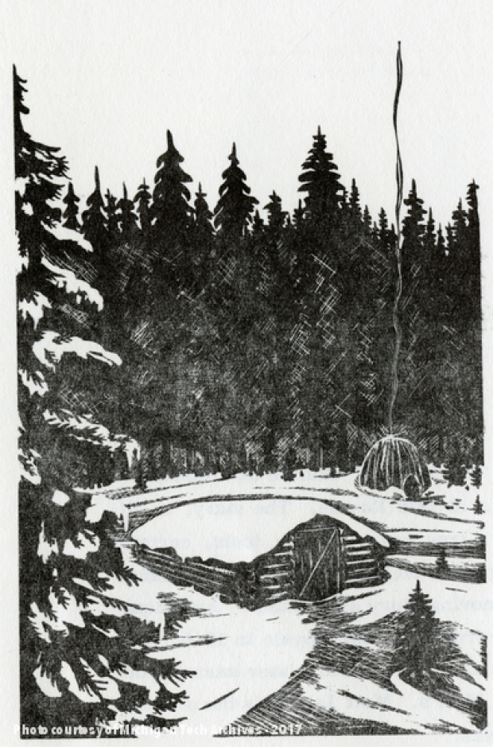
An illustration from “Wolf’s Eye” Vol. 5, No. 4a. “Charlie and Angelique Mott: A tragic but true story of Isle Royale.” It depicts the living quarters of Charlie and Angelique Mott while they were staying on Mott island.

Isle Royale is not the easiest location to film a movie, so the film was shot in Terrace Bay (near Rossport) and Fort William in Ontario, Canada. The sand beaches are a dead giveaway – I don’t know of any sand beaches on Isle Royale. It’s all rock and cobble. I also don’t know of any rivers with huge rapids on the island like are in the lead photo for this post, but the stunted trees and rocky shoreline found in Canada are quite similar.

In all my time on Isle Royale, I never knew that Mott Island was named in their honor. It’s a small island where the National Park’s island headquarters are located off the main island. I was excited to see Native actress Tantoo Cardinal in the movie. She plays Angelique’s grandmother. I was in a movie with Tantoo and actually got to touch her arm in a scene! So, it was like seeing an old acting buddy, ha ha.

According to Mikel B. Classen’s blog, Angelique’s story was first written down as a footnote in the book, “The Honorable Peter White: A Biographical Sketch of the Lake Superior Iron Country.” That, combined with original research, inspired the book, “Angelique Abandoned” by James R. Stevens. His book was turned into a screenplay by Michelle Desrosier, an Indigenous woman from Canada.

Although some of the storytelling could have been smoother, I found the movie a meaningful tale of the power of women, the power of love, and belief in the forces of the universe.

All the Light We Cannot See: The TV Series that Broke the Internet

Well, it wasn’t the series itself that broke the internet in my neighborhood, rather it was a virtual presentation about it by Netflix that seemed to break it.

About a month ago, I was invited to an exclusive virtual screening of a new television series that’s being made out of the book, “All the Light We Cannot See,” by Anthony Doerr. I was invited because I rated the book on Goodreads.

However, right when the screening was supposed to begin, the internet went down at my house. Luckily, I was able to access the event via my cell phone. I sure was glad I signed up for that new unlimited data plan!

The event began with an introduction of one of the series’ main characters (Aria/Marie). Then the first installment of the four-part series was shown. It was filmed in Budapest and is set to air November 2 on Netflix. This was followed by an enthusiastic conversation between Doerr and the series director, Shawn Levy. I recorded it so I could make this blog post, complete with quotes and everything.

If you’ve been living under a literary rock, you might not know that “All the Light We Cannot See” won the Pulitzer Prize for fiction in 2015. I attribute this to Marie being one of the main characters’ names. Ha ha.

Marie-Laure is a blind girl who crosses paths with a Werner Pfennig, a German soldier, in occupied France during World War II. After her uncle disappears, Marie takes over his nightly clandestine radio broadcasts from the attic. Werner’s job is to track down resistance operations, including radio broadcasts. His life and Marie’s collide in this book, which illuminates the ways people try to be good to one another against all odds.

I gave the novel five stars on Goodreads, saying, “This book has *almost* spoiled me for any other. The writing! The metaphors! The sensory descriptions! OMG. The flipping between time periods and character points of view were confusing at times, but it all works in the end. So, keep reading. You won’t be disappointed.”

The character of Marie is played by a woman who is actually blind, “That’s valuable detail that impacts and informs every frame of this series,” Director Levy said. He conducted a global casting search for the part.

“We got thousands of videos. One of them is a unicorn of a discovery. She’s never auditioned, she’s never thought about being an actress, she’s an academic,” Levy explained.

He chose Aria Mia Loberti. She’s an American who was a graduate student in rhetoric. She learned about the audition from a former childhood teacher. Aria was a fan of the book and this is her first acting role.

Levy optioned the rights for the story after it was rejected by another firm, which decided it was too complicated to tell in a single movie.

Levy directs all four episodes, a task that Doerr called “herculean,” but Levy said this allows for aesthetic continuity between episodes.

Levy decided to direct all four out of selfishness because he loved the book. “By page 12 of episode 1 of the script . . . I said, ‘Oh no, no, I can’t share. I need to direct it and I need to direct all of it because I want live in this world and create this world in a way that feels uniform and unified across episodes.’”

Levy describes the work as one story that happens to have four episodic breaks. “I knew if I could make myself happy as a rabid fan of this book, likely I could make other fans happy. That was my whole strategy.”

Levy previously directed “Stranger Things,” a sci-fi horror series on Netflix. He also directed “The Night at the Museum” movies and “Deadpool 3.”

Doerr said that the general advice writers get is to write what they know. “I like to write into what I don’t know.” With “All the Light,” he said to Levy, “often, I’d get one-and-a-half sentences in and just like you guys, I’d have to go and build the set.” He had to research what it was like to be blind during the time period of World War II.

Levy asked Doerr how he combines lyrical storytelling with a taut narrative action. “Often, as a novelist, you’re toggling between the tiniest microscopic details, which can take a whole morning . . . and then other days, you’re trying to move totally structurally, and think, ‘where’s this tiny moment in the book falling in the larger scope of the narrative?’” Doerr said.

Levy finished Doerr’s thought with: “Because you always have to keep the narrative in your mind. Always. But you also have to be hyper-focused on this shot. It’s like zooming in and out from a macro to a micro lens.”

Many people think the book’s title comes from the blindness of the protagonist, but this was not Doerr’s intention. He thought of the title while on a train to NYC to see his editor about the cover of his current novel at the time.

“There was a guy in the seat in front of me and he was on his big 2004 cell phone. He was talking about the movie, ‘The Matrix.’ I remember that quite clearly. As we go underground as we near the city and Penn Station, his call drops, and he gets unreasonably angry. I remember thinking at the moment that what he’s doing is a miracle. He’s got this tiny set – a radio — a receiver and a transmitter no bigger than a deck of cards, and he’s expecting this conversation to work at 60 miles an hour, sending these little packets of light between radio towers at the speed of light. And who knows, the person’s he’s talking to could be in Madagascar or France. I remember thinking that what we’re all taking for granted is using this invisible light that can pass through walls. It’s a miracle and so many generations of humanity never had access to this kind of communication.

“I wrote down the title (usually titles come really late to me) but I wrote down “All the Light We Cannot See” in my little notebook that I carry in my pocket before I had anything. All I had was a girl reading a story to a boy, which is how episode 1 really begins, over the radio. I conceived of her being blind and him trapped in darkness, desperately needing this story. I just wanted to play with all the metaphorical meanings of where are we living and what our human perceptions involve.”

Levy asked Doerr whether it is surreal to have this population of people living in your head for years and then to see them burst into life on the screen. Doerr replied that he was blown away by seeing Aria’s audition video and also by the younger version of Marie, played by a child actress named Nell.

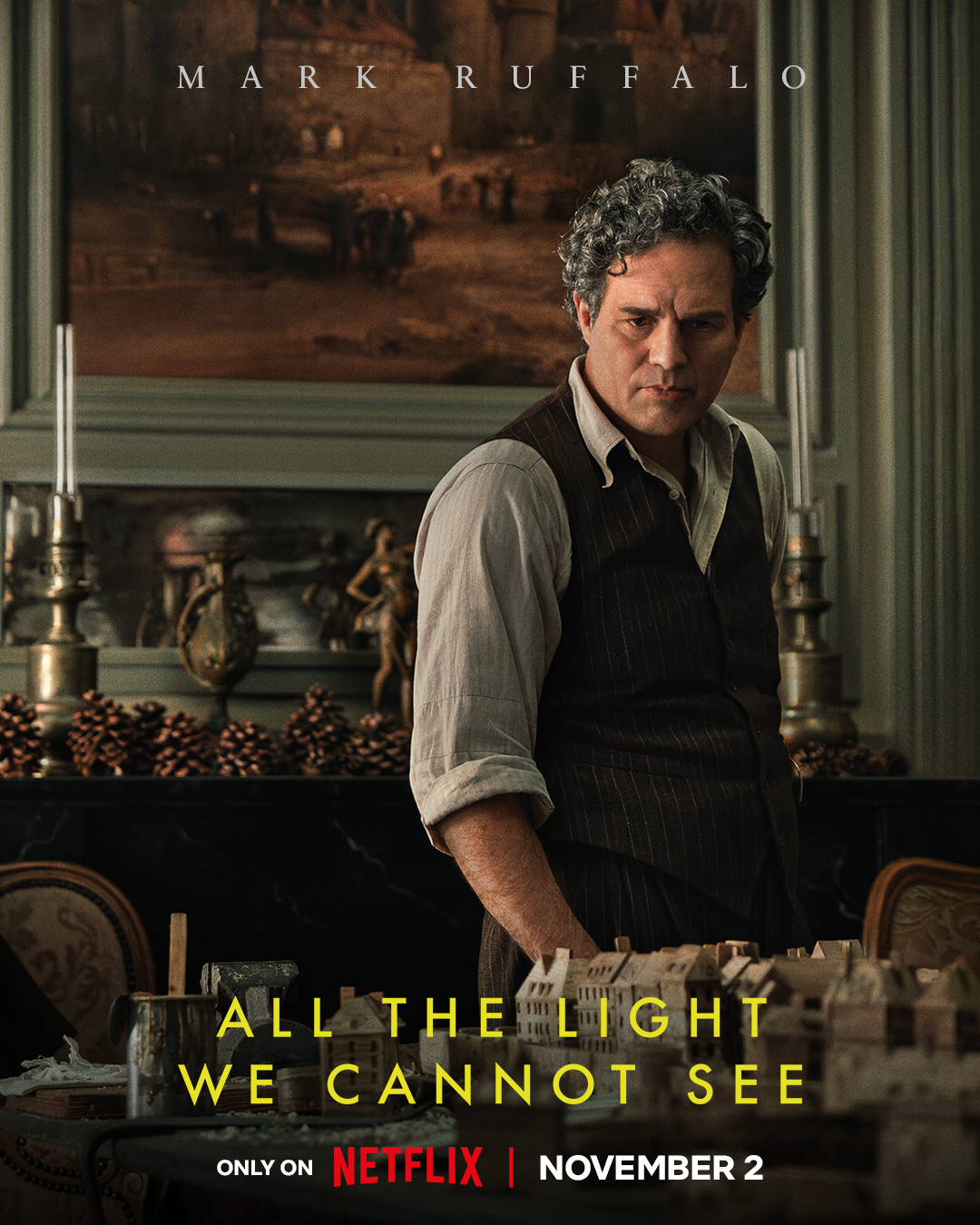
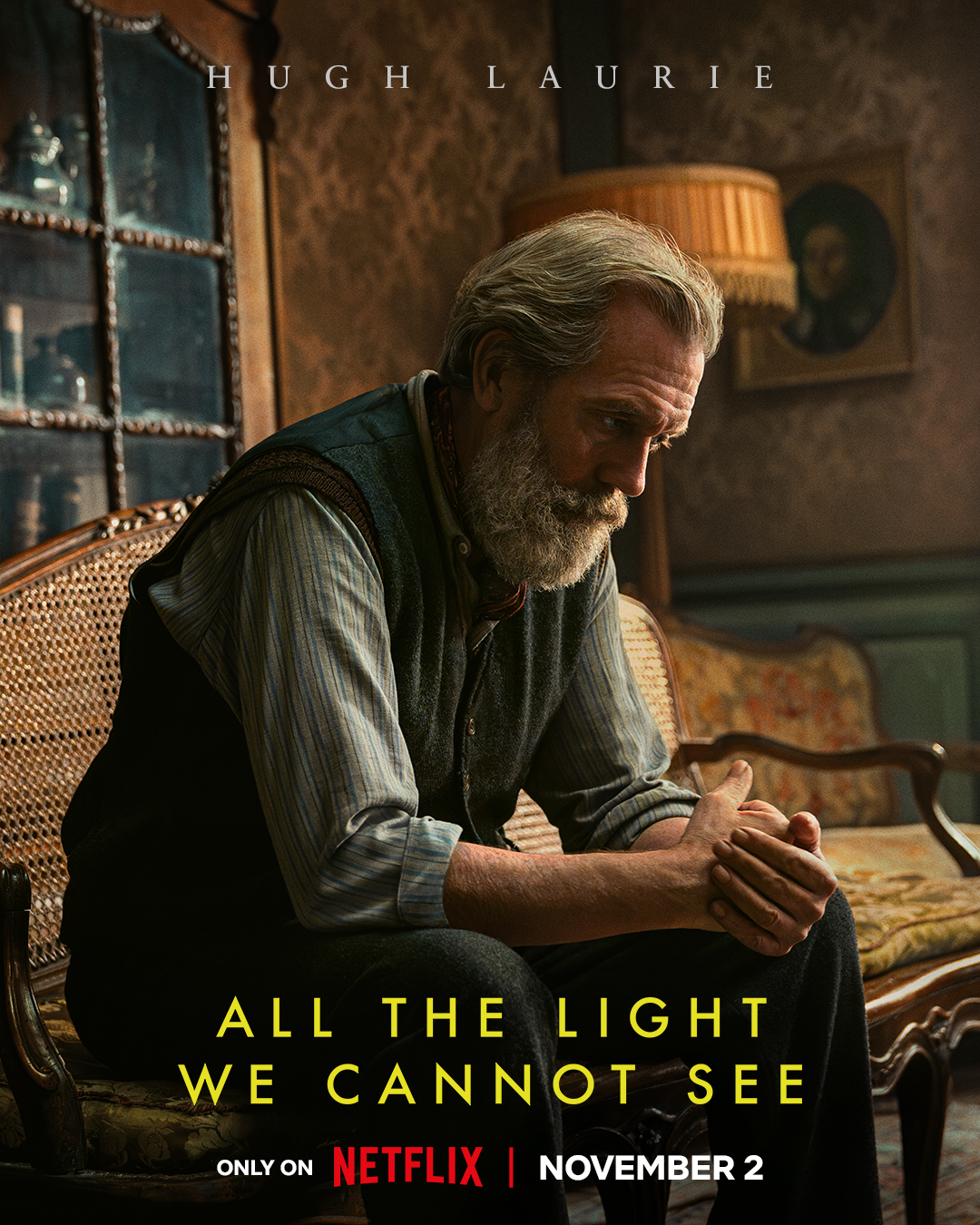
The movie stars other, more familiar actors, too. Wisconsinite Mark Ruffalo plays Daniel, Marie’s father. Hugh Laurie plays the reclusive uncle.

From being privy to episode 1, I can tell you that if you loved the book, you’ll love this series! I still can’t quite believe that I was invited to this preview.

Then the screening and conversation was over. Just as mysteriously, my internet reappeared at that instant. It made me wonder how many people got invited to this “exclusive” screening, anyway?

Unlike the man on Doerr’s train, I did not get unreasonably angry when my technology stopped working. I did get stressed out though, because I didn’t want to miss the screening. The irony does not escape me that my cell phone worked while the train man’s didn’t. And for that, we have to thank the miracle of invisible light that can pass through walls.

A Perfect Duluth Evening

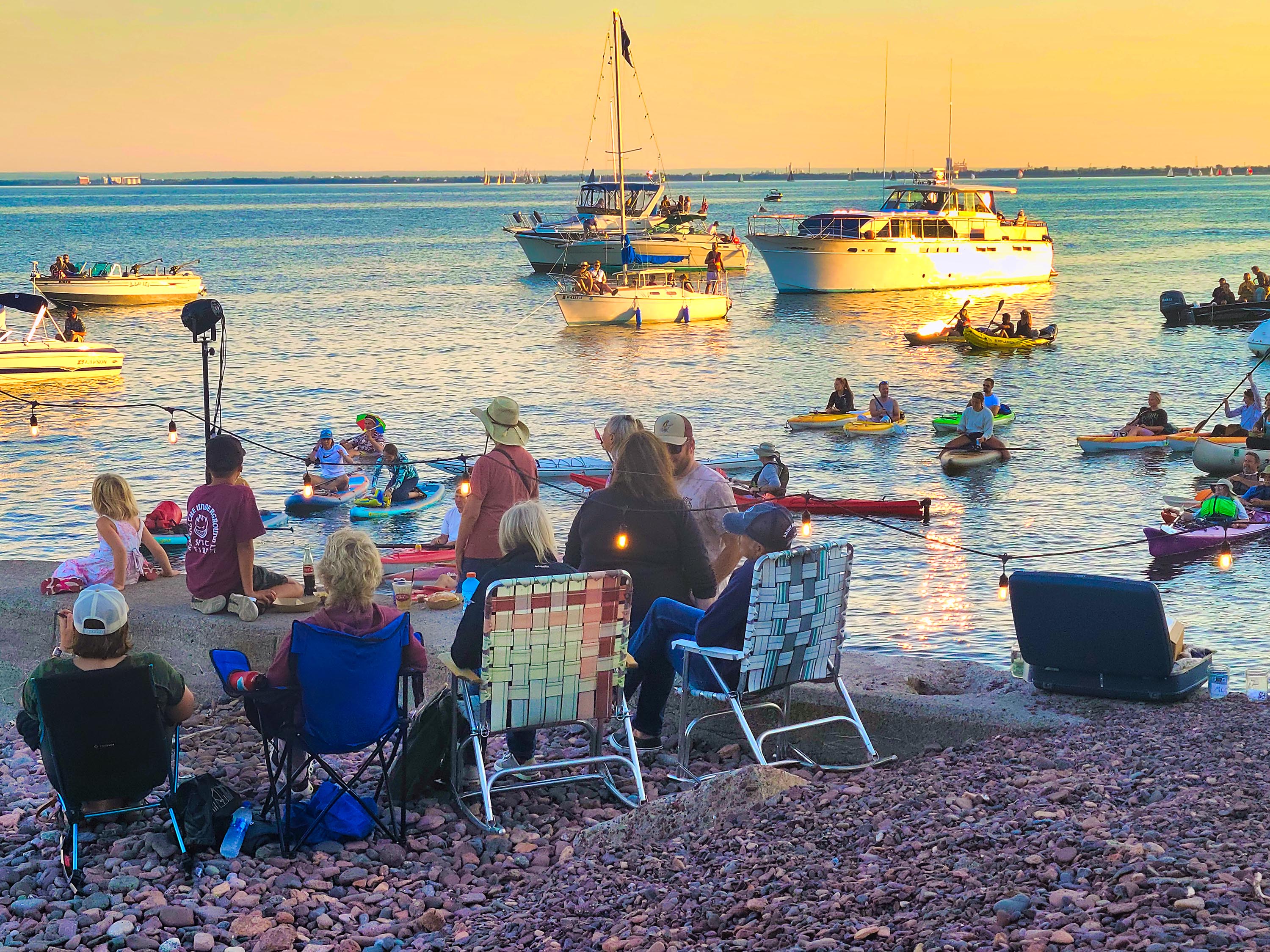
Boaters and landlubbers alike gather on the shores of Lake Superior for a “Concert on the Pier.” In the far background, you can see sailboats doing their Wednesday night races.

A historic mansion on the shores of Lake Superior in Duluth, Minnesota, offers free concerts on Wednesday evenings during summer. Local musicians play on a pier that juts out into the lake as hundreds of listeners lounge on blankets on the Glensheen Mansion grounds and the rocky shoreline. Boaters take advantage of the concerts as well, anchoring just off the pier. I should explain that all manner of watercraft people show up to listen: paddleboarders, kayakers, canoers, sailors, inner tubers.

I had never been to one of these concerts before. It was the last of the season, the weather was warm and calm, and some of my favorite musicians were playing – Jacob Mahon and Teague Alexy – in Teague’s “Common Thread” band. So, Russ and I grabbed our folding chairs and headed to the shore.

Since these events are so well-attended, parking space is at a premium. We parked in a neighborhood about a quarter mile away and walked onto the mansion grounds. We got there about an hour early so we would have a chance to sit in a good location.

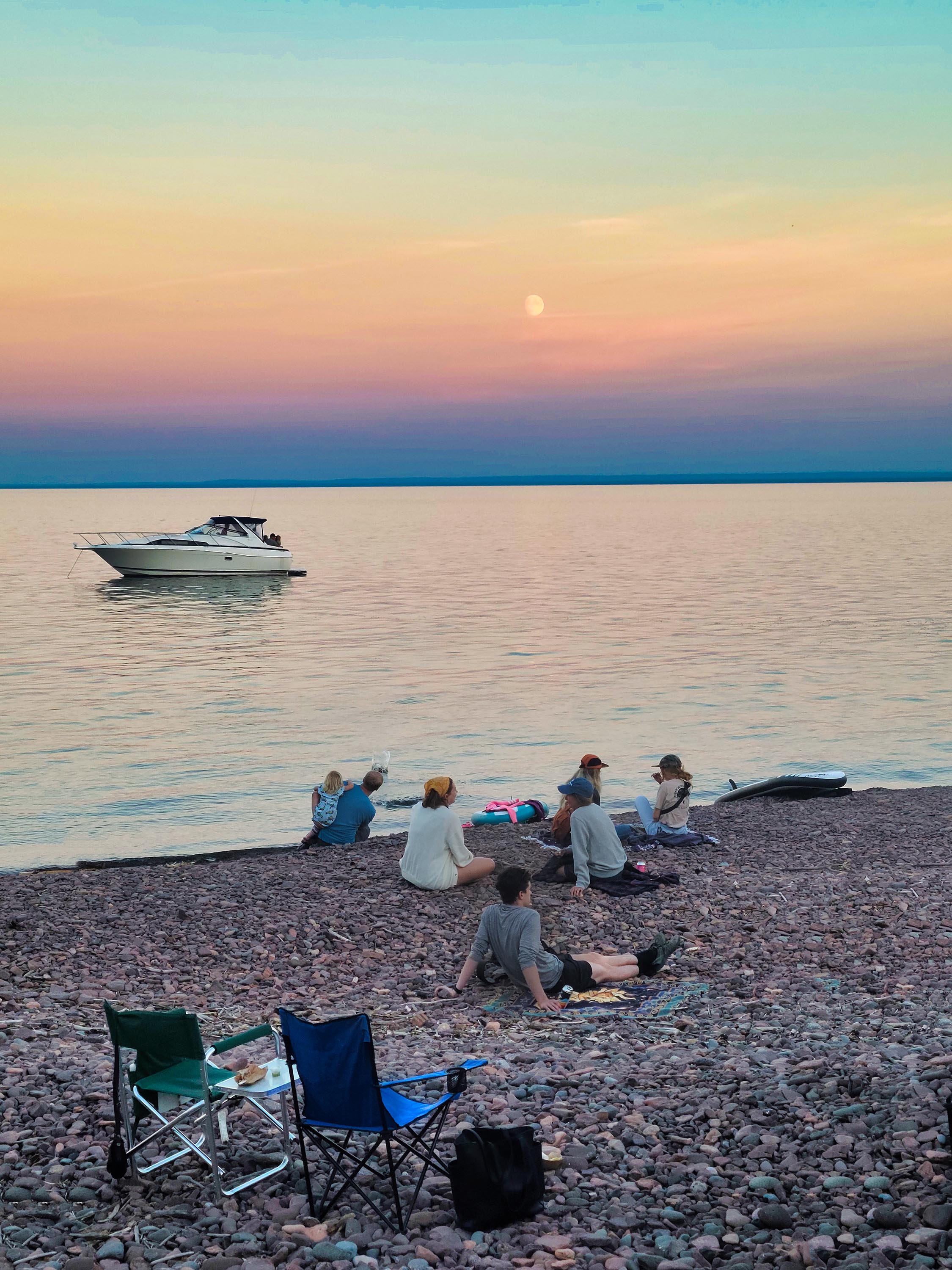
The view from our concert spot on the beach. That’s the moon rising.

The best spots with direct views of the pier were already filled with picnickers. We noticed a small rocky hill on the beach behind the pier and decided to head there. We soon discovered that getting to the hill required fording the end of a creek (Tischer Creek) that runs through the property into the lake. Luckily, water levels were low enough that this was a simple task, requiring only a few steps on some well-placed rocks.

We planted our chairs to stake our claim and then headed out to investigate the food trucks, ice cream stand, and adult beverage purveyors on the grounds. We had just enough time to obtain some treats and return when the music began.

Teague’s songs have been described as “an inviting style of laid-back roots music” with a few Irish ditties sprinkled here and there. It was perfect for listening as the sun set in pinks and periwinkle blues over the lake.

More boats arrived until a minor flotilla floated in front of the pier. The boaters had the best seats!

Neighbors greeted neighbors. Former soccer moms reunited. Children continued their never-ending, generations-long quest to fill up Lake Superior with rocks.

A moonlit path on Lake Superior

Soon, an almost-Harvest-Moon rose, its light trailing a glowing path on the water. The disappearing sun had taken its warmth along with it. Although we wore jackets, a chill from the lake began seeping through. We stayed until we became too uncomfortable, leaving a few songs before the concert’s end.

As we walked back to our car serenaded by the band, the Lake Superior cold in our limbs was offset by warmth toward our community for providing this perfect way to spend a Duluth evening. Glensheen’s Concerts on the Pier are a unique experience. So glad we got our butts down to the shore to enjoy one.

The Fish Dish: New Podcast Mixes Friends, Fun and Food

I’ve been busy at work lately, giving birth to a new podcast. If you want the latest “dish” about Great Lakes fish, you’ll want to listen to “The Fish Dish.” I host it with longtime coworker and friend Sharon Moen, Sea Grant’s Eat Wisconsin Fish Outreach Specialist. Besides introducing you to the people behind Wisconsin’s fishing and aquaculture industries, each episode includes a “Fish-o-licious” section where we cook a new fish recipe.

The first episode features Craig Hoopman, a sixth-generation commercial fisherman from Bayfield, Wisconsin. Hoopman shares his beginnings in the business, current challenges, plus his dreams for the future. Also, Sharon and I share our backgrounds in fishing and introduce listeners to the Eat Wisconsin Fish campaign. During the “Fish-o-licious” part of the show, we cook Greek-Style Lake Whitefish at Hoopman’s recommendation.

Tying it all together is ska music by Twin Ports band, Woodblind. Take a listen — let me know what you think!

Lawn Mower Races: Cutting-Edge Excitement

The grand marshal of the Thunder Valley Lawn Mower Races, Maine. Image credit: Mark Haskell, Courier-Gazette

Apologies for the bad pun in the title, but I wanted to let you know that you truly haven’t lived until you’ve witnessed this phenomenon. Lawn mower races happen all across America, from Idaho to Maine. I received my first taste in late summer when I meandered into Cotton, a small town in northern Minnesota.

Grown men (and in other places, women) clamber aboard riding lawn mowers that they have modified for racing. In Cotton, the circular racing track was an actual lawn situated behind what used to be the town’s high school but is now a community center.

The races are a cultural highlight of the season. Families gather to sit on the grass or on haybales to watch the festivities. Kids eat cotton candy. Some folks even back their jacked-up pickup trucks along the track. Sitting in folding lawn chairs in the cargo bed, they have a prime, elevated view.

Engines rev. The starting gun cracks, and they’re off! The machines tilt as they round the corners, wheels lifting off the ground. The drivers likewise tilt, leaning into the movement. Around and around they buzz, neck and neck. After a few turns around the track, one man’s mower putters out and he pulls into the center, defeated.

Cotton, MN, lawn mower racers lean into the turn.

According to the U.S. Lawn Mower Racing Association, this quirky form of racing began in the early 1970s – touted as a perfect way to use a machine that many people already have, and to let off steam. It became official when the makers of a fuel stabilizer came up with the idea of using a lawn mower race to promote their product on April Fools’ Day in 1992.

I had no idea this pastime had been around for so long! There’s even such a thing as lawn mower ice racing in winter.

With a wave of a checkered flag, the race ends. The crowd applauds. The winners strut over to claim their prizes and pose for the local newspaper photographer.

In Cotton, racers competed in two events, “modified” and “stock.” I felt culturally enriched for having watched these events. But it all seemed like such a waste. You see, the racing mowers don’t have their blades engaged. All that noise and hype, and in the end, the grass on the track is just as long as before. 🙂

The Hallmark Christmas Movie Drinking Game – Marie’s Version

Greetings! I hope all my dear readers made it through Thanksgiving in a healthy and happy way. But if you are getting COVID-isolation crazy and want to let off some steam, I humbly suggest you try the Hallmark Christmas Movie Drinking Game. I heard about this from a coworker and it sounded too fun to pass up.

I got together with two people from my COVID bubble and we watched “Christmas at Grand Valley,” available for streaming from Amazon Prime. In this scintillating saga, which is cast in the Hallmark Movies and Mysteries series, Kelly returns to her Wyoming hometown (from Chicago) and becomes involved in an effort to save the town’s beloved lodge. In the process, she falls for a handsome widower sent to decide the fate of the lodge.

I’m not sure why this movie is considered a mystery. The only inkling of mystery comes in the form of, “WHEN ARE KELLY AND WIDOWER MAN EVER GOING TO KISS?”

Whenever certain things happen on screen, viewers must take a sip of their drink, or two sips, down the whole thing, or take a shot. I *think* (memory is fuzzy) I ended up drinking a whole bottle of wine between supper and the movie. It was great fun, plus I thought up some new rules, which are the ones posted in red.

Happy Holidays everyone!

RULES

Take one drink whenever:

  • A reference is made to a dead relative
  • The “Mayor” appears on screen
  • The main character’s name is related to Christmas (Holly, Nick, etc.)
  • Anytime someone disses fake Christmas trees
  • A newcomer partakes in an old family or town tradition
  • Hot chocolate, apple cider, or eggnog is on screen
  • A big city person is transplanted to a small town
  • Christmas caroling, a tree farm, or baking cookies appears
  • Mistletoe is on screen
  • A character makes a magic deal with Santa or an angel
  • Any time you hear “Jingle Bells”
  • The town is named something Christmas-y

Take two drinks whenever:

  • Characters experience a ‘near-miss’ kiss
  • An obvious product advertisement appears
  • A snowball fight or ice skating happens
  • An ugly sweater or tie appears
  • The characters are snowed in
  • A “Pride and Prejudice” reference is introduced (a character is named Darcy, a place named Pemberly)
  • Someone with slicked-back hair expresses their hate for Christmas

Finish your drink whenever:

  • The cynic is filled with the Christmas spirit
  • It snows on Christmas
  • Someone selects a Christmas tree
  • The main characters bake/cook something together, or Christmas-themed food is mentioned
  • Bad art appears or a literary reference is made
  • Dissonant architecture appears (for instance, a lighthouse in Wyoming)
  • Accordion music happens, especially if it’s playing Jingle Bells

Take a shot whenever:

  • The movie stars Candace Cameron-Bure, Lacey Chabert, or Andrew Walker appear
  • The main characters fall in love
  • The main characters kiss

The Year 2020 in a Cartoon

I was listening to a recent episode of National Public Radio’s “Wait, Wait, Don’t Tell Me” podcast when my heart leapt with joy. The guests were talking about the year 2020 and the grandiose ideas people had in the past about how we would be living today.

What got my heart going was when the host mentioned the “Sealab 2020” cartoon.

I had been thinking about that cartoon lately, with it being the year 2020 now.  Until listening to the podcast, I was beginning to wonder if anyone else but me remembered the short-lived series.

“Sealab 2020” only ran from September until December 1972, but it made a big impression on me – with my proclivities toward all things watery. The setting was an underwater lab. The dramas and intrigue of the 250 “oceanauts” featured heavily, as they faced challenges ranging from environmental disasters to attacks from giant squid.

As a nine-year-old, I envisioned myself as one of the oceanauts by the time 2020 came around. Alas, I am still landlocked, and I don’t think there are any large underwater labs in operation at this time.

My dream did not come to pass. But at least I work for Sea Grant, and that’s almost as good!