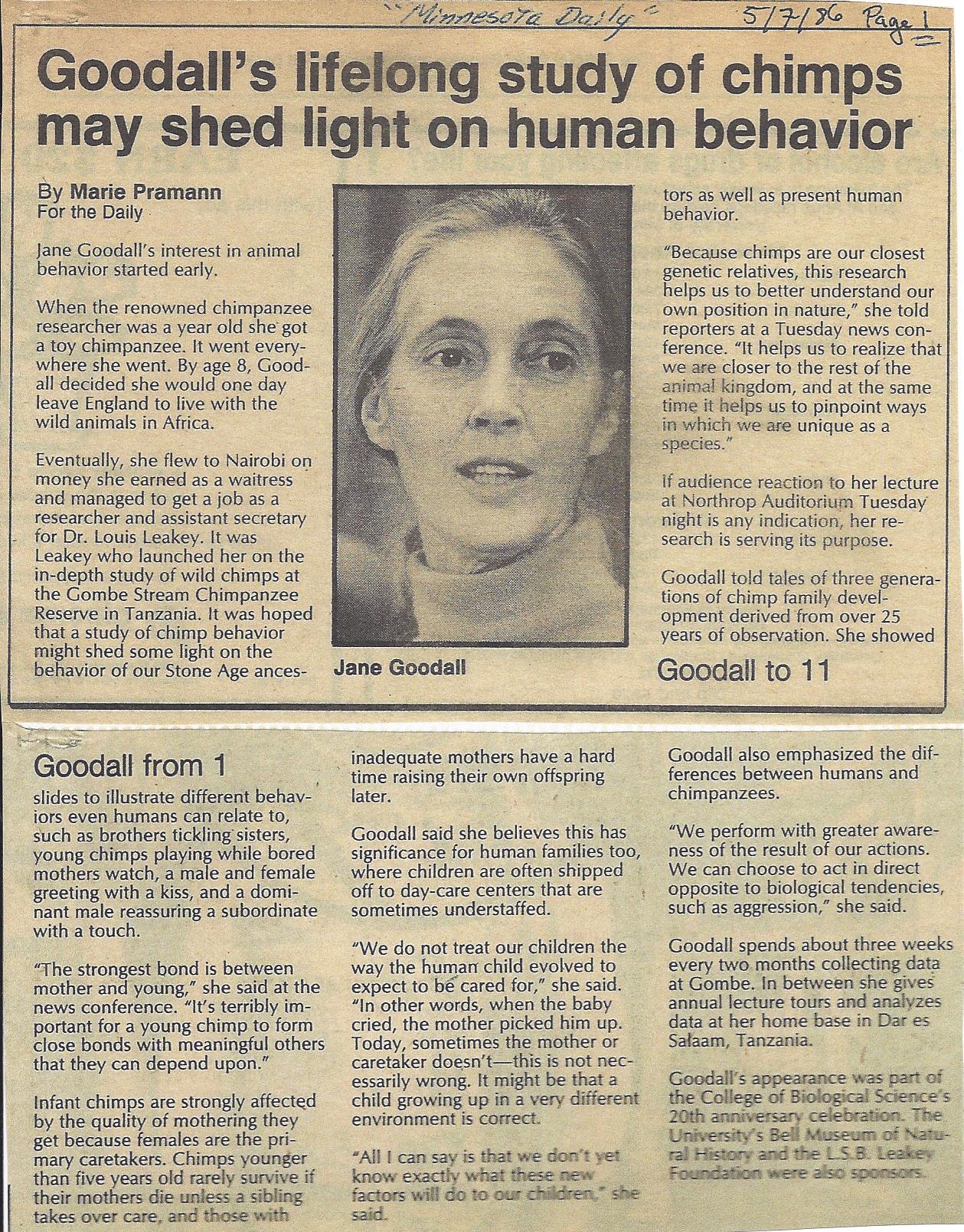
Story from the Minnesota Daily, May 7, 1986, page 1.
You may have heard that chimpanzee researcher Jane Goodall died recently. As a young college environmental reporter, I had the chance to meet her once. Here’s a story that I posted in my blog previously and included in my Meander Northbook. Not only was Goodall a great scientist and advocate for nature, she was a wonderful human being.
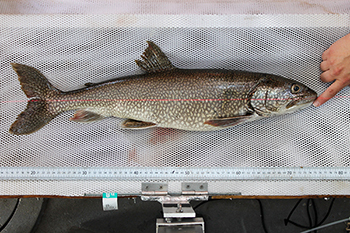
The oldest lake trout yet discovered in Lake Superior, also known as “Mary Catherine.”Image courtesy of the Michigan DNR.
The Michigan Department of Natural Resources (DNR) published a story a few days ago that made many people upset. As someone who has her feet in both natural resources management and public relations/science communication it offers an interesting case study. The DNR was trying to highlight an interesting fact about how fish can reach old ages, but some mistakes got in the way of this message.
The ear bone of one fish they caught in a special survey done in 2023 to study the different forms of lake trout and their reproductive biology was recently analyzed and the DNR discovered that the fish was as old as I am! (62 years) They caught the lake trout on a reef in the southeastern part of Lake Superior (40 miles north of Grand Marais, Michigan) and this lake trout is the oldest one currently on record.
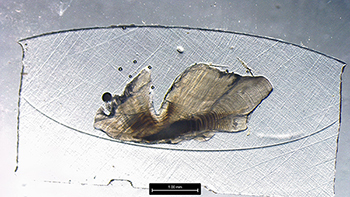
The ear bones of fish show annual rings much like a tree, and that’s how the DNR can tell the age of the fish. It’s the only way they can do this, and they have to kill the fish to extract the ear bone, also called an otolith
Mary Catherine’s otolith shows 62 years of growth.Michigan DNR image.
One mistake the technicians made was naming the fish. They picked the era-specific moniker of Mary Catherine because Mary was one of the most common names in 1961 when the fish was hatched. People who heard news reports were excited that such an old fish was found, and that it even had a name, only to be crushed when they learned later that the fish was killed in the process of discovering its age.
One Facebook commenter said, “Hey we just killed Mary Catherine, but the upside is we now know that she was 62 years young, much like many grandmothers and recently retirees. There’s one less on Social Security now, and that should help keep it solvent.”
Another said, “Sad that they killed a fish who is probably older than the combined ages of some of the researchers, but it is interesting information.” Another commented that the fish might have lived another 20 years if not sacrificed for science.
You might think that such an old fish would be very large, but she wasn’t. Mary Catherine weighed 2.1 kilograms (4.62 pounds) and was 627 millimeters (24.7 inches) long. That’s because Lake Superior doesn’t have much food in it and animals grow slowly. The typical lifespan for a lake trout is 25-30 years.
The story gained wide media coverage, so it was successful that way, but even some of the reporters were dismayed that Mary Catherine was a goner. People already love to hate the DNR, and this well-intentioned science story just gave them another reason.
I’d say the main lesson is not to name your research subjects in newsworthy stories, especially if they’re dead.
The researchers were mum about whether they were inspired by the Saturday Night Live character, Mary Katherine Gallagher.
The current administration is trying to do away with Sea Grant and other environmental research organizations by cutting them from the federal budget. I am hoping that Sea Grant proved its worth when this happened in 2017 and that Congress will put it back into the budget. I just retired from Sea Grant, so I’m not privy to the latest info, but here’s a repeat of my post from 2017.
I feel for my former colleagues. This is stressful and demoralizing for them. Yet I’m sure they’ll continue their good and important work to understand and keep our waters safe, nevertheless. Sea Grant is still a kick-ass program, even though I don’t work there any more. 🙂
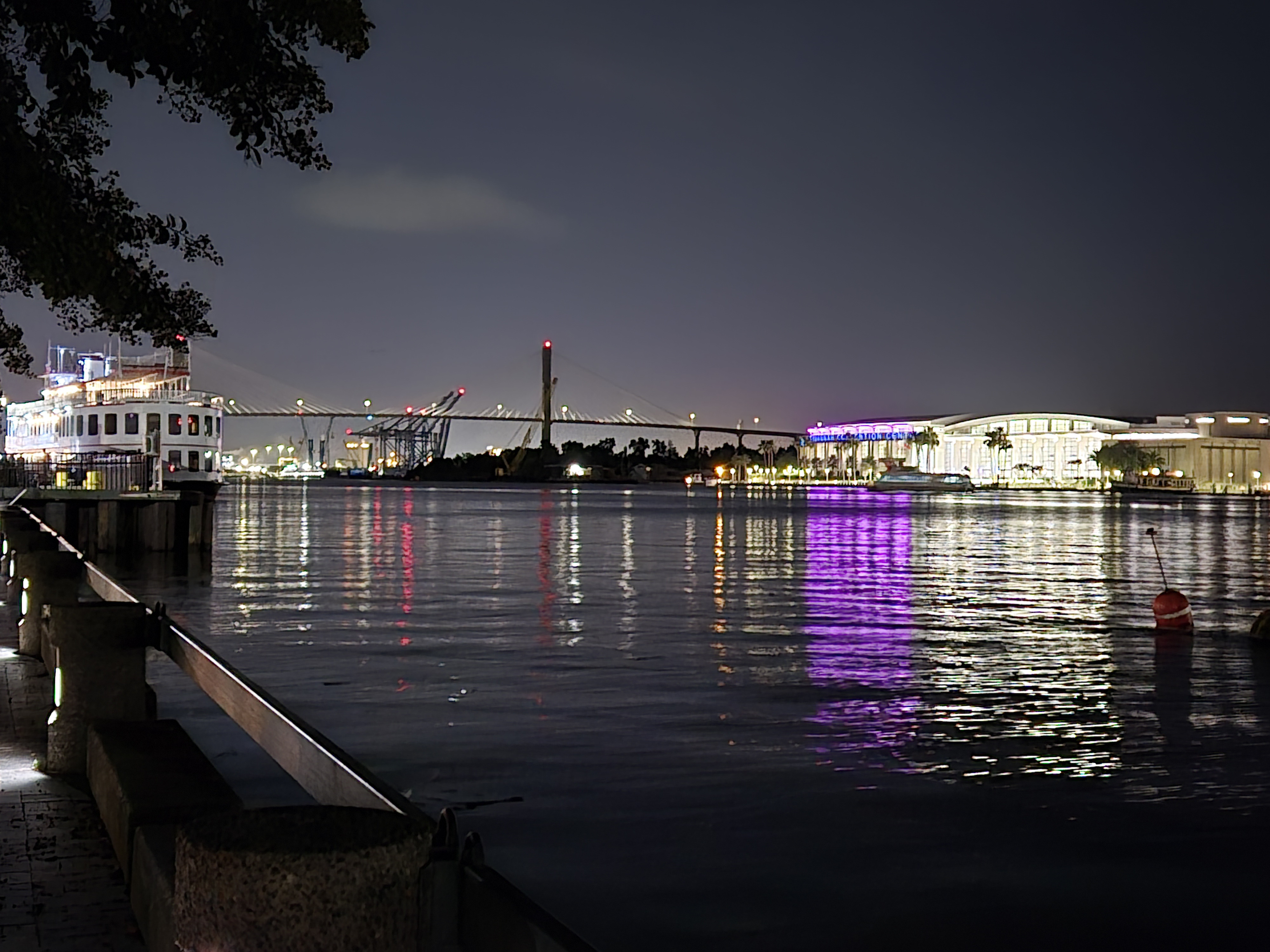
The Savannah River spoke to me as I walked its banks at night. Stark white and neon purple lights reflected across its surface, and it whispered, “I’ve been widened, deepened, and dirtied. Cargo ships ply through me. Tourists in paddlewheel boats churn atop me. Factories have dumped their pollution in me. I am ancient, older than those who use me. Once you are gone, I will remain. I will become whole again.”
We’ve been driving up and down Highway 61 on Lake Superior’s North Shore more than usual lately to deliver and retrieve my photos that were on display in Grand Marais. On one trip, I noticed a river that flowed underneath the highway. No sign sported the river’s name. Looking landward as we whizzed past, I spotted a double culvert bridge about a hundred yards away that the river flowed through. Was that a waterfall behind one of the culverts? The scene was intriguing and not one I’d ever seen photographed by established North Shore photographers. I made note of the location and vowed to stop on our next trip.
That “next trip” was last weekend. On our way back to Duluth from Grand Marais, we stopped near the mystery river, which is near Taconite Harbor. The harbor’s a place where mining companies used to load taconite (iron-ore pellets mined and made on Minnesota’s Iron Range) from rail cars into ships bound for steel-making plants in Michigan and Illinois.
We parked our car in a driveway entrance that was blocked by a gate overgrown by saplings. Although the driveway had a fire number on it, that gate obviously hadn’t been opened in years, so we weren’t too worried about blocking access.
We walked across the highway and, as cars rushed past, took a short jaunt to the river. We hopped the guardrail in a likely looking spot and soon found a faint game trail. The trail also could have been made by anglers. We found out later that part of the river is considered an “Aquatic Management Area” allowing angler access by the Minnesota Department of Natural Resources.
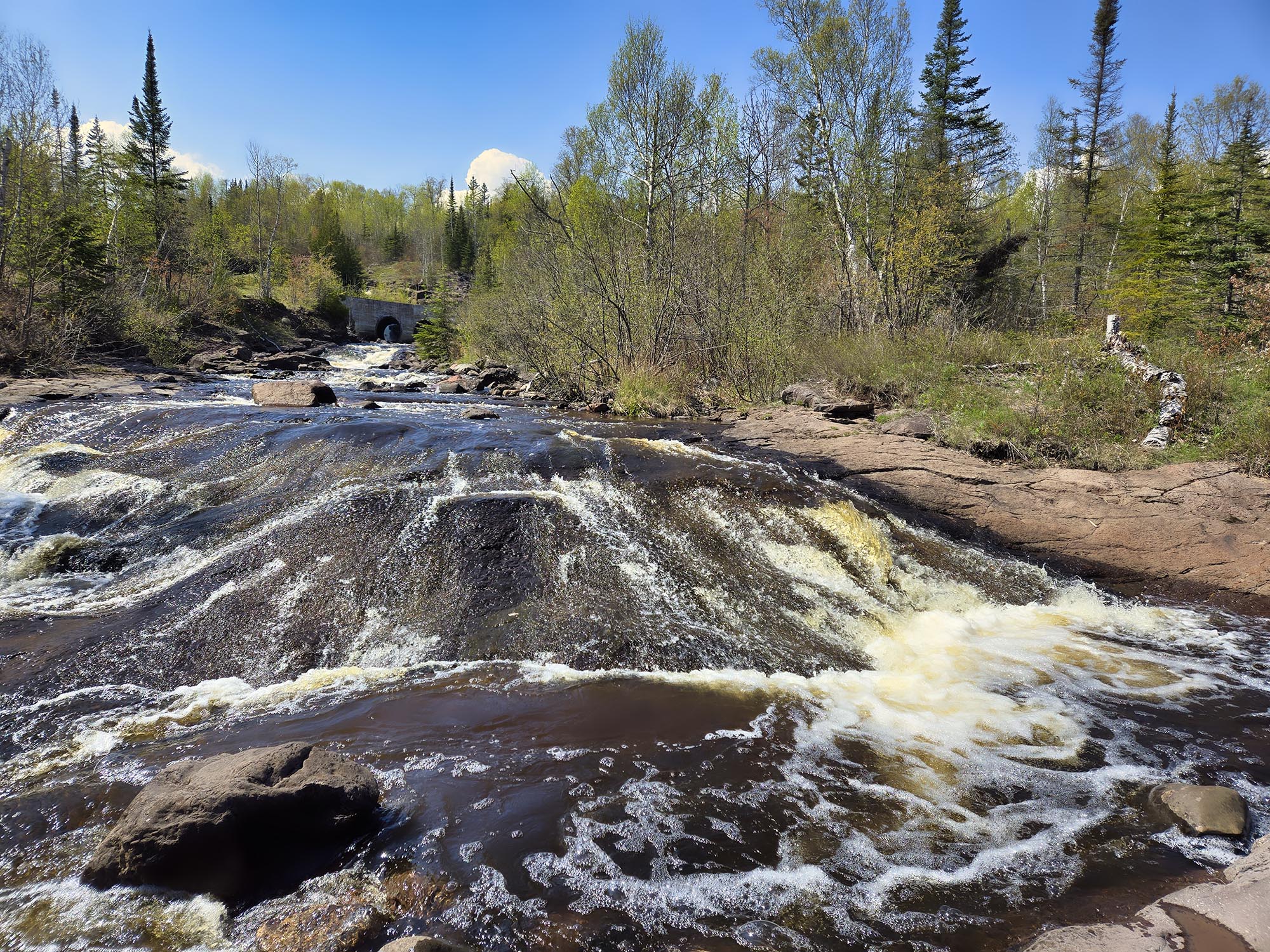
Two Island River, see the culverts upstream?
It’s spring and we’d had a heavy rain recently, so the shallow river splashed with gusto over reddish-gray rocks. I clambered along the banks, camera in hand, taking photos at spots that offered a good vantage. But I was impatient to get to my goal: the double culvert up the hill, and that waterfall behind it.
Russ went ahead while I took photos. When I caught up to him at the railroad bridge with the culverts, he’d had time to look up the name of the river on his phone. We were looking at Two Island River, a 15-mile waterway. There’s not much info out there about it, but Wikipedia says the river is named for two lake islands near its mouth.
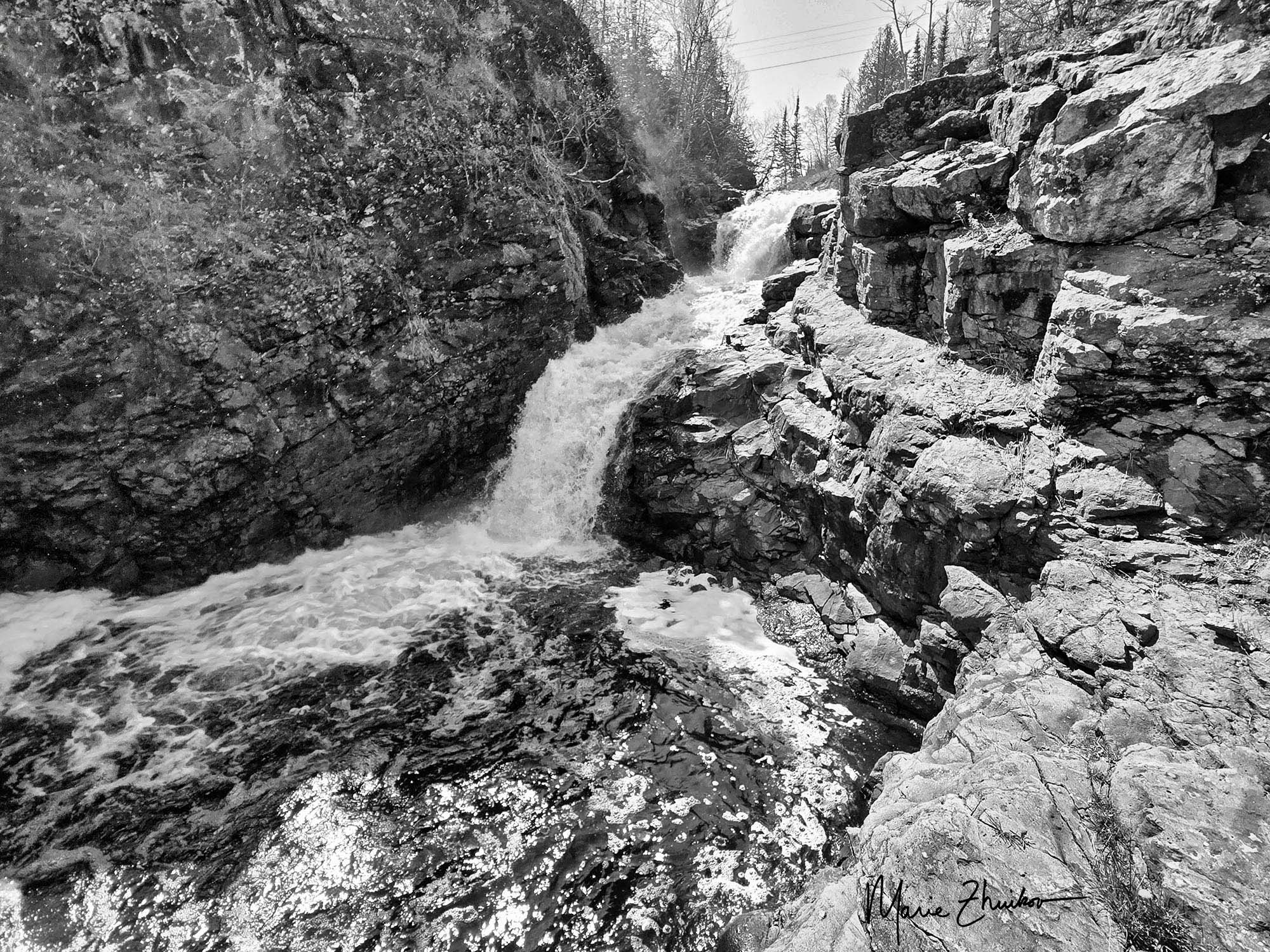
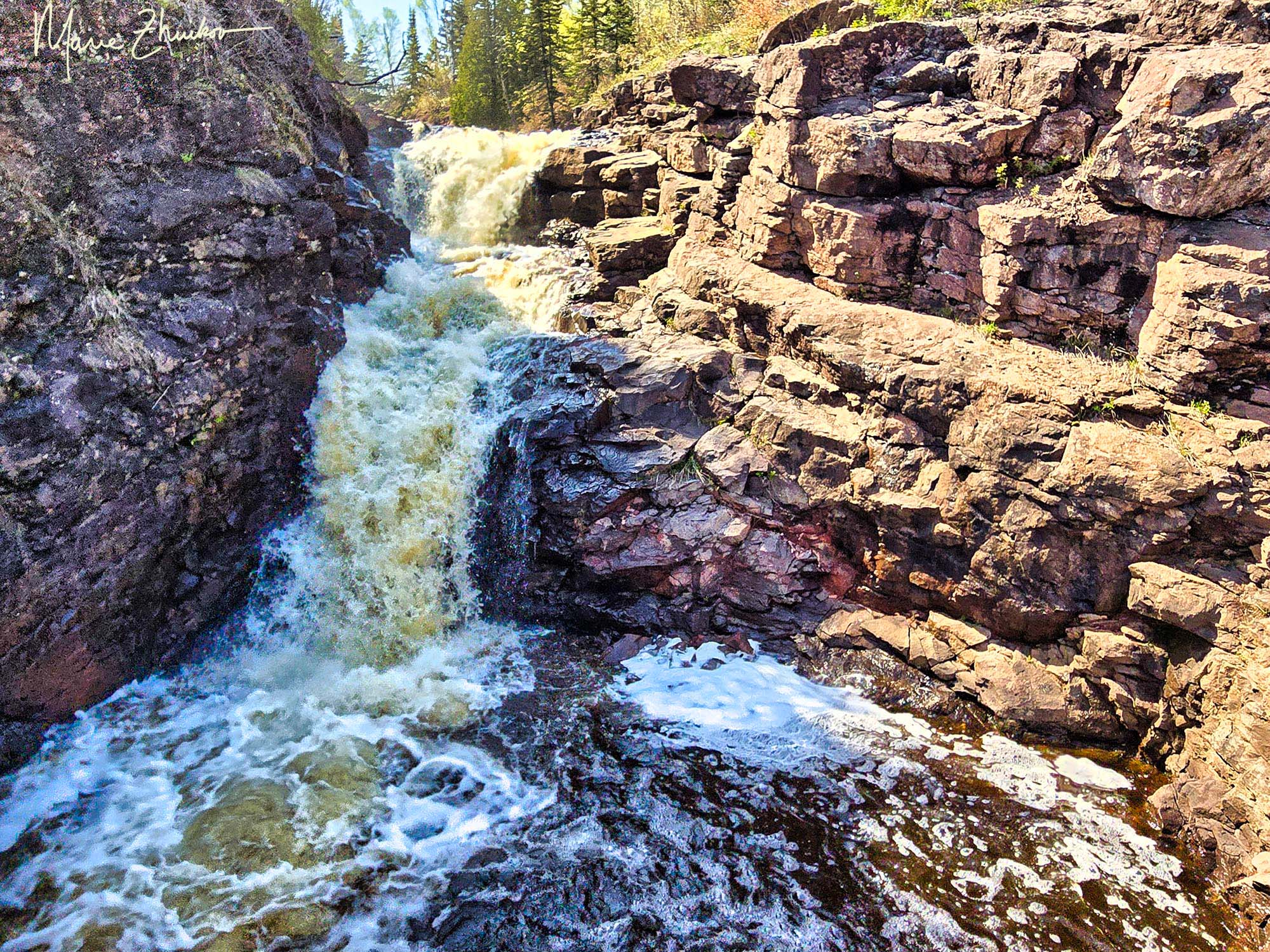
As you can probably tell, there was a waterfall behind the culverts. A very nice one, too. The steep angle of the sun and rising mist from the falls made for some blurry spots in my photos, but I managed to get a few images without amorphous blobs floating around in them.
Two Island River Waterfall (in color)
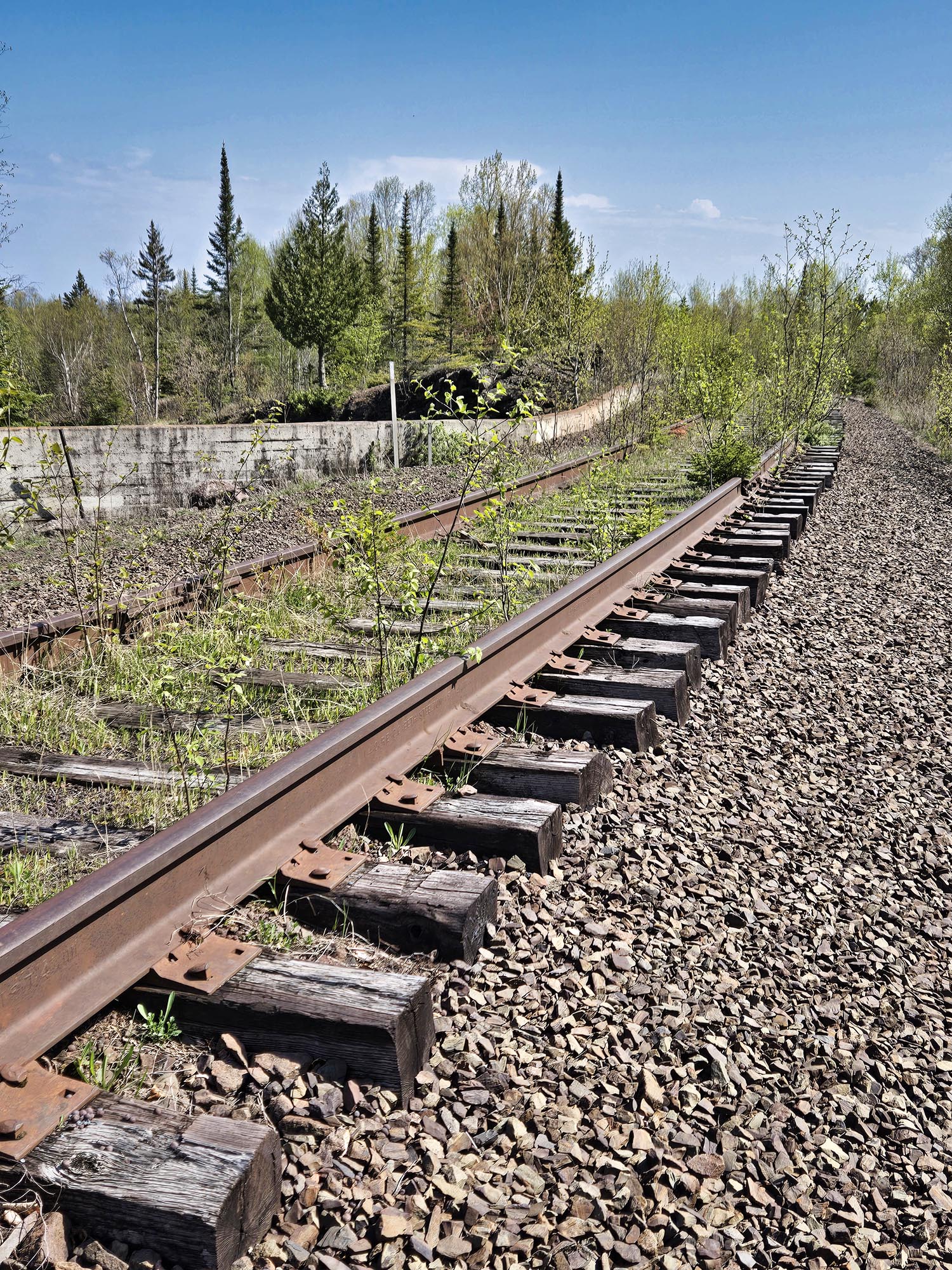
Waterfall appreciation over, we investigated the railway bridge. Like the driveway gate, the railroad was overgrown with saplings and obviously hadn’t been used in years. Research I did while writing this post uncovered the facts that the railway was named the Cliffs Erie Railroad. The last train operated in 2001, but after that, cleanup trains, which collected leftover chips and pellets from the mines, operated until 2008.
A bustling little town was situated near the Two Island River, probably accessed through that overgrown driveway where we parked. Taconite Harbor, Minnesota, was a mining town built by the Erie Mining Company. In 1957, twenty-two prefabbed homes were trucked into a several block area near the lake. The little community even had a fire hall, community center, playground, and baseball/tennis courts.
It seemed like a 1950s ideal community. Seventy-five children grew up there and probably played along the river’s banks. In the 1970s, families were driven away by noise pollution and health concerns about the taconite dust that blew off the rail cars and from local stockpiles.
The steel industry lull added another blow in the 1980s and by 1988, the last resident had left the little Taconite Harbor town. In 1990, the remaining homes and buildings were packed up and transported away by trucks. Driving past the site, I recall seeing only empty asphalt streets, home foundations and streetlights. Nature has reclaimed much of the area, but town remnants remain. It’s truly a North Shore ghost town.
Russ and I didn’t have time to investigate the town site ourselves, but there are many good images of it on the internet. “Forgotten Minnesota” has some good ones.
The Cliffs Erie Railroad tracks that cross the Two Island River bridge.
The history of this area also includes an event that I narrowly escaped. It’s an involved tale so I’ll start from the beginning. In 1957 when the little town of Taconite Harbor was being formed, the mining company also began dumping ash from its nearby coal-fired power plant near the river and the town. I’m not sure it was illegal at the time, but it probably was as time went on. The dumping continued until 1982 and the pile covered 27 acres.
On the morning of July 28, 1993, I drove up the highway in a pale green government car through a heavy rain on my way up to Grand Marais for my job with the Forest Service. Later that day, thanks to the rain and the fact that the mining company had been dumping excess water from a coal stockpile onto the ash heap, the pile became saturated and it liquified in a rare phenomenon called “static liquefaction.”
The heap collapsed and flowed downhill, covering the highway and contaminating the river and Lake Superior. It knocked out an electric substation and buried someone in their car who was traveling on the highway. I can’t find any news reports about the incident now, but as I recall, the person was rescued. I believe another car was partially buried.
All I could think of at the time is that could have been me! Luckily, it wasn’t. And luckily, I already had been planning to stay overnight in Grand Marais because the highway was unpassable and closed until the ash was cleared later the next day when I traveled home.
Russ also recalls hearing about a truck that hit the top of one of the railroad bridges that span the highway at that site. As a result, the bridge spans that cross the highway have been removed, leaving just the tracks and growing saplings on either side.
In short, this is a picturesque area that has had a lot happen to it! Its history of abuse and neglect is probably why the site is not sought-after by more photographers or tourists. That’s too bad. I suppose the mining company still owns the area and they obviously just want to forget about it. The river and the old town site could use some love. The nearby harbor has had some public funds put into it. It’d be nice to see the same for the Two Island River.
Pergrine falcon. Photo by Frank Cone on Pexels.com
One summer, not long ago, I was walking down my home street in Duluth when a pigeon came streaking above it, like the proverbial bat out of hell. A flock of pigeons lived in an old school building on the end of my street. Seeing pigeons around was not unusual, but I’d never seen one fly so fast. In another few seconds, a peregrine falcon zoomed by in pursuit.
This minidrama was a first for my quiet neighborhood, as far as I know. The birds were too far away for me to see if the pigeon was doomed, but witnessing the chase was definitely exciting.
Not long ago, peregrines were classified as an endangered species in Minnesota and the rest of the country. They were delisted federally in 1999 and in Minnesota in 2013, although they are still considered a species of special concern.
I’ve had the privilege of documenting and even helping a bit with their recovery, so seeing one fly down my street did my heart good. It all began in the spring of 1985 when I was the environmental reporter for the University of Minnesota college newspaper, “The Minnesota Daily.” A photographer and I were invited to the top of the IDS Tower (also known as the Multifoods Tower, the tallest structure in the city at that time) for a peregrine falcon media event. Staff from the university’s raptor center and biology department were going to install chicks that had hatched in a hack box that had been newly established atop the tower.
Hack boxes are large wooden boxes with a nest inside them. Young birds of prey grown from eggs that were either captive bred or taken from wild nests are placed inside the boxes a couple of weeks before they fledge (start trying to fly). In the meantime, the birds are closely looked after and provided food without too much human contact. In a few days, the box is opened, and the birds can start stretching their wings, so to speak. They are still fed until they are self-sufficient.
Why was it a good idea to introduce falcons into the middle of the city? Well, Minneapolis contained plenty of food for the falcons (pigeons), the skyscraper mimicked their preferred habitat (steep cliffs), natural enemies were scarce, and it was an easy place for researchers to access.
I remember the excitement when one of the researchers (Pat Redig) took a squawking, fluffy baby falcon out of a carrier to put into the box. As he did, he described the plight of the birds and the concept behind hacking. Photographers clicked away and reporters scribbled in their notebooks. We were able to wander around atop the building and look over the impressive edge, 51 stories high – a memorable experience in itself.
A pre-event story I wrote about that news conference ended up being 40 newspaper column inches long. This was longer than usual. My editor (Doug Iverson) asked me to justify why he should give me such a large space. I don’t remember what I said (probably something like, “because peregrine falcons are cool!”), but it must have worked because he didn’t cut its length. The post-event story I wrote made page 1 of the newspaper, which was a big deal to this cub reporter.
The next time peregrines came into my life was a couple years later when I was a summer volunteer for the Forest Service on the LaCroix Ranger District in Cook, Minnesota. My boss (Steve Hoecker), was a falconer and he was involved in the recovery effort. A hack box was being constructed on one of the iron ore mine pits nearby in Virginia, MN. Like the IDS Tower, the mine featured steep cliffs that peregrines prefer.
My memory of this experience is hazier than the IDS Tower event, but I think I helped Steve scramble box construction materials down the steep banks of the mine. I took photos and covered the story for the local newspaper.
The next time I saw a falcon, it was in the wild. I was hiking on Isle Royale, a national park island in Lake Superior in the early 1990s with a group from an Audubon Society camp, when a peregrine shot across and above the trail in front of us, like a kamikaze jet. The island features some steep cliffs as does the Canadian shore not far away where the falcons could nest. I remember thinking that maybe all the work being done to restore the falcons was beginning to pay off.
After that, my last experience with a falcon (before seeing the one on my street) was in downtown Rochester, Minnesota. It happened during the winter of 2009 when I was working at Mayo Clinic in public affairs. I lived within walking distance of my office. As I trudged along on cold winter days and evenings, a strange call of a bird echoed loudly against the clinic building walls. The call was familiar to me, but I couldn’t quite place it. And what kind of bird would still be in Minnesota in February, for goodness sakes?
It took me a few months, but I finally figured out that the obnoxious bird call that accompanied my walking commutes was a falcon. They had been hacked atop one of the clinic buildings. I think I was even able to attend some sort of celebration event about the project at Mayo that year.
If you’d like more information about the history of peregrine recovery in Minnesota, a good article can be found here.
So, it seems like peregrines have been following me around ever since my first encounter with them in downtown Minneapolis. Or have I been following them around? Maybe we’ve been following each other. In any event, their recovery is a good news story in a world beset by so many environmental problems.
I recently wrote a post for the blog I manage for work, which I think you might enjoy. The promo: “Senior science communicator, Marie Zhuikov, recalls a grisly discovery in connection with a project to control invasive goldfish.”
We expected only a few local poets would be interested. We thought they’d offer poems about the St. Louis River on the Minnesota-Wisconsin border.
That was our mindset when the River Talk planning team at my workplace first developed the theme for the public poetry reading to be held in conjunction with the St. Louis River Summit as an evening program in March 2021. We were mistaken, but in the best possible way.
In reality, our call for river poems through the literary submission management platform Submittable garnered interest from 76 poets from across the U.S. and around the world. They submitted 148 poems for consideration.
“As it turns out, a lot of people like to write about rivers. That’s because they are really important in our communities and in our lives,” said Deanna Erickson, director of the National Lake Superior Estuarine Research Reserve, which co-sponsors the River Talk series with Wisconsin Sea Grant.
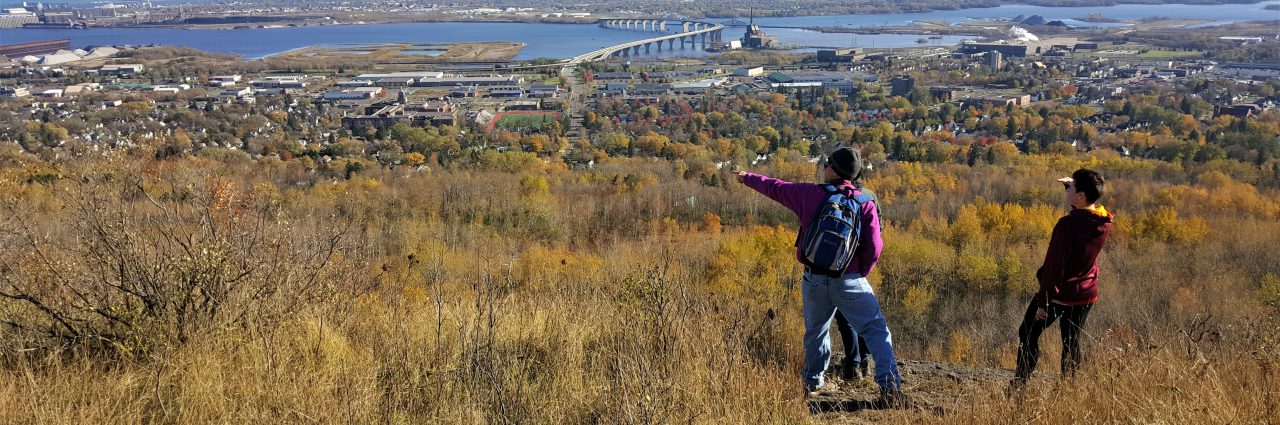
An overlook above the St. Louis River in Duluth, Minn.
We quickly realized we were going to need more judges. In the end, we gathered six who represented a good cross-section of the audience we expected to attend the summit.
The judging was “blind,” which means the poets’ names were not associated with their poems. After two rounds, the judges narrowed the number of poems down to a dozen, with a few for backup in case any of the chosen poets could not be reached.
Although communication was sometimes a challenge, all 12 poets were enthusiastic about participating in the reading. They represented a wide diversity of ages and ethnicities.
The River Talk was a couple of weeks ago, but the warm fuzzy feelings it engendered remain with me. I could use many adjectives to describe it: powerful, beautiful, stark, raw, funny — but it’s really best if you listen to the poems and feel all the feels for yourselves. The reading drew 85 Zoomers, a record attendance.
The Lake Superior Reserve, our partner in the talks, recorded the reading and it’s available on their YouTube channel. Here’s a list of the poets (in the order they read) and the names of their poems:
Tyler Dettloff (Michigan) “My Stars” Heather Dobbins (Arkansas) “I Held us on for 36 Hours after the Levee Broke to hell” Ben Green (New Mexico) “Immersion: A Prayer of Intent” Lorraine Lamey (Michigan) “Catching Your Drift” Joan Macintosh (Newfoundland) “The Current Feels” Kate Meyer-Currey (England) “Timberscombe” Rebecca Nelson (California) “Of the St. Louis River” Stephanie Niu (New York) “To the Beaver’s Eyes” Diana Randolph (Wisconsin) “Knowing the Way” Ron Riekki (Florida) “It Took a Long Time to Discover” Derold Sligh (South Korea) “Rouge River” Lucy Tyrrell (Wisconsin) “Talking Water”
Ironically, the one poem specifically about the St. Louis River was written by someone who had never visited it. Rebecca Nelson said her poem, “Of the St. Louis River” was inspired by the spiritual experiences she’s had while watching water. She grew up in the Midwest and said she wrote the poem thinking of the rivers she knew from childhood. “I would love to visit sometime after the pandemic!” Nelson said.
Barb Huberty, St. Louis River Area of Concern coordinator for the Minnesota Pollution Control Agency, offered this comment in the Zoom chat, “I never knew that poetry could unite people across the globe.”
Sharon Moen, Eat Wisconsin Fish outreach specialist for Wisconsin Sea Grant, offered, “Thank you to all the poets and organizers! I am inspired by the depth of your thoughts and stories.”
Remaining River Talks will be held on April 14 and May 12. For more information, visit the River Talks page: go.wisc.edu/4uz720.
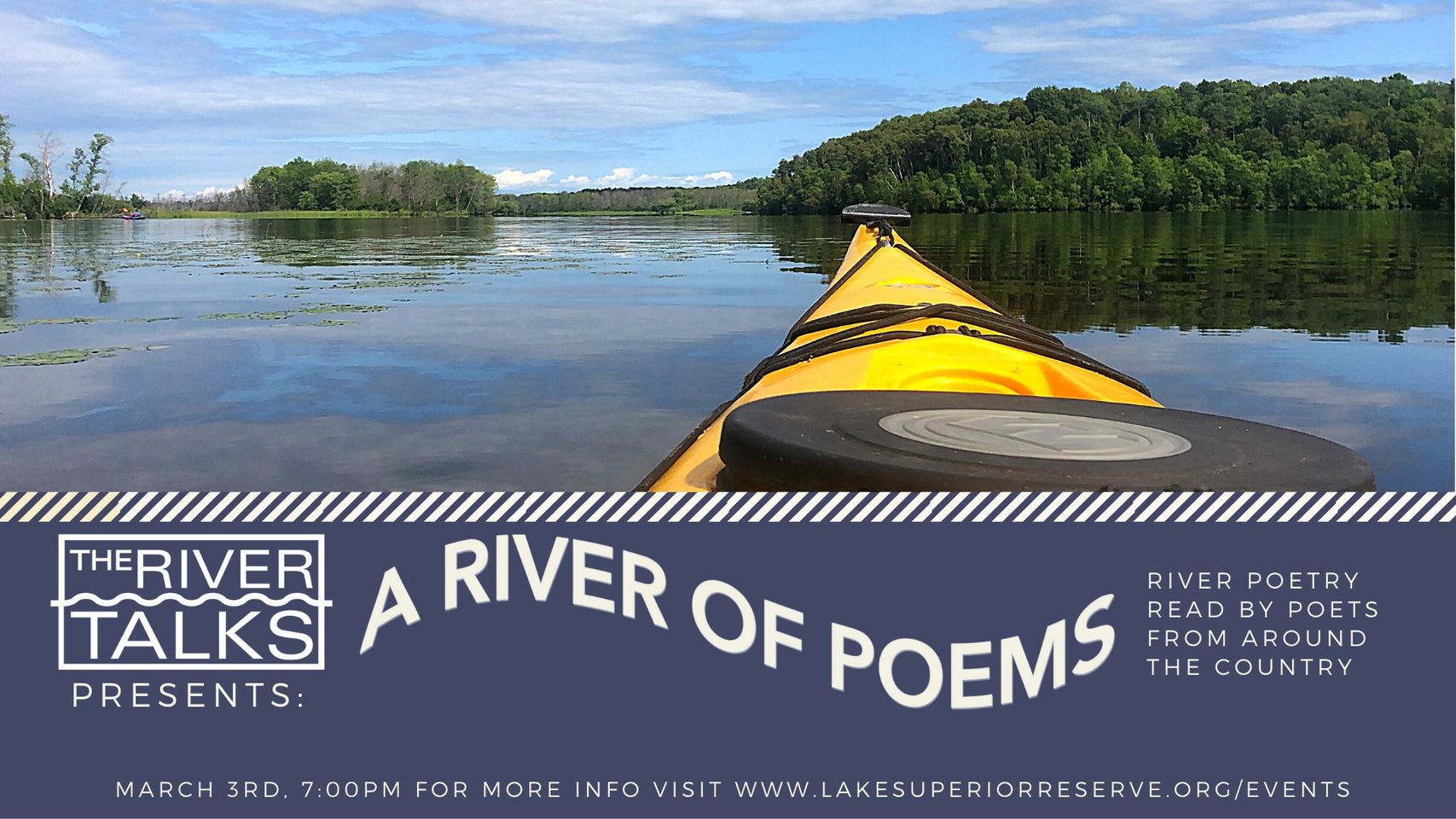
This Wednesday at 7 p.m. Central, I’m co-hosting a Zoom event that will showcase a dozen poets from around the world and across the country reading their powerful, evocative and beautiful poems about rivers. The March 3, 2021 reading is an evening program of the annual St. Louis River Summit, which brings together hundreds of people who work on and care about the St. Louis River in Minnesota and Wisconsin. It’s also part of our monthly River Talk programs, which are free and public-friendly. Details are below. Come experience different perspectives on our waterways!
Tyler Dettloff (Michigan) “My Stars” Heather Dobbins (Arkansas) “I Held us on for 36 Hours after the Levee Broke to Hell” Ben Green (New Mexico) “Immersion: A Prayer of Intent” Lorraine Lamey (Michigan) “Catching Your Drift” Joan Macintosh (Newfoundland) “The Current Feels” Kate Meyer-Currey (England) “Timberscombe” Rebecca Nelson (California) “Of the St. Louis River” Stephanie Niu (New York) “To the Beaver’s Eyes” Diana Randolph (Wisconsin) “Knowing the Way” Ron Riekki (Florida) “It Took a Long Time to Discover” Derold Sligh (South Korea) “Rouge River” Lucy Tyrrell (Wisconsin) “Talking Water”
The reading will last an hour and will include time for comments and questions. The talk will be recorded and posted afterward on the Reserve’s Facebook page and YouTube. A summary will also be posted on Wisconsin Sea Grant’s blog.
River Talks are sponsored by The Lake Superior National Estuarine Research Reserve and the Wisconsin Sea Grant Program.
This is just a quick post to let you know I’ll be giving a reading this weekend that’s being organized by a local Climate Change awareness group. The event is this Sunday Feb 21 by Zoom.
Here are the deets:
Here’s info about the Zoom poetry reading I’ll be doing this Saturday (Feb 21) at 3 pm Central. I’ll be reading an excerpt from “Plover Landing,” and a couple of poems. I think I will be the last reader because they’ll be going alphabetically. Here’s the Zoom address for Climate Emergency Poetry Reading #5 set for THIS Sunday, February 21 at 3:00 p.m. CST (4 EST):https://us02web.zoom.us/j/81576699711…
Join our Cloud HD Video MeetingZoom is the leader in modern enterprise video communications, with an easy, reliable cloud platform for video and audio conferencing, chat, and webinars across mobile, desktop, and room systems. Zoom Rooms is the original software-based conference room solution used around the world in board, conference, huddle, and training rooms, as well as executive offices and classrooms. Founded in 2011, Zoom helps businesses and organizations bring their teams together in a frictionless environment to get more done. Zoom is a publicly traded company headquartered in San Jose, CA.us02web.zoom.us
Meeting ID: 815 7669 9711Passcode: 286977
SEE YOU THERE! HERE ARE YOUR SCHEDULED GUESTS:POETS: Ella Grim, Marie Zhuikov, Cal Benson, Jill Hinners, Jim Johnson CLIMATE ACTIVIST: Bill Mittlefehldt UMD MPIRG SPOKESPERSON: Stine Myrah YOUR HOSTS: John Herold & Phil Fitzpatrick AND OUR FIRST Q & A SESSION WILL FOLLOW!


 Marie's Meanderings