Why Sea Grant is a Kick-Ass Program (And Not Just Because I Work There)

Wi Point Ladies 2016 003We interrupt all these dreams of Aruba to insert some harsh (but hopefully entertaining and educational) reality. You may recall from my recent pancake recipe posting that President Trump has zeroed out the National Sea Grant Program that I work for in his proposed budget for 2018.

If that weren’t worrisome enough, he just recently he proposed drastic cuts to Sea Grant and other environmental and health and human services programs in 2017 in order to find funds to build the wall between Mexico and the U.S. You remember his beloved wall, don’t you? The one that Mexico was supposed to pay for (and like it)?

If Congress grants his request, Sea Grant would be gone – maybe as soon as May or August of this year, and I will be out of a job.

Maybe you’re wondering what a “Sea Grant” is. Sea Grant is a kick-ass program that funnels federal money from the National Oceanic and Atmospheric Administration to universities in 33 states across the U.S. The money goes to university researchers for water studies and to people like me who let taxpayers know about the research results through the media and through other local communications outlets.

Our staff and researchers also develop tools that people can use for things like growing fish, protecting their towns from a messed-up climate, keeping invasive animals and plants out of their local lake, fixing up polluted swimming beaches, making seafood safe to eat and water safe to drink.

UWI_SeaGrant_logo_cyanI work as a writer for the Sea Grant program in Wisconsin. Why is there an ocean program in Wisconsin, you ask? Because the Great Lakes are the freshwater equivalent of oceans (Sweetwater Seas). As water sources for millions of people and home to one of the world’s largest economies, it makes sense to pay attention to the Great Lakes and to put money into understanding them and protecting them.

Nationally, Sea Grant has been around for over fifty years. The federal dollars ($67.3 million) that come into the states are matched by the universities.

One reason it’s a kick-ass program is that in 2015 alone, the work done nationally with these dollars led to an 854% economic return on investment (Turned $67.3 million into $575 million in the communities in which we work). I bet none of President Trump’s business ventures have provided such a huge impact. Seems like a bad idea to cut such a successful program.

We’ve restored over 127,000 acres of degraded ecosystems. We trained almost 2,000 people how to keep seafood safe to eat. We offered about 900 classes to people living on coastlines on how to improve their community’s resilience to storms. We also supported training and funding for 2,000 students who are the next generation of water scientists.

In Wisconsin alone, our programs save lives. Our Sea Caves Watch program, which warns kayakers about wave conditions in the Apostle Islands National Lakeshore has prevented deaths. Since it went online about seven years ago, no deaths have happened. Before, there was about one death every year. Seven people might not seem like a lot – but every person counts!

Last year, a boater who saw our video about “ghost nets” (abandoned nets lost in the lake) and how to get out of them without capsizing, remembered what the video said when his boat got into a tangle. He credits Wisconsin Sea Grant for saving his life.

In Wisconsin, we also fund a program that helps children who are going through rough times by getting them into the water and taking pictures. The underwater photography program has changed the lives of many of them, and their photos are good enough to be in public displays and even a book. Read the children’s testimonials in the book. They will make you cry!

We find cures to fish diseases. We created over 5,000 jobs during the past two years. We helped almost 12,000 anglers or aquaculture people. We helped find out what was causing the steel pilings in the Duluth-Superior Harbor to corrode (and won a national award for it). Through our sister program, the Water Resources Institute, we are changing how the state warns people about the chemical strontium in their drinking water.

If I lose my job, I can’t take any more nice vacations and write about them for your benefit. I also will be so busy finding a job that I won’t be able to write my blog any more, or my fiction.

So, if you give a rip, please email your Congressperson right away. Tell them to reject the Administration’s proposal in the Fiscal Year 2017 Security Supplemental that would cut the National Sea Grant College Program by $30 million. Also, please ask them to reject the Administration’s Fiscal Year 2018 proposal to zero out and terminate the Sea Grant program (for all the reasons I’ve just mentioned).

I had an interesting discussion with someone at my church about President Trump. She said she was finding it very hard to love him in a spiritual sort of way. I told her that I don’t like what Trump stands for, but I do like that he’s making us fight for what’s important. It’s definitely not politics as usual.

The only weapons I have to fight this with are my words. I hope you will join your words with mine to preserve a program that makes much more sense for this country than a wall with Mexico. For more information, please see the Sea Grant Association’s website (FY 2017 and FY 2018 documents).

Thank you for your support. Now back to our regularly scheduled programming.

That Time I was the Subject of a Federal Whistleblower Complaint

whistleblower

A page in my life story that I’d rather not have repeated, but a page that is interesting, was written back in the 1990s when I was a federal employee. I was working in public affairs for the USDA Forest Service in the Superior National Forest. This particular forest is also home to the Boundary Waters Canoe Area Wilderness (BWCAW), renowned for its canoe routes and primitive character.

As part of my job, I often helped with public meetings, and I wrote and edited documents. At the time, the agency was working on its first-ever management plan for the BWCAW. I wrote some of the background information for the plan and I edited the final version of the document. The plan required public comment, which we gathered by hosting meetings in towns across northern Minnesota. I sent out news releases about the meetings to the media and in general, just tried to ensure that people knew about the opportunity to comment.

Around that same time, I was a board member for our local chapter of the Audubon Society (you know, the environmentalist bird-lovers). I edited their newsletter and helped plan monthly programs. I can’t recall the exact timing of things, but I eventually quit the board because I was just too busy. The problem is, the new editor forgot to take my name off the board member list that was published on the back page of the newsletter.

After a few months, I noticed my name was still listed, and I asked the editor to delete it just for accuracy’s sake. A few more months later, it was still on there. I reminded the editor again, and he took it off.

As it turns out, it was too late. Somewhere during this time, the Audubon newsletter published a story in favor of the new BWCAW plan. Someone in Minnesota who was connected to the Blue Ribbon Coalition (an organization originating out West that advocates for the use of motorized vehicles on public lands) saw the newsletter story and noticed my name on the list of board members.

This person (who shall remain nameless) and the organization he was affiliated with did not like the new wilderness plan because it limited the use of motors in several areas where they had been allowed previously. He, with all the logic of the clueless, came to the conclusion that it was ALL MY FAULT that motors were being restricted in the plan because I was a board member of the Audubon group. He filed a complaint to this effect through the federal Whistleblower Program. He also complained about the manager of the BWCAW in a separate filing.

This was during a time when the Forest Service was getting political heat for not investigating claims. Heh heh, lucky us. Taxpayers got to foot the bill for an investigator to travel from Washington D. C. to Minnesota for several days to investigate us.

In the complaint about me (which I don’t think I ever got to read, but I got told about it by the investigator), the man claimed that my job within the agency put me in a position of power to influence the new rules that were being proposed in the plan, and that because I was a member of Audubon, I had a conflict of interest.

I explained to the investigator that I wasn’t even on the Audubon board when they developed their position in support of the BWCAW plan. I described the oversight that left my name on the back of the newsletter. I also explained my role in writing the plan, which did not include any omnipotent power to make up new rules against the use of motors in the wilderness. (I only WISH I had that type of power.)

Even though I was sure no wrong-doing would be found, being investigated by the feds was not comfortable, which was another outcome I’m sure the Complainer Guy wanted.

In the end, both the wilderness manager and I were found “not guilty,” and we were able to continue about our business. You can bet that we thought harder about how we did our business, but we continued it, nonetheless – savvier about the tactics used by some organizations.

And Then There Were Two: An Update on the Status of Isle Royale’s Wolves

isrowolvesrolfpeterson

The remaining wolf pair on Isle Royale. Photo by Rolf Peterson.

Last week I attended a public meeting by the National Park Service to hear about their preferred plan to deal with the declining wolf population on Isle Royale, a remote island-sized park in Lake Superior.

If you’re a long-time reader of this blog, you may recall the story I wrote about the issue in 2015. At that point, there were three wolves left on the island. Now there are only two.

The deformed wolf mentioned in my last story is nowhere to be found (presumably dead) and the other two wolves, who may or may not be its parents, are still alive.

Researchers have discovered that they are a male and female wolf who are related to each other in several incestuous ways. (Hard to avoid this when you live on an island.) They are father and daughter, but also half-siblings. And they are old for wild wolves — six and eight years old. As such, it’s not likely they would have any (more?) ultra-incestuous offspring.

During the meeting, the park service staff discussed four alternative plans of action they are considering. Their preferred plan calls for the introduction of 20-30 wolves starting next fall/winter over a span of three to five years. It’s known in the Environmental Impact Statement as Alternative B.

The other alternatives involve taking no action, introducing a smaller number of wolves over a period longer than five years (20 years), and taking no action now but allowing for the option of action in the future.

Under Alternative B, the park service plans to capture packs of wolves, if they can, and to release them ASAP together on the island. They will collect wolves from the Great Lakes area, and ones that are not habituated to humans and are already used to eating moose for food. They want the wolves to spend as little time in holding pens as possible so that they don’t become habituated to them. Initially, the park service will provide moose carcasses (from Isle Royale) for the wolves to eat, but then will leave the wolves to fend for themselves. They will monitor them (with radio collars, etc.) to see how they are doing.

The fact that the park is considering messing with wolf introduction is a big deal. Normally, they are a “hands-off, let-nature-take-its-course” organization. But the wolves are so important to the island’s ecosystem and to controlling the moose population, that public pressure and human-caused global environmental changes have made the park willing to change its philosophy.

When I commented on this issue back in 2015, for nature-purist motives I was against any action. But now since it seems like the wolf population is indeed doomed, and it’s not likely that wolves will wander over to the island from the mainland on an ice bridge during the winter (especially right now as I am writing this and it’s 50-frikin’ degrees in February!), I am okay with the idea of introducing wolves.

What I am not so okay with is introducing the new wolves while the two existing wolves are still living on the island. At the meeting, when someone asked this question, the park biologist dismissed the concern, saying the existing wolves would have a survival advantage over the new wolves because they already know the island’s terrain, etc.

But come on, what chance do two old wolves have against 20-30 young whippersnapper wolves? I fear they will be shredded to pieces by the newcomers. I think it’s kind of inhumane to introduce the new ones while the old ones are alive. But for some reason, the park service is hot to do the introductions ASAP.

Another question that was dismissed at the meeting is whether the park would alter its plans for introducing the wolves if an ice bridge to the mainland was in place. The biologist said that wolf experts have told them the wolves would likely stay on the island.

I question this as well. The park service plans to get the wolves from MN, WI or Michigan. If I was a wolf, and my family and I were taken from our home not that far away (wolves can easily travel 40 miles in a day), dropped somewhere new, and there was a way to escape and go back home, I sure as heck wouldn’t stay there. Studies of wolves introduced in other situations found that they do travel away from the site of introduction toward their site of origin.

One would think the park service would want to ensure that the introduced wolves would stay in place by not introducing wolves if there was an ice bridge, but apparently not. This could be a waste of time and expense to taxpayers.

Another comment that was dismissed, and this time I’m glad it was dismissed, was the idea that people be used to control the moose population on the island instead of wolves. This would involve hunting, of course. Hunting on Isle Royale is currently prohibited by federal law. But also, I’d just rather not have the top predator on the island be humans instead of wolves. There are plenty of other places where people can hunt. And I can only imagine how hard it would be to haul a moose carcass over those island ridges. It was hard enough to haul my own carcass over them when I hiked!

Okay, enough of my ranting. If you’re interested in commenting on the plan, the deadline is March 15. And if you’d like to learn about Isle Royale’s wolves in a fun way, please read my novel, “Eye of the Wolf.”

The Gathering of the Orbs

dsc03811b

A girl and her orb.

Today is the time when all the ice orbs for the Lake Superior Ice Festival are gathered. The orbs I contributed are the colored ones in the photos (and in the bucket).

The water is frozen in water balloons, and the balloons are removed later. A group of Headstart children from Superior, Wis., participated in this community art collaborative, and it was so fun to see them enjoying the outdoors and learning about water and ice.

dsc03803City of Superior staff are arranging the orbs in the shape of Lake Superior in the city park on Barker’s Island to highlight the importance of fresh water. Each orb represents a day that water is important to us. The goal is to create 365 of them to represent a year.
Take a moment to consider how important fresh water is to you!

dsc03802

My bucket o’ orbs.

Saving the Whales (and Dolphins): Adventures in Scotland, Part 5

038

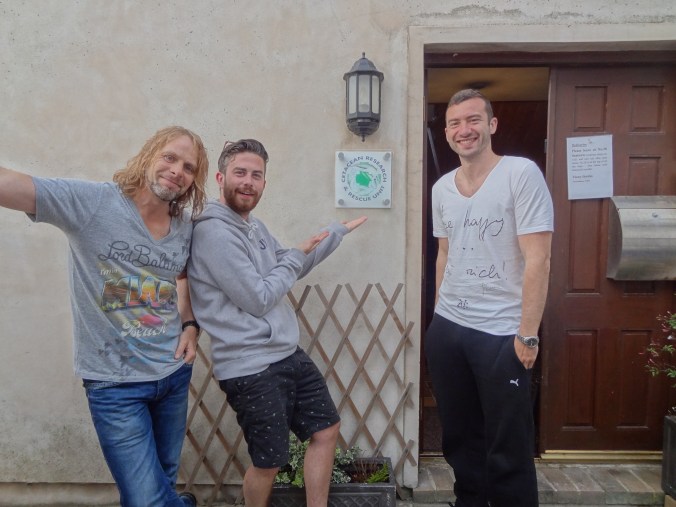
Director Kevin Robinson (left) and Theo (right). The ham in the middle is Jack Borrett.

When I was researching things to do in Scotland, I was intrigued to discover the Cetacean Research & Rescue Unit in Gardenstown, next door to our temporary Scottish home of Crovie.

I contacted the “unit” by email before our trip and asked about the opportunity to learn about what they do. We were welcomed to visit. Although it took a few tries to connect once we were in Scotland (due to vagaries in weather and schedules), we found director Dr. Kevin Robinson and research assistant Theofilos Sidropoulos (Theo for short) in their office on the shores of the Moray Coast one afternoon and they were nice enough to talk to us for over an hour.

Let me set something straight. You may have misread the name of the unit as the “Crustacean Research & Rescue Unit.” No, they do not rescue hapless mollusks. They research and rescue cetaceans, which are whales, dolphins, and porpoises.

Kevin founded the organization over twenty years ago. He explained that he got his start in the field by working in Inverness for a marine mammal organization. He saw the need for another organization that focused more on marine mammal strandings, and the Cetacean Research & Rescue Unit was born. The Unit is a nonprofit organization that tracks the population of the farthest northern pod of dolphins in the world in the Moray Firth. They do this through scouting trips and by taking photos of the dolphins and identifying them by their dorsal fins. Despite dire predictions at first, Kevin said the dolphin population in the Firth is thriving.

SCOTLAND! 039

Gardenstown, Scotland.

The unit also conducts research. Kevin explained that their latest quest was to take skin mucus samples from minke whales. The samples can then be genetically analyzed. To take such a sample, the researchers must get close enough to a whale to reach it with a pole that has the sampler attached to the end. They need only touch the whale with the sampler (no skin pricks or pain involved), but that was proving easier said than done at the time of our conversation. Also, Theo is a student at Edinburgh University and said he was researching the effects of climate change on the environment and marine mammals.

And, of course, they respond to reports of strandings. They provide 24-hour veterinary response for sick, injured and stranded marine mammals. Kevin said that unfortunately, most of the stranded animals don’t make it. But it’s nice to know that someone is looking out for them.

In our wide-ranging conversation, we also learned the organization focuses on environmental education as well. They educate school children about marine mammals and present papers at scientific conferences, and the like. They even have a Facebook page.

IMG_0921

The sign on the path between Crovie and Gardenstown. One takes their lives in their hands at every passing. And it seems the sign has seen its share of rockfalls (or bullets!)

And if, like me, you have a secret desire to save the whales, you can do so by volunteering for the unit during the summer (May-Oct.). As long as you are able-bodied enough to get out in a boat and to walk along steep coastal paths, you’re in! Kevin mentioned that a woman in her seventies volunteered for them and for other organizations around the world. She ended up coming back to them for a second time when she was in her eighties because she so enjoyed her first experience. There are still openings available for this year.

The unit is working to raise funds for a new boat to help with their conservation work and to replace their aging vessels. Click here to donate. Their goal is to raise the funds by the end of July, so please act fast if you are so inclined. They are about three-quarters of the way there.

We left their office with a better understanding of life in the waters of the Moray Firth. Kevin and Theo were also nice enough to direct us to where we could see puffins and seals locally. (And we did!) I think it would be totally fun to come back there someday as a volunteer. We’ll see if the fates will allow for that.

Next up – Visiting Edinburgh in an hour-and-a-half!


Monarch Mania

20160521_125303

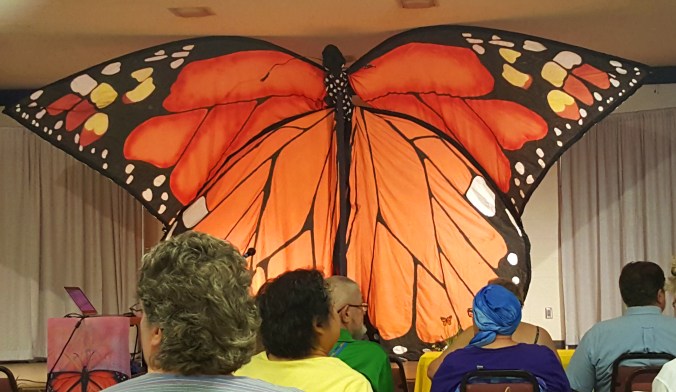
Any minute now the first monarch butterflies will wing their way into the northland on their annual migration. Thanks to the first-ever Duluth Monarch Festival this weekend, I learned that the butterflies that return to Minnesota aren’t the ones that left in fall for Mexico, but are their offspring that grew up in early spring somewhere in the southern U.S.

If they aren’t the butterflies that left here, how do they know to return? How can an insect that weighs about the same as a paperclip survive the long flight? These are just some of the intriguing questions that surround monarchs.

On the street where I grew up, milkweed (the monarch caterpillar’s favorite plant food) flourished in a vacant lot kitty-corner from our house. I had a little round wire mesh insect container where I would grow the caterpillars into butterflies indoors. I can’t recall exactly how I learned to do this, but suspect my older brothers taught me. I raised dozens, fascinated by the transformations the caterpillars went through in becoming the beautiful black, orange and white butterflies that are so distinctive and a joy to see.

My attachment to the creatures even extended to the schoolyard. On one of my first days on the kindergarten playground, a boy killed a monarch caterpillar. I thought he was the cruelest person on the planet, and begged him not to kill it because, “These are the ones that make butterflies!” Other than that, I lacked the communication skills to tell him why I was so upset. I ended up burying the caterpillar underneath a pile of playground pebbles. Now I understand his actions were just the casual cruelty of boys (and because he had probably never raised caterpillars), but for the rest of my grade school career, I shunned him as The Boy Who Kills Caterpillars.

DSC02677

A monarch caterpillar on a milkweed plant.

Playground killings aside, the monarch population has dropped significantly over the years due to habitat loss, pesticide use, and a wacky climate — to the point that the fall migration to Mexico is in danger of disappearing. The last two years have had the lowest counts in history. Instead of taking up 18 hectares of roosting forest in Mexico (1996), the butterflies now only take up 2-4 hectares.

One relatively painless way to learn more about the plight of the monarch is to read “Flight Behavior,” a novel by Barbara Kingsolver.

The monarch festival I attended is one effort to help this beleaguered bug, and the organizers hope to make it an annual event. The goal was to educate citizens about monarchs and to help people become involved in restoring monarch habitat. One of the speakers was Prof. Karen Oberhauser from the University of Minnesota. She said an estimated two million more milkweed plants are needed for the monarch population to stabilize. To that end, a local group (Duluth Monarch Buddies) was giving away milkweed seeds. Milkweed plants and other butterfly-friendly plants were available for sale.

They were also encouraging people to sign up to be monarch larva (caterpillar) monitors. The Monarch Larva Monitoring Project is a citizen science effort where volunteers track how many monarch eggs and caterpillars are in a local milkweed patch. How I would have loved to do this when I was a child! Heck, I intend to do it now. Monitors visit their sites once a week and enter observations onto a data sheet. The goal is to better understand the health of local monarch populations and how they change over time.

I picked up a packet of milkweed seeds. I can’t wait to plant them and do my small part to save the monarchs. Take that, Boy Who Kills Caterpillars!

The ‘Castle’ has Fallen, Spring Must be Coming

Ice Castle 2016 001

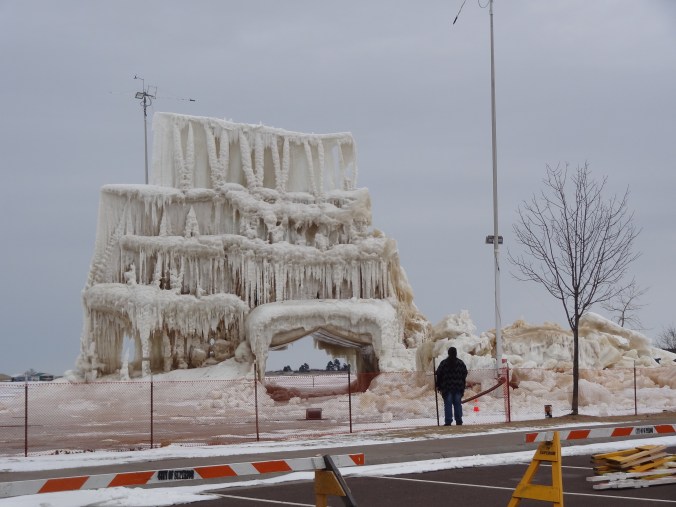
The Lake Superior Ice Project formation collapsed near my workplace this week, and that means spring can’t be far behind. The photo above is from a week ago when the right part of it collapsed, and now the whole thing is a pile of ice rubble.

When the collapse in the picture happened, we weren’t sure if it was planned or not. It caused a bit of a stir in the office – especially since last year the structure had a rather spectacular and unintended collapse right in front of a New York Times reporter. But we later heard that the formation’s creator, Roger Hanson, had been working for the past few days on dismantling his ice castle.

It would have been nice if he had alerted the public that he was dismantling the structure. The woman in my photo complained that she would have come to see it earlier had she known. And it could have avoided some surprise and speculation.

I have “castle” in quotes in this posting’s title because the ice never ended up looking like the European-style castle with four towers that Mr. Hanson described in media stories. It looked more like a birthday cake with a door in it to me. I suspect our warm El Nino winter had something to do with that.

The structure also didn’t break any world height records as hoped, but it did serve as a focal point for a community Ice Festival, complete with fireworks.

Orbs 002

Ice orbs during the freezing process.

A related icy project (that I actually helped with instead of snarking about) involved bringing community groups together to create ice orbs in the shape of Lake Superior. The City of Superior’s Environmental Services Division organized this collaborative art project to highlight the importance of fresh water to the community. Different groups pledged to create a certain number of ice orbs so that 365 of them (Get it? One for each day of the year) could be installed near the ice castle for the festival.

The project was called Orb365 and, along with instructions on how to make the orbs, the project included educational messages about how water reacts to freezing and ways water is important.

I pledged 10 orbs, which I created by filling water balloons and sticking them outside in hopes that they would freeze. I started the freezing process four days before the orbs were needed, certain that would be plenty of time, especially in February in northern Wisconsin. However, the weather was so warm, the orbs didn’t completely freeze until the very last night, eliciting some anxiety on my part.

DSCN0051

Lake Superior shaped in ice orbs.

Triumphant, I was able to deliver the orbs the following day to the “orb construction site” where a city worker artistically arranged them into the shape of the lake, and festooned them with lights. She positioned larger orbs to represent major cities around the lake.

Alas, now the orbs are melted along with the castle. The snow is almost gone, and the meatloaf-brown grass of spring is upon us. Although this winter was warmer than usual, I’m not going to complain about it. I’m sure the northern weather gods will make us pay for it next winter.

Hiking and Emoting for the Climate

ClimateWalkThis past weekend I joined about 175 other people in an event to raise awareness about climate change. If you’ve read my novel, “Plover Landing,” you know that climate disruption (as some are now calling it) is a topic addressed in it, and it’s a cause near and dear to me.

The event was held in a church near Duluth’s Lakewalk – a boardwalk that follows the shore of Lake Superior. Several speakers kicked things off inside the church, and it was interesting to see who the players are, and which politicians are devoted to this issue. It was also fun being with other people who have similar concerns. I’m not sure whether our message will reach from Duluth to the climate summit in Paris, but perhaps this blog will help!

After the talks, we hiked on the Lakewalk, along Lake Superior – one of the largest freshwater lakes in the world, but also one that is showing marked effects of climate change.

During the talks, which were heartfelt and inspiring, I found myself impatient with the lack of factual information in them. Speakers mentioned their observations of changes in behavior in animals and weather but admitted they didn’t know if it was directly due to climate change or not. They admitted knowing scientists they could ask about these things, but apparently, none of them did.

No one mentioned the impacts of climate change on the lake, facts which are readily available from local organizations, and I assume, was the reason the event was held on its shores.

I realized that listening to talks filled with too much emotion and few facts was as frustrating as the last climate event I attended — a talk by the state climatologist (see It’s Climate Change, Stupid!) where there were too many facts and not enough emotion.

Somewhere, there’s got to be a happy medium, but I haven’t heard a local speaker yet who is able to mix climate change facts and emotion in a compelling way. That needs to be done for this issue to reach the widest range of people, and to have an effect. And don’t you start looking at me (Smirk). Seriously, I’m a better writer than talker, and my way of contributing to the issue is through my novel (and this blog).

One of the best heart-twisting climate change stories I heard was from a bird biologist and author. She said that in her talks, she doesn’t even mention the term climate change, but she describes how winter thaws, which are becoming more frequent, can kill baby birds.

Gray_Jay_in_Late_Spring

Image of a gray jay by Zachaysan (Own work) [CC0], via Wikimedia Commons.

The species in question is the gray jay. These curious birds are a cousin of the blue jay, but don’t have the pointy head or the bright plumage. I’ve often seen them deep in the woods, where, with whisper-quiet wings, they like to follow hikers and campers. The biologist said that the birds hide small pieces of meat or berries under the bark of trees in winter as food caches for their babies, which hatch in late winter.

If there’s a mid-winter thaw, the food spoils. The parents can’t tell if it’s spoiled though, and when their babies hatch, they feed them the rotten food and the chicks die. The biologist teared up as she described it, and I almost stated bawling right during her talk, too. But then, I’m a bird person. Although we humans may rejoice in a winter thaw, such unusual events can mess up other species.

Not to dismiss the efforts and emotions of the people at my local climate event, but I came away from it thinking that we need more stories like the one about the gray jays – stories from people who know their facts but aren’t afraid to add emotions to them.

Five Pieces of Glass

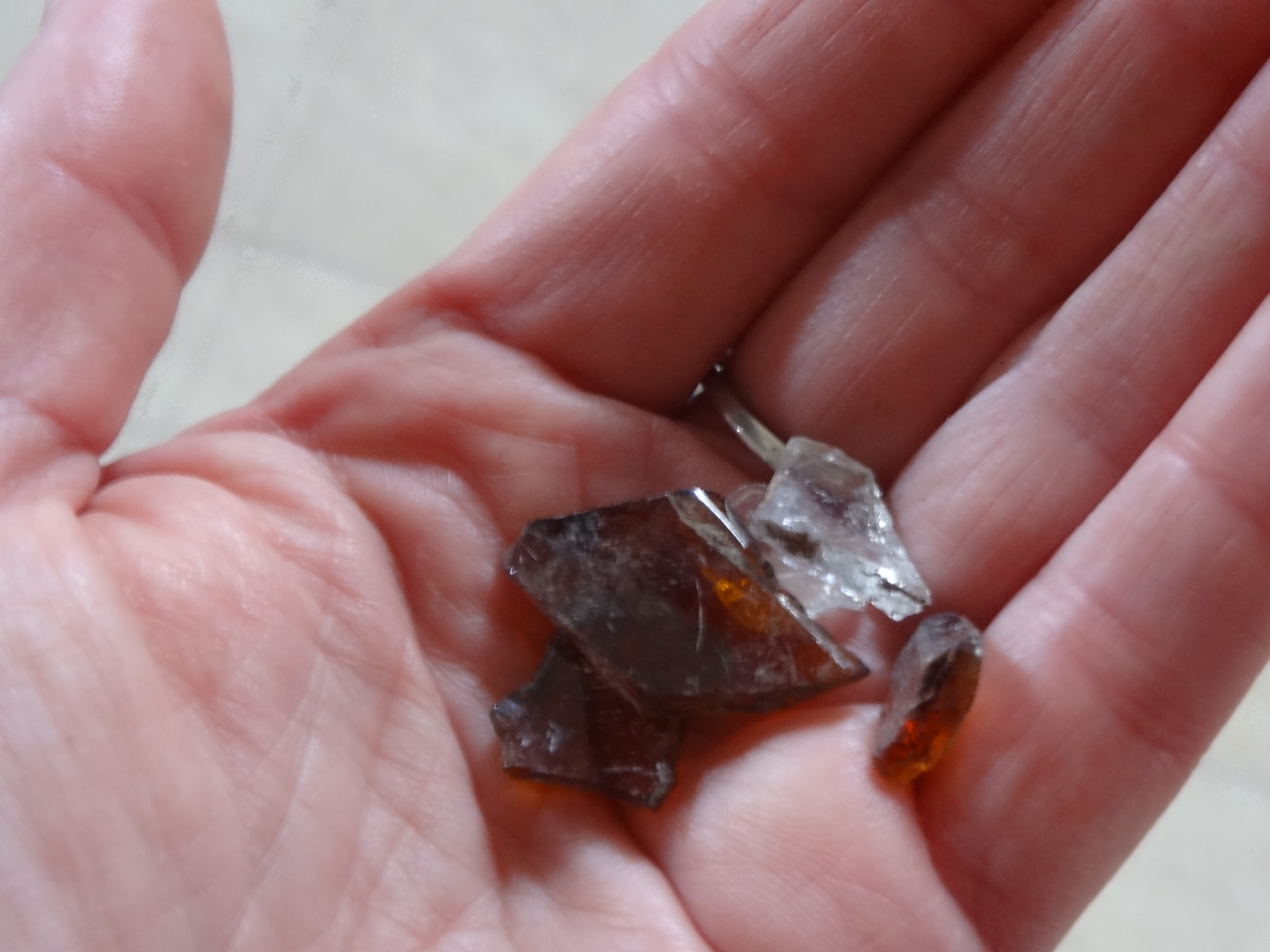
Today's five pieces of glass.

Today’s five pieces of glass.

As my youngest son and I walked our dog in the woods near our house, he noticed me picking up pieces of glass that litter part of the trail. Neighbors who have lived in the ‘hood longer than I told me the glass pieces are remnants of an abandoned car that used to rest there.

My son asked me what I was doing. I explained that for years, I’ve pick up five pieces of glass every time I walk the trail in a long-term effort to clean it up. I do it as long as the trail’s not covered by snow. My son said something like, “You should get an award for that.”

“I’m not doing it for recognition,” I told him. “I’m doing it to make our neighborhood a nicer place to live.”

That gave him something to think about.

So it is with interest I read the story circulating in the news lately about a man from the Netherlands who is doing something similar for a river that he walks along on his way to work. He picks up one bag of trash there every day.

He took photos of his progress and made a Facebook page about it (Project Schone Schie – which means the project to clean the River Schie). Eventually, neighbors noticed and began to help. The project went viral and he started a movement where other people are cleaning up trash on their daily routes. The news stories say people all over the world have been inspired.

I’m glad people are caring about the environment and their neighborhoods. As a kid, I used to organize neighborhood clean-ups of the vacant lot across from my house. A budding public relations professional, I even had a name for the campaign – the Kit Kat Kleanup Klub. I’m not sure my parents appreciated the increased garbage bill, but the work felt good and it was fun. Throughout my career, I’ve organized annual beach sweeps and helped with other clean-up efforts.

But now that I am older, I am content with quietly picking up my five pieces of glass. It’s meditative. It’s slow. It takes discipline to limit myself to only five pieces. I guess I don’t want the job to be over too soon.

The Case of the Disappearing Wolves

Only three wolves are thought to remain on Isle Royale National Park. These are them. The deformed pup is on the left. Photo by Michigan Technological University.

Only three wolves are thought to remain on Isle Royale National Park. These are them. The deformed pup is easy to spot on the left. Photo by Michigan Technological University.

Every winter for the past 57 years, researchers have visited Isle Royale National Park – a remote island in Lake Superior – to study its wolf and moose populations. From a high of 50 wolves in 1980, the pack has dwindled from disease, inbreeding and accidents to a low of nine last year. This dwindling has caused much discussion among the scientists, park service, wildlife-lovers, and news media about what to do – should the wolves be saved or allowed to die out? In the meantime, the moose population (upon which the wolves prey) has increased to over a thousand animals, although it’s nowhere near its highest point.

I worked on Isle Royale as a waitress at the Rock Harbor Lodge in the mid-1980s when wolf numbers plummeted, and was privy to the arguments and discussions about the wolves back then. I paid attention because I am fascinated by wolves and I was minoring in biology in college at the time. The situation literally sparked a novel idea in me: what if the wolves knew they were in trouble and decided to do something to help themselves? To heck with management by the scientists. To heck with the park service. What would the wolves do?

I let the question ping around in my brain for a few years and I took some novel writing classes. Then, for 17 years as the wolf population slowly rebounded, I worked on writing the story and finding a publisher. I combined the real issue of the wolf population decline with Native American myths and a little steamy romance between the human and wolf characters.

My first novel, Eye of the Wolf, was published in 2011, just in time for the wolf population to take another dip and all the old arguments to return. Suddenly, I became a local wolf expert, giving talks on the issue and my book to local conservation groups and the news media. As the population rose slightly again, the issue died down. But the park service recognized they needed to develop a policy about the wolves. They held open houses to gather public input on what should be done.

I attended one of the open houses and provided my input, which was that the park service should let the wolf story play out on its own without interference. That’s what makes national parks special – they’re places where people don’t have their fingers into everything, messing it all up. I am a wolf-lover, but I feel like the wolves might have something to teach us in this situation, even if they die out. If they die out, then perhaps new wolves could be brought in, but I prefer a hands-off approach to this situation.

After all that effort, the park service announced a plan to develop a plan. (Don’t you just love the bureaucracy of that?!) They intended to convene a panel of experts to discuss the issue and to recommend the best course of long-term action. That hasn’t come to pass yet.

Well, guess what? The Isle Royale researchers just came back from their latest winter trip, and report that the wolves number only three now. They found two adults and a yearling. They are not sure if the adults are the pup’s parents, or even if they are different genders, but they are pretty sure the other is a young wolf.

Unfortunately, this new wolf is not a cause for rejoicing. It has problems – it’s small, with an arched back, pinched waist, and a hunched tail. Researchers don’t expect it to live much longer, and they despair that the chance for a genetic rescue of the wolves (introducing new wolves that can interbreed with the island population) is past. If this pup dies and the other wolves are a mated pair, there’s little chance for breeding with new wolves. With the lack of predation, the moose population has increased to 1,250, which is stressful for the moose (lack of food) and the island’s plants (because the moose eat the heck out of everything).

All this begs the question: what happened to the six wolves that have disappeared since last winter? The researchers know that one died. It had a radio collar on it, which started emitting a mortality signal. Did the five others die, did the researchers just not see them, or did they escape somehow? The researchers will learn more about whether they didn’t see the wolves by examining the DNA in the fresh wolf scat they collected this winter.

There is a good chance the five wolves escaped the island across an ice bridge to the mainland in Minnesota, which is 14 miles away. An ice bridge was in place for 20 days last winter, which would allow plenty of time. However, life is not easy for wolves on the mainland. One wolf did escape across the ice in 2014. Unfortunately she was killed by some #$%&@! person brandishing a BB gun who shot her in just the wrong place.

Then there’s the more literary possibility that the wolves knew they were in trouble and tried to get humans to help them escape. In my novel, a wolf pack tries to escape the island on a tour boat with the help of a boat pilot and his girlfriend. There were five wolves left in this pack. Hmmm. There are five wolves missing on the island now. Coincidence? You decide! (Smile.)

True to my novel, I hope the five missing wolves saved themselves instead of waiting for the park service or the researchers to do something. Let’s hope they genetically rescued themselves by escaping to Minnesota or Canada, and that they are happily romping with their new friends (if they haven’t been torn apart by them!)

The novelist in me also suspects the three remaining wolves are a family, and that the two adults stayed on the island because they knew their pup could not survive the journey across the ice. If their pup dies this summer, maybe the adults will have a chance to save themselves next winter unless it’s too warm for an ice bridge.

In any event, the Isle Royale wolf situation is a quiet long-term drama that’s been playing out for years. What we, as humans, decide to do about it will tell a lot about our relationship with nature and how we think about wolves.

Aaaaaaaroooow!