An angry raccoon. This image is from a Fox News story about a Florida couple who thought they were attacked by a bobcat, but after DNA analysis, it turned out to be a raccoon.
In his “Recollections of L. E. Potter,” my great-grandfather Laforest, who was a young settler in Minnesota tells a cute story that I didn’t have time to include in an earlier post about him.
The year was 1865. The family of 12 had moved from Wisconsin to Minnesota, settling for a time on the banks of the Watonwan River a few miles south of Madelia. One spring day, Laforest’s father John was mowing hay with a scythe about 80 rods from the house they were renting. Laforest writes (edited for clarity):
*
I was sent to take him a drink of water, also a watermelon. We got our water from a spring on the riverbank back from the house. I took my pail and melon to the top of the bank or bluff, laid the melon down by the side of the path and went down the path through the brush after the water. When coming back up the bluff, I heard something going through the bushes straight down to the river. This was rather startling to an eight-year-old.
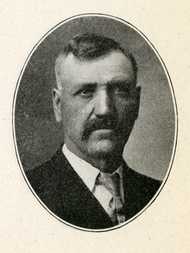
Laforest Potterin his later years.
When I got to the top of the bluff and my melon was gone, boy-fashion, I did not stop to reason, but let my imagination run wild. I thought some animal had carried it off and that was what I heard going through the bushes.
I took the water to father and told him about the melon and the animal that carried it off. The more I talked about it, the better my imagination worked until I could tell what the animal looked like – what color he was, bigger than a dog. In my mind it was something terrible!
Father asked what I thought it was. I couldn’t tell him. So, he said he thought it must be a Racorebob.
Father told folks about my Racorebob for years after. Whenever my imagination would get the best of reason, I was reminded about my Racorebob. I believe it has always had a good effect on my life.
Father found the melon at the foot of the bluff, smashed against a tree. Somehow, it had started rolling down the bluff and that was what I heard.
*
(Marie here – I’m not sure what the word amalgam Racorebob means. Laforest never explained it, but my guess would be a “raccoon or bobcat?” Any other interpretations are welcome!)
A giant burbot replica found in the lobby of Duluth’s Great Lakes Aquarium.
My recent post about a trip to a local fish market in Cornucopia, Wisconsin, to buy some burbot piqued readers’ curiosities about its taste and my experience eating this ugly looking fish for the first time. I’m here to say that I survived and that I’m no longer a Burbot Virgin!
The experience is memorialized in “The Fish Dish,” a podcast I co-host for work. We chose a Valentine’s Day theme for the show because Feburary is an important time in the burbot’s life cycle: a time for LOVE.
See photos and hear all about it at this Fish Dish link. And while you’re at it, get your sweetie a card with a big burbot on the front for that special day. Such smooth moves might not work on everyone, but you just never know . . . .
I recently attended a Zoom meeting for work where the presenter was wearing a bow tie. His tie was full of bright colors in contrast to his dark shirt. The speaker was a professed bow tie-aficionado. His tie was fun to look at, but it was crooked. I kept mentally straightening it during his whole presentation. It was distracting.
This reminded me that every bow tie I have ever seen someone wear has been crooked, which reminded me of an idea I had in 2010 when I worked for Mayo Clinic Public Affairs (where many of the doctors are also bow tie-aficionados) for an addition to a tip sheet for television interviews. This was a one-pager that we had on hand to advise doctors who weren’t familiar with being interviewed. It contained tips like women not wearing long, dangly earrings because they are distracting. (Although I suppose this could also apply to men!)
If I had continued working at Mayo Clinic longer and gained more “street cred” in the organization, I would have advocated for adding to the tip sheet: “Don’t wear a bow tie.”
Before I list the reasons why, I want to say that I think bow ties are fine for everyday life. I realize they are a way for the wearer to express their individuality and quirkiness, and I’m all for that. They are also convenient in many professions, allowing for a fashion statement that doesn’t drag in your soup bowl like a long necktie would. Also, according to a story on the WHYY public television station, for doctors, bow ties are more hygienic, collecting less bacteria than neckties. But I just don’t think they work for television interviews.
Here’s my reasoning, as if speaking to the interviewee:
No matter how hard you try, your bow tie will be crooked, which is distracting and dilutes the verbal message you’re trying to convey.
Yes, bow ties make the wearer look smart, but they also alienate you from the viewing audience. Historically, bow ties have been a marker of privilege and conservatism. Think of who you are trying to reach with your television interview message. For most health information, I would wager you want the widest possible audience.
During media interviews, you are representing your organization. This is not a time to get all individualist and fancy. You can put your bowtie back on afterward.
Despite straightening beforehand, your bowtie WILL become crooked during the interview.
Your bowtie will run askew. (I cannot stress this enough.) 😊
There, I’ve been carrying that inside for a long time. I feel better now! Feel free to comment with dissenting opinions or agreements below.
It seems lately as if several species of wild animals have been stopping Russ and I from our normal activities. These include a song sparrow, mallards, and wasps.
It all began on Fourth of July weekend when, in preparation for mowing, I was cleaning up sticks that had fallen from the many birches that abound in our cabin yard. Every time I approached our fire ring to drop off a load of sticks, a small brown bird would fly away.
I thought the bird was coming from inside the fire ring. I looked around for evidence of a possible nest there but could not find any. So, I mowed the yard.
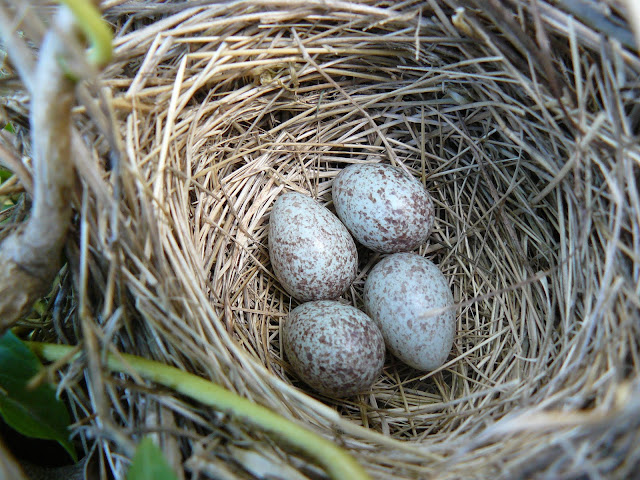
Song sparrow eggs. Image credit: Rich Mooney
I mentioned the mysterious bird to Russ, saying I thought maybe it had a nest nearby. It was later in the day when Russ was moving a pile of sticks we had a few feet away from the fire ring into the ring so we could have a major 4th of July blaze that he called me over. “Look!” he said, pointing to something at the base of the brush pile. Sure enough, it was a nest with a clutch of four to five eggs inside. The eggs were bluish-brown and spotted. The mother bird was nowhere to be seen. I must have traumatized her with my mowing.
We quickly added some sticks back atop the nest in a poor approximation of the shelter the pile had offered before. Then we hightailed it away from the fire ring. We didn’t want to encourage the mother to stay off her nest any longer than we already (unintentionally) had.
The day was warm, so I hoped the eggs had not suffered greatly from the mother’s absence while I had mowed. Still, we worried we may have scared her away forever.
A few hours later, I couldn’t help but check to see if she had returned to the nest. I carefully approached and peered through the grass and brush. The bird was back! I slowly retreated to leave her in peace.
Our plans for a fun campfire with friends and relatives over the 4th of July holiday evaporated. If we had a fire, we’d be baking some poor baby birds in their eggs. We didn’t want that on our conscience. When our cabin guests arrived, we let them know why we wouldn’t be having any fires that weekend. They were good sports about it.
Then, the evening before we were to return home, I was about to go out to our dock and retrieve my paddleboard, which was attached to a dock pole with its leg strap. Storms were supposed to roll in by morning and I wanted my board safe inside the boat house.
As I looked out the cabin window at my paddleboard on the lake in the evening gloom, I noticed an unusual dark shape on our dock. It looked like a duck was sitting there, right above where my paddleboard was wedged in the water between two of the dock supports.
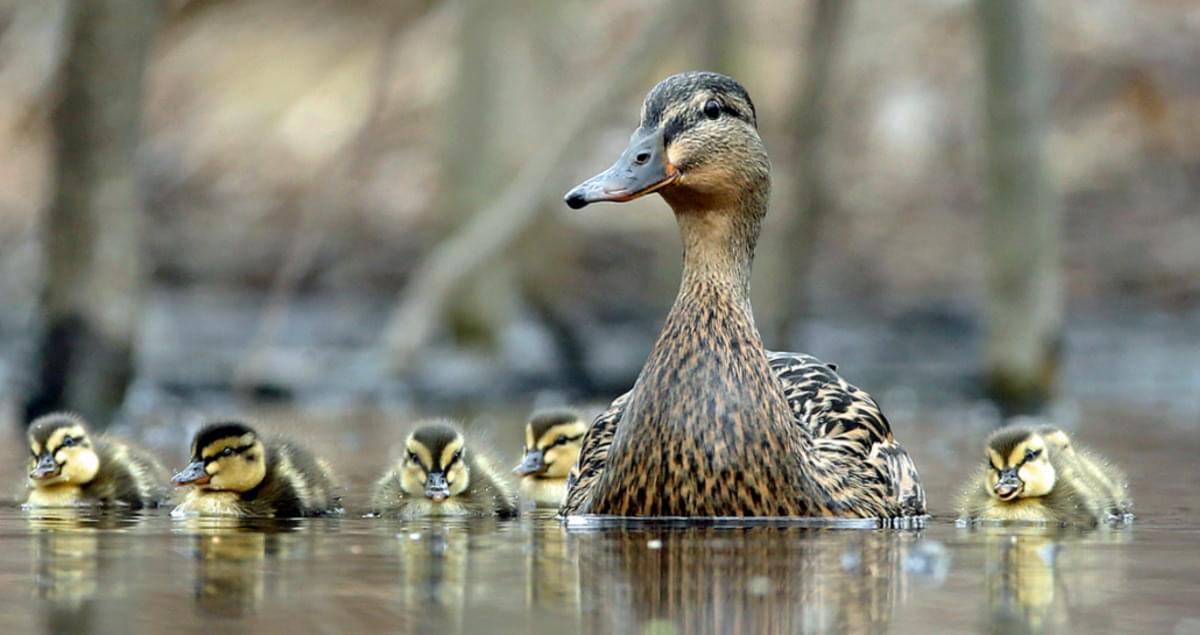
A mother mallard and her ducklings. Image credit: Cornell Lab of Ornithology
I mentioned to Russ that we had a duck on our dock, and when he looked at the scene, he discerned a bunch of smaller shapes on my paddleboard. We’d seen a mother mallard and her four ducklings swimming around our dock earlier in the day. Could they have decided to stay the night?
I took a closer look, and sure enough, the mother mallard was guarding her brood, who were nestled all cozy and cute against the life jacket I had strapped to my paddleboard.
What kind of heartless human could disturb them? Not me. I decided that stowing my board could wait until morning.
Of course, in the morning when I checked, baby duck poop covered my board. The ducklings must have spent the entire night on it. But that was easy enough to clean. I just turned the board over so that the top of it soaked in the lake for a while.
The next weekend we did not return to our cabin since we were on a trip to Isle Royale National Park (which I will describe in a later post). When we returned home from that excursion, Russ got stung several times while he walked up our back steps.
Wasps had built a hive in our absence under the top step. They were coming and going from a small crack between two boards. We couldn’t easily see the nest from underneath due to the cover provided by our day lilies.
What the heck, were the animals taking over? I mean, I’m an animal lover, but I was beginning to feel nervous.
Inconvenience by birds is one thing. Wasps are something different. I’m all for leaving wildlife in peace, but not when it comes to them controlling ingress and egress from my house.
We were too busy to deal with the hive for a few days, so we used the front door of our house instead. It was inconvenient, but better than risking stings.
One evening, when we hoped the wasps were drowsy, we donned our head nets and gloves. We used a broom handle to lay down the lilies along the side of the porch to see if we could pinpoint the hive’s location to spray it with some deadly wasp and yellowjacket foam.
I could not see where the hive was and I really didn’t want to stick my head any farther under the porch in this attempt, so Russ and I decided to spray the foam through the crack the bees were using to enter their hive.
This seemed mostly successful, although a wasp or two were still flying around the next day, so I put on my brave lady pants and stuck my head under the porch far enough to get a good shot at the nest with the spray this time. The nest wasn’t that large, and no insects emerged from the porch crack when I sprayed it, so maybe they were all gone by then. For good measure, we sprayed the crack one more time.
I think we successfully reclaimed our porch.
The next time we visited our cabin, we checked the nest by the fire ring and it was empty. It had been two weeks since we last saw it. I wondered, could the nestlings fledge that quickly? I hoped they could, and that the emptiness wasn’t because the mother had abandoned the nest.
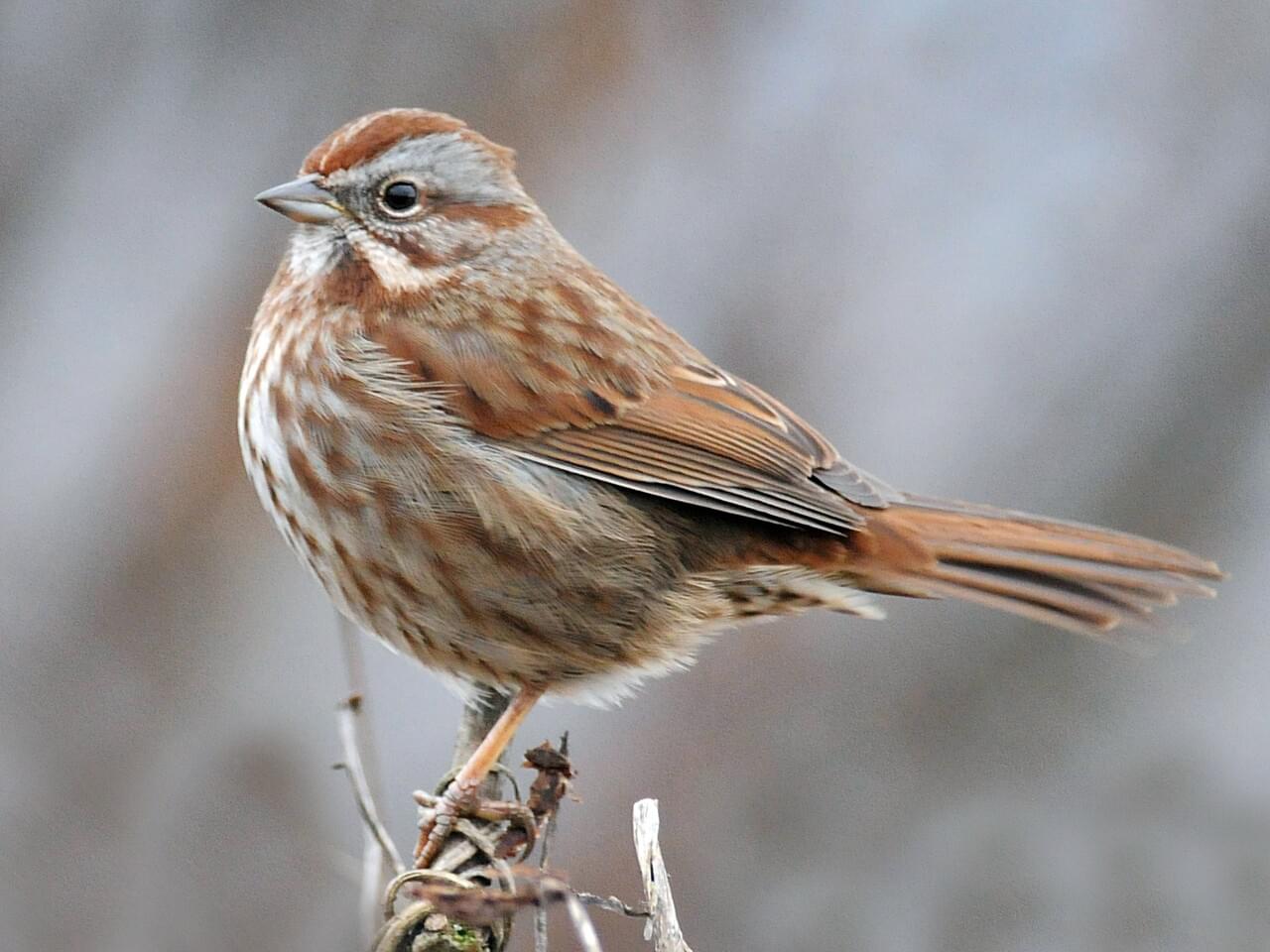
A song sparrow. Image credit: Steven Mlodinow
As we sat around the fire ring that night enjoying a crackling fire, a song sparrow sang from the woods nearby. With its trilling notes, it almost sounded as if this bird were thanking us for allowing her to nest in peace. Could it have been a song sparrow that had been holding our fire ring hostage previously?
I looked up the bird’s appearance and what its eggs looked like on the internet. Yes, I think it must have indeed been a song sparrow. The site I visited said that song sparrow young can fledge in 10-12 days, so it’s possible that the empty nest could have signaled a successful brood – they would have had enough time to fledge while we were gone.
The other thing the site said was that song sparrows can have up to seven broods in a season and that they often use the same nesting site.
The next day when I mowed the lawn, I made sure to aim for that nest.
All I can say is that these cross-country ski trails are terrible. They were noisy and crowded. The other skiers scowled at us and muttered oaths most foul. The snow was coated with soot, the scenery filled with skyscrapers. The forest was mangled and misshapen. The grooming was awful – tracks all over the place. And the air held a lingering stench, reminiscent of dried pickles.
If you enjoy the Korkki Nordic Ski Trails near Duluth, you’ll intensely dislike these ski trails because they are like Korkki but with frozen ponds everywhere.
By all means, you should never ever go on these classic-only ski trails. Really, don’t go.
The grand marshal of the Thunder Valley Lawn Mower Races, Maine. Image credit: Mark Haskell, Courier-Gazette
Apologies for the bad pun in the title, but I wanted to let you know that you truly haven’t lived until you’ve witnessed this phenomenon. Lawn mower races happen all across America, from Idaho to Maine. I received my first taste in late summer when I meandered into Cotton, a small town in northern Minnesota.
Grown men (and in other places, women) clamber aboard riding lawn mowers that they have modified for racing. In Cotton, the circular racing track was an actual lawn situated behind what used to be the town’s high school but is now a community center.
The races are a cultural highlight of the season. Families gather to sit on the grass or on haybales to watch the festivities. Kids eat cotton candy. Some folks even back their jacked-up pickup trucks along the track. Sitting in folding lawn chairs in the cargo bed, they have a prime, elevated view.
Engines rev. The starting gun cracks, and they’re off! The machines tilt as they round the corners, wheels lifting off the ground. The drivers likewise tilt, leaning into the movement. Around and around they buzz, neck and neck. After a few turns around the track, one man’s mower putters out and he pulls into the center, defeated.
Cotton, MN, lawn mower racers lean into the turn.
According to the U.S. Lawn Mower Racing Association, this quirky form of racing began in the early 1970s – touted as a perfect way to use a machine that many people already have, and to let off steam. It became official when the makers of a fuel stabilizer came up with the idea of using a lawn mower race to promote their product on April Fools’ Day in 1992.
I had no idea this pastime had been around for so long! There’s even such a thing as lawn mower ice racing in winter.
With a wave of a checkered flag, the race ends. The crowd applauds. The winners strut over to claim their prizes and pose for the local newspaper photographer.
In Cotton, racers competed in two events, “modified” and “stock.” I felt culturally enriched for having watched these events. But it all seemed like such a waste. You see, the racing mowers don’t have their blades engaged. All that noise and hype, and in the end, the grass on the track is just as long as before. 🙂
I recently wrote a post for the blog I manage for work, which I think you might enjoy. The promo: “Senior science communicator, Marie Zhuikov, recalls a grisly discovery in connection with a project to control invasive goldfish.”
Image of one of my current favorite commercials courtesy of Progressive Insurance
In high school, I had a classmate named Dave. One of his favorite sayings was, “You have a keen grasp of the obvious.” He’d say it whenever someone made a comment that was self-evident. These were often conversation fillers, used in instances when a person would step outside, notice it was raining, and say, “It’s raining.” Dave would then say his thing. It made him sound so smart and superior.
Dave and I have since been lost to each other through the vagaries of forty years and geography, but I think of him and his sarcastic saying periodically, especially when it comes to those signs that are so popular now in people’s homes. You know, the ones made for the kitchen that say “EAT,” or ones for the living room that say “LOVE, LAUGH, LIVE,” etc.
When they first started appearing years ago, I thought the signs were sort of neat, mainly because, you know me, I love words. But the longer they stay around and the more I see them, the more I have developed a knee-jerk negative reaction toward them. I think things like, “Why would I need a sign to tell me what to do in a kitchen?” As my friend Dave would say, the signs have a keen grasp of the obvious.
The signs are also bossy. Maybe I don’t want to laugh or love. Stop telling me what to do, signs!
I have taken a solemn and deadly vow never to add one of those signs to my home décor.
My dislike of these signs is one thing that makes me love the recent series of Progressive Insurance commercials that feature “Dr. Rick.” He is a pseudo-therapist who tries to ensure his customers (patients) don’t turn into their parents once they become homeowners (a.k.a. parentomorphosis). One of the most recent commercials features not one, but two instances of Dr. Rick encouraging a young female homeowner to trash one of the dreaded bossy signs.
Those commercials make me laugh every time I see them, and that’s something during a pandemic. Well done, Progressive. And Dave, if you’re out there, I look forward to seeing you at our 40th class reunion this year. Maybe I’ll bring you a sign.
Greetings! I hope all my dear readers made it through Thanksgiving in a healthy and happy way. But if you are getting COVID-isolation crazy and want to let off some steam, I humbly suggest you try the Hallmark Christmas Movie Drinking Game. I heard about this from a coworker and it sounded too fun to pass up.
I got together with two people from my COVID bubble and we watched “Christmas at Grand Valley,” available for streaming from Amazon Prime. In this scintillating saga, which is cast in the Hallmark Movies and Mysteries series, Kelly returns to her Wyoming hometown (from Chicago) and becomes involved in an effort to save the town’s beloved lodge. In the process, she falls for a handsome widower sent to decide the fate of the lodge.
I’m not sure why this movie is considered a mystery. The only inkling of mystery comes in the form of, “WHEN ARE KELLY AND WIDOWER MAN EVER GOING TO KISS?”
Whenever certain things happen on screen, viewers must take a sip of their drink, or two sips, down the whole thing, or take a shot. I *think* (memory is fuzzy) I ended up drinking a whole bottle of wine between supper and the movie. It was great fun, plus I thought up some new rules, which are the ones posted in red.
Happy Holidays everyone!
RULES
Take one drink whenever:
A reference is made to a dead relative
The “Mayor” appears on screen
The main character’s name is related to Christmas (Holly, Nick, etc.)
Anytime someone disses fake Christmas trees
A newcomer partakes in an old family or town tradition
Hot chocolate, apple cider, or eggnog is on screen
A big city person is transplanted to a small town
Christmas caroling, a tree farm, or baking cookies appears
Mistletoe is on screen
A character makes a magic deal with Santa or an angel
Any time you hear “Jingle Bells”
The town is named something Christmas-y
Take two drinks whenever:
Characters experience a ‘near-miss’ kiss
An obvious product advertisement appears
A snowball fight or ice skating happens
An ugly sweater or tie appears
The characters are snowed in
A “Pride and Prejudice” reference is introduced (a character is named Darcy, a place named Pemberly)
Someone with slicked-back hair expresses their hate for Christmas
Finish your drink whenever:
The cynic is filled with the Christmas spirit
It snows on Christmas
Someone selects a Christmas tree
The main characters bake/cook something together, or Christmas-themed food is mentioned
Bad art appears or a literary reference is made
Dissonant architecture appears (for instance, a lighthouse in Wyoming)
Accordion music happens, especially if it’s playing Jingle Bells
Take a shot whenever:
The movie stars Candace Cameron-Bure, Lacey Chabert, or Andrew Walker appear
Back in my high school days – when cowl neck fuzzy sweaters were in, hair styles were big, and women’s shirts sported shoulder pads large enough for the wearer to participate in professional football – I took the ACT test to get into college.
I studied out of a large book, which offered practice questions and reviews of math concepts. Now, I’m sure students must be able to do this all online, but this was back in the 80s, before most people had any inkling about computers.
I’m not sure if the test is still in the same format, but back then, most of it was multiple-choice. The most useful thing I learned from studying for the ACT was how to identify incorrect answers so that I could home in on the correct ones. The hardest things about the test were figuring out its format and its unwritten rules.
All my studying paid off. I scored very high in the English section, and higher in the math section than if I hadn’t studied. My overall score was good enough that I didn’t need to worry about admission into the college of my choice. It was also elevated enough that I received a letter from Mensa in the mail one day.
Mensa International is an organization for people with high IQs. As author and comedian David Sedaris says in “Me Talk Pretty One Day” (which I just finished reading), Mensa members “come from all walks of life and get together every few weeks to take in a movie or enjoy a weenie roast. They’re like the Elks or the Masons, only they’re smart.”
Growing up in the northern hinterlands of Minnesota, I had never heard of Mensa. After opening the letter, I mentioned it to my mother, and her first, and only, response was, “Ach, you don’t want to join that!”
So I didn’t.
I was so taken aback by her reaction, I didn’t ask her why I shouldn’t join them.
Looking back over the decades, I have a twinge of regret that I so blindly followed my mother’s advice. How might my life have been different if I had surrounded myself with high-IQ people?
But I also realize my mother’s knee-jerk reaction was truly Minnesotan. It’s not part of our culture to brag or make ourselves stand out. (See more in my post about “Minnesota Nice.”)
Perhaps my mother was afraid my head would swell with self-importance were I to hang around other intelligent people. Or, maybe she figured they were all a bunch of dorks and exposure to them would increase my social awkwardness. Or she could have been threatened by having a daughter labelled as “smart.” I don’t know. My mother has passed, so it’s not like I can ask her now.
A couple of years ago, I looked into the qualifications for joining Mensa. They’ve upped them now. My ACT score is a few points short. Another way to qualify is through an IQ test. But an IQ test just seems like a lot of work to me now. I wonder if they grandfather (or in my case, grandmother) people into the organization based on the year they took their ACT?
Even if I did get in somehow, I suspect I would feel like a fraud. I am not naturally brilliant; I just know how to study, and I read a lot.
I guess I’m satisfied I was invited and could have joined Mensa if I really wanted to — but that I am just too Minnesotan to do so.








 Marie's Meanderings