We continued our New England Road Trip by taking a train from New York City to Old Saybrook, Connecticut. This is where Russ spent many of his formative years. We rented a car and toured his old neighborhood and saw his family home, which is still standing. We even spent a little time greeting the Atlantic at the town beach.
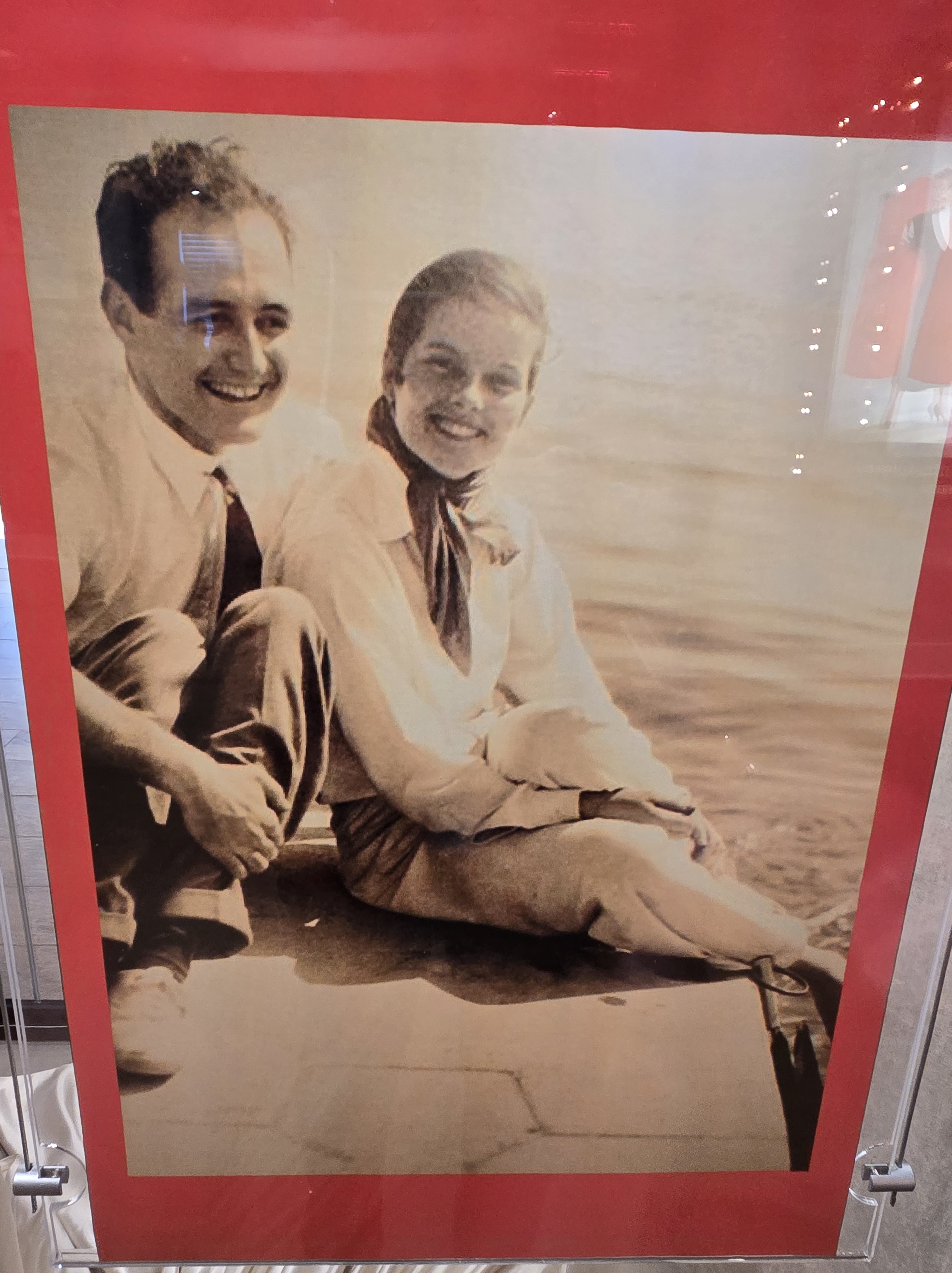
The docent told us that Kate liked this photo of herself, so it’s featured prominently in the front of the museum.
Before we left Old Saybrook the next day, we had a few hours to kill so we visited the Katherine Hepburn Museum. Hepburn lived near Old Saybrook after her family bought a summer home there when she was five. The day before, we’d driven through the exclusive oceanside neighborhood (Fenwick) where her home was located. It sports a golf course and a lighthouse. We wanted to visit the lighthouse, but couldn’t due to public access issues. We also weren’t able to see her home, where she retired in 1996.
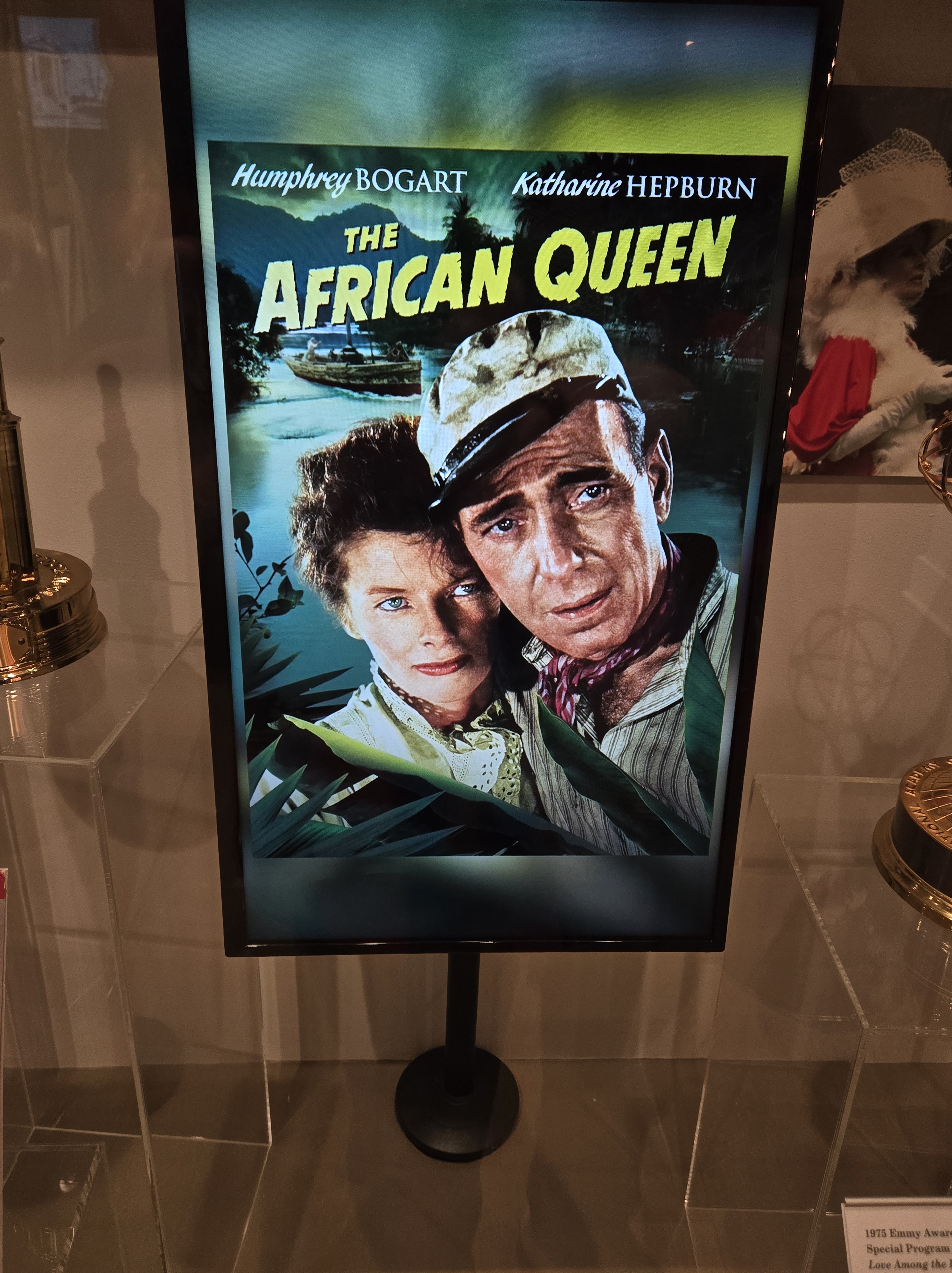
If you’re not familiar, Katherine Hepburn (aka Kate) was a feisty actress of great renown who had a six-decade career in Hollywood. She’s best known for movies like The Philadelphia Story, The African Queen, and On Golden Pond. With her athleticism and outspokenness, she broke the mold for women in Hollywood.
Kate and her husband Ludlow Smith. They were married for six years.
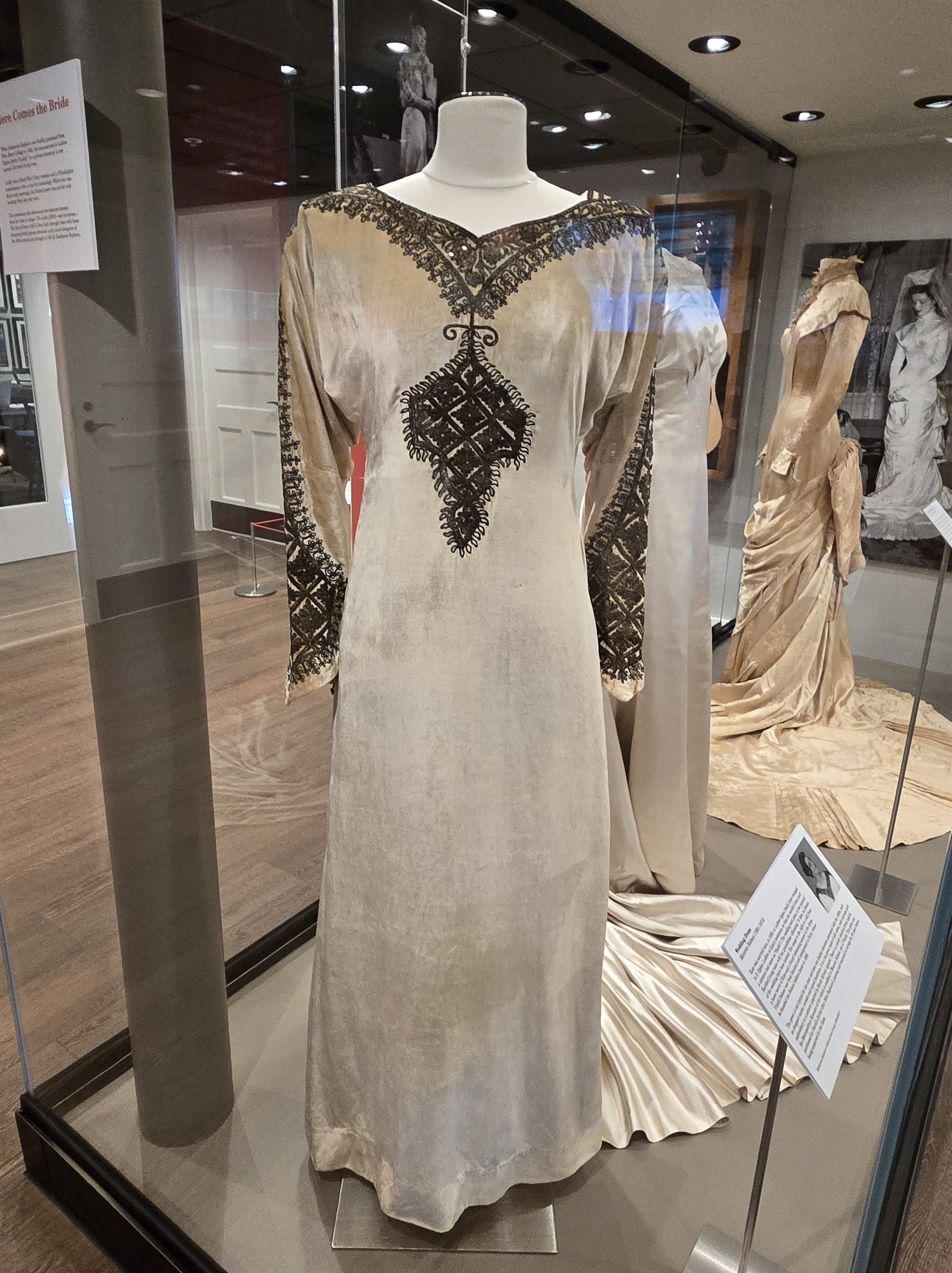
At the museum, we were given a comprehensive introduction by a helpful docent, who was excited to learn that Russ was a hometown boy. The museum features eight exhibits that focus on Kate’s family, her athleticism, her Fenwick home, her career and other special topics. Wedding gowns were the focus of the special exhibit when we were there, including Kate’s own wedding gown from when she was married early in her life.
I always enjoyed Kate’s movies, and she’s been an inspiration to me to keep active. I recall watching her on a television talk show once when I was younger. I believe she was in her 70s and she proudly showed the host how she could still bend over and touch her toes. I remember thinking, I want to be able to do that when I’m 70! I’m happy to report that I can still accomplish this feat in my early 60s. 😊
Kate’s wedding dress. It’s a tea gown made of silk velvet with gold embroidery in a pattern inspired by North African apparel. It was purchased by a wedding gown company and remained in storage for 20 years before being purchased by the museum.
The museum is also a cultural arts center, hosting lectures, workshops, and film screenings. Admission is free but there’s a suggested $10 donation per person.
According to one placard, “Although her legendary career catapulted her to dizzying heights of international fame, Connecticut’s local girl never really left home. The road always led her back to her family and to her refuge in Fenwick.” Katherine died in her Fenwick home in 2003. Her grave is in a cemetery in Hartford. She didn’t want a service, nonetheless accolades for this special actress were given throughout the country in many other ways. It’s good to know that her memory and passions are preserved in this little piece of Old Saybrook.
I’m so far behind on my blog posts but thought I could write this one before I head off meandering again. (Plus I’m still finalizing my poetry manuscript.)
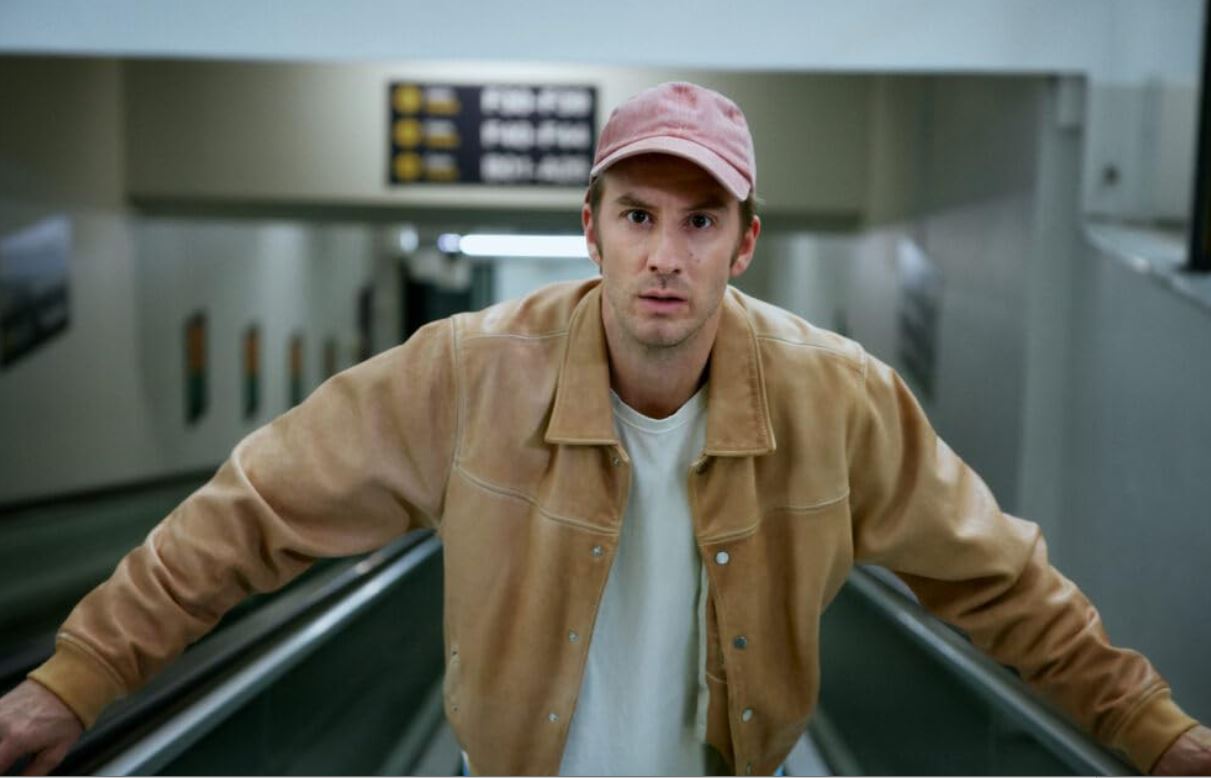
ActorFilip Berg from Trouble. Image courtesy of Netflix.
My first recommendation is the movie Trouble. This Swedish action comedy is a remake of a 1988 movie by the same name. An electronics salesman and handyman innocently gets caught up in a home invasion and murder. What follows is a farcical romp involving corrupt police and relationship drama. The movie is streaming on Netflix with English voiceovers. I thoroughly enjoyed it and laughed a lot!
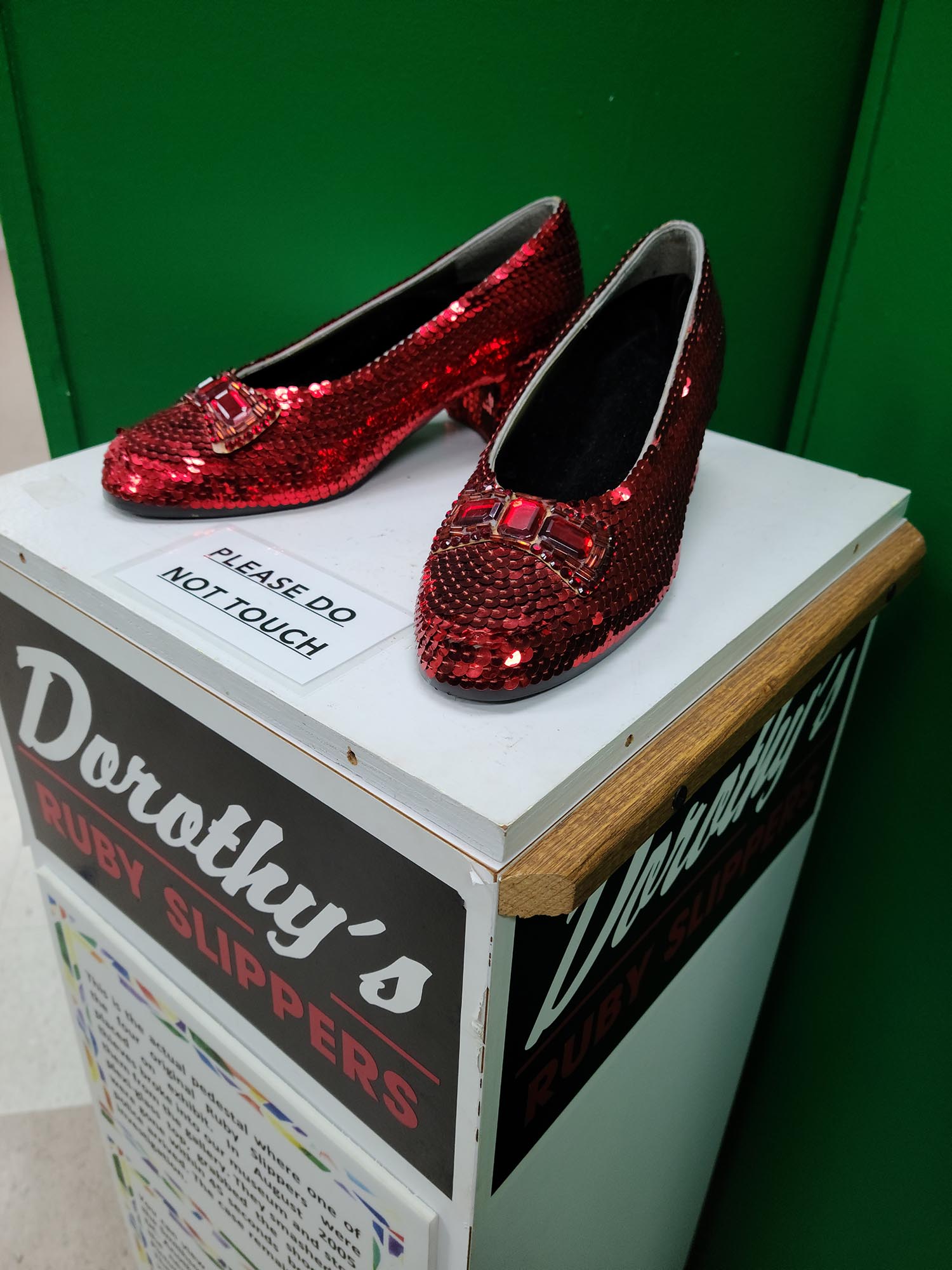
Red slipper replicas that were in the Judy Garland museum when we visited in 2021.
The second is Ruby Red Handed. It’s a tongue-in-cheek documentary about the case of the missing ruby red slippers that Dorothy (Judy Garland) wore in The Wizard of Oz. This theft happened a few hours’ drive from where I live. Russ and I visited the Judy Garland Museum in Grand Rapids, Minnesota, after the theft happened, so that’s why the movie intrigued us. (See my post about our museum visit.)
Solving the crime took years and the help of the FBI. It involved clueless criminals (who thought the shoes contained real rubies) and buried treasure. Spoiler alert: the show has a happy ending, but if you’ve been paying attention to the news, you know that already. It’s available for free on Hulu and was produced by a Minnesota-based company. You’ll get the inside scoop on all the juicy details of the crime.
If you’ve been reading this blog for a while, you may recall that I’ve written two other posts about Bob Dylan. Thus, the name of this post. Here’s another one!
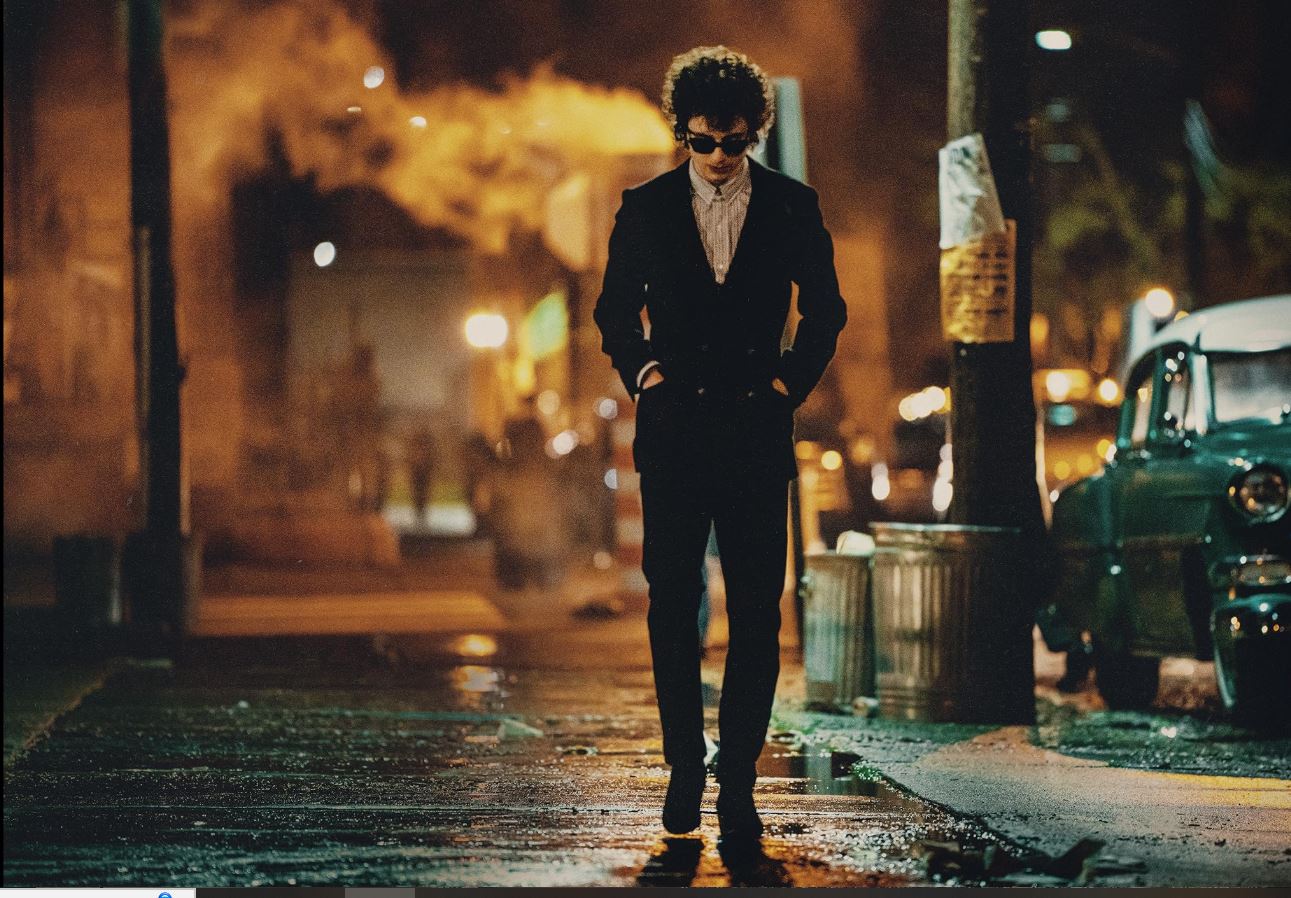
I watched two Bob Dylan movies recently. The first, “A Complete Unknown,” inspired me to watch the second, “No Direction Home,” so I could get a better picture of the famous singer who spent his early years in my part of the world. I’m glad I watched both.
Of course, the first movie is the one that’s out in theaters now. It features Timothée Chalamet, the dishy French-American actor who portrays Dylan in his early years. Based on the book, “Dylan Goes Electric,” by Elijah Wald, the story begins with Dylan “escaping” his college experience at the University of Minnesota and traveling to New York City to meet his folk music hero, Woodie Guthrie, who was hospitalized with a neurological illness. Another folkie, Pete Seeger, takes Dylan under his wing, and his rise to stardom begins.
I liked that the story was told mainly through music; this was much more effective than a lot of talking. Chalamet’s portrayal of Dylan is superb as are the performances by the two actresses who portray his love interests from that time: Elle Fanning who plays his girlfriend Suze Rotolo/Sylvie Russo, and Monica Barbaro who plays singer Joan Baez. It helped me understand the pressures Dylan was under as a person and an artist. Even Dylan, who was an executive producer for the movie, liked it, so that’s saying something!
The movie concludes with Dylan’s performance in 1965 at the Newport Folk Festival, where he was backed by an electric band. The audience of folk purists and political activists reacted badly, with booing and shouts. Some people just couldn’t handle that something they loved had changed. As Google says, his performance, “was a shot heard round the world—Dylan’s declaration of musical independence, the end of the folk revival, and the birth of rock as the voice of a generation—and one of the defining moments in twentieth-century music.” There are still people who are upset by what they perceive as Dylan’s turning his back on acoustic folk music and political activism.
As I mentioned, “A Complete Unknown” left me wanting to know more, so I watched “No Direction Home,” a 2005 documentary by Martin Scorsese that’s available through PBS. It follows Dylan’s life for a year longer than the current movie, and features in-person interviews with Dylan, poet Allen Ginsberg, Suze Rotolo, Joan Baez, and Pete Seeger.
Seeing/hearing Dylan describe events from his life in his own words was so interesting! According to Wikipedia, the movie was well-received. It “creates a portrait that is deep, sympathetic, perceptive and yet finally leaves Dylan shrouded in mystery, which is where he properly lives.”
So, if like me, you found yourself wanting more after watching “A Complete Unknown,” I highly recommend “No Direction Home.” It helped me understand why there’s not a snowball’s chance in hell that Dylan will ever come back to Duluth no matter how we try to honor him. (The city has named a street after him, but he didn’t show up, much to the city’s dismay. He didn’t even show up for his Nobel Prize; he sure isn’t going to come back to Duluth!) We need to just leave the man alone.
Also, Suze Rotolo wrote a memoir about her time with Dylan, titled, “A Freewheelin’ Time,” which I plan to read someday.
I still remain happy that I’m not famous like Dylan. See my blog post from 2017 that explains why. Have you seen “A Complete Unknown?” If so, I’d love to hear your thoughts about the movie.
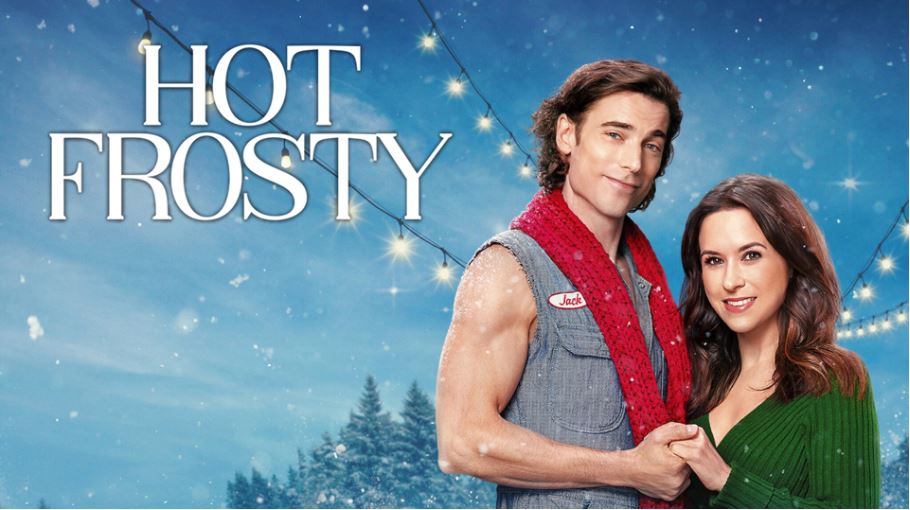
Russ and I are fans of National Public Radio’s “Wait, Wait, Don’t Tell Me” news quiz humor show. In a recent edition, host Peter Sagal mentioned that holiday movies are being produced with a decidedly sexy bent. He named one in particular: “Hot Frosty.” This Netflix production is about a muscular snowman who comes to life after a young widow drapes him with a scarf that has magical properties. Needless to say, he keeps his “hot” physique once he’s human, and romance ensues. But he also keeps some of his cold properties, too, such as a penchant for eating ice and a below-freezing body temperature.
We decided that “Hot Frosty” was a good candidate for a drinking game, even though it wasn’t an official Hallmark movie. We set a date with my friend Sharon, with whom we had a riotous time four years ago enacting and enhancing this drinking game list.
This living snowman causes quite a stir while fixing a roof.Image courtesy of Netflix.
Although “Hot Frosty” didn’t contain as many troupes as a Hallmark movie, we still had fun watching it. In fact, it inspired us to enlarge our game list with a few new rules. I’ll post the revised version below Sharon’s review of the movie. Please note: Sharon provided this review after drinking to drown her sorrows after the Packers lost to the Vikings, and after playing our movie drinking game.
“It’s part PG-rated but it doesn’t go too far in the sexy category. It’s not like “Magic Mike.” Netflix, could you ramp it up a notch? The snowman had an interesting body but no substance.
“Women are usually colder than men. I dunno if it’s from our estrogen or what. We don’t want to snuggle up to men who are colder than we are. We want hot men! If someone was as cold as this guy is, it would put a damper on things.”
So, there you have it. Maybe not all that sexy, and probably too cold, but it was a fun way to spend an evening.
Here’s our freshly revised list.
RULES
Take one drink whenever:
A reference is made to a dead relative The “Mayor” appears on screen The main character’s name is related to Christmas (Holly, Nick, etc.) Anytime someone disses fake Christmas trees A newcomer partakes in an old family or town tradition Hot chocolate, apple cider, or eggnog is on screen A big city person is transplanted to a small town Christmas caroling, a tree farm, baking cookies, or a snowman appears Mistletoe or a scarf is on screen A character makes a magic deal Any time you hear “Jingle Bells” The town is named something Christmas-y An interracial couple appears An angry, misdirected law enforcement officer appears
Take two drinks whenever:
Characters experience a ‘near-miss’ kiss An obvious product advertisement appears A snowball fight, ice skating, or dancing happens An ugly sweater or tie appears The characters are snowed in Someone gets a makeover A “Pride and Prejudice” reference is introduced (a character is named Darcy, a place named Pemberly) Someone refers to a metaphor or uses intelligent phrasing Someone refers to fishing or hunting Someone with slicked-back hair expresses their hate for Christmas
Finish your drink whenever:
The cynic is filled with the Christmas spirit It snows on Christmas Someone selects a Christmas tree The main characters bake/cook something together, or Christmas-themed food is mentioned Bad art appears or a literary reference is made Dissonant architecture appears (for instance, a lighthouse in Wyoming) Accordion music happens, especially if it’s playing Jingle Bells
Take a shot whenever:
The movie stars Candace Cameron-Bure, Lacey Chabert, or Andrew Walker appear The main characters fall in love The main characters kiss
Blackness Castle. In the “Outlander” series, it’s Fort William.
Russ and I have long been fans of the “Outlander” television series and books. Actually, I was a fan first, then I sucked Russ into it. He’s been a willing and devoted victim. We were tickled to discover during our Broomhall House tour the previous day that even distant cousin Charles Bruce is a fan!
If you’re not familiar, “Outlander” follows the story of Claire Randall, an Englishwoman who’s enjoying a second honeymoon in Scotland with her husband once World War 2 ends, when she’s sucked back in time 200 years after touching a mysterious standing stone. While in the past, she meets Jamie Fraser, a burly and charming Scot, who ends up marrying her to save her from the clutches of an evil pre-ancestor of her English husband.
The series hops back and forth in time and geography, but some fans’ most-beloved sites can be found in Scotland, many not far from Edinburgh. It only made sense for us to go on an Outlander tour while we were there, especially after I found a company that offered group tours that departed only a few blocks from our hotel.
That’s where we met Henry, who is a co-owner of Tartan Viking Tours. He informed us that we were in luck; nobody else had signed up for the tour, so we were getting a private tour for the cost of a group one. That allowed us more leeway in what we could see, which worked out great!
Dean Village and the Water of Leith
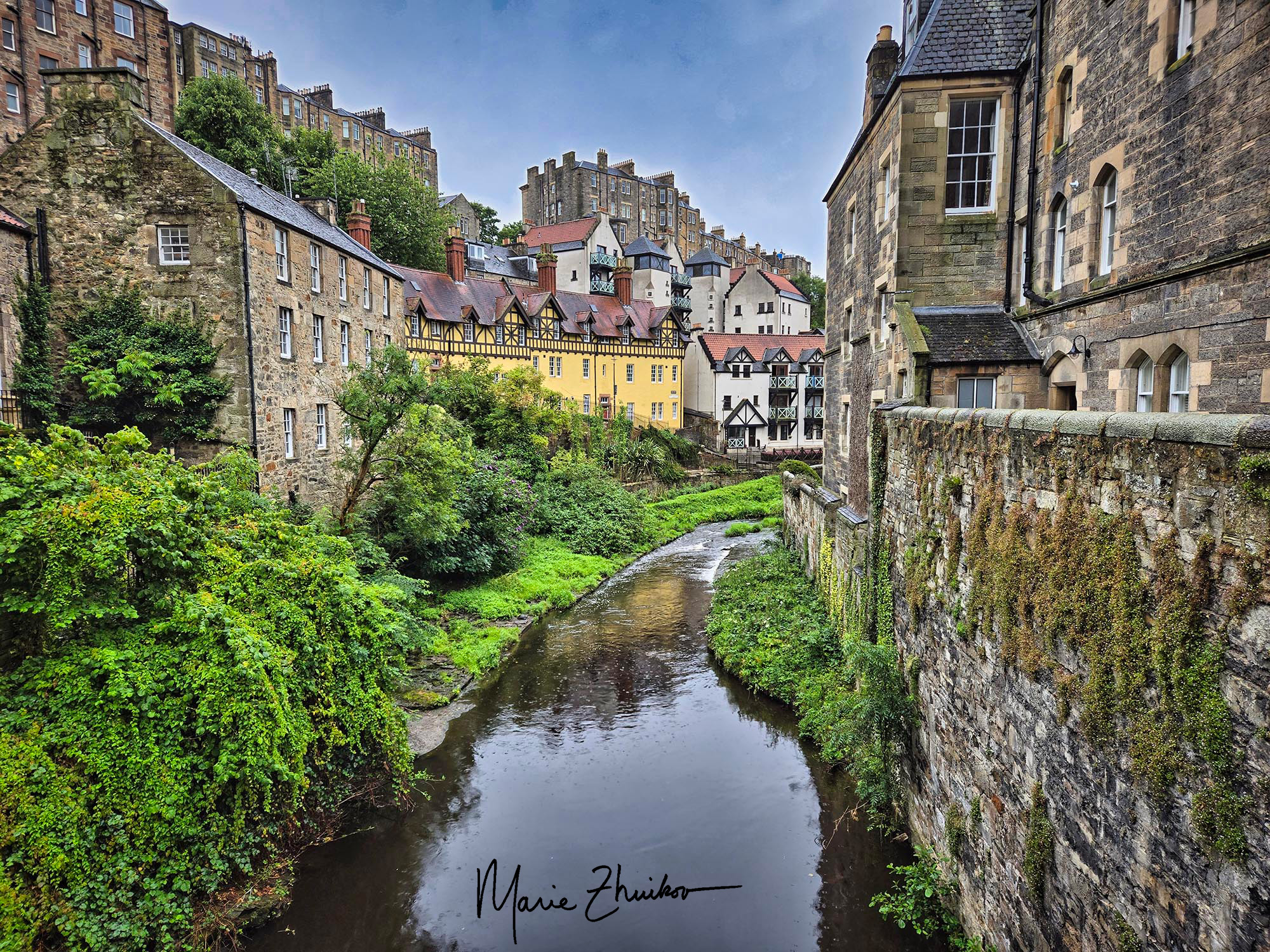
On our way out of town, we stopped at two non-Outlander locations that were just too picturesque to pass by. The first was Dean Village which is split by a river named Water of Leith. It used to sport many water mills for grinding grains into flour. Next were some Pictish standing stones that happened to be along the highway on the way to the village of Culross, which stands in for Crainsmuir in Outlander. I was excited to see them because I hadn’t had the chance to see anything Pictish or standing on either of my other trips to Scotland.
Standing stones in a field.
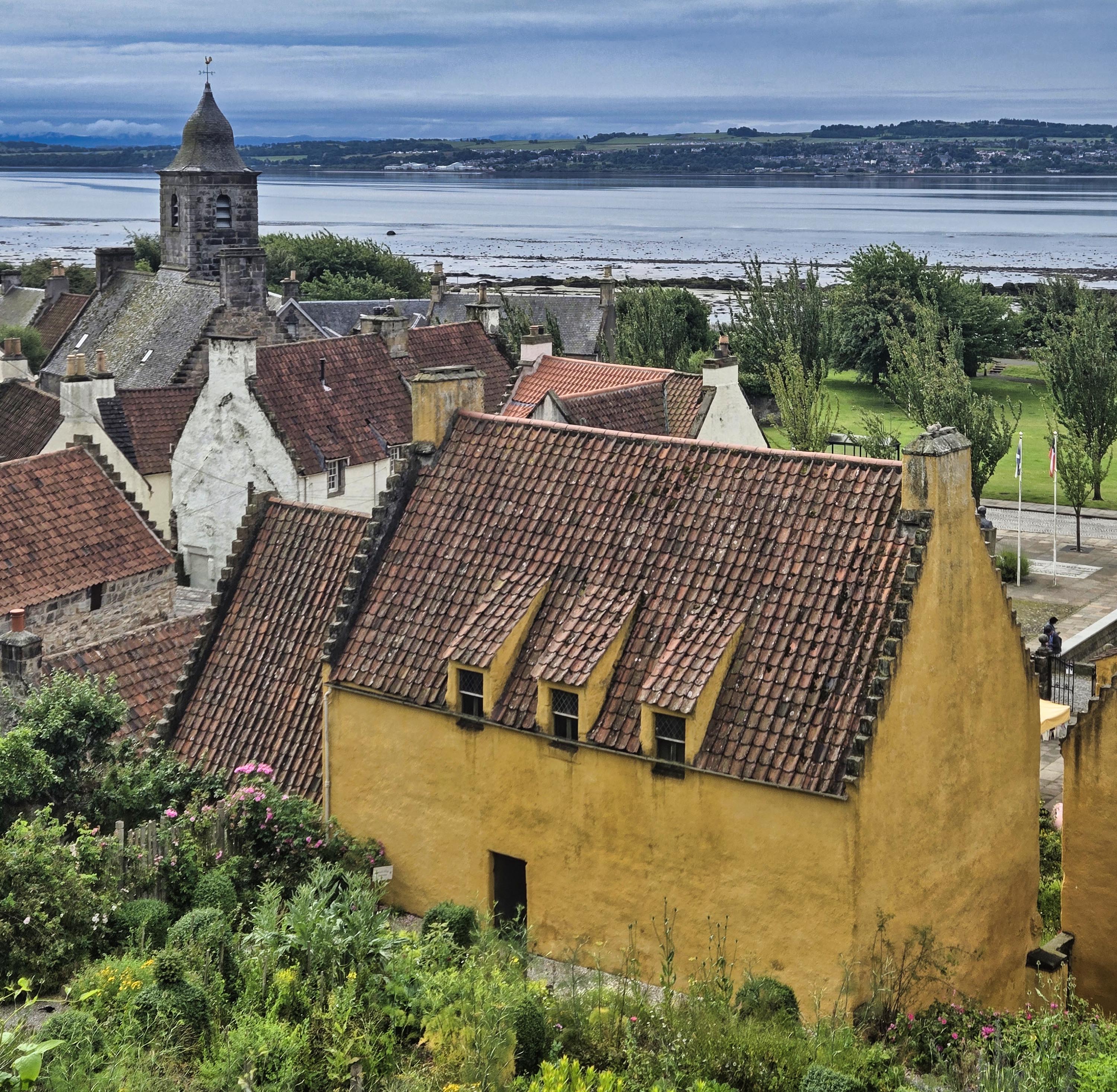
Crainsmuir/Culross is where the witch Gellis Duncan lived and is where she and Claire were tried for witchcraft. The village is one of Scotland’s most complete examples of a 17th and 18th-century town. Steep cobblestone streets are lined with white stone houses that sport red-tiled roofs. The town center is occupied by a small golden-yellow palace with a beautifully reconstructed period garden. Henry took us along the streets and up to an overlook flanked by a garden full of pink roses. We could also see an herb garden behind the palace that was Gellis’s garden in the series.
A rose garden in Culross.
A picturesque doorway in Culross
Culross Palace with Gellis’s herb garden behind it.
Then we were off to Doune Castle. In Outlander, it’s Castle Leoch, home to Clan MacKenzie. In “Monty Python and the Holy Grail,” it’s the castle where there’s a discussion about African Swallows and where a prince croons about how he doesn’t want to be king. It’s also featured in “Game of Thrones.” Seeing the familiar courtyard, Mrs. Fitzgibbon’s kitchen, and other movie locations was so fun! We took an audio tour, which was narrated by Sam Heughan, the actor who plays Outlander’s Jamie Fraser.
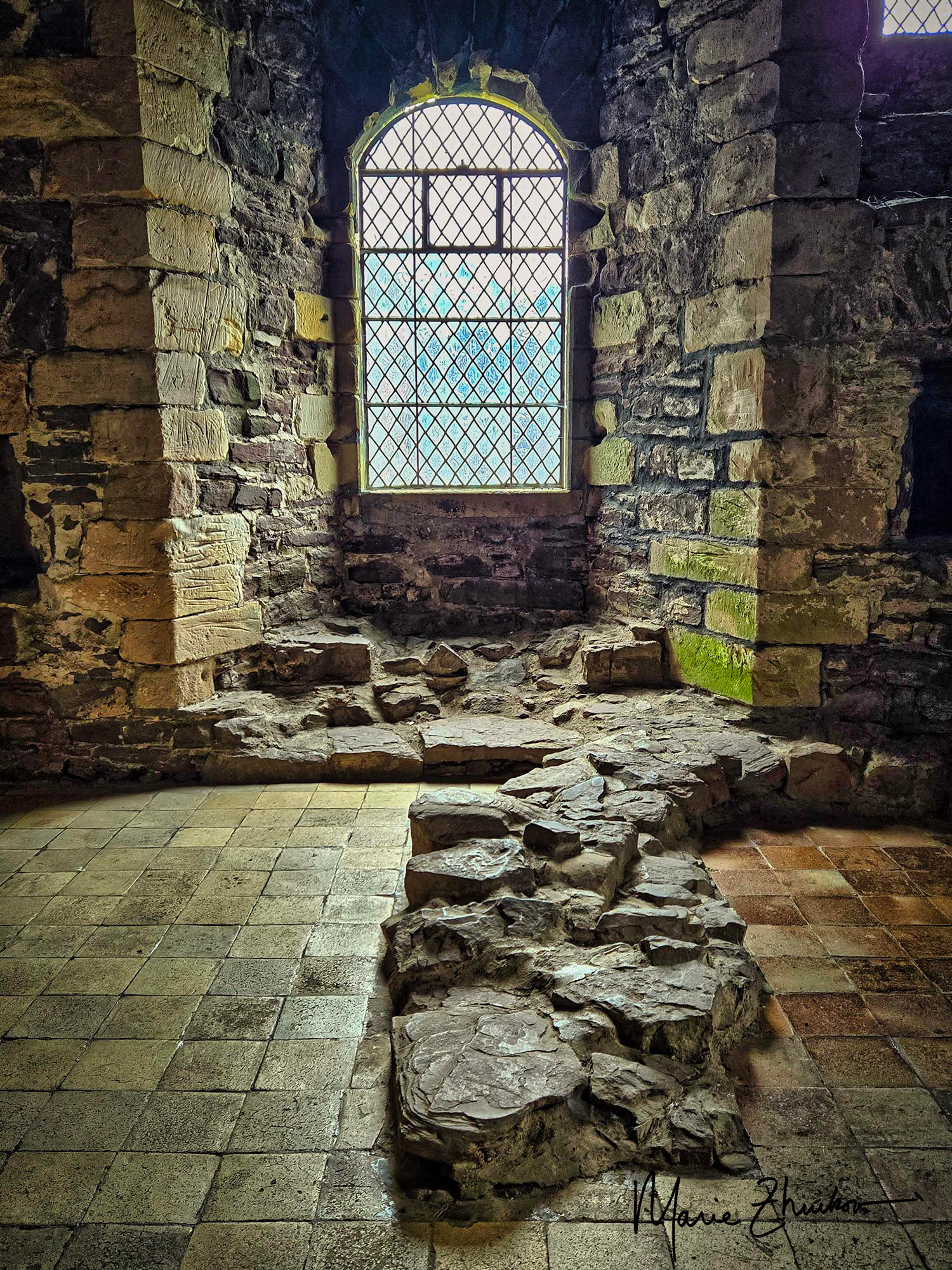
Doune Castle
A window in Doune Castle.
Our next stop was Linlithgow Palace, which is known as the birthplace of Mary Queen of Scots. In Outlander, it’s also the stand in for Wentworth Prison where Jamie was sentenced to hang and was tortured and assaulted by Captain “Black Jack” Randall. Linlithgow means “the loch in the damp hollow,” named because the palace lies on the shore of a small lake. We weren’t really feeling a need to tour the castle, so spent most of our time walking the grounds and visiting the Mary Queen of Scots statue, which sports the mysterious quote: “My heart is my own.” A biography about her has the same title, but I suspect that the statue came first. Apparently, this quote was from one of her letters to her cousin Queen Elizabeth where Mary discusses potential husbands for herself. I guess she didn’t like any of her suitors! Mary’s such a fascinating historical figure. I had the chance to visit a museum about her in Jedburgh during a previous visit.
Mary Queen of Scots was born in this turret room at Linlithgow Palace.
Mary Queen of Scots statue at Linlithgow Palace
We ate a scrumptious lunch at The Four Marys pub, named for Queen Mary’s ladies in waiting, who all obviously must have been named Mary. One thing to note in Scotland and Ireland is that at smaller restaurants and pubs like this one, which are outside of large towns, you have to pay at the bar till. They don’t bring a bill to your table like in the U.S. And if you wait for them to do so, you’ll be waiting for a long time!
Blackness Castle and the courtyard where Jamie was flogged.
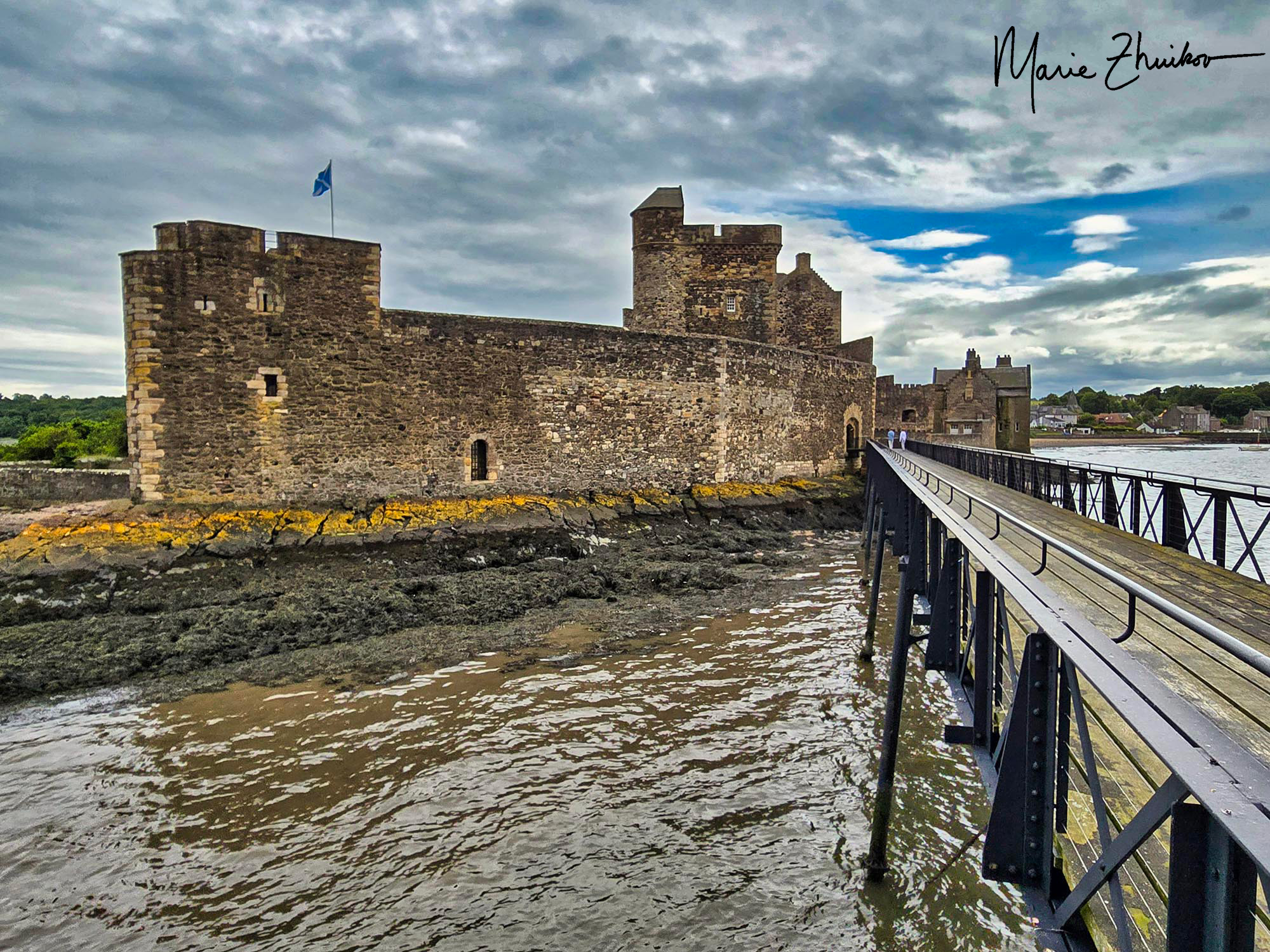
Next to last was Blackness Castle, a.k.a. Fort William. This imposing stone structure is built on the Firth of Forth and was meant to resemble a ship. Like in Outlander, the castle served as a prison in real life, housing high-ranking prisoners and their household staff. This was where Jamie was flogged and held prisoner in Season One. The place is depressing, dank, and rocky. It was so interesting how the original landscape was incorporated into it. We spent a lot of time climbing around and walking out on the pier over the Firth.
Blackness Castle as viewed from the pier. Note its ship-like shape.
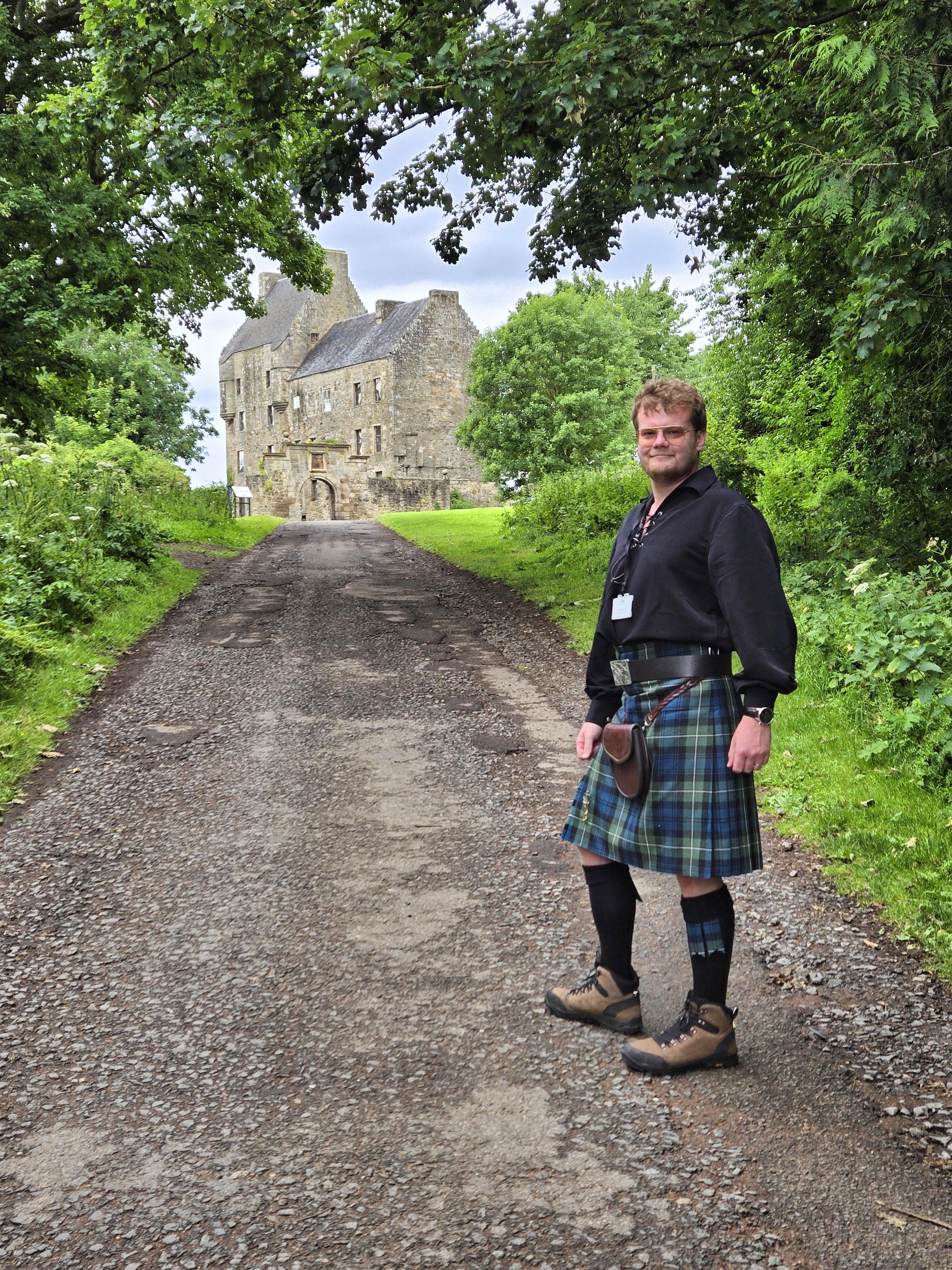
Our last stop was Midhope Castle, a.k.a. Lallybroch, home to Jamie Fraser and his kin. Just the outside of the castle was used for filming because the inside is not habitable. Walking up the road and under the familiar archway made me feel like I was in an episode of Outlander! We snooped around the castle and meandered into the back yard where several ruined sheds and stables molder. In Outlander there are scenes of the back of Lallybroch, but they are so far away, they conceal the ruins.
Our tour guide, Henry at Midhope Castle. Or is that Jamie Fraser with glasses?!
The stairway into Midhope Castle.
I’d recommend an Outlander tour for anyone who is a fan. There are cheaper versions with other companies out there, but you might not get a kilted guide or a “wee dram” along the way. We enjoyed meeting Henry and seeing sights from the books/movies. Once we returned home, I began watching the series all over again to see if I could spot the places we visited. Also, the next season is set to begin this November, so it’s been a good refresher.
One of the sheds behind Midhope Castle.
I didn’t mention this, but between Culross and Doune Castle, Henry obliged us with a non-Outlander side trip to Clackmannan Tower, which is connected to my ancestors. That deserves its own entry, so that’s up next!
The main characters in “Rescuing Christmas.” Image courtesy of Hallmark.
Russ and I watched “Rescuing Christmas,” a Hallmark movie this weekend that is set in my home of Duluth, Minnesota. The movie is available on the Hallmark Movie Now Channel. If you have an Amazon Prime membership, you can get a week-long free trial membership, which we opted for to view this movie.
I know, I’m so cheap!
Hallmark shot another Christmas movie in my fair town last year. It was called “Merry Kiss Cam” and dealt with a Christmas romance between a bar owner and an artistic painter. I don’t recall that “Merry Kiss Cam” ever specifically mentioned the setting was Duluth, but that was refreshingly clear in “Rescuing Christmas.” This was one reason I liked it better.
I also liked it better because it didn’t try to make Duluth look like something it’s not. There were plenty of local landmarks included in the shots, from OMC Smokehouse (a restaurant whose name stands for oink, moo, cluck – very meat-centric, but vegetarians can find something to eat there, too), and other Lincoln Park businesses including the Dovetail Café and Frost River, which is an outdoor clothing and equipment store. Those familiar with Duluth will also recognize the Aerial Lift Bridge, Bayfront Festival Park, the train Depot, and one of the red brick mansions that are frequent sights in the eastern part of town.
The movie follows several days in the life of Erin, a talented photographer whose Christmas spirit has been ruined by a past breakup. She’s granted three Christmas wishes, her final wish being that Christmas would just disappear. To her bewilderment, it does! Can Sam, her potential (and rather generic-looking) suitor who is a wood-carving lawyer, help her bring back Christmas to the world?
Other things I liked about the movie are that it wasn’t too smarmy and that it attempted a bit of diversity. Get this, there was a Black Santa. Plus, a Black Santa overlord, who had Star Trek tendencies. She was rather like a combination of Captain Kirk and Lieutenant Uhura. Good for Hallmark to at least try for some diversity.
My now-famous Christmas tree ornament.
Yet another thing I liked about this movie is that an ornament similar to one we happen to have on our own Christmas tree plays a pivotal role! The ornament is a birch tree slice that features a painting by Kate Kebbekus, a local artist. It depicts a grove of white birch trees with a red heart etched into one of them. (What the movie doesn’t show you is that there’s another painting on the back that features a red Christmas ornament.)
I bought the ornament at a local Christmas fair a couple of years ago. I could not believe it when a similar ornament showed up in the movie! Sam gives the ornament as a present to Erin when they celebrate their first Christmas together. Sam said that the ornament was one his family used to hang, and it was his favorite. Erin reacts favorably, giving him a big smooch in front of all their relatives and friends.
It’s a Hallmark movie, so, of course, everything ends happily for all.
If you’re a “Marie’s Meanderings” devotee, you may remember that I created my own Hallmark Movie Drinking Game during the pandemic. The rules involve imbibing varying amounts of alcohol depending on what formulaic scenes occur in the movie.
In the case of “Rescuing Christmas,” there are not as many formulaic scenes as usual, but there are a few. The Christmas kiss between the main characters is the biggest one. According to my game, that is on the highest level and involves a whole shot of liquor.
Lessor imbibing results from the scenes where “a cynic is filled with the Christmas spirit” and “a Christmas-themed food is mentioned.” In this movie, the food are pizzelles, or Italian cookies. In my game, these require finishing your drink.
One sip is required whenever the town mayor appears, hot chocolate is on screen (lots of those scenes are in this movie, usually with a peppermint stick), mistletoe makes an appearance, and a character makes a deal with Santa or one of his minions.
Russ and I did not play the drinking game during this movie, but if you do, there’s probably enough for a proper buzz.
Even if you don’t play the drinking game, the movie could help you get into the Christmas spirit. We watched it after a day of decorating amidst a gentle snowfall that provided the required ambiance but did not amount to enough to shovel. Now that’s something everyone can get behind.
Angelique and Charlie Mott. Image courtesy of “Abandoned: Angelique’s Isle”
We recently watched the movie “Abandoned: Angelique’s Isle,” which is a based on a true story set on Isle Royale in Lake Superior. I’d heard of the movie before but never had an easy way to view it until it turned up for free in my Redbox feed. Can’t get much easier than that!
Longtime readers are probably well-aware of my love for this wilderness island. I had a chance to revisit this national park this summer and fulfill longtime dreams. As wonderful as the Isle Royale is in the summer, I can’t imagine spending a winter out there.
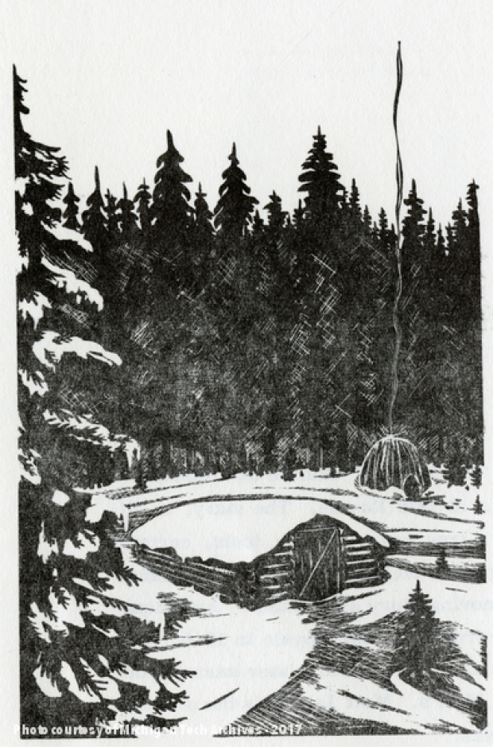
A sketch of the actual Angelique, courtesy of Michigan Technological University archives.
But that’s just what happened to a French voyageur and his Metis wife during 1845. Charlie Mott met 17-year-old Angelique and they lived at LaPointe on Madeline Island – although the movie makes it look like they were in Sault Ste Marie. Looking for work, Charlie is persuaded by some bigwigs from Detroit to visit Isle Royale on a mission to find copper.
Despite Angelique’s grandmother’s concerns, Angelique accompanies him and ends up being the one to discover copper – a huge mass. In the movie, the copper boulder is up on the shoreline but in reality, it was in the water. It’s summer and the Detroit men convince Charlie and Angelique to stay on the island for a few weeks so that the men have time to stake a claim. They said they’d send a supply boat and then they’d return for the copper and take them off the island before winter.
The couple agree and find shelter in an old fishing cabin on the island. They fix it up along with a birchbark canoe that’s there with it.
As you can guess from the movie title, the supply boat never comes, and the men don’t return before winter. What follows is a tale of perseverance, emotional strength, ingenuity and heartbreak. The themes revolve around being true to one’s roots and also (tongue in cheek), if your grandmother is having bad dreams about your impending trip, maybe you shouldn’t take it! I won’t give away any more of the plot in case you want to watch it.
An illustration from “Wolf’s Eye” Vol. 5, No. 4a. “Charlie and Angelique Mott: A tragic but true story of Isle Royale.” It depicts the living quarters of Charlie and Angelique Mott while they were staying on Mott island.
Isle Royale is not the easiest location to film a movie, so the film was shot in Terrace Bay (near Rossport) and Fort William in Ontario, Canada. The sand beaches are a dead giveaway – I don’t know of any sand beaches on Isle Royale. It’s all rock and cobble. I also don’t know of any rivers with huge rapids on the island like are in the lead photo for this post, but the stunted trees and rocky shoreline found in Canada are quite similar.
In all my time on Isle Royale, I never knew that Mott Island was named in their honor. It’s a small island where the National Park’s island headquarters are located off the main island. I was excited to see Native actress Tantoo Cardinal in the movie. She plays Angelique’s grandmother. I was in a movie with Tantoo and actually got to touch her arm in a scene! So, it was like seeing an old acting buddy, ha ha.
According to Mikel B. Classen’s blog, Angelique’s story was first written down as a footnote in the book, “The Honorable Peter White: A Biographical Sketch of the Lake Superior Iron Country.” That, combined with original research, inspired the book, “Angelique Abandoned” by James R. Stevens. His book was turned into a screenplay by Michelle Desrosier, an Indigenous woman from Canada.
Although some of the storytelling could have been smoother, I found the movie a meaningful tale of the power of women, the power of love, and belief in the forces of the universe.
Well, it wasn’t the series itself that broke the internet in my neighborhood, rather it was a virtual presentation about it by Netflix that seemed to break it.
About a month ago, I was invited to an exclusive virtual screening of a new television series that’s being made out of the book, “All the Light We Cannot See,” by Anthony Doerr. I was invited because I rated the book on Goodreads.
However, right when the screening was supposed to begin, the internet went down at my house. Luckily, I was able to access the event via my cell phone. I sure was glad I signed up for that new unlimited data plan!
The event began with an introduction of one of the series’ main characters (Aria/Marie). Then the first installment of the four-part series was shown. It was filmed in Budapest and is set to air November 2 on Netflix. This was followed by an enthusiastic conversation between Doerr and the series director, Shawn Levy. I recorded it so I could make this blog post, complete with quotes and everything.
If you’ve been living under a literary rock, you might not know that “All the Light We Cannot See” won the Pulitzer Prize for fiction in 2015. I attribute this to Marie being one of the main characters’ names. Ha ha.
Marie-Laure is a blind girl who crosses paths with a Werner Pfennig, a German soldier, in occupied France during World War II. After her uncle disappears, Marie takes over his nightly clandestine radio broadcasts from the attic. Werner’s job is to track down resistance operations, including radio broadcasts. His life and Marie’s collide in this book, which illuminates the ways people try to be good to one another against all odds.
I gave the novel five stars on Goodreads, saying, “This book has *almost* spoiled me for any other. The writing! The metaphors! The sensory descriptions! OMG. The flipping between time periods and character points of view were confusing at times, but it all works in the end. So, keep reading. You won’t be disappointed.”
The character of Marie is played by a woman who is actually blind, “That’s valuable detail that impacts and informs every frame of this series,” Director Levy said. He conducted a global casting search for the part.
“We got thousands of videos. One of them is a unicorn of a discovery. She’s never auditioned, she’s never thought about being an actress, she’s an academic,” Levy explained.
He chose Aria Mia Loberti. She’s an American who was a graduate student in rhetoric. She learned about the audition from a former childhood teacher. Aria was a fan of the book and this is her first acting role.
Levy optioned the rights for the story after it was rejected by another firm, which decided it was too complicated to tell in a single movie.
Levy directs all four episodes, a task that Doerr called “herculean,” but Levy said this allows for aesthetic continuity between episodes.
Levy decided to direct all four out of selfishness because he loved the book. “By page 12 of episode 1 of the script . . . I said, ‘Oh no, no, I can’t share. I need to direct it and I need to direct all of it because I want live in this world and create this world in a way that feels uniform and unified across episodes.’”
Levy describes the work as one story that happens to have four episodic breaks. “I knew if I could make myself happy as a rabid fan of this book, likely I could make other fans happy. That was my whole strategy.”
Levy previously directed “Stranger Things,” a sci-fi horror series on Netflix. He also directed “The Night at the Museum” movies and “Deadpool 3.”
Doerr said that the general advice writers get is to write what they know. “I like to write into what I don’t know.” With “All the Light,” he said to Levy, “often, I’d get one-and-a-half sentences in and just like you guys, I’d have to go and build the set.” He had to research what it was like to be blind during the time period of World War II.
Levy asked Doerr how he combines lyrical storytelling with a taut narrative action. “Often, as a novelist, you’re toggling between the tiniest microscopic details, which can take a whole morning . . . and then other days, you’re trying to move totally structurally, and think, ‘where’s this tiny moment in the book falling in the larger scope of the narrative?’” Doerr said.
Levy finished Doerr’s thought with: “Because you always have to keep the narrative in your mind. Always. But you also have to be hyper-focused on this shot. It’s like zooming in and out from a macro to a micro lens.”
Many people think the book’s title comes from the blindness of the protagonist, but this was not Doerr’s intention. He thought of the title while on a train to NYC to see his editor about the cover of his current novel at the time.
“There was a guy in the seat in front of me and he was on his big 2004 cell phone. He was talking about the movie, ‘The Matrix.’ I remember that quite clearly. As we go underground as we near the city and Penn Station, his call drops, and he gets unreasonably angry. I remember thinking at the moment that what he’s doing is a miracle. He’s got this tiny set – a radio — a receiver and a transmitter no bigger than a deck of cards, and he’s expecting this conversation to work at 60 miles an hour, sending these little packets of light between radio towers at the speed of light. And who knows, the person’s he’s talking to could be in Madagascar or France. I remember thinking that what we’re all taking for granted is using this invisible light that can pass through walls. It’s a miracle and so many generations of humanity never had access to this kind of communication.
“I wrote down the title (usually titles come really late to me) but I wrote down “All the Light We Cannot See” in my little notebook that I carry in my pocket before I had anything. All I had was a girl reading a story to a boy, which is how episode 1 really begins, over the radio. I conceived of her being blind and him trapped in darkness, desperately needing this story. I just wanted to play with all the metaphorical meanings of where are we living and what our human perceptions involve.”
Levy asked Doerr whether it is surreal to have this population of people living in your head for years and then to see them burst into life on the screen. Doerr replied that he was blown away by seeing Aria’s audition video and also by the younger version of Marie, played by a child actress named Nell.
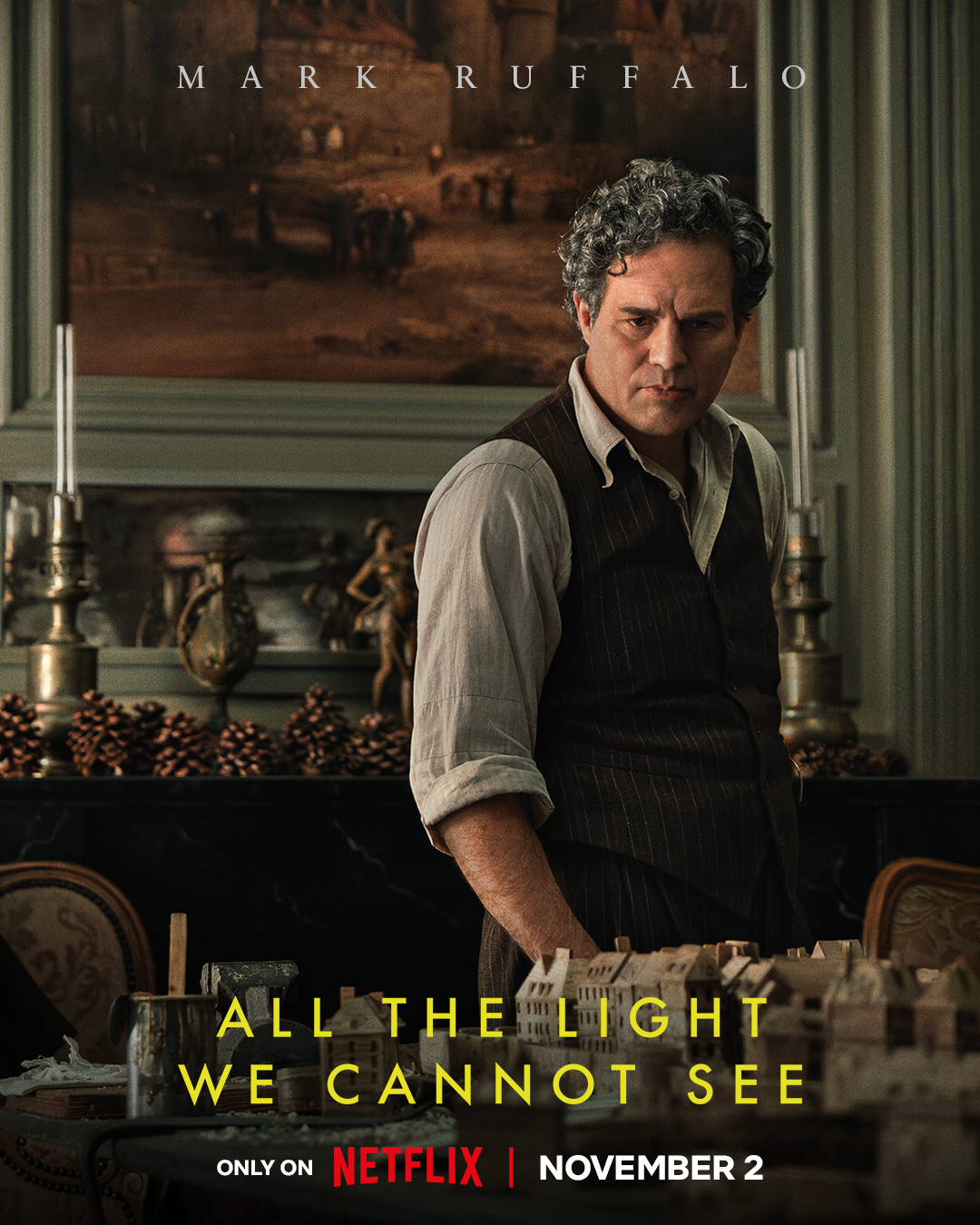
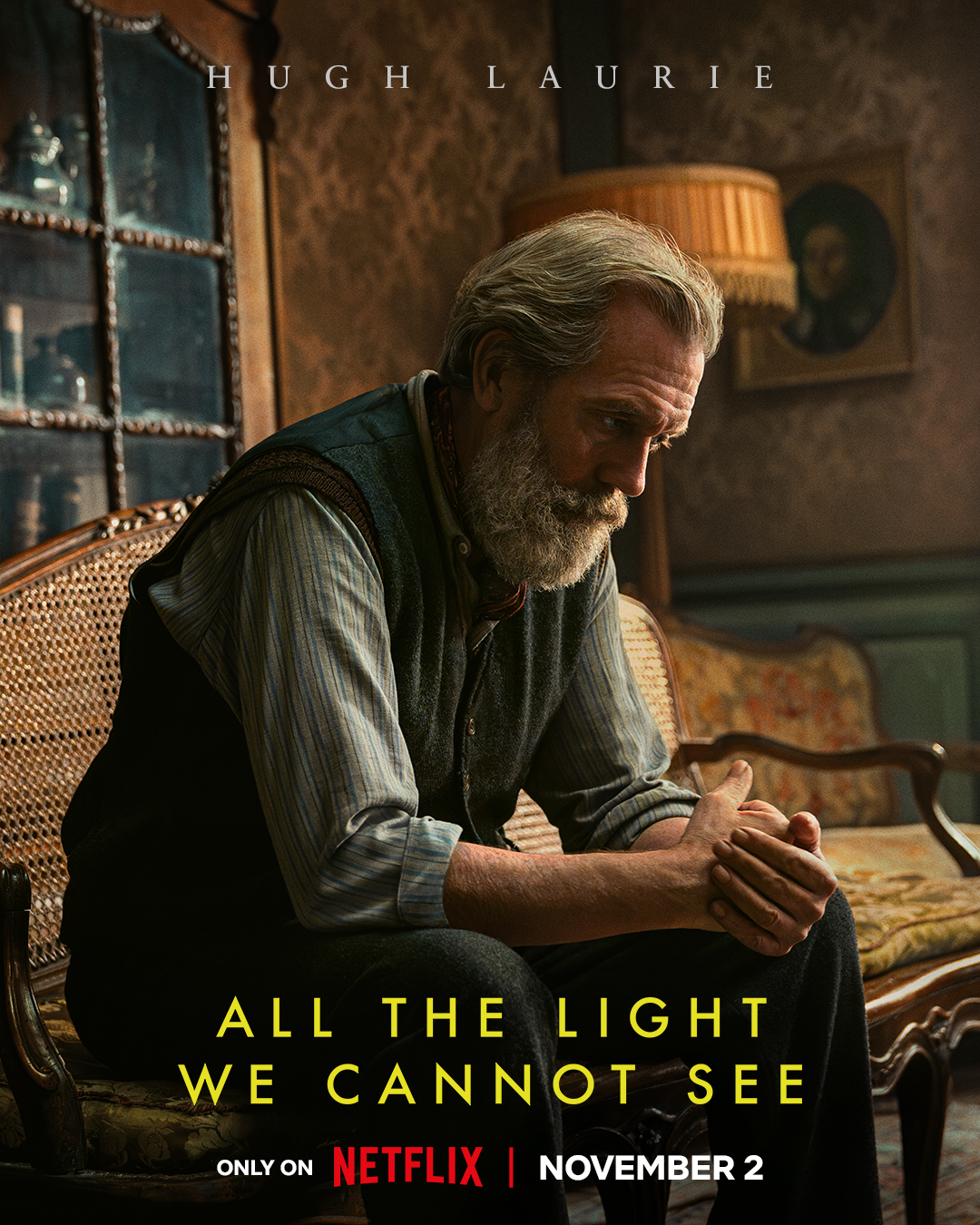
The movie stars other, more familiar actors, too. Wisconsinite Mark Ruffalo plays Daniel, Marie’s father. Hugh Laurie plays the reclusive uncle.
From being privy to episode 1, I can tell you that if you loved the book, you’ll love this series! I still can’t quite believe that I was invited to this preview.
Then the screening and conversation was over. Just as mysteriously, my internet reappeared at that instant. It made me wonder how many people got invited to this “exclusive” screening, anyway?
Unlike the man on Doerr’s train, I did not get unreasonably angry when my technology stopped working. I did get stressed out though, because I didn’t want to miss the screening. The irony does not escape me that my cell phone worked while the train man’s didn’t. And for that, we have to thank the miracle of invisible light that can pass through walls.
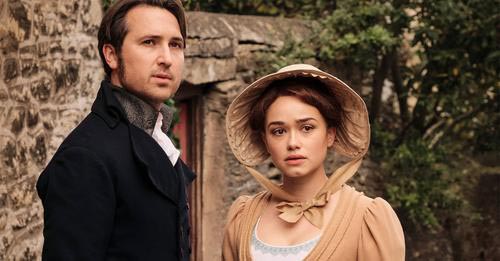
Characters from the series “Sanditon.” Image courtesy of PBS.
In my household, we’ve been watching the Public Broadcasting Service series, “Sanditon.” It’s based on an unfinished novel by Jane Austin – the last of her writings before she died. It’s set in England, of course, with strong and conflicted heroines.
Anyway, a social media announcement for last Sunday’s program said it was time to watch “the penultimate episode of Sanditon!”
I got all excited and told Russ that the best-ever episode of Sanditon was coming up. In our ensuing discussion I discovered that the word “penultimate” does not mean the ultra-ultimate of something like I had been thinking all these decades. Instead, it simply means it’s the next to last episode.
I was so disappointed. Not only because the series is ending and because the episode wasn’t going to be the best-ever, but because I’d been misinterpreting this word for so long. I don’t think I’d ever actually used the word anywhere, but it was a quite a blow to someone who is a writer.
I had fun thinking up a title for this post. Does the title mean this is the second to last mistake I will ever make in my life, or does it mean I am mistaken about the word penultimate? Or does it mean I’ve made the best mistake ever? 😊
Greetings! I hope all my dear readers made it through Thanksgiving in a healthy and happy way. But if you are getting COVID-isolation crazy and want to let off some steam, I humbly suggest you try the Hallmark Christmas Movie Drinking Game. I heard about this from a coworker and it sounded too fun to pass up.
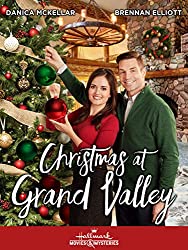
I got together with two people from my COVID bubble and we watched “Christmas at Grand Valley,” available for streaming from Amazon Prime. In this scintillating saga, which is cast in the Hallmark Movies and Mysteries series, Kelly returns to her Wyoming hometown (from Chicago) and becomes involved in an effort to save the town’s beloved lodge. In the process, she falls for a handsome widower sent to decide the fate of the lodge.
I’m not sure why this movie is considered a mystery. The only inkling of mystery comes in the form of, “WHEN ARE KELLY AND WIDOWER MAN EVER GOING TO KISS?”
Whenever certain things happen on screen, viewers must take a sip of their drink, or two sips, down the whole thing, or take a shot. I *think* (memory is fuzzy) I ended up drinking a whole bottle of wine between supper and the movie. It was great fun, plus I thought up some new rules, which are the ones posted in red.
Happy Holidays everyone!
RULES
Take one drink whenever:
A reference is made to a dead relative
The “Mayor” appears on screen
The main character’s name is related to Christmas (Holly, Nick, etc.)
Anytime someone disses fake Christmas trees
A newcomer partakes in an old family or town tradition
Hot chocolate, apple cider, or eggnog is on screen
A big city person is transplanted to a small town
Christmas caroling, a tree farm, or baking cookies appears
Mistletoe is on screen
A character makes a magic deal with Santa or an angel
Any time you hear “Jingle Bells”
The town is named something Christmas-y
Take two drinks whenever:
Characters experience a ‘near-miss’ kiss
An obvious product advertisement appears
A snowball fight or ice skating happens
An ugly sweater or tie appears
The characters are snowed in
A “Pride and Prejudice” reference is introduced (a character is named Darcy, a place named Pemberly)
Someone with slicked-back hair expresses their hate for Christmas
Finish your drink whenever:
The cynic is filled with the Christmas spirit
It snows on Christmas
Someone selects a Christmas tree
The main characters bake/cook something together, or Christmas-themed food is mentioned
Bad art appears or a literary reference is made
Dissonant architecture appears (for instance, a lighthouse in Wyoming)
Accordion music happens, especially if it’s playing Jingle Bells
Take a shot whenever:
The movie stars Candace Cameron-Bure, Lacey Chabert, or Andrew Walker appear

















 Marie's Meanderings