Autonomous Sensory Meridian Response: A Morning TV Breakthough

800px-Molly_Shannon_by_David_Shankbone

Molly Shannon image by David Shankbone.

I owe Molly Shannon (formerly of Saturday Night Live) a fathomless debt of gratitude.

I saw her on Good Morning America the other day. She was being interviewed about her new movie, “A Private Life.” In the beginning, she mentions how she loves being checked and patted down by airport security. It gives her a relaxed, spine-tingling feeling.

This captured my attention because of a blog post I wrote in 2015 about “A Scalp-Tingling Feeling” I get when someone writes on a chalkboard or I’m at a bookselling event and there’s the white noise of peaceful conversation in the background. It zones me out and is very pleasant.

I called it scalp-tingling contentment. Some of my readers called it “flow” or bliss, but thanks to Molly Shannon, I now know the syndrome is more properly defined as ASMR, which stands for Autonomous Sensory Meridian Response.

It’s an actual thing! I’m not crazy! There’s even a Facebook group for it!

People started working in 2007 to define it and by 2010, an organization was founded called the ASMR Group to support people who experience this feeling and to investigate it further.

Wikipedia says that, “ASMR signifies the subjective experience of “low-grade euphoria” characterized by “a combination of positive feelings and a distinct static-like tingling sensation on the skin.” It is most commonly triggered by specific auditory or visual stimuli, and less commonly by intentional attention control.” (Whatever that is.)

It’s amazing what you can learn from morning TV sometimes.

Lean Into Your Fear: Whitewater Rafting on the St. Louis River

pebd794cc-6d1a-4b89-a8a0-43eaca9722a7_c41a24d2-f4b0-4067-a203-838e20a4a2f3_m

Me (on the left in the red helmet) leaning into my fear on the St. Louis River.

When I write a travel post, because my blog’s name has the word “meander” in it, I usually open by saying I “meandered” here and there.

Well, I can’t use that term this time. It’s more accurate to say that I reluctantly agreed to go on a whitewater rafting trip down the St. Louis River this past weekend, and promised to scream all the way!

It all started when my friend Russ, who is an experienced kayaker, won a silent auction item at a fundraiser for the St. Louis River Alliance a few months ago. He won two tickets for whitewater rafting through Minnesota Whitewater Rafting, a local company that operates out of Scanlon, Minnesota.

Upon my insistence, we agreed to wait for the trip until the water was warm, to make it a more comfortable experience. Now it was August, month of warm weather and water, and I was out of excuses not to go. We gathered everything the company’s information sheet instructed rafters to bring: a dry change of clothes, snug-fitting footwear, windbreaker, towel, etc. And off we went.

Once we arrived, I was surprised by the number of other people who wanted to fling themselves into an inflatable raft at the mercy of the river – twenty-eight of us, to be exact, of all ages and fitness levels.

We started our three-hour journey by choosing one of the seven blue-and-yellow rafts lined up on the shore. Russ and I ended up paired with a young couple from St. Paul. A guide was assigned to each raft. Ours was named Logan.

To us oldsters, all of the guides looked like they were about twelve, but we hoped they knew what they were doing or they wouldn’t have been hired. Thankfully, this proved true!

The ensuing safety talk by the operations guy, named Blu, included instruction to ignore your instincts and “lean into” whatever fearful obstacle the raft encounters. He explained that if you lean away from the rock or high wave, you are more likely to lose your seat and fall out of the raft. Not that falling out of the raft is the worst thing that can happen, but most people like to stay with their group.

The other useful instruction was to keep your feet up if you fall overboard. This is helpful in avoiding sharp rocks and logs, etc., that are on the bottom. Plus, most people aren’t strong enough to withstand the current standing up, so you might as well just go with the flow until one of the kayak patrollers (who go with every trip) retrieve you.

Blu said that in a group our size, it’s common for at least one person to fall overboard. I sure hoped it wouldn’t be me.

I thought the “lean into” rule was particularly deep. Psychologically speaking, sometimes facing your fears is the best way to overcome them. Also, it reminded me of the book “People of the Lie” by M. Scott Peck, who says that most people’s psychological problems arise from trying to avoid emotional pain instead of addressing (leaning into) it.

I decided then and there to change my attitude about the trip – to stop seeing it as something fearful, and instead see it as something to relish, and an opportunity to know the river better. I mean, I’ve lived by it most of my life. I’ve canoed on it, paddleboarded it, boated on it, but I’d never immersed myself in it.

As the company’s website and instruction sheet promised, you will “see the river, feel the river, ride the river,” and you will get wet! On this sunny warm day, I was up for that.

Blu explained we’d encounter six sets of rapids ranging from Class I to III, and two sets of riffles. Each set of rapids would get more challenging along the four-plus-mile stretch until we reached the quiet-water reservoir formed by the Thompson Dam.

Safety talk over, we set out upon the water. Our first task was to run through a “slalom” course between the pylons of the freeway bridge that goes across the river. This let us practice paddling different directions and experience what it feels like when the raft bumps into things.

Then we paddled through a set of riffles called “Warm-Up Rapids.” Everyone came through unscathed and, after stopping for an orientation, we continued to a set of surfing waves at “First Hole” rapids.

Have you ever seen standing waves that form behind an underwater rock in a river? That’s what we surfed on – if your idea of surfing involves your raft filling with water, which ours did. We surfed several times, bailing out between sessions with the handy bailers provided in each raft.

p9091eedc-1216-426c-9429-98f3600b2324_671929cc-bda5-4d31-b3db-2344e2e28a00_m

Surfing the hole and having fun!

After another group orientation session, we were onto “Two Hole” rapids. I think it was this one that had a big rock in the middle of it. Logan, our guide, thought it would be a good and fun idea to smash our raft into the rock.

On purpose.

Why he thought this was a good idea, I’ll never know! I always thought the whole idea of river rafting was to avoid the rocks. I guess I’ve been wrong all this time.

Granted, he did give us a choice, so we were complicit in the decision. I blame it on the adrenaline rush.

Paddling as hard as we could, our raft went up and over the rock, then started sliding sideways. I was on the outside side – the tippiest side – and remembered to lean into the rock to avoid falling out of the raft. I almost floated out, but managed to stay in by the skin of my teeth. Rather like dental surgery, it felt so good once it was over!

Our next stop was a canyon that featured a couple of small beaches in a slow section of the river. We grounded our rafts and had the chance to swim for a while, clothes, lifejackets and all.

Russ went all the way in. I was fine going waist deep, not because I was worried about polluted water or anything, but because the water was rather chilly to me even for a warm day.

At this point I realized I had never been this far into the river before; me—who had even worked for the St. Louis River Alliance whose sole purpose is to protect the river. I marveled at the brown water – tea stained from the many wetland plants steeping at its headwaters and along the way. The white pines and bare rock faces along the shore looked primeval, like we could have been miles into a wilderness. The beauty filled me  and gave me a new sense of appreciation for the river.

Our rest stop over, it was time for the big guns in terms of rapids. We made it through “Hidden Hole” just fine, then it was onto “Electric Ledge,” which is a Class III rapids that consists of a four-to-six-foot drop.

I had heard the name of this rapids whispered in awe among my kayaker friends for years. Now we were about to go over it! And we were about to go over it before any of the others. Logan explained that our raft had the first aid kit in it, and we needed to go first in case the other rafts needed assistance once they ran the ledge.

Not only were we in the first raft, but Russ and I were sitting in the FRONT of the first raft. Oh, lucky us.

We didn’t have much time to wonder at our luck as the ledge was approaching. I repeated all the rules: lean into your fear, keep your feet up. Then we slid over it, sideways and steep. Russ grabbed onto my arm for support.

Luckily, that steadied him and we both stayed in the boat. So did the rest of our crew, but I can’t say that for one of the other rafts, which did indeed lose one person over the ledge. The person remembered the rules, however, and they were uneventfully picked up not far downriver.

The final set of rapids, “Little Kahuna,” is more technical than terrifying. After some twists and turns, we made it through just fine. From there, a somewhat longish paddle across peaceful water (known as the Boundary Waters to the staff) took us to the end of our journey and a bus that was waiting to drive us back to our starting point.

So, in summary, I did scream as initially promised, but it was from fun, not out of fear. I think this was due to the great job the staff did at letting us know what to expect from each set of rapids. I hadn’t had that on other rafting trips.

I would totally do it again on some warm day (although they do provide wet suits if it’s cold and you want one). And I would totally bring family members on such an adventure. Don’t let a little fear stop you if you have a hankering for some whitewater!
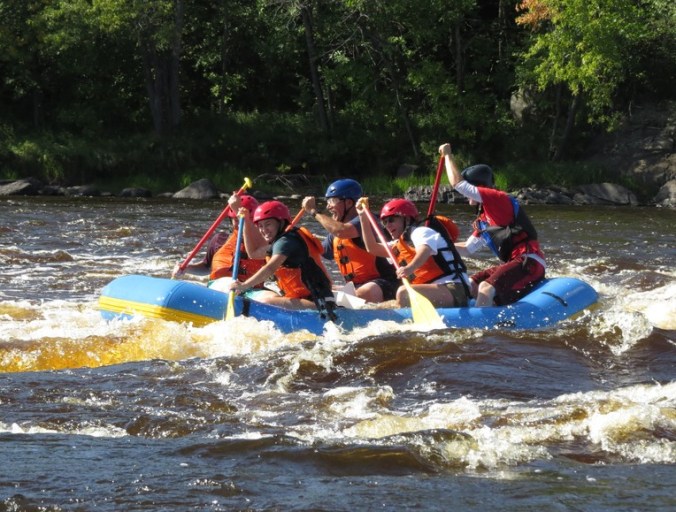
pb4537e2e-9595-42bc-b3f2-dbdd9d761701_cddf1de5-0eef-4962-8d2c-b16f78487c4b_m

Yee haw!

Yin Yoga in a Yurt

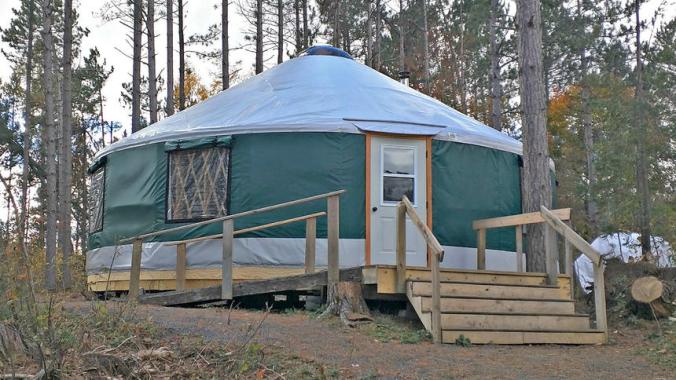
Hartley new yurt

Image credit: Hartley Nature Center

I seem to have a tendency to try different forms of yoga. Several years ago, I began regular yoga, then I tried hot yoga, then Thai yoga, and then aerial yoga.

Although I often practice regular yoga and hot yoga, in keeping with my yoga adventurousness, this week I tried yin yoga in a yurt.

The class was offered by Runa Yoga in Duluth. In addition to classes in their studio, they offer classes in different locations around town, including a Yoga + Beer class at a microbrewery.

We met at a city park inside a yurt owned by Hartley Nature Center. You may already know that a yurt is a round canvas tent with a wooden frame. This one was nestled in the woods, offering views of red pine tree trunks all around, and was large enough to fit 30 yogis.

The teacher said that yin yoga focuses more on stretching ligaments and joints than other forms of yoga. Our session featured live ambient music performed by two local musicians. I found it strange, however, that these musicians showed absolutely no emotion while performing. Even when the instructor introduced them, they remained stone-faced.

Is robotic-like behavior a prerequisite for ambient music performers? I have no idea. They DID smile after the class was all over, though.

It’s a mystery.

Their music was so ambient and so relaxing that at the end of class, when we were all in our final resting poses, I swear the guy in front of me started SNORING. Thankfully, he awoke once it was time to go, saving himself from further embarrassment. I wonder if anyone would have woken him at the end if he had just kept sleeping?

Yet another mystery.

Despite all the mysteries, or perhaps because of them, yin yoga in a yurt was cool. If you’re looking to switch up your routine, I recommend it. Just bring a friend along to wake you up in case it gets a little too relaxing.

Still Living in a War Zone

Planning Comm Mtg KBJR-TV

The Duluth Planning Commission. Image by KBJR-TV.

The rezoning plans for my neighborhood in Duluth are still alive. (For background info, see my previous post.)

The process is dragging out. Plans to rezone parts of Kenwood from Traditional Residential to Mixed Use Neighborhoods (and thus open them up to commercial developments) were supposed to be voted on at a planning commission meeting last month. But that meeting got postponed until this month.

In some ways, the delay is good because we were able to notify more neighbors about the plans. I drafted a form letter and distributed it to help give my neighbors ideas on how to respond to the commission, and they distributed it to other neighbors who were interested. We also had neighborhood meetings as part of National Night Out, and invited our city councilor to attend and offer advice on how to organize. (He is not in favor of the plans.)

In other ways, the delay is bad because it just drags out the uncertainty longer. At least one home on my street has been put up for sale because of the impending rezoning. I have delayed a much-needed backyard landscaping project because I don’t want to invest a bunch of money in a house that might one day overlook a parking lot or a bunch of business dumpsters instead of the current nicer view of my neighbors’ homes and large trees.

The fight also wears people down, so I’ve been careful not to let it consume me too much. I only pay attention to it when I have to. I’d much rather pay attention to Duluth’s ephemeral summer outdoor activities.

Things came to a head earlier this week when the rezoning plan was brought before the planning commission for a vote. Dozens of my neighbors packed the top floor of Duluth City Hall in the city council chambers, which are not air conditioned and were easily ninety degrees. Lucky me had the joy of hot flashes added on top of that.

True to form with this process, the first part of the meeting dragged out. We sat on the hard wooden benches for two hours before our rezoning issue was brought forward. It took so long that our city counselor had to leave for another engagement and wasn’t able to speak on our behalf. I was so disappointed in that!

The meeting was also held on primary voting night. Who does things like that? It almost makes one wonder if the planning department was trying to bring up the issue on a night when people had conflicts.

In the letter we received informing us of the delay in the meeting date, the planning commission threw us a bone, perhaps because they were receiving so many letters in opposition to the rezoning. They offered to “downzone” two outer areas in our neighborhood that currently could feature commercial development, in effect, making them Traditional Residential Neighborhoods in exchange for “upzoning” my neighborhood and several surrounding areas.

This downzoning was the first of our neighborhood issues brought before the council. During the public hearing time, nobody spoke in opposition to this move, although one planning commissioner was concerned that approving it would “tie the city’s hands” in terms of future development options, depending on what happened with the discussion of “upzoning” our neighborhoods.

So the issue was combined with the discussion of our neighborhoods. The commission gave first speaking rights to those in favor of the rezoning. Only one person spoke: Dave Holappa, a realtor who owns a house in the rezoning area. He whined (it’s my blog, so I can have opinions!) that when he bought the house in 2006, comments by city staff gave him the impression that rezoning would happen faster than it has. It’s pretty obvious that he wants to buy more properties in the neighborhood so that he can sell them to a developer because “developers want a significant land parcel in place.”

Then came the time for those opposed to the project to speak. Five people did so. The first was Jim P. who lives in my neighborhood. He eloquently said that it makes no sense to allow for the possibility of commercial development in a healthy, functioning neighborhood with families. He stressed the city’s need for single-family housing, of which our neighborhood has plenty.

“Development would totally change the neighborhood,” he said. “Why take an achieved goal to try and reach another goal? You’re telling our neighborhood that our homes are not as important as more commercial development.” He stressed that our neighborhood already has enough such developments (Kenwood Village, the shopping mall, a Walgreens, etc.)

As Jim left the podium, he asked all of those in the room who agree with him to stand. In a moving show of solidarity, almost everyone did. I suspect those who didn’t were in the room for other issues on the agenda. (Oh, and I bet Dave Haloppa didn’t stand.)

The next speaker was Tom B. He said that there’s already a lot of apartment buildings in the neighborhood and that it can’t sustain more. Right now, the area has many good neighbors and that the rezoning proposal would not make for good neighbors.

The third speaker was Chad R., who lives in a street behind Kenwood Village, a new apartment development. He listed all the problems that the new development caused for residents of his street, punctuating each one with a tap of his finger on the podium. He argued that the issues caused by previous developments need to be solved before new developments are built. The audience applauded him when he was done.

Another speaker made the point that traffic in the neighborhood is so bad it already takes him ten minutes every day just to get out of his driveway. Because there’s no development project pending for the rezoning area, he didn’t see the necessity of pre-emptive rezoning.

After a lengthy discussion, the planning commission decided they needed more information to make their decisions. They tabled both rezoning issues as topics for a “brown bag discussion.” They will be taken up again next month.

So, the good news is that after we all passed three hours sweating and gaining sore butts from sitting on those hard benches, the rezoning didn’t pass. The bad news is that the war will be dragged out even longer. But at least the commission is taking the matter seriously and is putting time into it.

As I left the building, one of my neighbors commented, “If this is government at work, then it’s obvious that government needs a better budget for air conditioning!”

That, at least, I can agree with. And I’m going to bring a pillow to the next meeting.

“I was blown up eating cheese.”

That’s my favorite quote from the 1932 movie, “A Farewell to Arms,” starring Gary Cooper. He says it when he’s in the hospital after being wounded in a bombing. His doctor friend is about to operate on him and asks if he was doing anything heroic during the bombing. All Gary Cooper can come up with is, “”I was blown up eating cheese.” LOL!

Somehow, I don’t think a line like that would ever happen in today’s movie industry.

Gary Cooper

Living in a War Zone

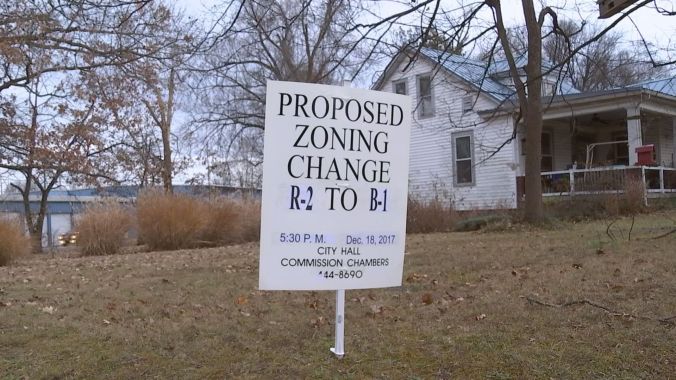
ZONING-CHANGE

Image from a different neighborhood zoning war that occurred in Kentucky, Image courtesy of WPSD-TV.

My neighborhood is in a war. We are not fighting with each other. Instead, we’re fighting against a more elusive and dangerous foe: the specter of commercial development.

We all received letters in the mail from the city planning department, which described a proposal to rezone our neighborhood from a Traditional Residential one to a Mixed Use Neighborhood. This could open up our streets to stores and businesses.

When I bought my house nineteen years ago, one of the major selling points was the “quiet neighborhood” where it was located. Even though it was near a shopping center, on the other side a massive city park offered a bit of wilderness, not to mention periodic backyard visits by deer, bear, and moose.

Friends and acquaintances who heard about my new home congratulated me. “It’s the nicest street,” they said. And it proved true. The street was full of long-term residents who cared about their community and their neighbors. We helped each other during snowstorms, floods, and ice storms.

Even 19 years later with new residents, the helpfulness is still there. My neighbors are invested in their homes and in making the neighborhood a good place to live.

But already, commercial development is encroaching. Two banks and an insurance agency take up one end of the street, which fronts a busy main artery and the shopping center. Basically, the planning agency proposes to extend that business district farther down my street and one block over, rezoning areas where people’s homes currently sit. The rezoning would impact 8 or 9 homes. My home is outside the area by the width of one home.

Our property taxes have increased due to a new apartment and business complex built a block away. I would not be surprised if someone wants to build something similar on my street.

Last week, the planning department held a public meeting about the rezoning proposal. There are three spots they want to rezone. Nobody protested the other two, which are located along already busy streets. All of the discussion focused on the plan for my neighborhood.

Residents, especially the ones in the homes inside the rezoning area, were concerned and angry. Some have already been approached by a developer, who also had the cajones to be at the meeting and to speak in favor of the rezoning. (You should have seen the nasty looks he got! My neighbors might be nice, but not when their way of life is threatened.)

At the meeting, one of my neighbors said that it makes no sense to rezone an established neighborhood to a Mixed Use Neighborhood and invite more development right into the middle of it. I agree with her.

My home was built almost 100 years ago by Swan Gustaf Anderson when he was 72 years old. His $450 mortgage was held by the Supreme Lodge of the Sons of Norway. I am the eighth owner of the house. I’ve been investing a lot in upkeep and remodeling of my home, but if rezoning occurs and a retail or apartment development goes in, I would be a fool to continue making that investment in a property that may one day have a view of dumpsters or a parking lot instead of big trees and homes.

This rezoning idea goes against provisions for Mixed Use Neighborhood development in Chapter 50 of the City of Duluth Legislative Code. One of the purposes of establishing a Mixed Use Neighborhood District is to, “Encourage mixed use redevelopment, conversion and reuse of aging and underutilized areas, and increase the efficient use of commercial land in the city.”

Our neighborhood is not “underutilized.” It is home to families who have lived there many years. Our homes may be aging, but they are all in good shape because we have invested in them. I would also argue that it is not an efficient use of commercial land in the city to displace people from an established neighborhood.

It also goes against one of the governing principles in the city’s comprehensive land use planning document. Principle #5 on Strengthening Neighborhoods says:

The present city is an historical amalgam of villages and other independent units of government, contributing to the present condition of Duluth being strongly defined by its neighborhoods. This condition should be reinforced through land use, transportation and public service delivery patterns which strengthen neighborhood identity. New institutional expansions, major public infrastructure or large commercial or industrial uses should not divide historic neighborhood patterns.

Allowing a commercial development right in the middle of our neighborhood is no way to strengthen it.

Fighting a zoning war is not how I wanted to spend my summer, but it’s necessary, I guess. Here we go!

How a Print Writer With a Lisp Turns to Radio

20180318_080010

Tools of the trade for the Twin Ports Newspaper of the Air.

On a recent Sunday morning, I faced a test of my skills when I led a radio broadcast for the Twin Ports Newspaper of the Air (TPNA) for the first time. This is a service of the Lighthouse Center for Vision Loss in Duluth. I am one of about seventy volunteers who read local newspapers every morning for two hours over a closed-circuit radio system for people who can’t read the newspaper themselves. Some are blind and some have had strokes and can no longer hold a newspaper.

Now, if you know me, you realize that getting up early on a weekend morning is definitely not in my character. But I enjoy reading the Sunday paper. I was looking for an organization to volunteer for, and because I have a background in audio work, this just seemed sort of fun.

Once a month, I haul myself out of bed at 6 a.m. and head down to the Lighthouse Center. We have two copies of the newspaper and read in teams of two, switching off every other story. The leader opens the broadcast, keeps track of time, reads public service announcements and the weather forecast, and has final say on which stories get read.  All the other person needs to do is read their assigned stories. It’s much easier not to be the leader!

We don’t have time to read everything in the paper, so we concentrate on news listeners can’t hear elsewhere – the local stories. Other broadcasts focus on national stories, so we don’t need to read those. The obituaries are a big draw, so we are required to read them at the top of the hour. Some people tune in just for those.

It’s tricky because the broadcast is live. If you mess up something, you need to muddle through the best you can. If you have a coughing fit, you need to run out of the room and cough outside, with your partner taking over instead. If you need to pee, you have to hold it until it’s your partner’s turn to read a longer story so that you have enough time to go.

20180318_080050None of these things have happened to me yet, although I did lose track of a story once. With all the story page jumps in the newspaper, it can be confusing to know which page to find it on. Thankfully, my partner noticed my confusion and handed me his copy of the article.

Besides having to overcome my natural weekend laziness, another reason this volunteer job is a challenge is because of the speech impediment I had as a child. In elementary school, while my classmates were out playing during recess, I was sitting in a room with four or five other children, practicing my “s”es.

I wasn’t aware I had a lisp until I got singled out for Speech Class. In fact, when I first heard about the class from my teacher, I thought it involved learning how to stand up in front of people and give speeches. I imagined that might be sort of fun.

It wasn’t until I started going to the class that I understood it involved the drudgery of practicing how to speak correctly. Once a week, we would sit around a table, concentrating on how our tongue moved in our mouths. I needed to learn to redirect the tip of my tongue to the roof of my mouth when speaking, instead of thrusting it forward against the back of my front teeth.

We practiced tongue-twisters and were drilled on certain sounds over and over again until we got it right. I don’t recall how many weeks I was in Speech Class, but I must have made progress because I was able to rejoin my classmates full-time.

My foray into audio began years later in graduate school, when I decided that learning how to do a radio show would be a more interesting capstone project than writing yet another article.

Some nice ladies at KUMD Radio (Thanks Christine Dean! Thanks Lisa Johnson!) were willing to show me how to record and work with the files, and I produced a pre-recorded series called Listening to the Lake, which had public health and environmental themes.

I found my “radio voice,” and this led to a later series called Superior Science News on KUWS Radio, which was produced by Dani Kaeding. Lo and behold, nobody complained about my “s”es.

Along the way, I got to see these radio professionals at work, and always marveled at their ability to simultaneously load CDs, remember to announce the time, and find the day’s weather forecast to read.

Now here I was, groggy on a Sunday morning, put to the test to see if I measured up to my radio lady role models.

I’m happy to report that everything came off without a hitch. They, and my speech teacher, would have been proud.

Creativity, Motherhood and Rats: How They All Go Together

Mom rat and baby

Image by Howcast.com.

I was asked to give a short talk today on creativity and motherhood for a local organization. Here’s the result:

When I became pregnant with my first child 26 years ago, I started to panic. It wasn’t that I was afraid something would be wrong with my baby or that I was afraid of the labor process — although these are justified fears and I did think about those things.

The real issue was, I was afraid that the idea I had for a novel would be subsumed by the demands of a newborn. Having a child would strike a death-knell for my creative dreams. My story would never see the light of day. I had floundered around with writing it, and had come to the realization that I needed help. This fear was foremost in my mind when I signed up for a novel-writing correspondence course offered by Writer’s Digest Magazine soon after I found I was pregnant.

I had heard all the cultural messages that tell women that being creative and having children are incompatible, and I believed them.

The novel-writing course provided me with structure that saw me through the rest of my pregnancy and motivated me to keep working on the story once I had my baby boy. The instructor’s encouragement also helped.

Even so, it took me a long time to finally finish my novel and to get it published — as long as it takes to grow a child into adulthood.

The thing that held me back wasn’t motherhood, it was waiting for the right moment to feel creative – the moment when I wasn’t busy, stressed, or emotional. I was too much at the whim of my outside life. I hadn’t learned yet how to control my inner life and allow room for the creativity to flow no matter what was happening “outside.”

A recent article in The Atlantic Monthly magazine backs up the premise that having children does not harm creativity. In fact, it can change the biology of the mother in ways that can allow for even greater creativity.

Kelly Lambert, a professor of behavioral neuroscience at the University of Richmond, studies the maternal brains of rats. Yes, on Mother’s Day, I am going to talk to you about rats, and their brains, no less. Lambert found that when rats become mothers, their brains, which are closer in structure to a human’s than even those of mice or dogs, start reprogramming themselves.

Their sensory and motor systems sharpen. Their circuitry becomes more efficient. Maternal rats are more direct and lethal hunters, catching their prey four times faster than non-mom rats.

Even after having their babies, the changes persist. Lambert found that the mother rats experience less memory decline in old age and have quicker navigation skills than non-mothers, outsmarting them in mazes.

Although neuroscientists do not yet understand what direct impact pregnancy and childbirth have on the human maternal brain and creativity, I am here to testify that, yes, it is possible to be a mother and be creative, too. And I’m sure plenty of other women can testify to this. It’s just that sometimes when you’re a parent, you have to find more creative ways to allow for that creativity.

If you have a partner, have them take care of the kids for a while so that you can go on a writing retreat. Don’t allow your creativity to take a back seat to the other demands of life. Try different things until you find something that works for you.

I learned how to make this inner creative space while I wrote my second novel. Even though I had a second child by this time, after reading a story about right-brain, left-brain thinking and how to make both sides of your brain work together to foster creativity, I learned how to put myself in that elusive creative mind zone, instead of waiting for the zone to come to me. Thanks to this, it only took me two years to write and publish the second one.

You don’t need to be superhuman to have children and to be creative. Mothers have been doing it forever. As the magazine article said, creativity takes time and periods of reflection, and a willingness to let go of ideas that don’t work and move on to better ones.

Learning to look at the world through the eyes of your children, be they yours biologically or children of your heart, is not a bad way to make your own thinking more flexible.

Vegan Shoes, Who Knew?

Vegan shoes

Did you know there’s such a thing as vegan shoes? I didn’t either, until I bought these, and the veganism came as an unexpected side benefit. They feature “microbuck vegan leather uppers,” whatever those are.

Does this mean I can eat them if I get hungry?