Does it bug anyone else when television news makes a big deal about the body of murder victim being found in a “shallow grave?” As if a deep grave would make any difference. Oh yes, so-and-so was killed, but at least they were buried in a deep grave, so everything’s cool. Gah!
Musings
How I got Jane Goodall to Stick her Head in a Potted Palm Tree
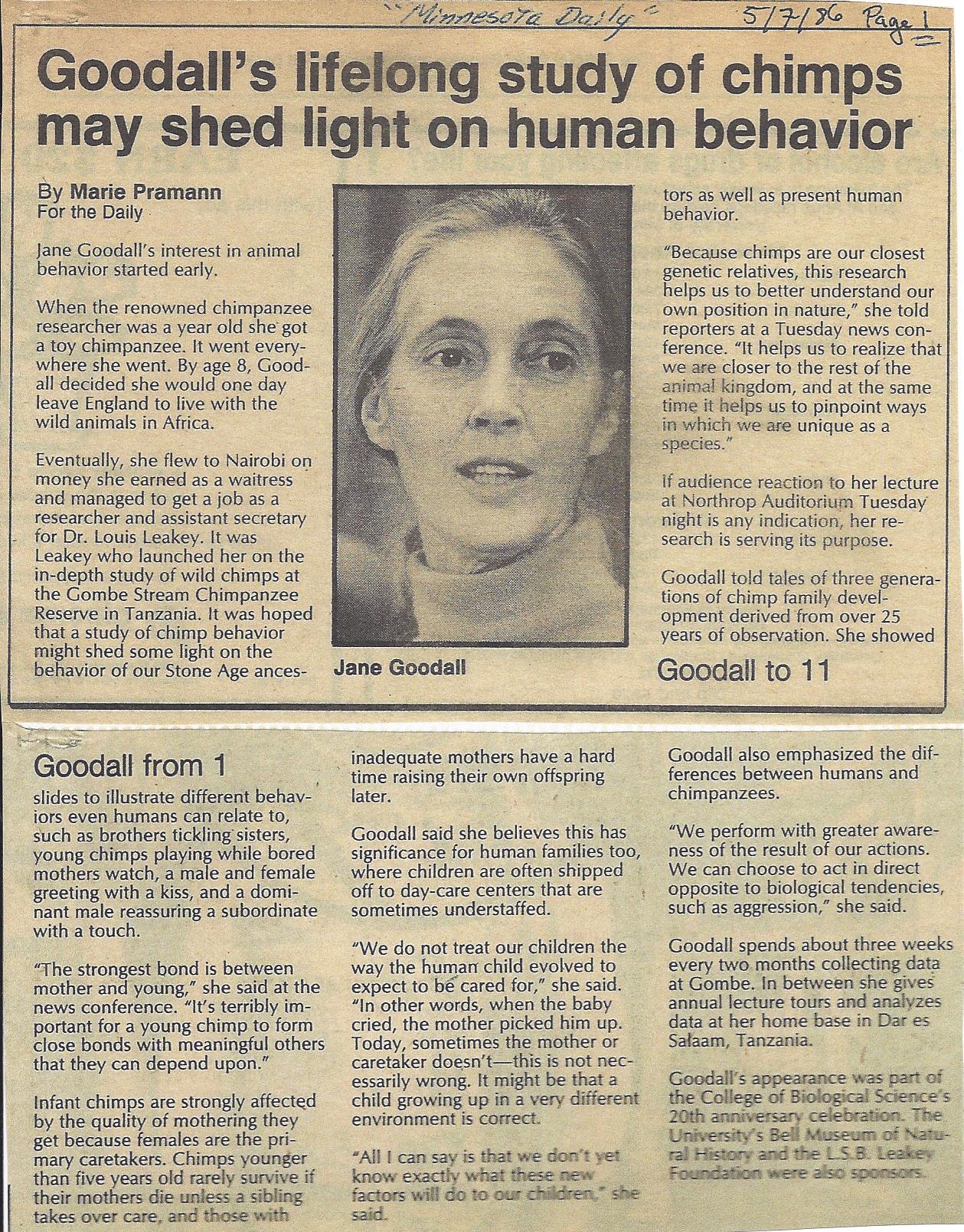
A recent news story about chimpanzee researcher Jane Goodall reminded me why she’s one of my favorites of the scientific glitterati. Here’s a link to the Huffington Post video story. Basically, she’s saying that researchers need to have empathy with their subjects in order to conduct ethical and meaningful science. I agree!
I had the chance to meet Jane (I don’t think she’d mind if I call her by her first name – she’s that kind of a person) back in my glory days as the environmental reporter for my college newspaper, the venerable “Minnesota Daily” (best college newspaper in the country!) Jane came to town to give a talk on chimpanzee behavior and DNA, and how similar they are to our own.
She presented to a packed auditorium and afterwards, hosted a news conference. I sat in the front row along with a photographer for the paper. I don’t remember what questions I asked, but I do recall being impressed by Jane’s seeming kindness and approachability.
During the news conference, the photographer and I surreptitiously discussed good locations in the room to take her photo afterwards, both agreeing (with the logic of college students) that the potted palm next to her podium would be ideal. She did work in the “jungle,” after all! However, the thought of asking Jane Goodall to stick her head among palm fronds filled me with anxiety. Would she be insulted? Have us thrown out of the room? Turn around and walk off in a huff?
Once the news conference was over, no other reporters seemed to want to talk to Jane, so I approached – probably gushed about what a big fan I was – and put forth to her the photographer’s plight of getting her photo against an interesting background. I couldn’t believe our luck when she pointed to the palm and said, “Well, why not here?”
Amazed and relieved, I agreed. Unfortunately, the palm tree photo did not run with the story — the photo editors ran a boring head-shot instead. But I will always remember how gracious and accommodating Jane was, and how willing she was to stick her head in a potted palm for a college reporter.
On the Ice Bucket Challenge and Apologizing for Happiness
My youngest son wanted me to video his friend dumping a bucket of cold water over his head, joining the masses participating in the ALS Ice Bucket Challenge. This was back a couple of weeks ago when it was all the rage. I agreed and probably laughed about it. My son then proceeded to make a snarky comment and went outside to join his friend who was waiting in our driveway with the bucket.
Stunned by my fifteen-year-old’s comment, I stood in the kitchen, at war over whether to call him out on it, but also feeling pressure to go outside and take the video. He doesn’t usually say such things, but the past few days, I’d noticed an edge to him that hadn’t been there before.
When he came on the porch looking for me, I motioned him into the house. I told him that if he wanted me to do something nice for him (take the video), he needed to be nicer to me and apologize for his comment (the words to which I can’t even recall any more).
He apologized and we had a rather heated discussion about what was wrong. It turns out, it’s all my fault. I was laughing too much. It annoyed him.
Now, even if I do say so myself, my laugh is not annoying. In fact, back when phone contact was the norm, my Allstate agent used to call me and crack jokes just to hear me laugh. He actually admitted this to me. My laugh is hearty, yes, but not unusually frequent. And I’m not one of those people who goes around smiling all the time. But, as you can probably tell from this blog, I do have an easy and strange sense of humor, and enjoy laughing when I have the chance.
Before I knew what was coming out of my mouth, I apologized to my son for being a happy person. In part, I did it to show him the absurdity of his complaint. I also did it because he had apologized to me and I was trying to move the discussion forward. Other parts of our conversation revolved around the need for him to find a way to deal with hearing his mother laugh. I have many things I could be sad about. I’m nowhere near as resilient as I used to be, but I’m not about to stop laughing any time soon. Afterwards, we went outside and commenced with the icewater dumping.
Last night, we had an airing out session about several things, and we talked more about the Terrible Awful Problem of having a happy mom. I told my son it’s rather normal for teenagers to get annoyed, especially when they are sleep-deprived. The day before the annoyance incident happened, he had his friend over for a “sleepover,” which usually involves almost anything but sleeping. We also talked about how annoyance over little things can be a waste of time and energy, and we both laughed about how silly it was to be annoyed by happiness. He assured me his annoyance wasn’t because he was unhappy, but because of hearing my laugh so often lately.
If having a happy mom is the worst issue for my son, I’d say we are doing all right.
The Fantasy Suite (er . . . Room)
Have you ever had an empty room in your house? I do, and it’s wonderful! Remember my temporary roommate? Although she moved out over seven months ago, I am still housing her furniture in my spare bedroom. She wasn’t making any concrete progress to find her own apartment (she’s still living with someone else who doesn’t have room for her furniture), so I decided to move her stuff to my garage. [Thank you friend who helped me move it!]
And now I have this echo-y empty room. What to do, what to do? . . . The possibilities are limitless. I don’t need to make it into a bedroom at this point, so I’ve decided to make it into an exercise and yoga room. Why? Because these lyrics of Paul Simon’s song, “You Can Call Me Al” resonate a bit too much with me: “Why am I so soft in the middle / The rest of my life is so hard.”
I’ve already got my yoga mat, hand weights, and stepping stair in there. Now I just need to drag the elliptical strider up from the basement. I figure there’s a greater chance I’ll actually use it if I see it every day. Sure, I could join a fitness center, but as a single mom with aging parents and a needy dog, the demands on my time are varied and great. My fantasy is that now, I’ll be able to just pop into my exercise room instead of making a big production of things by driving somewhere else.
It’s not like I need to lose weight (although dropping ten pounds would not be bad), I just need to get fit again. I sit almost all day at a desk job, which is the hardest thing a person can do to their body. And in the evenings, I often sit some more blogging and writing novels. Unless a person has some form of exercise, the sitting will catch up to them. I have already learned this the hard way in the past, and I’d rather not have those back problems back, thank you.
Maybe I can wire the room with a sound system for exercise-inducing rhythms or New Age yoga music. Add some mood lighting. Put some art on the wall. Here we go. Wish me motivation!
Saving a Skyrat – Part 2
When my co-worker and I were debating whether to save the listless gull that appeared outside our office last week, she said something like, “Usually, I like to let nature take its course . . .” and I interjected, “But it’s often not nature that causes things like this, it’s humans.” I was remembering a gull I rescued many years ago that had been hit by a car.
As it turns out, although the gull at our office was put in distress by a natural process, the cause probably was us. As you may recall, when I brought the gull to the wildlife rehabilitation group, they said they thought the cause was a Vitamin B deficiency. (To be exact, a Vitamin B1 or thiamine deficiency.) They weren’t sure what was causing it, but suspected it had something to do with the gulls eating dead fish.
Back at the office, that got us thinking, especially after we learned the Wildwoods group had received three other gulls with the same problem that week, and after learning that two other co-workers had seen other gulls exhibiting the same symptoms: wing droop, loss of the ability to fly, and loss of the ability to “speak.”
Being of a scientific bent, we started researching the problem and came up with a paper published in 2009 about herring gulls and other birds in Europe that were dying of a thiamine deficiency. The researchers named the affliction “thiamine deficiency syndrome.”
In the paper, the researchers described the exact symptoms we were seeing: “The general course of this disease in full-grown individuals is difficulty in keeping the wings folded along the side of the body, inability to fly, inability to walk, and death. Other symptoms are tremor and seizures.” They said that the length of time between when a gull loses its ability to fly and death is 10-20 days. Turns out, this was the same paper that the Wildwoods people had discovered last year in an attempt to help more than a dozen gulls with the syndrome.
The researchers attributed the syndrome to “a causative agent(s) acting directly on the affected individual, and/or by insufficient transfer of thiamine between the trophic levels in the food web.” They cited an urgent need for investigation into the cause since bird populations in Europe were declining rapidly.
Putting together what we knew got us thinking: what kind of fish-related problem could cause a thiamine deficiency in gulls? I recalled Minnesota Sea Grant research from years ago about Great Lakes fish being low in Vitamin B1 due to a diet of smelt and alewives. Almost at the same time, my co-worker discovered similar research. Both smelt and alewives contain an enzyme that breaks down thiamine in the fish that eat them, which has caused documented problems in the lake trout, steelhead trout, brown trout, and salmon populations in the Great Lakes.
It makes sense that birds eating fish low in thiamine would become low in thiamine themselves. We didn’t find any research describing this problem in birds the U.S., but we didn’t do an exhaustive search. However, it sure seems like an interesting research project for some enterprising biologist.
It’s ironic that although the gulls are eating what they are supposed to (fish) versus an unhealthy diet of French fries, they are suffering. Remember the debate in the first paragraph about whether the cause is natural vs. human-made? Alewives and smelt are both non-native species introduced by humans into the Great Lakes. So the problem most likely is us, I hate to say.
A local reporter even did a story about the issue, which appeared on the front page of the Sunday Duluth News Tribune. (This story will be available for a week to non-subscribers.)
How is our office gull doing? The wildlife rehab folks report that it perked up after a thiamine shot. It had recovered enough for release the very next day. I am amazed that the solution was so simple, and amazed by what we learned in the process of saving what most folks around here consider as sky vermin.
Powerless
![By Arlington County (Downed Power Lines Pole, uploaded by AlbertHerring) [CC-BY-SA-2.0 (http://creativecommons.org/licenses/by-sa/2.0)], via Wikimedia Commons.](https://mariezwrites.com/wp-content/uploads/2014/07/downed_power_lines_pole_7516108670.jpg?w=300&h=300)
By Arlington County (Downed Power Lines Pole, uploaded by AlbertHerring) [CC-BY-SA-2.0 (http://creativecommons.org/licenses/by-sa/2.0)%5D, via Wikimedia Commons.
When a storm took the power out in my neighborhood for ten hours this weekend, I didn’t even have the option of an invigorating zap. Talk about being alone with one’s thoughts. I couldn’t drive anywhere that had power because my garage door opens via electricity, and the double-wide door is too heavy to open manually by myself.
The article, led by Timothy Wilson of the University of Virginia, described the results of eleven studies, which found that when left alone in a room by themselves for six to fifteen minutes, people would rather do mundane tasks than sit and think, and that many preferred to administer electric shocks to themselves given the alternative of being alone with their thoughts.
Sixty-seven percent of men gave themselves at least one shock during the thinking period. On average, study participants zapped themselves 1.47 times in a fifteen-minute interval, not including one “outlier” who administered one hundred ninety shocks to himself. (!)
The authors contend the problem is that thinking is too complicated and our minds are too unruly. Without the training offered by meditation and other techniques, they say that the “untutored mind does not like to be alone with itself.” I think this is true, and it’s something that Elizabeth Gilbert learned in her book, “Eat, Pray, Love.” Since reading her book a few years ago, I’ve been dabbling in some meditation and mind-focusing techniques. But given my peri-menopausal-messed-up-hormonal-state at times, these attempts can be challenging.
But the attempts seemed to have served me well during the power outage. Had I been desperate, I could have biked somewhere, but truth is, I rather enjoyed living without electricity for a while. As if it were all planned, I had plenty of no-cook food available, an 800-page book (“Written in My Own Heart’s Blood” by Diana Gabaldon) and an outdoors painting job to keep me occupied. Sure, I went through Facebook and Email withdrawal, but when the power finally came back on, I found I didn’t miss much.
In fact, unlike the study participants, I wasn’t afraid to sit and think (and better yet, feel!) The lack of distractions helped me piece together an emotional puzzle I’ve been working on for four years. I can’t say that I liked what I discovered, but at least the picture on the puzzle is much clearer.
Dinner on Lake Michigan
My boss commissioned me to write a poem about Lake Michigan for our biennial report. I hesitated a moment before saying yes, not because I have any qualms about getting paid to write poetry (grin), but because I have mixed feelings about Lake Michigan. I know Lake Superior much better — having lived there most of my life. Lake Michigan I’ve only visited about a dozen times. I am sad to say that the pollution and development around that lake depress me.
I agreed to write the poem. I tried to let my feelings come through but have some fun, too. It’s much easier to accept sorrowful topics if there’s humor mixed in. But enough explaining!
Dinner on Lake Michigan
Sitting at a table at the end of the world,
or the end of Door County,
whichever comes first,
I bite into the tender white flesh of the lake.
Before the net,
this fish swam in the shallows
over Petosky stones,
through waving green hair of algae,
above sharp striped shells of zebra mussels;
eating its fill of midges, minnows, shiners, snails,
fingernail clams.
Perhaps it fought rip currents,
avoided dead zones,
dodged ore boats,
resisted shiny lures,
mouthed and spat out cherry pits from across the lake
where you sit
at the end of the world,
or the end of the Old Mission Peninsula,
whichever comes first.
In the sunset, you watch gulls,
the souls of lost sailors, or sky rats — take your pick —
as they skim over lawns cropped like emerald felt to the shore’s edge
where wetlands used to grow in spiky abundance.
You listen to the whistle of the lighthouse,
cutting through the sooty tangerine sky,
across the lake,
over the ferries,
above the lakers,
past the power plant chimneys,
through the dunes,
into the restaurant,
to the table
where I sit
alone
at the end of the world.
©2014 Marie Zhuikov and the University of Wisconsin Sea Grant Institute
Revisiting 9/11
This week, I travelled back to the place I was thirteen years ago when 9/11 happened. I didn’t have much of a choice – the travel was for a work conference – the same event I was attending on Sept. 11, 2001. It was a regional conference held in Erie, Penn. At least we are at a different hotel this time. Even so, the idea of going back there made me irrationally worried that a similar disaster would happen.
Back on 9/11, we were in the middle of our three-day conference when the first plane crashed into the World Trade Center building. The organizers stopped the meeting. Some of us watched news reports in the hotel bar and lobby. Others went to their rooms. Several colleagues from New York made frantic calls to their loved ones back home.
I was in my room with my roommate watching TV when the second plane hit the second tower. After the horror subsided and our brains started functioning, we thought about the implications. Not having loved ones in New York, our worries revolved around “How are we going to fly home tomorrow?” Realizing that flying was going to be impossible, I got on the phone to see if we could rent a vehicle. They were already all reserved.
We had five people from Minnesota who needed to get home. I had young sons and a husband who needed me. Intermixed in the newscasts was the report of the Pentagon plane crash. Then came the news of the downed plane in Stonycreek Township, Penn., only 200 miles south of us. That made us much more nervous – the site was so near.
The moment I heard about the Pennsylvania plane crash, something clicked in my head, and I told my roommate that the passengers must have heard what had happened to the other planes. They weren’t going to let the hijackers crash their plane into some significant national site. Turns out, that’s indeed what happened.
Like everyone else, we ran through a lot of feelings in the next few days: incredible heaviness of heart, fear, and a sense of desperation mixed with the desire to help others and make it through. (I find myself shaking just writing this.)
We made it home the next day, with the help of some colleagues from Ohio who drove us to Cleveland, where a rental van was available. Then came the long haul home (15 hours? 17?)
During those first few days after 9/11, I felt like I was living in an apocalyptic Stephen King novel – no planes in the sky, gas at a premium, uncertainty running rampant among the populace. It’s not fun living in a Stephen King novel. Things eventually got back to “normal,” but of course, we and the rest of the country were changed. But here I was, thirteen years later, going back to Erie for a conference again.
It didn’t help that I watched the movie “Gravity,” the night before leaving for Erie this time. If I had known beforehand about the sense of desperation and peril that pervades that movie, I would not have watched it. A woman alone, trying to make it back “home,” hit too close to home. (Pun intended.)
Things went well at the conference, and I thought the new events were erasing the 9/11 strangeness until it came time to go back home. Like Sandra Bullock in “Gravity,” it took me several tries and different modes of transportation to compete the feat, which put me right back into those 9/11 feelings. However, unlike Bullock, at least I had a breathable atmosphere.
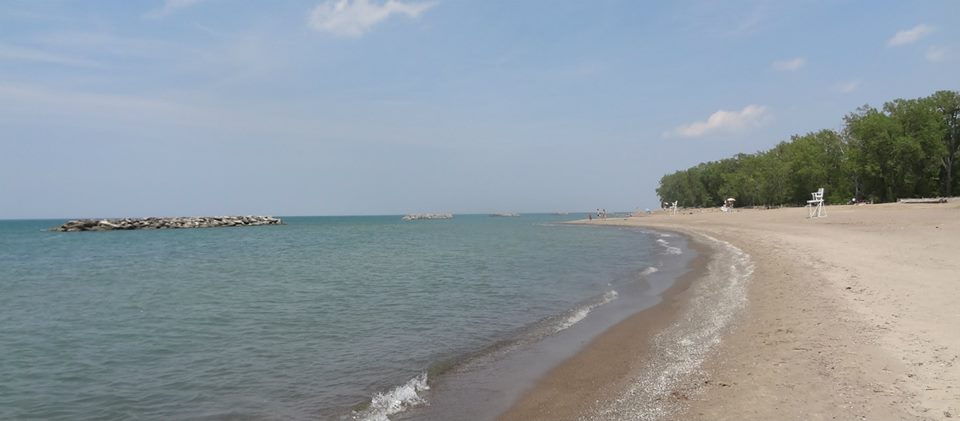
The weirdness started after the conference when a group of us decided to spend several free hours at a nearby beach on Presque Isle. A friend and I separated from the rest of the group to hike to a bird observation platform. The hike through the woods was hot and muddy. Once reaching the platform, we decided to return to the others by walking on the beach. We soon discovered that Lake Erie beaches are not like the beaches we are used to in Minnesota, where you can often walk unimpeded. This beach was eroded in many spots. Fallen trees and brush blocked our path, which necessitated inland bushwhacking forays — sometimes following deer trails, sometimes left to our own devices. The bushes had thorns, and our progress was slow.
We began to worry that we wouldn’t make it back to the others by the appointed time to leave. Having no map, we weren’t exactly sure how far we had to go or where we were in relationship to any civilized outposts. We started second-guessing our decisions, but that subsided once we saw familiar landmarks. Bramble-scratched, we made it back to the group in time to head for our respective planes.
The group dropped me off at the Erie Airport and went their merry way to Cleveland to catch their plane. As I stood in the ticketing line and looked at the flight departure schedule, I noticed the word “CANCELLED” next to my flight. Not good.
The ticketing agent explained the flight had been cancelled due to bad weather. They couldn’t get me out that day or the next from Erie, but if I could make it to Cleveland, I could take a flight tomorrow. I called my colleagues who turned around and rescued me from being stranded in Erie. With four of us smooshed in the back seat, we made the 100-mile journey to Cleveland.
Dropped off at the Cleveland Airport, my next goal was to find a place to stay the night. Because my flight was cancelled due to weather, the airlines said they were not required to pay for my extra night’s stay, so I was on my own. Like Sandra Bullock, trying to reach the Chinese space station on the radio, I desperately called different numbers, trying to find a hotel. No luck. The city was booked for the night (if one can believe the five places I reached).
By this time, it was 7:30 p.m. I was tired and hungry, having only an apple to eat since breakfast. Unable to reach my home office for help with a reservation due to tornados knocking out the phone system, and with my cell phone battery dying, I made a reservation with a place about 40 miles away in Cuyahoga Falls, Ohio.
After a $90 cab ride, I sank into a soft bed and ordered room service. I awoke at 4:15 a.m. to catch a cab back to Cleveland. My flight left with no problems, until we got to Minneapolis. Lightning strikes kept us from taxiing to the gateway for about 20 minutes – the very time my connecting flight home was supposed to leave. After sprint through the airport (okay, more like a computer-and-book-laden trot), I discovered my home flight was still at the gate, also delayed by the storm.
I made it home, and better yet, so did my baggage. Will I ever return to Erie again? Did Sandra Bullock’s character ever go into space again? I don’t think so.
Night Bird

As I watched my oldest son walk across the stage and pick up his college diploma last weekend, an image from memory flashed through my mind. It was a tiny sparrow, fluttering outside a window in the middle of the night at the attic apartment where we lived when my son was born.
If you’re squeamish, you might not want to read this next part because it deals with things that new mothers do. One last chance not to read. Okay: I had arisen to pump milk for my son, who, after a difficult birth, lay in an incubator in the intensive care unit. He had experienced some “dusky” episodes, where he turned bluish due to lack of oxygen. After a long (and screaming) labor, he had been born about ten days before his due date – just early enough that his systems needed extra time to kick in. I had recovered enough to be sent home, but had to leave the hospital without him.
The night of the sparrow was my first one home — my first away from my new son. As I pumped, the bird hovered outside in the dark, pecking at the window as if trying to come in. In my post-partum midnight haze, I felt like the bird was the spirit of my son, trying to come home. I can’t explain how that made me feel except to say it was a strange mixture of desolation and joy.
I was an emotional wreck for the next few days. Eventually, our son came home, but not before we learned infant CPR and how to attach the tentacled wires of a heart monitor to him, which he would wear for several months. Even though I was awake with him many other times in the night, I never saw another bird behave like the one that first night home.
Twenty-one years later, as I watched my son walk across that stage, I thought about all we’ve been through. He’s come so far from being a helpless infant in an incubator. He’s grown so tall and strong, smart and stubborn, determined and thoughtful.
I couldn’t be prouder of him, my little night bird.
Happy International Migratory Bird Day from a Recovering Birder
No, I’m not writing about Mother’s Day, but about a lesser known and newer commemorative event that celebrates birds. Yesterday, I participated in the second annual International Migratory Bird Day, held in Superior, Wis.
I haven’t been to a birding event in years, partly on purpose and partly due to other demands in my life. I like to think of myself as a recovering birder. I took up bird watching in seventh grade and was active in the birding community through my twenties – even participating for a year on the Audubon Expedition Institute, where I travelled across the country in a yellow school bus for a year with 24 other people interested in birding and the environment for master’s degree studies.
It was during that experience that I overdosed on birding. I came to realize that people stopped looking at birds once they had identified them. I rebelled against the obsession to name everything with feathers that I saw or heard. I rebelled against using eyesight aids like spotting scopes and binoculars – wanting to view the birds instead as part of their surroundings.
But I still feel an affinity with birds. My upcoming novel is about them, after all, and this event seemed a good excuse to get outside on a rare warm spring day. We met at Wisconsin Point, a long sandbar just outside the city. A small group of us spent three hours birding. We didn’t see very many birds but there were bald eagles, chickadees, scaups, red headed ducks, lots of blue jays passing through, and the requisite ring-billed gulls. I do admit to looking through a spotting scope (and the world did not end!), but I tried to keep it to a minimum to allow others the opportunity. After birding, we went to a local inn to listen to some presentations about migration.
My camera isn’t built for bird pictures, but I do love the lighthouse and the white pines on the point, so I thought I’d share photos of them with you.