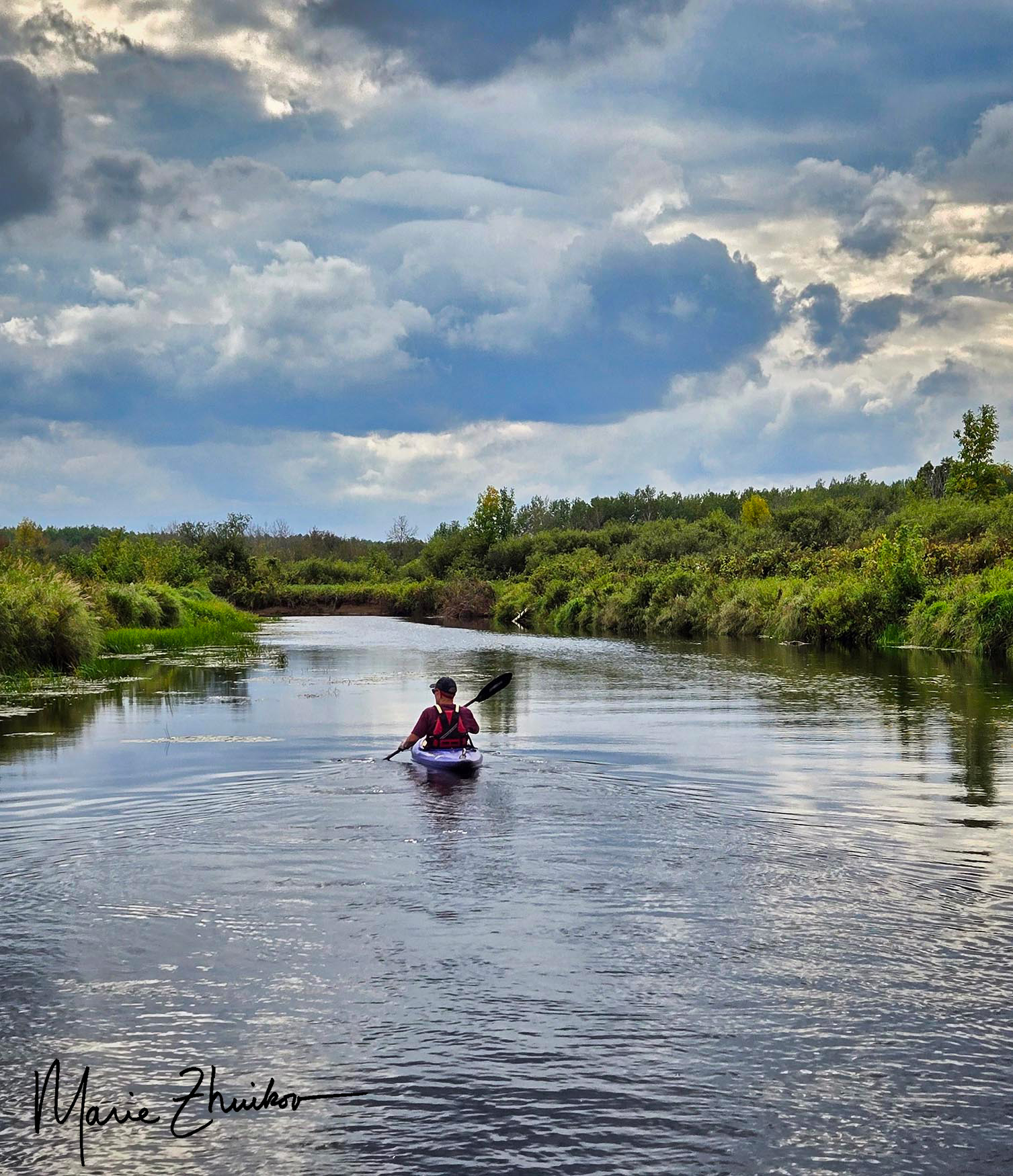
Russ and I took our kayak and paddleboard to a river near our cabin in northern Minnesota. We’d been on this stretch once before in a canoe. It was so calm, I vowed to return with my paddleboard some day. This was that day.
The fall colors were turning but not quite at their peak. We’ve had an usually warm fall and this day was no exception.
We paddled past beaver homes, some derelict, some not so derelict. Three Canada geese, disturbed by our approach, flew downriver to escape us several times. Fluffy white down feathers littered the backwaters where they must have spent the night.
Rain threatened, but never fell. After an hour paddling, we turned around to head back to the landing. We were going with the current this time, so the return trip was faster. My legs were quaking with fatigue when we reached the end of this long, end of season paddle. But my heart sang.
I meandered down to Savannah for a work trip last month. I’d visited the city once before, but that was a long time ago, and I didn’t stay long. I must say I enjoyed spending four days in this southern gothic berg, even though most of the time I was in an air-conditioned hotel listening to presentations.
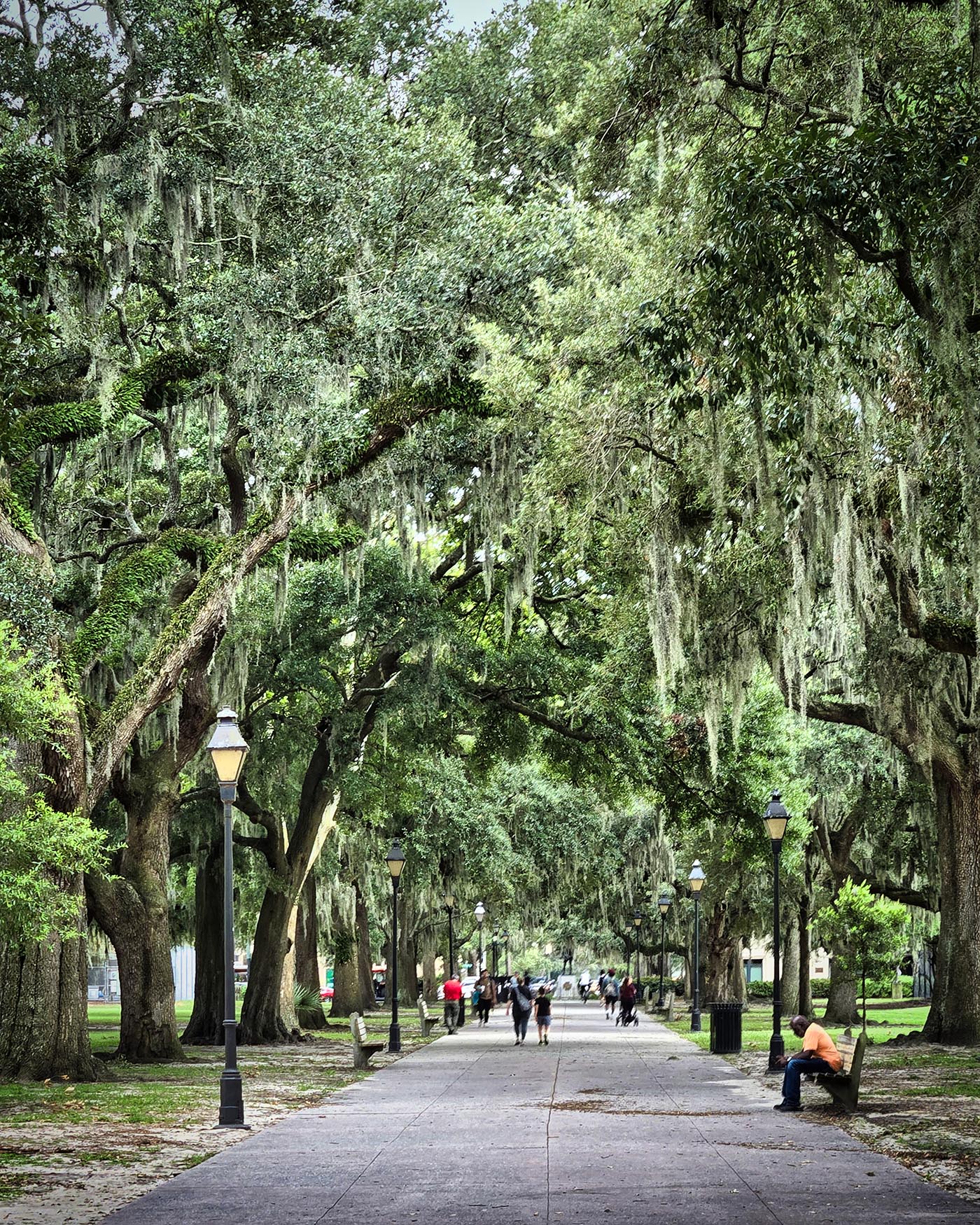
When I did get outdoors, I loved walking along the Savannah River down historic cobblestone streets. Live oaks draped with Spanish moss lined the route and historical sites seemed to emerge around every corner.
One morning, I managed to take a guided trolley tour around the city. It was one of those tours where you can hop on and off to explore the sights more closely. The trollies run every 20 minutes, which makes exploring very convenient. (Note: There are two trolley companies, so make sure you’re at the correct stop to board!)
I’d heard that Forsyth Park was picturesque, so I hopped off there and meandered around. The park offers wide sidewalks, those wonderful live oaks, and a large fountain. Near the fountain, a sidewalk trumpeter played a mellow tune. Even so, children walking by danced and hopped around to the music.
For the hungry, there’s a restaurant (Collins Quarter) in the park that offers takeout and sit-down dinners. People were lounging outside, dining under umbrellas on the patio of the Greek Revival building. I wasn’t hungry but didn’t want to pass up such a quaint place, so I ordered an iced spiced lavender mocha (decaf) from their takeout window. It was divine! The drink contained espresso, Condor chocolate, cinnamon, ginger, nutmeg, and lavender. I would rate it as one of the best mochas I’ve ever had. I sipped this purple cinnamon flower elixir as I walked to the trolley stop. It made the short wait more enjoyable.
The fountain in Forsyth Park.
Besides the mocha, another thing that impressed me about Savannah was the way they remember the different ethnic groups that helped found the city. About a tenth of the original settlers were Irish, so a Celtic cross stood in the park by my hotel. On the trolley ride, the driver pointed out a marker honoring Scottish Highlanders. Since I was just in Ireland and Scotland, this warmed the cockles of my heart and made me feel at home.
Once I was back near my hotel it was lunchtime. I decided to check out The Pirate’s House Restaurant. The building was first opened in 1753 as an inn for seafarers and then, as its website says, it “fast became a meeting place for pirates and sailors from the Seven Seas.” The building fell into disuse after World War II, but has been restored and is now considered a house museum.
I ordered the soup, salad, and sandwich, which featured she crab soup and a chicken salad croissant. Delish! As I ate, I realized that the building, with its uneven floors and clapboard siding, had a familiar feel – like I’d been there before. As I read about the restaurant’s history on my placemat, it struck me. I’d imagined this place while reading the book, “Treasure Island,” by Robert Louis Stevenson! Stevenson had visited Savannah and the house was thought to be his inspiration for the inn where Captain Flint died, uttering his last words: “Darby M’Graw, fetch aft the rum.”
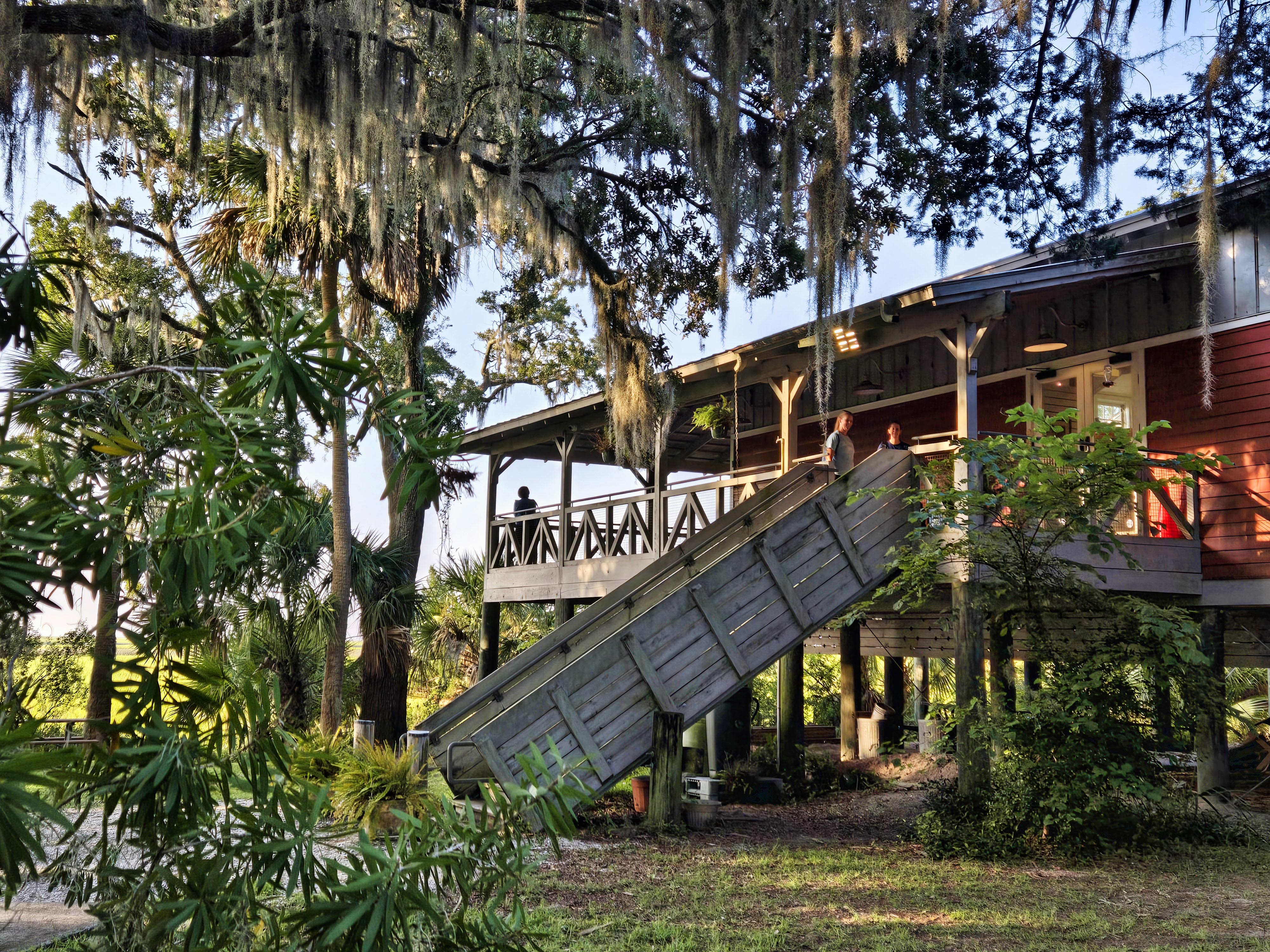
The Sapelo Island National Estuarine Research Reserve Visitor Center on the mainland.
The next day was field trip day for my conference. I had selected a trip to Sapelo Island off the Georgia coast. The island is a National Estuarine Research Reserve, part of the same national network dedicated to environmental research, education, and stewardship that the coworkers in my office back home work for. As you may recall, I’m an isleophile (I love islands!), so that, combined with the whole Reserve thing, is why I chose this particular field trip.
Not just anyone can visit the island. No roads lead to it—you have to take a ferry. Also, you need to be invited by the Reserve or one of the residents of the small island community of Hog Hammock. Many of the residents in Hog Hammock are Gullah—descendants of former slaves with their own unique culture.
Gullah ring shouters.
A few days earlier, our conference had kicked off with a stirring performance by Gullah ring shouters. They shuffled in a counterclockwise circle while singing, dancing, clapping, and stomping. Ring shouting is an African tradition that the slaves brought with them and is still part of the Gullah worship services. Hog Hammock is one of the last remaining Gullah communities in the U.S., and is under threat due to land development and zoning.
We boarded the ferry and traveled through the salt marshes to the island, where a flock of terns greeted us, sitting on the dock railings. Our first stop was the Reserve office where one of their naturalists oriented us to the island. Then we traipsed outdoors for a service project. The thirty of us weeded a native plant garden and transplanted live oaks into larger pots. The oaks were being grown to help rehab a former airstrip on the island. The island used to be owned by tobacco magnate, R. J. Reynolds. He built a mansion there (which sports a bowling alley and tennis courts and is now available for rent to large groups), a dairy barn and outbuildings. He wanted his compound on the island to be self-sufficient.
After the trees were all transplanted, we headed to the dock to collect some tiny salt marsh critters to bring back to the office lab and look at under microscopes. We found crabs, small fish, and barnacles.
A beach on Sapelo Island. I loved how natural it was.
After eating lunch under a shelter at the beach, our next stop was the University of Georgia Marine Research Institute. After Reynolds died, his widow donated the dairy barn compound to the university for that purpose. Students spend the summer on the island conducting research projects, and we saw several in progress.
The marine research institute on Sapelo Island.
A film screening studio is one surprising thing that Mr. Reynolds built into the dairy barn. Apparently, he had many friends in Hollywood who would fly out to the island to screen movies. He even had two extra-wide chairs built to accommodate his heftier movie mogul friends. We sat in the room and watched a movie about the research institute. But I must admit I was distracted by wondering if any famous movies were screened in that remote barn.
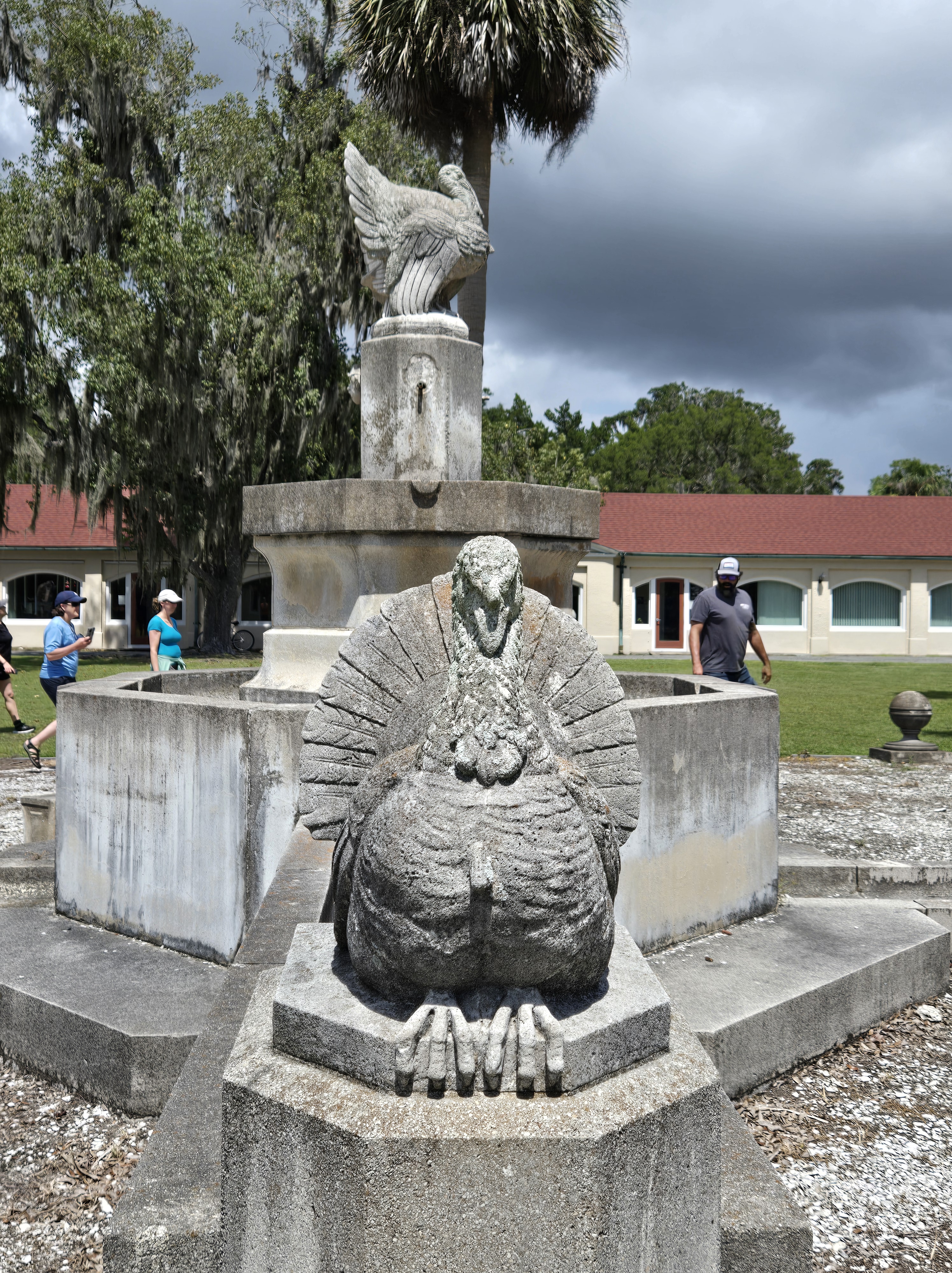
The turkey fountain on Sapelo Island.
Another surprising decorative feature at the institute was an outdoor fountain that features cement turkeys. Yes, you heard me, turkeys. Why? Conflicting stories abound. Some say it was R. J. Reynold’s idea. Others say it was his wife’s idea. It’s certainly not something you see every day, especially at a marine institute. When I first noticed the fountain from a distance, I assumed the turkeys, with their fanned-out tails, were large scallops or oysters. Huh.
Our last stop was the Sapelo Island Light Station. But on our way, we drove through Hog Hammock and were able to see where the ring shouter performers lived. The homes are very modest but some Gullah are selling their land to mainlanders who want to build larger homes, which would drive up property taxes.
The lighthouse is a red and white striped affair that rises 80 feet into the saltmarsh air. A tiny museum in a building alongside it offers bits of history and memorabilia. Others on our tour climbed the tower for the view from the top. I opted out. This northern lady was pretty sapped by the southern heat by then. Climbing a spiral staircase in a tower without air conditioning just didn’t appeal to me at that point.
Sapelo Island Light Station.
Then it was back to the ferry for us and a long bus ride back to Savannah. I felt privileged to have the opportunity for this special trip to the island and to learn more about Georgia’s environment and culture. It was fun to give back a bit, too, by transplanting those baby live oaks.
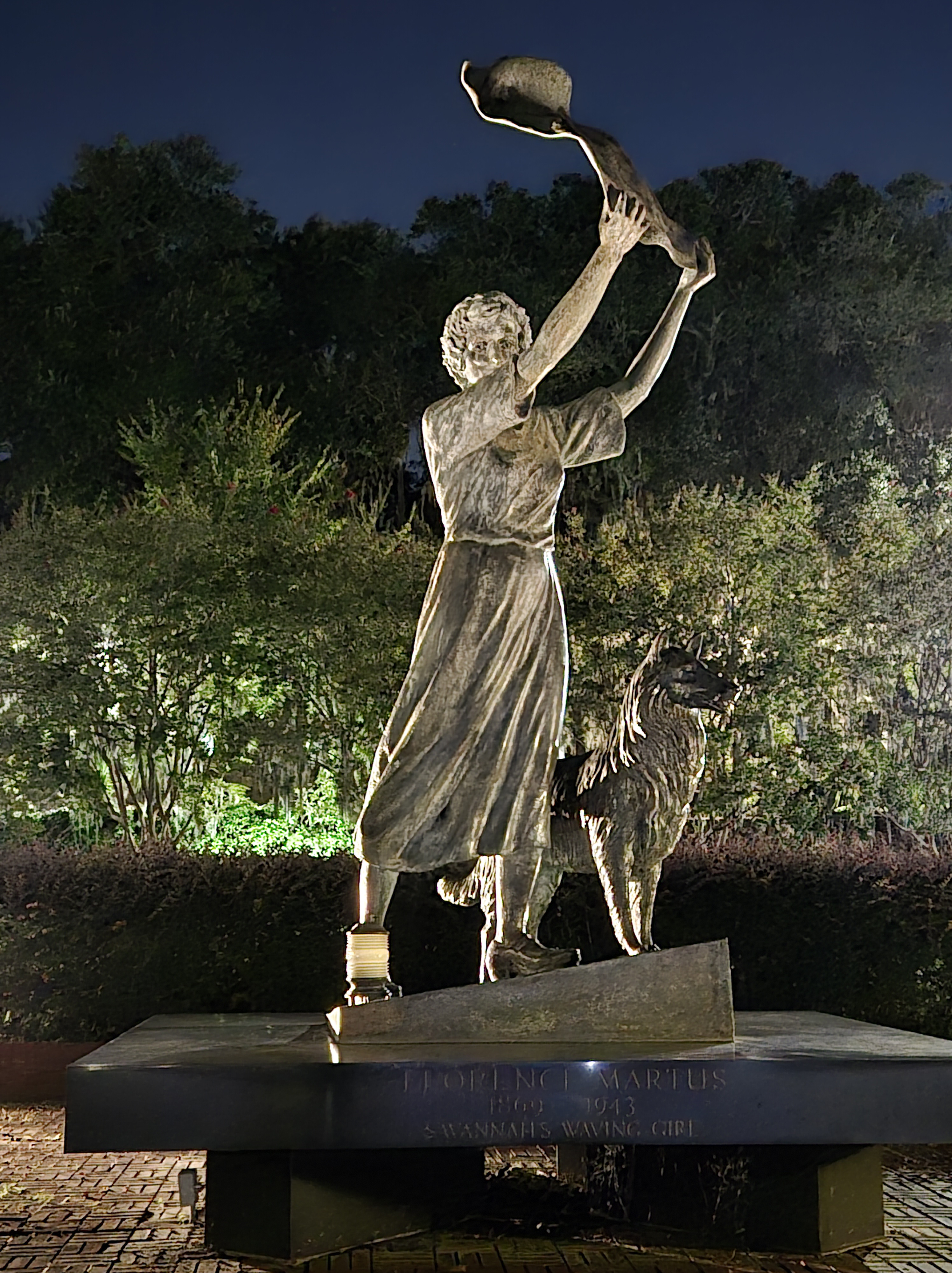
Savannah’s “Waving Girl” statue at night, waving hello (or is it goodbye?) to my blog readers and ships that pass on the Savannah River.
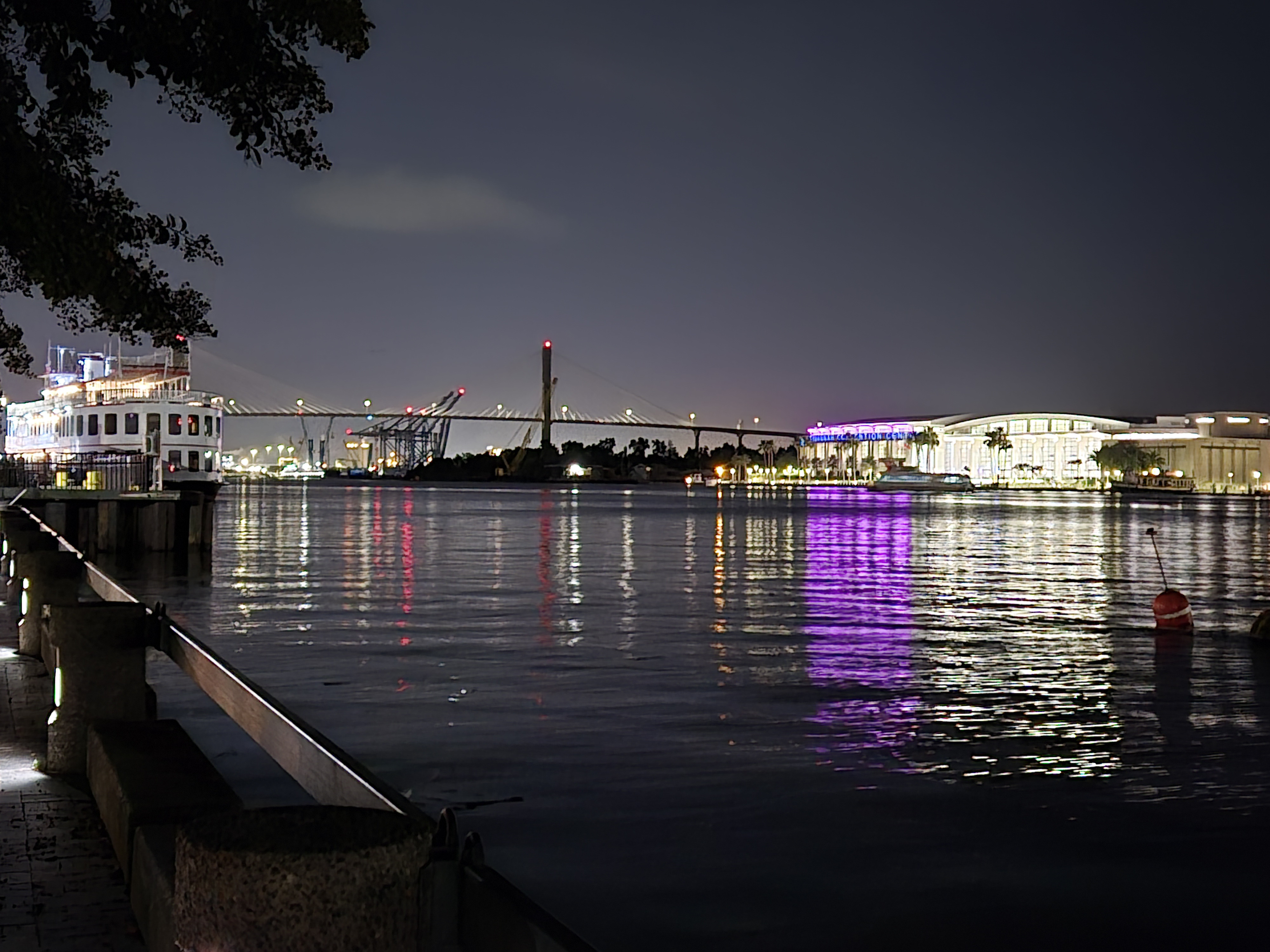
The Savannah River spoke to me as I walked its banks at night. Stark white and neon purple lights reflected across its surface, and it whispered, “I’ve been widened, deepened, and dirtied. Cargo ships ply through me. Tourists in paddlewheel boats churn atop me. Factories have dumped their pollution in me. I am ancient, older than those who use me. Once you are gone, I will remain. I will become whole again.”
Painted turtle photo by Andrew Patrick on Pexels.com
I usually take two walks every day. Recently, on one of my walks, I saw a painted turtle crossing the gravel road. It was headed in the direction of a small lake and had already made it across most of the road. But was now it had stopped. I worried it might get run over by an inattentive driver. I was tempted to pick it up and move it in the direction it was traveling, yet didn’t want to overly disturb it.
Luckily, as I stood behind the turtle, pondering, it began to move closer to the road’s edge. I slowly stepped forward and kept encouraging it to move in this way until I was sure it would be safe.
I wondered whether it was a late hibernator emerging from an inland pond or if it had laid its eggs somewhere and was now making its way back to the lake. I often see multiple painted turtles hanging out on a log at the end of the lake or swimming with their noses just above the water on quiet evenings.
After I walked a few more yards, a drizzle began. Then the drizzle became a shower. I wasn’t wearing a raincoat, so I cut my walk short and began quick-stepping my way back home. About a hundred yards past the first turtle, I saw another one that was almost the entire way across the road. It was moving quickly, so I didn’t worry about it like I had the first turtle.
Curious at seeing the two turtles crossing the road at nearly the same time, once back inside, I searched online for a possible explanation. Google said: “Every year, in mid to late spring, turtles start to move. The males are looking for partners and the females are looking for a good place to make a nest for their eggs. Unfortunately, for a lot of them, this means crossing busy roads and many don’t make it.”
In addition, Mississippi State University said that in the South, a legend says that rain is on the way any time you see a turtle cross the road. They continue, “There’s very little truth to this myth, even though it does seem like rain is in the forecast after we see one of these creatures slowly making its way across the street.”
Given my experience that day, I’m inclined to believe this legend!
Then I looked up the spiritual meaning of a turtle crossing your path. Google said it’s a sign of good fortune to come. Turtles are also omens of good health and symbolize a long, prosperous life.
If that ends up true, I’ll let you know in about thirty years.
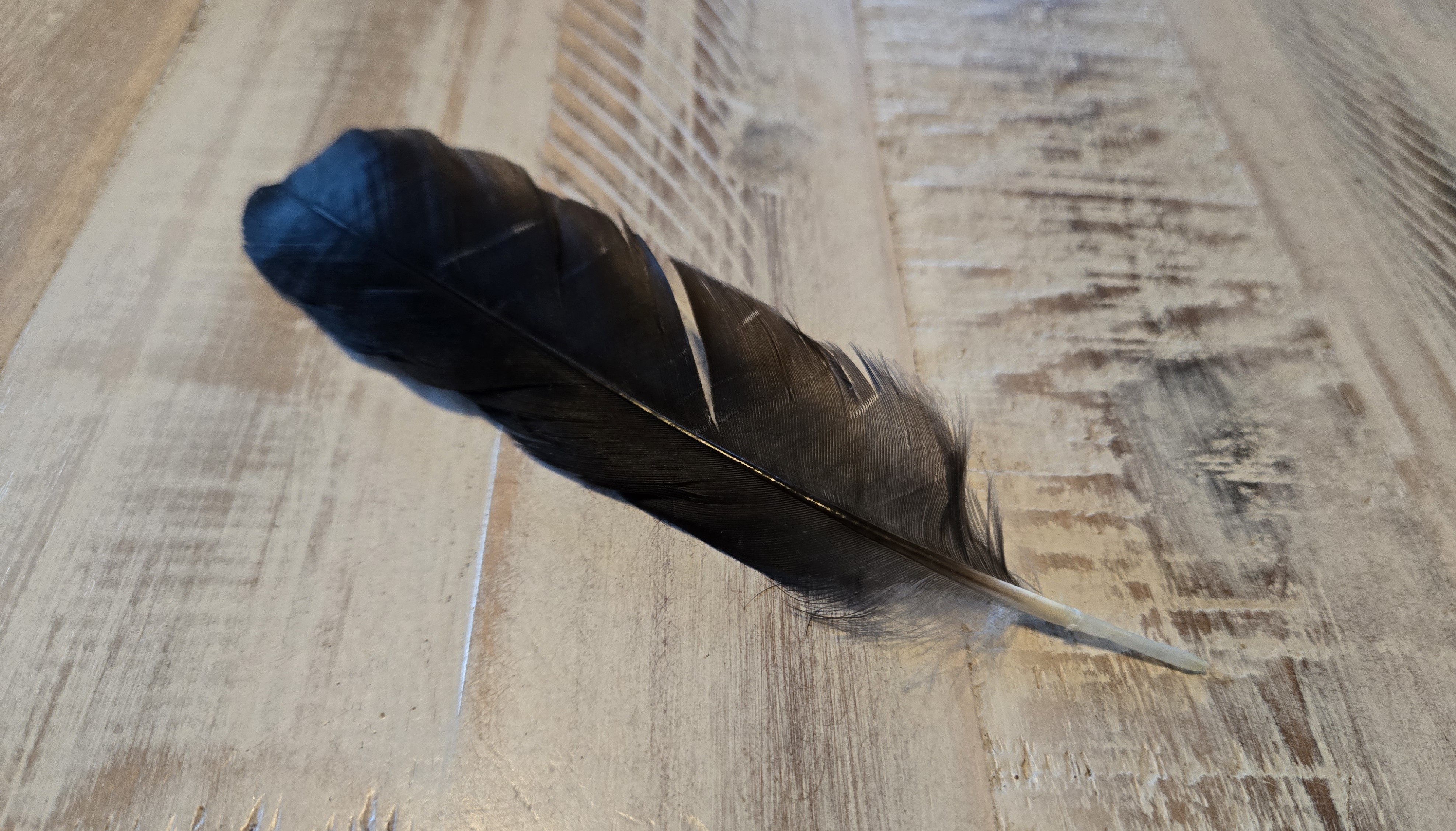
My second wildlife encounter happened the next day. The moment I stepped out the door for another walk, I felt something land in my hair. I thought it was a bug and tried to brush it away. Out fell a five-inch black feather!
I looked around but whatever bird had lost the feather was long gone. However, a crow sat in a tree not far away. The feather certainly looked like it could be a crow feather.
While I’ve come across feathers on the ground before, I’ve never had one actually fall on me. The event was rather surprising and noteworthy (thus this blog post).
The feather that fell on my head.
I seemed to be a roll with interesting animal encounters. Once again, I consulted the wise and wonderous internet for interpretation. I searched for “meaning of crow feather falling on your head.”
Nothing came up under that specific heading, but there were lots of entries about the “meaning of coming across a crow feather in your path.”
Apparently, like with the turtles, this is a good omen. A woo-woo yoga site said, “When a crow feather lands at your feet, it is a positive omen, meaning your calls have been heard and answered. If a feather comes to your path magically or surprisingly, it means a spirit is supporting or guiding you.”
Since the feather fell on my head, I must really be protected and supported!
Another site said it can also signify a visitation by a male loved one who has passed.
For several months, I have been working on a nonfiction story about a male relative. Although I was not born when he died (tragically and suddenly), I’ve found myself wondering if I haven’t conjured up his ghost with all my recent attention.
If he is watching over me, I’m okay with that. He was a good guy and I wish I would have had a chance to know him. Even if he’s not, these natural encounters have been interesting.
When I told Russ about the mysterious crow feather atop my head, he said, “At least it was a feather and not something else that birds usually let drop!” That’s my guy.
I think I’ll take another walk and see what happens next.
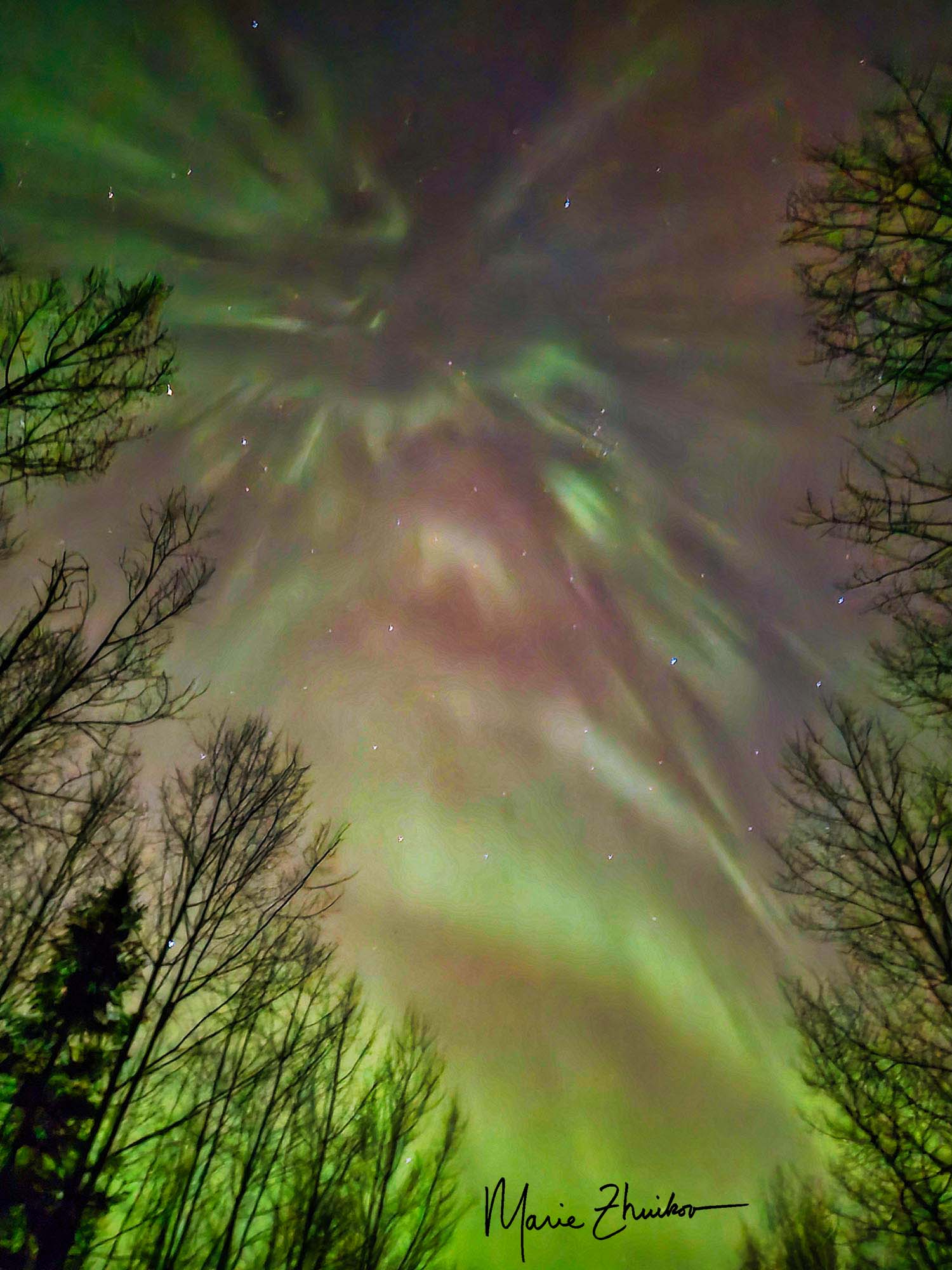
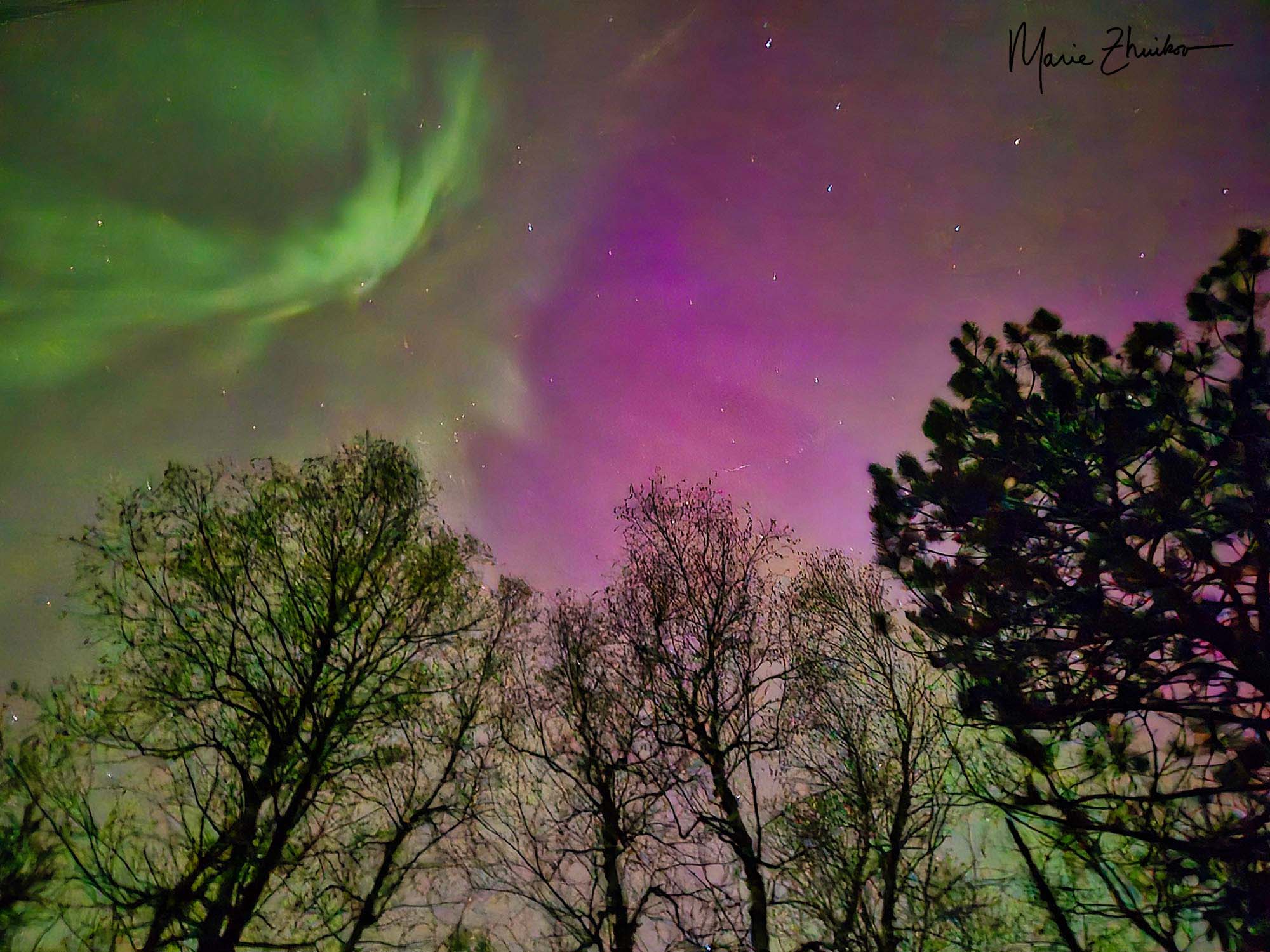
Thanks to a gargantuan sunspot group 15 times the size of Earth, we on Earth in northern climes were treated to a spectacular aurora borealis display last night.
The evening began with a thunder shower, which led to a picturesque sunset, which was capped off by the northern lights display.
I ran around with my camera, documenting everything at our cabin in northern Minnesota. I had tried before to photograph the sky at night with little luck. But this time, it worked! My camera captured even more colors than were visible to the “naked” eye.
As I wandered on gravel roads in the middle of nowhere with eyes raised to the eternal mystery of the dancing sky, our resident loons began to call. Spring peepers croaked and a distant train whistle blew. We are so fortunate to live in these times, in this place.
In my workaday world where I drive around, sit at my desk, eat, and sometimes sleep, I often run across photo opportunities that I don’t have the time or energy to pursue. I’ll be driving down Duluth’s hillside and see the sun shining in an interesting pattern on Lake Superior, but I have a work meeting to get to, so don’t have time to stop. Or, I’ll be walking into the grocery store and there’s a spectacular sunset but I’m on mission, so bye-bye sunset. Or, darn, I don’t have my fancy camera with me, just my cell phone, so I won’t take the shot.
Often at these times, I’ll sadly joke with myself, saying, “If I were a real photographer, I’d find a way to take that photo.” I can’t count how many times I’ve thought that over the years. My hope is that once I retire, I’ll have more time to follow up on these photo opportunities, but that’s about a year off.
This morning at our cabin, one of those moments happened again. I’d been awake in bed since 5:30 a.m. It was now an hour later, and sleep was not returning. From bed, I could see the lake, its far shore lit golden by the rising sun, water as smooth as glass with winter’s ice only recently melted.
Lying there, I thought, “If I were a real photographer I’d get outside and take that photo.” But I was cozy and drowsy. Outside, it was probably only 40 degrees.
But the spectacular shoreline lighting was only going to last a little while. It would be a shame to miss this opportunity. All I needed to do was get out of bed . . .
Beside me, Russ slumbered peacefully. I didn’t want any movements I might make to wake him . . .
Then, I thought about what fun it would be to actually be a real photographer this morning. Sure, I only had my cell phone, but that was better than nothing.
I hopped out of bed, donned my light blue fuzzy bathrobe, grabbed my phone, and jumped into my big Sorrel boots. As I headed outside, I could see the light fading from one section of the far shore. It wouldn’t be long before the bare trees were a drab brown once again across the whole thing.
As I neared our small beach, a duck farther down the lake took off in startled flight. That might have had something to do with it seeing a blue monstrosity emerge on shore!
I raised my phone and fired off a few shots, walking along the shoreline to gain a better vantage. The sun lingered for a few more minutes, enough time to take a few good images. I especially liked one with some reeds in the foreground.
Phone lowered, I stood for a while, drinking in the view directly with my eyes. All was still and quiet.
I turned to walk back the few yards it would take to get to the cabin. After a couple steps, I was stopped by the sound of something crashing through underbrush in the neighbor’s yard. I recognized two dogs, Kamikaze spaniels, as I like to think of them, headed right toward me! One sported black spots, the other brownish-red.
I knew from previous encounters with their master on the road, the dogs running beside his ATV for exercise, that they were nice dogs with a lot of energy. Whenever they pass a driveway, they head down it, circle the yard with noses to the ground and meet their master back on the road.
Still, to ensure they were forewarned of my presence, I greeted them with, “Hi dogs, hi dogs!”
Unlike the duck, the dogs took no notice of me and sped right past. One rounded the far corner of the cabin and headed back to the road, while the other took a detour around our boathouse and then ran through the forest, rejoining its buddy.
In all, I was only outside this morning for a few minutes, but a lot happened. As I opened the cabin door, I felt a bit more like a real photographer.
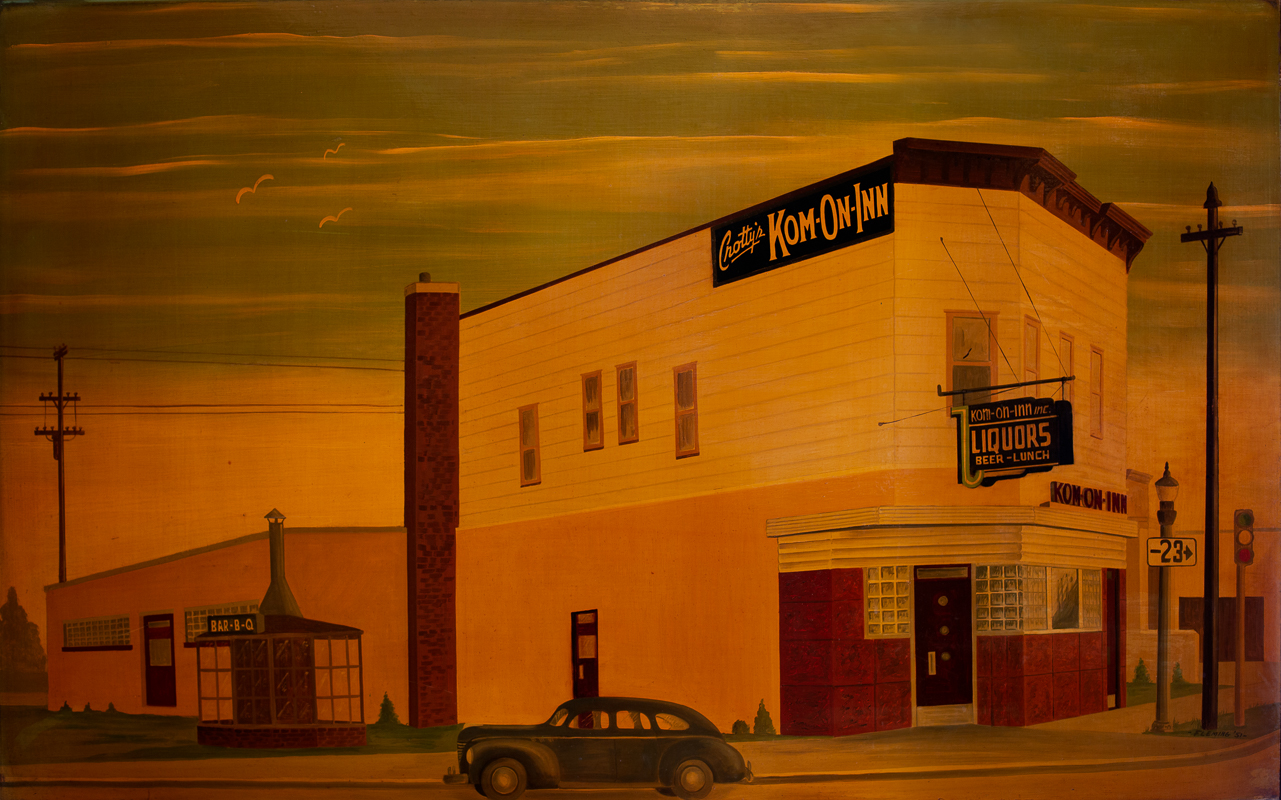
The Kom-on-Inn in West Duluth. Image courtesy of Jennifer Webb, University of Minnesota Duluth
I recently worked in a bar. Not as a bartender, though. I didn’t even drink! I was there to view art and explore how it relates to community and the restoration of the St. Louis River, which flows along the border of Minnesota and northwest Wisconsin. You can view my resulting story on Wisconsin Sea Grant’s “Unsalted” blog here.
Will this post be about a quest for emotional security? No! It’s all about web site security.
I recently completed several frustrating weeks of time (on and off) to get my author and photography website deemed “secure” with an SSL certificate. What is it? SSL stands for Secure Sockets Layer, which is “an encryption-based internet security protocol.” An SSL certificate is a digital certificate that authenticates a website’s identity and enables an encrypted connection.
I’d put off buying the certificate because the need for it strikes me as a money-grab by web hosting companies – rather like the kind of security a person receives from payoffs to the Mob. 😊
But now, many web browsers won’t even let people access “unsecure” (or insecure?) websites without going through a lot of clicking acrobatics. My analytics have also been dropping, so I decided to splurge and get the SSL certificate.
I didn’t want to hassle with coding it, so I purchased a more expensive option where I wouldn’t have to deal with that. I thought I could just buy the certificate and that would be it, but NO. I waited several days, and nothing changed with my website. It still came up as unsecure in my browser.
So, I called my web hosting company and asked for help. In a minor miracle, I was actually able to talk to a real person. As an added bonus, he had a sense of humor and he appreciated my humor. All was good. Except for the fact that my website was built on a platform that was too old for the fancy SSL certificate where I didn’t have to do any coding.
Mind you, my web site is only 10 years old, but in technology years, that’s ancient. As a result, the humorous tech guy gave me a partial refund and signed me up for the less-expensive-but-needs-coding certificate. He was also nice enough to add some of the needed code to my site. He said it should begin working within 48 hours.
It didn’t. I won’t bore you with the details, but the fix involved two more phone conversations with my web hosting platform and one hour-long online chat with my domain-name-holding company. Said company had to do a backdoor end-run special code to make the certificate work. It wasn’t something I could have ever done myself.
The process was a pain in the butt and took a good five hours of my life, but anyone who cares to visit my site can now do so with a sense of internet security. I am happy about that. What I am not happy about is that I will have to do this every year!
It might be time for a new web site, but I think I’m gonna eke the rest of my money’s worth out of this one, first. 😊
About a week ago, we drove north along the shore of Lake Superior to Grand Marais, Minnesota. We carried a precious cargo: a dozen landscape images I took, printed out on canvas, metal and paper. They had been accepted for my first public exhibit at a local health facility in the town.
I was excited by this opportunity to share my hobby with an audience. Once we arrived, we were met by the organizer who helped us unload. He also showed us where the images would be hung. We left my works with him and headed home on our two-hour drive.
After a half-hour cruising past pine trees along the rugged landscape of Lake Superior, I began feeling like I’d left something important behind me in Grand Marais. The feeling nagged until I acknowledged it and searched my psyche for its source.
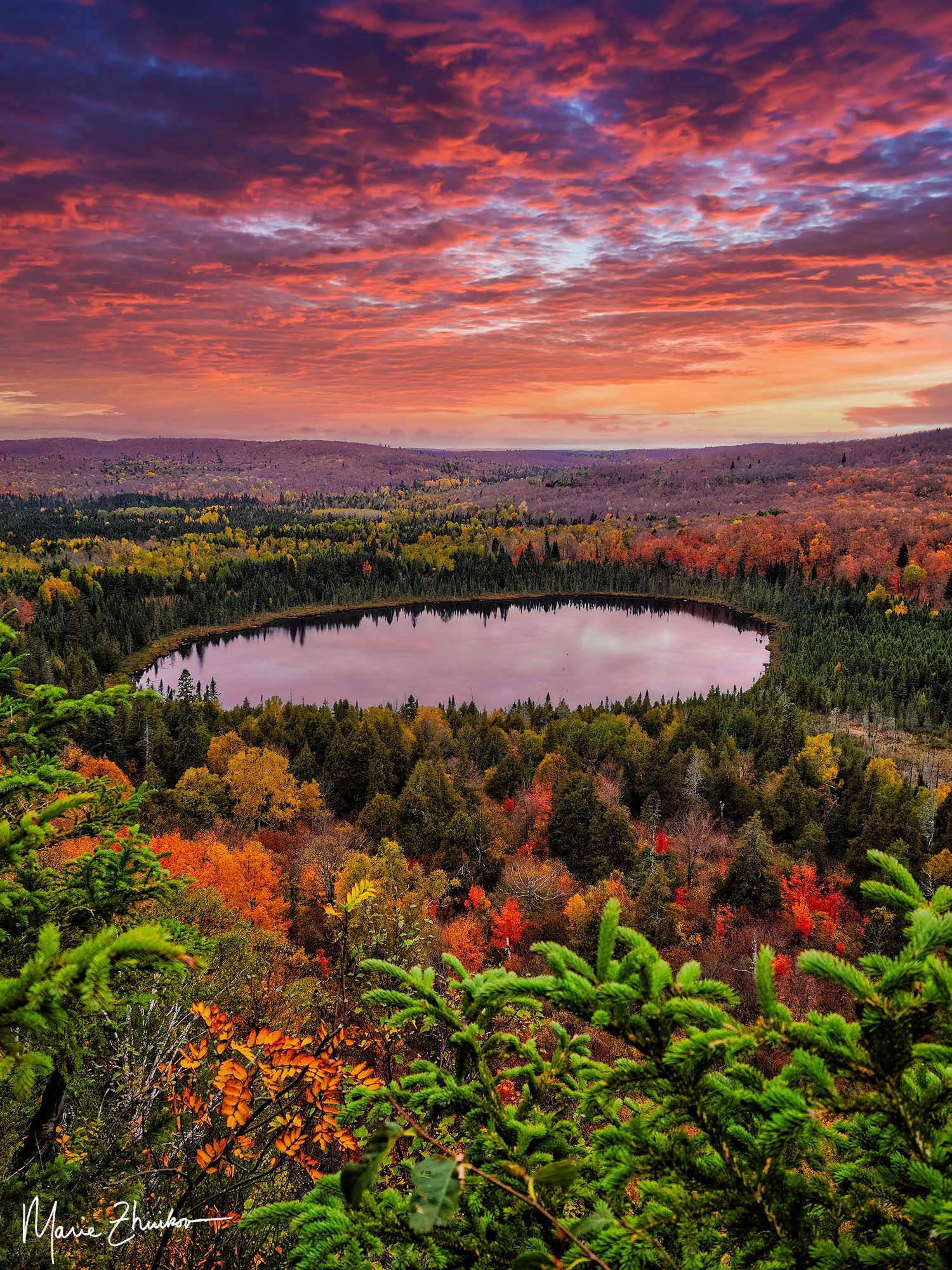
One of the babies I left in Grand Marais, MN. This is Oberg Lake in northern Minnesota.
It didn’t take long for me to realize the important things I left behind were my photos! The feeling was similar to when I dropped both of my children off at college. I turned to Russ and said, “My babies! We left my babies back there!”
He looked at me quizzically, but Russ is a quick study and soon smiled.
I did not expect that feeling. I didn’t realize I was so attached to the images, many of which have hung in my home for several months. It’s not that I don’t trust the exhibitor, it’s more I feel like I’ve left part of me in Grand Marais. Of course, the feeling isn’t as strong as what I have for my human babies, but it kept coming back over the course of the next few days. Russ got used to hearing me blurt sporadically, “My babies, I miss my babies!”
As with dropping my children off to college, I hope this is a one-time thing that will get better with time. But it’s made me wonder if other photographers experience this when they let their images out of their sight. I’d appreciate hearing any impressions you wish to share.












 Marie's Meanderings