The Root Beer Lady: A True Story


Once upon a time, a woman lived alone in the northern Minnesota wilderness. Except, she wasn’t really alone. Birds and otters kept her company. Canoeists stopped by her island on Knife Lake near the Canadian Border. At one time, she even ran a resort there.

Image courtesy of the Dorothy Molter Museum.

But after the land was designated as an official roadless area and then a Wilderness with a capital W, making a living became more difficult for the woman, not to mention getting supplies. Rogue sea plane pilots tried to help her, but they were arrested. The only thing the woman could do was haul in the supplies she needed by canoe, portaging five times over the 33 miles to civilization.

In 1952, a writer with the Saturday Evening Post visited her and wrote a story about “The Loneliest Woman in America.” The article turned her into a national legend – a woman living alone among wolves and braving minus 50-degree winter temperatures. But the woman always contended the writer got it wrong, she was never lonely, even in winter.

One day, she was cleaning and found dozens and dozens of glass bottles left from when her resort served pop (as we call it in Minnesota). Rather than haul out the bottles and discard them, Dorothy Molter (as was her name) got the idea to make root beer for passing canoeists in the Boundary Waters Canoe Area Wilderness.

Dorothy Molter’s root beer cooler.

She hit the jackpot. If there’s one thing most wilderness campers appreciate, it’s a fizzy cold drink after days away from civilization. Dorothy made her drinks with root beer extract, sugar, yeast, and water from Knife Lake. They were cooled on ice cut from the lake in winter. Canoeists donated a dollar per bottle.

Dorothy made root beer for years. At the height of her business, she produced 12,000 bottles and still couldn’t keep up with demand. She was trained as a nurse and aided any canoeists who needed help by sewing up cuts and removing fishhooks from various body parts. She once saved the lives of a father and son who got hit by lightning in a sudden summer storm. Dorothy also nursed wild animals, including a crow and a mink.

A strong and plain-spoken woman, Dorothy didn’t swear or curse, but she didn’t mince words either. Her philosophy for surviving in the wilderness could be summed up in the sign she posted at her home on the Isle of Pines. “Kwitchurbeliakin,” it advised.

Dorothy continued living in the wilderness until she was in her late 70s. She kept in touch by radio, checking in with Forest Service staff daily. One winter day she didn’t check in. Then another day passed with no contact. A wilderness ranger made the trek and found her dead of a heart attack from hauling wood.

The Dorothy Molter Museum, Ely, MN

Although Dorothy’s time passed, her memory is preserved in a museum named after her in Ely, Minnesota. The fame and good will she garnered through her lifestyle prompted its formation.

Russ and I had heard of Dorothy over the years but never had a chance to meet her or visit her museum. We thought we were out of luck on a recent camping trip to Ely because a brochure we happened upon said the museum was closed after Labor Day.

With drizzly weather forecast, Russ and I ditched hiking plans and meandered into Ely to see what struck our fancy. We had driven though the whole town with no fancies struck, when we passed the sign for the Dorothy Molter Museum on the outskirts. The sign read “Open.” So, we turned in, hoping the sign wasn’t just the product of end-of-season-forgetfulness on somebody’s part.

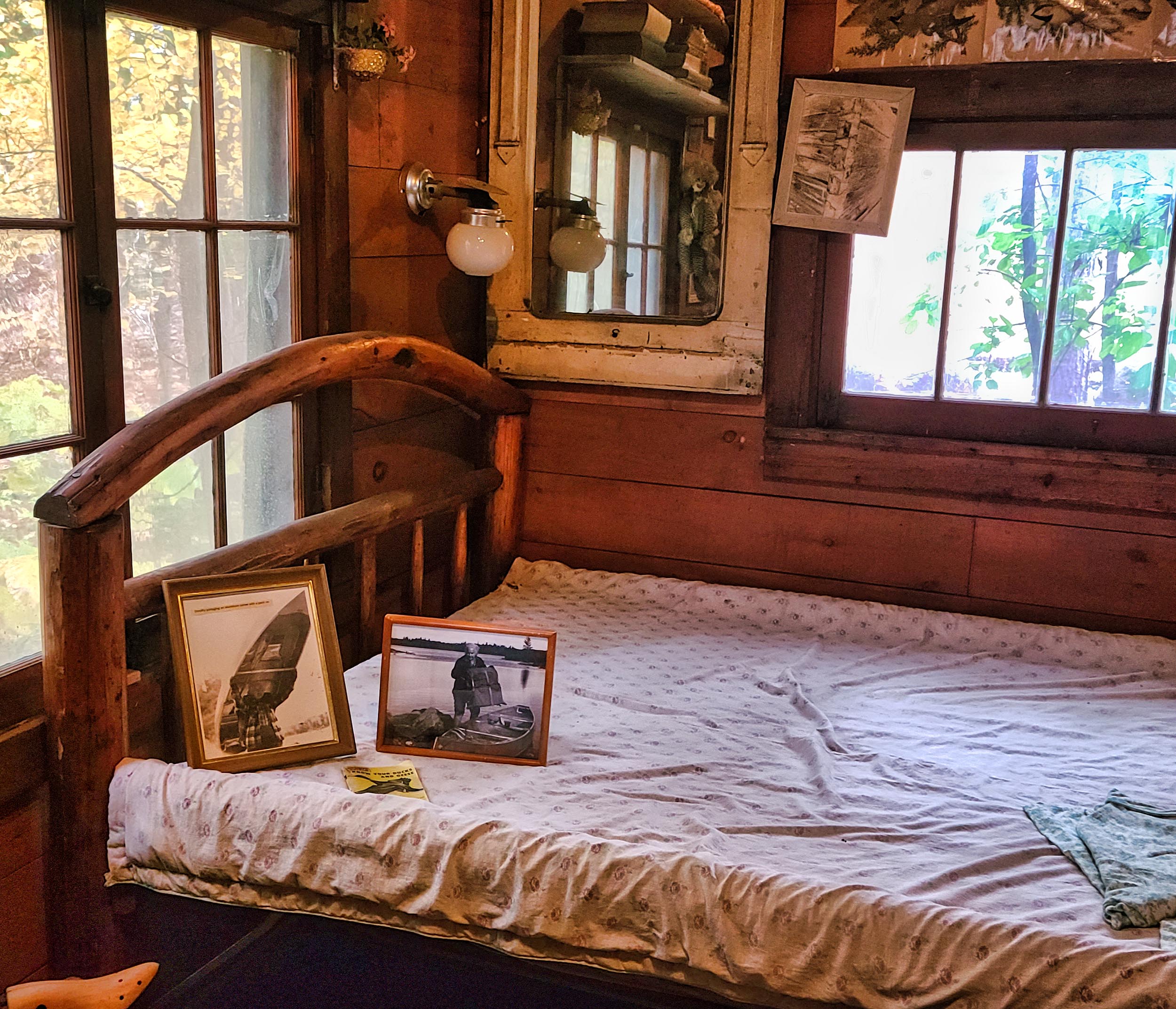
The museum really was open! We spent a couple of hours touring Dorothy’s cabins, which volunteers had hauled out of the wilderness to house her artifacts. We enjoyed watching excerpts from a video about Dorothy’s life. We viewed her root beer-making equipment and perused the gift shop, where visitors can buy a bottle of Dorothy’s root beer. Despite the drizzle, we also got a bit of hiking in on the quarter-mile trail in the pine plantation surrounding the museum.

We left glad to see Dorothy’s memory preserved.  As one of the museum signs says, “Although Dorothy  has been gone from Knife Lake for over 30 years, we hope that you find inspiration to live your lives like she did, in harmony with the environment, with integrity, helping humankind, and making a contribution toward a better world.”

Dorothy’s winter boots

Houseboating on Rainy Lake: Our Final Day and Working for Wilderness

…For the first time in my life I had failed to work for the joy of knowing the wilderness; had not given it a chance to become a part of me. –Sigurd Olson, “The Singing Wilderness”

Garretts Point Campsite

After our delightful stay on the Duckfoot Islands, we headed back toward the houseboat base. Our goal was Garretts Point, another sandy campsite in a protected cove. This was Garrett’s idea, for obvious reasons. 

He successfully piloted us out into the lake. Then I decided to give houseboat driving another try. The first time I did it, my steering wasn’t so bad, despite the wind. There was less wind on this day, but my steering was much worse. I almost did a 180 with the boat! Luckily, we were in the middle of the lake, without any obstacles. That was one reason why I chose this stretch to try again.

The campsite rubber duckie

As I zigzagged down our route, I figured out my problem. I’m used to steering a sailboat with a rudder. For that, you turn the rudder in the opposite direction you want the boat to go. Not so with a houseboat. To turn right, you turn the wheel to the right. I kept wanting to do the opposite. Also, you’re steering from near the front of the boat and the motor is in the back. That’s weird, too.

Despite all this, we successfully reached the Brule Narrows again and Garrett took over. The rest of our trip to Garretts Point in a light rain was uneventful. The site is sandy, but the beach is not as big as the one at the Duckfoot Islands. The fire ring is circled by nine stately red pines. We were greeted by a sparkly rubber duckie that someone had left on a rock by the fire ring.

Garrett was excited to arrive, and we took an obligatory picture of him standing behind the official campsite sign. Russ explored in the kayak and found a huge beaver house nearby. The beaver visited us that night as we sat around the fire.

I spent most of my time reading, but I also had a chance to explore my feelings. It didn’t seem right to be able to access these rustic locations without working very hard. Sure, driving the boat was stressful, but I wouldn’t call it physical labor. I’m used to canoeing for days and sleeping on the ground. This just seemed way too easy, like we didn’t earn it. It felt surreal to sit in my fluffy bathrobe next to a rocky campsite with scraggly jack pines and the chatter of a red squirrel.


The bell on our boat

Northwoods writer Sigurd Olson had these same feelings when he flew into Quetico National Park in Canada in a seaplane. In his book, “The Singing Wilderness,” he described the switch from civilization so quickly to the wilderness as “violent” and a psychological shock. While flying into the wilderness was what he had dreamed of doing, it didn’t allow him time to adjust and to soak in the wilderness ambiance.

He wrote, “Yes, I had been on a flight, had gone far into the lake country, had taken a few trout and enjoyed myself, but inside I was still a little out of breath and somewhat baffled by what I had done.”

We had another restful night and got up early in the morning so that we could drive the houseboat back to base by 9 a.m. so that somebody else could use it. In no time at all, we were back to the base. The houseboat guys came out to us when we were in the bay to pilot the boat into the dock.

As it turns out, we arrived in the nick of time. As we were clearing our gear out of the boat, we heard on the radio that the wind had switched and picked up speed. The base issued a no-travel advisory. We were glad we didn’t get stuck out there because Garrett had a plane to catch back to New York City. Whew!

I was glad to have had the houseboat experience, but I know that the next time I visit these northern border lakes it will be with a paddle and a pack so that like Olson, I can, “feel the rocks under my feet, breathe the scent of balsam and spruce under the sun, feel the wetness of spray and muskeg, be part of the wilderness itself.”

Sunset on Oveson Island

Natural History Gone Wild

An Ice Age exhibit at the Bell Museum of Natural History, including a mammoth, giant beaver and musk ox.

I recently had the chance to meander through two very different natural history museums. One was public and the other not so much. Both impacted my psyche.

The public one was the Bell Museum of Natural History. This was one of my favorite hangouts during my college days when I was minoring in biology. (I won’t divulge how many decades ago that was!) Besides the obvious appeal to the science-minded, my poetry professor once took us to the museum for inspiration purposes.


The new Bell Museum.

The Bell Museum used to be on the Minneapolis Campus of the University of Minnesota in Minneapolis. Now, it has a “new” facility on the St. Paul Campus.

Russ indulged me (smart man) and tagged along as we visited the Bell’s planetarium where we learned about astrobiology, or the search for life on other planets. The planetarium has a domed Imax theater roof. We saw a movie that was narrated by an actual museum staffer (in real life). This was unexpected, but cool, because we could ask questions. Many children in the audience did, and I was impressed by their interest in the planets.

One thing I learned was that we’ve had unmanned spacecrafts land on Venus. Somehow, I missed that news. It was so interesting to learn about the inhospitable conditions there – the landing crafts only lasted a few hours before they were incinerated by Venus’s hot temperatures.

Antlers on the wall, Bell Museum of Natural History.

In the natural history part of the Bell Museum, I was heartened to see that the painted dioramas I so loved in the old museum had been moved into the new museum. There was the wolf pack on the North Shore of Lake Superior. There were the sandhill cranes of the Platte River. I can’t imagine what it must have taken to move those overland to the St. Paul Campus intact!

Plus, the museum has many new exhibits that deal with the evolution of life on this planet. I don’t think they knew that stuff when I was a college student.

The not-so-public museum was the Zoology Museum on the University of Wisconsin-Madison Campus. I meandered into it for work. Every year, my boss at Sea Grant organizes a field trip for us science communicators and this year, our focus was Madison. This is where most Wisconsin Sea Grant staff are located, but there are many staffers from other areas in the state (including me), so all this was new to me.

The UW Zoology Museum is mainly for researchers and it was formed by researchers. Many of the specimens were collected during science expeditions or they came from nearby zoos. To give you an idea of its layout, there’s a bone room, where bones of animals are stored in boxes. There’s a skin room where animal skins are stored in drawers (think about an entire polar bear fitting into a small drawer). There’s also a taxidermy room that features various birds and mammals.

A soulful lion greeted us in the taxidermy room of the Univ. of Wisconsin-Madison Zoology Museum.

As we entered the facility, we had to carefully close doors behind us so that bugs and other contamination couldn’t follow us and destroy the samples.

In the lower level of the building is a fish room where various species of fish are stored in ethanol in jars and pails. This is in case the jars ever break – that way they won’t flood the other floors. The various jars are on shelves that are moveable. These are called compacter shelves. As opposed to stationary shelves, these can be easily moved so that more can fit in a room than otherwise possible.  Zooplankton are also preserved here. Various historic scientific instruments are scattered on nearby tables.


Another part of this basement room features preserved mammals, reptiles, and invertebrates in ethanol.

It was all kind of creepy and gave me some good ideas for a horror story. There were so many many samples! Something about all those dead animals in jars seemed wrong, even though it’s for the sake of science.

A polar bear in a drawer.

The piece de resistance, however, was a room we didn’t even get to see. It’s the room with the flesh-eating beetles. The museum staffer described the beetles as the best method to remove the “meat” from the bone samples that the museum staff wants. The beetles live up to their name, eating off the flesh from the bones. The dark room the beetles live in is down a concrete corridor that would give even Edgar Allan Poe pause. We did not get to see it, but our tour host’s description was good enough.

The beetles do a much better job of cleaning than any other method, so the university still uses them, even in the 21 Century.

Mice and bats in jars in the Zoology Museum.

I realize that science needs access to real animals for research purposes, but I must admit that this research museum creeped me out much more than the public museum. I guess that’s to be expected. I’m glad I was able to see both of them.

Look for the fruits of this field trip in my fiction some day! I just discovered that there’s a horror sub-genre called “dark academic.” The Harry Potter series fits into this – think gothic architecture, pleated skirts, melancholia, and leather satchels. This is opposed to “light academic.” “Pride and Prejudice” fits into this – think of the opening of the movie where Elizabeth Bennet Walks through a sunny field reading a book. It’s all about light and happiness. My story will be more along the dark academic vein.

My takeaway with this post? Visit a natural history museum near you sometime. It might spark something!

My Hidden Wasted Talents

A news reporter wearing colors that Marie approves of. Although they do clash a bit with the news van. Photo by cottonbro studio on Pexels.com.

As I walked down a long hallway in my local medical clinic, I analyzed the gaits of my fellow patients walking before me. “That person is walking on their instep. They need arch supports,” I thought. “That person is knock-kneed. I don’t know what they need, but they need something, or they will be facing problems later.”

Sometimes, I suspect I should have been a podiatrist or a psychiatrist in another life. I seem to have this talent for gait analysis and knowing what might help. But I am a science writer/podcaster/photographer by day and a novelist blogger by night. What do I know?

My other secret talent is as a fashion consultant to local television reporters. As I watch the local TV news almost every night, I think, “Why is that person wearing such dull colors, they’re obviously a “winter” in the color scheme! They need jewel tones. Look at that man’s suit sleeves! His arms have grown about four inches and he needs a new suit!”

These talents are a both a blessing and a curse. They’re not the kind of things one can just go and approach people about, unbidden. I would be laughed at, or worse, for offering such medical and fashion advice.

I guess I’ll just need to keep my thoughts to myself or risk another person’s ire. If I had my life to do over, perhaps I’d go to medical school or become a media fashion consultant.

Do you have any hidden wasted talents?

A “Meander North” Love Fest: The Midwest Book Awards Gala

When I was in the process proofreading my blog memoir, “Meander North,” before publication, I found myself laughing. “Hey, this book is pretty good,” I thought. “Who wrote it?”

Reading my book was like having an out-of-body experience. Finding pleasure in what I wrote was a good thing but it’s not a very Minnesota thing. We’re not supposed to think we’re that special! Well, it’s too late. I really did like what I wrote. That doesn’t happen often.

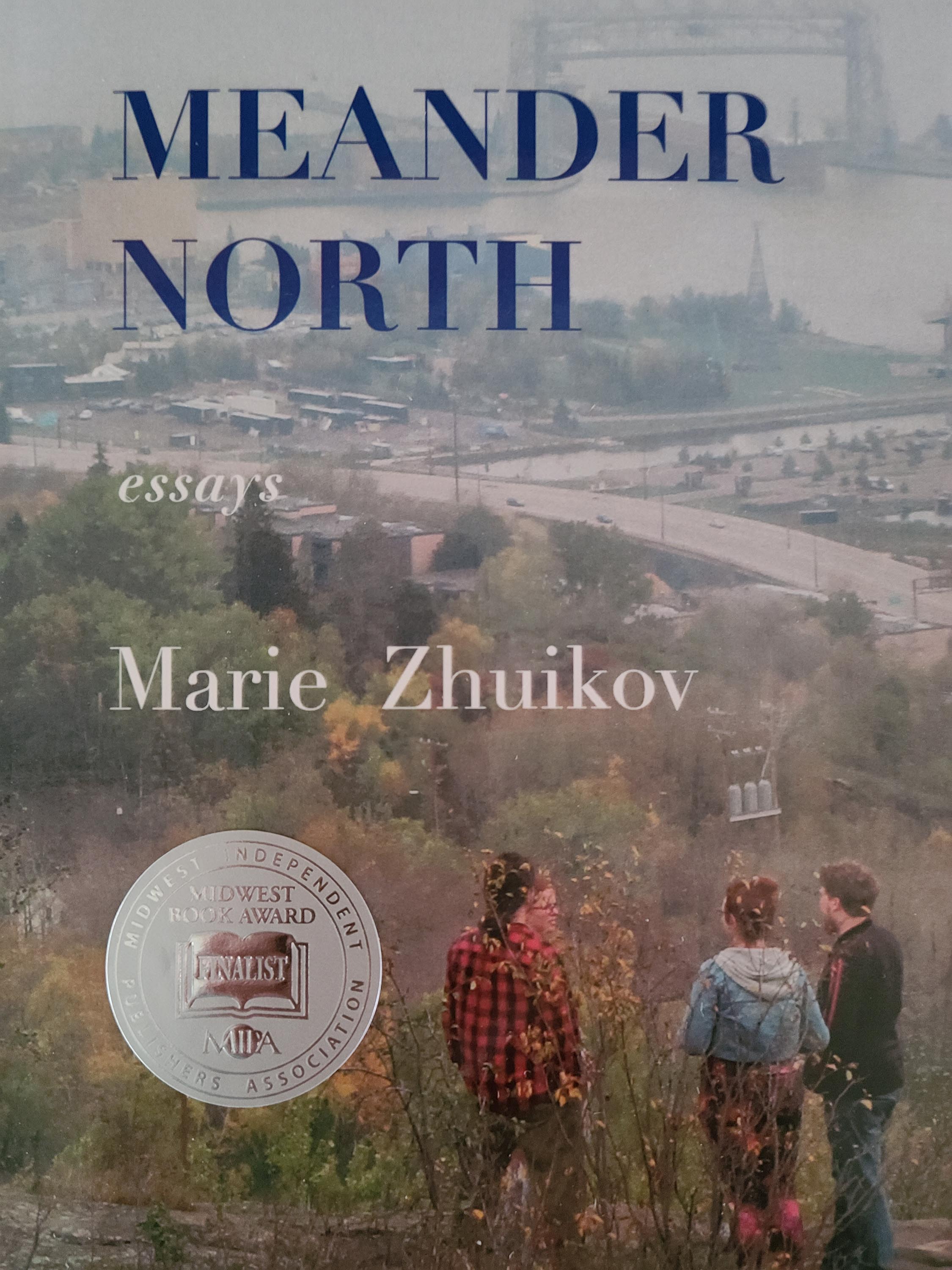
My book with its silver award seal.

I suspect most writers will agree there are several distinct and disparate phases they go through in completing a work. When you complete that first draft, you’re so relieved! You think it’s God’s gift to humankind. Then your writing group or beta readers get ahold of it and you begin to see its flaws. You fix those but by that time, you’re able to distance yourself from it enough that you see even more flaws. You hate the work. It’s awful. It should never see the light of day! There’s so much that needs fixing.

Some writers never get past this point. But if you take it slow, chunk by chunk, and are kind to yourself, and you remember what you were trying to say with your work, you can come out on the other side. You might even like it in the end – enough to think that maybe somebody else wrote it.

I recently attended the Midwest Book Awards Gala, held in Minneapolis for finalists in their awards program. It’s put on by the Midwest Independent Publishers Association, which serves indie publishers in 12 states. This year, the contest attracted 227 books from 122 publishers. “Meander North” was one of them. It ended up earning a silver award in the nature category.

Mary Ann Grossmann, keynote speaker.

The gala’s keynote speaker was Mary Ann Grossmann, retired book editor for the St. Paul Pioneer Press. She told tales from her long career, including when Pulitzer Prize-winning author Studs Terkel “kidnapped” her in his car because he wanted to keep talking, and when Grossmann convinced activist author Susan Sontag to go see the 5,000-pound boar at the Minnesota State Fair.

Grossmann’s main advice to authors was to “hire an editor!” In my case, I hired two of them, just to be sure. I was so close to the material that I felt like I was missing all the little nits that needed picking in the text.

At the end of the gala, authors were given the judges’ comments. I was heartened to see that they all thought the writing was very strong. The book was also judged on things like production quality and mechanics/organization. One judge said their favorite story was the one about the sensory deprivation tank. They said, “These essays are definitely something I would read again, and I intend on following this blog now, as well.” Thank you, whoever you are!

Another judge said they thought I had a “really appealing and charming voice, and I found the writing excellent.”

Do you see me over here, preening myself in a most non-Minnesotan way? Ha ha.

Cheri Johnson, who goes by the pen name Sigurd Brown, accepts her Midwest Book Award at the gala.

While at the gala, I got to meet some people from my past who turned into authors, one of them for the same publisher who produced my book (Nodin Press). I also met some people I have had interactions with online but had never seen in person. One of them was Sigurd Brown, the pen name for the author of the thriller, “The Girl in Duluth.” Her book won gold in its category. I have not read her book yet, but I have it on order.

She was nice enough to read “Meander North,” and she posted this review on Goodreads:

I enjoyed this book very much. Zhuikov’s personal stories of everyday life in northern Minnesota—which include subjects as varied as solving the mystery of headless rabbits on a trail near her house to her discovery, twenty-five years after the fact, that the UPS delivery driver at her new job is the boy she kissed in the coat room of her first-grade classroom—are both frank and charming, and in total they tell not only the story of a life but describe the fabric of a town (the port city of Duluth on Lake Superior, where Zhuikov lives). This is a friendly and calming book, with a narrator who is pleasant to spend time with. Reading one or two of the short essays that make up the book every night before bed, I often had the feeling that I was out on my porch in the evening, exchanging a few words with the neighbor I’m always glad to run into. The writing is also very nice; her sentences are as neat and luminous as pearls. The book is a silver winner of a 2023 Midwest Book Award and I can see why.

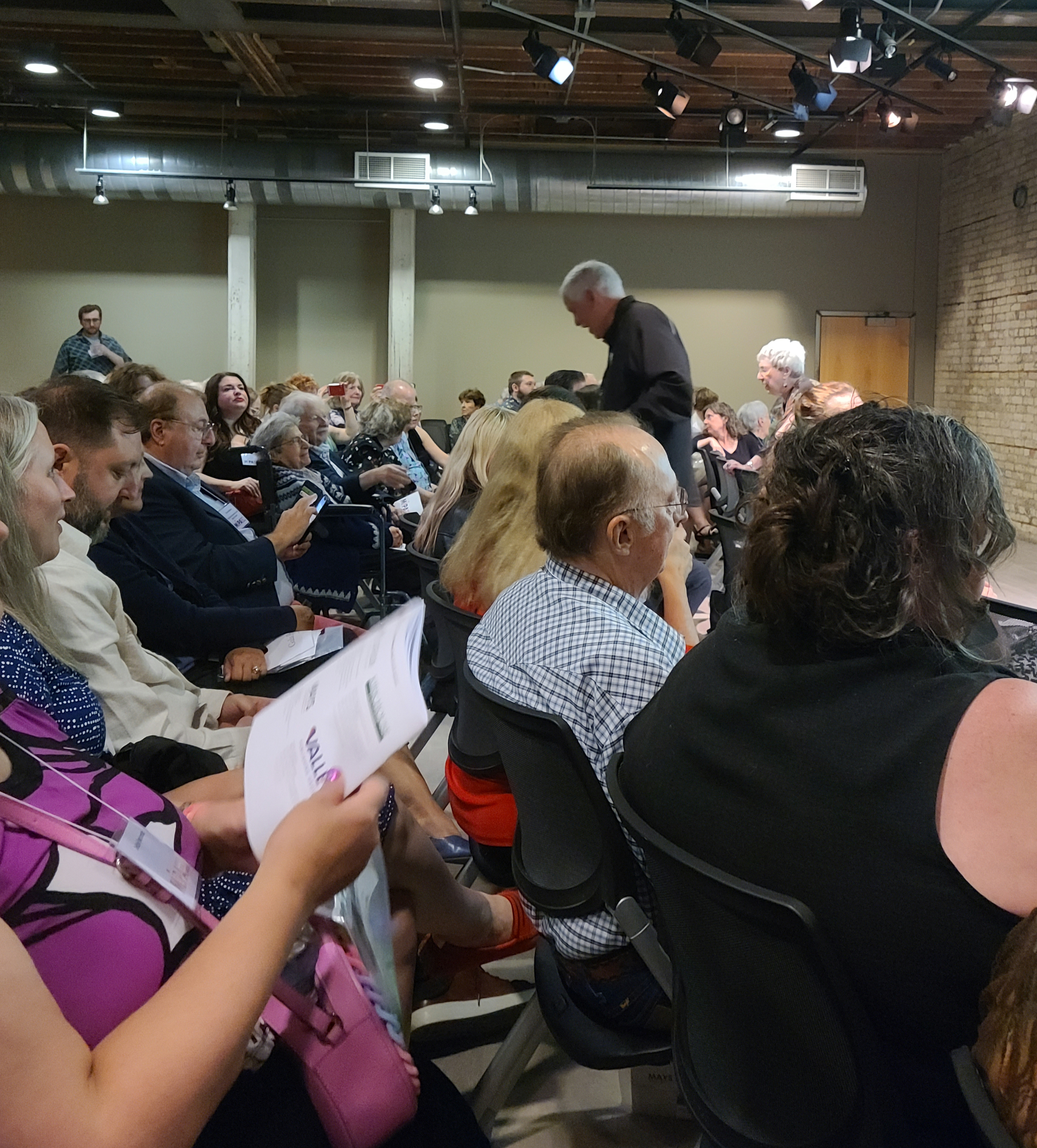
The gala audience.

I reread, “Her sentences are as neat and luminous as pearls,” several times. That’s what having two editors will do. Lord knows I don’t have that many editors for my blog! (From which the stories are derived.) Needless to say, I’m feeling a bit of pressure to write a similar glowing review of her book. But I’m sure that won’t be hard since it’s a gold winner already.

“Meander North” was also recently featured on the National Science Writers Association website. They offer a column that describes new books written by association members, and they were good enough to list mine, even though it’s been out for a while. Although my book is mostly personal reflections, there is some overlap with my day job as a science writer, so those things are highlighted in the column.

There, enough bragging. In ending, I’d like to point out that I probably never would have had enough content for a book based on this blog without the feedback and continued readership over the years from all my blogger buddies. So, you can consider this your accomplishment, as well. Thank you!!

Saying Goodbye to my 102-Year-Old Aunt

Marguerite and her brother (my father) on the Minnesota-Canada border, 1936.

A few weeks ago, I had the chance to speak with my Aunt Marguerite over the phone. She was in a hospital in Minneapolis and it was pretty clear she was dying. She’d gone in for a urinary tract infection, which should be easy enough to treat, but she wasn’t doing well. After a few days, she was on hospice care.

My cousin Priscilla was with her and said that Marguerite got a big smile on her face when she heard it was me on the phone. My aunt and I exchanged hellos. I said I hoped she felt better soon. I think we both understood that could be taken several ways. Then we said goodbye. Those were the last words she spoke. She died peacefully two days later with Priscilla at her side.

Although I live 150 miles away, the morning Marguerite died, I felt it as did one of my other relatives. We had a connection to this woman, my father’s sister and the last of her generation. I’m not sure how to explain the feeling except that it’s one of absence. A grand and stubborn spirit is gone from this world, into the next.

Russ and I felt lucky to have seen Marguerite in person a couple of weeks before when we made a trip to St. Paul. We felt like we said our goodbyes to her then.

Like me, my aunt loved meandering around. She attended at least 28 Elderhostels (when they still used to be called that) all over the world. If she had a blog, I bet she would have named it “Marguerite’s Meanderings!” We also both played the French horn in school. When I chose it, I did not know that she had played it, too. I just liked the mellow sound of it.

Marguerite never married and had no children of her own, but one special thing she did was take each of her nieces and nephews on a trip. My outing with her was in the 1970s in her Volkswagon camper van she nicknamed Pokey. We camped along Lake Superior’s North Shore. One destination I particularly recall was Finland. I was confused about how we could go there because I thought Finland was a country overseas, but I soon discovered that Minnesota had its own small town by that same name.

She was also very generous with her home. In 2005, when I was commuting to Minneapolis for graduate school, she let me stay overnight at her place on a regular basis. Money was tight for my family at this time, so I was thankful for this free lodging, plus I got to know her better.

I seem to be the family obituary writer, so that has been my contribution so far to all the tasks that need completing when someone dies. You can find Marguerite’s here.

As people like to say, she lived a good long life, but that doesn’t make her passing any easier.

A Guide to the Secrets of Blogging

Image courtesy of Word Press.

Last week, I gave a presentation about blogging for my local writers’ group. It was a first for me, so I needed to research the topic. Thankfully, there’s a lot of info out there about blogging, much of it from Word Press. I thought I’d share some of what I learned with you since I am now this font of knowledge.

  • There are 600 million blogs out there in the world. This is so many that they make up one-third of the web!
  • Most people read blogs to learn something new.
  • 80% of new blogs last only for 18 months. Most quit after 3 years.
  • 22% of Word Press bloggers write once per week. 2% post daily.
  • Word Press is the most popular blogging platform, hosting 43% of blogs.
  • The highest recorded salary for a blogger in the U.S. in 2022 was $104,000.
  • It takes an average of 20 months to start making money with a blog, but 27% of bloggers start earning money within 6 months and 38% are making a full-time income within 2 years.
  • Posts that have “how-to” or “guide” in their titles are the most popular in general. (I am testing this with the title of this post!)
  • Images are helpful in garnering interest. Post with up to 7 images get 116% more organic traffic compared to posts with no images.
  • In 2021, the average length of a blog post was 1,416 words.
  • The average blog post length has increased 57% since 2014.
  • The trend is for increasing word count for posts. Posts with over 3,000 words get 138% more visitors than posts with fewer than 500 words.

Do any of these stats surprise you? I’m surprised by the trend toward longer posts, but perhaps that makes sense because there more words and more topics for search engines to find. But I would think that people don’t have that much time to read. Maybe they find the posts but don’t read all of them?

Okay, now I need to find an image for this post. And I should probably make it longer, but I am out of time!

The Dreaded “Racorebob” Monster

An angry raccoon. This image is from a Fox News story about a Florida couple who thought they were attacked by a bobcat, but after DNA analysis, it turned out to be a raccoon.

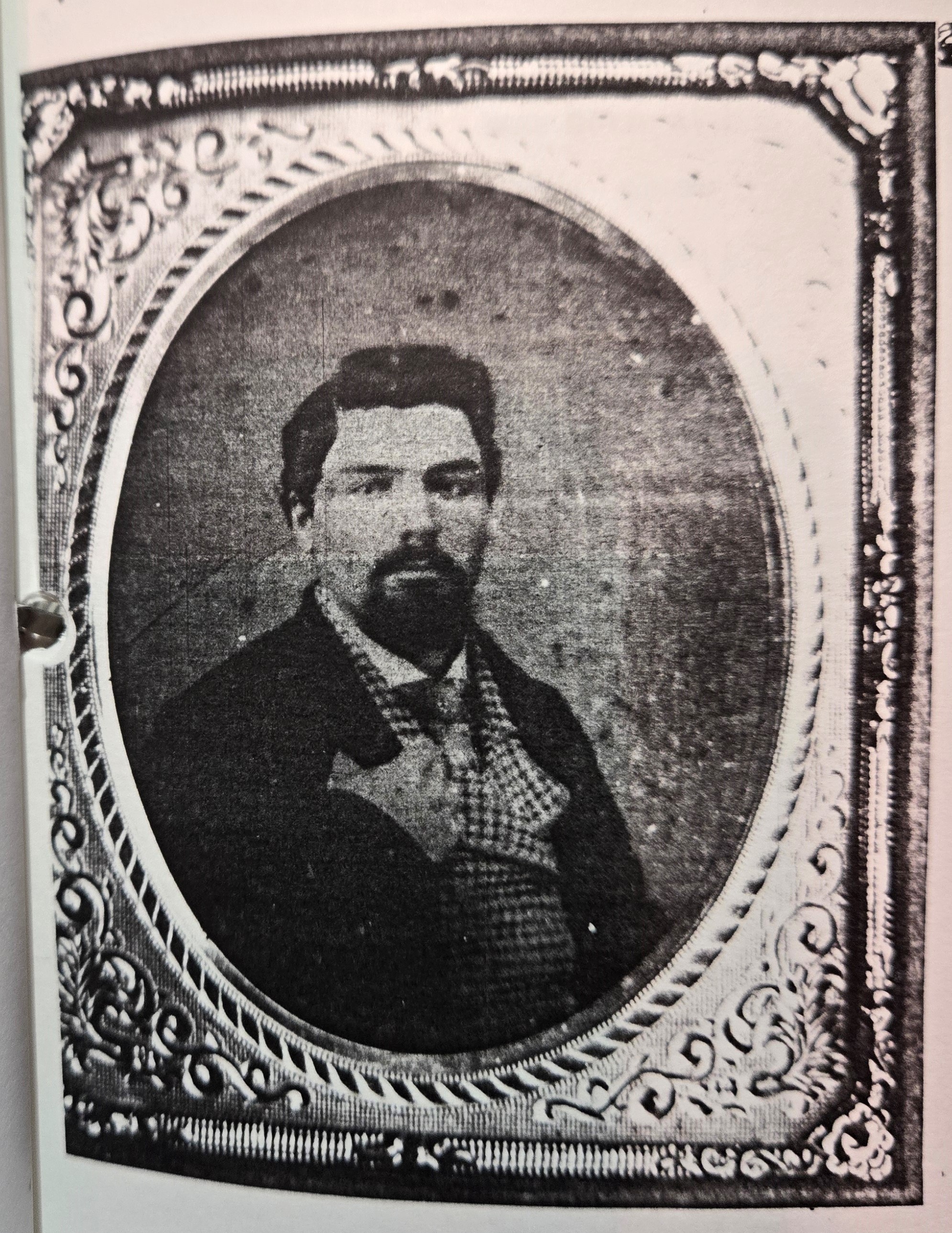
In his “Recollections of L. E. Potter,” my great-grandfather Laforest, who was a young settler in Minnesota tells a cute story that I didn’t have time to include in an earlier post about him.

The year was 1865. The family of 12 had moved from Wisconsin to Minnesota, settling for a time on the banks of the Watonwan River a few miles south of Madelia. One spring day, Laforest’s father John was mowing hay with a scythe about 80 rods from the house they were renting. Laforest writes (edited for clarity):

*

I was sent to take him a drink of water, also a watermelon. We got our water from a spring on the riverbank back from the house. I took my pail and melon to the top of the bank or bluff, laid the melon down by the side of the path and went down the path through the brush after the water. When coming back up the bluff, I heard something going through the bushes straight down to the river. This was rather startling to an eight-year-old.

Laforest Potter in his later years.

When I got to the top of the bluff and my melon was gone, boy-fashion, I did not stop to reason, but let my imagination run wild. I thought some animal had carried it off and that was what I heard going through the bushes.

I took the water to father and told him about the melon and the animal that carried it off. The more I talked about it, the better my imagination worked until I could tell what the animal looked like – what color he was, bigger than a dog. In my mind it was something terrible!

Father asked what I thought it was. I couldn’t tell him. So, he said he thought it must be a Racorebob.

Father told folks about my Racorebob for years after. Whenever my imagination would get the best of reason, I was reminded about my Racorebob. I believe it has always had a good effect on my life.

Father found the melon at the foot of the bluff, smashed against a tree. Somehow, it had started rolling down the bluff and that was what I heard.

*

(Marie here – I’m not sure what the word amalgam Racorebob means. Laforest never explained it, but my guess would be a “raccoon or bobcat?” Any other interpretations are welcome!)

Regressing in Prescott

Image courtesy of Deva.

When Russ and I travel, we usually do many “outward-looking” things like hiking, biking, seeing the sights, etc. For our recent trip to Arizona, we decided to go on a more inward adventure. We contacted a local psychic for past life regression sessions.

I’ve never shopped for a psychic before, but I figured the internet was a good start. A search of psychics in the Prescott area came up with three hits. The one that looked the most legit to me was “Psychic Readings by Deva.” Deva does readings by appointment only. She lives in a lovely home on the outskirts of Prescott.

We corresponded by email to set up the appointment. That went fine, except on my end. I was so distracted by dealing with the details of our impending trip that I sent Deva the incorrect dates of our visit. I thought I was setting our sessions up for the end of February and she thought they were going to be at the end of March!

When we showed up a month early, of course, she wasn’t home. Her husband was, though, and we were able to set up a session with Deva for the following day. Deva was very accommodating about this and I am forever grateful. I’m usually not such a scatterbrain. Was I unconsciously trying to sabotage the experience? Only Carl Jung can answer that!! (Get it? The famous Swiss psychoanalyst? Anyway…)

Besides past life regressions, Deva does tarot card readings, hypnosis, and energy work. She’s originally from Germany and has an accent that fits a session on a couch, which is where we laid during our separate hour-long regressions in her basement.

But first, while we were still sitting upright, Deva asked why we wanted the sessions. We basically just said we wanted a different vacation experience. Deva explained that in past lives, we could be different genders and races. There could be some violence involved since human history is so full of wars and conflict.

Russ went on the couch first while I waited upstairs, reading a book.

I was looking forward to the experience. I can’t say that I’m a true “believer” in past lives, but I am open and curious. I was bummed when I feared I had messed up our opportunity with the date snafu and was so glad that it worked out, after all.

A past-life regression is definitely not something I would have ever considered doing at home, where life is so busy. However, years ago, I bumped into a group past life session that was going on once down the hall from a meeting I had in the same building. A bunch of handouts entitled, “Tips for a Group-Guided Past Life Regression Experience” lay on a table, beckoning me. I picked one up.

One of the tips was to ignore your critical thinking so you can be fully present in the experience. This is very hard for me because I’m judgmental and critical by nature. Another was to trust that the information that drops into your mind during the regression is exactly what you’re supposed to see, even if it feels like you’re making it up.

When it was my turn, Deva spent about 20 minutes of the session on relaxation – taking me from the tip of my toes to the top of my head. Then came some imagery work that prepared me for exploring my past life/lives.

I ended up describing three lives. I really did feel like I was just making it all up, but thanks to that handy stolen tip sheet, I realized that was okay. I was male in two of the past lives, and female in one. One of the lives had a lot of violence and loss, but the other two were rather tame, except for a prairie fire and an absent husband.

In each life, I learned a lesson. None of the lessons were things that particularly resonated with me currently, and I didn’t really see anyone in my past lives that is in my current life. But I did end the session with a deep feeling of loss. Tears welled into my eyes and streamed down my cheeks. Deva found some tissues for me. 😊

I felt like I’d been through a ringer afterwards. It felt like one of those vacation experiences I often tend to get myself into — like a trail that’s way more difficult than the guidebook described.

On our way back to our hotel afterwards, Russ and I exchanged notes. He explored one life during his session. It seemed like it was in greater detail than my lives. But there were many similarities in it to the life of mine that had a lot of violence and loss. We were even the same ethnicity, although we were in different time periods. The lessons learned in these separate lives were eerily the same.

The session helped me understand some of my passions and dislikes and why I seem to have lost my green thumb.

In summary, Deva was great. The experience was unique, but if you do a past life regression, don’t expect a flippant jaunt down a flat trail, even if the guidebook classifies it as “easy.”

My Aligners are off!!

A pile of my Invisaligns.

It took longer than the 16 months predicted to get my Invisaligns off (see My Mouth is Full of Plastic), but I am happy to say they’re gone now. That only took 23 months of my life.

If you have a superb memory, you may recall that I found in my late 50s I was having a hard time chewing food with my back teeth. My front teeth were doing more work than they were supposed to, which led to chipping and general stress on them.

After a rocky start, I was fitted with plastic aligners. I was so relieved not to have to wear metal braces. I dutifully followed all the instructions and kept my orthodontist appointments. I saw improvement right away. However, gradually, I noticed I couldn’t bite off things like noodles and pizza crusts with my front teeth.

By the end of the two years, my problem had reversed itself. Instead of not being able to chew with my back teeth, that’s all I could chew with now. My front teeth weren’t working properly.

Of course, I relayed these concerns along the way to my orthodontic technician, who assured me that the fine-tuning by the last batch of aligners would take care of it. They didn’t.

You’d think, with all the computer-assisted measuring they do of your teeth during the process of fitting aligners, that things like this wouldn’t happen. I asked my orthodontist why, and he said something about jawbone structure and this and that.

To help my front teeth meet like they’re supposed to, he would need to shave off thin bits from my back teeth. I was not too thrilled about this, but he assured me the shavings were only the thickness of a fingernail and that it wouldn’t impact any of the fillings I have back there. If he didn’t do this, I would need to wear yet more aligners for more months.

At this point, I was willing to do just about anything to get my teeth free from all this plastic. I knew I’d have to wear a retainer afterward, but assumed that would only be at night, similar to my sons’ experiences with braces.

So, after much grinding and then additional grinding to take the aligner anchors off the rest of my mouth, my teeth are now free!!! They felt great and I could bite stuff with my front teeth!

I had a few minutes to rejoice before the hammer dropped.

The technician informed me I was going to be fitted for a plastic retainer (which looks much like a set of Invisaligns). This, I expected. What I didn’t expect was that I was going to have to wear it DAY and night for three months.

Alas, my mouth remains full of plastic. I gained freedom, but not all that much.