If you didn’t get a chance to see my article in “Lake Superior Magazine” about the rare and endangered Ojibwe Horses, the same story has been reprinted in a different magazine: “Equine Monthly.” Click here to read it online.
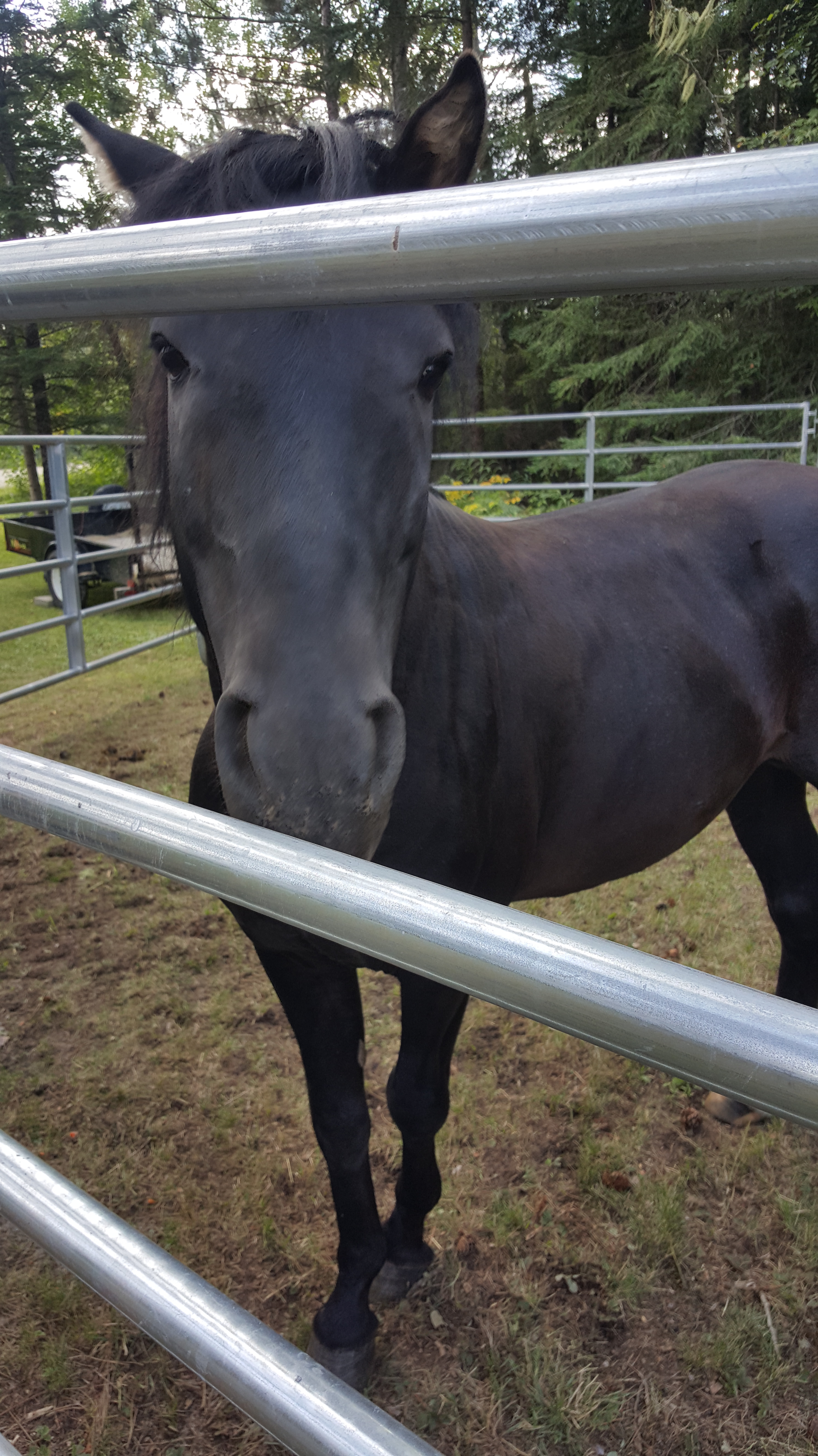
An Ojibwe Horse, also known as a Lac LaCoix Pony. These horses are well-adapted to life in the northern wilderness.
If you’d like to hear the story behind my story, read my blog post here. These animals are so special. I felt privileged to be introduced to them.
For the holidays, Russ and I decided to get away from it all – so much safer for us and for others, especially with this new variant of Covid-19 going around. Where better to avoid seeing anyone else than in a bog?

At our cabin in northern Minnesota, we walk regularly past a bog. It’s right next to a gravel road, enticing us with its remoteness and untrammeled nature. The plat book we consult signifies the bog is privately owned, however there’s no owner’s name listed, so we weren’t sure who to ask for permission for access. So, we just took a chance, donned our snowshoes, and trammeled it, just a little bit.
Although they look sterile, bogs are places of unparalleled abundance and life. The vast peatlands of northern Minnesota cover more than ten percent of the state. Unlike the clearing of the prairies and white pine forests, efforts to drain and develop the peatlands were mostly failures, although unnaturally straight ditches in some bogs testify to this toil.
The bottom of a peatland is a breathless place – cold, acidic, anaerobic – with no oxygen to decompose branches or the small, still faces of the weasels interred there. Sphagnum mosses wrap around the fur, wood, skin, casting their spell of chemical protection, preserving them whole. Growth is impossible, and Death cannot complete his spare work.
Minnesota’s peatlands formed over five thousand years ago when the climate cooled and rain increased. The state contains more peatlands than any other in the U.S., except its Alaskan stepsister. (A surprising number of Minnesotans spend time in Alaska and vice versa.) Although in the U.K. and northern Europe the smoky glow of peat still heats many houses, the trend never caught on in Minnesota.
In Europe, bogs are portals to distant worlds, wilder realms. Gods travel the bogs. In America, peatlands are just an inconvenience to be drained or avoided. Even the Ojibwe let them alone. Maybe that’s why birds love bogs, like the nearby Sax-Zim Bog. They are places where people are not. Owls can hunt voles, mice, and moles to peaceful content.
We saw many deer trails crossing the bog. Shrubby bushes of Labrador tea poked their tips through the covering of snow. We investigated an island of red pines at the bog’s edge – an upland out of sync with the rest. Climbing a short way, we came upon a human-made square wooden platform covered with a thin layer of snow. A cache of short, fire-ready sticks lay piled between two tree trunks nearby. It looked like a tent platform, ready for use.
We vowed to check the plat map to see how people could access this red pine “island” in summer. It was surrounded by the bog, but perhaps not too much bog for a person to cross when conditions are more liquid.
Back on the bog, we passed stunted black spruce trees and tamaracks, denuded of their needles by winter. A gentle snow began to fall, consecrating all with a layer of white.
All was silent. All was good.
We completed a circuit around the area, which was surprisingly much larger than we could see from the road. As we took off our snowshoes and walked back to our cabin, we were suffused with the peace of this wild place.
Imagine our distress when, a couple of weeks later, we walked past the bog again, only to see snowmobile tracks leading out onto it. The snowmobiles had run ragged circles around the part nearest to the road that was clear of trees. They churned up vegetation, spewing spatters of green “blood” across the snow.
It made me wonder what the snowmobilers were thinking of when they chose to motor around in the bog. They probably thought it looked like a fun place to tear around in – a wasteland, devoid of life, useless to humans. Why not have some fun in it?
Agh. It hurt my heart to see it. Thus, this blog post – letting people know that just because something looks useless to humans doesn’t mean it has no value. Bogs are home to countless creatures and many rare plants. Please, please don’t misuse them.
If you’re reading this, you survived the year that was 2020. I won’t offer any inane or overused platitudes about this year. We all know how it went. While I did write a few posts about the coronavirus and other 2020 disasters, everyone else was, too. So, I tried to keep my topics unique and personal. My most-popular list reflects that. Here are the five top posts from this year, along with a couple of overall popular posts since I started this blog seven years ago.
But first – a couple of more numbers: views almost doubled again this year, with 27,960. My blog has about 520 followers. Thank you, followers. I value you all!
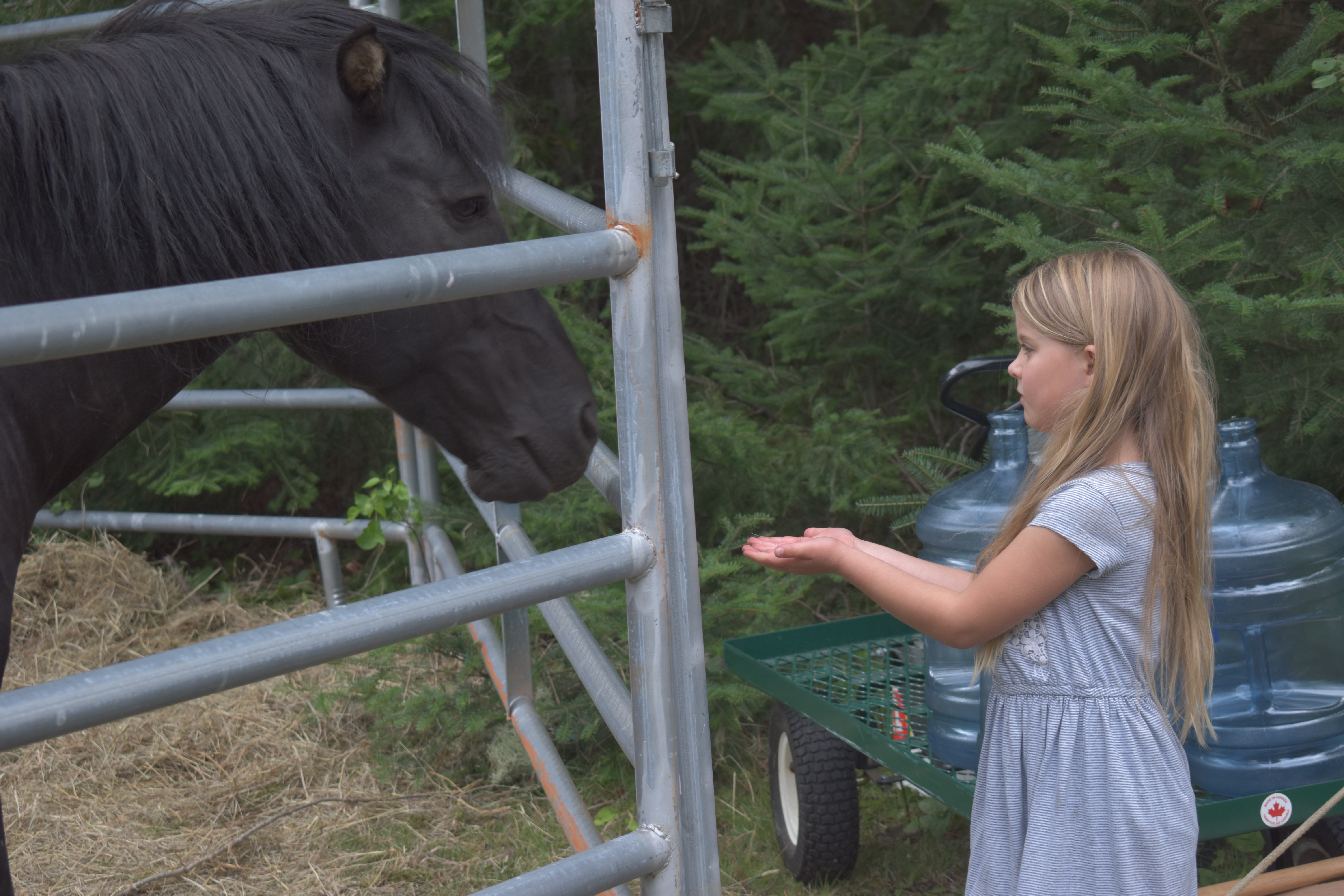
A girl makes friends with an Ojibwe horse at Quetico Provincial Park in Canada.
#1 Revisiting my Horse Mania – This is a relatively recent post (from November) where I reminisce about the love of horses I developed a child. I was able to revisit my passion as I researched and photographed a story in Canada for Lake Superior Magazine about a rare and endangered breed, the Ojibwe horse (also known as Lac La Croix Indian Ponies). My story, “The Horses Nobody Knows” describes how the breed was saved from extinction in the 1970s, and what the horses mean to the Ojibwe people today. The story is only available in the printed magazine (Dec-Jan issue) right now, but the magazine intends to post it online in Feb 2021. I’ll try to remember to post a link here once it’s up.
#2 Bog Birding Bust – This story’s high ranking surprised me because it’s about something that DIDN’T happen. After years of anticipation, I finally went to a local bog that’s a legendary birdwatching site. I hardly saw anything! So, this post was a lesson in the worst time to see birds in the Sax-Zim Bog in northern Minnesota. I guess failure is sometimes much more interesting than success.
#3 That Time I Organized a Sea Lamprey Taste Test – This was a trip down memory lane from when I worked for Minnesota Sea Grant in the late 1990s. We received funding for a demonstration project to determine whether there was an overseas market for a Great Lakes invasive pest – the sea lamprey. To promote the project, I organized a media event, which included a taste test by local luminaries, including the university chancellor, the mayor, etc. The event was a hit – leading to national and international stories. The project was also a hit, until further testing showed the lamprey were too high in mercury for safe consumption. So, it turns out, despite my concerns at the outset, I did a darn good job of promoting something that can contaminate people.
#4 The Many Faces of Buddy – As if this year wasn’t sucky enough, my dog (who was a frequent contributor to this blog) died. To know Buddy was to love him. We still keenly feel his sudden loss.
#5 A Mini-Minnesota Vacation: Lake Vermilion State Park – Despite travel restrictions, Russ and I were able to meander around a bit, close to home in our Scamp trailer. One of the first trips we took was to a new state park in northern Minnesota. Read my post for some pros and cons.
Overall, my blog’s most popular posts continue to be a tongue-in-cheek story I wrote about writer’s bumps (17,300 views this year!) and another about how crappy Iams dog food is.
Best wishes to you all in 2021. May your coronavirus vaccinations come quickly and with few side effects.
Happy holidays, dear readers. I am taking a bit of a break for now. But I will be back soon with “the best” of Marie’s Meanderings list for 2020. Stay safe and well, everyone!

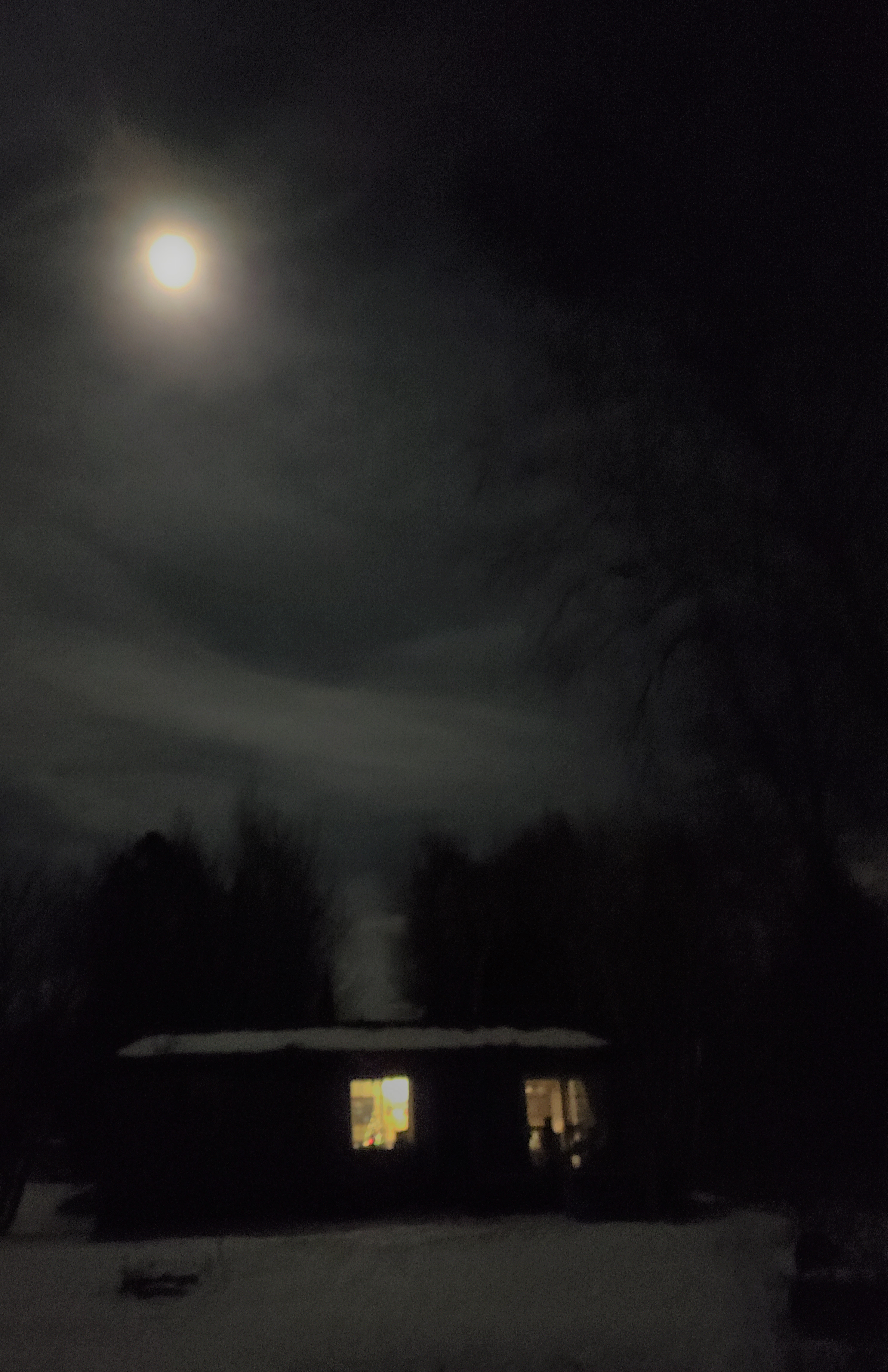
The moon was too gorgeous to be denied. We went out to greet it on a frozen lake.
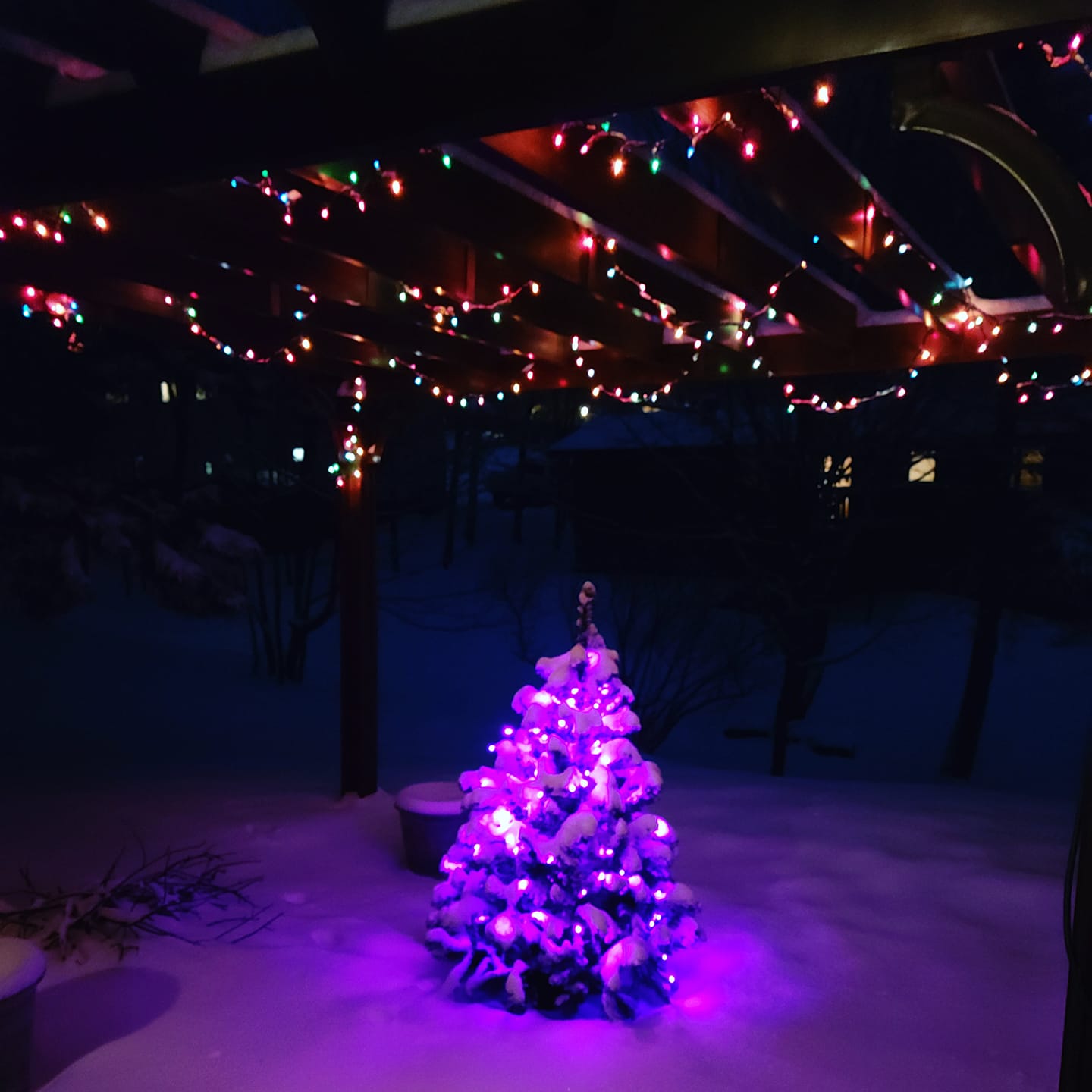
We snowshoed past this cozy cabin with a little Christmas tree in the middle window. You can almost see the tree in in this night-blurry photo. Silent night. Inspiring night….
An Ojibwe horse makes friends with a girl at Dawson Trail Campground in Quetico Provincial Park, Canada.
When I was a girl, I was horse crazy. My best friend, Jody, lived in my neighborhood and we collected every different breed of plastic toy horse we could get our hands on. (Or that we could convince our parents to buy.)
I had galloping horses, standing horses, rearing horses, trotting horses; Palominos, greys, Morgans, Appaloosas, Paints, you name it.
Jody and I enjoyed many imaginary adventures with our steeds. Enraptured, we watched movies like “The Miracle of the White Stallions,” “Justin Morgan had a Horse,” “The Black Stallion,” and “National Velvet.” I must have read all the Beverly Cleary horse books and Walter Farley books. During winter, we didn’t build snowmen, we made snow horses (which are basically snowmen lying down).
The highlight of my year was summer YWCA camp where I could ride a horse, although at a plodding pace. (Spatz, I miss you!)
It didn’t help that my grandfather raised horses (and mules, donkeys, ponies) and had his own Western store. He had a mule named Hubert (after Hubert Humphrey, a Minnesota politician) and a dapple-grey pony named Daisy that he let me ride on my rare visits. My grandfather trained Palominos for show. The back of his store housed saddles, which were propped on rows of sawhorses. The heavenly aroma of leather filled that back room. I climbed up on the saddles, pretending I was riding.
Jody and I begged our parents for a horse, coming up with outlandish plans about how they could be kept in the garage of our city homes, promising we would take care of them and exercise them every day.
When we were in sixth grade, Jody’s parents caved. She got her own horse, a paint named Friskie. She kept it at a stable just outside of town. I spent many Saturdays there, joining her as she exercised Friskie around the indoor arena. I rode a different horse that needed a workout.
Sometimes, Jody would trailer her horse, once even bringing it to my back yard (see photo below). Her family had a cabin outside of town and I also I recall riding Friskie bareback on the gravel roads around Island Lake.
Having a girlfriend with a horse wasn’t quite as good as having my own horse, but it must have helped assuage my passion somewhat. I’m sure my parents breathed a sigh of relief. My horse love didn’t totally go away, though. At the end of junior high, I attended a horse camp in central Minnesota with another girlfriend. It was the kind of place where you were assigned your own horse for the week and were responsible for its care. We learned how to brush a horse properly, feed it, etc. We were assigned to different groups based on our riding proficiency. I was proud to be in one of the upper levels. The week culminated with a trail ride and campfire, where we had the thrill of galloping the horses.
These memories resurfaced because a magazine story I wrote (and photographed) about horses was published recently. Not just any ol’ horse, however. Quietly, over the centuries, the Ojibwe people developed their own breed, now known as the Lac La Croix Horse (or Lac La Croix Indian Pony). Once roaming in the thousands over northern Minnesota and Ontario, Canada, these horses were semi-feral and community owned. Tribal members only brought them into enclosures during the winter to ensure their safety and health.
In the late 1970s, the horses almost went extinct for a number of reasons, including systematic efforts by European settlers to destroy them, and the rise of motorized technology.
In my story for Lake Superior Magazine (“The Horses Nobody Knows”), I describe how the breed was saved from the brink of nonexistence and what they mean to the Ojibwe today. It’s the longest article I’ve ever written. I had to wait a year for it to get published, which was extremely hard, because, you know, horse mania.
Learning about an unknown part of my home state’s past was exciting. I thought I knew every breed. As it turns out, there was a unique breed almost in my back yard, so to speak, that needed help.
I was more than happy to resurrect my horse crazies and put my writing talents to use to help raise awareness about the Ojibwe horses’ plight. If you’d like to donate to Grey Raven Ranch to help these special horses, they have that option on their website.
Getting my novel and an excerpt ready for the exhibit.
This week in downtown Duluth, an exhibit is being installed in the Zeitgeist Arts Café lobby windows. The effort is spearheaded by Tone Lanzillo and Phil Fitzpatrick to highlight how the creative arts can help people gain a deeper understanding and appreciation for the various impacts that climate change has on our lives. It’s part of a global campaign, “Culture x Climate 2020” organized by the Climate Heritage Network in France.
Although my novel “Plover Landing” may look like it’s all about shorebird restoration, it’s about climate change in equal measure. Besides being cute as a button, the character of young Demitri has mysterious powers related to climate. Much of the story revolves around Demetri and his friends figuring out his role in the world.
When Phil approached me about submitting poems for the Culture x Climate project, I had to decline, saying I had none, but that I did have a whole novel about climate change. He encouraged me to submit an excerpt and to provide a copy of the book for the display.
Tone and Phil are putting the finishing touches on the exhibit today and it will be up all week, possibly longer. Other activities are happening, too. Zenith Bookstore and the Duluth Public Library will present books on climate change for adults and children on social media. KUMD Radio and PACT-TV will be interviewing artists and poets who are participating in this project. The Duluth/365 climate initiative, as well as other climate and environmental groups, will be posting information about various poets, artists, musicians and photographers on social media. There is a Facebook event and discussion about the creative arts community and climate change on Nov. 17. And there will be a new blog providing information on the creative arts and climate change.
As Tone said in his Duluth Reader article, “This project will hopefully illustrate how important the creative arts are to the quality of life in Duluth. And just as significantly, show how the creative arts can be used as a very valuable and meaningful tool to engage, educate and empower our citizens to address climate change.”
I am happy to be part of this. I hope you get the chance to check it out!

Russ biking across the 3/4-mile floating bridge on the Mesabi Trail.
The Mesabi Bike Trail website offers a rather hokey legend about how this part of northern Minnesota came to be named “Mesabi.” Basically, it describes how native peoples thought of the glacier(s) that covered the far north during the Ice Age. The story says the area was “guarded by this great white giant, so large that he could not be seen over. He could not be walked around.” The early people named him Mesabi, which means “a great and stout giant man.”
When the weather warmed and the giant grew weak, he retreated, uncovering a land of abundant forests, lakes, and farmland. The Mesabi Bike Trail traverses 135 miles (of a planned 155 miles) through this terrain.
Russ and I had the opportunity to bike several sections of the trail this summer. Thanks to unseasonably warm weather on a weekend earlier this month, we had the chance to pull on our biking shorts and explore more. We took the Giant’s Ridge Spur, which we reached from the parking lot of the Giant’s Ridge Recreation Area near Biwabik, Minnesota.
Our goal was to make it across an extensive floating bridge that crosses a bog near the end of the spur, a 16-mile round trip. This goal was no big deal to Russ, a retiree who routinely bikes 50 miles at a pop, but for me, a person whose life is still ruled by working for a living, it would be the longest trip of the season.
I’ll cut to the chase: we made it! The trail runs through remote country, passing regrown timber lands and beaver ponds, and crossing cabin driveways. A relatively new section climbs up a rather large ridge – high enough that it sports cell phone towers on top. The trail on other side of the ridge features at least a half-mile downhill stretch that you can just blast down. The metal floating bridge is at the bottom; it runs ¾ of a mile through a wetlands in the Darwin Myers State Wildlife Management Area (WMA). The trail turns to gravel at the end of the bridge for a short stretch through the rest of the WMA.
Of course, going downhill means you have to go uphill on the way back. I needed to walk my bike a couple of times, but the fun I had during the downhill runs on the way out were totally worth it.
Soon after our bike trip, Old Man Winter returned with snow, so we put our bike shorts away for the season. Unlike those who lived during the Ice Age, at least we can look forward to taking them out again on the other side of winter.
Seeing snow on the runs at Giant’s Ridge while we were biking in shorts was strange.
The New York Times recently published an article about eating invasive species as a means of control. It reminded me of a demonstration project we undertook when I worked at Minnesota Sea Grant in 1996. We received money from The Great Lakes Protection Fund for two years to study the overseas market potential for Great Lakes sea lamprey.
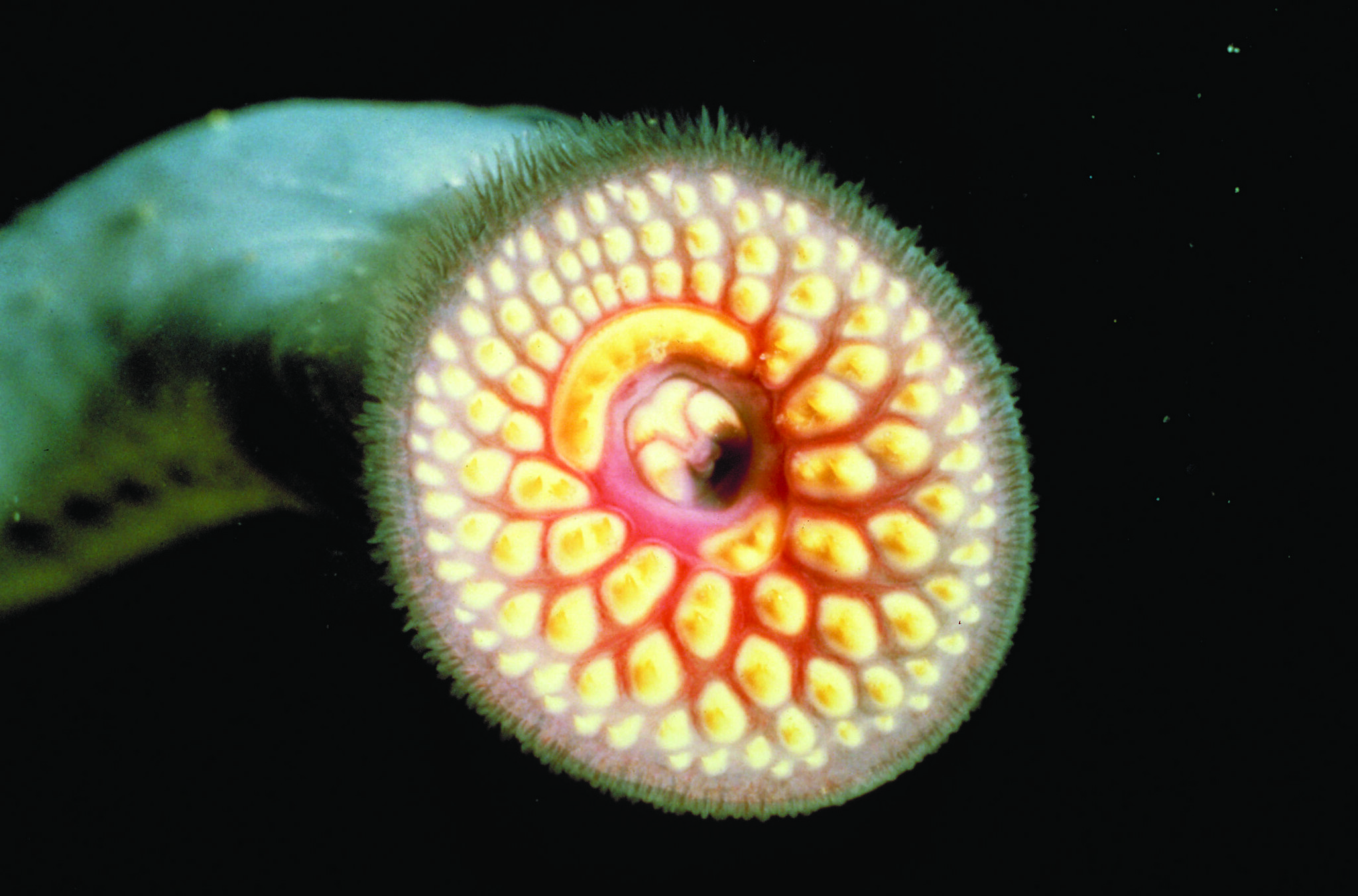
The business end of a lamprey. Image credit: U.S. Environmental Protection Agency
I’m sure many of you are familiar with the story: lamprey, with their penchant for sucking blood, are a parasitic exotic species that entered the Great Lakes and almost wiped out the Great Lakes fishery by the 1940s. This led to a control program coordinated by the Great Lakes Fishery Commission that is ongoing even today. Every year, the commission’s various lamprey control programs cost millions of dollars. Sea lamprey are clearly still an enduring threat.
In the mid-1990s, the commission’s lamprey control program routinely landfilled thousands of female lamprey they trapped. At that same time, lamprey populations in their native countries like Portugal and Spain were becoming decimated due to overfishing and habitat loss. This was an issue because lamprey were/are considered a culinary delicacy in Portugal and Spain. Like the lobster aquariums found in American restaurants, Portuguese restaurants offered tanks of sea lamprey where people could pick their dinners. Exclusive and expensive clubs even formed around lamprey consumption.
Jeff Gunderson, the fisheries and aquaculture specialist with Minnesota Sea Grant at the time, took an idea from a University of Minnesota food professor and the extension leader at Minnesota Sea Grant and turned it into a project to find a use for the excess, unwanted Great Lakes lamprey by seeing if chefs in Portugal and Spain would find them as palatable as their native lamprey. He set up a team that included a professor in Portugal who would conduct market testing, University of Minnesota experts, a NOAA international marketing expert, and a fisheries biologist.
My job was to garner visibility for the project and its results. When Jeff first described the project to me, one of my first questions was whether the lamprey had been tested for mercury. “I don’t want to promote something that’s going to contaminate people,” I recall saying. He assured me the lamprey had been tested and were within U.S. standards. But what I didn’t know at the time was that only a small sample of lamprey were tested. (More to come on this later.)
To figure out my publicity strategy, I consulted a couple of my news reporter friends. I think it was Mike Simonson, the well-known and now dearly departed Superior bureau chief for Wisconsin Public Radio who said, “You gotta have a taste test!”
That sounded like a capital idea, so my first step was to find a local chef willing to cooperate. I approached my favorite restaurant, Bennett’s Bar and Grill, run by Bob Bennett. This “forefather of contemporary cuisine in Duluth” was game.
The Portuguese professor had given me several traditional sea lamprey recipes, at least one of which involved using lamprey blood. Ewww. Anyway, I showed these to Chef Bennett, and we came up with a taste-test plan. He would prepare two traditional recipes and create two of his own. Gunderson talked the original Lou of Lou’s Fish House in Two Harbors into smoking some lamprey for the taste test, as well.
Next, we had to find some brave lamprey consumers. Somehow, I managed to convince the Duluth mayor (Gary Doty) to participate along with the University of Minnesota Duluth chancellor (Kathleen Martin). Several members of our Sea Grant Advisory Committee also agreed as did a freelance graphic designer who worked for us, a congressional office manager and the Minnesota Sea Grant director (Michael McDonald),
We held the lamprey taste test at Bennett’s restaurant, which was on Superior Street in downtown Duluth. Eight intrepid tasters were seated at a long table facing into the room so that reporters could easily see them and ask about their reactions to the food. We gave them a rating form. We also provided an aquarium with several lamprey in it, just to add to the room’s ambiance, and the smoked lamprey and some crackers for snacks.
Simonson was right about the lure of the taste test. We were mobbed by local reporters, both print and broadcast. Reporters from the Twin Cities even made the trip up north for it. The resulting stories went everywhere, even internationally. The Associated Press picked up the print story, and Gunderson said he talked to someone who saw it on a television station in Seattle. The story eventually made it into Newsweek and The New York Times.
Back in my office after the test, I received a phone call from the daughter of a Portuguese immigrant in Boston who saw the news stories and wanted to know how to obtain lamprey. She told me lamprey was a traditional Sunday dinner in Portugal, just like American pot roast. Her father was so excited when he saw the news, he implored her to find out more. I had to give her the disappointing information that lamprey were a regulated invasive species without a commercial source yet.
The highest rated dish was Bennett’s own lamprey stew with garlic mashed potatoes, rated 4.5 out of a possible 5. The smoked lamprey came in second, earning 3.7 out of 5. The taste of the lamprey came out more strongly in the traditional dishes, which did not suit these American taste-testers.
I ate both the lamprey stew and the smoked lamprey. I enjoyed the stew, although the chef forgot to take out the lamprey’s cartilaginous backbone (called a notochord), which made it a bit crunchy for my taste. I bet if he had removed the backbone, the dish’s ratings would have been higher. The smoked lamprey tasted rather like any kind of smoked fish – very good!
The taster’s comments included: “Surprisingly good. Try selling it without telling people what they are eating. It would be better.” And, “I would not order this out, but Bennett’s dishes were by far the best.”
More extensive taste tests were run in Porto, Portugal. Eight restaurants with lamprey-cooking experience, two homemakers and 16 individual taste testers participated in two studies. The restaurant chefs were asked to rate how the lamprey looked while alive, how they cooked compared to Portuguese lamprey, how they smelled/tasted/looked after cooking, how the lamprey tasted to them, and how their clients or family members liked them.
Overall, the Portuguese taste testers enjoyed the strong flavor and firm texture of the lamprey, noting the lamprey had a pleasant “turf” taste and was less soft and fatty than Portuguese lamprey. (A turf taste refers to an earthy flavor, somewhat like mushrooms or liver.) They rated the flavor 4.5 out of 5 – a definite win.
During the second year of the project, more lamprey were shipped to Spain for taste tests. The results weren’t as glowing, perhaps because only frozen and canned Great Lakes lamprey were shipped instead of live wriggly ones. The Spanish testers liked the texture and that some contained eggs. Yes, lamprey are a delicacy in Spain, but lamprey caviar takes it to a whole other level.
The death knell for this innovative program came from subsequent contaminant tests on the lamprey. The Great Lakes lamprey contained mercury levels that were too high to meet European Union standards. They tested at 1.3 ppm for mercury. The EU standard at that time was 0.3 ppm. This information came too late for our taste testers, but hopefully, one meal of lamprey was not detrimental. I certainly didn’t feel any ill effects.
Gunderson summed it up like this: “At least we have an answer to the question that has been debated for nearly 40 years. Yes, Great Lakes lamprey are marketable in Europe. Because of current control programs and experimental programs, a commercial harvest of lamprey would not have been a priority even if mercury levels were acceptable. But given time, a commercial harvest could fit into lamprey control and management. Lamprey are here forever and who knows if the funding for lamprey control will last that long. If funding ever does wane, let’s hope it’s not before mercury levels decline to acceptable levels so that lamprey harvest can be evaluated as part of a low-cost management program.”
That was almost 25 years ago. A Lamprey and Rice Festival is apparently held in Portugal each year, so it still must be popular, but I fear that the people who used to love eating them for Sunday dinner are aging out of this world.
Unfortunately, mercury levels in Great Lakes lamprey are still high. According to a 2018 study by the Great Lakes Indian Fish and Wildlife Commission and the University of Wisconsin, levels in adult lamprey were still beyond that deemed safe for human consumption.
In any event, this project was one of the highlights of my career. It seemed like a win-win idea: The U.S. could rid itself of an expensive invasive species, and European diners could eat a traditional and much longed-for dish. Yes, I promoted something that could have contaminated people. But I did a darn good job of it.
When last you saw us, Russ and I were thwarted in our attempts to bike along the North Shore of Lake Superior by cold weather and lack of appropriate clothing on my part. As an alternative, we decided to hike somewhere we had never been before. This turned out to be along the Temperance River.
The trailhead is extremely easy to reach – it’s right along Highway 61, with parking on both sides of the road. (The trailhead is on the side opposite Lake Superior.) Russ and I had driven past the park roughly a bazillion times but were always going somewhere else. We were so glad we stopped this time!
The first part of the trail takes you to a plunge pool, which is at the base of a waterfall hidden back in the rocky clefts. At the end of the Ice Age, the waterfall wasn’t so hidden. Torrents of melting glacier ice cascaded over the rock ledges, creating a waterfall that was 300 feet wide, or so said the interpretive sign along the trail.
We hiked along the river gorge on the Superior Hiking Trail about eight-tenths of a mile to the upper falls and then backtracked to return to our car. With lots of rocky ledges to clamber and scenic river vistas around every turn, this trail would be a perfect way to get sullen teenagers excited about nature. Although there are some stairs to climb, most of the trail is relatively easy if you are able-bodied.
The river gorge is super gorgeous. I kept wondering why I’d never heard my friends who know the North Shore rave about it, because it certainly is rave-worthy. My photos only capture a minor part of the beauty.
If you do go to the Temperance River, please remember to practice social distancing and carry out your trash. The park looked clean when we were there, but I know that some parts of the shore are being over-loved and over-travelled lately.







 Marie's Meanderings