I recently wrote a post for the blog I manage for work, which I think you might enjoy. The promo: “Senior science communicator, Marie Zhuikov, recalls a grisly discovery in connection with a project to control invasive goldfish.”
The adorable, incomparable Francine in 2020. Image credit: Amanda Jo Dahl-Sales
Videos that show happy reunions between grandparents and grandchildren keep popping up on my social media feeds and in newscasts. With the Center for Disease Control’s blessing, once grandparents wait until their immune systems are fully protected by their vaccinations, they have the green light to hug their children and grandchildren.
Many of these reunions happen outdoors. The grandparents surprise their grandchildren at a bus stop or on a sidewalk. The children pause a moment to realize what’s happening and then run with squeals of joy into their grandparent’s open arms. I always tear up at these.
I am looking forward to such a reunion myself. My target date is April 15, two weeks after my second vaccination. But I have no illusions that my grandchild will even recognize me. I expect she may even scream and run away!
Francine was less than a year old once COVID hit and we all retreated to our individual lairs. Since then, we’ve visited a couple of times outdoors with masks on. We’ve computer Zoomed with Francine and her parents at least monthly, sometimes more. But it’s not the same as spending in-person time with a young grandchild.
Most of the grandchildren in the happy reunion videos are older. They had time to bond with their grandparents before the pandemic. Poor Francine was too young for that, and I expect there’s at least half a generation of other grandbabies who have had their grandparent-bonding interrupted.
We saw videos of Francine’s milestones – learning to walk and talk, but it’s not the same as being there. It sucks and it’s been so hard. And I don’t know about you, but I have a bad case of Zoom fatigue these days. For work and play, I’ve had at least two Zoom meetings every weekday for the past three weeks. Today, I didn’t have any, so that’s why I think I have energy to write this post.
I’m not the only Minnesotan with Zoom fatigue. I just read a story in the Minneapolis Star Tribune that proves it. By tracking geotagged tweets, researchers found that Minnesotan tweets led the nation in phrases like, “I hate virtual meetings” and “I hate Zoom meetings.” Some of the reasons posited are that the Zoom communication style goes against Minnesota culture. More eye contact is required, plus, watching yourself on camera can be “cognitively tiring and anxiety provoking.” Then there are those awkward pauses so difficult to negotiate. Minnesotans prefer a more indirect communication style that simply doesn’t work well in a virtual world.
Nevertheless, I’m glad we at least had Zoom to work with. I don’t know what we would have done without it. We won’t ever get this year back. I am fully prepared for Francine to take time to warm up to me. But I’m sure going to enjoy making up for lost time.
We expected only a few local poets would be interested. We thought they’d offer poems about the St. Louis River on the Minnesota-Wisconsin border.
That was our mindset when the River Talk planning team at my workplace first developed the theme for the public poetry reading to be held in conjunction with the St. Louis River Summit as an evening program in March 2021. We were mistaken, but in the best possible way.
In reality, our call for river poems through the literary submission management platform Submittable garnered interest from 76 poets from across the U.S. and around the world. They submitted 148 poems for consideration.
“As it turns out, a lot of people like to write about rivers. That’s because they are really important in our communities and in our lives,” said Deanna Erickson, director of the National Lake Superior Estuarine Research Reserve, which co-sponsors the River Talk series with Wisconsin Sea Grant.
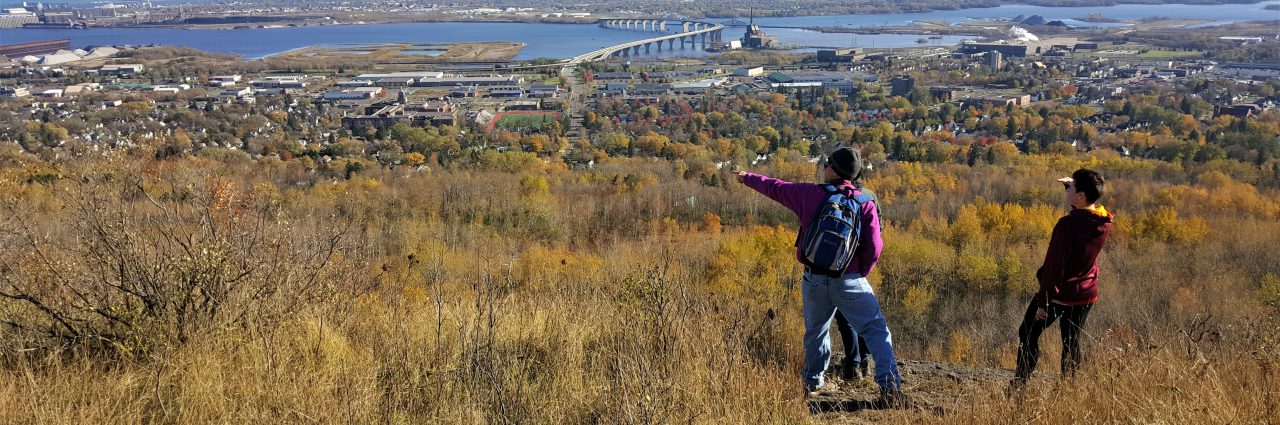
An overlook above the St. Louis River in Duluth, Minn.
We quickly realized we were going to need more judges. In the end, we gathered six who represented a good cross-section of the audience we expected to attend the summit.
The judging was “blind,” which means the poets’ names were not associated with their poems. After two rounds, the judges narrowed the number of poems down to a dozen, with a few for backup in case any of the chosen poets could not be reached.
Although communication was sometimes a challenge, all 12 poets were enthusiastic about participating in the reading. They represented a wide diversity of ages and ethnicities.
The River Talk was a couple of weeks ago, but the warm fuzzy feelings it engendered remain with me. I could use many adjectives to describe it: powerful, beautiful, stark, raw, funny — but it’s really best if you listen to the poems and feel all the feels for yourselves. The reading drew 85 Zoomers, a record attendance.
The Lake Superior Reserve, our partner in the talks, recorded the reading and it’s available on their YouTube channel. Here’s a list of the poets (in the order they read) and the names of their poems:
Tyler Dettloff (Michigan) “My Stars” Heather Dobbins (Arkansas) “I Held us on for 36 Hours after the Levee Broke to hell” Ben Green (New Mexico) “Immersion: A Prayer of Intent” Lorraine Lamey (Michigan) “Catching Your Drift” Joan Macintosh (Newfoundland) “The Current Feels” Kate Meyer-Currey (England) “Timberscombe” Rebecca Nelson (California) “Of the St. Louis River” Stephanie Niu (New York) “To the Beaver’s Eyes” Diana Randolph (Wisconsin) “Knowing the Way” Ron Riekki (Florida) “It Took a Long Time to Discover” Derold Sligh (South Korea) “Rouge River” Lucy Tyrrell (Wisconsin) “Talking Water”
Ironically, the one poem specifically about the St. Louis River was written by someone who had never visited it. Rebecca Nelson said her poem, “Of the St. Louis River” was inspired by the spiritual experiences she’s had while watching water. She grew up in the Midwest and said she wrote the poem thinking of the rivers she knew from childhood. “I would love to visit sometime after the pandemic!” Nelson said.
Barb Huberty, St. Louis River Area of Concern coordinator for the Minnesota Pollution Control Agency, offered this comment in the Zoom chat, “I never knew that poetry could unite people across the globe.”
Sharon Moen, Eat Wisconsin Fish outreach specialist for Wisconsin Sea Grant, offered, “Thank you to all the poets and organizers! I am inspired by the depth of your thoughts and stories.”
Remaining River Talks will be held on April 14 and May 12. For more information, visit the River Talks page: go.wisc.edu/4uz720.
If you didn’t get a chance to see my article in “Lake Superior Magazine” about the rare and endangered Ojibwe Horses, the same story has been reprinted in a different magazine: “Equine Monthly.” Click here to read it online.
An Ojibwe Horse, also known as a Lac LaCoix Pony. These horses are well-adapted to life in the northern wilderness.
If you’d like to hear the story behind my story, read my blog post here. These animals are so special. I felt privileged to be introduced to them.
For the holidays, Russ and I decided to get away from it all – so much safer for us and for others, especially with this new variant of Covid-19 going around. Where better to avoid seeing anyone else than in a bog?
At our cabin in northern Minnesota, we walk regularly past a bog. It’s right next to a gravel road, enticing us with its remoteness and untrammeled nature. The plat book we consult signifies the bog is privately owned, however there’s no owner’s name listed, so we weren’t sure who to ask for permission for access. So, we just took a chance, donned our snowshoes, and trammeled it, just a little bit.
Although they look sterile, bogs are places of unparalleled abundance and life. The vast peatlands of northern Minnesota cover more than ten percent of the state. Unlike the clearing of the prairies and white pine forests, efforts to drain and develop the peatlands were mostly failures, although unnaturally straight ditches in some bogs testify to this toil.
The bottom of a peatland is a breathless place – cold, acidic, anaerobic – with no oxygen to decompose branches or the small, still faces of the weasels interred there. Sphagnum mosses wrap around the fur, wood, skin, casting their spell of chemical protection, preserving them whole. Growth is impossible, and Death cannot complete his spare work.
Minnesota’s peatlands formed over five thousand years ago when the climate cooled and rain increased. The state contains more peatlands than any other in the U.S., except its Alaskan stepsister. (A surprising number of Minnesotans spend time in Alaska and vice versa.) Although in the U.K. and northern Europe the smoky glow of peat still heats many houses, the trend never caught on in Minnesota.
In Europe, bogs are portals to distant worlds, wilder realms. Gods travel the bogs. In America, peatlands are just an inconvenience to be drained or avoided. Even the Ojibwe let them alone. Maybe that’s why birds love bogs, like the nearby Sax-Zim Bog. They are places where people are not. Owls can hunt voles, mice, and moles to peaceful content.
We saw many deer trails crossing the bog. Shrubby bushes of Labrador tea poked their tips through the covering of snow. We investigated an island of red pines at the bog’s edge – an upland out of sync with the rest. Climbing a short way, we came upon a human-made square wooden platform covered with a thin layer of snow. A cache of short, fire-ready sticks lay piled between two tree trunks nearby. It looked like a tent platform, ready for use.
We vowed to check the plat map to see how people could access this red pine “island” in summer. It was surrounded by the bog, but perhaps not too much bog for a person to cross when conditions are more liquid.

Back on the bog, we passed stunted black spruce trees and tamaracks, denuded of their needles by winter. A gentle snow began to fall, consecrating all with a layer of white.
All was silent. All was good.
We completed a circuit around the area, which was surprisingly much larger than we could see from the road. As we took off our snowshoes and walked back to our cabin, we were suffused with the peace of this wild place.
Imagine our distress when, a couple of weeks later, we walked past the bog again, only to see snowmobile tracks leading out onto it. The snowmobiles had run ragged circles around the part nearest to the road that was clear of trees. They churned up vegetation, spewing spatters of green “blood” across the snow.
It made me wonder what the snowmobilers were thinking of when they chose to motor around in the bog. They probably thought it looked like a fun place to tear around in – a wasteland, devoid of life, useless to humans. Why not have some fun in it?
Agh. It hurt my heart to see it. Thus, this blog post – letting people know that just because something looks useless to humans doesn’t mean it has no value. Bogs are home to countless creatures and many rare plants. Please, please don’t misuse them.
If you’re reading this, you survived the year that was 2020. I won’t offer any inane or overused platitudes about this year. We all know how it went. While I did write a few posts about the coronavirus and other 2020 disasters, everyone else was, too. So, I tried to keep my topics unique and personal. My most-popular list reflects that. Here are the five top posts from this year, along with a couple of overall popular posts since I started this blog seven years ago.
But first – a couple of more numbers: views almost doubled again this year, with 27,960. My blog has about 520 followers. Thank you, followers. I value you all!
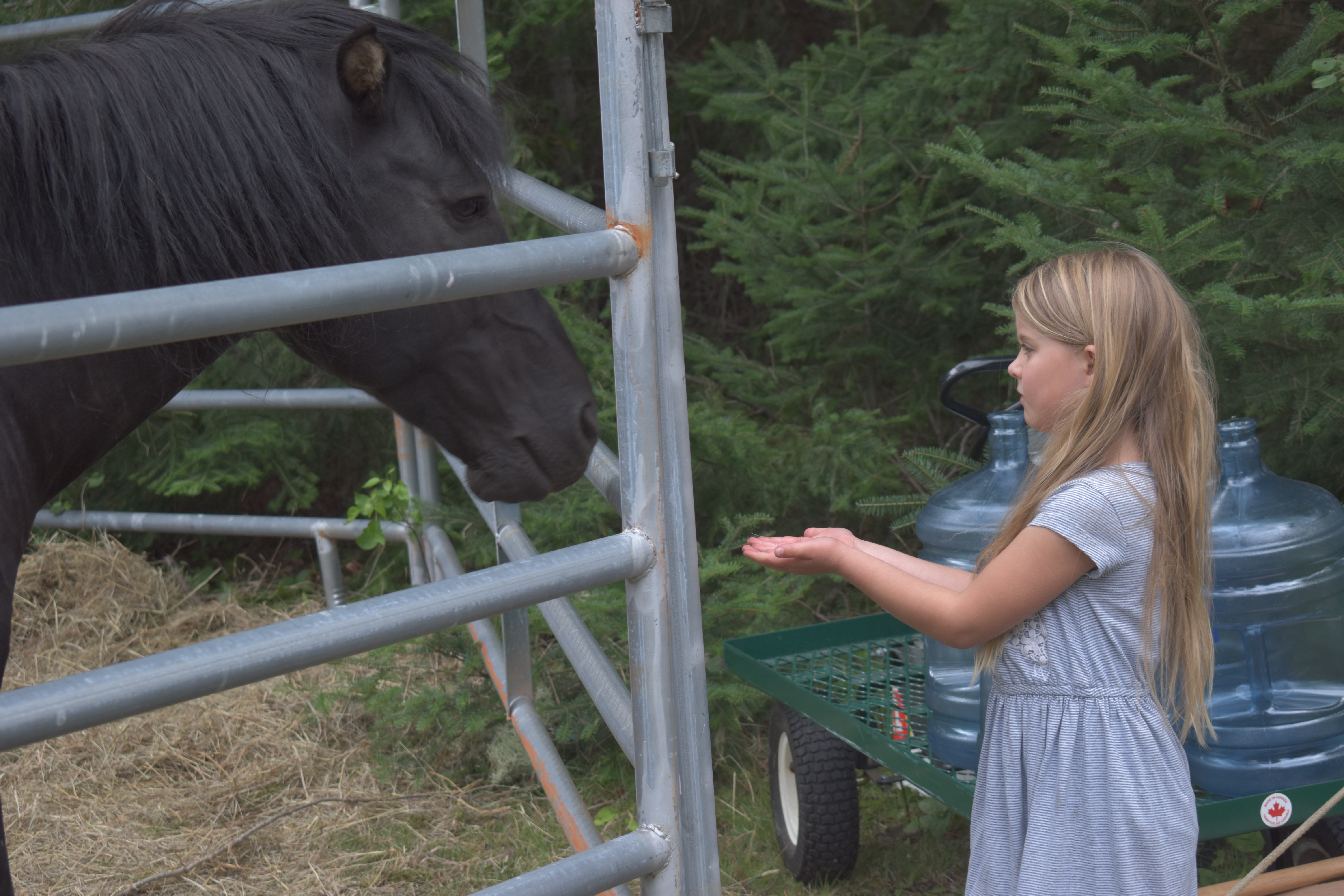
A girl makes friends with an Ojibwe horse at Quetico Provincial Park in Canada.
#1 Revisiting my Horse Mania – This is a relatively recent post (from November) where I reminisce about the love of horses I developed a child. I was able to revisit my passion as I researched and photographed a story in Canada for Lake Superior Magazine about a rare and endangered breed, the Ojibwe horse (also known as Lac La Croix Indian Ponies). My story, “The Horses Nobody Knows” describes how the breed was saved from extinction in the 1970s, and what the horses mean to the Ojibwe people today. The story is only available in the printed magazine (Dec-Jan issue) right now, but the magazine intends to post it online in Feb 2021. I’ll try to remember to post a link here once it’s up.
#2 Bog Birding Bust – This story’s high ranking surprised me because it’s about something that DIDN’T happen. After years of anticipation, I finally went to a local bog that’s a legendary birdwatching site. I hardly saw anything! So, this post was a lesson in the worst time to see birds in the Sax-Zim Bog in northern Minnesota. I guess failure is sometimes much more interesting than success.
#3 That Time I Organized a Sea Lamprey Taste Test – This was a trip down memory lane from when I worked for Minnesota Sea Grant in the late 1990s. We received funding for a demonstration project to determine whether there was an overseas market for a Great Lakes invasive pest – the sea lamprey. To promote the project, I organized a media event, which included a taste test by local luminaries, including the university chancellor, the mayor, etc. The event was a hit – leading to national and international stories. The project was also a hit, until further testing showed the lamprey were too high in mercury for safe consumption. So, it turns out, despite my concerns at the outset, I did a darn good job of promoting something that can contaminate people.
#4 The Many Faces of Buddy – As if this year wasn’t sucky enough, my dog (who was a frequent contributor to this blog) died. To know Buddy was to love him. We still keenly feel his sudden loss.
#5 A Mini-Minnesota Vacation: Lake Vermilion State Park – Despite travel restrictions, Russ and I were able to meander around a bit, close to home in our Scamp trailer. One of the first trips we took was to a new state park in northern Minnesota. Read my post for some pros and cons.
Overall, my blog’s most popular posts continue to be a tongue-in-cheek story I wrote about writer’s bumps (17,300 views this year!) and another about how crappy Iams dog food is.
Best wishes to you all in 2021. May your coronavirus vaccinations come quickly and with few side effects.
Happy holidays, dear readers. I am taking a bit of a break for now. But I will be back soon with “the best” of Marie’s Meanderings list for 2020. Stay safe and well, everyone!
The moon was too gorgeous to be denied. We went out to greet it on a frozen lake.
We snowshoed past this cozy cabin with a little Christmas tree in the middle window. You can almost see the tree in in this night-blurry photo. Silent night. Inspiring night….
An Ojibwe horse makes friends with a girl at Dawson Trail Campground in Quetico Provincial Park, Canada.
When I was a girl, I was horse crazy. My best friend, Jody, lived in my neighborhood and we collected every different breed of plastic toy horse we could get our hands on. (Or that we could convince our parents to buy.)
I had galloping horses, standing horses, rearing horses, trotting horses; Palominos, greys, Morgans, Appaloosas, Paints, you name it.
Jody and I enjoyed many imaginary adventures with our steeds. Enraptured, we watched movies like “The Miracle of the White Stallions,” “Justin Morgan had a Horse,” “The Black Stallion,” and “National Velvet.” I must have read all the Beverly Cleary horse books and Walter Farley books. During winter, we didn’t build snowmen, we made snow horses (which are basically snowmen lying down).
The highlight of my year was summer YWCA camp where I could ride a horse, although at a plodding pace. (Spatz, I miss you!)
It didn’t help that my grandfather raised horses (and mules, donkeys, ponies) and had his own Western store. He had a mule named Hubert (after Hubert Humphrey, a Minnesota politician) and a dapple-grey pony named Daisy that he let me ride on my rare visits. My grandfather trained Palominos for show. The back of his store housed saddles, which were propped on rows of sawhorses. The heavenly aroma of leather filled that back room. I climbed up on the saddles, pretending I was riding.
Jody and I begged our parents for a horse, coming up with outlandish plans about how they could be kept in the garage of our city homes, promising we would take care of them and exercise them every day.
When we were in sixth grade, Jody’s parents caved. She got her own horse, a paint named Friskie. She kept it at a stable just outside of town. I spent many Saturdays there, joining her as she exercised Friskie around the indoor arena. I rode a different horse that needed a workout.
Sometimes, Jody would trailer her horse, once even bringing it to my back yard (see photo below). Her family had a cabin outside of town and I also I recall riding Friskie bareback on the gravel roads around Island Lake.
Having a girlfriend with a horse wasn’t quite as good as having my own horse, but it must have helped assuage my passion somewhat. I’m sure my parents breathed a sigh of relief. My horse love didn’t totally go away, though. At the end of junior high, I attended a horse camp in central Minnesota with another girlfriend. It was the kind of place where you were assigned your own horse for the week and were responsible for its care. We learned how to brush a horse properly, feed it, etc. We were assigned to different groups based on our riding proficiency. I was proud to be in one of the upper levels. The week culminated with a trail ride and campfire, where we had the thrill of galloping the horses.
These memories resurfaced because a magazine story I wrote (and photographed) about horses was published recently. Not just any ol’ horse, however. Quietly, over the centuries, the Ojibwe people developed their own breed, now known as the Lac La Croix Horse (or Lac La Croix Indian Pony). Once roaming in the thousands over northern Minnesota and Ontario, Canada, these horses were semi-feral and community owned. Tribal members only brought them into enclosures during the winter to ensure their safety and health.
In the late 1970s, the horses almost went extinct for a number of reasons, including systematic efforts by European settlers to destroy them, and the rise of motorized technology.
In my story for Lake Superior Magazine (“The Horses Nobody Knows”), I describe how the breed was saved from the brink of nonexistence and what they mean to the Ojibwe today. It’s the longest article I’ve ever written. I had to wait a year for it to get published, which was extremely hard, because, you know, horse mania.
Learning about an unknown part of my home state’s past was exciting. I thought I knew every breed. As it turns out, there was a unique breed almost in my back yard, so to speak, that needed help.
I was more than happy to resurrect my horse crazies and put my writing talents to use to help raise awareness about the Ojibwe horses’ plight. If you’d like to donate to Grey Raven Ranch to help these special horses, they have that option on their website.