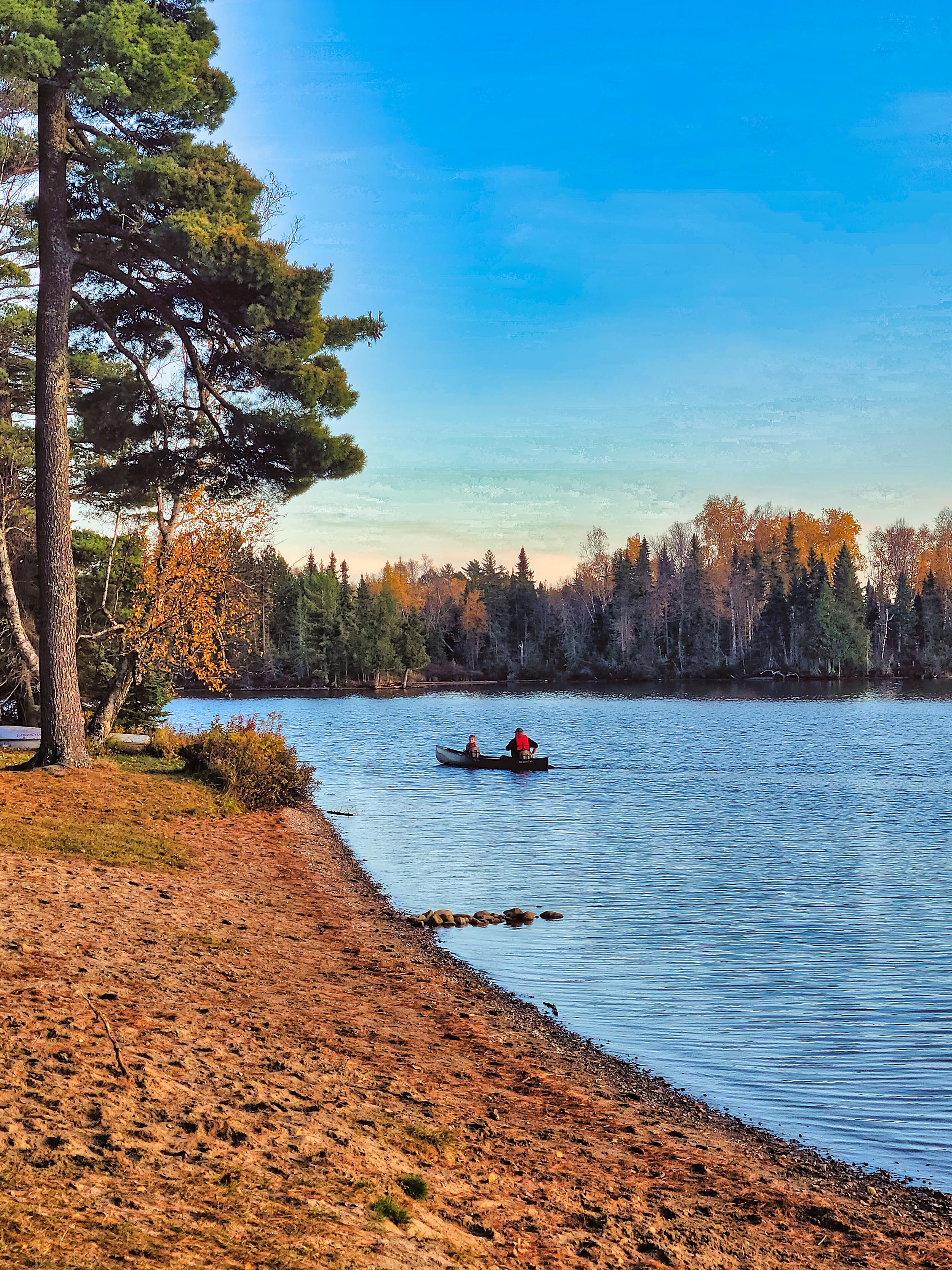
About a week ago, we drove north along the shore of Lake Superior to Grand Marais, Minnesota. We carried a precious cargo: a dozen landscape images I took, printed out on canvas, metal and paper. They had been accepted for my first public exhibit at a local health facility in the town.
I was excited by this opportunity to share my hobby with an audience. Once we arrived, we were met by the organizer who helped us unload. He also showed us where the images would be hung. We left my works with him and headed home on our two-hour drive.
After a half-hour cruising past pine trees along the rugged landscape of Lake Superior, I began feeling like I’d left something important behind me in Grand Marais. The feeling nagged until I acknowledged it and searched my psyche for its source.
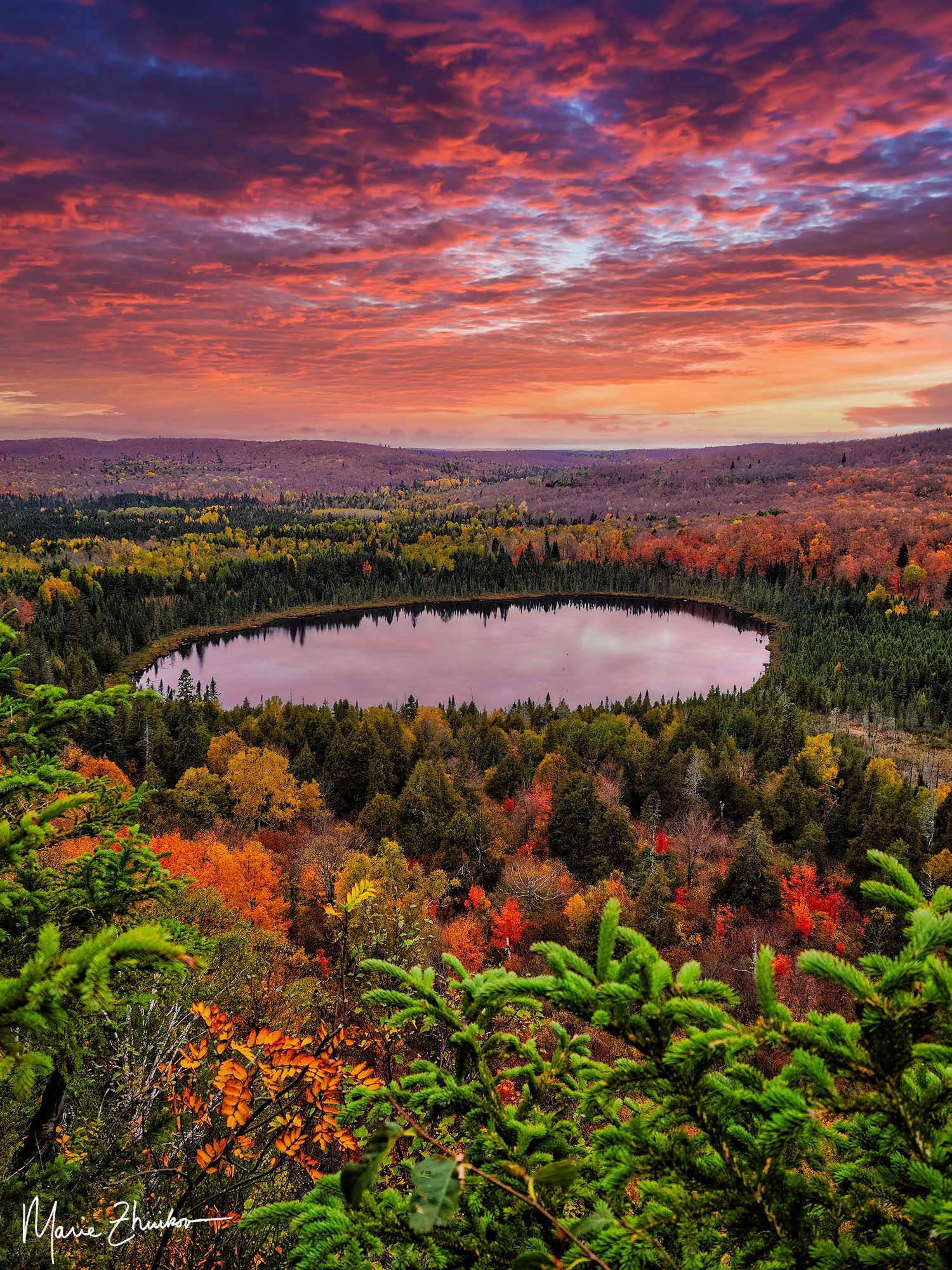
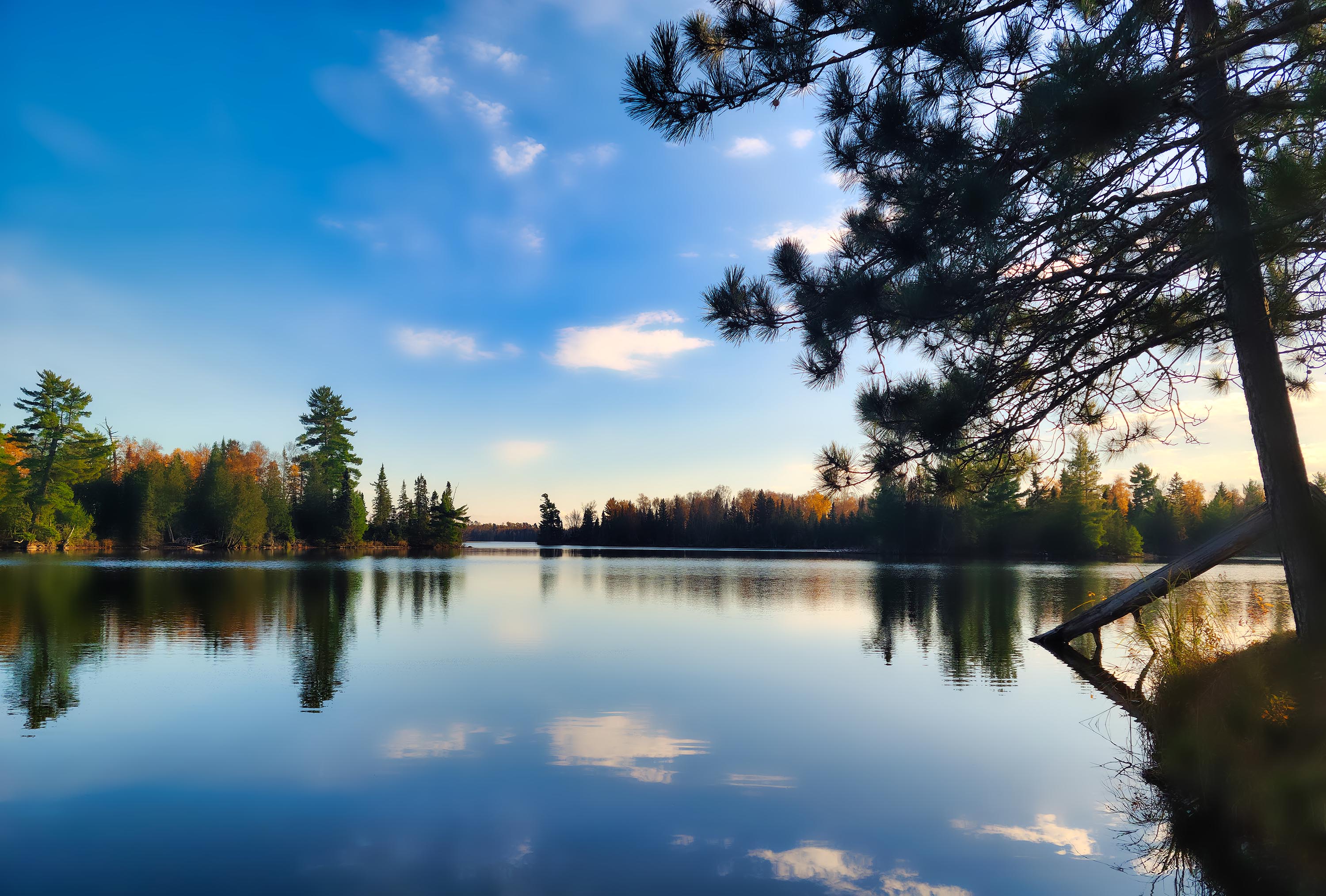
One of the babies I left in Grand Marais, MN. This is Oberg Lake in northern Minnesota.
It didn’t take long for me to realize the important things I left behind were my photos! The feeling was similar to when I dropped both of my children off at college. I turned to Russ and said, “My babies! We left my babies back there!”
He looked at me quizzically, but Russ is a quick study and soon smiled.
I did not expect that feeling. I didn’t realize I was so attached to the images, many of which have hung in my home for several months. It’s not that I don’t trust the exhibitor, it’s more I feel like I’ve left part of me in Grand Marais. Of course, the feeling isn’t as strong as what I have for my human babies, but it kept coming back over the course of the next few days. Russ got used to hearing me blurt sporadically, “My babies, I miss my babies!”
As with dropping my children off to college, I hope this is a one-time thing that will get better with time. But it’s made me wonder if other photographers experience this when they let their images out of their sight. I’d appreciate hearing any impressions you wish to share.
“The world today is sick to its thin blood for lack of elemental things, for fire before the hands, for water welling from the earth, for air, for the dear earth itself underfoot. In my world of rock and water these elemental presences lived and had their being, and under their arch there moved an incomparable pageant of nature and the year.”
― Slightly modified quote from Henry Beston,The Outermost House
One of the Croftville Cottages near Grand Marais, MN
When Russ and I made reservations for a cabin on the shores of Lake Superior months ago, we envisioned a weekend getaway filled with cross-country skiing and listening to the roar of waves.
Well, we experienced only one of those things. Thanks to El Nino we have NO SNOW in northern Minnesota, or at least very little. We have not been skiing ONCE this season.
The living room of our cozy cottage.
I thought I was cross-county-ski starved when I wrote this post in 2014, but that was nothing compared to what I’m feeling now! If it gets much worse, I might have to pay to ski on artificial snow at our local ski area.
So, we had to cast around for other things to do during our stay in Croftville and Grand Marais, MN. While researching, I discovered that Grand Marais is having a month-long hygge festival. What is “hygge” you ask? It’s pronounced hoo-gah and is a Danish word that means “creating a warm atmosphere and enjoying the good things in life with good people.” In fewer words, it means “cozy.” The events included a lodge fireplace tour, art shows, and saunas.
That sounded good to us, so off we went. We stayed at Croftville Cottages, which is just outside Grand Marais. Besides a main building with lovely condo-like apartments (where I’ve stayed for work) they offer three cottages on the lakeshore. Ours had two bedrooms and a full kitchen, plus two gas stoves for heat. We fell asleep to the roar of a gray and foamy Lake Superior crashing onto the black rocks.
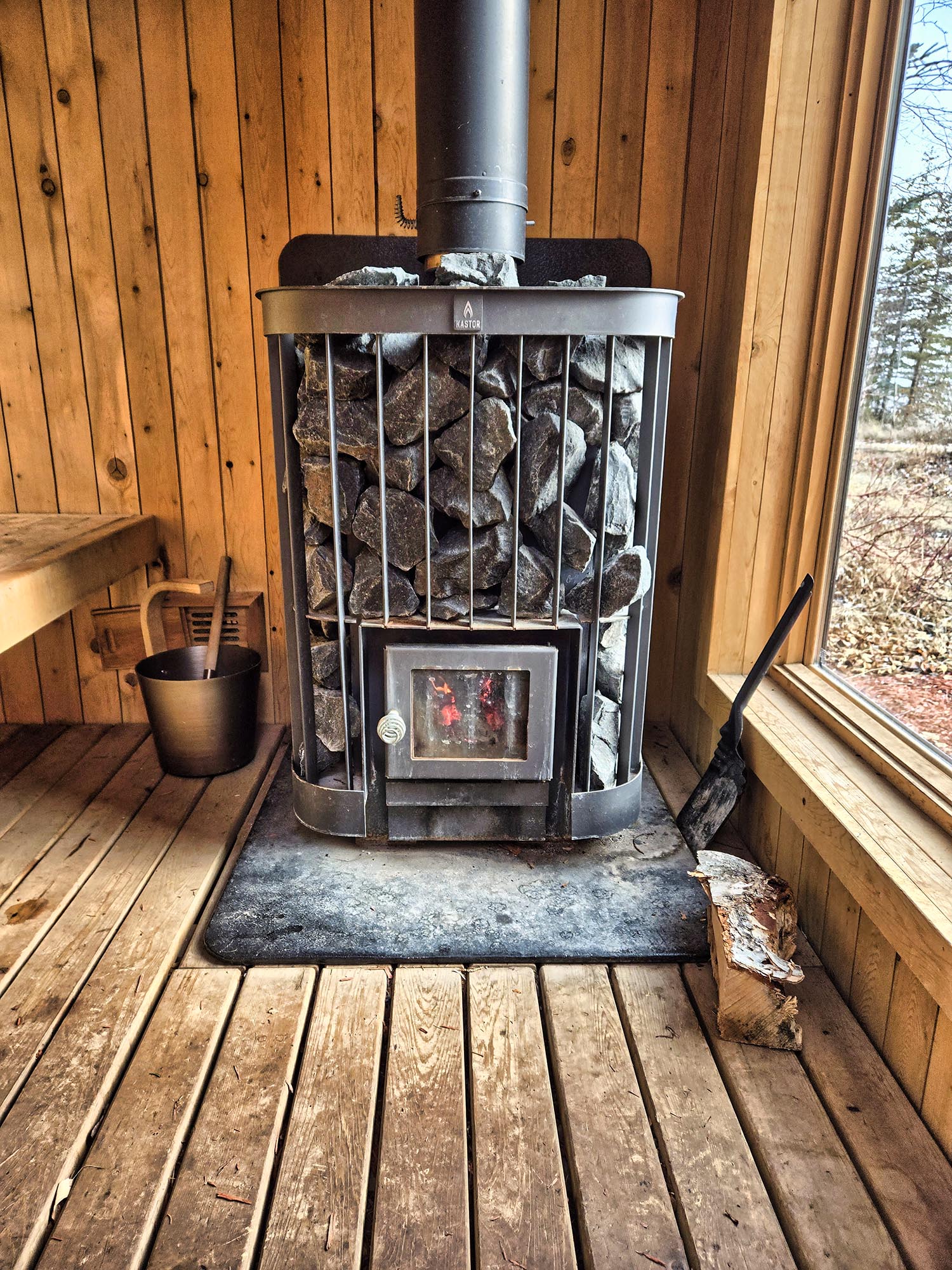
The log-powered sauna at Thomsonite Inn.
We brought our own food along, so after a leisurely breakfast at the cabin, we headed into town to visit bookstores and chocolate shops.
Laden with books and maple truffles, we returned to the cabin for lunch and then drove a few miles to the Thomsonite Inn for a free sauna, courtesy of the Hygge Festival. I had been in touch with the inn beforehand via email to ensure that we didn’t need a reservation, and they said we could just show up.
When we arrived at the inn, the office was closed. Never having been there before, we weren’t sure where the sauna was located. But we found it after referring to a map posted near the office. A short walk down a trail toward the lake led us to the sauna, which was made from a shipping container and it sported a wood fireplace.
A group of twenty-somethings were exiting just as we arrived. Their bodies steamed as they toweled off in the twenty-eight-degree breeze. They said that our timing was perfect and that we’d have the sauna to ourselves.
The sauna offered a view of Lake Superior.
Russ and I looked for a changing room, but there was none. One of the young women said she just walked into a clump of nearby trees to change. Hmph! And did I mention that it was twenty-eight degrees outside??
We ended up changing behind the sauna. The ground was frozen, so I laid my winter coat down and changed atop it, wearing socks for the short trip to the sauna door, taking them off before I went inside. Although changing into our swimsuits outdoors was chilly, we had some hygge to look forward to!
The “youngsters” had added a log to the fire when the left, so the sauna was warm and toasty. For me, it was a bit too toasty. I had to step out every few minutes to cool off before going back inside. A large window looked out at Lake Superior, which had calmed during the night.
When we emerged, steaming, we felt lighter, somehow – both emotionally and physically.
A large Thomsonite rock. Image courtesy of Lapidary Adventures.
The inn sits on a beach known for its Thomsonite, a rare mineral formed eons ago via volcanic activity. The rocks are pink, tan, white, red, and brown — kind of like agates. Those with green or gray backgrounds and green “eyes” are the most prized. The beach was icy, so we didn’t plan to rock hunt, but I did manage to take a few shoreline photos once our sauna was over.
We drove back to town and visited two art galleries that feature local artists. So many talented people live here and it’s always inspiring to see their works.
After a quick stop back at our cabin for my camera, we drove north to Tombolo Island, which is located down a short section of the Superior Hiking Trail off the highway. Another photographer was there, also hoping to catch the sunset. He had a loud, mean dog that quickly made itself known to us. The photographer’s wife (I assume) came running after it to clip on a leash.
The Tombolo is a popular photo op. I think it has something to do with the curve of the beach, the dramatic rocks, the waves, and relative ease of access.
The other photographer was already set up with his tripod, so we walked behind him to another spot that wouldn’t be in his way. Then we waited for the sun to do its thing. Russ and I arrived plenty early since we had never been here before and weren’t sure how long it would take. I had forgotten my hand warmers, so after taking off my gloves a few times for practice shots, my fingers were plenty cold. I had my camera set up on a tripod and then walked around with my cell phone, taking photos from other locations that struck my fancy.
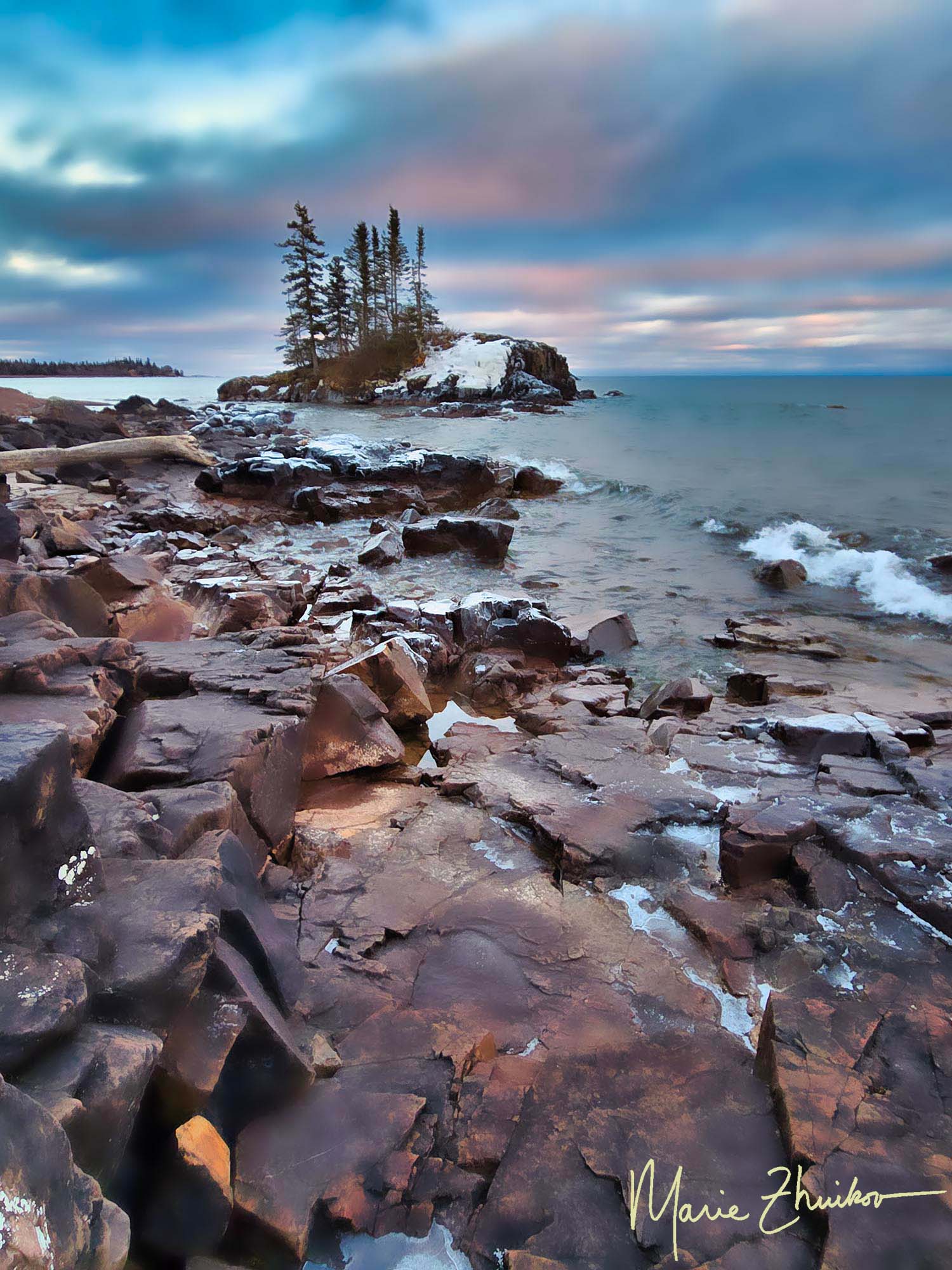
Tombolo Island on Lake Superior’s North Shore
The sun took its sweet time. The colors were muted but icy rocks provided some nice contrast and drama. I took pictures until my fingers insisted that it was time to go. Famished, we walked back to the car, looking forward to a homemade dinner at the cabin.
We cooked up a porterhouse steak and baked potatoes (with sour cream and chives). For dessert, we made a chocolate lava cake for two, complete with vanilla ice cream. Heavenly!
The next morning, after a short walk on the road along the shore, we headed home. Although we didn’t have snow to play in on our trip, at least we had hygge, and that was plenty good.
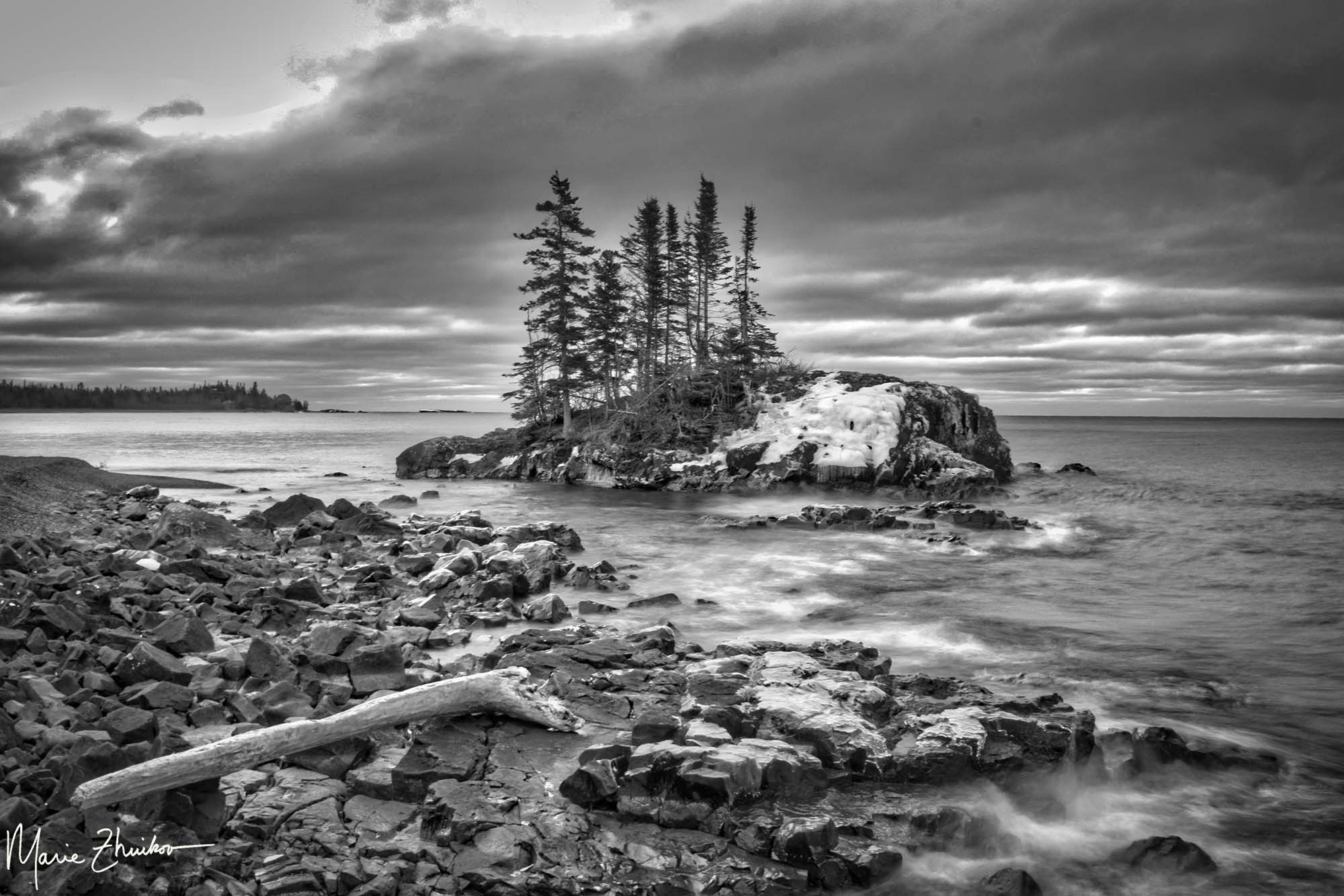
This is one of my favorite photos from a recent meander north to Grand Marais, MN. I was hoping for good sunset photos, but the colors weren’t cooperating. After standing outside in the frigid cold for an hour, and with fingers beginning to numb, I snapped this one last photo of Tombolo Island in Lake Superior.
I love the blurry water and the placement of the driftwood. The cynical part of me wonders if some other photographer placed it on the shore for effect. All I know is that I didn’t do it! So I’ll pretend that it just washed up on the rocky beach.
No sunset colors? Turn the photo into a black and white! So moody. I love this lake and hope that shows.
Bogs get a bad rap. People tend to think they’re just a waste of good land. However, they have a unique beauty, especially when frosted with winter.
This is my favorite bog that I often visit in northern Minnesota. I’ve written about it before. (See Bog Wonder). I recently finished reading “The Good Berry Cookbook” by Tashia Hart. It’s much more than recipes about wild rice. She also describes her relationship to plants and the importance of Manoomin (wild rice) to her Native culture.
One funny story she shared was about spending an hour admiring plants (orchids, Labrador tea, pitcher plants, etc.) in a bog. A car pulled up on the dirt road near the bog and parked. A woman emerged and then, “squinted at me, and began to shout, ‘What are you doing out there!’ It came across as less a question about what I was doing and more a question about my character. ‘Looking at flowers!’ I replied, still crouched low. She stood there for a bit, hands on hips, obviously disturbed, then shook her head and flailed her arms as she stomped back to her vehicle and drove away.”
Tashia mentions that one must be careful not to sink into bogs. Perhaps the woman was concerned for her safety. But Tashia felt safe there. Moose walk on the floating plant masses and seem to do fine. But to be safe, she recommends bringing a friend along.
She offers a recipe for Swamp Tea, made with the Labrador tea plant. I think those reddish masses in my photo are dried up Labrador tea plants. The tea is supposed to lift anxieties and aid creativity.
Sounds good to me. Next time I’m at “my” bog, think I’ll put on my rubber boots or snowshoes, grab Russ, and meander out there to gather some tea leaves. We’ll see if anyone stops and yells at us.
Northern pike illustration by Virgil Beck, courtesy of the Wisconsin Dept. of Natural Resources.
If you’ve watched Disney’s “Finding Nemo” movie, you probably recall the scene where Bruce, the ravenous great white shark pledges to curb his natural impulses as a way to improve the reputation of sharks. “Fish are friends, not food,” he says during a mock Alcoholics Anonymous meeting undersea.
That line runs through my head whenever anyone asks me if I fish in the lake at my cabin.
I tried fishing there once, a couple of years ago. I dug out my angling gear, which hadn’t been used in years. As a child, I enjoyed fishing, once I got over my squeamishness at impaling angleworms on hooks and handling the sunfish I caught. I thought it might be fun to resurrect this pastime.
I asked Russ if he wanted to fish. His answer was short and definitive: “No.” Then he added, “And don’t come running to me if you can’t get the hook out of the fish’s mouth.”
Oh well, more fish for me! I bought a fishing license online. Then I set up a chair at the end of the dock, tied on a rubbery lure impregnated with fish scent, and began casting.
Not long afterward, I caught a long, skinny northern pike. These fish have a lot of teeth. They’re voracious eaters and are considered an undesirable invasive species in the western U.S. Since this one was too small to eat (and pike are supposedly full of bones, as well) I gingerly picked the fish up to unhook it, intending to throw it back.
I’d hooked it well. I couldn’t get it out though just using my hands. Now, most experienced anglers have a pliers in their fishing tackle box. I was just getting re-started, so I hadn’t quite got that far in my preparations.
I carefully laid the fish on the dock planks and scurried into the boat house, looking for a pliers. I couldn’t find one, so I went back to the dock and put the fish back into the water, securing my pole so the pike couldn’t swim away.
I ran into the cabin and asked Russ if he had a pliers in his toolbox. Grumbling a bit, perhaps shaking his head, he retrieved the tool for me. I ran back to the dock, fishing the fish out of the water. I began to work on the hook again. It was stuck into the fish’s mouth at such a weird angle, I couldn’t get a good grip.
At this point, I was getting stressed out. I felt urgency to release the fish back into the water so that it could survive being hooked, and I knew that messing with it so ineffectually was probably stressing out the fish, too.
I worked on the pike a few more minutes and then put it back into the water. I realized I was going to have to break my promise to Russ. The life of this watery being depended upon it.
I ran back into the cabin. “Russ, please, you’ve gotta come help. I caught a pike and I can’t get the hook out. It’s stuck in this weird angle and I just can’t do it.”
Bless his reluctant heart, Russ took pity on me, or perhaps he took pity on the fish. He sauntered down to the dock, picked up the fish, and with a single flick of his wrist, dislodged the hook.
I stared, dumbfounded, as the fish swam away into the murky depths.
To this day, I don’t understand how Russ unhooked the fish so easily. It must be a Man Thing.
My return to fishing was not fun. I decided it was too stressful to continue. I tell this story about Russ and the hook whenever anyone asks me whether I fish.
I’ve realized I’d rather be like another Minnesota woman I saw on the television news. She feeds the sunfish that gather underneath her dock, even forming a five-year friendship with one of them. The fish follows her when she swims. She dislodged a hook from its mouth once after someone tried unsuccessfully to catch it.
That’s more in my nature. I want to be like her. The television woman digs up worms, which she no doubt cuts up for the fish. I don’t think I can do that, but I can buy some commercial fish food pellets and see if those will work. I used to take care of a tank of sunfish in a Forest Service reception office where I worked, and they ate pellets just fine.
That’s going to be my project come ice-out this spring.
I made my Minnesota-themed blog-memoir, “Meander North,” which features essays from this very blog, into an e-book. My publisher didn’t offer that service, so I did it myself over holiday break. It took quite a while because of formatting issues. I grumbled, but I did it!
It’s now available on Kobo, Barnes and Noble, and Amazon. It sells for about half the price of the print version. But if you’re a fan of print books, that’s still available, too, through distributor Itasca Books.
If you like this blog, you’ll love the book. It earned a Midwest Independent Publishing Association book award last year for nature writing, so it’s not just me saying that it’s good. It’s all your favorite posts gathered into one place.
Thank you for reading and thanks for your support!
Not much has been going on lately in my mind or in my personal life, thus the paucity of posts. But I have been blogging for work. I attended a two-day wild rice symposium recently in northern Minnesota and learned all sorts of useful tips for harvesting this wild delicacy. Plus I learned more about efforts to restore it to lakes where it has disappeared. Read more here.
You may recall my recent “immersive experience” into ricing. I heard many similar tales of tipped-over harvesting canoes, so felt in good company.
Gobs of people attended the symposium — well over 200. It was good to see so much interest in the topic!
One of the small docks along the shore of Bear Head Lake.
Russ and I had only used our Scamp trailer once this summer (to Pictured Rocks National Lakeshore), so, we decided to get one more trip in before the snow began to fly. We chose Bear Head Lake State Park in northern Minnesota for several reasons: it was nearby, and we had passed the turnoff for it several times and wondered what it would be like to stay there. We were also intrigued because we’d heard that in 2010, it won the America’s Favorite Park contest. It must have something going for it!
We pulled into our site on a Friday evening. We chose a site on a loop that bordered the lakeshore. One thing that impressed us was that all campers have equal access to the shore. No sites are directly on the lake (they’re across the road from it), but there are several trails off the road that lead down to small docks that are perfect for fishing or lake-gazing.
The beach at Bear Head Lake State Park.
The air was warm for mid-October and the wind was calm. After our Spam and eggs supper, we took a walk on trails along the lake. The tamarack trees and aspens were still clothed in their splendid yellows. The trail ended at a beach surrounded by tall red pines. We’d find out later that these pines were spared during logging times because they were too small to be of interest. Good thing the place is a state park because they’d certainly be of interest to loggers now!
A Trail Center building nearby offered bathrooms and a warm place for hikers to gather before heading out on any one of the park’s 13 miles of paths. I discovered later that the impressive center was built thanks to the park’s standing in the 2010 contest, which was sponsored by Coca Cola. The park won $100,000, which they spent to build the center.
At the time, the park staff credited their win to Facebook and the power of social media because a popular bear frequented the park and people wanted to help draw attention to the bear’s home. The bear is no doubt long gone, but the Trail Center stands as a testament to the good will of social media strangers.
After our hike we enjoyed a fire (firewood is for sale at the park office). Our plans to hike the next day were disrupted by a steady drizzle. We opted to drive to Ely, Minnesota, instead. One of our stops was the Dorothy Molter Museum, which I described in my previous post. We also ended up getting a private tour of the Pioneer Mine Museum. Like the Dorothy Molter Museum, it was also open past Labor Day, contrary to its publicized operating season.
We didn’t intend to visit the Mine Museum. We began walking on a paved trail around Miner’s Lake but the steady drizzle and my failing health (I was catching the flu or something from Russ) made us turn around after a short jaunt.
As we neared our car in the parking lot of the Mine Museum, a man called to us from a building atop a nearby hill. He said the museum was open and he’d gladly give us a tour. Having nothing else better to do on a rainy day, we took him up on his offer.
The Pioneer Mine closed in 1967 and its payload was iron ore. The museum featured a plethora of artifacts and photos from its hey day. Our guide was Seraphine Rolando whose grandfather and other relatives had worked in the mine. Seraphine was a great storyteller and regaled us with tales of memorable rescues and descriptions of what it was like to work in the mine. Unlike the nearby Tower-Soudan Mine, the Pioneer Mine was wet, dirty, and much more hazardous.
Seraphine is a legend in his own right. I found this profile of him in the local Ely paper after I returned home. I easily remembered his name because one of my ancestors was named Seraphina, which must be the female version of his name.
Seraphine Rolando in the mine museum. Image courtesy of Trip Advisor
After our tour, we stopped at the Evergreen Restaurant in the Ely Grand Lodge for lunch. Interestingly, the lodge is built on a pile of mine tailings. The restaurant featured a beautiful view of Shagawa Lake and more golden trees.
Rain featured heavily on our next camping day, too. We ended up leaving for home a few hours early because I was now fully engulfed by the flu. But I recovered and am now ready for more meanderings.
Staying at Bear Head Lake State Park is like staying on a lake in the Boundary Waters Canoe Area Wilderness, but with more conveniences. Electric sites are available but not water hookups. A pump well is in the park and civilized toilet facilities are also available. They were closed during our visit, however, so we had to make do with an outhouse.
A final thing I wanted to mention was that one of our camping neighbors employed was using a leaf blower as they were packing up to leave. I suppose they were cleaning leaves off their outdoor carpet, or something. That was a new one on us – hearing a leaf blower at a campground. It’s bad enough hearing them at home, much less in a natural space. I sure hope this doesn’t become a trend!