Why Sea Grant is a Kick-Ass Program (And Not Just Because I Work There)

Wi Point Ladies 2016 003We interrupt all these dreams of Aruba to insert some harsh (but hopefully entertaining and educational) reality. You may recall from my recent pancake recipe posting that President Trump has zeroed out the National Sea Grant Program that I work for in his proposed budget for 2018.

If that weren’t worrisome enough, he just recently he proposed drastic cuts to Sea Grant and other environmental and health and human services programs in 2017 in order to find funds to build the wall between Mexico and the U.S. You remember his beloved wall, don’t you? The one that Mexico was supposed to pay for (and like it)?

If Congress grants his request, Sea Grant would be gone – maybe as soon as May or August of this year, and I will be out of a job.

Maybe you’re wondering what a “Sea Grant” is. Sea Grant is a kick-ass program that funnels federal money from the National Oceanic and Atmospheric Administration to universities in 33 states across the U.S. The money goes to university researchers for water studies and to people like me who let taxpayers know about the research results through the media and through other local communications outlets.

Our staff and researchers also develop tools that people can use for things like growing fish, protecting their towns from a messed-up climate, keeping invasive animals and plants out of their local lake, fixing up polluted swimming beaches, making seafood safe to eat and water safe to drink.

UWI_SeaGrant_logo_cyanI work as a writer for the Sea Grant program in Wisconsin. Why is there an ocean program in Wisconsin, you ask? Because the Great Lakes are the freshwater equivalent of oceans (Sweetwater Seas). As water sources for millions of people and home to one of the world’s largest economies, it makes sense to pay attention to the Great Lakes and to put money into understanding them and protecting them.

Nationally, Sea Grant has been around for over fifty years. The federal dollars ($67.3 million) that come into the states are matched by the universities.

One reason it’s a kick-ass program is that in 2015 alone, the work done nationally with these dollars led to an 854% economic return on investment (Turned $67.3 million into $575 million in the communities in which we work). I bet none of President Trump’s business ventures have provided such a huge impact. Seems like a bad idea to cut such a successful program.

We’ve restored over 127,000 acres of degraded ecosystems. We trained almost 2,000 people how to keep seafood safe to eat. We offered about 900 classes to people living on coastlines on how to improve their community’s resilience to storms. We also supported training and funding for 2,000 students who are the next generation of water scientists.

In Wisconsin alone, our programs save lives. Our Sea Caves Watch program, which warns kayakers about wave conditions in the Apostle Islands National Lakeshore has prevented deaths. Since it went online about seven years ago, no deaths have happened. Before, there was about one death every year. Seven people might not seem like a lot – but every person counts!

Last year, a boater who saw our video about “ghost nets” (abandoned nets lost in the lake) and how to get out of them without capsizing, remembered what the video said when his boat got into a tangle. He credits Wisconsin Sea Grant for saving his life.

In Wisconsin, we also fund a program that helps children who are going through rough times by getting them into the water and taking pictures. The underwater photography program has changed the lives of many of them, and their photos are good enough to be in public displays and even a book. Read the children’s testimonials in the book. They will make you cry!

We find cures to fish diseases. We created over 5,000 jobs during the past two years. We helped almost 12,000 anglers or aquaculture people. We helped find out what was causing the steel pilings in the Duluth-Superior Harbor to corrode (and won a national award for it). Through our sister program, the Water Resources Institute, we are changing how the state warns people about the chemical strontium in their drinking water.

If I lose my job, I can’t take any more nice vacations and write about them for your benefit. I also will be so busy finding a job that I won’t be able to write my blog any more, or my fiction.

So, if you give a rip, please email your Congressperson right away. Tell them to reject the Administration’s proposal in the Fiscal Year 2017 Security Supplemental that would cut the National Sea Grant College Program by $30 million. Also, please ask them to reject the Administration’s Fiscal Year 2018 proposal to zero out and terminate the Sea Grant program (for all the reasons I’ve just mentioned).

I had an interesting discussion with someone at my church about President Trump. She said she was finding it very hard to love him in a spiritual sort of way. I told her that I don’t like what Trump stands for, but I do like that he’s making us fight for what’s important. It’s definitely not politics as usual.

The only weapons I have to fight this with are my words. I hope you will join your words with mine to preserve a program that makes much more sense for this country than a wall with Mexico. For more information, please see the Sea Grant Association’s website (FY 2017 and FY 2018 documents).

Thank you for your support. Now back to our regularly scheduled programming.
The Gathering of the Orbs

dsc03811b

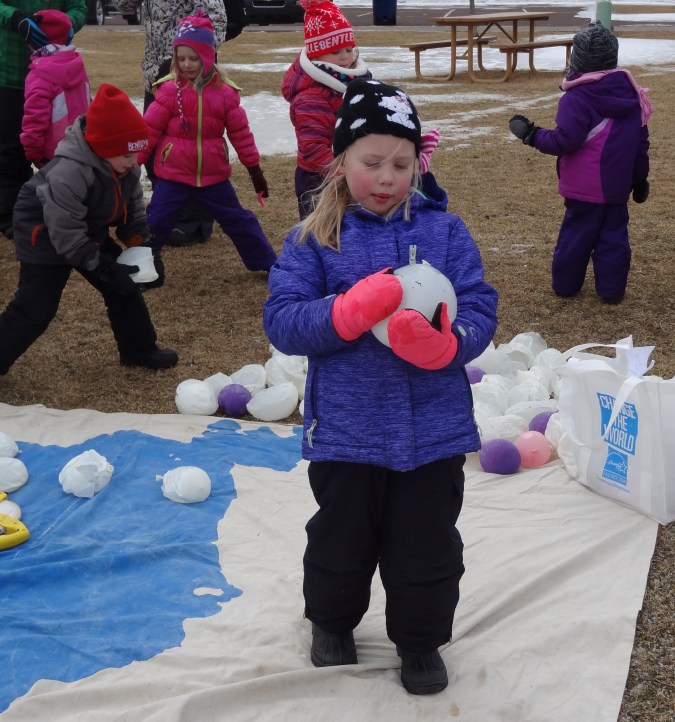
A girl and her orb.

Today is the time when all the ice orbs for the Lake Superior Ice Festival are gathered. The orbs I contributed are the colored ones in the photos (and in the bucket).

The water is frozen in water balloons, and the balloons are removed later. A group of Headstart children from Superior, Wis., participated in this community art collaborative, and it was so fun to see them enjoying the outdoors and learning about water and ice.

dsc03803City of Superior staff are arranging the orbs in the shape of Lake Superior in the city park on Barker’s Island to highlight the importance of fresh water. Each orb represents a day that water is important to us. The goal is to create 365 of them to represent a year.

Take a moment to consider how important fresh water is to you!

dsc03802

My bucket o’ orbs.

Wisconsin Public Radio Interview – Holiday Reads

love-books-1Greetings! I had the privilege of being interviewed last week on the local Wisconsin Public Radio affiliate, along with Julie Gard, a poetry professor at the University of Wisconsin-Superior, and Julie Buckles, the public relations person for Northland College in Ashland, Wis.
The show is hosted by Danielle Kaeding, now a full-fledged reporter for KUWS Radio (91.3 FM), who assisted me when she was but a college student and I had a radio show for work. Danielle hosts “Hear Me Out,” an hour-long show every Friday morning. She asked us what books we recommend for holiday gifts and holiday reading. (During all that spare time you have during holiday break – right!?)

In my role on the board of Lake Superior Writers (a local writers’ group), I always like to feature our member writers and other local authors when the topic of books comes up. And this interview was no exception. Between the three of us, we hit many of the most recent books produced locally. I only wish we would have had more time to highlight even more authors.

Our interview is featured in the first half-hour of the show. You can listen here.

Oh, and if you need a little romance during your holiday, don’t forget about my books.

Happy Reading!

The Lighthouse Tour That Wasn’t

mi-is-lighthouse-detour-009

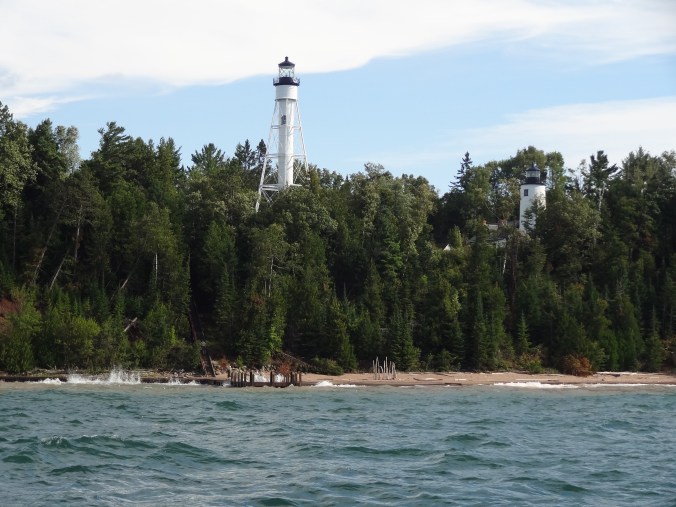
Michigan Island in the Apostle Islands National Lakeshore in Lake Superior. Note the waves crashing on the dock.

This weekend I revisited the Apostle Islands National Lakeshore in Wisconsin, in hopes of getting a look inside one of the lighthouses.

mi-is-lighthouse-detour-002

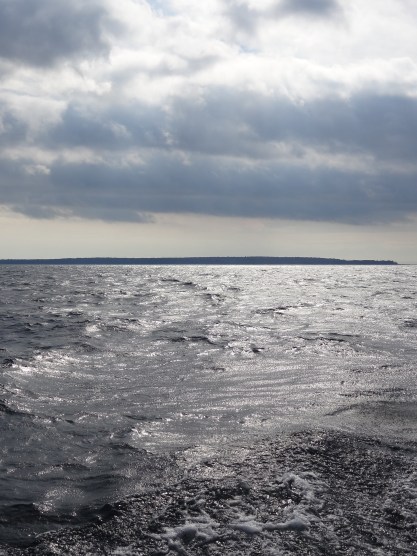
The gunmetal grey sweetwater sea that is Lake Superior.

I awoke at 5 a.m. (which for me, who likes to sleep late, is not as easy as it sounds), drove two hours in the rain to meet my friends and catch a boat, and spent an hour or so staving off seasickness on a roiling Lake Superior, only to hear the boat’s captain say they couldn’t dock at the lighthouse because it was too wavy.

But we could take distant pictures of the lighthouse. So that’s all I’ve got for you!

As our consolation prize, the captain ferried us to nearby Stockton Island, where we romped for a while before returning to Bayfield on the boat. I’ve been to Stockton Island three times now (see story from last year), so some of its magic has dimmed with repetition. But I confess that wandering around on Julian Bay (on the non-windy side of the island) was like experiencing a break in the space-time-weather continuum. The water was warm, the sky blue, and eagles coasted lazily on the calm breeze.

mi-is-lighthouse-detour-017

A bear track? Or a bare track? Julian Bay Beach on Stockton Island.

Afterwards, we walked to the boat dock to catch our ride back, not caring that we missed a lighthouse tour.

mi-is-lighthouse-detour-013

Radio Interview About Writing

13931688_10209957610474242_1721626169_o

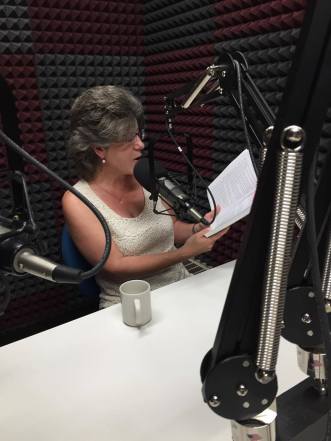
Me doing my radio thang.

Hello! I was interviewed earlier this month by for a show on the local Wisconsin Public Radio affiliate station, KUWS. The show is called the “Nine O’Clock Meltdown, ” and it’s hosted by “Simply C,” who I met at an open mic poetry reading.

She allowed me gobs of time on her show to talk about my novels, writing, and creativity in general. The file is so large, she had to divide it into two parts so I could post it. Give a listen to find out what I’m up to in my writing life…

Part 1

Part 2

The World’s Largest Freshwater Sandbar

Barkers & WI Point 047

Even though Wisconsin Point on Lake Superior is not truly part of “the world’s largest freshwater sandbar,” it’s still pretty.

It’s a common local point of pride in Duluth to say that Minnesota Point (a.k.a. Park Point) and Wisconsin Point form the “World’s Largest Freshwater Sandbar.” I am sorry to burst the community bubble but . . . NOT.

Way back so many years ago I can’t even find it on the Internet, Duluth sent a delegation of kayakers to Lake Baikal in Russia. They returned with tales of a sandbar or two on this freshwater lake that were even larger than MN/WI points. Maybe I was the only one who listened then because local tourism organizations and media outlets continued to refer to our sandbar as the “world’s largest.”

A couple of years ago (2014), I decided to fact-check the claim because I was editing a government report that repeated it. Lo and behold, I found a provincial park in Canada that claimed the same thing (Sandbanks Provincial Park).

I also asked several scientific types who are in the know about such things and received a response from a researcher at the University of Minnesota Duluth’s Large Lakes Observatory. Prof. Ted Ozersky did some Google Map comparisons and found that Jarki Island at the northernmost tip of Lake Baikal sports a sandbar that is 18 kilometers long. MN/WI points are 16 km long.

He also found a series of long sandbars on Proval Bay along the eastern shore of Lake Baikal that collectively stretch for 40 km.

So, in the document I was editing, I changed the wording to MN/WI points as comprising “one of the largest freshwater sandbars in the world.”

The issue arose again just last week when a fellow blogger made the “world’s largest” claim in his post. Why? Because he saw it elsewhere on the Web.

I figure it’s high time to get definitive news out on the Web that, alas, Minnesota and Wisconsin Points ARE NOT the largest freshwater sandbar in the world. Even the park in Canada has downgraded their claim to say instead that they have the “world’s largest baymouth barrier dune formation.”

In short, it’s okay to say that MN/WI points are the largest freshwater sandbar in the country, or one of the largest freshwater sandbars in the world, but not “THE largest freshwater sandbar in the world.”

Class dismissed.

The ‘Castle’ has Fallen, Spring Must be Coming

Ice Castle 2016 001

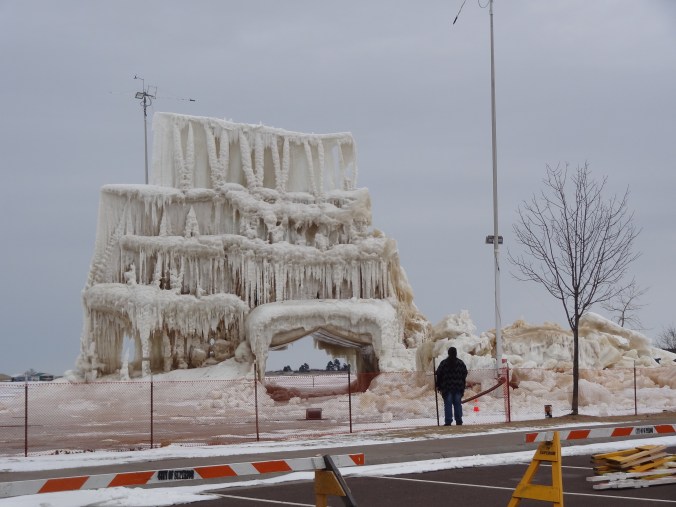
The Lake Superior Ice Project formation collapsed near my workplace this week, and that means spring can’t be far behind. The photo above is from a week ago when the right part of it collapsed, and now the whole thing is a pile of ice rubble.

When the collapse in the picture happened, we weren’t sure if it was planned or not. It caused a bit of a stir in the office – especially since last year the structure had a rather spectacular and unintended collapse right in front of a New York Times reporter. But we later heard that the formation’s creator, Roger Hanson, had been working for the past few days on dismantling his ice castle.

It would have been nice if he had alerted the public that he was dismantling the structure. The woman in my photo complained that she would have come to see it earlier had she known. And it could have avoided some surprise and speculation.

I have “castle” in quotes in this posting’s title because the ice never ended up looking like the European-style castle with four towers that Mr. Hanson described in media stories. It looked more like a birthday cake with a door in it to me. I suspect our warm El Nino winter had something to do with that.

The structure also didn’t break any world height records as hoped, but it did serve as a focal point for a community Ice Festival, complete with fireworks.

Orbs 002

Ice orbs during the freezing process.

A related icy project (that I actually helped with instead of snarking about) involved bringing community groups together to create ice orbs in the shape of Lake Superior. The City of Superior’s Environmental Services Division organized this collaborative art project to highlight the importance of fresh water to the community. Different groups pledged to create a certain number of ice orbs so that 365 of them (Get it? One for each day of the year) could be installed near the ice castle for the festival.

The project was called Orb365 and, along with instructions on how to make the orbs, the project included educational messages about how water reacts to freezing and ways water is important.

I pledged 10 orbs, which I created by filling water balloons and sticking them outside in hopes that they would freeze. I started the freezing process four days before the orbs were needed, certain that would be plenty of time, especially in February in northern Wisconsin. However, the weather was so warm, the orbs didn’t completely freeze until the very last night, eliciting some anxiety on my part.

DSCN0051

Lake Superior shaped in ice orbs.

Triumphant, I was able to deliver the orbs the following day to the “orb construction site” where a city worker artistically arranged them into the shape of the lake, and festooned them with lights. She positioned larger orbs to represent major cities around the lake.

Alas, now the orbs are melted along with the castle. The snow is almost gone, and the meatloaf-brown grass of spring is upon us. Although this winter was warmer than usual, I’m not going to complain about it. I’m sure the northern weather gods will make us pay for it next winter.

Another Winter, Another Ice Sculpture

Iceman 2016 008

The ice formation, viewed from behind. Above it is one of the four towers that sprays water to create the structure.

A European-style castle is being built a few steps away from my office. The building materials? The reddish brown water from the Duluth-Superior Harbor.

From the four blog posts I wrote last winter, you may recall “Ice Man” Roger Hanson’s adventures trying to build a world-record ice sculpture on Barker’s Island in Superior, Wis. (To read the posts, type “Roger Hanson” into the search box on my blog.)

Let’s just say he learned a lot from that experience, and is at it again. Roger has a contract with the City of Superior to provide ice sculptures as a tourism attraction for three winters, and this is his second.

Last year, Roger was going for height, but a February thaw and shifting ground toppled his world-record attempt. This year, he’s going for width and mass. Plus he has a heckofa large supporting ice base on his formation that looks like it might not melt until July.

Roger builds his creations with the help of towers that periodically spray water he pumps from the harbor. He controls the actions of the towers through a computer set-up he has in the trailer he lives in near the sculpture.

He plans to spray a ninety-foot-wide, seventy-foot tall, eight million-pound structure, complete with castle turrets and a doorway in the middle.

He had one small set-back a few days ago when high winds blew apart part of the formation. Roger has since recovered, and the structure is now sturdy and thick enough that winds should not be an issue. But it’s an El Nino winter, which typically means warmer temperatures for this area. The weather has been cold enough lately for ice formation. Who knows what the rest of the winter may hold?