The Rachel Files: Final Entry

This weekend, my temporary housemate who moved out a year and a half ago came to pick up the rest of her stuff that I was storing in my garage. “Rachel” was finally able to get her own apartment (after moving in with another, more suitable housemate).

I was happy to have the space in my garage back, and I was happy that she hadn’t been living with me for that whole time. Can you imagine how insane I would be by now? (To read the beginning of the three-month saga from 2013, start here –Half-Empty Nest Syndrome— and read onward.) As it is, we were able to hug and wish each other well.

I sure hope her building has a good plumber!

Rockin’ the First Day of Kindergarten

Five-year-old me wearing my cowgirl outfit from my Grandpa. I suspect the card is from him, too.

Five-year-old me wearing my cowgirl outfit from my Grandpa. I suspect the card is from him, too.

Last night, I attended a performance of “Love, Loss, and What I Wore” – a play about the associations between women’s clothing and emotions. It reminded me of how my childhood friend and I rocked the first day of kindergarten.

When I was young, my grandfather owned a western goods store in southwestern Minnesota. He sold saddles, boots, and clothing. When we visited, I loved the smell of leather in his store, and riding the ponies, mules, and horses he kept on his land.

For my fifth birthday, he sent me and my neighborhood best friend, Jody, cowgirl outfits – shirts, short skirts lined with white fringes, cowgirl boots and western hats. Mine was blue and Jody’s was red. We were both horse crazy and loved those outfits — so much so that we decided to wear them the first day of kindergarten together. We wanted to be stylish, yes, but we also wanted to catch the attention of the boys by twirling our short skirts so they could see our underwear. We must have been pretty provocative five-year-olds!

Our first day of kindergarten went as planned, including the twirling. I don’t recall if it garnered any male attention, but for me, the cowgirl outfit was the first of many favorite clothes yet to come. And it made what could have been an intimidating experience into one of confidence and fun. Do you have any favorite clothing memories?

How I Fought for my Mole

Cindy-Crawford Style Noted

Cindy Crawford and her mole. Image from Style Noted website.

I have a skin condition (rosacea) that, if left untreated, will turn my face into a vein-strewn red mess. Years ago, I had an elective skin treatment to eliminate the broken veins that had snaked their way onto my cheeks and nose. It was a light laser treatment, which they said would “feel like a rubber band is being snapped on your face.” Let me tell you, it was a heck of a lot more painful than that! But the treatment worked well. Since some veins and other assorted age-related globules were beginning to appear on my face, I decided it was time to subject myself to more elective self-torture.

I went to a local plastic surgery clinic that has a skin care specialist. She took one look at me and gave me a facial to remove about seven years of dead skin. We discussed options for removing my globs and decided on the lamprobe, a device that uses high-intensity something or ruthers to zap the veins and bumps into oblivion. This option was cheaper than the laser treatment I had before, so I was all for trying it.

We discussed what she would remove on my face next week, once my skin recovered from the shock of the facial. Things were fine until we talked about the big juicy mole I have on my right cheek. Well, it used to be a mole until a couple of years ago when its color began mysteriously disappearing. Now it’s just a big bump.

I swear I could hear the saliva collecting in the skin care specialist’s mouth as we discussed zapping my mole. She wanted it to add to her collection of dead skin tissue that I’m sure she keeps on a shrine in a hidden room inside her home.

I panicked. Unlike the other unwanted spots on my face, my mole had been with me for as long as I can remember. It had become part of my identity. Sure, it wasn’t as sexy as Cindy Crawford’s mole, but I was uncomfortable at the thought of parting with it.

The specialist said I should think about it during the coming week, and let her know when I came back for the procedure. So I did. The more I thought, the more I knew my mole had to stay. But that old crone’s bump alongside my nose? That could go. All those bumps on my forehead? Those could go, too. Good riddance.

The day of the procedure the specialist showed me a small device (like a pen) that had a pencil-lead thin metal probe on the end of it. This is what she would stick into my skin, firing the high-intensity whatevers to zap my face.

Would it hurt? She wouldn’t answer that directly, instead saying how some patents “got tired” after the worst blemishes were zapped and sometimes decided to leave the rest for another time. That did not bode well.

She washed my face and we discussed again what would go. The mole? “It stays,” I said. I gave her the whole Cindy Crawford argument.

She countered with “But Cindy Crawford’s mole has color to it. Yours doesn’t. It’s just a bump!”

After further negatory comments on my part, she begged, “Are you sure you don’t just want it made smaller? I can do that.”

“We’ll see once we get to that point,” I said.

She began on my forehead and worked her way down my face. It @#$%^&*! hurt. Not as much as the laser, but enough that my back arched several times while the probe did its nasty work. Specialist Lady said I was doing wonderfully.

Somewhere in our conversation punctuated by small moments of intense stinging – like a wasp was having its way with my face — I asked her if anyone had ever tried to hit her because of the pain. She said a woman raised her arm once, but put it back down after the specialist called the woman’s attention to it.

When Specialist Lady arrived at my mole terrain, I knew by that point how much more it would hurt than the other things she’d removed. I turned a hard heart to her pleas and said no again. But I did let her take off a mole on my lower neck as a consolation prize.

However, it’s been a few days now, and my neck mole has turned into a colorless blob. I’m a bit worried it will stay that way and am regretting giving Specialist Lady even this bit of turf. Well, I guess if it stays a colorless blob, it will match the one on my cheek! Who knows? Maybe I’ll even become attached to it.

* * *

P.S. My  neck mole did eventually disappear, so the treatment worked!

On the Ice Bucket Challenge and Apologizing for Happiness

Smileyes By Ramesh NG via Wikimedia Commons

Smileyes By Ramesh NG via Wikimedia Commons

My youngest son wanted me to video his friend dumping a bucket of cold water over his head, joining the masses participating in the ALS Ice Bucket Challenge. This was back a couple of weeks ago when it was all the rage. I agreed and probably laughed about it. My son then proceeded to make a snarky comment and went outside to join his friend who was waiting in our driveway with the bucket.

Stunned by my fifteen-year-old’s comment, I stood in the kitchen, at war over whether to call him out on it, but also feeling pressure to go outside and take the video. He doesn’t usually say such things, but the past few days, I’d noticed an edge to him that hadn’t been there before.

When he came on the porch looking for me, I motioned him into the house. I told him that if he wanted me to do something nice for him (take the video), he needed to be nicer to me and apologize for his comment (the words to which I can’t even recall any more).

He apologized and we had a rather heated discussion about what was wrong. It turns out, it’s all my fault. I was laughing too much. It annoyed him.

Now, even if I do say so myself, my laugh is not annoying. In fact, back when phone contact was the norm, my Allstate agent used to call me and crack jokes just to hear me laugh. He actually admitted this to me. My laugh is hearty, yes, but not unusually frequent. And I’m not one of those people who goes around smiling all the time. But, as you can probably tell from this blog, I do have an easy and strange sense of humor, and enjoy laughing when I have the chance.

Before I knew what was coming out of my mouth, I apologized to my son for being a happy person. In part, I did it to show him the absurdity of his complaint. I also did it because he had apologized to me and I was trying to move the discussion forward. Other parts of our conversation revolved around the need for him to find a way to deal with hearing his mother laugh. I have many things I could be sad about. I’m nowhere near as resilient as I used to be, but I’m not about to stop laughing any time soon. Afterwards, we went outside and commenced with the icewater dumping.

Last night, we had an airing out session about several things, and we talked more about the Terrible Awful Problem of having a happy mom. I told my son it’s rather normal for teenagers to get annoyed, especially when they are sleep-deprived. The day before the annoyance incident happened, he had his friend over for a “sleepover,” which usually involves almost anything but sleeping. We also talked about how annoyance over little things can be a waste of time and energy, and we both laughed about how silly it was to be annoyed by happiness. He assured me his annoyance wasn’t because he was unhappy, but because of hearing my laugh so often lately.

If having a happy mom is the worst issue for my son, I’d say we are doing all right.

Powerless

By Arlington County (Downed Power Lines Pole, uploaded by AlbertHerring) [CC-BY-SA-2.0 (http://creativecommons.org/licenses/by-sa/2.0)], via Wikimedia Commons.

By Arlington County (Downed Power Lines Pole, uploaded by AlbertHerring) [CC-BY-SA-2.0 (http://creativecommons.org/licenses/by-sa/2.0)%5D, via Wikimedia Commons.

A recent article in the journal “Science,” which garnered national news attention, found that most people (especially men) would rather endure electric shocks than sit alone with their thoughts.

When a storm took the power out in my neighborhood for ten hours this weekend, I didn’t even have the option of an invigorating zap. Talk about being alone with one’s thoughts. I couldn’t drive anywhere that had power because my garage door opens via electricity, and the double-wide door is too heavy to open manually by myself.

The article, led by Timothy Wilson of the University of Virginia, described the results of eleven studies, which found that when left alone in a room by themselves for six to fifteen minutes, people would rather do mundane tasks than sit and think, and that many preferred to administer electric shocks to themselves given the alternative of being alone with their thoughts.

Sixty-seven percent of men gave themselves at least one shock during the thinking period. On average, study participants zapped themselves 1.47 times in a fifteen-minute interval, not including one “outlier” who administered one hundred ninety shocks to himself. (!)

The authors contend the problem is that thinking is too complicated and our minds are too unruly. Without the training offered by meditation and other techniques, they say that the “untutored mind does not like to be alone with itself.” I think this is true, and it’s something that Elizabeth Gilbert learned in her book, “Eat, Pray, Love.” Since reading her book a few years ago, I’ve been dabbling in some meditation and mind-focusing techniques. But given my peri-menopausal-messed-up-hormonal-state at times, these attempts can be challenging.

But the attempts seemed to have served me well during the power outage. Had I been desperate, I could have biked somewhere, but truth is, I rather enjoyed living without electricity for a while. As if it were all planned, I had plenty of no-cook food available, an 800-page book (“Written in My Own Heart’s Blood” by Diana Gabaldon) and an outdoors painting job to keep me occupied. Sure, I went through Facebook and Email withdrawal, but when the power finally came back on, I found I didn’t miss much.

In fact, unlike the study participants, I wasn’t afraid to sit and think (and better yet, feel!) The lack of distractions helped me piece together an emotional puzzle I’ve been working on for four years. I can’t say that I liked what I discovered, but at least the picture on the puzzle is much clearer.

Connecting (or not) with Pets

RIP Sparky, 2007-2014.

RIP Sparky, 2007-2014.

Sparky the Guinea Pig died a few days ago. Actually, I had her euthanized. Her back legs stopped working. She didn’t seem in pain or anything – was still eating and drinking as usual. She just couldn’t move very well.

Sparky is a girl piggy that we bought almost seven years ago at the insistence of my youngest son, who wanted another pet. She’s been healthy and sweet for all that time, except for her recent development. Since Sparky was ancient for a guinea pig, and because I am the one who has been caring for her all that time, I wasn’t keen on going to heroic measures to save her. I did spend time doing Internet research on her condition and discovered it could be caused by many factors but a calcium deficiency was the most likely in our case. By the time I discovered that, she had been ill for about four days — it took a while to figure out what was going on because she didn’t move around much to begin with.

The instructions described use of a liquid form of calcium designed for human consumption. I called around all the local pharmacies, but couldn’t find any available. I found some through mail order, but that would have taken several days to arrive, and I wanted something soon. I described Sparky’s plight to a friend and she found that Pet Co had liquid calcium, so I went there the same day. But when I got to the store, the supplements they had for guinea pigs didn’t have any calcium in them, so I ended up buying one designed for lizards. I mean, calcium is calcium, right?

We did the three-day course of treatment, but it didn’t seem to make a difference. And now, Sparky was moving around even less, so that she wasn’t getting enough water to drink unless I moved her over to her bottle. That’s no way for her to live, so, call me heartless, I made the appointment to have her euthanized.

When the time came, I packed her in a box filled with a deep comfy layer of bedding and went to the vet. I filled out the paperwork and handed her over without a fuss or any desire to see her through the procedure. The experience was markedly different from when I had to have my cat of 14 years euthanized. For that, I was a blubbering pile of Marie goo. It got me thinking about what made the difference.

I suspect one reason is that I never really connected with Sparky. I’ll be the first to admit, I don’t “get” guinea pigs. I had never had one before, and although we read books about them, the emotional connection wasn’t there. The cute “popcorn” jumps they do just seemed spastic. In the beginning, we took Sparky out to cuddle and let her roam around, but she had a habit of peeing in one’s lap and she nipped hard with her beaver-like teeth. So that didn’t help. About a year after we got Sparky, we got our dog, Buddy. We were worried about his reaction to her, so we took Sparky out less often after that.

Another reason is that she was my son’s pet, so I felt like it was his responsibility to connect with her more than mine. And he did try, but as he got older and busier, that fell by the wayside and Sparky’s care fell to me. She became an obligation, not a joy.

I feel bad that I never connected with Sparky. I can connect to dogs, cats, birds, and even fish. (I taught my catfish to wink at me.) We had a hamster once, and I never connected with him, either. Maybe I’m just not a rodent person. Have you ever had a pet you didn’t connect with? Do you think there are just some types of pets you aren’t designed for? I’d be interested to hear.

Minnesota Nice Meets Hollywood (and it isn’t pretty)

HollywoodSign

The minister at my church gave a sermon on “Minnesota Nice” last Sunday. When he read the Wikipedia definition of it, my mouth almost dropped open. (If I wasn’t Minnesotan, my mouth would have dropped ALL the way open.) He was describing a great deal of my personality:

Minnesota nice is the stereotypical behavior of people born and raised in Minnesota to be courteous, reserved, and mild-mannered. The cultural characteristics of Minnesota nice include a polite friendliness, an aversion to confrontation, a tendency toward understatement, a disinclination to make a fuss or stand out, emotional restraint, and self-deprecation. It can also refer to traffic behavior, such as slowing down to allow another driver to enter a lane in front of the other person. . . . Some traits typical of this stereotype are also generally applied to neighboring Wisconsinites and Canadians. Similar attributes are also ascribed to Scandinavians, with whom Minnesotans share much cultural heritage.

I never knew Minnesota nice had its own Wikipedia entry. I’ve read books and watched the movie (“How to Talk Minnesotan”), but I’d never seen the personality type spelled out so clearly before. The minister went on to explain what Scandinavian traditions could have inspired this behavior and how they are rooted in “the good of the group” mentality. In general, people were supposed to work together and not call attention to themselves for the betterment of everyone.

Although not Scandinavian, I am a fifth-generation Minnesotan. The Minnesota nice philosophy has had plenty of time to seep up into my ancestors and me from the soil. It’s been absorbed into my family from neighbors and community. I’ve found I have to work to overcome it in a greater society that values individualism and charisma. Self-deprecation, after all, makes it difficult to find a job, sell a product or attract a mate (unless that mate is also into Minnesota nice and recognizes it for what it is). I’ve also found I measure people from the perspective of Minnesota nice. I mistrust anyone who is too confident or self-promoting. I suspect they do it to cover up insecurities, but it also goes against the code of Minnesota nice.

I and another co-worker once took a news producer from Hollywood on an overnight trip up the North Shore of Lake Superior to the famed Boundary Waters Canoe Area Wilderness to film a spot for “Good Morning America.” That man could talk, and self-promote.

By the next day, when we were driving back to civilization, he could tell he was out of place. He complained that I and my coworker (also a Minnesotan) didn’t talk enough. “Maybe we don’t have anything to say,” was the reply. He didn’t know how to deal with that. We weren’t trying to be mean — we had been worn out by talking over the course of his tour and didn’t know how to relate to his foreign personality type. He gave up after that and we rode along in blissful silence — blissful for us, awkward for him.

Back to the sermon. The point of it was that Minnesota nice isn’t enough. It’s too constricting and confining – allows for too little self-love. There’s got to be a happy medium between self-sacrifice for the good of the group and self-love that promotes a fulfilling life. I’d like to think that I’ve learned this during my life, sometimes the hard way. Although it goes against my nature, I can brag when I have to, and I’ve learned how to appreciate certain traits and aspects of my personality. But I doubt I’ll ever feel comfortable around people like Mr. Hollywood.

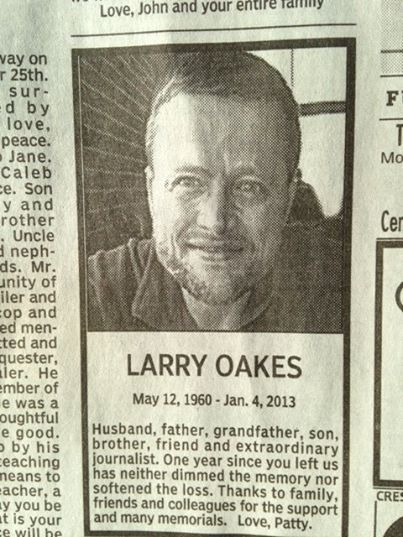
Remembering Larry Oakes

Larry Oakes

A few days ago, when most of the rest of the world was watching the Olympic opening ceremonies, I joined about seventy other people at an evening tribute for a noted Minnesota journalist. Larry Oakes was a reporter for the Minneapolis Star Tribune and before that, the Duluth News Tribune. He covered the crime beat and northern Minnesota stories.

Back in the 1980s, he was a few years ahead of me in journalism school. By the time I became the environmental reporter for the college newspaper (the Minnesota Daily), he had already moved on to an internship with the Minneapolis paper, and his name was legend among the Daily staff.

I didn’t meet Larry in person until I ended up back in Duluth working as a water science writer for the university’s Minnesota Sea Grant program. I was on the other end of the journalism profession now – a public relations hack who was trying to convince journalists to write about my organization’s research. We had lunch a few times as colleagues to talk over story ideas. Every time, I came away bowled over by his experience, not to mention his square-jawed good looks.

Some of my story ideas worked for him, some didn’t. That’s the way it goes. I do recall that Larry and a local radio news director, Mike Simonson, were especially helpful with one of the most popular stories of my career (so far!), which involved organizing a taste testing event for Great Lakes sea lamprey. We got the mayor together with the university chancellor and some other notable locals to taste dishes prepared by a volunteer gourmet chef who cooked lamprey several different ways for ratings.

After Larry married, he showed up at the same birthing class that my former husband and I were taking. Unfortunately, his wife was too sick from her pregnancy to attend, so I never met her. I felt sorry for him going through the classes alone, so I stood in as his partner sometimes when the activities required one. As the years passed, we also met at funerals and other local events. I recall thinking that Larry looked really rough at some of these events. I wondered if he had an illness or some other problem.

As it turns out, he suffered from depression and he also ended up having a stroke. Although he recovered enough from the stroke to resume his writing career, friends say he was never the same after it. In the end, the combination of factors and other things that perhaps only he knows were too much, and he took his life a year ago.

A journalism scholarship was created in his name at the University of Minnesota Duluth. The event I attended (instead of watching the Olympics) was to celebrate the creation of the scholarship and its first student recipient. I had mixed feelings watching the recipient (who wore the requisite gray vest of a journalist for the event). I was excited that he has this opportunity to help with his schooling, also scared for him. Starting out in anything is so hard. There’s always the conflict between what you want and what society will let you do. The process of figuring out your place can be terrifying, and well, depressing. But society has given him this chance, and hopefully, it’s what he really wants to do with his life.

The weird thing about the event was that I ended up sitting next to Gail, who was Larry’s hairstylist of over twenty years. I didn’t recognize her at first until I remembered I sat next to her at Larry’s funeral, also. It says something about Larry’s character that he went to the same stylist for so long — something about loyalty, friendship, and respect. Gail was lovely to talk to, and she and her friend kept me company until my friend for the evening arrived.

The world lost a great writer when depression took Larry. Although he sought help, it didn’t work for some reason. The heavy hands of depression have molded my family, my friends, and me. I lost my adopted sister to it; my father suffers from it and even at ninety-five is on depression medication. I have experienced bouts of situational depression, mainly tied to the impossible personal relationships that seem my specialty.

For me, depression is a signal that something needs changing, and that I either need to figure out how best to do that, or I need to let things run their course and just hang in there until they change. Some things I can handle myself. Some things the world needs to handle, and I need to have the wisdom to let it happen. It’s sort of like starting out in your career. There are things you want and things society wants. Finding the balance between the two is the trick.

I can’t stress how much reaching out for help is important if you have depression. It doesn’t necessarily have to be help from a professional. Sometimes friends can be better. Don’t worry about burdening them. Keeping it all locked up inside you is what kills. Sharing the burden makes it lighter – spreads it around. The world has lost too many talented people to depression. Please don’t let yourself be the next one.

Ding, Dong, Rachel’s Gone! The Rachel Files: Weeks 12-14

English: George Clooney at the 2009 Venice Fil...

Sorry George. I wouldn’t even live with someone like you until I recover from my last roommate. (Photo credit: Wikipedia)

I drove my temporary roommate, Rachel, to the airport at 5:45 this morning, to visit her ailing mother in another state. She’ll return in three weeks, but plans on moving somewhere else then. The separation has taken much longer than I hoped, but it’s finally happening!

I will miss her help walking my dog, doing dishes, and assisting with housework (except when she was overzealous). But I will not miss her clogging up my plumbing (which happened again during this most recent time period), and the general weirdness that goes with her condition. I will also not miss finding her used floss on my living room floor, and, I hate to say it, she was starting to ruin my furniture with her bulk.

On the way to the airport, she apologized for her “inconsiderate and inconsistent” behavior. I tried not to discount her statement (because it’s true!) but I didn’t want her to leave feeling bad. I told her it was a learning experience for me and my son. It helped open our eyes to the challenges that some people face.

After I took Rachel’s suitcase to the ticket counter, I gave her a hug and wished her a good trip. I’m so glad she found a way to make her trip happen. I hope it will be a good experience for her, and that it will provide some closure for her with her mother.

I figure three months is a very respectable amount of time to share one’s home on a volunteer basis. My son and I are looking forward to having our home back to ourselves. I think it’s given us a new appreciation for one another, and, as I mentioned in previous entries, the experience totally cured me of the half-empty nest feelings I was having when my oldest son moved out.

Now I am likely to enjoy and guard my privacy much too fiercely. One of my girlfriends asked me if I would let George Clooney live with me if he wanted. I replied, “Not even George Clooney.” Sorry guys! (Smirk)

The Rachel Files: Weeks 10-11 and the voicemail message

Answer machine

Answer machine (Photo credit: Insight Imaging: John A Ryan Photography)

It began with a voicemail message from Rachel’s husband. He mentioned it was important that Rachel call her mother’s conservator in another state. Unfortunately, Rachel found out her mother is dying.

But there’s another worrisome thing about his voicemail: it means her husband knows where Rachel is staying. He has anger management issues, which is one of the reasons she left him. From what I can tell, it seems to be more emotional than physical abuse – that’s why she’s not at a women’s shelter or something. Even so, the jig is up and it’s more urgent than ever that Rachel find another place to live.

When she and I talked about her moving in, she had been living with someone else for two months after escaping her home. I asked if I had to worry about her husband coming to my house. She assured me that although her adult daughter (who lives with her husband) knew where she was staying, she would not divulge that information to her husband. After all, she hadn’t done so for her previous address.

Guess what? Rachel says her daughter got mad at her and spilled my phone number. It’s not hard to find my address from that. It’s safe to assume if he has the number, he knows where we live. So, we are working to find her other living quarters as soon as possible, and looking for ways to get her out to California to see her mother with the help of our church. What a mess.

I’m not really that fearful. Maybe I should be. But that doesn’t mean we aren’t taking precautions. (Sorry for the double-negative.) Who knew a simple voicemail message could bring such drama? Let’s hope things don’t get any more dramatic.