The Rachel Files: Weeks 8-9, anger management and the electrical poltergeist

Angry Talk (Comic Style)

Angry Talk (Photo credit: Wikipedia)

Rachel indirectly asked me the other day if I was angry with her. Her question was perfectly reasonable, given the plumbing issue, the food issue, and her general invasion of my personal space. My answer surprised me. No, I’m not angry. In this case, anger would serve no purpose. It would be like being angry at the wind for blowing. It’s not like Rachel is doing any of these behaviors on purpose – they are a consequence of her condition. Being angry at her isn’t going to change her behavior or make her condition go away. It would only make our living situation even more uncomfortable.

On the other hand, if I discovered she WAS doing her actions on purpose, I would be angry. But I really don’t think that’s the case. I may vent to friends and co-workers (and this blog) about her issues, but I don’t hold any lingering grudges. It is what it is.

Last week, I returned from my second trip during her stay to find the house in good order, except for a few electrical things that Rachel had no control over. For instance, I arrived home at midnight to the annoying low-battery beep of a smoke detector. Rachel spends most of her time downstairs, and the smoke detector was upstairs, so she didn’t hear it very well. And what sounds she did hear, she mistook for the chirping of our guinea pig.

After one false start figuring out which of the seven detectors it could be, I changed the battery so that I could fall into bed and sleep uninterrupted. My trip occurred during the changeover in daylight savings time, so before finally closing my eyes, I needed to adjust the time on my digital clock. Right after I did so, the clock’s numeral display mysteriously disappeared. Granted, the device was seven years old, but I was beginning to feel jinxed – like my return was draining the life out of all things electrical.

The next day was no better. The display on my home thermostat started blinking “low battery.” I made a special trip to the store to get a pack of double-As, but alas, they were low on power, too. The thermostat won’t work without power, and I was too busy for another trip to the store, so we suffered through a cold day until I could get another pack. This time, I made sure to get the kind that can hold a charge for ten years. We now have heat again – a handy thing when outside temps are only 20 degrees F.

Anyway, this post finds Rachel still living with me. She has not had any luck finding another place. And it’s not like I can really be mad about that either, since her moving is dependent on the willingness of others. She’s been advertising and soliciting other people. It’s just that nothing has worked yet. Rachel was getting stressed about it, but I assured her I understood she was doing what she could. And it’s not like I’m going to throw her out into the frigid outdoors on a certain date.

But I long to have my house back to myself, especially with the Holidays approaching, and I know my son does, too. We’ll just have to muddle through a while longer, deal with issues as they arise, and go with the flow.

Anyone want a roommate? (Grin)

Who Knew Science Writing was Such a Hotbed of Intrigue?

Light Bulb

Light Bulb (Photo credit: CraftyGoat)

I recently returned from a National Association of Science Writers (NASW) Conference. I’m not sure of the exact count, but my guess is that it drew about 300 writers from across the country, and even a few from overseas.

An example of the kind of people who attend these annual conferences: on the short leg of my trip from Orlando to Gainesville, FL, there were only three of us on the plane. The flight attendant made us sit in the tail section, “to balance things out,” since the crew was in the front. We all sat together and got to talking. I was in the company of a co-founder of the online science magazine, “Matter,” who was flying in from London, and an editor for a new magazine in New York City called “Nautilus.” Myself, I write about Wisconsin water science for my day job. In the evenings, I write eco-mystic romance novels that are science-inspired.

The conference was great and informative, but it was overshadowed by a scandal, of which I was blissfully ignorant until the final session, which was entitled, “The XX Question.” The description made it sound like the session was about the role of women in science writing – how influential are they even though they are a prominent part of the profession compared to the past, how does their pay and recognition compare to that of male science writers?

While the standing-room-only session touched on those things, it was really about sexual harassment of women in the profession by sources and editors, and it offered an opportunity for discussion of the aforementioned “scandal.”

The scandal was that the blog editor for “Scientific American” magazine, and a prominent speaker at past NASW conferences, was accused of harassing several women who wrote for him. No overt details were given during the presentation, but from later research, I learned the accusations consisted of sexual conversations and unsolicited touching. Basically, his shtick was that he was in an asexual marriage and he wanted these women to take pity on him and have sex with him — never mind that he was in a position to publish or decline their work.

The ironic thing was that the issue came to light indirectly, when a woman biologist claimed harassment by an editor of another publication on Scientific American’s blog. The magazine’s treatment of the blog post prompted some women writers to name people involved in other instances of perceived harassment.

Now I realize the following might sound really insensitive and crass, but I found myself wondering why the Scientific American blog editor targeted science writers instead of prostitutes. I suppose the draw was that the science writers were legal and cheaper, plus maybe he knew he had some power over them, whether he consciously acknowledged it or not.

The discussion panel featured four female writers and editors, most of whom described experiences they’ve had with sexual harassment on the job. Their experiences ranged from men being mean and dismissive of them, presumably because of their gender, to men being WAY too friendly and imaginative. Most of the harassment seemed aimed at freelance writers, since they are in the vulnerable position of begging for work from multiple (often male) sources. The panelists and audience members did a good job of venting and not ranting, and it was heartening to see some metaphorical light bulbs turning on over many male heads in the audience.

After hearing the panelists’ experiences, I felt fortunate that I have not been harassed in my work as a science writer. However, I’ve mainly worked for organizations that are funding researchers, and, if I am to think crassly again, the researchers didn’t want to piss off the organization that is funding them. But I have experienced harassment as a member of a Forest Service trail crew and as a wildland fire fighter. So it is not unknown to me, and I found some creative (and highly effective) ways to deal with it, that I will perhaps get into in a different post.

But those were situations where I was basically outnumbered and living with men, out in the wilderness where civilized modes of conduct often seem distant and a bit silly. That harassment occurred was not that surprising to me. But these were women working in cities and offices, meeting with men in suits and ties. I guess it goes to show that respectful modes of conduct can disintegrate anywhere, and also that science writing has many more challenges than simply figuring out the right word to use in a story.

The Rachel Files: Week 7 and the real cost of toilet paper

Photo credit: Heather Cowper

Photo credit: Heather Cowper

So I mentioned at the end of my last entry that my house suffered under the care of my temporary roommate, Rachel, while I was gone for four days to a conference. I’m not even going to get into what happened with my dog, son, and elderly parents while I was gone, because none of these are connected to her. Suffice it to say that lately, my little world seems to fall apart if I’m not around, temporary roommate or not.

Shortly upon my return from the conference, the basement toilet overflowed after I took a shower in the first floor bathroom. Not good. I called a plumber – the kind with a machine that jets water into clogged sewer lines with laser-like intensity. You all probably remember Rachel’s fondness for toilet paper. I’m sure you can all make the connection. The plumber guessed that a tree root caught the toilet paper and clogged the line.

Well, it’s clear now, and I’m several hundred dollars lighter. Bless her heart, Rachel is going to help pay for the high-tech sewer enema, but still . . . If I hadn’t already decided she needed to live somewhere else, this would have clinched it.

We had that discussion a few days before I left on my trip. I explained that I felt she needed to live somewhere where people are home more often and can keep track of her more, and that it would be good for her to live with someone who has a better understanding of her condition(s). Also, my son has not adjusted to her presence very well. Just before Rachel moved in, my situation changed (or more like my ex-husband’s situation changed) and the amount of time my son stays with me increased. If I had known that was going to happen, I doubt I would have agreed to the arrangement. But it was too late by that point.

The good news is, I am TOTALLY cured of my half-empty nest syndrome. In fact, I may never let anyone stay in my house again (smirk). Plus, I am learning first-hand about the ravages of mental illness and how crappy some of the medications are.

Word is out now to other members of my church that Rachel needs another place to stay (that’s how I found out about her plight in the first place), so I hope the situation will change in a few weeks.

But, guess who has another work trip coming up in a few days? It just never ends. . . .

The Rachel Files: Weeks 4-6 and the black eye

Black eye (orbicular bruise). Crop and Rotatio...

(Photo credit: Wikipedia)

No, I did not give her the black eye!

As I mentioned in my previous post about my temporary roommate, Rachel had apparently been making inroads into my son’s snacks even though we talked about separation of our food. Now, I don’t mind so much when someone messes with me. But when my son approached me, shaking an empty package of cashews with a look of sad hunger in his eyes, I decided the woman had to go.

We had another small summit meeting (similar to the one we had about her excessive toilet paper use) and discussed the importance of keeping to our own food. It went well, but the mother lion in me was stirred, so I decided to take a few days to figure out how to tell Rachel that I could not keep her for the full time until a housing unit opens up. We had never set a specific amount of time for her stay, but I had been hoping to do that for her.

I do want to say that it has been great having Rachel walk my dog during the day, and hearing her tips about cooking and cleaning. She is a pleasant person on a difficult journey. But she is crossing lines that are too hard for me (and my son) to adjust to, especially since I have a choice in the matter.

While I was considering how to tell her she had to find another place to stay, Rachel, who has more serious mental health issues than I realized at first, started taking new medications that pretty much zonked her out and upset her balance. One morning, at 2:30 a.m., I heard a crash downstairs where she stays. Because she sometimes does things at odd hours, I didn’t think much of it. Plus, it sounded like something had just fallen off a shelf. I was too sleepy to get up and investigate. It wasn’t until the next day when I came home from work in the evening that I discovered the cause of the sound. Apparently, Rachel had fainted in the bathroom and fallen flat on her face on the linoleum. When I entered, she sat on the couch with a bag of ice on her eye, which sported a HUGE shiner.

I felt bad A) For not caring enough to investigate the crash, B) That this terrible thing happened to her, C) That she didn’t let me know about it in a timely manner so I could get her some help. And I’m sure she wasn’t too comfortable, either! I asked her if she had a doctor she should be calling, and offered to take her someplace, but she assured me she had it covered. Although I wasn’t so sure, I was in the middle of moving my elderly parents to an assisted living home, so I took her word for it.

In her medicated befuddlement over the next few days, Rachel was also leaving burners and lights on. I had a work trip coming up where I would be gone for four days. Guess how confident I felt leaving her home alone for that long? Thankfully, she was open to the idea of having a network of people check on her and go out to lunch with her, which we put into place before I left.

That seemed to go well. My house suffered in my absence, however. More on that in the next installment!

The Rachel Files: Weeks 2 & 3 and the Toilet Paper Summit Meeting

English: Toilet paper, orientation "over&...

(Photo credit: Wikipedia)

Week two with my temporary roommate, Rachel, went all right. The awkwardness of the first week was past and we had the major things worked out. Nothing too noteworthy happened, other than some excessive cleaning. But that’s okay. My house could benefit from some OCD care. Rachel even vacuumed the heater registers, something I hadn’t touched in the 13 years I’ve lived here.

Week three brought with it the realization that Rachel uses a lot of toilet paper. We’re talking a roll-per-day habit. My son and I use a roll per week, if that. Do you know how expensive toilet paper is? I called a small summit meeting about that. It went well. Rachel agreed to buy a supply to keep up with her habit.

Rachel’s cleaning efforts started to get more over-the-top, to the point that when I brought out a decorative fall garland and was starting to playfully cover my son with it, the first thing out of her mouth was, “Do you want me to wash that?” Silly me didn’t even know such a thing was possible, but she assured me it was. I let her know she could dust it, but that washing wasn’t necessary.

We had an agreement from the start to keep our food separate unless told otherwise. This is especially important since I have food intolerances. However, my son’s snacks seem to be disappearing. These include Oreos and cashews. I suspect another summit meeting is in order.

Call Me Surprised: The Rachel Files

OrangeUnderwearIn a previous entry about my new temporary roommate “Rachel,” I said these immortal words: We both disclosed our quirks so that we shouldn’t be too surprised by each other. Hah. Just call me surprised.

Rachel is a member of my church who needs somewhere to stay for a few months until a place of her own opens up. Her move into my home was accomplished smoothly, thanks to other church members. She has been here about a month, but I am already looking forward to having my home back to myself.

The night she arrived, Rachel ended up leaving the lights on in the living/dining room because she “couldn’t find the switch.” No big deal, except for the waste of electricity. I showed her the light switch – problem dealt with. During the first week three other notable things happened:

1) Rachel scrubbed most of the sealant off my tub/shower stall. She has a “thing” about cleaning, and got a bit overzealous. Nothing is leaking yet, and I have grandiose plans to one day redo my entire bathroom, so I will leave it as is for now.

2) Rachel loves my dog – a bit too much. She is helping to earn her keep by walking him at noon most week days while I am at work. I assumed that the first time out, we would walk him together. Before I had an opportunity to explain this to her, she took him for a walk (along a busy street where I never take him because he doesn’t really like cars) while I was gone and without asking me. Ugh. We had a talk about this, and took him out the next time together.

3) Rachel presented me with a pair of underwear that I had thrown into the garbage. They were a relatively new pair – bright orange with lace trim. But I had thrown them out on purpose while doing the laundry. Rachel thought maybe they fell into the waste basket by accident. I suppose this is plausible and that she’s just trying to be helpful, but it creeped me out that she was digging through my garbage, touching my dirty underwear. Wouldn’t that creep you out? I explained their landing in the wastebasket was not an accident. She has since not rummaged through my garbage that I am aware.

I know I promised I wouldn’t turn this blog into a blow-by-blow account, but I fear I may need to in order to survive the experience.

Half-Empty Nest Syndrome, Part II

English: a bird nest Français : un nid d'oiseau

A bird nest  (Photo credit: Wikipedia)

Here’s an update for those of you just dying to know. The lady I’m thinking of helping looked at my son’s former room last week. She liked it, but even more important, she liked my dog, so she’s planning to move in sometime in the next week or two.

We both disclosed our quirks so that we shouldn’t be too surprised by each other. I also explained to her my youngest son’s worries, and we discussed those. I’m sure other things will come up as we go along (don’t they always?) but I feel fairly confident that it will be an okay thing on a temporary basis. I have yet to speak with the people she is currently living with – I’m sure they’ll have some useful insights – but the move is a “go.”

I don’t intend to turn this blog into a blow-by-blow account of the experience, but I will write about any pertinent issues that arise. To protect my roommate’s privacy, I shall hereby call her by the name Rachel.

In the meantime, the weather here in northeastern Minnesota is wonderful. Hope you can get out and enjoy it wherever you are!

Half-Empty Nest Syndrome

An Osprey landing in the nest at Boy Scout Cam...

Osprey nest (credit: Wikipedia).

My oldest son moved out a few weeks ago. Although I’m happy that he’s fledged from the parental nest, it happened a bit sooner than I was expecting and it’s left me adrift, floundering, unanchored, if you will.

My youngest son is with me every other week, which leaves me alone (except for my dog) during those times. The thing is I have not been alone on a regular basis for 21 years. Just like becoming a parent takes adjustment, becoming an un-parent takes adjustment, too. And both seem to happen just as suddenly.

I am finding that I don’t like being alone at home. I am too used to helping other people and having someone around. Granted, I like my privacy and I am an introvert, so I don’t usually seek out crowds, but family is different. They are meaningful people and I like to surround myself with meaning.

So I’ve decided to open my home to a stranger. “Okay,” you’re saying, “does not compute.” How is opening my home to a stranger like living with a family member? Well, it does have some meaning. We both go to the same church so we have the same philosophy in that respect. And she is in a bind. She needs a temporary place to stay while awaiting a place of her own.

Will it work? I hope so. I rented a room in someone’s house once for 8 months, so I am familiar with the logistics. It was not a harmonious home – the mom was not a happy person and liked to criticize the teenage daughter harshly. And I found out toward the end that the house wasn’t even hers. She was renting it from somebody else. Yuk. I could not wait to get out of there after a while.

I’d like to think that my home is pretty mellow and happy. And this lady likes big dogs, so that part should work out well. But I suppose there are all sorts of opportunities for disaster and conflict. This person is coming to look at my son’s room later this week. If she doesn’t like it, so be it. If she does, my nest will no longer be half-empty. And if we end up disliking each other, it’s only temporary. Stay tuned . . . .

Why I Miss Wildland Fire Fighting

Me getting ready to go to Yosemite National Park to fight fires, 1990.

Me getting ready to go to Yosemite National Park to fight fires, 1990.

The tragedy of the Prescott hotshot crew has me remembering my short stint as a wildfire-fighting “hero.” It started when I worked for the U.S. Forest Service (Superior National Forest in MN). I began my Forest Service career as a volunteer, first on the ranger district in Grand Marais (wilderness trail crew) and then on the district in Cook (photojournalist).

When I was in Cook, I got my first taste for what wildland firefighters do by delivering lunches from town to the fire camp as a driver. I enjoyed the obvious camaraderie of the camp and hearing the fire fighters’ stories. A few years later when I got a paying job with the Forest Service and the annual call came out for Fire Guard School, I was eager to sign up. I attended a week-long training camp conducted by Forest Service and Minnesota DNR staff. Notable among my classmates was Minnesota-based writer Peter Leschak, who went on to write several books about his later experiences. We learned how to dig trenches and sat in a lot of classes about fire behavior and the function of the fire organization.

We also learned how to deploy our ‘shake-and-bake’ fire shelters. These are the devices that every fire fighter carries in case they get caught by the fire and have no other options. You shake it open, climb into it, and drop to the ground on your stomach with the shelter over you (at least that’s how we were taught back then, it might be different now). If the fire passes over you, that’s where the baking begins. The shelters are better than nothing, but truthfully, not by much.

A few months later Yosemite National Park in California started burning. It was my first, and only, on-the-ground firefighting experience. Our first job was to allay the fears of the residents of Foresta, Calif., whose town had been partially burned by the fire. Several trees still smoldered on a blackened hillside above the town and it was our task to put them out . . . at night in the dark, despite the possibility of hidden mine shafts and unexploded dynamite. After a few hours of hiking up the 90-degree incline, we found the snags and put them out. We “skied” down the loose dirt only to hear that the day crew had been called off the mountain because conditions were “too dangerous.” Maybe the fire conditions were worse during the day, but we found it ironic.The crew and I resting during our stint in a spike camp in Yosemite. I'm to the right.

 
The crew and I resting during our stint in a spike camp in Yosemite. I’m to the right.


My recollection of most of the rest of the experience centers around trudging through a foot of soot, which collected under my fingernails, in my pores, and despite wearing a bandanna — in my nose, and more worrisome, in my lungs. Morning in the fire camp was a cacophony of coughing and hacking. A few days later, I ended up in a clinic with a fever and a racing heartbeat. I was diagnosed with bronchitis and instructed to rest for a day and take medication. I rested in a spike camp that my crew was helicoptered into, high on the mountainside. Wouldn’t you know it, that was the day our crew built a fire line right next to the flames, and I missed it.

We worked out of the spike camp for a few more days (I did get to see some flames) and then we were ‘coptered back to the main camp, where we got a day of R & R (rest and relaxation). We took our first showers in 5 days and got a bus tour of Yosemite, which had been closed because of the fire, but recently reopened for tourists.

As we walked around the park attractions in our distinctive yellow and olive green fire clothes, people shouted their thanks to us for working on the fires. They wanted to shake our hands and pat us on the backs. With a start, I realized they considered us heroes. We certainly didn’t feel like heroes, we were just doing the job we were trained for.

Because I’m susceptible to pneumonia, I figured I’d have trouble with my lungs if I kept fighting fires directly, so after Yosemite, I started training to be a fire information officer. These are the people who work with the media and local organizations to get news about the fire out to the public. That way, I had all the fun of the fire camp but none of the soot. I ended up helping with fires in Colorado and Minnesota, but when I left the Forest Service for another job, my fire career ended.

I miss it. I like working in small groups to get things done. And I’ll probably never be recognized as a hero again. But the hero thing is not why I, or I assume, the Prescott hotshot crew fought fires. You do it because you like it, you do it to be part of a team, it’s exciting, a bit dangerous, and sometimes even fun. You wouldn’t want to be anywhere else. Rest in peace, guys.

Me and the flames. I'm smiling behind my bandana.

Me and the flames. I’m smiling behind my bandanna.

It’s Climate Change, Stupid!

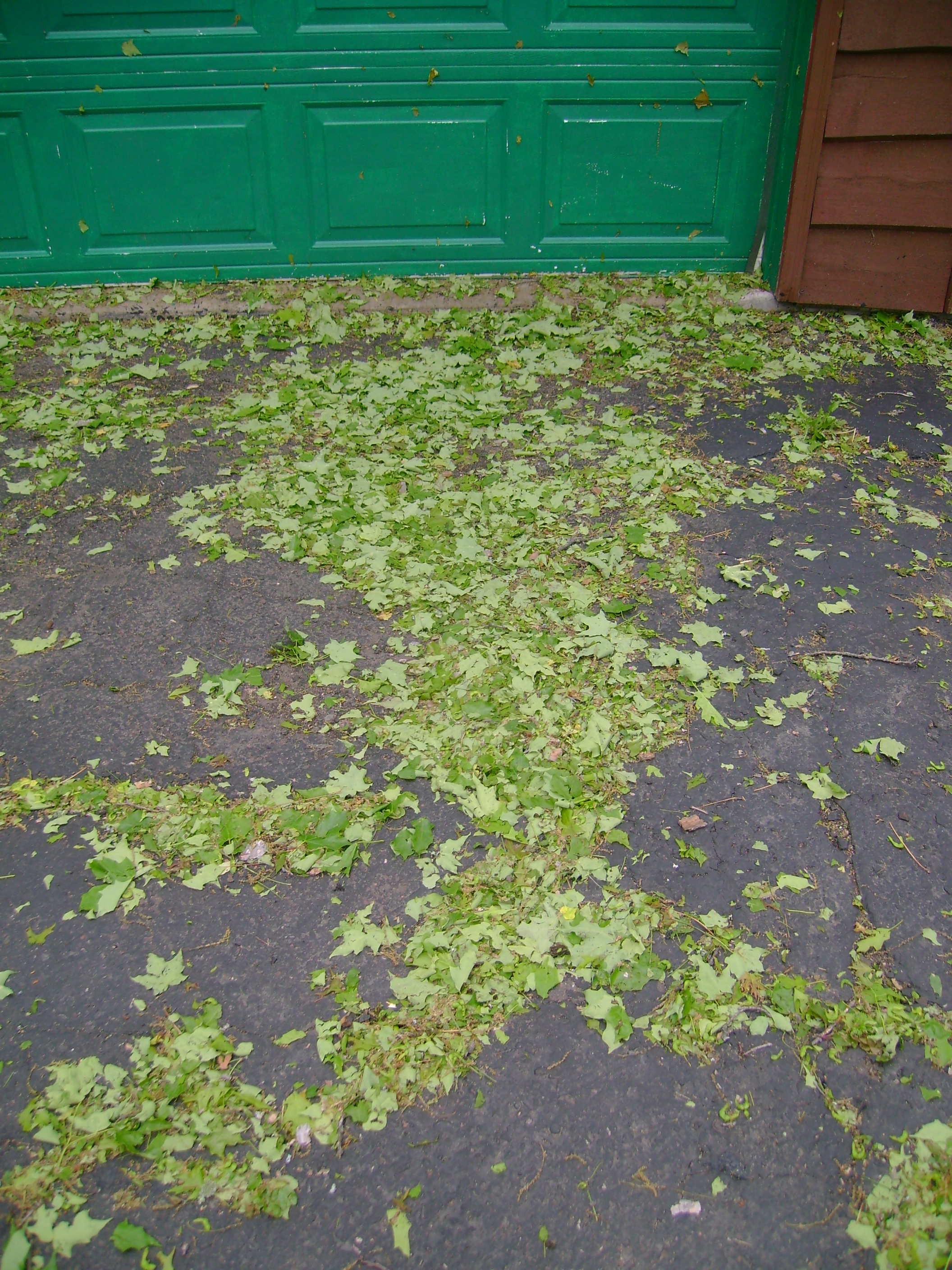
Shredded leaves from a hail storm litter my driveway.

Shredded leaves from a hail storm litter my driveway.

Even though it only lasted a few minutes, the hail squall that passed through my neighborhood earlier this week did a respectable amount of damage. Winds up to 70 mph toppled stately trees, people lost power – some for up to 22 hours (I lost power for about 12), and hail shredded the leaves that had finally popped out on the trees, creating a green carpet over people’s driveways and the roads.

Loss of power and loss of my routine reminded me of just how vulnerable we are to even the littlest whims of nature. I would have had to eat a cold supper but for the propane-fueled camp stove tucked away in my basement. With all our experience with snowstorms, perhaps northerners are more used to weathering weather disruptions than those in lower regions of the country, but we are far from immune. With no televisions and computers for distraction, my neighbors all took to the street to compare notes and make sure everyone was okay.

Unfortunately, violent storms like this are only likely to increase in the future. A few days after the storm, I attended a public forum called “A Flood of Options – Adapting to Climate Change,” which was hosted by the St. Louis River Alliance and the Izaak Walton League, and sponsored by the Minnesota Coastal Program and Freshwater Future. Speaker Mark Seely, the Minnesota State Climatologist, said that one of the things we can expect with climate change (and it’s happening now) is an increased amount of moisture from violent storms. There’s already been a 31 percent increase in this type of precipitation for the Great Lakes.

Higher temperatures are another thing that are happening, especially in the northern latitudes. The number of warm nights is increasing and so it goes that the number of cold nights is decreasing. Other lovely things to ponder are that mean monthly temperatures across the U.S. in 2012 were the highest since 1895 (I am guessing this is when stable record-keeping started). Not just by a little bit. Seely said they, “Obliterated all other year’s” temps. The same was true for Canada last year. Also, the value of economic losses due to weather/climate disasters has increased since 1980 due to hurricanes, floods, drought, etc. Seely said this is a motivator for communities to talk about climate adaptation. “Our climate vulnerability is becoming more and more clear to us.”

Other consequences include a longer mold and allergy season, increased frequency of freeze/thaw cycles, shorter time of ice cover on lakes (which leads to an increase in winter evaporation), and a longer growing season (which might not be all bad for northern Minnesota). The goal of the workshop was to inform participants about the impacts of climate change and provide ideas about how communities can adapt to it. It is a precursor to later workshops that will get more into advocacy and more specific adaptation measures.

During the question and answer session after his talk, Seely said, “Doing nothing is not an option. We’re obligated to think about this and to do something in our roles as citizens.” Chris Kleist, stormwater manager for the City of Duluth, also spoke, outlining the impacts of last year’s “500-year-flood” on the city. He estimates that long-term restoration will cost $12.6 million and the city has received about $2 million so far.

A look around the audience of 25 made it clear to me the presenters were preaching to the choir. Most of the others are already active in the environmental community. The guy seated next to me was so into the topic, he quoted from notes he wrote on a napkin. The type of approach used in the presentations wasn’t going to change anyone’s mind who wasn’t a climate-change believer. I know enough about behavior change theory to understand that.

Please forgive my Bill Clinton-esque title to this piece. I hope use of the word “stupid” does not offend, but I could not resist! It gets frustrating sometimes reading/hearing some of the refutations to climate change produced by nay-sayers. One of the problems is that those involved in climate change research and education do not employ effective communication techniques to get their messages across.

Spouting facts does not spur people to action. What does spur action and advocacy is storytelling, emotion, and spontaneity combined with some key message pre-testing and removing barriers to action. One of my favorite proponents to this approach is Randy Olson, a marine biologist-turned-filmmaker. He produced a movie about climate change (“Sizzle: A Global Warming Comedy), and wrote a book that tries to help scientists get their message across more effectively to the public (“Don’t Be Such a Scientist”). Seely did introduce a bit of emotion, but it wasn’t until the end of his talk, in the question and answer session. By then, an hour after his presentation began, it was too late.

It’s my sincere hope that the later climate workshops in this series integrate more effective communication techniques. And if you have a scientific message to get out to the public, please, consult with a trained communicator. It can only help! I’ll get down off my soapbox now.