Theodore Parker Unitarian Church

The morning before we visited the Parker Tavern in Massachusetts, we caught a church service at the Theodore Parker Unitarian Church in West Roxbury near Boston. This site was the second ancestral “treasure” I uncovered a few years ago (the tavern was the first) while looking for something else.

I discovered that noted Unitarian minister and abolitionist Theodore Parker (1810-1860) and I were related through Thomas Parker, a Congregational Church deacon who immigrated from England in 1635. Theodore’s first church assignment just out of Harvard Divinity School was this church in West Roxbury. But the actual building where he preached burned, so the church we attended was not the original.

After nine years, Theodore left the church after being kicked out of the Boston Unitarian Brotherhood for his “radical” views on abolishing slavery and other religious matters. He also believed outrageous things such as women should be allowed to vote, and to become doctors, lawyers, and (gasp!) even ministers.

Theodore spread his views not only through his sermons but via pamphlets. He is credited with famous quotes later shortened and used by President Lincoln and Martin Luther King. The phrases are, “a government of the people, by the people and for the people” and “the arc of the moral universe is long but it bends toward justice.” The former was used by Abraham Lincoln in the Gettysburg Address and the latter by Martin Luther King.

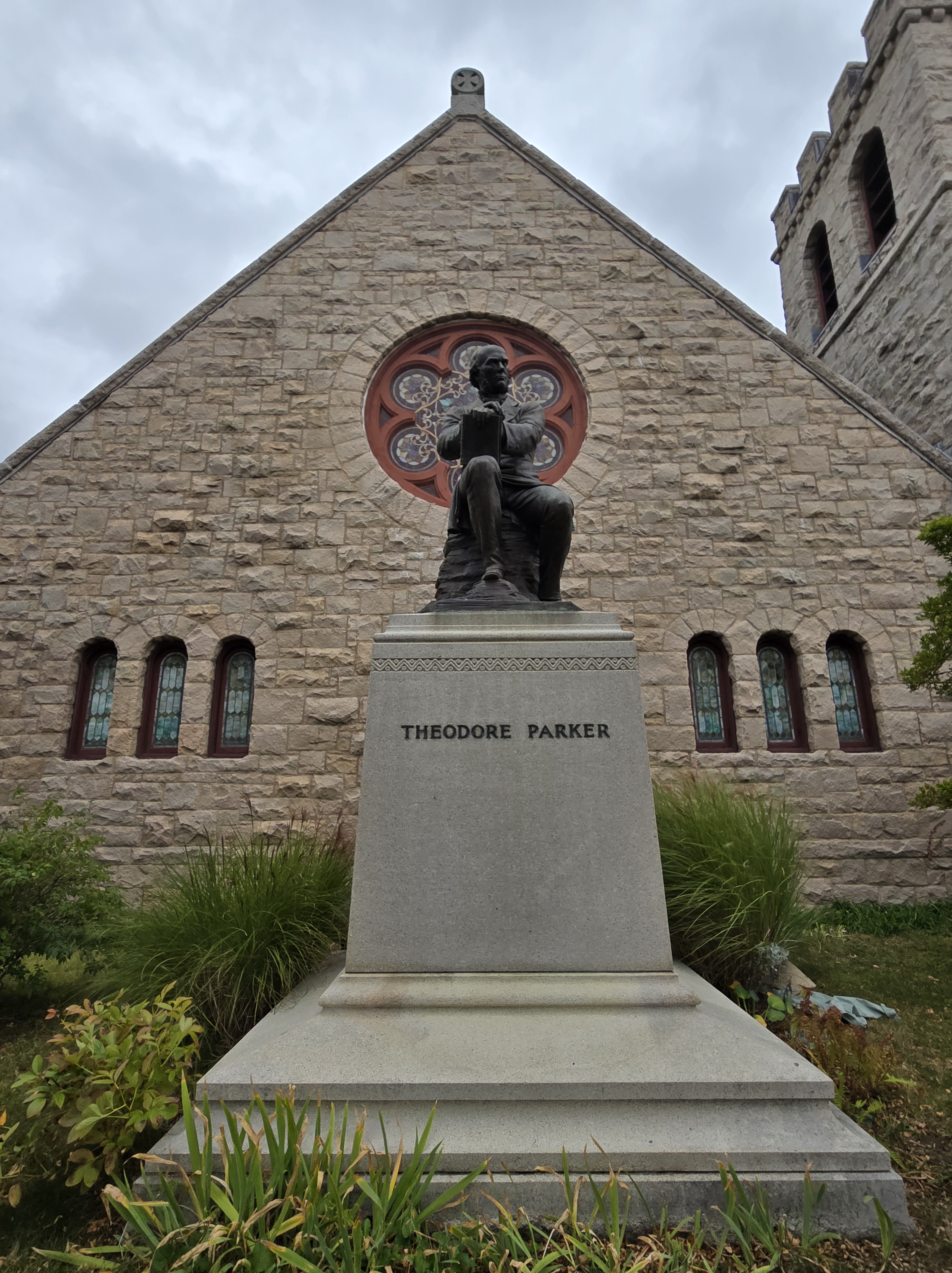
But as historical events played out, the moral arc of the universe must have brought him back into favor, because the church, designated a Boston Landmark, was named for him, and his statue was erected in front of it.

We arrived out a half-hour before the service began and had time to appreciate Theodore’s statue and wander around the outside of the church. Soon, a congregation member arrived, and we followed her to the old wooden front door. She took out a key to open it but had trouble. Russ and I looked at each other in dismay. We’d come all this way, and now we couldn’t get in!

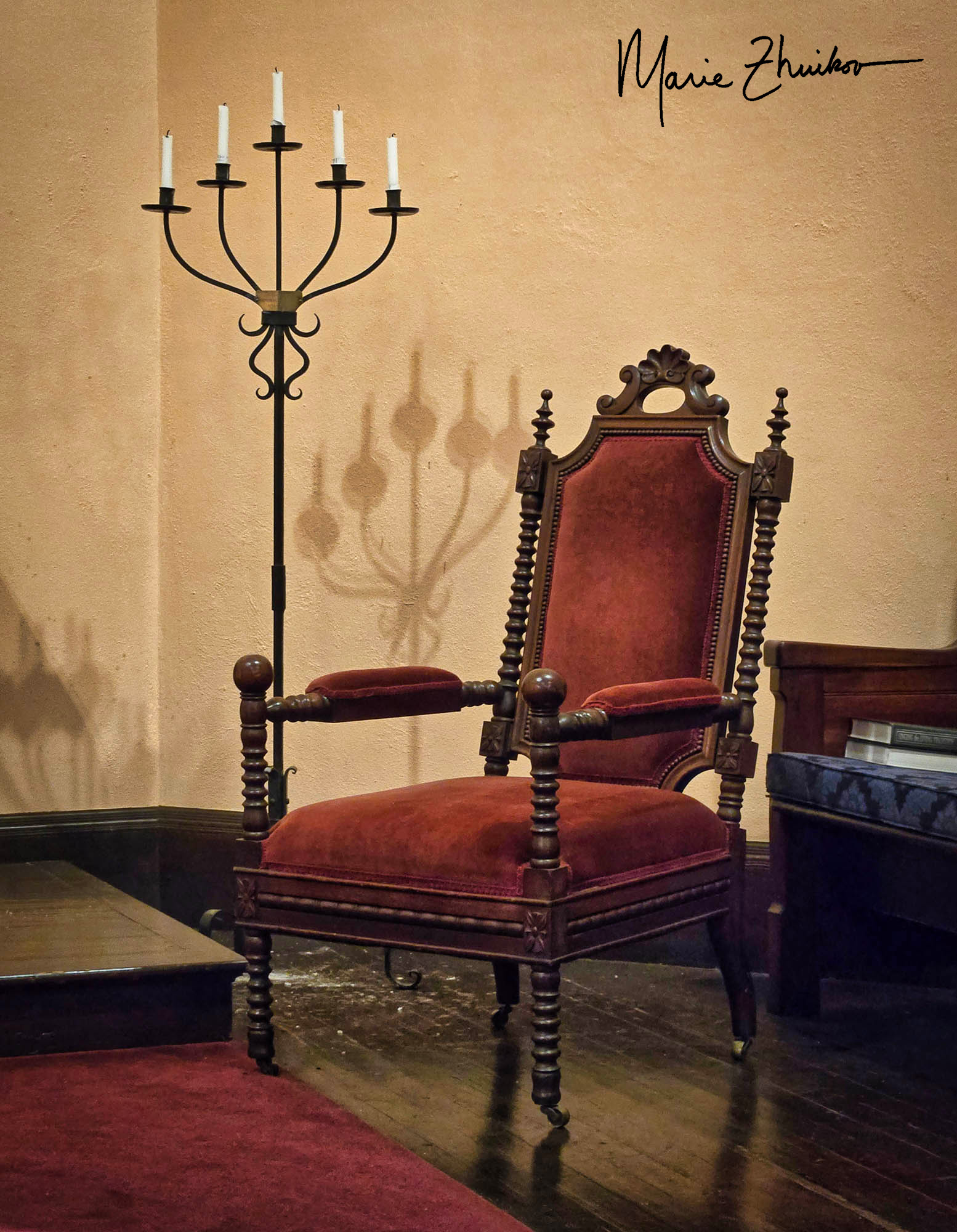
Russ soon stepped in to help, and with his key-handling expertise, he was able to open the door. Soon, more people arrived. In chatting with them about why we were there, they pointed out two Theodore Parker historians who were in attendance. We were able to speak with them both. They affectionately referred to him as “Teddy.” They reinforced what I already knew and pointed out some things I didn’t, including artifacts saved from the first church fire: a clock, Theodore’s pulpit, and his chair.

Theodore Parker’s chair.

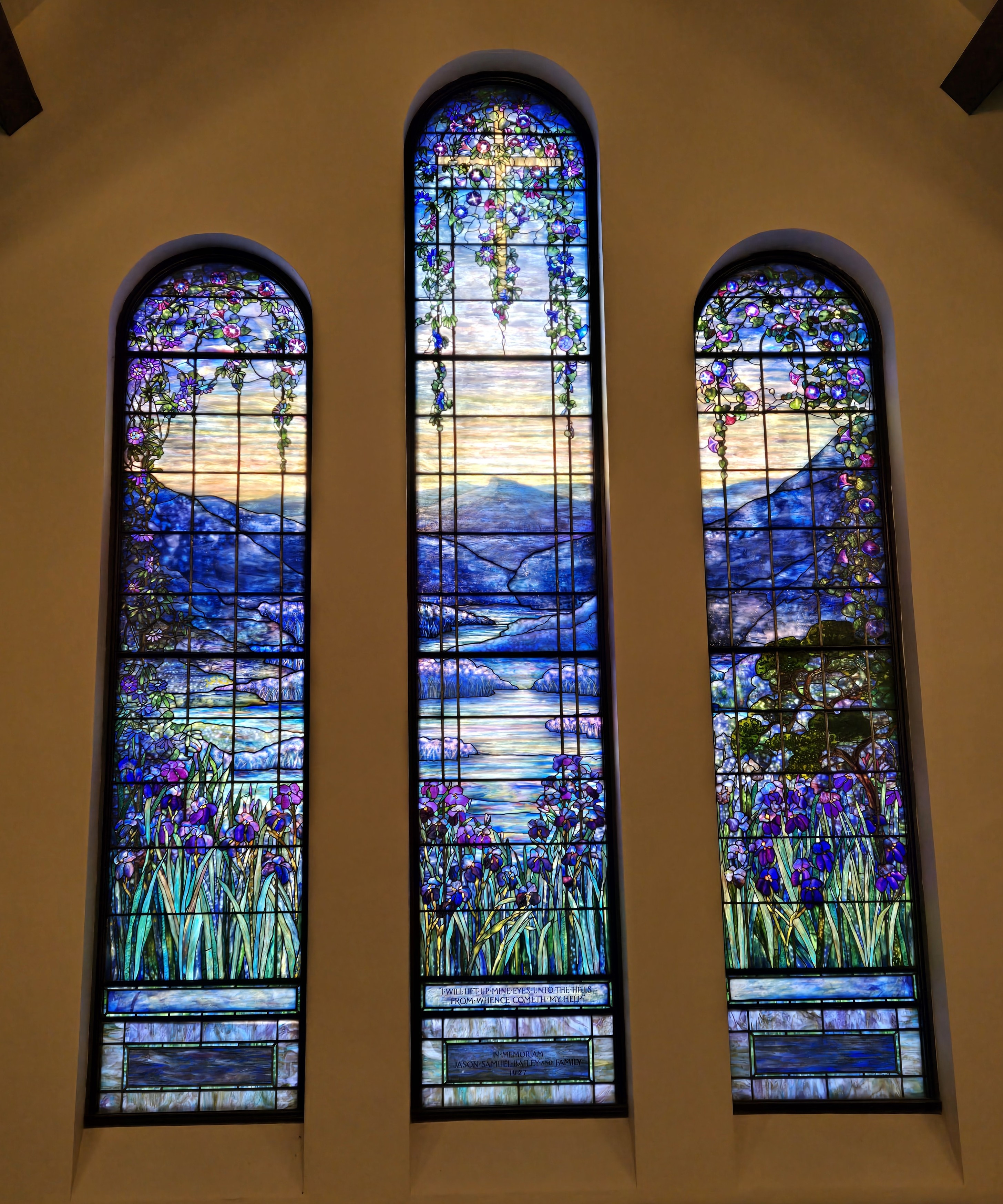
One of them also pointed out a trio of gorgeous 1927 Tiffany Studios stained glass windows that grace one wall. They feature irises and morning glories ringing a lake and mountain scene, with the words, “I will lift up mine eyes unto the hills from whence cometh my help.” According to a sign about the windows, a stained-glass consultant called the design one of the studio’s “greatest.” It incorporates several signature techniques: plating, where three layers of glass are used to achieve depth of color; mottling, which recreates intense sunlight as filtered through leaves; and acid etching, which involves removing a layer of colored glass to reveal a clear or palely tinted base glass. Intense leading is used on the windows to depict the organic lines of flowers and foliage.

The outcome is dazzling. One church attendee told us she purposefully positions herself during services so that she can see both the windows and the pulpit for comfort and inspiration.

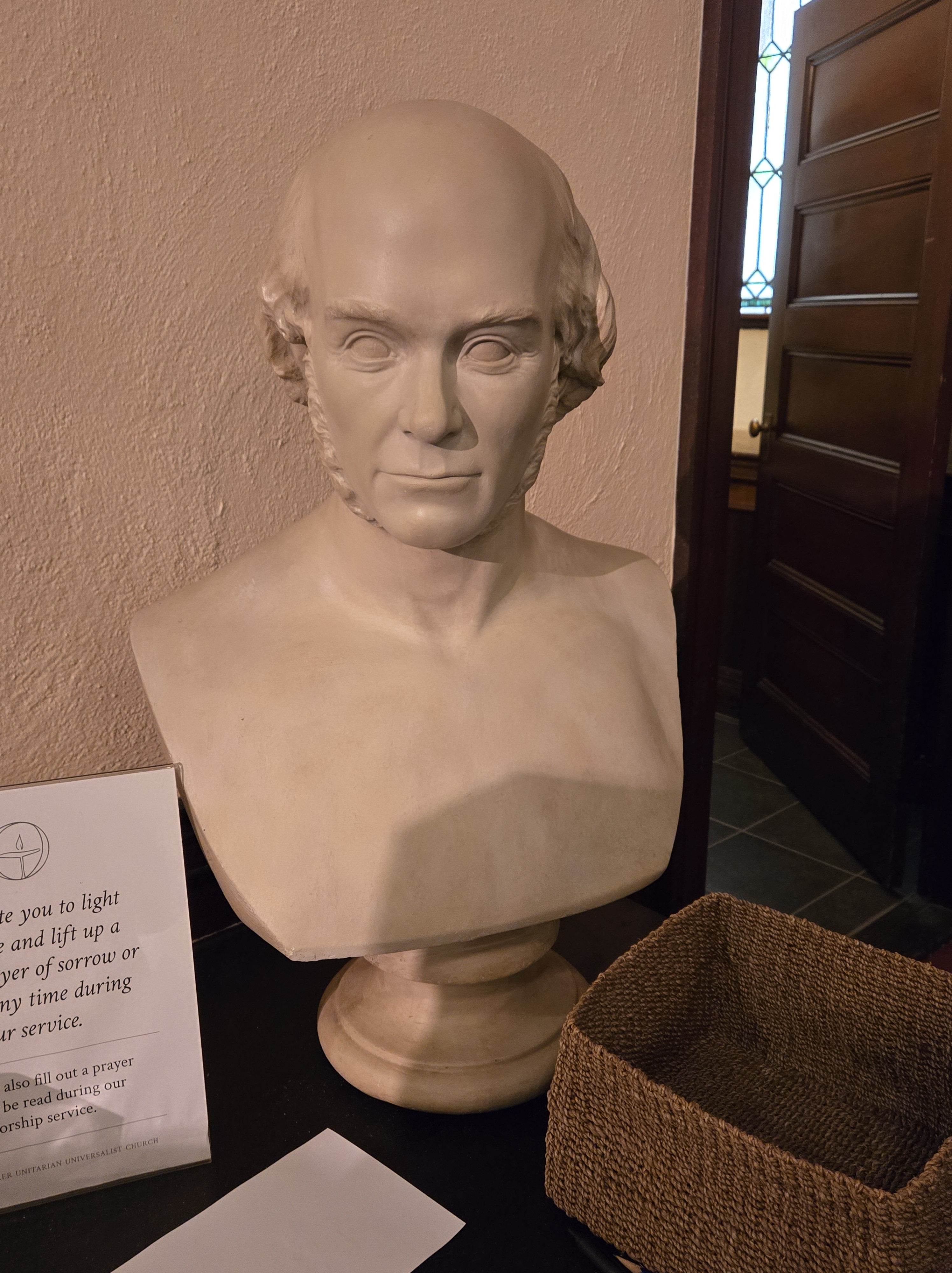
The service was conducted under the watchful eye of Theodore’s bust. We attend a Unitarian church in Duluth and were comforted by the similarities in the services. Everyone was super friendly, and we enjoyed hanging out with them afterward in the social hall.

Next up: Lexington, Massachusetts, and another illustrious Parker cousin who has his own statue.

The Parker Tavern, Reading, Massachusetts

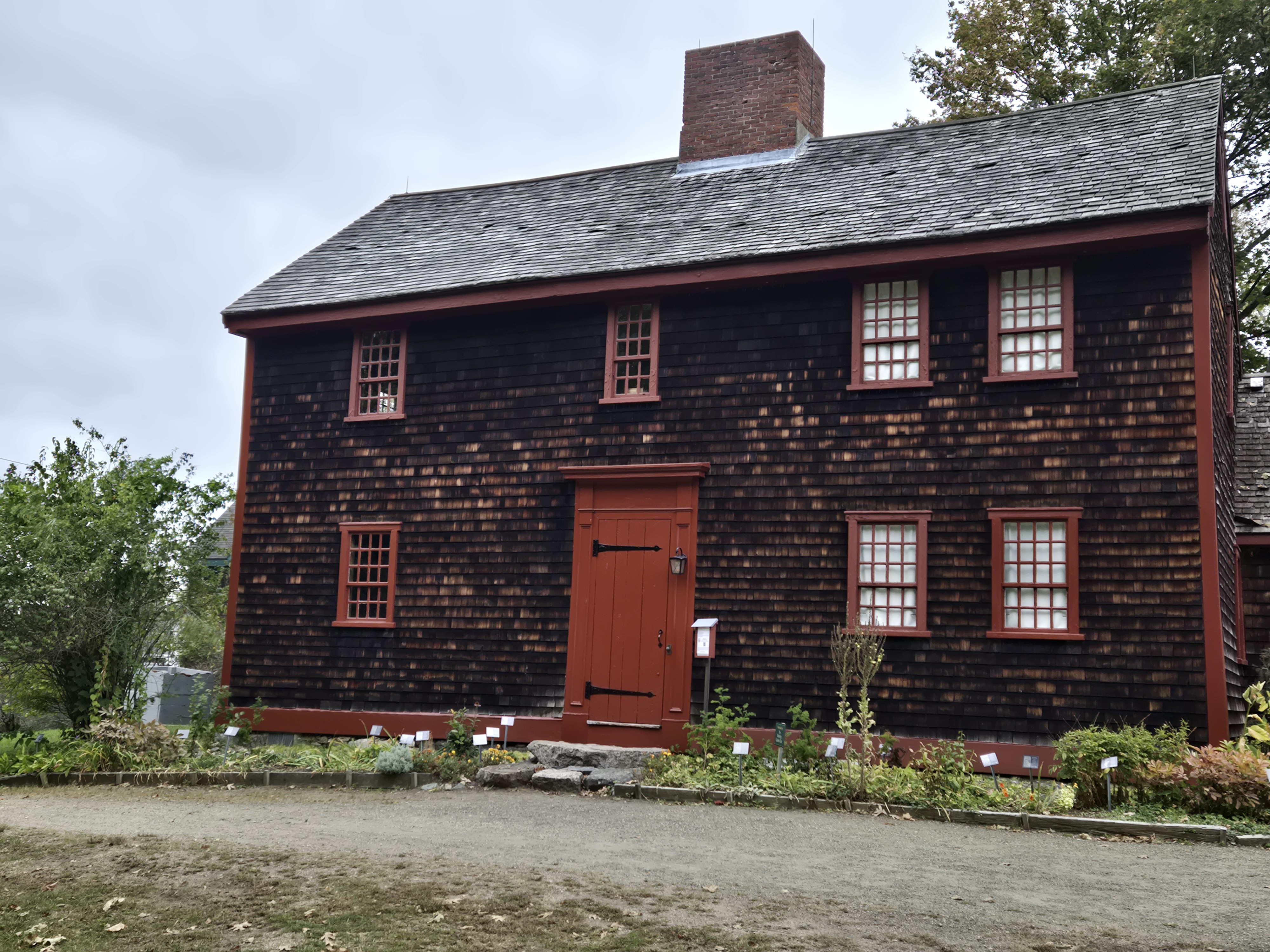
The Parker Tavern

If you have been reading this blog for about two years and have an excellent memory, you may recall this previous post about my search for Irish ancestor names in my genealogy before our trip to Ireland in 2024. I was unsuccessful in that quest, but I found colonial American treasure instead.

The first “treasure” was information about my direct ancestor, Caleb Parker. He was born in Shrewsbury, MA, in 1760, and was originally named Nathanial but was renamed by his parents after his presumed-dead-in-war brother. Caleb served under George Washington late in the Revolutionary War. Later, he was head of the Vermont militia. After he resigned his commission, he and his family moved to and founded Stukley, an eastern township of Lower Canada, not far over the Vermont border. Caleb died there in 1826.

That, in itself was pretty cool, but in following Caleb’s line back in time, I discovered that his grandfather, Thomas Parker, a Congregational Church deacon, immigrated from England and founded Reading, Massachusetts. I also found that the oldest surviving building in Reading is named after the family. The Parker Tavern was owned and operated by Thomas’s great-grandson Ephriam (who would have been a cousin of sorts to Caleb), and it has been turned into a museum. I vowed to visit it one day.

Well, that day came during our New England Road Trip. The first part of our trip was all about Russ and his family. The next part was all about MEEEE! (and my ancestors.) We left Russ’s relatives in Andover, Connecticut, and drove to Massachusetts. Our first stop that Sunday morning was to attend a church service at Theodore Parker Unitarian Church. More on that in the next post.

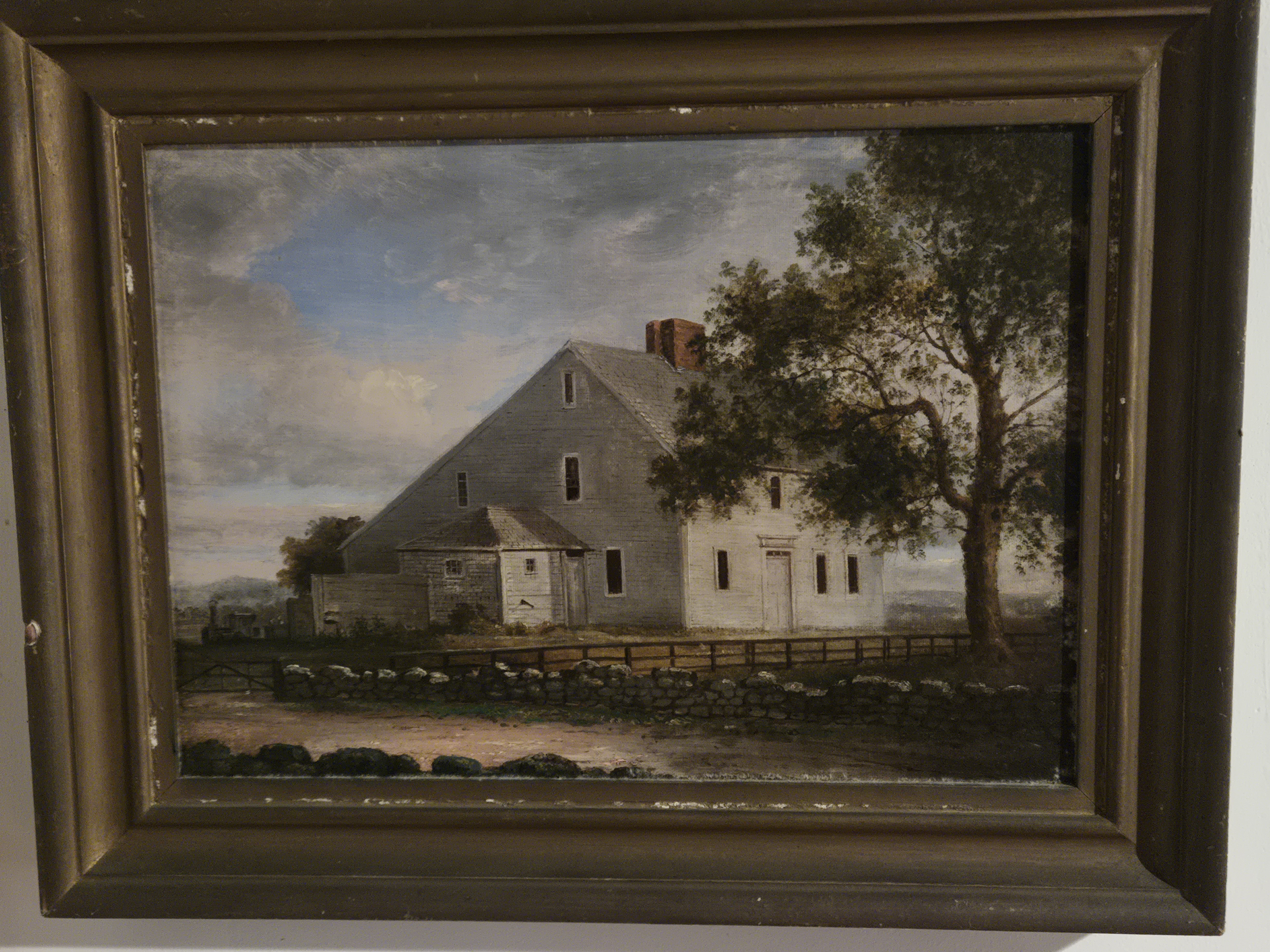
A painting of what the Parker Tavern used to look like.

Our second stop was the Parker Tavern in Reading. The tavern is on the National Register of Historical Places. It has been turned into a museum and is open Sunday afternoons from May to October. Due to our recent education about the importance of taverns at the Strong-Porter Homestead in Connecticut, we knew taverns were vital to colonial communities. They served as gathering places where information was exchanged and they provided food and lodging for travelers. As such, they were instrumental in the spread of revolutionary ideas, ultimately becoming hotbeds for political debate and organizing that led to the American Revolution. If you’re an Outlander fan, you’ll be familiar with this concept because characters in the books/movies are often shown scheming in taverns. Although the series is fiction, this depiction is based on truth.

Because they were such important spots, not just anyone could run a tavern. Managers needed to be in good standing in the community. Often, they were people associated with the local church, be they the ministers themselves or relatives of ministers. Given that Ephriam was from a ministerial family, it makes sense he was a tavern owner.

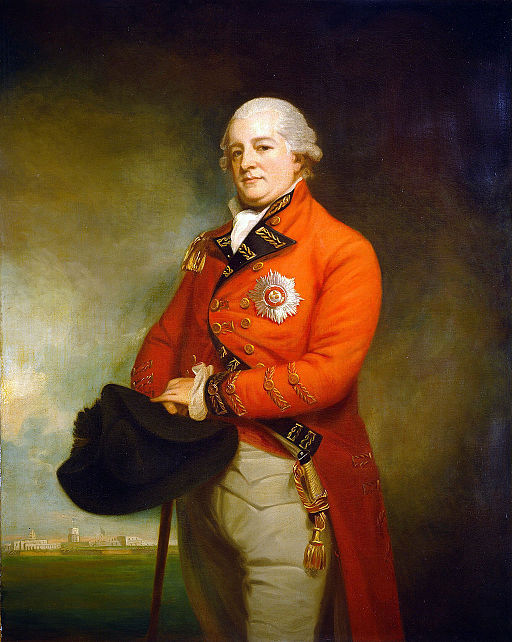
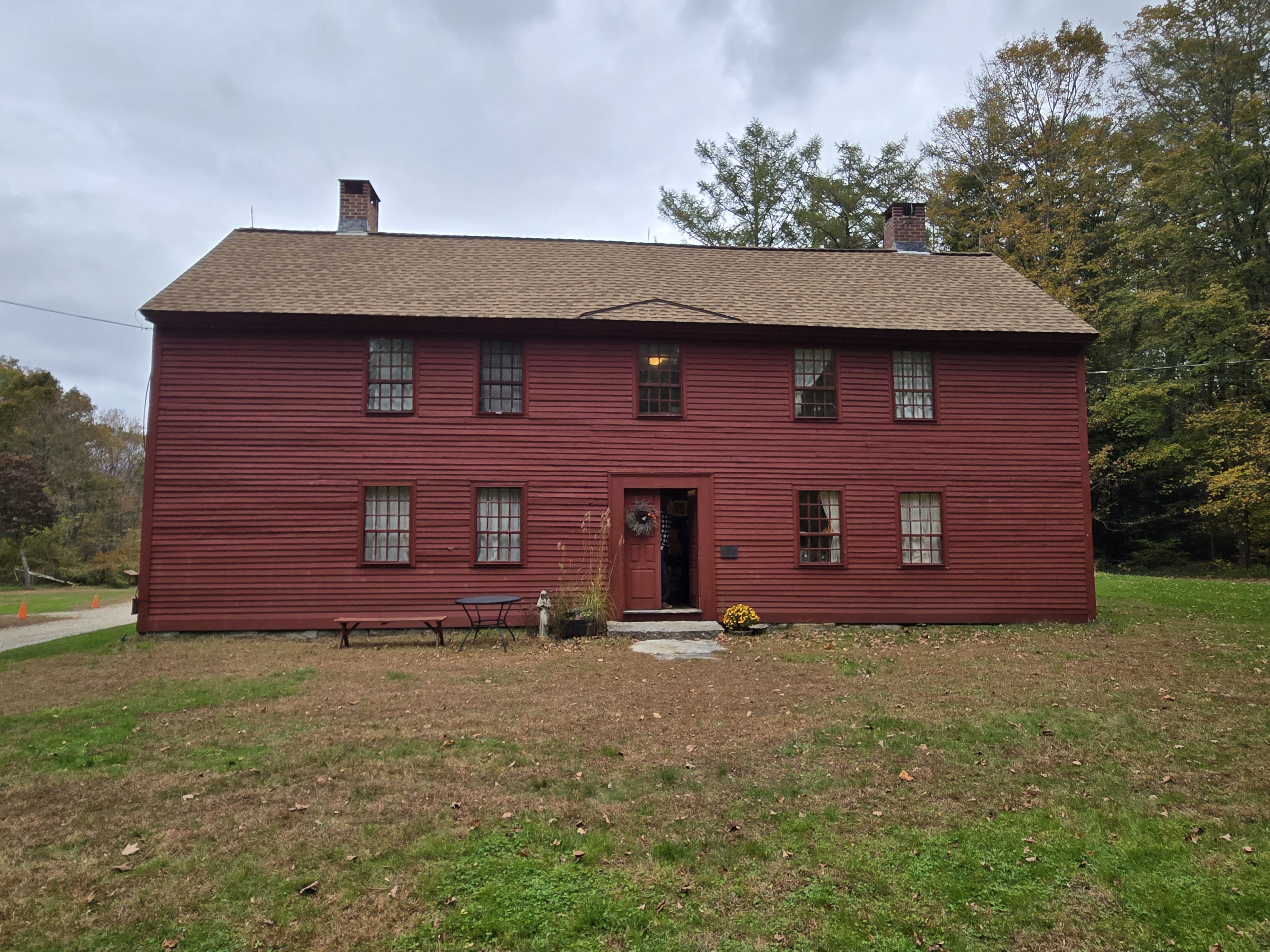
Like the colonial homesteads we visited the previous day, the Parker Tavern is a saltbox building, and it was built in the late 1600s. Besides providing lodging for travelers, the tavern also served as a jail of sorts. The docent told us that Sir Archibald Campbell, a lieutenant general for the British, was kept at the tavern from June 1776 to January 1777. He was a wealthy Scot who owned a lot of land in that country. At the time of his capture, he commanded the 71st Regiment of Foot, Fraser’s Highlanders. (For Outlander fans, another commander was Simon Fraser of Lovat.)

Sir Archibald Campbell image credit: George Romney, Public domain, via Wikimedia Commons

Campbell was captured after a battle aboard a ship in Boston Harbor. At first, he was in solitary confinement in the Concord jail. But after complaining to his superiors, who brought Campbell’s plight to the attention of George Washington, he was moved to the tavern for more humane living conditions.

In researching for this blog post, I discovered that Wikipedia says that the tavern was owned by the jailer. Ephriam Parker owned the tavern from 1770 to 1785, which is during the time that Campbell would have been there. The docent told us that Campbell was thankful for the amenities the tavern provided and enjoyed his stay there, as much as a prisoner can enjoy his “jail.” He wasn’t alone, however. According to a Daily Times Chronicle story (Woburn, MA), he housed about twenty-five of his servants in a tented area on the grounds and possibly on nearby Scotland Hill to comply with the army’s prison requirements.

The same newspaper story states that Ephriam and his son were part of the 4th Company of Minutemen, which took part in the battle of Lexington and Concord in April 1775 that began the Revolutionary War.

After his stay at the Parker Tavern, Campbell was released to “freedom” within the confines of Concord. In May of 1778, he was finally totally freed in an exchange for Ethan Allen. He later became the governor of Georgia, Jamaica, and Madras. His tomb lies in Westminster Abbey.

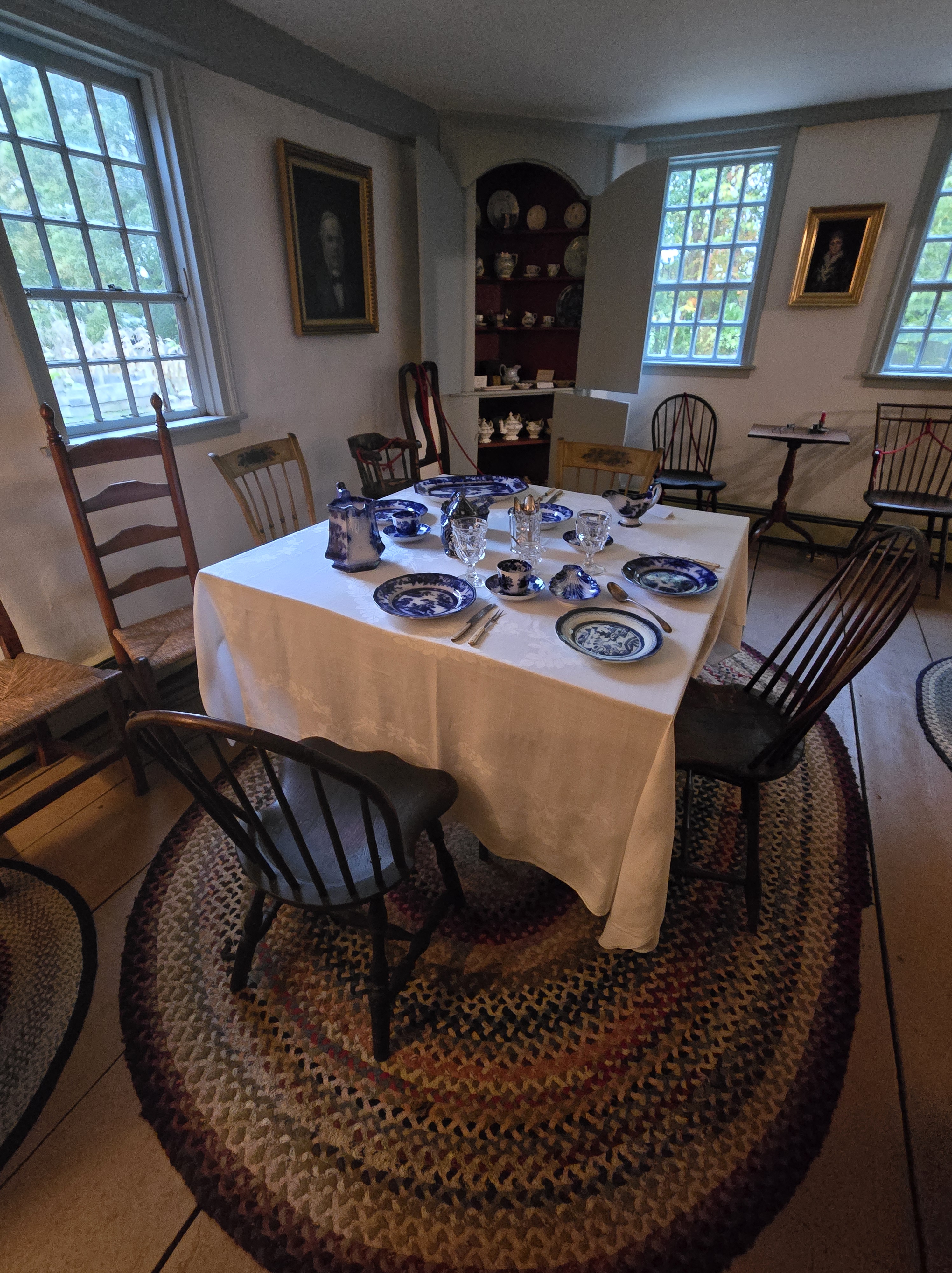
The Parker Tavern dining room.

The tavern museum is filled with antiques and an interesting display of shoe-making equipment. The docent explained that shoemaking used to be a cottage industry and that many homeowners participated in this side business.

Touring the museum is free; however, we chose to support it by joining the antiquarian society that runs it. To find out more about the tavern and to see more images, visit their Facebook page.

We left the tavern with our heads stuffed full of information and with a greater appreciation for the role of such buildings in the foundation of our country. Later, we toured the town to get a feel for it, and walked the graveyard where Thomas Parker is buried. We didn’t find his grave, but we saw some great examples of Puritan gravestones and their distinctive three-lobed shape, symbolic carvings like the “death’s head” or winged skull, and inscriptions that reflect their beliefs about death and eternity.

Next up: Theodore Parker Church

For previous posts about our New England trip, view:

The Nathan Hale and Strong-Porter Homesteads

Wickham Park

The Katherine Hepburn Museum

Governor’s Island

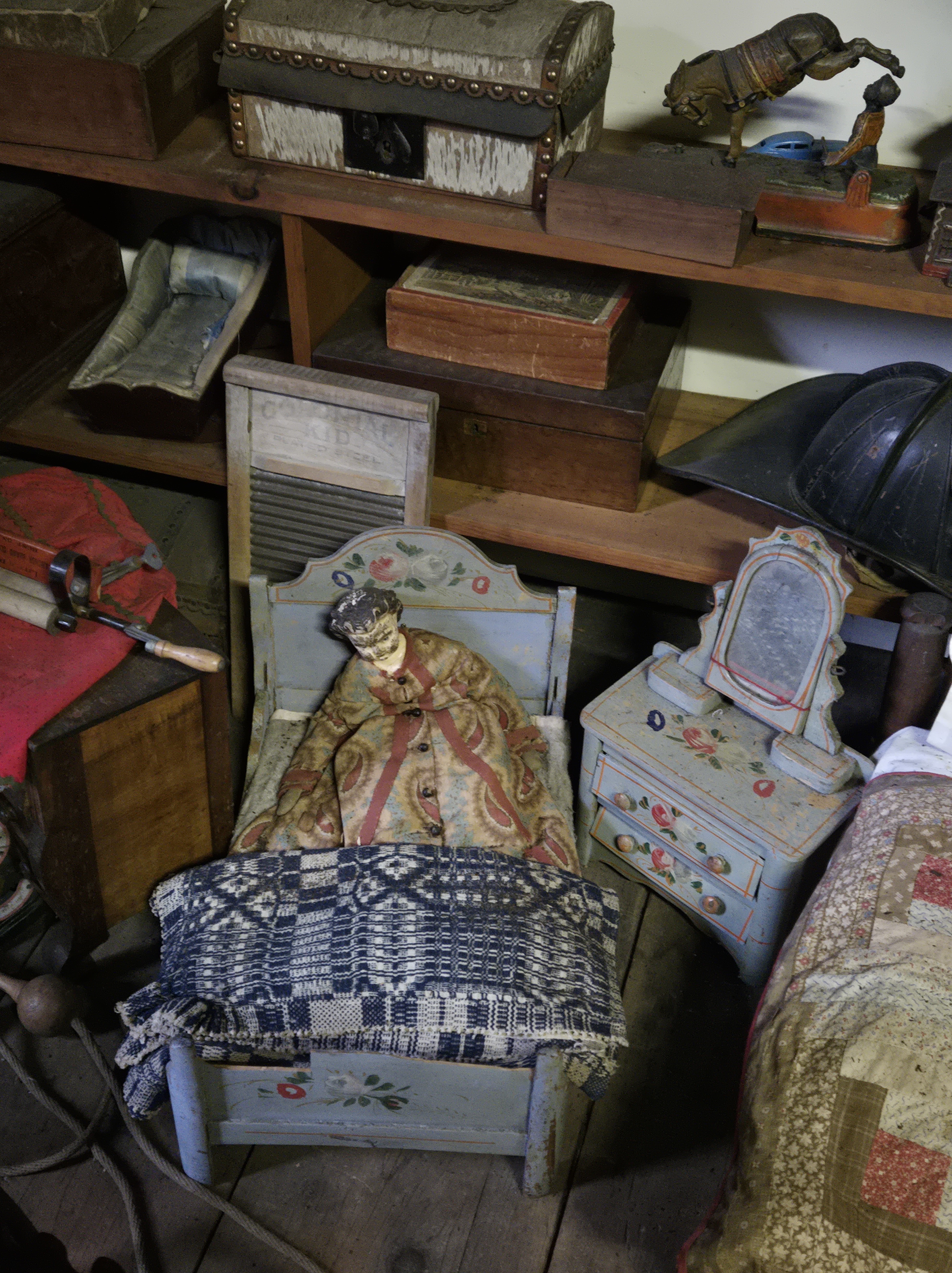
A creepy doll in the Parker Tavern attic.

The Nathan Hale and Strong-Porter Homesteads

The Nathan Hale Homestead in Connecticut

Andover Connecticut was our next stop in the Great New England Road Trip. Russ was having a mini family reunion there with his cousins, one of whom I hadn’t met yet. We stayed at his cousin’s home, which backed up to the Nathan Hale Homestead and state forest. After socializing, we decided on the spur of the moment to visit the homestead.

Because we hadn’t planned our trip well, the homestead museum was closed, but the grounds were open. Nathan Hale, Connecticut’s State Hero, was born on the property in 1755. After working as a schoolteacher, he was recruited as a Patriot spy but was caught and hanged by the British in 1776. He’s known for uttering his famous last words: “I only regret that I have but one life to lose for my country.” Statues of Hale stand in the Connecticut state capitol, at Yale University, the headquarters of the CIA, and more. 

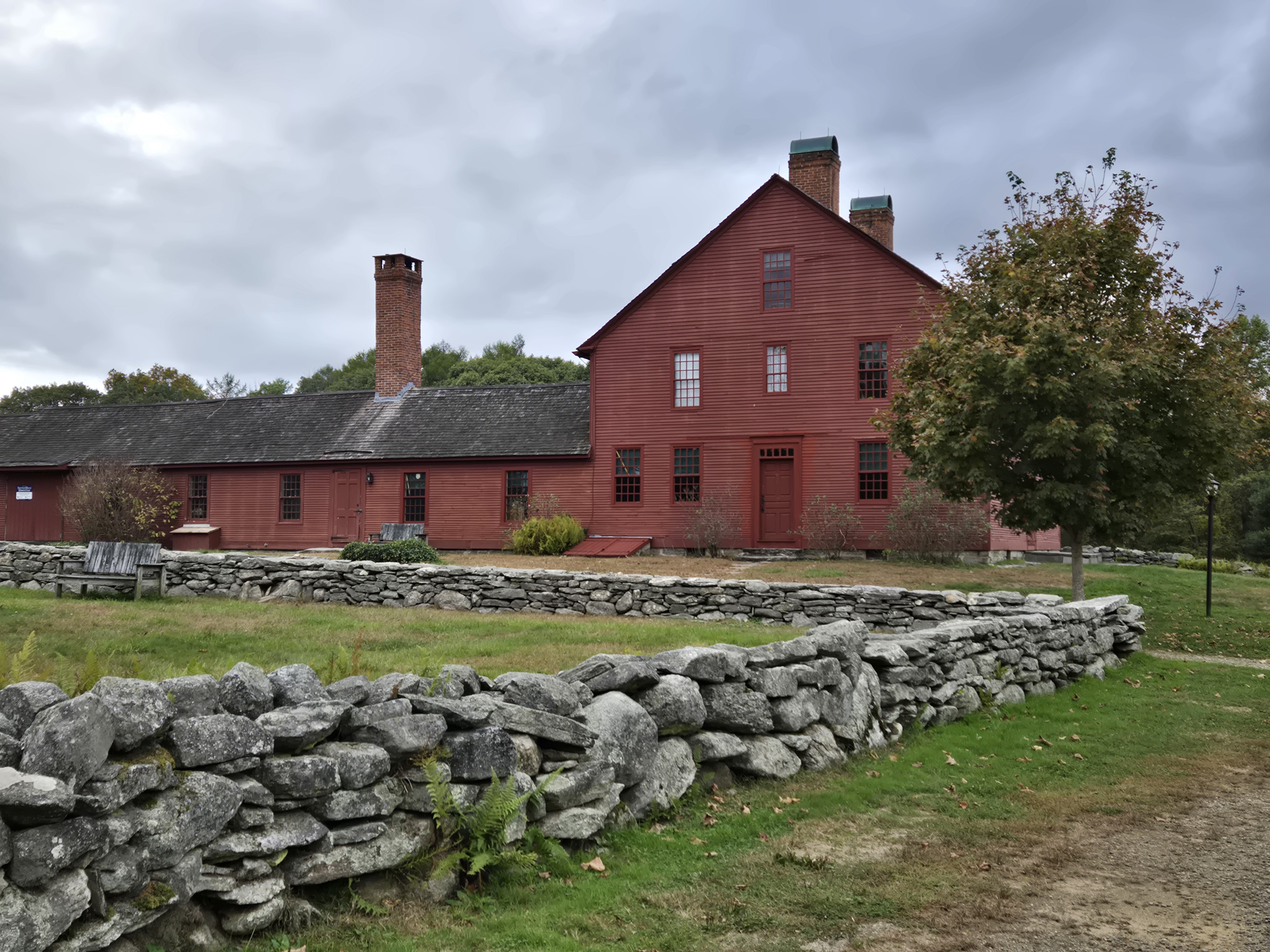
Hale’s dark maroon Georgian-style home has remained intact. If we had been able to go inside, we would have seen that it is furnished with family possessions and other period antiques. As it was, we wandered the grounds and enjoyed soaking up the colonial ambiance. It was easy to imagine a young Nathan frolicking in the nearby forest and working in the family fields.

The Strong-Porter House

Not far down the road we found a museum that was open. The Strong-Porter House was built by Nathan Hale’s great-uncle and is listed on the National Register of Historic Places. It was the same dark maroon as the Hale homestead. The oldest part of the saltbox-style house dates from 1710 and admission is free. The museum is open Sundays during summer and fall.

The dining room-turned museum in the Strong-Porter House.

The helpful docent showed us the dining room, which was filled with historical information about the importance of taverns in colonial times. We found this of keen interest because we planned to visit a historic tavern that’s associated with my ancestors the next day. (Synchronicity!)

The home’s floorboards were much wider than usual, a testament to the huge trees they were made from. The main parlor has exposed beams, wide paneled wainscoting, and a fireplace cupboard that suggests a much larger chimney once stood there. 

We left with a greater appreciation for the basic comforts and hardships people must have experienced during the early years of our country.

Next up: Theodore Parker Church and the Parker Tavern in Massachusetts

For previous posts about our New England trip, view:

Wickham Park

The Katherine Hepburn Museum

Governor’s Island

Wickham Park

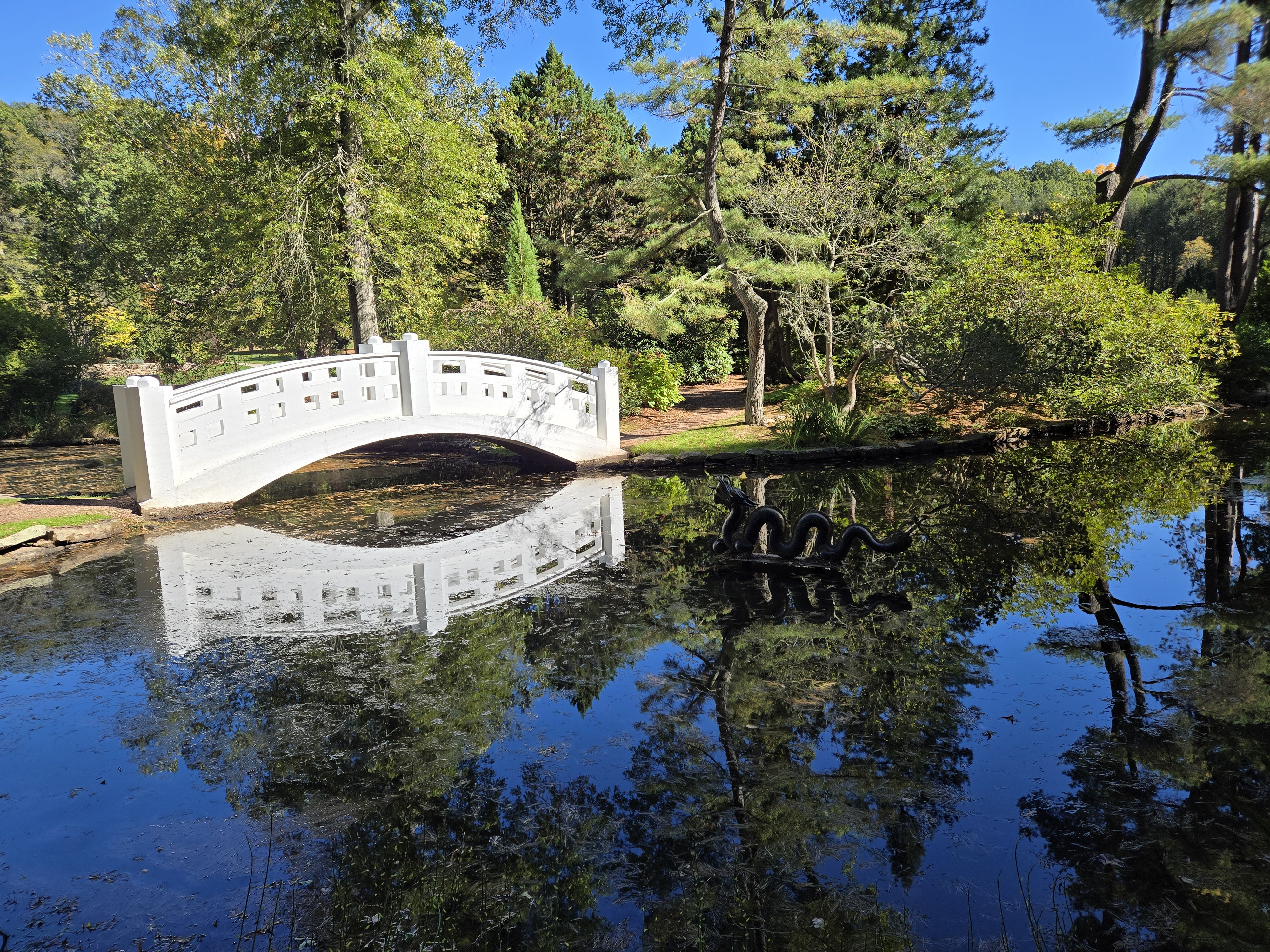
Part of the Oriental Garden in Wickham Park.

The next stop on our New England road trip was Manchester, Connecticut, and the beautiful Wickham Park. We chose this particular park because one of Russ’s cousins was a long-term manager of it, and it has connections to Russ’s family. Although Russ’s cousin Jeff is retired, he still works at the park “part-time” as director emeritus. That’s in quotation marks because, although his official position is part-time, we suspect he spends much more time at the park!

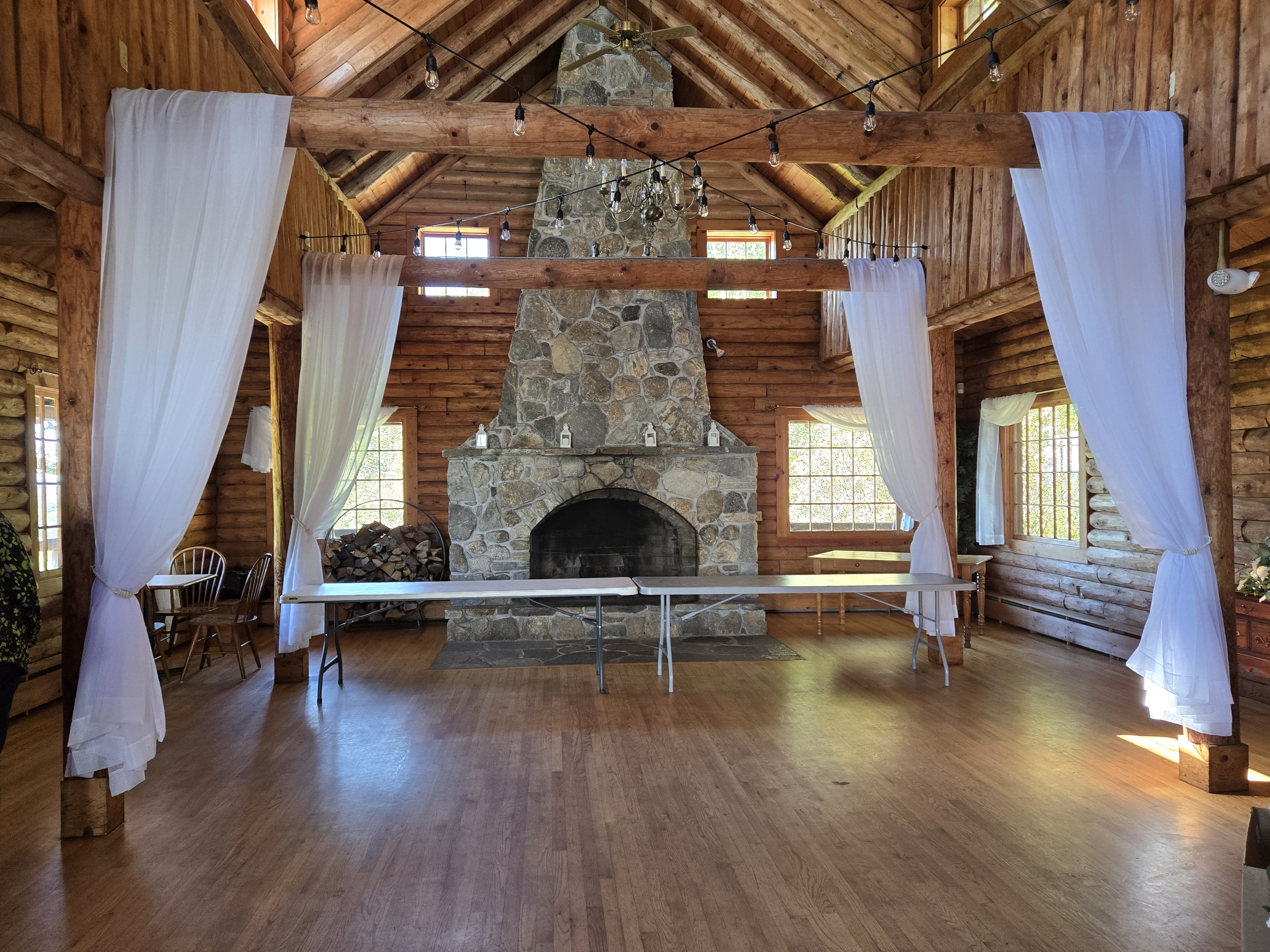
Just off Interstate 84, the park is managed under a nonprofit, private foundation and was created in 1961. It contains 280 acres of gardens, fields, woodlands, ponds, and sports facilities. People can even get married there in one of two stunning venues, including a log cabin. The entry fee is very reasonable ($7).

This log cabin was being set up for a wedding. It sits on a hill with a stunning view of Hartford, CT.

The majority of the park was a gift from businessman and inventor Clarence Wickham. If you’ve ever used an envelope with a little plastic window in it for the address, you’ve used one of Clarence’s inventions.

We received a personal tour from Jeff and his wife. We didn’t have time to tour the entire park (which would take more than a day, anyway), so we only saw the Irish Garden, the Italian Shrine, the Lotus Garden, the Oriental Garden, the Scottish Garden, and the Nature Center.

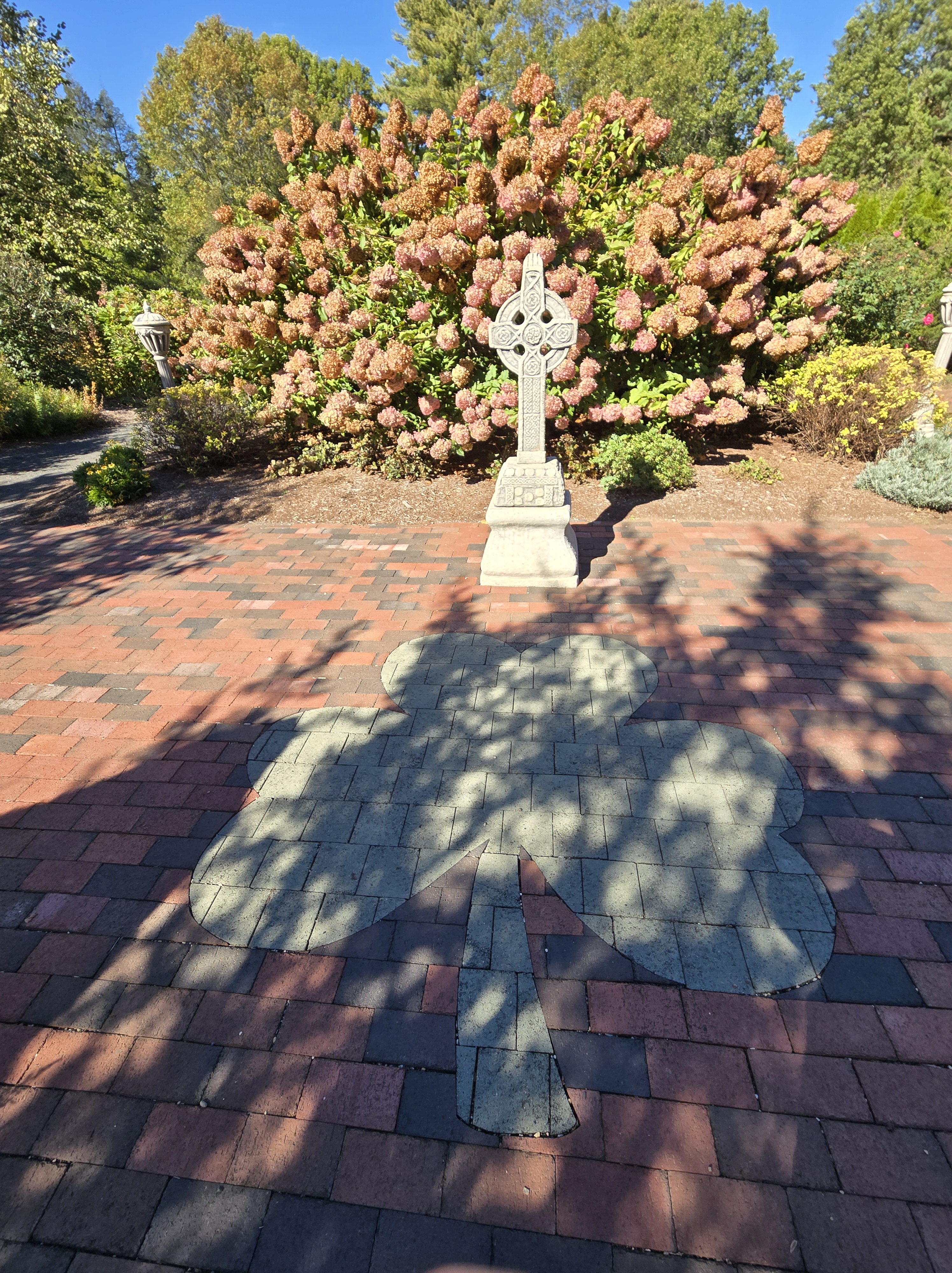
The Irish Garden and Wickham Park.

The highlight of the trip was a tour of a new garden that’s not open yet to the public. It’s named for Jeff and Russ’s family. (I’m not going to divulge that name here, but if you go to the park, it will be obvious). It was conceived by Jeff and his wife, financed by the family and donors, and built with the help of park staff. It celebrates the relationship between art and the natural world, showcasing sculptures and other art forms, including topiaries sculpted from plants. It even sports an observation tower and labyrinth. Some bureaucratic matters are still being finalized, but as soon as the paperwork is complete, the art park will open to the public.

The view from the observation tower in the “family art garden.” The building in the background used to be the carriage house but now houses the park office.
Russ and I interact with an art piece in the family garden.

The place exudes peace. If we lived in the area, I’m sure it would be one of our favorite places to visit and hold family gatherings. As it is, we live over a thousand miles away. So, we’ll have to visit it in our memories.

Next up: Two historic Connecticut homes.

For previous posts about our trip, view:

The Katherine Hepburn Museum

Governor’s Island

The Lotus Garden

Katherine Hepburn Museum

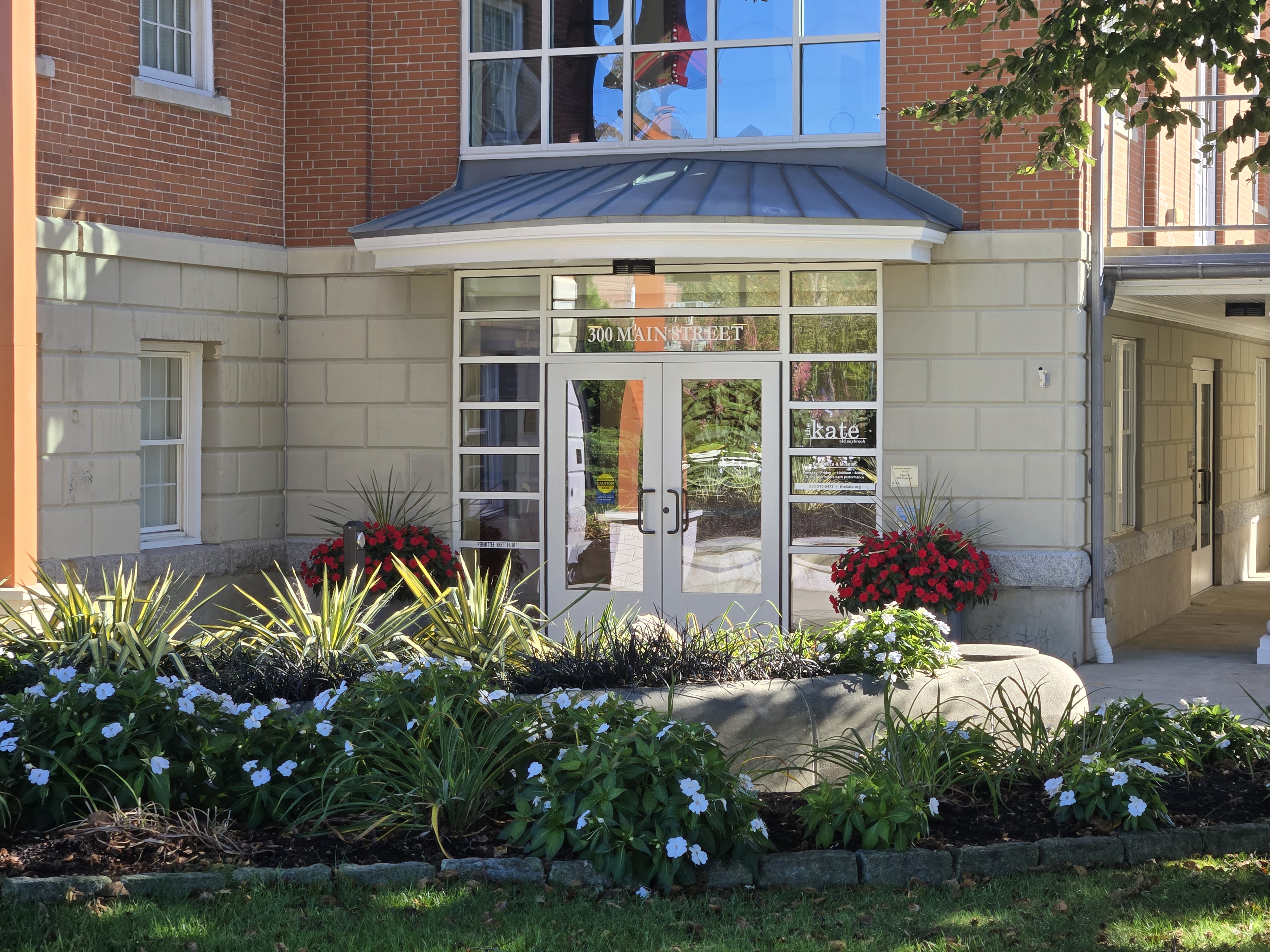
The entrance to the Katherine Hepburn Museum.

We continued our New England Road Trip by taking a train from New York City to Old Saybrook, Connecticut. This is where Russ spent many of his formative years. We rented a car and toured his old neighborhood and saw his family home, which is still standing. We even spent a little time greeting the Atlantic at the town beach.

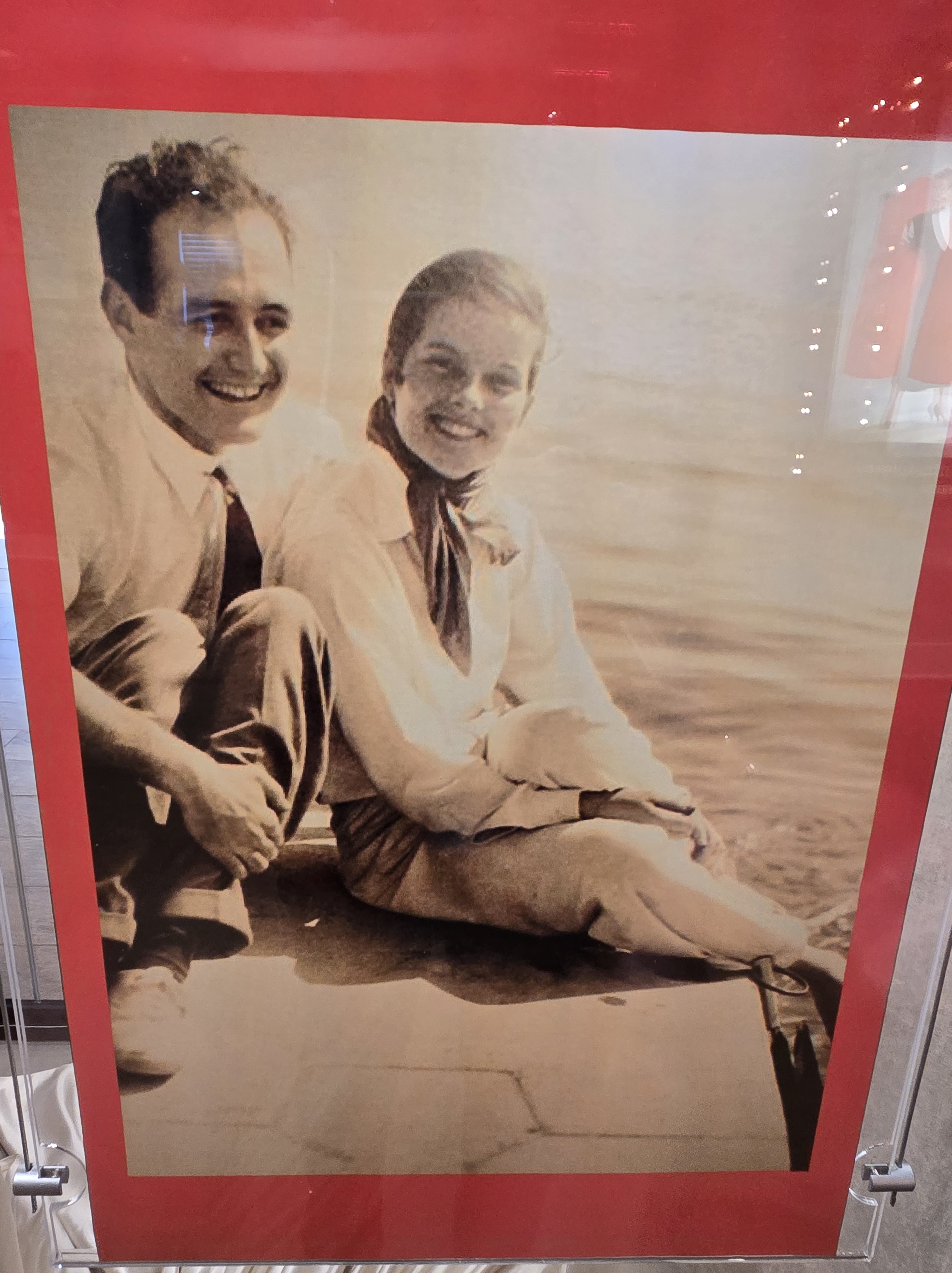
The docent told us that Kate liked this photo of herself, so it’s featured prominently in the front of the museum.

Before we left Old Saybrook the next day, we had a few hours to kill so we visited the Katherine Hepburn Museum. Hepburn lived near Old Saybrook after her family bought a summer home there when she was five. The day before, we’d driven through the exclusive oceanside neighborhood (Fenwick) where her home was located. It sports a golf course and a lighthouse. We wanted to visit the lighthouse, but couldn’t due to public access issues. We also weren’t able to see her home, where she retired in 1996.

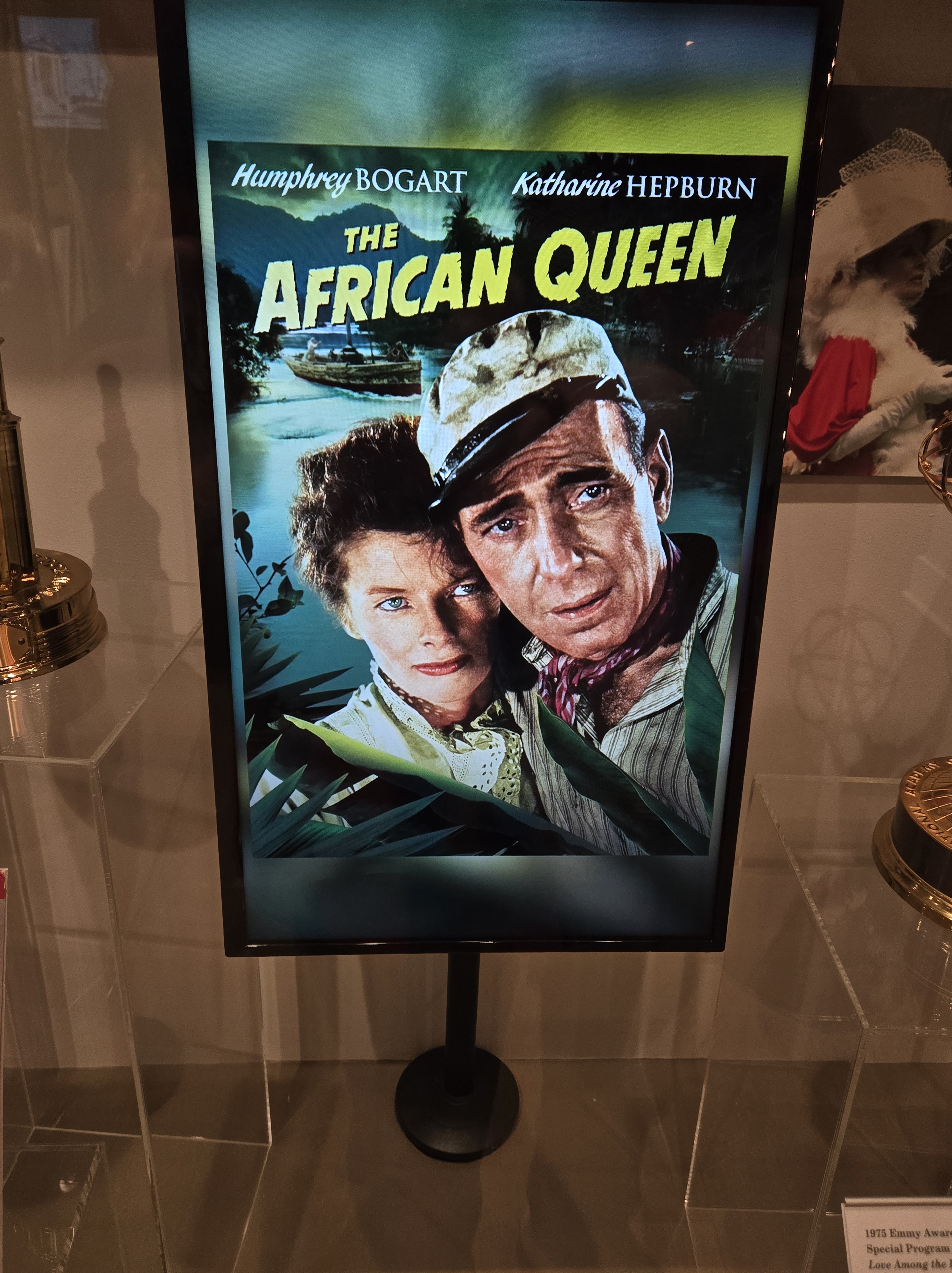
If you’re not familiar, Katherine Hepburn (aka Kate) was a feisty actress of great renown who had a six-decade career in Hollywood. She’s best known for movies like The Philadelphia Story, The African Queen, and On Golden Pond. With her athleticism and outspokenness, she broke the mold for women in Hollywood.

Kate and her husband Ludlow Smith. They were married for six years.

At the museum, we were given a comprehensive introduction by a helpful docent, who was excited to learn that Russ was a hometown boy. The museum features eight exhibits that focus on Kate’s family, her athleticism, her Fenwick home, her career and other special topics. Wedding gowns were the focus of the special exhibit when we were there, including Kate’s own wedding gown from when she was married early in her life.

I always enjoyed Kate’s movies, and she’s been an inspiration to me to keep active. I recall watching her on a television talk show once when I was younger. I believe she was in her 70s and she proudly showed the host how she could still bend over and touch her toes. I remember thinking, I want to be able to do that when I’m 70! I’m happy to report that I can still accomplish this feat in my early 60s. 😊

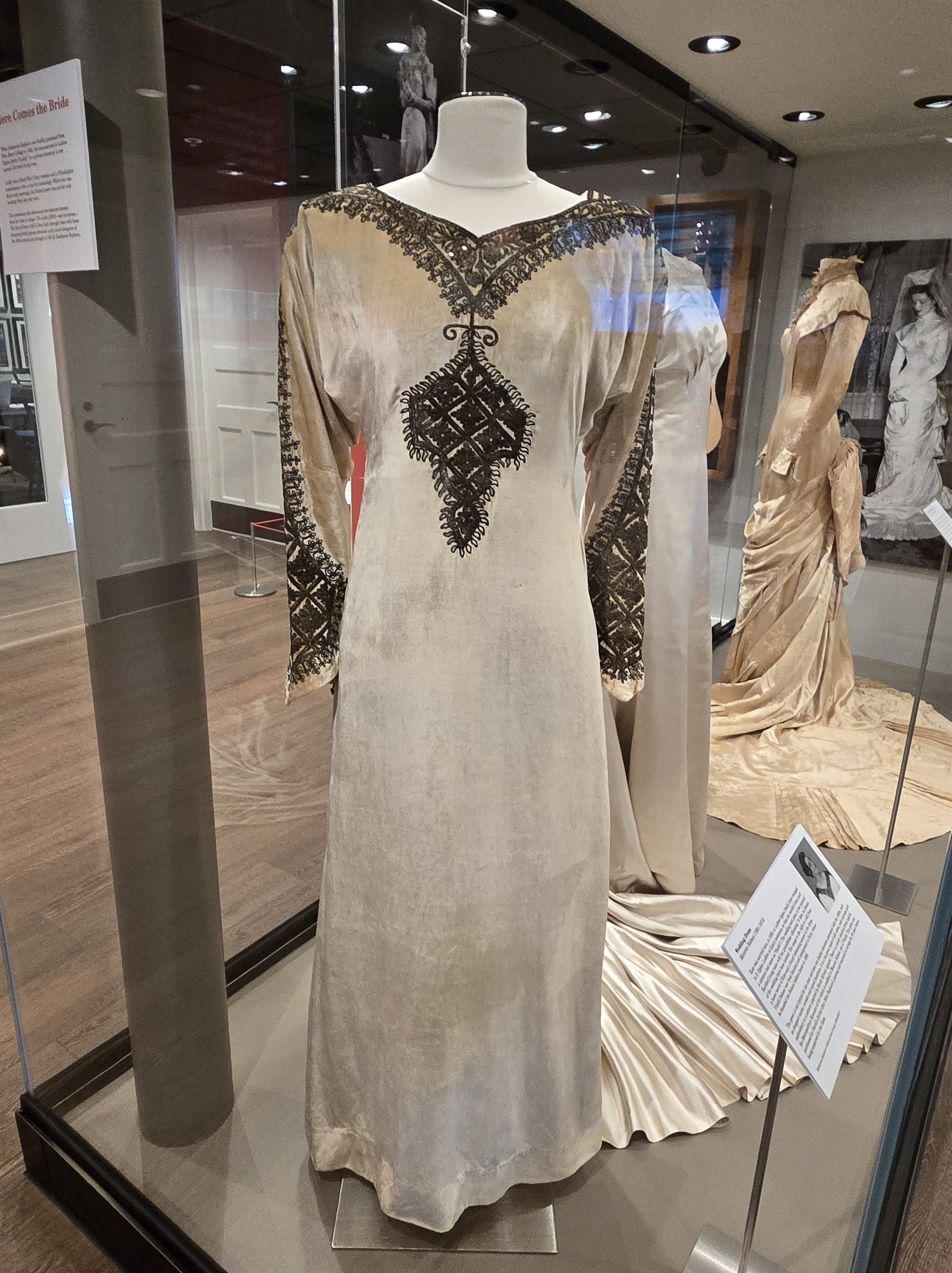
Kate’s wedding dress. It’s a tea gown made of silk velvet with gold embroidery in a pattern inspired by North African apparel. It was purchased by a wedding gown company and remained in storage for 20 years before being purchased by the museum.

The museum is also a cultural arts center, hosting lectures, workshops, and film screenings. Admission is free but there’s a suggested $10 donation per person.

According to one placard, “Although her legendary career catapulted her to dizzying heights of international fame, Connecticut’s local girl never really left home. The road always led her back to her family and to her refuge in Fenwick.” Katherine died in her Fenwick home in 2003. Her grave is in a cemetery in Hartford. She didn’t want a service, nonetheless accolades for this special actress were given throughout the country in many other ways. It’s good to know that her memory and passions are preserved in this little piece of Old Saybrook.

Do you have a favorite Hepburn movie?

Governor’s Island, New York City

A view of Manhattan from a Brooklyn pier.

Russ and I decided to see New England in the fall. We began our road trip earlier this month in New York City even though this mid-Atlantic state is not technically part of New England. We landed in NYC because Russ’s son lives there. We wanted to visit him and he planned to join us for the first few days of our ten-day trip.

Besides the colors, our other goal was to visit sites relevant to ourselves and our ancestors.  But first, some fun in NYC! This was not our first visit. In 2019 we dropped in just before COVID hit. (See “Unicorns in New York City!” and “Images.”)

We booked a hotel in Brooklyn. The place looked great online but when we arrived, we were surprised to see it lay in a gritty neighborhood filled with graffiti. We never felt unsafe, but we definitely knew we were not in Duluth anymore!

A sculpture atop the fort on Governor’s Island, NYC.

We’d agreed to spend most of a day on Governor’s Island, a 172-acre former military installation in the heart of the harbor that’s reachable only by ferry. Native Americans used to fish there and gather nuts from the island’s plentiful trees. After colonization, the Dutch promptly set about cutting down those trees, and established a sawmill and fort. The island’s location made it a strategic military base. It was occupied later by the British and the U.S. Army. In more recent days, the island was the site of an historic meeting between President Ronald Reagan and Russian leader Mikhail Gorbachev.

Now the island is managed by several entities, including the National Park Service. The island is a car-free zone, so after disembarking from the ferry, we walked around. Later, in a fit of classic tourism, we elected to pedal the island in a dorky four-person bike surrey.

The Field Station of the Melancholy Marine Biologist art installation.

Besides old brick army personnel quarters and homes, the island sports eateries, an urban farm, a private spa, and art installations. Given my Sea Grant background, my favorite artwork was named “The Field Station of the Melancholy Marine Biologist.” Ensconced in an old military building, the mixed-media work “suggests an abandoned research outpost filled with scientific objects, instruments, artifacts, and samples. Through the windows, the viewer finds a scene preserved in time—a staged moment that invites you to imagine the life of a solitary researcher faced with the realities of a dark future defined by declining ocean health and climate change.” (Art installation sign text.)

A view of the Staten Island Ferry and Manhattan from Governor’s Island.

The island offers great views of Manhattan, the Statue of Liberty, and the harbor. Once back on the mainland, we attended the Broadway musical “Six,” which is about Henry the 8th’s six ill-fated wives. Given the topic, one would expect a depressing show, but it comes off full of female empowerment and strength. I highly recommend it!

Day 2 took us to Russ’s hometown of Old Saybrook, Connecticut. More on that, next.

Bicycling from Keewatin to Nashwauk, MN

The Hawkins Mine Pit in Nashwauk. We heard peregrine falcons on the cliffs to the right.

Russ and I have been biking short sections of the 150+ mile-long Mesabi Trail in northeastern Minnesota. Stretching from the Mississippi River to the Boundary Waters Canoe Area Wilderness, the trail will be complete in the next year or two. At that point, it will be 165 miles long, making it one of the longest paved trails in the country.

We’ve biked the trail twice this summer (and many times in the past – a list of other posts included at the end). Those recent trips weren’t very noteworthy, so I didn’t blog about them.

This section of the trail took us between two iron ore mining towns. We began in Keewatin, which was formed during the iron ore mining boom in the early 20th century. The town’s name comes from the Ojibwe word for “north” or “north wind,” and the soil is a rusty red from all the iron it contains.

The 11-mile round trip seemed like a gradual climb both ways to me. I’m not sure how that worked! Only one short, steep hill gave me pause, otherwise it was smooth cycling. The first part out of Keewatin follows an old highway/road that’s no longer in use.

We passed several lakes and mine pits, namely O’Brien Reservoir, Hawkins Mine Pit, and LaRue Pit Lake. A cold rain shower caught us about halfway to Nashwauk. I had to stop and clean off my sunglasses. Sometimes I think they need little windshield wipers! The rain didn’t last long, so we kept on going and the breeze dried our clothes.

Downtown Nashwauk, MN

When we reached Nashwauk, we stopped at an overlook at the Hawkins Mine Pit. It used to be an open pit iron ore mine but is now unused and filled with water. Steep red and tan cliffs topped with green trees line the “lake.” As we admired the view, we heard some squawking that sounded suspiciously like peregrine falcons. I’ve heard that they sometimes nest on the mine pit ledges, so perhaps there was a nest at the Hawkins Pit?

It’s believed that Nashwauk was named after a river in New Brunswick, Canada. The word is said to be from the Algonquin language and means “land between.”

As we turned around and headed back to Keewatin, we noticed a spur trail with a sign about the LaRue Pit Lake. The sign said the area features a boat landing, fishing pier, and is a tourist attraction. We decided to check it out.

Our bikes needed a rest at the LaRue Pit lake. We were fine, of course.

The spur trail came out on a paved road. Unsure which way to go, we chose to turn right, which ended up being the correct direction. The road took us down a steep hill to a picturesque lake. It looked like the “tourist attraction” was still under construction – no grass, just bare dirt that was being graded. An angler floated offshore in his boat, trying his luck with the fish. The LaRue Pit began as an underground mine in 1903-1905. The park looks like it will be a nice place, once finished.

The LaRue Pit lake near Nashwauk.

Then we biked back UP the road and rejoined the trail. Not far from the spur, we stopped at a memorial we had passed earlier. The name on the weathered white wooden cross was James Dorgan and it was dated 12/22/1973. The memorial looked in such good shape, we weren’t sure if that was the day he died or the day he was born. Once back home, I did a bit of sleuthing and discovered that it was his death date. James was a former Keewatin resident living in St. Paul who died in a car accident when he stopped to help his ex-wife, whose car was stalled. Another driver apparently hit him.

We were impressed by how well the memorial has been kept up for fifty-two years. Colorful plastic flowers decorated a flower box, and a wind chime hung from a post nearby. Solar lights illuminate the memorial at night.

We mostly had the trail to ourselves. Saw a few squirrels hightailing it across the pavement. Saw a few walkers. We passed a couple of other cyclists in town. Heard some ATVs but didn’t see any.

From rainstorms to pit lakes to falcons to ghosts, this is a good stretch to ride to get a feel for how important mining is to this part of the country.

Wishing everyone a good Labor Day Weekend!

For more information on other sections of the Mesabi Trail, check out my previous posts:

Biking the Mesabi Trail from Ely West

The Mesabi Bike Trail from Mt. Iron to Kinney, MN

Biking the Mesabi Trail from Hibbing to Chisholm

Biking Along the Giant’s Ridge

Biking Across Minnesota’s Tallest Bridge

Boundary Waters Adventures

Our canoe at our campsite on Brule Lake.

Russ and I sacrificed a 40-day winning streak on the NY Times Connections word game to head to the Boundary Waters Canoe Area Wilderness where there is no phone or internet service. We traveled with our friends Sharon and Mike to Brule Lake – a place I last visited 35 years ago.

To go easy on our aging bodies, we decided to do a canoe trip without any portages. (Portages are where you carry your canoe overturned atop your shoulders on a rugged trail to the next lake.) Brule Lake is large enough to spend several days there without needing to go anywhere else.

We were partially successful in meeting our goal. The only “failure” came on our third day of tent camping when Sharon and Mike decided to portage to a small lake for better fishing. We hiked the portage without our canoe to see if the lake was worth the effort of hauling it there. With forested hills and a cute island, the beauty of the new lake and the short length of the portage convinced us to bend our no-portage rule. It was a true wilderness lake with no campsites or other signs of human habitation.

To share the pain of portaging, we opted for a two-person carry, where we carried the canoe over the portage with one of us on each end of the watercraft – no hefting it up onto one person’s shoulders.

We were glad we did; canoeing on the lake offered views of a loon and its baby. We found the loon’s nest on the small island, where we ended up eating lunch much to the delight of the ants there. Our presence was probably the most exciting thing to happen to them in years! Sharon and Mike caught enough fish to feed us all dinner that night.

After we spent several hours on the lake (which I am purposefully not naming because Minnesotans don’t do that with good fishing lakes), the sky began to darken. We decided to head back to our campsite on Brule Lake. We couldn’t relay this to Sharon and Mike because they were at the far end of the lake.

We made it across the portage and out into the bay when the storm broke. The first drops of rain were huge and cold. We were wearing our swimsuits because we expected rain, so we didn’t mind being wet. What we did mind was the wind and the thunder/lightning! Yelling through the gale, we briefly considered riding out the storm on land, but we were so close to our campsite and the lightning was far away enough that we decided to power through and hope we didn’t get struck. (That was reckless of us, I don’t recommend staying on the water in a thunderstorm. Don’t try this at home!)

Our cute tent in dryer times.

We made it to camp and I quickly climbed into the tent to get into dry clothes. Russ was already so wet, he stayed outside. Once I changed clothes, the wind picked up even more. Russ had to tie down our lightweight Kevlar canoe to keep it from blowing away. From inside the tent, I held down the side the wind was hitting so that the stakes wouldn’t pull out of the ground. After what seemed like hours, the storm abated.

Our tent bottom (and a sleeping pad), drying out in the sun after the storm.

We were a little worried about Sharon and Mike, but this wasn’t their first BWCA Wilderness trip, so we assumed they’d be okay. But as the hours ticked by and the sun lowered, we began to discuss how long to wait until beginning a search for them. Not long afterwards, we heard them paddling back to our campsite. We greeted them with shouts of “You’re alive!”

They explained that they also stayed on the water during the storm, riding it out next to shore. (That was reckless of them, I don’t recommend staying on the water in a thunderstorm. Don’t try this at home!) Then they stayed on the unnamed lake to fish more. We ate the fruits of their efforts with relish that night – the first non-freeze-dried dinner Russ and I had eaten in days.

Mmmmm, wilderness walleye filets!

The next morning, our final morning, another thunderstorm rolled through, but it wasn’t as strong as the previous one. Once it stopped, we packed up our soggy gear and headed to the canoe landing, wanting to cross Brule Lake as quickly as possible in case another storm was gathering. Sharon and Mike planned to leave later.

We made it back to the landing. Driving home, we appreciated the gradual return to civilization. Backwoods gravel roads gave way to pavement that led us past homes and eventually to the small town of Lutsen. The day turned hot and muggy, so we stopped for ice cream on the way home to Duluth.

Our campfire on Brule Lake.

Now we’re back winning Connections again: 6 games so far. But we both agree this wilderness trip and the memories of spending time with good friends, listening to loons yodel, telling stories around the fire, and surviving thunderstorms were more than worth breaking our streak.

Paddles and sunset on Brule Lake.

Close Calls in Boulder, CO

The Flatiron Mountains as seen from Chautauqua Park in Boulder.

When Russ and I were Scamping in Colorado last month, we visited Boulder with my son and his friends.  One site was a local park that’s home to the Flatiron Mountains, which are a series of five impressive flat-sided peaks. The destination is popular with hikers and climbers.

I almost went to college there at the University of Colorado in Boulder, so that was one reason for our visit. Back then (and maybe even now) its biology program had a good reputation, which attracted me. I was even assigned a roommate. But at the last moment, I decided to attend the University of Minnesota instead for financial reasons. The university wasn’t far from the park we visited, and as we drove past, it was fun to ponder how my life might have been different if I’d stuck with my first choice of college.

Anyway, back to Chautauqua Park. We hiked 1-1/2 miles UP and DOWN the base of the Flatirons. The spring flowers were out, which added cheerful color to our high-altitude breathlessness. My son’s friend went to college in Boulder and had climbed the mountains and he regaled us with tales of his adventures.

Afterward, we ate lunch at a Vietnamese restaurant. As our meal wrapped up, we discussed the agenda for the rest of our day. Originally, we’d planned to shop at the Pearl Street Mall in downtown Boulder, but nature won out when we decided we didn’t have enough time and would rather stop at Golden Gate Canyon State Park for a short hike. As we rose from the table to leave, emergency vehicles raced down the road. We wondered what was going on, but didn’t give it much thought until the next day when we learned about the Pearl Street Mall hate-crime attack.

Every Sunday since the Hamas-led attack on Israel in the fall of 2023, pro-Israel people have walked at 1 p.m. through the mall toward the courthouse to remind people of the hostages taken. Sometimes they sing the Israeli national anthem. It’s a peaceful demonstration.

On the day of our visit, a man yelled “Free Palestine” and threw a Molotov cocktail into the crowd of demonstrators. You can read national news accounts for a description of what happened next. In the end, eight people were badly burned and four had to be airlifted to Denver. One later died. The suspect (a recent transplant from Egypt) was quickly arrested and now faces a possible death penalty.

The view from Panorama Point, Golden Gate Canyon State Park, CO.

Blissfully unaware of these circumstances, and as more emergency vehicles passed us going the other direction toward downtown, we drove to Golden Gate Canyon State Park on our way back to Denver.  The park was recommended for hiking by my cousin who lives in Golden. We stopped at Panorama Point and enjoyed watching a dramatic thunderstorm roll past. As the storm turned toward us, we parted ways.

The next day when we learned about the Pearl Street Mall attack, we felt for the injured people, but also felt lucky that we had changed our minds about a mall visit and didn’t end up as collateral damage. The restaurant where we had lunch was only 10 blocks away from it.

What if I had gone to Boulder for college? What if we had eaten our lunch faster and decided to visit the Pearl Street Mall? I guess we’ll never know answers to the questions raised by these two close calls.

I dedicate this post and these images to the victims of the Pearl Street Mall attack.

Panorama Point, Golden Gate Canyon State Park

The Solace of Far Horizons

Trappers Peak, Flat Tops Wilderness, CO

The lure is more than scenery, varied vistas and magnificent lookout points; it is the consciousness of being at the threshold of the unknown. – Sigurd Olson, Listening Point

Finding a good view of the landscape in Minnesota is a challenge. So many trees and shrubs block the way. You have to work to see an unencumbered horizon – climb a rock ledge, climb a tree, climb a tower.

Duluth is an exception. Growing up here, I always knew where I was. The skinny, long city is built on the side of a hill on the shores of Lake Superior. You are either looking at the hill or the lake. Even with all the trees, you can tell where you were.

When I moved to the flatland of Minneapolis for college, I lost those landmarks and had a hard time orienting. Finally, in frustration, I took an elevator to the top of the fifty-seven-story IDS building in downtown. From that viewpoint, I could see the horizon and the major landmarks: the Mississippi River, the University of Minnesota, the Metrodome, and I finally began to sense the landscape despite all the trees.

Trappers Lake, Flat Tops Wilderness. Image by Russ.

Russ and I recently meandered to a place where the views come easy: Denver, Boulder, and the Flat Top Wilderness of Colorado. Walk down any trail and you’ll see mountains, lakes, valleys, ridges. I adore the feeling of looking a long way without any houses dotting the landscape. Sleeping in our little Scamp trailer at 9,000 feet, the only ones in a campground with no water, we were as alone and as much a part of the wilderness as we have ever been.

Big Fish Trail, Flat Tops Wilderness

Although in our homes we have all the modern conveniences and comforts, it’s hard to be truly happy without a connection to nature. In those far horizons, wherever they might be, is a partial answer to the hunger and unrest within us.
To paraphrase Sigurd Olson from Listening Point, “Some find their wilderness in the grandeur of snow-capped peaks and high flowering meadows. To mountain people, this is the primeval on a noble scale, a timelessness and immensity they seem to find nowhere else. They come down from the hills refreshed and ready once more for life among their kind.”
We are back among our kind now, refreshed and ready for whatever life may bring.
Trappers Outlet Trail, Flat Tops Wilderness