Lean Into Your Fear: Whitewater Rafting on the St. Louis River

pebd794cc-6d1a-4b89-a8a0-43eaca9722a7_c41a24d2-f4b0-4067-a203-838e20a4a2f3_m

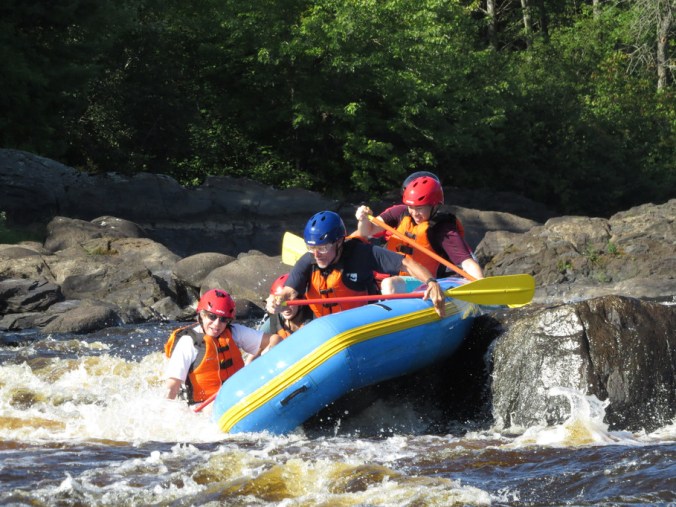
Me (on the left in the red helmet) leaning into my fear on the St. Louis River.

When I write a travel post, because my blog’s name has the word “meander” in it, I usually open by saying I “meandered” here and there.

Well, I can’t use that term this time. It’s more accurate to say that I reluctantly agreed to go on a whitewater rafting trip down the St. Louis River this past weekend, and promised to scream all the way!

It all started when my friend Russ, who is an experienced kayaker, won a silent auction item at a fundraiser for the St. Louis River Alliance a few months ago. He won two tickets for whitewater rafting through Minnesota Whitewater Rafting, a local company that operates out of Scanlon, Minnesota.

Upon my insistence, we agreed to wait for the trip until the water was warm, to make it a more comfortable experience. Now it was August, month of warm weather and water, and I was out of excuses not to go. We gathered everything the company’s information sheet instructed rafters to bring: a dry change of clothes, snug-fitting footwear, windbreaker, towel, etc. And off we went.

Once we arrived, I was surprised by the number of other people who wanted to fling themselves into an inflatable raft at the mercy of the river – twenty-eight of us, to be exact, of all ages and fitness levels.

We started our three-hour journey by choosing one of the seven blue-and-yellow rafts lined up on the shore. Russ and I ended up paired with a young couple from St. Paul. A guide was assigned to each raft. Ours was named Logan.

To us oldsters, all of the guides looked like they were about twelve, but we hoped they knew what they were doing or they wouldn’t have been hired. Thankfully, this proved true!

The ensuing safety talk by the operations guy, named Blu, included instruction to ignore your instincts and “lean into” whatever fearful obstacle the raft encounters. He explained that if you lean away from the rock or high wave, you are more likely to lose your seat and fall out of the raft. Not that falling out of the raft is the worst thing that can happen, but most people like to stay with their group.

The other useful instruction was to keep your feet up if you fall overboard. This is helpful in avoiding sharp rocks and logs, etc., that are on the bottom. Plus, most people aren’t strong enough to withstand the current standing up, so you might as well just go with the flow until one of the kayak patrollers (who go with every trip) retrieve you.

Blu said that in a group our size, it’s common for at least one person to fall overboard. I sure hoped it wouldn’t be me.

I thought the “lean into” rule was particularly deep. Psychologically speaking, sometimes facing your fears is the best way to overcome them. Also, it reminded me of the book “People of the Lie” by M. Scott Peck, who says that most people’s psychological problems arise from trying to avoid emotional pain instead of addressing (leaning into) it.

I decided then and there to change my attitude about the trip – to stop seeing it as something fearful, and instead see it as something to relish, and an opportunity to know the river better. I mean, I’ve lived by it most of my life. I’ve canoed on it, paddleboarded it, boated on it, but I’d never immersed myself in it.

As the company’s website and instruction sheet promised, you will “see the river, feel the river, ride the river,” and you will get wet! On this sunny warm day, I was up for that.

Blu explained we’d encounter six sets of rapids ranging from Class I to III, and two sets of riffles. Each set of rapids would get more challenging along the four-plus-mile stretch until we reached the quiet-water reservoir formed by the Thompson Dam.

Safety talk over, we set out upon the water. Our first task was to run through a “slalom” course between the pylons of the freeway bridge that goes across the river. This let us practice paddling different directions and experience what it feels like when the raft bumps into things.

Then we paddled through a set of riffles called “Warm-Up Rapids.” Everyone came through unscathed and, after stopping for an orientation, we continued to a set of surfing waves at “First Hole” rapids.

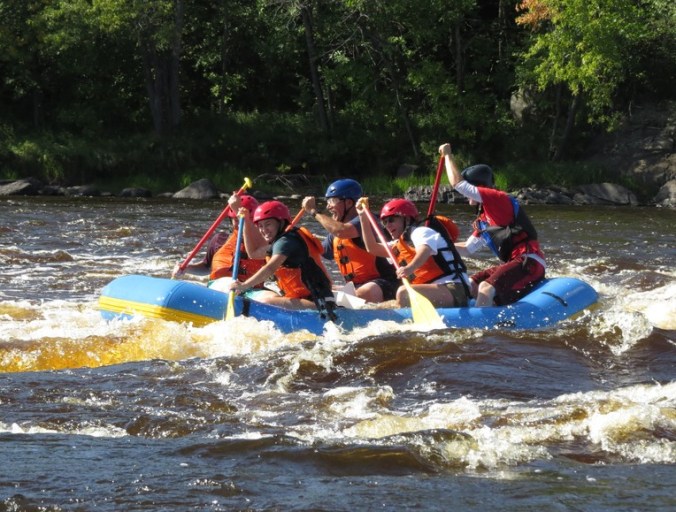
Have you ever seen standing waves that form behind an underwater rock in a river? That’s what we surfed on – if your idea of surfing involves your raft filling with water, which ours did. We surfed several times, bailing out between sessions with the handy bailers provided in each raft.

p9091eedc-1216-426c-9429-98f3600b2324_671929cc-bda5-4d31-b3db-2344e2e28a00_m

Surfing the hole and having fun!

After another group orientation session, we were onto “Two Hole” rapids. I think it was this one that had a big rock in the middle of it. Logan, our guide, thought it would be a good and fun idea to smash our raft into the rock.

On purpose.

Why he thought this was a good idea, I’ll never know! I always thought the whole idea of river rafting was to avoid the rocks. I guess I’ve been wrong all this time.

Granted, he did give us a choice, so we were complicit in the decision. I blame it on the adrenaline rush.

Paddling as hard as we could, our raft went up and over the rock, then started sliding sideways. I was on the outside side – the tippiest side – and remembered to lean into the rock to avoid falling out of the raft. I almost floated out, but managed to stay in by the skin of my teeth. Rather like dental surgery, it felt so good once it was over!

Our next stop was a canyon that featured a couple of small beaches in a slow section of the river. We grounded our rafts and had the chance to swim for a while, clothes, lifejackets and all.

Russ went all the way in. I was fine going waist deep, not because I was worried about polluted water or anything, but because the water was rather chilly to me even for a warm day.

At this point I realized I had never been this far into the river before; me—who had even worked for the St. Louis River Alliance whose sole purpose is to protect the river. I marveled at the brown water – tea stained from the many wetland plants steeping at its headwaters and along the way. The white pines and bare rock faces along the shore looked primeval, like we could have been miles into a wilderness. The beauty filled me  and gave me a new sense of appreciation for the river.

Our rest stop over, it was time for the big guns in terms of rapids. We made it through “Hidden Hole” just fine, then it was onto “Electric Ledge,” which is a Class III rapids that consists of a four-to-six-foot drop.

I had heard the name of this rapids whispered in awe among my kayaker friends for years. Now we were about to go over it! And we were about to go over it before any of the others. Logan explained that our raft had the first aid kit in it, and we needed to go first in case the other rafts needed assistance once they ran the ledge.

Not only were we in the first raft, but Russ and I were sitting in the FRONT of the first raft. Oh, lucky us.

We didn’t have much time to wonder at our luck as the ledge was approaching. I repeated all the rules: lean into your fear, keep your feet up. Then we slid over it, sideways and steep. Russ grabbed onto my arm for support.

Luckily, that steadied him and we both stayed in the boat. So did the rest of our crew, but I can’t say that for one of the other rafts, which did indeed lose one person over the ledge. The person remembered the rules, however, and they were uneventfully picked up not far downriver.

The final set of rapids, “Little Kahuna,” is more technical than terrifying. After some twists and turns, we made it through just fine. From there, a somewhat longish paddle across peaceful water (known as the Boundary Waters to the staff) took us to the end of our journey and a bus that was waiting to drive us back to our starting point.

So, in summary, I did scream as initially promised, but it was from fun, not out of fear. I think this was due to the great job the staff did at letting us know what to expect from each set of rapids. I hadn’t had that on other rafting trips.

I would totally do it again on some warm day (although they do provide wet suits if it’s cold and you want one). And I would totally bring family members on such an adventure. Don’t let a little fear stop you if you have a hankering for some whitewater!
pb4537e2e-9595-42bc-b3f2-dbdd9d761701_cddf1de5-0eef-4962-8d2c-b16f78487c4b_m

Yee haw!

Communing with Duckies

20180825_192404

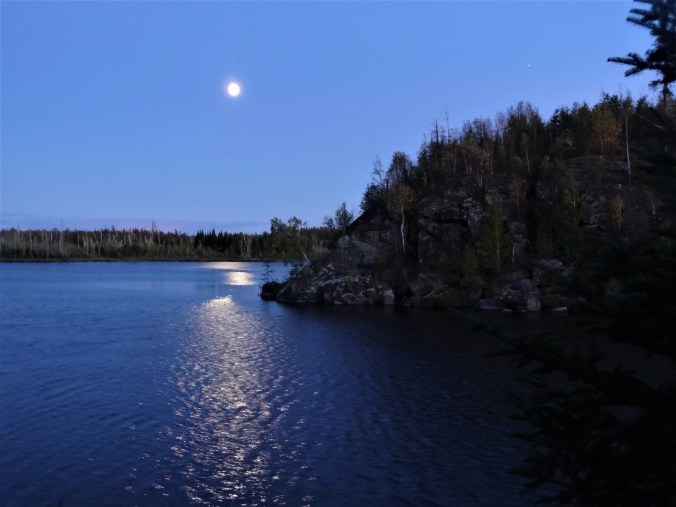
Last weekend I meandered up the Gunflint Trail in northeastern Minnesota near the Canadian border. I was able to spend time on Gunflint Lake with friends, old and new. I also made friends with this trio of ducks who were out for a peaceful evening swim.

Of Lighthouses and Books

20180801_161517

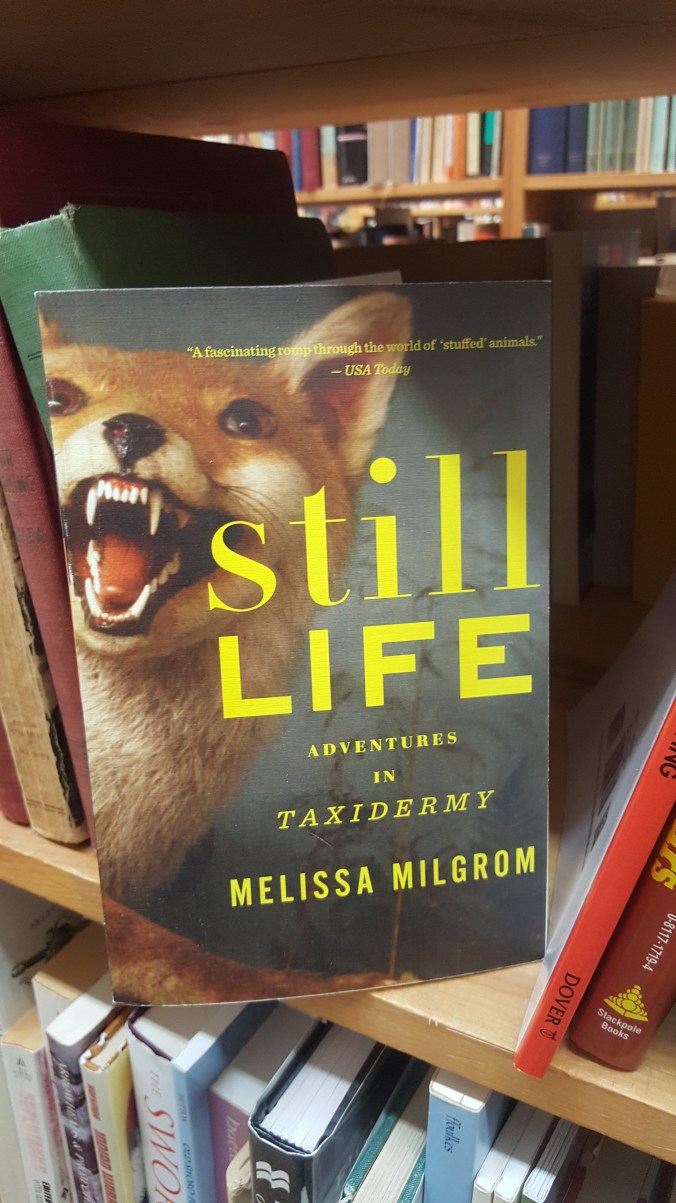
I found this gem of a book at Chequamegon Books in Washburn, Wisconsin. Would you read it? I especially like its promo blurb by USA Today: “A fascinating romp through the world of ‘stuffed’ animals.”

Somehow the phrase “fascinating romp” has never combined in my mind with the topic of taxidermy.

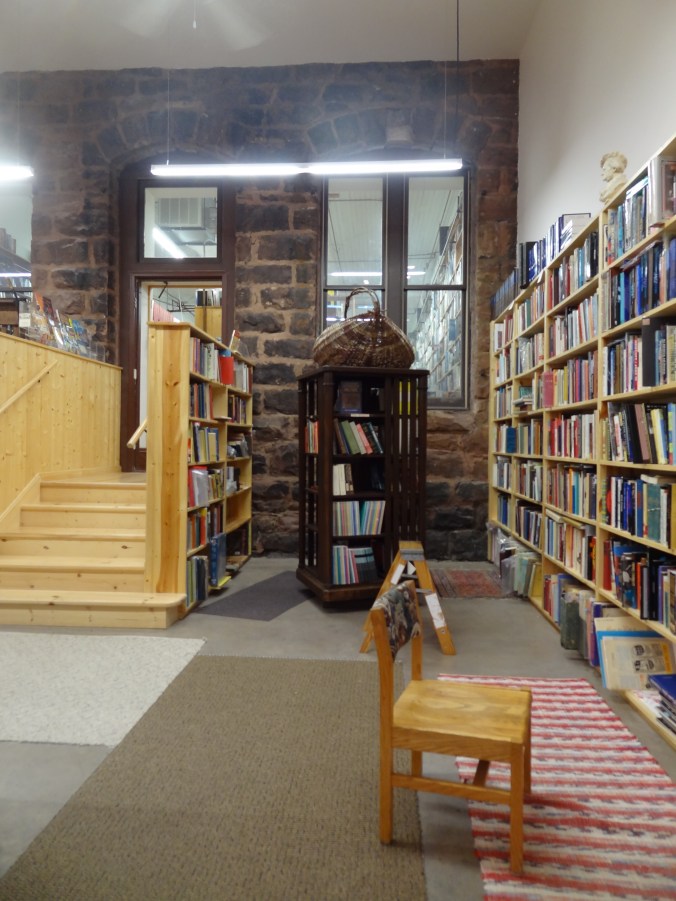
I did not buy the book. But I was impressed with the bookstore. The last time I visited years ago, the store looked like the kind of place where books go to die. It’s been spiffed up recently, with better lighting, ventilation, and a new back room that makes space for lots more books!

The topics are all well-organized and easy to find. It’s a book nerd’s dream. Stop in if you’re ever in Washburn.

DSC04840

The back room in Chequamegon Books in Ashland.

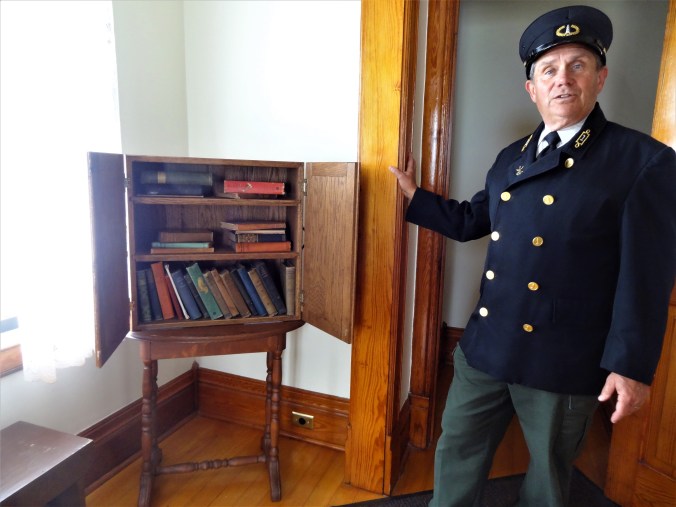
While I was in the area, I had the chance to visit Raspberry Island in the Apostle Islands National Lakeshore. My bookish theme continued when the lighthouse keeper on the island showed me the traveling bookcase that the lighthouse service used to provide to help entertain the keepers and their families.

And I really do mean that he only showed me the traveling bookcase. Of our group that visited the island, I was the only one who opted for the $5 lighthouse tour, so I got personal service!

DSC04862

DSC04870

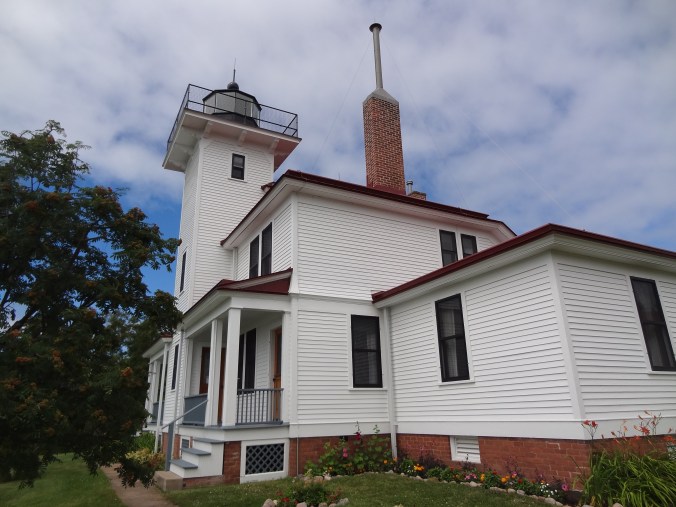
Raspberry Island Lighthouse in the Apostle Islands National Lakeshore.

DSC04866

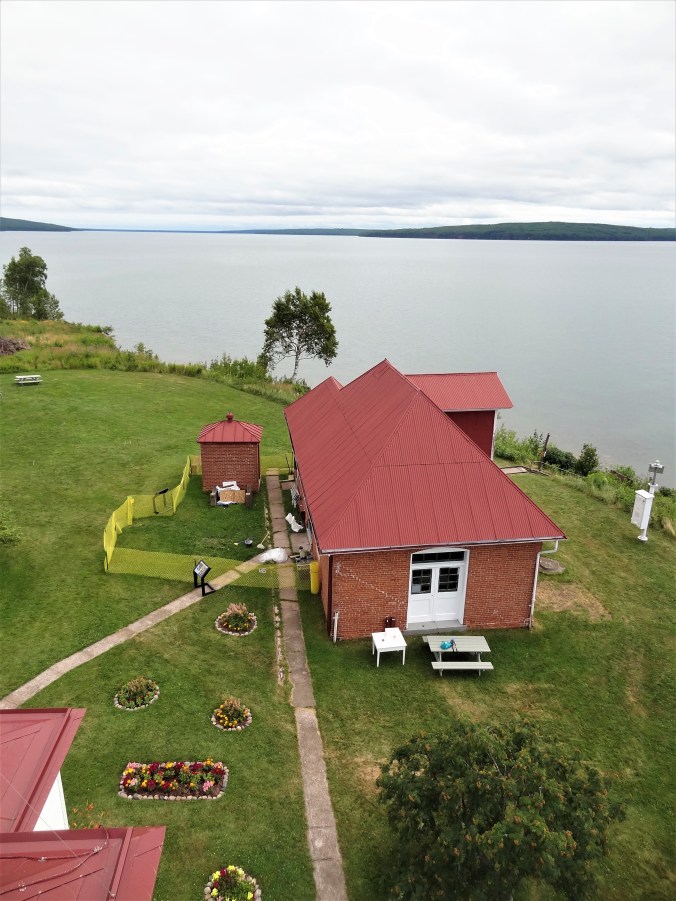
The view from the top of the Raspberry Island Lighthouse.

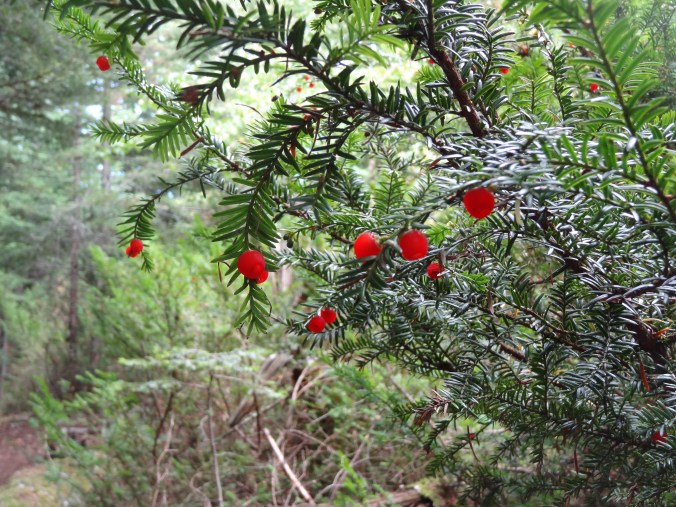
After the tour, I took a hike to an overlook along the coast of the island. On the way, I found this fine example of Canada yew.

DSC04872

Christmas colors in August! Canada Yew is an important shrub for wildlife. Not often found on the mainland because it gets eaten by deer, it sometimes thrives on islands like Raspberry Island, which have few, if any, deer.

Books and lighthouses: a good combination for an outing….

Beauteous Billings Park

20180729_211258

People who live in Duluth are sometimes snobbish about their city parks and trails. They think they’re the best in the Twin Ports. I know, I have been guilty of such civic offenses.

Well, I had my eyes opened when I attended a recent after-work picnic in Billings Park across the bridge and the state line from Duluth in Superior, Wisconsin. In all my years of living in the area, I had never been to this gem of a park. It’s gorgeous!

20180723_173953

The park features several picnic areas, a playground, grills, a volleyball pit, and trails along the bay. I’ve been back the the park twice more to walk Buddy and to paddleboard. With a public water access and calm bays to explore, the park is great for human-powered watersports.

20180723_191415I urge fellow Duluthians to put aside their prejudices and explore Superior. Get out there and get your Blue Mind on!

20180729_211208

Biking in the Rain on the Alex Leveau Trail

20180730_125149

A view from the Alex Leveau Trail in Carlton.

We heard through the bicycling grapevine that the Willard Munger Bike Trail was all repaired (from the storm damage a few years ago) and open now in its entirety. So my friend Russ and I headed to Carlton, Minnesota, to catch the trail there and bike to our hearts’ content.

The only problem was, the bicycling grapevine was WRONG. When we got to the Munger Trail parking lot in Carlton and started biking toward the trailhead, we found a large sign that said the trail was closed!

Another trail is accessible from the same area, named the Alex Leveau Memorial Trail if you head southeast across the railroad tracks. I had biked it a few years ago, and remembered it was there.

Somewhat disconsolate, we biked that instead. But our mood soon lifted because the trail is just so gosh darn nice. It features views of wetlands and farmlands, barns and raspberries. Without huge hills, it’s an easy ride, and would be a good trail for children to try. But it’s not too monotonous either.

20180730_125246The segment we travelled is 6.5 miles long. Most of it is a paved trail, but when you get near Wrenshall, you have to follow the highway for a while. At the 6.5-mile milepost, the trail seems to dead end at a highway. We weren’t sure where to go from there, so we just turned around and went back to Carlton, although I think there might be other parts of it farther on.
The trail was named in memory of a former county commissioner and dairy farmer who was an advocate for using abandoned railways as public trails.

As we biked back to the parking lot, a series of “pop-up” rainstorms popped up. We thought they would miss us until the wind changed and one caught us. The rain spatters were cold, but we kept warm by biking.

If this had been a romance novel, getting caught in the rain could have led to a passionate embrace in rain-slicked bike clothes. But it’s kind of hard to kiss when you’re both wearing bike helmets and you’re trying to go fast enough to ward off the chill.

So we opted for just being thankful to arrive back to our vehicle wet, but no worse for wear – no road rash from slippery pavement, no lightning strikes nearby. Sometimes, in your elder years, that’s as good as it gets.

A Lake Superior Sailing Experience, Part Two of Two: In Which I Become a Winch Wench

20180704_181011Vignette

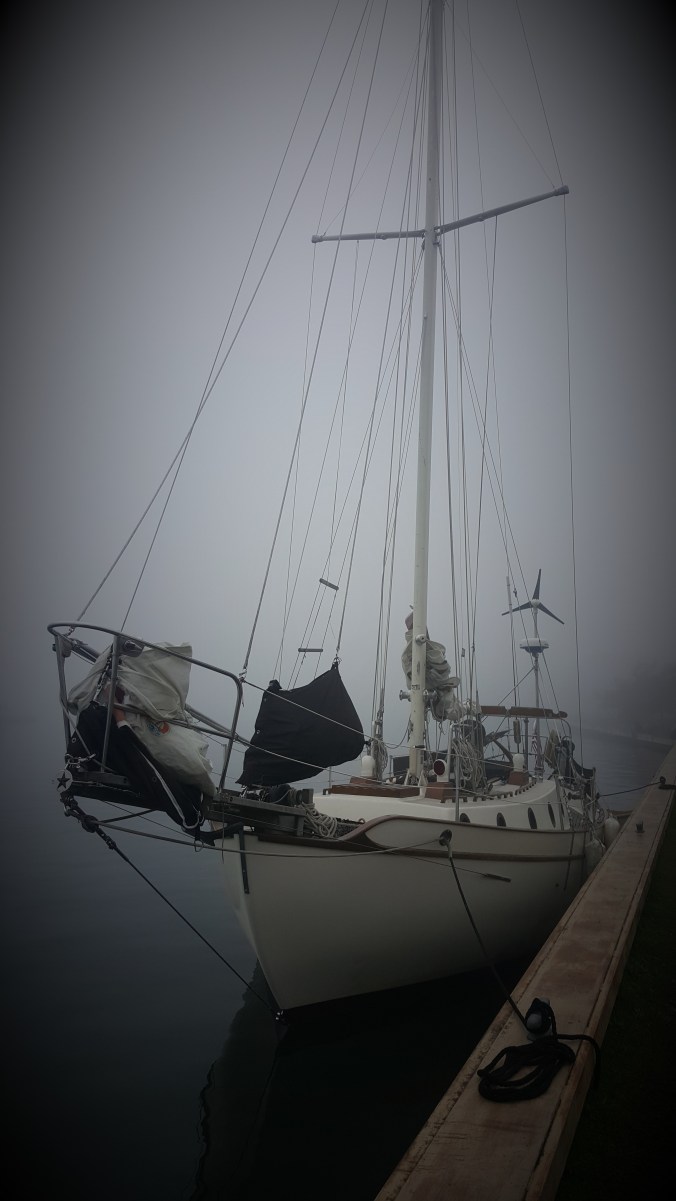
We sailed in a 32-foot Westsail.

When our sailing captain was hoisting the genoa sail during my recent trip (see Part One), the block for it broke off the top of the mast. A block is a pulley that the line (rope) for the sail goes through. Let’s just say it’s a rather necessary piece of equipment if one wants to use a sail.

We had other sails up, however, so we were able to voyage to our desired destination without the genoa. But the issue needed to be addressed. So after we anchored off Outer Island in the Apostle Islands (the most remote of all the islands), our captain decided on a daring and strenuous plan.

DSC04744.JPGMy friend Russ was to hoist him up to the top of the mast so he could replace the block with a spare he happened to have on board. This feat would involve several ropes and climbing gear, along with the help of a winch. Russ was supposed to pull the rope by hand, which was wrapped around the body of the winch spool several times for support.

My job was to take pictures of the event and pray that our captain did not fall and hurt himself in the process. If that happened, let’s just say we would have a questionable chance of making it back home. So I felt I had a rather important job.

The captain donned his harness and got all the ropes in place. Russ started pulling, I started taking photos, and the operation commenced.

Now, you should understand that masts are tall. I’m not sure exactly how tall, but they seem even taller when you’re on a boat that’s rocking in the water, even if the rocking is gentle.

DSC04773

Captain on his way up the mast…

Russ was able to get Captain about a quarter of the way up the mast when his progress slowed and it became obvious that more person-power was needed. So I pocketed my camera, put the handle in the winch, and hauled away. Between my winching and Russ’s pulling, we were able to get Captain half-way up the mast where he had a different job to do, fixing something else that had broken a while ago.

We rested while he worked, but soon he was ready to go to the top. Man, we winched and pulled as hard as we could, and slowly, steadily hoisted Captain all the way up. Thankfully, the waves and winds remained calm, and he was able to do his work.

Then his legs started going numb from the pressure of his harness. And clambering up a mast is hard work, even if you’re being hoisted. And I suspect it’s a bit scary up there.

DSC04780

All the way to the top!

Before he had the job completed, he wanted to come down. So we lowered him, with me standing behind Russ and holding the rope as a backup in case another set of hands was needed to steady his descent.

When Captain’s feet touched the deck, we all breathed secrets sighs of relief, even if the job was incomplete. We couldn’t sail as fast without the genoa, but suddenly, that seemed all right for now.

And I gained yet another new sailing skill on this trip, that of a Winch Wench.

DSC04796

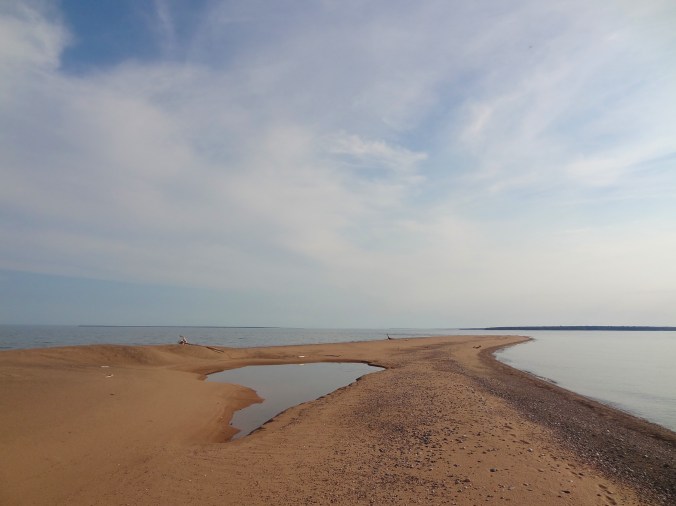
Outer Island sand spit, Apostle Islands National Lakeshore.

Other things I learned as a Lake Superior sailing newbie:

-You need to be willing to take orders.

-You have to be willing to be taught everything, even how to go to the head (the boat had a compostable toilet).

-Bring your winter clothes, even in the middle of summer.

-Pay attention all the time to everything.

-The captain is the boss of the ship, but the lake and the winds are the boss of the captain.

-Bring along good food, good music, and good scotch. They can go a long way to make up for any uncomfortableness.

Anyone else out there have more to add?

20180704_200455

Sunset in Grand Marais Harbor, Minn.

A Lake Superior Sailing Experience, Part One: Chocolate Milk and Biting Flies

DSC04737

I recently meandered out onto Lake Superior on my first extended sailboat trip across it with some friends. We left Duluth, Minnesota, and headed to Wisconsin’s Apostle Island National Lakeshore, and then traversed the western arm of the lake to Grand Marais Harbor in Minnesota.

Since I am writing this, you know I survived the three-day trip. If fact, I would like to think I thrived, despite turning green with seasickness once (I avoided hurling, though!) and having to wear all my winter gear, plus hand warmers, on the 4th of July.

I learned a lot about sailing, but still have more to know. And I got a firsthand look at conditions on the lake, which is useful for my job, since we fund research projects on Lake Superior.

Two things struck me and my sailing companions. The first was the color of the water. Almost all the way to the Apostles it was the hue of chocolate milk. The large extent and persistence of the coloring was unusual. There were also floating logs to watch out for.

According to a news story I read upon returning home, the condition is due to a series of recent heavy rains that have sent thousands of tons of silt into the lake. Chequamegon Bay, on the other side of the Apostles, is also experiencing heavy sedimentation.

Usually, the chocolate milk dissipates within a few days, but this round of it is lasting longer than usual because we kept having downpours every few days. Most of the sediment comes from the Nemadji River and its red clay banks, along with the St. Louis River.

We also had more than double the amount of usual rainfall for the month of June. Anglers and charter captains are having to travel farther than usual out into the lake to find clear water for fishing.

DSC04795

Stable flies covering jeans during a beach walk. Good thing they can’t bite through denim!

The second notable thing were the flies. Known locally by the name of “ankle-biters” or sand flies, stable flies look like a common housefly but they are meaner because they bite – usually a person’s ankles. I can attest that there are roughly a gazillion of them out on the lake and its shores this summer.

The only thing that saved us from certain insanity on a shore trip to Outer Island was the fact that we were wearing jeans, which they couldn’t bite through.

The flies congregated in seething clusters from our knees down, rarely venturing farther up our legs. Thank goodness they had no interest in our bare arms or we would have had to run screaming back to our dinghy!

According to a story on National Public Radio, researchers have figured out how and why the flies and other biting insects like mosquitos do this. They think these biting bugs target feet and ankles because we are less likely to notice (and therefore kill) them. They hone in on their target by smell, and apparently, the sweat and skin on our ankles smells different from that of the rest of our body.

Besides wearing jeans, we found it helpful to elevate our feet off the ground while we were on the boat. They didn’t seem to be able to find our ankles if they were level with the rest of our legs. Conditions on the boat never got bad enough that we needed to apply repellant, but we were glad we had some along, just in case.

Although the water wasn’t its typical crystal-clear blue, and we had many insect stowaways aboard our sailboat, Lake Superior was still magical. I greatly enjoyed spending time on it, and hope to do so again someday.

DSC04785

DSC04790

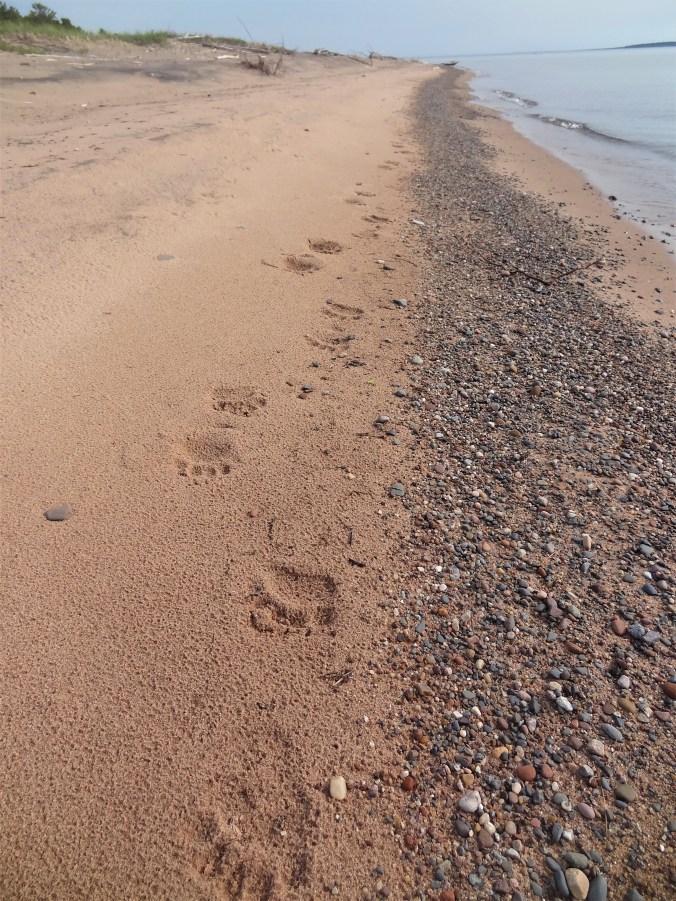
A bear got to this beach before we did.

A Visit to the Birthplace of the Ice Cream Sundae

DSC04716Last week, I meandered over to Two Rivers, Wisconsin, birthplace to the ice cream sundae. We arrived at the Historic Washington House Museum and Ice Cream Parlor at noon, just in time to have ice cream for lunch!
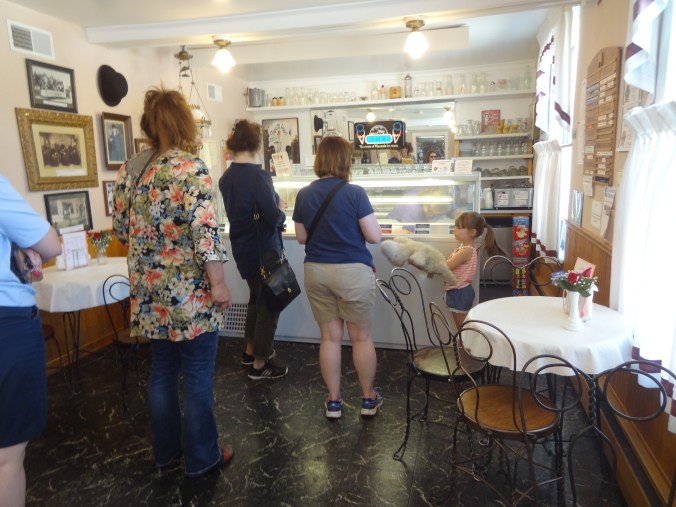
The Washington House is not the original place where the first sundae was served in 1881, but the original bar is in the building, which also features artifacts from that time, up to more modern times. A more modern parlor in a separate room offers the creamy confection to hungry travelers today.

DSC04718We were met by a little girl who seemed to be related to the parlor manager. As she stood next to the counter, hugging her fluffy teddy bear, she gave us recommendations for the best flavors, extolling the virtues of each.

DSC04720She tried to talk me into strawberry ice cream, but once I saw they had coconut, I begged her permission to have that instead. She graciously granted my request, so my lunch consisted of Coconut Joy ice cream (with coconut flakes, chocolate chunks and almonds), topped with hot fudge sauce.
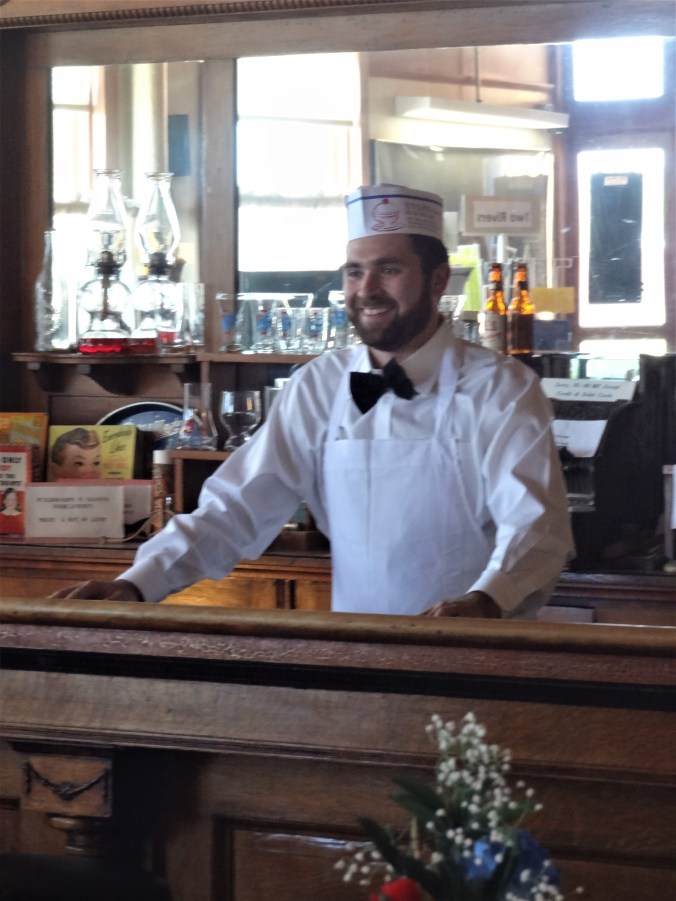
OMG, so good! Sated, we then toured the rest of the building, which houses different historic collections of clothing, clowns, typewriters, etc. A film crew from Chicago was interviewing a man who was dressed in a soda jerk uniform behind the original bar as we left. I took his photo between takes, and he gave me a wave and a big smile. One of the historical volunteer ladies told me that several television stations had been to the parlor recently to do stories. I guess it’s that time of year.

DSC04724Although some other towns make rival claims for the origin of the sundae, the place in Two Rivers is the only one recognized by the National Register of Historic Places. Read here  and here for more info.

20180628_183943

Romancing Las Vegas

20180529_204220

I just returned from four action-packed days in Las Vegas. I travelled with my new manfriend, Russ, so it was a chance for us to get to know each other better. We chose activities with an eye toward the romantic. Here’s a quick rundown.

The Nature

20180530_092342

Red Rock Canyon

What could be more romantic than the color red? Lucky for us, the Red Rock Canyon was just a short drive outside of Vegas. It offers plenty of trails for hiking, but if you don’t have time for that, you can drive on the one-way, thirteen-mile road through the reserve to see the spectacular scenery.

20180530_121932

Pictographs at Red Rock Canyon

We hiked two trails and saw lizards, cacti, colorful rocks, kangaroo rat dens, soaring vultures, and even some ancient Native American pictographs.

Tip: Hike in the morning, before it gets hot! During our stay, it was in the upper 90s every day with sun. Bring plenty of water.

Sharks may not be romantic, but they could make your loved one hold onto you for dear life. We visited the Shark Reef Aquarium in the Mandalay Bay Casino. Plenty of rays, sharks, and jellies.

Entertainment

Get up close and personal with your fantasy partners at Madame Toussand’s Wax Museum in the Venetian Casino. Russ and I temporarily ditched one another in favor of Brittany Spears, Celine Dione, Bradley Cooper, and George Clooney. Sigh.

20180531_115559The High Roller Observation Wheel will take you and your date to new heights on a slow spin five-hundred feet above the city. The wheel is so huge, it takes a half-hour for one rotation. Day or night, it’s a great way to get your bearings in a city with so many landmarks. Likewise is the Eiffel Tower Replica at the Paris Casino. Take an elevator ride to the top for a spectacular view.

Any of the Cirque du Soliel performances are romantic since they are French, after all. I would recommend the watery one called “O.”20180530_212209


Celine Dione has recovered from her ear surgery and is back giving concerts at the Colosseum. Somehow, we scored big on our seats. We were supposed to be in the second balcony, but got upgraded to seats on the main floor, only twenty-five rows away from her! How romantic to listen to “My Heart Will Go On” from that vantage point.

Tip: If all our nights hadn’t already been booked with shows, we would have tried a gondola ride outside the Venetian Casino. Don’t make our mistake!

Best Romantic Food

Vegas offers every type of food imaginable. But the most romantic we found was at the Eiffel Tower Restaurant. It is French, no?

If you reserve your table for two at 4:30 p.m., they will automatically seat you at the front window where you can watch the fountain show across the street at the Bellagio Casino. As with the Celine Dione concert, somehow, we mysteriously scored big on our seating. We were shown to the corner table at the front of the restaurant with a 180-degree view.

20180601_162112The food and wine is pricey, but oh so worth it! I had the lemon sorrel soup appetizer and veal medallions with morel mushrooms and fiddlehead ferns. So good! Russ had the roasted beet salad and bison with an asparagus add-on. For dessert, we romantically shared a Grand Marnier soufflé. Words fail me.

20180601_175946

Grand Marnier souffle

Communing with Vultures on Ely’s Peak

20180428_180725

One of the views from Ely’s Peak.

Last weekend, a friend and I meandered up 200-300 feet in elevation to the top of Ely’s Peak near Gary-New Duluth. I don’t have a more specific elevation to give you because the different trail guides that I consulted are inconsistent on that point. But I can say that for my 50-something-year-old legs, it felt more like 300 feet. Also, some of the guides say it’s a 1.5-mile round-trip hike. Others that it’s 1.8 miles. I vote for the latter.

20180428_181031We chose the trail to see a new place and because the crisp and sunny spring air seemed to demand it. We didn’t go seeking a vision quest like Native Americans are said to have done on the peak, nor to seek our spirit animals, but we just might have had a dose of both of those things along the way, too.

The trailhead is off of Becks Road. On this particular day, the trailhead parking area was easy to find from the many other cars gathered there.

I followed the directions given on this website, although I would argue that the “beginner” level trail classification is not accurate. I would rate it as “moderately hard” because near the peak, I found myself thinking it would have been helpful to be part mountain goat. And a young mountain goat at that.

(I would say that this trail is not for 80-year-old mountain goats, but for all others it should work as long as you are reasonably fit and coordinated.)

At the start, a boardwalk invites you into a spindly birch forest. The boardwalk gives way to a muddy climb up an incline to an old railroad bed for the Duluth, Winnipeg and Pacific Railway.

20180428_155924

Inside the railroad tunnel.

Follow the railroad bed to the right until you come to a rocky tunnel. The tunnel was built for the railway in 1911. There are trails on the other side of it, but we did not attempt to go through the tunnel because of the sheet of ice layering the way. You may run into some rock climbers, who practice on the craggy basalt in the tunnel.

Although it may seem counter-intuitive, from the tunnel, you should follow the main trail, which goes down the hill to the right. Don’t take the spur that goes up along the side of the tunnel, unless you really are a mountain goat and want to test your mettle.

Don’t be impatient, you will come to an incline soon enough. You are now on the Superior Hiking Trail, which is marked by blue blazes on the trees and rocks. Keep to the left and follow the blazes up the blazing &!*()%$ hill.

Soon enough, wide vistas will offer views of the St. Louis River and the Gary-New Duluth neighborhood.

20180428_162157(0)

Dogs like the Ely’s Peak Trail, too.

No leaves were out on the trees yet – everything looked stark and clean.

The peak offers breath-taking 360-degree views. It was named after Edmund Ely, a Presbyterian missionary from Massachusetts who began teaching the Fond Du Lac Native American community in 1834. Local lore says that this was one of his favorite spots.

As we sat, resting, we noticed several turkey vultures lazily circling the thermals below us. The more we watched, the more vultures seemed to appear from nowhere. Eerily quiet and patient, they circled and circled. We joked that they were probably looking for hapless hikers who fell down the trail.

There’s a school of thought that says if you sit out in nature long enough, an animal will appear that has a lesson to impart. Were the vultures trying to tell us something?

Once back home (and safely out of a vulture’s gullet), I looked up what vultures symbolize. Here’s what I found: the vulture is considered a symbol of cleansing, renewal, and transformation. Vultures are viewed as fearless of death – they stare it in the face and eat death for breakfast (literally)!

I did feel cleansed after that hike. It was like the sunshine and clear air burned off all the old gunk. Perhaps it’s only to make way for more new gunk (ha ha), but I’d like to think I’ll have some time before I get clogged up again.