Grand Cayman Day 4: Blue Iguanas, Blowholes, a Mansion, and Frigate Birds

A blue iguana at the Botanic Park. Image by Russ.

Our fourth day on Grand Cayman Island dawned hot and beautiful, just like all the previous days. Our first adventure was a visit to Queen Elizabeth II Botanic Park on the island’s North Side. Besides lush and gorgeous foliage, what drew us to the park was its unique mix of culture, natural history, and endangered blue iguanas.

You heard me: blue iguanas. This special species is only found on Grand Cayman Island. The park has a conservation facility where they breed iguanas – some for release in other parts of the island. If I would have been quicker writing this post, I could have had it done on May 8, which is National Blue Iguana Day on the island. As it was, we were still traveling around the island with no time to write!

Pretty border foliage on the Woodland Trail.

We bought our tickets and then meandered toward the Orchid Boardwalk. Not far down the path, I spied a small humpbacked brown animal that looked somewhat like a prehistoric horse. As it ran into the undergrowth, I realized that I had the good luck to see an elusive agouti. These rodents were introduced to the island years ago and eat fruit, leaves, and roots. That was worth the admission, right there.

An orchid on the Orchid Boardwalk.

When we arrived and walked toward the park visitor center, a wild blue iguana greeted us on the lawn. We joked that it had been placed there just for us, or that maybe it was a statue. But no, it had moved by the time we finished our visit, so I guess it wasn’t fake.

The park’s Orchid Boardwalk takes you through a jungle of epiphytes (air plants) and orchids, some of which are only found on the island. Our next stop was the Heritage Garden, which sports a traditional homestead and garden. By this time, we were pretty hot, so we hung out in the shade of the home for a while. Across from that was a Xerophytic Garden, which features plants that require little water. We also toured a Lily Pond and a Palm Walk. My favorite was the Color Garden, which offers flowering plants arranged by color.

A flower in the Color Garden.

Our final stop after a long (and hot) walk on a woodland trail was the iguana conservation area. Here the blue iguanas are housed in outdoor natural habitats and cages. Most of the captive iguanas were hiding but a large wild iguana wandered the pathways, and Russ was able to get a good picture of it without fencing in the way. From the interpretive signs, we learned that blue iguanas can live for 50 years, that 1,000 have been released into protected areas on the island, and that they only turn blue during mating season. Apparently, it was mating season because many of them were blue.

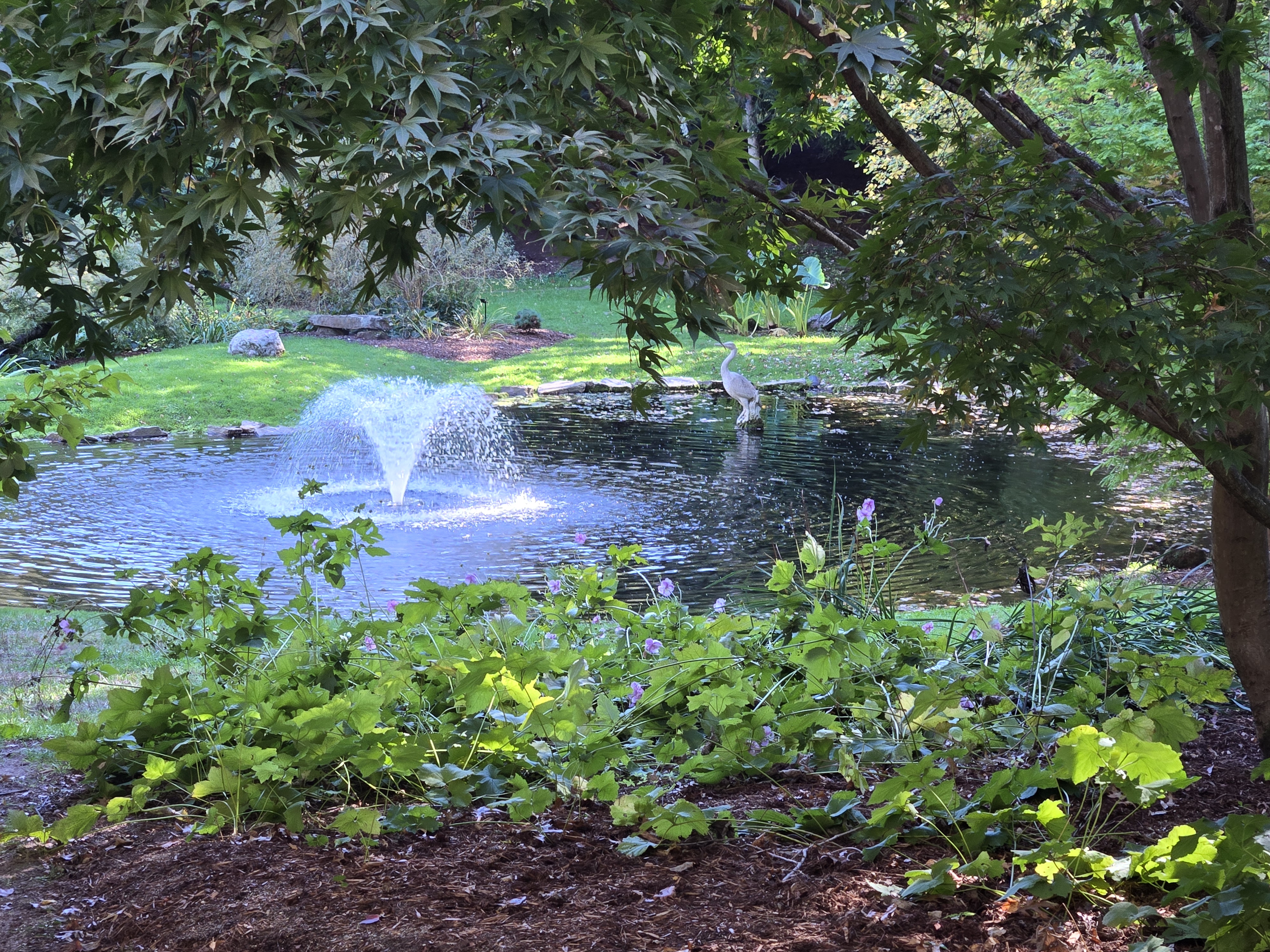
The Lily Pond in the Botanic Park.

Pedro St. James Mansion was our next destination but before we toured it, we enjoyed lunch and a view of the sea at its Thatch and Barrel Restaurant. Russ had bruschetta burrata flatbread, with tomato, burrata cheese, garlic, and a scotch bonnet pepper-infused balsamic reduction that looked outstanding! The restaurant is known for its locally sourced ingredients and cocktails that use 1780 rum, which is blended onsite. I had a refreshing 1780 colada and a luscious castle burger, which featured onion jam, brie, local red pepper jelly and greens, garlic jalapeno aioli, and truffle fries.

Russ’s flatbread dish from the Thatch and Barrel Restaurant.

Thus fortified, we bought our tickets to the mansion. The docent led us into a multimedia theater for an orientation. We were the only ones enjoying the show! The theater uses creative lighting, wind, water, and vapors to transport viewers into the early lives of Caymanian settlers. After that, we were free to wander the grounds and tour the three-story mansion. You can opt for a guided tour, but we chose self-guided.

Pedro St. James

Pedro St. James is the oldest surviving stone structure in the islands. Its verandas and shuttered windows reminded me of Earnest Hemingway’s house in Key West. The elaborate construction made it the Caymanian equivalent of a European castle, so locals often refer to it as Pedro Castle. The mansion has had its ups and downs and has seen its share of historic events. The first island parliament was held inside, and a proclamation ending slavery was read from its front stairs (somewhat ironic, since the mansion was built with slave labor). Once again, we were the only people touring the mansion.

There’s also an interesting International Scuba Diving Hall of Fame at Pedro St. James. It’s worth a look.

On the way out, I bought a small bottle of the 1780 rum to bring home. I’m here to tell you, it’s gone all ready! I’ve never tasted a rum so smooth – dark and rich, almost root beer-y. If you get the chance, buy this rum.

On our way back to our resort, we stopped at the Blowholes. These are holes in the rock along the ocean shore where the water sprays high into the air. There are only a few blowholes, but they were fun to see; kind of like the Grand Cayman version of Old Faithful.

A blowhole blowing.

We happened to be passing Tukka Restaurant (where we ate the previous day) at 5 p.m., when they feed the frigatebirds. We hung out in hammocks on the shore and watched the large and acrobatic black birds swoop down for restaurant scraps. Recycling at its finest!

Frigatebirds hover, awaiting handouts.

We cooked our own dinner that night in our resort room kitchen. We purchased king mackerel steaks, which I had never cooked before. But I found a simple recipe online and they came out pretty good – reminded me of a cross between tuna and shark – a firm, oily meat.
Next up: Art, Turtles, Hell, and Leaving our Mark

Grand Cayman Island Day 3: GoPro, Snorkeling, and Stingrays

Marie tests her new GoPro camera. Image by Russ.

At dawn on our next day in paradise, I jumped into the water off the resort dock and cavorted with three-foot-long tarpons and other smaller tropical fish during the resort’s daily fish feeding time.

Why would I put myself in the middle of a feeding frenzy with tarpons, a prehistoric fish with sharp teeth? I’ve always wanted to try underwater photography. In preparation for this trip and as a retirement present, I bought a GoPro Hero camera. It’s on the lower end in terms of price and bells and whistles, but it looked easy to use for a beginner like me. Plus, it’s small and perfect for traveling. Fish feeding time seemed like a good test run for the camera before more serious underwater adventures.

Sergeant major fish

One of my kickboxing trainers back home had experience with a GoPro and suggested I attach the camera to something that floats because, “Once you drop it, it sinks.” I immediately had visions of my camera, thirty feet below me on the bottom of the ocean – close enough to see but too far to reach with snorkel gear and ears that don’t equalize water pressure well. So, along with the camera, I purchased the Swim+Snorkel kit, which features a floating tube mount with a wrist strap and a small carrying case. On my morning outing, I was glad to discover that the camera did indeed float when attached to the tube mount.
The fish did not disappoint and neither did the camera. It was also helpful that on the dock, Russ was throwing fish food my way. Black and yellow sergeant major fish swarmed around me. Blue sea chubs darted past. Thankfully, the tarpons were shyer, keeping to the outskirts.

A tarpon lurks in the background.

The GoPro has video and photo settings. Switching between them requires a swipe of the screen. I wanted to stay in photo mode but noticed that every time a wave washed over the screen, it would switch to video mode. After my outing, I discovered it’s possible to lock the screen so that this doesn’t happen.

This discovery made our next outing that day, a trip to Stingray City, much less frustrating! For decades (between four and eight depending on who you ask) southern stingrays have gathered at a sandbar off the island to eat leftover fish parts discarded by fisherman. Our guide, Jefferson, told us mosquitoes used to be so bad on the island that fisherman came out to the sandbar to clean their fish in peace.

Here come the stingrays!

Now that mosquito populations are more under control, the rays gather to eat squid offered by tour operators instead. The attraction is tightly controlled so that the rays and the sandbar don’t get overrun, and the rays have been microchipped by scientists so that they can monitor them and ensure they aren’t getting too stressed by the human interaction.

Yes, all these wild stingrays still have their stingers! I had to prod Russ a bit to go on this adventure. He was finally persuaded by reports of the safety of the outing and the friendliness of the rays. One description likened them to giant puppies of the sea! Most of the rays are female – they’re larger than the males and friendlier, apparently.

A ray at Stingray City.

Entering the water with these soft, gentle giants was a bit freaky, but it was so cool! Russ impressed me. He was the first one off the boat and into the water with the rays. (I was second.) My GoPro worked great and I’m happy with the images I was able to capture. Russ even let a ray suck some squid off his hand and, with Jefferson’s help, he kissed a ray (and liked it)! I was too busy taking photos to partake in those activities, but I did pet a ray. The bottoms of the rays were smooth and soft, but the tops felt like sandpaper if you went against the grain. This experience was a highlight of our trip for both of us.

Brave Russ pets a stingray.

As part of our tour, Jefferson took us to a nearby coral reef, where we snorkeled for quite a while. Watching the fish was fun, but the poor condition of the reef was distressing. The coral was bleached and there were far fewer fish than there would be on a healthy reef.

We both had healthy appetites after these adventures. We satisfied them at Tukka Restaurant (East End), one of the other places on the island that serves lionfish (besides Eagle Ray’s Bar and Grill). We hadn’t made reservations, so the hostess walked us through the noisy, crowded main dining room to a lower room that sported plastic tables and chairs. However, the ocean view was just as stunning and, after the couple who were there when we arrived left, we ended up with the huge room all to ourselves! Tukka’s specializes in Australian/Caribbean fusion cuisine. I don’t recall what we ate, but it was very good. Every meal we had on the island couldn’t be beat.

Every evening at 5 p.m. restaurant staff and guests feed frigate birds off the dock. We arrived too late for that spectacle but were able to catch it by chance the next evening.

Next up: Blue iguanas, blowholes, a mansion, and frigate birds.

Grand Cayman Island Day 2: Crystal Caves and Lionfish

A soft focus image of Lake Cave at Crystal Caves.

After foraging for food at the grocery store, we spent the afternoon of our second day at one of the main attractions on the East End/North Side of Grand Cayman Island: Crystal Caves. Most of the island is limestone and the caves were formed over millions of years from water dripping through the rocks, creating stalactites and stalagmites. In the past, people used the caves for water and for shelter during hurricanes. They were also rumored pirate hangouts.

The guided tours last 1-1/2 hours and need to be prebooked. Ours began with the manager providing an orientation. Then we loaded into two vans for a short bumpy ride to the caves. Three caves are open for tours. Our first stop was Roots Cave, which features long tree roots draping from the ceiling. The roots have grown over the years as the trees above search for water in the cave.

Open Ceiling Cave. Note the ropes on the right that people used to use to enter the cave.

Our second cave was Open Ceiling Cave, which, as you’ve no doubt deduced, has a big hole in the ceiling. The third was my favorite from a photography standpoint. Lake Cave features a small, crystal-clear body of water (more like a pond) that has filtered through the rock.

One of the caves (I can’t recall which) had some fruit bats hanging from the ceiling. I felt bad that we disturbed their daily slumber, but it was cool to see them. During all the other cave tours I’ve been on in different locales the cave temperatures have been cool. These were hot, so be prepared. If you work up a thirst, there’s a small restaurant and gift shop at the cave site.

Russ and I were so hot and sweaty afterward that once we returned to the resort, we jumped into the pool. There’s nothing that a banana daquiri from a swim up bar can’t cure!

Lake Cave

For supper, we dined at a dive bar. An honest-to-goodness dive bar run by scuba divers. We chose Eagle Rays Dive Bar and Grill because they are known for featuring lionfish on their menu. We were also drawn by its casual atmosphere and relaxing ocean views.

Lionfish (and other invasive species) have popped up in my blog before. (See this guest post from 2020 by my friend Sharon.) These are a beautiful but venomous fish native to the Indian Ocean and west Pacific. It’s thought that people who no longer wanted lionfish in their aquariums, released them into the Caribbean Sea and the Atlantic, and now they have become invasive.

The good news is that, when prepared properly, lionfish are safe and good to eat! Island divers spear the fish, which are purchased by another restaurant and Eagle Rays. Rays claims to be the only place on Grand Cayman “that regularly serves everyone’s favorite marine pest.” Russ and I usually eat supper early, so we were able to get a table without a reservation. In fact, we were among the only people there, which ended up being a common and mysterious occurrence during this trip.

Lionfish tacos from Eagle Ray’s Dive Bar

Ray’s specializes in lionfish tacos, which Russ ordered. I can’t eat taco shells (wheat and corn), so they made me a special order of grilled lionfish and chips (which isn’t on the menu). Russ was very happy with his tacos and my dish was also delicious. Lionfish is a white meat, which to this Minnesotan, tastes a lot like our state delicacy of walleye.

Lionfish and chips (plus a margarita!)

As we enjoyed our meal in the sea breeze, I uttered our trip slogan once again: “Can’t do this in Duluth!”

Next up: GoPro, Snorkeling, and Stingrays

Grand Cayman Island: The Third Time’s the Charm

Mimi’s Bar and Grill at Morritt’s Resort

I’ve been quiet for a while. Why? I’ve been meandering!

With its turquoise waters and abundant sea life, Grand Cayman Island had beckoned me for years. Russ and I have tried three times to travel to this isle in the Caribbean Sea south of Cuba. The first time, the British government closed the island due to COVID, so we had to cancel. The second time, we were able to make a lodging reservation, but we couldn’t get a flight there (probably due to COVID).

We decided to try one more time and keep our fingers crossed. It did indeed come to pass, but not without challenges. Despite my best efforts to book us flights that departed/arrived at civilized hours, after I made our reservations, the airline changed its schedules and foiled my plans. We ended up needing to awaken at 3 a.m. to leave and then return around midnight. Because of this, we booked a hotel room at the Holiday Inn Express and Suites in Minneapolis (near the Mall of America) through Expedia for before and after our trip, and left our car at the hotel, which had cheaper parking than the airport. The place had great reviews and ratings, so I thought we were safe. I received confirmations for all our reservations, and we were set!

A few days before our departure, I had a question about the parking arrangements and called the hotel for information. My Cayman-dreaming heart filled with dread when the reservation person said they couldn’t find our outbound reservation. They only had our return one. They suggested I contact Expedia to sort out the mess.

I contacted Expedia and they were great. They called the Holiday Inn but were unable to work things out with the reservation person. They asked to speak with a manager but were told no manager was available for three days. We were leaving in two days, so that was no good. Expedia said they’d refund our money for the outbound reservation and that we’d have to contact the hotel directly to redo that reservation. So, I did. Luckily, they still had room, but now it was going to cost us $50 more. However, they’d upgrade us to a room with more floor space to make up for it.

This seemed like extortion to me, but I wasn’t going to argue. The success of our trip meant too much for that. But, as you can see, I’m not above calling out the hotel’s name in the blog post to warn others. I was glad we found out about the issue with enough time to rectify it so that we didn’t arrive in Minneapolis and find we had no place to stay! (We could have stayed with some friends or relatives, but I didn’t want to subject them to our early departure and late arrival.)

A ruddy turnstone eyes our food.

This snafu left me wondering what else would go wrong, but thankfully, nothing did. Everything else went smoothly and we arrived in Grand Cayman to 90-degree temps and 70% humidity. That was quite a shock to our Minnesota systems!

We stayed at Morritt’s Resort on the East End of the island. Despite being away from the thick of the action, we found plenty to do nearby as we gained confidence driving on the “wrong” side of the road in our rental car.

We enjoyed supper at the dock bar, watching tropical fish in the sea and shorebirds flit around the dock as the sun set. It was then I uttered, “Can’t do this in Duluth,” which was to become the slogan for the rest of our trip.

A school of tarpons gather off the dock at sunset.

Next up: Crystal Caves and Lionfish.

The resort cats enjoy their supper.

The Red-Haired Mummy

I received notification about new results recently from one of the DNA-testing services that I use. (Note: it is not the beleaguered 23&Me.) Through this service, I had my maternal (mitochondrial) DNA tested. One report offered is called “Notable Connections.” These are “connections based on direct DNA testing or deduced from testing of relatives and should be considered as fun facts.”

Included in my results were some Swedish and Danish royalty and some poor bronze-age blokes who were dug up in England when modern roads were built. One connection sent shivers through me, however. It was for an Egyptian mummy named Takabuti. Her remains are currently on display at the Ulster Museum in Belfast. We visited that museum this summer! We went there on our first day in Ireland.

I racked my brains trying to remember if we’d seen the mummy. We must have because it’s a major display. But I don’t think we paid her a lot of attention. I mean, I’ve seen King Tut’s mummy, and after that, everything else is small potatoes. I also recall a vague distaste at seeing a dead body on display. However, if I had known I was related to this mummy, you can bet I would’ve taken more notice!

Takabuti. Image courtesy of the Egypt Museum.

According to the DNA site, Takabuti and I shared a common ancestor 6,300 years ago. She died and was mummified about 2,600 years ago in Thebes, which is now known as Luxor. The striking thing about her is that she has red hair. It has lightened to a golden color now, due to light exposure since she’s been on display. DNA testing on the mummy showed that her mother was European – probably from the Canary Islands or Southern Iberia (Spain and Portugal). Red hair is not uncommon in that part of the world. It’s thought to come from the area’s indigenous peoples who were known as the Guanches. They were believed to have originated in North Africa, specifically the Berber people of the mainland African deserts.

Takabuti was the daughter of a priest of Ammon-Ra, the sun good and the major deity in Egypt (like Zeus was to the Greeks). As such, her family would have lived comfortably and enjoyed the benefits of high status. Later, Takabuti was the mistress of a great house, and held high social standing. Although she wasn’t royalty, she was mummified to expensive royal standards.

Tragically, Takabuti’s life was cut short between the ages of twenty and thirty. Recent scientific analysis revealed she met a violent end while running, killed by an axe blow to her upper left shoulder that was likely instantly fatal. She may have been trying to escape an assailant, possibly during a period of conflict – perhaps at the hands of an Assyrian soldier or someone from her own community. A magic poultice was packed into her wound to help it heal in the afterlife.

How did an Egyptian mummy get to Ireland? The DNA site says that following the Napoleonic Wars, during a period of active trade in Egyptian antiquities (known as Egyptomania), Takabuti was purchased in 1834 by Thomas Greg of Ballymenoch House, Holywood, County Down. (Perhaps, because of her red hair, he thought he was bringing her back to her homeland?) She made history as the first mummy to be unwrapped in Ireland, with this significant event taking place on January 27, 1835, at the Belfast Natural History Society’s museum. The unwrapping generated considerable scientific interest, particularly in Belfast, then the commercial center of the Irish linen industry, which took special note of her fine linen wrappings.

The cover of a book about Takabuti shows a reconstruction of her face and the face on her coffin.

We know so much about Takabuti because she was the subject of intense academic study. Her face has been reconstructed. A book has been written about her, and she’s also been the subject of a short story. I haven’t read that story yet, but plan to soon. (It’s in Matters of Life and Death by Irish/Scottish author Bernard MacLaverty. Yet another retirement project!)

I wonder if her unusual red hair contributed to her high status is Egypt. Although I don’t have red hair, my mother had it. But hers came from her Scottish/Irish ancestry. My relationship to the mummy is a fun link to history. You can bet if I ever visit Belfast again, I’ll stop into the Ulster Museum and pay distant, distant cousin Takabuti proper respects.

The World According to Accordions

The World of Accordions Museum. Image courtesy of the museum.

I’m aware that I’m jumping the gun. World Accordion Day is May 6, and National Accordion Awareness Month isn’t until June. But I just couldn’t wait to write about our visit to the World of Accordions Museum in Superior, Wisconsin.

I’ve driven past the unassuming building on a busy street corner hundreds of times on my way to work and finally had time to take a peek last weekend. Inside are over 3,000 accordions and probably every ceramic figurine ever made that’s holding an accordion. The museum contains instruments from all over the world: Ireland, Spain, Germany, Scandinavia, etc. —from primitive concertinas to highly embellished accordions from the Vaudeville era that feature abalone. We even noticed a wooden accordion.

One of the fancier accordions in the museum.

The World of Accordions Museum was founded by Helmi Strahl Harrington in 1993. Our tour guide told us that Helmi’s mother was an accordionist who was conscripted in Hitler’s Germany to teach SAS wives to play the accordion. The family escaped to America and Helmi continued the family accordion tradition. She learned how to maintain accordions through a technical college in Red Wing, Minnesota. Although she currently has cancer, she hasn’t let that stop her from teaching accordion students and repairing accordions.

Christmas accordion figurines.

The nonprofit museum also houses a music and files room and a concert hall in what used to be the sanctuary of a former Episcopal Church. Our helpful tour guide said she got hooked on the museum when she came in for a tour. Now, she’s taking lessons and giving the tours herself. She even let us try our hand(s) at playing an accordion.

The performance space in the museum.
Mae West. Image courtesy of the Los Angeles Times Archives

Due to my dust allergies, I couldn’t spend as much time in the museum as I wanted. My sinuses began to ache! But before we left, one interesting thing we learned was that blond bombshell and actress Mae West was married to an accordionist. His name was Frank Szatkus, whose stage name was Frank Wallace. He agreed to keep their marriage secret to help West’s career. According to Wikipedia, the couple never lived together as husband and wife. When asked, West insisted that they had separate bedrooms, and that soon after their marriage, she sent him away in a show of his own to get rid of him. They married in 1911 and divorced in 1942. Was it because of the accordion?? We may never know.

One of my favorite store chains, Drink Wisconsibly, has made a YouTube video about the museum, which is fun to watch.

The museum has an annual festival in early May, centered around World Accordion Day. They offer workshops, talks, and concerts. Keep your eyes out for info about that. It would be a good excuse to visit if you just can’t get enough of accordions.

I don’t know who this guy is, but he seems pretty happy with his accordion.

Having Fun with Trolls

Marie and her troll friends.

Russ and I went to one of those outdoor Christmas villages for this first time last weekend. It was in Knife River, which is about 20 miles north of us along the shore of Lake Superior. The village is called Julebyen (pronounced YOOL-eh-BE-en), which (appropriately) means Christmas village in Norwegian. The quaint former fishing village that it’s located in has Norwegian roots. Proceeds from the event support the community.

Outdoor stalls at Julebyen in Knife River, Minnesota.

 Julebyen features ethnic foods (like lefse and krumkake), crafts, holiday decorations, and music. There are also food trucks from local eateries. A train brings visitors up from Duluth and Christmas-themed buses travel from the Twin Cities. We quickly learned that the event is HUGE. Lots of people and lots of fun. Shopping takes place in outdoor stalls and indoors under a couple of large tents. There are candles, pottery, clothing, teas, notecards, wooden sleds, fish, wreaths, honey, jewelry, mittens and honey.

My favorite thing, however, were the trolls. Two men in costume posed for photos and make troll-like comments and jokes with passersby. As you can see, I took advantage of the photo op. In Scandinavian folklore, trolls are supernatural creatures who are dangerous, evil, and hostile to humans. These ones weren’t, though. Trolls are thought to be able to transform themselves, offer prophesies, and steal human maidens. When exposed to sunlight, they explode or turn to stone. This is helpful to know if you ever meet one. Also helpful to know is that lightning kills them instantly.

I assume this is a Norwegian-style fishing boat, with a festive sail for the holidays.

The village also offered a sledding hill, but there wasn’t enough snow yet for that. I’m glad we got to enjoy Julebyen and get into the holiday spirit. I think it’s helping us through some hard times. I just learned by happenstance that my friend Yooper Duane died this year, on my birthday, no less. He was a special soul. We met on Isle Royale National Park in Lake Superior when I was in college and corresponded for years. I’d make a point of visiting him when I traveled across Michigan’s Upper Peninsula. The last time we touched base was by phone when I was on Isle Royale a couple of years ago. He was impressed by the phone call, since such contact was not technologically possible when we both worked on the island. Duane died at the ripe old age of 80. I’ll miss him!

The Knife River, which flows through the town.

Also, this week a family member was hospitalized. That’s all I’ll say about it to preserve this person’s privacy. But it’s a stressful situation that’s difficult for everyone.

Be sure to give your loved ones a hug this holiday season. You never know what the future holds.

That Time I Lost a Canoe in the Wilderness

Me and my boys in our Old Town canoe, Clearwater Lake. Photo by Sharon Moen.

It was August 2003 and my friend Sharon and I decided it would be fun to do a mother/children canoe trip in Minnesota’s Boundary Waters Canoe Area Wilderness. At the time, my boys Hunter (4 yrs) and Logan (11 yrs) had been camping but I don’t think they’d been in the wilderness yet.

We planned to stay on Clearwater Lake, which I became familiar with years ago when I was a volunteer wilderness trail crew member for the Forest Service. I had fond memories of the clear water and impressive rock ledges on the campsites there. I used to work for the Forest Service and had been in the wilderness many times, so I was quite comfortable taking my children there in our red Old Town canoe without their dad.

Marie, Hunter, and Logan. Photo by Sharon Moen

Sharon brought along her two girls, Sierra and Savannah, and their dog. I can’t recall exactly how many days we camped – maybe two or three. The weather was great, and the water was warm enough for swimming. A submerged log lay not far offshore from our campsite and provided endless hours of entertainment for our children as they swam. They could stand and bounce on it, which made it seem like a wilderness theme park ride. A downed tree near our campsite also fascinated them.

Marie camp cooking. Photo by Sharon Moen

We spent evenings around the fire regaling each other with tales of our wilderness exploits and prowess. One afternoon, we decided to canoe to a campsite farther down the lake that I recalled was a good fishing spot. A large rock ledge with a deep drop off was also the perfect place for a picnic lunch. We beached our canoes on the small sandy beach at the empty campsite and the festivities commenced.

Sharon about to help Logan unhook his fish.

Later, Logan caught a fish. As Sharon was trying to unhook it for him, the hook went into her finger. I performed minor surgery to get the hook out and all was well. That was, until I noticed a red canoe floating across the lake.

“Huh, that canoe looks the same as mine,” I said to Sharon.

She looked at the beach where her canoe sat all by itself. “That IS your canoe!” she said.

What I, Miss Wilderness Expert, didn’t count on was the wind switching. Part of my canoe had still been in the water, enough so that it floated away.

I panicked. Losing a canoe in the wilderness is like losing your car in the city; maybe worse than losing your car because there’s no public transportation in the wilderness. I was ready to swim out and grab it. I’m not sure why I didn’t think of paddling to it in Sharon’s canoe with one of my children and having them hold onto the canoe so we could tow it back. Anyway, swimming was what made sense at the time. And time was of the essence before the canoe drifted farther away.

I was ready to jump into the lake when a couple in a motorboat happened by. Although motors are not allowed in most of the wilderness, there are a few lakes like Clearwater where they are allowed. I think it’s because there’s a resort on this lake.

“That your canoe?” One of them asked. When we responded in the affirmative, they followed up with: “Want us to get it?”

That earned an enthusiastic “Yes, please!”

Helpful motorboaters return my canoe. Photo by Sharon Moen

They grabbed the canoe, no problem, and brought it back to us. We thanked them profusely and I made sure that sucker was totally out of the water when I beached it this time.

Over the years, Sharon has made sure I don’t forget this incident. We trotted it out just last week when having lunch with a new coworker who wanted to know how long we’d been friends.

Although it was incredibly embarrassing at the time, losing my canoe was a good lesson about not getting too complacent in the wilderness or in life. You never know when the wind might switch.

The whole crew.

Scotland Day 10: The Last Day!

The Sir Walter Scott Monument, Edinburgh

After an awesome Outlander Tour and seeing the Tower of Clackmannan the previous day, we spent our final day in Scotland meandering some more around Edinburgh. We walked through the Princes Street Gardens, marveling at the fountain, statues, and quaint homes that can be viewed from it.

Homes seen from the Princes Street Gardens, Edinburgh

One unexpected sight was a statue memorializing Bum the Dog. Usually, everyone wants to see Greyfriars Bobby, the cute little statue of a terrier who slept on his master’s grave for years. I mean, the dog has even had a movie made about him! I don’t know. I much prefer the less popular landmark of Bum.

Bum, the San Diego dog, in Scotland

This remarkable dog disembarked from a ship in San Diego, where he won the hearts of the populace. The half-St. Bernard, half-Spaniel was owned by everyone and no one. Butchers fed him scraps and local doctors met his medical needs. He was so beloved that when San Diego issued its first dog license, Bum’s image adorned it.

His likeness sits in a small park in Edinburgh in tribute to San Diego, which is Edinburgh’s sister city. The Scots gifted San Diego with a statue of Bobby. The dogs represent the spirit of a twinning link friendship, loyalty, and shared experience. Bum died at age 12 in 1898. His memorial is one of five dog statues in Edinburgh.

The Writers’ Museum, Edinburgh

On the other side of the gardens, we made our way to the Writers’ Museum. It’s in a narrow stone building, complete with more spiral staircases (my favorite!) The free museum is devoted to three Scottish writers: Robert Louis Stevenson, Sir Walter Scott, and Robert Burns. I never knew that Stevenson spent his later years in Samoa. One of the artifacts we saw was a tortoise shell ring given to him by a Samoan chief, engraved with the name ‘Tusitala,’ meaning ‘teller of tales.’ 

Author Robert Lewis Stevenson

The museum is near the Royal Mile, so we walked down that again, picking up last gifts for people back home. We also found the Witches’ Well, a memorial to all the women who were killed for practicing “witchcraft.” They were strangled and burnt on Edinburgh Castle’s Esplanade. It’s so small, we almost missed it! Surely, a memorial to the deaths hundreds of people should be a bit larger?

The Witches’ Well, Edinburgh

The plaque features a bronze relief of witches’ heads entangled by a snake. It uses dualism to highlight the balance between good and evil and to show that every story has two sides. The relief contains the image of a foxglove plant, from the center of which is a coiled snake intertwined around the head of Aesculapius, the god of medicine, and his daughter Hygeia, the goddess of health. Foxglove, though used medicinally, can also be poisonous depending on dosage, and the image of the serpent imbued with wisdom is also acknowledged as evil. 

As if to counterbalance the paganism, we popped into St. Giles Cathedral, another free tour opportunity. It’s quite the impressive structure! It was built in 1124 and has no doubt been rebuilt over time. I loved the ornate ceiling.

St. Giles Cathedral, Edinburgh

On our walk back to our hotel, we passed the Sir Walter Scott Monument, or the “gothic rocket ship” as our Outlander tour guide Henry dubbed it. I climbed the monument as a child and didn’t particularly feel the need to traverse more spiral staircases with my mending broken ankle now, so we appreciated it from the ground. Sir Walter’s statue in the middle of the tower sported another one of Edinburgh’s dogs, which sits by Sir Walter’s side. The dog, Maida, was a cross between a highland deerhound and a Pyrenean wolfdog.

Sir Walter Scott and Maida

At the hotel, we got spiffed up for our final dinner in Scotland. We planned to go out in style! We had made reservations at The Rhubarb Restaurant, where rhubarb was first introduced to Scotland from Asia in the eighteenth century. Its garish yet fun interior reflects the plant: red velvet with green accents. So does its menu.

The Rhubarb Restaurant and Hotel

We caught a cab for a ride around the other side of Edinburgh Castle and Arthur’s Seat where the mansion and its large landholdings sit in the middle of the city. We had some time before our reservation and used it to explore the grounds and gardens. We were inordinately excited to see Highland cows (or coos) on the estate. We hadn’t seen any proper coos during our trip yet. There they were, lying underneath an impressive tree!

The coos! Rhubarb Restaurant Estate.

Inside, we were seated in a dining room (there are several) that offered a beautiful view of the grounds. I had a rhubarb-themed cocktail called the rhubarb patch. It had vermouth and rhubarb syrup — very good!

A rhubarb patch cocktail

For dinner, we shared a Châteaubriand Angus steak platter for two that was accompanied by potato purée, Lyonnaise potato with leek emulsion, crispy onions, braised red cabbage, honey-roasted pumpkin, beef dripping parsnips, a chicory and watercress salad, Béarnaise sauce, and Madeira jus. Oh man, the meat was so tender. As we ate, we watched a peacock strut outside and a cat scampering.

The view from our table. Note the peacock.

For dessert, Russ had a hazelnut banana ice cream concoction. I had tiramisu topped with a decorative chocolate square. Our dining experience was completed by a bagpiper who marched through the restaurant. I can’t think of a better way to top off our trip.

The Rhubarb Restaurant

The next day, however, we were slapped back into reality. Our plans were to fly to Dublin and then to Minneapolis. We made it to Dublin, but our plane arrived late from Edinburgh, and it took SO LONG to get through the Dublin Airport customs and security that we missed our flight to Minneapolis. When we arrived at the gate, they informed us we missed our flight by only two minutes! As it turned out, this was just as well because our baggage never even made it on the plane to Dublin because they didn’t have room for it.

Same as with our flights to Ireland at the beginning of this adventure, once again we were stranded without our baggage. But unlike that experience, this time the airline (Aer Lingus) put us up in a 4-star hotel and all our meals were paid for. It was a nice place, but it had a non-functioning toilet paper dispenser. How can a hotel get 4 stars with broken TP dispensers? I know, whine, whine. But we just wanted to get home! By now, we knew how to survive without a change of clothes or any toiletries. It really wasn’t that bad. What upset us was that due to this delay, we would miss our friends’ 50th wedding anniversary back home.

Russ’s hazelnut banana ice cream dessert, Rhubarb Restaurant

The next day at the airport, the lines for security and customs were EVEN LONGER (think hundreds of people) but we made it to our gate in time. Plus, once we landed in Minneapolis, our baggage was there, too!

So ends our nearly three-week excursion through Ireland and Scotland. Thanks for coming along on this epic ride. It’s taken me three months to write about everything. Reliving our adventures was so fun. Every time I wrote a post, I felt like I was right back in the experience. But my impatient mind already has ideas for six other topics I’d like to write posts about. I guess I’ll just have to keep blogging!

Despite setbacks, this trip opened our eyes to our pasts and gave Russ and I a stronger sense of where we come from. In Russ’s case, it’s a quaint hovel in the Irish countryside. In my case, it’s an imposing tower on a hill. It was truly a journey of discovery, and we feel so fortunate to have had these experiences.

I opened this series with a quote and I’m going to end with a favorite quote I discovered during our trip:

The world is full of magical things patiently waiting for our senses to become sharper. William Butler Yeats.

Keep your senses open, dear readers, and keep meandering!

Stirling Castle, Scotland

Scotland Day 9 – continued: The Leaning Tower of Clackmannan

I mentioned a few posts ago that during this trip to Scotland, I figured out that my ancestors were the Barons of Clackmannan and lived for many generations in a tower in the village of Clackmannan. Because we were the only ones who signed up for a group Outlander tour, Henry, our bekilted Tartan Viking Tour guide, had leeway to treat us to a side trip to this venerable ancestral tower.

For me, our visit to Clackmannan Tower was truly an unexpected highlight of our trip (thank you, Henry!). King’s Seat Hill upon which the tower is built had long been a strategic outpost. Before the brick tower, the English had built a wooden tower upon it. It commands a view of the Ochil Hills, a 25-mile range that stretches between the Firth of Tay and Stirling.

I’m not exactly clear on this, but I think the tower was built by King David Bruce (Robert the Bruce’s son and second king of Scotland) and was given to his kinsman, Sir Robert Bruce, who is my ancestor. It was inherited by Sir Robert’s son Thomas, who was the 1st Baron of Clackmannan. My ancestors were part of the tower’s history until the 6th Baron of Clackmannan. After that, my ancestry diverges through the baron’s daughter, Lady Christina Bruce. The tower was passed from father to son, and since she was a daughter, she left once she got married.

A wonderful post with useful links about the tower is available through Wee Walking Tours, including embedded videos.

The tower had another tower built onto it, forming an L shape. Originally, a mansion was attached to the tower, but that has been long gone now. In the 1700s, the Bruces who were the current Barons of Clackmannan built a coal mine underneath the tower. Their venture into coal proved a downfall for both the family and the tower. They became bankrupt and the ground underneath the tower became unstable, causing it to lean. The family had to sell the tower to pay their debts. After that, it fell into neglect.

The tower has been rebuilt and refortified a couple of times due to this subsidence. It’s not usually open for tours and is now owned by Historic Scotland. During our tour of Broomhall, Charles Bruce told us that one of the stone archways in an upper level of the tower collapsed and broke through the floors below it. It’s not habitable but does have electricity and a well with water. Historic Scotland has plans to increase public access to the tower in the coming years. I wish them luck!

Near the tower is a modern stone timeline that describes the geologic and glacial history of the area. A nostalgic and primitive tree swing hangs from one of the large trees on the hillside.

If I ever return to Scotland, I think it would be fun to stay in Clackmannanshire and learn more about the area where my ancestors lived for so many generations, and spend more time with the leaning tower.

Next up: our final day in Scotland and a fancy dinner in a mansion that we won’t soon forget!