Lake Superior Skink Soup

Cullen Skink soup, homemade bread and tea served at the Laird’s Kitchen in Delgatie Castle (2016).

I know what you’re thinking – that is an unappetizing name for a soup! But there’s a reason behind it.

Back in 2016, when my friend Sharon and I traveled to Scotland, we became acquainted with Scotland’s version of chowder, thanks to some friendly people in a café in Gardenstown. The soup is called Cullen Skink and they said the best place to find it was Delgatie Castle, which was not too far away.

We took them up on the advice and ate lunch at the café in the basement and then toured the pinkish castle. We tried the soup, which is made with smoked haddock, potatoes, and onions – thus, a very white dish. It was served with homemade white bread slathered with butter. More whiteness!
Delgatie Castle, Scotland, where I had my first Cullen Skink.

The soup was very creamy and good. I am a chowderholic, so I loved it. The café is also known for its scones, which were lovely. The soup was invented in the Scottish town of Cullen. It was created from deprivation and want. The skink part of the name is usually reserved for soups in Scotland with ingredients like a shank of beef or ham. Having none of these on hand, smoked fish was used instead, but the name of “skink” stuck to it.

Cullen Skink has been described by The Guardian newspaper as “smokier and more assertive than American chowder, heartier than classical French bisque.” I agree.

The Scottish are proud of their skink, holding an annual Cullen Skink World Championships competition. The most recent event was just a couple of weeks ago in a hotel in Aberlour.

Kellie Spooner, excited winner of the 2024 Cullen Skink World Championships. Image courtesy of NE Scotland BBC.

During our trip, Sharon found a recipe in a travel guide and took a photo of it. I recently came across the image and decided to follow up on my long-ago plans to make the soup at home. The only problem is that smoked haddock is impossible to find in my neck of the woods. So, true to the original nature of Cullen Skink, I had to make do with what was at hand, and that was a Lake Superior smoked whitefish.

To make the soup even more white, I substituted white pepper for black pepper. For the milk, I used Carnation brand evaporated milk because it was on sale. But I had forgotten I can’t have it due to my intolerance to corn and any ingredients derived from corn. Carnation contains dextrose, which is derived from corn.

I had migraines for two days as I ate the soup and its leftovers, until I figured out the culprit. So, if you have a corn intolerance, keep that in mind! The generic brand of evaporated milk at my store is free of dextrose, so I will use that next time.

If you want to introduce a bit of color into the soup, I suggest using B-sized (new) red potatoes and not peeling them. The parsley also adds color.

I forgot to soak the smoked fish overnight in the milk beforehand, but it still came out tasting great! If you love chowder but are looking for something different, this is the soup for you.

Here’s my version, which I have named Lake Superior Skink to honor the fish from Lake Superior that I used. If you use a local fish species, feel free to call this recipe your own geographic version of skink. For instance, a version containing catfish could be called Mississippi River Skink. Yet another appetizing name!

For a another version of chowder, see my steelhead and clam chowder recipe.

Lake Superior Skink

(Inspired by Scottish Cullen Skink Soup)

Lake Superior Skink with red potatoes

Serves 4, wheat- and corn-free, gluten-free

2 Tablespoons butter
1 onion, diced
2 pints evaporated milk (approx. 3 cans) or whole milk
1-1/2 lbs potatoes, peeled and diced
1 lb smoked Lake Superior whitefish or lake trout
2 teaspoons dried parsley
sea salt and white pepper, to taste
lite sour cream

Soak fish in milk overnight to infuse extra smoky flavor into the broth.

Melt butter in a pan, add the onion and cook gently for 7-8 minutes until it is soft but not browned. Pour in the milk and bring to a simmer. Poach the smoked fish for 3-4 minutes until it is cooked and will flake easily.

Carefully lift the fish out onto a plate and leave it to cool slightly. Add the diced potatoes and simmer for about 20 minutes until soft. Blend some of the potatoes with a stick blender to thicken the soup a little. If you have a regular blender, put about a quarter of the soup into it, blend, then return to the pan.

When the fish is cool enough to handle, break it into flakes, discarding the skin and bones. Return the fish to the pan and stir in the parsley and spices. When serving, add sour cream as desired.

Having a Hygge Holiday

One of the Croftville Cottages near Grand Marais, MN

When Russ and I made reservations for a cabin on the shores of Lake Superior months ago, we envisioned a weekend getaway filled with cross-country skiing and listening to the roar of waves.

Well, we experienced only one of those things. Thanks to El Nino we have NO SNOW in northern Minnesota, or at least very little. We have not been skiing ONCE this season.

The living room of our cozy cottage.

I thought I was cross-county-ski starved when I wrote this post in 2014, but that was nothing compared to what I’m feeling now! If it gets much worse, I might have to pay to ski on artificial snow at our local ski area.

So, we had to cast around for other things to do during our stay in Croftville and Grand Marais, MN. While researching, I discovered that Grand Marais is having a month-long hygge festival. What is “hygge” you ask? It’s pronounced hoo-gah and is a Danish word that means “creating a warm atmosphere and enjoying the good things in life with good people.” In fewer words, it means “cozy.” The events included a lodge fireplace tour, art shows, and saunas.

That sounded good to us, so off we went. We stayed at Croftville Cottages, which is just outside Grand Marais. Besides a main building with lovely condo-like apartments (where I’ve stayed for work) they offer three cottages on the lakeshore. Ours had two bedrooms and a full kitchen, plus two gas stoves for heat. We fell asleep to the roar of a gray and foamy Lake Superior crashing onto the black rocks.

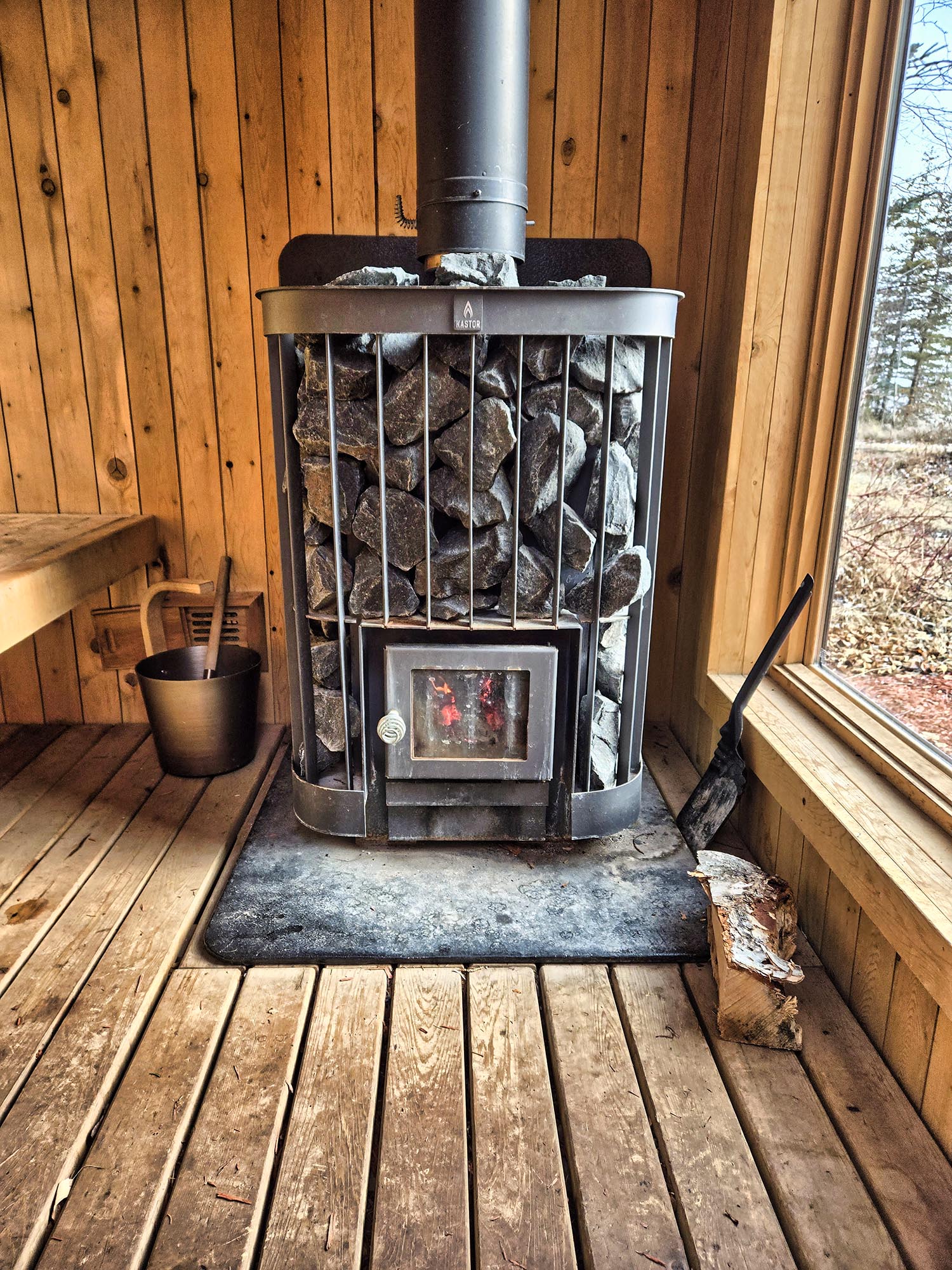
The log-powered sauna at Thomsonite Inn.

We brought our own food along, so after a leisurely breakfast at the cabin, we headed into town to visit bookstores and chocolate shops.

Laden with books and maple truffles, we returned to the cabin for lunch and then drove a few miles to the Thomsonite Inn for a free sauna, courtesy of the Hygge Festival. I had been in touch with the inn beforehand via email to ensure that we didn’t need a reservation, and they said we could just show up.

When we arrived at the inn, the office was closed. Never having been there before, we weren’t sure where the sauna was located. But we found it after referring to a map posted near the office. A short walk down a trail toward the lake led us to the sauna, which was made from a shipping container and it sported a wood fireplace.

A group of twenty-somethings were exiting just as we arrived. Their bodies steamed as they toweled off in the twenty-eight-degree breeze. They said that our timing was perfect and that we’d have the sauna to ourselves.

The sauna offered a view of Lake Superior.

Russ and I looked for a changing room, but there was none. One of the young women said she just walked into a clump of nearby trees to change. Hmph! And did I mention that it was twenty-eight degrees outside??

We ended up changing behind the sauna. The ground was frozen, so I laid my winter coat down and changed atop it, wearing socks for the short trip to the sauna door, taking them off before I went inside. Although changing into our swimsuits outdoors was chilly, we had some hygge to look forward to!

The “youngsters” had added a log to the fire when the left, so the sauna was warm and toasty. For me, it was a bit too toasty. I had to step out every few minutes to cool off before going back inside. A large window looked out at Lake Superior, which had calmed during the night.

When we emerged, steaming, we felt lighter, somehow – both emotionally and physically.

A large Thomsonite rock. Image courtesy of Lapidary Adventures.

The inn sits on a beach known for its Thomsonite, a rare mineral formed eons ago via volcanic activity. The rocks are pink, tan, white, red, and brown — kind of like agates. Those with green or gray backgrounds and green “eyes” are the most prized. The beach was icy, so we didn’t plan to rock hunt, but I did manage to take a few shoreline photos once our sauna was over.

We drove back to town and visited two art galleries that feature local artists. So many talented people live here and it’s always inspiring to see their works.

After a quick stop back at our cabin for my camera, we drove north to Tombolo Island, which is located down a short section of the Superior Hiking Trail off the highway. Another photographer was there, also hoping to catch the sunset. He had a loud, mean dog that quickly made itself known to us. The photographer’s wife (I assume) came running after it to clip on a leash.

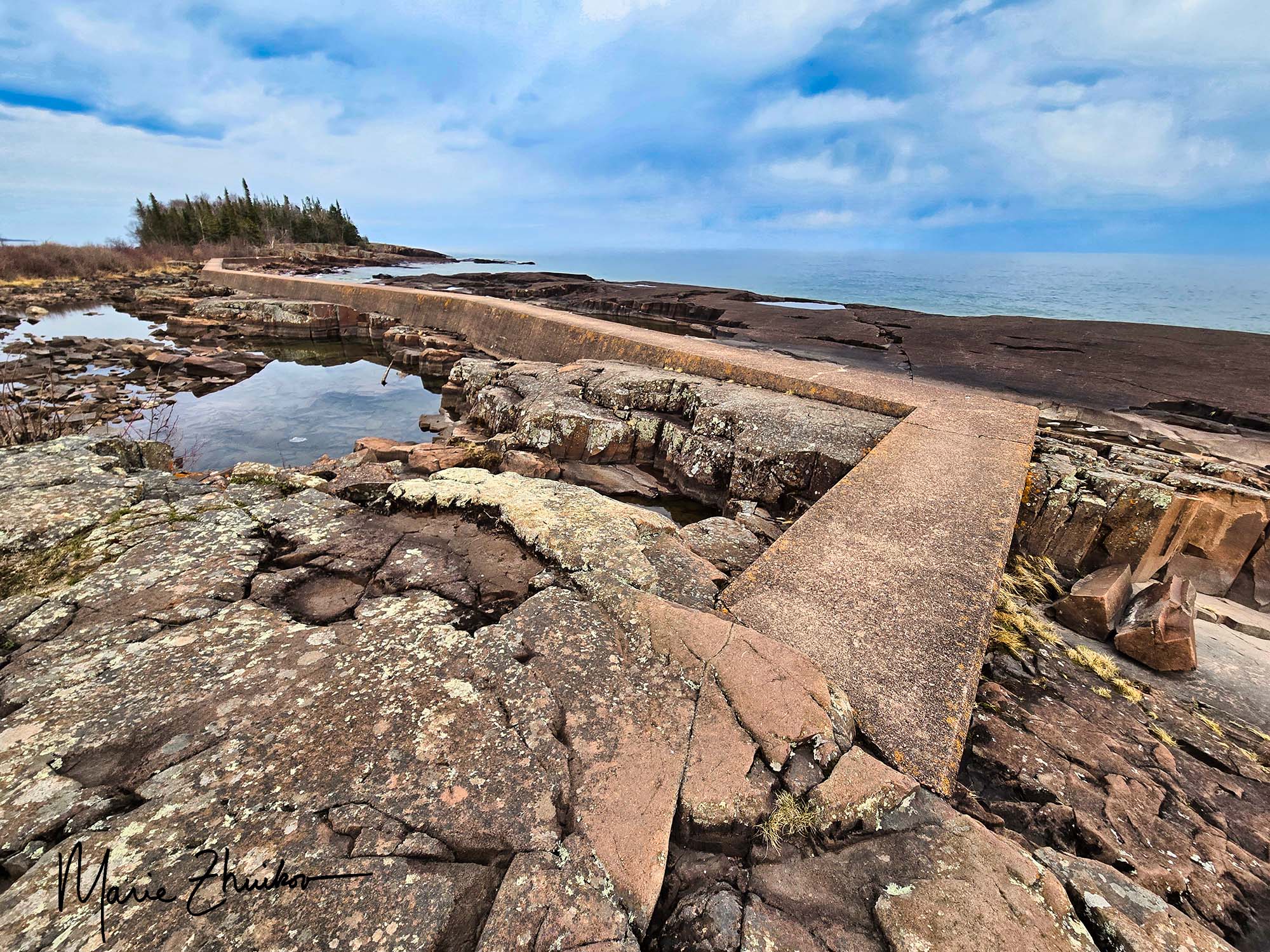
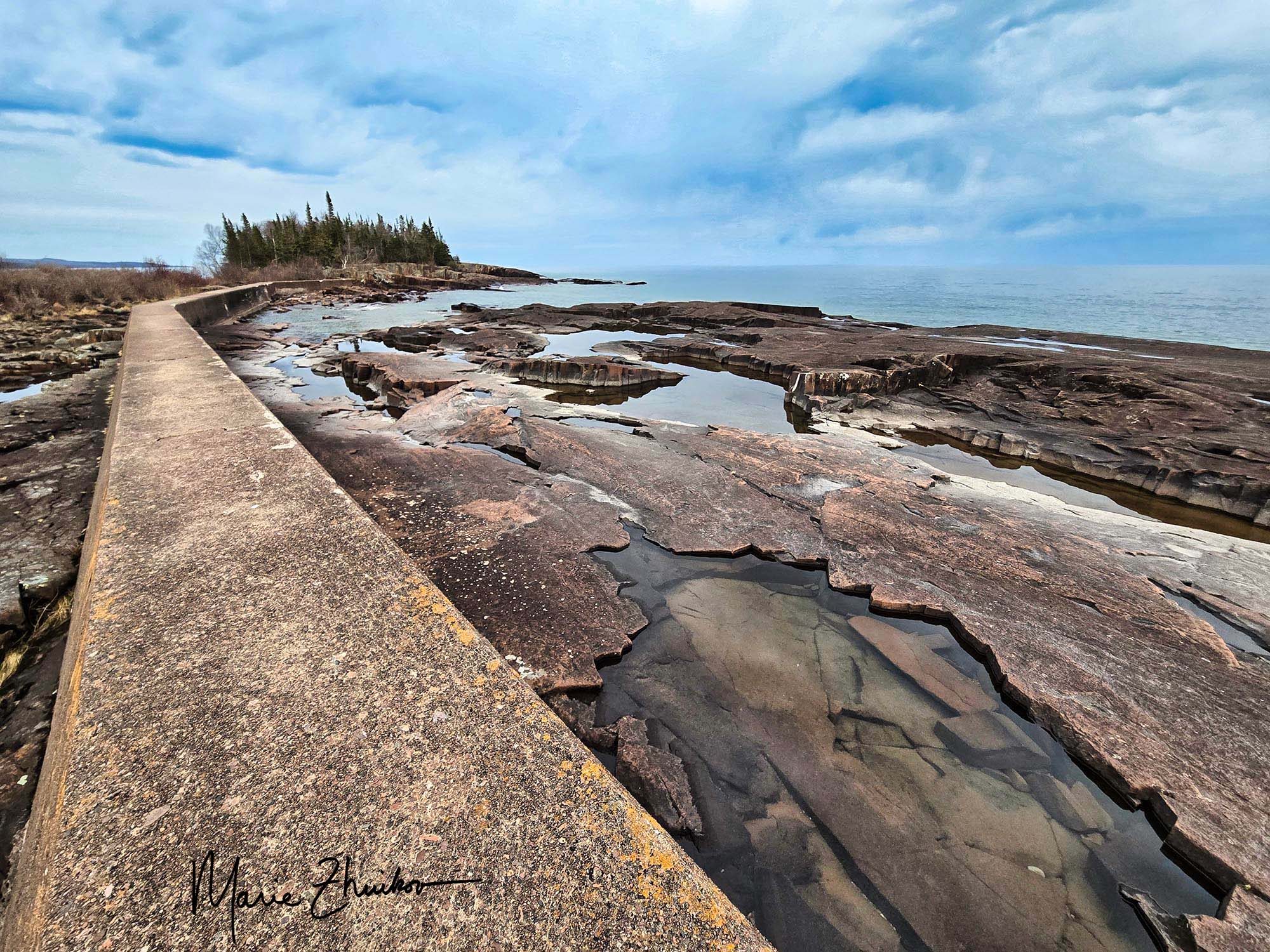
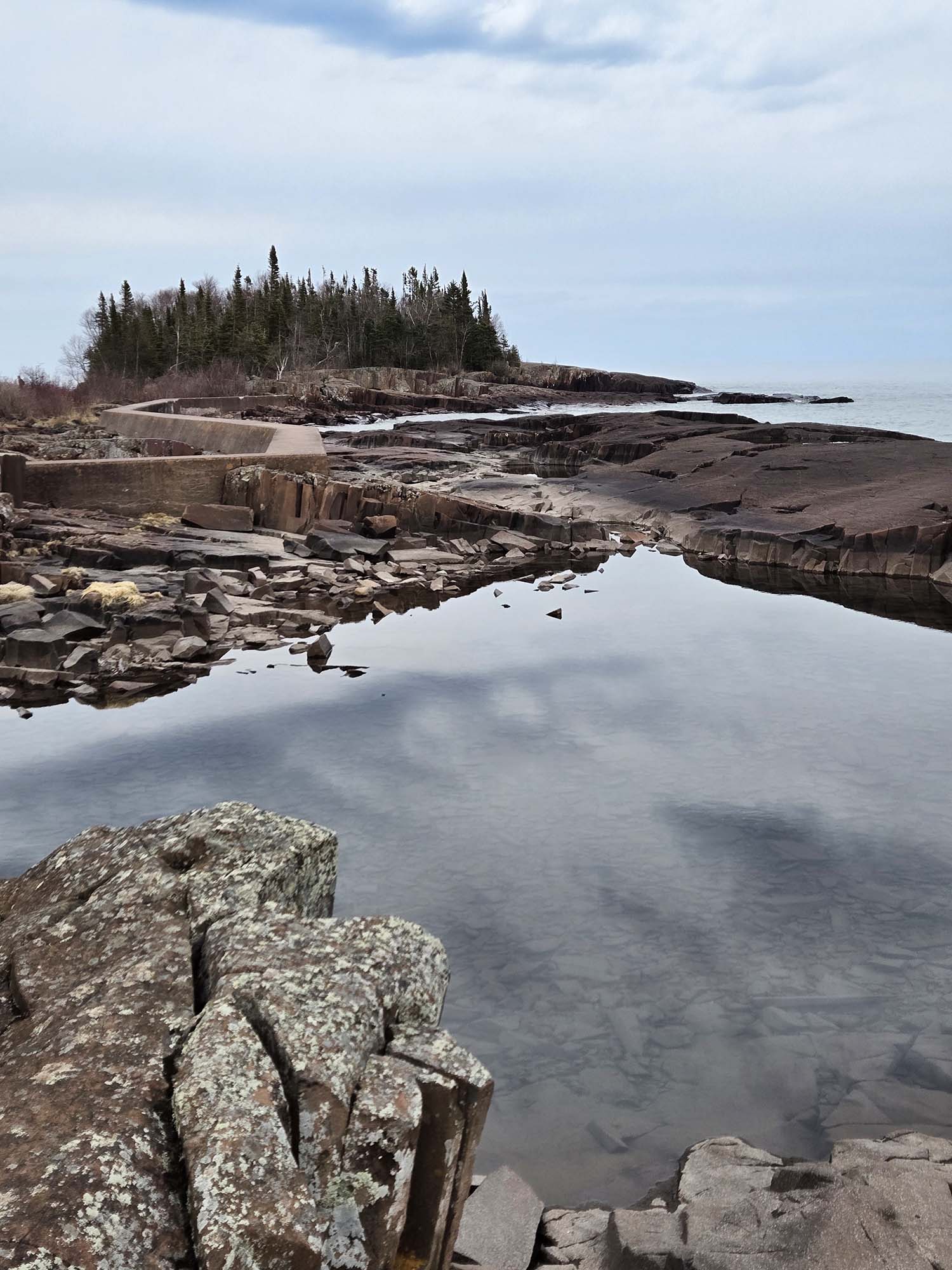
The Tombolo is a popular photo op. I think it has something to do with the curve of the beach, the dramatic rocks, the waves, and relative ease of access.

The other photographer was already set up with his tripod, so we walked behind him to another spot that wouldn’t be in his way. Then we waited for the sun to do its thing. Russ and I arrived plenty early since we had never been here before and weren’t sure how long it would take. I had forgotten my hand warmers, so after taking off my gloves a few times for practice shots, my fingers were plenty cold. I had my camera set up on a tripod and then walked around with my cell phone, taking photos from other locations that struck my fancy.

Tombolo Island on Lake Superior’s North Shore

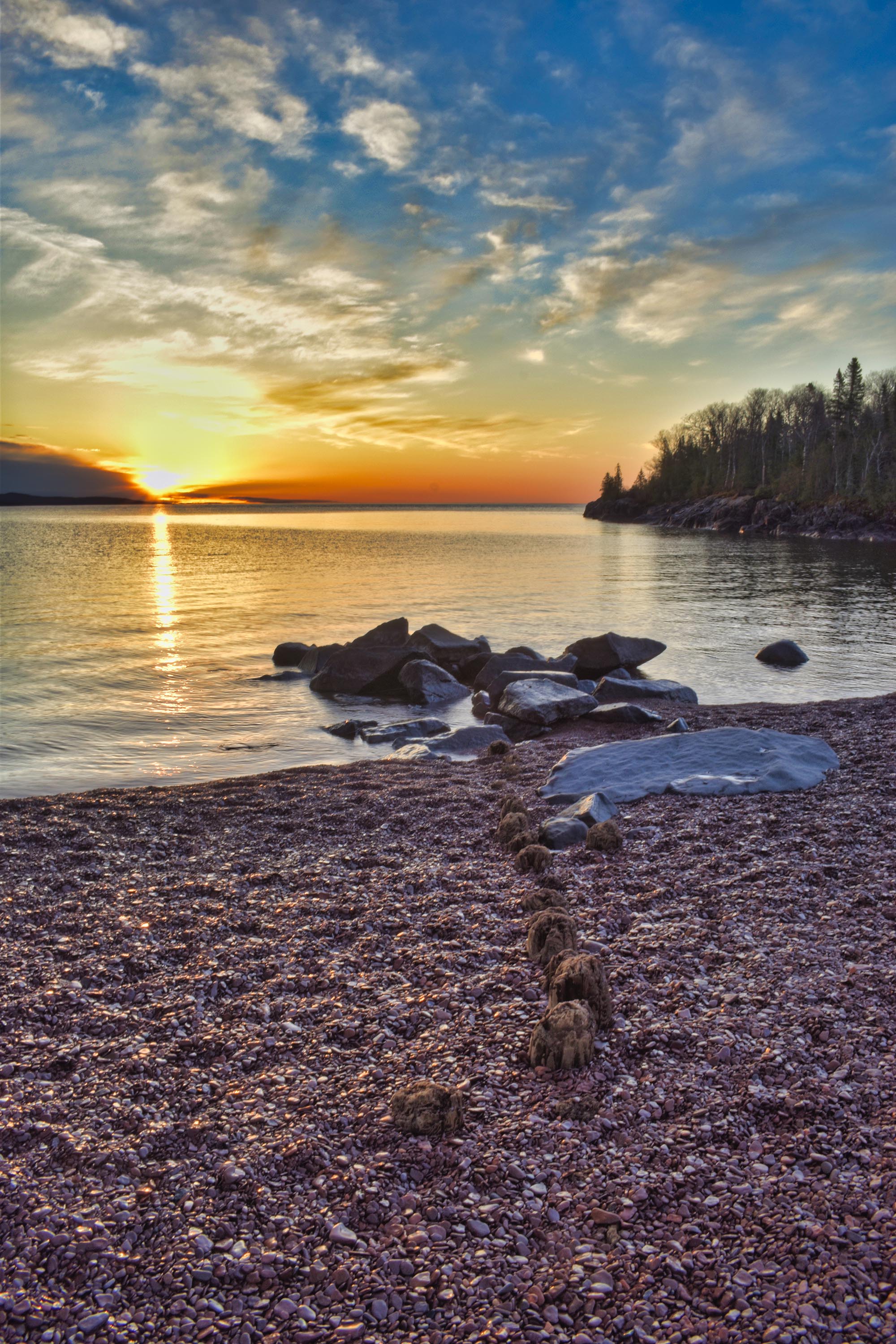
The sun took its sweet time. The colors were muted but icy rocks provided some nice contrast and drama. I took pictures until my fingers insisted that it was time to go. Famished, we walked back to the car, looking forward to a homemade dinner at the cabin.

We cooked up a porterhouse steak and baked potatoes (with sour cream and chives). For dessert, we made a chocolate lava cake for two, complete with vanilla ice cream. Heavenly!

The next morning, after a short walk on the road along the shore, we headed home. Although we didn’t have snow to play in on our trip, at least we had hygge, and that was plenty good.

Northern Dreams

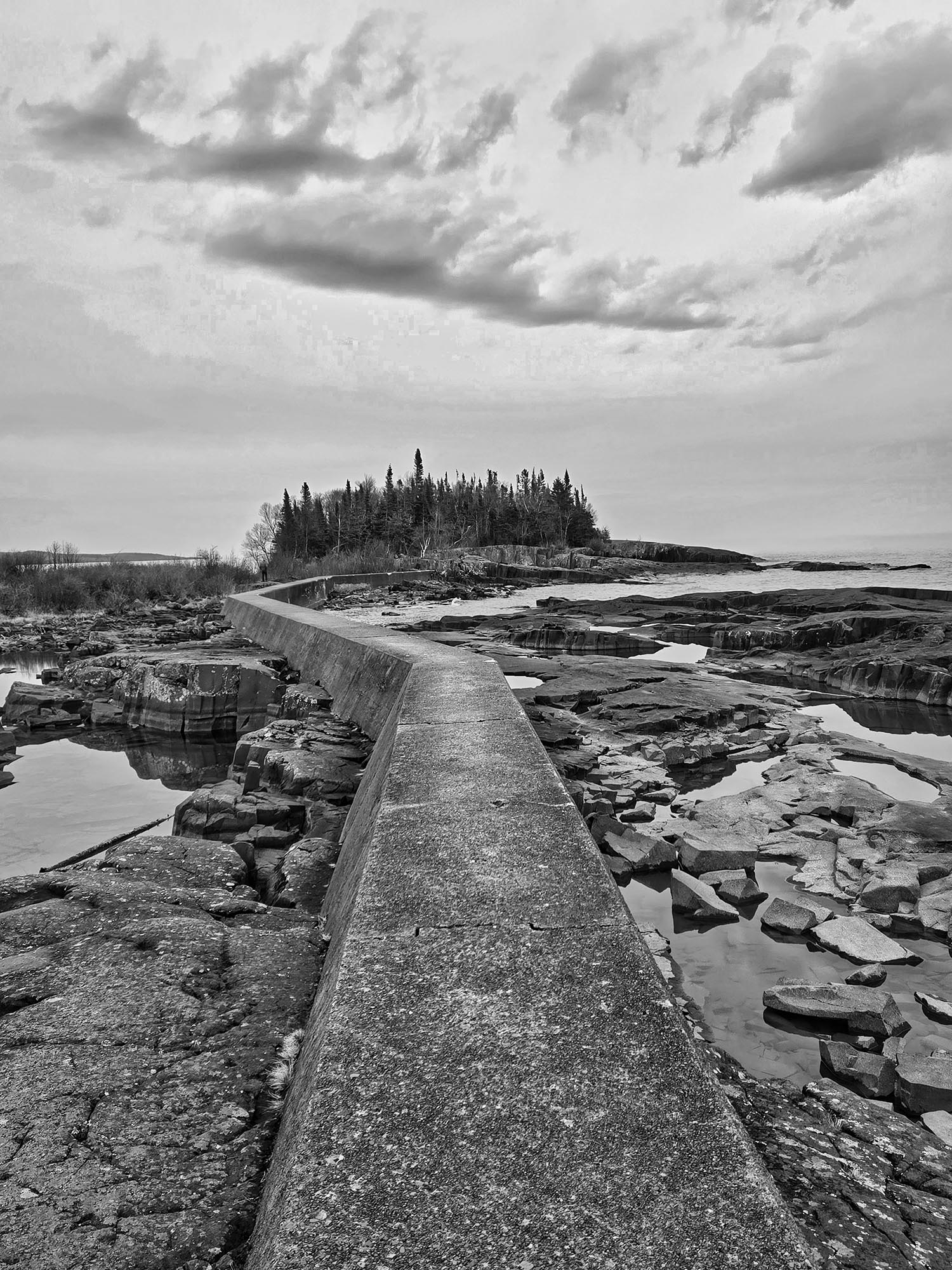
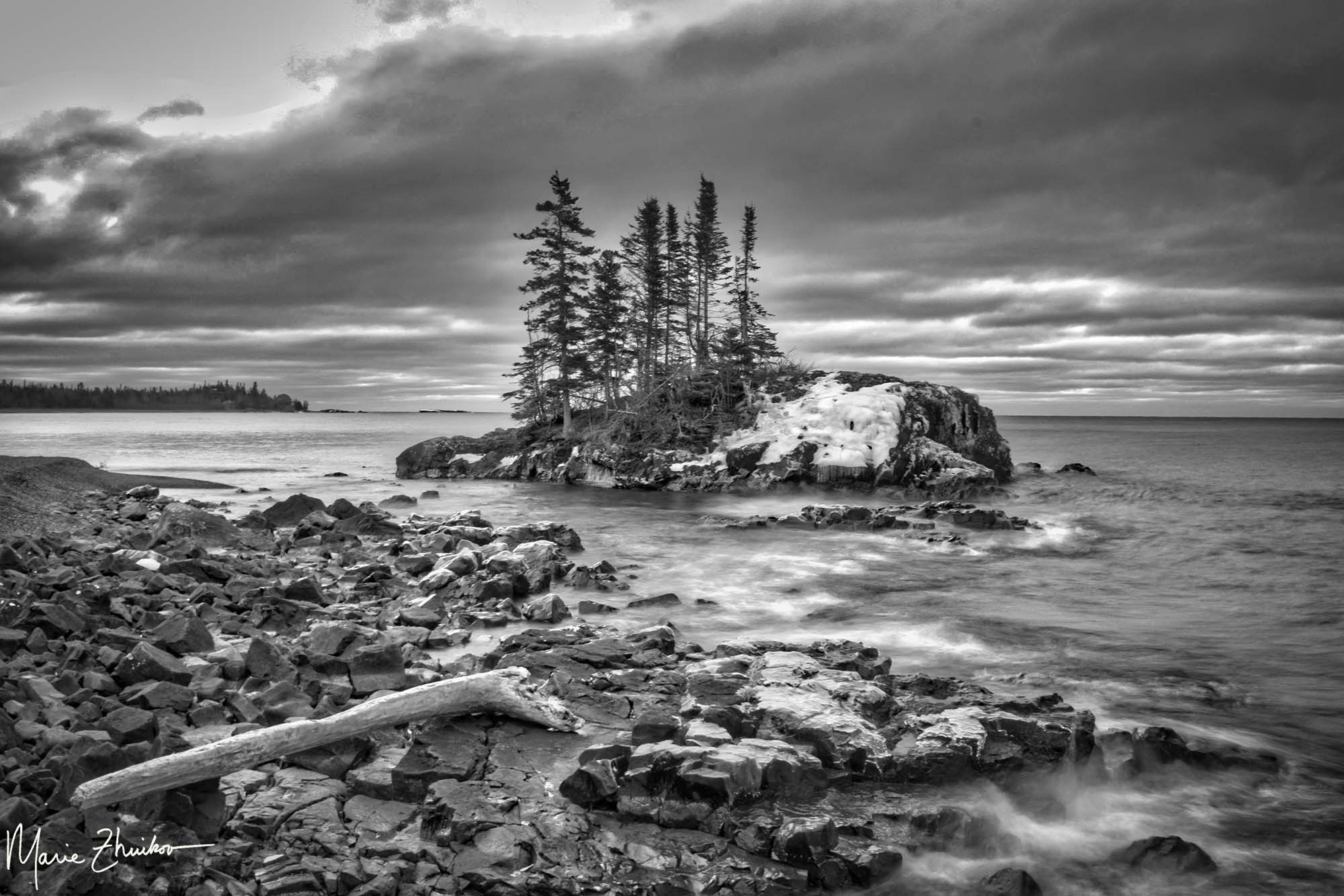
This is one of my favorite photos from a recent meander north to Grand Marais, MN. I was hoping for good sunset photos, but the colors weren’t cooperating. After standing outside in the frigid cold for an hour, and with fingers beginning to numb, I snapped this one last photo of Tombolo Island in Lake Superior.

I love the blurry water and the placement of the driftwood. The cynical part of me wonders if some other photographer placed it on the shore for effect. All I know is that I didn’t do it! So I’ll pretend that it just washed up on the rocky beach.

No sunset colors? Turn the photo into a black and white! So moody. I love this lake and hope that shows.

Musical Phoenix

Phoenix’s Musical Instrument Museum. Image courtesy of the Musical Instrument Museum

During our recent meanderings in Arizona, we visited the Musical Instrument Museum in Phoenix. Russ and I enjoy music, both listening and playing, so the museum naturally intrigued us.

This musical museum offers two floors filled with 4,200 instruments from across the world. The CEO of the Target department store corporation founded it to highlight more than just western classical instruments (which are found in many other museums). Robert Ulrich wanted to focus on instruments played by everyday people across the globe. The museum’s motto is: Music is the language of the soul.

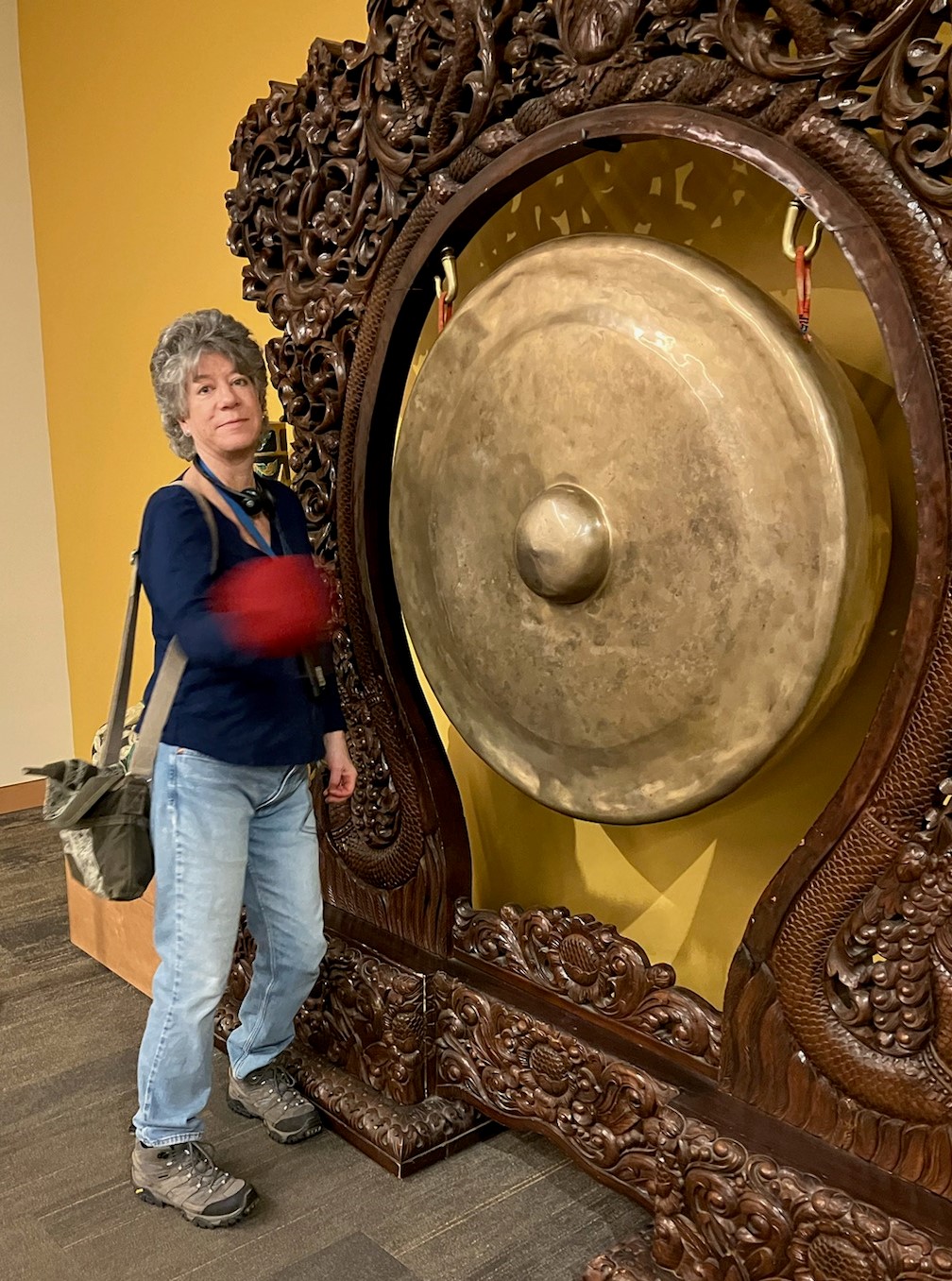
Marie getting it on, banging a gong.

The museum delivers on its mission and motto in spades! We could have easily spent an entire day perusing the exhibits. The upper floor has instruments from different geographic regions such as Asia, Europe, and Latin America. Tours are self-guided with an audio headset.

The lower level contains two of my favorite galleries. The Artist Gallery highlights famous musicians past and present, such as Prince and Johnny Cash. Each display features photos, music audio, and memorabilia. Prince’s had a purple piano from one of his tours. One unusual exhibit focuses on the theremin, an eerie electronic instrument played without any direct physical contact by the performer. Clara Rockmore was a theremin “virtuoso” featured.

My other favorite was the Experience Gallery. We were allowed to unleash our inner musicians in this room, which offers banjos to pluck, drums to beat, and gongs to gong.

The museum’s Mechanical Music Gallery shows self-playing pianos and the like. We arrived just in time for a demonstration of a wall-sized instrument called an orchestrion. It’s powered by compressed air and is like having a whole orchestra at the ready.

Until fall of 2024, the museum has a special exhibit called Acoustic America, which displays 90 iconic guitars, mandolins, and banjos that shaped American music since the Civil War. If you’re a stringed instrument-lover, you’ll have to check that out.

If you can’t just pick up and head to Phoenix, the museum provides this virtual tour.

We left the Musical Instrument Museum with many songs in our hearts.

Enchanted Phoenix

The skating rink/trail and light display at Enchant in Phoenix.

Russ and I meandered down to Phoenix, AZ, to visit relatives. One of our festive outings was to an outdoor baseball stadium (Salt River Fields) in the suburb of Scottsdale to a walk-through light display, called “Enchant.”

I must admit, I was a bit skeptical about the likelihood of experiencing a magical Christmas experience without snow and the cold, but I came away impressed by the scope and organization of the event.

We entered the gates and spent time wandering through a “village” with food vendors and booths selling Christmas wares. A trip down the stadium stairs took us to the light maze on the field. The maze’s theme is “mischievous.” One of Santa’s elves and his reindeer pal have misplaced toys meant for children on Christmas. The goal is to find all the missing toys in the maze so that children will receive them as presents.

We were delighted by the scenes around every corner in the maze. A gigantic Christmas tree dominates the center, surrounded by huge lighted up presents. There’s even a multi-colored “disco” floor where the light squares change color when stepped upon.

People enjoying a warm fire and one of those light bulb drinks by the skating trail.

Although it was about 45 degrees out, everyone was dressed like it was twenty below. Many people were walking around with drinks in lighted clear containers that resembled light bulbs. I asked one person what was in the drinks and they said something about vodka and strawberry juice.

The more adventurous in our party signed up to rent skates and try out the ice-skating trail. You need to sign up for a specific time so that the rink doesn’t get too crowded. I haven’t skated in about 7 years, but I was game to give it a try with my sixty-year-old legs. The skates were made of sturdy black plastic and are available in a huge variety of sizes. After signing accident waivers, we snapped on our skates and hit the trail with dozens of other people, many of whom had probably imbibed those light bulb drinks. Vodka and inexperienced skaters – probably not the best combination?

I was intrigued to see how Arizonians skate. You see, in Minnesota, most children learn to skate about the same time that they learn to walk. If their fathers are speedskating coaches like one of my children’s was, they are out on the ice even before they learn how to walk. That son was with us and he had no problem skating. His Arizonian girlfriend was another story, but she gave it a good try.

Elves having fun on the changing-color disco floor.

After a few wobbly steps, my skating instincts returned, and I was good to go. My main worry was avoiding out-of-control skaters. We witnessed many butt thumps on the ice and many people turning in circles when they wanted to skate forward. But everyone seemed to be having fun.

After skating around for about 20 minutes, we emerged unscathed from the trail. We spent more time exploring parts of the light maze we’d missed before. Afterward, we made our way back up the stadium stairs and visited more of the vendors.

There are other activities at Enchant as well. I think there’s a play, and there are various levels of tickets that people can purchase. Enchant is not only in Phoenix. It’s offered at six other cities, including Milwaukee and Las Vegas. The show goes on until December 31, so there’s still time to go if you haven’t already.

Bear Head Lake State Park

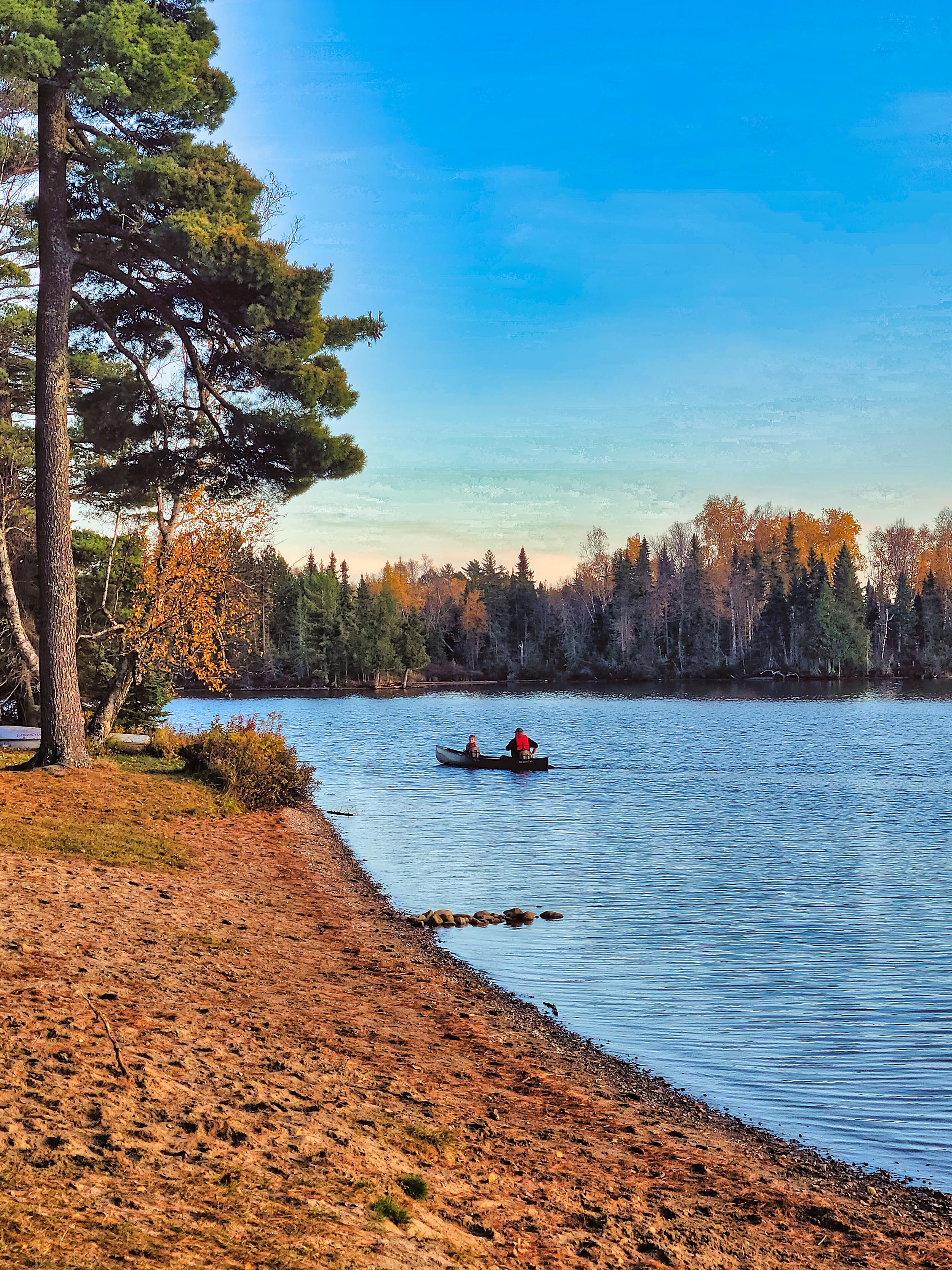
One of the small docks along the shore of Bear Head Lake.

Russ and I had only used our Scamp trailer once this summer (to Pictured Rocks National Lakeshore), so, we decided to get one more trip in before the snow began to fly. We chose Bear Head Lake State Park in northern Minnesota for several reasons: it was nearby, and we had passed the turnoff for it several times and wondered what it would be like to stay there. We were also intrigued because we’d heard that in 2010, it won the America’s Favorite Park contest. It must have something going for it!

We pulled into our site on a Friday evening. We chose a site on a loop that bordered the lakeshore. One thing that impressed us was that all campers have equal access to the shore. No sites are directly on the lake (they’re across the road from it), but there are several trails off the road that lead down to small docks that are perfect for fishing or lake-gazing.

The beach at Bear Head Lake State Park.

The air was warm for mid-October and the wind was calm. After our Spam and eggs supper, we took a walk on trails along the lake. The tamarack trees and aspens were still clothed in their splendid yellows. The trail ended at a beach surrounded by tall red pines. We’d find out later that these pines were spared during logging times because they were too small to be of interest. Good thing the place is a state park because they’d certainly be of interest to loggers now!

A Trail Center building nearby offered bathrooms and a warm place for hikers to gather before heading out on any one of the park’s 13 miles of paths. I discovered later that the impressive center was built thanks to the park’s standing in the 2010 contest, which was sponsored by Coca Cola. The park won $100,000, which they spent to build the center.

At the time, the park staff credited their win to Facebook and the power of social media because a popular bear frequented the park and people wanted to help draw attention to the bear’s home. The bear is no doubt long gone, but the Trail Center stands as a testament to the good will of social media strangers.

After our hike we enjoyed a fire (firewood is for sale at the park office). Our plans to hike the next day were disrupted by a steady drizzle. We opted to drive to Ely, Minnesota, instead. One of our stops was the Dorothy Molter Museum, which I described in my previous post. We also ended up getting a private tour of the Pioneer Mine Museum. Like the Dorothy Molter Museum, it was also open past Labor Day, contrary to its publicized operating season.

We didn’t intend to visit the Mine Museum. We began walking on a paved trail around Miner’s Lake but the steady drizzle and my failing health (I was catching the flu or something from Russ) made us turn around after a short jaunt.

As we neared our car in the parking lot of the Mine Museum, a man called to us from a building atop a nearby hill. He said the museum was open and he’d gladly give us a tour. Having nothing else better to do on a rainy day, we took him up on his offer.

The Pioneer Mine closed in 1967 and its payload was iron ore. The museum featured a plethora of artifacts and photos from its hey day. Our guide was Seraphine Rolando whose grandfather and other relatives had worked in the mine. Seraphine was a great storyteller and regaled us with tales of memorable rescues and descriptions of what it was like to work in the mine. Unlike the nearby Tower-Soudan Mine, the Pioneer Mine was wet, dirty, and much more hazardous.

Seraphine is a legend in his own right. I found this profile of him in the local Ely paper after I returned home. I easily remembered his name because one of my ancestors was named Seraphina, which must be the female version of his name.

Seraphine Rolando in the mine museum. Image courtesy of Trip Advisor

After our tour, we stopped at the Evergreen Restaurant in the Ely Grand Lodge for lunch. Interestingly, the lodge is built on a pile of mine tailings. The restaurant featured a beautiful view of Shagawa Lake and more golden trees.

Rain featured heavily on our next camping day, too. We ended up leaving for home a few hours early because I was now fully engulfed by the flu. But I recovered and am now ready for more meanderings.

Staying at Bear Head Lake State Park is like staying on a lake in the Boundary Waters Canoe Area Wilderness, but with more conveniences. Electric sites are available but not water hookups. A pump well is in the park and civilized toilet facilities are also available. They were closed during our visit, however, so we had to make do with an outhouse.

A final thing I wanted to mention was that one of our camping neighbors employed was using a leaf blower as they were packing up to leave. I suppose they were cleaning leaves off their outdoor carpet, or something. That was a new one on us – hearing a leaf blower at a campground. It’s bad enough hearing them at home, much less in a natural space. I sure hope this doesn’t become a trend!

The view from Evergreen Restaurant in Ely, MN.

The Root Beer Lady: A True Story

Once upon a time, a woman lived alone in the northern Minnesota wilderness. Except, she wasn’t really alone. Birds and otters kept her company. Canoeists stopped by her island on Knife Lake near the Canadian Border. At one time, she even ran a resort there.

Image courtesy of the Dorothy Molter Museum.

But after the land was designated as an official roadless area and then a Wilderness with a capital W, making a living became more difficult for the woman, not to mention getting supplies. Rogue sea plane pilots tried to help her, but they were arrested. The only thing the woman could do was haul in the supplies she needed by canoe, portaging five times over the 33 miles to civilization.

In 1952, a writer with the Saturday Evening Post visited her and wrote a story about “The Loneliest Woman in America.” The article turned her into a national legend – a woman living alone among wolves and braving minus 50-degree winter temperatures. But the woman always contended the writer got it wrong, she was never lonely, even in winter.

One day, she was cleaning and found dozens and dozens of glass bottles left from when her resort served pop (as we call it in Minnesota). Rather than haul out the bottles and discard them, Dorothy Molter (as was her name) got the idea to make root beer for passing canoeists in the Boundary Waters Canoe Area Wilderness.

Dorothy Molter’s root beer cooler.

She hit the jackpot. If there’s one thing most wilderness campers appreciate, it’s a fizzy cold drink after days away from civilization. Dorothy made her drinks with root beer extract, sugar, yeast, and water from Knife Lake. They were cooled on ice cut from the lake in winter. Canoeists donated a dollar per bottle.

Dorothy made root beer for years. At the height of her business, she produced 12,000 bottles and still couldn’t keep up with demand. She was trained as a nurse and aided any canoeists who needed help by sewing up cuts and removing fishhooks from various body parts. She once saved the lives of a father and son who got hit by lightning in a sudden summer storm. Dorothy also nursed wild animals, including a crow and a mink.

A strong and plain-spoken woman, Dorothy didn’t swear or curse, but she didn’t mince words either. Her philosophy for surviving in the wilderness could be summed up in the sign she posted at her home on the Isle of Pines. “Kwitchurbeliakin,” it advised.

Dorothy continued living in the wilderness until she was in her late 70s. She kept in touch by radio, checking in with Forest Service staff daily. One winter day she didn’t check in. Then another day passed with no contact. A wilderness ranger made the trek and found her dead of a heart attack from hauling wood.

The Dorothy Molter Museum, Ely, MN

Although Dorothy’s time passed, her memory is preserved in a museum named after her in Ely, Minnesota. The fame and good will she garnered through her lifestyle prompted its formation.

Russ and I had heard of Dorothy over the years but never had a chance to meet her or visit her museum. We thought we were out of luck on a recent camping trip to Ely because a brochure we happened upon said the museum was closed after Labor Day.

With drizzly weather forecast, Russ and I ditched hiking plans and meandered into Ely to see what struck our fancy. We had driven though the whole town with no fancies struck, when we passed the sign for the Dorothy Molter Museum on the outskirts. The sign read “Open.” So, we turned in, hoping the sign wasn’t just the product of end-of-season-forgetfulness on somebody’s part.

The museum really was open! We spent a couple of hours touring Dorothy’s cabins, which volunteers had hauled out of the wilderness to house her artifacts. We enjoyed watching excerpts from a video about Dorothy’s life. We viewed her root beer-making equipment and perused the gift shop, where visitors can buy a bottle of Dorothy’s root beer. Despite the drizzle, we also got a bit of hiking in on the quarter-mile trail in the pine plantation surrounding the museum.

We left glad to see Dorothy’s memory preserved.  As one of the museum signs says, “Although Dorothy  has been gone from Knife Lake for over 30 years, we hope that you find inspiration to live your lives like she did, in harmony with the environment, with integrity, helping humankind, and making a contribution toward a better world.”

Dorothy’s winter boots

Minnesota’s Pink Beach: Biking the Gitchi-Gami State Trail

Iona’s Beach, Lake Superior

The online entry for the part of the Gitchi-Gami State Trail from Gooseberry Falls State Park to Split Rock State Park along Lake Superior said, This trail segment has steep hills and curves that can be particularly arduous for recreational use.

The warning was in italics and demanded attention. Russ and I looked at each other and shrugged. “Meh. How hard can it be?”

Will we never learn?! Spoiler alert: Actually, it wasn’t that bad, but a few of the uphills toward the end of our round-trip tour did defeat me, and I walked them. Just a reminder that I am 60 years old, so you gotta cut me some slack.

But the arduosity was worth it to bike a new (to us) segment of this trail on the North Shore and to see Iona’s Beach – a fabled shore littered with pink stones.

The Gitchi-Gami trail is composed of several paved segments totaling 33 miles. Eventually, it will span 86 miles from Two Harbors, MN, to Grand Marais, MN. I’d been on a segment north of the Gooseberry-Split Rock previously and enjoyed gliding through the birch and aspen forests and crossing river bridges.

The Gooseberry River before the falls on a foggy day.

After buying our MN state park pass at Gooseberry, we made our way to the trailhead, which is near the picnic area. The trail begins by taking bicyclists in the wrong direction – you travel south for a bit, but once you get near the park entrance it turns north. Cyclists get a spectacular view of the head of the Gooseberry River falls. In about 3 miles the trail winds into Twin Points Safe Harbor and Iona’s Beach Scientific and Natural Area. Fog from the lake rolled in and out along the way.

Iona’s Beach

We stopped and explored Iona’s Beach. Probably because of the mist, it wasn’t very crowded, but that was okay with us.

As you can see from the photos, the beach really is composed of pink stones. The stones have eroded from waves and frost from a nearby cliff (made of rhyolite) and are kept in place by dark basalt rock headlands on either side.

We sat by the water to see if we could hear the beach “sing.” When waves recede from the cobblestones, the stones come to rest with a tinkling sound unique to this beach. Waves were plentiful during our visit – the sound was subtle, but I do think we heard the beach sing!

The beach is named after Iona Lind, whose family bought the area and ran a resort there for more than 50 years. Iona ended up protecting the lakeshore she loved permanently by donating it to the state.

We continued on our way, gaining a close view of the rhyolite cliff from a bridge. A small waterfall cascaded down its face. The Split Rock River was another inspiring site. We made it a few miles into the park before my legs begged me to turn around, so we headed back to Gooseberry Falls. We did not make it all the way to the famed Split Rock Lighthouse.

All total, our trip was 15 miles. We were famished by the end of it. We wanted to eat at Betty’s Pies outside of Two Harbors, but it was so crowded that we opted for Blackwoods in Two Harbors. A mushroom and swiss burger never tasted so good!

The rhyolite cliffs that formed Iona’s Beach

FYI – Minnesota also has a black beach farther up the Shore in Silver Bay. It’s not natural, however. It’s created from discarded taconite tailings from iron ore mining activities. According to media reports and info from friends, it’s not that healthy to regularly play around on a beach made from industrial pollution, but a visit or two is just fine. The beach has been cleaned up in the past, but I would still be cautious if you have young children or have immune issues.  Maybe opt for a natural pink beach instead.

Last Day at Pictured Rocks: Au Sable Light Station and Luscious Food

The Au Sable Light Station.

Rain moved in on our last full day at Pictured Rocks. It foiled our morning plans to hike from our campground (Hurricane River, Lower Loop) to the Au Sable Lighthouse, a 3-mile round trip. But after Russ and I read and were generally slothful, the rain stopped in the afternoon and we were able to hike.

The “trail” to the lighthouse is more like a gravel road. In fact, the park employees who staff it drive on it with their car. It’s mostly level and easy walking along the shore of Lake Superior. Several shipwrecks lie on the beach near the lighthouse, but we couldn’t access them because of the rough waves.

The treacherous sandstone makes up Au Sable Point.

The light station is comprised of a small museum, the lighthouse and keeper’s quarters, a foghorn signal building, two historic outhouses (plus one the public can use), and a small brick oil building.

I’d wanted to visit this particular lighthouse for several years – ever since I discovered it’s the twin of the lighthouse on Outer Island in the Apostle Islands National Lakeshore. I would like to set a novel in the Outer Island lighthouse but was unable to tour inside it, so the Au Sable Light was the next best thing! Tours are offered during the summer for $5.

With its underwater reefs and thick fogs, Au Sable Point is a hazard to Lake Superior mariners. The lighthouse was built in 1874, the same year as the Outer Island Lighthouse. The light tower is 86 feet high. In 1945, the U.S. Coast Guard took over operation, replacing civilian keepers. In 1958, the Coast Guard converted the light station to an automatic, unattended light and discontinued the fog signal. The station became the property of the park service in 1968. The Coast Guard maintains the small LED beacon and solar panel that charges its battery. The park has completed several restoration projects over the years.

The Au Sable Lighthouse as the fog rolled in.

The furnishings inside the lighthouse are not original, but they are of the appropriate time period. The keeper’s quarters consist of a kitchen, dining room, living room, bedroom, work room and several closets. The lighthouse tower can be accessed directly from the living quarters.

The second floor of the keeper’s quarters is much like the first and was built for the assistant keeper’s family. Tours include a trip up the 90 steps to the top of the tower, with its impressive view of Lake Superior and the surrounding forest.

After the tour, Russ and I wandered the grounds (with me taking photos). As we prepared to leave for the hike back to the campground, a fog rolled in, completing the ambiance.

Our evening plans included a drive to Munising to trade in our Spam camping food for more elegant fare. We made reservations at Tracey’s at Roam Inn. It was pricey, but the food was worth it! I had the Lakeshore Pan Roast – a seafood stew made with lobster, whitefish and scallops in reposado cream (made with tequila). Russ had the Grass-Fed Bison Filet Mignon. You can choose three different ways for your meat to be prepared. He chose the “House” method, which involves covering the meat in pepper and serving it with mashed potatoes, birch syrup asparagus, and morel mead cream. If you like pepper, this is the dish for you.

The Lakeshore Pan Roast from Tracey’s Restaurant in Munising, MI.

Both of our meals were luscious and provided the perfect end to a wonderful trip. For dessert, Russ had the chocolate cake (served with raspberry sauce and whipped cream), and I had the crème brulee served with lingonberry sauce and a stroopwafel (a Dutch waffle cookie with caramel filling). This put our meals over the top!

Chocolate cake for dessert.

As we dined, we reflected on our experience. I was tickled by how excited people became from seeing “rocks.” On our sunset cruise, they were taking selfies with the various rock formations as well as cell phone videos to share with friends. Calling the Pictured Rocks National Lakeshore “just a bunch of rocks” (like our church friend did) was like calling the Grand Canyon “just a big hole in the ground.”

The next day, we would drive home with our Scamp. But we would do so filled with a new appreciation for an area we had driven past many times but never had time to visit.

Taking Pictures at Pictured Rocks National Lakeshore

One of my favorite images from the Pictured Rocks sunset cruise.

Pictured Rocks National Lakeshore in Michigan has plenty of wonderful overlooks across Lake Superior with great views (for some, see my previous post here).

But the best way to see the sandstone rock formations is via boat. Russ and I took a sunset cruise the first full day of our trip. We knew the weather would be changing to rain the next day, so we didn’t want to miss the opportunity for good photos.

Our particular cruise left from the town of Munising. Although we arrived at the cruise dock early, apparently, we weren’t quite early enough. A huge line had already formed.

Pro tips:

  • Make a reservation a few days in advance for your cruise to ensure you can experience it on the day you want.
  • Arrive at the dock more than a half-hour early to ensure you get a good seat. Good seats for taking photos are toward the front of the top deck, which is open to the elements.

There were so many passengers, the cruise line ended up fitting us onto two boats. Russ and I nabbed seats in the middle of the top deck. Not ideal, but not that bad, either.

The captain wouldn’t let people stand up to take photos, so when we neared interesting rock formations, I had to go downstairs to the viewing platform on the back of the boat where photography was allowed.

The sunset was colorful, but even more impressive was how it reflected off the rock formations. Although the sunset cruise costs a bit more, it’s worth it for the added colors.

If there’s some way you can get out on the water in a canoe or kayak, that would be even better for taking photos, but we didn’t have time for that.

Next up: a lighthouse tour and a sumptuous meal in Munising.