I received notification about new results recently from one of the DNA-testing services that I use. (Note: it is not the beleaguered 23&Me.) Through this service, I had my maternal (mitochondrial) DNA tested. One report offered is called “Notable Connections.” These are “connections based on direct DNA testing or deduced from testing of relatives and should be considered as fun facts.”
Included in my results were some Swedish and Danish royalty and some poor bronze-age blokes who were dug up in England when modern roads were built. One connection sent shivers through me, however. It was for an Egyptian mummy named Takabuti. Her remains are currently on display at the Ulster Museum in Belfast. We visited that museum this summer! We went there on our first day in Ireland.
I racked my brains trying to remember if we’d seen the mummy. We must have because it’s a major display. But I don’t think we paid her a lot of attention. I mean, I’ve seen King Tut’s mummy, and after that, everything else is small potatoes. I also recall a vague distaste at seeing a dead body on display. However, if I had known I was related to this mummy, you can bet I would’ve taken more notice!
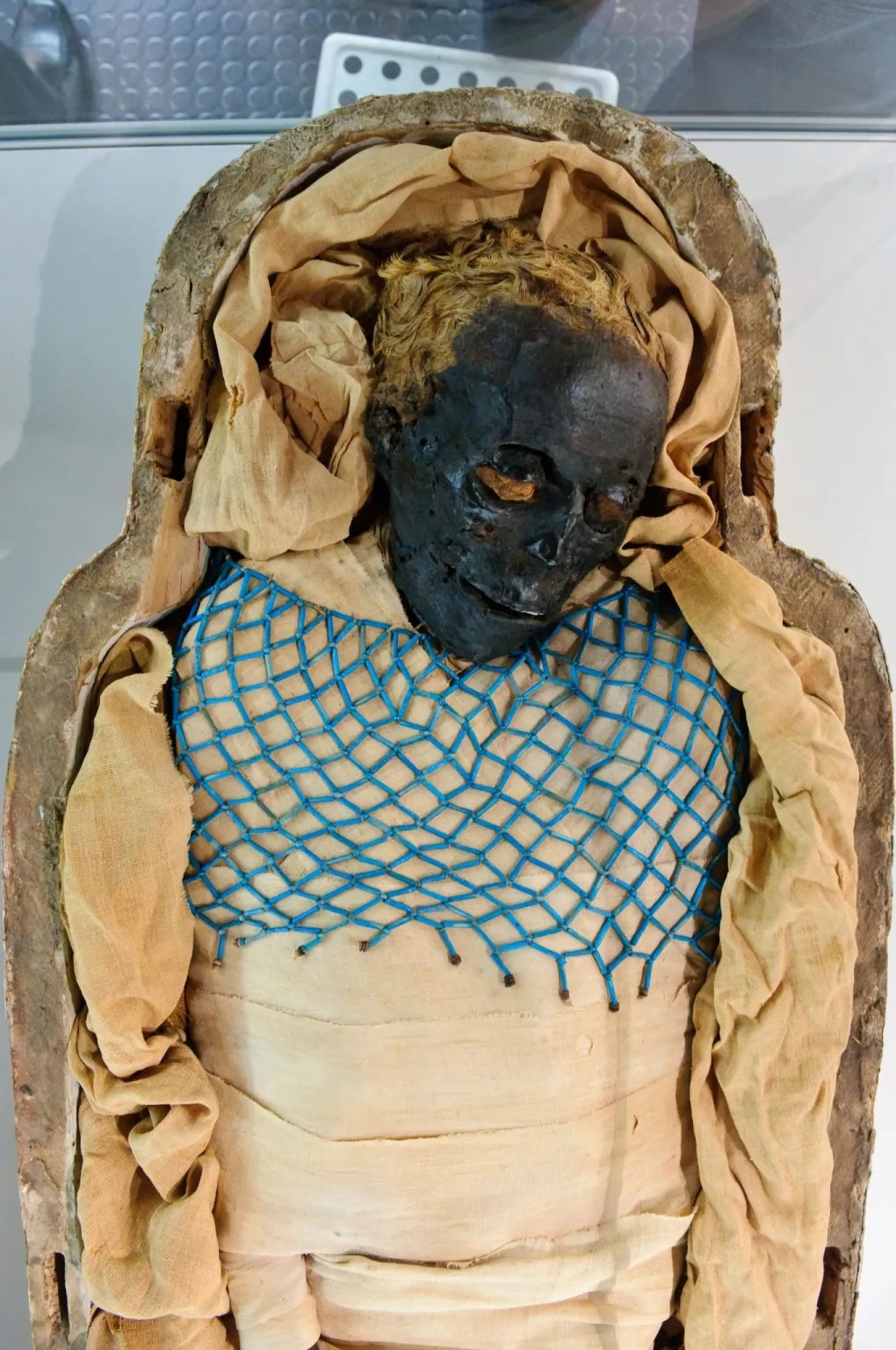
Takabuti. Image courtesy of the Egypt Museum.
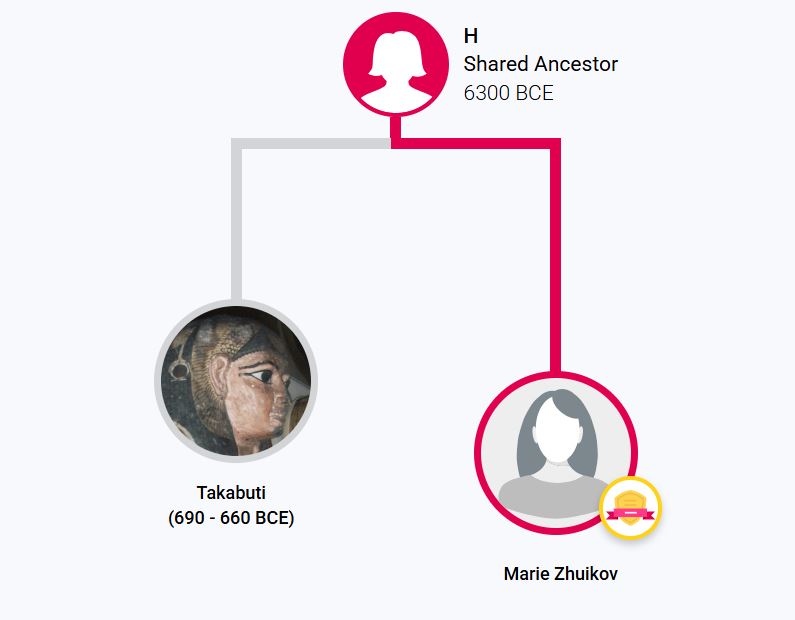
According to the DNA site, Takabuti and I shared a common ancestor 6,300 years ago. She died and was mummified about 2,600 years ago in Thebes, which is now known as Luxor. The striking thing about her is that she has red hair. It has lightened to a golden color now, due to light exposure since she’s been on display. DNA testing on the mummy showed that her mother was European – probably from the Canary Islands or Southern Iberia (Spain and Portugal). Red hair is not uncommon in that part of the world. It’s thought to come from the area’s indigenous peoples who were known as the Guanches. They were believed to have originated in North Africa, specifically the Berber people of the mainland African deserts.
Takabuti was the daughter of a priest of Ammon-Ra, the sun good and the major deity in Egypt (like Zeus was to the Greeks). As such, her family would have lived comfortably and enjoyed the benefits of high status. Later, Takabuti was the mistress of a great house, and held high social standing. Although she wasn’t royalty, she was mummified to expensive royal standards.
Tragically, Takabuti’s life was cut short between the ages of twenty and thirty. Recent scientific analysis revealed she met a violent end while running, killed by an axe blow to her upper left shoulder that was likely instantly fatal. She may have been trying to escape an assailant, possibly during a period of conflict – perhaps at the hands of an Assyrian soldier or someone from her own community. A magic poultice was packed into her wound to help it heal in the afterlife.
How did an Egyptian mummy get to Ireland? The DNA site says that following the Napoleonic Wars, during a period of active trade in Egyptian antiquities (known as Egyptomania), Takabuti was purchased in 1834 by Thomas Greg of Ballymenoch House, Holywood, County Down. (Perhaps, because of her red hair, he thought he was bringing her back to her homeland?) She made history as the first mummy to be unwrapped in Ireland, with this significant event taking place on January 27, 1835, at the Belfast Natural History Society’s museum. The unwrapping generated considerable scientific interest, particularly in Belfast, then the commercial center of the Irish linen industry, which took special note of her fine linen wrappings.
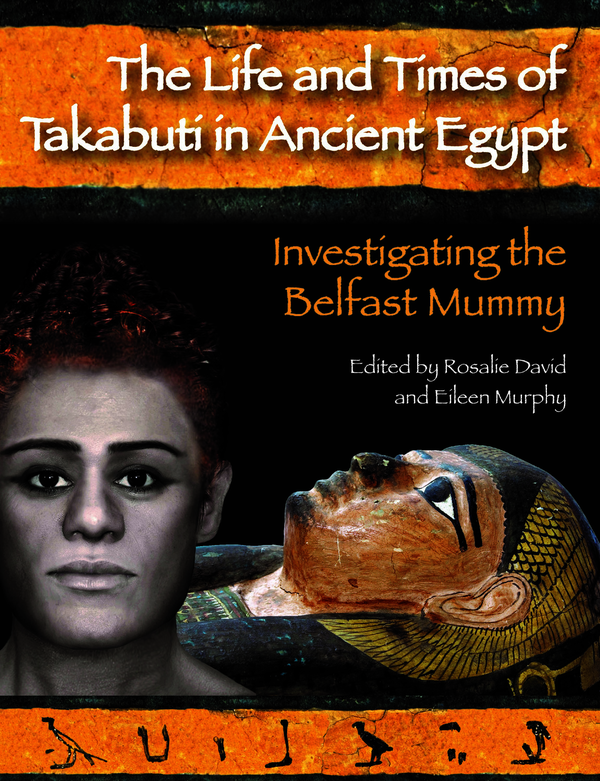
The cover of a book about Takabuti shows a reconstruction of her face and the face on her coffin.
We know so much about Takabuti because she was the subject of intense academic study. Her face has been reconstructed. A book has been written about her, and she’s also been the subject of a short story. I haven’t read that story yet, but plan to soon. (It’s in Matters of Life and Death by Irish/Scottish author Bernard MacLaverty. Yet another retirement project!)
I wonder if her unusual red hair contributed to her high status is Egypt. Although I don’t have red hair, my mother had it. But hers came from her Scottish/Irish ancestry. My relationship to the mummy is a fun link to history. You can bet if I ever visit Belfast again, I’ll stop into the Ulster Museum and pay distant, distant cousin Takabuti proper respects.
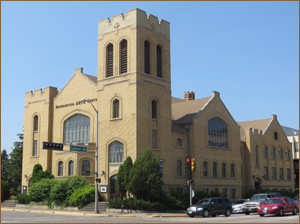
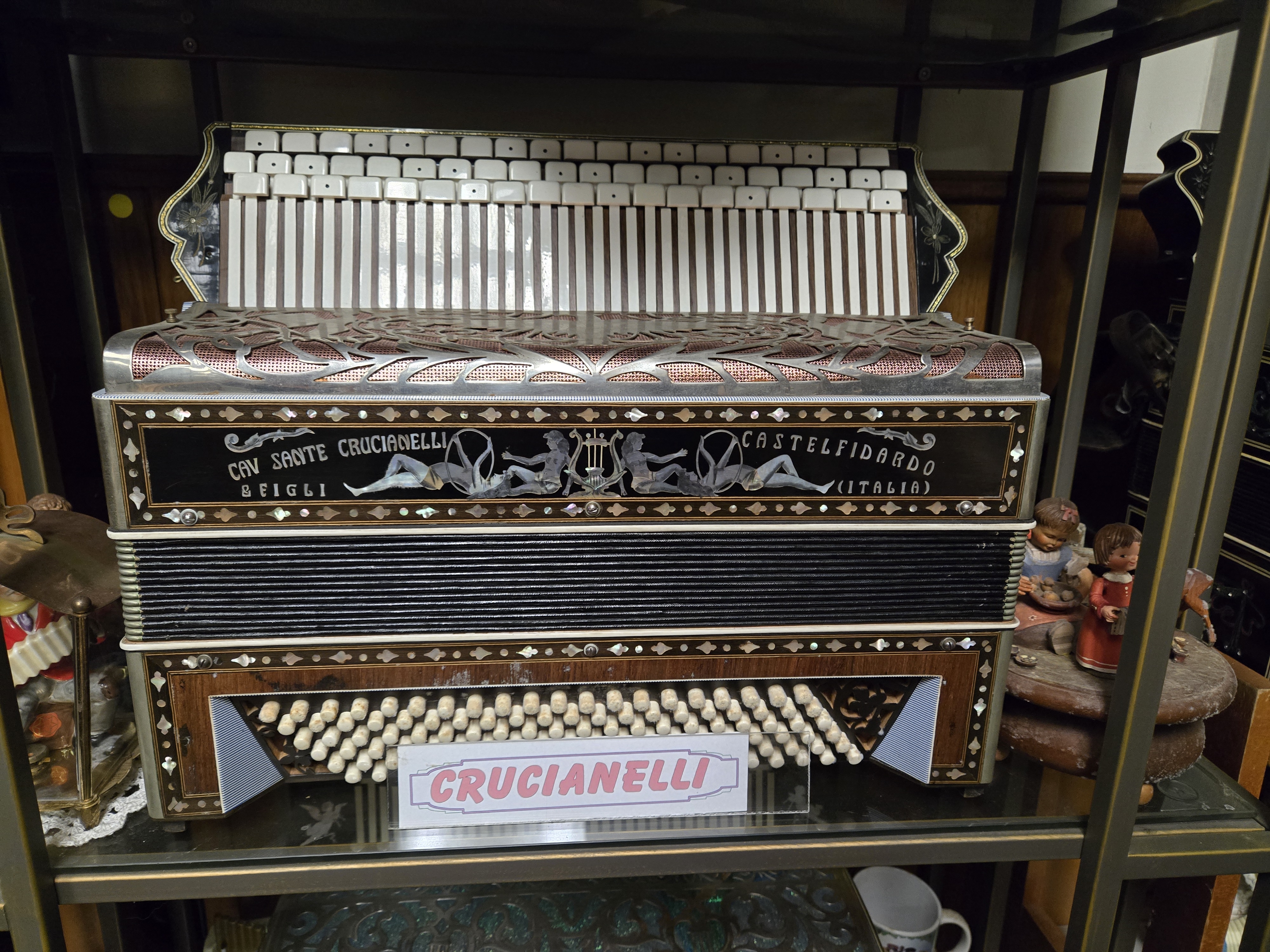
The World of Accordions Museum. Image courtesy of the museum.
I’m aware that I’m jumping the gun. World Accordion Day is May 6, and National Accordion Awareness Month isn’t until June. But I just couldn’t wait to write about our visit to the World of Accordions Museum in Superior, Wisconsin.
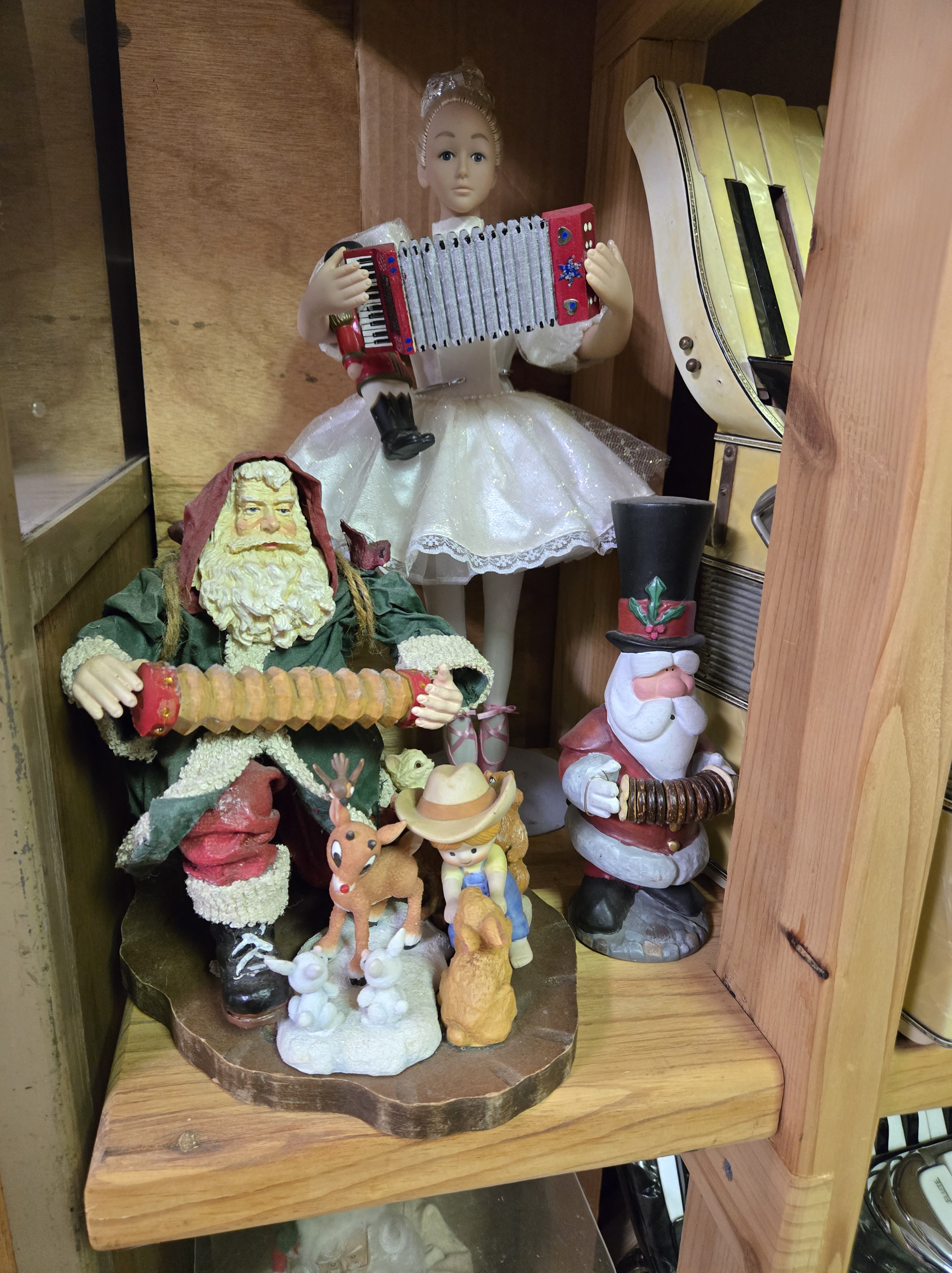
I’ve driven past the unassuming building on a busy street corner hundreds of times on my way to work and finally had time to take a peek last weekend. Inside are over 3,000 accordions and probably every ceramic figurine ever made that’s holding an accordion. The museum contains instruments from all over the world: Ireland, Spain, Germany, Scandinavia, etc. —from primitive concertinas to highly embellished accordions from the Vaudeville era that feature abalone. We even noticed a wooden accordion.
One of the fancier accordions in the museum.
The World of Accordions Museum was founded by Helmi Strahl Harrington in 1993. Our tour guide told us that Helmi’s mother was an accordionist who was conscripted in Hitler’s Germany to teach SAS wives to play the accordion. The family escaped to America and Helmi continued the family accordion tradition. She learned how to maintain accordions through a technical college in Red Wing, Minnesota. Although she currently has cancer, she hasn’t let that stop her from teaching accordion students and repairing accordions.
Christmas accordion figurines.
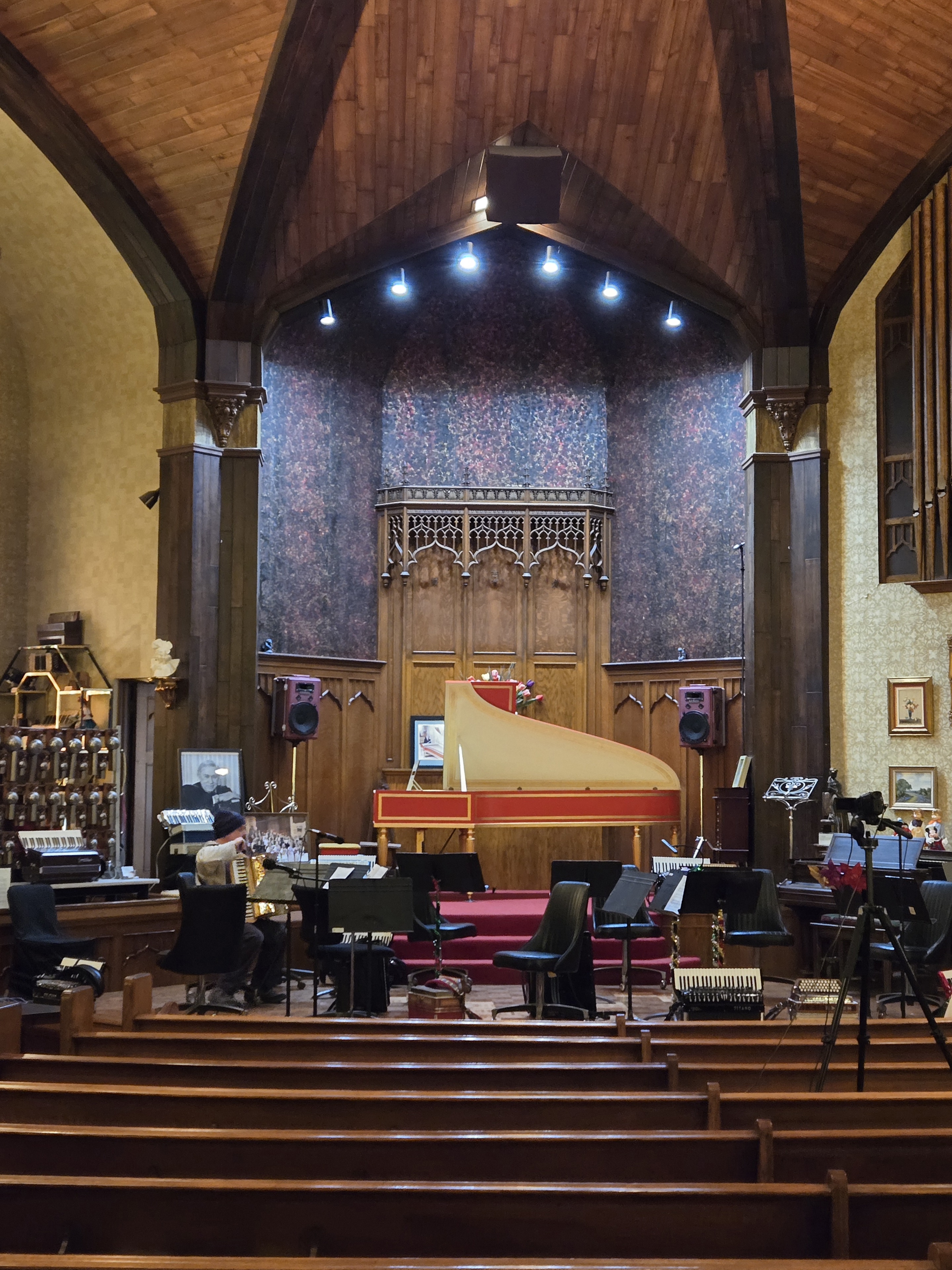
The nonprofit museum also houses a music and files room and a concert hall in what used to be the sanctuary of a former Episcopal Church. Our helpful tour guide said she got hooked on the museum when she came in for a tour. Now, she’s taking lessons and giving the tours herself. She even let us try our hand(s) at playing an accordion.
The performance space in the museum.
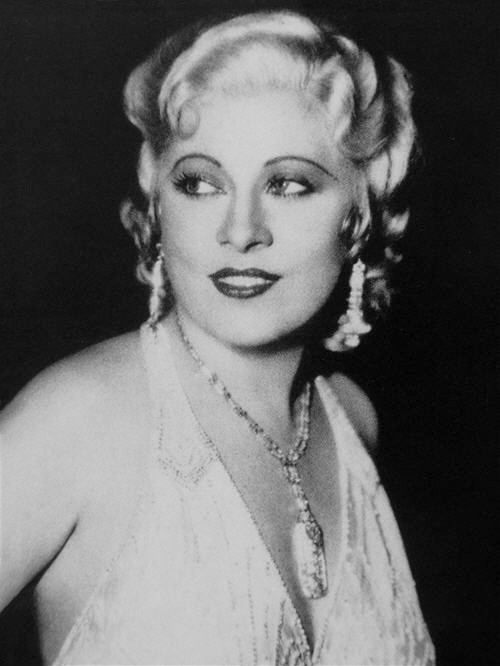
Mae West. Image courtesy of the Los Angeles Times Archives
Due to my dust allergies, I couldn’t spend as much time in the museum as I wanted. My sinuses began to ache! But before we left, one interesting thing we learned was that blond bombshell and actress Mae West was married to an accordionist. His name was Frank Szatkus, whose stage name was Frank Wallace. He agreed to keep their marriage secret to help West’s career. According to Wikipedia, the couple never lived together as husband and wife. When asked, West insisted that they had separate bedrooms, and that soon after their marriage, she sent him away in a show of his own to get rid of him. They married in 1911 and divorced in 1942. Was it because of the accordion?? We may never know.
One of my favorite store chains, Drink Wisconsibly, has made a YouTube video about the museum, which is fun to watch.
The museum has an annual festival in early May, centered around World Accordion Day. They offer workshops, talks, and concerts. Keep your eyes out for info about that. It would be a good excuse to visit if you just can’t get enough of accordions.
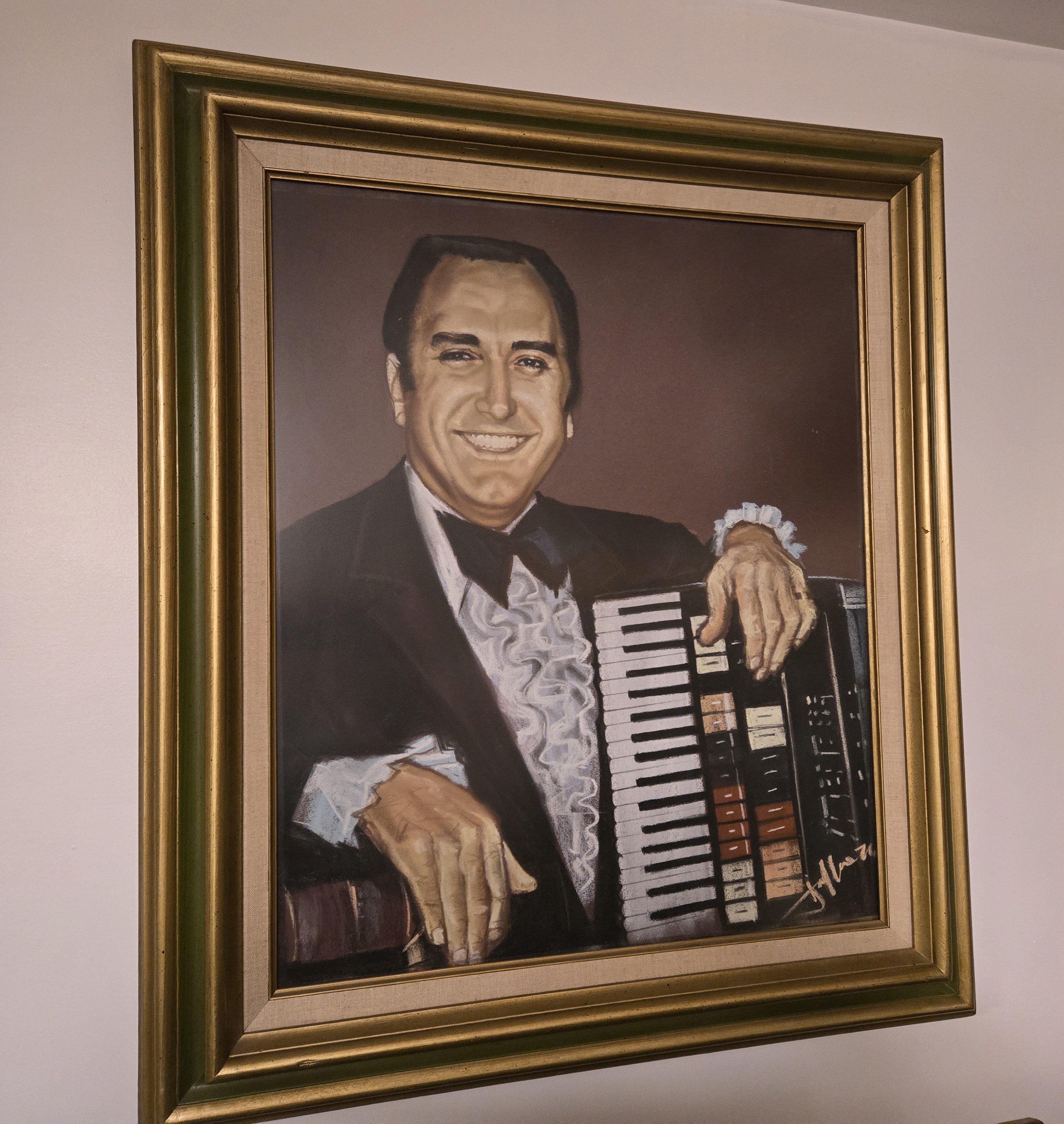
I don’t know who this guy is, but he seems pretty happy with his accordion.
Russ and I went to one of those outdoor Christmas villages for this first time last weekend. It was in Knife River, which is about 20 miles north of us along the shore of Lake Superior. The village is called Julebyen (pronounced YOOL-eh-BE-en), which (appropriately) means Christmas village in Norwegian. The quaint former fishing village that it’s located in has Norwegian roots. Proceeds from the event support the community.
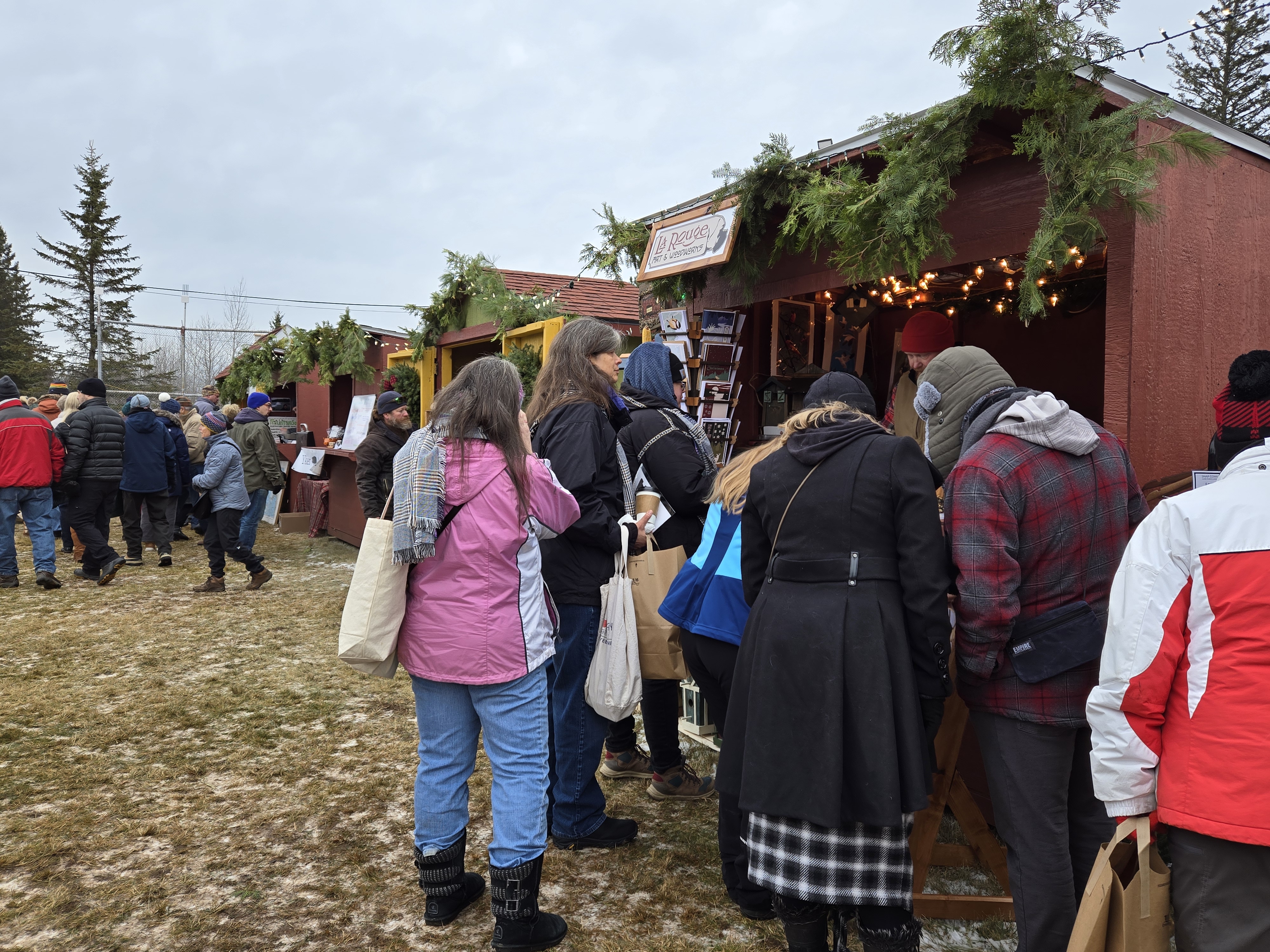
Outdoor stalls at Julebyen in Knife River, Minnesota.
Julebyen features ethnic foods (like lefse and krumkake), crafts, holiday decorations, and music. There are also food trucks from local eateries. A train brings visitors up from Duluth and Christmas-themed buses travel from the Twin Cities. We quickly learned that the event is HUGE. Lots of people and lots of fun. Shopping takes place in outdoor stalls and indoors under a couple of large tents. There are candles, pottery, clothing, teas, notecards, wooden sleds, fish, wreaths, honey, jewelry, mittens and honey.
My favorite thing, however, were the trolls. Two men in costume posed for photos and make troll-like comments and jokes with passersby. As you can see, I took advantage of the photo op. In Scandinavian folklore, trolls are supernatural creatures who are dangerous, evil, and hostile to humans. These ones weren’t, though. Trolls are thought to be able to transform themselves, offer prophesies, and steal human maidens. When exposed to sunlight, they explode or turn to stone. This is helpful to know if you ever meet one. Also helpful to know is that lightning kills them instantly.
I assume this is a Norwegian-style fishing boat, with a festive sail for the holidays.
The village also offered a sledding hill, but there wasn’t enough snow yet for that. I’m glad we got to enjoy Julebyen and get into the holiday spirit. I think it’s helping us through some hard times. I just learned by happenstance that my friend Yooper Duane died this year, on my birthday, no less. He was a special soul. We met on Isle Royale National Park in Lake Superior when I was in college and corresponded for years. I’d make a point of visiting him when I traveled across Michigan’s Upper Peninsula. The last time we touched base was by phone when I was on Isle Royale a couple of years ago. He was impressed by the phone call, since such contact was not technologically possible when we both worked on the island. Duane died at the ripe old age of 80. I’ll miss him!
The Knife River, which flows through the town.
Also, this week a family member was hospitalized. That’s all I’ll say about it to preserve this person’s privacy. But it’s a stressful situation that’s difficult for everyone.
Be sure to give your loved ones a hug this holiday season. You never know what the future holds.
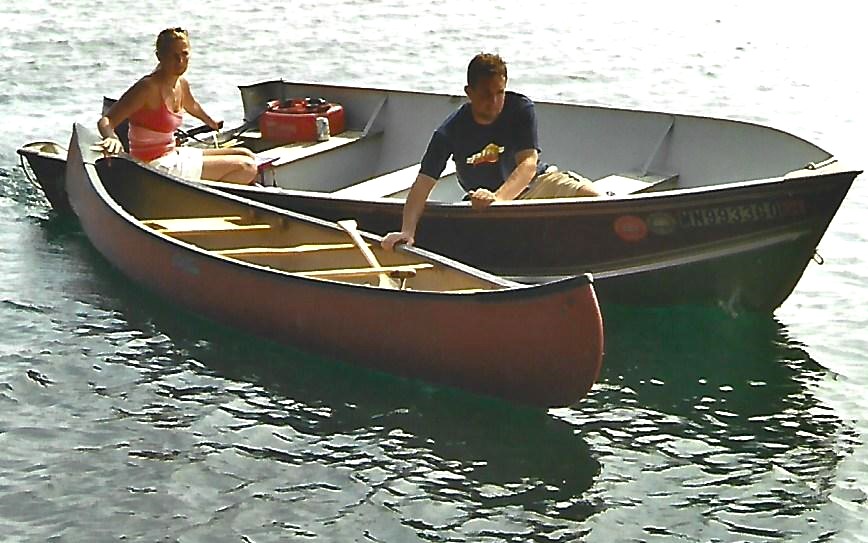
Me and my boys in our Old Town canoe, Clearwater Lake. Photo by Sharon Moen.
It was August 2003 and my friend Sharon and I decided it would be fun to do a mother/children canoe trip in Minnesota’s Boundary Waters Canoe Area Wilderness. At the time, my boys Hunter (4 yrs) and Logan (11 yrs) had been camping but I don’t think they’d been in the wilderness yet.
We planned to stay on Clearwater Lake, which I became familiar with years ago when I was a volunteer wilderness trail crew member for the Forest Service. I had fond memories of the clear water and impressive rock ledges on the campsites there. I used to work for the Forest Service and had been in the wilderness many times, so I was quite comfortable taking my children there in our red Old Town canoe without their dad.
Marie, Hunter, and Logan. Photo by Sharon Moen
Sharon brought along her two girls, Sierra and Savannah, and their dog. I can’t recall exactly how many days we camped – maybe two or three. The weather was great, and the water was warm enough for swimming. A submerged log lay not far offshore from our campsite and provided endless hours of entertainment for our children as they swam. They could stand and bounce on it, which made it seem like a wilderness theme park ride. A downed tree near our campsite also fascinated them.
Marie camp cooking. Photo by Sharon Moen
We spent evenings around the fire regaling each other with tales of our wilderness exploits and prowess. One afternoon, we decided to canoe to a campsite farther down the lake that I recalled was a good fishing spot. A large rock ledge with a deep drop off was also the perfect place for a picnic lunch. We beached our canoes on the small sandy beach at the empty campsite and the festivities commenced.
Sharon about to help Logan unhook his fish.
Later, Logan caught a fish. As Sharon was trying to unhook it for him, the hook went into her finger. I performed minor surgery to get the hook out and all was well. That was, until I noticed a red canoe floating across the lake.
“Huh, that canoe looks the same as mine,” I said to Sharon.
She looked at the beach where her canoe sat all by itself. “That IS your canoe!” she said.
What I, Miss Wilderness Expert, didn’t count on was the wind switching. Part of my canoe had still been in the water, enough so that it floated away.
I panicked. Losing a canoe in the wilderness is like losing your car in the city; maybe worse than losing your car because there’s no public transportation in the wilderness. I was ready to swim out and grab it. I’m not sure why I didn’t think of paddling to it in Sharon’s canoe with one of my children and having them hold onto the canoe so we could tow it back. Anyway, swimming was what made sense at the time. And time was of the essence before the canoe drifted farther away.
I was ready to jump into the lake when a couple in a motorboat happened by. Although motors are not allowed in most of the wilderness, there are a few lakes like Clearwater where they are allowed. I think it’s because there’s a resort on this lake.
“That your canoe?” One of them asked. When we responded in the affirmative, they followed up with: “Want us to get it?”
That earned an enthusiastic “Yes, please!”
Helpful motorboaters return my canoe. Photo by Sharon Moen
They grabbed the canoe, no problem, and brought it back to us. We thanked them profusely and I made sure that sucker was totally out of the water when I beached it this time.
Over the years, Sharon has made sure I don’t forget this incident. We trotted it out just last week when having lunch with a new coworker who wanted to know how long we’d been friends.
Although it was incredibly embarrassing at the time, losing my canoe was a good lesson about not getting too complacent in the wilderness or in life. You never know when the wind might switch.
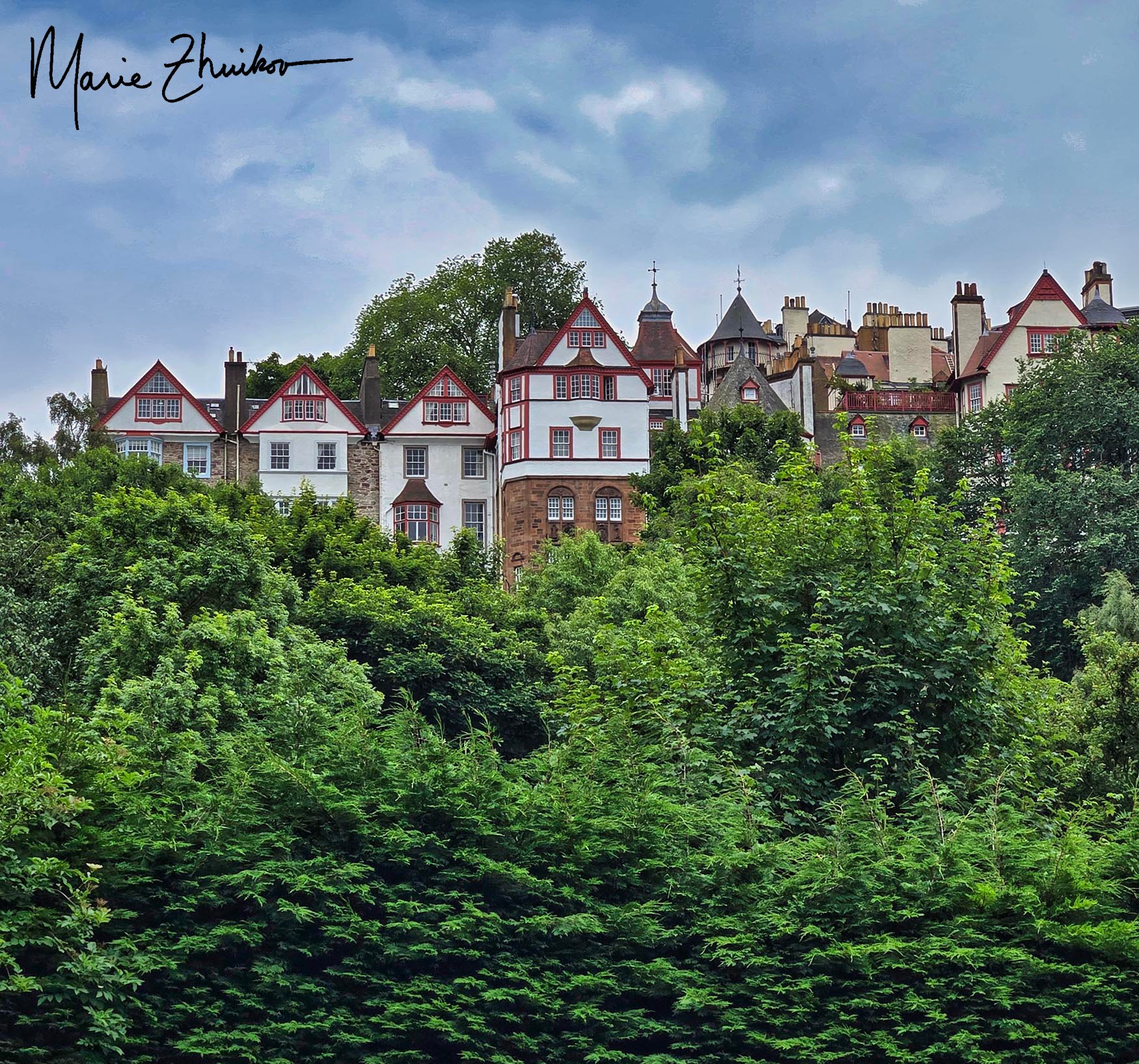
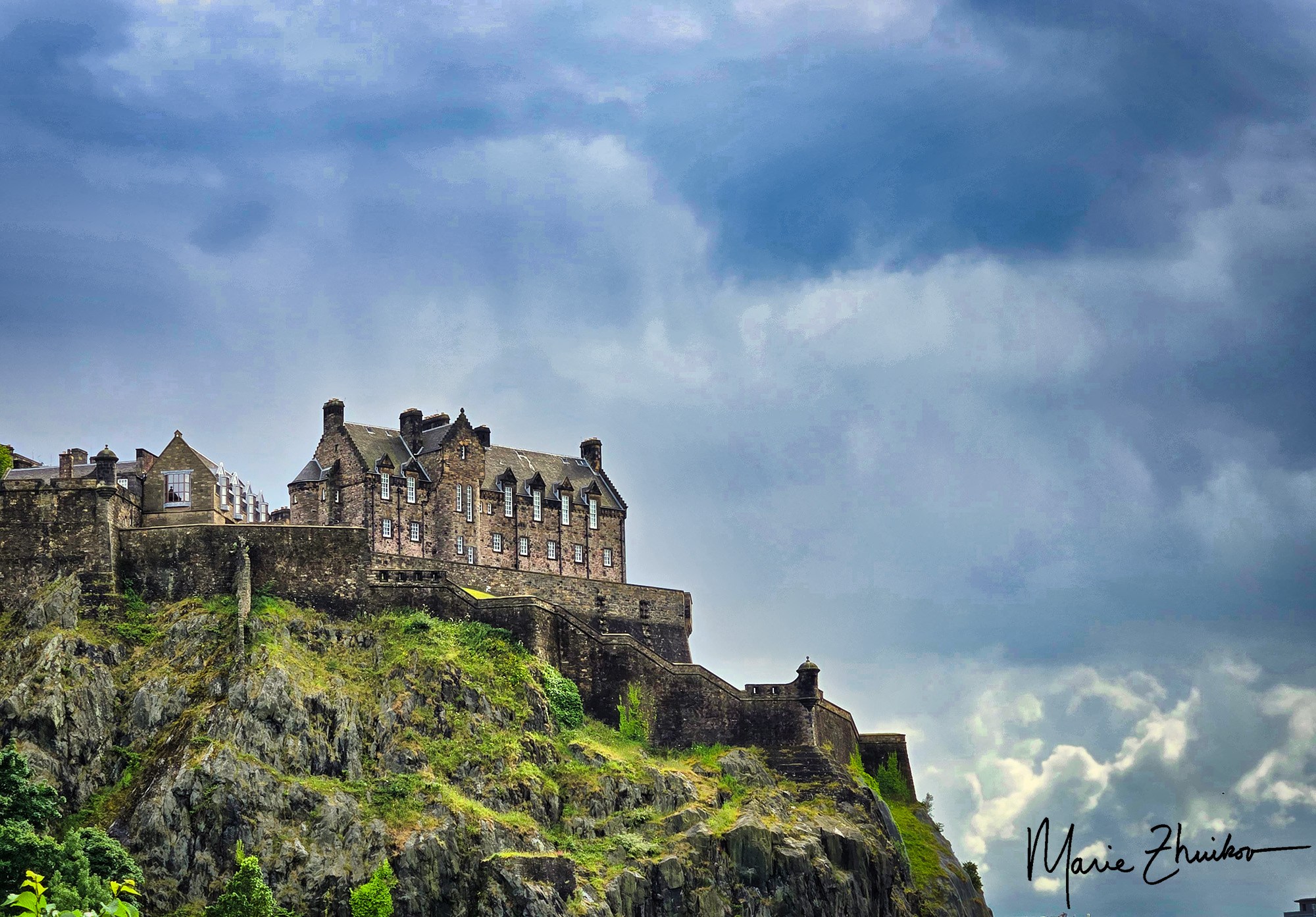
After an awesome Outlander Tour and seeing the Tower of Clackmannan the previous day, we spent our final day in Scotland meandering some more around Edinburgh. We walked through the Princes Street Gardens, marveling at the fountain, statues, and quaint homes that can be viewed from it.
Homes seen from the Princes Street Gardens, Edinburgh
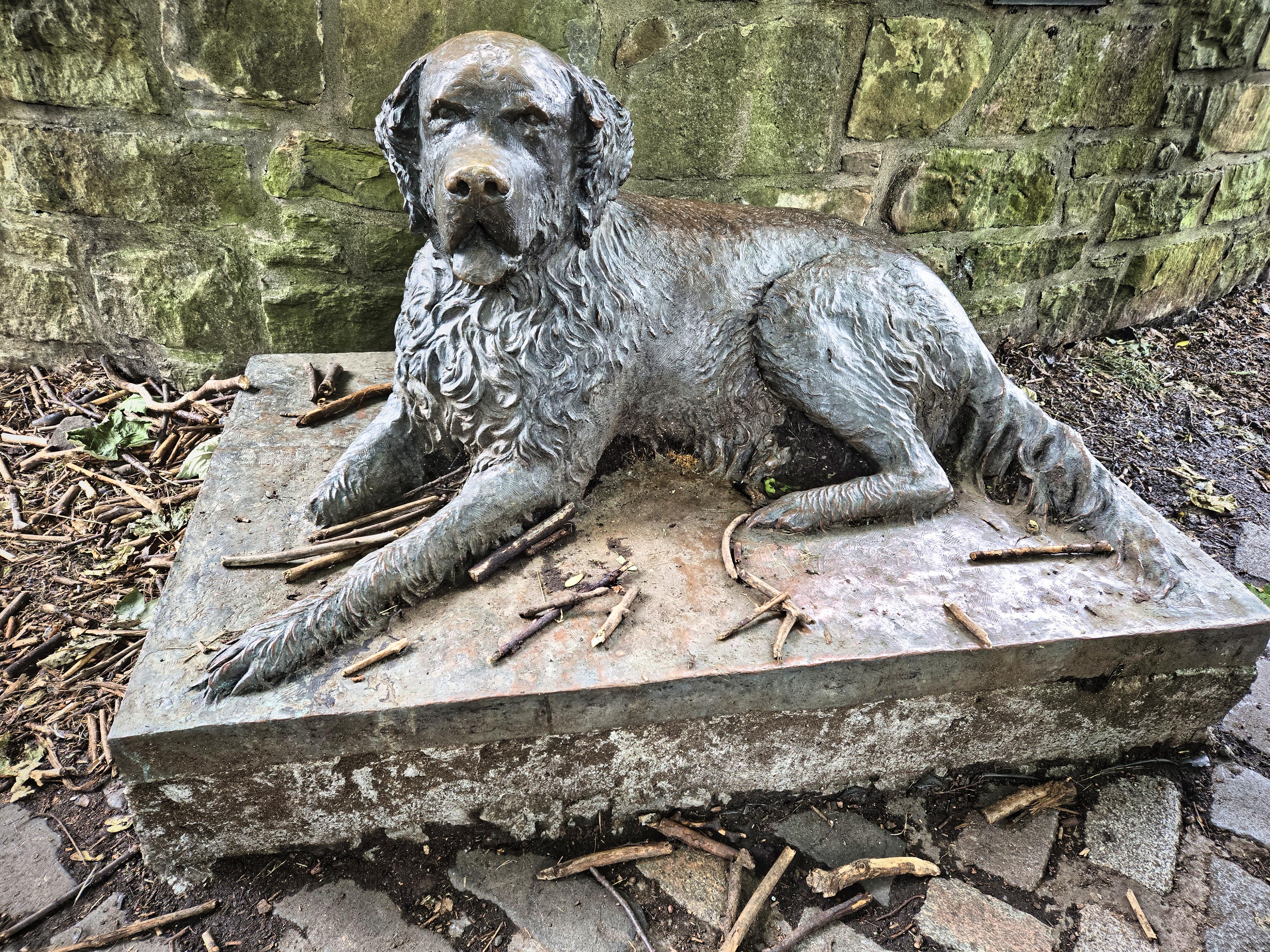
One unexpected sight was a statue memorializing Bum the Dog. Usually, everyone wants to see Greyfriars Bobby, the cute little statue of a terrier who slept on his master’s grave for years. I mean, the dog has even had a movie made about him! I don’t know. I much prefer the less popular landmark of Bum.
Bum, the San Diego dog, in Scotland
This remarkable dog disembarked from a ship in San Diego, where he won the hearts of the populace. The half-St. Bernard, half-Spaniel was owned by everyone and no one. Butchers fed him scraps and local doctors met his medical needs. He was so beloved that when San Diego issued its first dog license, Bum’s image adorned it.
His likeness sits in a small park in Edinburgh in tribute to San Diego, which is Edinburgh’s sister city. The Scots gifted San Diego with a statue of Bobby. The dogs represent the spirit of a twinning link friendship, loyalty, and shared experience. Bum died at age 12 in 1898. His memorial is one of five dog statues in Edinburgh.
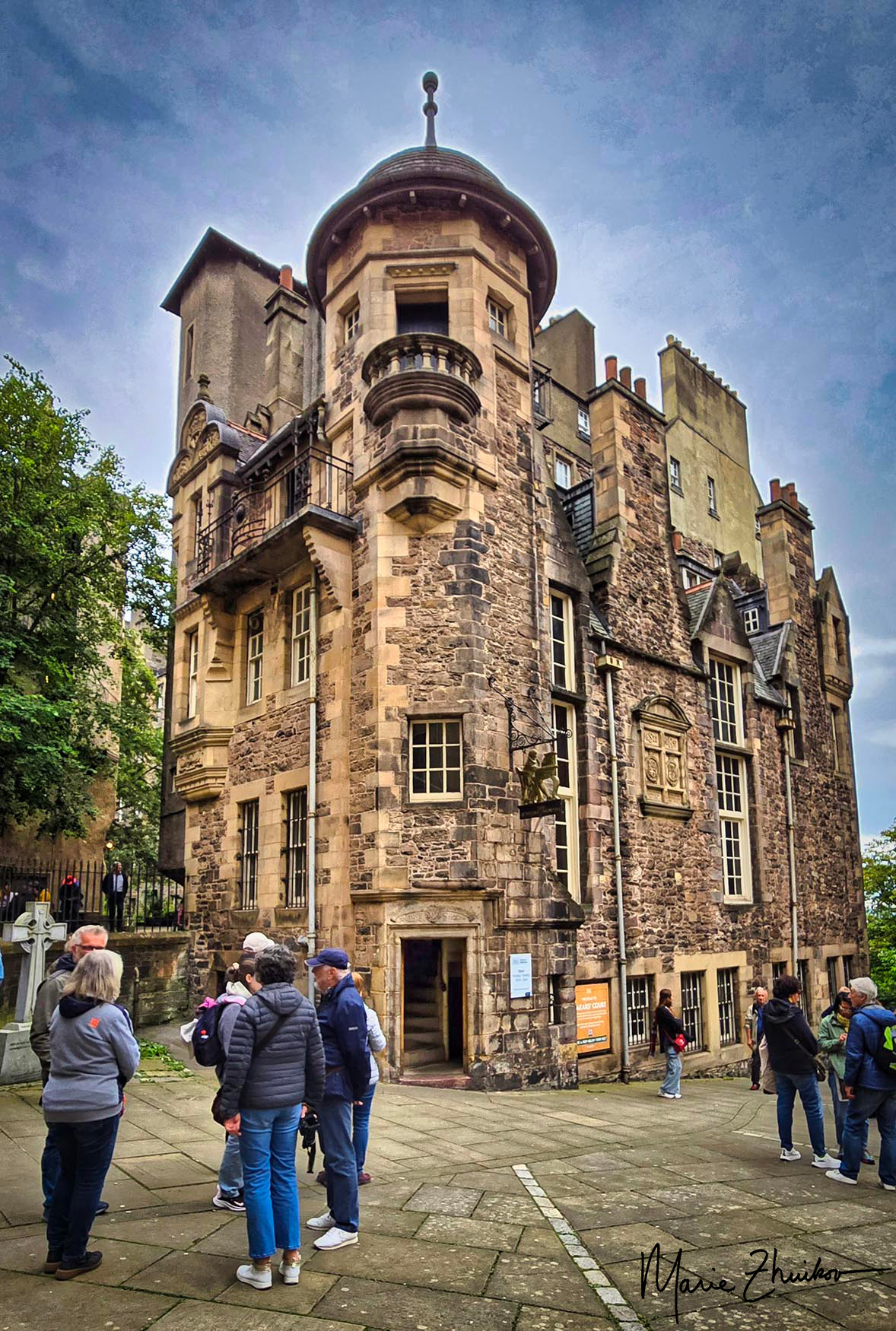
The Writers’ Museum, Edinburgh
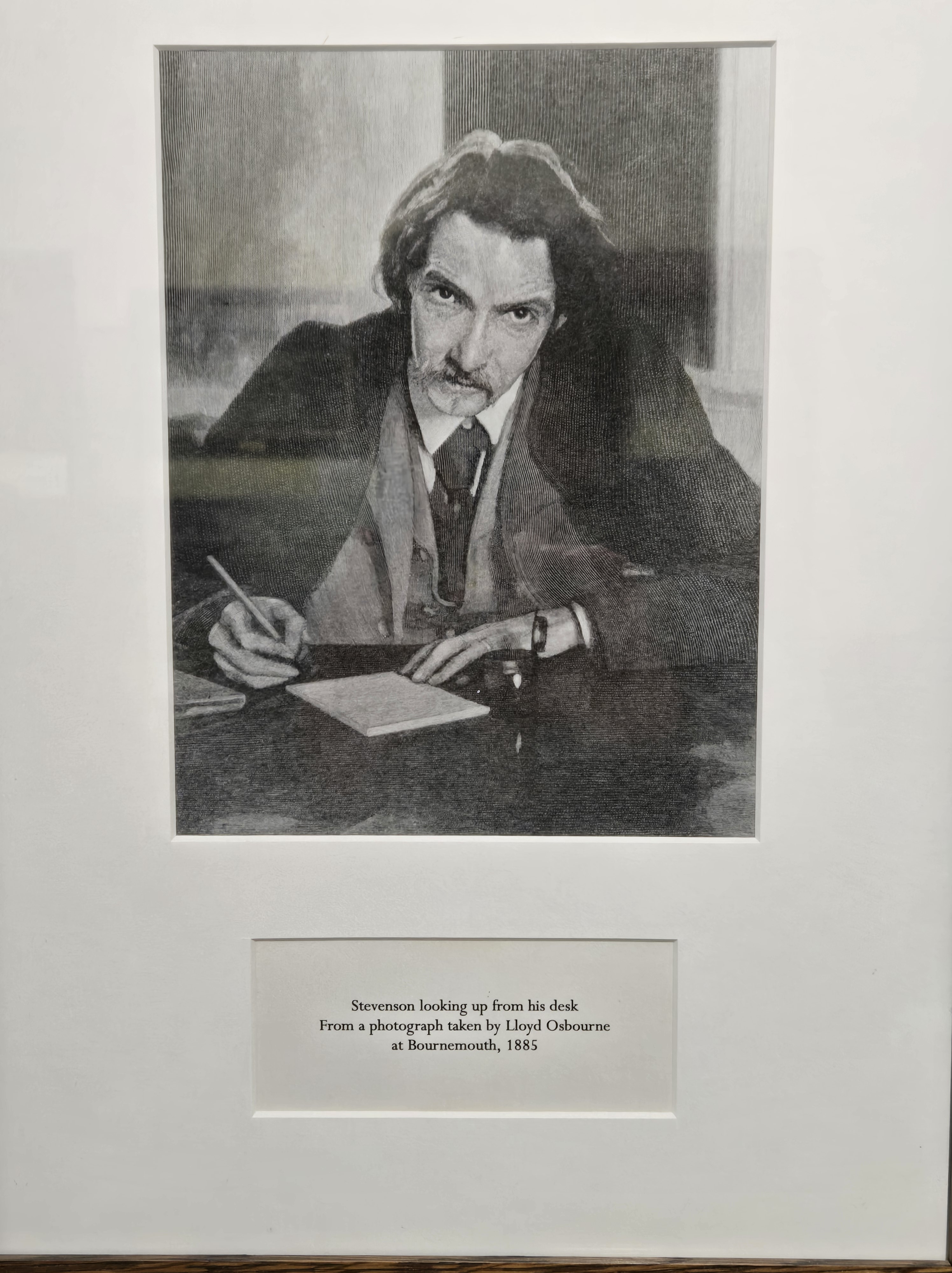
On the other side of the gardens, we made our way to the Writers’ Museum. It’s in a narrow stone building, complete with more spiral staircases (my favorite!) The free museum is devoted to three Scottish writers: Robert Louis Stevenson, Sir Walter Scott, and Robert Burns. I never knew that Stevenson spent his later years in Samoa. One of the artifacts we saw was a tortoise shell ring given to him by a Samoan chief, engraved with the name ‘Tusitala,’ meaning ‘teller of tales.’
AuthorRobert Lewis Stevenson
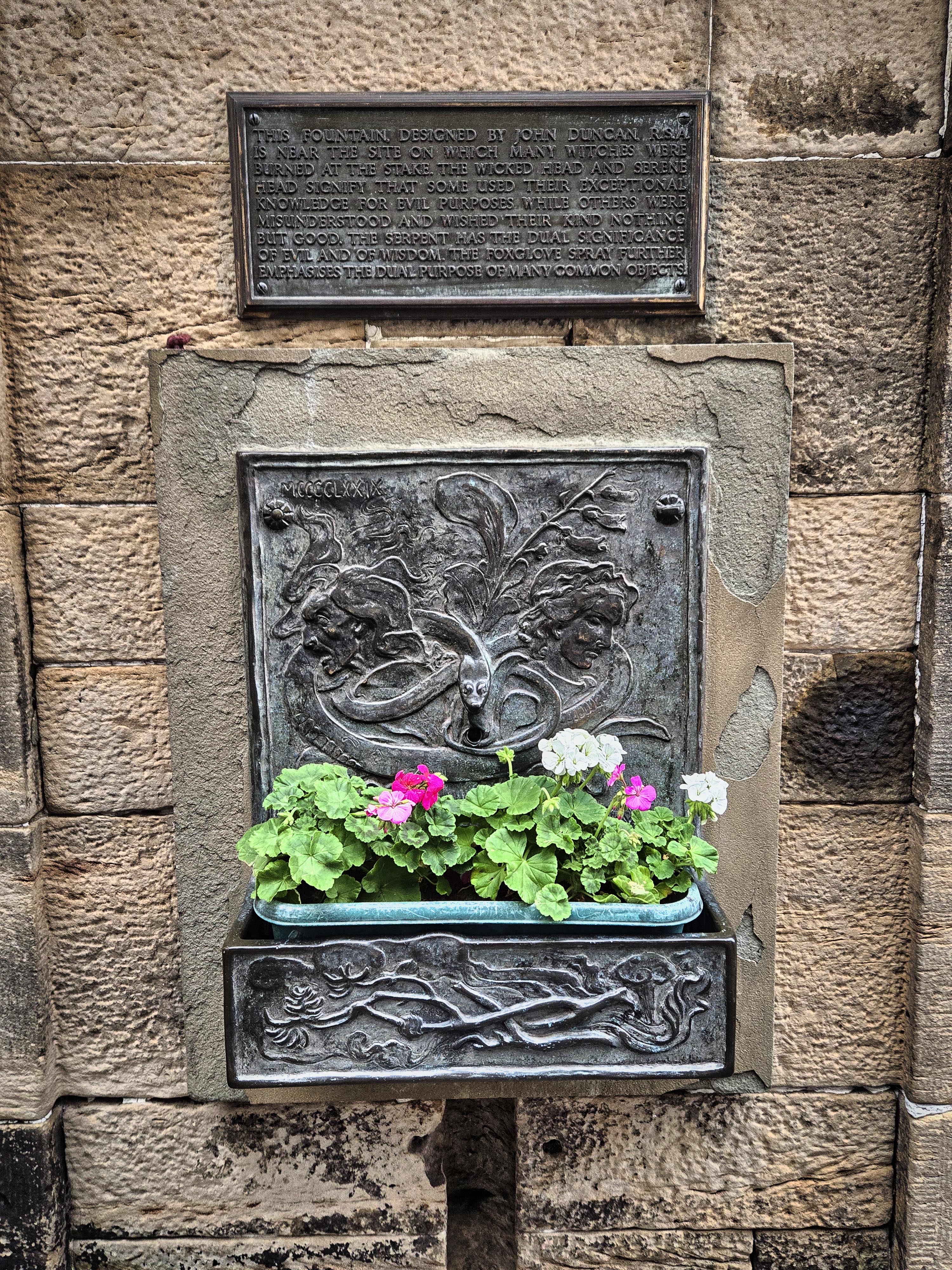
The museum is near the Royal Mile, so we walked down that again, picking up last gifts for people back home. We also found the Witches’ Well, a memorial to all the women who were killed for practicing “witchcraft.” They were strangled and burnt on Edinburgh Castle’s Esplanade. It’s so small, we almost missed it! Surely, a memorial to the deaths hundreds of people should be a bit larger?
The Witches’ Well, Edinburgh
The plaque features a bronze relief of witches’ heads entangled by a snake. It uses dualism to highlight the balance between good and evil and to show that every story has two sides. The relief contains the image of a foxglove plant, from the center of which is a coiled snake intertwined around the head of Aesculapius, the god of medicine, and his daughter Hygeia, the goddess of health. Foxglove, though used medicinally, can also be poisonous depending on dosage, and the image of the serpent imbued with wisdom is also acknowledged as evil.
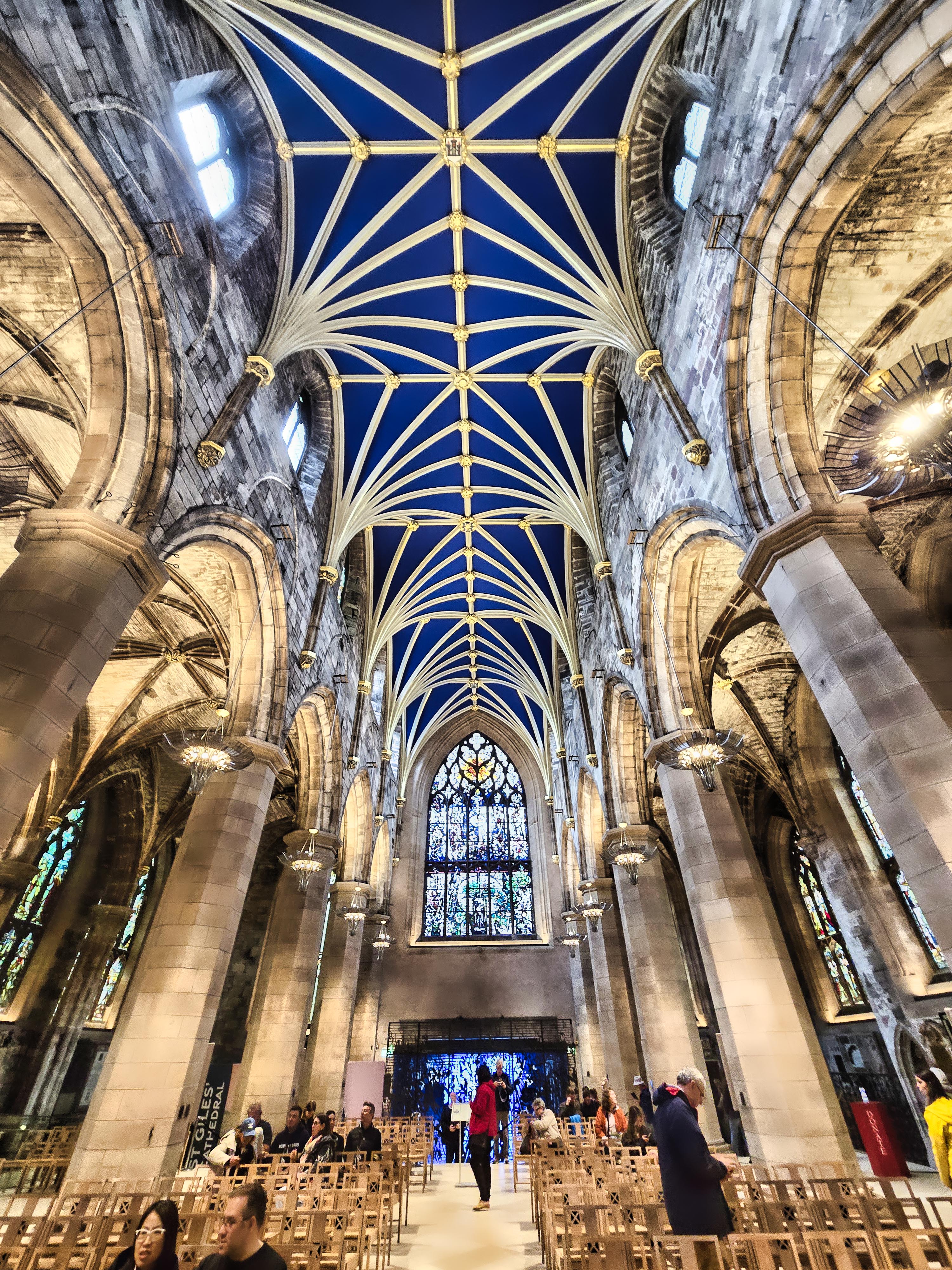
As if to counterbalance the paganism, we popped into St. Giles Cathedral, another free tour opportunity. It’s quite the impressive structure! It was built in 1124 and has no doubt been rebuilt over time. I loved the ornate ceiling.
St. Giles Cathedral, Edinburgh
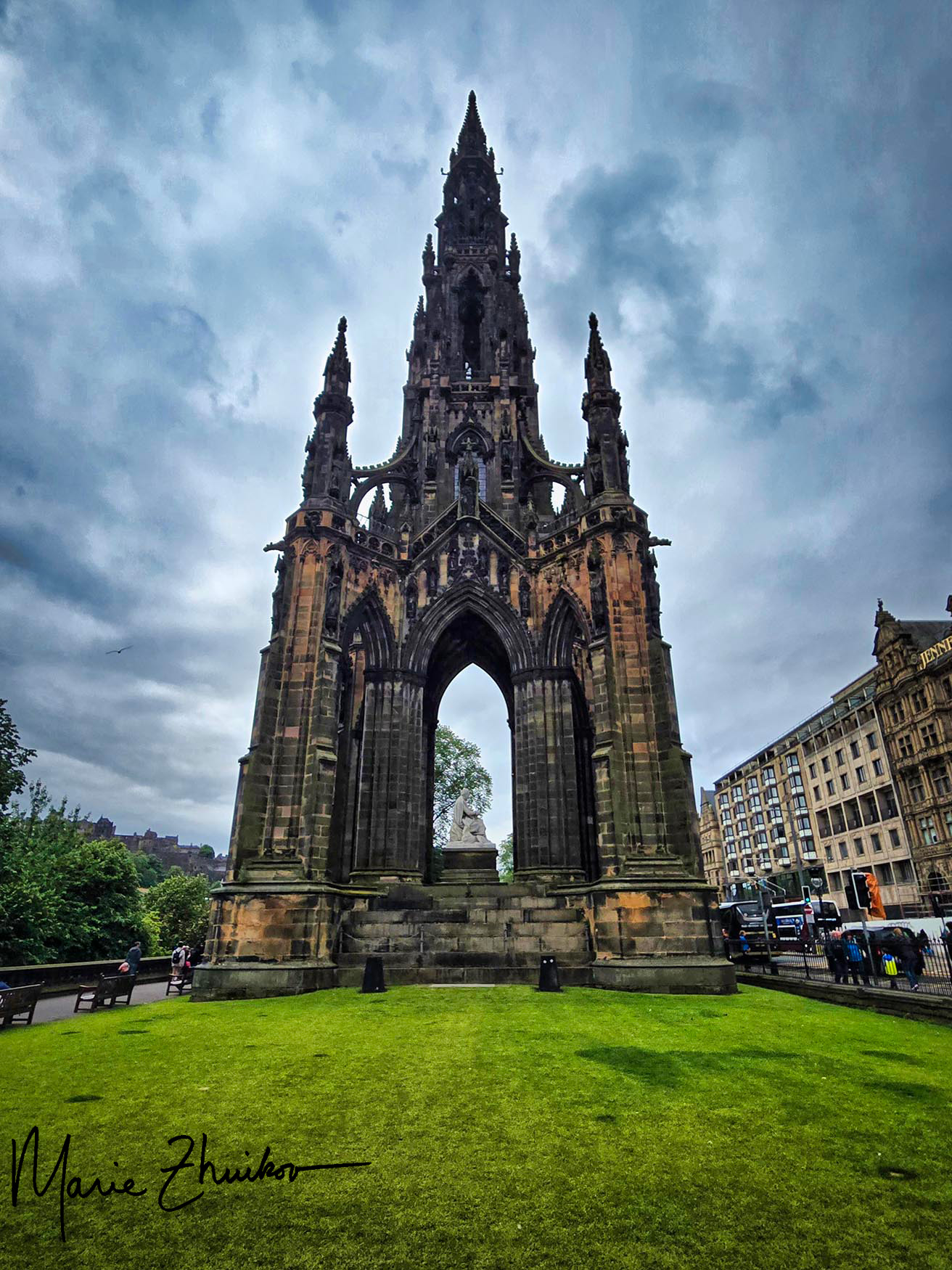
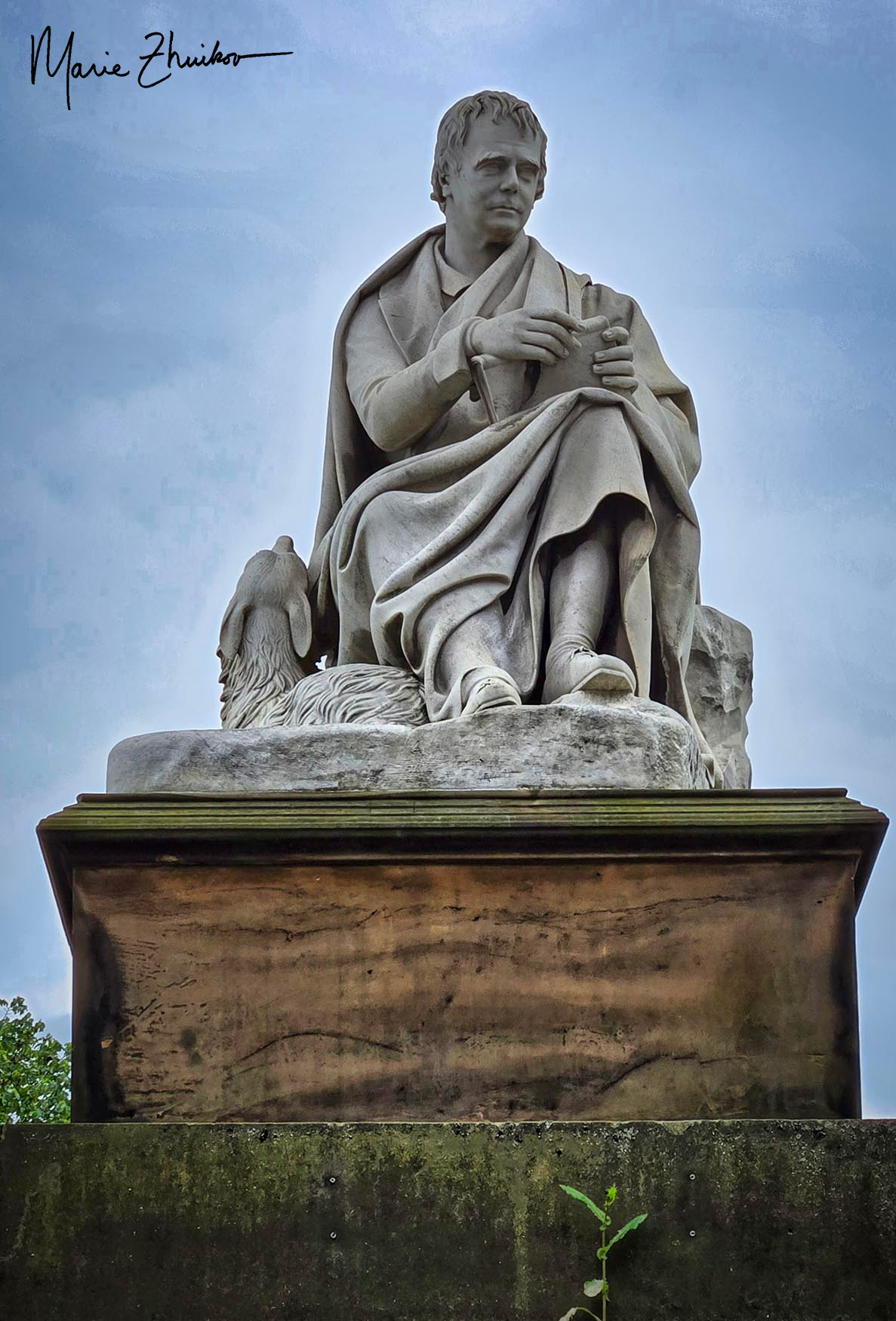
On our walk back to our hotel, we passed the Sir Walter Scott Monument, or the “gothic rocket ship” as our Outlander tour guide Henry dubbed it. I climbed the monument as a child and didn’t particularly feel the need to traverse more spiral staircases with my mending broken ankle now, so we appreciated it from the ground. Sir Walter’s statue in the middle of the tower sported another one of Edinburgh’s dogs, which sits by Sir Walter’s side. The dog, Maida, was a cross between a highland deerhound and a Pyrenean wolfdog.
Sir Walter Scott and Maida
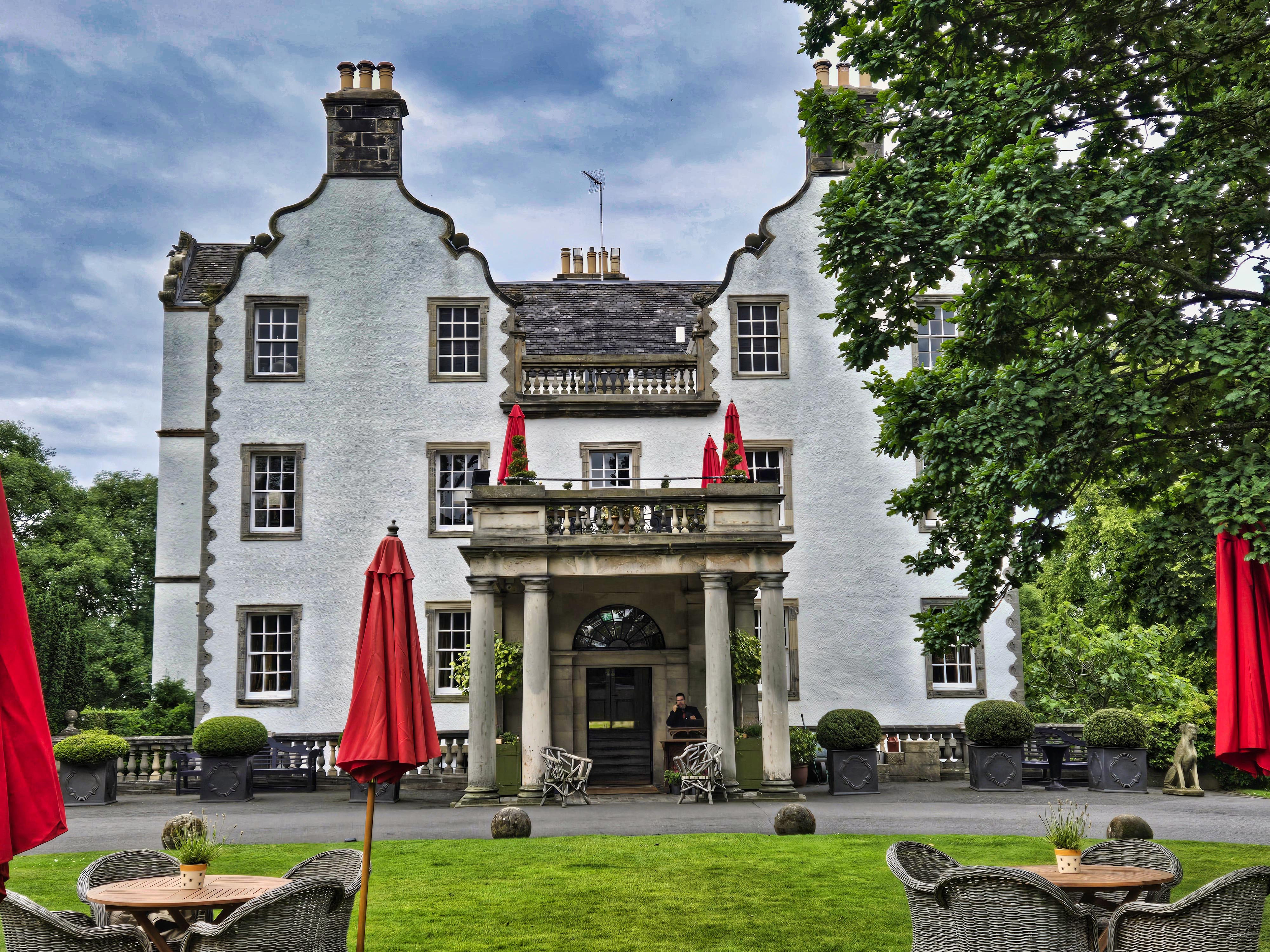
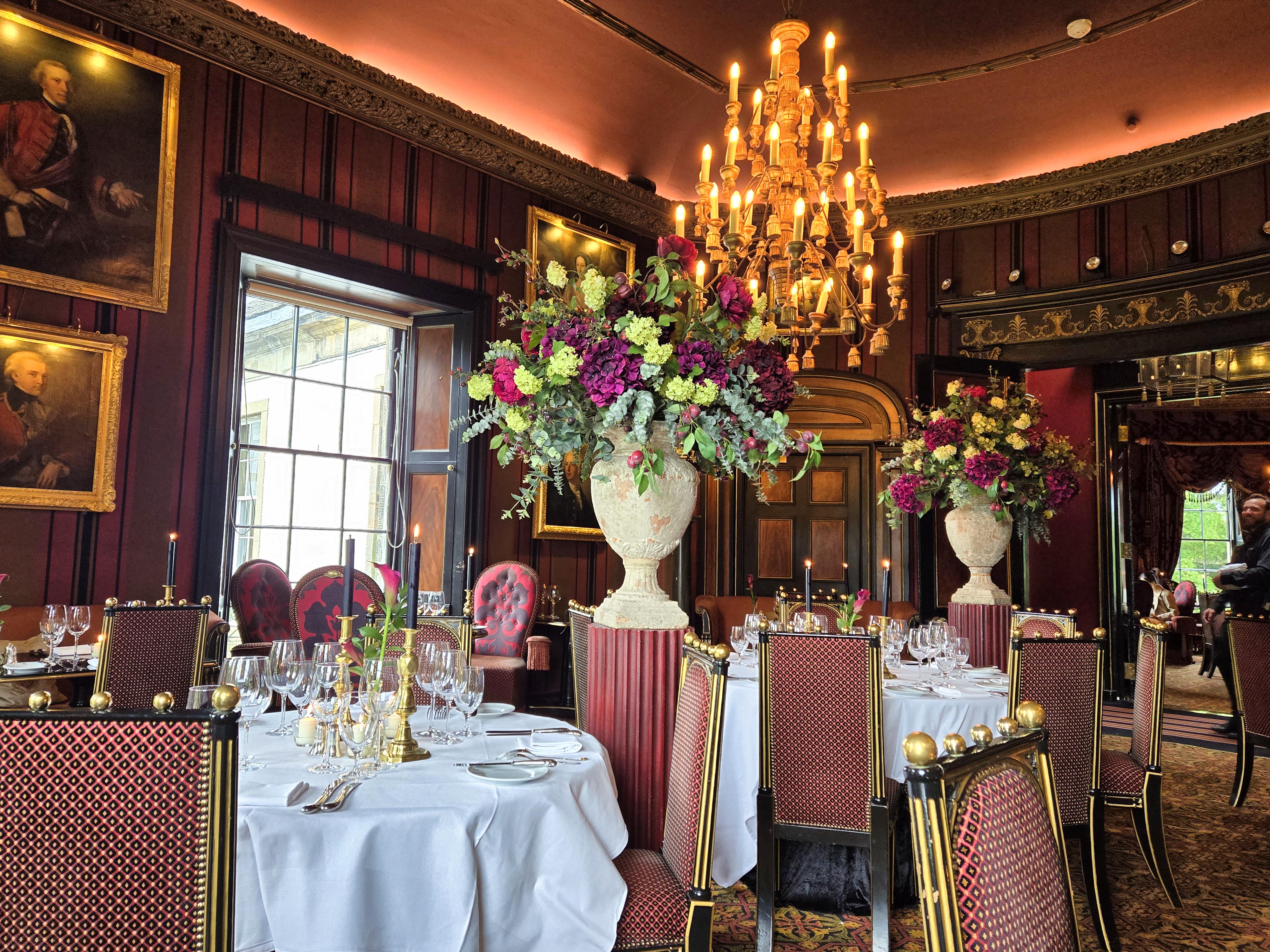
At the hotel, we got spiffed up for our final dinner in Scotland. We planned to go out in style! We had made reservations at The Rhubarb Restaurant, where rhubarb was first introduced to Scotland from Asia in the eighteenth century. Its garish yet fun interior reflects the plant: red velvet with green accents. So does its menu.
The Rhubarb Restaurant and Hotel
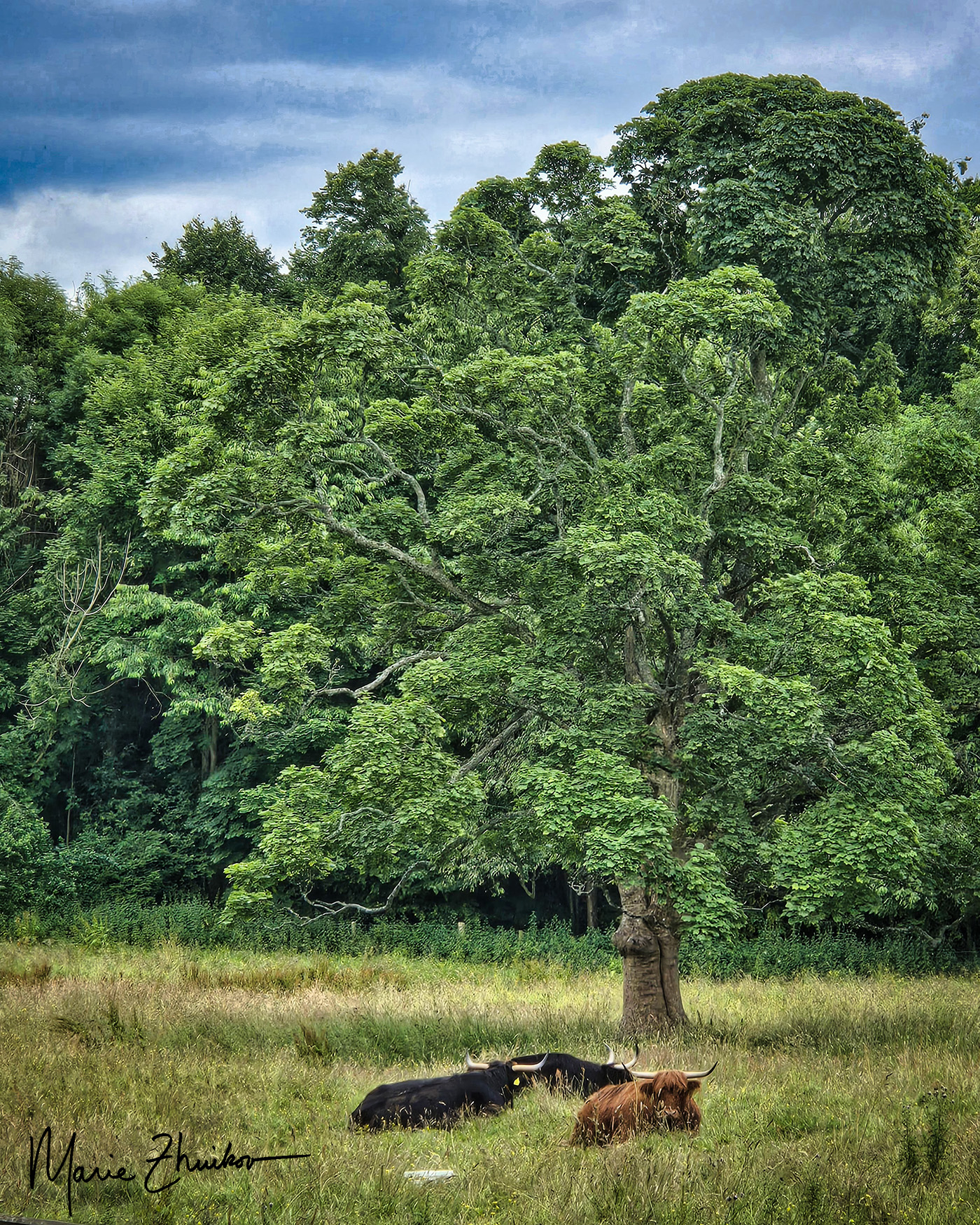
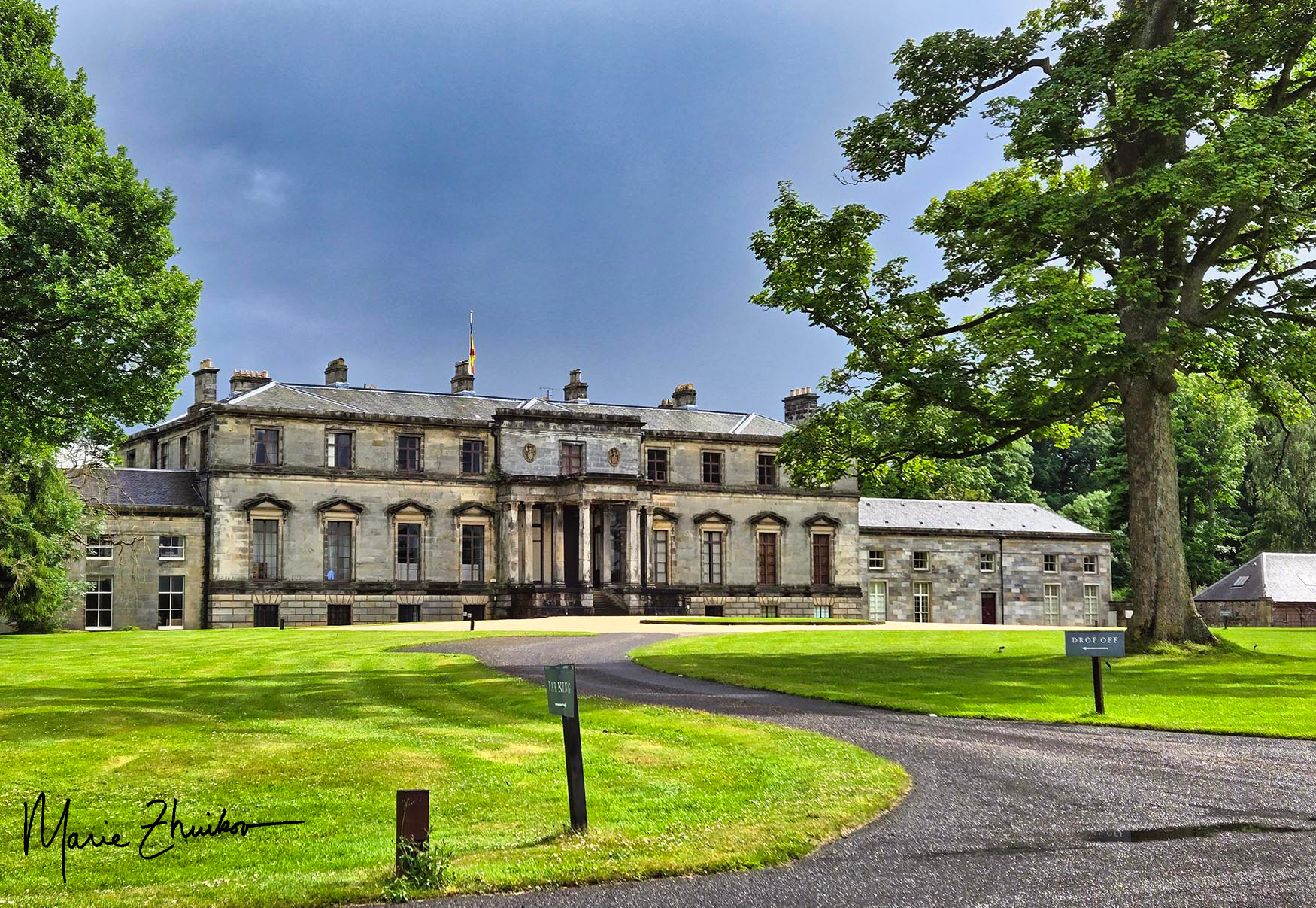
We caught a cab for a ride around the other side of Edinburgh Castle and Arthur’s Seat where the mansion and its large landholdings sit in the middle of the city. We had some time before our reservation and used it to explore the grounds and gardens. We were inordinately excited to see Highland cows (or coos) on the estate. We hadn’t seen any proper coos during our trip yet. There they were, lying underneath an impressive tree!
The coos! Rhubarb Restaurant Estate.
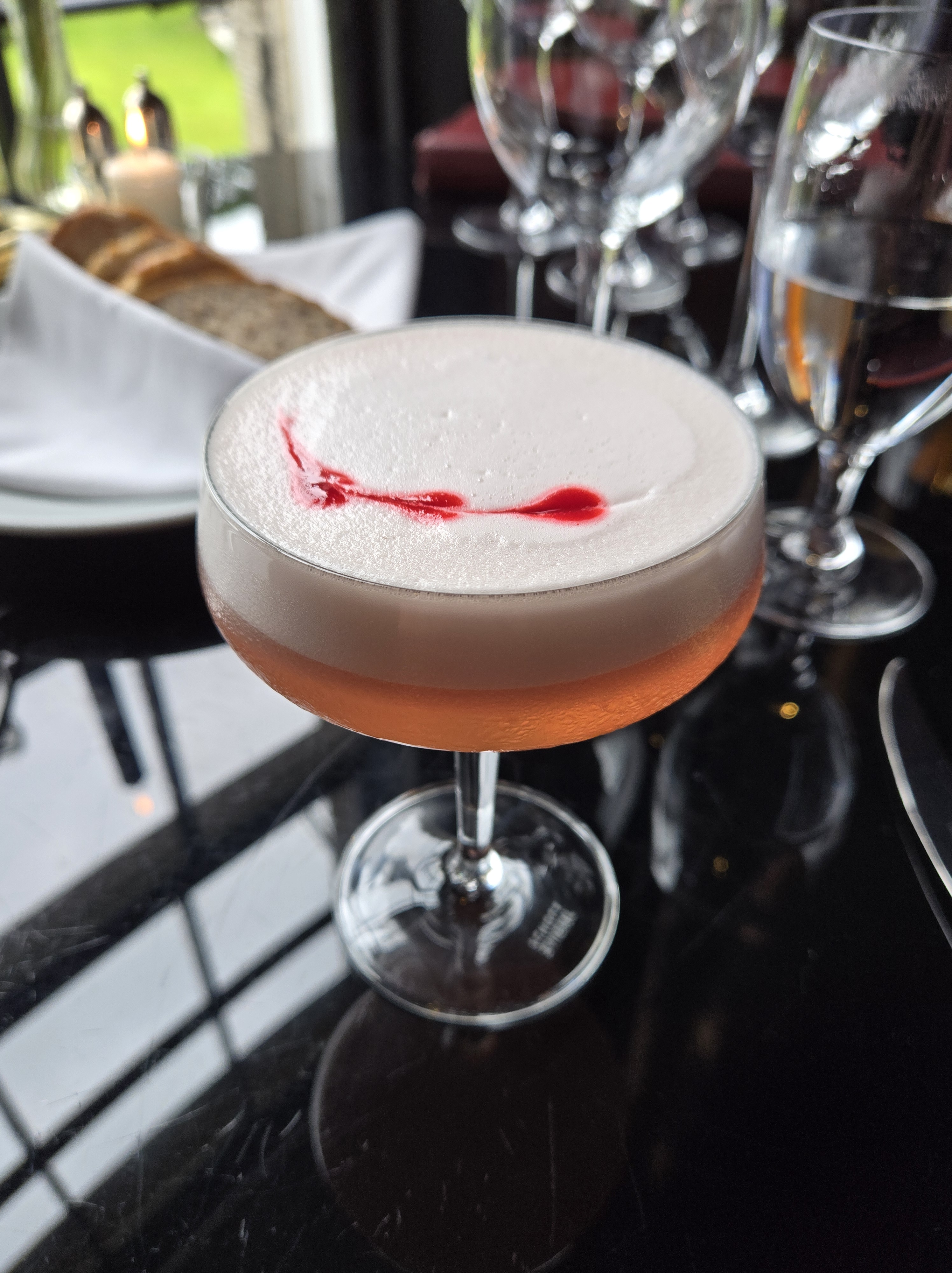
Inside, we were seated in a dining room (there are several) that offered a beautiful view of the grounds. I had a rhubarb-themed cocktail called the rhubarb patch. It had vermouth and rhubarb syrup — very good!
A rhubarb patch cocktail
For dinner, we shared a Châteaubriand Angus steak platter for two that was accompanied by potato purée, Lyonnaise potato with leek emulsion, crispy onions, braised red cabbage, honey-roasted pumpkin, beef dripping parsnips, a chicory and watercress salad, Béarnaise sauce, and Madeira jus. Oh man, the meat was so tender. As we ate, we watched a peacock strut outside and a cat scampering.
The view from our table. Note the peacock.
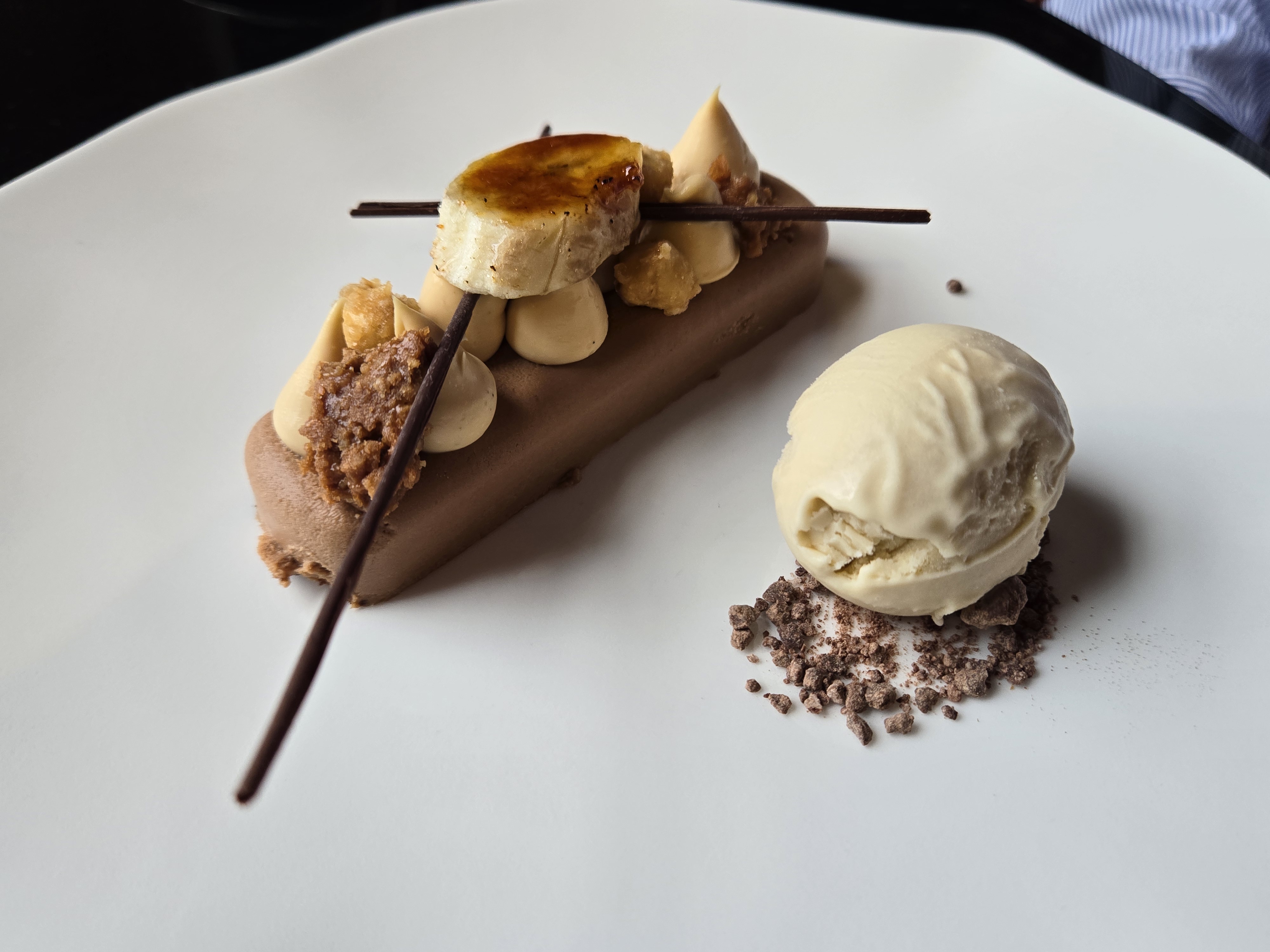
For dessert, Russ had a hazelnut banana ice cream concoction. I had tiramisu topped with a decorative chocolate square. Our dining experience was completed by a bagpiper who marched through the restaurant. I can’t think of a better way to top off our trip.
The Rhubarb Restaurant
The next day, however, we were slapped back into reality. Our plans were to fly to Dublin and then to Minneapolis. We made it to Dublin, but our plane arrived late from Edinburgh, and it took SO LONG to get through the Dublin Airport customs and security that we missed our flight to Minneapolis. When we arrived at the gate, they informed us we missed our flight by only two minutes! As it turned out, this was just as well because our baggage never even made it on the plane to Dublin because they didn’t have room for it.
Same as with our flights to Ireland at the beginning of this adventure, once again we were stranded without our baggage. But unlike that experience, this time the airline (Aer Lingus) put us up in a 4-star hotel and all our meals were paid for. It was a nice place, but it had a non-functioning toilet paper dispenser. How can a hotel get 4 stars with broken TP dispensers? I know, whine, whine. But we just wanted to get home! By now, we knew how to survive without a change of clothes or any toiletries. It really wasn’t that bad. What upset us was that due to this delay, we would miss our friends’ 50th wedding anniversary back home.
The next day at the airport, the lines for security and customs were EVEN LONGER (think hundreds of people) but we made it to our gate in time. Plus, once we landed in Minneapolis, our baggage was there, too!
So ends our nearly three-week excursion through Ireland and Scotland. Thanks for coming along on this epic ride. It’s taken me three months to write about everything. Reliving our adventures was so fun. Every time I wrote a post, I felt like I was right back in the experience. But my impatient mind already has ideas for six other topics I’d like to write posts about. I guess I’ll just have to keep blogging!
Despite setbacks, this trip opened our eyes to our pasts and gave Russ and I a stronger sense of where we come from. In Russ’s case, it’s a quaint hovel in the Irish countryside. In my case, it’s an imposing tower on a hill. It was truly a journey of discovery, and we feel so fortunate to have had these experiences.
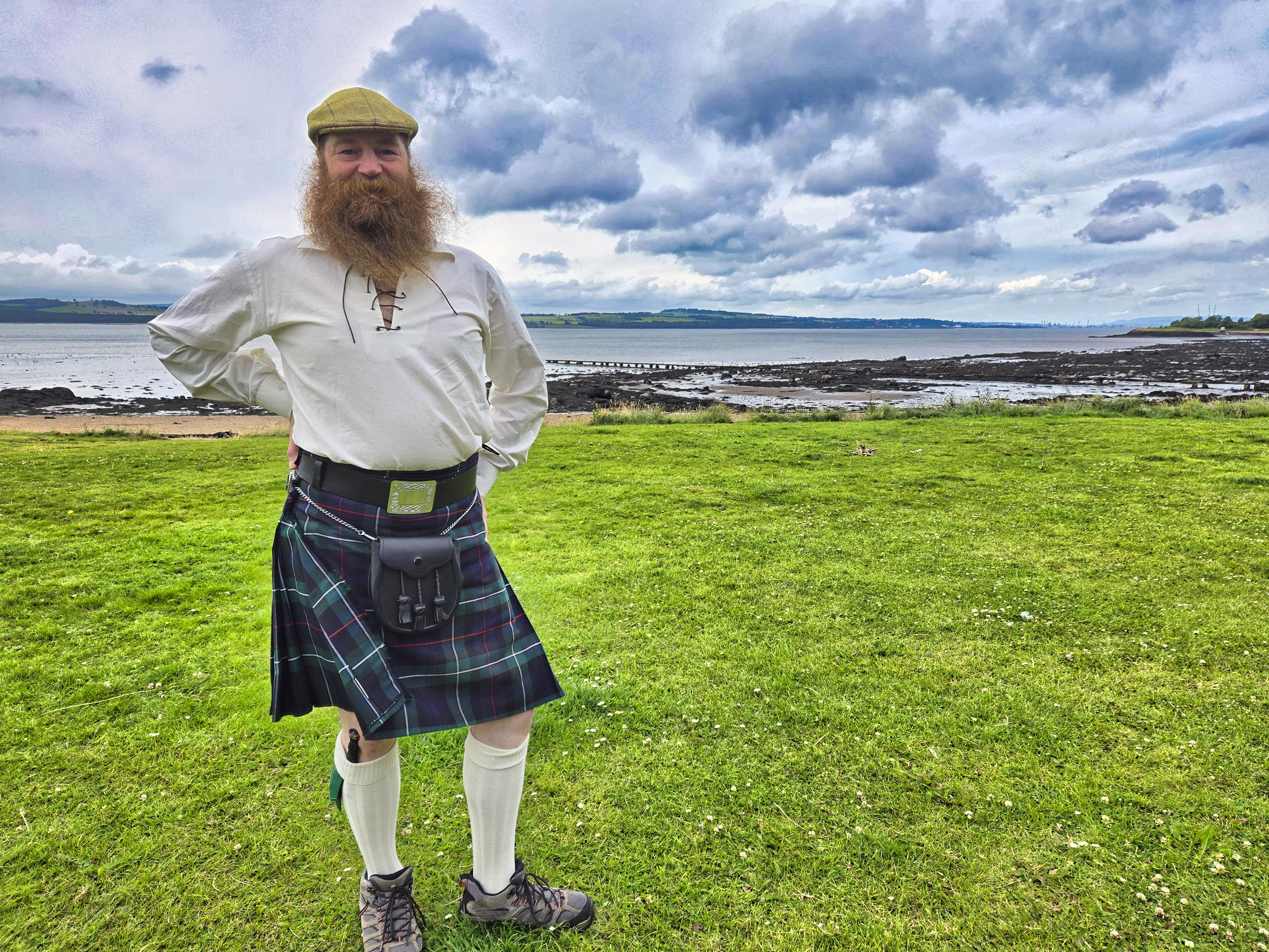
I mentioned a few posts ago that during this trip to Scotland, I figured out that my ancestors were the Barons of Clackmannan and lived for many generations in a tower in the village of Clackmannan. Because we were the only ones who signed up for a group Outlander tour, Henry, our bekilted Tartan Viking Tour guide, had leeway to treat us to a side trip to this venerable ancestral tower.
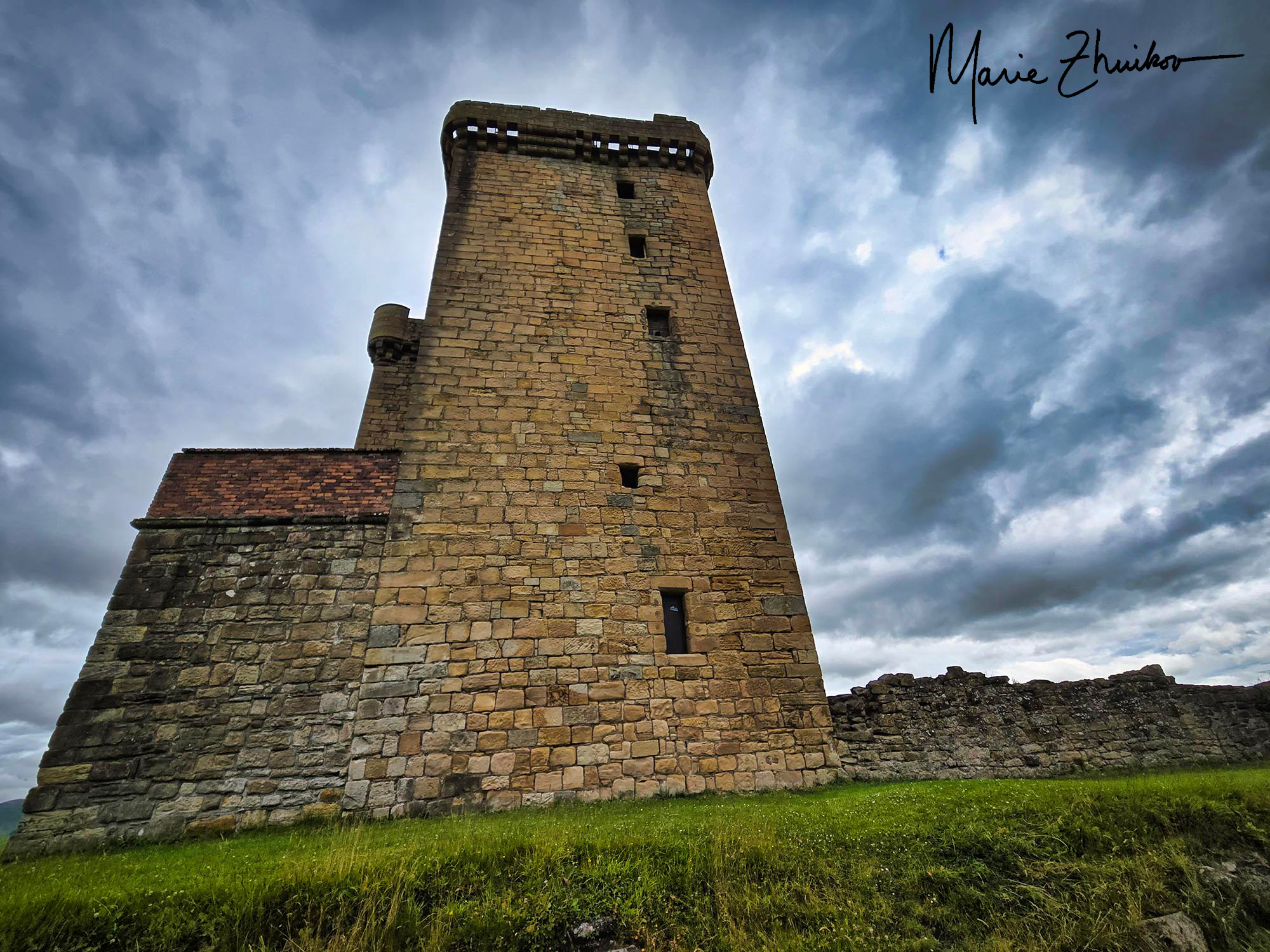
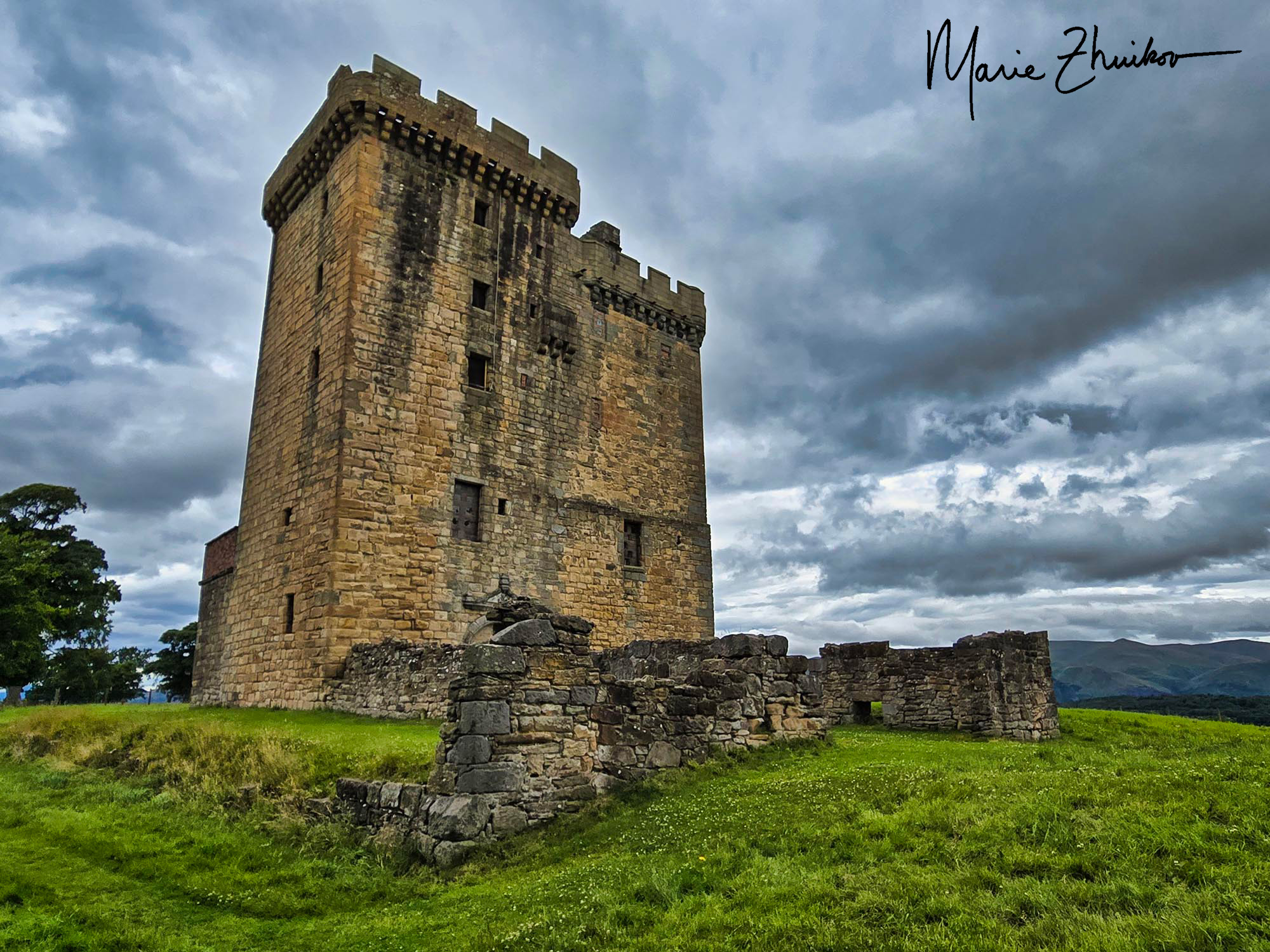
For me, our visit to Clackmannan Tower was truly an unexpected highlight of our trip (thank you, Henry!). King’s Seat Hill upon which the tower is built had long been a strategic outpost. Before the brick tower, the English had built a wooden tower upon it. It commands a view of the Ochil Hills, a 25-mile range that stretches between the Firth of Tay and Stirling.
I’m not exactly clear on this, but I think the tower was built by King David Bruce (Robert the Bruce’s son and second king of Scotland) and was given to his kinsman, Sir Robert Bruce, who is my ancestor. It was inherited by Sir Robert’s son Thomas, who was the 1st Baron of Clackmannan. My ancestors were part of the tower’s history until the 6th Baron of Clackmannan. After that, my ancestry diverges through the baron’s daughter, Lady Christina Bruce. The tower was passed from father to son, and since she was a daughter, she left once she got married.
A wonderful post with useful links about the tower is available through Wee Walking Tours, including embedded videos.
The tower had another tower built onto it, forming an L shape. Originally, a mansion was attached to the tower, but that has been long gone now. In the 1700s, the Bruces who were the current Barons of Clackmannan built a coal mine underneath the tower. Their venture into coal proved a downfall for both the family and the tower. They became bankrupt and the ground underneath the tower became unstable, causing it to lean. The family had to sell the tower to pay their debts. After that, it fell into neglect.
The tower has been rebuilt and refortified a couple of times due to this subsidence. It’s not usually open for tours and is now owned by Historic Scotland. During our tour of Broomhall, Charles Bruce told us that one of the stone archways in an upper level of the tower collapsed and broke through the floors below it. It’s not habitable but does have electricity and a well with water. Historic Scotland has plans to increase public access to the tower in the coming years. I wish them luck!
Near the tower is a modern stone timeline that describes the geologic and glacial history of the area. A nostalgic and primitive tree swing hangs from one of the large trees on the hillside.
If I ever return to Scotland, I think it would be fun to stay in Clackmannanshire and learn more about the area where my ancestors lived for so many generations, and spend more time with the leaning tower.
Next up: our final day in Scotland and a fancy dinner in a mansion that we won’t soon forget!
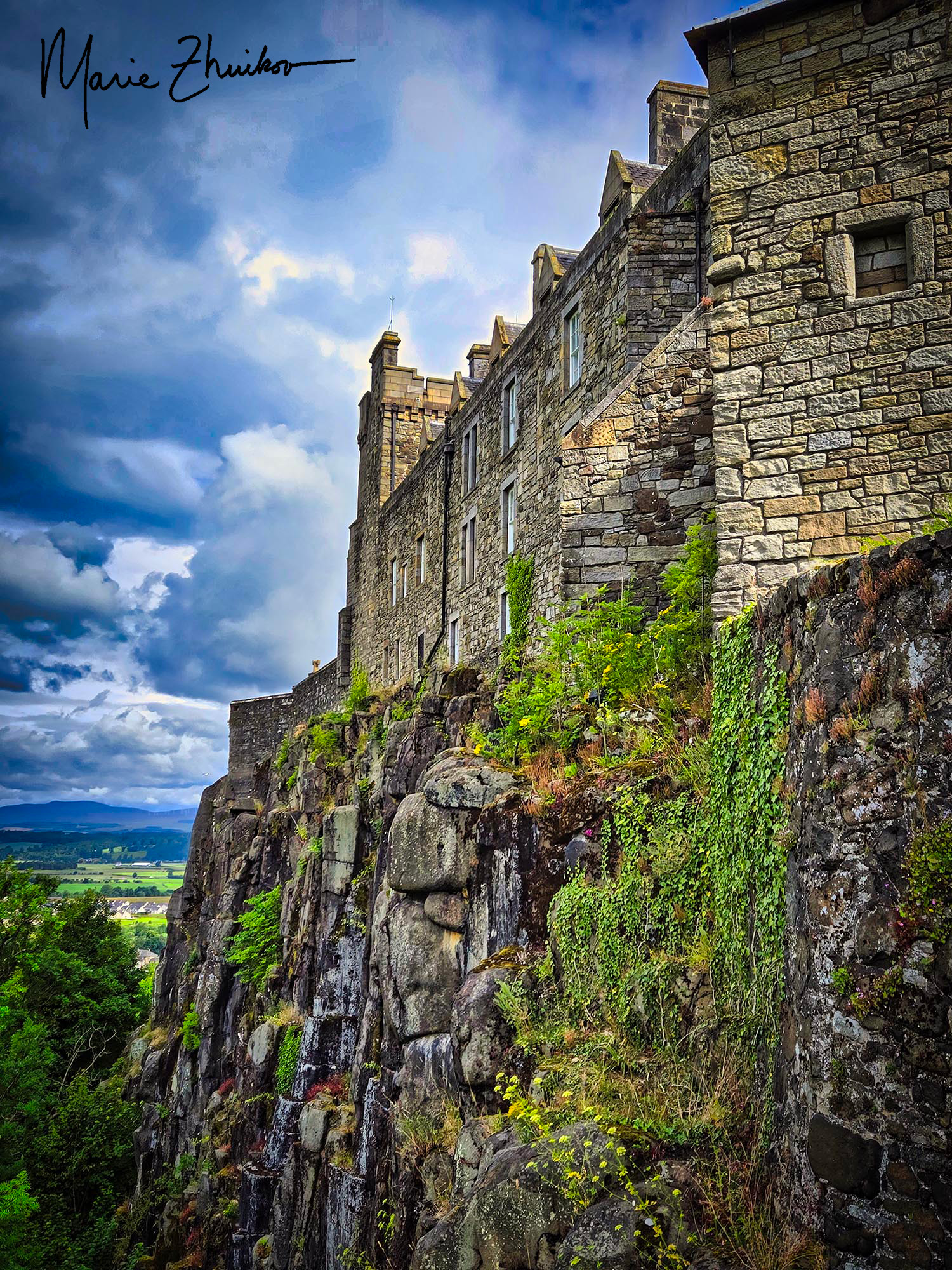
Blackness Castle. In the “Outlander” series, it’s Fort William.
Russ and I have long been fans of the “Outlander” television series and books. Actually, I was a fan first, then I sucked Russ into it. He’s been a willing and devoted victim. We were tickled to discover during our Broomhall House tour the previous day that even distant cousin Charles Bruce is a fan!
If you’re not familiar, “Outlander” follows the story of Claire Randall, an Englishwoman who’s enjoying a second honeymoon in Scotland with her husband once World War 2 ends, when she’s sucked back in time 200 years after touching a mysterious standing stone. While in the past, she meets Jamie Fraser, a burly and charming Scot, who ends up marrying her to save her from the clutches of an evil pre-ancestor of her English husband.
The series hops back and forth in time and geography, but some fans’ most-beloved sites can be found in Scotland, many not far from Edinburgh. It only made sense for us to go on an Outlander tour while we were there, especially after I found a company that offered group tours that departed only a few blocks from our hotel.
That’s where we met Henry, who is a co-owner of Tartan Viking Tours. He informed us that we were in luck; nobody else had signed up for the tour, so we were getting a private tour for the cost of a group one. That allowed us more leeway in what we could see, which worked out great!
Dean Village and the Water of Leith
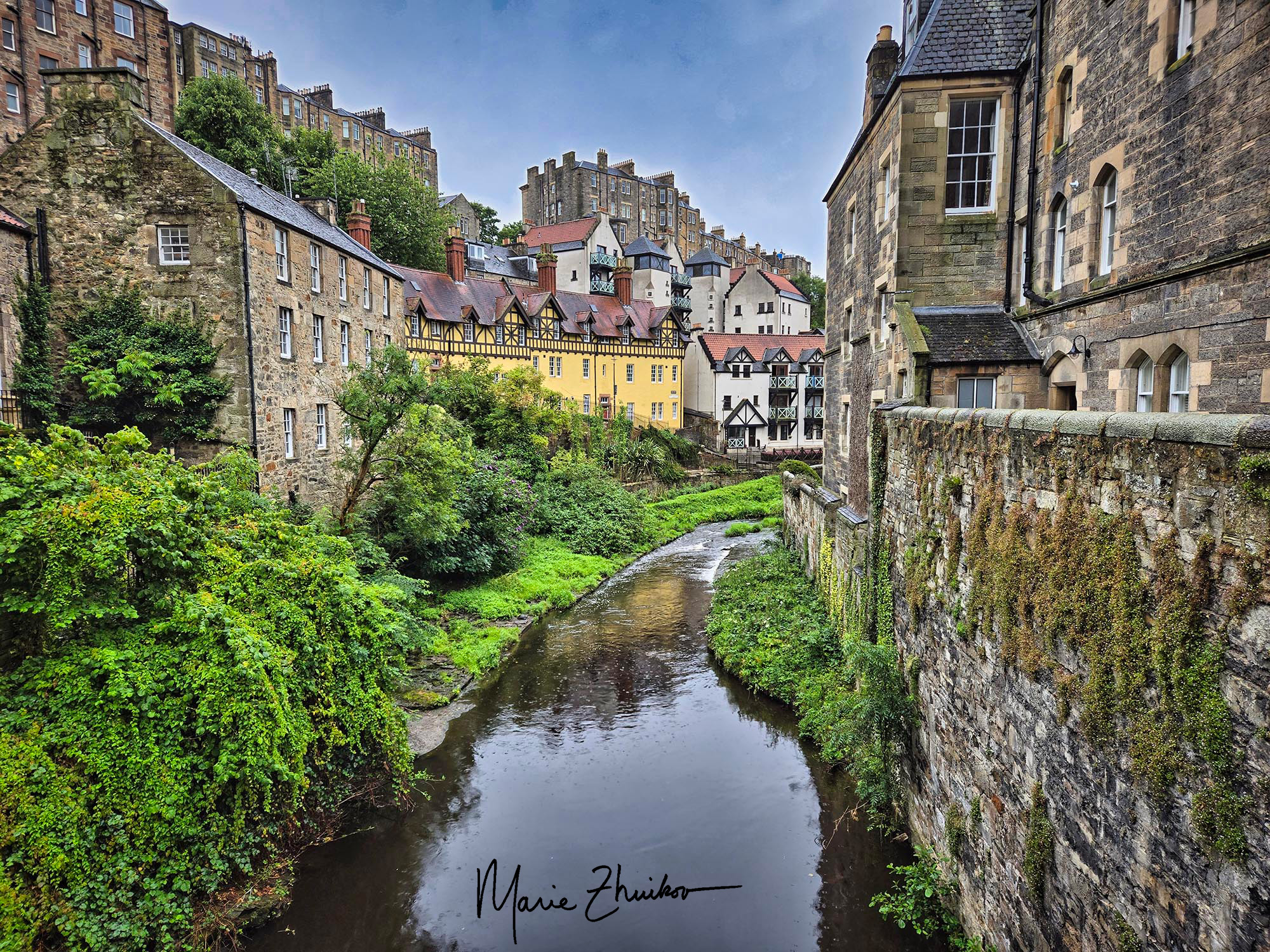
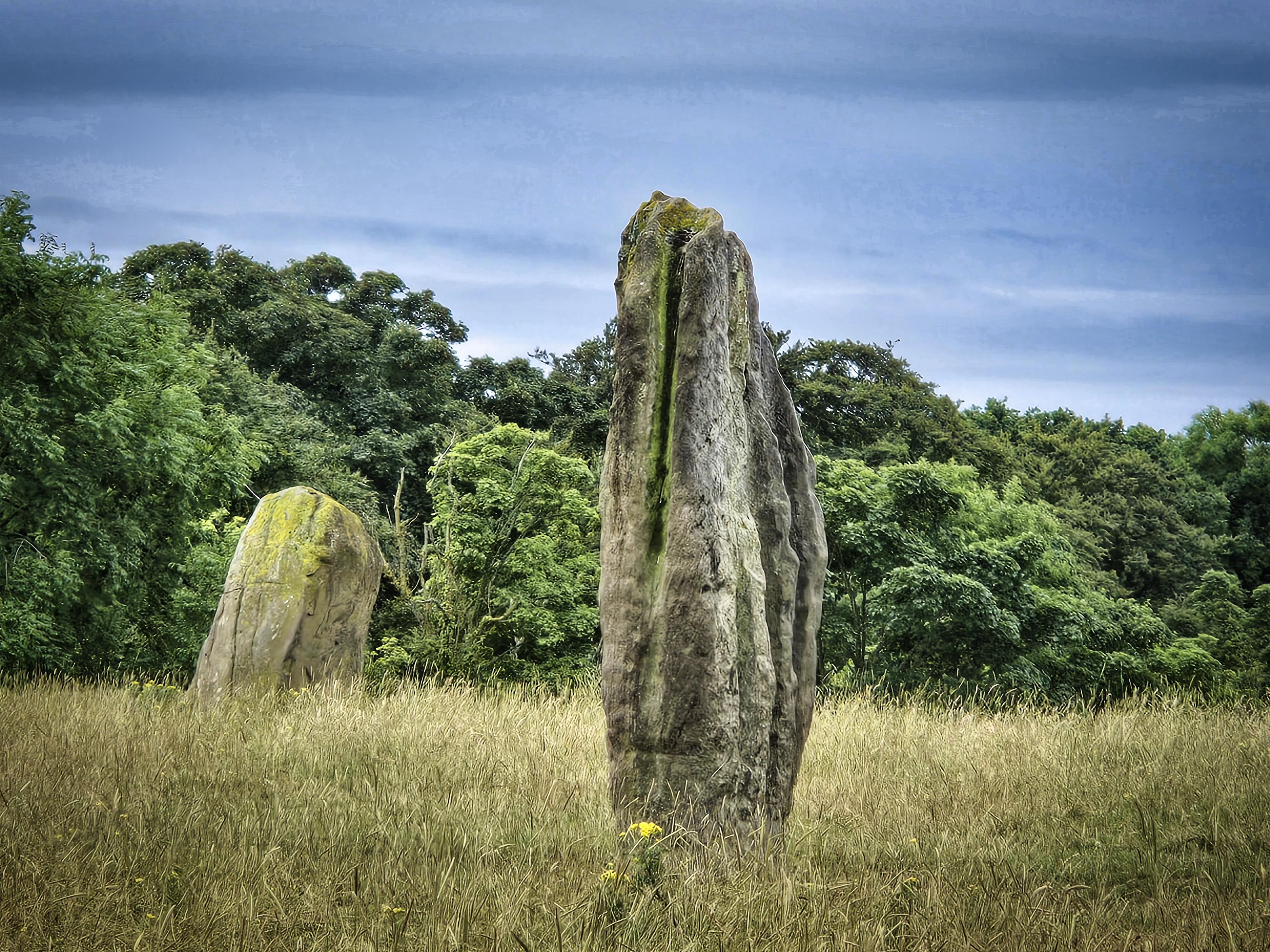
On our way out of town, we stopped at two non-Outlander locations that were just too picturesque to pass by. The first was Dean Village which is split by a river named Water of Leith. It used to sport many water mills for grinding grains into flour. Next were some Pictish standing stones that happened to be along the highway on the way to the village of Culross, which stands in for Crainsmuir in Outlander. I was excited to see them because I hadn’t had the chance to see anything Pictish or standing on either of my other trips to Scotland.
Standing stones in a field.
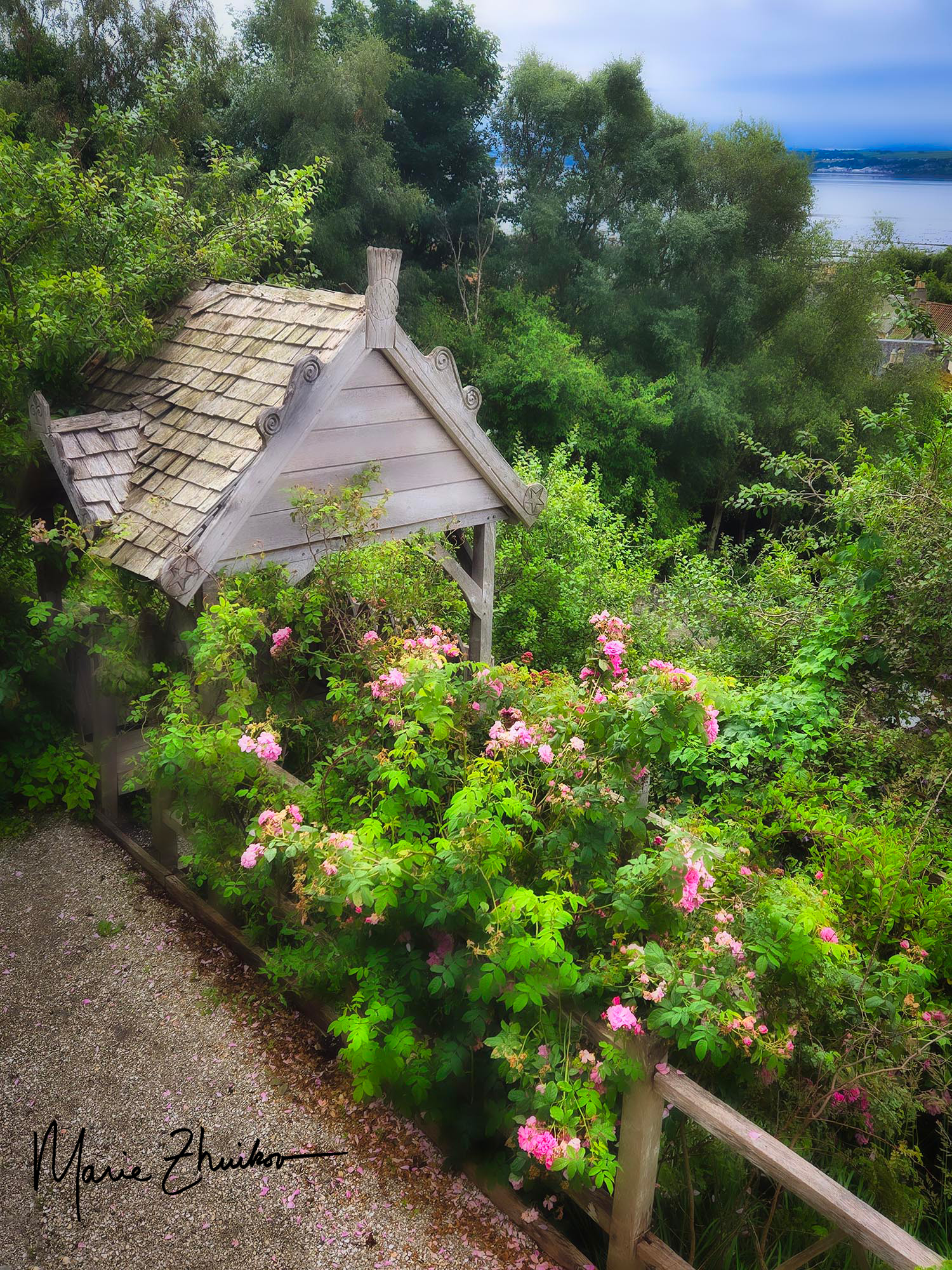
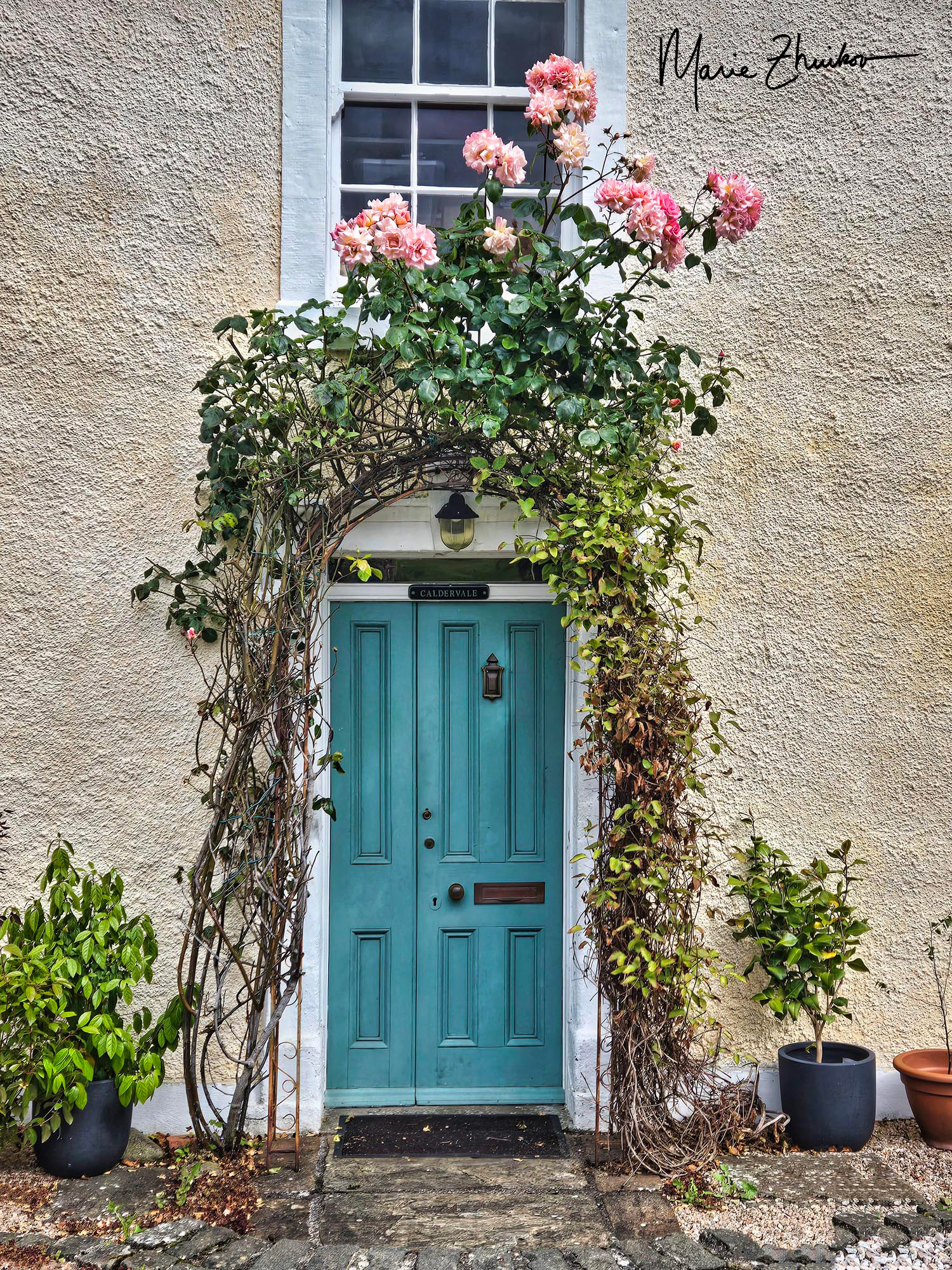
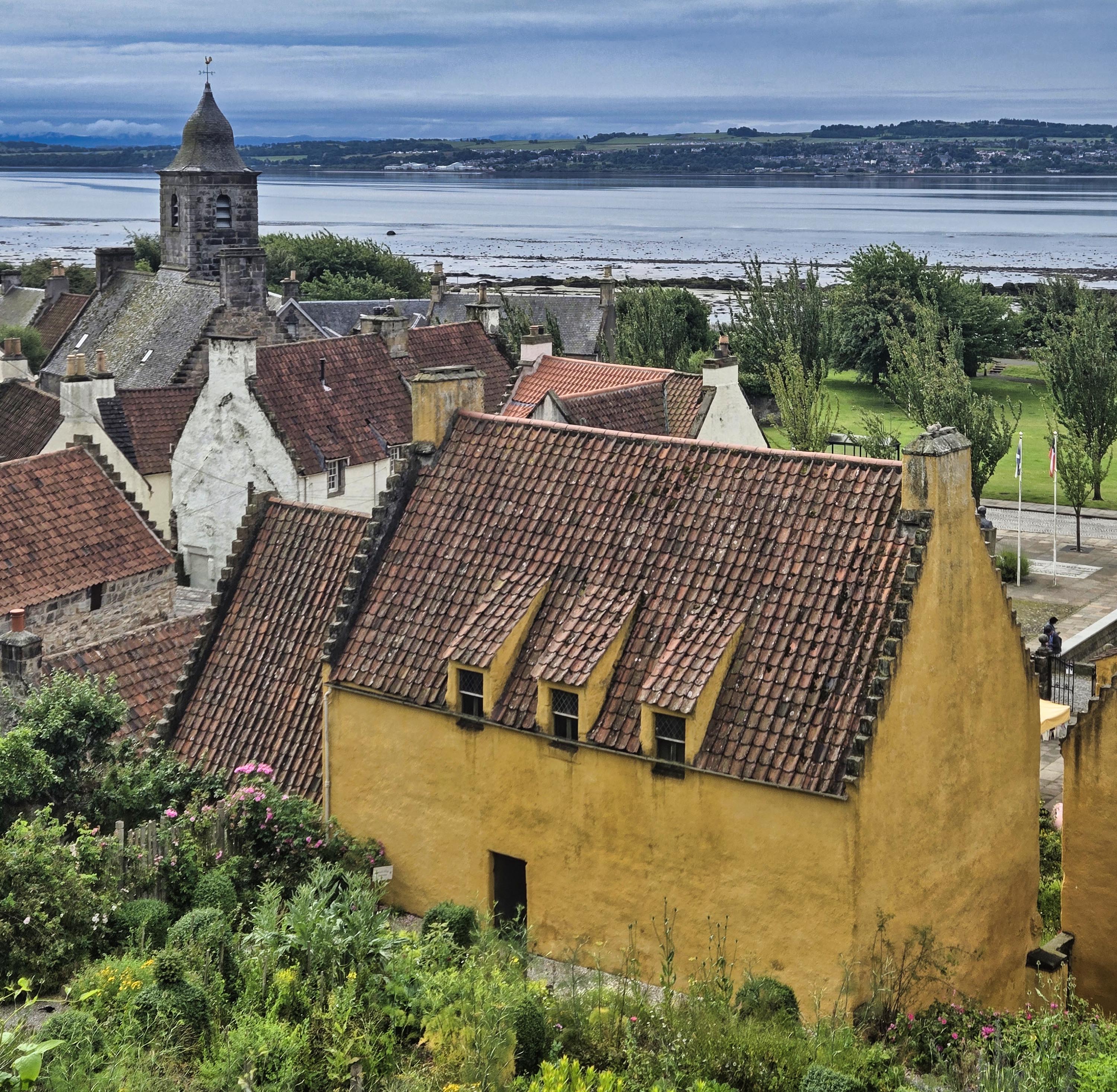
Crainsmuir/Culross is where the witch Gellis Duncan lived and is where she and Claire were tried for witchcraft. The village is one of Scotland’s most complete examples of a 17th and 18th-century town. Steep cobblestone streets are lined with white stone houses that sport red-tiled roofs. The town center is occupied by a small golden-yellow palace with a beautifully reconstructed period garden. Henry took us along the streets and up to an overlook flanked by a garden full of pink roses. We could also see an herb garden behind the palace that was Gellis’s garden in the series.
A rose garden in Culross.
A picturesque doorway in Culross
Culross Palace with Gellis’s herb garden behind it.
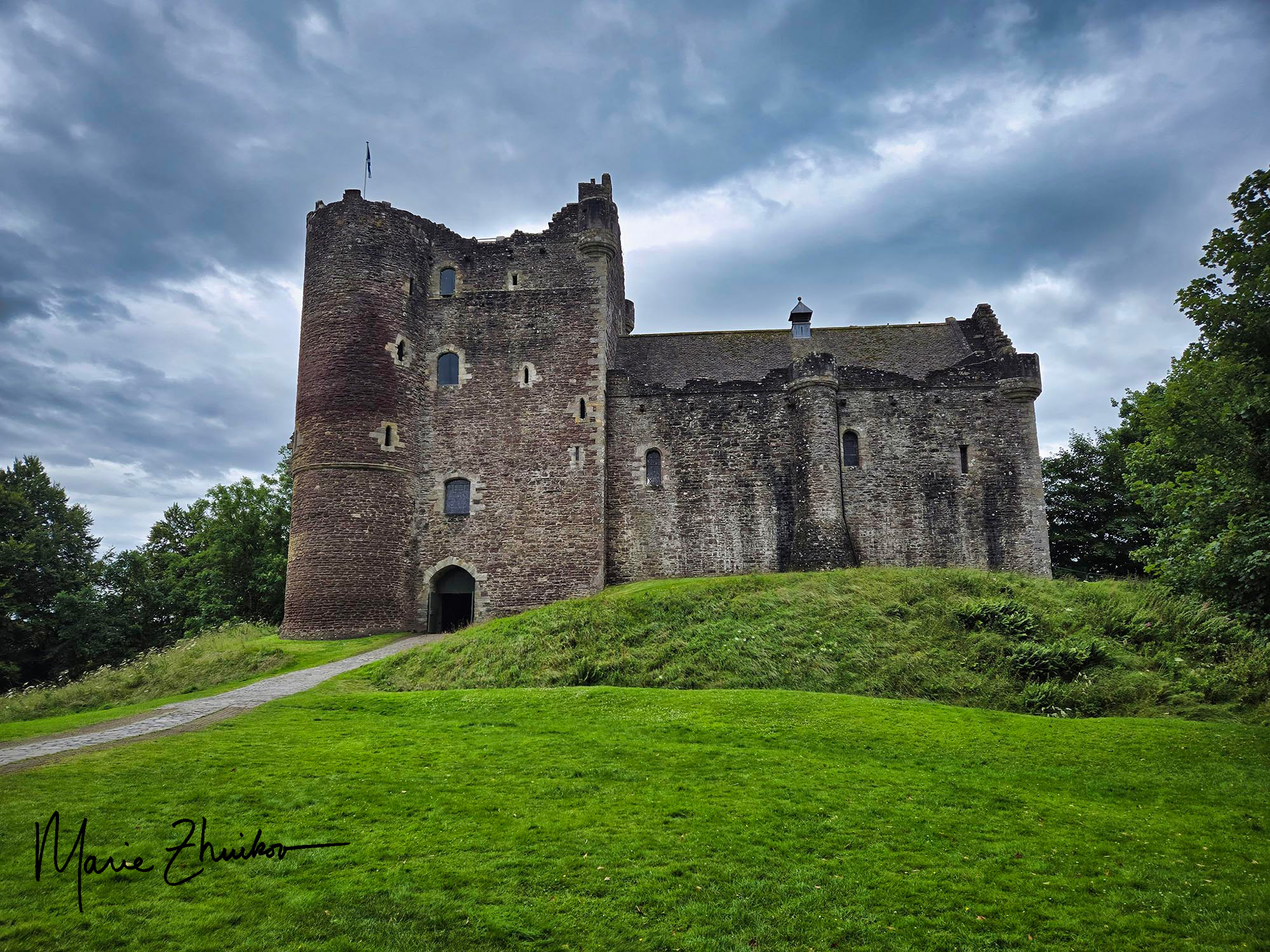
Then we were off to Doune Castle. In Outlander, it’s Castle Leoch, home to Clan MacKenzie. In “Monty Python and the Holy Grail,” it’s the castle where there’s a discussion about African Swallows and where a prince croons about how he doesn’t want to be king. It’s also featured in “Game of Thrones.” Seeing the familiar courtyard, Mrs. Fitzgibbon’s kitchen, and other movie locations was so fun! We took an audio tour, which was narrated by Sam Heughan, the actor who plays Outlander’s Jamie Fraser.
Doune Castle
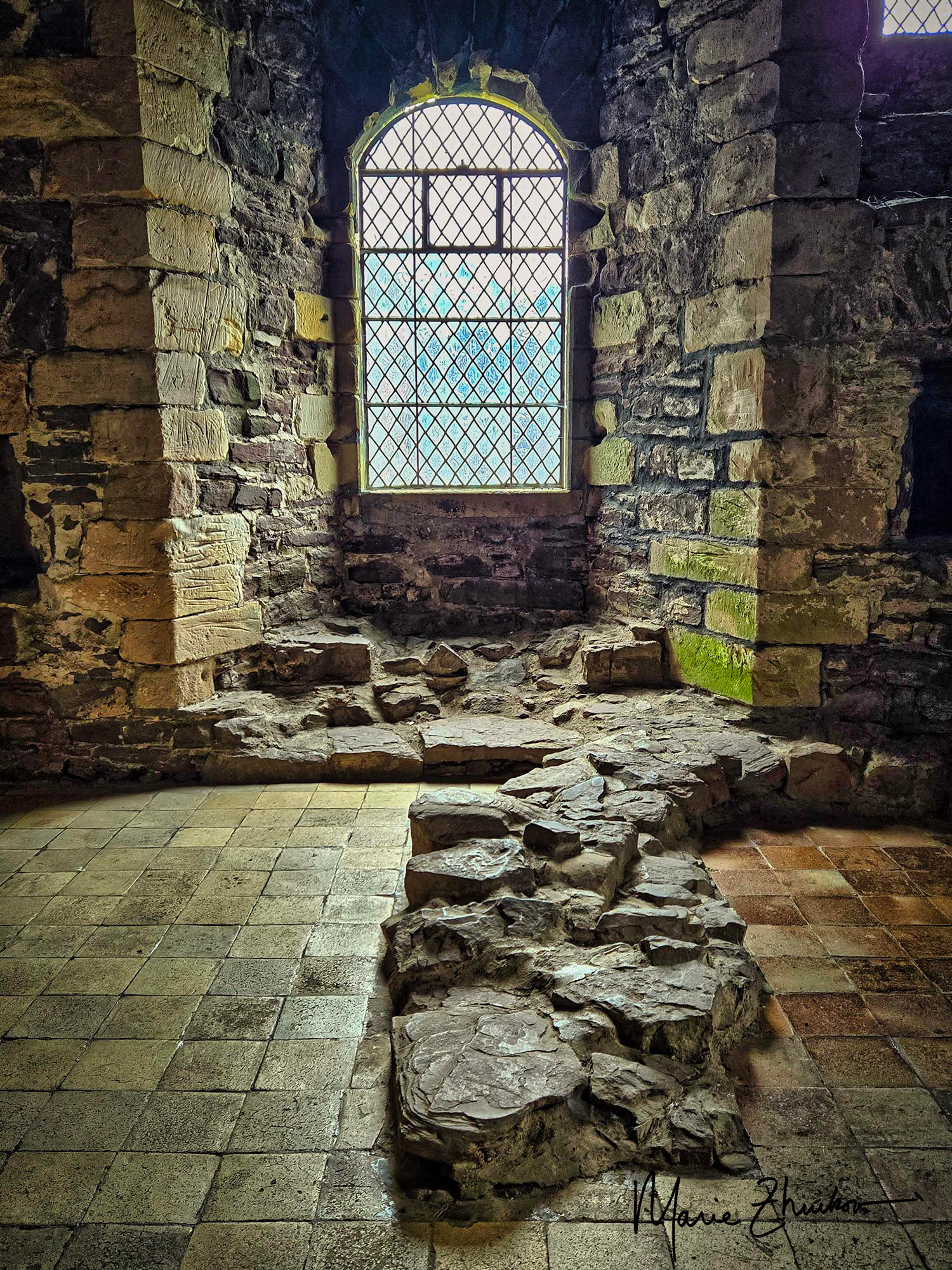
A window in Doune Castle.
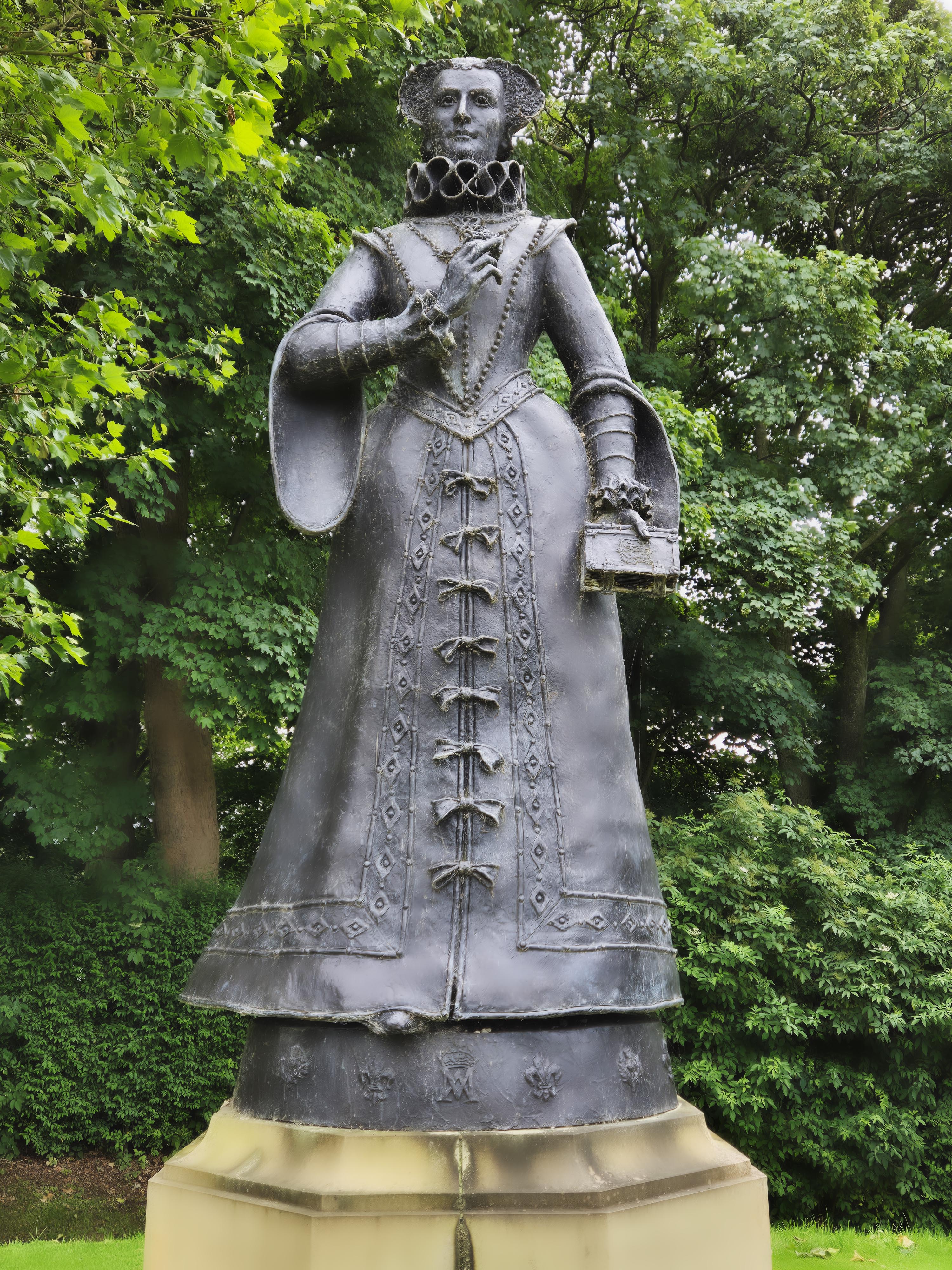
Our next stop was Linlithgow Palace, which is known as the birthplace of Mary Queen of Scots. In Outlander, it’s also the stand in for Wentworth Prison where Jamie was sentenced to hang and was tortured and assaulted by Captain “Black Jack” Randall. Linlithgow means “the loch in the damp hollow,” named because the palace lies on the shore of a small lake. We weren’t really feeling a need to tour the castle, so spent most of our time walking the grounds and visiting the Mary Queen of Scots statue, which sports the mysterious quote: “My heart is my own.” A biography about her has the same title, but I suspect that the statue came first. Apparently, this quote was from one of her letters to her cousin Queen Elizabeth where Mary discusses potential husbands for herself. I guess she didn’t like any of her suitors! Mary’s such a fascinating historical figure. I had the chance to visit a museum about her in Jedburgh during a previous visit.
Mary Queen of Scots was born in this turret room at Linlithgow Palace.
Mary Queen of Scots statue at Linlithgow Palace
We ate a scrumptious lunch at The Four Marys pub, named for Queen Mary’s ladies in waiting, who all obviously must have been named Mary. One thing to note in Scotland and Ireland is that at smaller restaurants and pubs like this one, which are outside of large towns, you have to pay at the bar till. They don’t bring a bill to your table like in the U.S. And if you wait for them to do so, you’ll be waiting for a long time!
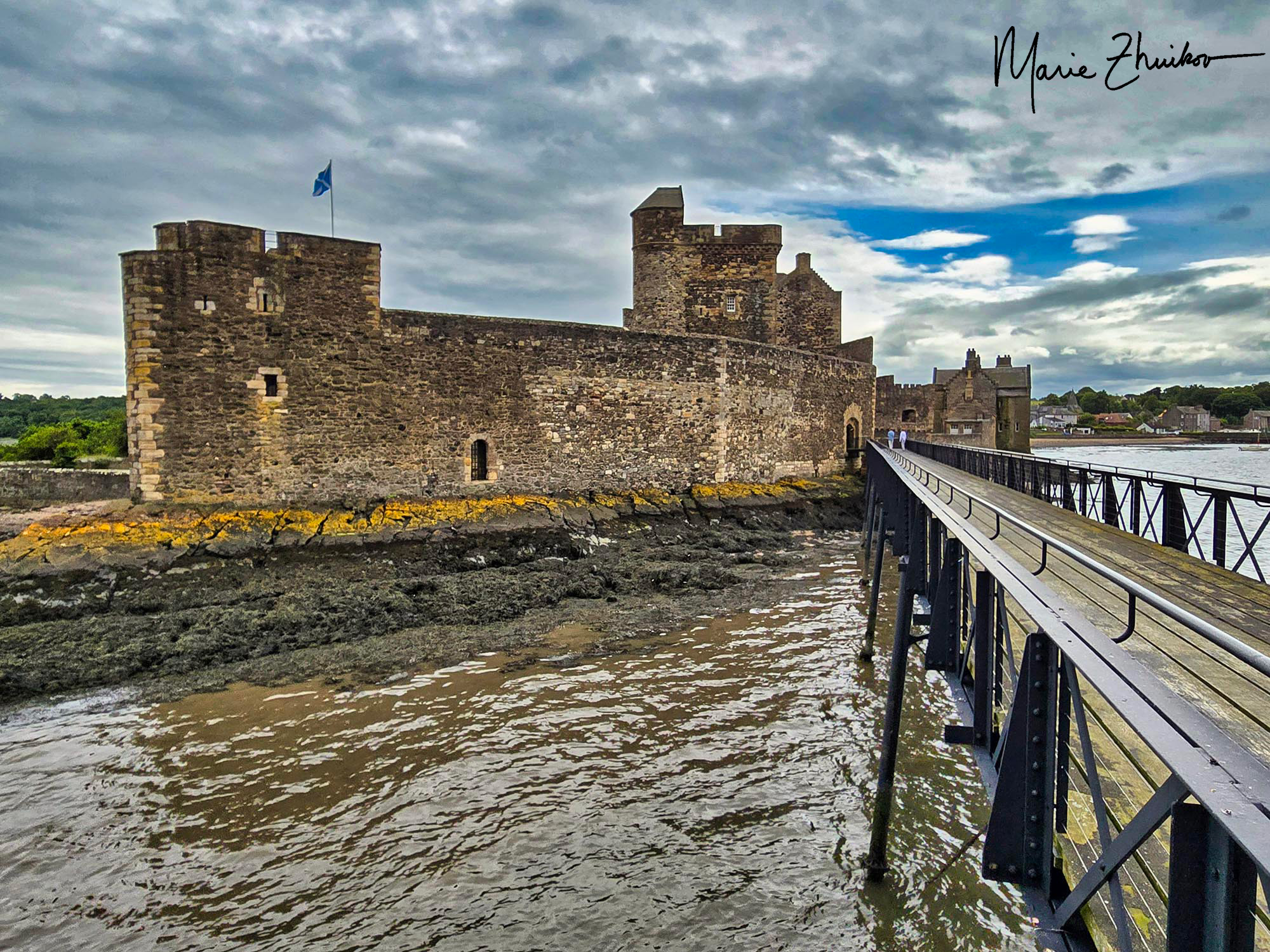
Blackness Castle and the courtyard where Jamie was flogged.
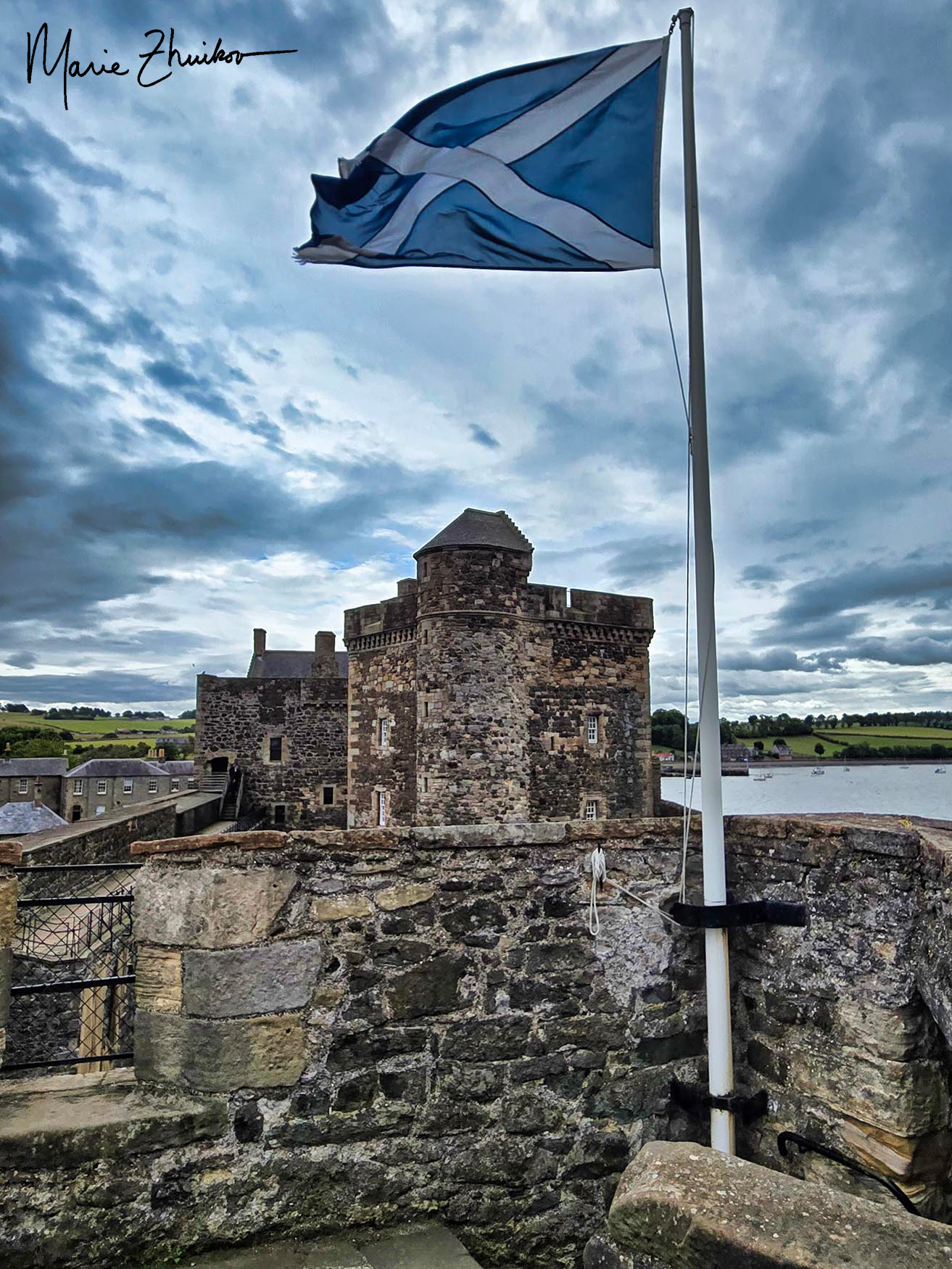
Next to last was Blackness Castle, a.k.a. Fort William. This imposing stone structure is built on the Firth of Forth and was meant to resemble a ship. Like in Outlander, the castle served as a prison in real life, housing high-ranking prisoners and their household staff. This was where Jamie was flogged and held prisoner in Season One. The place is depressing, dank, and rocky. It was so interesting how the original landscape was incorporated into it. We spent a lot of time climbing around and walking out on the pier over the Firth.
Blackness Castle as viewed from the pier. Note its ship-like shape.
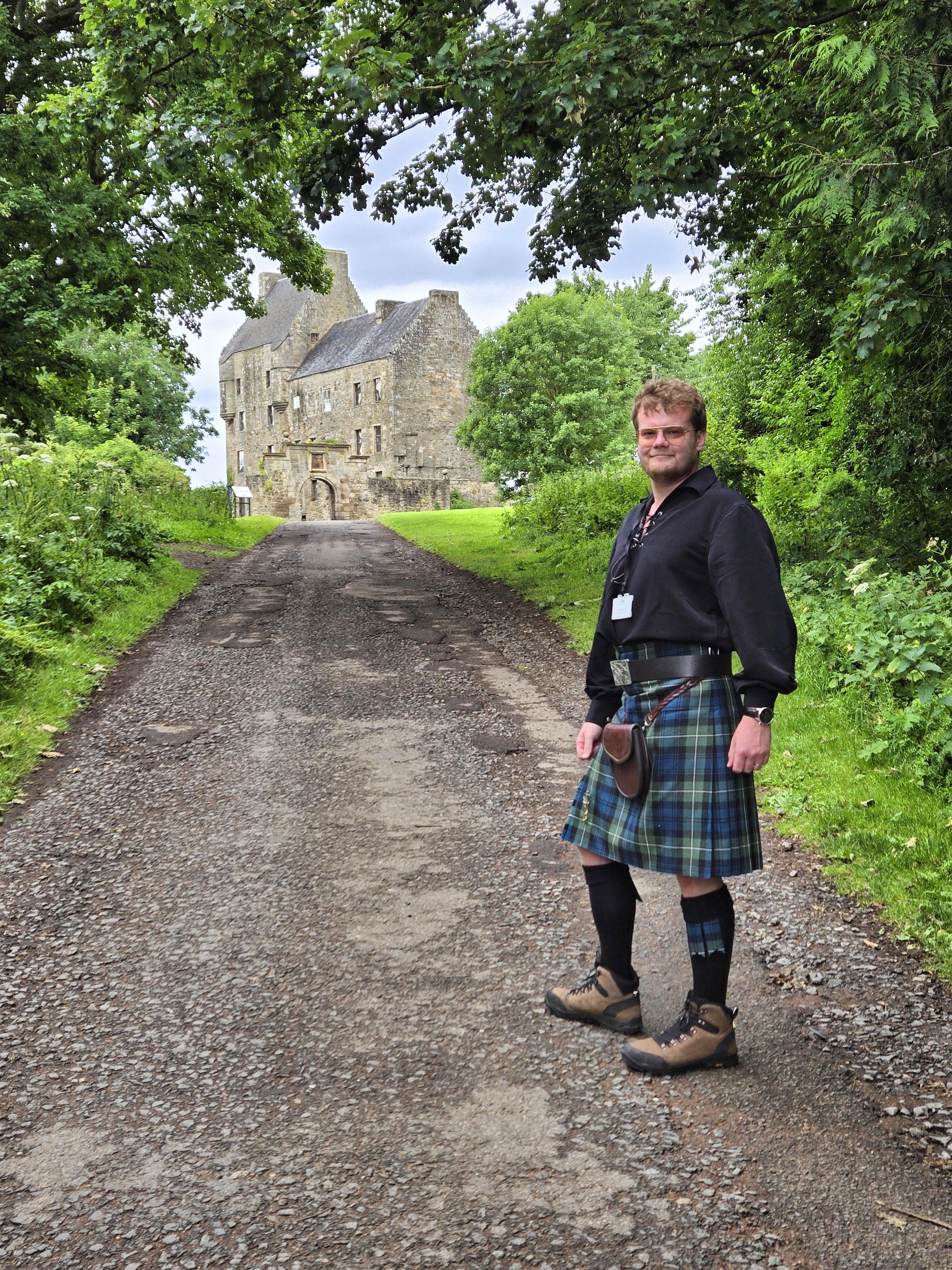
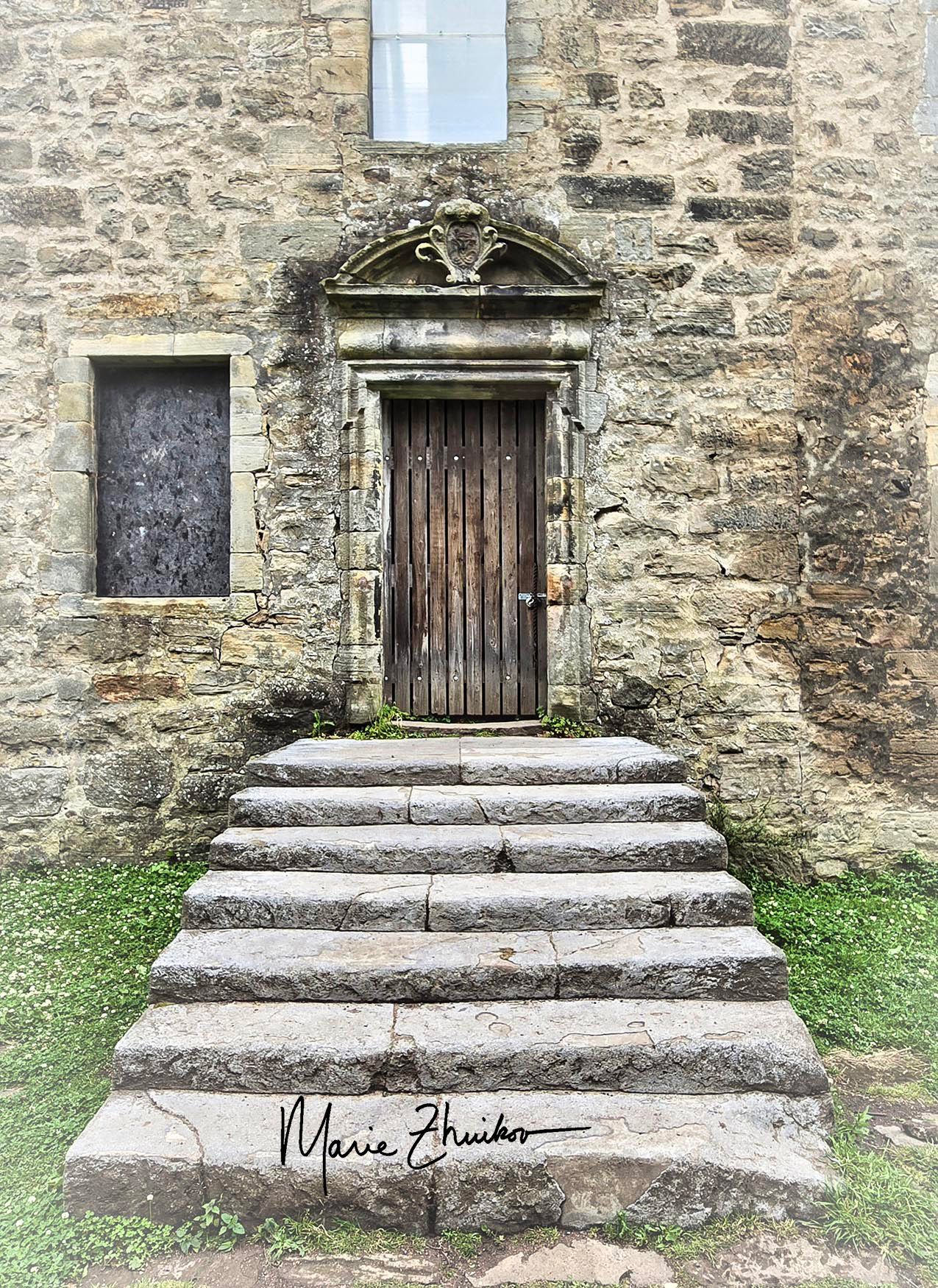
Our last stop was Midhope Castle, a.k.a. Lallybroch, home to Jamie Fraser and his kin. Just the outside of the castle was used for filming because the inside is not habitable. Walking up the road and under the familiar archway made me feel like I was in an episode of Outlander! We snooped around the castle and meandered into the back yard where several ruined sheds and stables molder. In Outlander there are scenes of the back of Lallybroch, but they are so far away, they conceal the ruins.
Our tour guide, Henry at Midhope Castle. Or is that Jamie Fraser with glasses?!
The stairway into Midhope Castle.
I’d recommend an Outlander tour for anyone who is a fan. There are cheaper versions with other companies out there, but you might not get a kilted guide or a “wee dram” along the way. We enjoyed meeting Henry and seeing sights from the books/movies. Once we returned home, I began watching the series all over again to see if I could spot the places we visited. Also, the next season is set to begin this November, so it’s been a good refresher.
One of the sheds behind Midhope Castle.
I didn’t mention this, but between Culross and Doune Castle, Henry obliged us with a non-Outlander side trip to Clackmannan Tower, which is connected to my ancestors. That deserves its own entry, so that’s up next!
The Royal Scots Greys Monument with Edinburgh Castle in the background.
In my previous post, Russ and I returned to Edinburgh, mystified and a bit sad after a failed attempt to tour Broomhall House, current home of the Family of Bruce, which we’d been planning for months.
We spent the next day in Edinburgh, seeing the sights including the Scottish National Gallery, which offered several floors of exquisite Scottish and international art from the Renaissance to the beginning of the 20th century. The building looks like an ancient Greek temple and was meant as a “temple to the arts.”
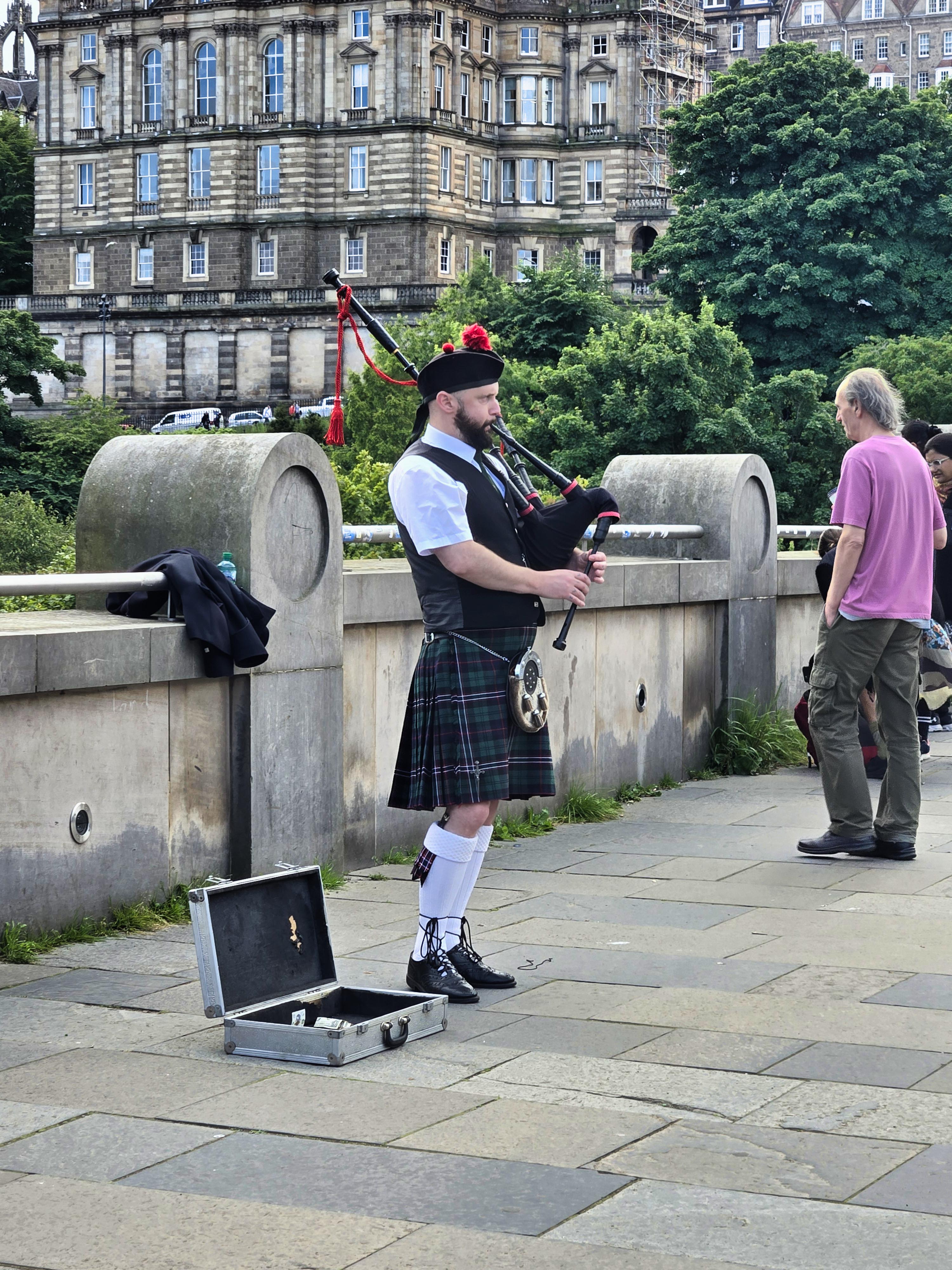
A street piper outside the Scottish National Gallery.
As we walked back to our hotel, we got a happy text from Tartan Viking Tours that our Broomhall tour was rescheduled for tomorrow! We ate lunch next door to our hotel, at Whighams Wine Cellars. I was excited to see they had Cullen skink soup on their menu. It was very good! We ended up eating two more meals there since the food was so good and the prices reasonable. In the afternoon, we meandered about a mile up the hill to Edinburgh Castle. We were an hour early for our reserved tour, so we wandered down the Royal Mile (along with thousands of other people) and shopped.
When it was finally tour time, great-grandfather to the 21st power, Robert the Bruce, greeted us in statue form as we crossed the drawbridge. (William Wallace is on the other side.) It’s crazy to think The Bruce strode some of the same walkways that we were now treading. Later, inside, we saw the ruins of a tower built by his son David. They were crumbling away underneath another building that had been constructed atop it. Stones may crumble, but the bloodline lives on in me and so many other people. I’ve seen estimates that 200 million people are related to Robert the Bruce. (BTW, I just sent off a DNA test kit so that I can confirm, or not, this relationship. The current info I have comes from some cousins.)
The Robert the Bruce statue at Edinburgh Castle.
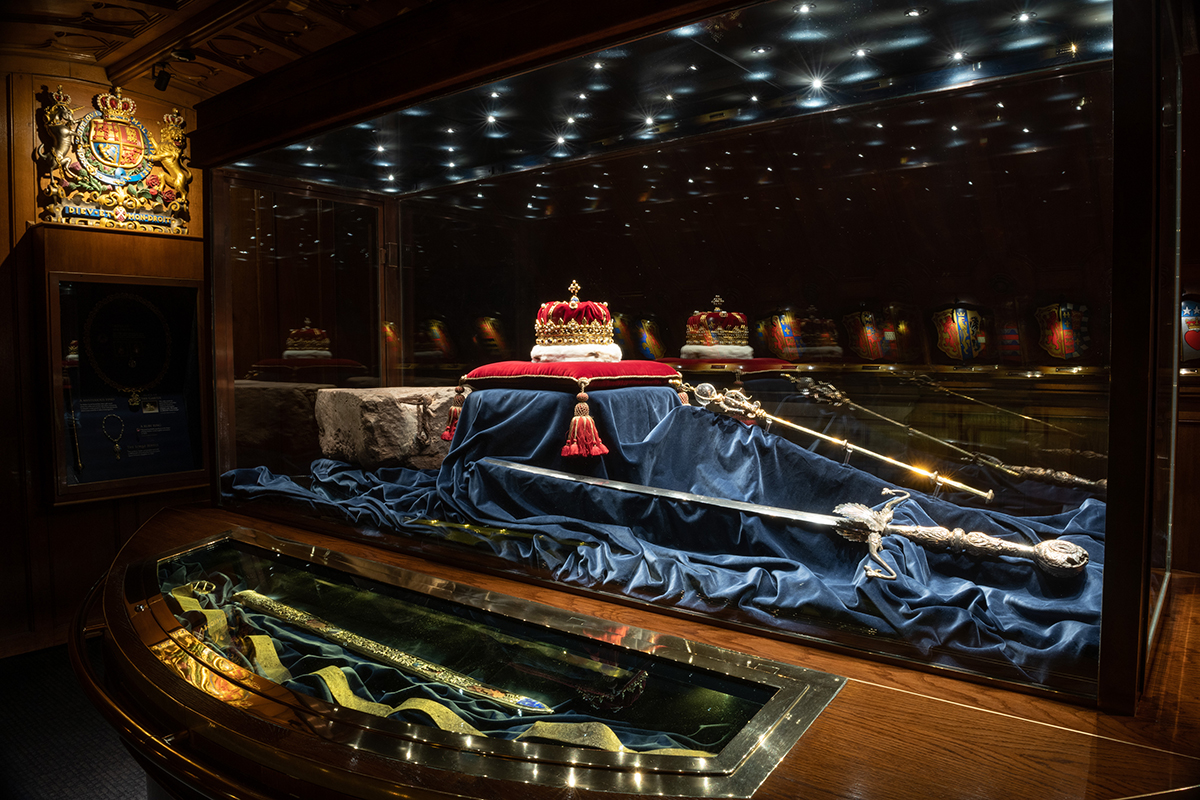
The castle is built on an impressive volcanic plug, but I found the castle itself – especially the royal quarters – not that impressive when compared to Stirling Castle. The Great Hall was cool, though, with its huge fireplace, oak paneling and suits of armor. I was also a bit let down by the crown jewels. From the long line of people waiting to see them, I guess I expected something more than just a crown, scepter, and sword. They wouldn’t let us take photos, but thanks to the castle’s blog, I have one to share with you.
Edinburgh Castle Crown Jewels Room. Image courtesy of Honours of Scotland.
I wondered if part of the reason the castle wasn’t “all that” was because it was yet another casualty of Robert the Bruce’s campaign to destroy castles so that the English couldn’t use them later. (Read more about that on the castle blog here.)
Tour over, we shopped some more on the Royal Mile and returned to our hotel. That was enough for me for the day. I had developed a bad cold or allergies was feeling under the weather. However, the actual weather this day was the best yet – no rain for once!
The beginning of the Royal Mile outside of Edinburgh Castle.
Day 8 in Scotland found Russ and I with our kilted tour guide Calum on the way to Broomhall House. Our tour was finally going to happen!!
Broomhall House
Distant cousin Charles Bruce met us at the door. My first impression was that he must have an awesome skin care routine. His face positively glowed! After exchanging greetings, Calum said he was going to depart now. I looked at him, surprised. We had talked earlier about whether he’d be able to do the tour with us. He said he wanted to, as long as I was okay with it and Charles was okay with it. I was astute enough to notice that although Calum’s mouth was saying one thing, his eyes were pleading to let him stay. I said something like nonsense, we were fine with having Calum along for the tour as long as it was okay with Charles. Charles gave his permission and then led us through a room containing replicas of the “Elgin Marbles.” These are historic marble statues collected by a previous Lord Elgin (the 7th) from the Parthenon in Greece. In recent years, they caused quite a stir at being in the hands of the family, so they donated them to the British Museum in London.
Calum, our Tartan Viking Tour guide, in Limekiln.
We settled in the library and Charles poured us some tea. He asked a bit about my ancestral background and then began a lecture about Andrew Carnegie, the Scottish-American industrialist and philanthropist who was born nearby in Dunfermline. He showed us a ledger book that contained an IOU to the Bruce Family from the Carnegie Family. It’s not known whether this debt was ever paid since the Carnegies moved to America later. But Charles was rather tickled to think that a family destined to become one of the richest in America had been in debt to his family.
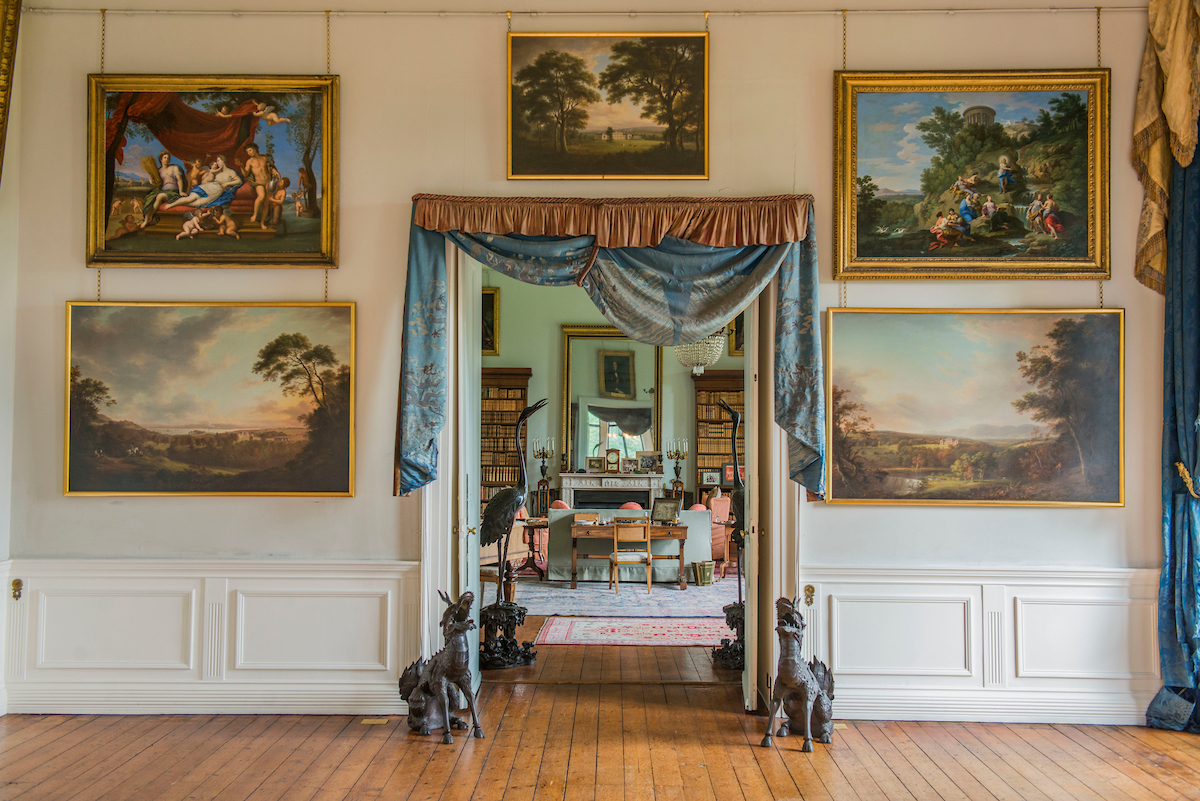
View from the Music Room into the Library. Image courtesy of Broomhall House.
As we discussed the books in the library, Charles off-handedly mentioned they had a first edition copy of “Waverly” by Sir Walter Scott. Later, I asked if I could see it. He couldn’t find it, but he did find a third edition of “Rob Roy.”
At one point, he opened a book that contained an old map. Me, with my cold and my dust allergies, immediately began a mortifying coughing fit. Charles, the dear man, ran out of the room to find me some water. In the meantime, I thought to pour myself more tea. By the time he returned, my fit had subsided, thankfully.
The Music Room in Broomhall. Image courtesy of Broomhall House.
Our next stop was the Music Room, which contained the original plans for Broomhall House. It was originally supposed to have marble columns on the front, but the family ran out of funds by that point. The columns, which were already cut, were added to a different building elsewhere. Charles also talked about the nearby town of Limekiln and how the citizens there made the best mortar (plaster) for building. It’s the same mortar that was used by the Scottish builders who worked on the White House in the U.S. Limekiln no longer has a lime works, but a nearby town does.
Limekiln, Scotland. Home of the mortar that holds the U.S. White House together!
On our way into the dining room, we passed a lighted cabinet that contained one of the plaster casts of Robert the Bruce’s skull and his claymore sword, which has been passed down in the family through the generations. I felt compelled to stand in front of it for a few moments and pay my respects.
The dining room sported a long table that Charles said was given as a wedding present. Family members each bought a chair that line the table, and he said they are very uncomfortable! There was also an impressive Delft tile fireplace with a mantle made from a bed that Queen Anne of Denmark slept in. Charles said his grandfather found the bed in pieces in an antique shop. There weren’t enough pieces to make it back into a bed, so he had them crafted into the mantle instead.
The Broomhall Dining Room and fireplace, decorated for the holidays. Image courtesy of Broomhall House.
On the table were many silver pieces, some oriental-looking. One of Charles’s ancestors was ambassador to Turkey and perhaps picked them up in his travels. The dining room also sported a painting of Catherine Bruce of Clackmannan. She was the last Bruce to live at the mansion and tower in Clackmannan and was a memorable character. She and her husband were Jacobites. She is known for unofficially knighting poet Robert Burns with the very sword I saw in the cabinet. She also has a contra dancing reel named after her.
Catherine Bruce of Clackmannan, the painting that hangs in Broomhall House. Image courtesy of Wikipedia.
Our last stop was a room that had a large, tattered Union Jack flag hanging from the ceiling. Charles said the flag had been flying at the house in the 1940s when three Nazi planes attacked. Charles’s father was ushered to the basement, but his grandfather grabbed a gun and went outside to shoot the planes! Later, at least one of the planes was shot down and it contained some bullet holes that might have been made by his grandfather. Charles showed us newspaper accounts of the adventure.
Our tour was only supposed to last for two hours but a fast 2-1/2 hours had gone past. As we began parting words, I thought to grab my genealogy list from my purse. I asked Charles if we could figure out where our lines diverged. He led me to a large book that contained a family chart. As near as I could tell with a quick look, our paths diverged after the 6th Baron of Clackmannan, David Bruce, in the late 1400s, which was about 15 generations ago.
Charles said he’d never had anyone come so prepared to discuss genealogy before. I was excited to see that the information Charles had gibed with what I had. I just laughed at his comment but inside I was thinking, “You have no idea!” I was glad for the time that my broken ankle gave me to bone up on the family tree. (Ha ha.) By now, my ankle had healed enough that I didn’t need to use hiking pole anymore. I was glad I didn’t have that thing clunking around in this fine home.
Charles gave me permission to blog about our visit; however, the Bruces don’t allow photos to be taken in the house. The ones accompanying this post are from the Broomhall website. We did take some shots of all of us on the steps of the house, thanks to Calum. I was tickled to notice that both Russ and Charles were wearing the same seersucker shirt.
Me, Charles and Russ after our tour.
I was so happy the tour came to pass. It truly was a once-in-a-lifetime thing. As Calum later commented, “That was posh!” And it was worth every penny and all the angst. In fact, the angst made me appreciate it even more.
Next up: An Outlander Tour.
If you enjoy my blog, you’ll love my book! Meander North showcases 51 of the best stories from this blog about my quirky life in northern Minnesota and my writerly pursuits. It earned a silver Midwest Book Award for nature writing and was published by Nodin Press in Minneapolis. It is available for $19.95 through their distributor at this link.
We departed the village of Gardenstown in a drizzle, boarding a bus for Banff with water squishing out of our shoes. In Banff, we caught a cab to the train station in Huntly. We had learned from our lesson the previous day and booked the cab in advance. The train arrived on time. We spent the relaxing ride reading and playing cards.
Schlepping my suitcase around while using a hiking pole for my broken ankle wasn’t easy, but my ankle, despite its deep purple, green, and sickly yellow hues, was no longer swollen and it felt pretty good. About five hours later, we arrived in Edinburgh.
The Angel’s Share Hotel, Edinburgh
Our destination for the next six nights was the Angel’s Share Hotel. I chose it because it was only six blocks away from the station (so we could walk there) and because I liked the name. If you’re a whisky drinker, you probably know that it’s named for the small amount of whisky that evaporates while it ages in a cask. It’s thought that the angels drink it, and thus get their share. The hotel’s bar and restaurant offer a wide range of whiskies and each room features large images of famous Scots. The singer Lulu Kennedy-Cairns graced our room. She’s best known for her song, “To Sir, With Love.” She looks like Olivia Newton-John.
After settling in our room, we popped down to the restaurant for a meal. The restaurant and bar are combined. The place was packed, and a soccer game was on (England vs. Sweden), plus a birthday or two were being celebrated. The decibel level was high! We assumed the crowd would be rooting for England, since it is geographically closer to Scotland, but they seemed to be cheering Sweden. I guess that even when it comes to sports, old grudges and rivalries die hard in Scotland.
Edinburgh Castle as seen during our walk from the train station.
Staying at the Angel’s Share ended up being a superb experience. It’s in a great location for walking to Edinburgh Castle, the Royale Mile, and many, many wonderful restaurants. We ate at a different place almost every day and never had a bad meal. Most were only a few blocks away. The rooms were quiet, and I loved the ambiance of the lobby with its dark wood paneling and fireplace.
We rose early the next day for a tour I’d been eagerly awaiting for months: sites connected with my great-grandfather to the 21st power and first king of Scotland, Robert the Bruce, including Broomhall House, the current home of the Bruce Family.
I was most excited about Broomhall House. It only recently opened for tours, which are led by Charles Bruce. I had contacted Broomhall directly through their website inquiring about a tour over six months before our trip but I never heard anything back from them. Then I contacted a tour company that listed Broomhall on its website as a tour option. I did not hear back from them, either. A few months before our trip, I tried the company again and they said they were all booked. By this time, I’d made arrangements for a different tour with Tartan Viking Tours (an Outlander tour. More on this in a later post) I contacted them and asked if I could “build a private tour” with them that included Broomhall. They said they could do it, which delighted me to no end. Later, they told me the private tour would cost $1,500. This gave us pause, but not for long. We figured this was a once-in-a-lifetime experience and that it would save us having to return some other time to do it, so we said “Yes!”
Calum was our guide. Sporting full Scottish regalia, he picked us up at our hotel in a van. Our first stop really didn’t have anything to do with “The Bruce,” but I had wanted to see it because I love Scottish myths and the images I’d seen of this attraction. Besides, The Kelpies were on the way to the other things we wanted to see.
The Kelpies
The Kelpies are two giant horse heads surrounded by a moat of water. In Scottish myth, kelpies are shape-shifting water spirits that lure humans to their deaths by drowning. They were built by Andy Scott and unveiled in 2014. The Kelpies have royal names: Duke and Baron. We saw more of Scott’s smaller sculptures in the middle of round abouts along the way. Also, Minnesota just got one of his giant sculptures in the form of a loon in St. Paul. It was just put in place last week!
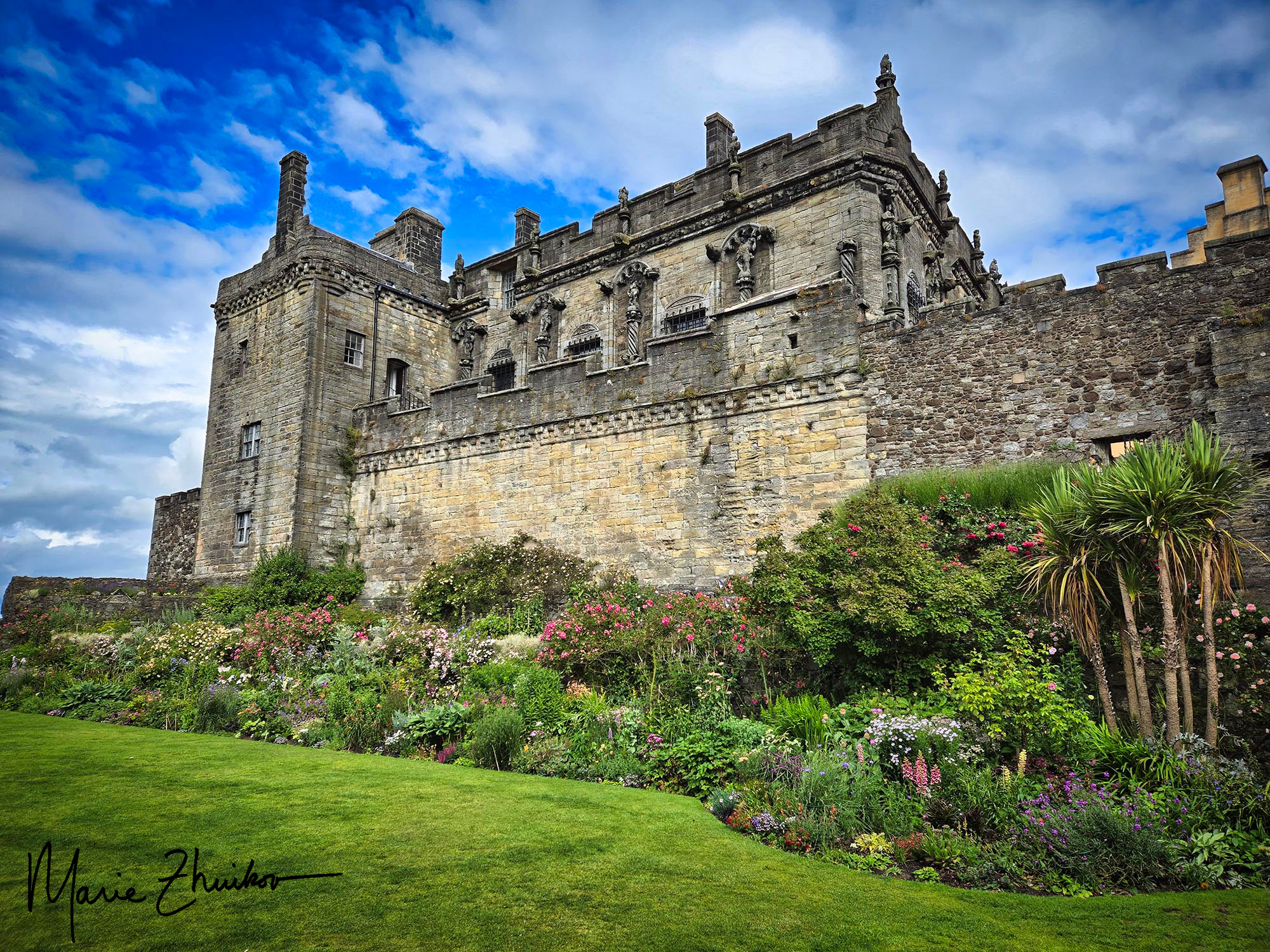
The gardens at Stirling Castle
Our next stop was Stirling Castle. If you only have time to visit one castle in Scotland, I suggest this one. We liked it because it just seemed like a castle should be. Built on a volcanic crag, the castle has a great hall, a palace with impressive bedrooms, a chapel, pretty gardens, and great views of the surrounding landscape including the Wallace Monument. Live actors worked in several of the rooms. One thing I learned was that the impressive bedrooms were mostly for show. Castle royalty actually slept in smaller, more modest rooms off the showy bedrooms.
The Robert the Bruce statue at Stirling Castle
Throughout his reign Robert the Bruce was known for destroying castles. He did this so that they couldn’t fall into the hands of the British. He also never settled in one place long himself to avoid being killed. Stirling Castle was one of The Bruce’s castle casualties, but it was rebuilt later. Even so, The Bruce is honored with a statue outside of it. While we were admiring the statue, Calum and his kilt created quite a stir among a group of Asian tourists. They were so excited, they were taking photos of his back! I mentioned this to Calum, who graciously posed for some full-frontal photos with the group. 😊
Calum being accommodating
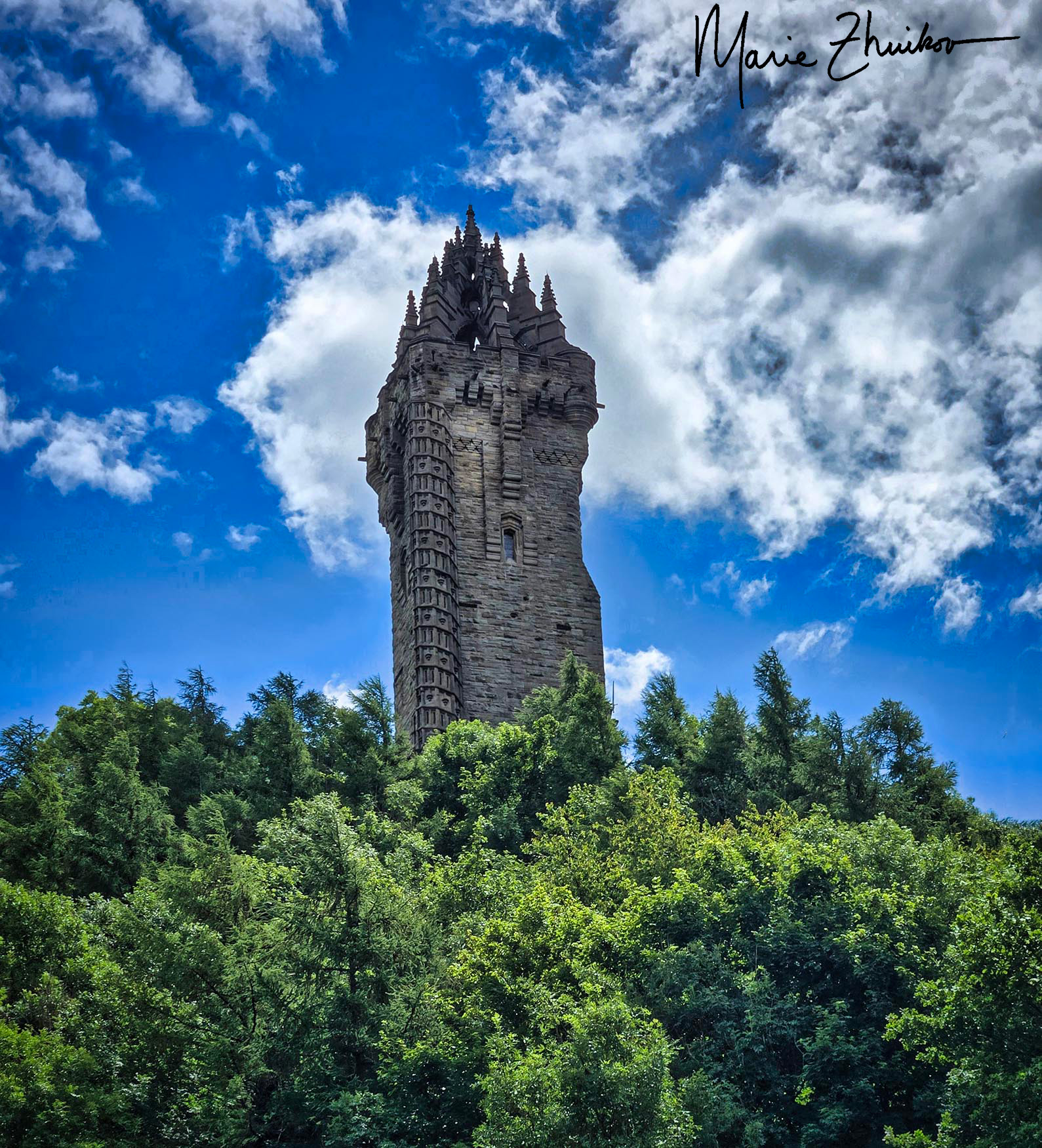
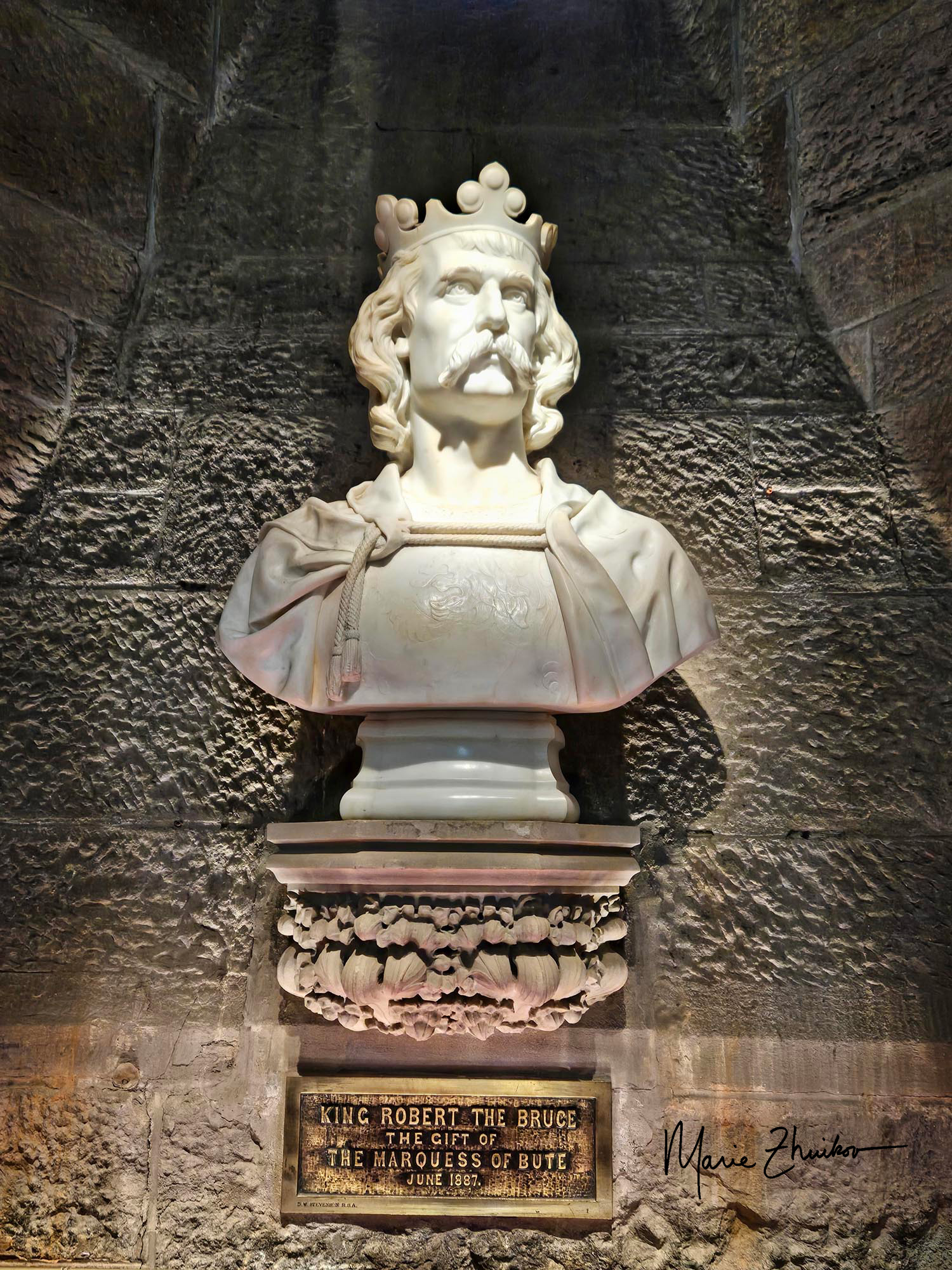
Next was the Wallace Monument. Although it was built to honor William Wallace, a heroic Scottish warrior, Robert the Bruce is honored in it, as well. A spiral staircase leads to the top of the monument. Several floors on the way up offer exhibits (and a rest from stair climbing). I learned that climbing spiral staircases with a hiking pole and a broken ankle is tricky. We encountered MANY spiral staircases during this tour and others, but in case you were worried, I’m happy to say, I emerged unscathed.
Wallace Monument as seen from Stirling CastleThe Wallace MonumentRobert the Bruce bust in the Wallace MonumentWhat the inside of the top of the Wallace Monument looks likeThe view from the Wallace Monument
Our next site offered a much stronger connection to The Bruce. Dunfermline Abbey is where Robert the Bruce was buried. Actually, his alabaster tomb was destroyed during the reformation in the 1500s, but his body (along with alabaster fragments) was found in 1818 when the abbey was being renovated. His new tomb is done in the Scottish royal colors of red and yellow/gold. A wooden pulpit was built directly over it, so it’s as if the minister is channeling the king during his/her sermons! The abbey is still in use.
Robert the Bruce’s grave in Dunfermline Abbey.
The whole structure honors the former king. As we walked toward it, Russ noticed the words “King Robert The Bruce” are spelled out at the top of the abbey’s square spire. Before his body was reinterred, five plaster casts were taken of his skull. One was on display at the abbey. Another one is in Broomhall. For me, this was perhaps the most moving of all the places we visited. Something about the silence and the reverence impacted me.
Dunfermline Abbey
Then came the piece de resistance: Broomhall House! Calum had never been there, so he had to look it up on his mapping app. As we drove up to it, I noticed signs for a restaurant and hotel. The research I’d done on Broomhall had not mentioned anything like that. Curious.
We hopped out of the van and went to the reception desk. Calum said, “We’re here for the tour.” The receptionist looked at him blankly. Uh oh. As it turned out, we were at Broomhall Castle, not Broomhall House.
After discovering the error, we sped back in the proper direction. This time, the place we approached looked much more like what I was expecting. We stayed in the van while Calum knocked on the door. A woman came out from a different door, and they chatted. She looked worried and took up her phone. Uh oh. Eventually, both of them approached the van.
Broomhall House
The gist of it was that we were not expected. My heart bottomed out right there but I tried to keep it together. The woman who was speaking with us was Antonia Bruce, Charles’s sister. She had tried calling Charles, but he wasn’t picking up. She was willing to go into the house with us but she wasn’t really up on giving tours and besides, she was taking care of her parents, 100-year-old Lord Elgin (Andrew Bruce) and Victoria.
Antonia was verra verra nice. We apologized for interrupting her and said we’d try to come back another day. We had two days open on our itinerary and hoped that one of them would work. Somewhere there had been a communications breakdown. (Hint: it wasn’t on the tour company’s side.) I was hugely disappointed but realized that shit happens. I was just glad we were staying longer and might have time to for the situation to be rectified.
So, with fingers crossed, we drove away.
Did months of planning go down the drain? Did we just throw away a bunch of money? Did we ever get to tour Broomhall? Tune into the next exciting installment!
If you enjoy my blog, you’ll love my book! Meander North showcases 51 of the best stories from this blog about my quirky life in northern Minnesota and my writerly pursuits. It earned a silver Midwest Book Award for nature writing and was published by Nodin Press in Minneapolis. It is available for $19.95 through their distributor at this link.
After breaking my ankle during a hike from Gardenstown, we laid low the next day. I sat in the window seat, watching boats and the tide come in and go out of the harbor with ankle iced and elevated. “Losing” a day of adventures was frustrating, especially after losing a day in Ireland due to our flight getting canceled. But I really had no choice but to be sensible. Sigh.
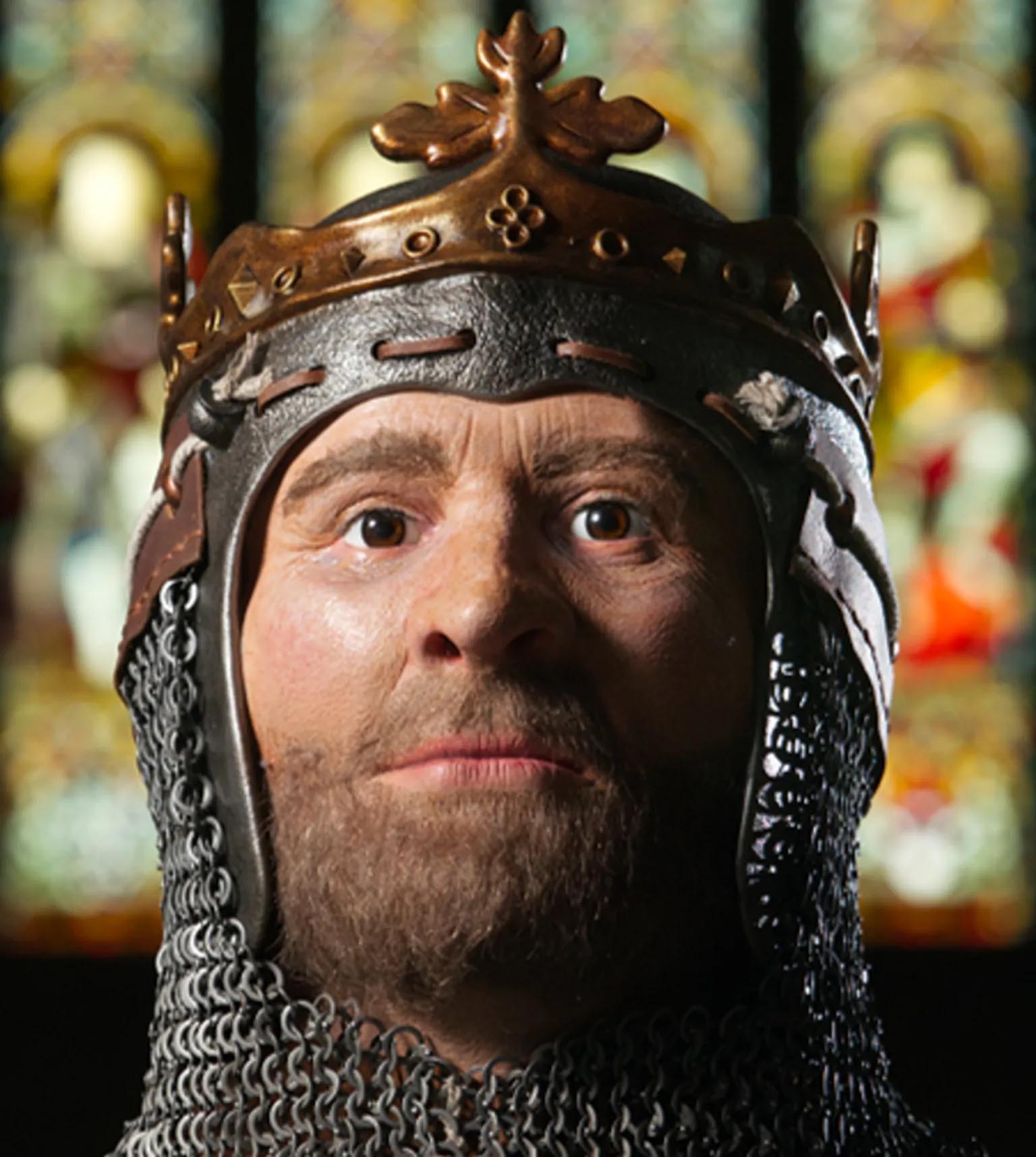
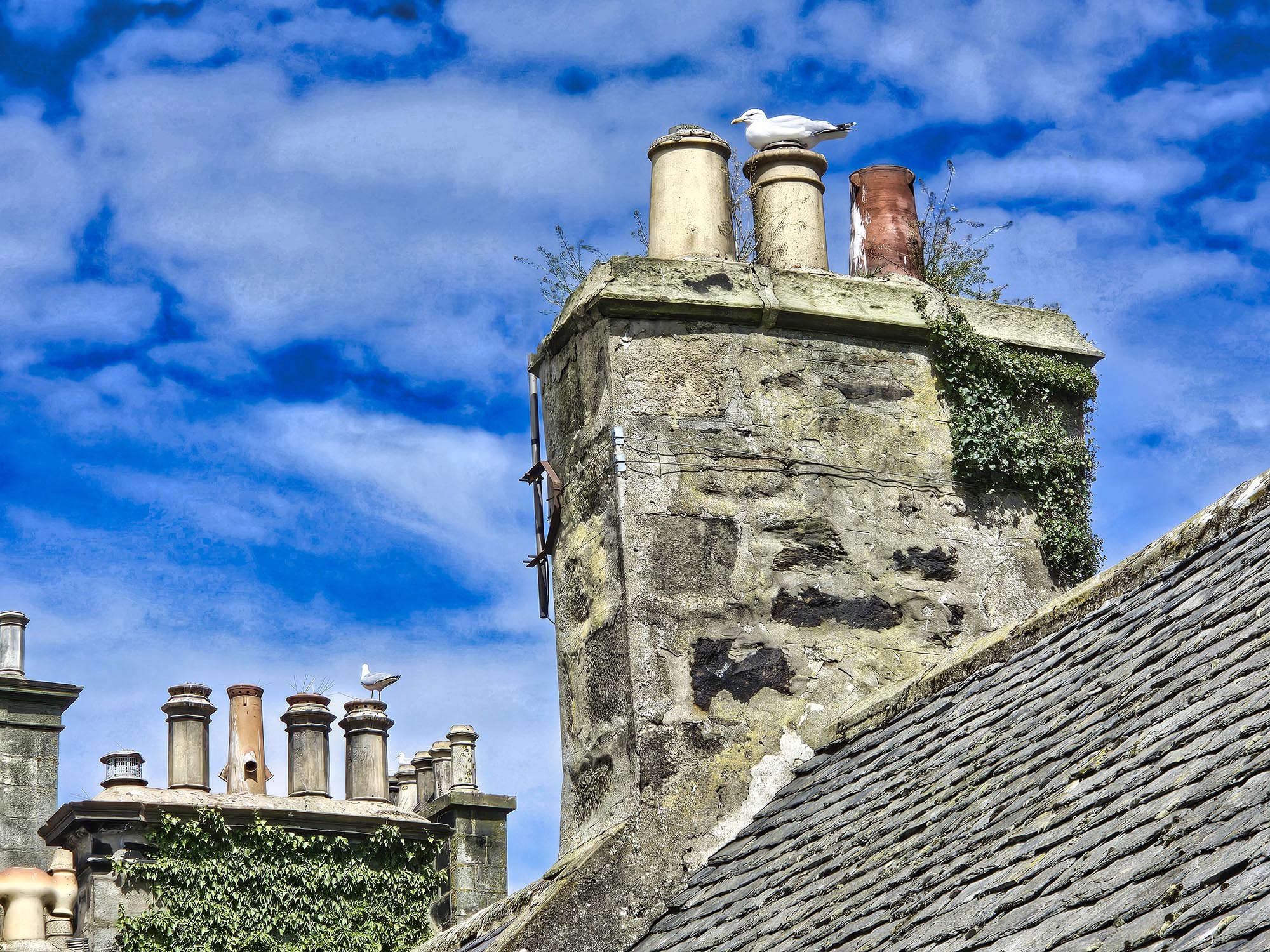
Gulls were nesting on the slate roofs in the nearby courtyard, squawking loudly and bringing food to their half-grown babies. With their calls in the background, I boned up on my Scottish genealogy in preparation for our meeting with a distant cousin at Broomhall House near Edinburgh. I mentioned in one of my posts about Ireland that, according to some less-distant cousins, I’m related to Robert the Bruce, the first king of Scotland. He was my great-grandfather to the 21st power. Someday I plan to get a genetics test to prove this, but I hadn’t had time or opportunity to do that just yet.
A reconstruction of Robert the Bruce’s face. Image courtesy of the BBC.
As I perused the genealogical chart, I was impressed by some of the sir names that popped up, including Stuart and Wallace. Apparently, our cab driver the other day might be a Stuart relative of mine! No wonder we became buddies so quickly. Also, there were six Barons of Clackmannan in my line. Thanks to some internet searches, I discovered that the barons lived in a tower and mansion in the town of Clackmannan and that the tower still stands. I thought it would be great to go there some day and filed that in the back of my mind. It wasn’t too far away from Broomhall House. Hmmmm.
The next day we decided to brave a bus trip to Banff, the nearest large town, to take in some of the sights. The bus stop was nearby, and it ran every hour or so, so it looked very convenient. And it was! Hobbling to the stop with my hiking pole, we caught the bus. Our goal was to wander around Banff for a while, then catch a taxi in the afternoon to Huntley and the Glendronach Distillery, one of our favorite brands of whisky.
Chimney gulls in Banff.
We were dropped off in the central town square of Banff. Mind you, this is the original Banff that Banff, Canada, is named for, or so the locals say. (I checked, and Banff Canada was named by the president of the Canadian Pacific Railway who grew up in Banff, Scotland.) An internet search told me that a local mansion called Duff House was open for tours. The walk wasn’t too far, so off we (I) hobbled.
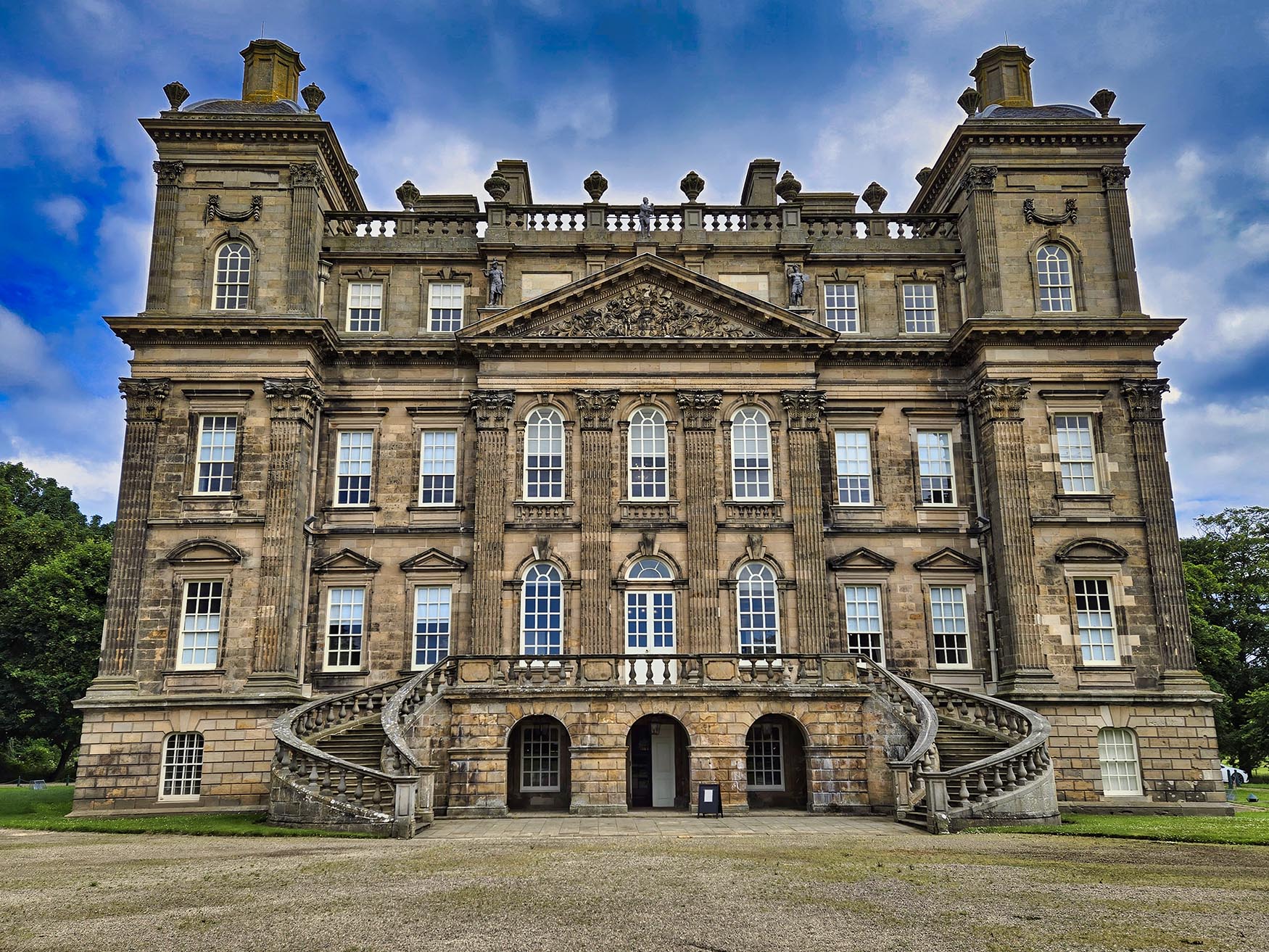
Duff House in Banff.
The building was designed in the 18th century by Scottish architect William Adam for the local lord. However, before the interior was finished, work on the house stopped due to cost overruns. Apparently, the local lord’s (William Duff) plans were larger than his wallet. A court case ensued, which found in favor of the architect. Unfortunately, he died before the case was finished and never collected his payment. The lord was so disappointed by the whole thing, he never spent a night in the house and its completion was left to his heirs. During its life, the house has served many uses, including a hotel, sanatorium, and POW camp. If you’re interested in more history about the house, visit this site.
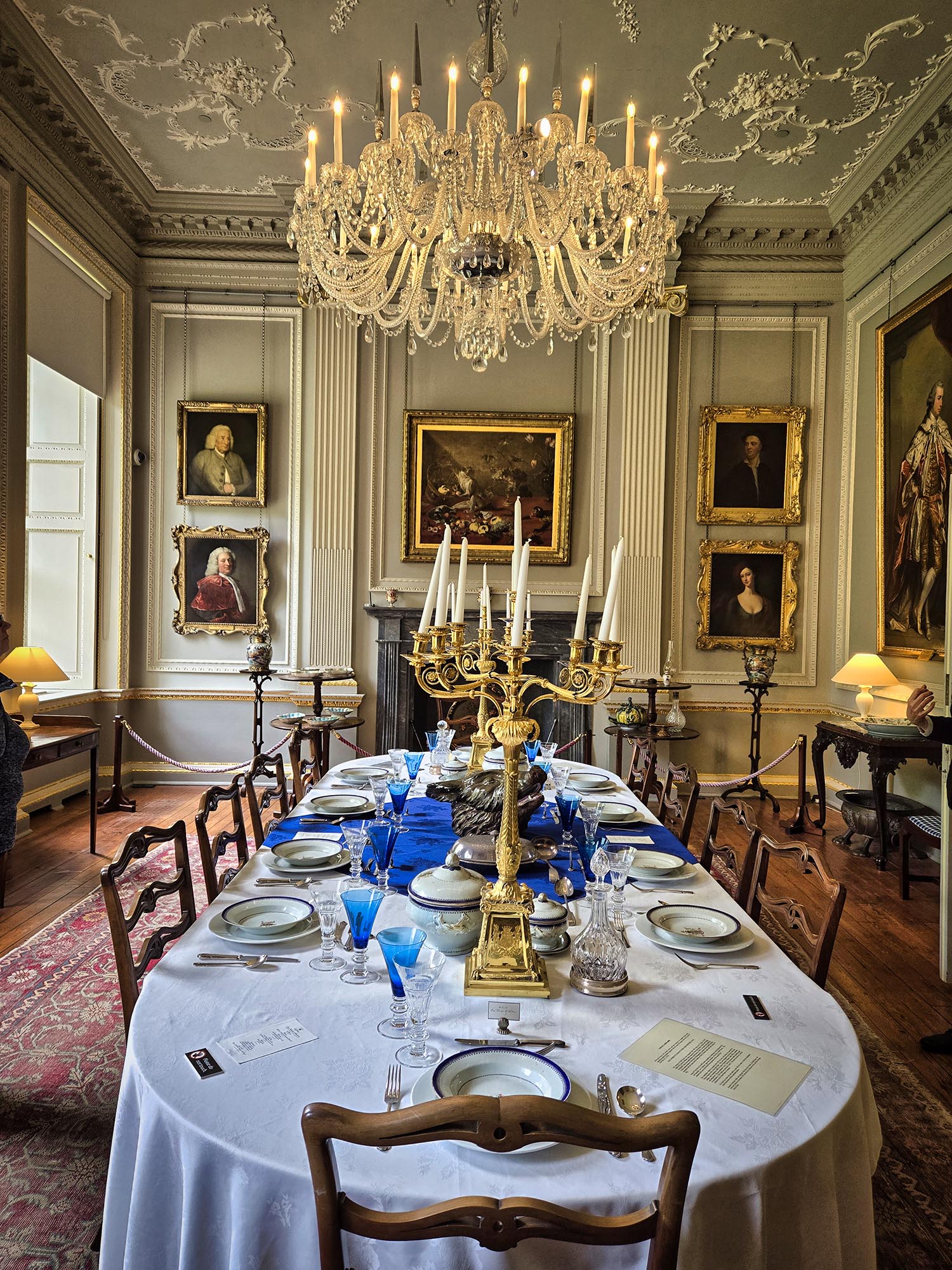
The dining room in Duff House, with a crooked candelabra.
The house is several stories tall. Rather than have a woman with a broken ankle hobble up and down stairways, the tour guides led me to elevators between floors, something I was thankful for! We enjoyed viewing the notable paintings and relics in the mansion.
By then, it was lunch time, so we walked back to the town square to a café we noticed earlier. Sated, we went back to the town square to see if we could connect with a cab. There are five cab companies serving Banff. Much to our dismay, we discovered that all of them were booked and there was no way we could make our distillery tour reservation time. We planned to leave for Edinburgh the next day, so we were out of luck for a tour later. We discovered the hard way that we should have made advance reservations with a cab. We learned that many school children in the area use cabs to get to and from school and that’s why none were available for us.
What was really lovely is that a woman who was walking by noted our plight and tried to help us. She even went across the street to a travel agent and asked his advice. Unfortunately, his advice was to spend time in the café where we had just had lunch and get a cab later. That wasn’t going to work for several reasons. So, we made the best of it and walked to the harbor to see more of the town.
Banff Harbor
We also stopped at The Market Arms Pub, which is rated the best in Banff. A bunch of guys were sitting at the bar. We grabbed a nearby table and had a pint while we waited for our bus ride back to Gardenstown. After about an hour, and older bespectacled gentleman turned to us and said, “Aye, do ye know who Mellors is then?”
It took me a beat to place the name, but I was soon able to tell him that Mellors was the gamekeeper in “Lady Chatterley’s Lover.” He said something about the other guys at the bar being too young to know who Mellors was. I told him it was one of my favorite books, and he agreed that it was beautifully written. That was the extent of our conversation. Where else in the world would a person in a bar ask you about a D. H. Lawrence book? I feel like something like this could have only happened in Scotland! This conversation made up for missing our distillery tour and is just one reason why I love this country.
A Gardenstown evening.
We caught the bus back to Gardenstown. Everyone on the bus was very friendly, both coming and going, and seemed to know each other. One man even tried to give us advice on where to sit. His advice would have separated me from Russ, however. I told him that just wasn’t happening. He huffed in a way that said, “Suit yourself. I tried!” As with my previous trip, I was so impressed by the community spirit of this area of Scotland and the helpfulness of the people. They’ve got their noses all up in your business, but they mean well by it.
We capped off our night with another meal at the Garden Arms Hotel. I had langoustine nuggets (they’re a kind of shrimp also known as Norwegian lobster) and tiramisu for dessert. They were superb! We spent the rest of the evening at our AirBnB in front of the fire sipping scotch. The next day, our destination was Edinburgh, by train.