Here’s yet another side detour from my New England travelog. Don’t worry, I’ll get back to it!
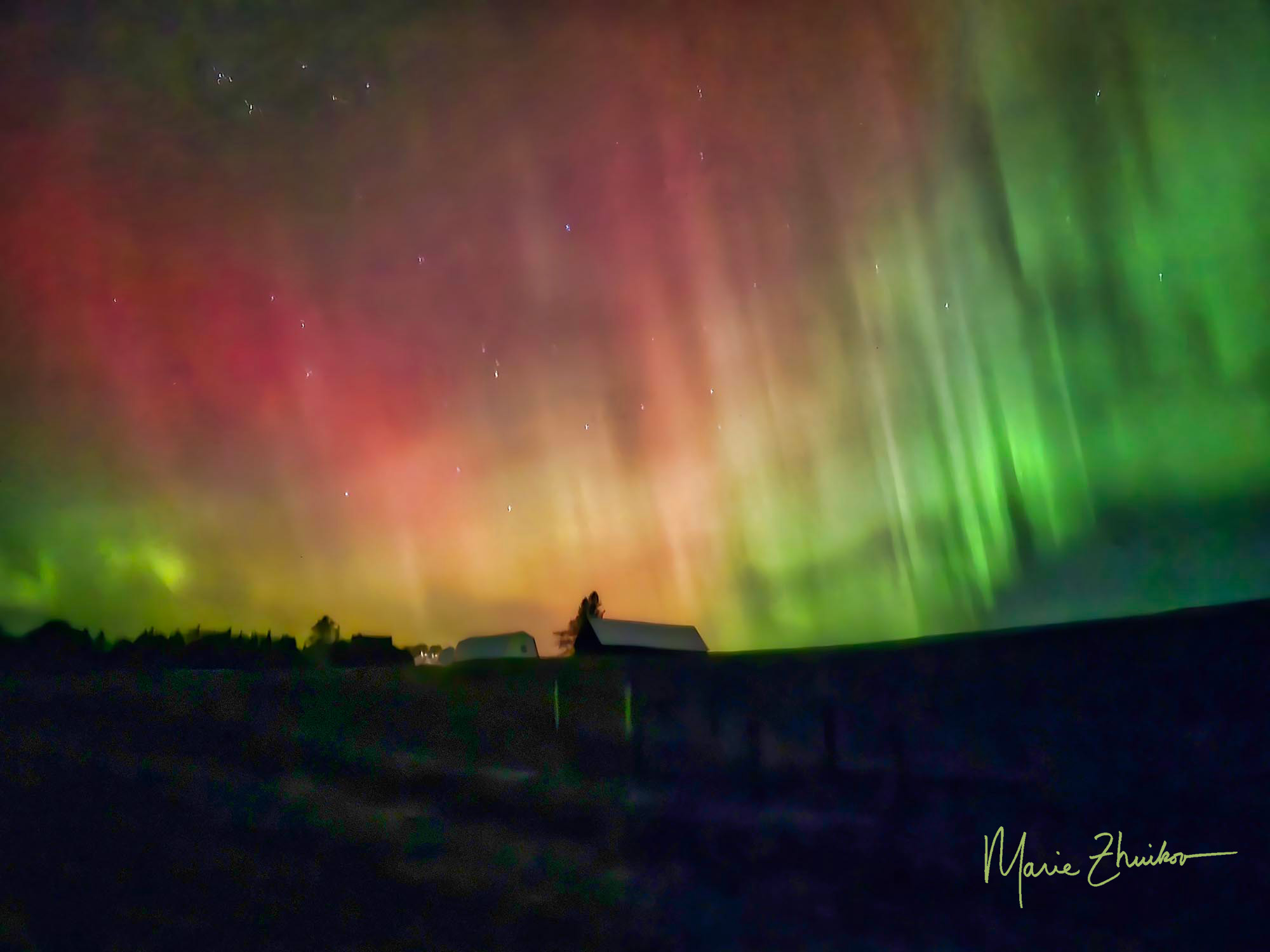
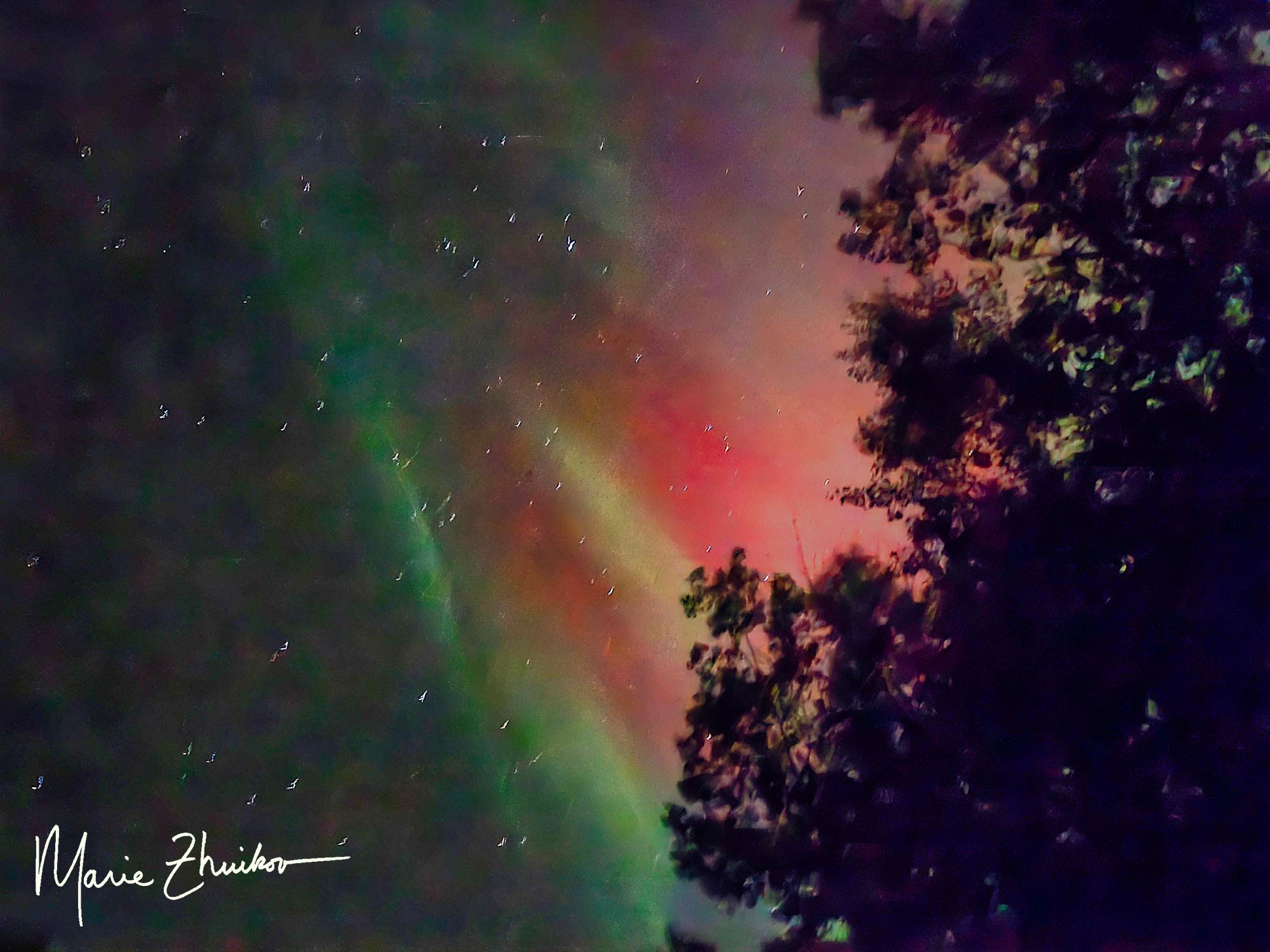
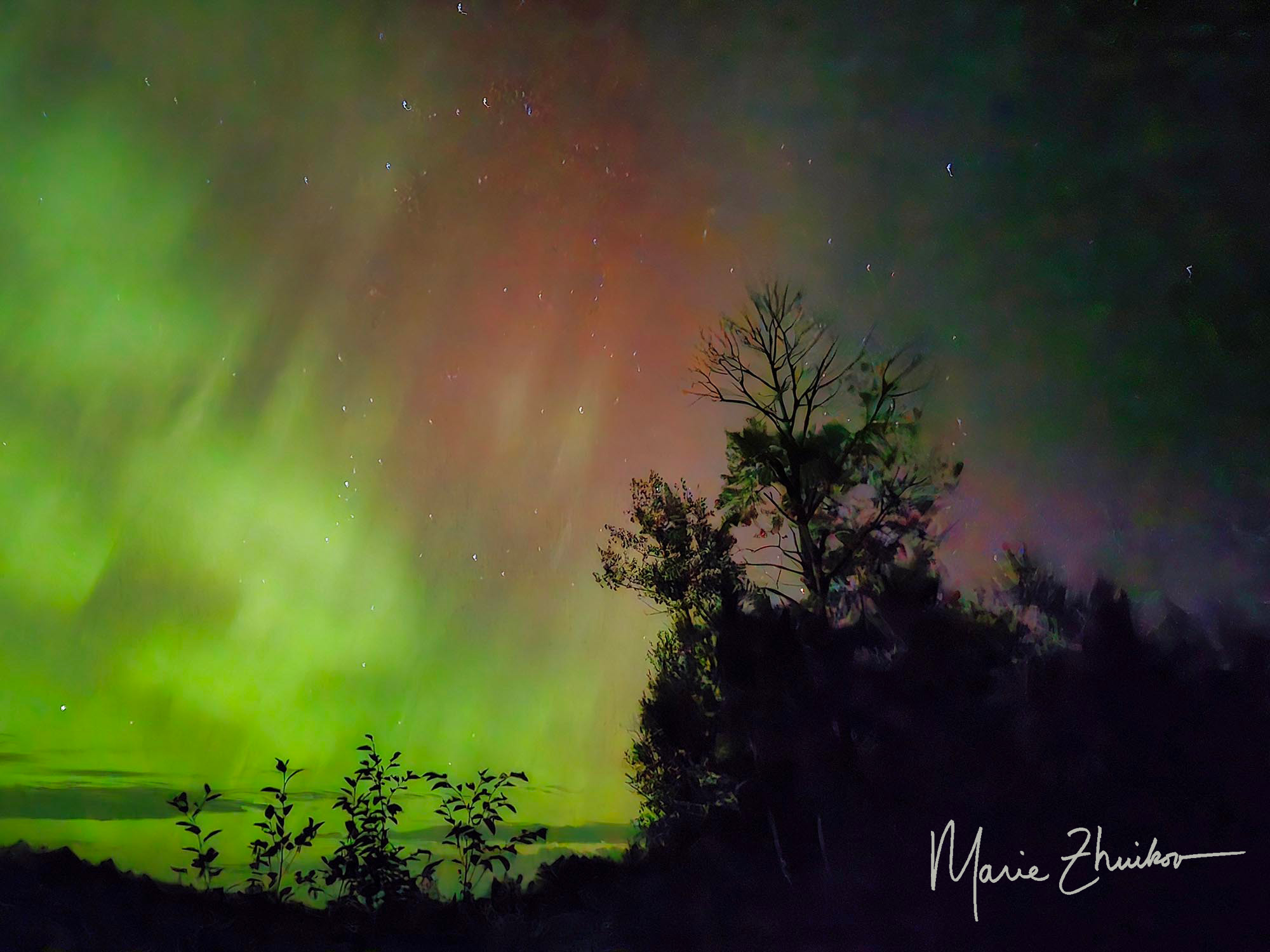
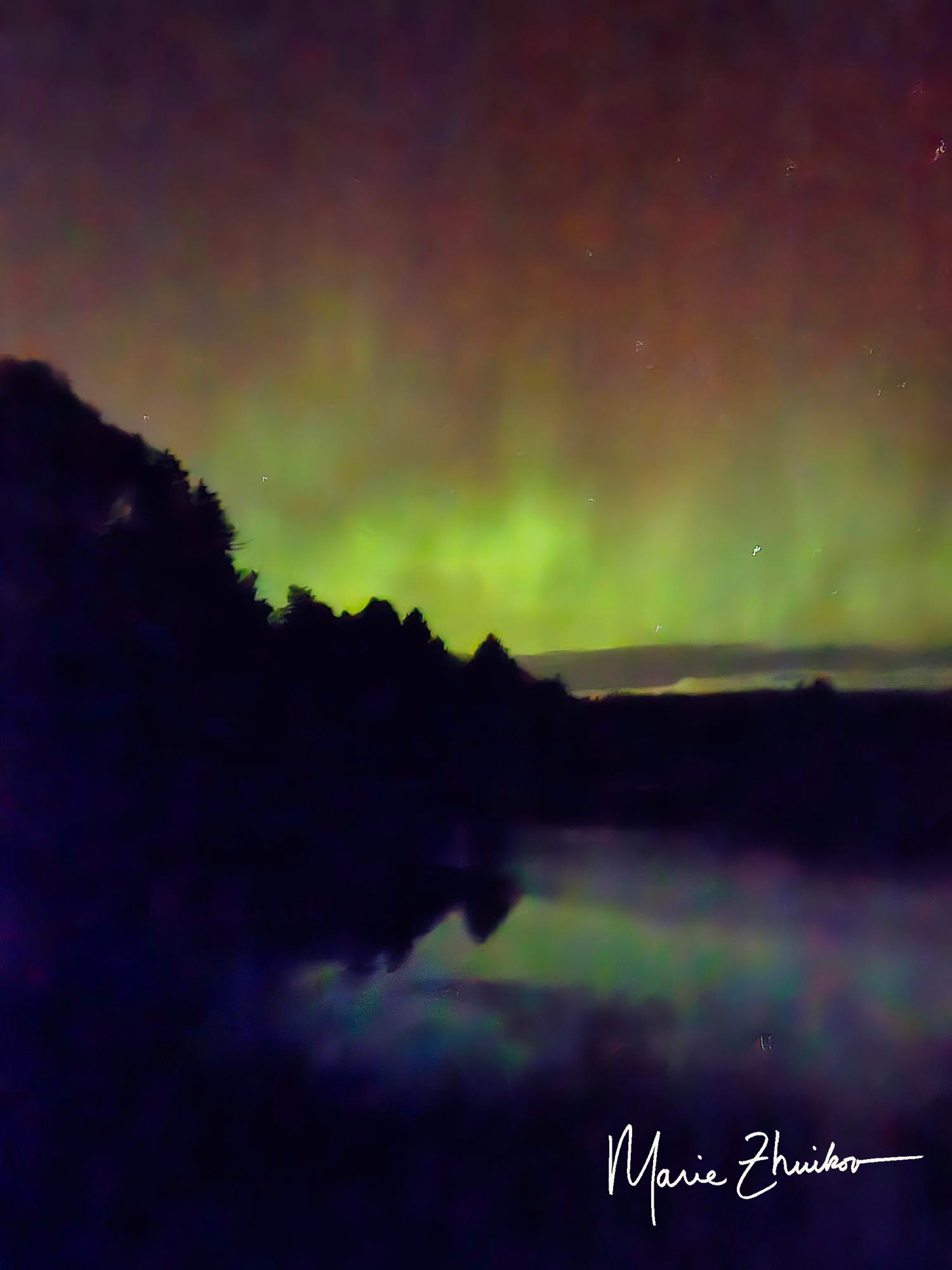
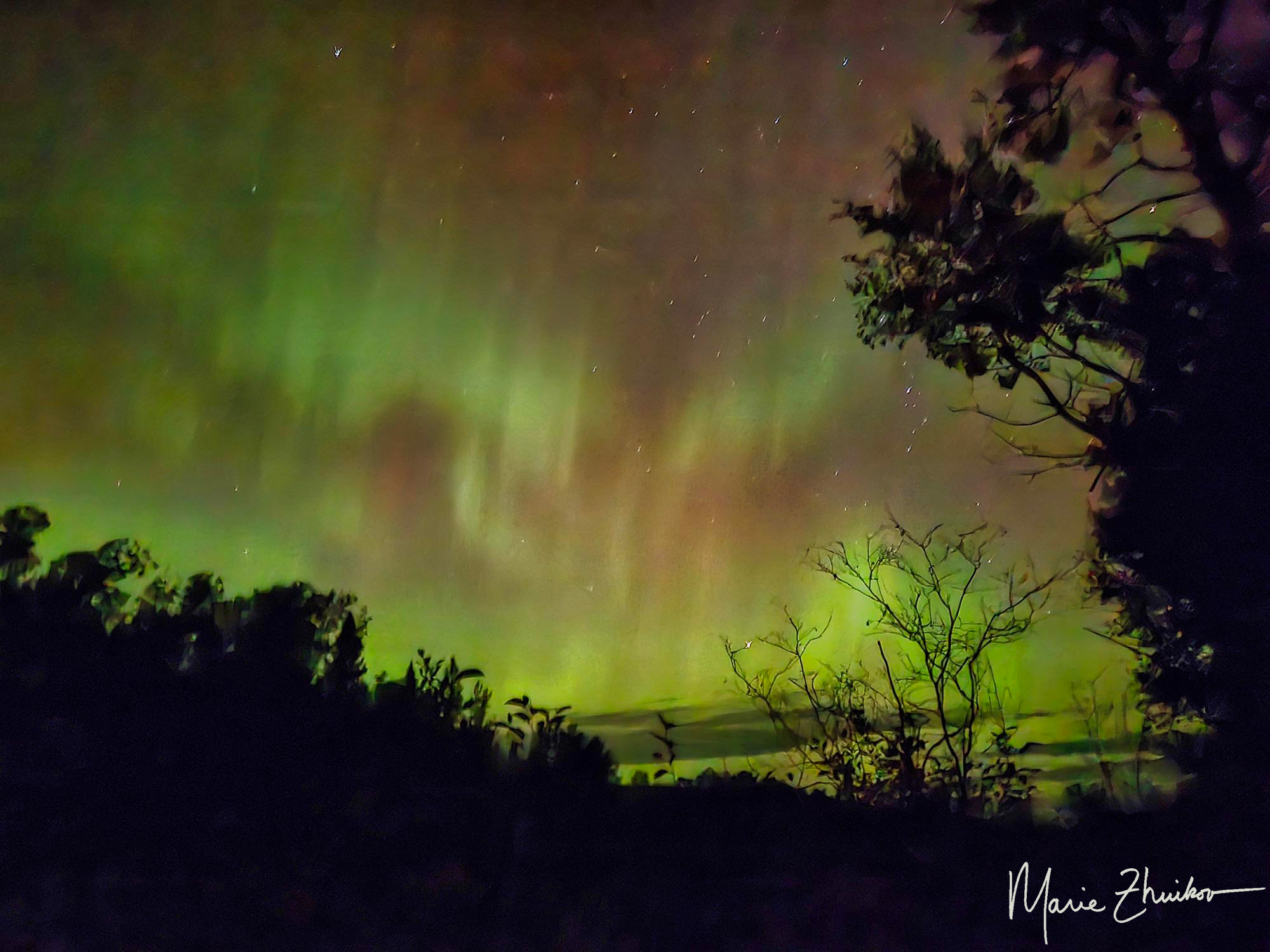
The other night Russ and I meandered around the backroads north of Duluth, joining many others who parked their cars in random spots and looked up to the spectacle happening in the sky.
That spectacle was the northern lights. I took these photos the second night of the show at about 8:30 p.m. It was so kind of the aurora to happen before bedtime! We found a spot on a gravel road where we could see a whitish curtain of aurora on the horizon. We first stopped at a town hall but there were too many lights, so we went back down the road until we found a dark area. I took a few test shots with my phone camera and wowza! Jackpot.
A green curtain filled the sky, with some red overtones. As the lights continued to dance, the red intensified. This color is rare in auroras.
Here’s an explanation from a local astronomer, Astro Bob (King). I don’t totally understand it, but here’s what he said about that storm:
Red aurora occurs high up in the atmosphere at an altitude of around 150-300 miles. Green emission happens at lower altitudes, around 75 miles. Both are produced when incoming charged particles strike and energize oxygen atoms. After the impacts, the atoms release that energy in the form of green and red light when they return to their original relaxed state.
At high altitude, the number of atoms drops sharply — it’s basically a hard vacuum up there. After it’s struck by a charged particle, an oxygen atom needs almost two minutes to release that energy. If a neighboring atom were to bump into it during the transition, it would short-circuit the process. But because there are so few atoms at that altitude, oxygen has time to release red light before a collision occurs.
There’s so little oxygen to begin with at high altitude, a strong storm is required to crank up enough oxygen atoms to produce the red aurora. Seeing red is a good sign that a significant storm is underway. Overall, the Nov. 11 storm reached the G4 (severe) level, with aurora reported in all 50 states (including Hawaii) and as far south as the tropics.
A farm house and barn stood off to the side and provided more visual interest to the shots. Eventually, the cold got the better of us and we crawled back into our car to return to our modest home filled with artificial light.
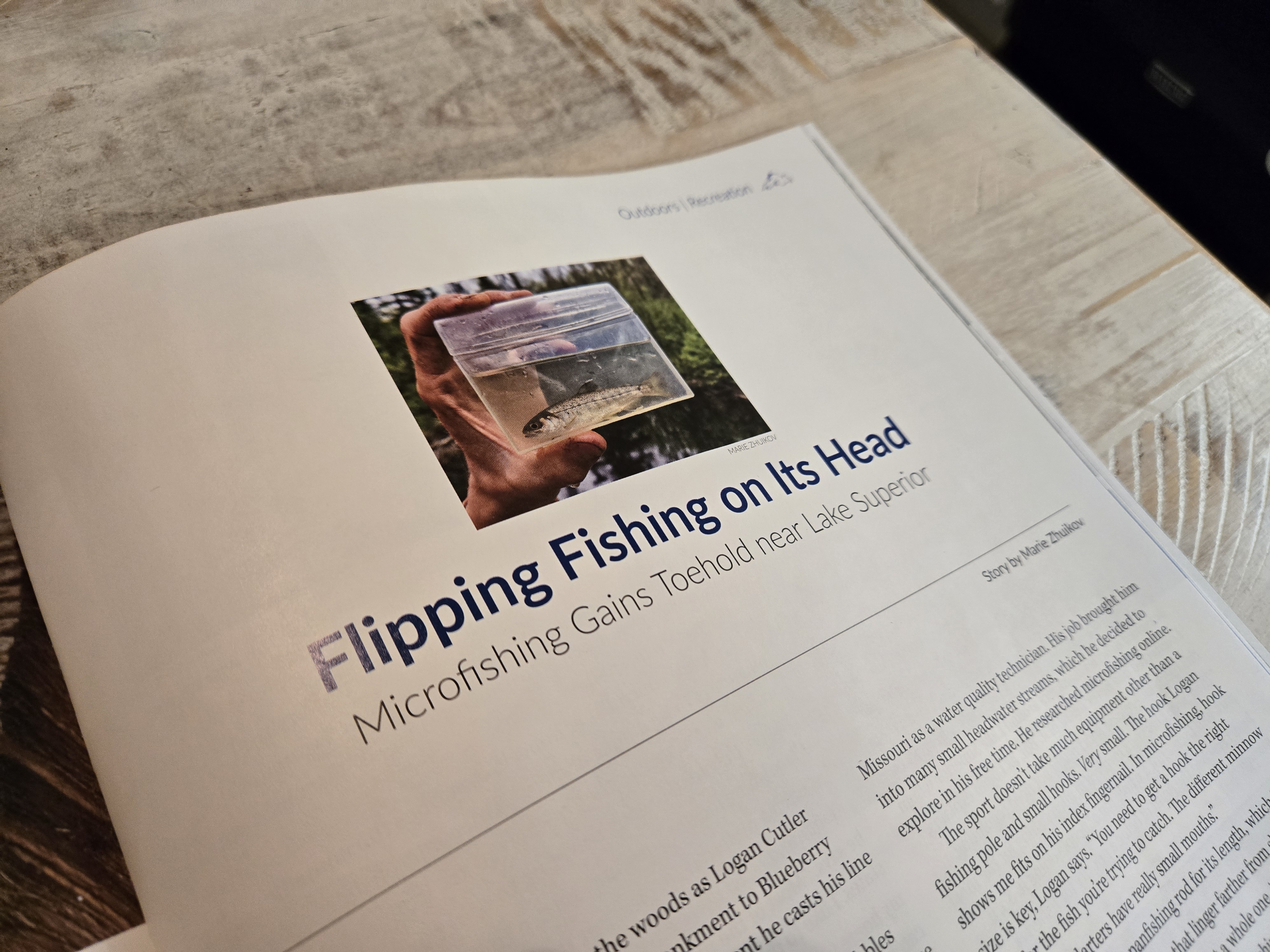
A new sport has reached the shores of Lake Superior. It’s called microfishing. Think birdwatching, but with tiny fish. Quite a change from trying to catch the largest possible fish!
You can read all about it if you’re a subscriber to Lake Superior Magazine. My story is in the October/November 2025 issue. I learned about this unique sport when I interviewed a local department of natural resources fisheries biologist for a different story. Once I retired, I had time to pursue a magazine story. The sport is practiced all over the world.
If you’re not a magazine subscriber and want to learn more, visit microfishing.com.
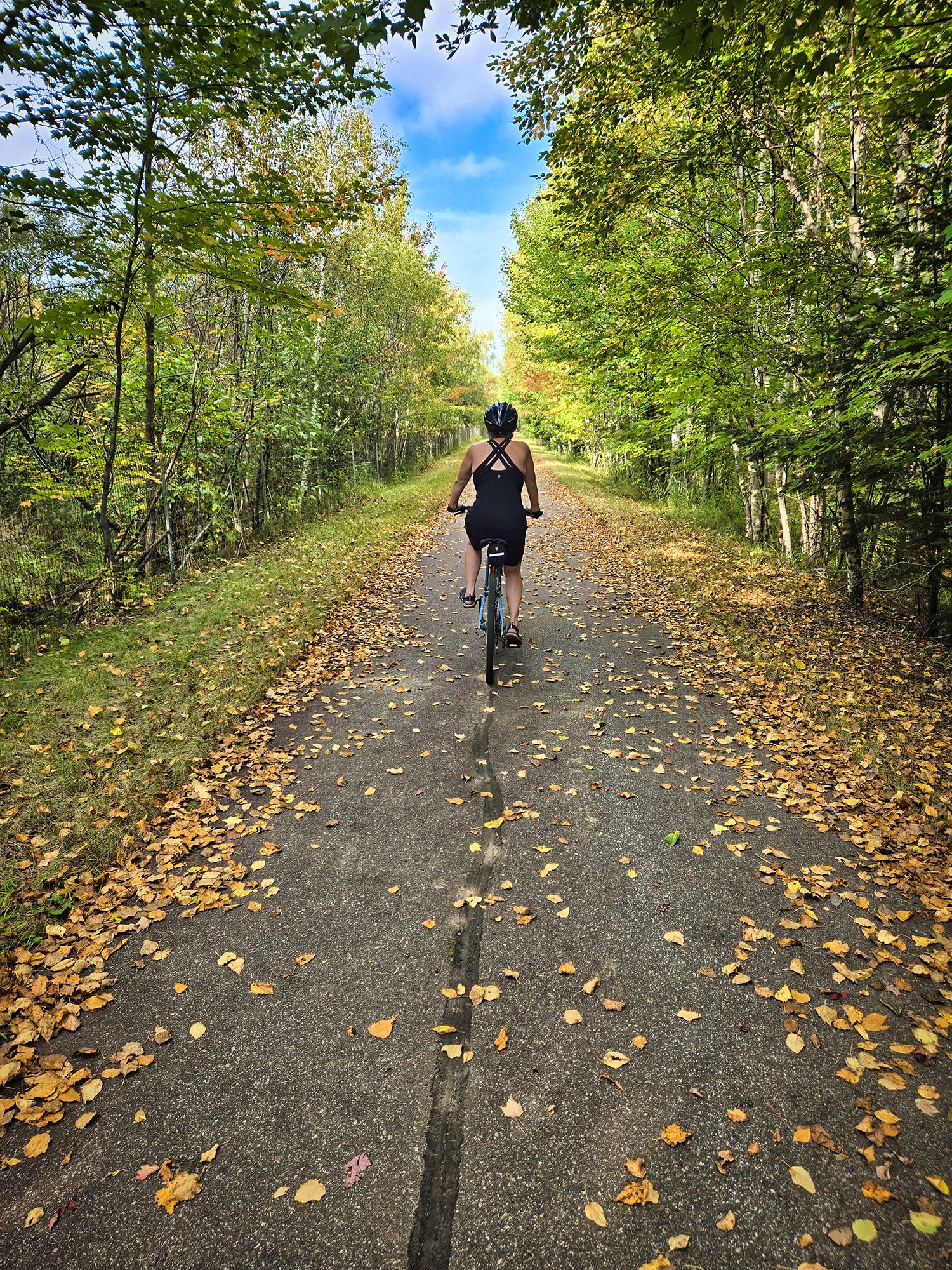
Last month, Russ and I continued our quest to cycle different sections of the Mesabi Trail, which crosses northern Minnesota’s Iron Range. Amid the crunch of fallen leaves and the brilliant red of sumac, we biked from Nashwuak to Calumet with a side trip to Pengilly.
A warm breeze offered one of those final temperate days between summer and fall. The trail began in Nashwauk at a nondescript parking lot near a closed restaurant with the suggestive name of Big O’s Chef House. (Maybe that’s why it went out of business?) Except for a few frost heaves, the mostly flat trail was in good condition. It parallels the highway ,so the distant noise of cars is ever-present.
Much of the land surrounding the trail is owned by Mesabi Metallics Co., an iron ore and taconite mining company. We passed huge piles of mine tailing waste and overgrown past mining roads as a few vultures circled overhead.
In the sleepy Sunday town of Calumet, we rested at a public picnic shelter. The only evidence of life was a man throwing a ball for his black lab. Then we turned around and made our way back to Nashwauk. Along the way, we took a short spur trail to the town of Pengilly just for a change of scenery.
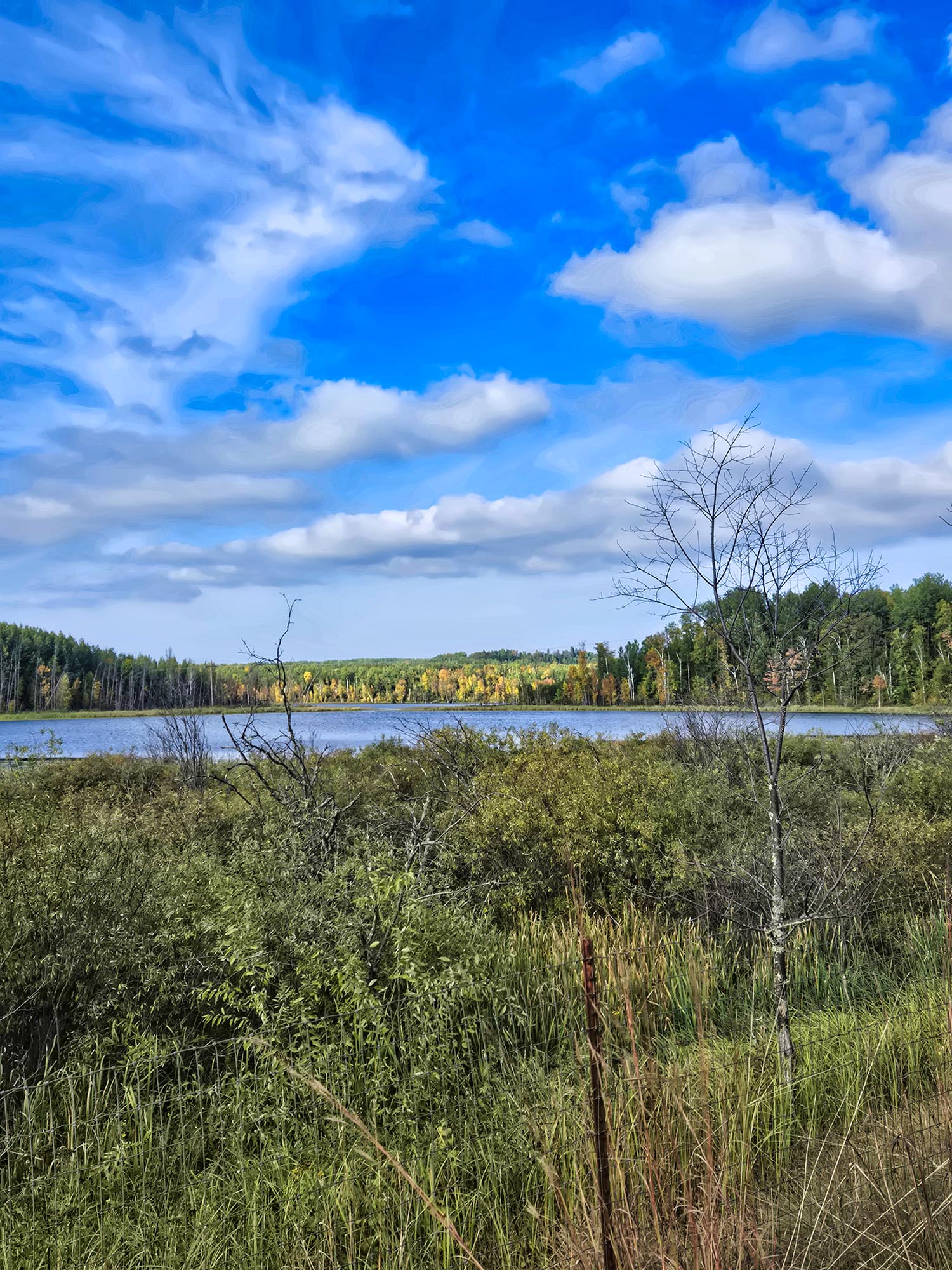
Scenery along the trail.
Once, a pair of teenagers on an ATV surprised us (they’re not supposed to go on the trail). Several times, we had to dodge Halloween-colored (black and orange) woolly bear caterpillars inching their way across the trail. Folklore says they can predict how harsh the winter will be by the width of the colored bands on their bodies: more black equals a harsher winter. We were trying too hard not to squish these fuzzy forecasters, so we didn’t notice their band patterns.
Apparently, science has not confirmed the caterpillars’ weather-forecasting abilities. Even so, the woolly bear remains a symbol of autumn. Its presence offered us a gentle reminder that the season is turning, and nature is preparing for the quiet, cold months ahead. This will probably be our last long ride of the season.
Total distance: 14 miles. For more information about other sections of the trail, please see these previous posts:
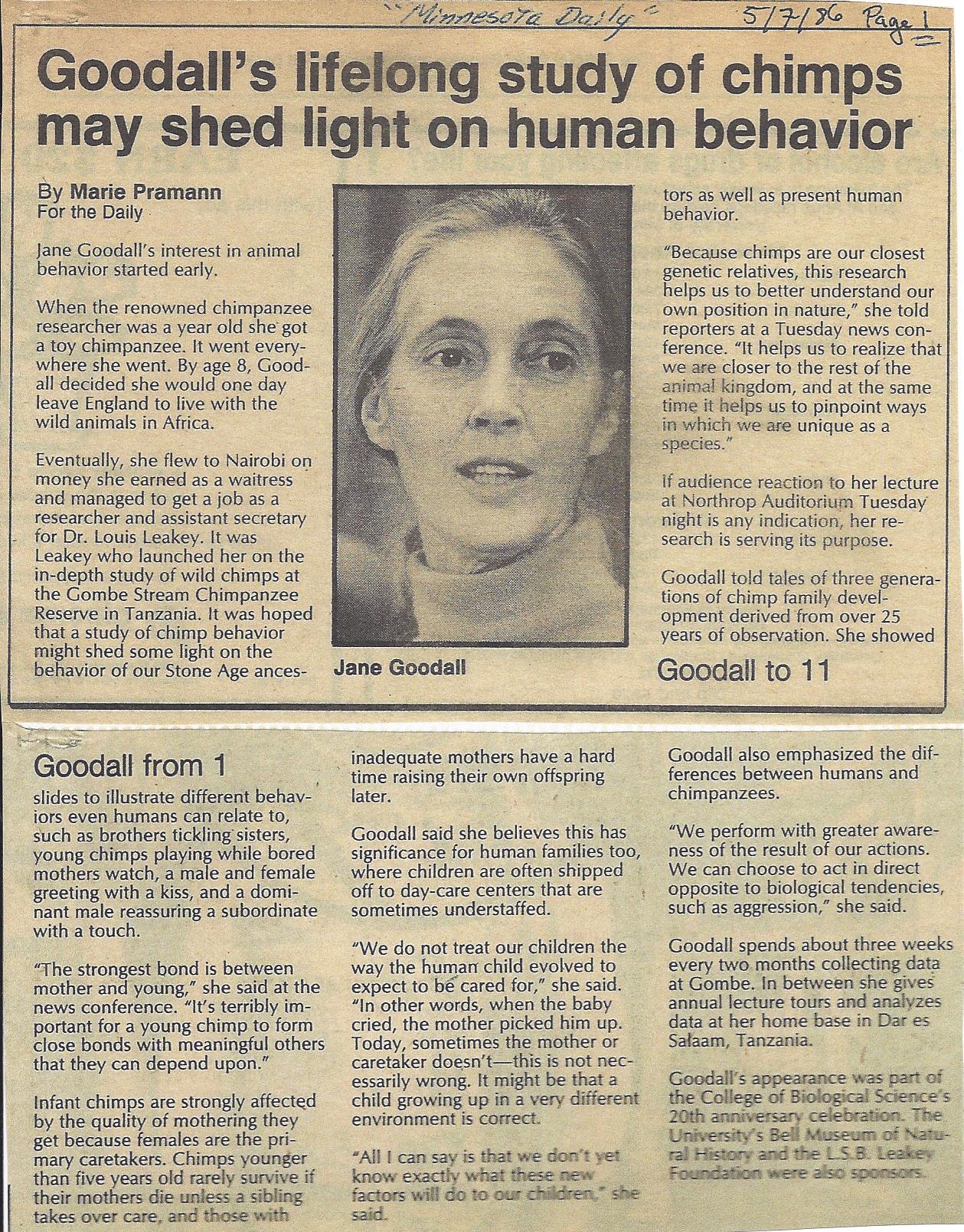
Story from the Minnesota Daily, May 7, 1986, page 1.
You may have heard that chimpanzee researcher Jane Goodall died recently. As a young college environmental reporter, I had the chance to meet her once. Here’s a story that I posted in my blog previously and included in my Meander Northbook. Not only was Goodall a great scientist and advocate for nature, she was a wonderful human being.
With all the noise in the blogosphere, no one’s probably noticed that I’ve been quieter than usual lately. That’s because I’m working on another book manuscript. This time it’s poetry. I’ve had poems published here and there but never a book of my own. So, I decided to compile my life’s work of poems—yet another good retirement project.
I finished the manuscript last week and sent it off to a local publisher. I decided to choose this publisher because they exist solely to help poets in our area with projects like this, the turn-around is quick, I’ll get to keep the profits, and have control over the final manuscript.
Two days later, I received a “yes”! Now I’m working on fine-tuning the manuscript and getting marketing blurbs ready. Here’s what I have so far:
High Fire Danger: Poems of Love and Nature
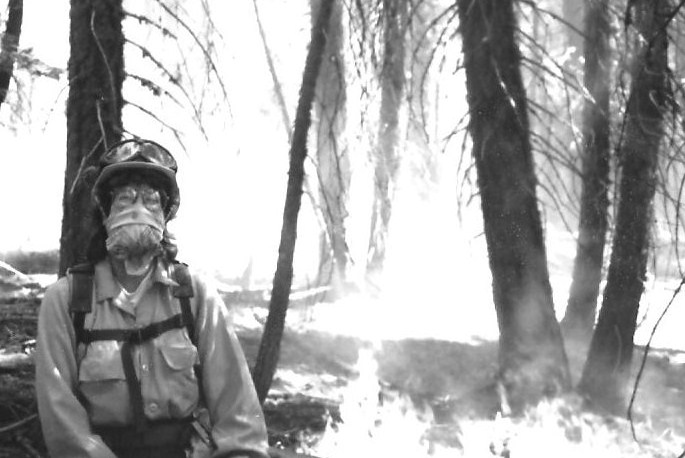
Me years ago on a firefighting assignment in Yosemite. I’m smiling behind my bandana.
In High Fire Danger, Marie Zhuikov meditates on the transformative power of love and the magic and menace of nature. Written over the past thirty-eight years, Zhuikov’s enchanting poems offer unique insights and cutting humor. They take readers from her home in Minnesota to far-flung locales across the Great Lakes, Canada, Scotland, the Caribbean, and even to another planet. These accessible poems are filled with the heat and longing of romantic love, but also a deep love for family, community, and nature. They’ll scorch your soul like wildfire.
In a few months, I hope to have this book out into the world! For info about my other fiction and nonfiction books, please visit my book page.
A rare show lit up the sky above our cabin last night. Russ and I meandered down roads in the dark, feeling our way by the gravel crunching under our shoes. We made it to a bog that has a good view north.
As the aurora silently danced above in curtains of reds and greens, lightning bugs danced closer to the ground, their feeble white lights the last of summer.
If you’d like to see my photo page with lots of other images (organized by topic: water/wood/stone/sky/travel and lighthouses) please visit my photography page and choose a topic: https://mariezwrites.com/photography/.
Wild rice, the kind of rice native to the Great Lakes and other parts of North America, is not only delicious in soups and other dishes, it makes a great and healthy snack.
A few years ago, I was gifted a copy of The Good Berry Cookbook by Tashia Hart. The author is a member of the Red Lake Anishinaabe (northern Minnesota) and she’s a culinary ethnobotanist, artist, photographer, writer, and cook. The book is more than a cookbook. It’s everything you ever wanted to know about wild rice.
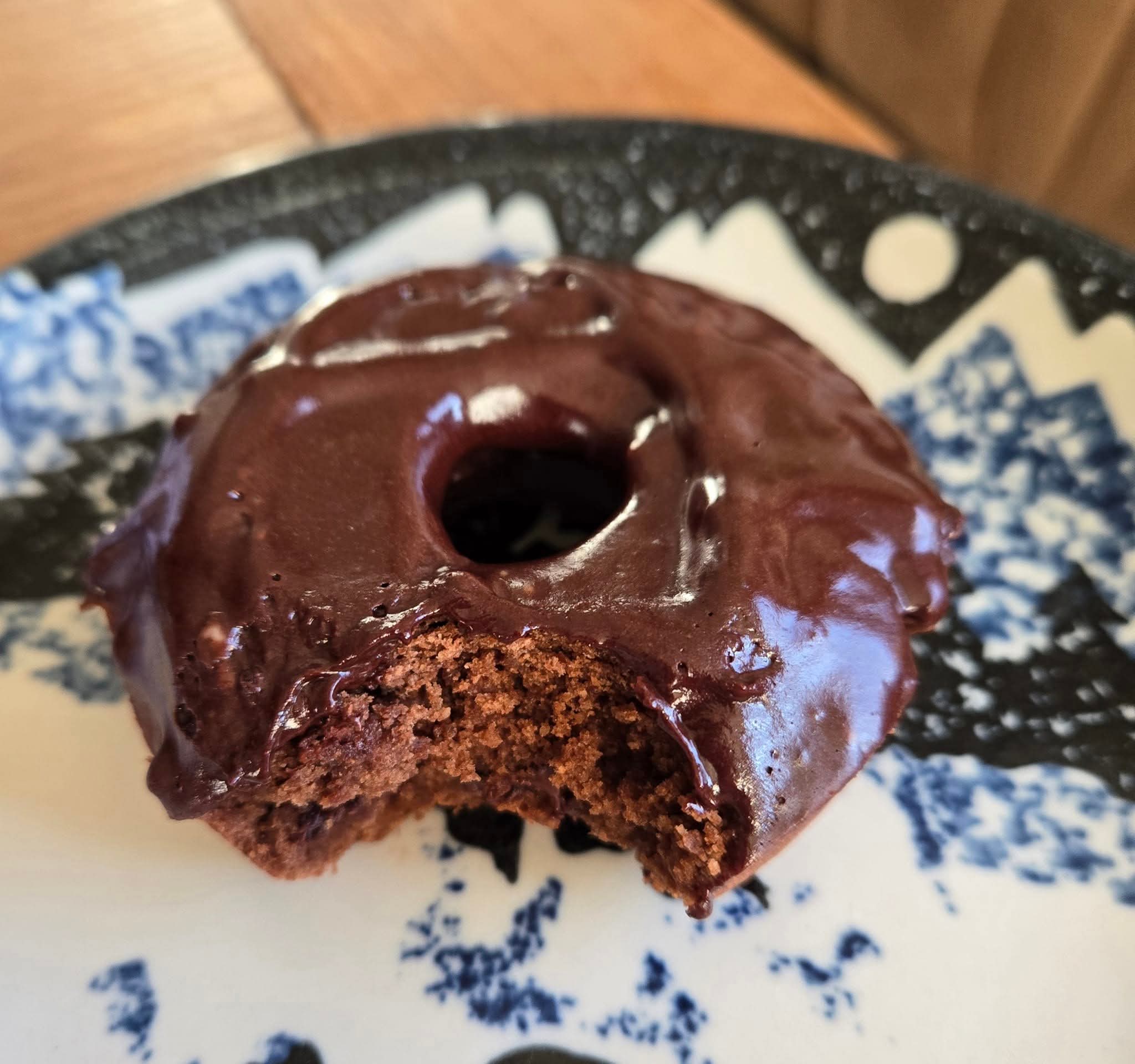
A wild rice triple chocolate donut. Doesn’t it look tasty?
I’ve made several recipes from the book, notably, one for wild rice chocolate donuts (Triple Chocolate Donuts). As someone who’s always on the lookout for alternatives to wheat and corn, I was attracted by this recipe. They turned out looking great but were a bit gritty. Maybe I didn’t grind the rice into flour as fine as I should have. Since then, I’ve found other wheat- and corn-free recipes I like better.
This weekend, I went to a Harvest Festival in Duluth, which features produce from local farmers and artisans. One booth offered puffed wild rice in several flavors (for instance, cheese pizza!) I tried a sample of salted rice puffs. They were very good. Done this way, the wild rice tastes almost like popcorn, but with a richer, nuttier flavor. I would have bought some, but the vendor used popcorn salt, which usually contains cornstarch, so I passed.
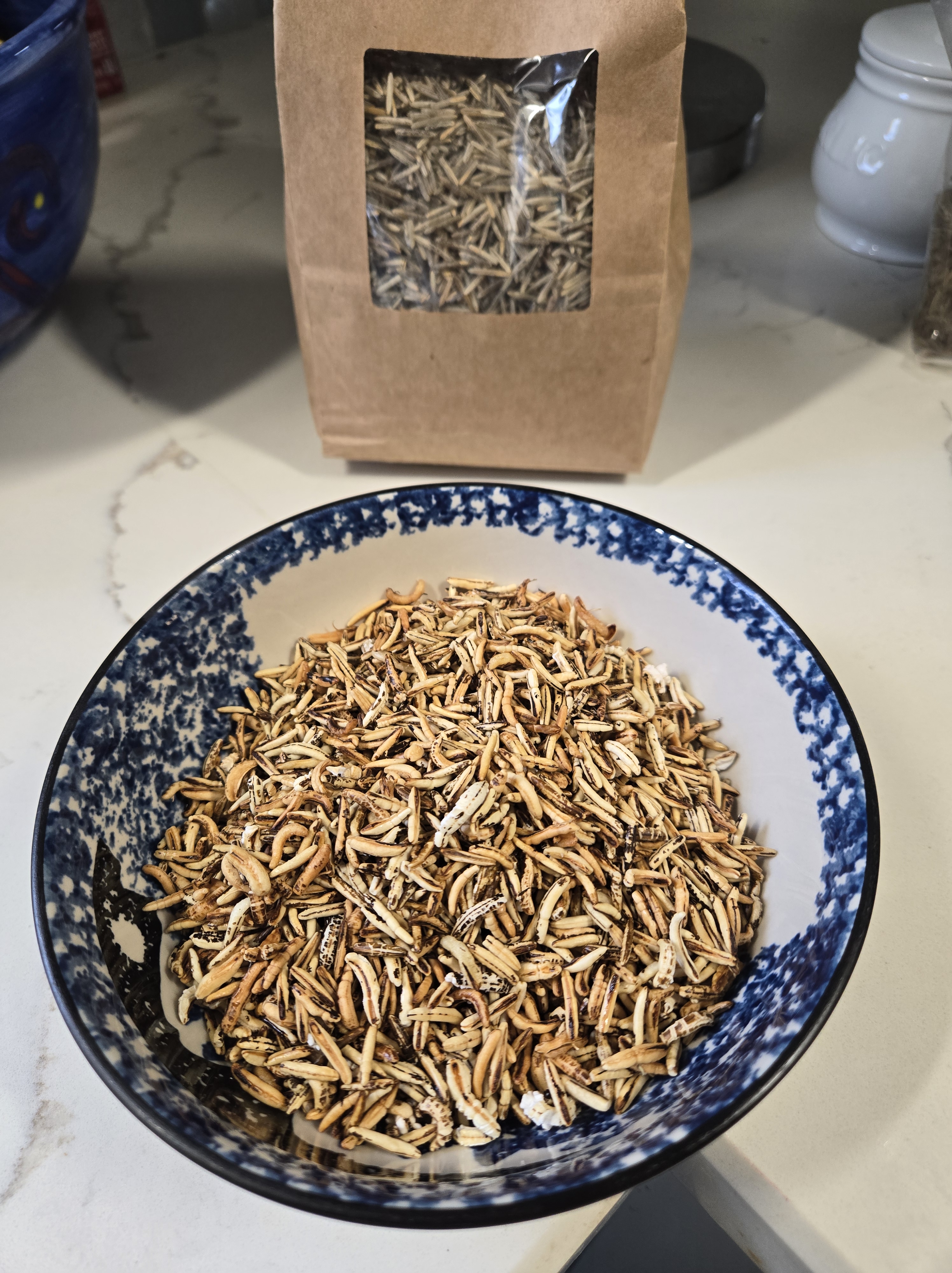
Seeing the puffed wild rice reminded me that the Good Berry cookbook had a recipe for it, so when I returned home, I made some. It requires wild rice that has been picked and parched in a traditional manner. This makes it a lighter color (dull brown) versus the paddy-grown wild rice, which is dark and shiny.
All you do is heat a few inches of oil (I used canola) in a pan at a high temperature. I used setting 7 out of 9 on my stovetop. Wait until the oil is good and hot, then place a small amount of wild rice in a sieve (2-3 tablespoons) and lower it into the oil. It should puff up quickly if the oil is hot enough. Then spread the rice on a plate lined with paper towels to drain. I seasoned mine with sea salt (which usually contains no cornstarch).
If you’ve ever had puffed wheat cereal, you’ll recognize puffed wild rice, although the rice kernels are smaller and skinnier. It tasted great!
Marie tries her hand at harvesting wild rice, St. Louis River, MN.
Russ has developed the habit of eating popcorn in the evenings, which is sort of torture for me because I can’t have it. (Do you think he’s doing this on purpose??) Now, I have an alternative.
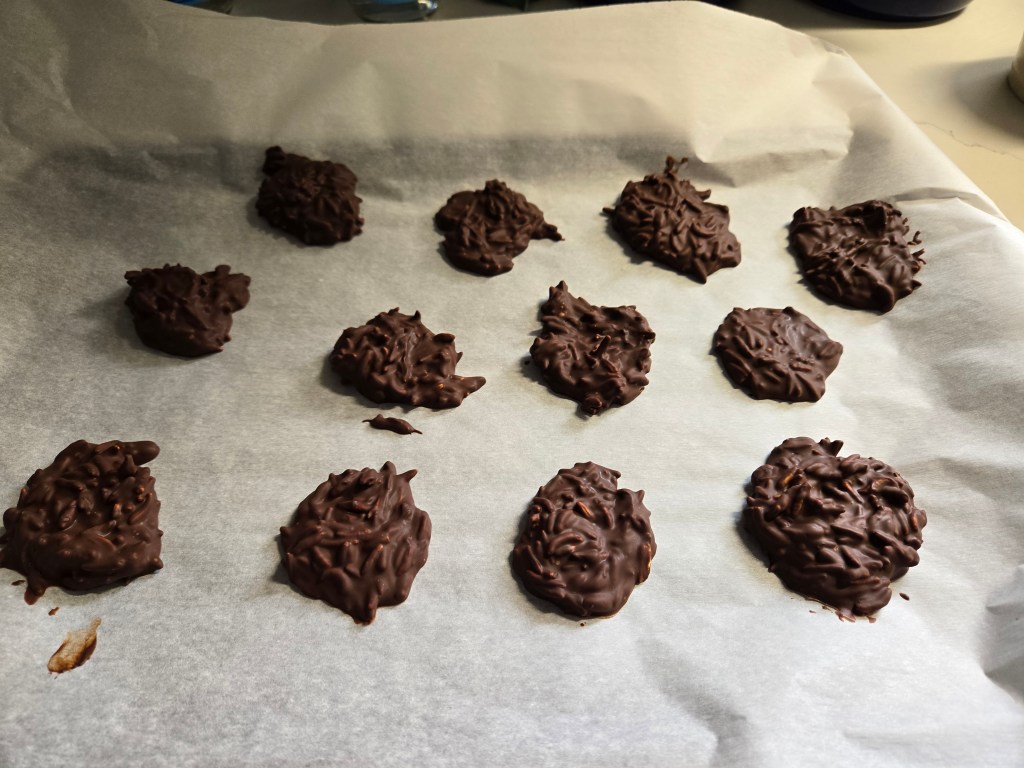
Tashia also offers a recipe for wild rice chocolates. Basically, you take the puffed wild rice and pour melted chocolate chips over them. I have some leftover puffed wild rice. That’s next on my list!
For a story about my “immersive” experience harvesting wild rice, visit this link.
Update: 9/10/25
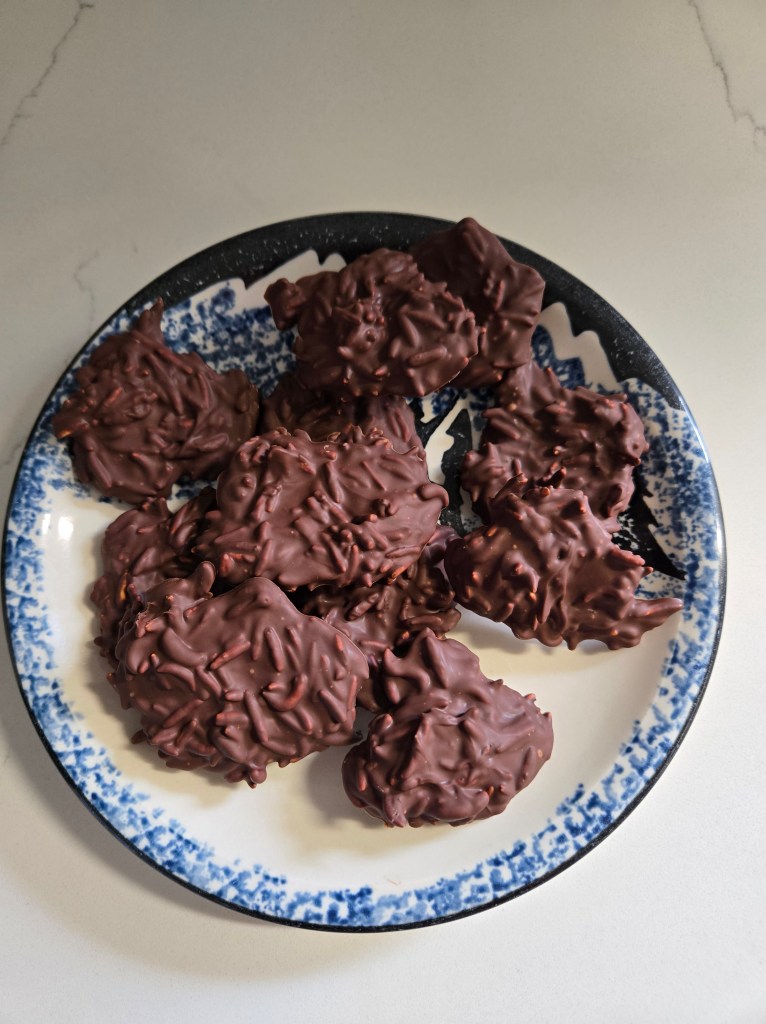
I made the puffed wild rice chocolates. Very good! The recipe calls for making them in a flat sheet, but I chose to clump them instead. They taste rather like a Nestle crunch bar.
The oldest lake trout yet discovered in Lake Superior, also known as “Mary Catherine.”Image courtesy of the Michigan DNR.
The Michigan Department of Natural Resources (DNR) published a story a few days ago that made many people upset. As someone who has her feet in both natural resources management and public relations/science communication it offers an interesting case study. The DNR was trying to highlight an interesting fact about how fish can reach old ages, but some mistakes got in the way of this message.
The ear bone of one fish they caught in a special survey done in 2023 to study the different forms of lake trout and their reproductive biology was recently analyzed and the DNR discovered that the fish was as old as I am! (62 years) They caught the lake trout on a reef in the southeastern part of Lake Superior (40 miles north of Grand Marais, Michigan) and this lake trout is the oldest one currently on record.
The ear bones of fish show annual rings much like a tree, and that’s how the DNR can tell the age of the fish. It’s the only way they can do this, and they have to kill the fish to extract the ear bone, also called an otolith
Mary Catherine’s otolith shows 62 years of growth.Michigan DNR image.
One mistake the technicians made was naming the fish. They picked the era-specific moniker of Mary Catherine because Mary was one of the most common names in 1961 when the fish was hatched. People who heard news reports were excited that such an old fish was found, and that it even had a name, only to be crushed when they learned later that the fish was killed in the process of discovering its age.
One Facebook commenter said, “Hey we just killed Mary Catherine, but the upside is we now know that she was 62 years young, much like many grandmothers and recently retirees. There’s one less on Social Security now, and that should help keep it solvent.”
Another said, “Sad that they killed a fish who is probably older than the combined ages of some of the researchers, but it is interesting information.” Another commented that the fish might have lived another 20 years if not sacrificed for science.
You might think that such an old fish would be very large, but she wasn’t. Mary Catherine weighed 2.1 kilograms (4.62 pounds) and was 627 millimeters (24.7 inches) long. That’s because Lake Superior doesn’t have much food in it and animals grow slowly. The typical lifespan for a lake trout is 25-30 years.
The story gained wide media coverage, so it was successful that way, but even some of the reporters were dismayed that Mary Catherine was a goner. People already love to hate the DNR, and this well-intentioned science story just gave them another reason.
I’d say the main lesson is not to name your research subjects in newsworthy stories, especially if they’re dead.
The researchers were mum about whether they were inspired by the Saturday Night Live character, Mary Katherine Gallagher.
My husband’s nickname is Russell Brussel. He has a fondness, some might call it an obsession, with Brussels sprouts. We were cooking supper the other night: caramelized Brussels sprouts pasta with toasted chickpeas – a great vegetarian meal that we’ve cooked before – and I noticed a curious thing. The day was warm, so we had the kitchen windows open. Gradually, gobs of large black flies collected on the screens. They not only collected, they swarmed. In a spontaneous, miniature airshow, they divebombed the screens, as if trying to get inside.
Curious about whether this was happening elsewhere around the house, I checked other windows. No. The phenomenon was only happening at the kitchen windows. Thank god for the screens or we would have had an invasion on our hands!
We were busy cooking and then eating, so I didn’t think much more about it, although I noticed that the flies dispersed once the cooking was done.
The next morning, I did an internet search about whether flies are attracted to the smell of cooking Brussels sprouts. As you can probably guess, YES, they are!
Here’s why:
Odor Amplification:
Cooking can intensify the smells of food, making them more noticeable to flies, which have a highly developed sense of smell.
Volatile Compounds:
When heated, Brussels sprouts release various volatile organic compounds, some of which might be similar to those produced during decomposition, a known fly attractant.
Opportunistic Feeders:
Flies are attracted to a variety of food sources, including those that are decaying or decomposing.
The process of cooking, especially when done with heat, can amplify the odors of food and make them more appealing to flies. Brussels sprouts, like other vegetables, can release volatile compounds when cooked that are similar to those found in decaying organic matter, which is a common attractant for flies. This is due to the presence of methyl eugenol, which is also found in other fruits and vegetables such as cherries, raspberries, and basil. When this compound is present in high concentrations, it can be intoxicating to flies and other insects.
Now you know! Plus the next time we have Brussels sprouts I can joke to Russ that he’s cooking carrion again.
Our fourth day on Grand Cayman Island dawned hot and beautiful, just like all the previous days. Our first adventure was a visit to Queen Elizabeth II Botanic Park on the island’s North Side. Besides lush and gorgeous foliage, what drew us to the park was its unique mix of culture, natural history, and endangered blue iguanas.
You heard me: blue iguanas. This special species is only found on Grand Cayman Island. The park has a conservation facility where they breed iguanas – some for release in other parts of the island. If I would have been quicker writing this post, I could have had it done on May 8, which is National Blue Iguana Day on the island. As it was, we were still traveling around the island with no time to write!
Pretty border foliage on the Woodland Trail.
We bought our tickets and then meandered toward the Orchid Boardwalk. Not far down the path, I spied a small humpbacked brown animal that looked somewhat like a prehistoric horse. As it ran into the undergrowth, I realized that I had the good luck to see an elusive agouti. These rodents were introduced to the island years ago and eat fruit, leaves, and roots. That was worth the admission, right there.
An orchid on the Orchid Boardwalk.
When we arrived and walked toward the park visitor center, a wild blue iguana greeted us on the lawn. We joked that it had been placed there just for us, or that maybe it was a statue. But no, it had moved by the time we finished our visit, so I guess it wasn’t fake.
The park’s Orchid Boardwalk takes you through a jungle of epiphytes (air plants) and orchids, some of which are only found on the island. Our next stop was the Heritage Garden, which sports a traditional homestead and garden. By this time, we were pretty hot, so we hung out in the shade of the home for a while. Across from that was a Xerophytic Garden, which features plants that require little water. We also toured a Lily Pond and a Palm Walk. My favorite was the Color Garden, which offers flowering plants arranged by color.
A flower in the Color Garden.
Our final stop after a long (and hot) walk on a woodland trail was the iguana conservation area. Here the blue iguanas are housed in outdoor natural habitats and cages. Most of the captive iguanas were hiding but a large wild iguana wandered the pathways, and Russ was able to get a good picture of it without fencing in the way. From the interpretive signs, we learned that blue iguanas can live for 50 years, that 1,000 have been released into protected areas on the island, and that they only turn blue during mating season. Apparently, it was mating season because many of them were blue.
The Lily Pond in the Botanic Park.
Pedro St. James Mansion was our next destination but before we toured it, we enjoyed lunch and a view of the sea at its Thatch and Barrel Restaurant. Russ had bruschetta burrata flatbread, with tomato, burrata cheese, garlic, and a scotch bonnet pepper-infused balsamic reduction that looked outstanding! The restaurant is known for its locally sourced ingredients and cocktails that use 1780 rum, which is blended onsite. I had a refreshing 1780 colada and a luscious castle burger, which featured onion jam, brie, local red pepper jelly and greens, garlic jalapeno aioli, and truffle fries.
Russ’s flatbread dish from the Thatch and Barrel Restaurant.
Thus fortified, we bought our tickets to the mansion. The docent led us into a multimedia theater for an orientation. We were the only ones enjoying the show! The theater uses creative lighting, wind, water, and vapors to transport viewers into the early lives of Caymanian settlers. After that, we were free to wander the grounds and tour the three-story mansion. You can opt for a guided tour, but we chose self-guided.
Pedro St. James
Pedro St. James is the oldest surviving stone structure in the islands. Its verandas and shuttered windows reminded me of Earnest Hemingway’s house in Key West. The elaborate construction made it the Caymanian equivalent of a European castle, so locals often refer to it as Pedro Castle. The mansion has had its ups and downs and has seen its share of historic events. The first island parliament was held inside, and a proclamation ending slavery was read from its front stairs (somewhat ironic, since the mansion was built with slave labor). Once again, we were the only people touring the mansion.
There’s also an interesting International Scuba Diving Hall of Fame at Pedro St. James. It’s worth a look.
On the way out, I bought a small bottle of the 1780 rum to bring home. I’m here to tell you, it’s gone all ready! I’ve never tasted a rum so smooth – dark and rich, almost root beer-y. If you get the chance, buy this rum.
On our way back to our resort, we stopped at the Blowholes. These are holes in the rock along the ocean shore where the water sprays high into the air. There are only a few blowholes, but they were fun to see; kind of like the Grand Cayman version of Old Faithful.
A blowhole blowing.
We happened to be passing Tukka Restaurant (where we ate the previous day) at 5 p.m., when they feed the frigatebirds. We hung out in hammocks on the shore and watched the large and acrobatic black birds swoop down for restaurant scraps. Recycling at its finest!
Frigatebirds hover, awaiting handouts.
We cooked our own dinner that night in our resort room kitchen. We purchased king mackerel steaks, which I had never cooked before. But I found a simple recipe online and they came out pretty good – reminded me of a cross between tuna and shark – a firm, oily meat.