
One of the views from Ely’s Peak.
Last weekend, a friend and I meandered up 200-300 feet in elevation to the top of Ely’s Peak near Gary-New Duluth. I don’t have a more specific elevation to give you because the different trail guides that I consulted are inconsistent on that point. But I can say that for my 50-something-year-old legs, it felt more like 300 feet. Also, some of the guides say it’s a 1.5-mile round-trip hike. Others that it’s 1.8 miles. I vote for the latter.
 We chose the trail to see a new place and because the crisp and sunny spring air seemed to demand it. We didn’t go seeking a vision quest like Native Americans are said to have done on the peak, nor to seek our spirit animals, but we just might have had a dose of both of those things along the way, too.
The trailhead is off of Becks Road. On this particular day, the trailhead parking area was easy to find from the many other cars gathered there.
I followed the directions given on this website, although I would argue that the “beginner” level trail classification is not accurate. I would rate it as “moderately hard” because near the peak, I found myself thinking it would have been helpful to be part mountain goat. And a young mountain goat at that.
(I would say that this trail is not for 80-year-old mountain goats, but for all others it should work as long as you are reasonably fit and coordinated.)
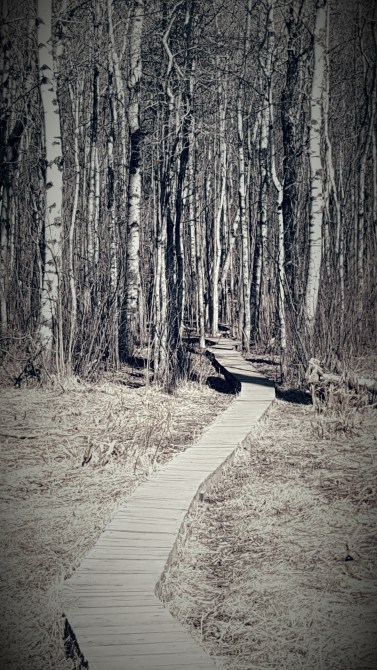
At the start, a boardwalk invites you into a spindly birch forest. The boardwalk gives way to a muddy climb up an incline to an old railroad bed for the Duluth, Winnipeg and Pacific Railway.
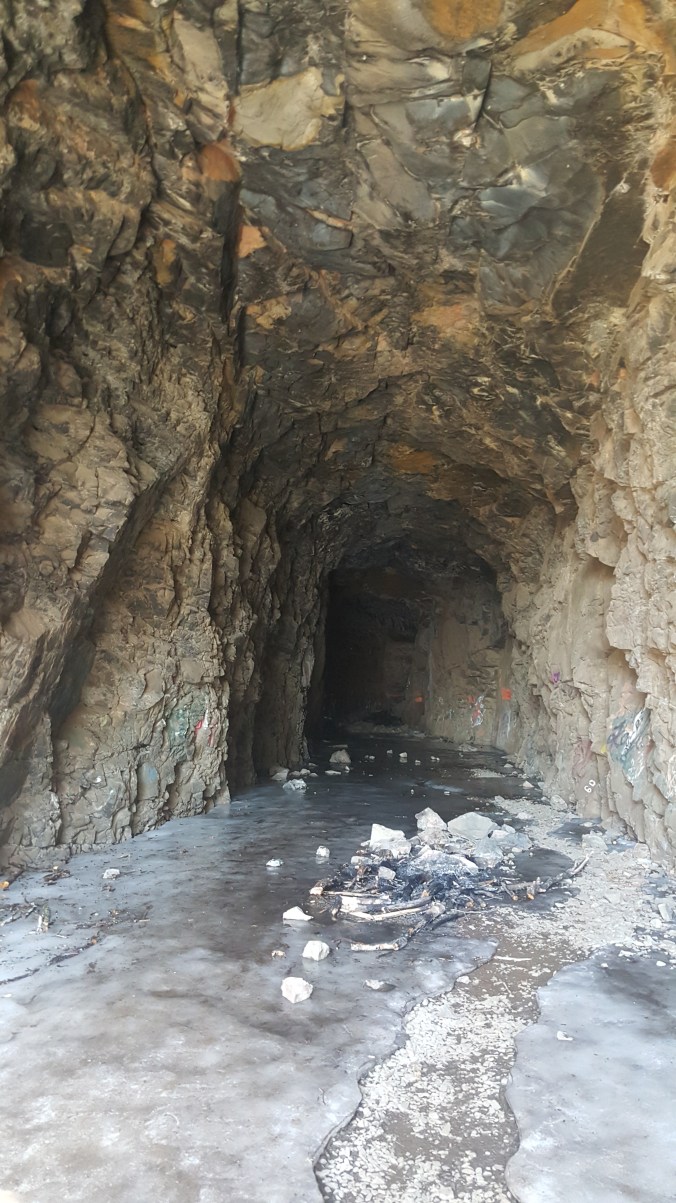
Inside the railroad tunnel.
Follow the railroad bed to the right until you come to a rocky tunnel. The tunnel was built for the railway in 1911. There are trails on the other side of it, but we did not attempt to go through the tunnel because of the sheet of ice layering the way. You may run into some rock climbers, who practice on the craggy basalt in the tunnel.
Although it may seem counter-intuitive, from the tunnel, you should follow the main trail, which goes down the hill to the right. Don’t take the spur that goes up along the side of the tunnel, unless you really are a mountain goat and want to test your mettle.
Don’t be impatient, you will come to an incline soon enough. You are now on the Superior Hiking Trail, which is marked by blue blazes on the trees and rocks. Keep to the left and follow the blazes up the blazing &!*()%$ hill.
Soon enough, wide vistas will offer views of the St. Louis River and the Gary-New Duluth neighborhood.
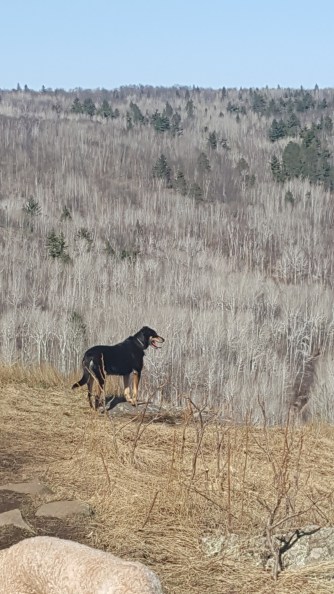
Dogs like the Ely’s Peak Trail, too.
No leaves were out on the trees yet – everything looked stark and clean.
The peak offers breath-taking 360-degree views. It was named after Edmund Ely, a Presbyterian missionary from Massachusetts who began teaching the Fond Du Lac Native American community in 1834. Local lore says that this was one of his favorite spots.
As we sat, resting, we noticed several turkey vultures lazily circling the thermals below us. The more we watched, the more vultures seemed to appear from nowhere. Eerily quiet and patient, they circled and circled. We joked that they were probably looking for hapless hikers who fell down the trail.
There’s a school of thought that says if you sit out in nature long enough, an animal will appear that has a lesson to impart. Were the vultures trying to tell us something?
Once back home (and safely out of a vulture’s gullet), I looked up what vultures symbolize. Here’s what I found: the vulture is considered a symbol of cleansing, renewal, and transformation. Vultures are viewed as fearless of death – they stare it in the face and eat death for breakfast (literally)!
I did feel cleansed after that hike. It was like the sunshine and clear air burned off all the old gunk. Perhaps it’s only to make way for more new gunk (ha ha), but I’d like to think I’ll have some time before I get clogged up again.

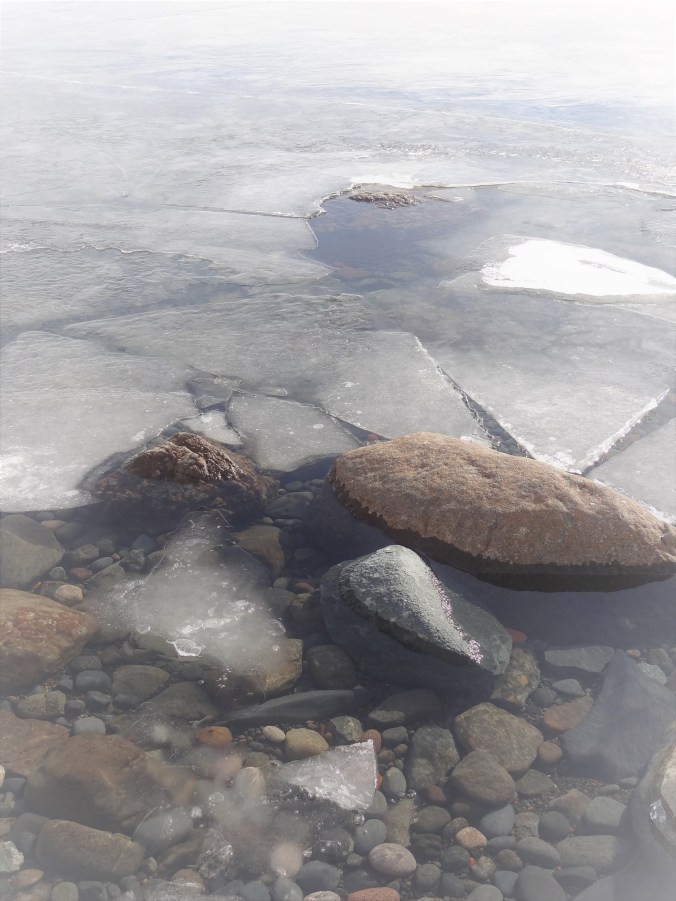
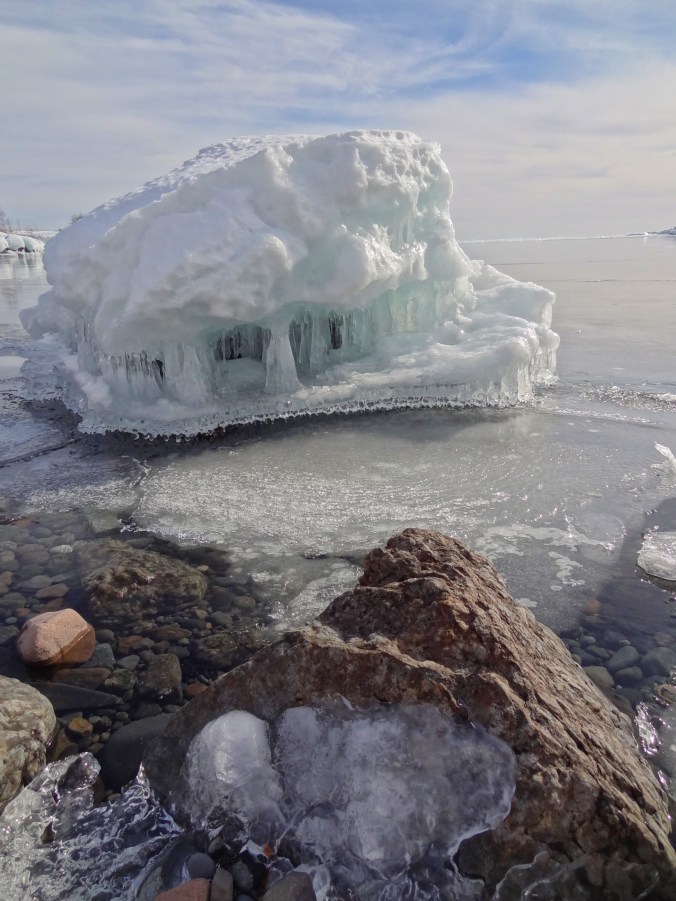
 We stopped several times along the highway, but the best place was one without a ready-made scenic parking lot. We glimpsed a bay that whispered of Norway and ice and stillness. We drove back and forth, looking for the best access road. There were no roads, only private driveways.
 It’s been about twenty years since I used my own snowshoes. I had the chance this week to dig them out and tromp around the grounds of a local mansion that’s open to the public for nighttime outdoor tours.




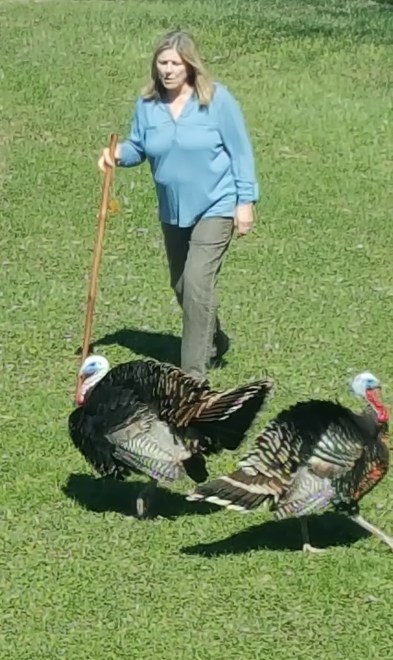 The turkeys immediately spotted me and followed. I walked faster. They walked faster. Soon I was running for my life to the house door. Just in time, my friend opened the door. She deterred the turkeys with a big stick and ushered me quickly into the house. I swear the turkeys would have followed me right inside, had it not been for that stick.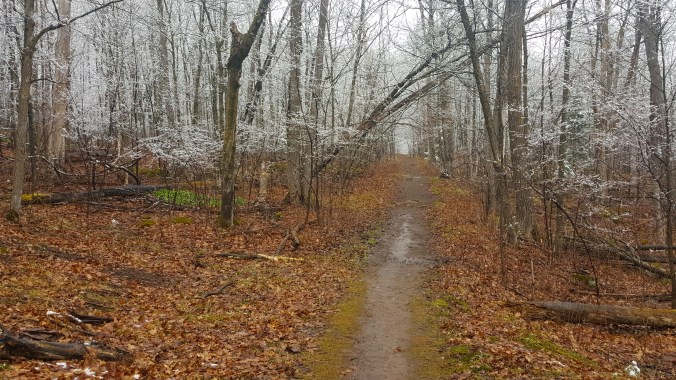
 We interrupt all these dreams of Aruba to insert some harsh (but hopefully entertaining and educational) reality. You may recall from my recent
  I work as a writer for the Sea Grant program in Wisconsin. Why is there an ocean program in Wisconsin, you ask? Because the Great Lakes are the freshwater equivalent of oceans (Sweetwater Seas). As water sources for millions of people and home to one of the world’s largest economies, it makes sense to pay attention to the Great Lakes and to put money into understanding them and protecting them.
