Making Piping Plovers Sexy

My second novel is coming out later this month. I’m happy to unveil the cover for you:

Layout 1

Plover Landing is an ecological-mystical-romance that I wrote for college-age readers and older. What’s an ecological-mystical-romance, you ask? It’s a genre I’d like to think that I created, which deals with endangered species, Native American mythology, and human-human, human-animal romance and connections.

Plover Landing is set in my hometown of Duluth, Minn., in 1995, and it’s a sequel to Eye of the Wolf. Novelists who haven’t been published yet might hate me for what I’m about to admit, but when my publisher suggested a sequel, I wasn’t that enthused. That’s because, between life’s distractions, the first novel took me seventeen years to write, then another couple years to publish.

The thought of doing that all over again was exhausting, although at least I wouldn’t have to spend time looking for a publisher. I was also exhausted from seventeen years of thinking about wolves, which are the animals I focus on in Eye of the Wolf. If I was going to survive a sequel, I needed to focus on a different endangered animal and environmental topic.

It just so happens I was working on a project to restore habitat along the shores of Lake Superior in hopes of encouraging an endangered shorebird to nest. Through that process, I had already learned a lot about piping plovers, so that became the focus of my sequel. Granted, plovers are not as sexy as wolves and they don’t have a handy supernatural being associated with them (like the wolves have werewolves), so I had to ponder how to work the mysticism into it. (But never fear, wolf aficionados, the wolves come into the story at the end.)

My writer’s group joked that I should write about plover zombies, but I did not take them up on that idea. (Smirk) Instead, I researched myths about plovers. While I couldn’t find any local myths, I did find an interesting and sexy Hawaiian myth about plovers, and I discovered a way to use it as the foundation of the story.

Even so, that wasn’t quite supernatural enough, so in addition to the heroine and hero from Eye of the Wolf (Melora St. James and Drew Tamsen), I introduced a new character, a boy named Demetri, who both helps the plovers and focuses readers’ attention on the issue of climate change. I feel strongly that the more integrated that issue is into mainstream media, especially through the use of storytelling, the more people will come to accept it as real.

Because I’d learned ways to encourage myself to write with my first novel, even though I had just as many distractions, Plover Landing only took two-and-a-half years to write. My publisher thinks it’s an even better story than the first and has hinted about the desire for another in the series. I created the ending of Plover Landing with openings for another story or so that it works as a finale. I don’t know. I’ll have to think about that one.

In any case, let the marketing begin! Speaking of which, if any of you are active on Goodreads, I have a giveaway for Plover Landing that’s active until July 15.
Happy International Migratory Bird Day from a Recovering Birder

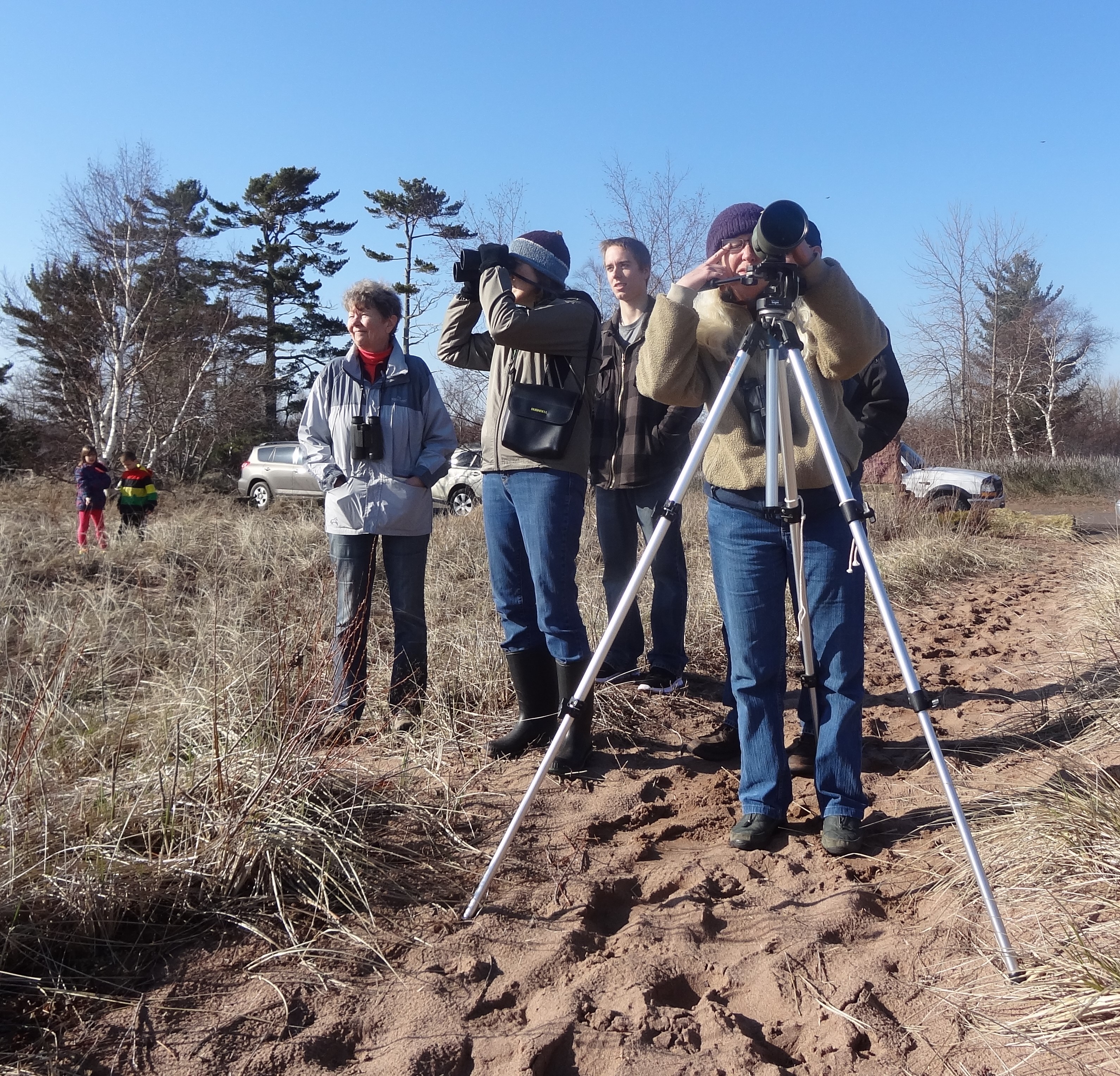
Birders on the shore of Lake Superior, Wisconsin Point.

Birders on the shore of Lake Superior, Wisconsin Point.

No, I’m not writing about Mother’s Day, but about a lesser known and newer commemorative event that celebrates birds. Yesterday, I participated in the second annual International Migratory Bird Day, held in Superior, Wis.

White pines on Wisconsin Point.

White pines on Wisconsin Point.

I haven’t been to a birding event in years, partly on purpose and partly due to other demands in my life. I like to think of myself as a recovering birder. I took up bird watching in seventh grade and was active in the birding community through my twenties – even participating for a year on the Audubon Expedition Institute, where I travelled across the country in a yellow school bus for a year with 24 other people interested in birding and the environment for master’s degree studies.

It was during that experience that I overdosed on birding. I came to realize that people stopped looking at birds once they had identified them. I rebelled against the obsession to name everything with feathers that I saw or heard. I rebelled against using eyesight aids like spotting scopes and binoculars – wanting to view the birds instead as part of their surroundings.

But I still feel an affinity with birds. My upcoming novel is about them, after all, and this event seemed a good excuse to get outside on a rare warm spring day. We met at Wisconsin Point, a long sandbar just outside the city. A small group of us spent three hours birding. We didn’t see very many birds but there were bald eagles, chickadees, scaups, red headed ducks, lots of blue jays passing through, and the requisite ring-billed gulls. I do admit to looking through a spotting scope (and the world did not end!), but I tried to keep it to a minimum to allow others the opportunity. After birding, we went to a local inn to listen to some presentations about migration.

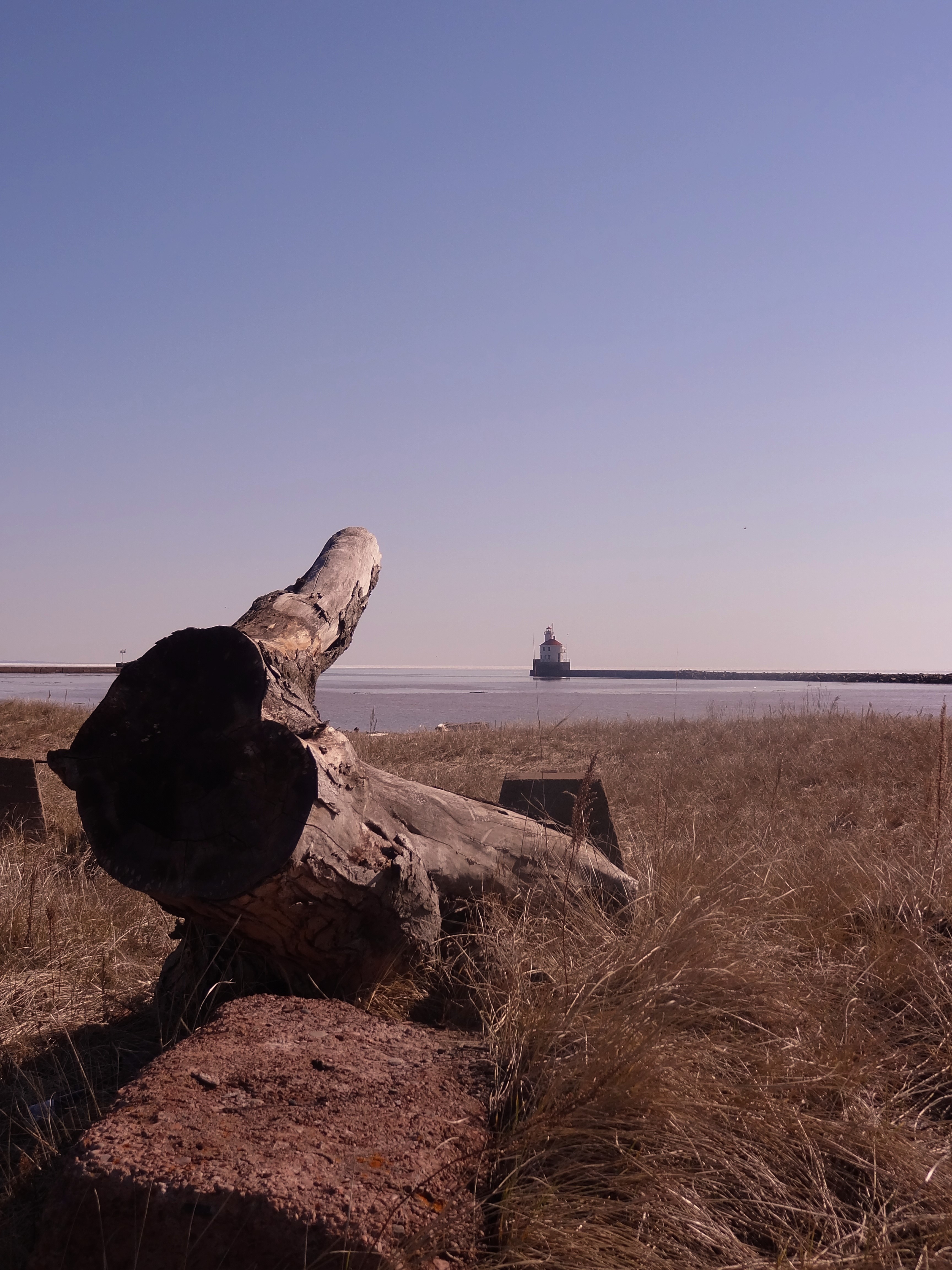
My camera isn’t built for bird pictures, but I do love the lighthouse and the white pines on the point, so I thought I’d share photos of them with you.

Wisconsin Point Lighthouse

The Wisconsin Point Lighthouse.

Wisconsin Point Lighthouse and log

The Smelt Parade That Wasn’t

Duluth Smelt Parade

A party of one: the 2014 Duluth Smelt Parade.

An annual Smelt Parade is held in Duluth to welcome the spring run of this tasty silvery little fish. Although the runs are much smaller than they used to be (which is a good thing because smelt are non-native) the fish still serves as a unique celebration of abundance and a cultural reminder that spring is on its way. For the past two years, the parade has been spearheaded by a local puppet troupe. Citizens make costumes and participate in the procession along the shores of Lake Superior, complete with a brass band.

I’ve never attended the parade, so today I committed to going. Wouldn’t you know it, this year the wind, rain and 35-degree-temperatures made it “the parade that wasn’t.” I was hoping to get a lot of fun images to share, but all I got was this single photo of a “parade of one” that happened outside a local arts café where the rag-tag group of parade-goers gathered indoors instead of walking along the shores of Lake Superior.

Oh well. Better luck next year. If you’d like to learn more about smelt, Minnesota Sea Grant offers a great fact sheet.

Updated Look

Yes, you are still in the right place. I decided to update the look of my blog. Hope you like it! The name of this theme is “Hemmingway Rewritten.” It seemed appropriate for a writerly type like me. I can change the header image, so don’t be shocked if you come back sometime and it looks different. The current image is one I took in Sheboygan, Mich., at sunrise.

The view out my window right now, though, is one of snow falling on gray water. People are shaking their heads at this winter that won’t quit. I hope things are warm and sunny wherever you are. Thanks for visiting.

Why I am a Zumba Failure

Zumba

For my birthday last week, I went to a free Zumba class and dinner with some girlfriends. A new Zumba studio had opened downtown and they wanted to check it out. I had taken a six-week beginners’ class a few years ago through a community education program, so I was game, even though I had some misgivings.

The instructor of the community education class was a belly dancer, and all her Zumba instruction seemed to devolve into belly dancing, with the requisite swaying of hips and jiggling of key feminine body parts.

Introverted me doesn’t feel all that comfortable swaying anything in front of anyone. I figured that was just the way she taught Zumba because of her background. I hoped this new class would be different.

We entered the studio, which was filled with women, blinking lights, and pounding music. It didn’t take long for me to discover that the community education class music and movements had been slow-motion compared to a regular Zumba class. There was also the requisite jiggling of the “girls” and gyrating of the hips.

Now, I have no problem gyrating my hips when required during certain intimate acts performed between two consenting adults, but that’s different than doing it in a room full of people. And it also goes against my genetic make-up. My hips are German, English, Irish, Scottish and some rumored Native American. When is the last time you saw an ethnic Irish dancer gyrate their hips? Try never. How about a German folk dancer? I daresay NO. Those hips remain straight and true with nary a come-hither twitch.

It might be different if I had some Latin, Italian, Spanish or other hot-blooded ethnicity inside me. But I don’t. And it shows. Even from the back row of the Zumba studio.

I also realized I’m too used to endurance sports where the goal is to move as gracefully and efficiently as possible — sports like swimming, x-c skiing, bicycling, and yoga. With Zumba, it seems the whole point is to be as inefficient as possible. There’s lots of jumping and prancing and pointless arm waving.

I’m sorry, Zumba. I suppose with enough time and motivation, I could adapt to you. The music is fun, after all. But I don’t want to. There are too many other forms of fitness better suited to my inhibited hips.

Sea Cave Pilgrimage

sea cave icicles

Icicles hanging down from the ceiling of a sea cave.

Icelanders resembled Minnesotans (at least of the last generation) in this regard: if nature has condemned you to life in a continuously foul climate, you have no choice but to ignore it and proceed with your plans. If you wait for the weather to improve before doing anything, your bones will have crumbled to fine dust. – Minnesota author Bill Holm

Despite the National Park Service urging people to visit another day because the wind chill was twenty-five below, my son and some friends traveled to the sea caves in the Apostle Islands National Lakeshore last weekend. We weren’t the only ones disobeying the feds to see this natural wonder on the south shore of Lake Superior. Since the parking lot was full, a line of cars was already parked on the main highway. This added ten minutes to the twenty-minute walk we were expecting across the ice to the sea caves.

Apostle Islands mainland sea caves.It was no mean feat just to get this far. My son, who is a teenager, and his friend, would have much rather stayed home on the couch, little balls wrapped in comforters, playing computer games. “Why do we have to go?” They challenged more than once. After about the fifth round of such questioning, I was reduced to, “Because you’ll have fun, dammit!”

Once they were off the couch came the trial of getting them to wear more than one layer of clothing. Exhortations about how cold it was were met with more, “Then why do we have to go?” Somehow, the mother of my son’s friend (Charlotte) and I got the boys dressed and into the car. The wind direction made the walk from our car to the lake the coldest part of the trip. Charlotte and I were surreptitiously looking at each other, questioning whether this adventure was wise, and, although they would never admit it, I could tell the boys were happy they had been forced to wear so many layers.

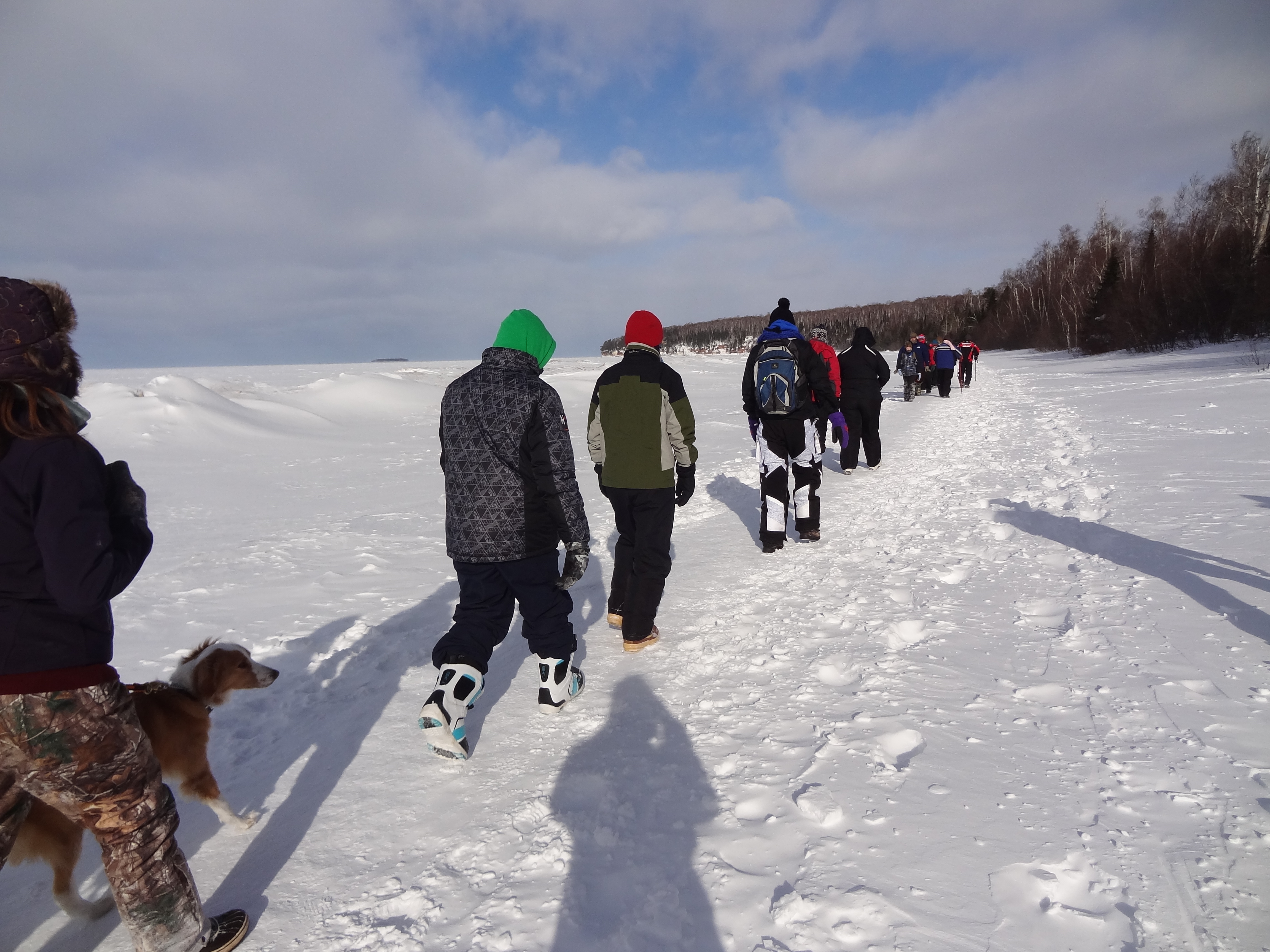
Once we got to the lake, we joined the others on a hard-trodden snowy path along the shore. With the wind at our backs, the sunshine helped us feel warmer in spirit than perhaps in body. After about half-a-mile into the mile-long walk, I marveled at how warm my feet were. I thought my toes would be the first to go.

DSC01358 We were joined by snowshoers, skiers, dog walkers, and people pulling sleds containing mounds of blankets, which, from the hats sticking out of them, must have contained children. For the most part, it was too cold to talk, so we walked in silence – pilgrims on our way to see a natural wonder denied us for five years due to poor ice conditions.

Walking on the winter ice is the easiest way for most people to see the caves. In the summer, it requires kayaking or canoeing skills, or paying the price for a tour boat. A hiking trail runs along the top of the caves, but the view is nowhere near as spectacular as from the water.

I had seen the caves from water level, but never in winter. This year, the formations were more intricate and extensive than most, prompting widespread media coverage that piqued interest by the masses, including Charlotte and me.

Before you venture to the caves, it’s a good idea to check with the Lakeshore’s Facebook page and check the Sea Cave Watch website, a Wisconsin Sea Grant project. The site features real-time images of the ice conditions at the caves, although the wave sensor has been pulled for the season.

frozen waterfall

A frozen waterfall.

When we reached the start of the caves, the boys were quickly taken in by opportunities to explore. Icy nooks, frozen waterfalls, tunnels, slides, and hidden alcoves proved irresistible. When it came time to go due to a commitment back home, they protested, saying they wanted to stay longer. I couldn’t help but smile, noting their change in attitude. Nature had worked its subtle magic.

I hope the lesson is lasting and that next time, it will be easier to tear my son or his friend away from their comfortable couches and computers to experience real life.

One thing I want to mention if you go: please don’t break off the icicles from the caves. The conditions that formed them are not likely to happen again this winter, and it ruins the formations for those who will come after you. Take away memories, not icicles!

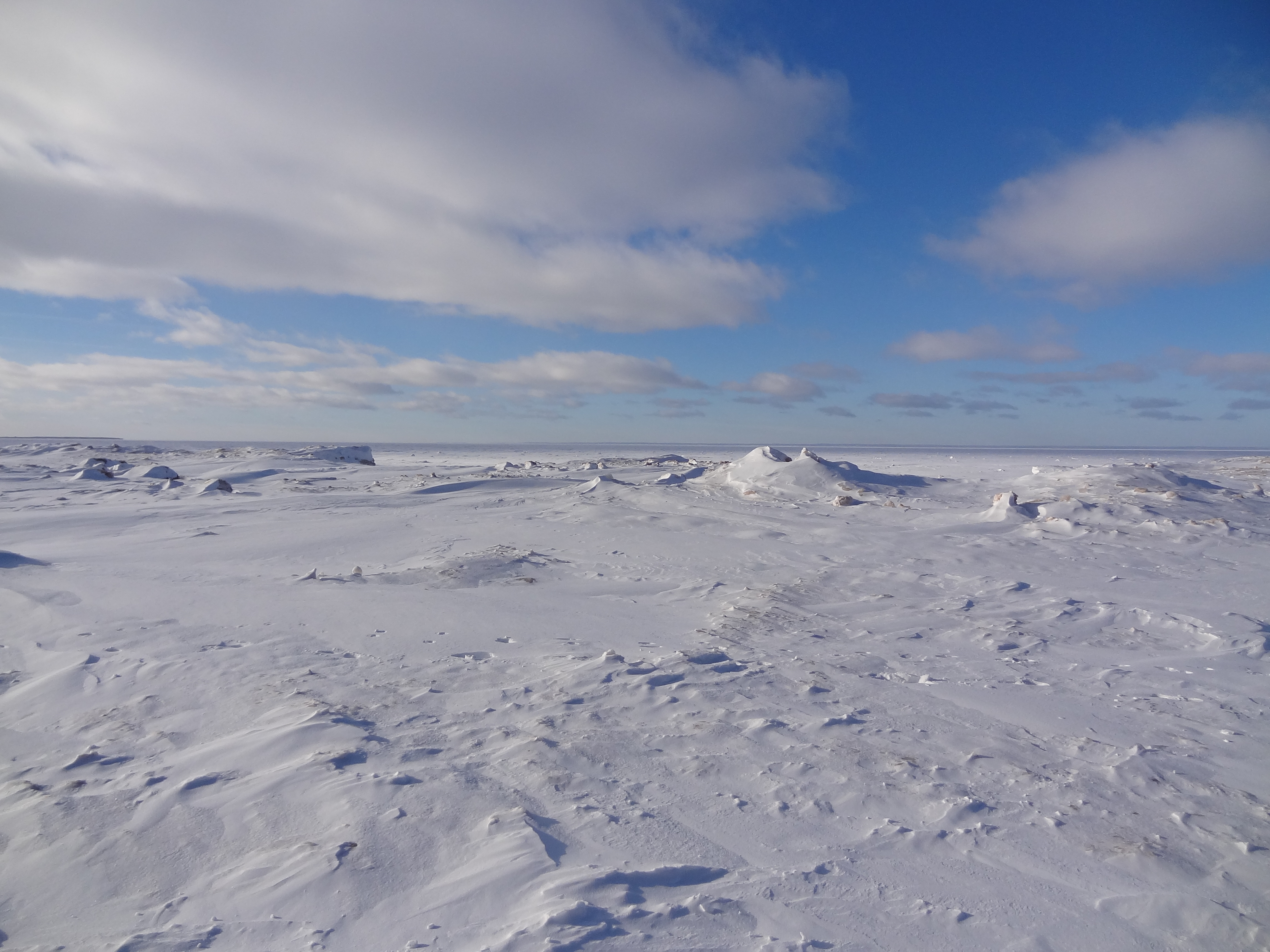
frozen Lake Superior

The view of Lake Superior when you turn away from the caves.

Why I Miss Wildland Fire Fighting

Me getting ready to go to Yosemite National Park to fight fires, 1990.

Me getting ready to go to Yosemite National Park to fight fires, 1990.

The tragedy of the Prescott hotshot crew has me remembering my short stint as a wildfire-fighting “hero.” It started when I worked for the U.S. Forest Service (Superior National Forest in MN). I began my Forest Service career as a volunteer, first on the ranger district in Grand Marais (wilderness trail crew) and then on the district in Cook (photojournalist).

When I was in Cook, I got my first taste for what wildland firefighters do by delivering lunches from town to the fire camp as a driver. I enjoyed the obvious camaraderie of the camp and hearing the fire fighters’ stories. A few years later when I got a paying job with the Forest Service and the annual call came out for Fire Guard School, I was eager to sign up. I attended a week-long training camp conducted by Forest Service and Minnesota DNR staff. Notable among my classmates was Minnesota-based writer Peter Leschak, who went on to write several books about his later experiences. We learned how to dig trenches and sat in a lot of classes about fire behavior and the function of the fire organization.

We also learned how to deploy our ‘shake-and-bake’ fire shelters. These are the devices that every fire fighter carries in case they get caught by the fire and have no other options. You shake it open, climb into it, and drop to the ground on your stomach with the shelter over you (at least that’s how we were taught back then, it might be different now). If the fire passes over you, that’s where the baking begins. The shelters are better than nothing, but truthfully, not by much.

A few months later Yosemite National Park in California started burning. It was my first, and only, on-the-ground firefighting experience. Our first job was to allay the fears of the residents of Foresta, Calif., whose town had been partially burned by the fire. Several trees still smoldered on a blackened hillside above the town and it was our task to put them out . . . at night in the dark, despite the possibility of hidden mine shafts and unexploded dynamite. After a few hours of hiking up the 90-degree incline, we found the snags and put them out. We “skied” down the loose dirt only to hear that the day crew had been called off the mountain because conditions were “too dangerous.” Maybe the fire conditions were worse during the day, but we found it ironic.The crew and I resting during our stint in a spike camp in Yosemite. I'm to the right.

 
The crew and I resting during our stint in a spike camp in Yosemite. I’m to the right.


My recollection of most of the rest of the experience centers around trudging through a foot of soot, which collected under my fingernails, in my pores, and despite wearing a bandanna — in my nose, and more worrisome, in my lungs. Morning in the fire camp was a cacophony of coughing and hacking. A few days later, I ended up in a clinic with a fever and a racing heartbeat. I was diagnosed with bronchitis and instructed to rest for a day and take medication. I rested in a spike camp that my crew was helicoptered into, high on the mountainside. Wouldn’t you know it, that was the day our crew built a fire line right next to the flames, and I missed it.

We worked out of the spike camp for a few more days (I did get to see some flames) and then we were ‘coptered back to the main camp, where we got a day of R & R (rest and relaxation). We took our first showers in 5 days and got a bus tour of Yosemite, which had been closed because of the fire, but recently reopened for tourists.

As we walked around the park attractions in our distinctive yellow and olive green fire clothes, people shouted their thanks to us for working on the fires. They wanted to shake our hands and pat us on the backs. With a start, I realized they considered us heroes. We certainly didn’t feel like heroes, we were just doing the job we were trained for.

Because I’m susceptible to pneumonia, I figured I’d have trouble with my lungs if I kept fighting fires directly, so after Yosemite, I started training to be a fire information officer. These are the people who work with the media and local organizations to get news about the fire out to the public. That way, I had all the fun of the fire camp but none of the soot. I ended up helping with fires in Colorado and Minnesota, but when I left the Forest Service for another job, my fire career ended.

I miss it. I like working in small groups to get things done. And I’ll probably never be recognized as a hero again. But the hero thing is not why I, or I assume, the Prescott hotshot crew fought fires. You do it because you like it, you do it to be part of a team, it’s exciting, a bit dangerous, and sometimes even fun. You wouldn’t want to be anywhere else. Rest in peace, guys.

Me and the flames. I'm smiling behind my bandana.

Me and the flames. I’m smiling behind my bandanna.

It’s Climate Change, Stupid!

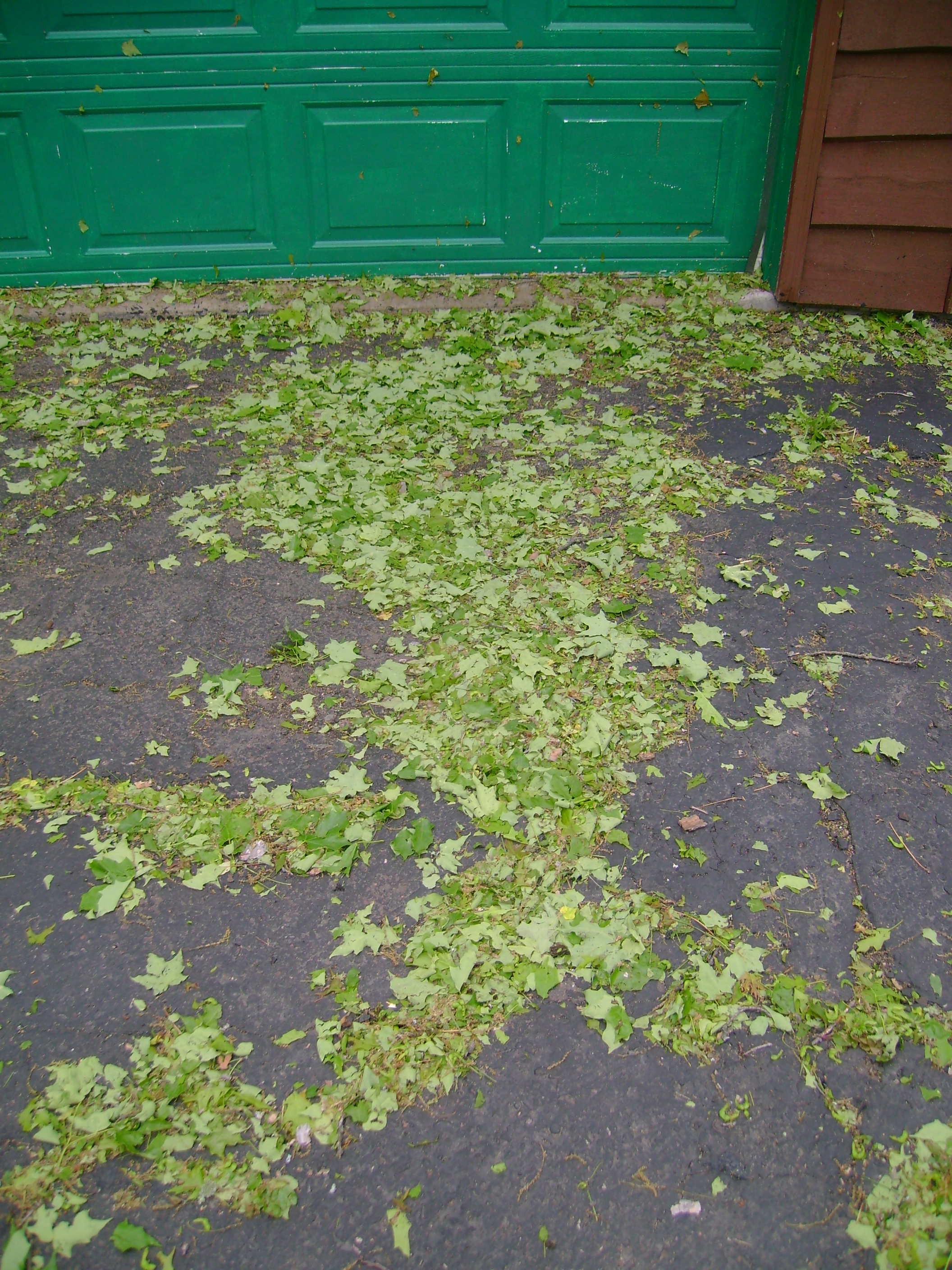
Shredded leaves from a hail storm litter my driveway.

Shredded leaves from a hail storm litter my driveway.

Even though it only lasted a few minutes, the hail squall that passed through my neighborhood earlier this week did a respectable amount of damage. Winds up to 70 mph toppled stately trees, people lost power – some for up to 22 hours (I lost power for about 12), and hail shredded the leaves that had finally popped out on the trees, creating a green carpet over people’s driveways and the roads.

Loss of power and loss of my routine reminded me of just how vulnerable we are to even the littlest whims of nature. I would have had to eat a cold supper but for the propane-fueled camp stove tucked away in my basement. With all our experience with snowstorms, perhaps northerners are more used to weathering weather disruptions than those in lower regions of the country, but we are far from immune. With no televisions and computers for distraction, my neighbors all took to the street to compare notes and make sure everyone was okay.

Unfortunately, violent storms like this are only likely to increase in the future. A few days after the storm, I attended a public forum called “A Flood of Options – Adapting to Climate Change,” which was hosted by the St. Louis River Alliance and the Izaak Walton League, and sponsored by the Minnesota Coastal Program and Freshwater Future. Speaker Mark Seely, the Minnesota State Climatologist, said that one of the things we can expect with climate change (and it’s happening now) is an increased amount of moisture from violent storms. There’s already been a 31 percent increase in this type of precipitation for the Great Lakes.

Higher temperatures are another thing that are happening, especially in the northern latitudes. The number of warm nights is increasing and so it goes that the number of cold nights is decreasing. Other lovely things to ponder are that mean monthly temperatures across the U.S. in 2012 were the highest since 1895 (I am guessing this is when stable record-keeping started). Not just by a little bit. Seely said they, “Obliterated all other year’s” temps. The same was true for Canada last year. Also, the value of economic losses due to weather/climate disasters has increased since 1980 due to hurricanes, floods, drought, etc. Seely said this is a motivator for communities to talk about climate adaptation. “Our climate vulnerability is becoming more and more clear to us.”

Other consequences include a longer mold and allergy season, increased frequency of freeze/thaw cycles, shorter time of ice cover on lakes (which leads to an increase in winter evaporation), and a longer growing season (which might not be all bad for northern Minnesota). The goal of the workshop was to inform participants about the impacts of climate change and provide ideas about how communities can adapt to it. It is a precursor to later workshops that will get more into advocacy and more specific adaptation measures.

During the question and answer session after his talk, Seely said, “Doing nothing is not an option. We’re obligated to think about this and to do something in our roles as citizens.” Chris Kleist, stormwater manager for the City of Duluth, also spoke, outlining the impacts of last year’s “500-year-flood” on the city. He estimates that long-term restoration will cost $12.6 million and the city has received about $2 million so far.

A look around the audience of 25 made it clear to me the presenters were preaching to the choir. Most of the others are already active in the environmental community. The guy seated next to me was so into the topic, he quoted from notes he wrote on a napkin. The type of approach used in the presentations wasn’t going to change anyone’s mind who wasn’t a climate-change believer. I know enough about behavior change theory to understand that.

Please forgive my Bill Clinton-esque title to this piece. I hope use of the word “stupid” does not offend, but I could not resist! It gets frustrating sometimes reading/hearing some of the refutations to climate change produced by nay-sayers. One of the problems is that those involved in climate change research and education do not employ effective communication techniques to get their messages across.

Spouting facts does not spur people to action. What does spur action and advocacy is storytelling, emotion, and spontaneity combined with some key message pre-testing and removing barriers to action. One of my favorite proponents to this approach is Randy Olson, a marine biologist-turned-filmmaker. He produced a movie about climate change (“Sizzle: A Global Warming Comedy), and wrote a book that tries to help scientists get their message across more effectively to the public (“Don’t Be Such a Scientist”). Seely did introduce a bit of emotion, but it wasn’t until the end of his talk, in the question and answer session. By then, an hour after his presentation began, it was too late.

It’s my sincere hope that the later climate workshops in this series integrate more effective communication techniques. And if you have a scientific message to get out to the public, please, consult with a trained communicator. It can only help! I’ll get down off my soapbox now.

A River Runs Through My Bucket List (or Learning How to Fly Fish Before It’s Too Late)

English: Green Highlander salmon fly. The hook...

English: Green Highlander salmon fly. (Photo credit: Wikipedia)

I have to admit, I like creating lists. They help me remember things and when I cross something off one, it gives me a straight-lined sense of accomplishment. A few years back I started a “Things to Do When I Retire” list; not really a bucket list (things to do before I die), but a similar concept. The list contains things like volunteering for the Red Cross, taking painting lessons, taking classes at a local folk arts school, and doing more photography.

I was content to delay the activities on the list until I had time during retirement, which was probably about 15 years away. That was, until one of my friends died unexpectedly in his early 40s. A sense of mortality smacked me in the forehead and I realized how much I’d been putting off really living and making the most of the present. In my friend’s honor, I decided to stop PLANNING and start DOING.

One of the activities on my retirement list is fly fishing. I suspect the inspiration for that came from watching the 1992 movie “A River Runs Through It.” Directed by Robert Redford and featuring Brad Pitt, the movie centers around fly fishing scenes in Montana. It was also around that time that I visited Montana and helped fight a wildfire on the White River National Forest in Colorado. I saw people fly fishing on rivers in these places and it looked so idyllic, I knew I had to try it someday. Plus, the biological aspect of the sport appeals to me. You have to know how to think like a fish and be aware of what’s going on with the local bugs to be successful.

Well, “someday” came last week. Rogue, non-retired list-breaker that I am, I took a fly fishing class with a group of women along the banks of a river on the outskirts of town. The opportunity was organized by one of my women friends and taught by Katherine Lansing, a local fly casting instructor certified by the International Federation of Fly Fishers.  

Katherine Lansing

Katherine Lansing

Lansing became an instructor by accident. She had been fly fishing for a few years, then she signed up for a class she thought was about how to learn to cast better. Turned out it was about how to learn to teach other people to cast better. Although hesitant, she took the class, which led her on the path to becoming one of only 80 female certified fly fishing instructors in the U.S. at the time.

We met under a picnic shelter at a local city park on a 40-degree evening. As the five other women described how they became interested in fly fishing, I realized I was the only one there not introduced to the sport by a man. Everyone else had been introduced by a boyfriend, husband, brother or father. Not sure what that says about me. I do admit I had been hoping “some man” would take me fly fishing, but it just never happened.

Lansing started the class by giving us an overview of the various fly fishing equipment and showing us how things worked. Then she introduced us to knot tying. We learned two knots, practicing first on chunks of nylon rope, and then on the more challenging fishing line. Tying the knots became more difficult as the cold temperature took its toll on our fingers. But it wasn’t long before we were up and moving, practicing our casts on the lawn beside the river, which was roaring with melt from spring runoff.

Casting was fun, and people kept remarking that I’m a natural at it (preen, preen). If I am a natural it’s from a lot of practice casting regular fishing lures and maybe from throwing an atlatl (a prehistoric throwing spear), which is a story I’ll perhaps tell another time. As we casted, Lansing went around and gave us tips in her no-nonsense and helpful manner.

After about 2-1/2 hours outdoors, I could no longer feel my toes, so I decided it was time to head home. But I enjoyed the experience and I’m looking forward to actually getting out on the water to fly fish next time. Then I’ll be able to officially cross that one off my list, and I’ll have a new hobby NOW instead of waiting for my retirement or until I’m dead, whichever comes first. (Smile.)

Working by the Duluth-Superior Harbor and Lake Superior

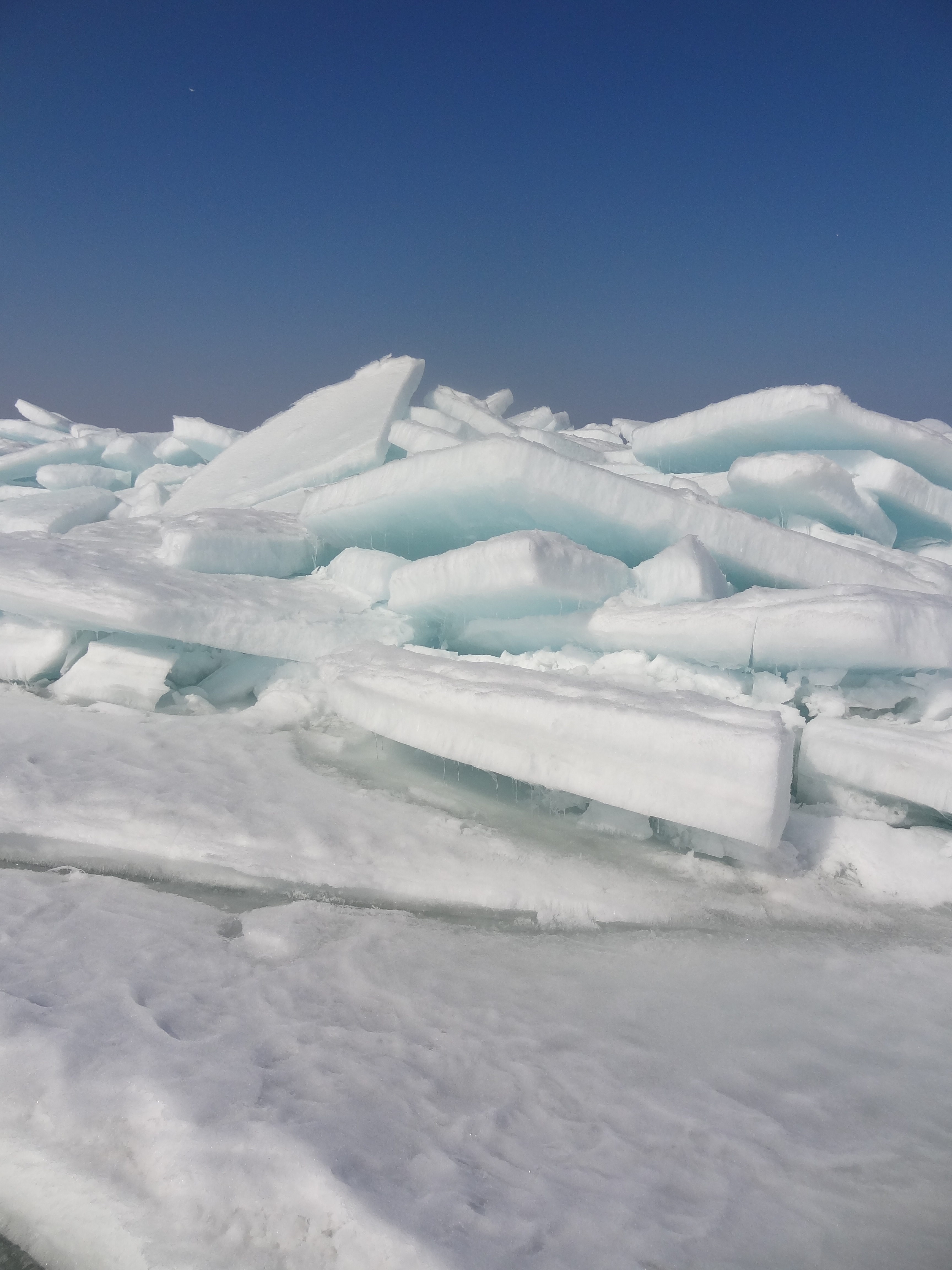
Huge chunks of ice piled atop eachother off of Wisconsin Point, Superior WI

Huge chunks of ice piled atop eachother off of Wisconsin Point, Superior WI in April.

No deep thoughts for this week; just wanted to show you some photos I’ve taken recently at and near my office on an island in the Duluth-Superior Harbor. I feel so fortunate to work in such a cool place and I never take it for granted. Ice can still be found in the bays and along the shore, but the spring break-up is finally here and it’s as if a bottleneck of birds has been unleashed upon the waters. I haven’t taken any bird photos, but I did manage to catch a fox kit out the office back door, an instant before it got scared away by someone approaching outside.

A fox kit investigates a stick as seen out the back door of my office last week.

A fox kit investigates a stick as seen out the back door of my office last week.

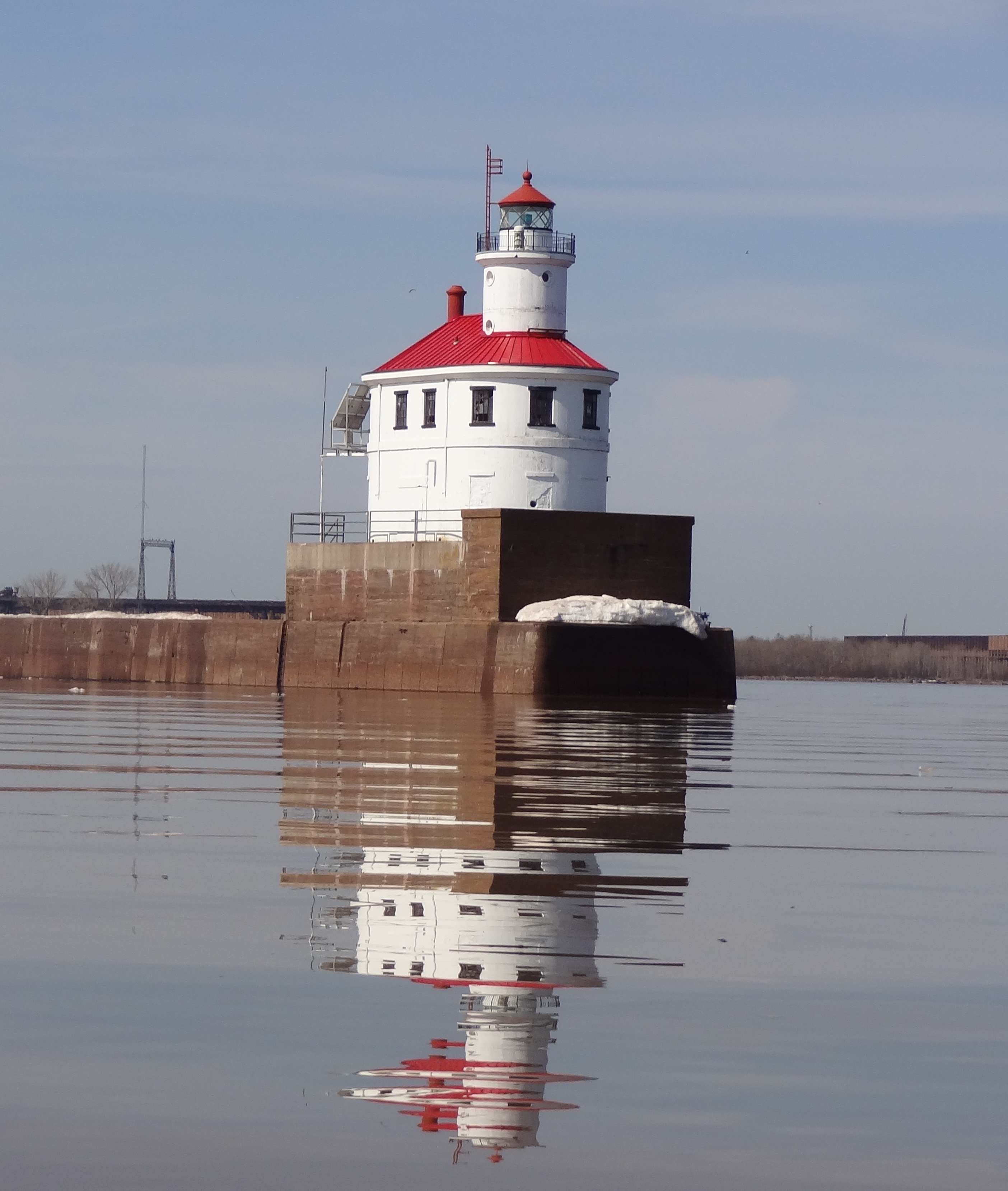
Yesterday I accompanied some researchers out on the St. Louis River Estuary. They were taking water samples for an ongoing project about seasonal water quality variation in the river. Because it was a calm day, we went out on Lake Superior just for kicks, through the Superior Entry. I got a good shot of the lighthouse despite the chilling wind that stole my cap later on and dunked it into the river. The researchers were nice enough to turn the boat around so I could retrieve it. My cap is now christened in the estuary, so I guess I’ll have to wear it out there all the time now. Anyway, I love the reflection in this photo!

The lighthouse that guards the Superior Entry into Lake Superior.

The lighthouse that guards the Superior Entry into Lake Superior.

On the other side of the breakwall was the U.S. Army Corps of Engineers dredger and some tugboats. The Army Corps dredges the harbor (digs out the muck) to ensure that the harbor is deep enough for the boats that ply its waters. The dredge is resting here. I thought this photo looks like a little mechanical family; papa dredge, mama tug and baby tug. Enjoy!

Dredge and tugs, Superior WI Entry to Lake Superior

Dredge and tugs, Superior WI Entry to Lake Superior