The Dolphin Who Ate Fish at my Feet

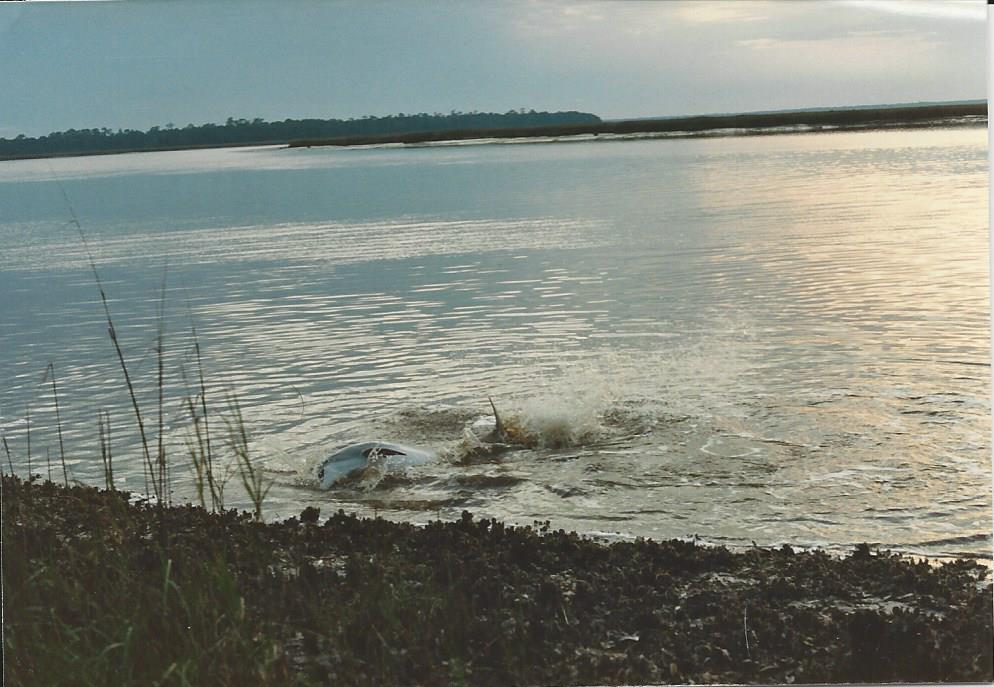
A dolphin beaching itself to catch fish it has pushed ashore. Cumberland Island, Georgia.

A dolphin beaching itself to catch fish it has pushed ashore. Cumberland Island, Georgia.

I once lived outside for nine months (September – May), traveling North America. The experience was through the Audubon Expedition Institute and I was working toward a graduate degree in environmental education.

While on the trip I learned I was not there for the academics but for the adventure. And there certainly was a lot of adventure. It was 1986-87 and we travelled from New York City up the East Coast to Maine and Nova Scotia, Canada. Then we took the ferry to Newfoundland. We went all the way to the northern tip (you can see Labrador and icebergs from there) and then headed back south, eventually reaching all the way to Key Largo, Fla. From there we headed West, making it to Canyonlands Utah before the yellow school bus that was our home had a fatal break down.

Along the way we tented and cooked our meals over campstoves. We sometimes lived for a week in a fishing village, or among Buddhist monks or uranium miners. We visited with local experts, learning about environmental issues and how the locals thought about the land and sea. We took hikes, canoe trips, and snorkeling excursions; swam with manatees; danced contra dances; joined pow wows and local organic fairs; and were privy to Native American ceremonies.

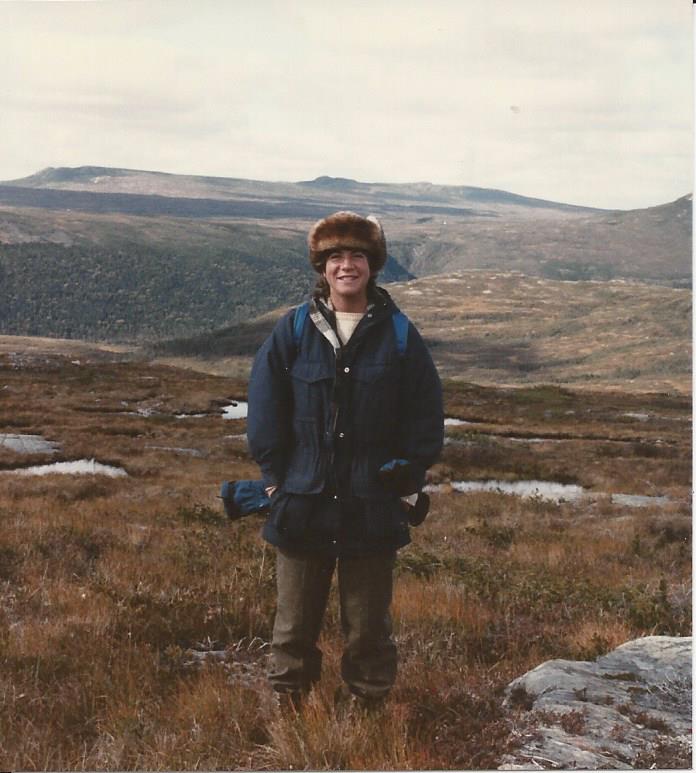
Me on the moors in Newfoundland, looking for caribou, circa 1986.

Me on the moors in Newfoundland, looking for caribou, circa 1986.

I got so acclimated to living outdoors that when I came home to my parents for breaks, I slept in the backyard, even when it was twenty below. My body was so used to revving up with heat at night, that I got too hot sleeping indoors. I also remember when we visited a medicine man in Boston (Slow Turtle). Twenty of us crowded into a skyscraper conference room to speak with him. That, combined with being in a heated space, made me feel faint. I had to go outside to cool off for a while.

The experience was like a combination of “Survivor” and one of those bachelor/bachelorette reality TV shows. We began with twenty-four people, but through a process of mostly self-elimination, ended up with twenty.

All this is a long preamble to what I really want to write about, which is an experience I had during the expedition with a dolphin on Cumberland Island National Seashore in Georgia. We spent several days on the island among wild horses and armadillos, hiking from one end to the other, mostly along the beach on the Atlantic side. On the other side of the island, a salt marsh and river separate it from the mainland. One evening, we camped on the mainland side. We had eaten dinner and several of us were hanging out by the water as the sun started to set.

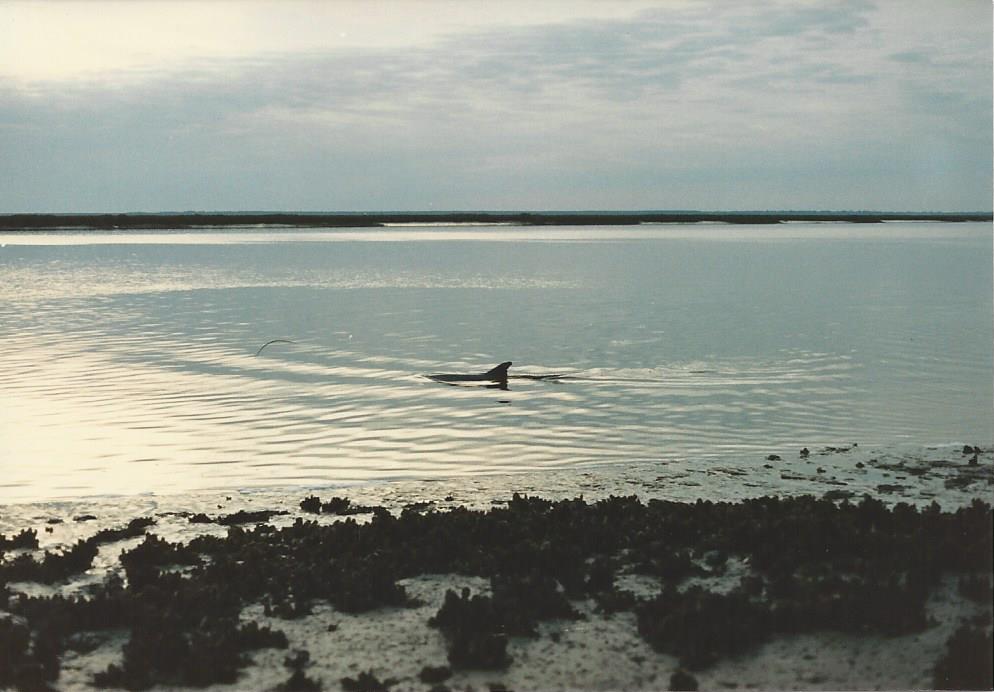
Then the dolphins came. Two of them swam alongside the muddy banks of the river, peeling off into circles. We didn’t realize it until later, but the dolphins were corralling fish with their bodies. When enough were captured in their water circle, they rushed toward the bank. The fish were stranded on the bank, easy pickings for a dolphin who doesn’t mind a little air time itself. . I learned later that this behavior is indeed called strand feeding. Here’s what I wrote in my journal:

We run down to the Brickhill River like lunatics, insatiable for a rare glimpse into the workings of nature. We try not to get too close and scare the dolphin away, but it’s hard. We follow the dolphin as it swims along the shore, the deep mud sucking at our shoes.

The mammal tips on its side and looks at us with a dark gray eye – two, three times. It corrals the fish and rushes the bank, its whole body breaching again. We go mad. Paul jumps up and down, saying he’s seen God. I click photos like I’ve got a roll of thirty-six instead of only four photos left. Our oohs and ahhs echo across the sunset.

The dolphin wriggles its body back into the water comfortably. It swims back upriver and down. Its companion across the way breathes five times in quick succession, and with that signal, they depart.

Despite the shortage of film in my old-fashioned 35mm Olympus, I managed to snap a good picture of the dolphin doing its work. And it was just a few feet away from me – close enough for us to see eye-to-eye. It’s an experience I’ll never forget. It filled us with wonder and awe, and we felt a connection beyond time, beyond words to the place and each other.

Bye bye dolphin!

Bye bye dolphin!

Saving a Skyrat – Part 2

Pogo

When my co-worker and I were debating whether to save the listless gull that appeared outside our office last week, she said something like, “Usually, I like to let nature take its course . . .” and I interjected, “But it’s often not nature that causes things like this, it’s humans.” I was remembering a gull I rescued many years ago that had been hit by a car.

As it turns out, although the gull at our office was put in distress by a natural process, the cause probably was us. As you may recall, when I brought the gull to the wildlife rehabilitation group, they said they thought the cause was a Vitamin B deficiency. (To be exact, a Vitamin B1 or thiamine deficiency.) They weren’t sure what was causing it, but suspected it had something to do with the gulls eating dead fish.

Back at the office, that got us thinking, especially after we learned the Wildwoods group had received three other gulls with the same problem that week, and after learning that two other co-workers had seen other gulls exhibiting the same symptoms: wing droop, loss of the ability to fly, and loss of the ability to “speak.”

Being of a scientific bent, we started researching the problem and came up with a paper published in 2009 about herring gulls and other birds in Europe that were dying of a thiamine deficiency. The researchers named the affliction “thiamine deficiency syndrome.”

In the paper, the researchers described the exact symptoms we were seeing: “The general course of this disease in full-grown individuals is difficulty in keeping the wings folded along the side of the body, inability to fly, inability to walk, and death. Other symptoms are tremor and seizures.” They said that the length of time between when a gull loses its ability to fly and death is 10-20 days. Turns out, this was the same paper that the Wildwoods people had discovered last year in an attempt to help more than a dozen gulls with the syndrome.

The researchers attributed the syndrome to “a causative agent(s) acting directly on the affected individual, and/or by insufficient transfer of thiamine between the trophic levels in the food web.” They cited an urgent need for investigation into the cause since bird populations in Europe were declining rapidly.

Putting together what we knew got us thinking: what kind of fish-related problem could cause a thiamine deficiency in gulls? I recalled Minnesota Sea Grant research from years ago about Great Lakes fish being low in Vitamin B1 due to a diet of smelt and alewives. Almost at the same time, my co-worker discovered similar research. Both smelt and alewives contain an enzyme that breaks down thiamine in the fish that eat them, which has caused documented problems in the lake trout, steelhead trout, brown trout, and salmon populations in the Great Lakes.

It makes sense that birds eating fish low in thiamine would become low in thiamine themselves. We didn’t find any research describing this problem in birds the U.S., but we didn’t do an exhaustive search. However, it sure seems like an interesting research project for some enterprising biologist.

It’s ironic that although the gulls are eating what they are supposed to (fish) versus an unhealthy diet of French fries, they are suffering. Remember the debate in the first paragraph about whether the cause is natural vs. human-made? Alewives and smelt are both non-native species introduced by humans into the Great Lakes. So the problem most likely is us, I hate to say.

A local reporter even did a story about the issue, which appeared on the front page of the Sunday Duluth News Tribune. (This story will be available for a week to non-subscribers.)

How is our office gull doing? The wildlife rehab folks report that it perked up after a thiamine shot. It had recovered enough for release the very next day. I am amazed that the solution was so simple, and amazed by what we learned in the process of saving what most folks around here consider as sky vermin.

Saving a Sky Rat

A Wildwoods worker inspects the "injured" gull.

A Wildwoods worker inspects the “injured” gull.

When a co-worker mentioned she spotted a wounded gull near our office yesterday, I knew I was in trouble. I’m a sucker for wanting to save injured wildlife, even if it’s a “sky rat,” which are far too abundant. And besides, we both work for the National Oceanic and Atmospheric Administration, which has a gull as part of its logo. How could we just ignore it? Not to mention that I am the author of a novel about shorebirds. I could hardly be indifferent to its plight or my readers would revolt.

My co-worker (Mary) thought the gull’s wing might be broken and that it seemed listless. When we went outside to look for it, we couldn’t find it, but a short time later when I happened to look out my window, I saw the gull standing dejectedly on our office dock.

I alerted Mary, who in the meantime had called Wildwoods, a nonprofit local wildlife rehabilitation organization, to see if they would take the gull. They said they would, but that we would have to deliver it. They instructed Mary how to handle the gull, so that when it appeared again, she was ready.

Since I am squeamish about handling wild animals (I don’t even like unhooking the fish I catch), and since it was her “find,” I allowed Mary the honor of capturing the bird. She did so easily, and placed it in a box lined with newspaper. Upon this chance for close inspection, she identified it as a ring-billed gull.

Since Wildwoods was located on my way home, I volunteered to transport the bird. When the box was in the office, the bird was quiet. But once it got in my car, the gull started rustling around. I decided to try a classical radio station to soothe the savage beast. It worked!

I found the Wildwoods building and took the bird in. I was surprised at how weightless the box was. Upon inspecting the gull, the Wildwoods workers said they didn’t think it had any broken bones– instead, they suspected its listlessness might due to a Vitamin B deficiency. They said it’s a common problem due to their diets. Who knew birds could get vitamin deficiencies? They planned to give it a shot and to see if that helps.

If I receive any updates on the gull’s progress, I’ll let you know!

Dinner on Lake Michigan

My boss commissioned me to write a poem about Lake Michigan for our biennial report. I hesitated a moment before saying yes, not because I have any qualms about getting paid to write poetry (grin), but because I have mixed feelings about Lake Michigan. I know Lake Superior much better — having lived there most of my life. Lake Michigan I’ve only visited about a dozen times. I am sad to say that the pollution and development around that lake depress me.

I agreed to write the poem. I tried to let my feelings come through but have some fun, too. It’s much easier to accept sorrowful topics if there’s humor mixed in. But enough explaining!

Dinner on Lake Michigan

Sitting at a table at the end of the world,
or the end of Door County,
whichever comes first,
I bite into the tender white flesh of the lake.

Before the net,
this fish swam in the shallows
over Petosky stones,
through waving green hair of algae,
above sharp striped shells of zebra mussels;
eating its fill of midges, minnows, shiners, snails,
fingernail clams.

Perhaps it fought rip currents,
avoided dead zones,
dodged ore boats,
resisted shiny lures,
mouthed and spat out cherry pits from across the lake
where you sit
at the end of the world,
or the end of the Old Mission Peninsula,
whichever comes first.

In the sunset, you watch gulls,
the souls of lost sailors, or sky rats — take your pick —
as they skim over lawns cropped like emerald felt to the shore’s edge
where wetlands used to grow in spiky abundance.

You listen to the whistle of the lighthouse,
cutting through the sooty tangerine sky,
across the lake,
over the ferries,
above the lakers,
past the power plant chimneys,
through the dunes,
into the restaurant,
to the table
where I sit
alone
at the end of the world.

©2014 Marie Zhuikov and the University of Wisconsin Sea Grant Institute

Making Piping Plovers Sexy

My second novel is coming out later this month. I’m happy to unveil the cover for you:

Layout 1

Plover Landing is an ecological-mystical-romance that I wrote for college-age readers and older. What’s an ecological-mystical-romance, you ask? It’s a genre I’d like to think that I created, which deals with endangered species, Native American mythology, and human-human, human-animal romance and connections.

Plover Landing is set in my hometown of Duluth, Minn., in 1995, and it’s a sequel to Eye of the Wolf. Novelists who haven’t been published yet might hate me for what I’m about to admit, but when my publisher suggested a sequel, I wasn’t that enthused. That’s because, between life’s distractions, the first novel took me seventeen years to write, then another couple years to publish.

The thought of doing that all over again was exhausting, although at least I wouldn’t have to spend time looking for a publisher. I was also exhausted from seventeen years of thinking about wolves, which are the animals I focus on in Eye of the Wolf. If I was going to survive a sequel, I needed to focus on a different endangered animal and environmental topic.

It just so happens I was working on a project to restore habitat along the shores of Lake Superior in hopes of encouraging an endangered shorebird to nest. Through that process, I had already learned a lot about piping plovers, so that became the focus of my sequel. Granted, plovers are not as sexy as wolves and they don’t have a handy supernatural being associated with them (like the wolves have werewolves), so I had to ponder how to work the mysticism into it. (But never fear, wolf aficionados, the wolves come into the story at the end.)

My writer’s group joked that I should write about plover zombies, but I did not take them up on that idea. (Smirk) Instead, I researched myths about plovers. While I couldn’t find any local myths, I did find an interesting and sexy Hawaiian myth about plovers, and I discovered a way to use it as the foundation of the story.

Even so, that wasn’t quite supernatural enough, so in addition to the heroine and hero from Eye of the Wolf (Melora St. James and Drew Tamsen), I introduced a new character, a boy named Demetri, who both helps the plovers and focuses readers’ attention on the issue of climate change. I feel strongly that the more integrated that issue is into mainstream media, especially through the use of storytelling, the more people will come to accept it as real.

Because I’d learned ways to encourage myself to write with my first novel, even though I had just as many distractions, Plover Landing only took two-and-a-half years to write. My publisher thinks it’s an even better story than the first and has hinted about the desire for another in the series. I created the ending of Plover Landing with openings for another story or so that it works as a finale. I don’t know. I’ll have to think about that one.

In any case, let the marketing begin! Speaking of which, if any of you are active on Goodreads, I have a giveaway for Plover Landing that’s active until July 15.

Happy International Migratory Bird Day from a Recovering Birder

Birders on the shore of Lake Superior, Wisconsin Point.

Birders on the shore of Lake Superior, Wisconsin Point.

No, I’m not writing about Mother’s Day, but about a lesser known and newer commemorative event that celebrates birds. Yesterday, I participated in the second annual International Migratory Bird Day, held in Superior, Wis.

White pines on Wisconsin Point.

White pines on Wisconsin Point.

I haven’t been to a birding event in years, partly on purpose and partly due to other demands in my life. I like to think of myself as a recovering birder. I took up bird watching in seventh grade and was active in the birding community through my twenties – even participating for a year on the Audubon Expedition Institute, where I travelled across the country in a yellow school bus for a year with 24 other people interested in birding and the environment for master’s degree studies.

It was during that experience that I overdosed on birding. I came to realize that people stopped looking at birds once they had identified them. I rebelled against the obsession to name everything with feathers that I saw or heard. I rebelled against using eyesight aids like spotting scopes and binoculars – wanting to view the birds instead as part of their surroundings.

But I still feel an affinity with birds. My upcoming novel is about them, after all, and this event seemed a good excuse to get outside on a rare warm spring day. We met at Wisconsin Point, a long sandbar just outside the city. A small group of us spent three hours birding. We didn’t see very many birds but there were bald eagles, chickadees, scaups, red headed ducks, lots of blue jays passing through, and the requisite ring-billed gulls. I do admit to looking through a spotting scope (and the world did not end!), but I tried to keep it to a minimum to allow others the opportunity. After birding, we went to a local inn to listen to some presentations about migration.

My camera isn’t built for bird pictures, but I do love the lighthouse and the white pines on the point, so I thought I’d share photos of them with you.

Wisconsin Point Lighthouse

The Wisconsin Point Lighthouse.

Wisconsin Point Lighthouse and log

The Smelt Parade That Wasn’t

Duluth Smelt Parade

A party of one: the 2014 Duluth Smelt Parade.

An annual Smelt Parade is held in Duluth to welcome the spring run of this tasty silvery little fish. Although the runs are much smaller than they used to be (which is a good thing because smelt are non-native) the fish still serves as a unique celebration of abundance and a cultural reminder that spring is on its way. For the past two years, the parade has been spearheaded by a local puppet troupe. Citizens make costumes and participate in the procession along the shores of Lake Superior, complete with a brass band.

I’ve never attended the parade, so today I committed to going. Wouldn’t you know it, this year the wind, rain and 35-degree-temperatures made it “the parade that wasn’t.” I was hoping to get a lot of fun images to share, but all I got was this single photo of a “parade of one” that happened outside a local arts café where the rag-tag group of parade-goers gathered indoors instead of walking along the shores of Lake Superior.

Oh well. Better luck next year. If you’d like to learn more about smelt, Minnesota Sea Grant offers a great fact sheet.

Updated Look

Yes, you are still in the right place. I decided to update the look of my blog. Hope you like it! The name of this theme is “Hemmingway Rewritten.” It seemed appropriate for a writerly type like me. I can change the header image, so don’t be shocked if you come back sometime and it looks different. The current image is one I took in Sheboygan, Mich., at sunrise.

The view out my window right now, though, is one of snow falling on gray water. People are shaking their heads at this winter that won’t quit. I hope things are warm and sunny wherever you are. Thanks for visiting.

Why I am a Zumba Failure

Zumba

For my birthday last week, I went to a free Zumba class and dinner with some girlfriends. A new Zumba studio had opened downtown and they wanted to check it out. I had taken a six-week beginners’ class a few years ago through a community education program, so I was game, even though I had some misgivings.

The instructor of the community education class was a belly dancer, and all her Zumba instruction seemed to devolve into belly dancing, with the requisite swaying of hips and jiggling of key feminine body parts.

Introverted me doesn’t feel all that comfortable swaying anything in front of anyone. I figured that was just the way she taught Zumba because of her background. I hoped this new class would be different.

We entered the studio, which was filled with women, blinking lights, and pounding music. It didn’t take long for me to discover that the community education class music and movements had been slow-motion compared to a regular Zumba class. There was also the requisite jiggling of the “girls” and gyrating of the hips.

Now, I have no problem gyrating my hips when required during certain intimate acts performed between two consenting adults, but that’s different than doing it in a room full of people. And it also goes against my genetic make-up. My hips are German, English, Irish, Scottish and some rumored Native American. When is the last time you saw an ethnic Irish dancer gyrate their hips? Try never. How about a German folk dancer? I daresay NO. Those hips remain straight and true with nary a come-hither twitch.

It might be different if I had some Latin, Italian, Spanish or other hot-blooded ethnicity inside me. But I don’t. And it shows. Even from the back row of the Zumba studio.

I also realized I’m too used to endurance sports where the goal is to move as gracefully and efficiently as possible — sports like swimming, x-c skiing, bicycling, and yoga. With Zumba, it seems the whole point is to be as inefficient as possible. There’s lots of jumping and prancing and pointless arm waving.

I’m sorry, Zumba. I suppose with enough time and motivation, I could adapt to you. The music is fun, after all. But I don’t want to. There are too many other forms of fitness better suited to my inhibited hips.

Sea Cave Pilgrimage

sea cave icicles

Icicles hanging down from the ceiling of a sea cave.

Icelanders resembled Minnesotans (at least of the last generation) in this regard: if nature has condemned you to life in a continuously foul climate, you have no choice but to ignore it and proceed with your plans. If you wait for the weather to improve before doing anything, your bones will have crumbled to fine dust. – Minnesota author Bill Holm

Despite the National Park Service urging people to visit another day because the wind chill was twenty-five below, my son and some friends traveled to the sea caves in the Apostle Islands National Lakeshore last weekend. We weren’t the only ones disobeying the feds to see this natural wonder on the south shore of Lake Superior. Since the parking lot was full, a line of cars was already parked on the main highway. This added ten minutes to the twenty-minute walk we were expecting across the ice to the sea caves.

Apostle Islands mainland sea caves.It was no mean feat just to get this far. My son, who is a teenager, and his friend, would have much rather stayed home on the couch, little balls wrapped in comforters, playing computer games. “Why do we have to go?” They challenged more than once. After about the fifth round of such questioning, I was reduced to, “Because you’ll have fun, dammit!”

Once they were off the couch came the trial of getting them to wear more than one layer of clothing. Exhortations about how cold it was were met with more, “Then why do we have to go?” Somehow, the mother of my son’s friend (Charlotte) and I got the boys dressed and into the car. The wind direction made the walk from our car to the lake the coldest part of the trip. Charlotte and I were surreptitiously looking at each other, questioning whether this adventure was wise, and, although they would never admit it, I could tell the boys were happy they had been forced to wear so many layers.

Once we got to the lake, we joined the others on a hard-trodden snowy path along the shore. With the wind at our backs, the sunshine helped us feel warmer in spirit than perhaps in body. After about half-a-mile into the mile-long walk, I marveled at how warm my feet were. I thought my toes would be the first to go.

DSC01358 We were joined by snowshoers, skiers, dog walkers, and people pulling sleds containing mounds of blankets, which, from the hats sticking out of them, must have contained children. For the most part, it was too cold to talk, so we walked in silence – pilgrims on our way to see a natural wonder denied us for five years due to poor ice conditions.

Walking on the winter ice is the easiest way for most people to see the caves. In the summer, it requires kayaking or canoeing skills, or paying the price for a tour boat. A hiking trail runs along the top of the caves, but the view is nowhere near as spectacular as from the water.

I had seen the caves from water level, but never in winter. This year, the formations were more intricate and extensive than most, prompting widespread media coverage that piqued interest by the masses, including Charlotte and me.

Before you venture to the caves, it’s a good idea to check with the Lakeshore’s Facebook page and check the Sea Cave Watch website, a Wisconsin Sea Grant project. The site features real-time images of the ice conditions at the caves, although the wave sensor has been pulled for the season.

frozen waterfall

A frozen waterfall.

When we reached the start of the caves, the boys were quickly taken in by opportunities to explore. Icy nooks, frozen waterfalls, tunnels, slides, and hidden alcoves proved irresistible. When it came time to go due to a commitment back home, they protested, saying they wanted to stay longer. I couldn’t help but smile, noting their change in attitude. Nature had worked its subtle magic.

I hope the lesson is lasting and that next time, it will be easier to tear my son or his friend away from their comfortable couches and computers to experience real life.

One thing I want to mention if you go: please don’t break off the icicles from the caves. The conditions that formed them are not likely to happen again this winter, and it ruins the formations for those who will come after you. Take away memories, not icicles!

frozen Lake Superior

The view of Lake Superior when you turn away from the caves.