Writing at Dream Speed

The Northeastern Minnesota Book Awards ceremony was held a few days ago in Duluth. I attended in because my novel, Plover Landing, was nominated in the fiction category, and because it’s fun to hob nob with other writers. Although any hope of an award was futile (sniff, small sob), the event always has inspiring speakers (see last year’s blog story), and poet Barton Sutter provides entertaining emceeing.Layout 1

This year’s speaker was Duluth Poet Laureate Jim Johnson, who offered a tongue-in-cheek look at the writing process. Regarding the importance of writing rituals: “The muse can only find you at the same place and same time every day. The first step in writing is to be there . . . . While you are waiting for the muse to appear, you might as well write.”

Is the writing process about hard work or inspiration? “Yes,” is Johnson’s answer. “You can’t write if your ritual doesn’t work right. Don’t skip over the details!” Then he went into a long explanation of the importance of exact paper and pen placement on the desk, having all your pencils sharpened, your computer programs updated, etc.

Is all this preparation and procrastination worth it? “Trust me,” Johnson said. “Something will happen. When it does, it’s magical. The words will come out at dream speed . . . . This is its own reward. Writing isn’t about money, awards, or publication. Sometimes we’re rewarded, sometimes not. The odds are not good.”

DSC02240

The crowd gathers for the Northeastern Minnesota Book Awards presentation.

Basically, he was saying that writers need to trust in whatever process they’ve developed, and that the key is to persevere despite rejections from publishers or awards judges. There’s nothing better than when the words seem to come of their own accord and you get into that “flow.”

Keep flowing, my friends. Keep writing at dream speed.

The Case of the Disappearing Wolves

Only three wolves are thought to remain on Isle Royale National Park. These are them. The deformed pup is on the left. Photo by Michigan Technological University.

Only three wolves are thought to remain on Isle Royale National Park. These are them. The deformed pup is easy to spot on the left. Photo by Michigan Technological University.

Every winter for the past 57 years, researchers have visited Isle Royale National Park – a remote island in Lake Superior – to study its wolf and moose populations. From a high of 50 wolves in 1980, the pack has dwindled from disease, inbreeding and accidents to a low of nine last year. This dwindling has caused much discussion among the scientists, park service, wildlife-lovers, and news media about what to do – should the wolves be saved or allowed to die out? In the meantime, the moose population (upon which the wolves prey) has increased to over a thousand animals, although it’s nowhere near its highest point.

I worked on Isle Royale as a waitress at the Rock Harbor Lodge in the mid-1980s when wolf numbers plummeted, and was privy to the arguments and discussions about the wolves back then. I paid attention because I am fascinated by wolves and I was minoring in biology in college at the time. The situation literally sparked a novel idea in me: what if the wolves knew they were in trouble and decided to do something to help themselves? To heck with management by the scientists. To heck with the park service. What would the wolves do?

I let the question ping around in my brain for a few years and I took some novel writing classes. Then, for 17 years as the wolf population slowly rebounded, I worked on writing the story and finding a publisher. I combined the real issue of the wolf population decline with Native American myths and a little steamy romance between the human and wolf characters.

My first novel, Eye of the Wolf, was published in 2011, just in time for the wolf population to take another dip and all the old arguments to return. Suddenly, I became a local wolf expert, giving talks on the issue and my book to local conservation groups and the news media. As the population rose slightly again, the issue died down. But the park service recognized they needed to develop a policy about the wolves. They held open houses to gather public input on what should be done.

I attended one of the open houses and provided my input, which was that the park service should let the wolf story play out on its own without interference. That’s what makes national parks special – they’re places where people don’t have their fingers into everything, messing it all up. I am a wolf-lover, but I feel like the wolves might have something to teach us in this situation, even if they die out. If they die out, then perhaps new wolves could be brought in, but I prefer a hands-off approach to this situation.

After all that effort, the park service announced a plan to develop a plan. (Don’t you just love the bureaucracy of that?!) They intended to convene a panel of experts to discuss the issue and to recommend the best course of long-term action. That hasn’t come to pass yet.

Well, guess what? The Isle Royale researchers just came back from their latest winter trip, and report that the wolves number only three now. They found two adults and a yearling. They are not sure if the adults are the pup’s parents, or even if they are different genders, but they are pretty sure the other is a young wolf.

Unfortunately, this new wolf is not a cause for rejoicing. It has problems – it’s small, with an arched back, pinched waist, and a hunched tail. Researchers don’t expect it to live much longer, and they despair that the chance for a genetic rescue of the wolves (introducing new wolves that can interbreed with the island population) is past. If this pup dies and the other wolves are a mated pair, there’s little chance for breeding with new wolves. With the lack of predation, the moose population has increased to 1,250, which is stressful for the moose (lack of food) and the island’s plants (because the moose eat the heck out of everything).

All this begs the question: what happened to the six wolves that have disappeared since last winter? The researchers know that one died. It had a radio collar on it, which started emitting a mortality signal. Did the five others die, did the researchers just not see them, or did they escape somehow? The researchers will learn more about whether they didn’t see the wolves by examining the DNA in the fresh wolf scat they collected this winter.

There is a good chance the five wolves escaped the island across an ice bridge to the mainland in Minnesota, which is 14 miles away. An ice bridge was in place for 20 days last winter, which would allow plenty of time. However, life is not easy for wolves on the mainland. One wolf did escape across the ice in 2014. Unfortunately she was killed by some #$%&@! person brandishing a BB gun who shot her in just the wrong place.

Then there’s the more literary possibility that the wolves knew they were in trouble and tried to get humans to help them escape. In my novel, a wolf pack tries to escape the island on a tour boat with the help of a boat pilot and his girlfriend. There were five wolves left in this pack. Hmmm. There are five wolves missing on the island now. Coincidence? You decide! (Smile.)

True to my novel, I hope the five missing wolves saved themselves instead of waiting for the park service or the researchers to do something. Let’s hope they genetically rescued themselves by escaping to Minnesota or Canada, and that they are happily romping with their new friends (if they haven’t been torn apart by them!)

The novelist in me also suspects the three remaining wolves are a family, and that the two adults stayed on the island because they knew their pup could not survive the journey across the ice. If their pup dies this summer, maybe the adults will have a chance to save themselves next winter unless it’s too warm for an ice bridge.

In any event, the Isle Royale wolf situation is a quiet long-term drama that’s been playing out for years. What we, as humans, decide to do about it will tell a lot about our relationship with nature and how we think about wolves.

Aaaaaaaroooow!

Author Reading from “Plover Landing”

Layout 1A community radio station, KUMD, featured my most recent novel on their “Women’s Words” show last weekend. My novel is called “Plover Landing” and it’s an eco-mystic romance set in Duluth, Minn., that highlights the plight of an endangered shorebird, the piping plover.

You can listen to the six-something minute show here. My novel is available for sale in the usual places (Amazon, Barnes and Noble, etc.) or you can contact me through my website to receive an autographed copy. My online store isn’t working at the moment, but if you send me a message from my site, we can work something out!

Author Reading from “Eye of the Wolf”

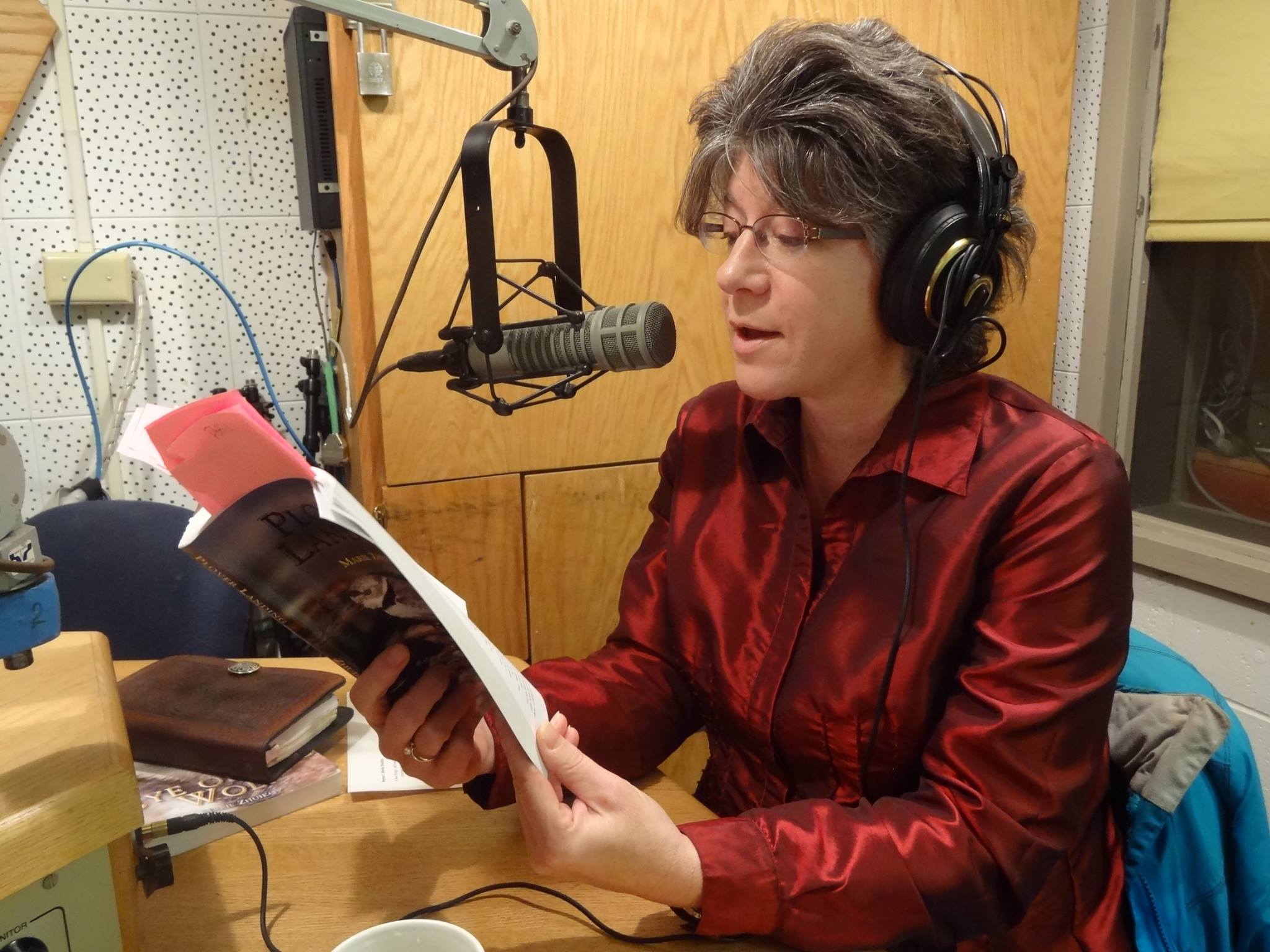
In the sound studio at KUMD Radio.

In the sound studio at KUMD Radio.

I took advantage of the opportunity to be part of a local radio station’s weekly program that features Minnesota women authors. I read excerpts from both of my eco-mystic romance novels, so they’ll be doing two shows about them. The first one featuring “Eye of the Wolf” aired this week on KUMD Radio in Duluth. You can access the six-minute audio file here.

My trip to the station in the basement of the local college was nostalgic. I used to have my own radio show for work called “Listening to the Lake.” I produced the show at that station with the help of their staff. They still have the same sound board I used for my show. These community stations are a great and unique news resource, so if you have one in your town, be sure to support it however you can!

The Banned Words of Bleak Mid-Winter

lssubanishtoon_AdamRaffaele

Cartoon by Adam Raffaele

I look forward to this time of season every year. What’s to like about bleak mid-winter – especially since the temperatures are below zero and I have a head cold that’s producing enough mucus to irrigate a small farm field? Why, the “List of Words Banished from the Queen’s English,” of course! The list is distributed annually by fellow northerners over at Lake Superior State University in Sault Ste. Marie, Mich.

At only 2,500 students the university is small, but its influence on writers looms large with a forty-year tradition of publicizing words that are misused, overused, or generally useless to society. The tradition of listing words everyone loves to hate started at a New Year’s Eve party in 1975 and has enjoyed worldwide fame and attention since then.

This year’s list includes several entries that I totally agree should be banned, such as SWAG. Around my house (which contains a highschooler and his friends) this means that someone is “cool” more than it implies a “free gift.” I have heard this word enough times to last a lifetime. Yes, it should be banned for the sake of parental sanity.

Another term that should never be uttered is ENHANCED INTERROGATION, or as the head of the CIA would say for short, EIT (for Enhanced Interrogation Techniques). The term hit the national spotlight last month with the release of the U.S. Senate report on the CIA’s intelligence-gathering tactics under former President George W. Bush. Torture is torture, people. Let’s not sugar-coat it with a lot of extra syllables.

The top word on the list, however, I’d never heard of. It’s BAE, which stands for “before anyone else.” I suppose it could also be a shortcut word for “babe.” Perhaps I’ve never heard this term because I am nobody’s bae (maybe it’s the mucus). But my Facebook friends and my highschooler assure me the word is alive and well among the middle school and highschool crowds, and apparently, people are sick of it.

The other word of note is NATION used as a suffix to denote fans of a team, celebrity, or the like. I thought it was entirely and appropriately ironic that Lake Superior State University encourages people to join the “Laker-Nation” in the standard institutional blurb that’s included at the end of the banned word list story. I hope they did that on purpose.

Some of the other words are featured in the cartoon above. If a word strikes you during the year as one that should be banned, go here to list it with the university and see how it fares in next year’s list. They also have a Banished Words Facebook page that you can join.

Now, if you’ll excuse me, I have to go blow my nose again.

Two Poets in the Cereal Aisle

Image from Pulpconnection.

Image from Pulpconnection.

I attended a reading last night by Duluth’s Poet Laureate Jim Johnson. (Yes, Duluth sports its own official poet.) Superior writer Tony Bukoski also read from his essays. It was hosted by Holy Cow Press – a local publisher that’s been in business for 37 years. Both Jim and Tony write from their ethnic roots (Finnish and Polish, respectively), providing for many laughs and some sighs. Topics included accordions, cows, gravel roads, railroads, and tractors. No saunas, though. Maybe next time.

The reading inspired me to uncover a poem that’s been incubating within me for several years. The reading must have made me think about local poets. Hot off the brain press – enjoy!

Two Poets in the Cereal Aisle

He stands, head bowed toward boxes
on the Captain Crunch shelf.
Bearded and barrel-chested,
if Hemingway had been a poet,
this is him.
The local Old Man and the Sea
is in my grocery store.

I slide over
pushing my cart softly, carefully.
Not wanting to disturb.
Will I see in his next book
a poem about golden wheat?
About waves and ships?
Short men in blue uniforms with
shiny gold buttons, and wearing
large hats?

Eyes still closed,
he reaches out his hand,
steadies himself against the shelf —
inspiration rocking and
pulling him
away from shore.

©2014 Marie Zhuikov

The Book Signing and the Viola Player

This weekend I had my first book-signing events in the metropolises of Minneapolis and Maple Grove, Minn. One was a reading at a small indie bookstore; the other was a signing event with a bunch of other authors at a big box chain bookstore.

Moon Palace Books in south Minneapolis.

Moon Palace Books in south Minneapolis.

I did the indie bookstore reading first, at Moon Palace Books in south Minneapolis. The audience was intimate and mostly genetically related to myself. (Grin.) But it was fun and I sold a few books. The owner was wonderful and, with thirty bookcases that were only two years old, the place smelled good — like freshly cut lumber.

We were just wrapping up when the Viola Player arrived. Or rather, she swooped in. Judy with the Duluth-Superior Symphony Orchestra (DSSO), is not the type to enter any other way. I experienced her vivaciousness first-hand when I had lunch with her as research for my novel “Plover Landing.” A viola player figures prominently in the story, but I needed to learn more about the life of this type of musician. I brought my plight to the DSSO and they hooked me up with Judy.

I chose the instrument because it’s the one I would have wanted to play if I hadn’t already been a French horn player in the high school band. I just love how it sounds, and the introvert in me loves how it’s a background instrument. From Judy, I learned about the underdog, scrappy culture of violists.

Judy, the vivacious violist.

Judy, the vivacious violist.

I didn’t know she was planning on attending my reading, so her swooping entrance was a surprise. A nice one, however! She even had her viola strapped to her back, and with little coaxing, treated us to several tunes. That’s one reading I won’t soon forget, and I’m sure the bookstore owners will remember it, too.

The big box chain bookstore event was a bust. Hardly anyone attended. If it had been my only event, I would have driven home in the dark of night feeling like the five-hour round trip was not worth it. I learned two lessons from this experience that I would like to share, especially with new authors who are responsible for their own marketing:

  1. If you’re traveling more than an hour or two from home, try to have more than one signing event scheduled to hedge your bets on feeling successful. In other words: Don’t put your book signing eggs all in one basket.
  2. The book signing ain’t over until the viola lady plays!

The Bench

A sailboat off Park Point Beach in Duluth, Minn.

A sailboat off Park Point Beach in Duluth, Minn.

I saw the bench in passing as I was hauling a box of my novels into a local community center where I was to take part in a local arts sale and book signing. My first thought was that the bench offered a nice place to sit if someone got tired on the walkway up to the center.

On my second trip, I noticed the red crabapples that had fallen onto the weathered wooden slats of the bench from the tree that sheltered it. On my third trip, I saw the small sliver plaque that had tarnished beyond readability and how the main metal support on the bottom of the seat was hanging askew. That bench had been there for a while, and no one was taking care of it.

On my fourth trip, I realized I was having all these reactions to the bench, and that I should pay attention. It’s funny and sad sometimes how intent we get on what we are doing (in this case, setting up my book table) that we miss creative fodder that’s right along the path.

Where will the path of life take you? To the beach!

Where will the path of life take you? To the beach!

After I was done hauling books and moving my car across the street to allow arts sale patrons the best parking spots, I took time to appreciate the bench. I unpocketed my camera and shot some photos of it and the surrounding beach. The bench photos don’t do it justice. I think my words describe it better, but I got some good beach shots.

I’ve been thinking a lot about mortality lately, what with “shallow graves” occupying my mind, and attending a visitation for a fallen media comrade. This bench spoke to me of a life remembered. It served as a token of respite and peace in a busy world, but a token now forgotten and in disrepair. How fragile human memory is! How fleeting! Yet the bench stands in testament that someone once cared.

Like any good, self-absorbed artist, I wondered if anyone would care enough about me to dedicate a bench in my name, and if they did, how long the intent would last to keep it in good repair. And in the big scheme of things, does it really matter? Dust to dust, ashes to ashes, and all that.

I suppose a poem is in that bench somewhere. I wonder if I will have the opportunity to step off the path of my busy life and write it.

Okay, I changed my mind. Here's the bench.

Okay, I changed my mind. Here’s the bench.

How I got Jane Goodall to Stick her Head in a Potted Palm Tree

Jane Goodall

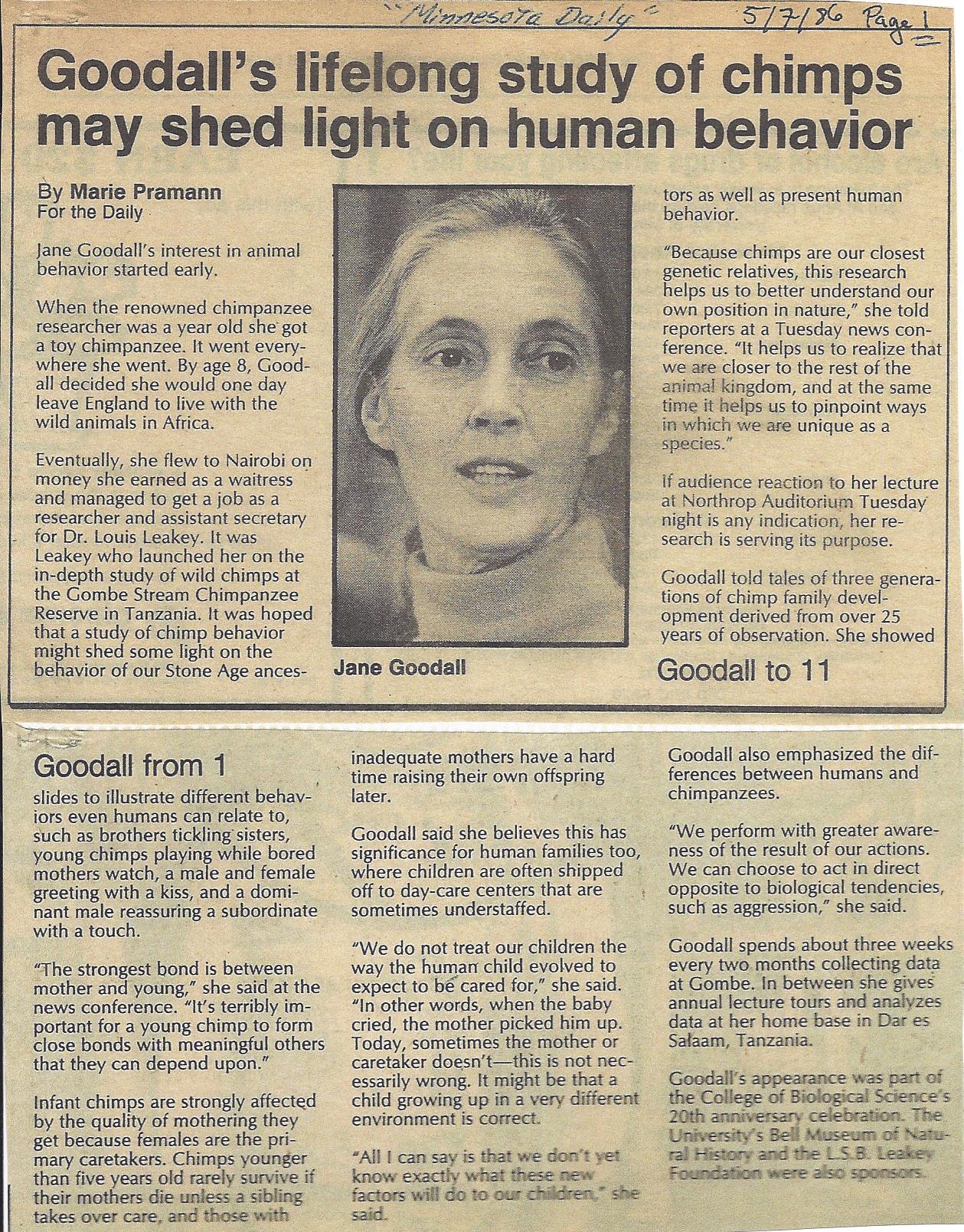
My story from the Minnesota Daily, May 7, 1986, page 1.

A recent news story about chimpanzee researcher Jane Goodall reminded me why she’s one of my favorites of the scientific glitterati. Here’s a link to the Huffington Post video story. Basically, she’s saying that researchers need to have empathy with their subjects in order to conduct ethical and meaningful science. I agree!

I had the chance to meet Jane (I don’t think she’d mind if I call her by her first name – she’s that kind of a person) back in my glory days as the environmental reporter for my college newspaper, the venerable “Minnesota Daily” (best college newspaper in the country!) Jane came to town to give a talk on chimpanzee behavior and DNA, and how similar they are to our own.

She presented to a packed auditorium and afterwards, hosted a news conference. I sat in the front row along with a photographer for the paper. I don’t remember what questions I asked, but I do recall being impressed by Jane’s seeming kindness and approachability.

During the news conference, the photographer and I surreptitiously discussed good locations in the room to take her photo afterwards, both agreeing (with the logic of college students) that the potted palm next to her podium would be ideal. She did work in the “jungle,” after all! However, the thought of asking Jane Goodall to stick her head among palm fronds filled me with anxiety. Would she be insulted? Have us thrown out of the room? Turn around and walk off in a huff?

Once the news conference was over, no other reporters seemed to want to talk to Jane, so I approached – probably gushed about what a big fan I was – and put forth to her the photographer’s plight of getting her photo against an interesting background. I couldn’t believe our luck when she pointed to the palm and said, “Well, why not here?”

Amazed and relieved, I agreed. Unfortunately, the palm tree photo did not run with the story — the photo editors ran a boring head-shot instead. But I will always remember how gracious and accommodating Jane was, and how willing she was to stick her head in a potted palm for a college reporter.

Chinese Scooter Instructions — A “Found” Poem

The moon as seen from my writing studio this past June. (The Strawberry Moon.)

The moon as seen from my writing studio this past June. (The Strawberry Moon.)

We bought a scooter from China a few years back. These are the actual words that were in the instructions (so they are not mine), but the formatting is mine. The recent Harvest Moon reminded me of it.

Chinese Scooter Instructions

When driving
please you keep the relaxing moon
and wear comfortable clothes,
obey the traffic rule
and prohibit
making the moon
impatient.