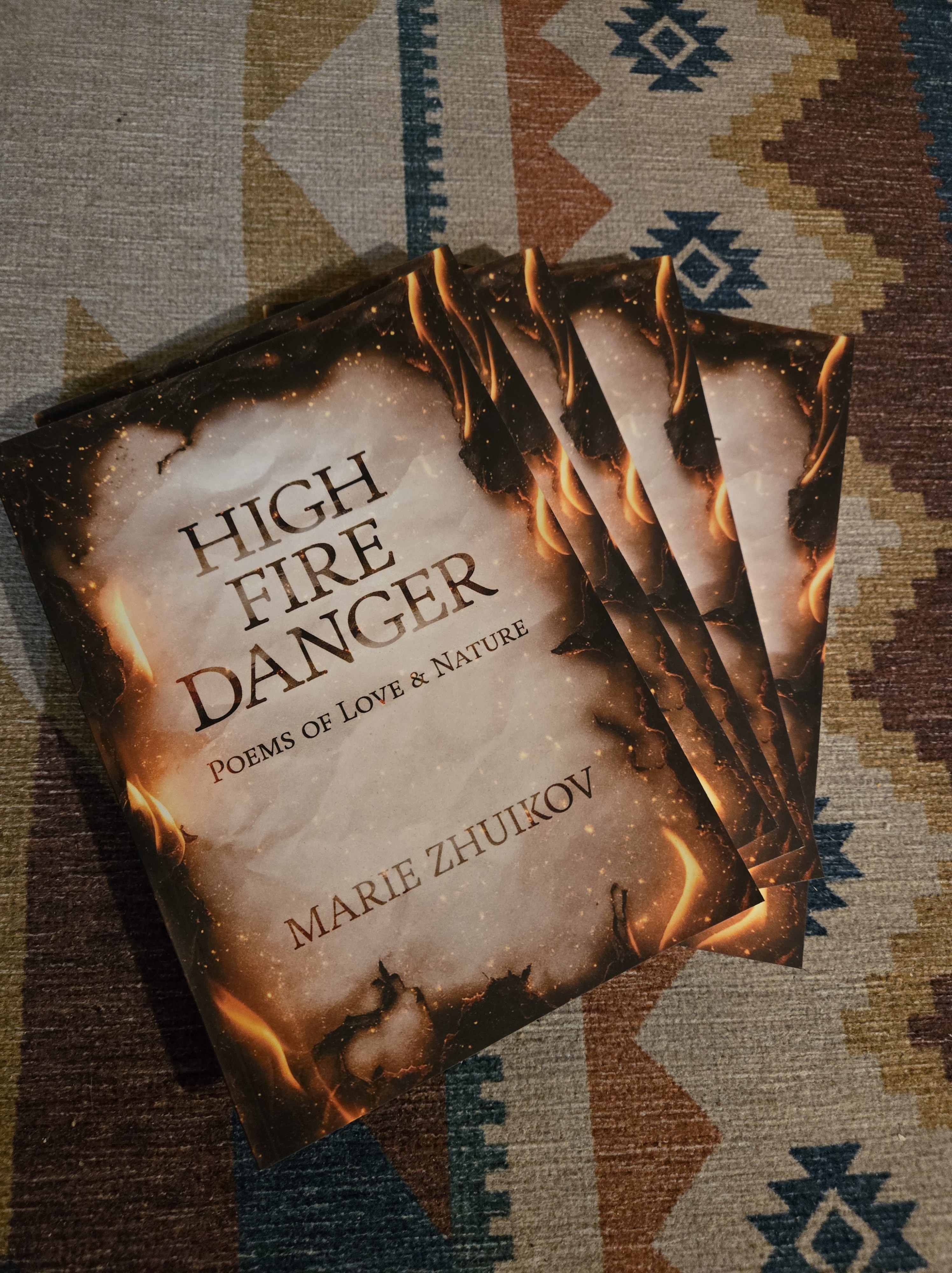
I’m interrupting my New England Road Trip travelog to reveal the cover of my latest book. It’s my first collection of poetry. As I mentioned in this previous post, the book came together fast because it’s locally (but professionally) produced. The designer and I had fun playing with ideas for the cover but we settled on this one quickly.
The book’s comprised of poems I’ve written over the past 38 years. Many were published in literary journals, including the one for which the book is named. Here’s a taste:
High Fire Danger
The flame is still there, sparking, small and warm.
It was all I could do to dampen it. Your breath kindles it brighter. Neutrality only a smoky dream.
I will give you what breath I can, but my house burned once and I must protect my family from fire.
The paperback is available now on Amazon for $15. Visit this link to buy. I’m so happy to see the book out in the wilds! For info about my other fiction and nonfiction books, please visit my book page.
We continued our New England Road Trip by taking a train from New York City to Old Saybrook, Connecticut. This is where Russ spent many of his formative years. We rented a car and toured his old neighborhood and saw his family home, which is still standing. We even spent a little time greeting the Atlantic at the town beach.
The docent told us that Kate liked this photo of herself, so it’s featured prominently in the front of the museum.
Before we left Old Saybrook the next day, we had a few hours to kill so we visited the Katherine Hepburn Museum. Hepburn lived near Old Saybrook after her family bought a summer home there when she was five. The day before, we’d driven through the exclusive oceanside neighborhood (Fenwick) where her home was located. It sports a golf course and a lighthouse. We wanted to visit the lighthouse, but couldn’t due to public access issues. We also weren’t able to see her home, where she retired in 1996.
If you’re not familiar, Katherine Hepburn (aka Kate) was a feisty actress of great renown who had a six-decade career in Hollywood. She’s best known for movies like The Philadelphia Story, The African Queen, and On Golden Pond. With her athleticism and outspokenness, she broke the mold for women in Hollywood.
Kate and her husband Ludlow Smith. They were married for six years.
At the museum, we were given a comprehensive introduction by a helpful docent, who was excited to learn that Russ was a hometown boy. The museum features eight exhibits that focus on Kate’s family, her athleticism, her Fenwick home, her career and other special topics. Wedding gowns were the focus of the special exhibit when we were there, including Kate’s own wedding gown from when she was married early in her life.
I always enjoyed Kate’s movies, and she’s been an inspiration to me to keep active. I recall watching her on a television talk show once when I was younger. I believe she was in her 70s and she proudly showed the host how she could still bend over and touch her toes. I remember thinking, I want to be able to do that when I’m 70! I’m happy to report that I can still accomplish this feat in my early 60s. 😊
Kate’s wedding dress. It’s a tea gown made of silk velvet with gold embroidery in a pattern inspired by North African apparel. It was purchased by a wedding gown company and remained in storage for 20 years before being purchased by the museum.
The museum is also a cultural arts center, hosting lectures, workshops, and film screenings. Admission is free but there’s a suggested $10 donation per person.
According to one placard, “Although her legendary career catapulted her to dizzying heights of international fame, Connecticut’s local girl never really left home. The road always led her back to her family and to her refuge in Fenwick.” Katherine died in her Fenwick home in 2003. Her grave is in a cemetery in Hartford. She didn’t want a service, nonetheless accolades for this special actress were given throughout the country in many other ways. It’s good to know that her memory and passions are preserved in this little piece of Old Saybrook.
Russ and I decided to see New England in the fall. We began our road trip earlier this month in New York City even though this mid-Atlantic state is not technically part of New England. We landed in NYC because Russ’s son lives there. We wanted to visit him and he planned to join us for the first few days of our ten-day trip.
Besides the colors, our other goal was to visit sites relevant to ourselves and our ancestors. But first, some fun in NYC! This was not our first visit. In 2019 we dropped in just before COVID hit. (See “Unicorns in New York City!” and “Images.”)
We booked a hotel in Brooklyn. The place looked great online but when we arrived, we were surprised to see it lay in a gritty neighborhood filled with graffiti. We never felt unsafe, but we definitely knew we were not in Duluth anymore!
A sculpture atop the fort on Governor’s Island, NYC.
We’d agreed to spend most of a day on Governor’s Island, a 172-acre former military installation in the heart of the harbor that’s reachable only by ferry. Native Americans used to fish there and gather nuts from the island’s plentiful trees. After colonization, the Dutch promptly set about cutting down those trees, and established a sawmill and fort. The island’s location made it a strategic military base. It was occupied later by the British and the U.S. Army. In more recent days, the island was the site of an historic meeting between President Ronald Reagan and Russian leader Mikhail Gorbachev.
Now the island is managed by several entities, including the National Park Service. The island is a car-free zone, so after disembarking from the ferry, we walked around. Later, in a fit of classic tourism, we elected to pedal the island in a dorky four-person bike surrey.
The Field Station of the Melancholy Marine Biologist art installation.
Besides old brick army personnel quarters and homes, the island sports eateries, an urban farm, a private spa, and art installations. Given my Sea Grant background, my favorite artwork was named “The Field Station of the Melancholy Marine Biologist.” Ensconced in an old military building, the mixed-media work “suggests an abandoned research outpost filled with scientific objects, instruments, artifacts, and samples. Through the windows, the viewer finds a scene preserved in time—a staged moment that invites you to imagine the life of a solitary researcher faced with the realities of a dark future defined by declining ocean health and climate change.” (Art installation sign text.)
A view of the Staten Island Ferry and Manhattan from Governor’s Island.
The island offers great views of Manhattan, the Statue of Liberty, and the harbor. Once back on the mainland, we attended the Broadway musical “Six,” which is about Henry the 8th’s six ill-fated wives. Given the topic, one would expect a depressing show, but it comes off full of female empowerment and strength. I highly recommend it!
Day 2 took us to Russ’s hometown of Old Saybrook, Connecticut. More on that, next.
A new sport has reached the shores of Lake Superior. It’s called microfishing. Think birdwatching, but with tiny fish. Quite a change from trying to catch the largest possible fish!
You can read all about it if you’re a subscriber to Lake Superior Magazine. My story is in the October/November 2025 issue. I learned about this unique sport when I interviewed a local department of natural resources fisheries biologist for a different story. Once I retired, I had time to pursue a magazine story. The sport is practiced all over the world.
If you’re not a magazine subscriber and want to learn more, visit microfishing.com.
Last month, Russ and I continued our quest to cycle different sections of the Mesabi Trail, which crosses northern Minnesota’s Iron Range. Amid the crunch of fallen leaves and the brilliant red of sumac, we biked from Nashwuak to Calumet with a side trip to Pengilly.
A warm breeze offered one of those final temperate days between summer and fall. The trail began in Nashwauk at a nondescript parking lot near a closed restaurant with the suggestive name of Big O’s Chef House. (Maybe that’s why it went out of business?) Except for a few frost heaves, the mostly flat trail was in good condition. It parallels the highway ,so the distant noise of cars is ever-present.
Much of the land surrounding the trail is owned by Mesabi Metallics Co., an iron ore and taconite mining company. We passed huge piles of mine tailing waste and overgrown past mining roads as a few vultures circled overhead.
In the sleepy Sunday town of Calumet, we rested at a public picnic shelter. The only evidence of life was a man throwing a ball for his black lab. Then we turned around and made our way back to Nashwauk. Along the way, we took a short spur trail to the town of Pengilly just for a change of scenery.
Scenery along the trail.
Once, a pair of teenagers on an ATV surprised us (they’re not supposed to go on the trail). Several times, we had to dodge Halloween-colored (black and orange) woolly bear caterpillars inching their way across the trail. Folklore says they can predict how harsh the winter will be by the width of the colored bands on their bodies: more black equals a harsher winter. We were trying too hard not to squish these fuzzy forecasters, so we didn’t notice their band patterns.
Apparently, science has not confirmed the caterpillars’ weather-forecasting abilities. Even so, the woolly bear remains a symbol of autumn. Its presence offered us a gentle reminder that the season is turning, and nature is preparing for the quiet, cold months ahead. This will probably be our last long ride of the season.
Total distance: 14 miles. For more information about other sections of the trail, please see these previous posts:
Story from the Minnesota Daily, May 7, 1986, page 1.
You may have heard that chimpanzee researcher Jane Goodall died recently. As a young college environmental reporter, I had the chance to meet her once. Here’s a story that I posted in my blog previously and included in my Meander Northbook. Not only was Goodall a great scientist and advocate for nature, she was a wonderful human being.
I’m so far behind on my blog posts but thought I could write this one before I head off meandering again. (Plus I’m still finalizing my poetry manuscript.)
ActorFilip Berg from Trouble. Image courtesy of Netflix.
My first recommendation is the movie Trouble. This Swedish action comedy is a remake of a 1988 movie by the same name. An electronics salesman and handyman innocently gets caught up in a home invasion and murder. What follows is a farcical romp involving corrupt police and relationship drama. The movie is streaming on Netflix with English voiceovers. I thoroughly enjoyed it and laughed a lot!
Red slipper replicas that were in the Judy Garland museum when we visited in 2021.
The second is Ruby Red Handed. It’s a tongue-in-cheek documentary about the case of the missing ruby red slippers that Dorothy (Judy Garland) wore in The Wizard of Oz. This theft happened a few hours’ drive from where I live. Russ and I visited the Judy Garland Museum in Grand Rapids, Minnesota, after the theft happened, so that’s why the movie intrigued us. (See my post about our museum visit.)
Solving the crime took years and the help of the FBI. It involved clueless criminals (who thought the shoes contained real rubies) and buried treasure. Spoiler alert: the show has a happy ending, but if you’ve been paying attention to the news, you know that already. It’s available for free on Hulu and was produced by a Minnesota-based company. You’ll get the inside scoop on all the juicy details of the crime.
With all the noise in the blogosphere, no one’s probably noticed that I’ve been quieter than usual lately. That’s because I’m working on another book manuscript. This time it’s poetry. I’ve had poems published here and there but never a book of my own. So, I decided to compile my life’s work of poems—yet another good retirement project.
I finished the manuscript last week and sent it off to a local publisher. I decided to choose this publisher because they exist solely to help poets in our area with projects like this, the turn-around is quick, I’ll get to keep the profits, and have control over the final manuscript.
Two days later, I received a “yes”! Now I’m working on fine-tuning the manuscript and getting marketing blurbs ready. Here’s what I have so far:
High Fire Danger: Poems of Love and Nature
Me years ago on a firefighting assignment in Yosemite. I’m smiling behind my bandana.
In High Fire Danger, Marie Zhuikov meditates on the transformative power of love and the magic and menace of nature. Written over the past thirty-eight years, Zhuikov’s enchanting poems offer unique insights and cutting humor. They take readers from her home in Minnesota to far-flung locales across the Great Lakes, Canada, Scotland, the Caribbean, and even to another planet. These accessible poems are filled with the heat and longing of romantic love, but also a deep love for family, community, and nature. They’ll scorch your soul like wildfire.
In a few months, I hope to have this book out into the world! For info about my other fiction and nonfiction books, please visit my book page.
A rare show lit up the sky above our cabin last night. Russ and I meandered down roads in the dark, feeling our way by the gravel crunching under our shoes. We made it to a bog that has a good view north.
As the aurora silently danced above in curtains of reds and greens, lightning bugs danced closer to the ground, their feeble white lights the last of summer.
If you’d like to see my photo page with lots of other images (organized by topic: water/wood/stone/sky/travel and lighthouses) please visit my photography page and choose a topic: https://mariezwrites.com/photography/.
Wild rice, the kind of rice native to the Great Lakes and other parts of North America, is not only delicious in soups and other dishes, it makes a great and healthy snack.
A few years ago, I was gifted a copy of The Good Berry Cookbook by Tashia Hart. The author is a member of the Red Lake Anishinaabe (northern Minnesota) and she’s a culinary ethnobotanist, artist, photographer, writer, and cook. The book is more than a cookbook. It’s everything you ever wanted to know about wild rice.
A wild rice triple chocolate donut. Doesn’t it look tasty?
I’ve made several recipes from the book, notably, one for wild rice chocolate donuts (Triple Chocolate Donuts). As someone who’s always on the lookout for alternatives to wheat and corn, I was attracted by this recipe. They turned out looking great but were a bit gritty. Maybe I didn’t grind the rice into flour as fine as I should have. Since then, I’ve found other wheat- and corn-free recipes I like better.
This weekend, I went to a Harvest Festival in Duluth, which features produce from local farmers and artisans. One booth offered puffed wild rice in several flavors (for instance, cheese pizza!) I tried a sample of salted rice puffs. They were very good. Done this way, the wild rice tastes almost like popcorn, but with a richer, nuttier flavor. I would have bought some, but the vendor used popcorn salt, which usually contains cornstarch, so I passed.
Seeing the puffed wild rice reminded me that the Good Berry cookbook had a recipe for it, so when I returned home, I made some. It requires wild rice that has been picked and parched in a traditional manner. This makes it a lighter color (dull brown) versus the paddy-grown wild rice, which is dark and shiny.
All you do is heat a few inches of oil (I used canola) in a pan at a high temperature. I used setting 7 out of 9 on my stovetop. Wait until the oil is good and hot, then place a small amount of wild rice in a sieve (2-3 tablespoons) and lower it into the oil. It should puff up quickly if the oil is hot enough. Then spread the rice on a plate lined with paper towels to drain. I seasoned mine with sea salt (which usually contains no cornstarch).
If you’ve ever had puffed wheat cereal, you’ll recognize puffed wild rice, although the rice kernels are smaller and skinnier. It tasted great!
Marie tries her hand at harvesting wild rice, St. Louis River, MN.
Russ has developed the habit of eating popcorn in the evenings, which is sort of torture for me because I can’t have it. (Do you think he’s doing this on purpose??) Now, I have an alternative.
Tashia also offers a recipe for wild rice chocolates. Basically, you take the puffed wild rice and pour melted chocolate chips over them. I have some leftover puffed wild rice. That’s next on my list!
For a story about my “immersive” experience harvesting wild rice, visit this link.
Update: 9/10/25
I made the puffed wild rice chocolates. Very good! The recipe calls for making them in a flat sheet, but I chose to clump them instead. They taste rather like a Nestle crunch bar.