We are experiencing a blizzard right now in Minnesota. This seems like a good time to wrap up my posts about our wonderful, warm St. Martin Island trip. (To see previous ones about Loterie Farm, Fort Amsterdam, or Topper’s Rhum Distillery, please click on the embedded links.)

Cooling off in the ocean at the end of a trail ride at Seaside Nature Park in St. Martin.
Another memorable outing we did was a visit to the Seaside Nature Park for a horseback ride. Although this former plantation is a nature park, ironically, you have to pass through one of the islands power plants to get there — a rather disconcerting experience. Plus, Google Maps will misdirect you to a road that is not finished yet. We found our way by asking a guy along the road who happened to know. I would suggest calling the park for directions beforehand.
Once we arrived at the rustic reserve, we were introduced to our horses, who were all named after musicians. My horse was named Prince, then there was Electra, Madonna, and Freddie (Mercury). The park offers sunset champagne rides (2 hours) and just regular daytime trail rides (1 hour). After a butt-wrenching experience years ago in Puerto Rico riding a horse for two hours, I decided it was wiser for us to just do the one-hour ride for our inexperienced butts. It was just the right amount of time.
Our horses plodded along steep cliff faces with spectacular ocean views. Some of the horses were not too fond of each other, but we quickly learned which ones needed to avoid each other. A highlight was the end, where we rode our horses into the ocean to cool off after the ride. They enjoyed the saltwater dip so much, they groaned with each step! That was something to hear.
The water rose higher than we were expecting during this part of the ride. I thought maybe our calves would get wet, but we went deep enough that our butts (and saddles) got wet. I almost floated off my horse at one point, so a tip would be to bring towels along in the car so that you can use them to sit on for your car ride back to wherever you are staying.
Our guide took photos of us with my phone. I was glad my phone did not fall into the ocean! It was a memorable experience. We all walked sort of funny for a few steps after we got off our horses, but no lasting damage was done to our physiques.
I’ll share the last of my “good” images below and some other tips to help you navigate St. Martin that we learned along the way.
Pro Tips:
If you’re driving and someone blinks their headlights at you, that means “go ahead.” They are either letting you turn in front of them or some other friendly move.
If you happen to stay at the Divi Resort in Little Bay, a great place to snorkel is near the pelican nesting area. Currently, there’s a houseboat there and some buoys that mark a place where people (used to? Currently?) do those Sea Trek dive helmet excursions. The fish there are used to getting fed and will swarm around you near that site, even if you have nothing to feed them. We also saw a sea turtle and an octopus on our way from the resort to the buoys.
Iguanas will bite if they think your toe is food. Beware!
An ignuana at Great Bay. Or is it Godzilla’s baby?
The infinity pool at Divi Little Bay Resort
Marie makes a rare appearance (twice) in her own blog. This is at Fort Amsterdam.
The view from Chewbaca Point on Loterie Farm, St. Martin.
Continuing my posts about the isle of St. Martin, I offer this one about Loterie Farm, a private nature reserve on the French side of the island. This was my second time at the farm, but a first for my traveling companions.
The Jungle Room
The other time I was there, I was initiated into ziplining. The farm has a course that takes you through the surrounding trees and hillsides. If you’re lucky, you’ll see the resident monkeys as you glide along. But since I’d already been there, done that, I and two others from our group decided to explore the farm’s hiking trails.
I admit to not doing much research on the trails beforehand. But I should have clued into the strenuousness of the hike from the switchbacks on the map, which we paid $10 for. (I advise just accessing the map on your phone from the farm’s website if you have coverage). The receptionist’s questions about whether we were wearing adequate footwear also should have been a big hint.
We each grabbed a cane stalk hiking stick from a box near the trailhead, which we were thankful for later. We took the short (60-minute) hike to a spring and then up to Chewbaca View Point.
The hike to the spring was easy, although the spring was not flowing when we were there in November. Then the trail headed up a mountain. There were parts where we Elders were scrambling over boulders, clinging to handholds as best we could. This is where we were very thankful for the hiking sticks.
But, the view from Chewbaca Point was worth it. We could see all the way to the ocean and many of the towns in between. We rested there and rehydrated. (Bring water!) The temps were about 85 degrees (F) and my tank top was totally soaked in sweat from the climb.
From the point, the trail descends back to the farm whence we came. Erosion caused gullies and tricky footing, but we went slow, and everyone made it back to the trailhead without mishap. Along the way, numerous green moths fluttered around us, making us feel like we were in a Disney movie or something.

The best mojito ever!

I should also mention that before our hike, we ate lunch at the farm’s Jungle Room Restaurant. It’s up among the treetops and features cozy couches for large groups and an area for sit-down dinners. The food was exquisite the first time I was there, and we certainly had a repeat performance. I had one of their poke bowls and Russ had the cajun Mahi Mahi salad (see image). Both were delectable, plus my mojito with fresh mint was the best I’ve ever had.
After our hike, we contemplated a plunge in the farm’s Jungle Pool, but we would have only had an hour to enjoy it, and the price tag didn’t seem worth it. So, we hung out at the bar while waiting for the rest of our crew to return from their activities. I ended up having one of their nonalcoholic mixed drinks – I think it had mango in it. So refreshing!
I find it ironic that I was able to complete our hike intact because when I returned home, I ended up breaking my ankle doing a simple side-shuffle exercise during a kickboxing workout. So, I sit here in my ankle boot, envious of my past flexibility and prowess on this adventure. Oh well. Go figure!
Russ and I took a long-awaited and several times cancelled trip to warmer climes earlier this month. We orginally planned to meander to Grand Cayman Island, but our timing was unfortunate. Twice our reservations coincided with times the island was closed due to COVID restrictions. We gave up on trying to go to a U.K. territory and opted for a Dutch/French one instead, the island of St. Martin.
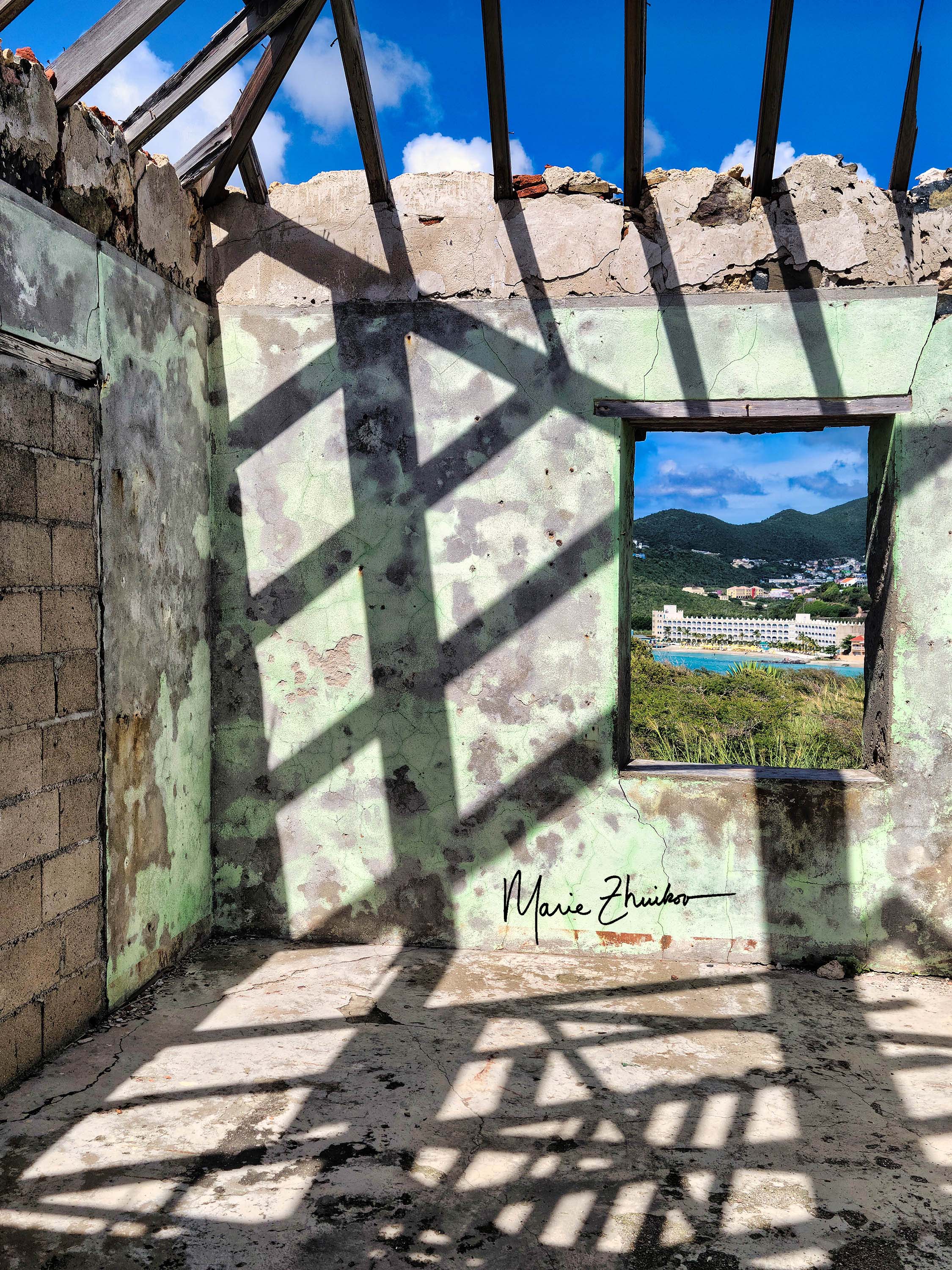
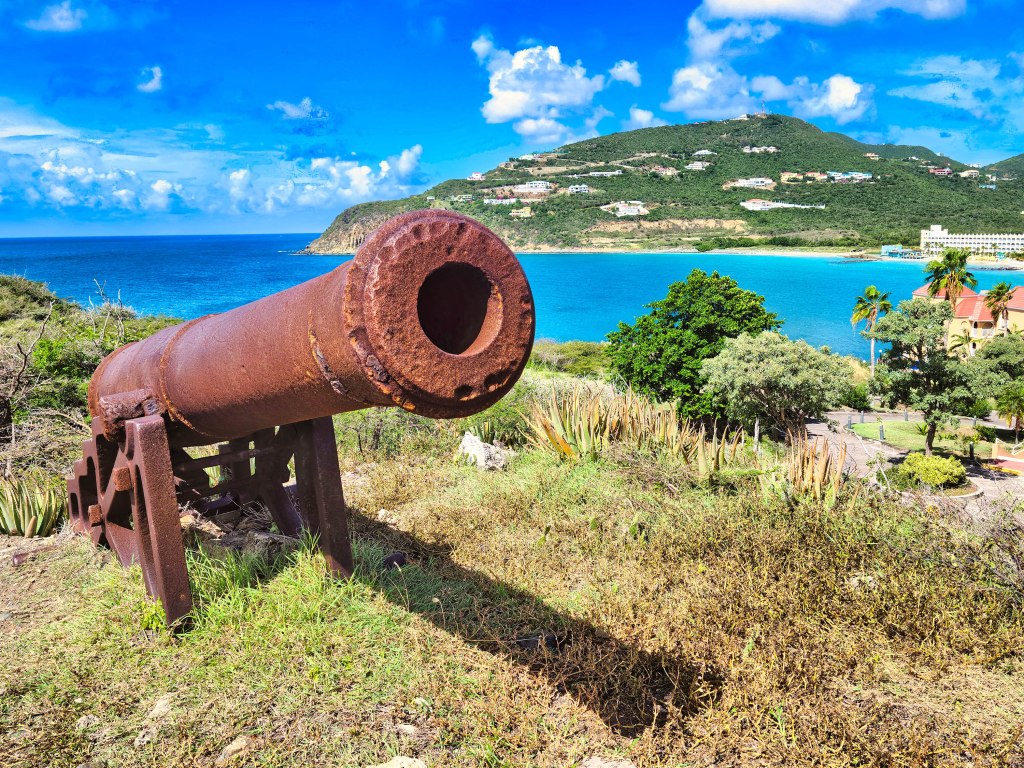
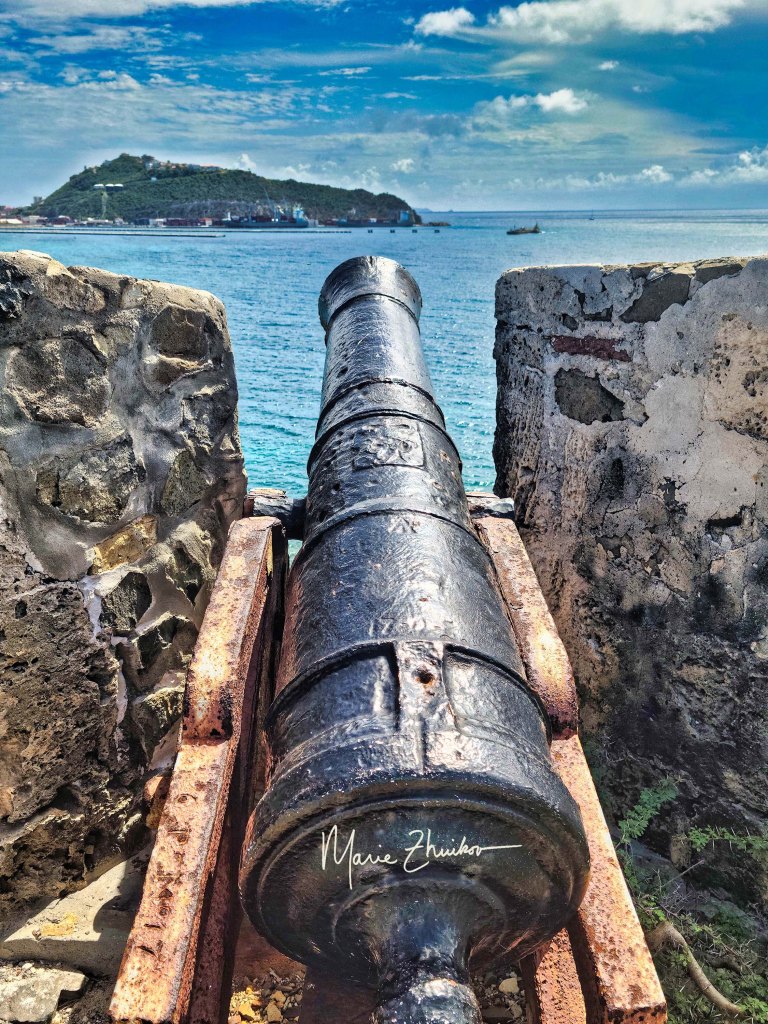
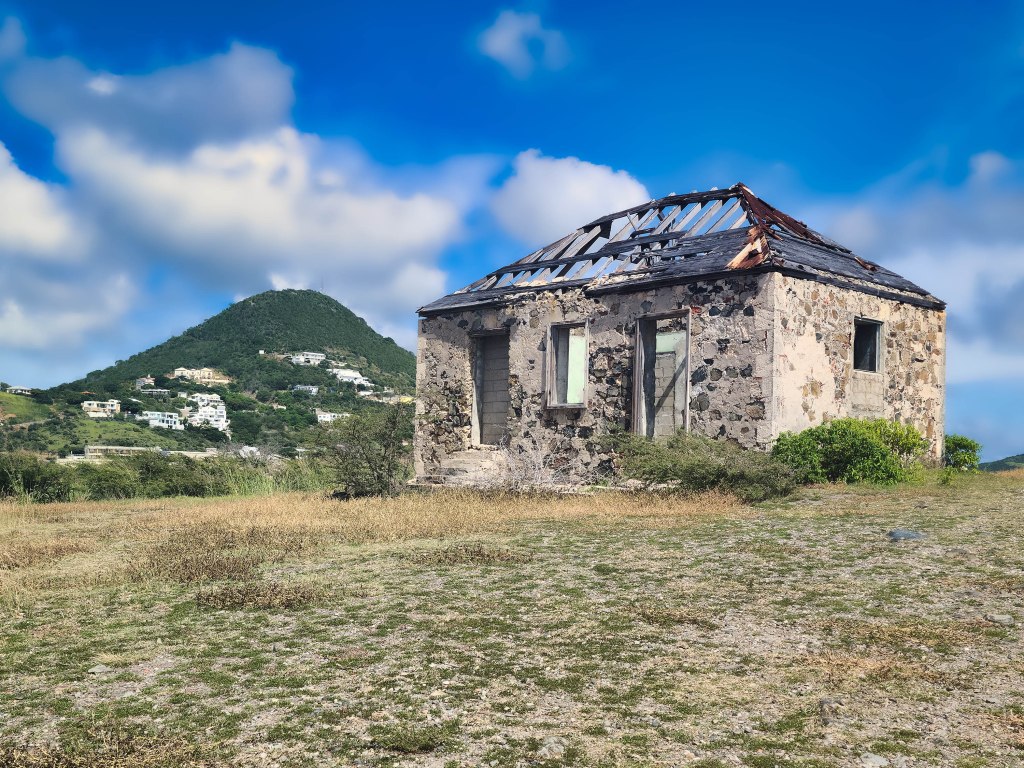
This was my second time there (for photos from the first time, see St. Martin Island – Where Nothing is Better). Sitting here in the snow of Minnesota, I am dreaming of the 85-degree (F) temps and warm turquoise ocean. In my next few posts, I plan to share images from our trip. The image above is from a fort that was near our resort. Fort Amsterdam was built by the Dutch and later the Spanish to protect the salt trade on the island. Several buildings and bastions comprise the fort, which is located on a dramatic point. My favorite was the signal house. It was built in the late 19th century for signal tower communications and was later used to house a radio station.
Its roof is missing, from Hurricane Irma, I suspect. The inside tells the tale of many layers of paint. Several windows look to the ocean or to our resort. Here are some of my favorite images.
A gallery of images from the rest of the area around the fort. Pelicans nest nearby and I caught one resting on rocks below the fort.
I recently attended a Zoom meeting for work where the presenter was wearing a bow tie. His tie was full of bright colors in contrast to his dark shirt. The speaker was a professed bow tie-aficionado. His tie was fun to look at, but it was crooked. I kept mentally straightening it during his whole presentation. It was distracting.
This reminded me that every bow tie I have ever seen someone wear has been crooked, which reminded me of an idea I had in 2010 when I worked for Mayo Clinic Public Affairs (where many of the doctors are also bow tie-aficionados) for an addition to a tip sheet for television interviews. This was a one-pager that we had on hand to advise doctors who weren’t familiar with being interviewed. It contained tips like women not wearing long, dangly earrings because they are distracting. (Although I suppose this could also apply to men!)
If I had continued working at Mayo Clinic longer and gained more “street cred” in the organization, I would have advocated for adding to the tip sheet: “Don’t wear a bow tie.”
Before I list the reasons why, I want to say that I think bow ties are fine for everyday life. I realize they are a way for the wearer to express their individuality and quirkiness, and I’m all for that. They are also convenient in many professions, allowing for a fashion statement that doesn’t drag in your soup bowl like a long necktie would. Also, according to a story on the WHYY public television station, for doctors, bow ties are more hygienic, collecting less bacteria than neckties. But I just don’t think they work for television interviews.
Here’s my reasoning, as if speaking to the interviewee:
No matter how hard you try, your bow tie will be crooked, which is distracting and dilutes the verbal message you’re trying to convey.
Yes, bow ties make the wearer look smart, but they also alienate you from the viewing audience. Historically, bow ties have been a marker of privilege and conservatism. Think of who you are trying to reach with your television interview message. For most health information, I would wager you want the widest possible audience.
During media interviews, you are representing your organization. This is not a time to get all individualist and fancy. You can put your bowtie back on afterward.
Despite straightening beforehand, your bowtie WILL become crooked during the interview.
Your bowtie will run askew. (I cannot stress this enough.) 😊
There, I’ve been carrying that inside for a long time. I feel better now! Feel free to comment with dissenting opinions or agreements below.
I sit with snow lightly falling outside and a cold wind blowing. I sip my rhum infused with a tang of tea and lemon, and my mind meanders back to the balmy beaches and warm salty breezes of the island of St. Martin in the Lesser Antilles.
You may wonder why I’m using the spelling of rum with an h. I admit to being a bit confused on this point. Our Toppers Distillery tour guide, Cristina, on St. Martin, said that “rhum” was how it used to be spelled back in the early days. An internet search tells me that rum is made from molasses, while rhum is made directly from fresh-pressed sugar cane juice. However, Cristina tells me that Topper’s rhum is made from molasses.
In any event, this rhum is exquisite – sinfully smooth and way too easy to drink. It needs no other ingredients to cushion the tongue.

Cristina introduces us to the many varieties of Topper’s rhum.
We toured the Toppers Distillery on St. Martin a few weeks ago. After plying us with a rhum punch, Cristina described the history of rum to us and how the distillery makes its beverages. She invited us to taste many samples of the handcrafted rhums that are mixed on-site. These include white chocolate-raspberry, mocha, banana-vanilla-cinnamon, coconut, a white rhum, and a spiced rhum. All were delicious, even to one member of our tour who had a past bad experience with a rum and coke drink.
The first rhum we tasted was my favorite, and it’s what I am drinking now. It has the unappetizing name of Nelson’s Blood. It also has an unappetizing story behind it, but it tastes so good! Cristina told us that it’s named after British Vice-Admiral Horatio Nelson, who was regarded as one of the greatest naval commanders in history. He was killed at age 47 by a French sharpshooter during the Battle of Trafalgar off the coast of Spain. Too important to be buried at sea, his body was transported back to England for a state funeral.
To preserve Nelson’s body for the trip, it was put into one of the casks of rum (I’ve also heard that it could have been brandy) that the crew habitually drank as part of their daily rations. Cristina told us that once Nelson’s body reached England and the cask was opened, those doing the opening were surprised to find that the rum had disappeared. Apparently, the sailors had drunk the rum. Ewwwww!
Rest assured, Topper’s Nelson’s Blood rhum does not taste like a dead body. I assume the tea and lemon flavors were added to it as a nod to the Admiral’s British heritage. We only brought one bottle of rhum home with us, and this one was it. That’s how good it is.
As we listened to this fascinating tale, blue-eyed, dark-skinned “Topper” himself poked his head inside the room and Cristina introduced him. Meeting one of the owners was cool. He and his wife moved to St. Martin from Boston. They made mixed rum drinks for guests at their restaurant. Their guests liked the drinks so much that the couple decided to produce a supply for local restaurants and stores. In 2008, they commercialized the brand and won many awards. They moved to their current facility in 2012.
Mandarin chicken with a banana vanilla cinnamon rhum sauce.
Back on our tour, Cristina explained how the inside of the rum storage barrels are charred and treated in various ways to elicit different flavors. Then we moved onto the distillery’s small lab, where they create the tasty fruit and spice mixes that are added to the rhum. These natural flavors are hand-mixed in five-gallon buckets. It was also in this room where Russ got drafted into cooking us a mandarin chicken dish with a rhum sauce. With Cristina’s coaching, he created a delicious tropical dish that we all got to taste. By this time, we were all a bit tipsy, so it was good to have a few bites of solid food in our stomachs.
After that, we meandered over to the bottling room, which was surprisingly small for such a large operation. Russ’s daughter had the honor of pushing the “start” button on the assembly line. It can fill six bottles at a time. The colorful bottle sizes vary a bit, so Cristina showed us how they use syringes of rhum to equalize the liquid levels in the bottles.
Then it was my turn to participate in the tour. After the swing top closures are in place atop the bottles, a clear plastic safety seal is applied. This is done with a small heat-sensitive shrink-wrap piece of plastic using high-tech equipment like your hands and hair blow dryer. I volunteered to seal a bottle and it was a piece of cake. (Or, a bottle of rhum, if you prefer.)
Our tour over, we perused their gift shop and ate lunch in the attached restaurant and bar, which features a wonderful view of Simpson Bay. We topped it off with a dessert of gelato from the distillery’s gelateria.
If you’re ever in St. Martin, Topper’s Rhum Distillery tour is a must! It’s a way of bringing a bit of the island home with you.
Debut novelist Carol Dunbar is living a dream. She’s been slogging along in the local writing trenches of the Duluth-Superior area for years. She gained some local notoriety and then hit it big, signing with an agent and getting a two-book deal with a national publisher.
But it almost didn’t happen. During a recent Wisconsin Writers Association (WWA) conference Dunbar said that ten years into her twelve-year journey writing her novel, a flood in her office made her want to quit. She printed out a draft of her manuscript and was about to begin querying agents. She had written notes in the margins and on the backs of pages – things she wanted to address before she sent out the document.
Carol Dunbar discusses her book at its launch in Duluth, Minnesota, earlier this year.
Dunbar’s writing office lies underneath two 250-gallon water tanks that serve her off-the-grid home in the woods. The tanks developed a leak. For twenty minutes, water poured into her 10 x 10-foot office and onto her manuscript.
“Water is death to all things writing,” Dunbar said. Her draft was illegible. The books lining her office were destroyed. She couldn’t see how to recover from this catastrophe, and she began to cry.
At some point in the devastation, the voice of one of her characters cut through to her. It was Ethan Arnasson, the father-in-law of Elsa, the novel’s main character. Dunbar said that Ethan told her, “Carol, just give it time.” She knew he was right and felt giddy that, “My fictional character was giving me personal life advice!”
Lucky for us, Dunbar persisted. “The Net Beneath Us,” is set in remote northern Wisconsin, where Elsa, a cossetted city girl turned country widow, must determine how to carry on with two her two children in the unfinished home her husband was building for them. To cope with the challenges she faces, Elsa forges a deeper relationship with the land, learning from the trees her husband loved.
As the book jacket says, the novel is a lyrical exploration of loss, marriage, parenthood, and self-reliance; a tale of how the natural world – without and within us – offers healing, if we can learn where to look. The story is written in a rotating third-person perspective and covers the course of a year.
As a writer with a nature bent, myself, I loved Dunbar’s descriptions of Elsa’s growing connection to the forest that surrounds her home. From a floating puffball that seems sentient, to the underground fungal connections that foster communication among trees, to a mysterious white stag, nature reigns supreme in the story.
However, be prepared. A slow grief lays heavy over it, also. Dunbar’s true account about her husband, which appeared this year in the New York TimesModern Love column, offers a huge hint about the source of her dark inspiration.
I gave the book five stars on Goodreads. The writing is so beautiful, I hesitate to nitpick. But it wouldn’t be a full review without some nits. I found that the middle section dragged just a bit. Through multiple examples, this part highlights all the various ways that Elsa feels out of place in her off-the-grid home. I felt like there were too many of these instances. I found myself thinking, “We get it, already!” The other nit occurs near the end where the symbolism of the unfinished second story of Elsa’s home is compared to an unfinished aspect of Else’s psyche. I felt like it would have been stronger and more “literary” not to spell this out for readers so clearly.
At the WWA conference, Dunbar said her book editor encouraged her to change the ending from one “where the dog dies,” (a no-no in literary fiction these days) to something else. After much thought and gnashing of teeth, Dunbar did this, opting instead for the drama of a lost child. This revision works, and it anchors the story even more strongly into the trees and to the white deer.
So, this local woman made good, and we are all the richer for it. I can’t wait to see what gifts her next book will hold for us.
I so appreciate this book review of “Meander North” by blogger and fellow writer Vickie Smith.I especially like the paragraph where she mentions that my book/blog invites people along on my meanders. That is my hope – that my essays/posts inspire people to meander around on their own, plus have a few laughs while they do it.
Marie Zhuikov’s newest book, Meander North, is a collection of essays, many from her blog Marie’s Meanderings, which she started writing in 2013. I look forward to each new post by Zhuikov, so when I had a chance to read Meander North, I was excited. Zhuikov selected some of her favorite blogs, then added essays, some of which have appeared in other publications.
Many of Zhuikov’s selections are about getting outdoors and enjoying nature. In her humorous essay “How X-C Ski Starvation Can Lead to Impaired Judgment,” she writes about one of her first cross-country skiing adventures of the season: “I . . . desperately needed to do something to break out of my winter slothfulness and raise my heart rate…
On a lark one day, I meandered around on the internet, searching for one of my great-grandfathers on my mother’s side. Imagine my surprise when I discovered he has his own Wikipedia entry, plus a YouTube video done by a stranger. Not bad for a man with humble beginnings who lived most of his life in the 1800s.
Why does he merit such acclaim in 2022? One reason is that he was a Minnesota state senator. Another is that he was a regent for the University of Minnesota. The final reason has to do with bricks. Yes, bricks. I’ll explain near the end of this post.
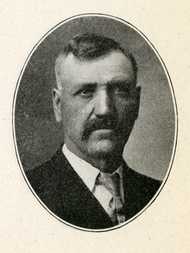
Laforest Potter
A cousin recently sent me recollections that Laforest, also known as “L. E.” (for Laforest Edgar), wrote later in life about his younger days. I’d like to share some of the highlights.
Laforest Potter was born in the same year that Minnesota became a state — 1858. But he was not born in the state where he spent most of his life. He was born in Ripon, Wisconsin. Both of his parents (John Potter and Olive Weymouth Potter) had moved there from Maine. His father was an orphan who farmed rented land and worked in the woods and on the water.
When Laforest was six, his father “rigged up a covered wagon and loaded in his belongings, which were mostly kids,” (he had ten!) “and started with others for Minnesota.” Laforest remembers crossing the Wisconsin and Mississippi rivers. It was on the Mississippi where he saw his first steamboat.
The family lived on the banks of the Watonwan River near Madelia, Minnesota, in the upper story of a log house owned by another family, who lived on the first floor. That family ended up spreading typhoid fever to Laforest and one of his brothers, who both survived.
Laforest remembers when he fell ill: “Father was working on a threshing machine to earn a living for us kids and one day in late fall, us boys were going to the woods to find wild grapes that had dried on the vines (and there were plenty). We got a short distance from the house when I became so sick, I had to turn back, and that was the last I remember until I was getting well.”
The next spring, they rented a log home across the river. That winter they were hard up for clothing and food. “At one time all we had was some small potatoes and not many of them. Father was away most of the time working at whatever he could get to do. Work was scarce, wages, low, and prices high.”
The family survived a deadly snowstorm that blocked roads and drifted through the cracks between the logs in their home until “our beds and the floor were covered when we got up in the morning . . . Father, knowing the condition we were in, started for home on foot with food. He made the trip where a less robust, determined man would have perished.”
When spring arrived, the family moved again to a farm near Mankato. They lived there for two years and Laforest got his first taste of farm work, made especially challenging after his father fell ill with appendicitis. “Us three boys, the oldest thirteen years old, did the fall work and husked the corn. We had no husking gloves then, and I remember the row I husked could be told by the blood on the husks where my fingers bled, but we stuck to the finish!”
It was near Mankato where Laforest first began to attend school when he was ten. In 1869 the family settled a land claim (I apologize to any Native Americans who may be reading this) fifty-five miles away near Springfield, Minnesota, the area where he was to live for the rest of his life.
He describes the area as “Fifty miles from a railroad, thirty miles from a doctor, and a day’s journey from a schoolhouse. This part of the state was one vast prairie with lakes and sloughs abounding with muskrats, mink, skunks, badgers, foxes, and some wolves, lots of buffalo bones, some Indian relics, all kinds of ducks, geese, sandhill cranes, prairie chickens, and jack rabbits.”
When they weren’t farming, the boys trapped. The family’s crops were destroyed for three years by grasshoppers. Laforest was able to receive about fifteen more months of schooling and survived more snowstorms.
Laforest writes about livestock and how he prized “the company and friendship of good animals more than that of some people I have met.”
He also recounted an incident that happened when he was a teenaged fur trapper one winter:
The ground and ice were covered with a clean layer of snow. There was a fox in one of my traps. He had lost a part of his tail and appeared as though he had been unfortunate at least. He was jumping and whirling around. I watched my chance and struck him on the head with my hatchet with sufficient force to kill him. As he lay there on the white snow with blood running from his mouth and nose, he sobbed and cried like a baby. I will never forget the effect this had on me, out there in the still morning, everything frozen and white, with death at my feet. I believe I have been more careful since in causing pain or death to animals unless necessary.
Wow – what an image! I can just see that fox. Perhaps this is where I get some of my interest and empathy for animals from.
Laforest worked his father’s farm until his father died in 1885. Less than two months later, Laforest married Ada May Redford and then purchased a farm not far from his father’s. His “Shady Lane Stock Farm” outside of Springfield was highly successful. He raised Hereford cattle, pigs, and sheep. His Herefords won numerous awards and are what probably got him an “in” with the University of Minnesota, leading to his appointment by the Minnesota governor as a regent (1920-22).
The “shady lane” on Shady Lane Farm in Springfield, Minnesota (2016)
He was also involved in many agricultural groups and became a sought-after speaker. My guess is that this is what led to his election to the state legislature.
According to the YouTube video I mentioned earlier, Laforest was also a proponent of home improvement, believing that farmers should improve their homes with conveniences “for the comfort of their wives.” He said that farm wives had “as much right to the benefits of labor-saving conveniences and a pleasant home in which to work, as the husband has to improved machinery and fine farm buildings.” Quite a progressive thought for the time, I’m sure. Or perhaps his wife Ada was the one who wrote his speeches?!
Laforest’s Shady Lane Farm was one of the first in the county to have electricity. His home still stands today, and I had a chance to see it a few years ago.
The Shady Lane Farmhouse that Laforest built (2016)
In 1911, Laforest built a silo on his farm from curved hollow clay blocks (rusty orange in color) purchased from the Ochs Brickyard across the road. This is what piqued the curiosity of Vince from Minnesota Bricks. He wondered about the silo’s history, since he has an abiding interest in bricks.
He did some research and discovered Laforest. He shared his knowledge in this impressive YouTube video. Laforest’s silo is no longer standing.
Laforest survived poverty, typhoid, killer snowstorms, child labor, grasshopper plagues, and a lack of formal education. He succeeded through grit and determination. He summed up his philosophy with these words:
First, believe you can do a thing, and then do it or bust a hame strap!
(A hame strap is one of the straps on a harness for horses. It sometimes broke when the horse pulled extra-heavy loads.)
A view of Lake Michigan along the Eagle Trail in Door County’s Peninsula State Park.
Russ and I have been meandering around a lot. I am so far behind with my blog! Where to start?
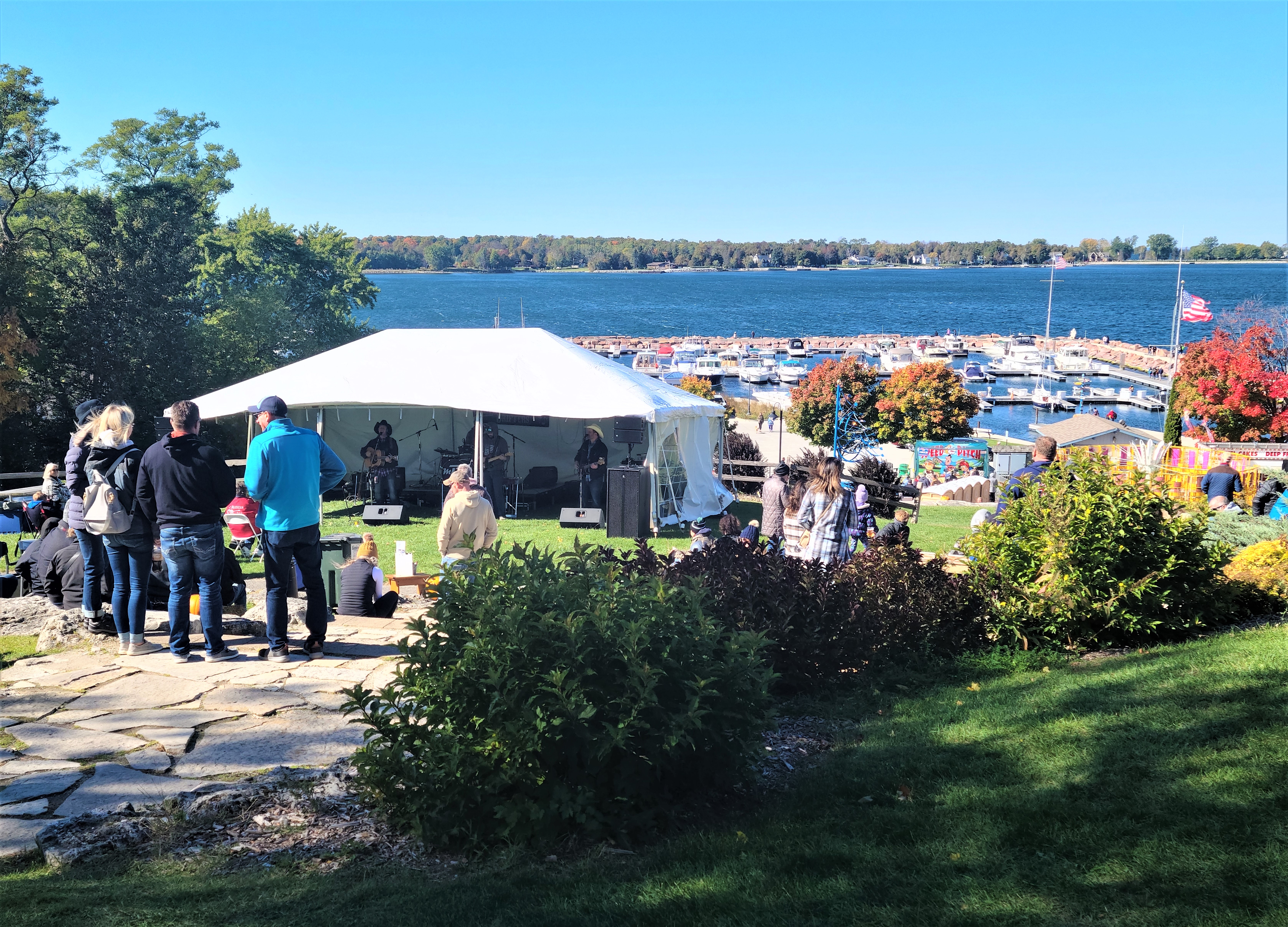
I will start in Door County, Wisconsin, where I needed to spend a weekend for a work event. This necessitated a stay in Egg Harbor on the shores of Lake Michigan. My event coincided with the town’s annual Pumpkin Patch Festival.
As a comparison for northern Wisconsin and Minnesota people, this festival rivals Bayfield’s Apple Festival. It lasts the weekend and gobs of people converge on the small town from all over. But instead of apple-everything (apple pies, apple jam, etc.) there’s pumpkin-everything.
Pumpkin Patch Festival-goers near the Egg Harbor Marina.
I had time to kill before work, so Russ and I were able to go on a little adventure. We drove about 10 miles away from Egg Harbor to Peninsula State Park. This park has a lot to offer and is very popular. It encompasses eight miles of Green Bay shoreline, northern hardwood forests, wetlands, meadows, and 150-foot high dolostone cliffs.
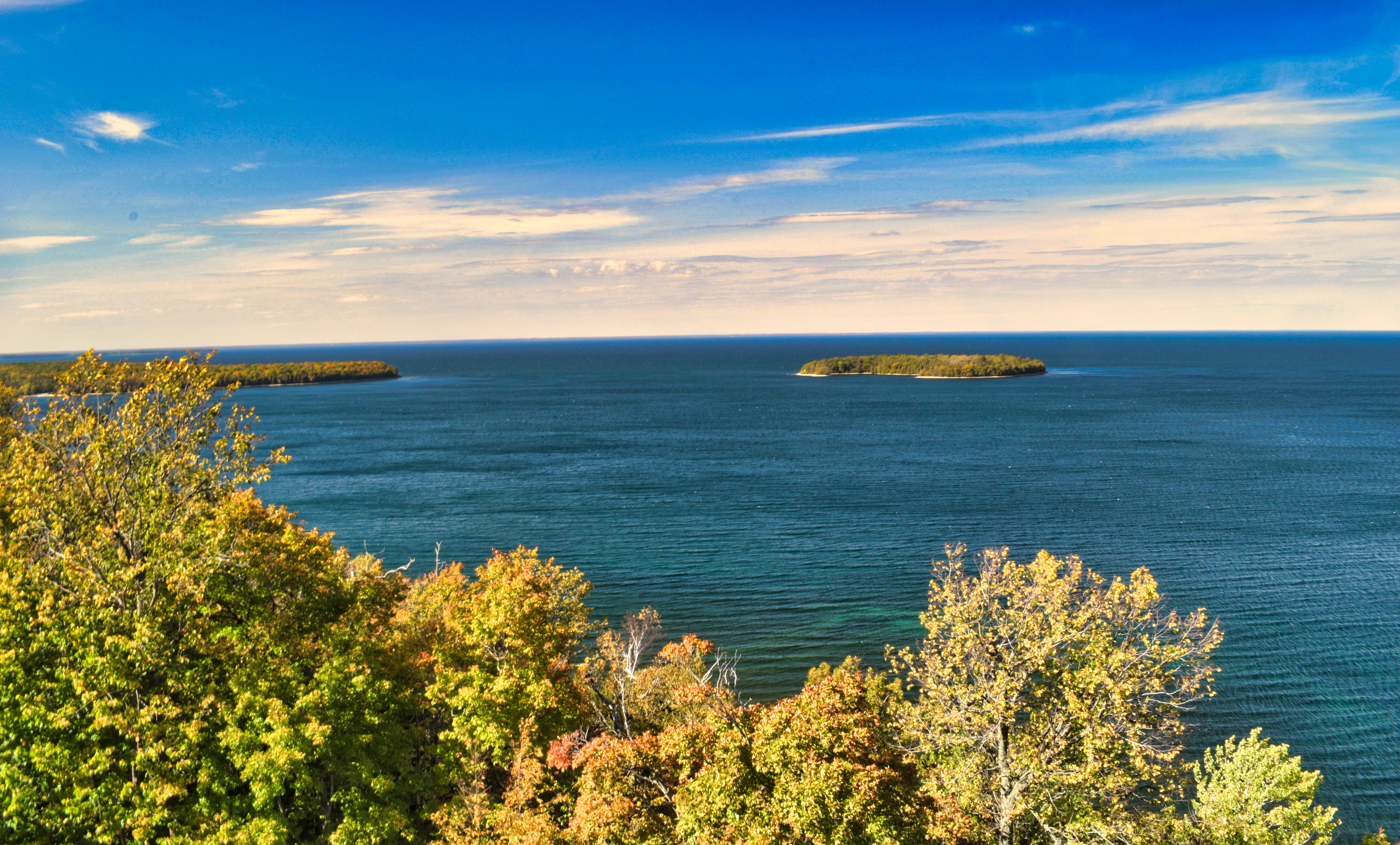
The view from atop Eagle Tower, Peninsula State Park.
We meandered over there on the advice of the guest book in our Airbnb. Some other Minnesotans had stayed there a few days before us and highly recommended the park and a trip to Eagle Tower within it. They were right! Eagle Tower is a newly rebuilt impressive structure that provides views of Lake Michigan and nearby islands. Visitors can either climb several stories of stairs or take an impressive ramp, which offers a more gradual ascent. Interpretive signs along the way offer insights into the views.
We were also hankering for a hike, so we chose Eagle Trail. It’s not far from the tower and parallels the shoreline for about two miles. The trail was rated “difficult,” but we scoffed a bit at this. Surely Wisconsin’s version of difficult couldn’t be that bad.
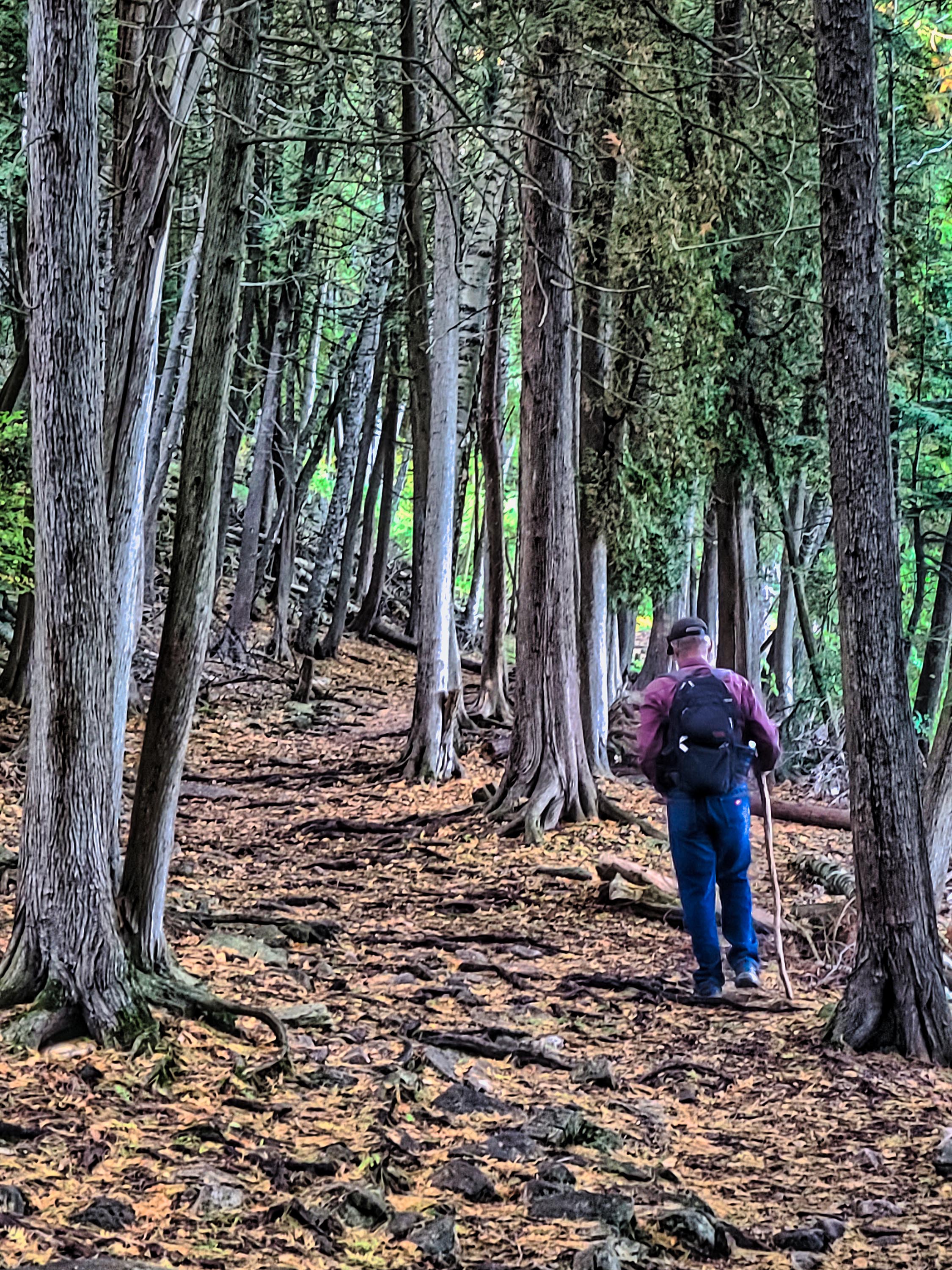
Russ hiking on Eagle Trail among the cedars.
Will we never learn? Apparently not. Eagle Trail was indeed “difficult.” Not all of it, but there were parts right along the shore that were eroded, which required scrambling over rocks and downed trees. Then there were the steep descent and ascents. The trail even has several “emergency access” locations. These are spots where it’s easy for emergency crews to evacuate hikers who have turned their ankles or worse. But we managed to avoid the need for a medical evacuation. Russ found the use of a hiking stick helpful. Although the trail was challenging, the views of the lake, cliffs, and cedar forests were worth it.
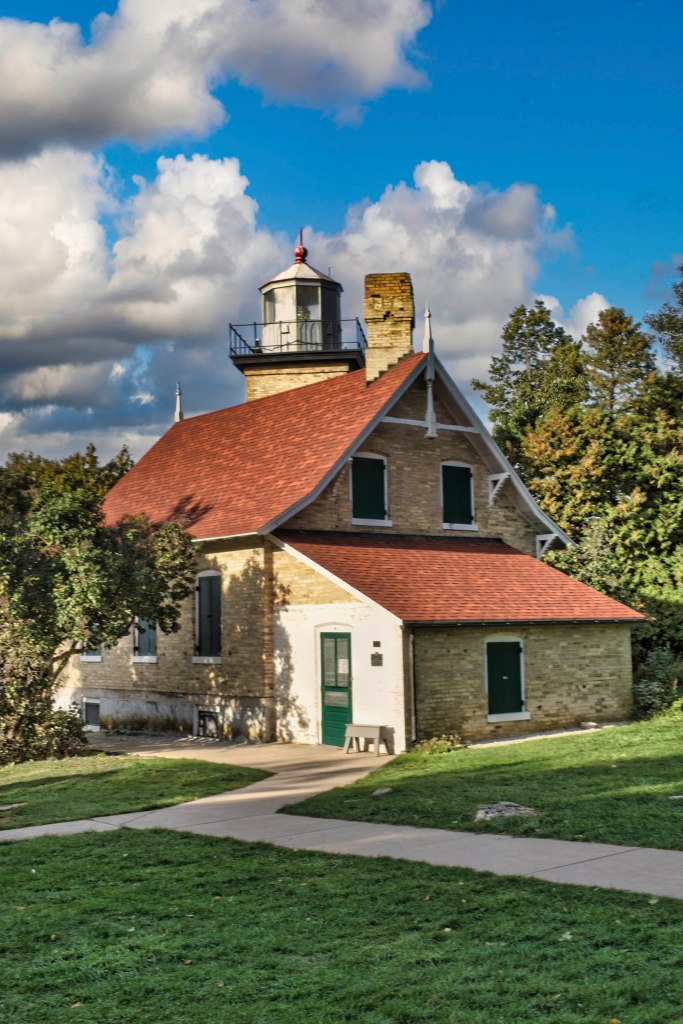
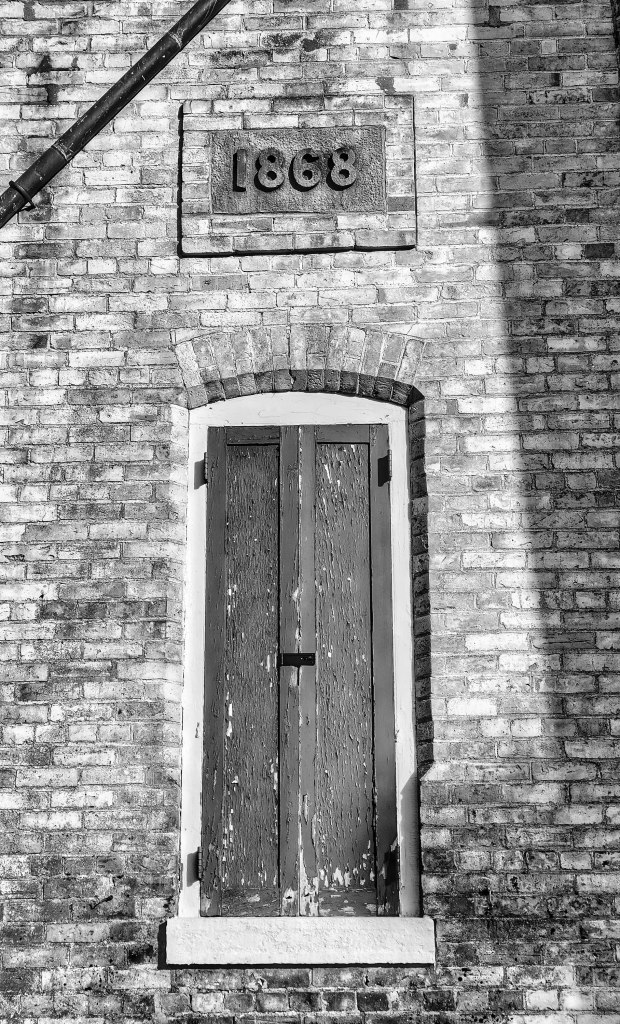
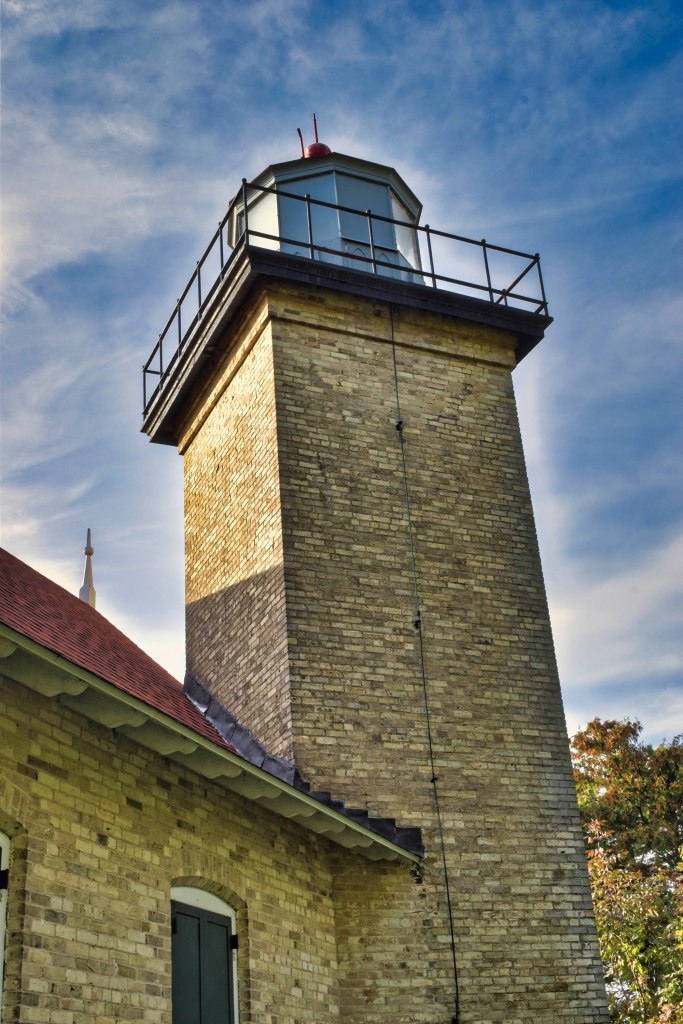
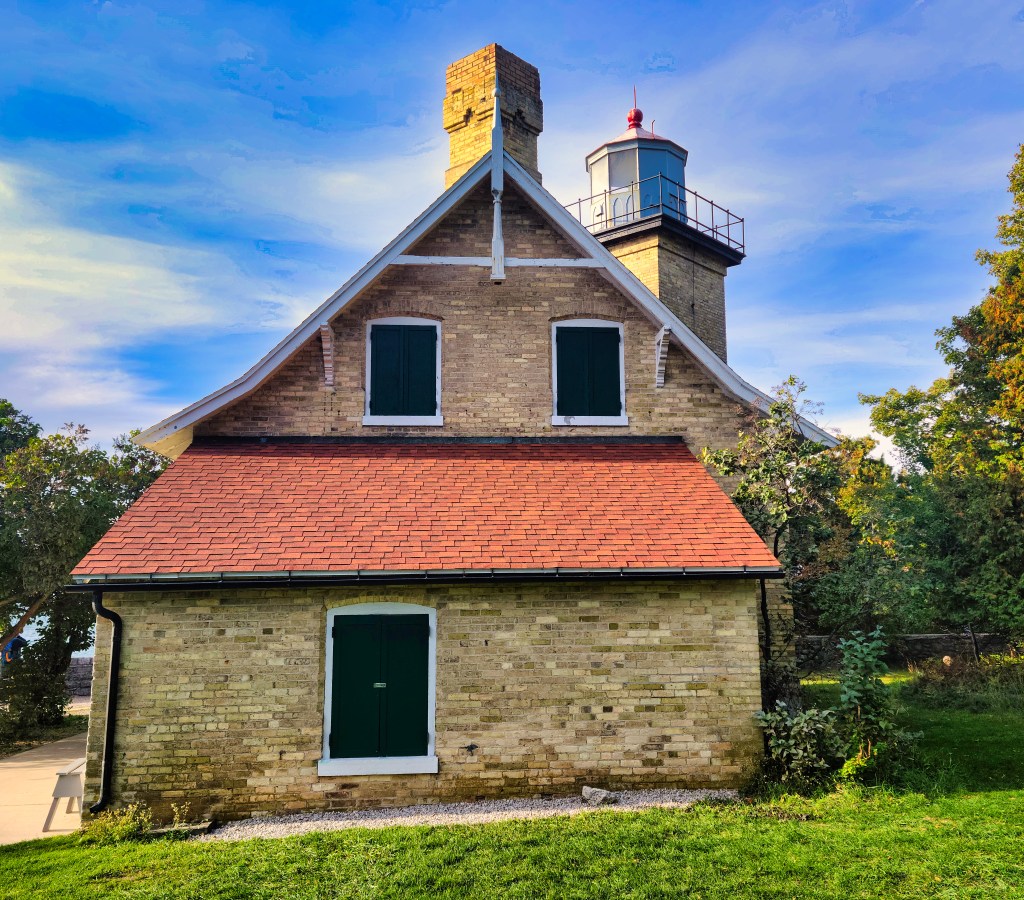
After our hike we drove a short way to visit the Eagle Bluff Lighthouse. Built in 1868, the lighthouse is perched on a cliff above Lake Michigan. A museum is inside it, but this was closed by the time we arrived.
The park also offers several campgrounds, a golf course, a nature center, amphitheater and twenty miles of bicycle trails. If we return someday, we hope to bring our bikes along.
My memoir based on this blog has been printed and is on its way to the distributor. I haven’t received my copies yet, but soon…
Here’s the cover. The image was taken by the Nodin Press editor. I like how “Duluthy” it is, with the lift bridge, a person wearing flannel, and a ship coming into the harbor.
It’s available for preorder ($19.95) from Itasca Books in Minneapolis.
Here are the deets:
Bite-sized memories and adventures written on a weekly basis come together in “Meander North,” a blog-memoir by Minnesota author Marie Zhuikov. Collected over nine years on Zhuikov’s “Marie’s Meanderings” blog, the 51 quirky essays are arranged by season, and cover a wide range of outdoorsy and community-based reflections: from an insider’s view of Duluth’s Christmas City of the North Parade, to a spring cleaning trip to the local dump, and a description of a lawn-mower race. One piece depicts a gleeful summer morning paddleboard on a quiet lake. Another takes readers on a meditative fall walk on a woodland trail. The book finishes with specific topics including, “Brushes with Fame,” where Zhuikov describes close calls and meetings with famous (and not so famous) people, and “Bookish Adventures,” which detail her literary leanings and incidents that have added spice to book signings for her previous works.
Although the topics are diverse, all display Zhuikov’s love for her home state. “Meander North” is a celebration of Minnesota, its seasons and traditions.
Reviews:
Naturalist Marie Zhuikov’s sense of home bubbles up at the confluence of absurdity, loss, and transcendent beauty. Drawn from the annals of her long-standing blog “Marie’s Meanderings,” the short essays in “Meander North” shimmer like the northern lights in their illumination of the joy, folly, and hard-earned grit one develops living at the crossroads of Minnesota’s and Wisconsin’s north shores. From encounters with boat-towing loons to organizing a sea-lamprey tasting event, the stories within the collection are sometimes zany and always delightful, revealing a Midwestern outdoorswoman’s celebration of family, community, and the mysterious forces of the natural world. – Meg Muthupandiyan, author of “Forty Days in the Wilderness Wandering”
A walk with Marie through the seasons and terrains of her northland writer’s life, this interweaving of environmental science with a reverent appreciation for the Earth and its inhabitants is lovely and moving. In essays that evoke the fragility and toughness of this northern world of icy lake waters and rocky shores, rugged pines and graceful birches, this collection is timeless, a treasure to be read and reread. – Linda LeGarde Grover, author of “Gichigami Hearts”
With wit, reverence and unabashed honesty, Zhuikov offers us delightful insight into what it means to live with purpose in the North. – Sam Cook, “Duluth News Tribune” outdoors writer
Upcoming Events:
Zenith Books (318 North Central Ave., Duluth MN) will host a book launch on November 17 at 7 p.m.
Old School Holiday Market (9165 Hwy 53, Cotton MN), Nov. 19, 10 am – 3 pm
Get it Local art and gift fair, Peace Church (1111 N 11th Ave E., Duluth MN), Dec. 3, 10 am – 3 pm
















 Marie's Meanderings