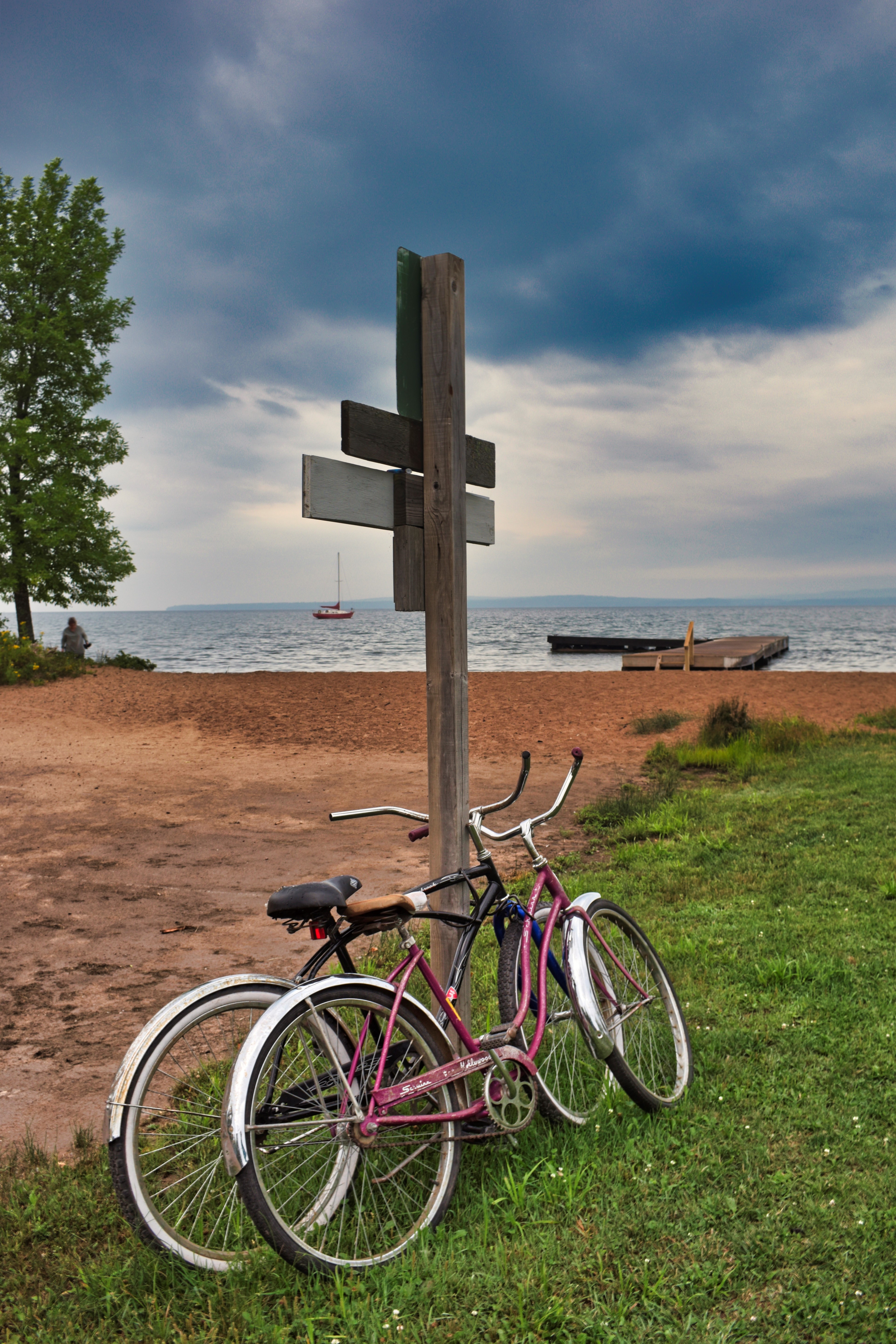
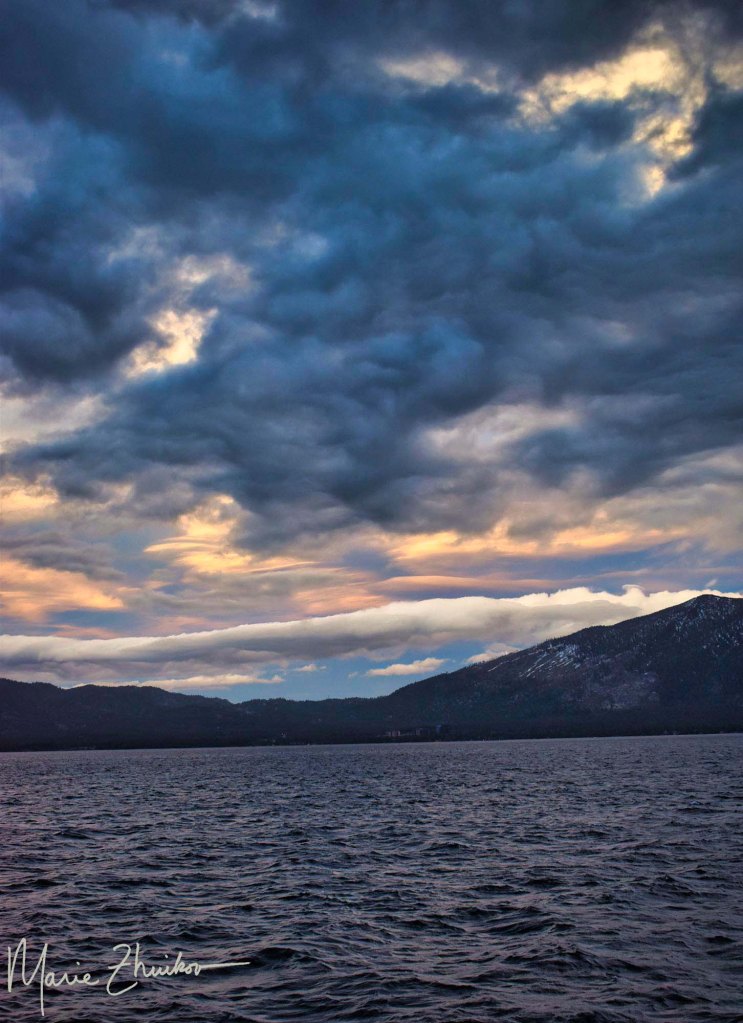
“Bikes Before the Storm,” taken at Joni’s Beach on Madeline Island in Lake Superior.
A photo I took last summer earned an honorable mention in a national “Coastal Love” contest organized by the National Oceanic and Atmospheric Administration’s Office for Coastal Management. The images chosen celebrate America’s coastlines – both salt and freshwater.
Sailboats moor off the beach and I suspect the bikes were there for boaters to use to get around town after they row ashore in their dinghies. I was on the beach for a sunrise shoot, but as you can see, the sun was not cooperating.
I’m not sure what got into me last week. I saw an ad on Facebook and signed up for a free kickboxing lesson at a gym within walking distance of my house.
Well, I do sort of know what got into me. At the beginning of this year, I grew aghast at the post-menopausal weight that had crept upon my thighs (and butt!) with little pig’s feet, so, I signed up for Noom, an app that helps you track your food intake, exercise, steps taken, and thought processes around food.
The program has been very helpful and effective. I’ve lost eighteen pounds so far and still have a few more to go. I can tighten my belt three or four more notches than before. Pretty soon I’ll need to buy smaller jeans!
I noticed the gym when it opened a few years ago and joked with my girlfriends that we should try it, but in my mind, I figured the sport was for people younger than those in their late (ahem) fifties. But since losing weight, I’ve been feeling a bit feisty and ready to try something new. Plus, the more weight that comes off, the harder it is to lose because your body becomes more efficient using calories. One of the things Noom suggests to counteract this is to up the intensity of your workouts. Kickboxing would certainly be more intense than walking, biking, and elliptical striding, which is what I’ve been doing.
My main goal with this lesson was not to get broken. Having fun would be a plus.
I just returned from my lesson and I *think* I’m still intact (I’ll know better tomorrow after the stiffness sets in). And, it was FUN. I enjoyed punching the crap out of something without any social consequences. I must have subterranean anger that needs an outlet! Plus, the music was good.
Here’s how it works: The instructor interviews you about your fitness goals, motivations and any injuries you may have. Then it’s time to get moving. There are nine stations. You exercise alone at a station for three minutes. Then there’s a thirty-second interlude where the staff call out different exercises for everyone to do, like holding a plank position or doing mountain-climbers. Then everyone moves to the next station. Instructions for what to do are written on placards at each station. Time is kept by a lighted box on the wall.
Station exercises include sit-ups, kicking a heavy bag, doing uppercut punches on a wrecking ball-type heavy bag, and practicing traditional punches on a speed bag. The exercise I failed miserably at was jump roping. Apparently, jumping is not in my adult repertoire of activities. The activity I was surprised I could do fairly well were sit-ups while holding a medicine ball.
I like that, even though you work out at a station alone, you’re with other people who are working out in the same room. It’s rather like weight-lifting that way. But on the thirty-second interludes between stations, everyone works together doing whatever torture, er… exercise the instructors call out.
At the end, the instructor had me step on a machine that calibrates body composition. It basically said what I already knew – I’m doing pretty good for my age but could lose a few more pounds.
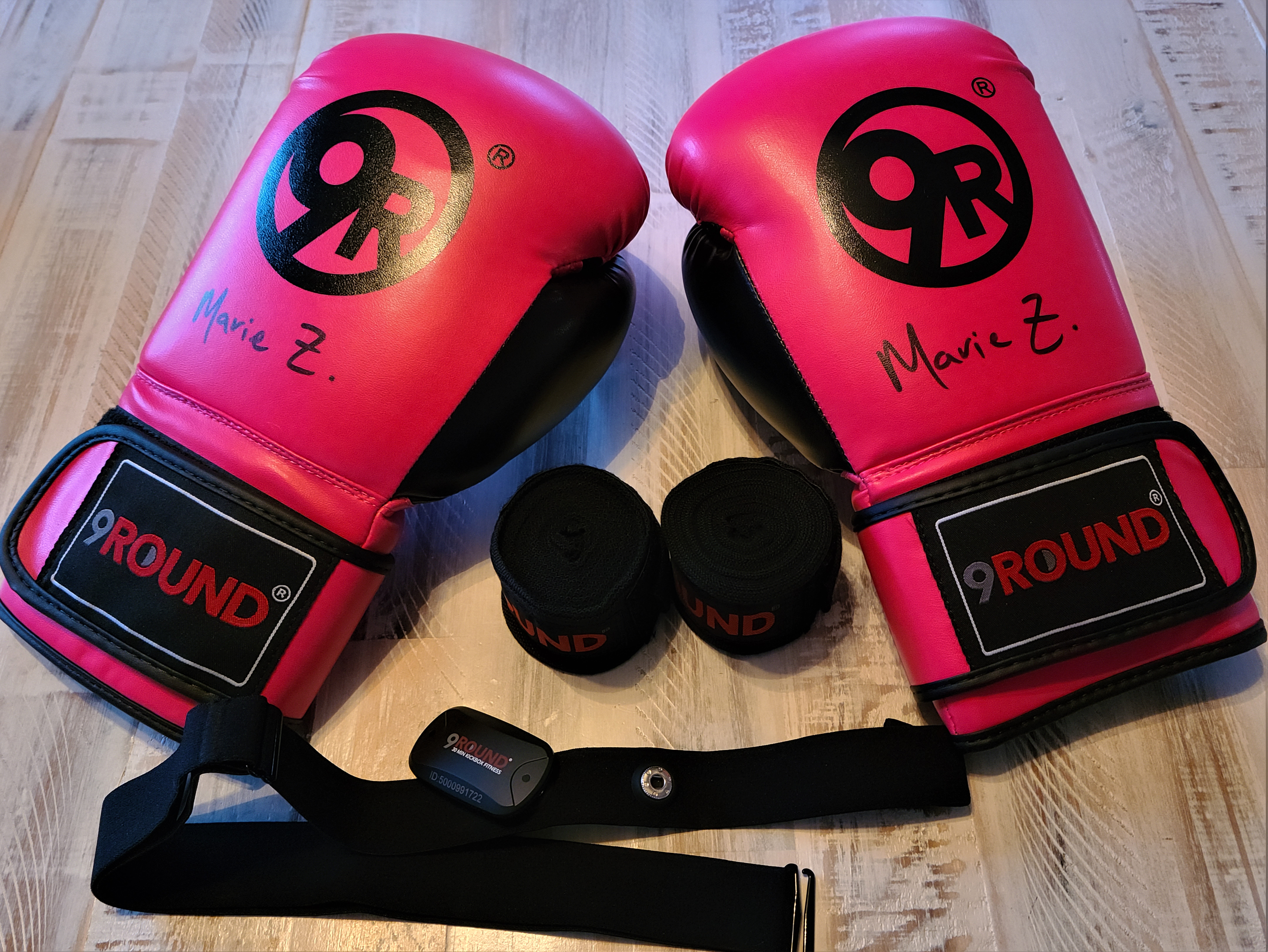
Then, the instructor outlined the three monthly exercise plan options they offer. I chose the cheapest one (because I’m cheap) and was issued my VERY OWN boxing gloves (I chose pink and black), wrapping tape, and heart monitor. I was also able to choose my own boxing superhero name, which will be shown on the public monitor display in the workout room. I chose “Magma” because it starts with M like Marie, plus cuz I’m so hot.
I may regret all this tomorrow when I can’t get out of bed, but for now, I’m feeling pretty darn good, and for a Minnesotan, that’s saying a lot.
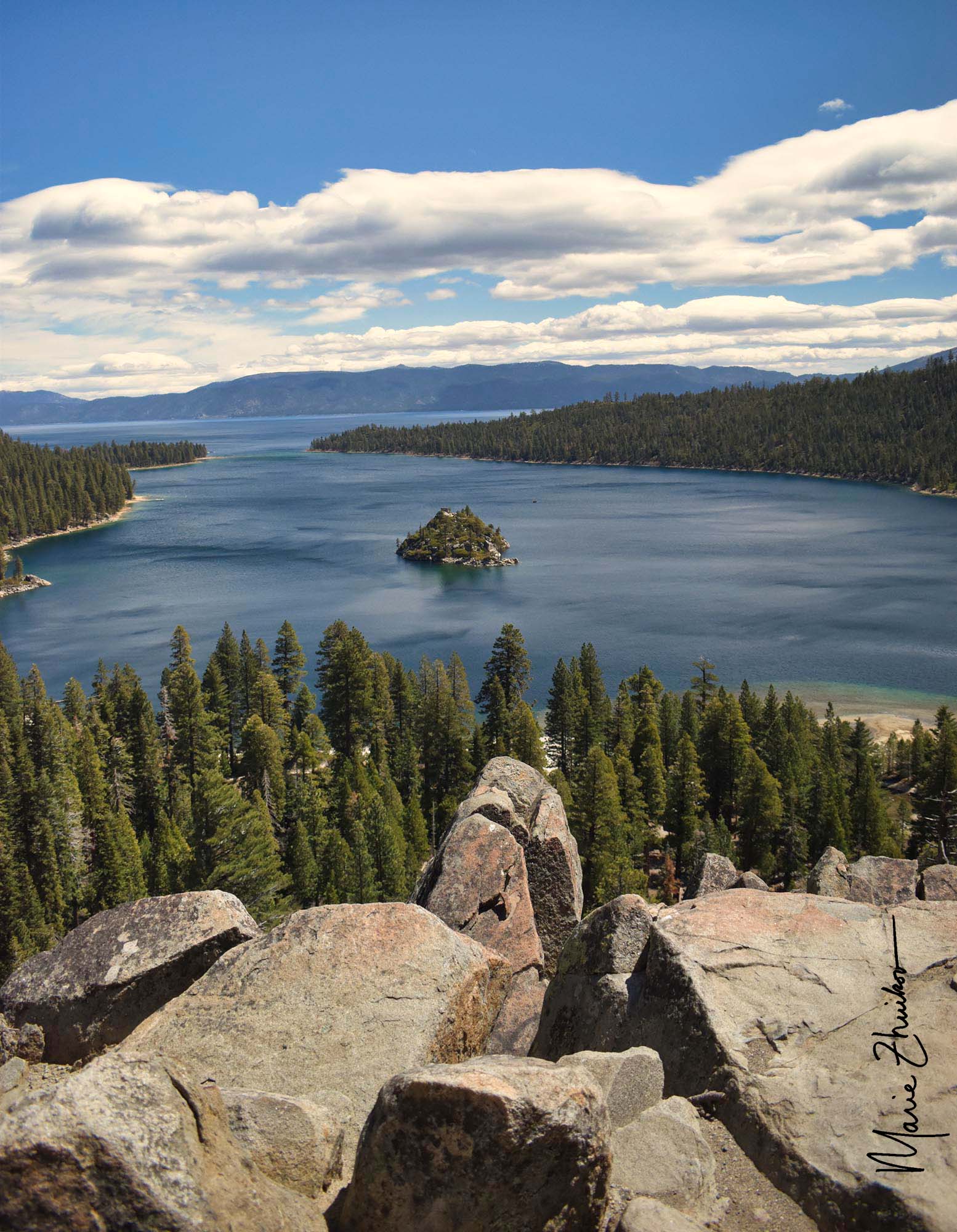
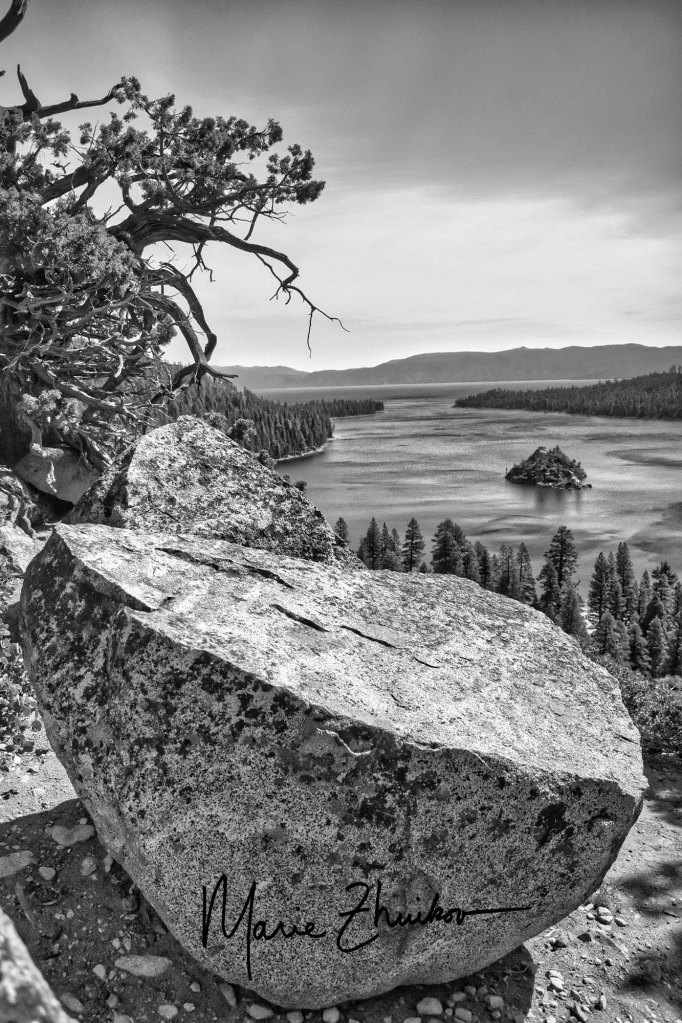
Lower Eagle Falls on its way into Emerald Bay, Lake Tahoe. Fannette Island is in the background.
After Russ and I spent a few days in Yosemite National Park (see Westward Ho! Part 1), we drove north on twisty-turny mountain roads to visit Lake Tahoe, famed for its crystal-clear waters and scenic mountain vistas.
We had a few days there by ourselves before my youngest son and his lady friend arrived to join the fun. The weather cooperated while we were by ourselves – 70 degrees and sunny, which was similar to the weather we experienced in Yosemite, and much different than the rainy, gray weather in our hometown of Duluth. We felt so fortunate to escape and soak up some Vitamin D sunshine for a while. Snow crept in for the latter part of our trip, but it was a mountainesque snow globe kind of snow, much prettier than what we get at home, so we weren’t bothered.
The view out the back window of our condo.
The first thing that struck me was that the forests seemed healthier than those in Yosemite. Yes, there were some burned over areas, but they were few and far between compared to Yosemite. Apparently, the drought wasn’t as severe here.
Our condo in South Tahoe backed up against a National Forest, so we had a view unmarred by evidence of humankind, which was fine by me. Tall ponderosa pines and scattered boulders greeted us each day.
Fannette Island in Emerald Bay
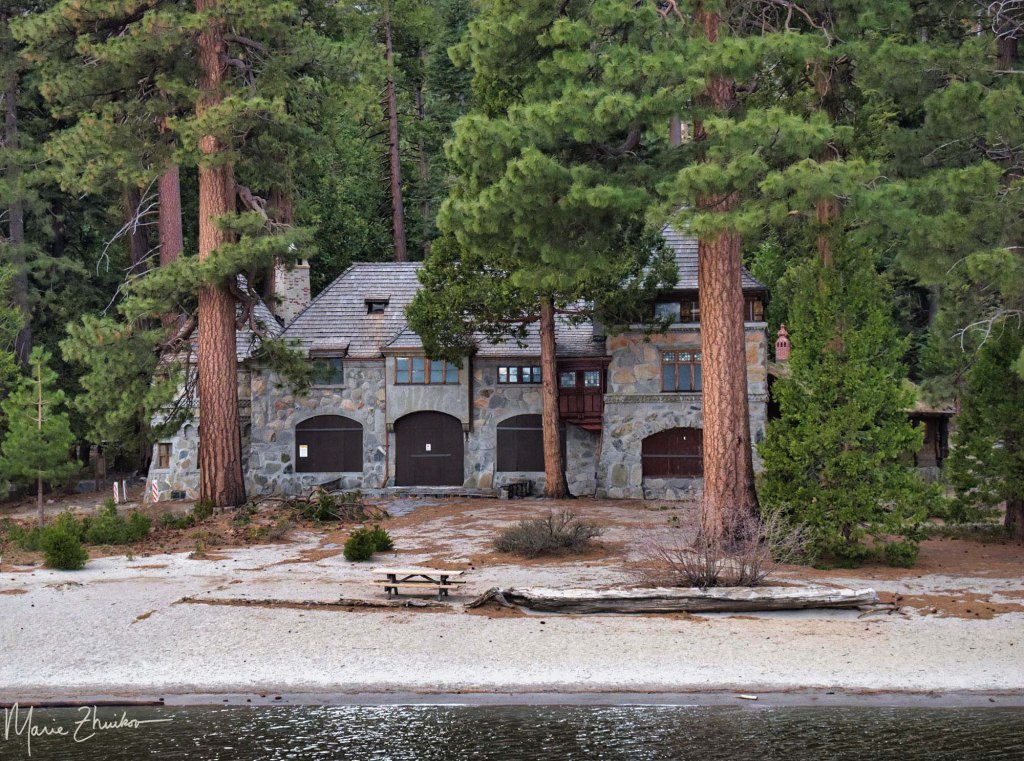
Our first stop was Emerald Bay Vista, just outside of South Tahoe. Wow! What a view. This picturesque bay is probably the most-photographed feature of Lake Tahoe, with its turquoise waters and conical island in the middle. The island is named Fannette Island and it sports a small square stone building at its peak, which was built as a tea house by the people who used to live in Vikingsholm, an impressive Nordic-style house on the shoreline nearby.
We also hiked to Cascade Falls, a waterfall that empties into Cascade Lake, which is not far from Emerald Bay. Despite what the Internet and guidebooks say, the hike is NOT easy (don’t believe them!). Maybe the beginning of the hike is easy, but the trail quickly turns into a strenuous, rock-strewn and up and down experience. The falls themselves weren’t that impressive, but the views of Cascade Lake and Emerald Bay almost made up for it.
The next day, we hiked to Lower and Upper Eagle Lake Falls (the trailhead is near the Emerald Bay vista). The lower falls is right near the highway and if you don’t have a lot of time, I’d suggest you spend it here rather than hiking to the upper falls. At the lower falls, you can walk right up to the top of the waterfall where it spills precariously down the mountainside and into Emerald Bay – super impressive!
The Safari Rose tour boat.

That evening, we took a champagne sunset cruise aboard the Safari Rose, an aging luxury yacht that used to be the company boat for Minnesota’s 3M Corporation (think post-it notes). Its African-themed décor was probably quite the thing back in 1959 when it was built, although it doesn’t really stand the test of time. The outside of the boat looks like it could use some TLC. But, we enjoyed the cruise into Emerald Bay and the chance to see Fannette Island up close.
One tip: get in the line to board the boat early because seating is limited. We did not know this and ended up sharing a table with a very accommodating family of four from California who didn’t mind having a couple old folks sitting with them.
We ended up taking a day cruise later in our stay with my son and his girlfriend on the same boat. The tour narrative included new information, so we feel like it was worth doing it twice to learn new things (plus, we got our own table this time!)
Nevada Beach
A paved bicycle trail runs through the forest in many places, including near our resort. We used it to access Nevada Beach and Round Hill – home to a fifty-year-old closed resort. Its buildings are still intact and provide an interesting diversion among the trees.
One of our last days, we drove around the entire lake. Some of our relatives had raved about the town of King’s Beach on the north end of the lake and said we “had” to see it. Perhaps because it was early in the season (and snowing) many of its attractions were closed. But we found a good gift shop and did our best to support the local economy.
On our very last day, after finding a trail we wanted to hike closed, we ended up walking on the paved bike trail to Baldwin Beach during a gentle snow fall. On our way back to our car, we had the privilege of glimpsing a black bear, which was walking on a large downed tree about 100 feet away from us. Luckily, the bear was afraid of people. As it reared back its head to turn around and hightail it back the other way down the tree, I caught a glimpse of a white ruff of fur on its neck. We were glad the bear was running away from us and not toward us.
After enjoying ten days off, reentry into the workaday world was unpleasant for me, especially because I had a big event to host the day of my return, but I wouldn’t trade this trip for anything. Tahoe is truly beautiful, as I hope my photos will attest.
A few of my photographs are featured in an art show that’s currently on display at my church. The show is open to the public. If you are in Duluth this summer, pop in and take a look! (Unitarian Universalist Church of Duluth, 835 W. College St.) The show will be up until Fall.
This post is a presentation I gave along with other artists for a service today that was centered on the show and the theme of “cultivating beauty.”
The image that started it all (my first image that was critiqued in my photography class). Big Bay State Park, Madeline Island, Lake Superior.
During Christmas when I was a freshman in college, my parents gave me an Instamatic camera. I suspect my mother was the driving force behind this gift, as she had begun dabbling in photography. She was a member of the Duluth Camera Club and was starting to take classes with the likes of Les Blacklock and later, his son Craig.
I had fun with the camera and even used it for a visual communication class I took for my journalism studies. Then, when I graduated college, I graduated cameras. My parents gave me an Olympus 35 mm film camera. My mother showed me how to use it, thinking it would be a great way to document my next adventure, which was grad school through the Audubon Society’s Expedition Institute – a traveling school bus classroom that focused on the outdoors and environmental education.
How that camera survived a 20,000-mile journey across America without a camera bag, I’ll never know. But I used it to capture the beauty of the rugged landscapes we traveled through all those years ago.
Once I got into the workaday world as a science writer, the camera came in handy for stories I needed to cover. Eventually, it malfunctioned and, having to buy a camera by myself this time, I downgraded back to the point-and-shoot type.
After I had children, I noticed that my youngest son was interested in photography. He was only 6 or 7 when we went to Yellowstone. We bought him one of those disposable Kodak cameras so that he could take his own pictures on the trip. He enthusiastically clicked away at geysers and majestic elk. Then, when he went to college, I continued my mother’s tradition and helped him buy a Nikon digital camera, since he was interested in taking a photography class. He loved this beginner-level camera and soon bought his own, more advanced Nikon. He’s since started a side business in portrait photography.
I was interested in getting a more serious camera around that time, so I bought out his part of the original Nikon and it became my own. He showed me how to use it, but my phone camera was so much easier, that Nikon mostly stayed in its bag.
Then came the day when my boss at work suggested I take a photography class instead of the typical writing classes I take every year. She liked the images I was able to capture with my phone and wondered what I could do with more formal training.
I was taken aback by her suggestion. After all, I’m a writer, not a photographer. Taking photos was always just a side dish in my life – something I did while doing something else – never the main course.
The idea stewed during the pandemic until last summer when I felt it might be safer for such an endeavor. I found a week-long sunset photography class through the Madeline Island School for the Arts in Lake Superior. My job deals with communicating water research, so I figured I’d get some photos that would come in handy.
I already knew how to frame a photo, but an F-stop? ISO? What are those?
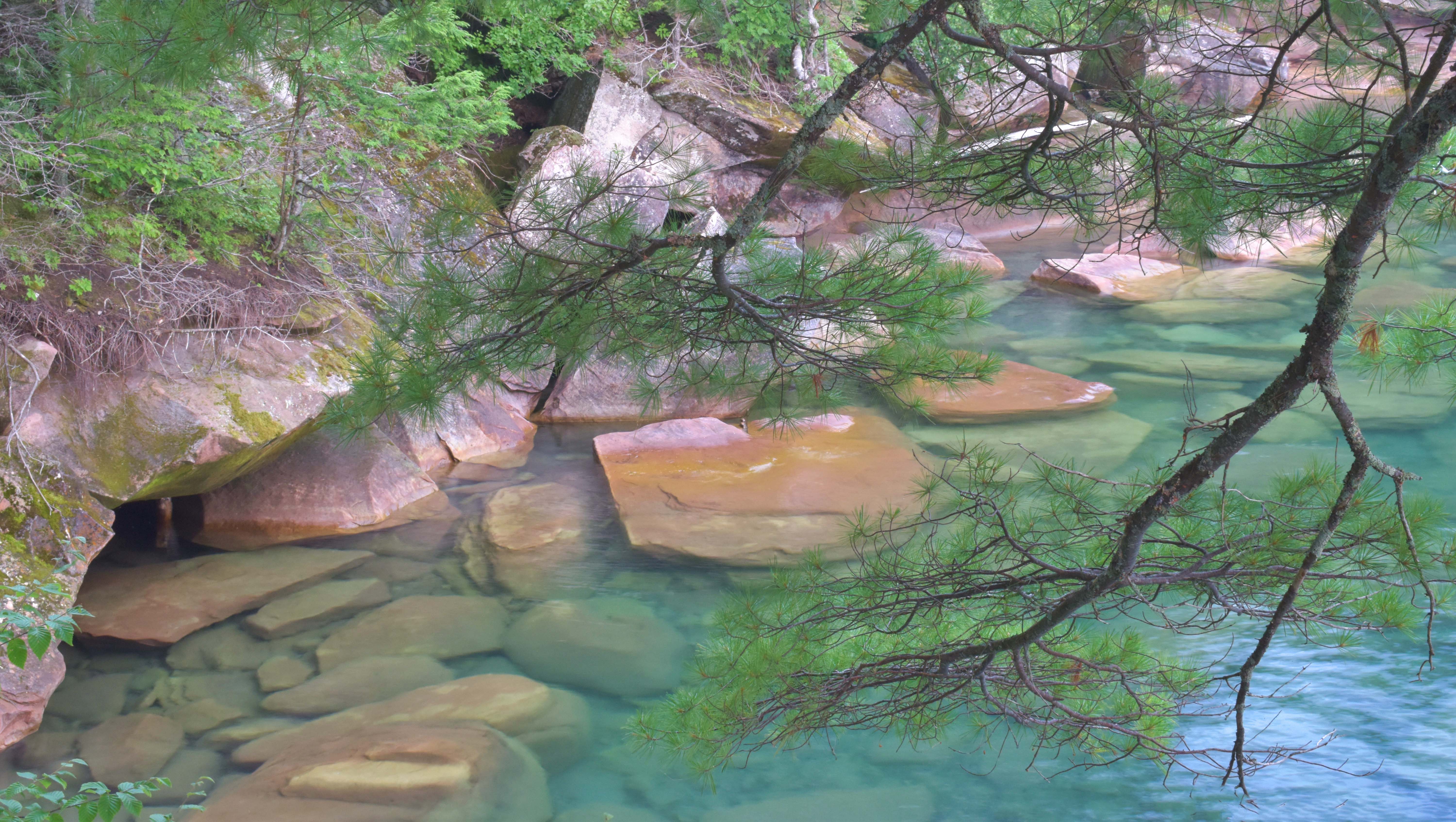
The class was a crash-course in camera settings. Each day, we offered up one image for critique by the instructor and our classmates. I’d never had an image critiqued before. With trepidation, I submitted my first – it was a greenish photo with pine branches against rocks and water. The instructor said, “This photographer knows what they’re doing. Who took this photo?”
I thought, “I know what I’m doing?” I identified myself and listened to his suggestions for a few improvements, glowing inside all the while. None of the other students had been moved to take a photo of that particular scene, and the instructor discussed how everyone sees beauty differently. He said, “You can take a dozen photographers out to a park and they’ll all come back with different images.”
Maybe there really was something to this photography hobby? Maybe I could be both a writer and a photographer?
I returned home with a big confidence boost, new knowledge of my camera and of the photo editing software. I loved having another way outside of words to capture the grandeur of nature that I see around me. Of course, the camera is much more limited than our eyes, but the photo editing software gets things a bit closer to what our eyes actually see.
I have my mother to thank for getting me started in photography and I am glad that my son continued this family art. I’m excited to participate in the UU Art Show – it’s my first one!
Russ and I recently returned from a trip to California that was centered around photography. My photographer son was along, and we had the chance to meet a distant cousin for the first time. As we discussed our lives with our cousin over breakfast, we discovered that she’s a portrait photographer, too, focusing on babies. On a hunch, I asked her what brand of camera she uses.
My son and I exchanged meaningful looks when she uttered, “It’s a Nikon.”
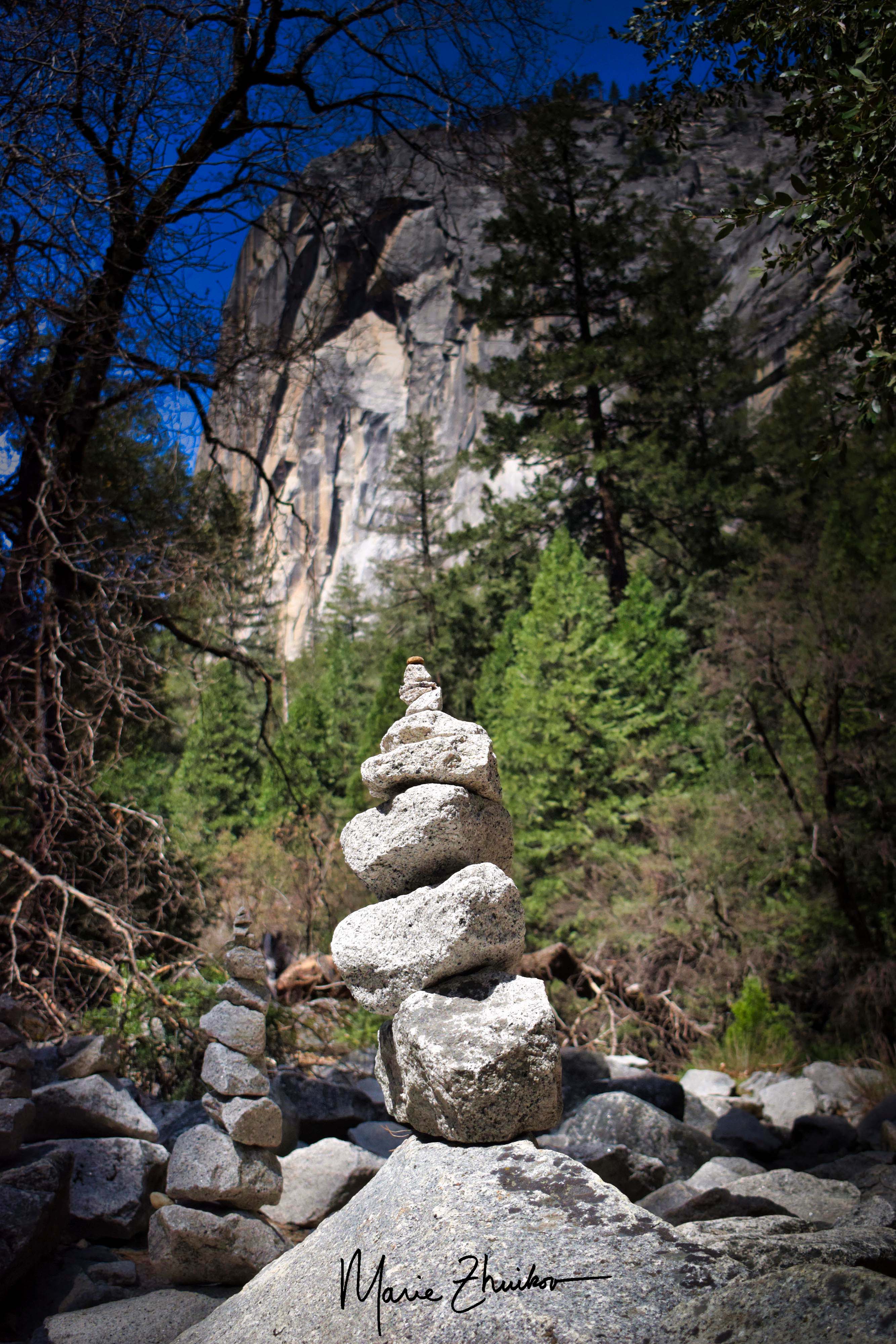
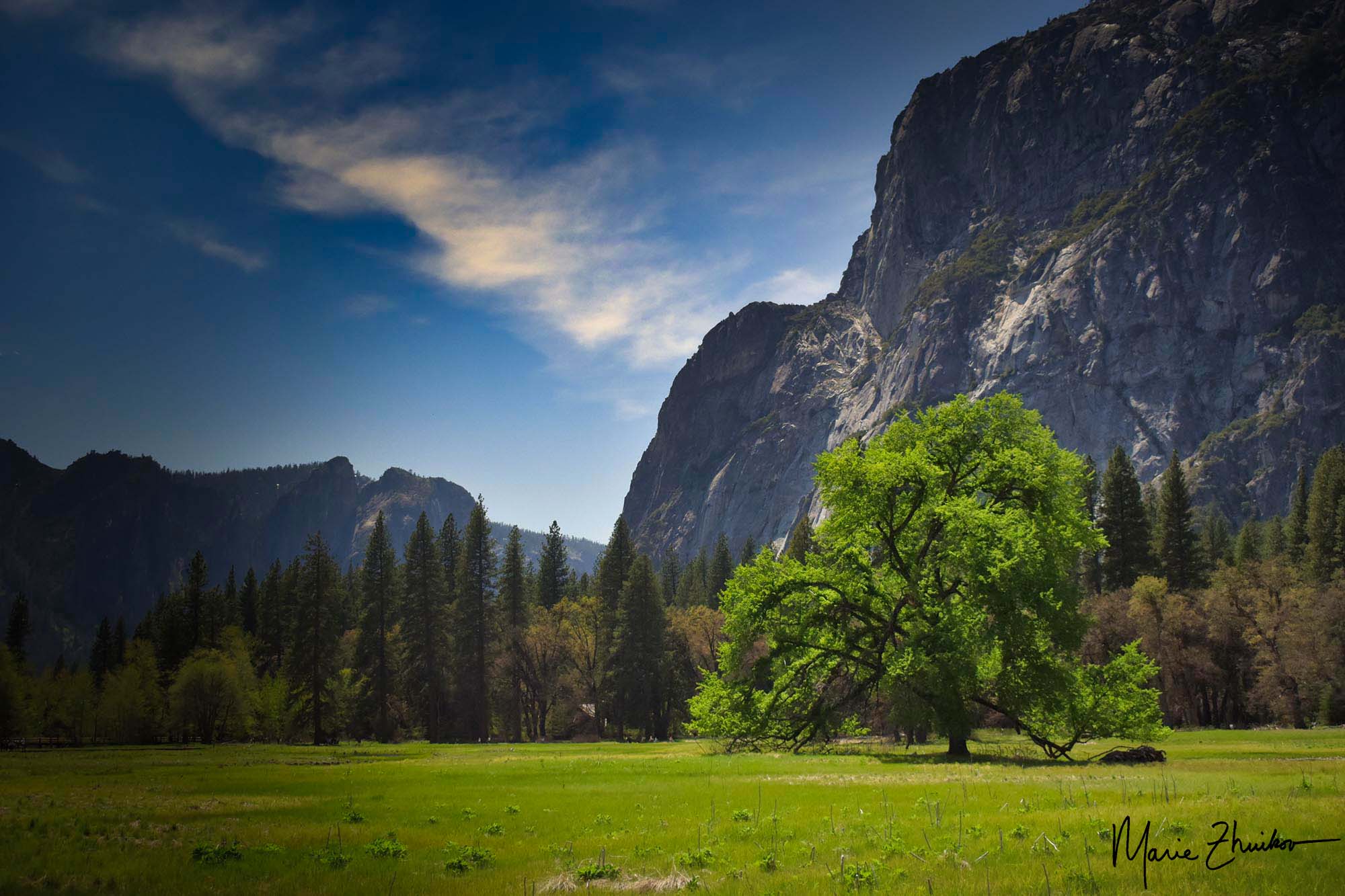
The view from the Tunnel View pulloff in Yosemite National Park. Bridalveil Falls is on the right, Half Dome is in the middle and El Capitan is on the left.
The last time I was in Yosemite National Park, it was on fire. I was there to put help put it out. That was 32 years ago (!) when I worked for the Forest Service. (See that story in “Why I Miss Wildland Fire Fighting.”)
I journeyed to the park this time to be a photographer-tourist.
As Russ and I planned a long overdue (due to Covid) vacation to Lake Tahoe, we discussed what to do there. It came to light that Yosemite was within driving distance and that Russ had never been there before. Well, that would never do.
A sequoia near Mariposa Grove.
“You’ve got to see it!” I said. Wise man that he is, we made plans to begin the first few days of our trip in Yosemite and then drive to Tahoe. Thus, began our Westward Ho adventure.
In late April, we flew into Fresno, CA, and then drove about 90 mins to our lodge just outside the park. Our first foray on the day we arrived was to Mariposa Grove, which wasn’t far from the lodge. We eagerly hiked two miles to see the grove, only to be mystified when we discovered it was closed!
How can a grove of ancient sequoia pines be closed, you ask? Well, you’ve got me on that one. There were no signs at the trailhead giving hint of this closure, nor did we see anything obvious online. But after we made it back to the (closed) visitor center near the grove, we did see a small sign that explained the grove was closed until 2023 so that the trail could be rehabbed.
The grove had a fence all around it, which prohibited people from using the trail that runs through it. Thankfully, we were at least able to view the trees from outside the fence on the road that runs past it. Disheartened, we walked back to our car on the road, which was much easier than the trail. Positive points are, we saw a mule deer (see photo) and a cool rock cut alongside the road (see the other photo).
Another closure to be aware of is that Bridalveil Falls – the iconic waterfall that’s the first thing tourists see from the Tunnel View overlook and when they approach the park from the south, is closed. This is another closure that’s not very well publicized by the Park Service. But you can still get close to the base of the falls if you are a bit intrepid.
We spent the next few days driving through the park and doing more hiking. We visited Yosemite Falls, Mirror Lake (an easy two-mile round-trip hike on a closed paved road), Cathedral Beach, and Valley View. Valley View was hard to find because there were no signs that designated it, just so you’re aware. We tried unsuccessfully to find it our first full day but figured it out by the second day. We also ate lunch one day at the historic Ahwahnee Lodge, which is in the park.
Russ’s favorite experience was visiting Yosemite Falls. There’s an upper and lower part of the falls, and he appreciated the aesthetics of the approach as you walk toward the falls. I think mine was Mirror Lake. As you can see from the photos, the reflections of the backside of Half Dome in the water were stellar, and I enjoyed the scenes available along Tenaya Creek.
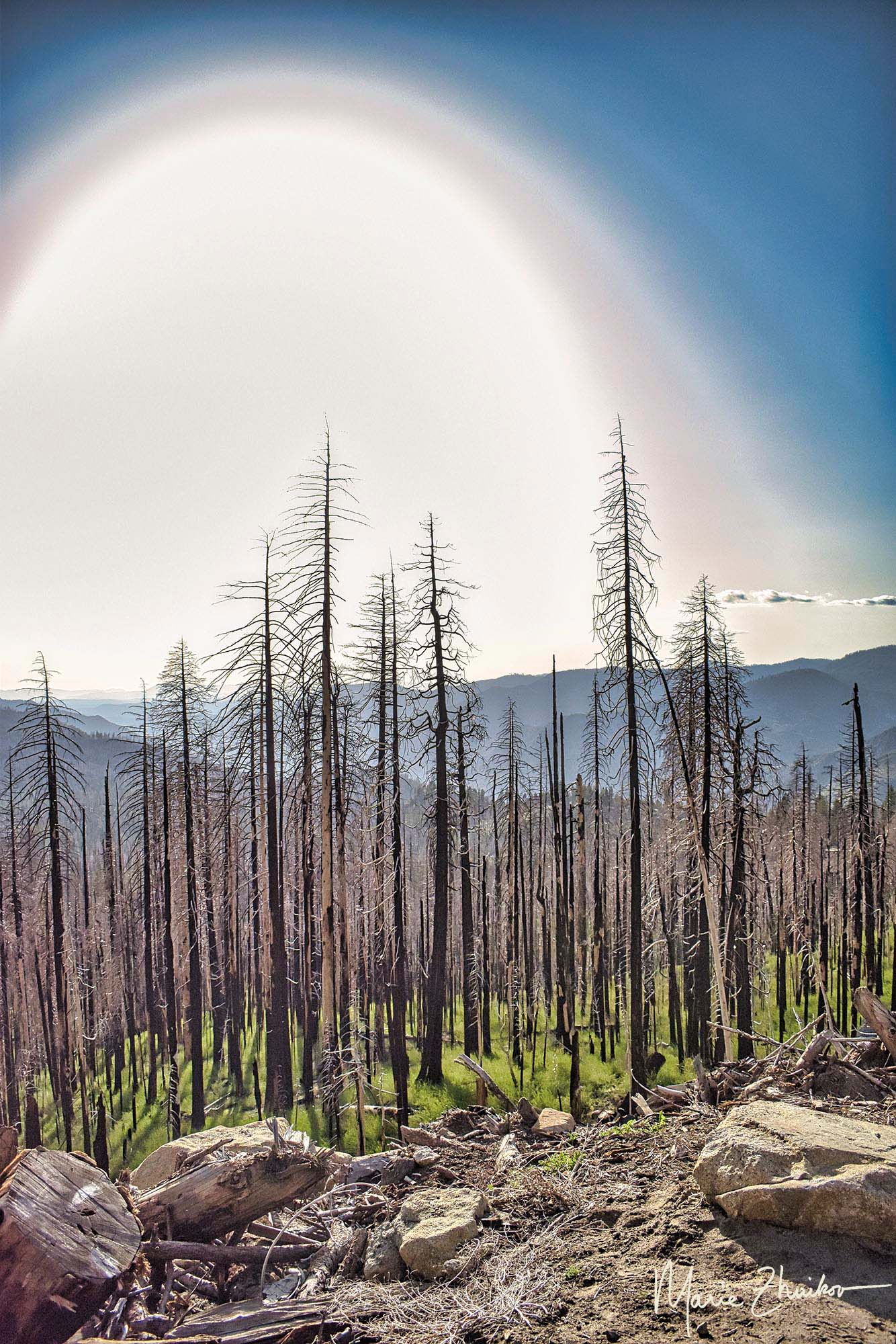
One thing that struck me was how rough the forest looked. Wildfires had obviously burned all the way into the Yosemite Valley floor. That must have been nerve-wracking for the park service. And many areas on our drive to the park were burned or showed evidence of wind damage. California has been experiencing a drought for the past three years and it sure showed. Perhaps the fire that I worked on so many years ago was only the beginning?
Timber salvage operations were taking place in the burned areas of the valley when we were there, necessitating some traffic disruption. BUT it was Spring, and the waterfalls were full, conveying runoff from the High Sierras. The water-full bounty a glorious sight to see, as John Muir would have said.
I hope you enjoy my photos. Next up: Lake Tahoe or maybe a post about my first art exhibit. I’m not sure which I’ll finish writing first.
As always, please do not use photos that have my signature on them. Others you may use with permission.
Lower Yosemite Falls in black and white and green.
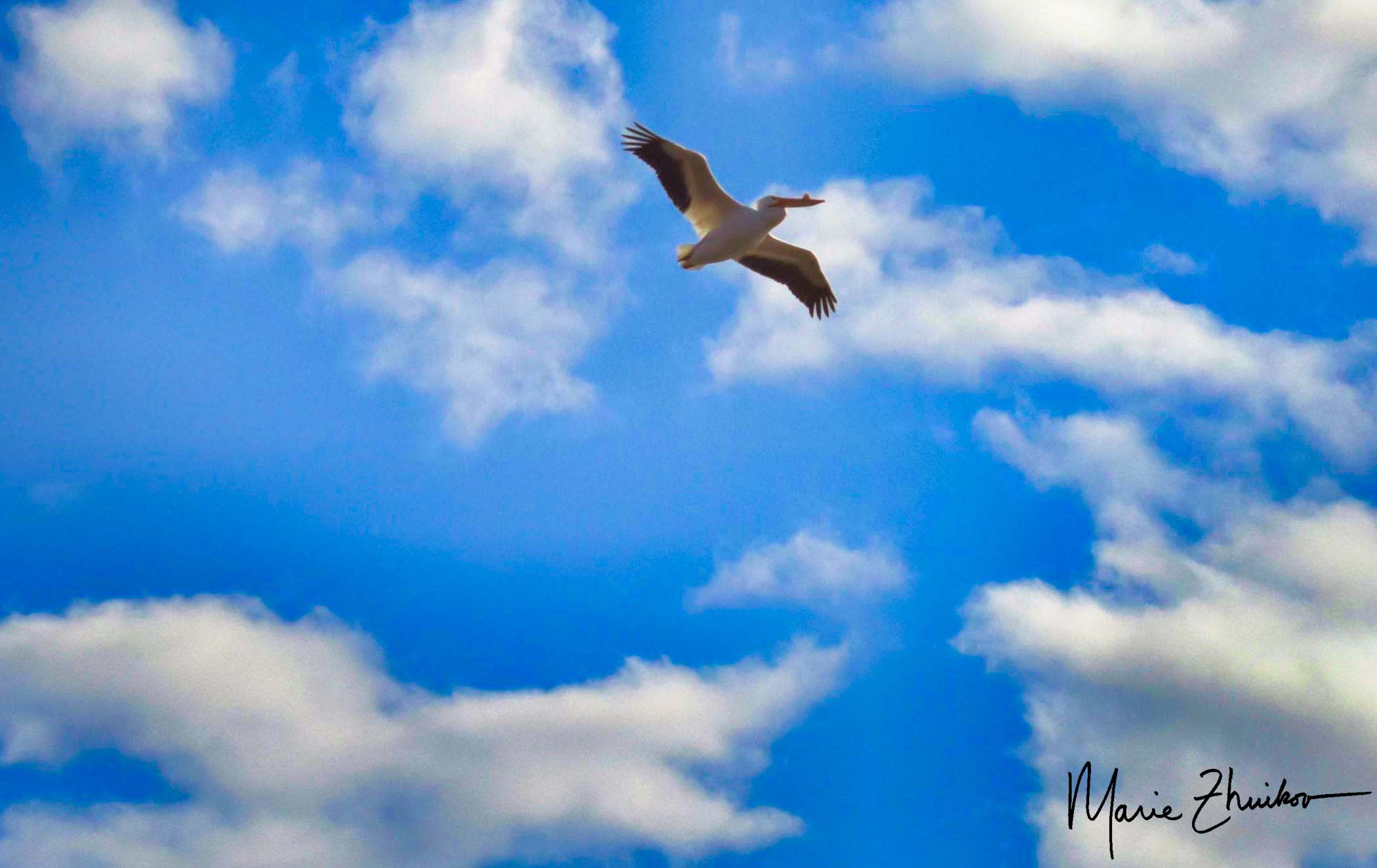
An American white pelican comes in for a landing on the St. Louis River, MN. The bump on its bill denotes that it’s a breeding bird. The bump falls off after the birds have mated and laid eggs.
Last week I took the long way home from work. My route took me past Chambers Grove Park, which is in the far western part of Duluth, along the St. Louis River. I had heard that the pelicans were back, resting there on a stopover during their migration north, and I wanted to see them.
I brought my camera in case the birds were close enough for me to photograph. Alas, the experience reinforced my thought that I really need to buy a more powerful telephoto lens! Also, the light was right in my face, harsh and white, fading out everything on the far side of the river where the pelicans rested.
Luckily, a few were flying around, and I was able to get at least one good shot.
According to the Duluth News Tribune, pelicans were “virtually unseen in Minnesota between the late 1800s and 1960s. Fishermen destroyed them out of the erroneous belief that they competed for game fish, and pesticides took a toll.” They mostly prefer nongame fish and do not compete with anglers.
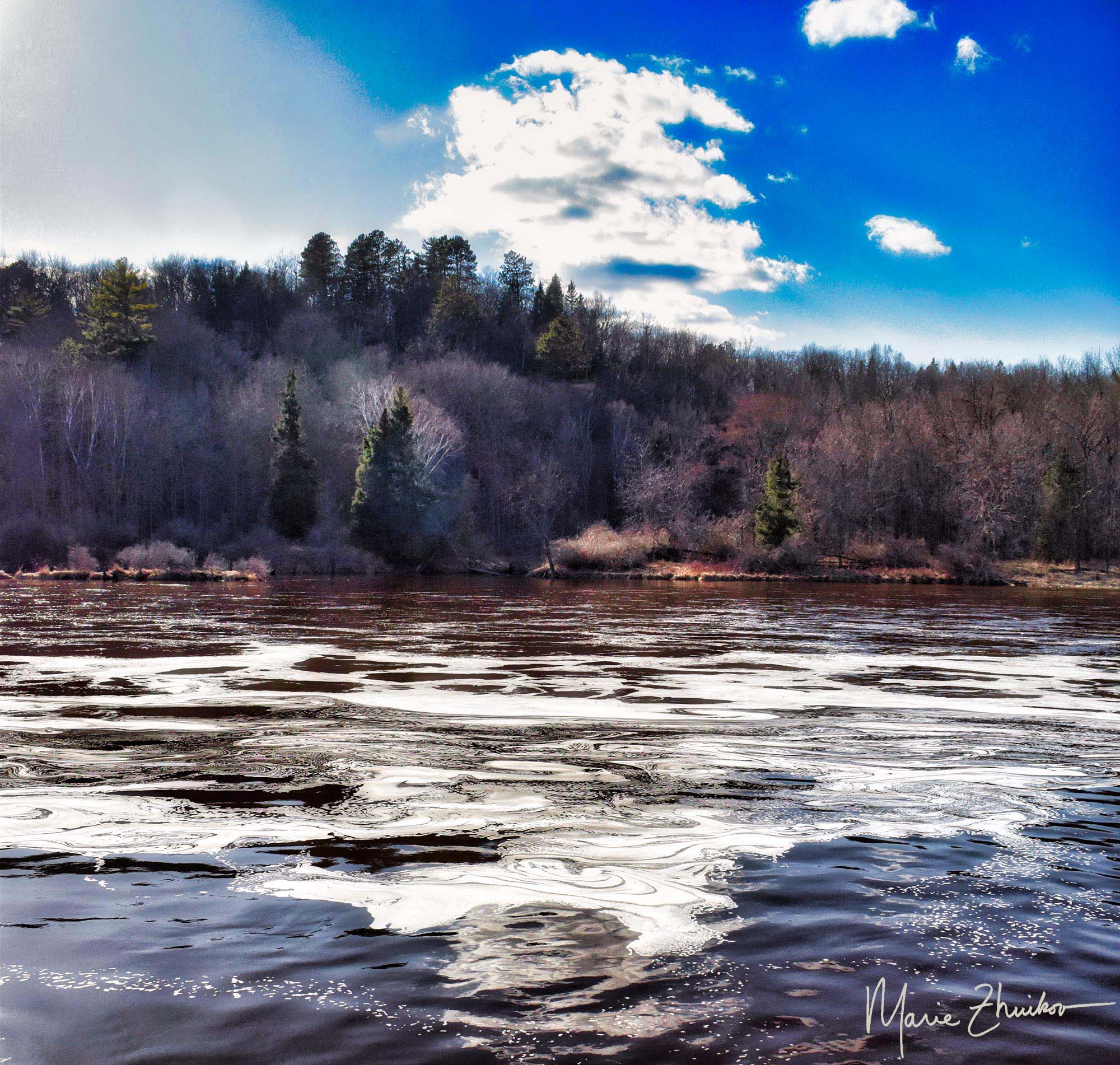
No pelicans in this shot (but they are nearby). I just liked the cloud and water patterns. St. Louis River, MN.
Thanks to environmental reforms and protection, their numbers have recovered. Minnesota boasts one of the largest populations of nesting white pelicans in the world. I thought I’d share my photos from my sojourn with you.
If you’d like to see some better, close-up images of the birds, please visit Richard Hoeg’s blog, “365 Days of Birds” for some great shots.
Despite the snow we’ve been having lately, their presence is a sure sign that spring is coming.
We’re in that awkward and dreary “shoulder season” when the snow conditions are too crappy for skiing but it’s still too cold to bicycle or do anything else outside. The trees are bare, what little grass is showing amid the snow piles is brown. It was time to explore somewhere new indoors. So, Russ and I meandered north to the largest museum complex outside of the Twin Cities.
It’s had several names since it opened in 1977 near Chisholm in northern Minnesota. First it was the Iron Range Interpretive Center, then Iron World USA, and now it’s the Minnesota Discovery Center.
Perched near a defunct open pit mine and atop underground mine shafts, the Minnesota Discovery Center tells the story of the Iron Range through exhibits, interpretation, programming, and research materials. It highlights the story of the immigrants who migrated to the Iron Range (or the Iron Ridge, as President George W. Bush once mistakenly said during a campaign speech in Duluth). The immigrants came at the turn of the 20th century to find work in the iron ore industry. Native Americans are also featured.
Apparently, everyone else was holed up in their homes because we had the place almost to ourselves on a Saturday afternoon. We were able to wander through the exhibits totally unimpeded. So unimpeded that when Russ saw a person standing in front of an exhibit, he mistook it for a mannequin until it moved!
The lower level of the center features exhibits about the immigrants’ journey to the United States, examples of what a schoolroom and a saloon were like, and information about conditions of the land farther back in time – geology and fossils.
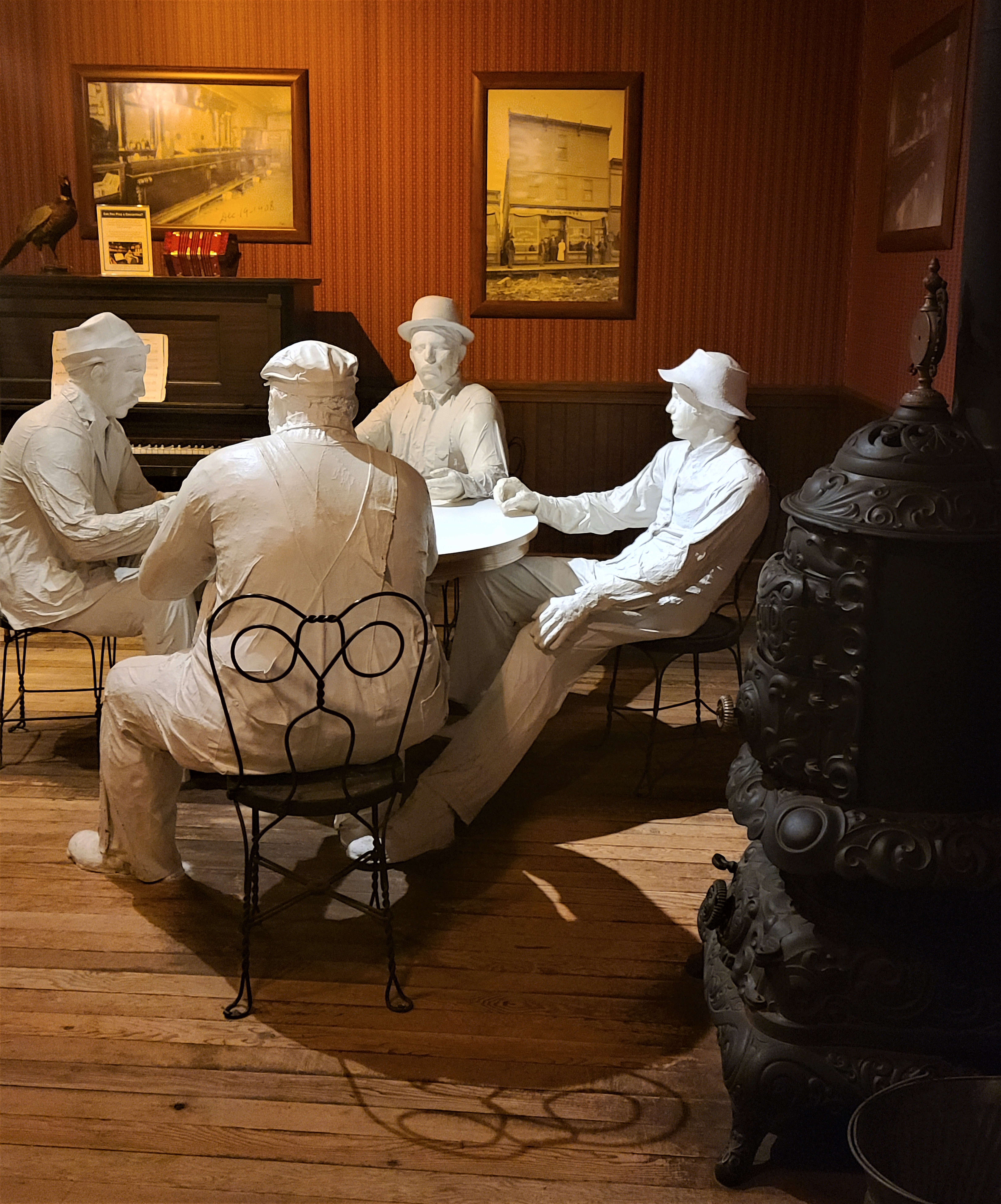
The saloon
I must have been feeling lonely because my favorite exhibit was the replica saloon, complete with mannequins who were playing cards and standing at the bar. Back in the day in the nearby town of Hibbing, there were 6 dry goods stores, 12 general stores, and 45 saloons! People had their priorities and it wasn’t churches back then. Saloons were social centers where miners shared the news of the day, had a drink, and spent time with each other.

Both floors of the center offer views of the Glen Mine Pit, but I chose to look from the second floor. The open pit mine was closed in 1957 and trees have started to reclaim its banks. The second floor also features a movie theater. With the push of a button, Russ and I had our own private showing of the documentary, “Iron Range: Minnesota Building America.” This floor also provides access to a research center.
The Glen Mine Pit
The discovery center’s restaurant is closed for the season, but their gift shop is open. During summer, they offer trolley tours of the grounds, plus there’s a mountain bike park that opens in mid- to late-May and a mini-golf course. I’m sure it must be a busier place in summer.
As we left, the staff at the reception desk were marveling at the “crowds” that were visiting the center. One exclaimed, “There were four people in here already and we just got eight more!”
They were serious.
Russ and I just gave each other a look and chuckled.
If you’re still social distancing due to the pandemic, this is the place for you. But if you get too lonely, you can at least socialize with the saloon mannequins.
The weather is still wintry here in the North – stubborn snow piles linger, and more snow is falling as I type this. A few days have been warm enough to provide a hint of spring, but today is not one of them. Everyone is bundled back up in their puffy jackets and boots. A perfect time for a bowl of thick, creamy goodness.
This is a recipe I saved from our local newspaper. It was originally written by Bea Ojakangas, Duluth’s Scandinavian version of Julia Childs. I have modified it over the years to make it wheat- and corn-free, plus I’ve changed some of the spices more to my liking. If you want to make it with wheat, the original flour measurements are included. If you want corn, simply add a can of corn when you add the beans. Instead of cream, I prefer evaporated milk because cream is just too rich for me these days. This makes 4-6 servings.
Bon appetit!
White Chicken Chili (Wheat- and Corn-Free)
½ lb butter 1 T chopped garlic (or ½ tsp dried minced garlic) 2 lbs chopped chicken or 2-10 oz cans of chicken 2 cups white onion, cut in large chunks (one large onion) ¾ cp gluten free all-purpose flour (or ½ cup regular flour) 2 tsp cumin sprinkle of chili powder salt to taste (I use 1-1/2 tsp sea salt) pepper 4 cups chicken broth (I use Imagine organic vegetarian no-chicken broth) 1 pint cream (or 1 can evaporated milk) 2 cups cooked navy beans (1 can beans)
Melt the butter in a large saucepan. Add garlic and cook until it starts to brown, stirring occasionally. Add the chicken and onion and stir together. Slowly add the flour to absorb the butter. Add the cumin, chili powder, salt, pepper, and broth. Simmer approximately a half-hour. Add evaporated milk (cream) and beans. Simmer another 15 mins.
Serve topped with sour cream, shredded white cheese and chopped parsley, if desired.
The walkway toward the “Spoonbridge and Cherry” sculpture in the Minneapolis Sculpture Garden.
My aunt is 101 years “old” and lives in St. Paul. I know, one-hundred-and-one, amazing! She’s my inspiration for aging well. She still resides in her own condo and is fairly self-sufficient. She’s cared for by my cousin.
Sometimes my cousin has other things she needs to do, so friends from the condo building or my relatives in the Twin Cities step in and visit my aunt in her stead.
The other weekend was one of those times for us to help. We needed to be at my aunt’s place early in the morning, so Russ and I meandered down from Duluth the night before. To make the trip more fun, we booked a stay in a bed and breakfast in an historic mansion near the Walker Arts Center in Minneapolis. We’d never been to the center or the sculpture garden near it, so this trip was going to fulfill those cultural deficits as well as getting in an Aunt Marguerite visit.
We booked a room in the carriage house of 300 Clifton, also known as the Eugene J. Carpenter Mansion. Carpenter was a lumber baron who totally overhauled the Queen Anne-style home, complete with turrets and gables, into a more rectangular Georgian-style mansion after purchasing it about a hundred years ago.
300 Clifton. The carriage house where we stayed is on the right. Image courtesy of 300 Clifton.
As we checked into the big house, we were greeted by the two resident great danes, Madonna and her grandson Clifton. I thought Madonna was big, but Clifton was even taller – his head came to about the middle of my chest and I’m 5-6. After the requisite petting and ear rubbing (I found the spot on Clifton that made him groan) the two mellow dogs returned to their spots by the hearth in the library.
Sorry, I have no pictures of the dogs. I was too busy petting them.
The Library. Imagine one great dane on either side of the fireplace. Image courtesy of 300 Clifton.
We were oriented by a knowledgeable young man who’s been working at the mansion for eight years. He told us the Carpenters were instrumental in creating the Minneapolis Institute of Art (MIA). At that point, we decided not to tell him about our desire to see the Walker Arts Center (we’d already seen the MIA). As it turns out, that might have been a good call. Later, reading an information sheet in our room, we found out that the Walker was established by someone who got disillusioned with the MIA project, a competitor of the Carpenters. I expect a rivalry must still exist between the two institutions to this day.
The nice young man (it’s so typical that we know the dogs’ names but not the human’s name!) took us back outside, past the large courtyard with a fountain and gardens, and showed us our room in the carriage house, explaining this was where all the men on the household staff slept because the Carpenters had a daughter they didn’t want sullied by male influences.
The ground level of the carriage house contains an antique taxi, a pool table, big-screen television, and arcade games. The building originally housed horses but then was renovated for cars. The floor even sports the original turntable used to point cars in the right direction for storage. Sleeping rooms are on the upper floor.
The antique pedestal sink in our room.
Our room was small, but totally adequate – full of nooks and crannies that you just don’t get in a modern hotel room, not to mention the Tiffany-style dragonfly lamp. Our room didn’t have the sound proofing you’d find in a modern building, but that is really the only criticism we have.
Once unpacked, we dropped back into the main house to explore its three floors. The interior is arts and craft style. It contains little of the original furnishings because it was made into a boarding house and offices in the past. However, there is a Georgian Room in the MIA that holds original furniture from the home and pieces collected by Carpenter during his travels.
The library (with its hearth and great danes) features original sconces that were moved from elsewhere in the house. The dining room sports an impressive painted ceiling. The music room, done in muted greens, feels like a place too nice for the likes of us to hang out.
The Music Room at 300 Clifton. Image courtesy of 300 Clifton.
The main staircase reminds me of the one in Duluth’s Glensheen Mansion, but it didn’t have the impressive window art found in Glensheen. The top floor features modern skylights and plants everywhere, including historic images and interpretive text.
Explorations over, we returned to our cozy room and slept while the wind whipped through the city, rattling the windowpanes.
The next morning, we ate our continental breakfast in the impressive dining room. If a person wants to spend $99 more, you can get a four-course breakfast, but we didn’t need that since we were going out for lunch with my aunt and cousin later that day.
We made it to my aunt’s and had a great visit. She brought out some of her old scrapbooks and we took trips down memory lane, which included some highly unflattering class photos of me in junior high, which made Russ laugh.
After lunch at the Tavern Grill in Arden Hills (delish!), we drove back in the direction of our bed and breakfast, which was three blocks away from the Walker Art Center. We could have parked at the B&B and walked to the art center, but a cold wind was still blowing, so we wimped out and parked at the center.
I really wanted to “walk to the Walker” because I like the sound of it, but it was not to be. Sorry for misleading everyone with the title of this post. I know, false advertising! (I’m just seeing if you are paying attention.) But, if you ever stay at 300 Clifton, be aware of this option.
Right now, entrance fees for the Walker are half-priced because many of their displays are closed for renovation, but there was plenty still there to keep us occupied for an hour-and-a-half. I especially enjoyed seeing an Edward Hopper painting (Office at Night) and an Andy Warhol (Sixteen Jackies). Some of the other art just made me scratch my head.
The bright sun made our quick walk in the sculpture garden across the street bearable despite the wind. We had watched television news stories with interest when the cherry from the iconic Spoonbridge and Cherry sculpture had been separated from its spoon and hauled to New York for cleaning earlier this year. The cherry is now back.
Spoonbridge and Cherry sculpture.
The fifty-foot sculpture is synonymous with the identity of Minneapolis. It was created in 1988 by Claes Oldenburg and Coosje van Bruggen a husband and wife team from Sweden and the Netherlands. It was inspired by a novelty item that Oldenburg collected, which featured a spoon resting on an “island” of plastic chocolate. The sign at the site says, “From this, the artists envisioned a gigantic utensil as a fanciful bridge over a pond. In considering Minnesota as a site, they compared the spoon’s raised bowl to a prow of a Viking ship or a duck bobbing in a lake. Van Bruggen added the cherry, a personal symbol recalling happy moments in a childhood clouded by World War II.”
The sculpture from another angle.Prow of a Viking ship or bobbing duck? You decide.
The cherry was the first sculpture added to the garden, but there are many others, including a bright blue rooster, which also caught our attention. The rooster is called Hahn/Cock, created by Katharina Fritsch from Germany and it towers twenty-five feet over the garden.
Its sign says, “The rooster can be a symbol of pride, power and courage, or posturing and macho prowess. Fritsch has admitted that she enjoys ‘games with language,’ and the sculpture’s tongue-in-cheek title knowingly plays on its double meaning. Like Spoonbridge and Cherry, Hahn/Cock presents an unexpected take on the idea of a traditional public monument. Together, these two landmarks show how ordinary objects can become iconic and deeply symbolic.”
The Hahn/Cock sculpture.
If you’re ever in Minneapolis, the sculpture garden is a must-see! Access to it is free and open to the public. You don’t need to walk to the Walker to see it.
This is a post I wrote for work, but I thought you might enjoy it, too. During the latest St. Louis River Summit, I had the chance to meander over to the library in Superior, Wisconsin, for field trip . . . .
Mural #2 in the Superior Public Library by Carl Gawboy. It shows the area where the Ojibwe people settled on Wisconsin and Minnesota points on Lake Superior and how the points were separated by a giant otter. Image taken with permission by Marie Zhuikov, Wisconsin Sea Grant.
What’s in a library that could relate to a river summit? A series of 35 murals line the Superior Public Library walls, showing the history of the area. Many feature the St. Louis River, Duluth-Superior Harbor and Lake Superior.
The murals were painted over 10 years by artist Carl Gawboy, an Elder enrolled in the Bois Fort Band of Chippewa. The murals begin with the Ojibwe creation story and continue through the 20th century, reflecting how people have interacted with the landscape through time.
Local historian and retired librarian Teddie Meronek led the tour. “I like to say I was here at the birth of the murals, but that started long before any paint went on canvas,” Meronek said. She described how Paul Gaboriault, the library director who commissioned the murals, was a former co-worker of Gawboy’s. Gawboy was born in Cloquet, Minnesota, and grew up on a family farm outside of Ely. He eventually taught at Ely High School, which is where he met Gaboriault. The friends both ended up back in the Twin Ports.
To research the murals, Meronek studied Gaboriault’s and Gawboy’s correspondence. She said the library used to be a Super One grocery store. “If you really look at this building it was just a big warehouse. It wasn’t built for a library. Dr. Gaboriault knew, in his way, that it needed something, and the first thing he thought of were murals.”
The second mural in the series shows the story of how the Superior Harbor opening was created through Wisconsin Point. A giant otter digs as a Native man approaches.
“The great otter represents the Ojibwe religion,” Meronek said. “He is breaking an entryway from Lake Superior into the harbor. The human figure is Nanabozho. He is bringing arts and fire to the land. That was Carl’s interpretation of the legend. The otter is pictured as being so large because it’s representing power.”
According to Gawboy, Lake Superior ties all the murals together, Meronek said. “You can’t always see it in every mural but it’s there. It influences what is going on, which is very true. I’ve lived three blocks from the bay of Lake Superior every day of my life and I can tell you there’s not a day that goes by that the lake doesn’t influence you in some way.”
The location of the horizon line also links the paintings. Meronek said it’s in the same place in each image. As she walked past the murals, she described each one, sharing her impressive knowledge of local history along with personal observations. Other murals include notable buildings and personages, as well as historic events.
Meronek ended the tour on a somber note at a mural of the Edmund Fitzgerald. She often listens to Gordon Lightfoot’s song about the ill-fated ship. “There’s one line in it that always makes me cry: ‘Does anyone know where the love of God goes when the waves turn the minutes to hours.’ Always beware of Lake Superior, right? I can’t even put my foot in it, it’s too cold! What a beautiful thing though, isn’t it? It’s the greatest of the Great Lakes, right? An inland ocean.”
If you’re ever in Superior, stop in the library and take a look. Of course, if you’re not a Superior resident, you can’t check out a book, but you can check out the murals, so to speak. Not planning a visit soon? You can also see the murals online.