My Mouth is Full of Plastic

My discard pile of ill-fitting aligners.

My mouth is full of plastic and I’m happy about it! I am also not alone.

A few years ago, I noticed I wasn’t able to chew my food like usual. My back teeth didn’t close all the way. I sometimes also bit my tongue. Ouch! A few of my front teeth were getting chipped, which began to worry me.

My dentist suggested I see an orthodontist. My dentist thought my front teeth were chipping because I was using them for grinding my food instead of using my molars. Front teeth aren’t made for that.

So, I went to the same orthodontist who put braces on my two teenage sons. That felt weird. Here I was, a 50-something lady seeing an orthodontist. I thought I was long past the age when I would need to do that.

Mr. Orthodontist said my front teeth were too straight up and down, which wasn’t allowing my back teeth to close all the way. Now, you need to understand that as a youngster, I had 16 teeth pulled so that I would not need to have braces. Some were baby teeth, and a few were permanent teeth. I didn’t have them pulled all at once. It was more like four per year every few years. This gave enough room in my small jaw for my big teeth. My permanent teeth grew in straight and lovely.

But now, forty years later, I couldn’t chew! Somehow, I felt betrayed – as if my parents’ plan for my young teeth hadn’t worked. But, I guess it did. The original plan lasted forty years. That’s pretty good.

If I had to have braces now, so be it. The ability to chew one’s food is sort of important.

At first Mr. Orthodontist thought I would need metal braces. But after hearing my somewhat vocal protests to this idea and taking all sorts of scans and x-rays, he decided that Invisaligns would work. I was so relieved! If I had to have braces, I would rather not have the metal ones. Looking like a teenager at my age just did not float my boat.

As I mentioned above, I was not alone. Apparently, needing braces in your elder years is a “thing,” especially in Hollywood. I am in the company of famous folks like Faye Dunaway and Tom Cruise. They all had braces in their adult years.

And, according to the American Dental Association, in 2012, one million adults had seen an orthodontist in the U.S. and Canada. This was a 40% increase from 1989. In 2014, that number increased to 1.4 million.

These stats made me feel a bit better. So, I got my first sets of plastic aligners, but of course, it was not to go smoothly. There were several sets and I was to wear each for two weeks. At the orthodontist’s office, after affixing some teeth-colored “anchors” to my teeth, the technician put in my first set of aligners. She had a hard time getting the top one to fit on my back upper right molars, but after some futzing, she made it stick.

When I got home and took my aligners out to eat lunch and then put the back in, I couldn’t get the top one to fit on those pesky back molars. I tried a bunch of different techniques, to no avail. After a few days of this, I called the orthodontist’s office and relayed my plight. They told me to just keep wearing the tray with the back molar part flapping around for two weeks. Sometimes the trays came with small defects, they said. They were sure the next trays would fit.

So, I wore the defective set for two weeks. I eagerly freed my next set from its small plastic bag and tried them on, only to be met with dismay. The top set didn’t fit either! I immediately called the ortho office and complained. They set up an appointment for me. When I went to the office, they couldn’t get the second set to fit, either. This relieved me. At least my technique wasn’t the problem. They also had me try the third set on.

Those didn’t fit, either.

Now it was time to bring in the big guns. Mr. Orthodontist himself was called over.  He watched the technician try in vain to fit the tray to my top teeth. He sat back, flummoxed. “I’ve never had this happen before!” he said.

He asked if I had worn my aligners when I drank anything hot. No.

He had no choice but to order me another set. The technician scanned my teeth again. She also made a plastic retainer for my top teeth and had me continue to wear the second week’s aligner on my bottom teeth. The technician said it would take about a month before my new aligners were ready.

Ugh!

When the day of my new aligners finally arrived, I approached the orthodontist’s office, full of hope. That hope quickly disappeared when they couldn’t get the new aligner to fit on my upper teeth. After some frustration and futzing, we decided the problem was due to the weird shape of one of my teeth. The technician shaved off the associated offending divot from the aligner, and presto – it fit!

She also shaved off the same part from the next few sets of aligners. To make up for lost time, the orthodontist put me on an accelerated wear schedule, switching from two weeks per set to 10 days.

So, the good news is, my aligners fit now, and I can already tell my bite is better. Now, only another 16 months to go!

Post-Vaccination Reunions: Why I Expect my Grandchild to Run Away From me

The adorable, incomparable Francine in 2020. Image credit: Amanda Jo Dahl-Sales

Videos that show happy reunions between grandparents and grandchildren keep popping up on my social media feeds and in newscasts. With the Center for Disease Control’s blessing, once grandparents wait until their immune systems are fully protected by their vaccinations, they have the green light to hug their children and grandchildren.

Many of these reunions happen outdoors. The grandparents surprise their grandchildren at a bus stop or on a sidewalk. The children pause a moment to realize what’s happening and then run with squeals of joy into their grandparent’s open arms. I always tear up at these.

I am looking forward to such a reunion myself. My target date is April 15, two weeks after my second vaccination. But I have no illusions that my grandchild will even recognize me. I expect she may even scream and run away!

Francine was less than a year old once COVID hit and we all retreated to our individual lairs. Since then, we’ve visited a couple of times outdoors with masks on. We’ve computer Zoomed with Francine and her parents at least monthly, sometimes more. But it’s not the same as spending in-person time with a young grandchild.

Most of the grandchildren in the happy reunion videos are older. They had time to bond with their grandparents before the pandemic. Poor Francine was too young for that, and I expect there’s at least half a generation of other grandbabies who have had their grandparent-bonding interrupted.

We saw videos of Francine’s milestones – learning to walk and talk, but it’s not the same as being there. It sucks and it’s been so hard. And I don’t know about you, but I have a bad case of Zoom fatigue these days. For work and play, I’ve had at least two Zoom meetings every weekday for the past three weeks. Today, I didn’t have any, so that’s why I think I have energy to write this post.

I’m not the only Minnesotan with Zoom fatigue. I just read a story in the Minneapolis Star Tribune that proves it. By tracking geotagged tweets, researchers found that Minnesotan tweets led the nation in phrases like, “I hate virtual meetings” and “I hate Zoom meetings.” Some of the reasons posited are that the Zoom communication style goes against Minnesota culture. More eye contact is required, plus, watching yourself on camera can be “cognitively tiring and anxiety provoking.” Then there are those awkward pauses so difficult to negotiate. Minnesotans prefer a more indirect communication style that simply doesn’t work well in a virtual world.

Nevertheless, I’m glad we at least had Zoom to work with. I don’t know what we would have done without it. We won’t ever get this year back. I am fully prepared for Francine to take time to warm up to me. But I’m sure going to enjoy making up for lost time.

A “River of Poems” spans the world

We expected only a few local poets would be interested. We thought they’d offer poems about the St. Louis River on the Minnesota-Wisconsin border.

That was our mindset when the River Talk planning team at my workplace first developed the theme for the public poetry reading to be held in conjunction with the St. Louis River Summit as an evening program in March 2021. We were mistaken, but in the best possible way.

In reality, our call for river poems through the literary submission management platform Submittable garnered interest from 76 poets from across the U.S. and around the world. They submitted 148 poems for consideration.

“As it turns out, a lot of people like to write about rivers. That’s because they are really important in our communities and in our lives,” said Deanna Erickson, director of the National Lake Superior Estuarine Research Reserve, which co-sponsors the River Talk series with Wisconsin Sea Grant.

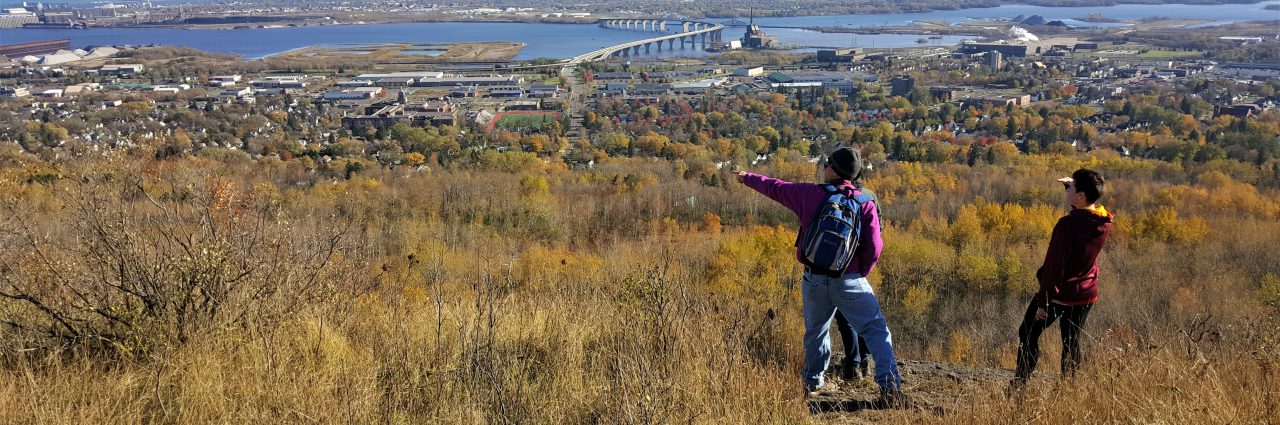
An overlook above the St. Louis River in Duluth, Minn.

We quickly realized we were going to need more judges. In the end, we gathered six who represented a good cross-section of the audience we expected to attend the summit.

The judging was “blind,” which means the poets’ names were not associated with their poems. After two rounds, the judges narrowed the number of poems down to a dozen, with a few for backup in case any of the chosen poets could not be reached.

Although communication was sometimes a challenge, all 12 poets were enthusiastic about participating in the reading. They represented a wide diversity of ages and ethnicities.

The River Talk was a couple of weeks ago, but the warm fuzzy feelings it engendered remain with me. I could use many adjectives to describe it: powerful, beautiful, stark, raw, funny — but it’s really best if you listen to the poems and feel all the feels for yourselves. The reading drew 85 Zoomers, a record attendance.

The Lake Superior Reserve, our partner in the talks, recorded the reading and it’s available on their YouTube channel. Here’s a list of the poets (in the order they read) and the names of their poems:

Tyler Dettloff (Michigan) “My Stars”
Heather Dobbins (Arkansas) “I Held us on for 36 Hours after the Levee Broke to hell”
Ben Green (New Mexico) “Immersion: A Prayer of Intent”
Lorraine Lamey (Michigan) “Catching Your Drift”
Joan Macintosh (Newfoundland) “The Current Feels”
Kate Meyer-Currey (England) “Timberscombe”
Rebecca Nelson (California) “Of the St. Louis River”
Stephanie Niu (New York) “To the Beaver’s Eyes”
Diana Randolph (Wisconsin) “Knowing the Way”
Ron Riekki (Florida) “It Took a Long Time to Discover”
Derold Sligh (South Korea) “Rouge River”
Lucy Tyrrell (Wisconsin) “Talking Water”

Ironically, the one poem specifically about the St. Louis River was written by someone who had never visited it. Rebecca Nelson said her poem, “Of the St. Louis River” was inspired by the spiritual experiences she’s had while watching water. She grew up in the Midwest and said she wrote the poem thinking of the rivers she knew from childhood. “I would love to visit sometime after the pandemic!” Nelson said.

Barb Huberty, St. Louis River Area of Concern coordinator for the Minnesota Pollution Control Agency, offered this comment in the Zoom chat, “I never knew that poetry could unite people across the globe.”

Sharon Moen, Eat Wisconsin Fish outreach specialist for Wisconsin Sea Grant, offered, “Thank you to all the poets and organizers! I am inspired by the depth of your thoughts and stories.”

Remaining River Talks will be held on April 14 and May 12. For more information, visit the River Talks page: go.wisc.edu/4uz720.

The Horses Nobody Knows

If you didn’t get a chance to see my article in “Lake Superior Magazine” about the rare and endangered Ojibwe Horses, the same story has been reprinted in a different magazine: “Equine Monthly.” Click here to read it online.

An Ojibwe Horse, also known as a Lac LaCoix Pony. These horses are well-adapted to life in the northern wilderness.

If you’d like to hear the story behind my story, read my blog post here. These animals are so special. I felt privileged to be introduced to them.

A River of Poems

This Wednesday at 7 p.m. Central, I’m co-hosting a Zoom event that will showcase a dozen poets from around the world and across the country reading their powerful, evocative and beautiful poems about rivers. The March 3, 2021 reading is an evening program of the annual St. Louis River Summit, which brings together hundreds of people who work on and care about the St. Louis River in Minnesota and Wisconsin. It’s also part of our monthly River Talk programs, which are free and public-friendly. Details are below. Come experience different perspectives on our waterways!

Here is the Zoom link:
https://uwmadison.zoom.us/j/93264788373?pwd=amRqSWgvT1ZxNW03WFBnU2ZYclZUQT09
Meeting ID: 932 6478 8373
Passcode: 776905

The selected poets are:

Tyler Dettloff (Michigan) “My Stars”
Heather Dobbins (Arkansas) “I Held us on for 36 Hours after the Levee Broke to Hell”
Ben Green (New Mexico) “Immersion: A Prayer of Intent”
Lorraine Lamey (Michigan) “Catching Your Drift”
Joan Macintosh (Newfoundland) “The Current Feels”
Kate Meyer-Currey (England) “Timberscombe”
Rebecca Nelson (California) “Of the St. Louis River”
Stephanie Niu (New York) “To the Beaver’s Eyes”
Diana Randolph (Wisconsin) “Knowing the Way”
Ron Riekki (Florida) “It Took a Long Time to Discover”
Derold Sligh (South Korea) “Rouge River”
Lucy Tyrrell (Wisconsin) “Talking Water”

The reading will last an hour and will include time for comments and questions. The talk will be recorded and posted afterward on the Reserve’s Facebook page and YouTube. A summary will also be posted on Wisconsin Sea Grant’s blog.

River Talks are sponsored by The Lake Superior National Estuarine Research Reserve and the Wisconsin Sea Grant Program.

A Review of the Lungplus Device

The first time I cross-country ski each year, my lungs revolt in the form of tightness while skiing and coughing afterwards. I have allergies and have had pneumonia a couple times in the past. I think my lungs just don’t like the stress of breathing in all that cold air while I am working hard skiing. I guess you could call it exercise asthma, but does it count as asthma if it only happens once per year?

This year, among the “joys” of the pandemic (she said sarcastically), I realized that my lungs did not seem to be adjusting to cross-country skiing. I was coughing afterward every time, not just the first time. And I’ve been skiing a lot this year since the snow conditions and temps have been good.

So, it was with interest that I watched a TV news story about a local lady who is the U.S. distributor for Lungplus, a mouth-worn humidity and heat exchanger you can use while skiing to make your lungs happier.

I want happy lungs, so I ordered the Lungplus Sport ($50), which is for use with high-intensity activities like cross-country skiing.


As I took it out of the package, I was pleasantly surprised by how small it was – it had looked larger on the people using it on TV. It comes with a long piece of embroidery string that you can use to hang it around your neck, so don’t throw it away like I almost did!

The device works by trapping the heat and humidity of your breath inside an aluminum mesh as you breath out. When you breathe in, the air passes through the mesh, which is already warmed and humidified, and makes lungs happy.

I did a test-ski recently and am here to report that my lungs were about 80% happier. I still had a little tightness and coughing, but nowhere near as much as usual. Another pleasant surprise was how light and easy to use the Lungplus was. You just stick it in your mouth in the space between your lips and teeth. Yes, you look like a dork doing this, but hey, it’s worth it to breathe easy.

Excess condensation collects inside it. The Lungplus lady says the embroidery string will catch the “drool” so it doesn’t end up on your chest, or you can blow out the water or suck it in and swallow. That last suggestion grossed me out, but that’s what I ended up doing. The condensation seemed to naturally collect in my mouth, so swallowing it was really no big deal.

The string is also handy if you want to remove the device. You can just take the Lungplus out and it will hang like some space-age necklace pendant around your neck, handy for when you want to put it back in.

Besides allowing me to breathe easier, I found the Lungplus had the side benefit of discouraging conversation by passing skiers. This is handy for introverts. Nobody wants to talk to someone with a strange white gadget sticking out of their mouth.

Lungplus is easy to clean. Just rinse it with warm water or stick it in the dishwasher.

So, I’m here to say that it works! And no, I have not been paid to say this.

Climate Emergency Poetry

This is just a quick post to let you know I’ll be giving a reading this weekend that’s being organized by a local Climate Change awareness group. The event is this Sunday Feb 21 by Zoom.

Here are the deets:

Here’s info about the Zoom poetry reading I’ll be doing this Saturday (Feb 21) at 3 pm Central. I’ll be reading an excerpt from “Plover Landing,” and a couple of poems. I think I will be the last reader because they’ll be going alphabetically.
Here’s the Zoom address for Climate Emergency Poetry Reading #5 set for THIS Sunday, February 21 at 3:00 p.m. CST (4 EST):https://us02web.zoom.us/j/81576699711…

Join our Cloud HD Video MeetingZoom is the leader in modern enterprise video communications, with an easy, reliable cloud platform for video and audio conferencing, chat, and webinars across mobile, desktop, and room systems. Zoom Rooms is the original software-based conference room solution used around the world in board, conference, huddle, and training rooms, as well as executive offices and classrooms. Founded in 2011, Zoom helps businesses and organizations bring their teams together in a frictionless environment to get more done. Zoom is a publicly traded company headquartered in San Jose, CA.us02web.zoom.us

Meeting ID: 815 7669 9711Passcode: 286977

SEE YOU THERE! HERE ARE YOUR SCHEDULED GUESTS:POETS: Ella Grim, Marie Zhuikov, Cal Benson, Jill Hinners, Jim Johnson
CLIMATE ACTIVIST: Bill Mittlefehldt
UMD MPIRG SPOKESPERSON: Stine Myrah
YOUR HOSTS: John Herold & Phil Fitzpatrick           AND OUR FIRST Q & A SESSION WILL FOLLOW!

A Keen Grasp of the Obvious

Image of one of my current favorite commercials courtesy of Progressive Insurance

In high school, I had a classmate named Dave. One of his favorite sayings was, “You have a keen grasp of the obvious.” He’d say it whenever someone made a comment that was self-evident. These were often conversation fillers, used in instances when a person would step outside, notice it was raining, and say, “It’s raining.” Dave would then say his thing. It made him sound so smart and superior.

Dave and I have since been lost to each other through the vagaries of forty years and geography, but I think of him and his sarcastic saying periodically, especially when it comes to those signs that are so popular now in people’s homes. You know, the ones made for the kitchen that say “EAT,” or ones for the living room that say “LOVE, LAUGH, LIVE,” etc.

When they first started appearing years ago, I thought the signs were sort of neat, mainly because, you know me, I love words. But the longer they stay around and the more I see them, the more I have developed a knee-jerk negative reaction toward them. I think things like, “Why would I need a sign to tell me what to do in a kitchen?” As my friend Dave would say, the signs have a keen grasp of the obvious.

The signs are also bossy. Maybe I don’t want to laugh or love. Stop telling me what to do, signs!

I have taken a solemn and deadly vow never to add one of those signs to my home décor.

My dislike of these signs is one thing that makes me love the recent series of Progressive Insurance commercials that feature “Dr. Rick.” He is a pseudo-therapist who tries to ensure his customers (patients) don’t turn into their parents once they become homeowners (a.k.a. parentomorphosis). One of the most recent commercials features not one, but two instances of Dr. Rick encouraging a young female homeowner to trash one of the dreaded bossy signs.

Those commercials make me laugh every time I see them, and that’s something during a pandemic. Well done, Progressive. And Dave, if you’re out there, I look forward to seeing you at our 40th class reunion this year. Maybe I’ll bring you a sign.

Bog Wonder

For the holidays, Russ and I decided to get away from it all – so much safer for us and for others, especially with this new variant of Covid-19 going around. Where better to avoid seeing anyone else than in a bog?


At our cabin in northern Minnesota, we walk regularly past a bog. It’s right next to a gravel road, enticing us with its remoteness and untrammeled nature. The plat book we consult signifies the bog is privately owned, however there’s no owner’s name listed, so we weren’t sure who to ask for permission for access. So, we just took a chance, donned our snowshoes, and trammeled it, just a little bit.

Although they look sterile, bogs are places of unparalleled abundance and life. The vast peatlands of northern Minnesota cover more than ten percent of the state. Unlike the clearing of the prairies and white pine forests, efforts to drain and develop the peatlands were mostly failures, although unnaturally straight ditches in some bogs testify to this toil.

The bottom of a peatland is a breathless place – cold, acidic, anaerobic – with no oxygen to decompose branches or the small, still faces of the weasels interred there. Sphagnum mosses wrap around the fur, wood, skin, casting their spell of chemical protection, preserving them whole. Growth is impossible, and Death cannot complete his spare work.

Minnesota’s peatlands formed over five thousand years ago when the climate cooled and rain increased. The state contains more peatlands than any other in the U.S., except its Alaskan stepsister. (A surprising number of Minnesotans spend time in Alaska and vice versa.) Although in the U.K. and northern Europe the smoky glow of peat still heats many houses, the trend never caught on in Minnesota.

In Europe, bogs are portals to distant worlds, wilder realms. Gods travel the bogs. In America, peatlands are just an inconvenience to be drained or avoided. Even the Ojibwe let them alone. Maybe that’s why birds love bogs, like the nearby Sax-Zim Bog. They are places where people are not. Owls can hunt voles, mice, and moles to peaceful content.

We saw many deer trails crossing the bog. Shrubby bushes of Labrador tea poked their tips through the covering of snow. We investigated an island of red pines at the bog’s edge – an upland out of sync with the rest. Climbing a short way, we came upon a human-made square wooden platform covered with a thin layer of snow. A cache of short, fire-ready sticks lay piled between two tree trunks nearby. It looked like a tent platform, ready for use.

We vowed to check the plat map to see how people could access this red pine “island” in summer. It was surrounded by the bog, but perhaps not too much bog for a person to cross when conditions are more liquid.

Back on the bog, we passed stunted black spruce trees and tamaracks, denuded of their needles by winter. A gentle snow began to fall, consecrating all with a layer of white.

All was silent. All was good.

We completed a circuit around the area, which was surprisingly much larger than we could see from the road. As we took off our snowshoes and walked back to our cabin, we were suffused with the peace of this wild place.

Imagine our distress when, a couple of weeks later, we walked past the bog again, only to see snowmobile tracks leading out onto it. The snowmobiles had run ragged circles around the part nearest to the road that was clear of trees. They churned up vegetation, spewing spatters of green “blood” across the snow.

It made me wonder what the snowmobilers were thinking of when they chose to motor around in the bog. They probably thought it looked like a fun place to tear around in – a wasteland, devoid of life, useless to humans. Why not have some fun in it?

Agh. It hurt my heart to see it. Thus, this blog post – letting people know that just because something looks useless to humans doesn’t mean it has no value. Bogs are home to countless creatures and many rare plants. Please, please don’t misuse them.

Letting go of the Past

I bet you’re expecting me to write something deep about how to recover from past hurts and abuses. No such luck. I’m writing about getting rid of an antique that I used to be trapped inside as a child: the elevatorized Baby Butler.

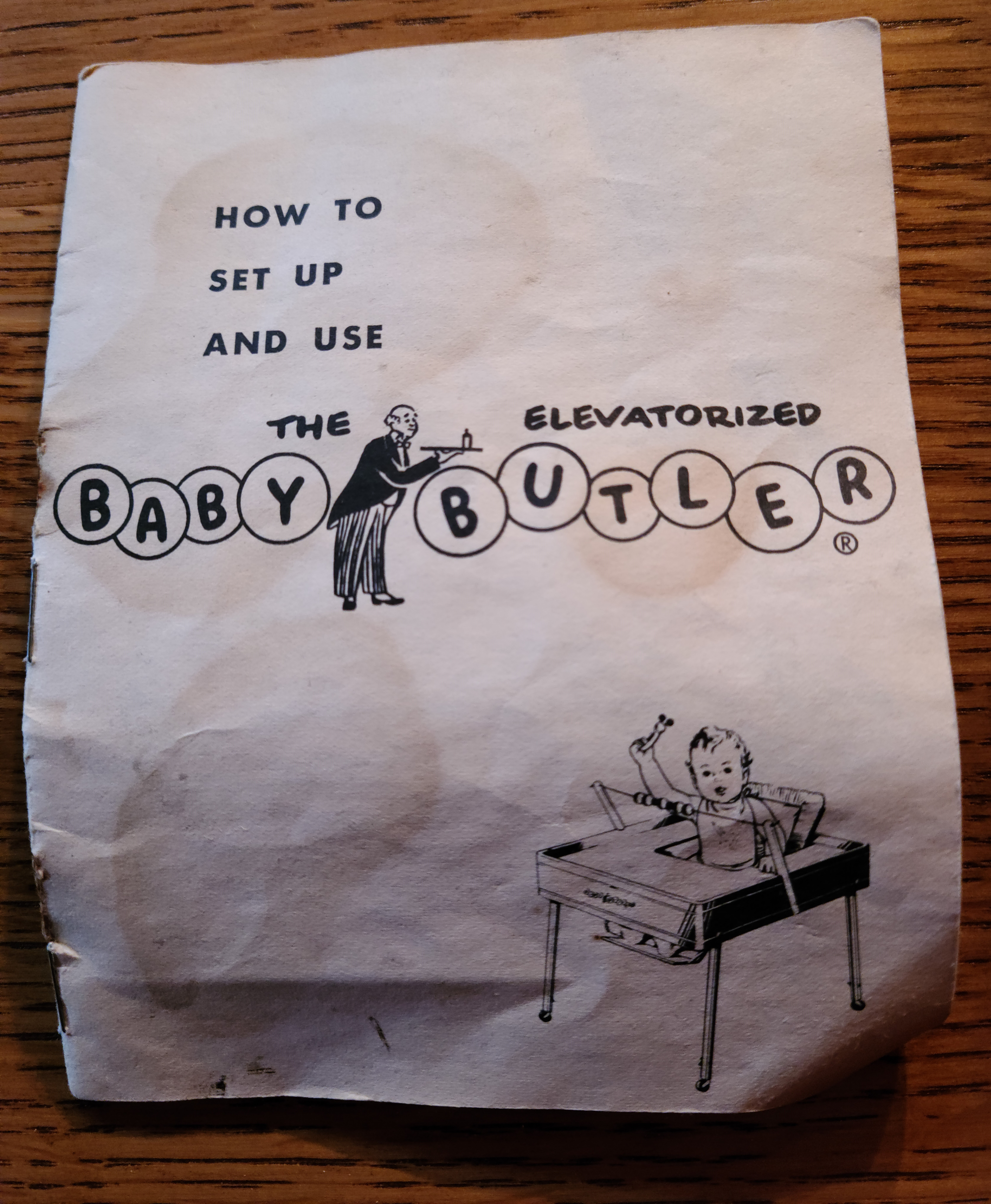
Yes, the marketers at Guild Industries really used the word “elevatorized” to describe it. Just what is this curious device, which was manufactured out of oak in the late 1950s and 60s? It’s a combination highchair, bed, and play table for young children.

I’m not quite sure why it’s considered elevatorized – perhaps because the seat is adjustable. Elevators had been common for decades by then. I guess it was just a 1950s marketing buzzword.

When we were growing up, my mother strapped my brothers and I into it for meals. The Baby Butler also came with a blackboard cover for use when the seat was removed – thus, the play table part.

My butler is missing the metal seat. I think I threw it away because I didn’t realize it went with the rest.

I associate the device with conflicting emotions: the comfort of food, and the frustration of feeling trapped. I feel a twinge of sentimentality toward it, but that’s about it — the kind you’d feel toward a jack-in-the-box you played with as a kid. The music was nice, but the “jack” jumping out of it was unpleasant.

I inherited the butler when we moved my parents into an assisted living facility. I’ve kept it about a half-dozen years, thinking I could sell it as an antique. A lot of them are for sale on E-Bay. But when I discovered mine no longer had the seat, and that the green blackboard was marred by a black marker, I slowly came to the realization the Baby Butler needed to go.

Before I tossed it, I read through the instruction booklet, which my parents had also saved. I love how marketers used to write:

Dear Mother and Dad: We take pleasure in welcoming you as one more happy family in our ever-growing circle of Baby Butler friends. . . The new and improved Baby Butler supplies the answer to your needs, and it satisfies the most discriminating tastes with its beauty of styling and workmanship.

Sorry, Guild Industries. I’m no longer part of your circle of friends.

Do you still have relics from your childhood that give you mixed feelings?