That Time I Organized a Sea Lamprey Taste Test

The New York Times recently published an article about eating invasive species as a means of control. It reminded me of a demonstration project we undertook when I worked at Minnesota Sea Grant in 1996. We received money from The Great Lakes Protection Fund for two years to study the overseas market potential for Great Lakes sea lamprey.

The business end of a lamprey. Image credit: U.S. Environmental Protection Agency

I’m sure many of you are familiar with the story: lamprey, with their penchant for sucking blood, are a parasitic exotic species that entered the Great Lakes and almost wiped out the Great Lakes fishery by the 1940s. This led to a control program coordinated by the Great Lakes Fishery Commission that is ongoing even today. Every year, the commission’s various lamprey control programs cost millions of dollars. Sea lamprey are clearly still an enduring threat.

In the mid-1990s, the commission’s lamprey control program routinely landfilled thousands of female lamprey they trapped. At that same time, lamprey populations in their native countries like Portugal and Spain were becoming decimated due to overfishing and habitat loss. This was an issue because lamprey were/are considered a culinary delicacy in Portugal and Spain. Like the lobster aquariums found in American restaurants, Portuguese restaurants offered tanks of sea lamprey where people could pick their dinners. Exclusive and expensive clubs even formed around lamprey consumption.

Jeff Gunderson, the fisheries and aquaculture specialist with Minnesota Sea Grant at the time, took an idea from a University of Minnesota food professor and the extension leader at Minnesota Sea Grant and turned it into a project to find a use for the excess, unwanted Great Lakes lamprey by seeing if chefs in Portugal and Spain would find them as palatable as their native lamprey. He set up a team that included a professor in Portugal who would conduct market testing, University of Minnesota experts, a NOAA international marketing expert, and a fisheries biologist.

My job was to garner visibility for the project and its results. When Jeff first described the project to me, one of my first questions was whether the lamprey had been tested for mercury. “I don’t want to promote something that’s going to contaminate people,” I recall saying. He assured me the lamprey had been tested and were within U.S. standards. But what I didn’t know at the time was that only a small sample of lamprey were tested. (More to come on this later.)

To figure out my publicity strategy, I consulted a couple of my news reporter friends. I think it was Mike Simonson, the well-known and now dearly departed Superior bureau chief for Wisconsin Public Radio who said, “You gotta have a taste test!”

That sounded like a capital idea, so my first step was to find a local chef willing to cooperate. I approached my favorite restaurant, Bennett’s Bar and Grill, run by Bob Bennett. This “forefather of contemporary cuisine in Duluth” was game.

The Portuguese professor had given me several traditional sea lamprey recipes, at least one of which involved using lamprey blood. Ewww. Anyway, I showed these to Chef Bennett, and we came up with a taste-test plan. He would prepare two traditional recipes and create two of his own. Gunderson talked the original Lou of Lou’s Fish House in Two Harbors into smoking some lamprey for the taste test, as well.

Next, we had to find some brave lamprey consumers. Somehow, I managed to convince the Duluth mayor (Gary Doty) to participate along with the University of Minnesota Duluth chancellor (Kathleen Martin). Several members of our Sea Grant Advisory Committee also agreed as did a freelance graphic designer who worked for us, a congressional office manager and the Minnesota Sea Grant director (Michael McDonald),

We held the lamprey taste test at Bennett’s restaurant, which was on Superior Street in downtown Duluth. Eight intrepid tasters were seated at a long table facing into the room so that reporters could easily see them and ask about their reactions to the food. We gave them a rating form. We also provided an aquarium with several lamprey in it, just to add to the room’s ambiance, and the smoked lamprey and some crackers for snacks.

Simonson was right about the lure of the taste test. We were mobbed by local reporters, both print and broadcast. Reporters from the Twin Cities even made the trip up north for it. The resulting stories went everywhere, even internationally. The Associated Press picked up the print story, and Gunderson said he talked to someone who saw it on a television station in Seattle. The story eventually made it into Newsweek and The New York Times.

Back in my office after the test, I received a phone call from the daughter of a Portuguese immigrant in Boston who saw the news stories and wanted to know how to obtain lamprey. She told me lamprey was a traditional Sunday dinner in Portugal, just like American pot roast. Her father was so excited when he saw the news, he implored her to find out more. I had to give her the disappointing information that lamprey were a regulated invasive species without a commercial source yet.

The highest rated dish was Bennett’s own lamprey stew with garlic mashed potatoes, rated 4.5 out of a possible 5. The smoked lamprey came in second, earning 3.7 out of 5. The taste of the lamprey came out more strongly in the traditional dishes, which did not suit these American taste-testers.

I ate both the lamprey stew and the smoked lamprey. I enjoyed the stew, although the chef forgot to take out the lamprey’s cartilaginous backbone (called a notochord), which made it a bit crunchy for my taste. I bet if he had removed the backbone, the dish’s ratings would have been higher. The smoked lamprey tasted rather like any kind of smoked fish – very good!

The taster’s comments included: “Surprisingly good. Try selling it without telling people what they are eating. It would be better.” And, “I would not order this out, but Bennett’s dishes were by far the best.”

More extensive taste tests were run in Porto, Portugal. Eight restaurants with lamprey-cooking experience, two homemakers and 16 individual taste testers participated in two studies. The restaurant chefs were asked to rate how the lamprey looked while alive, how they cooked compared to Portuguese lamprey, how they smelled/tasted/looked after cooking, how the lamprey tasted to them, and how their clients or family members liked them.

Overall, the Portuguese taste testers enjoyed the strong flavor and firm texture of the lamprey, noting the lamprey had a pleasant “turf” taste and was less soft and fatty than Portuguese lamprey. (A turf taste refers to an earthy flavor, somewhat like mushrooms or liver.) They rated the flavor 4.5 out of 5 – a definite win.

During the second year of the project, more lamprey were shipped to Spain for taste tests. The results weren’t as glowing, perhaps because only frozen and canned Great Lakes lamprey were shipped instead of live wriggly ones. The Spanish testers liked the texture and that some contained eggs. Yes, lamprey are a delicacy in Spain, but lamprey caviar takes it to a whole other level.

The death knell for this innovative program came from subsequent contaminant tests on the lamprey. The Great Lakes lamprey contained mercury levels that were too high to meet European Union standards. They tested at 1.3 ppm for mercury. The EU standard at that time was 0.3 ppm. This information came too late for our taste testers, but hopefully, one meal of lamprey was not detrimental. I certainly didn’t feel any ill effects.

Gunderson summed it up like this: “At least we have an answer to the question that has been debated for nearly 40 years. Yes, Great Lakes lamprey are marketable in Europe. Because of current control programs and experimental programs, a commercial harvest of lamprey would not have been a priority even if mercury levels were acceptable. But given time, a commercial harvest could fit into lamprey control and management. Lamprey are here forever and who knows if the funding for lamprey control will last that long. If funding ever does wane, let’s hope it’s not before mercury levels decline to acceptable levels so that lamprey harvest can be evaluated as part of a low-cost management program.”

That was almost 25 years ago. A Lamprey and Rice Festival is apparently held in Portugal each year, so it still must be popular, but I fear that the people who used to love eating them for Sunday dinner are aging out of this world.

Unfortunately, mercury levels in Great Lakes lamprey are still high. According to a 2018 study by the Great Lakes Indian Fish and Wildlife Commission and the University of Wisconsin, levels in adult lamprey were still beyond that deemed safe for human consumption.

In any event, this project was one of the highlights of my career. It seemed like a win-win idea: The U.S. could rid itself of an expensive invasive species, and European diners could eat a traditional and much longed-for dish. Yes, I promoted something that could have contaminated people. But I did a darn good job of it.

Temperance River State Park, Minnesota

When last you saw us, Russ and I were thwarted in our attempts to bike along the North Shore of Lake Superior by cold weather and lack of appropriate clothing on my part. As an alternative, we decided to hike somewhere we had never been before. This turned out to be along the Temperance River.

The trailhead is extremely easy to reach – it’s right along Highway 61, with parking on both sides of the road. (The trailhead is on the side opposite Lake Superior.) Russ and I had driven past the park roughly a bazillion times but were always going somewhere else. We were so glad we stopped this time!

The first part of the trail takes you to a plunge pool, which is at the base of a waterfall hidden back in the rocky clefts. At the end of the Ice Age, the waterfall wasn’t so hidden. Torrents of melting glacier ice cascaded over the rock ledges, creating a waterfall that was 300 feet wide, or so said the interpretive sign along the trail.

We hiked along the river gorge on the Superior Hiking Trail about eight-tenths of a mile to the upper falls and then backtracked to return to our car. With lots of rocky ledges to clamber and scenic river vistas around every turn, this trail would be a perfect way to get sullen teenagers excited about nature. Although there are some stairs to climb, most of the trail is relatively easy if you are able-bodied.

The river gorge is super gorgeous. I kept wondering why I’d never heard my friends who know the North Shore rave about it, because it certainly is rave-worthy. My photos only capture a minor part of the beauty.

If you do go to the Temperance River, please remember to practice social distancing and carry out your trash. The park looked clean when we were there, but I know that some parts of the shore are being over-loved and over-travelled lately.

The hidden falls.

A Mini-Minnesota Vacation: Cascade River State Park

The main falls on the Cascade River.

For mini-vacation #2, Russ and I meandered with our thirteen-foot Scamp trailer to Cascade River State Park on the North Shore of Lake Superior. (Interested in mini-vacation #1? Read about Lake Vermilion State Park.)

I must admit, one reason we chose Cascade River was because it had camping reservations available during the time we wanted. Another reason is that, despite innumerable trips along the North Shore, neither of us had spent any time there. It was a good excuse to see some new sights.

We decided to add a little glamour to this outing, just for fun. Before we left Duluth, we made dinner reservations at The Strand restaurant at Lutsen Resort, which is just a 15-minute drive from the campground, and for a wine tasting at the North Shore Winery, also at Lutsen.

Because it’s late in the camping season, the shower building wasn’t open at the campground, so we decided to go the restaurant our first night (of two). We weren’t sure how presentable we’d look later!

Before I go into the long description of our stay, I’ll offer some Cascade River Campground pros and cons for those of you in a hurry.

PROS

  • Although the campground is located near a highway, it was quiet at night.
  • A short hike takes you to the river’s scenic falls and to Lake Superior. Plus, there are many options for other hikes.
  • Near the many civilized attractions of the North Shore at Lutsen and Grand Marais.
  • We saw a bear!

CONS

  • The sites offer little privacy. The lack of vegetation between them made us feel like we were living in an outdoor fishbowl sometimes.
  • You can hear the highway during the day.
  • The squirrels and chipmunks are habituated to people – watch your food!
  • We saw a bear, which made going to the outhouse in the middle of the night a sketchy affair.

You can’t check into your site until 4 p.m., so we only had enough time to plug in our camper and take a quick hike along the river and shore before we needed to leave for dinner at Lutsen. The waterfall cascades that the park is named for are just a short walk directly from the campground, and Lake Superior is not far downstream, so we were able to see a lot in just an hour. We had time to plunk ourselves down on a rock along Lake Superior and shake off the worries of the city.

Soon, it was time to hike back to our site and drive to Lutsen. This is the first restaurant we’ve eaten inside since COVID. We felt that by now, most restaurants should have their safety act together regarding the virus, especially a place like Lutsen, which sees a lot of tourists. We decided the food was worth whatever slight risk it might entail.

The image from our table at The Strand Restaurant.

I’m not sure how we managed, but we scored a table right by a window overlooking the lake. While we ate, we watched the sun set in muted pinks and purples – a perfect accompaniment to our food. For starters, Russ had the North Shore salad, which features blueberries, candied pecans, and a blueberry vinaigrette dressing. I had a cup of the Red Lake wild rice chowder.

My tastebuds were in heaven! I’ve eaten many chowders in my day, but this ranks among the top. I could tell it was made with real cream, hand-harvested wild rice that was fluffy and tender, and care. The flavors were perfectly balanced, and the soup wasn’t too salty.  I would have just been happy with the soup, but there was more!

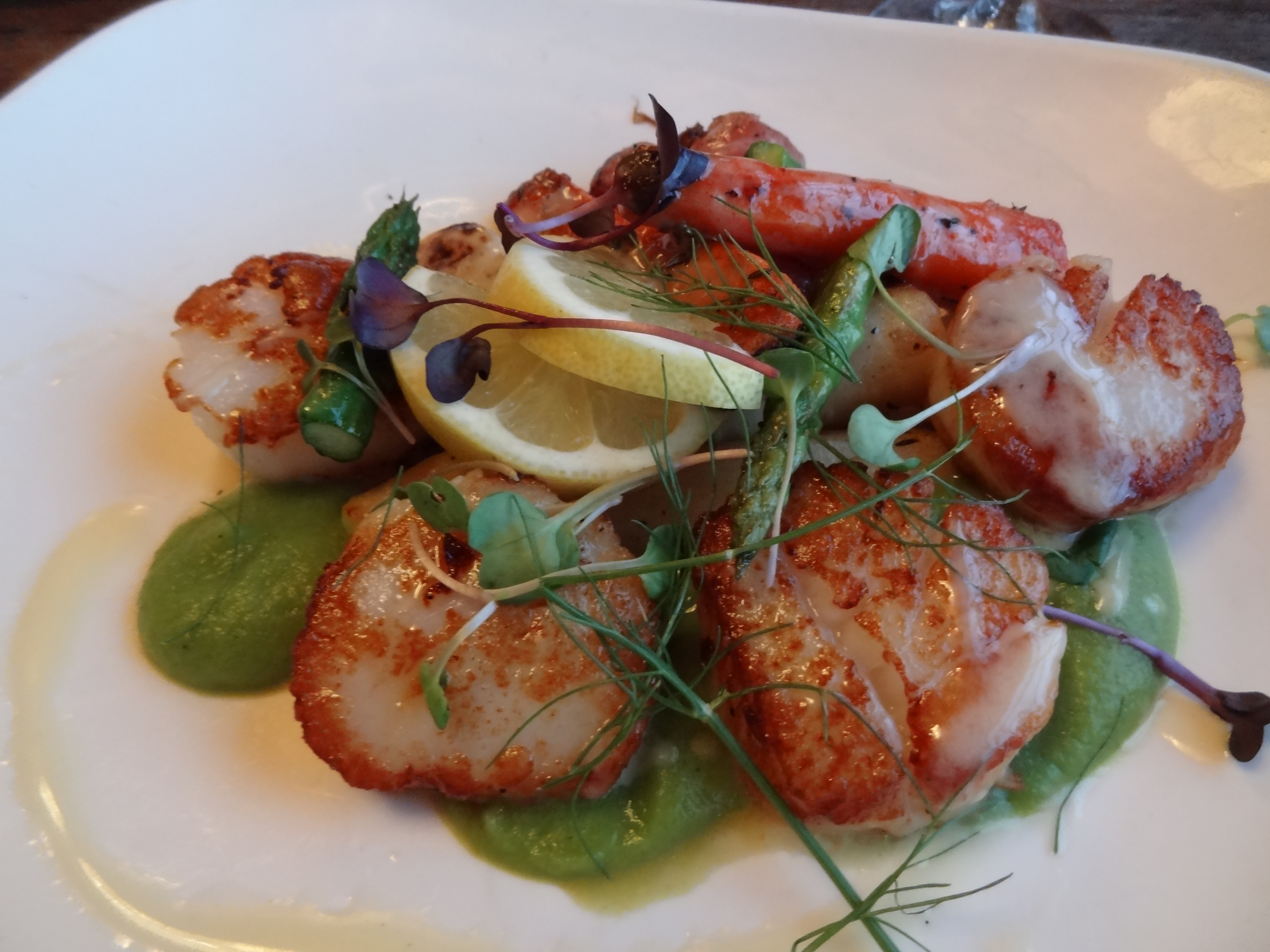
For entrees, Russ ordered the night’s special, which was a rack of lamb. I ordered the sea scallops. Russ was very happy with his, and I was, too. My scallops were seared to perfection and accompanied by an asparagus puree and root vegetables. As I dined on the parsnips, I was transported back to my childhood when I used to help my father harvest parsnips from our backyard garden. And then a bite of scallop zinged me over to the seaside, but I didn’t mind!

We decided to go for the gusto and ordered dessert. Russ had the apple pie ala mode. I had the flourless orange chocolate cake. Once again, a win, although my cake was not shaped like any piece of cake I’ve ever seen before. It was rather like a tall blob. But it was a good blob. I ate it all. Well, Russ had to help with the last few bites because I was stuffed.

On our sated drive back to the campground, our headlights shined on a black bear crossing the road near the entrance. We had already noticed signs everywhere in the campground about bears, and this proved them right. Thankfully, the bear was headed away from the campground.

Despite being near the highway, the campground was quiet at night. It was also cold. Both nights were near freezing and we were glad we brought extra blankets.

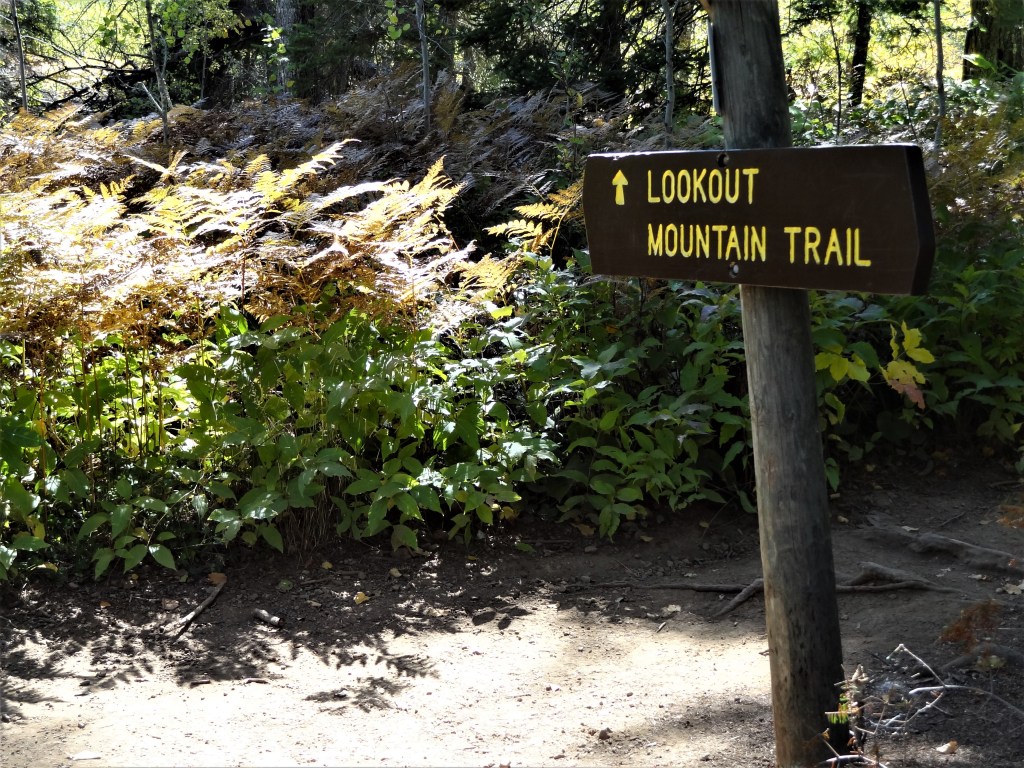
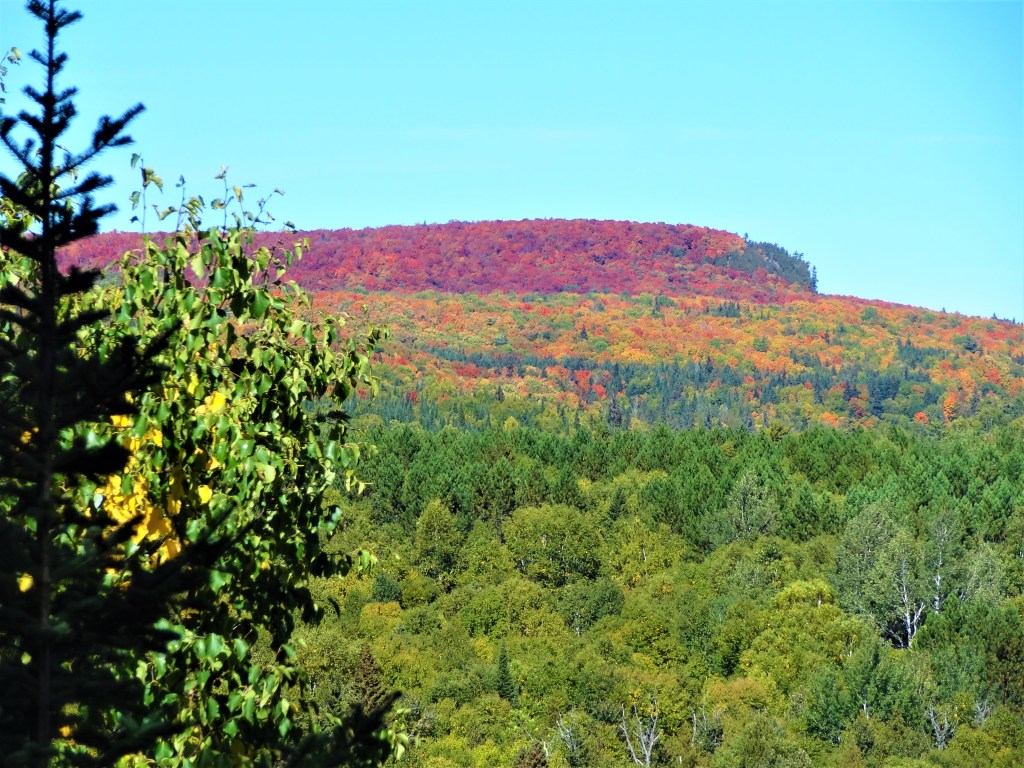
The next day we hiked to Lookout Mountain, which was about a 2.6-mile round trip. The cold nights hastened the fall colors, which were especially spectacular to see from the mountain overlook. We also took in more waterfalls along the river.

Then it was time for Thursday-night date night at the North Shore winery. From 6-8 pm you can listen to music and try flights of their red or white wines and hard ciders. It surprised us that the event was all outdoors. That’s not mentioned anywhere on their website or when you call them for a reservation. It was a bit nippy spending a couple of hours outdoors on a September evening, but thankfully, we happened to be dressed for the occasion.

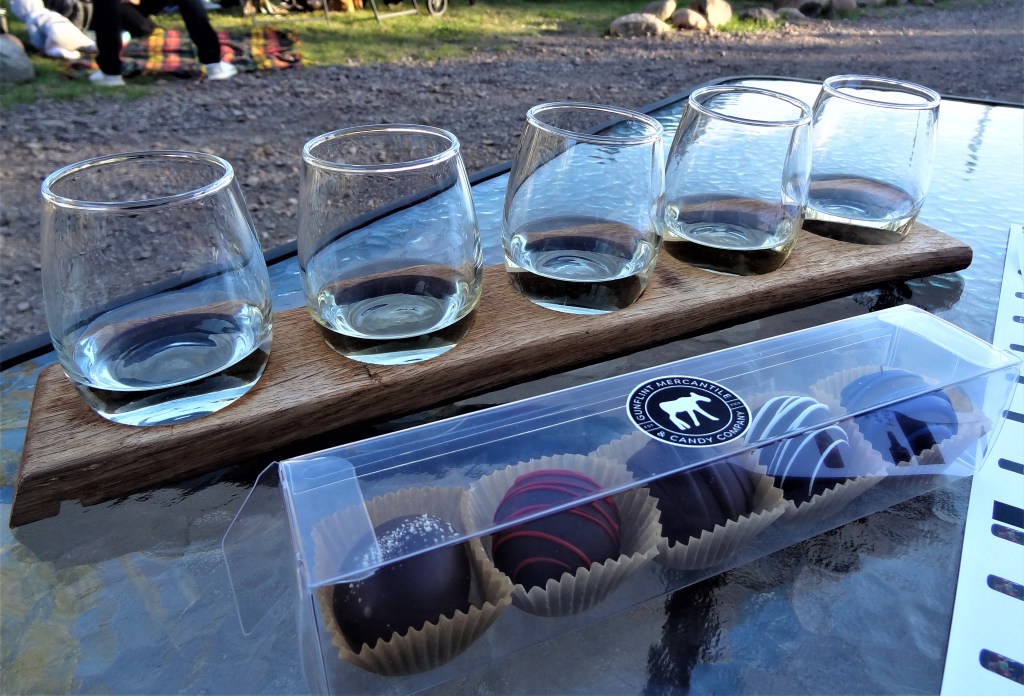
I tasted a white flight and Russ a red. None of the whites did much for me, but Russ liked some of the reds, enough to buy a bottle of their oak-aged petite syrah for home. The winery also offered munchies with the wine, like salami bites, cheese, and truffles. I was impressed by the flight of truffles from the Gunflint Mercantile in Grand Marais. The flight consisted of blueberry, espresso, triple chocolate, maple, and dark chocolate raspberry.

The maple was my fave – creamy and not overpoweringly sweet. I liked it enough to order a dozen once we returned home. I was especially delighted when they eventually arrived to discover they were about twice as large as the ones we had at the winery. So good!

The white flight of wines from North Shore Winery, plus a flight of truffles.

On our final day we had plans to bike on the Gitchi-Gami State Trail but were thwarted by the cold. On a whim, we decided to visit another place we never have had the opportunity to explore before: Temperance River State Park. But I will save that for another post.

Kudos to my Commenters!

I would like to thank everyone who reads my blog. I so appreciate your attention and time. I often tell my friends that blogging is like having pen pals who live all over the world. I love you all!

I’d like to recognize those who have consistently liked and commented on my posts and photos throughout the years. I particularly would like to thank the five most-frequent commenters over my blog’s seven-year lifespan.

Please take a look at their blogs and consider following them if you like what you see.

The Coastal Crone, a.k.a. Jo Nell Huff, hails from Corpus Christi, Texas. She’s a writer who has grown her muse from working on a few newspaper articles and poems to writing a novel that involves a Texas Ranger. Her blog features stories about life in Texas. I think I “discovered” Jo Nell from comments she made on somebody else’s blog. Her comments on “Marie’s Meanderings” are always so thoughtful and kind. She even won a photo caption contest I ran and received a copy of one of my novels as a prize. I always worry about her when a Gulf hurricane is brewing.

Sharon Moen doesn’t have a blog, but she does have a website about her nature-based pottery creations: Falcon Fire Pottery. Sharon is my BFF from Duluth. We met decades ago through work. Our lives have intertwined ever since. In addition to her talent with clay, Sharon is a writer, poet, and chicken-mama.

WriterInSoul, a.k.a., Colette, hails from Pennsylvania – or at least I think she does. She’s rather mysterious. Her blog is about as old as mine and she’s “still here because I have things I want to say and things to share.” She’s a writer who produces a combination of longer posts and short thoughts. Colette is on short thought #280, she’s that prolific! I also especially enjoy her posts about “Things Men Have Said to Me.”

Jennifer’s Journal, a.k.a. Jennifer Kelland Perry, lives by the sea in Newtown, Newfoundland. I’ve been following Jennifer since she was an aspiring young adult novelist. Now, she’s published two novels and is working on a third. One of her posts inspired me to write this post. She writes about her life in the Great White North and her writing accomplishments. Sometimes her cats write posts for her.

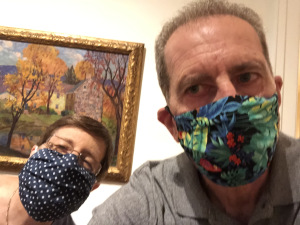
Neil’s wife and Neil.

Yeah, Another Blogger, a.k.a. Neil Scheinin, reports from suburban Philadelphia. His blog chronicles “An arts-filled, tasty and sometimes-loopy jaunt through life,” complete with sarcasm, mild vulgarity, and some good photos. Along the loopy line, Neil documents imaginary conversations with psychologists and famous musicians. I appreciate his sense of humor and off-kilter views.

Bog Birding Bust

I have heard about the Sax-Zim Bog in northern Minnesota for years, decades even. During winter, it’s a birding mecca – home to many rare owls and other species that visit from the arctic when food and weather conditions get too dicey up there. Birding is good during summer, too. The bog is a place where birds can nest in their natural habitat, relatively undisturbed.

Russ and I had a chance to visit the bog over Labor Day weekend. I’m getting back into birding and was excited to finally be seeing this place I had heard so much about. It’s even mentioned twice in “The Big Year,” a 2011 movie that stars Rosamund Pike, Jack Black, Owen Wilson, and Steve Martin. However, no filming was done on-site, so viewers never get to see the bog. The closest is when Owen Wilson’s character spends Christmas at a Chinese restaurant in Duluth, which is about fifty miles away. I suspect even the restaurant was fictional because it didn’t look like any I’ve ever seen in my hometown.

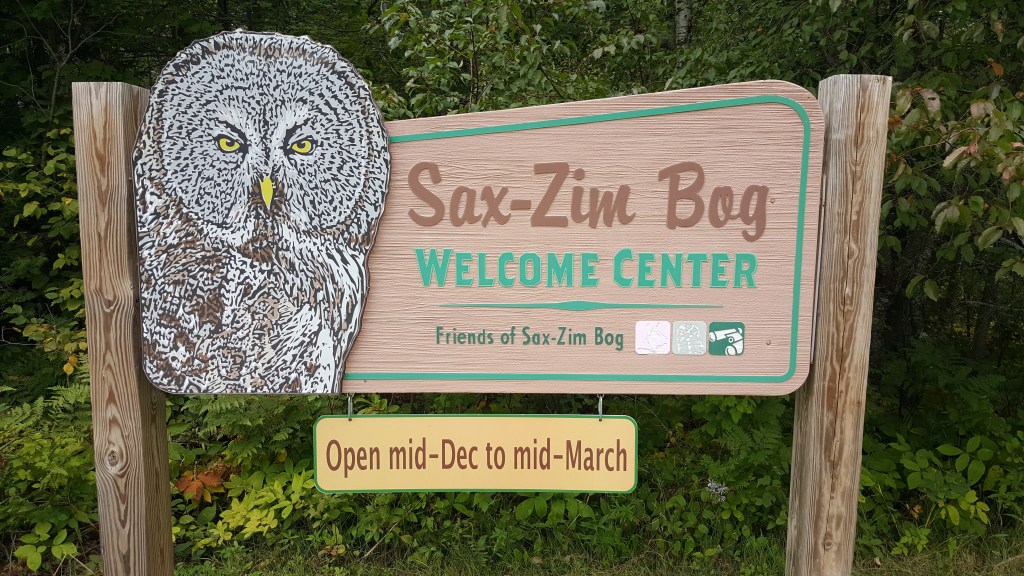
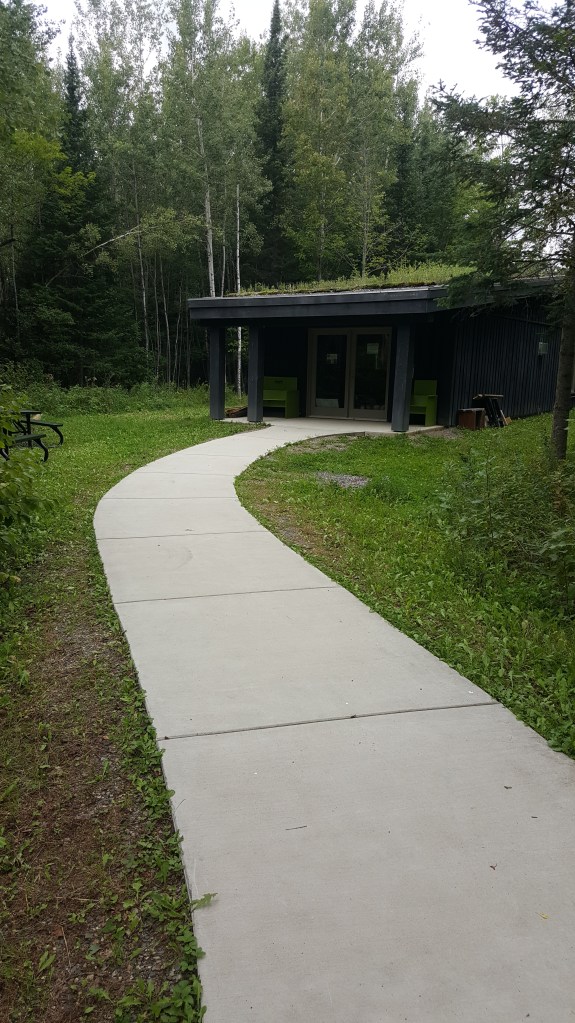
The Welcome Center

Anyway, so I was psyched to visit the bog. I thought since migration season had started, we might have a good opportunity to see birds moving through the area. We pulled up to the visitor center (which is closed now, opens mid-December through mid-March) and hiked the trails that go out from it. There’s a loop trail that starts at the parking lot and a Gray Jay Way that begins at the visitor center.

After all these years of anticipation, maybe I was expecting too much. We only saw a thrush (probably a Swainson’s), blue jays, and the chickadees and nuthatches found everywhere in the north. I was disappointed.

But it was neat getting a close look at a bog and learning the history of the area from the interpretive signs near the welcome center. For instance, I never knew that Jeno Paulucci, famed creator of Pizza Rolls and Chung King foods had a celery farm near the bog.

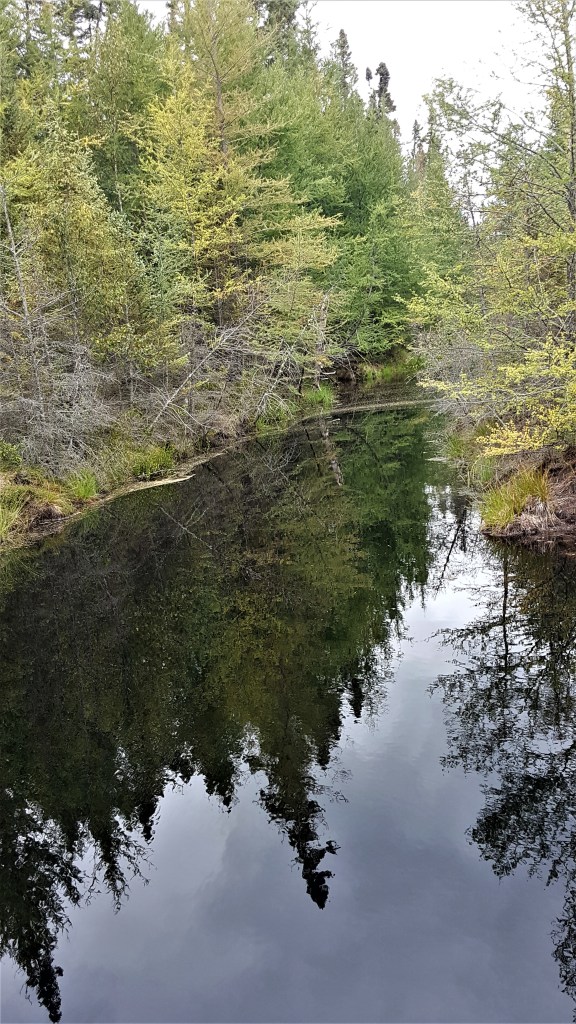
Gray Jay Way ends with a viewing platform where visitors can see the remnants of ditches that were dug in the early 1900s to drain the bog land for farming. Russ and I pushed through the undergrowth for a better look at the ditch junction. The dark bog water lay acidic and still on the landscape, lending an eerie air to the place.

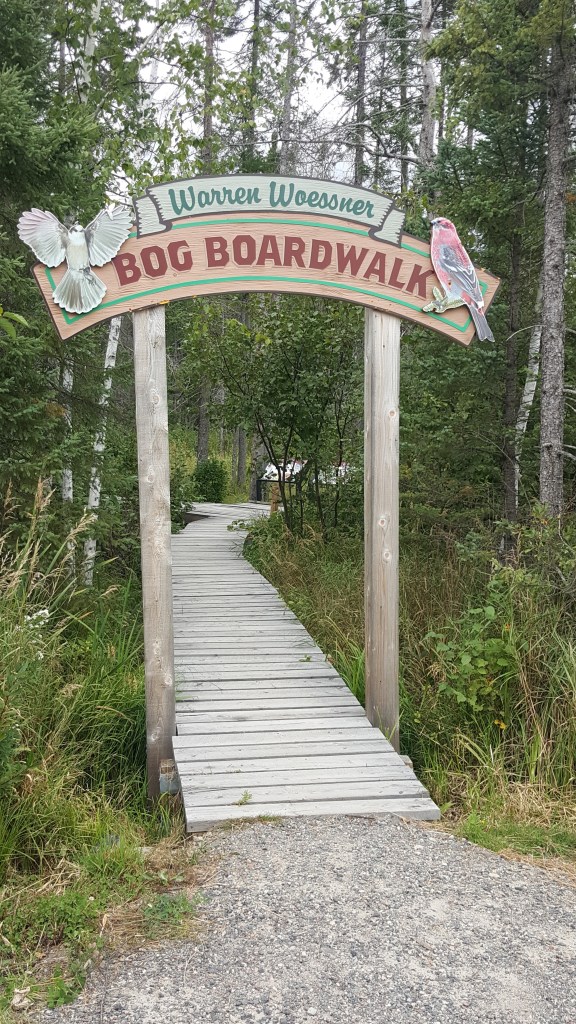
On our way home, we stopped at one of three boardwalks in the bog: The Warren Woessner walk. We marveled at all the work that must have gone into its construction. We had a pleasant walk but didn’t see any more birds.

When I got home, I asked the executive director of the Friends of the Sax-Zim Bog what was up with the lack of birds. Was this just a bad time to look? Sparky Stensaas said this is the worst time of the year for birding in the bog. Just my luck!

Sparky and I go way back to when we used to be on the board of the local Audubon Society chapter. He took over editing the chapter newsletter from me a loooong time ago. Or did I take over from him?

Sparky also said that the visitor center is only open during the winter because that’s when 90% of the visitors come, but that they probably won’t be open this winter due to COVID. Guess I’ll have to content myself with watching the videos Sparky made this spring and summer, which show there really ARE birds in the bog.

So, don’t be like me. Don’t go birding at the Sax-Zim Bog in September.

The Many Faces of Buddy

Today would have been Buddy the Wonderdog’s eleventh birthday. I am sorry to say that our beloved companion died on August 21st. It’s taken me a while to be able to write about it.

We had hints of the end five months ago when Buddy had two grand mal seizures, the first in the middle of the night. I had never witnessed a seizure before, so I wasn’t sure what was wrong. Was he just acting out a dream?

Buddy. Image by Amanda Jo Dahl Sales.

In the morning, I made an appointment with the vet who explained what they were. We decided to wait to see if another one happened. If it did, I would put him on anti-seizure meds. She said he could have epilepsy, or he could have eaten something that triggered it, or it could be cancer.

Buddy had a cancerous tumor in his ear, which easily could have spread to his brain or vice versa. I had chosen not to have it taken out previously (along with some skin cancer spots) because Buddy had a heart murmur. There was a risk that if we put him under, he might never wake up. I felt like he would have a better, longer life if we did not do any medical intervention.

His seizures did not return and during the five extra months we had, Buddy got to enjoy summer – swimming in lakes, riding in boats, two walks a day, playing with neighborhood doggie friends. And as you know, he discovered his true passion: fishing. He acted like the seizures never happened. Buddy also got to enjoy having his people with him all day, since I was working at home due to COVID-19 and Russ is retired.

On August 21, Buddy was fine until early afternoon. He was laying on the living room carpet, drifting to sleep when his first seizure happened. The event seemed to scare him more than before, and he stuck with me, wanting to be pet and comforted.

The second seizure happened a couple of hours later as he was drifting to sleep again. After this one, I called the vet’s office and got some anti-seizure meds. I gave him a pill right away, but it takes time for the medicine to build up to effective levels.

Buddy had two more seizures, each more severe. By that time, it was 8 p.m. on a Friday night. The vet was closed, so I called the emergency vet. They told us to bring him in.

Buddy was excited to go for a car ride and happy to hear we were going to the “doggie doctor”—one of his favorite places. He stumbled getting into the car and we noticed during the ride that he seemed to have trouble swallowing or he had a hitch in his breathing.

Due to the virus, we couldn’t go inside the office, but Buddy went without protest. The vet examined him and then called us as we waited in the car. He was pretty sure Buddy had a slow-growing brain tumor. He could treat the seizures with intravenous meds, but that would not fix the underlying problem of the tumor. He also said that Buddy’s bark did not sound normal – as if something in his throat was paralyzed by the seizures.

Things had already been ugly, but I knew they were about to get a lot uglier if we started hooking Buddy up to tubes. Russ and I made the hard decision to euthanize him.

Before the procedure, they brought Buddy out so we could see him one last time. I told Buddy that we loved him and would miss him. I explained what was going to happen. I cried. But Buddy seemed distracted, like he was eager to go back inside. So after a short time, I let him go. He knew what was best, too.

As one of my friends said, “To know Buddy was to love him.” He was such a large, exuberant presence in our lives. I’m still getting over the shock of having him here one day and gone the next. Of course, I’ve second-guessed our decision — should we have spent more time and money on his recovery? Ultimately, I feel like we did the right thing by him. We plan to spread his ashes along his favorite walking trail and his fishing spot in northern Minnesota.

My last photo of Buddy, taken between seizures.

One of my former colleagues recently wrote a story describing a University of Wisconsin-Madison study about the monetary worth of a dog’s life. The researchers surveyed hundreds of dog owners to see what they would be willing to pay for a hypothetical vaccine that would protect their dog from a fatal dog flu. Incorporating additional factors, they were able to come up with the value of $10,000.

We did not spend nearly that much during Buddy’s last day. But if some sort of procedure was available that could have reversed his brain tumor and cured his seizure damage, I would have considered it.

We are still dealing with the emotional cost of his absence. There’s no way to put a monetary value on grief.

Bye bye, big guy.

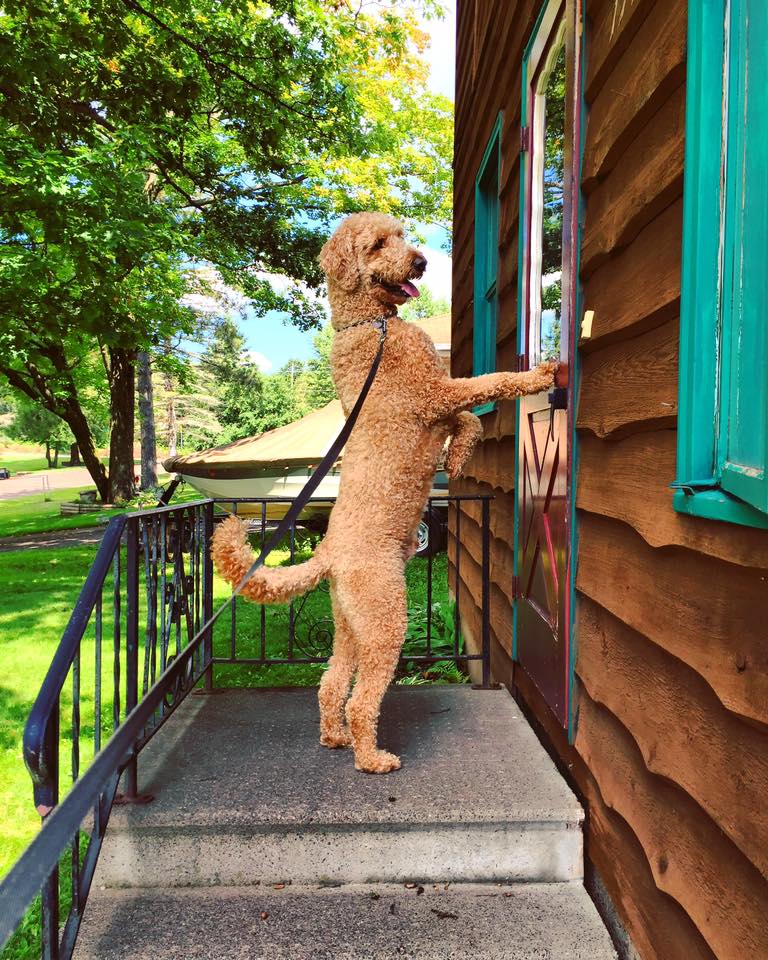
Buddy, the door-to-door salesman. Image by Amanda Jo Dahl-Sales.

Biking the DWP

20200815_151705If you are a Duluthian or just want to be Duluthy, and you are tired of biking the Munger Trail, try its wild, more adventurous twin, the Duluth, Winnipeg and Pacific Railroad Corridor Trail. I call it a twin because, like the Munger Trail, it follows an abandoned railroad line and passes over a similar geography. But the DWP is wilder and more adventurous because it’s gravel, less developed, and fewer people use it.

20200815_154215We accessed the DWP from Spirit Mountain’s Grand Avenue chalet. If you go up the ski hill about 200 yards from the chalet, you will run into the trail, which crosses the hill. You can also access it from a gravel road and trail system to the right of the chalet, but those are technically closed this season due to COVID-19.

Take a left, and you are on your way to new vistas, a couple of updated trestle bridges, and a tunnel. The 10-mile trail will take you to Ely’s Peak, Becks Road, and eventually to Proctor. When we arrived at Ely’s Peak tunnel, rock climbers were scaling the outside walls, testing their nerve and equipment.

We turned back at the tunnel. Later, while resting on a bridge, we had the chance to speak to a family who said they biked to the Buffalo House and had lunch before biking back to the parking lot at the chalet.

We hope to do the rest of the trail next time!

20200815_161259

A Little Chaos in the Garden

DSC02361 (2) use this oneIn the movie, “A Little Chaos,” which is about the creation of the gardens at the Palace of Versailles, one of the gardeners says gardening is, “an act of faith . . . .God put us first into a garden, and when we lost Eden, we were fated to search and reinvent it again.”
The story is about two gardeners with different approaches to their craft. One (who is a man) wants to dominate nature and instill order on the landscape. The other (who is a woman) wants to work with the landscape and thinks a little chaos is more interesting and natural.

In terms of the flower garden in my front yard, I have tried for years to be like the first gardener – instilling order in my plantings and symmetry in their placements. My garden has a theme of purple flowers: lupine, allium, coneflowers, night sage, iris, phlox, crocus.

My garden’s composition has changed due to my varying degree of attention and the severity of winters, watched over by a statue of a little naked boy who is sitting and reading. Even the statue has faced challenges. I’ve reattached his foot twice and even his head once after various misadventures and mishaps.

Weeds are a never-ending battle. My attempts to recreate an orderly Eden where humans have prime dominion has given way to a philosophy more like the second gardener who welcomes chaos and nature. And who’s to say that Eden didn’t have chaos? I like to think that we come from nature. What is nature if not chaotic?

My garden now sports a mix of cultivated and wild flowers. Some white flowers have crept in with the purple, although the white ones bloom after most of the purple ones are done. I don’t even know the names of the wildflowers, they just started growing with no help. I rather like not knowing their names. This makes me look at these flowers more deeply. If I knew their identities, I would say their names in my head each time I saw them and then immediately look away. Now there is mystery and wonder.

Patches of grass intersperse with the flowers. I could continue to spend time trying to dig up all the grass, but I’d rather spend my time writing or playing. It’s freeing to have given up trying to instill order on the landscape. My garden does not have to be “perfect.”

In the “chaos” movie, the lead gardener at Versailles hires the chaotic gardener because “the gardens are large enough to contain more voices than just my own.” The movie ends with a scene from the woman’s completed garden, which is an outdoor ballroom. The king of France and his court dance in a space where order and chaos intermingle in a triumph of design.

I’m not sure what my neighbors think of my garden. No doubt, some wish I would spend more time controlling it. Perhaps others who drive by simply enjoy the colors. All I know is that, with its colors and a little chaos, it’s Eden enough for me.

Fruit Pizza Recipe

20200707_073742I first had this confection at the baby shower for my second son. My office coworkers organized the event and one of the highlights was this tasting this fruit pizza for the first time. Our venerable administrative assistant, Judy Zomerfelt, baked it and kindly gave me the recipe (and permission to feature it here).
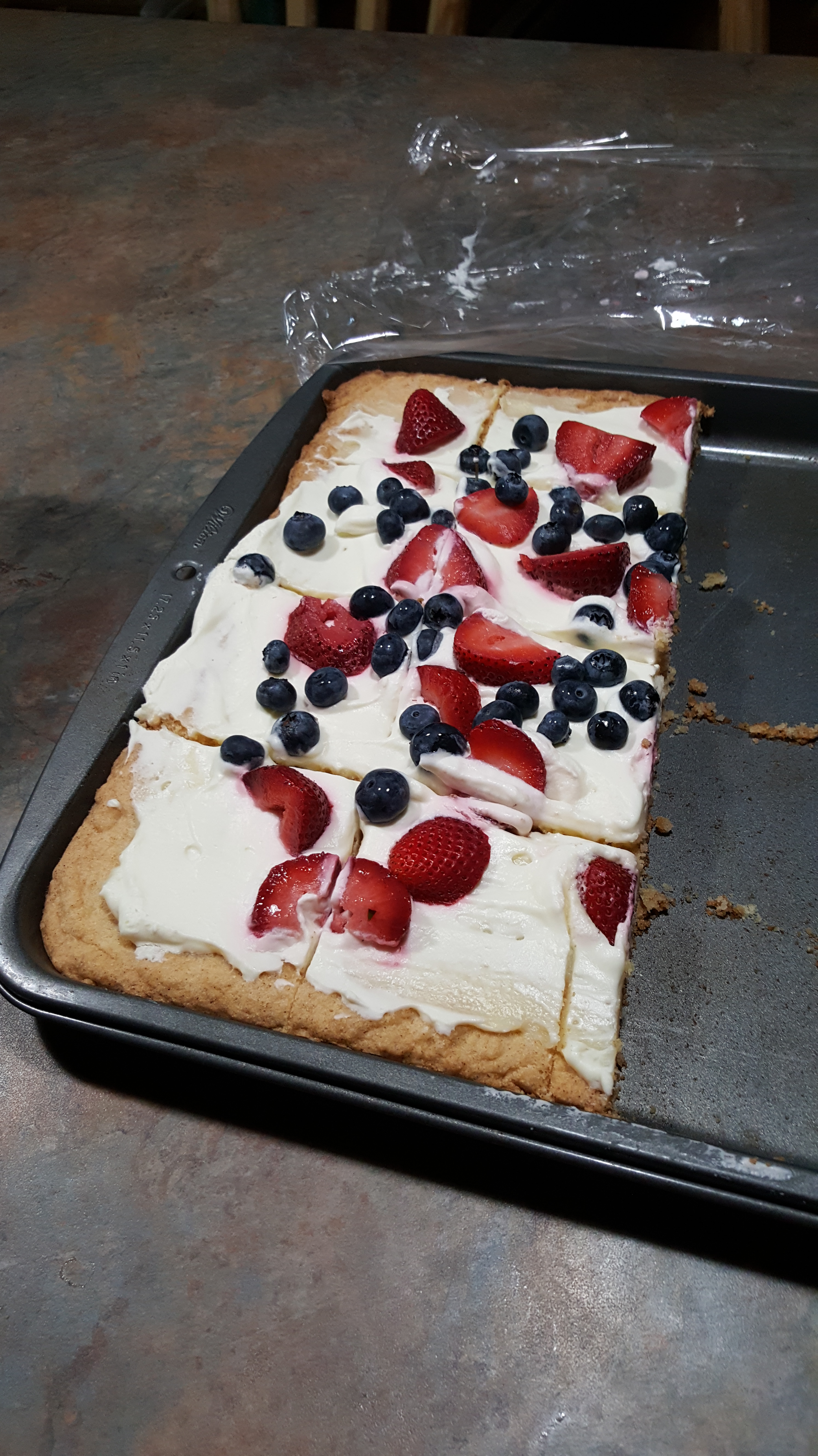
Since then, I’ve become sensitive to wheat and corn, so I have modified the recipe. Most recently, I made it for the 4th of July – if you top the whipped cream with blueberries and strawberries, it makes a patriotic red, white, and blue dessert. Enjoy!

Fruit Pizza (wheat- and corn-free)
Inspired by Judy Zomerfelt

1 cup powdered sugar (Be sure it doesn’t contain cornstarch. I use one that substitutes tapioca starch.)
1 cup cane sugar
1 cup butter
1 cup canola oil
2 eggs
1 tsp wheat-free vanilla extract (I make my own with potato vodka)
4 cups flour (I use a mix of white rice flour and Bob’s Red Mill gluten-free all-purpose flour, 2 cups each)
1 tsp sea salt
1 tsp baking soda
1 tsp cream of tartar

(For people without food allergies, simply use 1 package of sugar cookie dough instead, and cook accordingly.)

Cream the sugars and butter together. Stir in the oil, eggs, and vanilla. Add the dry ingredients and mix well. Pat the dough out on a nonstick cookie sheet or a greased rectangular baking pan. Bake at 350 degrees for 25 minutes. Let cool.

Filling:

1 8-oz package of organic cream cheese
1 cup cane sugar
Fresh fruit (I use strawberries and blueberries)
1 pint organic whipped cream

Mix the cream cheese and sugar. Spread on the cooked cookie dough. Cover with whipped cream. Top with fruit.

If you can’t find fresh fruit, you can use a can of fruit cocktail, drained well.

Refrigerate leftovers.

The Dog Who Fished

DSC05844

Buddy has a new favorite pastime: fishing!

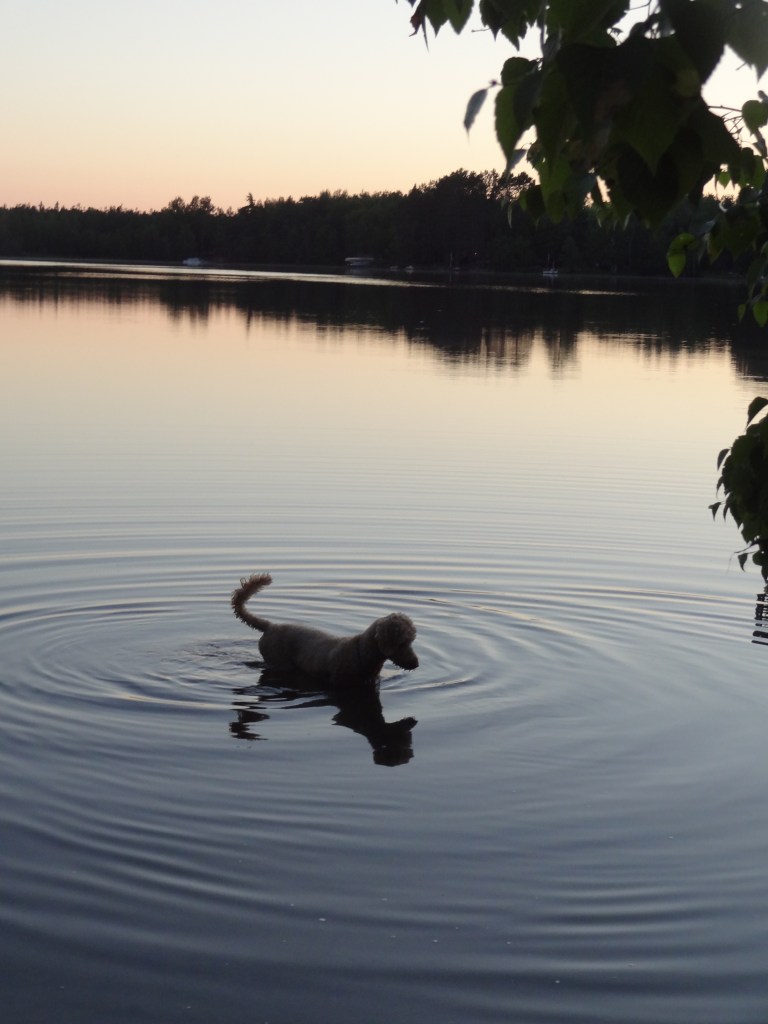
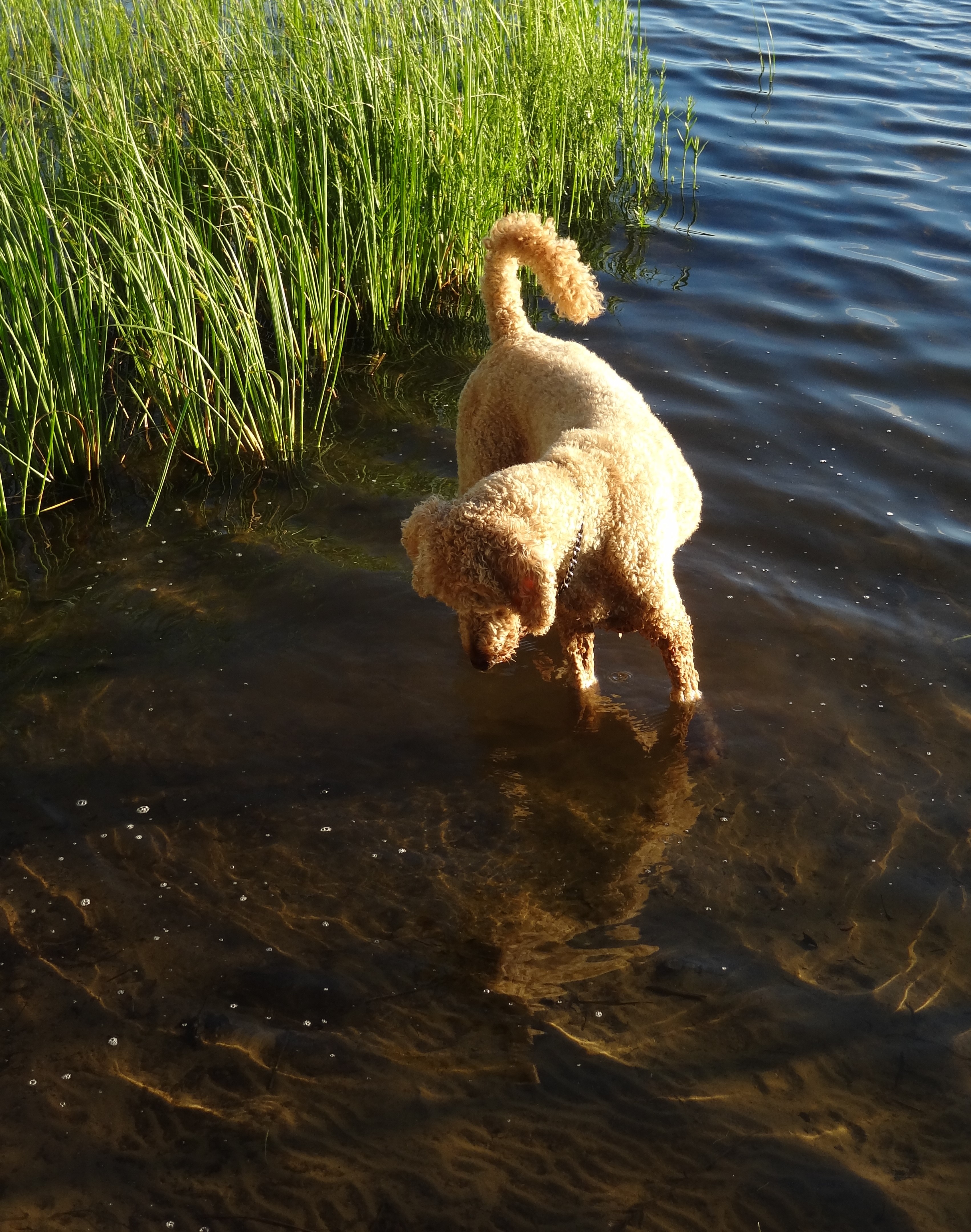
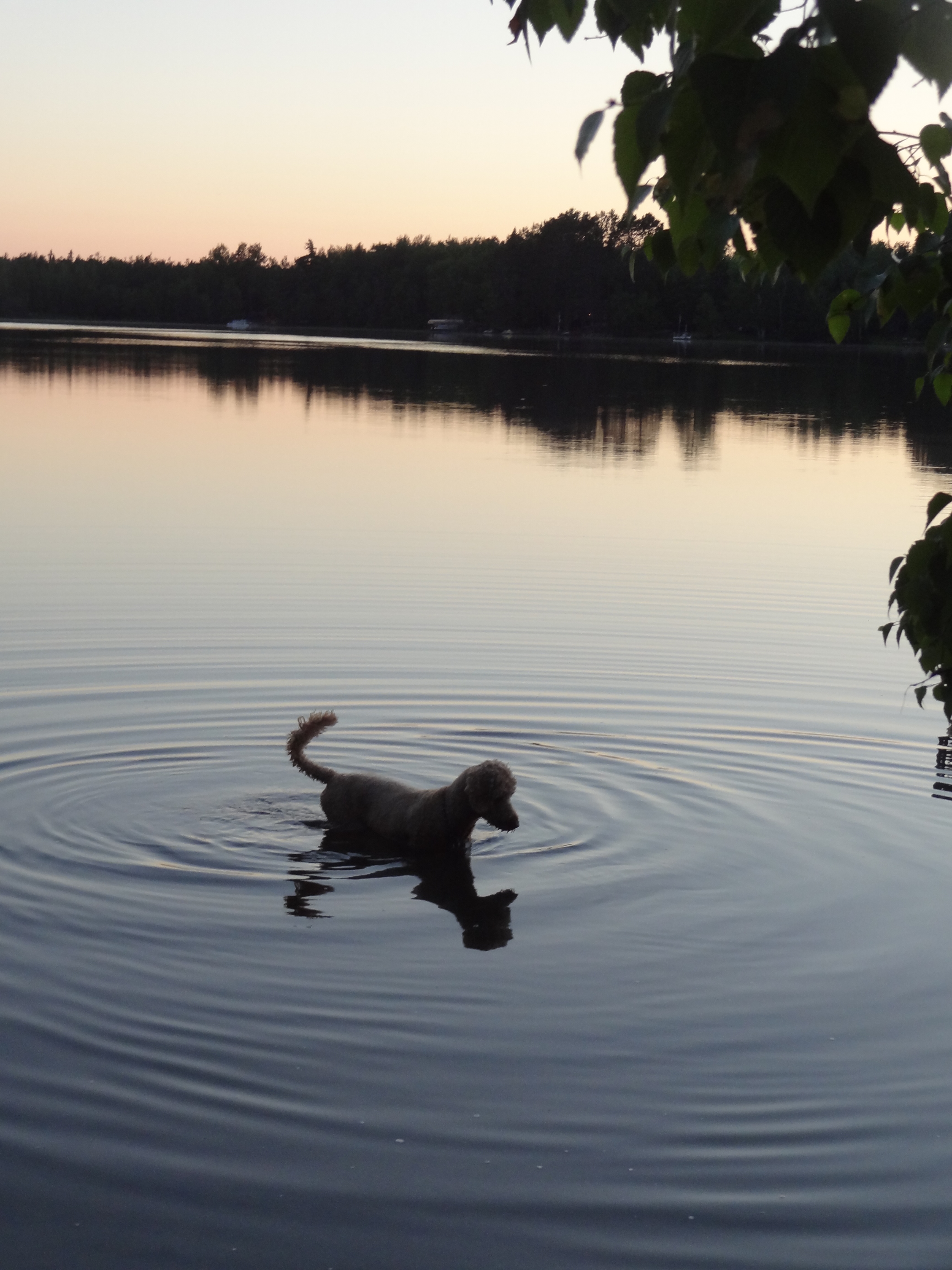
He’s had the chance to spend extra time on a clear northern Minnesota lake. It’s easy to see the young fish and bluegills against the sandy bottom. He was so excited when I pointed out the “fishies” in the water that now he whiles away many an hour wading and chasing them.

He hasn’t caught a fish yet. I don’t think he’d know what to do with one if he did. But that’s why they call it “fishing” and not “catching,” right?

DSC05819

I know that Garrison Keillor of “Prairie Home Companion” fame has fallen out of favor these days, but he told a great story about Bruno, the fishing dog, during a Lake Wobegon skit a few years ago. Bruno could catch fish, and caused a memorable panic during a baby’s baptism reception.

I am hoping that Buddy does not follow suit.

DSC05839

It’s just fun seeing Buddy excited about fishing. I am hoping it doesn’t stress out the fish too much. They probably know by now that he’s not a major threat.

I hope you all are having a summer as good as Buddy’s.

DSC05808