Bicycling from Keewatin to Nashwauk, MN

The Hawkins Mine Pit in Nashwauk. We heard peregrine falcons on the cliffs to the right.

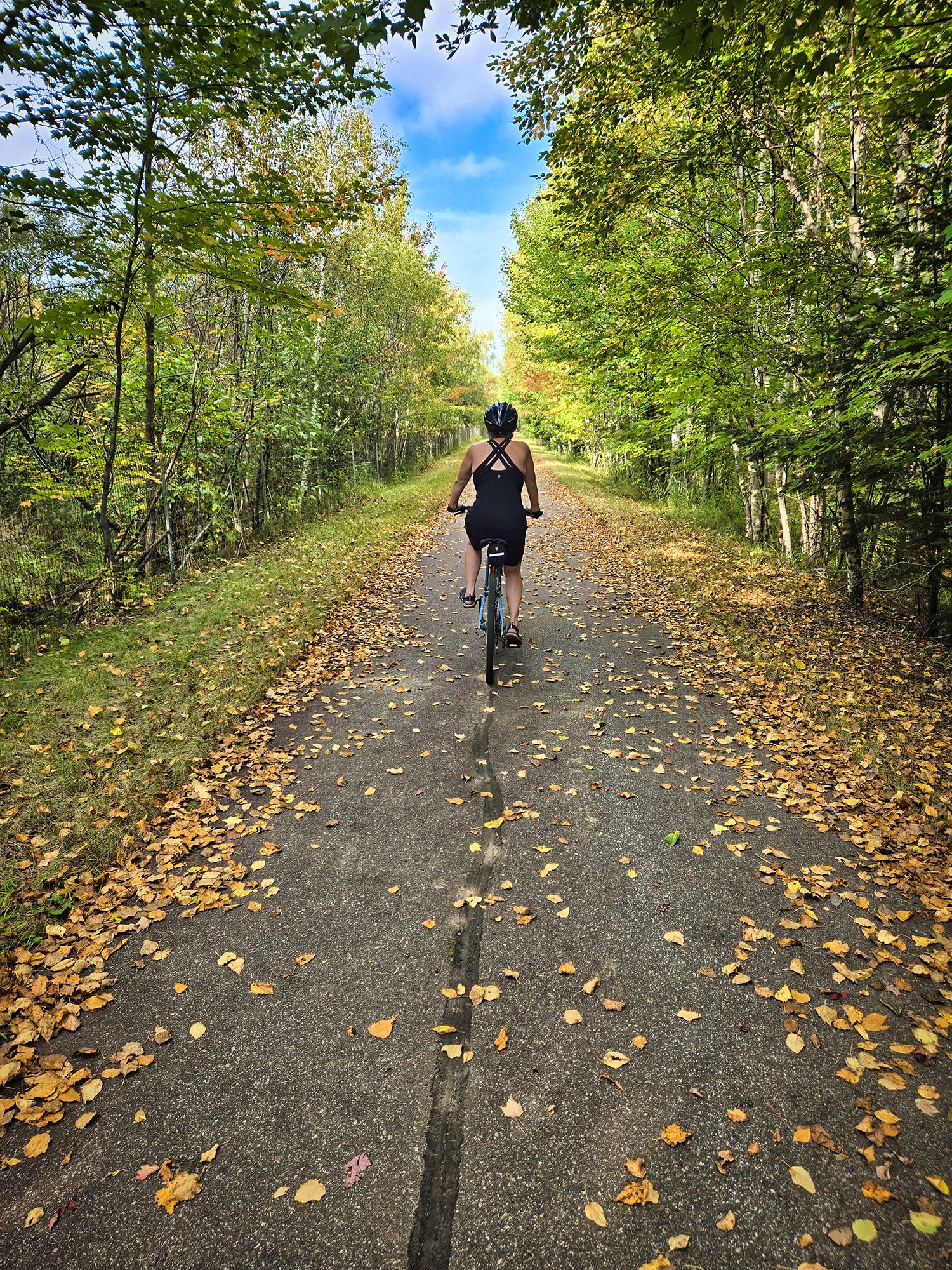
Russ and I have been biking short sections of the 150+ mile-long Mesabi Trail in northeastern Minnesota. Stretching from the Mississippi River to the Boundary Waters Canoe Area Wilderness, the trail will be complete in the next year or two. At that point, it will be 165 miles long, making it one of the longest paved trails in the country.

We’ve biked the trail twice this summer (and many times in the past – a list of other posts included at the end). Those recent trips weren’t very noteworthy, so I didn’t blog about them.

This section of the trail took us between two iron ore mining towns. We began in Keewatin, which was formed during the iron ore mining boom in the early 20th century. The town’s name comes from the Ojibwe word for “north” or “north wind,” and the soil is a rusty red from all the iron it contains.

The 11-mile round trip seemed like a gradual climb both ways to me. I’m not sure how that worked! Only one short, steep hill gave me pause, otherwise it was smooth cycling. The first part out of Keewatin follows an old highway/road that’s no longer in use.

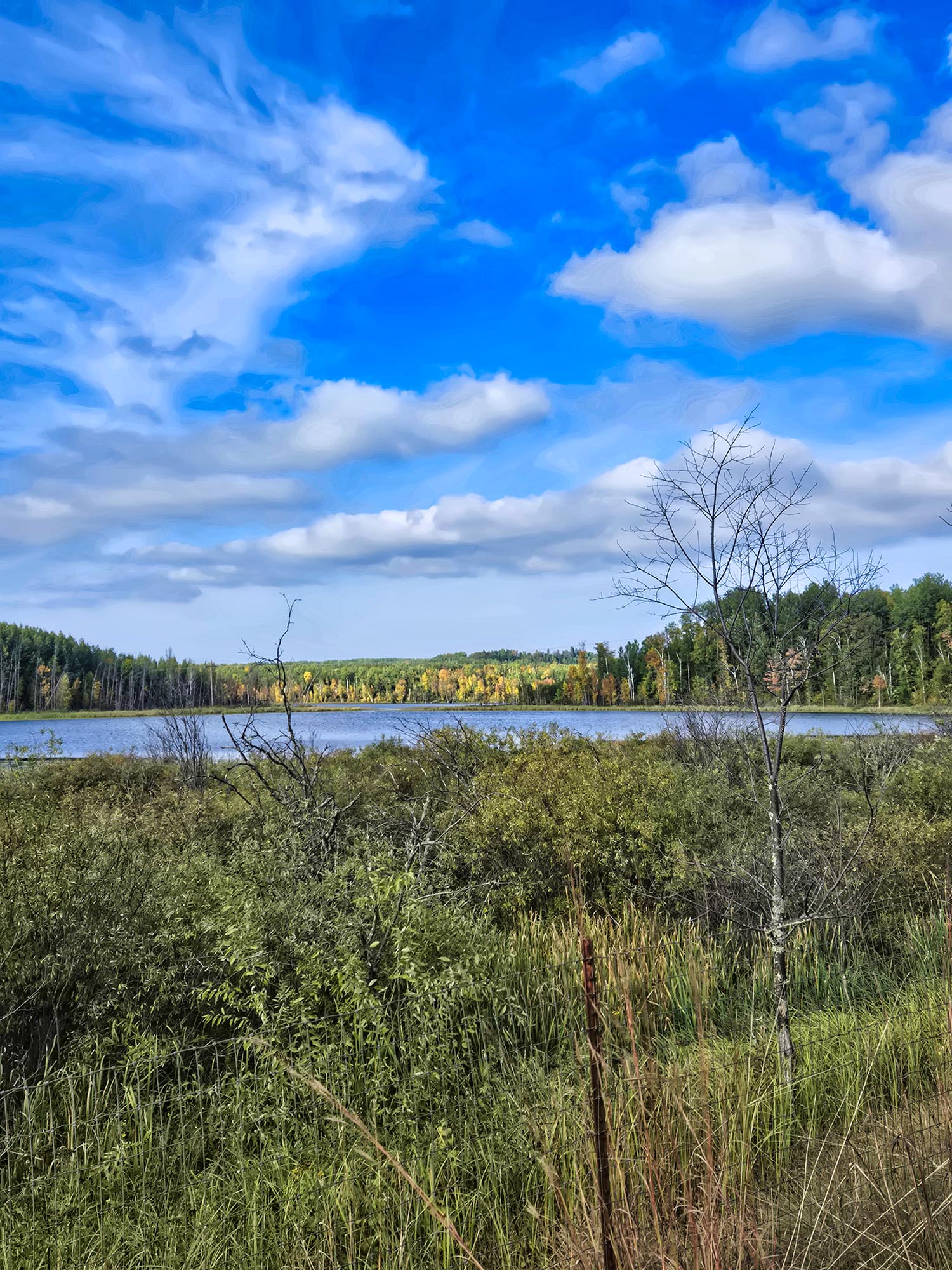
We passed several lakes and mine pits, namely O’Brien Reservoir, Hawkins Mine Pit, and LaRue Pit Lake. A cold rain shower caught us about halfway to Nashwauk. I had to stop and clean off my sunglasses. Sometimes I think they need little windshield wipers! The rain didn’t last long, so we kept on going and the breeze dried our clothes.

Downtown Nashwauk, MN

When we reached Nashwauk, we stopped at an overlook at the Hawkins Mine Pit. It used to be an open pit iron ore mine but is now unused and filled with water. Steep red and tan cliffs topped with green trees line the “lake.” As we admired the view, we heard some squawking that sounded suspiciously like peregrine falcons. I’ve heard that they sometimes nest on the mine pit ledges, so perhaps there was a nest at the Hawkins Pit?

It’s believed that Nashwauk was named after a river in New Brunswick, Canada. The word is said to be from the Algonquin language and means “land between.”

As we turned around and headed back to Keewatin, we noticed a spur trail with a sign about the LaRue Pit Lake. The sign said the area features a boat landing, fishing pier, and is a tourist attraction. We decided to check it out.

Our bikes needed a rest at the LaRue Pit lake. We were fine, of course.

The spur trail came out on a paved road. Unsure which way to go, we chose to turn right, which ended up being the correct direction. The road took us down a steep hill to a picturesque lake. It looked like the “tourist attraction” was still under construction – no grass, just bare dirt that was being graded. An angler floated offshore in his boat, trying his luck with the fish. The LaRue Pit began as an underground mine in 1903-1905. The park looks like it will be a nice place, once finished.

The LaRue Pit lake near Nashwauk.

Then we biked back UP the road and rejoined the trail. Not far from the spur, we stopped at a memorial we had passed earlier. The name on the weathered white wooden cross was James Dorgan and it was dated 12/22/1973. The memorial looked in such good shape, we weren’t sure if that was the day he died or the day he was born. Once back home, I did a bit of sleuthing and discovered that it was his death date. James was a former Keewatin resident living in St. Paul who died in a car accident when he stopped to help his ex-wife, whose car was stalled. Another driver apparently hit him.

We were impressed by how well the memorial has been kept up for fifty-two years. Colorful plastic flowers decorated a flower box, and a wind chime hung from a post nearby. Solar lights illuminate the memorial at night.

We mostly had the trail to ourselves. Saw a few squirrels hightailing it across the pavement. Saw a few walkers. We passed a couple of other cyclists in town. Heard some ATVs but didn’t see any.

From rainstorms to pit lakes to falcons to ghosts, this is a good stretch to ride to get a feel for how important mining is to this part of the country.

Wishing everyone a good Labor Day Weekend!

For more information on other sections of the Mesabi Trail, check out my previous posts:

Biking the Mesabi Trail from Ely West

The Mesabi Bike Trail from Mt. Iron to Kinney, MN

Biking the Mesabi Trail from Hibbing to Chisholm

Biking Along the Giant’s Ridge

Biking Across Minnesota’s Tallest Bridge

Foxes and Fireflies Bookstore Turns One

Superior, Wisconsin, is just across the Minnesota state border from my home in Duluth. A twenty-minute drive down a hill and over a bridge takes me to another state. I used to make this drive nearly every day for work before I retired this spring. Now, I do it less often but it’s for events that are more fun than work!

One such event is a reading and discussion next Saturday (Aug. 30) at Foxes and Fireflies Bookstore in Superior (1401 Tower Ave). It’s billed as a “local author extravaganza,” which I love, especially since there are only two of us doing presentations. 😊

I used to get nervous before these events from self-consciousness and fear of being judged, etc. (By the way, fellow blogger Swabby offers an excellent post today about self-absorption.) But I’ve had enough practice now and done enough presentations about my books and photography that for the last several events, I’ve just winged it.

Me at the book launch for Meander North. (This was before Foxes and Fireflies had opened.) Look, I’m having fun! Image by Russ.

It’s worked out well, I think. I wasn’t nervous one bit. I’m glad I’ve finally reached this point. That only took over a decade! Public appearances still take a lot out of me, but dare I say they’re even becoming fun. I enjoy learning about the audience members and pondering their questions. And I’m not talking about huge audiences here, so they’re usually intimate affairs. Ah yes, the glamorous life of a local author!

For next weekend’s event, I’ll read from my books, The Path of Totality (magical realism short story collection) and Meander North (blog memoir). I’ll look over notes from past talks beforehand, but I’m going to leave them at home and see how “winging it” goes again.

The other author who’s reading is Gina Ramsey from Superior. Her book is Burnt Gloveboxes. (Two volumes.) She relates crazy but true things that have happened to her family.

Foxes and Fireflies is the first independent bookstore that Superior has had in years since Beecroft Books closed. I used to love going to Beecroft for author events. Afterward, the authors would have the honor of signing their names on a long white hallway. It was my goal to someday write a book and be able to sign that hallway, but the store closed before I had that chance.

My fox from the bookstore.

Foxes and Fireflies was opened by Maria Lockwood, a reporter for the Superior Telegram, kind of by accident. She was researching a business grant program for a story and decided to submit a grant to see how the process worked. Lo and behold, her project was chosen to receive the funding! She’s been working at the bookstore and at her reporting job, so she has her plate full. She’s so supportive of local authors. Besides books, Maria offers all sorts of other literary paraphernalia and cute little toy foxes.

Instead of a long hallway for authors to sign, in the tradition of Beecroft Books, Maria offers a whiteboard. My name is proudly on it.

If you’re in the area, please stop by for the author extravaganza or any of the bookstore’s other events.

Old Fish in Lake Superior Sparks Controversy

The oldest lake trout yet discovered in Lake Superior, also known as “Mary Catherine.” Image courtesy of the Michigan DNR.

The Michigan Department of Natural Resources (DNR) published a story a few days ago that made many people upset. As someone who has her feet in both natural resources management and public relations/science communication it offers an interesting case study. The DNR was trying to highlight an interesting fact about how fish can reach old ages, but some mistakes got in the way of this message.

The ear bone of one fish they caught in a special survey done in 2023 to study the different forms of lake trout and their reproductive biology was recently analyzed and the DNR discovered that the fish was as old as I am! (62 years) They caught the lake trout on a reef in the southeastern part of Lake Superior (40 miles north of Grand Marais, Michigan) and this lake trout is the oldest one currently on record.

The ear bones of fish show annual rings much like a tree, and that’s how the DNR can tell the age of the fish. It’s the only way they can do this, and they have to kill the fish to extract the ear bone, also called an otolith

Mary Catherine’s otolith shows 62 years of growth. Michigan DNR image.

One mistake the technicians made was naming the fish. They picked the era-specific moniker of Mary Catherine because Mary was one of the most common names in 1961 when the fish was hatched. People who heard news reports were excited that such an old fish was found, and that it even had a name, only to be crushed when they learned later that the fish was killed in the process of discovering its age.

One Facebook commenter said, “Hey we just killed Mary Catherine, but the upside is we now know that she was 62 years young, much like many grandmothers and recently retirees. There’s one less on Social Security now, and that should help keep it solvent.”

Another said, “Sad that they killed a fish who is probably older than the combined ages of some of the researchers, but it is interesting information.” Another commented that the fish might have lived another 20 years if not sacrificed for science.

You might think that such an old fish would be very large, but she wasn’t. Mary Catherine weighed 2.1 kilograms (4.62 pounds) and was 627 millimeters (24.7 inches) long. That’s because Lake Superior doesn’t have much food in it and animals grow slowly. The typical lifespan for a lake trout is 25-30 years.

The story gained wide media coverage, so it was successful that way, but even some of the reporters were dismayed that Mary Catherine was a goner. People already love to hate the DNR, and this well-intentioned science story just gave them another reason.

I’d say the main lesson is not to name your research subjects in newsworthy stories, especially if they’re dead.

The researchers were mum about whether they were inspired by the Saturday Night Live character, Mary Katherine Gallagher.

In Which Marie Competes in her First Paddleboard Race

One of my paddleboards and a sliver of the moon reflected in the water.

For more years than I care to count, I’ve staffed a booth for work at Lake Superior Day, which falls annually on the third Sunday in July. When I wasn’t informing people about water quality issues and research, I was gazing wistfully at the groups of paddlers gathered for a race held in conjunction with the event.

The “Paddle for the People” competition welcomes paddleboarders, canoeists, and kayakers. The 4 K race takes them around Barker’s Island in the bay just offshore from the city of Superior.

Last year, a gray-haired woman won the event. She inspired me. I decided that in 2025, since I’d be retired and not staffing a booth anymore, I was going to enter the race.

This spring I sent in my entry. Once the ice went out on our cabin lake, I began training. Having never raced on a paddleboard before, I watched online videos for tips. Russ helped me figure out that two-and-a-half times around our lake equaled the race distance. Around and around our lake I went.

Me, ready to paddle!

I’d circled Barker’s Island on my board a couple times in the past just for fun, but I did it one more time before the race to assess any hazards and to build my confidence.

Come race day, I awoke a couple hours earlier than usual (ouch) to make it to the start of the race on time. I felt good but had no illusions about winning. The weather cooperated: warm and sunny with little wind. The only problem was poor air quality from wildfire that had drifted from Canada, but it didn’t seem to bother me.

About thirty of us lined up in the bay on our various crafts behind an imaginary starting line. When the bullhorn blew, we were off! I got a good start, paddling with quick, short and powerful strokes and I didn’t crash into anybody. Soon, we paddled around one end of the island and were out on the unprotected side, but conditions stayed optimal.

I was about halfway around the island when an older lady who I’d spied before the race slowly passed me. I wondered if she was in the same “old lady” race category as I was. She was about a foot taller than me. Her technique wasn’t that good, but she was propelled by long-armed strokes. I decided to try and stay with her and pass her if I could in case she was my competition.

At one point, she slowed to (unsuccessfully) try and pick up a can floating in the water. Although I was impressed by her environmental concern, I thought this was my chance to pass her. Try as I might, I couldn’t catch her. I still felt like I was paddling strong when I watched in dismay as a couple of young people with small dogs on their boards passed me. Then came two overweight people who were sitting too far to the front of their boards. They virtually plowed through the water paddling with kayak paddles and also passed me.

I shrugged off my dismay and just dug in. The “other old lady” crossed the finish line twenty-five seconds ahead of me. At the end, I felt good about the effort I expended and the fact that I wasn’t last.

The race organizers held a short awards ceremony afterward and sure enough, I came in second in my category to the woman I had been chasing. I received a silver medal for my efforts.

Now I know what the race is about. But I don’t think I’ll do it again. Waking up early and then paddling hard for 45 minutes isn’t my idea of fun. But I’m glad I stayed true to my self-promise and participated instead of gazing at the racers wistfully from shore. What dreams have you pursued this summer?

Boundary Waters Adventures

Our canoe at our campsite on Brule Lake.

Russ and I sacrificed a 40-day winning streak on the NY Times Connections word game to head to the Boundary Waters Canoe Area Wilderness where there is no phone or internet service. We traveled with our friends Sharon and Mike to Brule Lake – a place I last visited 35 years ago.

To go easy on our aging bodies, we decided to do a canoe trip without any portages. (Portages are where you carry your canoe overturned atop your shoulders on a rugged trail to the next lake.) Brule Lake is large enough to spend several days there without needing to go anywhere else.

We were partially successful in meeting our goal. The only “failure” came on our third day of tent camping when Sharon and Mike decided to portage to a small lake for better fishing. We hiked the portage without our canoe to see if the lake was worth the effort of hauling it there. With forested hills and a cute island, the beauty of the new lake and the short length of the portage convinced us to bend our no-portage rule. It was a true wilderness lake with no campsites or other signs of human habitation.

To share the pain of portaging, we opted for a two-person carry, where we carried the canoe over the portage with one of us on each end of the watercraft – no hefting it up onto one person’s shoulders.

We were glad we did; canoeing on the lake offered views of a loon and its baby. We found the loon’s nest on the small island, where we ended up eating lunch much to the delight of the ants there. Our presence was probably the most exciting thing to happen to them in years! Sharon and Mike caught enough fish to feed us all dinner that night.

After we spent several hours on the lake (which I am purposefully not naming because Minnesotans don’t do that with good fishing lakes), the sky began to darken. We decided to head back to our campsite on Brule Lake. We couldn’t relay this to Sharon and Mike because they were at the far end of the lake.

We made it across the portage and out into the bay when the storm broke. The first drops of rain were huge and cold. We were wearing our swimsuits because we expected rain, so we didn’t mind being wet. What we did mind was the wind and the thunder/lightning! Yelling through the gale, we briefly considered riding out the storm on land, but we were so close to our campsite and the lightning was far away enough that we decided to power through and hope we didn’t get struck. (That was reckless of us, I don’t recommend staying on the water in a thunderstorm. Don’t try this at home!)

Our cute tent in dryer times.

We made it to camp and I quickly climbed into the tent to get into dry clothes. Russ was already so wet, he stayed outside. Once I changed clothes, the wind picked up even more. Russ had to tie down our lightweight Kevlar canoe to keep it from blowing away. From inside the tent, I held down the side the wind was hitting so that the stakes wouldn’t pull out of the ground. After what seemed like hours, the storm abated.

Our tent bottom (and a sleeping pad), drying out in the sun after the storm.

We were a little worried about Sharon and Mike, but this wasn’t their first BWCA Wilderness trip, so we assumed they’d be okay. But as the hours ticked by and the sun lowered, we began to discuss how long to wait until beginning a search for them. Not long afterwards, we heard them paddling back to our campsite. We greeted them with shouts of “You’re alive!”

They explained that they also stayed on the water during the storm, riding it out next to shore. (That was reckless of them, I don’t recommend staying on the water in a thunderstorm. Don’t try this at home!) Then they stayed on the unnamed lake to fish more. We ate the fruits of their efforts with relish that night – the first non-freeze-dried dinner Russ and I had eaten in days.

Mmmmm, wilderness walleye filets!

The next morning, our final morning, another thunderstorm rolled through, but it wasn’t as strong as the previous one. Once it stopped, we packed up our soggy gear and headed to the canoe landing, wanting to cross Brule Lake as quickly as possible in case another storm was gathering. Sharon and Mike planned to leave later.

We made it back to the landing. Driving home, we appreciated the gradual return to civilization. Backwoods gravel roads gave way to pavement that led us past homes and eventually to the small town of Lutsen. The day turned hot and muggy, so we stopped for ice cream on the way home to Duluth.

Our campfire on Brule Lake.

Now we’re back winning Connections again: 6 games so far. But we both agree this wilderness trip and the memories of spending time with good friends, listening to loons yodel, telling stories around the fire, and surviving thunderstorms were more than worth breaking our streak.

Paddles and sunset on Brule Lake.

Close Calls in Boulder, CO

The Flatiron Mountains as seen from Chautauqua Park in Boulder.

When Russ and I were Scamping in Colorado last month, we visited Boulder with my son and his friends.  One site was a local park that’s home to the Flatiron Mountains, which are a series of five impressive flat-sided peaks. The destination is popular with hikers and climbers.

I almost went to college there at the University of Colorado in Boulder, so that was one reason for our visit. Back then (and maybe even now) its biology program had a good reputation, which attracted me. I was even assigned a roommate. But at the last moment, I decided to attend the University of Minnesota instead for financial reasons. The university wasn’t far from the park we visited, and as we drove past, it was fun to ponder how my life might have been different if I’d stuck with my first choice of college.

Anyway, back to Chautauqua Park. We hiked 1-1/2 miles UP and DOWN the base of the Flatirons. The spring flowers were out, which added cheerful color to our high-altitude breathlessness. My son’s friend went to college in Boulder and had climbed the mountains and he regaled us with tales of his adventures.

Afterward, we ate lunch at a Vietnamese restaurant. As our meal wrapped up, we discussed the agenda for the rest of our day. Originally, we’d planned to shop at the Pearl Street Mall in downtown Boulder, but nature won out when we decided we didn’t have enough time and would rather stop at Golden Gate Canyon State Park for a short hike. As we rose from the table to leave, emergency vehicles raced down the road. We wondered what was going on, but didn’t give it much thought until the next day when we learned about the Pearl Street Mall hate-crime attack.

Every Sunday since the Hamas-led attack on Israel in the fall of 2023, pro-Israel people have walked at 1 p.m. through the mall toward the courthouse to remind people of the hostages taken. Sometimes they sing the Israeli national anthem. It’s a peaceful demonstration.

On the day of our visit, a man yelled “Free Palestine” and threw a Molotov cocktail into the crowd of demonstrators. You can read national news accounts for a description of what happened next. In the end, eight people were badly burned and four had to be airlifted to Denver. One later died. The suspect (a recent transplant from Egypt) was quickly arrested and now faces a possible death penalty.

The view from Panorama Point, Golden Gate Canyon State Park, CO.

Blissfully unaware of these circumstances, and as more emergency vehicles passed us going the other direction toward downtown, we drove to Golden Gate Canyon State Park on our way back to Denver.  The park was recommended for hiking by my cousin who lives in Golden. We stopped at Panorama Point and enjoyed watching a dramatic thunderstorm roll past. As the storm turned toward us, we parted ways.

The next day when we learned about the Pearl Street Mall attack, we felt for the injured people, but also felt lucky that we had changed our minds about a mall visit and didn’t end up as collateral damage. The restaurant where we had lunch was only 10 blocks away from it.

What if I had gone to Boulder for college? What if we had eaten our lunch faster and decided to visit the Pearl Street Mall? I guess we’ll never know answers to the questions raised by these two close calls.

I dedicate this post and these images to the victims of the Pearl Street Mall attack.

Panorama Point, Golden Gate Canyon State Park

Changing my Morning Routine

My last (and empty) box of dark cocoa.

I discovered recently that conditions half a world away have disrupted my morning routine. Instead of drinking coffee like many of you out in the blogosphere do, I drink cocoa. I make it myself because most of the commercial brands have ingredients I can’t tolerate. I use dark cocoa, pure cane sugar, milk, some decaf coffee crystals for extra flavor, plus cinnamon and nutmeg for zip. I drink it hot in winter and iced in summer.

However, for the past few months, I haven’t been able to find dark cocoa on the grocery shelves anywhere in my town. I can only find regular cocoa, but not much of that, either. I finally turned to the internet to discover why.

I learned there’s a global cocoa shortage that’s affecting the entire chocolate industry. I was aware there was a chocolate shortage, but I never thought of that affecting cocoa, for some strange reason. Cacao crops in Ghana and the Ivory Coast of Africa (which produces 60% of the world’s cocoa) are being destroyed by weather and an insect-borne disease with the worrisome name of Cacao Swollen Shoot Virus Disease (CCSVD). This and other factors are causing shortages of cocoa and chocolate, increases in prices, and supply chain issues. According to one blog, it’s even encouraged a cocoa smuggling business.

I began drinking dark cocoa because I thought it was “healthier” – containing more antioxidants than regular cocoa, just like dark chocolate contains more antioxidants than regular chocolate. Later, I discovered this is not true! Regular Hershey’s cocoa actually contains more antioxidants. But I kept drinking dark cocoa for the taste.

I guess that for now, I’m forced to drink regular cocoa and be “healthier.” I’m just glad I can find that on the shelves.

Here’s what AI suggests for finding Hershey’s dark cocoa if you just can’t live without it:

  • Check online retailers: While some stores may be out of stock, it might be available on websites like Amazon.
  • Consider other brands: If you can’t find Hershey’s, you might consider other brands of cocoa powder.
  • Use product locators: Some retailers may have online tools to help you find stores that have the product in stock. 

‘Murica!

The weather for Independence Day in northern Minnesota was perfect: hot and sunny. I thought I’d share some images from it.

I can’t believe that my phone camera caught this firework on its way into the sky, looking like a space rocket. An empty brandy bottle served as a fine launch pad.

No 4th of July is complete without my mother’s potato salad recipe. It features extras like black olives, hard-boiled eggs, mustard, onion, dill, and paprika. I made enough to last our crew for several days!

Back in Colonial days, cakes used to be a “thing” for Independence Day. As for us, we devoured a fruit pizza, which is basically a huge sugar cookie covered in cream cheese, whipped cream and fruit that matches the day’s color scheme (red, white and blue).

We ended the day at a community parade. I’d never been to it before and was surprised by the number of people who attended, especially since there aren’t that many people who live in the area. The parade was filled with ATVs, floats from local businesses, and people tossing candy to children. One guy was even handing out fireball whisky shots! There were also a few disturbing “Don’t Tread on Me” flags on the ATVs (a symbol for the alt-right) and much Trump paraphernalia in sight, but that’s the politics of this rural area, as it is in many small towns across the country.

This was the cutest float in the parade. While many of the ATVs were trailing beer cans, he chose pop cans. Note the patriotic dudes in the background.

We had a great time with family and friends. I hope your 4th was memorable, as well. What are your traditions?