A Tribute to Mary Oliver

I happened to be reading Mary Oliver’s “Dog Songs” book of poems over the course of several evenings when I heard the news of her death last week. What a momentous passing for the poetry world! The thought that she will never write another word for the world to read is depressing. I’ve been in a funk for a few days.

One of my friends said that when he heard the news, it hit him like that scene in “Star Wars” when Princess Leia’s home planet of Alderaan is destroyed by the Death Star; a giant scream passes through the galaxy, heard only by those who are strong in the Force. In the case of Mary Oliver, I imagine many poets emitted silent screams when they heard the news.
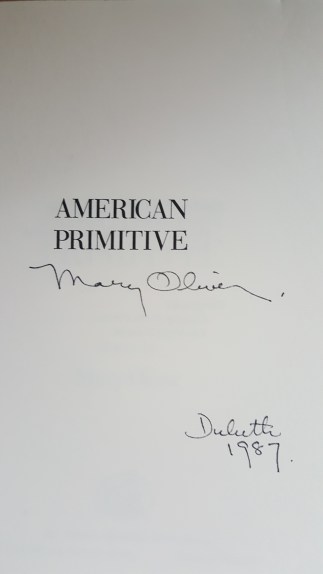
20190121_143759I’ve long been a fan of her work. I even was able to see her read in person in the hinterlands that are Duluth way back in 1987. Her autograph is on my copy of “American Primitive” as proof!

I appreciate how Mary made poetry accessible. Her consistent weaving of themes from the natural world and the sensual world spoke to me unlike the work of any other poet.  Thank you thank you Mary Oliver for having the courage to put your words to paper and the perseverance to publish them!

I’d like to share with you some of my favorite poems from “Dog Songs,” which, as if you couldn’t guess, are poems about her dogs.

These lines are from one entitled “Her Grave,” and they echo thoughts I have almost every time I walk my dog:

A dog can never tell you what she knows from the

smells of the world, but you know, watching her,

that you know

almost nothing.

In that short phrase, Mary explains the different worlds that dogs and humans inhabit, yet how closely they are connected.

Another favorite is, “The Poetry Teacher.” This poem describes how the university gave Mary a “new, elegant” classroom to teach in – one where her dogs were not allowed. She would not agree to that and instead moved into an old classroom in an old building. She kept the door propped open and eventually her dog would arrive with his friends . . .

all of them thirsty and happy.

They drank, they flung themselves down

among the students. The students loved

it. They all wrote thirsty, happy poems.

Then there’s “The Wicked Smile,” about a dog who seems famished for breakfast and “talks” Mary into feeding it, only to “confess” afterward that someone else fed him breakfast already.

While her dog poems are not quite as strong as her people-oriented poems, they are certainly worth reading. You won’t look at dogs in quite the same way afterward.

May you all write thirsty, happy poems!
The Jayme Closs Case and the Importance of News Headlines

jaymecloss

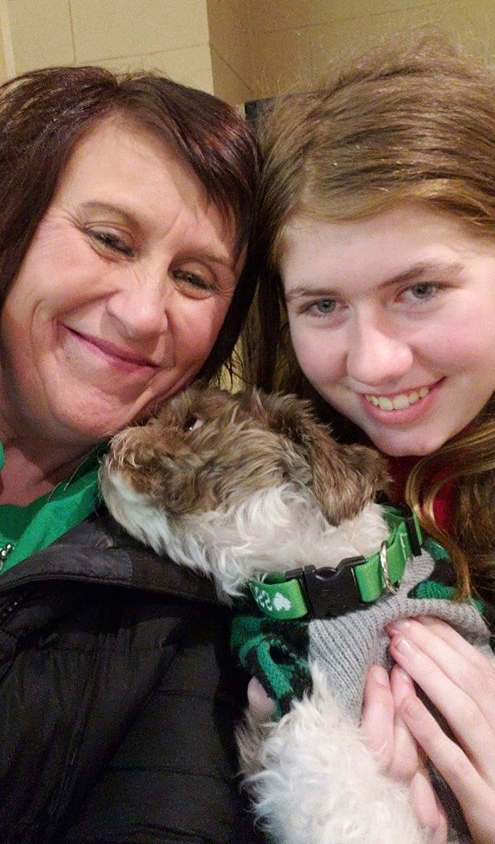
Jayme (right), her aunt, and doggie, safe at home. Credit: Jennifer Smith

I was in the bathroom, putting on my makeup with the door open when the television news story came on about Jayme Closs. She’s the 13-year-old girl who was kidnapped in northern Wisconsin. This was the morning after she was “found.”

The newscasters were going on about how she had been “found alive.” Of course, this was wonderful and superb. News of her kidnapping had filled newspapers and airwaves for weeks, and it seemed that, especially during the holidays, her photo and identifying information appeared often in an attempt to keep public awareness keen.

The reporter on the news show was interviewing Jayme’s aunt over the phone and was asking for details about how Jayme had been found. Since there had been such a major search effort put on for her in the area where she disappeared, I think most people assumed that volunteers or the authorities had found her. Part of the inherent definition of “found” is that it’s something that somebody else does.

Then Jayme’s aunt said that Jayme had escaped from the house where she was held. I popped my head out of the bathroom and walked over to the television. This was new information. This wasn’t just a damsel in distress being found. This was the damsel slaying the dragon and saving herself!

I watched the interview for a few more minutes, but then had to leave for work. During my drive, I heard a radio story about how Jayme had been “found.”

By the time I got to work, the writer in me and the MeToo woman-power feminist in me was dismayed by the passive and inaccurate role these newscasts were putting Jayme in. I wrote this quick post to my recent (personal) Twitter account:

I’m happy and relieved to hear that Jayme Closs is alive! However, it bugs me that the media keeps saying she was “found” alive. She freakin’ escaped her captor and saved herself. #JaymeCloss

I’ve only written a few tweets before then, and I’d never used a hashtag before. I didn’t expect much to come of it.

Holy moly, the thing went viral! As of this writing, my little tweet made 209,000 impressions. It had 4,400 engagements, 2,270 likes, 372 retweets and 78 replies. At one point as I sat watching the stats rise, 20 people per second were viewing it.

That was scarily overwhelming for a person whose most popular tweet to date only had six likes. Handling the comments was also overwhelming. Obviously, many people agreed with my sentiments and said they thought the same thing. Others were upset because they thought I was criticizing law enforcement personnel. I explained I was criticizing the news media, not law enforcement.

Others asked me what words would be better to use instead. I said, “Missing Girl Escapes.” Better yet is the headline I saw a few days ago that said, “She’s the Hero!”

Others jumped on my semantics bandwagon and criticized the use of the word “miracle” in connection with her escape. “It’s called self-preservation and bravery,” one tweeter said.

Then the authorities held their first news conference after her escape and commenters to my tweet started dissing them for the self-congratulatory tone of the event. Yes, these agencies did stellar work in trying to find her, and yes, they found her captor soon after Jayme escaped, but to many, it seemed as if the law enforcement agencies were taking all the credit and not giving enough to Jayme. This incensed one commenter so much that she said she called the sheriff’s office and complained about the way they handled the press conference.

Others criticized me for making a big deal out of word choice when this was such a joyous occasion. All I can say is that words matter. Accuracy matters. I have a journalism background and master’s degree in journalism. Words are part of who I am and I’m not going to apologize for that. And it’s obvious my words struck a chord because a heck of a lot of the commenters agreed with me.

This issue makes me wonder, if Jayme had been a boy, would the news media and the authorities have characterized her escape so passively at first? Comparing headlines (passive vs. active) for kidnap victims who escape would be a good PhD journalism research project to see if gender plays a role. PhD students feel free to steal this idea!

Lately, the news conversation has been about who should get the $50,000 reward in the case. Everyone – even the people who first saw Jayme – are saying the reward should go to Jayme because she saved herself. I think that’s very fitting. Jayme’s parents were both killed by her attacker/kidnapper. She’s going to need all the emotional and financial help she can get in the future. I hope that happens.

But I’m not going to tweet this opinion. 🙂


P.S. If you want to write or donate to Jayme, the address is: Light the Way Home for Jayme, PO Box 539, Rice Lake, WI, 54868.

The Case of the Headless Bunnies

bunny1naturehaven

A cottontail rabbit. Image courtesy of naturehaven.com.

Almost every day, I walk Buddy the Wonderdog in the woods by my home. This past summer, I was creeped out to see two dead rabbits on the edge of the woods. The incidents happened at separate times but in almost the same locations. The rabbits’ heads were gone, but much of their bodies was still there.

Then yesterday, I saw a headless rabbit again along a different edge of the woods. It lay in the snow with its fur ruffled at the beginning of the trailhead — almost as if someone had placed it there on purpose. A bloody mangled mess of muscle marked where its head and one of its legs had been. No animal tracks led to or from the body. It was as if the rabbit dropped from the sky.

Mysterious.

I finally got curious enough to investigate. I searched the internet for “animals that eat rabbit heads.” I came up with a story from the Toronto Star in Canada that described the horror some schoolchildren felt when they found headless bunnies near their schoolyard. The children thought a person with evil intentions decapitated the rabbits.

However, people familiar with the ways of wild animals responded that the bunnies were the work of an owl, not a Satanic Cult. They explained that owls can’t carry the whole rabbit, so they only take the head.

That’s the same explanation my woods-wise friends gave me when I described the gruesome scene from my dog walks. Also, brains are made out of fat, so I suppose owls get more energy from eating them than from eating other parts of a rabbit.

Similar to the situation mentioned in the news article, the rabbits’ bodies I saw this summer were near the same location each time. I think that makes sense. Animals tend to hang out in the same places. If an owl found a rabbit in a certain place one time, it must be a good place for rabbits, so they are likely to hunt there again.

The lack of tracks also makes the case for an owl doing the killing (or some other type of raptor) versus a human or an animal. The owl attacked from above, so of course it wouldn’t leave tracks.

I am glad to learn that the headless bunnies are just a case of nature taking its course, and not the work of twisted humans. But I am still sorta creeped out.

Old Wood: A Love Story, Part 3

20181217_161210

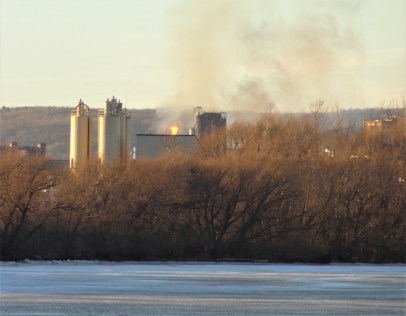
A screenshot of the Globe Elevator fire, courtesy of WDIO-TV.

Sometimes I shiver at the prescience of my past blog posts. Like the time I wrote about the “ice castle” that was being built outside of my office and said, “What could possibly go wrong?” (It collapsed while its creator was talking to a reporter for the New York Times.)

I got the same shiver when I read my 2013 “Old Wood” series about the historic Globe Elevator in Superior. (See Part 1 and Part 2.) The owners were trying to save their wood reclamation business from bankruptcy. The last line of my story was, “These pieces of history should not go up in smoke.”

Guess what? Unfortunately, the old grain elevator, some equipment, and a couple million dollars of wood burned in an accidental fire last month.

dsc05093

The view of the fire from my office window.

The sight of flames and a plume of smoke out my office window alerted me to the fire. My coworkers and I immediately felt the lingering trauma of the Husky Energy Refinery Fire that happened this spring near our office and required a community evacuation. We made frantic calls to assess the danger and whether we should leave again.

Thankfully, no explosive chemicals were involved in this fire, just some really dry and valuable old wood, so we didn’t need to evacuate. The people I interviewed for my previous posts no longer owned the site – others were working to salvage the wood. News reports blame a spark from a piece of equipment for starting the fire, which quickly engulfed the elevator.

Another thing to be thankful for is that the elevator was out on a spit of land in the harbor away from other structures, so there wasn’t much danger of the fire spreading elsewhere. The location did make firefighting a challenge, however, because it was a long way away from a hydrant. Once the flames calmed down enough, fire crews were able to pump water from the harbor to put out the fire.

Anyway, now I’m rather paranoid to write about anything for fear of encouraging mayhem. I learned during Christmas gatherings with my relatives that I am now known as “the cousin in the middle of all the disasters.”

Of course, I know I don’t really have the power to write disasters into existence, but you’ve got to admit, my record is rather uncanny!

The Neighborhood Rezoning Zombie Apocalypse

WalkingDead-963583AMC

Image from The Walking Dead television series, courtesy of AMC.

One of my blog readers warned me it might not be dead, but I didn’t want to hear. I plugged my ears, closed my eyes and started singing (“La la la la la…”)

But he was correct. The rezoning issue for my neighborhood wasn’t dead. It rose, like a zombie, from the Duluth City Planning Department even though the planning commission voted it down. (See Part 1, Part 2, and Part 3 for more info about this six-month-long saga.)

As it turns out, this is common practice in my city. The planning commission actions are just considered “recommendations,” not the final word. I wish someone had explained this to us from the beginning.

Thinking you’ve won a fight only to find you need to fight it all over again is disheartening. It also seems like a waste of effort to have every zoning issue heard by two civic groups. Why even have a planning commission then?

Anyway, once I heard that the proposal to rezone our Duluth residential neighborhood for commercial development was going before the city council, I admit, I tucked my head and legs inside my shell and hid for a while. However, in hiding, I regathered my gumption and eventually fired off yet another letter of protest to the city council. But that, and writing blog posts, didn’t seem like enough.

The city council heard the issue during two meetings. I couldn’t make the first hearing (because it happened while I was being a turtle). The same couple of neighbors who spoke before the planning commission spoke before the council. I decided it would be good to add a new voice for the next meeting, and that voice should be mine. If I was going to come out of my shell, I might as well do it up good.

The city council chambers was packed – standing-room-only. Most people were there for another contentious issue that involved a proposal for a new downtown apartment building that did not have any affordable housing units included. Along with a lack of single-family homes (like those in my neighborhood), a lack of affordable housing is a big issue in our city.

The hearing for the apartment building and other city council issues took 3-1/2 hours. We sat there at 10:30 p.m., boiling in our long johns, awaiting our turn. Once the affordable housing protesters left, a good number of my neighbors remained in the chambers.

I ended up as the first signed up to speak for our issue. When my name was called, I took a big gulp, stood, and did my thing. I was too nervous to speak without notes, so I used those as an aid. They also helped me stay within the three-minute speaking limit. My speech went fine, and I was sure glad once it was over! Several other neighbors also spoke.

The city councilors asked questions and a few explained their positions. In the end, they voted UNANIMOUSLY (7-0) to reject the proposal to rezone my neighborhood. I am so thankful that they listened to us and to the planning commission.

Is the zombie rezoning war over? Not if the planning commissioner has his way. He said he plans to bring it up again in a few years because he wants to see “orderly development” of my neighborhood. We neighbors would rather see no development. We are a neighborhood that works. Like I said in my speech, our neighborhood ain’t broke, and this won’t fix it.

This fight seems to have renewed people’s appreciation for our neighborhood. This Christmas, for the first time, carolers came to my door. Another neighbor made luminaries (ice candles) and placed them all along the road to her house, providing a special festive touch.

The zombie is dead for now, but it seems as if the issue is biding its time, waiting for another chance to strike. I hope we’re ready to rally then.

Let’s have some fun with this. Feel free to comment with your favorite zombie-killing techniques. They could come in handy later!

The Year in Blogging, 2018

OLYMPUS DIGITAL CAMERA

The image from my most popular post of 2018. No, I am not flipping you off! Photo by Jak of the Mast Cells & Collagen Behaving Badly blog.

Traffic to my blog continues to grow slowly. Part of the slowness is because I don’t have a lot of time to visit other blogs and court their owners’ readership of mine. I am too busy living life and writing about it! But at least my readership isn’t shrinking.

In 2018, more than 7,100 people visited my blog and it had over 8,900 views.

Here are the three most popular stories I wrote this year, plus the most popular overall:

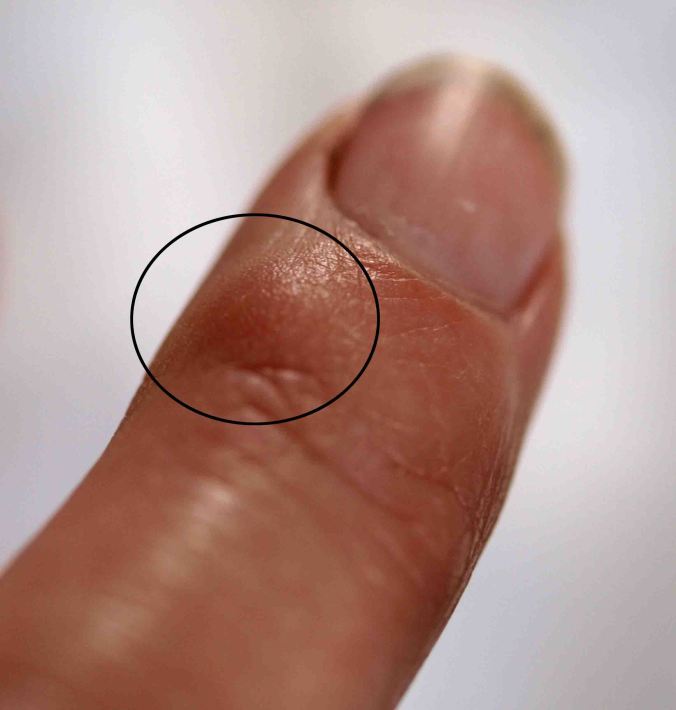
#1 Writer’s Bumps: An Endangered Condition? – My, my, my, but many people have mysterious bumps on their hands! I had no idea. I wrote this post as a joke because I thought that the cushioning bump that grows on writers’ middle fingers when they hold a pencil was going out of style in this age of computer keyboards. Apparently not! Almost every day someone finds my story because they are wondering what the heck that thing is on their finger.

#2 Echoes of the Past: A Sneak Peek Into the Hotel Chequamegon – I had the chance to stay in an historic hotel in Ashland, Wisconsin, for a writing contest reading I gave last winter. I wrote a review of my stay. Hardly anyone else has written reviews, so I suspect that’s why people who are interested in the hotel are finding it.

#3 A Visit to the Tallest Waterfall in Minnesota – A friend and I visited High Falls in Grand Portage State Park last winter and lived to tell the tale, which involved slippery footing and some harmless trespassing.

The most popular post during my six years of blogging is one I wrote in 2017 about a bad experience my dog had with his food. It involved some sleuthing and label reading on my part. To think, I almost didn’t write it, but then went ahead because I hoped others might find the information useful. I guess my hunch was correct.

Iams Dog Food Alert!—This story’s popularity is unfortunately because many dogs other than mine have had bad reactions to the sneaky changes this company made in the recipe of their dog food. I wish it wasn’t so popular, but more and more people keep finding it though searches. I am glad the story is providing them with answers, but sorry to hear that their dogs are having problems.

Thank you again for meandering with me, and Happy New Year wherever you may be . . .

Tips from Outdoors Writer Sam Cook

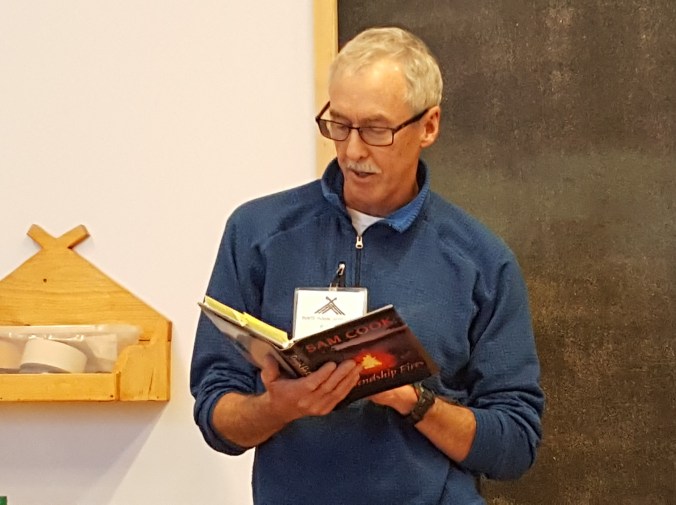
20181116_152952CropI meandered up the North Shore of Lake Superior last month for a writing workshop offered by Sam Cook, noted book author and outdoors writer for the Duluth News Tribune. The workshop was offered by North House Folk School in Grand Marais, Minnesota.


As he stood in front of us in the classroom, Sam’s eyes grew misty as he read this passage from Aldo Leopold’s “A Sand County Almanac:”

A dawn wind stirs on the great marsh. With almost imperceptible slowness it rolls a bank of fog across the wide morass. Like the white ghost of a glacier the mists advance, riding over phalanxes of tamarack, sliding across bogmeadows heavy with dew. A single silence hangs on the horizon.

Out of some far recess of the sky a tinkling of little bells falls soft upon the listening land. Then again silence. Now comes a baying of some sweet-throated hound, soon the clamor of a responding pack. Then a far clear blast of hunting horns, out of the sky into the fog.

High horns, low horns, silence, and finally a pandemonium of trumpets, rattles, croaks, and cries that almost shakes the bog with its nearness, but without yet disclosing whence it comes. At last a glint of sun reveals the approach of a great echelon of birds. On motionless wing they emerge from the lifting mists, sweep a final arc of sky, and settle in clangorous descending spirals to their feeding grounds. A new day has begun on the crane marsh.

“Sometimes it makes you depressed to read really good writing,” Sam said. However, I suspect he was moved by Leopold’s writing, and just wanted to hide how sentimental he truly is.

Sam was talking to us about the power of details in writing and how they can draw a reader into your story. Other writers he quoted from included Leif Enger, Barry Lopez, John McPhee and Dennis Olson.

I won’t give away all of Sam’s secrets, but I would like to share a few bullet points from his class that you might find useful.

  • Good writing makes people feel like they’re in the experience with the author. Incorporate all the senses into your writing (taste, touch, smell, etc.) Be a sponge, soak it all in when you’re gathering information.
  • Read your story aloud during the editing process to smooth out awkward wording.
  • In bad weather, pencils work better outdoors on paper than pens (or electronics!)

Sam passed around a stack of his reporter’s notebooks to show us how he processes information for his stories. He also read from some of his own works, notably, a story about how he – a Kanas native – became a true northerner by sticking his tongue on metal in the middle of winter.

I learned new ideas for writing story openings from Sam. If you ever get a chance to take a class from him, don’t miss it!

Psycho Dads: A Comparative Book Review of “My Absolute Darling” and “The Marsh King’s Daughter”

Warner bros the shining

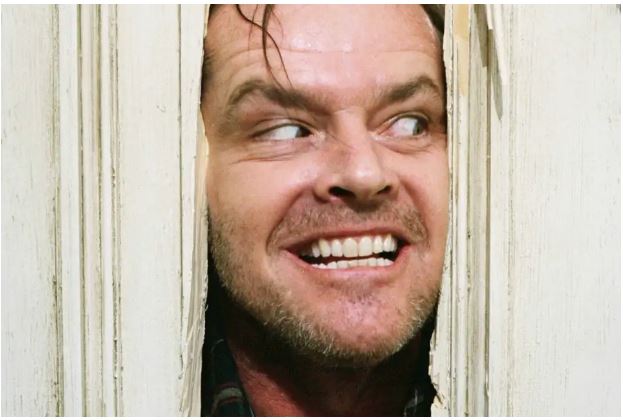
One of the scariest psycho dads of all time: Jack from “The Shining.” My post is not about him, but it is about psycho dads. Image by Warner Bros.

Fathers. They can have a profound impact on their daughters’ lives. Unfortunately, the two daughters in these books hit the jackpot when it comes to living in a family headed by psycho dads. Both books make for compelling, disturbing reads.

I read them back-to-back by happenstance. I was lured into “My Absolute Darling” by an intriguing and glowing New York Times book review. Alas, judging from all the complaints on Goodreads, I wasn’t the only one misled by the review, which glosses over the nasty bits about incest and the fact that THE DOG DIES in it. (I hate books where the dog dies, especially when scavengers pull its intestines out of its anus afterward.)

Instead, the review focused on positive comments by other writers, including Stephen King, and the author Gabriel Tallent’s background (this is his first novel).

The unfortunate daughter in “Absolute” is Turtle, a young teen living in the woods of northern California with her dad. Her mother died when she was young, leaving her at the mercy of her father who has an inordinate fondness for guns, and a paranoia about societal collapse. Turtle eats raw eggs for breakfast and wears combat boots to school. Her only friends are her grandfather, who lives in a trailer home next door, and a teacher who sees the signs of abuse and tries to help.

Later, Turtle befriends Jacob and Brett, two boys near her age who are lost in the woods. These well-read surfer dudes provide a foil for Turtle’s dark story, and are the catalyst for her father’s abuse to escalate.

The story of Turtle’s escape from her father is often profane, violent, heartbreaking, frustrating, stark and sometimes funny. On Goodreads, I rated the book 3/5 stars, mainly because some of the violence felt unnecessarily exploitive.

I read “The Marsh King’s Daughter” at the recommendation of my book group and because it’s set in Michigan’s Upper Peninsula – not far from my stomping grounds. The unfortunate daughter in this story is Helena. Her father kidnapped her mother when she was young and brought her into a remote marsh in the wilds of the U.P. Born in the marsh, Helena grows up in blissful ignorance of her true situation because her family is so isolated from the outside world.

Like Turtle, Helena is at home in the woods. Her father has taught her well how to survive and track animals. These descriptions are especially vivid and believable, as are the scenes of Helena’s eventual escape from the marsh.

The abuse in “Marsh King” is tamer than that in “Absolute.” Another thing that puts readers at more of a distance is that the story is told in retrospective. Helena is grown and out of the marsh, with a family of her own when she begins relating the tale. Even when the action is in the present, Helena is prone to bouts of rumination and repetition that slow down the action. There was so much of this in the climax scene where she has a death match with her father that I could hardly tell it was taking place in the present. But the story hooked me enough that I kept reading.

Another scene that stuck in my reader’s craw, however, was the one where Helena’s father tries to drown her mother in punishment for what he thinks is an escape attempt. Helena’s mother is canoeing alone across a lake (to search for strawberries on the other side) – something she is apparently forbidden to do. The father comes home and asks Helena where her mother is. Helena points to her mother who is out in the canoe. Somehow (I don’t recall exactly and no longer have the book to refer to), the father reaches the mother in the canoe and manhandles her out of it. To punish her, he almost drowns her. But does he do it in the lake where there’s plenty of available water? No. He drags her up to the porch, gets a bucket full of water and does it there. That just seems inefficient and weird to me, even for a psycho dad.

I gave “Marsh King” a higher rating on Goodreads (4/5 stars) than “Absolute” because the violence seemed less exploitive. I would have given it an even higher rating but for the rumination/repetition issues and the near-drowning scene.

Neither book dwells on how the fathers became psycho. They just deal with how the fathers’ actions impact their families.

In both books [spoiler alert!] the daughters triumph over their fathers both physically and emotionally. So if you want to read a book about “girl power” these are for you.

Marten Mania

DSC05086Edited

A marten carving graces the post of a Keweenaw Bay Indian Community pow wow shelter in Michigan’s Upper Peninsula. The marten is one of the Ojibwe clan symbols.

I’m in the planning stages for my third eco-mystic-romance novel. In my previous novels I’ve focused on endangered animals from the Lake Superior region, like the wolves of Isle Royale or piping plover shorebirds.

During a trip I took to the Apostle Islands a few years ago, the American marten (also referred to as the pine marten) came to my attention. It’s the only endangered mammal in Wisconsin and has mysteriously started showing up on Lake Superior islands where it was once thought extinct.

Sounds like a good topic for an eco-mystic-romance novel, right? To beef up my knowledge about martens (Martes americana), I attended the 7th International Martes Symposium in Bayfield, Wisconsin, this past fall. I was able to speak with marten researchers from all over the world and to interview ones who are doing local projects. I also took a field trip out to the Apostle Islands with the Wisconsin researchers and learned more about their methods.

45400919_10155548206416386_4915007419303591936_nTo cover the cost of the symposium and field trip, I wrote two magazine articles about martens. They are both out on newsstands now. The first ended up as the cover story for the December/January issue of Lake Superior Magazine. It focuses on the Apostle Islands martens and other populations found around the lake.

The second is in the “Around the Shore” section of the November Northern Wilds Magazine (on page 6). It focuses on the Isle Royale martens.

Take a read about these magical and mysterious animals of the north!

thumbnail_IMG_0294Cat Is

A marten climbs a tree on Cat Island of the Apostle Islands National Lakeshore. Trail cam image courtesy of Northland College, the University of Wisconsin-Madison, and the National Park Service.