It’s so funny when politicians complain about other politicians who “play politics.” They say it like it’s a bad thing. Makes me wonder why they went into politics if they don’t like it. 🙂
Walt Whitman Lives!

Patrick Scully as Walt Whitman
A literary figure came to life in downtown Duluth a few days ago. Walt Whitman made an appearance at the Zeitgeist Teatro Zuccone on September 12 in the form of a one-man show by Patrick Scully.
Whitman, of course, is known for his poetic work, “Leaves of Grass” (1855). The book received praise from Ralph Waldo Emerson and Henry David Thoreau but was also controversial for its overt sexuality.
In Scully’s show, “Leaves of Grass – Illuminated,” Scully embodies Whitman in his “multitudes,” exploring his inclusiveness and embrace of all humankind – things everyone needs reminders of, especially now.
The show premiered in New York City and Minneapolis. If you missed it in Duluth, you’ll have a chance to see it at the Guthrie Theater in Minneapolis on July 12-14, 2019, shortly after the 200th anniversary of Whitman’s birth.
Scully performs a couple different versions of his show. The one we saw was the full-meal deal, featuring videos of male dancers dressed in appropriate period garb (and also lack thereof). The videos played behind Scully, who stood at a podium near the audience.
 Whitman has been a long-time favorite of mine, ever since I read a first-edition version of “Leaves of Grass” (pictured, copyright 1959) that I think my parents gave me off their bookshelf. It kept me company during a summer on Isle Royale National Park in the middle of Lake Superior. No libraries there! So I lugged a duffle bag full of books along with me when I worked as a waitress at the resort on the island during college.
Some of my favorite lines come from, “I Sing the Body Electric.” In looking through my old book, this one still strikes me:
I have perceived that to be with those I like is enough,
To stop in company with the rest at evening is enough,
To be surrounded by beautiful curious breathing laughing flesh is enough,
To pass among them . . to touch any one . . . . to rest my arm ever so lightly around his or her neck for a moment . . . . what is this then?
I do not ask any more delight . . . . I swim in it as in a sea.
Like Whitman’s poetry, Scully’s show pleased my soul well.
Thanks go to Lake Superior Writers and the Minnesota State Arts Board for hosting and sponsoring the evening.
Lean Into Your Fear: Whitewater Rafting on the St. Louis River
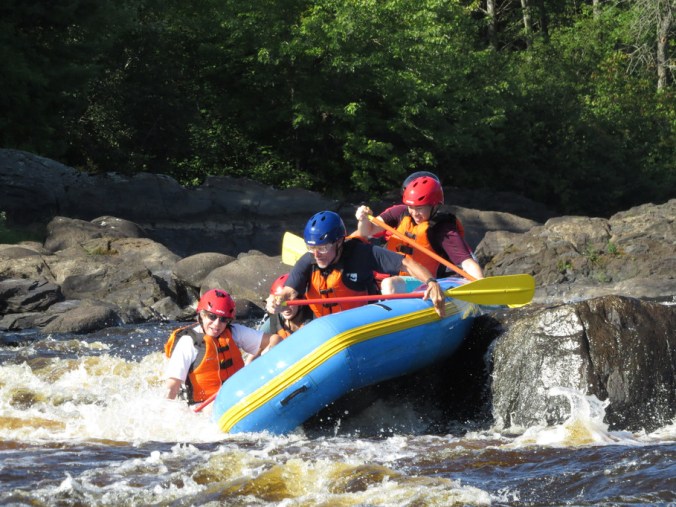
Me (on the left in the red helmet) leaning into my fear on the St. Louis River.
When I write a travel post, because my blog’s name has the word “meander” in it, I usually open by saying I “meandered” here and there.
Well, I can’t use that term this time. It’s more accurate to say that I reluctantly agreed to go on a whitewater rafting trip down the St. Louis River this past weekend, and promised to scream all the way!
It all started when my friend Russ, who is an experienced kayaker, won a silent auction item at a fundraiser for the St. Louis River Alliance a few months ago. He won two tickets for whitewater rafting through Minnesota Whitewater Rafting, a local company that operates out of Scanlon, Minnesota.
Upon my insistence, we agreed to wait for the trip until the water was warm, to make it a more comfortable experience. Now it was August, month of warm weather and water, and I was out of excuses not to go. We gathered everything the company’s information sheet instructed rafters to bring: a dry change of clothes, snug-fitting footwear, windbreaker, towel, etc. And off we went.
Once we arrived, I was surprised by the number of other people who wanted to fling themselves into an inflatable raft at the mercy of the river – twenty-eight of us, to be exact, of all ages and fitness levels.
We started our three-hour journey by choosing one of the seven blue-and-yellow rafts lined up on the shore. Russ and I ended up paired with a young couple from St. Paul. A guide was assigned to each raft. Ours was named Logan.
To us oldsters, all of the guides looked like they were about twelve, but we hoped they knew what they were doing or they wouldn’t have been hired. Thankfully, this proved true!
The ensuing safety talk by the operations guy, named Blu, included instruction to ignore your instincts and “lean into” whatever fearful obstacle the raft encounters. He explained that if you lean away from the rock or high wave, you are more likely to lose your seat and fall out of the raft. Not that falling out of the raft is the worst thing that can happen, but most people like to stay with their group.
The other useful instruction was to keep your feet up if you fall overboard. This is helpful in avoiding sharp rocks and logs, etc., that are on the bottom. Plus, most people aren’t strong enough to withstand the current standing up, so you might as well just go with the flow until one of the kayak patrollers (who go with every trip) retrieve you.
Blu said that in a group our size, it’s common for at least one person to fall overboard. I sure hoped it wouldn’t be me.
I thought the “lean into” rule was particularly deep. Psychologically speaking, sometimes facing your fears is the best way to overcome them. Also, it reminded me of the book “People of the Lie” by M. Scott Peck, who says that most people’s psychological problems arise from trying to avoid emotional pain instead of addressing (leaning into) it.
I decided then and there to change my attitude about the trip – to stop seeing it as something fearful, and instead see it as something to relish, and an opportunity to know the river better. I mean, I’ve lived by it most of my life. I’ve canoed on it, paddleboarded it, boated on it, but I’d never immersed myself in it.
As the company’s website and instruction sheet promised, you will “see the river, feel the river, ride the river,” and you will get wet! On this sunny warm day, I was up for that.
Blu explained we’d encounter six sets of rapids ranging from Class I to III, and two sets of riffles. Each set of rapids would get more challenging along the four-plus-mile stretch until we reached the quiet-water reservoir formed by the Thompson Dam.
Safety talk over, we set out upon the water. Our first task was to run through a “slalom” course between the pylons of the freeway bridge that goes across the river. This let us practice paddling different directions and experience what it feels like when the raft bumps into things.
Then we paddled through a set of riffles called “Warm-Up Rapids.” Everyone came through unscathed and, after stopping for an orientation, we continued to a set of surfing waves at “First Hole” rapids.
Have you ever seen standing waves that form behind an underwater rock in a river? That’s what we surfed on – if your idea of surfing involves your raft filling with water, which ours did. We surfed several times, bailing out between sessions with the handy bailers provided in each raft.

Surfing the hole and having fun!
After another group orientation session, we were onto “Two Hole” rapids. I think it was this one that had a big rock in the middle of it. Logan, our guide, thought it would be a good and fun idea to smash our raft into the rock.
On purpose.
Why he thought this was a good idea, I’ll never know! I always thought the whole idea of river rafting was to avoid the rocks. I guess I’ve been wrong all this time.
Granted, he did give us a choice, so we were complicit in the decision. I blame it on the adrenaline rush.
Paddling as hard as we could, our raft went up and over the rock, then started sliding sideways. I was on the outside side – the tippiest side – and remembered to lean into the rock to avoid falling out of the raft. I almost floated out, but managed to stay in by the skin of my teeth. Rather like dental surgery, it felt so good once it was over!
Our next stop was a canyon that featured a couple of small beaches in a slow section of the river. We grounded our rafts and had the chance to swim for a while, clothes, lifejackets and all.
Russ went all the way in. I was fine going waist deep, not because I was worried about polluted water or anything, but because the water was rather chilly to me even for a warm day.
At this point I realized I had never been this far into the river before; me—who had even worked for the St. Louis River Alliance whose sole purpose is to protect the river. I marveled at the brown water – tea stained from the many wetland plants steeping at its headwaters and along the way. The white pines and bare rock faces along the shore looked primeval, like we could have been miles into a wilderness. The beauty filled me and gave me a new sense of appreciation for the river.
Our rest stop over, it was time for the big guns in terms of rapids. We made it through “Hidden Hole” just fine, then it was onto “Electric Ledge,” which is a Class III rapids that consists of a four-to-six-foot drop.
I had heard the name of this rapids whispered in awe among my kayaker friends for years. Now we were about to go over it! And we were about to go over it before any of the others. Logan explained that our raft had the first aid kit in it, and we needed to go first in case the other rafts needed assistance once they ran the ledge.
Not only were we in the first raft, but Russ and I were sitting in the FRONT of the first raft. Oh, lucky us.
We didn’t have much time to wonder at our luck as the ledge was approaching. I repeated all the rules: lean into your fear, keep your feet up. Then we slid over it, sideways and steep. Russ grabbed onto my arm for support.
Luckily, that steadied him and we both stayed in the boat. So did the rest of our crew, but I can’t say that for one of the other rafts, which did indeed lose one person over the ledge. The person remembered the rules, however, and they were uneventfully picked up not far downriver.
The final set of rapids, “Little Kahuna,” is more technical than terrifying. After some twists and turns, we made it through just fine. From there, a somewhat longish paddle across peaceful water (known as the Boundary Waters to the staff) took us to the end of our journey and a bus that was waiting to drive us back to our starting point.
So, in summary, I did scream as initially promised, but it was from fun, not out of fear. I think this was due to the great job the staff did at letting us know what to expect from each set of rapids. I hadn’t had that on other rafting trips.
I would totally do it again on some warm day (although they do provide wet suits if it’s cold and you want one). And I would totally bring family members on such an adventure. Don’t let a little fear stop you if you have a hankering for some whitewater!
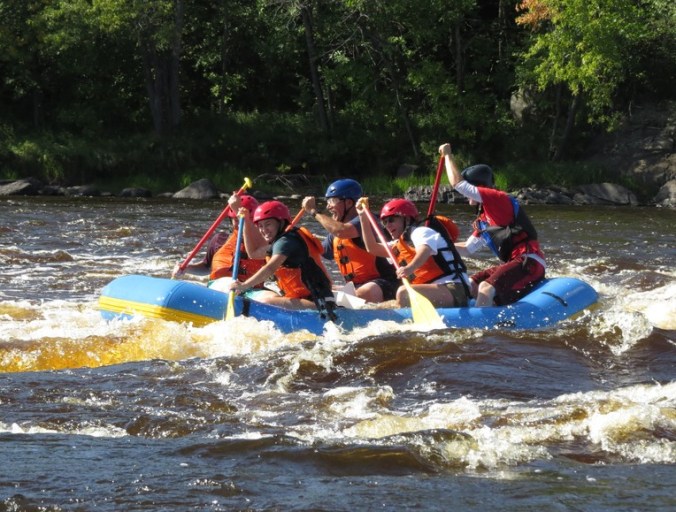
Yee haw!
Communing with Duckies

Last weekend I meandered up the Gunflint Trail in northeastern Minnesota near the Canadian border. I was able to spend time on Gunflint Lake with friends, old and new. I also made friends with this trio of ducks who were out for a peaceful evening swim.
Yin Yoga in a Yurt
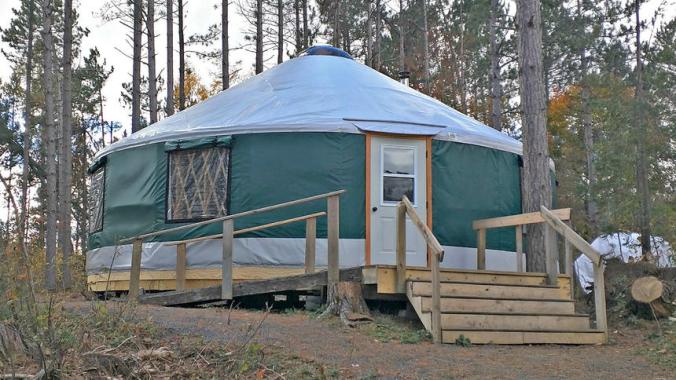
Image credit: Hartley Nature Center
I seem to have a tendency to try different forms of yoga. Several years ago, I began regular yoga, then I tried hot yoga, then Thai yoga, and then aerial yoga.
Although I often practice regular yoga and hot yoga, in keeping with my yoga adventurousness, this week I tried yin yoga in a yurt.
The class was offered by Runa Yoga in Duluth. In addition to classes in their studio, they offer classes in different locations around town, including a Yoga + Beer class at a microbrewery.
We met at a city park inside a yurt owned by Hartley Nature Center. You may already know that a yurt is a round canvas tent with a wooden frame. This one was nestled in the woods, offering views of red pine tree trunks all around, and was large enough to fit 30 yogis.
The teacher said that yin yoga focuses more on stretching ligaments and joints than other forms of yoga. Our session featured live ambient music performed by two local musicians. I found it strange, however, that these musicians showed absolutely no emotion while performing. Even when the instructor introduced them, they remained stone-faced.
Is robotic-like behavior a prerequisite for ambient music performers? I have no idea. They DID smile after the class was all over, though.
It’s a mystery.
Their music was so ambient and so relaxing that at the end of class, when we were all in our final resting poses, I swear the guy in front of me started SNORING. Thankfully, he awoke once it was time to go, saving himself from further embarrassment. I wonder if anyone would have woken him at the end if he had just kept sleeping?
Yet another mystery.
Despite all the mysteries, or perhaps because of them, yin yoga in a yurt was cool. If you’re looking to switch up your routine, I recommend it. Just bring a friend along to wake you up in case it gets a little too relaxing.
Of Lighthouses and Books

I found this gem of a book at Chequamegon Books in Washburn, Wisconsin. Would you read it? I especially like its promo blurb by USA Today: “A fascinating romp through the world of ‘stuffed’ animals.”
Somehow the phrase “fascinating romp” has never combined in my mind with the topic of taxidermy.
I did not buy the book. But I was impressed with the bookstore. The last time I visited years ago, the store looked like the kind of place where books go to die. It’s been spiffed up recently, with better lighting, ventilation, and a new back room that makes space for lots more books!
The topics are all well-organized and easy to find. It’s a book nerd’s dream. Stop in if you’re ever in Washburn.

The back room in Chequamegon Books in Ashland.
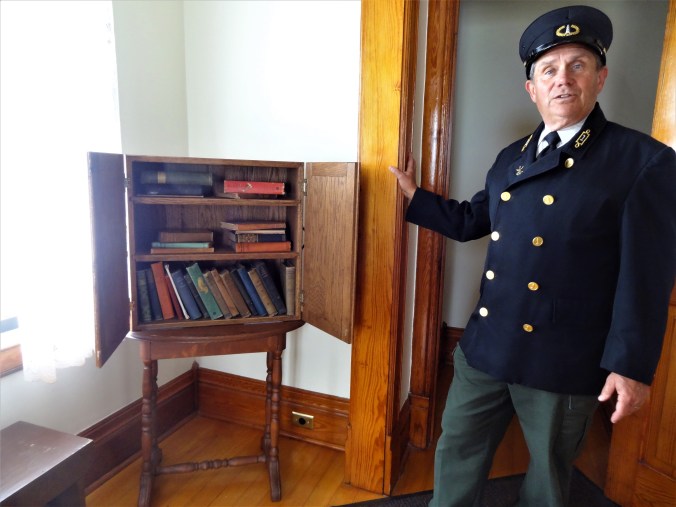
While I was in the area, I had the chance to visit Raspberry Island in the Apostle Islands National Lakeshore. My bookish theme continued when the lighthouse keeper on the island showed me the traveling bookcase that the lighthouse service used to provide to help entertain the keepers and their families.
And I really do mean that he only showed me the traveling bookcase. Of our group that visited the island, I was the only one who opted for the $5 lighthouse tour, so I got personal service!
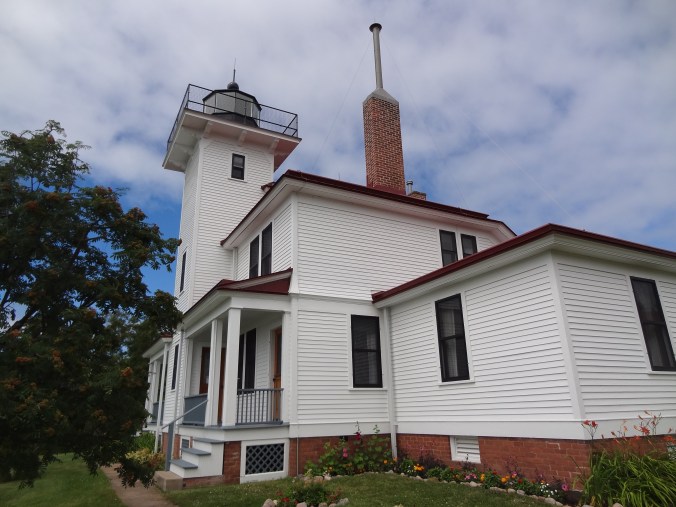
Raspberry Island Lighthouse in the Apostle Islands National Lakeshore.
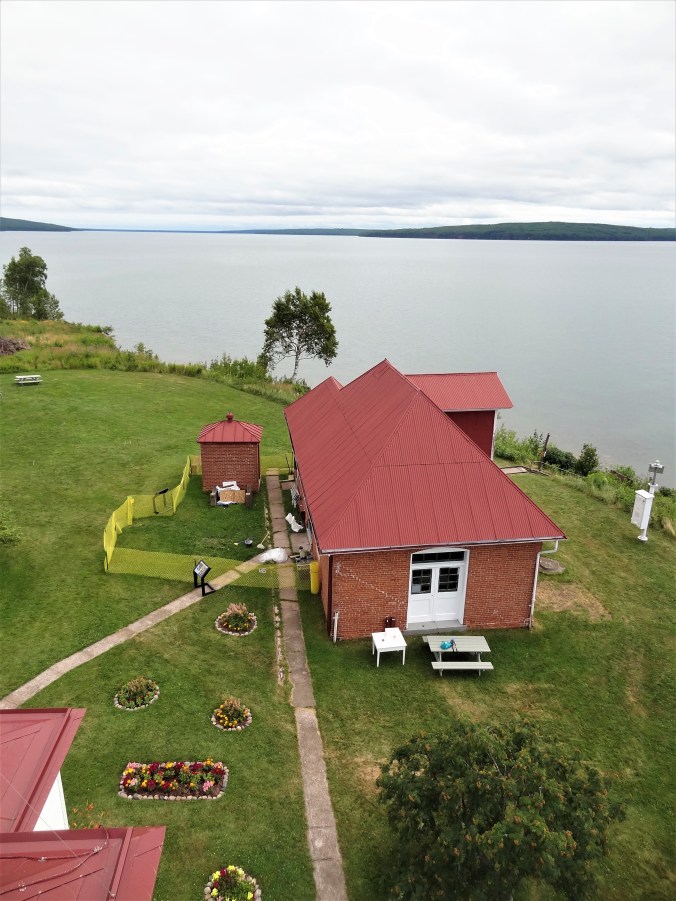
The view from the top of the Raspberry Island Lighthouse.
After the tour, I took a hike to an overlook along the coast of the island. On the way, I found this fine example of Canada yew.
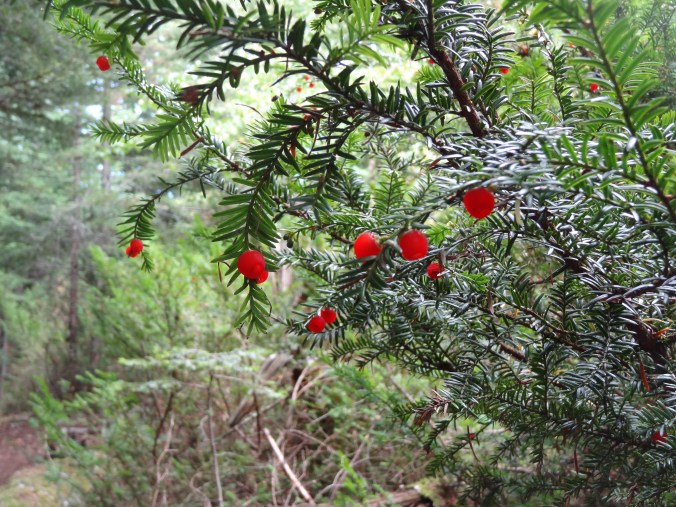
Christmas colors in August! Canada Yew is an important shrub for wildlife. Not often found on the mainland because it gets eaten by deer, it sometimes thrives on islands like Raspberry Island, which have few, if any, deer.
Books and lighthouses: a good combination for an outing….
Still Living in a War Zone

The Duluth Planning Commission. Image by KBJR-TV.
The rezoning plans for my neighborhood in Duluth are still alive. (For background info, see my previous post.)
The process is dragging out. Plans to rezone parts of Kenwood from Traditional Residential to Mixed Use Neighborhoods (and thus open them up to commercial developments) were supposed to be voted on at a planning commission meeting last month. But that meeting got postponed until this month.
In some ways, the delay is good because we were able to notify more neighbors about the plans. I drafted a form letter and distributed it to help give my neighbors ideas on how to respond to the commission, and they distributed it to other neighbors who were interested. We also had neighborhood meetings as part of National Night Out, and invited our city councilor to attend and offer advice on how to organize. (He is not in favor of the plans.)
In other ways, the delay is bad because it just drags out the uncertainty longer. At least one home on my street has been put up for sale because of the impending rezoning. I have delayed a much-needed backyard landscaping project because I don’t want to invest a bunch of money in a house that might one day overlook a parking lot or a bunch of business dumpsters instead of the current nicer view of my neighbors’ homes and large trees.
The fight also wears people down, so I’ve been careful not to let it consume me too much. I only pay attention to it when I have to. I’d much rather pay attention to Duluth’s ephemeral summer outdoor activities.
Things came to a head earlier this week when the rezoning plan was brought before the planning commission for a vote. Dozens of my neighbors packed the top floor of Duluth City Hall in the city council chambers, which are not air conditioned and were easily ninety degrees. Lucky me had the joy of hot flashes added on top of that.
True to form with this process, the first part of the meeting dragged out. We sat on the hard wooden benches for two hours before our rezoning issue was brought forward. It took so long that our city counselor had to leave for another engagement and wasn’t able to speak on our behalf. I was so disappointed in that!
The meeting was also held on primary voting night. Who does things like that? It almost makes one wonder if the planning department was trying to bring up the issue on a night when people had conflicts.
In the letter we received informing us of the delay in the meeting date, the planning commission threw us a bone, perhaps because they were receiving so many letters in opposition to the rezoning. They offered to “downzone” two outer areas in our neighborhood that currently could feature commercial development, in effect, making them Traditional Residential Neighborhoods in exchange for “upzoning” my neighborhood and several surrounding areas.
This downzoning was the first of our neighborhood issues brought before the council. During the public hearing time, nobody spoke in opposition to this move, although one planning commissioner was concerned that approving it would “tie the city’s hands” in terms of future development options, depending on what happened with the discussion of “upzoning” our neighborhoods.
So the issue was combined with the discussion of our neighborhoods. The commission gave first speaking rights to those in favor of the rezoning. Only one person spoke: Dave Holappa, a realtor who owns a house in the rezoning area. He whined (it’s my blog, so I can have opinions!) that when he bought the house in 2006, comments by city staff gave him the impression that rezoning would happen faster than it has. It’s pretty obvious that he wants to buy more properties in the neighborhood so that he can sell them to a developer because “developers want a significant land parcel in place.”
Then came the time for those opposed to the project to speak. Five people did so. The first was Jim P. who lives in my neighborhood. He eloquently said that it makes no sense to allow for the possibility of commercial development in a healthy, functioning neighborhood with families. He stressed the city’s need for single-family housing, of which our neighborhood has plenty.
“Development would totally change the neighborhood,” he said. “Why take an achieved goal to try and reach another goal? You’re telling our neighborhood that our homes are not as important as more commercial development.” He stressed that our neighborhood already has enough such developments (Kenwood Village, the shopping mall, a Walgreens, etc.)
As Jim left the podium, he asked all of those in the room who agree with him to stand. In a moving show of solidarity, almost everyone did. I suspect those who didn’t were in the room for other issues on the agenda. (Oh, and I bet Dave Haloppa didn’t stand.)
The next speaker was Tom B. He said that there’s already a lot of apartment buildings in the neighborhood and that it can’t sustain more. Right now, the area has many good neighbors and that the rezoning proposal would not make for good neighbors.
The third speaker was Chad R., who lives in a street behind Kenwood Village, a new apartment development. He listed all the problems that the new development caused for residents of his street, punctuating each one with a tap of his finger on the podium. He argued that the issues caused by previous developments need to be solved before new developments are built. The audience applauded him when he was done.
Another speaker made the point that traffic in the neighborhood is so bad it already takes him ten minutes every day just to get out of his driveway. Because there’s no development project pending for the rezoning area, he didn’t see the necessity of pre-emptive rezoning.
After a lengthy discussion, the planning commission decided they needed more information to make their decisions. They tabled both rezoning issues as topics for a “brown bag discussion.” They will be taken up again next month.
So, the good news is that after we all passed three hours sweating and gaining sore butts from sitting on those hard benches, the rezoning didn’t pass. The bad news is that the war will be dragged out even longer. But at least the commission is taking the matter seriously and is putting time into it.
As I left the building, one of my neighbors commented, “If this is government at work, then it’s obvious that government needs a better budget for air conditioning!”
That, at least, I can agree with. And I’m going to bring a pillow to the next meeting.
Beauteous Billings Park

People who live in Duluth are sometimes snobbish about their city parks and trails. They think they’re the best in the Twin Ports. I know, I have been guilty of such civic offenses.
Well, I had my eyes opened when I attended a recent after-work picnic in Billings Park across the bridge and the state line from Duluth in Superior, Wisconsin. In all my years of living in the area, I had never been to this gem of a park. It’s gorgeous!

The park features several picnic areas, a playground, grills, a volleyball pit, and trails along the bay. I’ve been back the the park twice more to walk Buddy and to paddleboard. With a public water access and calm bays to explore, the park is great for human-powered watersports.
 I urge fellow Duluthians to put aside their prejudices and explore Superior. Get out there and get your Blue Mind on!

“I was blown up eating cheese.”
That’s my favorite quote from the 1932 movie, “A Farewell to Arms,” starring Gary Cooper. He says it when he’s in the hospital after being wounded in a bombing. His doctor friend is about to operate on him and asks if he was doing anything heroic during the bombing. All Gary Cooper can come up with is, “”I was blown up eating cheese.” LOL!
Somehow, I don’t think a line like that would ever happen in today’s movie industry.

Biking in the Rain on the Alex Leveau Trail
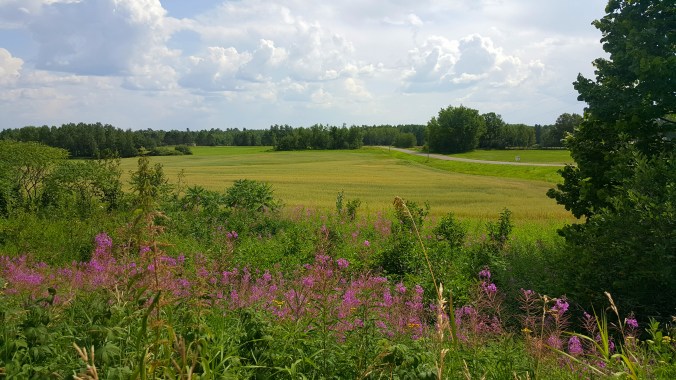
A view from the Alex Leveau Trail in Carlton.
We heard through the bicycling grapevine that the Willard Munger Bike Trail was all repaired (from the storm damage a few years ago) and open now in its entirety. So my friend Russ and I headed to Carlton, Minnesota, to catch the trail there and bike to our hearts’ content.
The only problem was, the bicycling grapevine was WRONG. When we got to the Munger Trail parking lot in Carlton and started biking toward the trailhead, we found a large sign that said the trail was closed!
Another trail is accessible from the same area, named the Alex Leveau Memorial Trail if you head southeast across the railroad tracks. I had biked it a few years ago, and remembered it was there.
Somewhat disconsolate, we biked that instead. But our mood soon lifted because the trail is just so gosh darn nice. It features views of wetlands and farmlands, barns and raspberries. Without huge hills, it’s an easy ride, and would be a good trail for children to try. But it’s not too monotonous either.
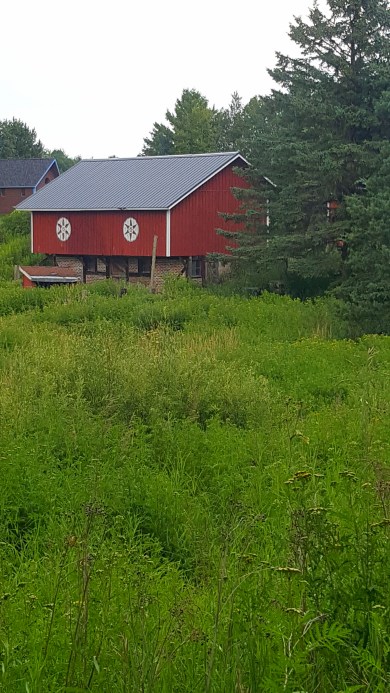 The segment we travelled is 6.5 miles long. Most of it is a paved trail, but when you get near Wrenshall, you have to follow the highway for a while. At the 6.5-mile milepost, the trail seems to dead end at a highway. We weren’t sure where to go from there, so we just turned around and went back to Carlton, although I think there might be other parts of it farther on.
The trail was named in memory of a former county commissioner and dairy farmer who was an advocate for using abandoned railways as public trails.
As we biked back to the parking lot, a series of “pop-up” rainstorms popped up. We thought they would miss us until the wind changed and one caught us. The rain spatters were cold, but we kept warm by biking.
If this had been a romance novel, getting caught in the rain could have led to a passionate embrace in rain-slicked bike clothes. But it’s kind of hard to kiss when you’re both wearing bike helmets and you’re trying to go fast enough to ward off the chill.
So we opted for just being thankful to arrive back to our vehicle wet, but no worse for wear – no road rash from slippery pavement, no lightning strikes nearby. Sometimes, in your elder years, that’s as good as it gets.
 Marie's Meanderings