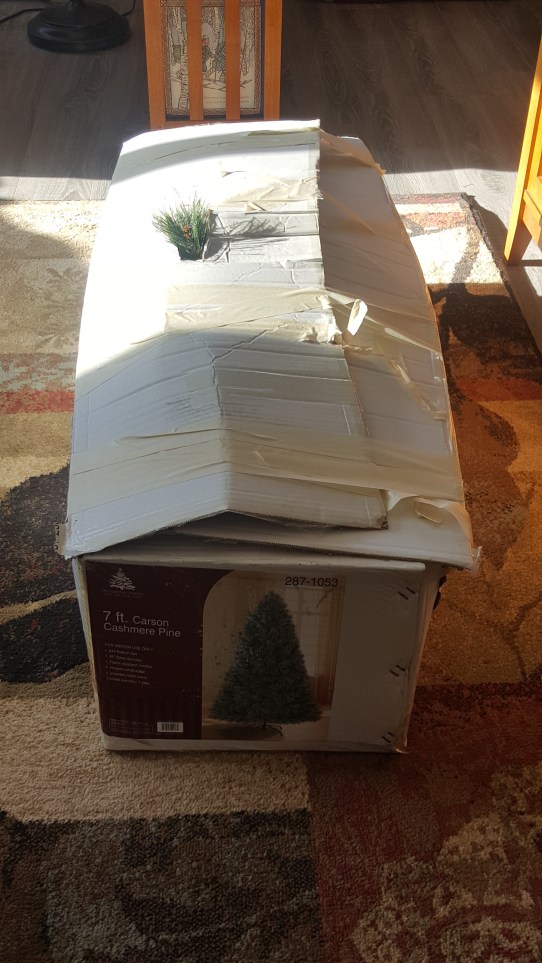
How can a fake Christmas tree, which is DEAD, grow larger and larger each year, until it no longer fits into its original box?
How can a fake Christmas tree, which is DEAD, grow larger and larger each year, until it no longer fits into its original box?

Chef Sean Sherman
Native American chef, Sean Sherman, visited my fair town several weeks ago to promote his book, “The Sioux Chef’s Indigenous Kitchen.” Given my interest in cooking and gathering wild edibles, I had to go. He spoke to a packed house along with his co-author, Beth Dooley, who is the food editor for the Minneapolis Star Tribune. The event was sponsored by Zenith Bookstore.
One of the first things Sherman did was to disabuse the audience of the notion that Native American cuisine involves any type of fry bread. He works with pre-colonization food made with ingredients the natives grew themselves or foraged. These are things like squash, wild rice, chestnuts, fish, berries, and cedar boughs.
Sherman talked about how natives used all parts of edible plants and animals and how every one of those things had a purpose, “Except for wood ticks. They don’t have a purpose,” he joked.
A member of the Sioux tribe, Sherman grew up in a hardscrabble life on the Pine Ridge Reservation in South Dakota. He became interested in learning about the foods of his ancestors when he was twenty-nine and was burned out from working as an executive chef in Minneapolis.
He took a year off in Mexico and ended up consulting for a restaurant there that focused on local foods. In his book, Sherman writes, “In an epiphany, I tasted how food weaves people together, connects families through generations, is a life force of identity and social structure. After seeing how the Huicholes held on to so much of their pre-European culture through artwork and food, I recognized that I wanted to know my own food heritage. What did my ancestors eat before Europeans arrived on our lands?”
Re-energized, Sherman returned to the U.S. with a plan in mind. After a lot of research and consulting, he formed The Sioux Chef in 2014 in Minneapolis. He worked with other indigenous team members to cater events, operate a food truck, host pop-up dinners, and soon they will open a restaurant.
Sherman’s vision for revitalizing indigenous foods reaches beyond the Midwest. He hopes to spread an indigenous food system model across the country, which involves providing education and tools to native communities to reclaim their ancestral cuisines and an important part of their cultures.
And why not? It’s a diet that is hyperlocal and uberhealthy in more ways than just the physical. At the end of his talk at Beaner’s Coffee House (thank you Beaner’s!), samples of cedar tea sweetened with maple syrup were passed around. Man, was that good!
As I drove home with his book on the car seat beside me, I was excited to learn more about Native American cuisine. I could still taste the tangy cedar and sweet syrup on my tongue. To me, it tasted like hope – hope that this movement will undo some of the damage to native cultures, and hope that it will interest more people in taking care of the natural world. You don’t pollute places where you gather your food. If we look on our whole landscape as a big grocery store, perhaps we will take better care of it.

This was my favorite image from 2017. I took it at the beginning of the March for Science, which happened in Duluth, Minn. I call it “Standing Strong for Science.”
My fifth year as a blogger has come to a close. I hear in the blog-o-sphere that such longevity is unusual. Most bloggers only maintain their efforts for a year or two. What can I say? I keep doing it because I keep coming up with stories to tell and places to visit. I don’t have any goals other than sharing my stories. Well, there might be a bit of book promotion in there, but I try to keep that to a minimum. Oh, and there’s also that time I tried to save my job, but more about that later…
In 2017, my blog saw the most traffic so far. It had over 4,500 visitors and over 6,100 views. I’m sure part of that is because there’s more content so my blog shows up in more searches, but I’d also like to think it’s because people find what I have to say of interest and of use.
I’m sure if I was active on more social media channels, I could up those numbers. But upping numbers is not my goal, it’s just a nice side-benefit of telling stories.
Here are the most popular stories for the year:
# 1 Why Sea Grant is a Kick Ass Program (And Not Just Because I Work There) – This was my plea for people to contact their congressional representatives to save the federal program that employs me. The post got shared widely among my colleagues and friends, and guess what? It worked! We all still have our jobs with an organization that works to study and protect one of our most basic requirements of survival: water.
Not only was this post the most popular for 2017, but for the entire time I’ve been blogging.
Congress ignored the President’s budget cut for us, and even gave us a little bit of a raise. It’s nice to know that your country values you. Alas, the president has zeroed out our budget once again for next year, but I’m not freaking out because the Sea Grant leadership suspects that congress will keep us in the budget as before.
Anyway, thank you for the support you all provided!! It means a lot.
#2 Iams Dog Food Alert!—This story didn’t take off right away like the Sea Grant one did. Its popularity is unfortunately based on the fact that many dogs other than mine have had bad reactions to the sneaky changes this company made in the recipe of their dog food. This is one story I wish wasn’t popular, but more and more people keep finding it though searches. I am glad the story is providing them with answers, but sorry that their dogs are having problems.
#3 Minnesota Singer/Songwriter Jacob Mahon – This is a short post that I whipped out in about 10 minutes after seeing a new Duluth-based musician. I suspect part of its appeal is that it was short and to the point, plus the guy is good! The story was shared by several people, which helped lead to its popularity. Go Jacob!
#4 and #5 The Lake, it is Said, Never Gives Up Her Dead and Remembering Black Sunday in Duluth – I group these two together because they are about the same topic, and because they follow each other in popularity. Fifty years ago, three of my cousins drowned in Lake Superior. The stories are about the incident and a special ceremony that was held on the lake in their honor and to remember the people who tried to rescue them. They serve as a reminder of how powerful this lake can be.
#6 Challenge: Describe Your Community in One Word – This story, which I wrote in 2014, describes the efforts of myself and a friend to find one word that describes the people who make up Duluth, Minnesota. I’ve noticed that this story pops up in a lot of searches, especially from the Philippines. I suspect there’s a school teacher there who is giving his/her students the assignment of coming up with one word for their city or country. My blog has probably been plagiarized for many a school paper, but that’s okay with me!
Thank you for meandering with me, and Happy New Year wherever you may be . . .

The Cameron Trading Post Restaurant near the Grand Canyon. Note the pressed tin ceiling.
This will be my last installment about Sedona, and it deals with the next best thing to the scenery: the food!
Our first morning in town, we made our way to Creekside Coffee after seeing it advertised on television. What a way to wake up! Perched on the edge of a hill on the second floor of a galleria, the café offers a stunning view along with just about any kind of coffee one would want, plus pastries and organic fare. Wine is also available.
Another great place for breakfast is the Coffeepot Restaurant (near Coffeepot Rock). I didn’t eat there, but my traveling partner did and said it was great. They offer 101 different types of omelets!
We usually ate lunches we packed ourselves. But the one time we ate a restaurant lunch was at the English Kitchen in Jerome. See my previous post about that divine and spooky BBQ experience.

The mussels and chorizo appetizer from the Mariposa.
We saved the piece de resistance of dining for after a full day of hiking near the end of our trip. We made dinner reservations at Mariposa, a Latin-inspired grill. We chose partly for the scenery — the restaurant has a wall of windows that look out to the red rock hills. The only glitch in our plan was that it was dark by dinner time! Duh.
But our view of the food more than made up for the lack of an outdoors view. And even though something went wrong with our reservation through Open Table, the hostess was able to find a spot for us.
We started off with cocktails. After hiking past juniper trees all day, I opted for a drink made from juniper berries (in the form of gin) called a juniperita. Other ingredients include St. Germain liquer, lemon juice, and agave. The lemony sweetness was the perfect refresher for my desert-worn pallet.
For an appetizer, we shared mejillones con chorizo, a mussel and sausage dish served in a white wine bouillabaisse with charred corn. O.M.G. – the sauce was divine! We dipped our bread in it, and could have been happy just with that. The sausage complemented the mussels surprising well.
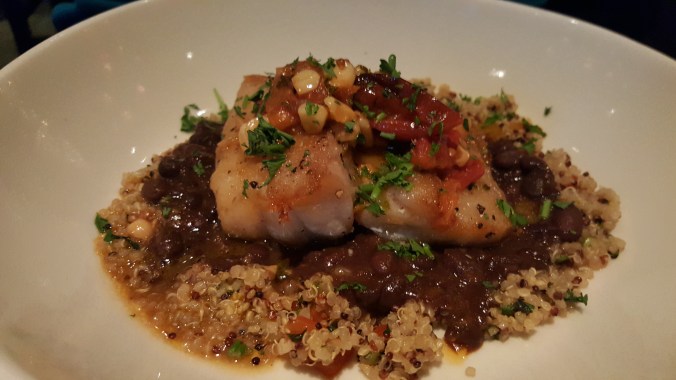
The grouper.
For entrees, Linda had grouper, which was the fish of the day. It was served with Campari fire-roasted tomatoes, charred corn, white wine and herb butter, frijoles negros and quinoa pilaf. She allowed me a wonderful taste. I had skirt steak served with roasted rosemary potatoes and frijoles negros.
Have you ever had a steak that melts in your mouth? It’s a rare thing, and that’s what this was. I had a hard time eating it because I kept making noises of gustatory satisfaction.
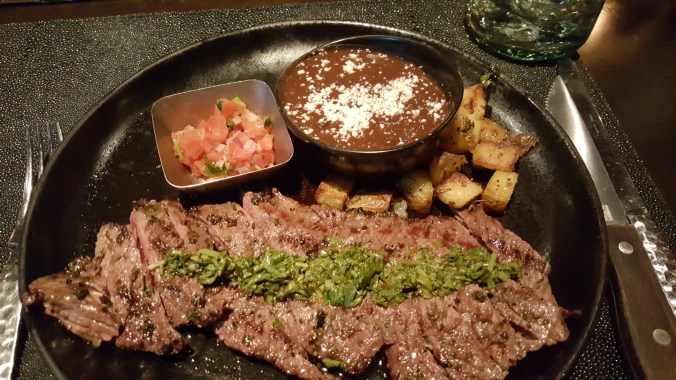
The skirt steak.
Although tempted, we opted out of dessert because we had a plan, and we made our way back to our resort. Although it was only 43 degrees outside, a hot tub awaited steps away from our unit. We hearty Minnesotans donned our swimsuits and ran out to the hot tub with wine, chocolate truffles and mint fudge in hand.
The candy was from the Sedona Fudge Company. Life doesn’t get much better than when it’s spent in a hot tub under the Arizona stars, accompanied by chocolate and alcohol. I truly felt like I was on vacation.

The Navaho taco (front) and other fare from the Cameron Trading Post.
The last notable eating spot we had a chance to sample was the Cameron Trading Company Restaurant near the Grand Canyon. Want a Navaho taco that’s bigger than your head while viewing Navaho blankets worth thousands of dollars? This is your place then.
Established in 1916, the trading post was the place where Hopis and Navahos bartered their wool blankets and livestock in exchange for dry goods. The restaurant’s ceiling of pressed tin is flanked by walls featuring cabinetry and stained glass from years past. A huge stone fireplace decorated for Christmas warmed us while we ate.
I had a Navaho taco, which is the most popular thing on the menu. It’s composed of a large round piece of fry bread, smothered with a combination of ground beef and beans, topped with lettuce, tomato, cheddar cheese and crowned with chopped green chilies. Spicy salsa is served on the side, but it was too much for my bland Minnesota taste buds.
So ends my accounting of this meander. I would go back in a heartbeat. There are more rocks to see, trails to hike, places to eat, and energy vortexes to experience. Thank you for journeying with me through words.

The Cameron Trading Post Restaurant fireplace.
 This was my Christmas Eve dinner. Hey, don’t look at me like that! While not typical, this chowder is totally holiday-appropriate, with red and green colors provided by the ham/steelhead and the green onions.
I modified this recipe from a crockpot version. This was the first time I used steelhead instead of cod or haddock because I “accidentally” found a nice fillet for half-price at the grocery store. All I can say is, yum!

What the soup looks like before the potatoes and milk are added.
1 lb fish fillets (torsk, cod, haddock, steelhead, etc.)
2-6.5 oz cans of clams
3 slices bacon (diced) or 1-8 oz package of diced ham
1 medium onion, chopped
½ cup green onions, chopped
2 large potatoes, pared and cubed
2+ cups water
1-1/2 tsp sea salt
¼ tsp pepper
1-12 oz can evaporated milk
Chop the onions and cube the potatoes. Cut the fish fillets into bite-sized pieces. In skillet, sauté onion and bacon (or ham) until golden in two tablespoons butter. (But if you use bacon, no butter is needed.)
Add all remaining ingredients except evaporated milk. There should be almost enough water to cover the ingredients. (Feel free to add more, if two cups isn’t enough.)
Cover and simmer for 30-40 minutes, or until potatoes are tender. Add evaporated milk and cook 10 minutes more.
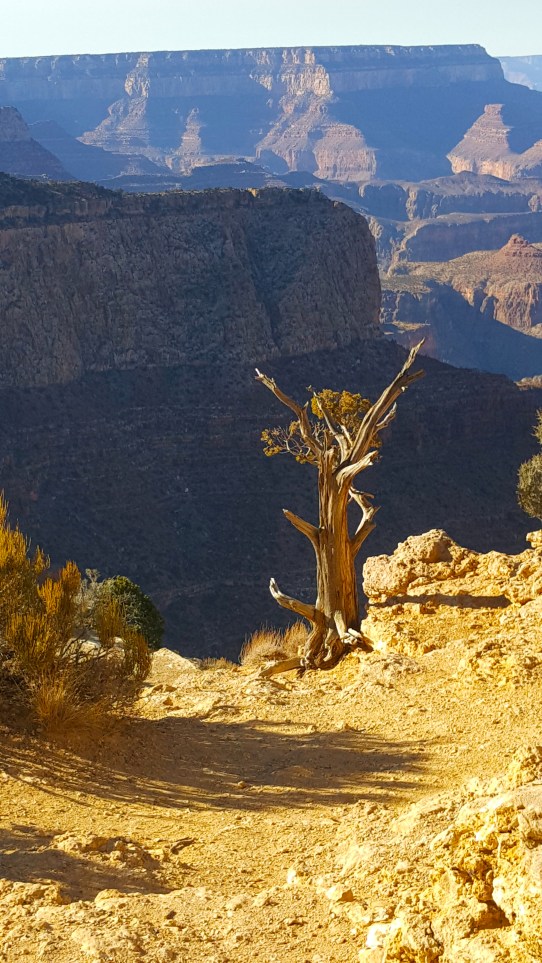
“Wherever you have friends, that’s your country, and wherever you receive love, that’s your home.” A Tibetan saying.
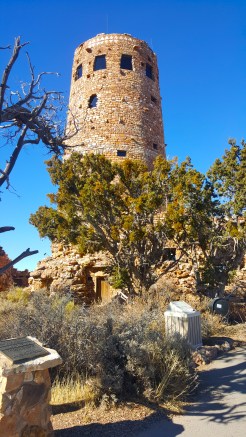
The Observation Tower on the South Rim of the Grand Canyon.
“Pain is inevitable; suffering is optional.” Dali Lama.
“Whoever gives you love, that’s your parent.” Dali Lama
“The brave man is not he who does not feel afraid, but he who conquers that fear.” Nelson Mandela
These quotes, which are worthy of pairing with Grand Canyon scenery, came from “The Book of Joy.”

The Grand Canyon in Arizona.

Linda (left) and I on Airport Mesa, before we knew it was a vortex area.
You know how, when you go on trips, you sometimes end up with a running joke in your conversations? The joke can be related to an event, a person you met, or a hapless comment made along the way. Well, for Linda’s and my Sedona trip, our running joke was The Vortex.
Because Linda and I are from Minnesota, we were mainly familiar with Polar Vortexes. You know, that’s when all the cold air comes down from the arctic and tries to freeze everything in its path. Although we had heard of Sedona’s reputation as a vortex center before we began our trip, we didn’t know any specifics.
Personally, I just thought the whole place was the site of mysterious energies. Little did I know that there are specific locations and different types of energies to be had.
Let me back up and define the word vortex (plural = vortices or vortexes). Merriam Webster says that a vortex is something that resembles a whirlpool. I assume all of you, dear readers, have watched water swirl down a drain. That’s a whirlpool — except that in Sedona, the swirling involves invisible energy more than it does water or freezing arctic air.
Our Vortextual Education
Our resort offered various programs for its patrons. Among the classes, which had titles like “Crafting a Festive Wine Glass for Christmas,” was one about vortexes. We decided we had to attend to learn more about this phenomenon. The presentation was given by a local Reiki healer.
She described the concept of vortexes and said the energies involved come from the rocks because of their mineral composition. She passed out a sheet that listed eight locations that are thought to be vortices and it described their different kinds of energies.
Some of the energies come out of the rocks (upflow), some flow into the rock (inflow), some are combinations of upflow and inflow, and some are horizontal (lateral). The lateral flow places involve the energy from nearby rivers and streams.
The sheet she gave us was an excerpt from a book entitled, “Scientific Vortex Information,” which was written by an author who claims to have been educated at the Massachusetts Institute of Technology.
I don’t know. The title seemed like an oxymoron. “Science” and “Vortex” don’t really go together in my world, where I move among scientists every day. I suspected there wasn’t that much science behind the information — more like wishful, imaginative thinking.
Once I got back home, I looked inside the first few pages of the book on Amazon, hoping to see proof that scientific instruments were used to actually measure electromagnetic fields at these locations, but all I saw were explanations of inflow and outflow, with nary any hard proof in sight.
But that’s okay. We weren’t in Sedona for the science. We were there for the experience. We were there for . . . The Vortex!
Our Vortextual Experiences

Oak Creek Canyon.
While looking at the list of locations, Linda and I discovered we had already visited a vortex the previous day. The site was Airport Mesa, which is easy to access because it’s right in town.
While we were enjoying the view there, we had noticed a couple of people sitting on the rocks in a lotus position. We didn’t think much of it – maybe they were just doing it because the scenic view inspired meditation. But after reading the list, we knew better. Those lotus people were trying to feel The Vortex.
We decided we needed to try that. Our journey the next day involved a trip north to Flagstaff, so we made plans to stop at the Oak Creek Canyon Overlook, which is on the way. The overlook scenic vista is located at the top of the switchbacked road at the end of the canyon about 15 miles from Sedona. A short walk on a paved path leads to an impressive overlook.
I sat on a bench near the overlook and Linda stood near the wall. Neither of us were hard core enough at this point to get into a lotus position (which is sort of hard on a bench, after all). So we just closed our eyes and tried to feel the feels.
I felt my own internal vortex more than any external one. My heartbeat rocked my body and made it sway a little. The Arizona sun felt good on my face and the breeze whispered its secrets.
After having our moments, we conferred. Linda said she didn’t really feel anything. We walked back to our car, but along the way, we stopped to look at some Navaho jewelry being sold at stand along the walkway. I was drawn like a magnet to one ring that featured a bright blue opal. I picked it up and it fit perfectly. I had to buy it.
We joked later that The Vortex made me do it. Who knows, maybe it did? It was like the ring was calling to me.

Cathedral Rock
A few days later, after a day of hiking, we visited Cathedral Rock, which is thought to be home to an upflow/inflow combination vortex. We hiked up to the flat rock plateau below the formation.
Someone had scratched two spirals into the rock about ten feet away from each other. Linda and I thought they looked like logical places to sit for people like us who were trying to find a vortex, so we sat with legs crossed and eyes closed.
The day had been breezy, but not particularly so. A few moments after we got into position, big gusts of wind started buffeting us. They were so powerful that Linda’s hat flew off.
We opened our eyes and quickly stood, spooked. The wind stopped.
We headed down the rock toward our car. We didn’t joke as much about vortexes after that.
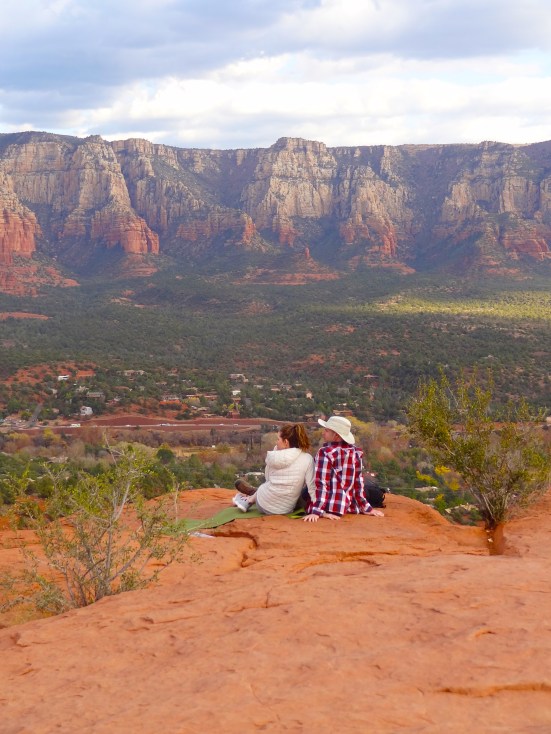
Young lovers on Airport Mesa, Sedona.
These words from the Navaho prayer, The Beauty Way, kept going through my head during a hike among the red rocks in Sedona. It’s hard to get exercise when all you’re doing is gawking all around you. But perhaps that offers exercise of a different sort….
I walk with beauty before me. I walk with beauty behind me.
I walk with beauty below me. I walk with beauty above me.
I walk with beauty around me. My words will be beautiful.

Bell Rock as seen from the Bell Rock Pathway.
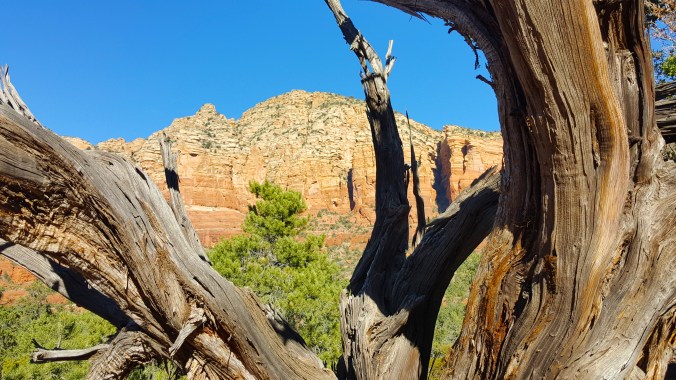


Red rock, white trees, Red Rock State Park.

May you walk in beauty…

Jerome, Arizona.
While I was standing in line to rent a car at the Phoenix Airport, the man in front of me asked where my friend and I were staying. He was from Philadelphia and vacationed in Arizona frequently. When I told him Sedona, he said that we had to go visit the nearby town of Jerome. “It’s an old mining town with shops run by a bunch of hippies,” he said.
That’s all it took to convince me that we needed to go there. I’ve found that some pre-planning is fine for vacations, but that the best advice often comes from people you meet along the way. This trip was no exception.
The day we journeyed to Jerome dawned bright and mild, like so many other mornings during our Arizona stay. Linda and I hopped in our rented Nissan Versa, which dutifully took us up and down the northern Arizona mountains (even though the rental agency clerk tried to talk us into getting a larger car to handle the elevation changes).
 A large “J” on a mountaintop was the first thing we noticed about Jerome. Then came the hairpin turns as we wound our way up to the town, which is situated precariously on the mountainside that used to yield its copper to miners. We parked in an area close to stores and hopped out to explore.
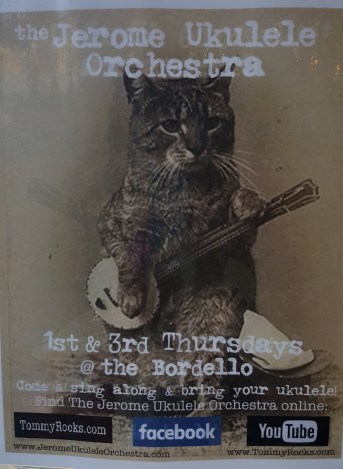
We purchased some goodies from the Connor Hotel gift shop, marveled at a poster that proclaimed the existence of a Jerome Ukulele Orchestra, and partook of a wine tasting at the Dragoon Mountain/Cellar 433 Winery outlet, which is simply called “Winery” on the outside. We had also visited their tasting room in Sedona, and were interested to see what different varieties of Arizona wine they offered here.
We sampled a flight of whites served by Barry, who wore a bandanna around his head and whose ears sported many heavy earrings. Our favorite was called “Sun.” Like the name implies, it was honey-colored with the warm flavor of roasted nuts. Hints of honeydew melon, white peaches and ginger topped it off. Unlike the Sedona winery, no guitarist serenaded our tasting. But like the Sedona winery, the view was fantastic, plus local artwork graced the walls.

The view from the winery. The impressive building on the left used to be a hotel, but is now a private home.
Lest we walk around the perilous Jerome pathways in a stupor, we decided to cross the street to the English Kitchen Restaurant to eat lunch to cut the alcohol. That turned out to be an excellent and otherworldly choice.
 We sat in an inviting booth and learned about the history of the place from the back of the menu while the smell of hickory barbecue drifted in from the restaurant’s smoker out back. The English Ktichen, also known as Bobby D’s BBQ is the oldest restaurant in northern Arizona. It was built in 1899 by Charley Hong after his original restaurant in the Connor Hotel (where we had just been buying gifts) burned down when the hotel burned. Oh, and by the way, there used to be an opium den in the basement of the English Kitchen.

The counter in the English Kitchen/Bobby D’s BBQ.
Charley died in booth #3 of the restaurant, where he frequently slept. Apparently, he is still hanging around, his presence manifested by flying salt shakers and misplaced items. The restaurant turned into the BBQ joint it is today in 2011.
When our waitress came to take our order, I asked her where booth #3 was. She pointed to the booth where we sat. “Do you want to know what side he died on?” she said, with the ghost of a smile. I could guess, but asked anyway. She pointed to the side where I sat.
 Ewwwww!
But that did not make me lose my appetite. I ordered the BBQ bacon cheeseburger with fries. Oh man, oh man, oh man. That was good! It came with four different barbecue sauce choices. My tastebuds grew up in Minnesota, so that means I chose the non-spicy sweet one. Sorry, I can’t recall the name, but the sauce complemented the meat perfectly.
After lunch, we waddled around town for another hour or so. We found a shop that specialized in kaleidoscopes. Don’t see that every day.
We could have easily spent several days looking through all the shops, but the Sedona hiking trails were calling us, and we had to answer. And besides, we needed to walk off all the barbecue.
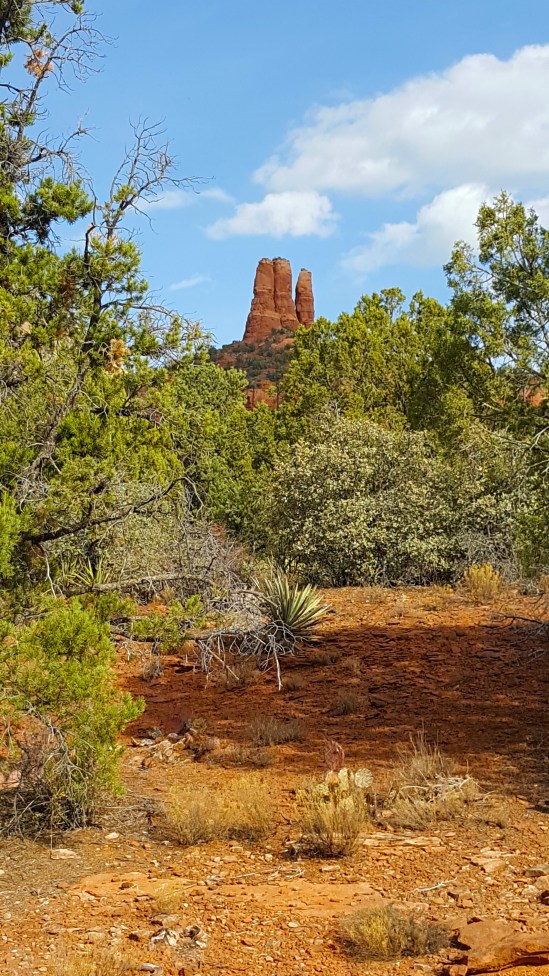
Chimney Rock, Sedona, AZ.
I meandered down to Arizona last week with a friend. Our goals were to commune with the sun and the rocks, and to meet a member of our writers group who had moved to Flagstaff. Our home base for the week was Sedona. I’d driven through the town two or three times over the years — each time sparking a desire to stay longer. I was glad to finally have my chance.
Our first outing was meant to be an easy hike. My friend Linda and I had never traveled together before and she is ten years my senior, so a hike of just a couple miles with little elevation change would be a good test run. We chose a trail around Chimney Rock, which is basically right in town, and doesn’t require any special permits, at least not from the trailhead where we parked.
The morning sun soaked some much-needed Vitamin D into our pasty white Minnesota faces, which felt divine. The air at this elevation (4,300 feet) was cool, but much warmer than the snowy atmosphere back home.
The first part of the hike around Chimney Rock went as planned. The walking was easy and scenic. With lots of energy left, we chose a side trip around Little Sugarloaf Mountain, a formation as squat and square as Chimney Rock is vertical and finger-y.
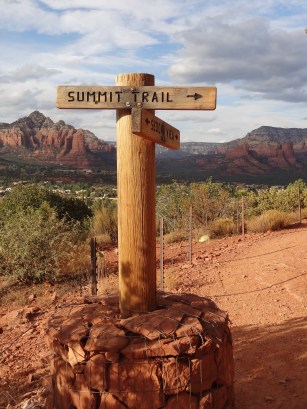 Then we came to the sign marked “Summit.” I asked Linda if she wanted to try it. She made the mistake of shrugging and saying, “Sure.”
By way of explanation, I must say that neither of us did any research on the trail beforehand, other than looking at the general guide we had, which listed distances and elevation changes. So we embarked on the summit trail in oblivious innocence.
I figured that since it was an official trail, it must be safe and relatively easy. I was about to get an education. The path quickly became a vertical scramble up loose rocks and dirt — no railings to grab onto, no cautionary signs.
Our lungs worked hard in the thin air and we stopped several times to rest, but also to enjoy the view that was unfolding below. As we neared the summit, the trail got worse. At one point we stopped and debated turning around. Then another hiker approached us, coming down from the summit, and he told us the 360-degree view was worth the climb.
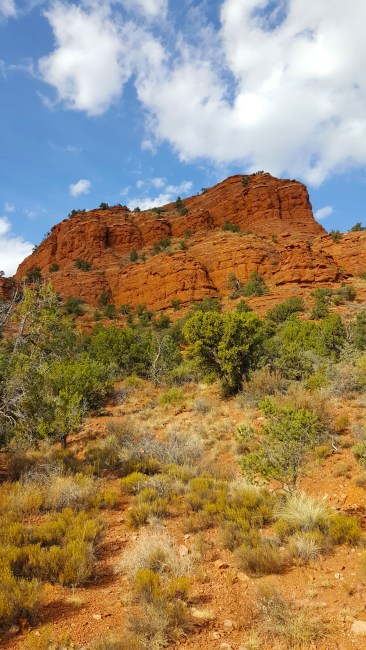
Little Sugarloaf Mountain. We climbed this sucker!
Linda and I looked at each other and decided to slog our way up the remaining twenty-five feet or so. The man was right — with the city spread below us and the red rock mountains in the distance, the view was amazing!
While we rested, we realized we would have to hike down the slippery rocks and loose gravel we came up. Linda was not wearing her best shoes because we hadn’t intended such a challenging climb. I told her we’d be okay as long as we went slowly and carefully. Her gaze was skeptical.
Nevertheless, after having our fill of the view, we headed down. It wasn’t as bad as we had feared. We just picked our way cautiously through the rocks, sometimes sliding on our butts, sometimes holding onto rocks or twisty juniper trees. On the way down, I noticed part of my tennis shoe sole had torn loose and lay mingled with the dust on the trail.
Once we reached the bottom, we congratulated each other for surviving. I asked Linda if I had any red sand on my butt that needed brushing off, sticking out my derriere for good measure. She spanked it much harder than required to remove a bit of sand.
I probably deserved that.
But I knew right then that I had a spunky travelling partner and that this was going to be a good trip.
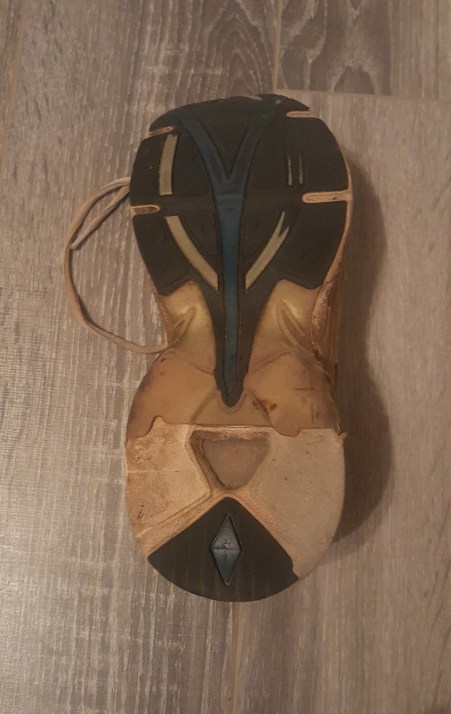
What my shoe looked like after the hike. (It’s missing a few pieces in the heel.)
 Marie's Meanderings